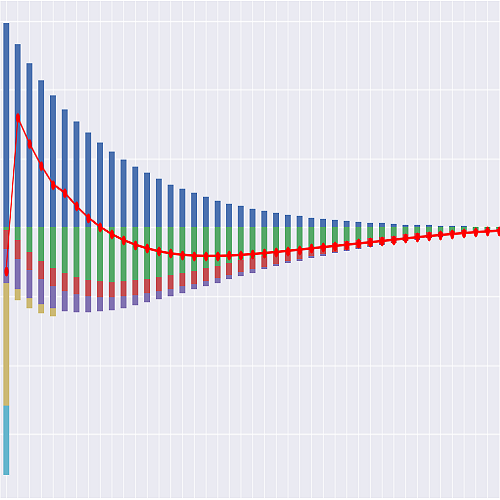
The Projection Space#
The by-contract projection of VA_US_S.
The Space is parameterized by point_id, so Projection[1] is an ItemSpace
projecting model point 1:
>>> Projection[1].result_cf()          # the anchor cell
>>> Projection.point_id = 2            # or switch the default
Input data
Inputs are external files: plain CSVs living in the model folder’s parent directory,
products/variable_annuity/, read at run time rather than stored inside the model.
The model folder therefore holds nothing but formulas — no _data/, no IOSpec, no
embedded values — so a diff of the model shows logic changes only, and an input can be
edited or swapped without rewriting the model. This follows annuallife.TradLife_A;
contrast basiclife.BasicTerm_S, which keeps its inputs inside the model through
modelx’s IOSpec machinery.
The consequence worth knowing: the model is not portable on its own. Copying the
VA_US_S folder without its parent’s CSVs produces a model that reads and
then fails on first evaluation.
The readers and the filename References live on the sibling
Data Space, reached here through the data Reference, so
each file is read once per model rather than once per model point:
Reference (on Data) |
Cells |
File |
|---|---|---|
model_point_file |
data.model_point_table() |
model_point_table.csv |
mort_table_file |
data.mort_table() |
mort_table.csv |
fund_file |
data.fund_table() |
fund_table.csv |
return_scenario_file |
data.return_scenario() |
return_scenario.csv |
rate_scenario_file |
data.rate_scenario() |
rate_scenario.csv |
gawa_pct_file |
data.gawa_pct_table() |
gawa_pct_table.csv |
cdsc_file |
data.cdsc_table() |
cdsc_table.csv |
transaction_file |
data.transaction_table() |
transaction_table.csv |
Projection basis
t counts projection months and is 0-based: t = 0 is the first projected
month, the frame is t = 0, 1, ..., proj_len() − 1, and len(result_cf()) is
proj_len(). The purchase payment falls at the beginning of month t = 0 — there is
no separate entry-instant row — and the state carried into the frame is the *_init()
family, which every recursion reads as the opening balance of t = 0.
The policy month is duration_mth(t) = duration_mth_init() + t, the number of policy
months already elapsed at the start of month t: 0 in an at-issue cell’s first
month, and duration_mth_init() in an in-force cell’s — the worked example’s carried
state is one, entered with 26 elapsed months. The ordinal policy month — the notes’
“the 27th policy month” — is duration_mth(t) + 1. Every calendar test (Contract
Anniversary, Contract Quarterly Anniversary, contract year, attained age) is written on
duration_mth(t), never on t.
policy_year(t) = duration_mth(t) // 12 + 1 is the contract year y, a 1-based
contractual label, and contract_quarter(t) = duration_mth(t) // 3 + 1 the contract
quarter k. Contract Anniversaries fall at the end of the months where
duration_mth + 1 ≡ 0 (mod 12) and Contract Quarterly Anniversaries at the end of
those where duration_mth + 1 ≡ 0 (mod 3) [std]; on an at-issue cell that is
t = 11, 23, 35, … and t = 2, 5, 8, …. The attained age is a(t) = x + y − 1,
equivalently x + duration(t) with duration(t) = duration_mth(t) // 12.
Within a month the technical notes’ processing order is followed exactly. At the
beginning of the month (BOM): if the contract is already depleted, run the
post-depletion routine and skip everything else; otherwise take the premium, which buys
units at the prior unit value per alloc[i] and raises GWB, BB, NP,
RP, RB, GAWA and ADJ; then take the withdrawal, which fixes the GAWA% if
it is the first one, splits into excess and non-excess portions, computes the withdrawal
charge, cancels units pro rata and updates GWB, GAWA and BB. Then unit values
grow over the month. At the end of the month (EOM): the two rider fees are assessed at a
Contract Quarterly Anniversary and the annual contract fee at a Contract Anniversary,
both by pro-rata unit cancellation; then, at a Contract Anniversary only, the seven
guarantee events in the notes’ order — GMDB withdrawal adjustment, GMDB roll-up, GLWB
bonus, step-up, GWB Adjustment Date test, the non-For-Life GAWA = GWB floor, and the
$10,000,000 cap; then the depletion test; then decrements, death first, then
surrender [std].
Undiscounted. Like every model in this library, this one projects gross liability cash flows only. Reserves and discounting are a separate layer: the notes’ Valuation and reserve pointers section cites VM-21’s CTE70 stochastic reserve, C-3 Phase II’s CTE(98), VM-22/VM-V §1 for the post-depletion stream and IRC §807, rather than reproducing any of them.
Naming
Cells names follow lifelib’s basiclife.BasicTerm_S and savings.CashValue_SE
wherever those models have an analogue, and MYGA_US_S — the deferred
annuity chassis of this library — wherever the two products share a concept:
pols_* for policy counts, av_* for account values, plural nouns for cash flows,
*_rate for rates, *_pp for per-contract amounts, *_at(t, timing) for a
quantity read at a point inside the month. The technical notes use compact actuarial
symbols instead. The mapping is:
Notes symbol |
Cells |
Meaning |
|---|---|---|
t (0-based) |
duration_mth(t) |
Elapsed policy months at the start of t |
(months elapsed at entry) |
duration_mth_init() |
0 at issue; the in-force cell’s own |
y = t//12 + 1 |
policy_year(t) |
Contract year containing month t (1-based) |
y - 1 |
duration(t) |
Completed contract years |
k = t//3 + 1 |
contract_quarter(t) |
Contract quarter containing month t (1-based) |
x, issue_age |
age_at_entry |
Issue age (ANB) |
a(t) = x + y - 1 |
age(t) |
Attained age during month t |
(a at the anniversary) |
age_at_anniv(t) |
Attained age just after the anniversary |
(none) |
policy_term |
Years from issue to omega_age |
(none) |
proj_len |
Months projected; last index proj_len - 1 |
av_initial |
av_pp_init() |
AV carried in, the opening balance at t = 0 |
gwb_initial |
gwb_pp_init() |
GWB carried in, opening balance at t = 0 |
bb_initial |
bb_pp_init() |
Bonus Base carried in, opening at t = 0 |
rb_initial |
rb_pp_init() |
GMDB Benefit Base carried in, at t = 0 |
(none) |
gawa_pp_init() |
GAWA carried in, opening at t = 0 |
(none) |
gawa_pct_init() |
GAWA% already locked before the frame |
(none) |
np_pp_init() |
Cumulative Net Premiums carried in |
(none) |
rp_pp_init() |
Remaining Premium carried in |
(none) |
adj_pp_init() |
GWB Adjustment carried in |
(none) |
bonus_end_init() |
Contract year the Bonus Period ends, carried in |
glwb_stepup_basis |
stepup_basis() |
annual_CV or highest_quarterly_CV |
i |
sub_ids |
Subaccount indices |
alloc[i] |
alloc(i) |
Allocation of net premium to subaccount i |
e_i |
fund_expense_rate(i) |
Annual fund expense ratio |
r_i(t) |
inv_return_mth(t, i) |
Gross monthly fund return (scenario input) |
m, alpha |
asset_charge_me, asset_charge_admin |
M&E and administrative asset charge |
(the growth factor) |
unit_growth(t, i) |
(1+r_i)(1-e_i/12)(1-(m+a)/12) |
V_i(t) |
(inside unit_growth) |
Unit value; see the note below |
U_i(t) |
(implicit) |
Units; see the note below |
SA_i(t) |
sa_pp(t, i) |
Subaccount value at end of month t |
SA_i at a point in the month sa_pp_at(t, i, timing) |
BEF_PREM / BEF_WD / BEF_INV / BEF_FEE / EOM |
|
AV(t) |
av_pp(t) |
Contract value at end of month t |
AV at a point in the month |
av_pp_at(t, timing) |
Same timings, summed over subaccounts |
l x AV(t) |
av_at(t, timing) |
In-force weighted contract value |
w_i(t) |
sa_weight(t, i) |
Value weight, the pro-rata deduction key |
(gross fund return) |
gross_inv_income_pp(t) |
Return before any charge |
(fund’s own expense) |
fund_expense_pp(t) |
Paid to the funds, not insurer revenue |
(M&E + admin) |
asset_charge_pp(t) |
Collected inside the unit value |
(net of both) |
inv_income_pp(t) |
Change in AV from investment over month t |
P(t) |
premium_pp(t) |
Gross premium at BOM of month t |
P(t)(1 - tau) |
prem_to_av_pp(t) |
Net premium buying units |
tau |
premium_tax_rate |
Premium tax rate |
W(t) |
wd_pp(t) |
Gross withdrawal, inclusive of charges |
(W before the AV cap) |
wd_pp_due(t) |
Withdrawal requested before capping at AV |
(scheduled part of W) |
wd_scheduled_pp(t) |
Withdrawal from transaction_table.csv |
(utilization part of W) |
wd_glwb_pp(t) |
wd_intensity x L(t) once activated |
L(t) |
wd_limit_pp(t) |
Annual withdrawal limit max(GAWA, RMD) |
SumW_y |
sum_wd_pp(t) |
Withdrawals to date in the contract year |
E(t) |
wd_excess_pp(t) |
Excess portion of W(t) |
N(t) |
wd_nonexcess_pp(t) |
Non-excess portion of W(t) |
CV_pre |
cv_pre_excess_pp(t) |
AV after N has been deducted |
(1 - E/CV_pre) |
excess_factor(t) |
The pro-rata factor for the excess |
(charge-free amount) |
free_wd_allow(t) |
max(earnings, 10% of RP) |
(unused allowance) |
free_wd_avail(t) |
Allowance left in the contract year |
(allowance consumed) |
wd_free_pp(t) |
Allowance used by month t’s withdrawal |
(allowance used to date) |
free_wd_used_cum_pp(t) |
Allowance used in the contract year so far |
(exempt part of W) |
wd_exempt_pp(t) |
Portion of W bearing no charge |
(chargeable part of W) |
wd_chargeable_pp(t) |
Portion of W bearing the CDSC |
c(t) |
wd_charge_pp(t) |
CDSC on the withdrawal |
W(t) - c(t) |
wd_payment_pp(t) |
Cash paid on the withdrawal |
CDSC scale |
surr_charge_rate(t) |
CDSC % by completed years since receipt |
(surrender chargeable base) |
surr_chargeable_pp(t) |
Remaining Premium withdrawn on surrender |
(CDSC on surrender) |
surr_charge_pp(t) |
Charge on a full surrender |
AV(t) - CDSC |
surr_benefit_pp(t) |
Surrender proceeds |
RP(t) |
rp_pp(t) |
Remaining Premium, the CDSC basis |
(premium portion withdrawn) |
rp_reduction_pp(t) |
Reduction of RP by a withdrawal |
NP(t) |
np_pp(t) |
Cumulative Net Premiums |
GWB(t) |
gwb_pp(t) |
Guaranteed Withdrawal Balance |
GWB at a point in the month |
gwb_pp_at(t, timing) |
BEF_PREM / BEF_WD / BEF_ANNIV |
(GWB after the bonus) |
gwb_pp_aft_bonus(t) |
Anniversary sub-step 3 |
(GWB after the step-up) |
gwb_pp_aft_stepup(t) |
Anniversary sub-step 4 |
b x BB |
bonus_pp(t) |
GLWB bonus credited at the anniversary |
BB(t) |
bb_pp(t) |
Bonus Base |
BB before the anniversary |
bb_pp_bef_anniv(t) |
Bonus Base the bonus is computed on |
bonus_end(t) |
bonus_end(t) |
Contract year the Bonus Period ends |
(the step-up basis) |
stepup_base_pp(t) |
Annual CV or highest quarterly CV |
(step-up occurred) |
is_stepup(t) |
True at a step-up anniversary |
GAWA(t) |
gawa_pp(t) |
Guaranteed Annual Withdrawal Amount |
GAWA in the month |
gawa_pp_at(t, timing) |
BEF_PREM / BEF_WD / BEF_ANNIV |
g(a) |
gawa_pct_at_age(a) |
GAWA% at attained age a |
gawa_pct_fixed |
gawa_pct_fixed(t) |
GAWA% locked at the first withdrawal |
ADJ(t) |
adj_pp(t) |
GWB Adjustment amount |
s |
gwb_adj_pct |
GWB Adjustment percentage, 105% |
(the Adjustment Date) |
is_gwb_adj_date(t) |
Later of anniv on/after 70 and the 12th |
RB(t) |
rb_pp(t) |
GMDB Benefit Base |
RB in the month |
rb_pp_at(t, timing) |
BEF_PREM / BEF_WD / BEF_ANNIV |
rho |
rollup_rate(t) |
GMDB roll-up percentage in force |
(the year’s d-f-d allowance) gmdb_allow_pp(t) |
rho x RB at the prior anniversary |
|
(d-f-d part of a withdrawal) gmdb_wd_dfd_pp(t) |
Dollar-for-dollar portion |
|
(excess part) |
gmdb_wd_excess_pp(t) |
Portion above the allowance |
(accrued d-f-d) |
gmdb_dfd_acc_pp(t) |
Accrued to the end of the contract year |
(accrued pro-rata factor) |
gmdb_factor_acc(t) |
Accrued to the end of the contract year |
DB(t) |
db_pp(t) |
Gross death benefit max(AV, NP, RB) |
max(NP, RB) |
gmdb_guarantee_pp(t) |
The floor under DB; |
GuaranteeClaim |
gmdb_claim_pp(t) |
Net general-account strain on death |
phi_G |
phi_glwb(t) |
GLWB charge rate in force |
phi_D |
phi_gmdb(t) |
GMDB charge rate in force |
Fee_G |
fee_glwb_pp(t) |
Quarterly GLWB fee, on the GWB |
Fee_D |
fee_gmdb_pp(t) |
Quarterly GMDB fee, on the RB |
f_c |
maint_fee_pp(t) |
Annual contract fee, $35 waived at $50k |
(total unit cancellation) |
charge_pp(t) |
Fee_G + Fee_D + f_c actually collected |
(fee reset formula) |
fee_rate_vix_raw(phi0, vix2) |
The VIX-squared fee formula [S4][S6] |
(fee reset clipping) |
fee_rate_vix_clip(prior, raw) |
Band and corridor clipping [S4] |
forlife_flag |
forlife_flag() |
For Life Guarantee in effect |
depleted_flag(t) |
depleted_flag(t) |
AV has reached zero with the GLWB alive |
(post-depletion payment) |
glwb_payment_pp(t) |
Insurer-funded GAWA payment |
phase(t) |
phase(t) |
ACCUM / DEPLETED / EXPIRED |
M_G(t) |
moneyness_glwb(t) |
GWB / AV |
M_D(t) |
moneyness_gmdb(t) |
max(NP, RB) / AV |
lambda(M) |
lapse_itm_mult(m) |
The VM-21 7.B.1 multiplier |
lambda*(t) |
lapse_dyn_mult(t) |
min of the two, per VM-21 6.C.6 |
kappa(t) |
lapse_wd_factor(t) |
0.60 in a withdrawal year |
q^w_base(y) |
lapse_rate_base(t) |
VM-21 Table 6.3 under-50%-ITM column |
q^w_annual(t) |
lapse_rate(t) |
Annual total surrender rate |
q^w(t) |
lapse_rate_mth(t) |
Monthly total surrender rate |
q^d(t) |
mort_rate_mth(t) |
Monthly mortality rate |
(annual q_x) |
mort_rate(t) |
Annual mortality at the attained age |
l(t-1) |
pols_if(t) |
In-force at the START of month t |
l(t) |
pols_if_at(t, “AFT_DECR”) |
In-force at the end of month t |
l(-1) |
pols_if_init |
In-force at entry |
l(t-1), … |
pols_if_at(t, timing) |
BEF_DECR / BEF_LAPSE / AFT_DECR |
l(t-1) q^d |
pols_death(t) |
Deaths |
l(t-1)(1-q^d) q^w |
pols_lapse(t) |
Full surrenders |
(none) |
pols_maturity(t) |
Survivors at the projection horizon |
Premium income |
premiums(t) |
Premium cash flow |
Charge income - M&E/admin |
asset_charges(t) |
Asset charge cash flow |
Charge income - rider fees |
fees_glwb(t), fees_gmdb(t) |
Rider fee cash flow |
Charge income - contract fee maint_fees(t) |
Contract fee cash flow |
|
Charge income - CDSC |
wd_charges(t) |
CDSC on withdrawals (memo; see below) |
Withdrawal proceeds |
withdrawals(t) |
W(t) - c(t), weighted |
Post-depletion GLWB payments glwb_payments(t) |
GAWA paid after depletion |
|
Death benefit (gross) |
claims(t, “DEATH”) |
DB(t) x deaths |
Death benefit (net strain) |
gmdb_claims(t) |
GuaranteeClaim x deaths (memo) |
Surrender proceeds |
claims(t, “LAPSE”) |
surr_benefit_pp(t) x surrenders |
(horizon benefit) |
claims(t, “MATURITY”) |
Survivors at proj_len() - 1 |
Maintenance expense |
expenses(t) |
VM-21 6.C.2 prescribed expense |
(acquisition) |
commissions(t) |
0 in the base run [std] |
(none) |
net_cf(t) |
The notes’ ledger, summed |
(none) |
net_cf_ga(t) |
General-account view (memo) |
Model point attributes the notes and the model name identically — sex,
designated_lives, tax_status, premium_single, premium_tax_rate,
glwb_option, gmdb_option, cdsc_schedule and the rate_sheet_date
Reference — are not repeated in the table above; issue_date is not carried at all,
the model working in policy months throughout.
Nine names needed care.
pols_if(t) is the count in force at the start of month t — the notes’
l(t-1) — and is the weight applied to that same row’s cash flows, so
premiums(t) / premium_pp(t) is exactly pols_if(t) and the printed in-force column
reconciles with the row it sits on. That is the library-wide convention, set by
Term_US_S and by savings.CashValue_SE. The notes’ own end-of-month l(t)
has not gone anywhere: it is pols_if_at() (t, "AFT_DECR"), and the roll-forward
is written across it.
lapse_rate(t) is the annual total surrender rate and lapse_rate_mth() the
monthly one, matching the mort_rate / mort_rate_mth pair. Both spellings of the
notes’ q^w are present and the suffix is the only thing that tells them apart, so
read the suffix.
wd_free_pp(t) is the portion of a withdrawal covered by the free-withdrawal
allowance, which is what the same name means on the deferred annuity chassis
(MYGA_US_S, min(W, FW)). On this product a second exemption
stacks on top of it — no CDSC applies to cumulative withdrawals within L [S1] — and
the union of the two is wd_exempt_pp(), the portion of W(t) bearing no charge
at all. The two differ by exactly wd_nonexcess_pp(), and it is
wd_exempt_pp(), not wd_free_pp(), that complements
wd_chargeable_pp(). The year-to-date cumulative is
free_wd_used_cum_pp(), named for what it is rather than sharing the wd_* stem.
E(t) is the guarantee excess here — the portion of a withdrawal above the GLWB
annual limit — and wd_excess_pp() carries that meaning. In
MYGA_US_S the same cells name means the portion of a withdrawal above
the free allowance, i.e. the charge base. On this product those are two different
quantities and both exist: the charge base is wd_chargeable_pp(). Reading
wd_excess_pp across the two models without checking is the single easiest mistake to
make in this library.
E(t) in Term_US_S is expenses, which here is expenses() as usual. M
is the in-the-moneyness ratio here and the market value adjustment in
MYGA_US_S; a VA separate account has no MVA at all, so there is no
collision in the model, only in the reader’s memory. c(t) is the CDSC here and the
Model #805 contract charge in MYGA_US_S; it becomes
wd_charge_pp(). g is the GAWA% here and the monthly nonforfeiture factor there;
it becomes gawa_pct_at_age(). And b is the GLWB bonus percentage here and the
MVA distribution yield there.
Two cells the chassis has that this model deliberately does not: mgsv_pp and
surr_value_pp. NAIC Model #805 expressly excludes variable annuities and reaches a VA
only through its fixed account under Model #250 §7.B [REG-R42][REG-R43], and this
contract has no fixed account because electing the Roll-up GMDB removes the Fixed Account
Options [S1]. There is therefore no minimum guaranteed surrender value and no pre-floor
surrender value to distinguish: surr_benefit_pp() is simply AV(t) less the
CDSC. Carrying the chassis’ floor across would be the error the chassis file itself warns
against.
The unit ledger
The notes write the account value as AV = Σ_i U_i V_i and require charges assessed
per unit of value (fund expense, M&E, administrative asset charge) to live inside
V_i, while charges assessed per contract or on a benefit base (the annual contract
fee, the two rider fees) are collected by cancelling units, leaving V_i
untouched: ΔU_i = C · w_i(t) / V_i(t), so ΔAV = C.
State carried into the frame
Every state variable in this model is a closing balance of month t: av_pp(t),
sa_pp(t, i), gwb_pp(t), bb_pp(t), rb_pp(t), gawa_pp(t), np_pp(t),
rp_pp(t) and adj_pp(t) are all values at the end of month t. Their
opening value is therefore S(t - 1), and in the first projected month it is the
carried-in S_init() instead — read in the opening timing, S_init() if t == 0 else
S(t - 1), as CashValue_SE and MYGA_US_S write it. That single convention
replaces the old entry-instant row: the premium, the guarantee-base initialization and
the acquisition expense are all beginning-of-month flows of t = 0, and S_init()
is the balance they act on. No carried-in state is read at a negative index; the
only guards below t = 0 left in the module return zero or False for an
out-of-range argument.
The model carries the product SA_i = U_i V_i rather than the two factors, because
with no transfers between subaccounts the two are never needed apart, and every quantity
the notes print is a subaccount value. The distinction the ledger exists to enforce
survives intact: a per-unit charge multiplies sa_pp through unit_growth(),
while a unit cancellation multiplies it by (1 − C / AV) — which is exactly pro-rata
deduction, and which therefore leaves every w_i unchanged.
That property is necessary for the notes’ 60/40 anchor cell to still sit at exactly
60/40 twenty-six months later, but it is not sufficient, and it would be a bad
lesson to take away on its own: unequal growth moves the weights whatever the charges
do. What closes the gap is the illustrative base path, reverse-engineered so that
the two subaccounts grow at the same rate net of fund expense (see the provenance
column of return_scenario.csv) — with equal net growth and pro-rata cancellation the
weights cannot move at all. The worked-example month itself is the counter-example:
r_1 = +1.20% against r_2 = −0.30% takes w_1 from 0.600000 at the beginning of
that month to sa_weight() = 0.603519 by the time the fees are read at its end. On
the at-issue cell the month is t = 26 — the 27th policy month.
Timing arguments
Account and subaccount values, following CashValue_SE’s av_pp_at:
"BEF_PREM"AV(t-1), at the start of monthtbefore the premium — the opening balance, andav_pp_init()whentis the first projected month."BEF_WD"after the premium has bought units, before the withdrawal.
"BEF_INV"AV'(t), after the withdrawal, before unit value growth."BEF_FEE"after growth, before the rider fees and the contract fee. This is the point at which the notes read the pro-rata key
w_i."EOM"AV(t), after every charge. Equal toav_pp().
Guarantee bases (gwb_pp_at, gawa_pp_at, rb_pp_at) take "BEF_PREM",
"BEF_WD" and "BEF_ANNIV"; their end-of-month value, after the anniversary
guarantee events, is the plain cells (gwb_pp(), gawa_pp(), rb_pp()).
Policy counts, following CashValue_SE’s pols_if_at:
"BEF_DECR"l(t-1), in force at the start of montht. Equal topols_if()(t)."BEF_LAPSE"after deaths,
l(t-1)(1 - q^d(t))."AFT_DECR"after surrenders,
l(t)— the notes’ end-of-month count, and equal topols_if()(t + 1)except in the horizon month, where the survivors leave aspols_maturity()instead.
Benefit kind arguments are "DEATH", "LAPSE" and "MATURITY". Any other
value of any of these raises ValueError.
pols_maturity and the projection horizon
The technical notes state no projection horizon, and this contract does not supply one:
once the account value is exhausted the For Life Guarantee is a pure life-contingent
annuity at GAWA, which the notes rank sixth in their sensitivity list precisely because
the mortality basis then becomes the whole story. The model therefore runs to attained
age omega_age = 120 [std], the terminal age of the mortality table, and
pols_maturity(t) carries the survivors out at that month — zero everywhere else — so
that
pols_if(t) - pols_if(t+1) = pols_death(t) + pols_lapse(t) + pols_maturity(t)
holds for every t, including the last, where the block would otherwise appear to lose
lives with no cause. The identity is written on start-of-month counts because that is
what pols_if() carries; the horizon month is t = proj_len() − 1 and
pols_if(proj_len()) is zero, every survivor of that month having left as
pols_maturity(). The name follows
BasicTerm_S.pols_maturity and the construction follows Term_US_S and
MYGA_US_S. It is bookkeeping determined by the horizon, not an added
assumption.
The contract’s own Latest Income Date — the Contract Anniversary at owner age 95 [S2] — is not implemented as a forced annuitization; see the model docstring’s list of what is not implemented.
Cells Descriptions#
- designated_lives()[source]#
singleorjoint.Reported only: the joint-life election of the modeled GLWB is out of scope in the product spec, so the GAWA% grid and the For Life test are the single-life ones [std].
- tax_status()[source]#
NQorQ.Reported only. The base run is non-qualified [std], which keeps the RMD term of
L = max(GAWA, RMD)disclosed but inactive; no RMD module is implemented.
tau: premium tax deducted from the purchase payment, 0% [std], 0-3.5% [S2].
Set to zero so that GWB at issue equals gross premium and the worked example is checkable; premium tax is contractually deducted from the amounts that initialize the guarantee bases [S1].
The single purchase payment, paid at the beginning of the first projected month.
- sub_ids()[source]#
The subaccount indices of the model point’s allocation set, in file order.
Two subaccounts [std] — the minimum that exercises pro-rata charge allocation and unit accounting. Real contracts offer far more; one carrier’s build-your-own menu lists 76 options across 12 asset classes [S4].
- fund_expense_rate(i)[source]#
e_i: the annual fund expense ratio of subaccount i, paid to the fund [S2].
- stepup_basis()[source]#
annual_CVorhighest_quarterly_CV[S1][S3].annual_CVis the representative election: the step-up test uses the Contract Value at the anniversary.highest_quarterly_CVuses the highest contract value over the four most recent Contract Quarterly Anniversaries; the source also adjusts each of those for subsequent premiums and withdrawals under the same dollar-for-dollar / proportional rule, which is not implemented — see the model docstring.
- gmdb_option()[source]#
rollup,HQAVorbasic.rollupis the representative election:RB(t) = RB(t-1)(1 + rho)at each anniversary to the age cutoff, with a dollar-for-dollar withdrawal allowance applied at Contract Year end [S1][S3].HQAVis the annual ratchetmax(RB, AV)at each anniversary with proportional withdrawal treatment [S1][S4][S7].basicis the included no-charge proportional return of premium [S1][S2]; on that election the base is the return of premium, sonp_pp()is not floored under it as well — seegmdb_guarantee_pp(). The notes’ fourth form,combination, is not implemented — see the model docstring.
- cdsc_schedule()[source]#
The key into cdsc_table.csv naming this contract’s withdrawal charge scale.
- fee_reset_rule()[source]#
none,quinquennialorvix.noneis the base run [std]: the insurer does not increase the rider charge and the owner does not opt out.quinquennialapplies the maximum single increase of +0.25% at each fifth Contract Anniversary up to the guaranteed maximum [S1].vixapplies a second carrier’s non-discretionary VIX-squared formula [S4][S6].
- rollup_rule()[source]#
fixedorcmt_linked.fixedis the base run [std]: 6.00% at election ages up to 69 and 5.00% from 70 [S3].cmt_linkedis a third carrier’s formula rate, a 20-day average 10-year CMT plus 1.00% (1.50% before the first withdrawal), rounded to 0.10%, floored at 4% and capped at 8% [S7].
- wd_start_age()[source]#
The attained age at which GLWB withdrawals begin; 70 in the base run [std].
Zero means the contract never withdraws. The base-run value rests on the finding that activation clusters at the RMD age [REG-R64 [unverified]][REG-R57][REG-R58]. The prescribed alternative is VM-21’s Withdrawal Delay Cohort Method, which is not implemented.
- wd_intensity()[source]#
The fraction of the annual limit withdrawn once activated; 100% [std].
100% matches VM-21 §6.C.3’s Guarantee Actuarial Present Value construction [R1]. The prescribed partial-withdrawal assumption is 90% for lifetime GMWBs and 70% for non-lifetime ones [R1].
- duration_mth_init()[source]#
Policy months already elapsed when the projection opens; 0 for an at-issue cell.
An in-force cell enters mid-contract, so its first projected month
t = 0already hasduration_mth_init()policy months behind it. The worked example’s carried state is entered this way on model point 2, with 26 elapsed months, so thatt = 0there is the 27th policy month.
- av_pp_init()[source]#
AV carried into the frame; 0 at issue, the in-force cell’s contract value else.
An in-force contract value is split across subaccounts by
alloc[i][std]: the notes give anav_initialmodel point attribute but no subaccount split, and the worked example’s carried state is exactly at its 60/40 target allocation.
- has_wd_init()[source]#
Whether a withdrawal had already been taken before the projection opened.
Inferred from
gawa_pct_init, which is non-zero exactly when the GAWA% has been locked, so an in-force cell needs no separate flag column.
- bonus_end_init()[source]#
The contract year the Bonus Period ends, carried into the frame.
Zero on an at-issue cell, where it is set to
bonus_period_years= 10 [S1].
- proj_len()[source]#
The number of months projected, net of the months already elapsed at entry.
The frame is
t = 0, 1, ..., proj_len() - 1, soproj_len()is the exclusive end of the projection andlen(result_cf()) == proj_len().
- duration_mth(t)[source]#
Policy months already elapsed at the start of month t.
duration_mth_init() + t, 0-based liketitself:duration_mth(t) = 0is the first policy month of an at-issue cell. The ordinal policy month — the notes’ “the 27th policy month” — isduration_mth(t) + 1.
- age_at_anniv(t)[source]#
The attained age just after the Contract Anniversary at the end of month t.
x + y, one more thanage(), and the age the GMDB growth cutoff and the Bonus Period restart cutoff are stated against [S1].
- contract_quarter(t)[source]#
k(t): the contract quarter containing month t, 1-based: 1 in months 0 to 2.
- is_anniv(t)[source]#
True at the end of a Contract Anniversary month.
The anniversary falls at the end of month t, when
duration_mth(t) + 1elapsed policy months is a whole number of years.
- is_quarterly_anniv(t)[source]#
True at a Contract Quarterly Anniversary, at the end of month t [std].
- t_of_month(m)[source]#
The projection index t of the policy month with m months elapsed.
mis 0-based, likeduration_mth():t_of_month(0)is the first policy month. Negative before the model point entered.
- inv_return_mth(t, i)[source]#
r_i(t): the gross monthly fund return of subaccount i, a scenario input.
Read from return_scenario.csv as a step function of the elapsed policy month
duration_mth()(t), so a flat path is one row per subaccount. The file’stcolumn is that 0-based elapsed month, and its first row ist = 0. VM-21 requires each variable subaccount to be mapped to a crafted proxy fund, normally a linear combination of recognized market indices [R1]; the model takes the return series as an input rather than hard-coding one.
- scenario_rate(t, name)[source]#
Step-function lookup of column
namein the model point’s rate scenario.Each row of rate_scenario.csv states the level that holds from its own elapsed policy month — the file’s 0-based
tcolumn — until the next row of the same scenario, so a flat path is one row, keyedt = 0.
- vix_sq(k)[source]#
The quarterly average of daily VIX-squared for contract quarter k [S4][S6].
Read at the last month of the quarter, which is the month with
3k - 1elapsed policy months. Used only by thevixfee reset rule.
- cmt10(t)[source]#
The 20-day average 10-year Constant Maturity Treasury rate at month t [S7].
Used only by the
cmt_linkedroll-up rule.
- unit_growth(t, i)[source]#
The monthly unit value factor of subaccount i.
(1 + r_i(t)) x (1 - e_i/12) x (1 - (m + alpha)/12)— a monthly discretization of a daily accrual [std] [S2]. The fund’s own expense and the base contract asset charge live inside the unit value; charges assessed per contract or on a benefit base do not, and are collected by cancelling units instead. Do not additionally compound daily: pick one discretization and document it, because reconciling to an admin system requires knowing which was used.
- sa_pp_at(t, i, timing)[source]#
SA_i at month t read at the point given by
timing; see the Space docstring.A withdrawal and a unit cancellation both scale the subaccount by
(1 - amount / AV)— pro-rata deduction — so neither moves the value weights."BEF_PREM"is the opening balance of month t: the carried-inav_pp_init()split byalloc(i)in the first projected month, andsa_pp(t - 1, i)after it.
- av_pp_at(t, timing)[source]#
AV at month t read at the point given by
timing: the sum over subaccounts.
- sa_weight(t, i)[source]#
w_i(t): the value weight of subaccount i, the pro-rata deduction key [S2].
Read at
BEF_FEE, where the notes read it: after the month’s growth and before the charges that cancel units.
- fund_expense_pp(t)[source]#
The funds’ own expense collected inside the unit value.
Σ_i SA_i(1 + r_i) e_i/12. Not insurer revenue — it is paid to the underlying funds — so it never enterscharge_income()ornet_cf().
- asset_charge_pp(t)[source]#
The M&E and administrative asset charge collected inside the unit value.
Σ_i SA_i^{pre-charge}(t) (m + alpha)/12where the pre-charge value is net of the fund’s own expense, which is deducted first insideunit_growth(). This is insurer charge income.
- inv_income_pp(t)[source]#
The change in AV over month t from investment, net of both per-unit charges.
AV(BEF_FEE) - AV(BEF_INV), and identicallygross_inv_income_pp - fund_expense_pp - asset_charge_pp.
- prem_scheduled_pp(t)[source]#
The gross premium scheduled for month t in transaction_table.csv, else zero.
The file’s
tcolumn is the elapsed policy month, so the key isduration_mth()(t).
P(t): the gross premium paid at BOM of month t.
The model point’s single purchase payment falls at the beginning of the first projected month,
t = 0, together with anything scheduled for that month in transaction_table.csv. The chassis is flexible-premium [S1][S2] and premium receipt is retained as an active term in every guarantee-base recursion, so a subsequent payment is a data change rather than a formula change.
- prem_to_av_pp(t)[source]#
P(t)(1 - tau): the net premium that buys units and raises the guarantee bases.
The per-contract counterpart of
prem_to_av(), and the name every account-value model in this library uses for the premium credited to the account value. Not to be confused withWholeLife_US_S.premium_net_pp, which is a gross premium net of the dividend offset — a different concept entirely.
- wd_scheduled_pp(t)[source]#
The gross withdrawal scheduled for month t in transaction_table.csv, else zero.
Keyed on the elapsed policy month
duration_mth()(t), asprem_scheduled_pp()is.
- is_wd_month(t)[source]#
True when the GLWB utilization withdrawal falls in month t.
Base run [std]: the contract activates in the first month of the contract year in which the attained age reaches
wd_start_age(), and withdraws in the first month of every contract year thereafter.wd_start_age = 0never withdraws.
- is_wd_taken(t)[source]#
True when any withdrawal is taken in month t, before its amount is known.
Stated as a predicate rather than
wd_pp(t) > 0so that the first-withdrawal test can run before the GAWA% is fixed, which is what the amount itself depends on.
- has_wd_by(t)[source]#
True when a withdrawal has been taken at or before month t.
The value carried into month t is
has_wd_init()in the first projected month andhas_wd_by(t - 1)after it.
- is_first_wd(t)[source]#
True in the month of the contract’s first withdrawal.
The notes are explicit that this test must run before the annual limit
Lis formed: a first withdrawal tested againstGAWA = 0would score entirely as excess and wreck both benefit bases [S1].
- is_wd_year(t)[source]#
True when any withdrawal falls in the contract year containing month t.
Drives the VM-21 withdrawal-year surrender factor
kappa[R1] and the rule that any withdrawal in a Contract Year kills that year’s bonus [S1].
- wd_limit_pp(t)[source]#
L(t) = max(GAWA, RMD): the annual withdrawal limit governing month t [S1].
At the first withdrawal the GAWA is fixed on the pre-withdrawal GWB, so the limit is formed from that. The RMD term is disclosed but inactive: the base run is non-qualified and no RMD module is implemented.
- wd_pp_due(t)[source]#
The gross withdrawal requested at BOM of month t, before capping at AV.
Scheduled withdrawals add to the utilization withdrawal, which is how a model point exercises the excess algebra without disturbing the base run.
- wd_pp(t)[source]#
W(t): the gross amount removed from the contract value at BOM of month t.
Measured inclusive of withdrawal charges, MVAs, advisory fees and every other charge for all guarantee calculations [S1]; using net proceeds would understate the benefit-base reduction. Capped at the available contract value [std].
- sum_wd_pp(t)[source]#
SumW_y: cumulative withdrawals in the current contract year, including W(t) [S1].
- wd_excess_pp(t)[source]#
E(t) = min(W, SumW_y - L) if SumW_y > L else 0: the excess withdrawal [S1].
This is the guarantee excess, not the charge base — see the Space docstring’s note on the divergence from
MYGA_US_S.
- cv_pre_excess_pp(t)[source]#
CV_pre: the contract value after the non-excess portion has been deducted [S1].
The order is decisive: the non-excess portion reduces the base dollar-for-dollar first, and the proportional factor for the excess is computed against the contract value after that reduction. Reversing it changes both GWB and GAWA.
- free_wd_allow(t)[source]#
The charge-free amount at month t: earnings first, then 10% of Remaining Premium.
The notes state it as
max(0, AV - RP)plusmax(0, 0.10 RP - earnings), which ismax(earnings, 0.10 x RP)[S1]. Aged-out premium is free too, which the CDSC scale delivers by reaching 0.0% at seven completed years [S2].
- free_wd_avail(t)[source]#
The free-withdrawal allowance still unused in the contract year at BOM of month t.
- wd_free_pp(t)[source]#
The free-allowance portion of month t’s withdrawal:
min(FW, E(t)).The chassis name for the same thing —
MYGA_US_Shasmin(W, FW)— differing only in that here the allowance is applied to the guarantee excess rather than to the whole withdrawal, because the non-excess portion is already exempt from the CDSC under the within-Lrule [S1]. The portion ofW(t)bearing no charge at all is therefore the widerwd_exempt_pp(), not this cells.
- free_wd_used_cum_pp(t)[source]#
The free allowance consumed so far in the contract year, including month t.
The year-to-date cumulative of
wd_free_pp(), reset at each contract year start; it is whatfree_wd_avail()andsurr_free_pp()net off.
- wd_exempt_pp(t)[source]#
The portion of W(t) bearing no withdrawal charge at all.
Two exemptions stack: no CDSC applies to cumulative withdrawals within L [S1], which covers the non-excess portion outright, and the free-withdrawal allowance covers part of what is left. So this is identically
wd_nonexcess_pp(t) + wd_free_pp(t), and it — notwd_free_pp()— is what complementswd_chargeable_pp().
- wd_chargeable_pp(t)[source]#
The portion of W(t) exposed to the CDSC:
max(0, E(t) - free allowance).
- surr_charge_rate(t)[source]#
The CDSC rate at month t, read off the contract duration [S2].
The scale runs 8.5% down to 0.0% at seven completed years and is read from cdsc_table.csv, keyed by
duration().The notes key it on completed years since receipt of the premium being withdrawn [S2], which coincides with the contract duration only while the contract is single premium. It is not implemented by premium tranche:
rp_pp()carries Remaining Premium as one undifferentiated pool, so a subsequent premium does not restart its own charge clock — model point 4 pays a second premium att = 72, its 73rd policy month, and is read at that contract’s 6-completed-year band rather than at the new tranche’s 8.5%. Named in the model docstring’s and the README’s not implemented lists and pinned by a test; splitting the pool needs a withdrawal-ordering rule across tranches that no retrieved source states.
- surr_chargeable_pp(t)[source]#
The Remaining Premium withdrawn on a full surrender, net of the free amount [S2].
- surr_benefit_pp(t)[source]#
Surrender proceeds:
AV(t)less the CDSC.There is no nonforfeiture floor under this value. NAIC Model #805 expressly excludes variable annuities and reaches a VA only through its fixed account under Model #250 §7.B [REG-R42][REG-R43], and electing the Roll-up GMDB removes the Fixed Account Options [S1]. Contrast
MYGA_US_S, wheremax(SV, MGSV)is the whole point.
- phi_glwb(t)[source]#
phi_G: the annual GLWB rider charge rate in force in month t.
1.25% of the GWB currently [S3], guaranteed maximum 3.00% [std] within an observed 1.20%-3.00% band by option and vintage [S1].
fee_reset_ruleselects the reset mechanism; the base run does not increase the charge and the owner does not opt out [std], because opting out forfeits bonus, step-up and GWB Adjustment and blocks future premium [S1], so a rational opt-out is a joint decision rather than an independent lapse-style rate.
- fee_rate_vix_raw(phi_0, vix_sq_avg)[source]#
The unclipped VIX-squared fee formula [S4][S6].
phi_0 + 0.05% x [ QuarterlyAverage(daily VIX^2) / 33 - 10 ]. The disclosed examples are an initial 1.45% with a quarterly average of 204.42 giving 1.26%, and 602.30 giving an unclipped 1.86%.
- fee_rate_vix_clip(prior, raw)[source]#
Clip a VIX-formula rate to the movement band and the absolute corridor [S4].
The band is +/-0.40% annualized against the prior quarter’s rate (advisory class) and the corridor is [0.60%, 2.50%]. The second disclosed example clips to 1.82% against a prior rate of 1.42%.
- phi_gmdb(t)[source]#
phi_D: the annual GMDB rider charge rate in force in month t.
0.90% of the GMDB Benefit Base currently, guaranteed maximum 1.80% [S2][S3]. The
basicdeath benefit is included at no charge [S1][S2], so the rate is zero there.
- rollup_rate(t)[source]#
rho(t): the GMDB roll-up percentage credited at the anniversary ending month t.
fixedis the base run [S3].cmt_linkedis a third carrier’s formula rate: the 10-year CMT plus 1.00%, or 1.50% before the first withdrawal, rounded to 0.10%, floored at 4% and capped at 8% [S7].
- fee_glwb_pp_due(t)[source]#
Fee_G = (phi_G/4) x GWB at a Contract Quarterly Anniversary [S1][S3].
The base is the benefit base, not the account value — putting the rider fee on account value is the most common and most consequential error on this product. The fee therefore rises as markets fall, until the account reaches zero, at which point it stops [S4].
- fee_gmdb_pp_due(t)[source]#
Fee_D = (phi_D/4) x RB at a Contract Quarterly Anniversary [S2][S3].
The charge base is the GMDB Benefit Base; the quarterly frequency aligns it with the GLWB fee [std], the research file recording quarterly for the GMWB family only.
- maint_fee_pp_due(t)[source]#
f_c: the $35 annual contract fee, waived at a contract value of $50,000 or more.
Assessed at the Contract Anniversary and deducted proportionally across investment divisions [S2]. The waiver is tested on the contract value after the rider fees [std], the notes placing the contract fee after them in the processing order.
- charge_pp_due(t)[source]#
The total unit cancellation due at EOM before capping at the contract value.
- charge_scale(t)[source]#
The fraction of the charges due that the contract value can actually pay [std].
Charges are collected only up to the available contract value; the shortfall is not carried forward. This binds in at most one month per contract, the one in which the account is exhausted, and it is what makes
check_av_roll_fwd()close there.
- charge_income_pp(t)[source]#
Insurer charge income per contract in month t.
The asset charge collected inside the unit value plus the charges collected by unit cancellation. The funds’ own expense is not included — it is paid to the funds.
- gwb_pp_at(t, timing)[source]#
GWB at month t read at
BEF_PREM,BEF_WDorBEF_ANNIV[S1]."BEF_PREM"is the opening balance of month t:gwb_pp_init()in the first projected month andgwb_pp(t - 1)afterwards.
- bb_pp_bef_anniv(t)[source]#
The Bonus Base carried into the anniversary events of month t [S1].
Increased by net premium, set to
min(GWB_after, BB_before)on an excess withdrawal, and otherwise unaffected by withdrawals. Applying the bonus does not change it.
- bonus_pp(t)[source]#
The GLWB bonus credited at the Contract Anniversary ending month t.
b x BBif no withdrawal was taken in the contract year and the year is within the Bonus Period [S1]. Any withdrawal kills the whole year’s bonus, including an automatic withdrawal or an RMD; pro-rating it for a partial year is wrong.
- stepup_base_pp(t)[source]#
The contract value the step-up test is made against [S1][S3].
annual_CV: the Contract Value at the anniversary.highest_quarterly_CV: the highest contract value over the four most recent Contract Quarterly Anniversaries.
- is_stepup(t)[source]#
True when the anniversary step-up fires: the contract value exceeds the GWB [S1].
- gwb_pp_aft_stepup(t)[source]#
GWB after anniversary sub-step 4, the step-up.
The [std] order — bonus first, then step-up — gives
max(GWB_old + bonus, AV); the reverse givesmax(GWB_old, AV) + bonus, which is strictly more generous. The research file does not settle the interaction, and the choice made here follows the one design in the set that states it explicitly [S8]. Treat the alternative as a first-order sensitivity, not a rounding issue.
- gwb_adj_year()[source]#
The contract year of the GWB Adjustment Date [S1].
The later of the anniversary on or after the Designated Life’s 70th birthday and the 12th Contract Anniversary.
- adj_pp_bef_anniv(t)[source]#
ADJ carried into the anniversary events of month t [S1][S3].
Initialized at 105% of net premium at endorsement, increased by
s x P(1-tau)for premiums before the first anniversary after endorsement and byP(1-tau)for later ones, and voided without value by any earlier partial withdrawal.“Before the first anniversary after endorsement” is the first twelve policy months,
duration_mth(t) < 12.
- gwb_pp(t)[source]#
GWB(t): the Guaranteed Withdrawal Balance at the end of month t [S1].
Anniversary sub-steps 5 to 7 finish here: the GWB Adjustment Date test, which raises the GWB to the Adjustment only if no withdrawal has ever been taken, and the $10,000,000 cap. In the depleted state the balance is run down by each payment when the For Life Guarantee is not in effect, and is left alone when it is.
- bb_pp(t)[source]#
BB(t): the Bonus Base at the end of month t [S1].
A step-up sets it to
max(GWB_after_step-up, BB_before); the bonus itself never changes it.
- bonus_end(t)[source]#
The contract year in which the Bonus Period ends [S1].
Ten Contract Years from the endorsement effective date, restarting on each Bonus-Base-increasing step-up occurring on or before the anniversary following the Designated Life’s 80th birthday. A hard-coded 10-year window from issue materially understates the guarantee in rising markets.
- gawa_pct_fixed(t)[source]#
The GAWA% locked at the first withdrawal; 0 until then [S1].
If the contract value reaches zero with the percentage not yet fixed, it is fixed at the percentage for the attained age at that moment [S1].
- gawa_pp(t)[source]#
GAWA(t): the Guaranteed Annual Withdrawal Amount at the end of month t [S1].
After the first withdrawal, both the bonus and the step-up raise it to
max(g x GWB, GAWA). If the For Life Guarantee is not in effect andGWB < GAWAat a Contract Year end, GAWA is set equal to GWB.
- np_pp(t)[source]#
NP(t): cumulative Net Premiums, a floor under the death benefit [S1].
Updated by premium only, as the notes’ state table has it: it is never reduced for a withdrawal. Under the
rollupandHQAVelections it is therefore an unreduced floor beneathDB. Undergmdb_option = "basic"the elected form is itself the proportional return of premium — carried onrb_pp(), which does fall with a withdrawal — and this cells is not layered over it, or the election would have no effect at all. Seegmdb_guarantee_pp().
- rp_reduction_pp(t)[source]#
The premium portion of month t’s withdrawal, earnings coming out first [std].
The sources state that Remaining Premium falls by “withdrawals of premium including withdrawal charges” [S2] and that earnings come out free first [S1], but give no algebra; this is the reading that makes the two consistent.
- rb_prior_anniv_pp(t)[source]#
RB at the Contract Anniversary preceding month t, the d-f-d allowance base [S1].
That anniversary is the end of the month with
12(y - 1) - 1elapsed policy months. Before the frame starts — the first contract year of an at-issue cell, or an in-force cell entered mid-year — there is no such row, and the base is the carried-in Benefit Base plus the premium taken at the start of the first projected month.
- gmdb_allow_pp(t)[source]#
The contract year’s dollar-for-dollar GMDB withdrawal allowance [S1].
rho x RBat the previous anniversary. Withdrawals inside it reduce the Benefit Base dollar for dollar; anything above it reduces it proportionally.
- gmdb_wd_dfd_pp(t)[source]#
The dollar-for-dollar portion of month t’s withdrawal against the allowance [S1].
- gmdb_wd_excess_pp(t)[source]#
The portion of month t’s withdrawal above the GMDB d-f-d allowance [S1].
- gmdb_wd_factor(t)[source]#
The proportional factor month t’s excess GMDB withdrawal accrues [std].
The notes say the adjustment above the allowance is “proportional to the contract value reduction from the excess” but leave the base unstated. The model measures it the same way the GLWB does: against the contract value after the dollar-for-dollar portion has been deducted.
- gmdb_dfd_acc_pp(t)[source]#
The dollar-for-dollar reduction accrued so far in the contract year [S1].
GMDB withdrawal adjustments are applied at Contract Year end, not at the withdrawal; applying them immediately changes the base the roll-up compounds on.
- rb_pp_at(t, timing)[source]#
RB at month t read at
BEF_PREM,BEF_WDorBEF_ANNIV.The
rollupform accrues its withdrawal adjustment and applies it at the Contract Year end; theHQAVandbasicforms reduce the base proportionally at the withdrawal itself [S1].
- rb_pp(t)[source]#
RB(t): the GMDB Benefit Base at the end of month t.
Growth cutoffs are age-based, not duration-based: roll-up and ratchet growth stop at the Contract Anniversary preceding the oldest Covered Life’s 81st birthday [S1], so an issue-age-60 cell gets 20 roll-up credits and an issue-age-75 cell gets 5.
- gmdb_guarantee_pp(t)[source]#
The guarantee actually floored under the death benefit [S1].
max(NP(t), RB(t))under therollupandHQAVelections, exactly as the notes’DB = max(AV, NP, RB)reads: thereNPis the included return of premium andRBthe separately elected base, and the two are different guarantees.Under
basicthey are the same guarantee — the elected form is the return of premium — and the notes’ two tables then contradict each other. The GMDB form table reduces itG <- G x (1 - W/AV_pre), “proportional, not dollar-for-dollar”, while the state table updatesNPby premium alone. Layering the unreducedNPover the reduced base would make the emphasized rule unreachable and the election a dead switch, so on that election the elected form governs alone [std]. The README section The basic GMDB election and the unreduced NP floor sets out the conflict and the choice;np_pp()still carries cumulative net premiums, and a test pins the difference on model point 9.
- db_pp(t)[source]#
DB(t) = max(AV(t), NP(t), RB(t)): the gross death benefit outflow [S1].
Zero once the contract value has reached zero with the GLWB in force: all other endorsements terminate without value and no death benefit is payable on subsequent death [S1].
- gmdb_claim_pp(t)[source]#
max(0, max(NP, RB) - AV): the net general-account strain on death [S1].Project
DB(t)as the outflow and derive this as the strain — never the reverse, never both. Projecting only the guarantee excess understates gross benefit outgo and breaks reconciliation with statutory exhibits; projecting both double counts.
- forlife_flag()[source]#
Whether the For Life Guarantee is in effect from issue [S1].
True when the Designated Life is 59 1/2 or older. On an age-nearest-birthday basis an ANB of 60 is exactly an actual age of 59 1/2 or more, so the test is
age_at_entry() >= 60with no approximation [std].
- depleted_flag(t)[source]#
True once the contract value has reached zero with the GLWB in force [S1].
Absorbing: once set it never clears. The threshold is half a cent [std] — the charge cap in
charge_scale()and the withdrawal cap inwd_pp()both drive the account to exactly zero, so the threshold only guards floating point.
- glwb_payment_pp(t)[source]#
The insurer-funded GLWB payment in month t once the contract is depleted [S1].
With the For Life Guarantee in effect, GAWA is paid for the life of the Designated Life. Without it, payments continue until the earlier of death and GWB depletion, the final one truncated to the remaining GWB. The notes place the routine at BOM and the payment “at each Contract Anniversary”; the model pays it at the BOM of the first month of each contract year [std], the instant just after the anniversary, which keeps it on the same clock as the pre-depletion withdrawals.
- mort_rate(t)[source]#
The annual mortality rate at the attained age and sex, from mort_table.csv.
The shipped table is an illustrative annuitant curve [std], not a published basis. The prescribed basis is the 2012 IAM Basic Table improved to December 31, 2017 on Projection Scale G2, generational, with no further improvement in the projection [R1][REG-R59]; it may not be redistributed here, so swap it in by repointing
Data.mort_table_file. Do not use CSO or VBT life tables — annuitant mortality is a different and generally lighter basis [REG-R59].
- lapse_rate_base(t)[source]#
q^w_base(y): VM-21 Table 6.3’s “under 50% ITM” column [std] [R1].
4.0% p.a. during the surrender-charge period (contract years 1 to 7 here [S2]), 25.0% in the first year after it, 15.0% thereafter.
- moneyness_gmdb(t)[source]#
M_D(t) = max(NP(t), RB(t)) / AV(t): the death-benefit moneyness ratio [R1].
Measured on the guarantee actually floored under
DB, not onRBalone.
- lapse_itm_mult(m)[source]#
lambda(M): the VM-21 §7.B.1 Alternative Methodology multiplier [R1].
min[U, max(L, 1 - Mult (M - D))]with U = 1.00, L = 0.50, Mult = 1.25, D = 1.10 — the only closed-form dynamic lapse formula the Valuation Manual publishes for VAs. Note that it floors suppression at 50% while Table 6.3’s own ITM grading implies an 84% suppression; compose one or the other, never both.
- lapse_dyn_mult(t)[source]#
lambda*(t) = min(lambda(M_G), lambda(M_D)) [R1].
The contract carries both a VAGLB and a GMDB, and VM-21 §6.C.6 directs that such contracts use the lower of the two ITM-based rates.
- lapse_wd_factor(t)[source]#
kappa(t): 0.60 in any contract year with a projected withdrawal, else 1.00 [R1].
- lapse_rate(t)[source]#
q^w_annual(t) = min[1, base x lambda* x kappa] [std] composition [R1].
The annual total surrender rate;
lapse_rate_mth()is the monthly one, the pair matchingmort_rate()/mort_rate_mth(). Zero whenever the contract value is zero: the prescribed surrender assumption for a GMWB contract atAV = 0is 0% [R1]. This is the single most important behavioural assumption on the product, because it determines how many deeply in-the-money contracts persist to become claims.
- pols_if(t)[source]#
The in-force probability at the start of projection month t.
The notes’
l(t-1), and the weight applied to montht’s cash flows, so that thepols_ifcolumn ofresult_cf()reconciles with the row it sits on:premiums(t) / premium_pp(t)is exactlypols_if(t). This is the library-wide convention, set byTerm_US_Sand bysavings.CashValue_SE.The notes’ own end-of-month
l(t)ispols_if_at()(t, "AFT_DECR"). The two coincide —pols_if(t + 1) == pols_if_at(t, "AFT_DECR")— everywhere but the horizon month, where the survivors leave aspols_maturity()and nothing is in force at the start of the month after it.
- pols_if_at(t, timing)[source]#
In-force at month t read at
BEF_DECR,BEF_LAPSEorAFT_DECR.The order is the notes’
l(t) = l(t-1)(1 - q^d(t))(1 - q^w(t))— death first, then surrender [std]."BEF_DECR"ispols_if()(t)and"AFT_DECR"is the notes’l(t), the end-of-month count.
- pols_maturity(t)[source]#
Survivors carried out at the projection horizon; zero in every other month.
Not a decrement — the projection runs out — but needed for the in-force roll-forward to close; see the Space docstring.
- claim_pp(t, kind)[source]#
The benefit paid per contract in month t by
kind."DEATH"is the gross death benefitdb_pp()."LAPSE"is the surrender proceedssurr_benefit_pp()."MATURITY"is the surrender value of the survivors at the projection horizon.
- claim_from_av_pp(t, kind)[source]#
The contract value released per contract by a claim of
kind.Always
AV(t): the separate account gives up the account value, and whatever the guarantee adds on top is general-account money, reported asclaims_over_av().
Premium income in month t, weighted by the contracts in force at the start of it.
pols_if(0)ispols_if_init(), so the purchase payment on the first row of the frame needs no special case.
- asset_charges(t)[source]#
Charge income from the M&E and administrative asset charge, in-force weighted.
- wd_charges(t)[source]#
The CDSC collected on withdrawals, in-force weighted — a memo line.
The notes’ ledger lists the withdrawal charge twice: once as charge income
c(t)and once as a deduction inside withdrawal proceedsW(t) - c(t). Counting both double-counts it.withdrawals()carries the net proceeds intonet_cf()and this line reports the charge separately.
- charge_income(t)[source]#
Total insurer charge income in month t, excluding the double-counted CDSC.
- claims_over_av(t, kind=None)[source]#
Benefit paid less the contract value released,
claims - claims_from_av.On death this is exactly the GMDB guarantee claim — the general-account strain. On a surrender it is negative by the withdrawal charge, which the separate account keeps. A reconciliation quantity, never a ledger line of its own.
- commissions(t)[source]#
Acquisition commission; 0 in the base run [std], the notes not modelling it.
Premium tax deducted from the purchase payment, 0% [std] [S2].
- inflation_factor(t)[source]#
The VM-21 §6.C.2 expense inflation factor for the contract year containing t.
1.025^(valuation year - 2015 + completed contract years)[R1].
- expenses(t)[source]#
VM-21 §6.C.2 prescribed maintenance expense [R1].
[100 x 1.025^(valuation year - 2015)]/12per contract per month, inflating 2.5% a year, plus 7 basis points of projected account value for a company-administered block. Acquisition expense is not modelled in the base run [std]; when it is, it falls at the beginning of the first projected month, alongside the purchase payment.
- net_cf(t)[source]#
The technical notes’ cash flow ledger, summed with the notes’ own signs.
Premium income and every charge income line are positive; the gross death benefit, surrender and horizon proceeds, withdrawal proceeds, post-depletion GLWB payments and maintenance expense are negative. Note what this is not: because a VA’s separate account is legally segregated, this line mixes separate-account movements (premium in, benefits out) with transfers into the general account (the charges), and it omits investment return entirely, so it does not reconcile to the account value.
net_cf_ga()is the insurer’s own view;check_av_roll_fwd()is the account-value identity.
- net_cf_ga(t)[source]#
The general-account view: charge income less guarantee strain and expenses.
The notes require both the gross death benefit and the net general-account strain and say they are not interchangeable. This line assembles the net one: charge income, less the GMDB guarantee claim, less insurer-funded post-depletion GLWB payments, less expenses, commissions and premium tax. It is the memo, not the ledger.
- av_at(t, timing)[source]#
The in-force weighted contract value at month t; see
av_pp_at().Every timing inside the month is weighted by the contracts in force at the start of it,
pols_if()(t)."EOM"is weighted bypols_if(t + 1)— the count still in force once the month’s decrements have gone — which is zero in the horizon month, where the survivors leave aspols_maturity()and their contract value is released throughclaims_from_av().The contract value carried into the frame,
av_pp_init() x pols_if_init(), is not a row of this cells: it is the opening valueav_change()uses in the first projected month, which is what makescheck_av_roll_fwd_resid()close there.
- charges_from_av(t)[source]#
The contract value cancelled by month t’s per-contract and benefit-base charges.
- av_change(t)[source]#
The change in the block’s contract value over month t.
The opening value is the carried-in
av_pp_init() x pols_if_init()in the first projected month andav_at(t - 1, "EOM")after it.
- check_av_roll_fwd_resid(t)[source]#
Contract value roll-forward residual; zero to floating point for every t >= 0.
AV(t) - AV(t-1) = net premium in - withdrawals out + investment income net of the
per-unit charges - the charges collected by unit cancellation - the contract value
released by each claim kind
. The cash paid on a death may exceed the contract value released; that excess isclaims_over_av()and is not part of this identity. In the first projected monthAV(t-1)is the carried-inav_pp_init(), so the purchase payment appears on that row as net premium in.The signed residual, for a debugging session that wants to know where the identity fails;
check_av_roll_fwd()is the library-wide boolean over allt.
- check_av_roll_fwd()[source]#
True when the contract value roll-forward closes at every projected month.
No argument and a
boolreturn, followingsavings.CashValue_SEand the library-wide convention, so one test can call the same check across every model. The per-month signed residual ischeck_av_roll_fwd_resid(); the tolerance is 1e-6 of a currency unit on a contract value of order 1e5.
- check_pols_roll_fwd_resid(t)[source]#
In-force roll-forward residual; zero to floating point for every t >= 0.
pols_if(t) - pols_if(t+1) = deaths + surrenders + horizon survivors, written on the start-of-month countspols_if()carries. In the horizon monthpols_if(t+1)is zero andpols_maturity()absorbs the survivors.
- check_pols_roll_fwd()[source]#
True when the in-force roll-forward closes at every projected month.
No argument and a
boolreturn;check_pols_roll_fwd_resid()is the signed per-month residual. In-force is a probability of order 1, so the tolerance is 1e-12.
- check_charge_split_resid(t)[source]#
Residual of the investment identity; zero to floating point for every t >= 0.
gross fund return = fund expense + asset charge + the change in AV from
investment
. It is the guard against the charge-base confusion the notes call the most consequential error on this product: M&E and admin are on account value, the rider fees on benefit bases, the contract fee per contract and the CDSC on Remaining Premium — four bases in one stack.
- check_charge_split()[source]#
True when the investment identity closes at every projected month.
No argument and a
boolreturn;check_charge_split_resid()is the signed per-month residual, measured per contract, so the tolerance is 1e-8.
- result_cf()[source]#
Result table of cashflows, indexed by projection month
t = 0 .. proj_len() - 1.Row
t = 0is the first projected month: it carries the purchase payment at its beginning and the month’s own growth, charges and decrements. Thepols_ifcolumn is the count in force at the start of each month and is the weight carried by every cash flow on that row, so the two reconcile.
- result_pols()[source]#
Result table of in-force movements, indexed by projection month t.
pols_ifopens the month, the three decrement columns take contracts out of it, andpols_if_aft_decr— the notes’l(t)— closes it. Rows therefore read across:pols_if - pols_death - pols_lapse - pols_maturityis the next row’spols_if.