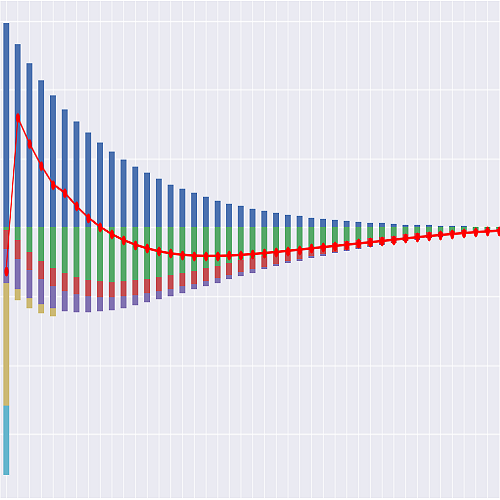
The Basis_DE_S Model#
Reference liability cash flow model for the German Basisrente (Rürup), Schicht 1.
Basis_DE_S is the executable counterpart of
products/basisrente/technical-notes.md in the lifelib-products library. It projects
gross best-estimate liability cash flows, undiscounted, for a single model point of
the Basisrentenvertrag of § 10 Abs. 1 Nr. 2 Buchst. b EStG — a deferred lifelong
annuity written on the general account, with an accumulation phase that builds a
Deckungskapital and a payout phase that pays a monthly annuity struck through a
Rentenfaktor — on a monthly grid, t = 0 ... proj_len() - 1.
The product is defined by prohibitions, and the model is too. The entitlement is
nicht vererblich, nicht übertragbar, nicht beleihbar, nicht veräußerbar and
nicht kapitalisierbar, so there is no surrender value at any duration, no
*Rückkaufswert*, no *Kapitalwahlrecht* and no *Teilkapitalauszahlung* anywhere in this
model. There is no commutation of a Kleinbetragsrente either, but that one is a
standardization and not a prohibition: § 10 Abs. 1 Nr. 2 Satz 3 EStG permits the
Abfindung of a Kleinbetragsrente out of a Basisrentenvertrag, and model.md
gives the reasons this model leaves it out. There is no lapse_rate, no
surr_rate, no cv_pp, no loan_pp and no claims_lapse column: these are
structural absences rather than switched-off options, and check_no_capital()
asserts them in code rather than in prose. A modeller arriving from the endowment or the
Schicht-3 annuity chassis has one thing to unlearn, and that is it.
Three mechanics carry the rest of the model.
A *Beitragsfreistellung* is not a lapse. § 165 VVG survives on this contract and is
its only behavioural exit, but it removes the premium, not the policy: the contract
stays certified, stays protected and still converts at Rentenbeginn. The model
therefore carries two ledgers — a premium-paying cohort per policy and a premium-free
cohort at fund level — whose account values diverge from the first freeze, and
pols_if(t+1) = pols_if(t) x (1 - mort_rate_mth(t)) with bf_rate absent from the
identity. Treating the freeze as an exit is the second listed modeling pitfall. The
freeze itself stays annual: § 165 VVG takes effect “für den Schluss der laufenden
Versicherungsperiode” and § 12 Abs. 1 VVG makes that period the Versicherungsjahr, so
pols_freeze is non-zero only in the last month of a projection year.
The declared rate is the *total* credited rate, not a spread. A German laufende
Verzinsung already includes the Rechnungszins, so cred_rate(k) = max(gtd_rate,
decl_rate(k)). Adding one to the other is the sixth pitfall, and on a book spanning
seven guarantee vintages it is worth a great deal.
The conversion basis is not the projection basis. The whole Deckungskapital, plus
a Schlussüberschussanteil allocated at that single date, converts at Rentenbeginn at
max(rentenfaktor_gtd, rf_curr(ret_age)) — a contractual rate struck on first-order
DAV 2004 R — while the projection runs on the best estimate. The wedge between the two
is the payout phase’s Risikoüberschuss, and ann_bonus_rate is what gives it back.
Converting on the projection’s own mortality abolishes it, which is the eleventh pitfall.
Spaces. The model contains two:
DataReads the seven input CSVs and holds their filename References. It takes no parameters, so each file is read once per model.
ProjectionThe by-policy projection, parameterized by
point_id:Projection[1]is an ItemSpace projecting model point 1. It reaches the input tables through itsdataReference, which resolves to the singleDataSpace.
The split matters for more than tidiness. Because Projection is parameterized, every
Projection[N] is a separate ItemSpace with its own cells cache; readers placed there
would re-read every file for every policy. In Data they are evaluated once, however
many policies are projected.
Input data is external: CSVs in the model folder’s parent directory, read at run
time rather than stored inside the model. The model folder itself holds no data, so the
model and its inputs must travel together — copying Basis_DE_S without its parent’s
CSVs produces a model that reads and then fails on first evaluation.
Projection basis. Monthly steps over a contract that is almost entirely annual, so
the model runs on two clocks and the argument of a cells says which. t counts
projection months from the valuation date and is 0-based; k = proj_year(t) =
t // 12 is the projection year, duration_y(k) = duration_init + k the completed
policy years and policy_year(t) = duration(t) + 1 the contractual label. The frame
runs t = 0 ... proj_len() - 1 with proj_len() = 12 x proj_len_y() and
proj_len_y() = omega_age() - age(0) + 1 — to the end of the mortality table, because
the annuity is lifelong: 924 months on the anchor cell.
The in force, the decrements, the claims, the expenses and the Rente instalments take a month. Everything the contract states per Versicherungsjahr takes a year: the Beitragsdynamik step, the Zuzahlung, the four account charges, the annual declaration of Überschussbeteiligung, the Deckungskapital and its interest credit, the Beitragsfreistellung effective at the end of the current premium period, and the conversion at Rentenbeginn. The Beitrag and the Zuzahlung fall in the first month of a projection year and interest is credited at its end; deaths fall at the end of each month and the Beitragsfreistellung transition after the deaths of the year’s last month.
The decrements carry the library’s two speeds — mort_rate(t) is the annual rate of
the year and mort_rate_mth(t) its geometric twelfth — so twelve months compound back to
the annual rate exactly and the whole Aufschubphase is bit-identical to the
annual-step model this replaced, on all thirteen model points. What the finer grid buys is
the Rente: a Rentenfaktor is quoted in euro a month, and where the annual model
booked twelve instalments at the start of each payout year on the opening count — its own
twelfth pitfall, and a stated approximation worth 4 290,52 € of the anchor’s payout phase —
the instalment is now paid to whoever is alive at the start of each month. The
Rentengarantiezeit is 12m instalments beginning in the month after the death that
triggered them, and a mid-year death now bears only the months of maintenance expense it
was there for.
What is sourced and what is not. The contractual mechanics are cited: the five
prohibitions and the absence of any surrender value, the confinement of survivor cover
to a spouse, registered partner or Kindergeld-eligible child, the Beitragsfreistellung
right, the Höchstzillmersatz of 25 ‰ of the Beitragssumme, the Höchstrechnungszins
ladder that fixes each cohort’s gtd_rate, and the statutory Überschussbeteiligung.
Every level is a standardization. Not one carrier’s Basisrente *Bedingungswerk*,
*Produktinformationsblatt* or declared-rate history was reached — direct HTTP egress
was blocked and the session’s search budget was exhausted before this product — so every
charge, every behavioural rate and both Rentenfaktoren are [std] figures with a
stated rationale and nothing behind them. The DAV tables (DAV 2004 R here) are the
property of the Deutsche Aktuarvereinigung, are not public, and are cited by name and
never redistributed; mort_table.csv is a shaped proxy anchored so the notes’ worked
example reproduces exactly. This model is a mechanics demonstration, not a pricing or
reserving result. Replace the decrement, charge and surplus tables with company data
before drawing any conclusion from the output.
Model points. Thirteen, covering both premium forms, all four payment frequencies, all three in-force shapes (accumulating, beitragsfrei, already in payment), the survivor’s annuity and the Rentengarantiezeit separately and together, both age-floor cohorts, four guarantee vintages, and four boundary cases — the whole Höchstbetrag, a Kleinbetragsrente this model annuitises rather than commuting, the 50 % BUZ rule at 0.49, and a guaranteed Rentenfaktor that binds over the current one. Model point 1 is the anchor cell of the worked example in the technical notes.
Verification. tests/test_basisrente_de.py asserts the notes’ worked example to
the cent and pols_if to six decimals, and one test per listed modeling pitfall. The
model publishes six check_* identities — check_net_cf(),
check_pols_roll_fwd(),
check_av_roll_fwd(),
check_conversion(),
check_no_capital() and
check_annuity_roll_fwd() — each a bool over the whole
projection with a per-period residual companion, whose argument follows its cells’ clock:
the cash flow statement, the policy ledgers and the nicht kapitalisierbar limb take a
month, and the Deckungskapital roll-forward, the conversion and the Überschussrente
take a projection year, because the quantities they check move once a Versicherungsjahr.
Example
>>> import modelx as mx
>>> model = mx.read_model("products/basisrente/Basis_DE_S")
>>> model.Projection[1].result_cf()