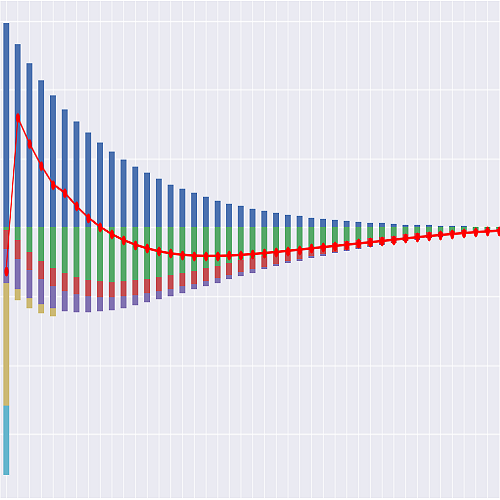
The Projection Space#
The by-policy projection of the TD_FR_S model.
The Space is parameterized by point_id, so Projection[1] is an ItemSpace
projecting model point 1:
>>> Projection[1].result_cf()          # the worked example's anchor cell
>>> Projection.point_id = 5            # or switch the default
t counts policy months, 0-based, the clock basiclife.BasicTerm_S and the five
monthly frlib models run on: t = 0 is the first policy month, month t runs from
time t to time t + 1, pols_if(t) is the count at time t (so
pols_if(0) == pols_if_init()), and the frame is t = 0, 1, ..., proj_len() - 1
with proj_len() = 12 * (cover_end_age() - issue_age()) the number of projected
months — the exclusive end of the frame, so the loop is lifelib’s
for t in range(proj_len()). Within a month the cotisation instalment, the maintenance
expense and the commission fall at the beginning; deaths and PTIA claims at the
end, settled there; lapses at the end, after both insured decrements.
Everything contractual about this product is nevertheless on an annual cycle — the
one-year risk renewed by tacite reconduction, the repricing at the new attained age,
the benefit schedule, the art. L. 132-7 suicide year, the first-year commission rate and
the constante equivalence — and the model keeps all of them there. So the policy year
is derived and used as a lookup key throughout: duration_mth(t) = t is the completed
policy months at the start of month t, duration(t) = duration_mth(t) // 12 the
completed policy years, policy_year(t) = duration(t) + 1 the contractual 1-based
label, and the attained age is age(t) = issue_age() + duration(t), stepping on the
anniversary and not monthly. The frame is indexed by t; the policy year is derived
and never indexed by. There is nothing after the frame — cover ceases at the échéance
following cover_end_age, nothing is payable there, and there is no maturity value, no
renewal and no conversion.
The two-speed structure that follows is the library’s convention, asserted by
tests/test_model_conventions_fr.py: mort_rate(), ptia_rate() and
lapse_rate() are the annual rates of the policy year containing month t —
the vectors the technical notes tabulate — and mort_rate_mth(),
ptia_rate_mth() and lapse_rate_mth() are the monthly rates actually applied,
derived at 1 - (1 - r)^(1/12) so that twelve of them compound back to exactly the
year’s rate. result_cf_annual() sums the monthly frame into policy years, which is
the view the notes’ worked example is stated on.
Input data
Inputs are external files: plain CSVs living in the model folder’s parent
directory, products/temporaire_deces/, read at run time rather than stored inside
the model. The model folder therefore holds nothing but formulas — no _data/, no
IOSpec, no embedded values — so a diff of the model shows logic changes only, and an
input can be edited or swapped without rewriting the model. This follows
annuallife.TradLife_A; contrast basiclife.BasicTerm_S, which keeps its inputs
inside the model through modelx’s IOSpec machinery.
The consequence worth knowing: the model is not portable on its own. Copying the
TD_FR_S folder without its parent’s CSVs produces a model that reads and then fails
on first evaluation.
Each table has a filename Reference and a reader Cells, both on
Data, reached here through the data Reference:
Reference |
Cells |
File |
|---|---|---|
model_point_file |
data.model_point_table() |
model_point_table.csv |
premium_rate_file |
data.premium_rate_table() |
premium_rate_table.csv |
mort_table_file |
data.mort_table() |
mort_table.csv |
lapse_file |
data.lapse_table() |
lapse_table.csv |
freq_loading_file |
data.freq_loading_table() |
freq_loading_table.csv |
benefit_schedule_file |
data.benefit_schedule() |
benefit_schedule.csv |
Naming
Cells names follow lifelib’s basiclife.BasicTerm_S wherever that model has an
analogue — pols_* for policy counts, plural nouns for cash flows, *_rate for
annual rates and *_rate_mth for the monthly ones derived from them, *_pp for
per-policy amounts, claims(t, kind) with an uppercase kind string,
pols_if_at(t, timing) for the within-month in-force reads — and, for the monthly
grid, the duration_mth / duration / policy_year triple that Obseques_FR_S,
ADE_FR_S and savings.CashValue_SE use. The technical notes use compact actuarial
symbols instead. The mapping is:
Notes symbol |
Cells |
Meaning |
|---|---|---|
(none) |
model_point() |
The selected model point row |
n = cover - issue |
proj_len_y() |
Number of projected years |
t = 0..12n-1 |
proj_len() |
Number of projected months |
(none) |
duration_mth(t) |
Months elapsed at BOM, = t |
dur(t) |
duration(t) |
Completed policy years, t // 12 |
y = dur(t) + 1 |
policy_year(t) |
Policy year, the 1-based label |
x(t) |
age(t) |
Attained age of month t’s year |
SA |
sum_assured() |
Guaranteed capital |
r(x) |
prem_rate(t) |
Tariff rate at that age |
(table) |
mort_rate_base(t) |
Table death rate at that age |
f |
rating_factor() |
Surprime multiplier |
phi |
prem_freq_load() |
Fractionation multiplier |
F |
prem_freq_fee() |
Fixed annual frais d’echeance |
P_tar(t) = SA r(x) f phi |
prem_tariff_pp(t) |
Tariff cotisation, before F |
P_lev |
prem_level_pp() |
Level cotisation, constante |
P(t) = P_tar(t) + F |
prem_pp(t) |
Annual cotisation of the year |
(instalments) |
prem_instalments() |
Instalments per policy year |
(modal cycle) |
prem_cycle() |
Months between instalments |
(due month) |
prem_due(t) |
Is an instalment due at BOM |
P_inst(t) |
prem_inst_pp(t) |
Instalment collected in month t |
v |
disc_factor(y) |
(1 + tech_rate)^-y, y a year |
p_tau(y) |
pols_tariff(y) |
Tariff survivorship, no lapse |
(denominator) |
tariff_annuity() |
Sum of v^y p_tau(y) |
(numerator) |
tariff_prem_pv() |
PV of the revisable stream |
(schedule) |
benefit_factor(t) |
Benefit schedule factor |
B(t) |
benefit_pp(t) |
Contractual capital in period t |
(none) |
benefit_death_pp(t) |
What a death claim pays |
(none) |
benefit_ptia_pp(t) |
What a PTIA claim pays |
(none) |
prem_refund_pp(t) |
Cotisations returned in the delai d’attente |
(none) |
accident_extra_pp(t) |
Additional accidental capital |
sigma(t) |
suicide_factor(t) |
First-year death exclusion |
q_d(t) |
mort_rate(t) |
Annual dependent death rate |
q_p(t) |
ptia_rate(t) |
Annual dependent PTIA rate |
q_d(t) + q_p(t) |
decr_rate(t) |
Annual insured decrement |
q_m(t) |
decr_rate_mth(t) |
Monthly insured decrement |
q_dm(t) |
mort_rate_mth(t) |
Monthly death rate applied |
q_pm(t) |
ptia_rate_mth(t) |
Monthly PTIA rate applied |
(tariff basis) |
ptia_rate_base(t) |
PTIA rate before the loading |
(table) |
lapse_rate_base(t) |
Annual table lapse rate |
M_shock(t) |
shock_lapse_factor(t) |
Premium-shock multiplier |
w(t) |
lapse_rate(t) |
Annual lapse rate of the year |
w_m(t) |
lapse_rate_mth(t) |
Monthly lapse rate applied |
w_cum(t) |
lapse_cum(t) |
Cumulative lapse proportion |
lambda |
sel_lapse_lambda |
Selective-lapsation loading |
w_ref |
sel_lapse_ref |
Selective-lapsation threshold |
(none) |
sel_lapse_factor(t) |
Mortality loading on persisters |
l(t) |
pols_if(t) |
In force at the start of month t |
l(t)(1-q), l(t+1) |
pols_if_at(t, timing) |
BEF_DECR / BEF_LAPSE / AFT_DECR |
pols_death(t) |
pols_death(t) |
Expected deaths in month t |
pols_ptia(t) |
pols_ptia(t) |
Expected PTIA claims in month t |
pols_lapse(t) |
pols_lapse(t) |
Expected lapses in month t |
premiums(t) |
premiums(t) |
Cotisation income |
claims_death, claims_ptia |
claims(t, kind) |
Benefit outgo by kind |
ec x (D + P) |
claim_expenses(t) |
Claim handling expense |
(none) |
inflation_factor(t) |
Expense inflation factor |
c0, c_r |
commissions(t) |
Commission outgo |
E0, e(t), ec, commission |
expenses(t) |
Total expense, incl. commission |
net_cf(t) |
net_cf(t) |
Net cash flow, income positive |
liability_cf(t) |
liability_cf(t) |
The same stream, outgo positive |
(none) |
result_cf_annual() |
result_cf() summed into years |
Six names needed care.
P(t) in the notes is the cotisation actually charged, which on the revisable
form is SA r(x(t)) f phi and on the constante form is a level P_lev. Both
then carry the fixed frais d’échéance. prem_tariff_pp() is the tariff amount,
prem_level_pp() the level one and prem_pp() what is charged, so the three
have somewhere to live and the fee is added exactly once — the notes’ pitfall 13, which
is about applying the fractionation loading and the fee both as percentages.
q_d(t) and q_p(t) are dependent rates of a two-decrement table, not
independent single-decrement rates, so they are additive: l(t+1) = l(t)(1 - q_d -
q_p)(1 - w). An implementation using 1 - (1 - q_d)(1 - q_p) gets 0.00479680
against 0.00480000 in the first year of the worked configuration — immaterial there,
material at older ages. mort_rate_base() is the table rate and mort_rate() the rate
applied after the selective-lapsation loading; ptia_rate_base() is the tariff-basis
PTIA rate that the constante equivalence is struck on, and ptia_rate() the one
the projection applies. Keeping the two pairs apart is also what keeps the level-premium
derivation acyclic: the equivalence is struck on the tariff basis, so it cannot depend on
a behavioural loading that depends on the lapse path that depends on the premium.
q_d and q_p being additive is also why they are converted to the month
together and split afterwards rather than converted apart. decr_rate() is their
sum, decr_rate_mth() is 1 - (1 - q_d - q_p)^(1/12), and mort_rate_mth() /
ptia_rate_mth() are that rate split in the two rates’ own proportion. Converting
each rate separately and adding the results gives a twelve-month insured survival of
0.9952029339 against the annual model’s 0.9952000000 at the anchor cell — an error of
2.6e-6 at the very first anniversary and 1.0e-5 in pols_if over the run, which is
what would break the anniversary equivalence. The proportional split also keeps
ptia_rate_mth / mort_rate_mth = ptia_ratio exactly, so the acceleration ratio the
product is built on survives the conversion untouched.
B(t) is the contractual capital. What a claim actually pays is not always B(t):
inside a délai d’attente an illness-caused death pays back the cotisations collected
and PTIA pays nothing, and in policy year 1 (t = 0) the death cover is void for
suicide. So
benefit_pp() is B(t), benefit_death_pp() and benefit_ptia_pp() are
what is payable, and suicide_factor() is applied on top of the first of them alone.
w(t) is the lapse rate and w_cum(t) the cumulative lapse proportion that drives
the selective-lapsation loading on mortality. Spelling them lapse_rate() and
lapse_cum() keeps the second from reading as a running total of the first, which it
is not: it is a proportion of the original cohort, and the loading it feeds moves claims,
not lapses.
expenses(t) in the notes includes the commission, and result_cf() publishes
commissions() beside it because the notes’ worked-example table does. The
commission is therefore a part of the expense column, not a further line: subtracting
both from premiums() charges the commission twice. The notes’ worked example fixes
the reading — expenses(0) = 882.14 is 250 + 2.08 + 0.06 + 630, the maintenance
term being one twelfth of the annual charge, and the last of those four is the 40 %
initial commission.
The cotisation rises with attained age
This is the French delta, and it is visible in the cash flows rather than buried in a
parameter. On the revisable form — the default of every retrieved French contract —
the cotisation is recomputed at every annual renewal from the tariff rate at the new
attained age, so prem_pp(t) moves every year — and only at the anniversary: it is
flat across the twelve months of a policy year, because the contracts say “à chaque
échéance annuelle” and not “chaque mois”:
prem_pp(24) / prem_pp(12) = 1.56 / 1.13 = 1.380531
— policy year 3 against policy year 2 — a 38 % step from age 59 to 60 against a trend of
about 8 % a year. That step is in the
published grid and a fitted curve would smooth it away, so prem_rate() is a table
lookup and nothing else. Over the worked configuration the cotisation runs from
1 575,00 € to 7 290,00 €, a factor of 4,6286 — which is exactly r(74)/r(58) and does
not depend on the capital at all.
The constante form is the level alternative, and it is a [std] construction: no
French standalone contract in the corpus writes one. With level_premium = 0 it is
derived by actuarial equivalence with the revisable stream over the whole cover period,
on tariff survivorship — insured decrements only, no lapse — at tech_rate:
P_lev = sum v^t p_tau(t) SA r(x(t)) f phi / sum v^t p_tau(t)
which on the worked configuration is 60,476.2476 / 15.449728 = 3,914.3891. With
level_premium > 0 that figure is supplied instead and no equivalence is struck.
The two forms do not collect the same projected premium total: the equivalence
ignores lapse, and once lapses truncate the expensive late years the constante
projection collects 36 367,46 € against the revisable 31 999,13 €. That is correct
rather than a bug — the identity that holds is the discounted one on tariff
survivorship — and a test asserting equality of projected totals is testing the wrong
thing.
PTIA is an acceleration, not an addition
Perte totale et irréversible d’autonomie pays the same capital, early, to the
insured, and its payment ends the contract. Arithmetically that means one two-decrement
table: a life that leaves through ptia_rate is gone from pols_if and can never
generate a death claim, and the two rates add rather than compound.
check_decrement_closure() asserts the consequence at every t — claim events
plus lapses plus survivors equal the original policy — so a PTIA life left in force, or
counted twice, fails there.
PTIA cover also stops earlier than death cover, at ptia_end_age, and the switch
is a hard gate on the attained age rather than a taper: ptia_rate(t) — and with it
ptia_rate_mth(t) — is exactly zero from the first t with
age(t) >= ptia_end_age(). Because the age steps on the anniversary, the gate closes
on an anniversary too: on the worked configuration that is t = 84 ... 203, the whole
of the policy year at attained age 65 onwards, and model point 11 enters at exactly
ptia_end_age so its PTIA cover never attaches at all. check_ptia_gate() asserts
both.
The suicide exclusion never touches PTIA. Art. L. 132-7 voids the death cover for
suicide in the first year, and PTIA is not death, so suicide_factor() multiplies
benefit_death_pp() alone and only at t = 0. Nor does the model carry the
art. R. 132-5 immediate-cover ceiling of 120 000 €: that alinéa belongs to
principal-residence loan cover and does not apply to a standalone temporaire décès.
No cash value, anywhere
Art. L. 132-23 forbids both rachat and réduction on a temporaire décès. There is no
account value, no surrender value, no reduced-paid-up state and no maturity value at any
duration, so a lapse is a pure decrement: it moves pols_if and pays nothing.
claims(t, "LAPSE") exists, returns zero, and appears in result_cf() as a zero
column, because a non-zero lapse row is the pitfall a reader arriving from a US model
with cash surrender values will import. A column of zeros states the product fact where a
missing column would only hide it, and check_no_cash_value() asserts it on every
model point.
The same statutory fact is why the whole of the exit machinery is lapse. The 30-day renonciation window sits inside the year-1 lapse rate [std]; there is no surrender charge, no dynamic surrender behaviour and no paid-up election to model.
The last projected year has no lapse, and why
The notes’ processing order puts lapses at the end of the month, after both insured
decrements. At the end of the final projected policy year the cover expires, and a lapse
and an expiry are then the same event paying the same nothing. So lapse_rate()
returns 0 through the whole of that policy year — duration(t) >= proj_len_y() - 1,
months 192 to 203 on the worked configuration — and the whole surviving population leaves
as an expiry: pols_if(proj_len()) is that cohort. The notes set out the same
convention, w(n - 1) = 0 [std], under Lapse and in step 7 of their processing
order, and they state it of a policy year; zeroing only the final month would leave
eleven months of 6 % lapse inside that year and move the expiring cohort from 27,887 % to
about 26,6 %, contradicting the notes’ own figure. Read over the whole year it reproduces
their split of the closure identity — 6,737 % deaths, 0,517 % PTIA, 64,859 % lapses and
27,887 % survivors on the worked configuration, the survivor term exactly the
annual-step model’s and the three exit terms reallocated by the finer grid. No cash flow
depends on the split.
pols_if(proj_len()) is read by check_decrement_closure() and by nothing
else. It is never a weight on a cash flow, and result_cf() stops at
t = proj_len() - 1.
The délai d’attente
A délai d’attente delays the start of cover: 12 months for illness-caused death and
PTIA where the adhesion carried no medical formality, with the cotisations collected
returned to the heirs on a death inside the window, and 3 months at another carrier
waived for accidental causes. Five of the eight retrieved carriers have none, and the
composite runs with waiting_period_y = 0.
Where it is switched on — model point 9 — the implementation is [std] in its
arithmetic and cited in its shape: inside the window a death claim pays
prem_refund_pp(), the cotisations collected up to and including the month of
claim, in place of the capital, and a PTIA claim pays nothing. The window itself is now
counted in months, duration_mth(t) < 12 * waiting_period_y(), which is the unit the
sources state it in and exactly the old window for a whole number of years; a sub-annual
window is expressible for the first time, and no shipped model point uses one. The accidental capital is not
suppressed inside the window, which is the one carrier’s express waiver for accidental
death. The decrements are untouched: the window changes what a claim pays, never who
leaves.
Modules that are off in the base run
Four constructions are implemented and switched off, so the base run reproduces the worked example while the machinery stays visible and testable:
Tariff drift,
tariff_drift = 0. Two of the eight retrieved carriers reserve an explicit right to reprice the class for experience, and the representative carrier’s current page implies a level above its own retrieved grid. Setting the drift to zero keeps the base run reproducible from cited data alone. A drift assumption is a premium-income assumption, not a mortality one.Premium-shock lapse,
shock_lapse_beta = 0, withshock_lapse_g0 = 0.10.M_shock = 1 + beta max(0, P(t)/P(t-12) - 1 - g0), the ratio being between consecutive renewals and so read twelve months back — on a monthly gridP(t)/P(t-1)would be 1 in eleven months of twelve and the module would never fire. The revisable form hands the policyholder a rising bill, and the grid’s own +38 % step at age 60 is exactly where an affordability response would show. Switched on it would bite through the whole of policy year 3, months 24 to 35 of the worked configuration, and nowhere else.Selective lapsation,
sel_lapse_lambda = 0, withsel_lapse_ref = 0.30.q_d_eff = q_d (1 + lambda max(0, w_cum - w_ref)), withw_cumread at the anniversary so that the loaded rate stays one annual rate for its policy year. Lapsers are healthier, so persisters are progressively impaired. The effect is larger here than on a UK level-premium term policy, because cumulative lapse reaches 64,9 % of the original cohort over seventeen years.The accidental capital,
acc_share = 0. The option pays an additional capital on the accidental share of claims, not a uniform uplift on every claim, and no retrieved source gives an accidental share of deaths. With the share at zero,accident_multipliermust have no effect on any cash flow — model point 6 is model point 1 with the multiplier at 2.00, and their frames are identical.
Indexation on the PASS or an insurer rate is described in the sources and is not implemented: it reprices capital and cotisation together on an exogenous index, refusal is definitive at three carriers, and modelling it would add an absorbing state driven entirely by an assumption with no source.
Sign convention
net_cf() is income positive — cotisations in, claims and expenses out — which
is the notes’ own orientation and the library-wide sign. liability_cf() publishes
the same stream outgo-positive, liability_cf(t) = -net_cf(t) exactly, so a
best-estimate liability is sum v(t) liability_cf(t) over whatever discount curve the
valuation layer supplies. Both are columns of result_cf(), so the identity is
verifiable in the frame rather than only in prose.
The shape to expect on the revisable form, read on result_cf_annual(), is
almost no new-business strain — policy year 1 is +2,58 € on the worked configuration,
because the year’s cotisation very nearly pays the year’s acquisition cost — and thin
positive margins thereafter that grow as the tariff climbs. On the annual grid the same
year read -38,72 €; the sign flips because a decrementing block carries fewer claims and
less maintenance than an anniversary weighting charges it. Within policy year 1 the
monthly frame shows what the annual one could not: net_cf(0) = +633,73 €, the whole
annual cotisation against the acquisition cost, then eleven negative months. The
constante form inverts the annual picture: strongly positive in the first year,
+1 406,22 €, and it would carry a real provision mathématique against the later years.
What the monthly grid changes, and what it does not
The grid is monthly; the product is not. Every contractual mechanic stays exactly where the contract puts it, and each of the following is a decision taken deliberately rather than inherited from the frame:
the tariff is re-read, and the cotisation repriced, on the anniversary only (
prem_rate(),prem_pp()), so both are flat across a policy year;the fractionnement is the one cycle the model point chooses rather than the contract, so the cotisation is collected in instalments on that cycle (
prem_cycle(),prem_inst_pp()) and the annual frais d’échéance is divided among them rather than charged twelve times — which is what the loading and the fee were pricing all along;the art. L. 132-7 suicide void covers the whole of policy year 1 (
suicide_factor()), the 40 % commission rate the whole of policy year 1 (commissions()), and the délai d’attente a whole number of months (in_waiting());expenses inflate by policy year, stepping on the anniversary (
inflation_factor()), which is the frlib house form rather than uslib’s continuous one;the
constanteequivalence stays an annual construction on policy-year arguments (disc_factor(),pols_tariff()), soP_levis unmoved by the conversion;the zero lapse rate of the final projected year covers that whole year (
lapse_rate()), because the notes state it of a year;the selective-lapsation loading reads cumulative lapse at the anniversary (
sel_lapse_factor()) and the premium-shock module compares consecutive renewals (shock_lapse_factor()), so both stay annual experience statements;the two dependent insured rates are converted to the month together and split, not converted apart (
decr_rate_mth()).
What the finer grid does resolve is everything that is not a contract term: claims fall at the end of the month of claim rather than of the policy year, maintenance expense accrues a twelfth a month on the in-force of that month, and a fractionated cotisation is collected on a block that has already lost lives.
That is what makes the two grids reconcile. Because the monthly insured decrement and the
monthly lapse rate each compound back to the year’s annual rate, the recursion collapses
over any twelve months of one policy year to l(t+12) = l(t)(1 - q_d - q_p)(1 - w) —
the annual-step recursion, term for term — so the in-force at every policy anniversary
is identical to the annual-step model’s, pols_if(12k) here equalling pols_if(k)
there to floating point, and so is every annual contractual quantity: the tariff rate, the
cotisation, the capital, the level premium and the annuity-due factor behind it. The cash
flows are not identical and are not meant to be: death claims fall from 10 396,90 € to
10 094,20 € over the worked configuration, PTIA claims from 804,25 € to 775,29 €, expenses
from 2 676,38 € to 2 666,69 €, and net_cf rises from 18 121,59 € to 18 462,95 €.
Those timing differences are the reason for the monthly grid. result_cf_annual()
sums the frame into policy years so the two can be laid side by side.
What a sibling may inherit
ADE_FR_S and Obseques_FR_S sit on this chassis, and all three now run the same
monthly grid and the same duration_mth / duration / policy_year vocabulary.
The decrement machinery (mort_rate(), mort_rate_mth(), ptia_rate(),
ptia_rate_mth(), lapse_rate(), lapse_rate_mth(), pols_if_at(),
pols_death(), pols_ptia(), pols_lapse()), the exclusion machinery
(suicide_factor(), benefit_death_pp(), benefit_ptia_pp()), the expense
and commission ledger and the claims(t, kind) interface carry over unchanged. What
does not carry over is the benefit: an ADE capital follows the outstanding loan
balance on an amortisation schedule and adds ITT and IPT covers with their own
franchise and quotité, and an obsèques capital is a small fixed sum over a lifetime
horizon with a cash value, behind a twelve-month carence. Anything a sibling adds to
those layers belongs there, not here.
Cells Descriptions#
The cotisation form:
revisableorconstante.revisableis the French default and the product’s signature — the cotisation is recomputed at every annual renewal on the new attained age.constanteis a [std] construction: no French standalone contract in the corpus writes a level cotisation, and it is carried because the contrast between the two is the largest structural lever in the model and the reason a provision mathématique exists on one form and not the other.
- benefit_shape()[source]#
The capital’s shape over the cover period:
constantordecreasing.Only
constanthas a shipped schedule, because no retrieved French standalone contract amortizes the capital — a decreasing capital is the assurance emprunteur shape, and it lives inADE_FR_Sagainst a real loan balance rather than here against an invented one. A model point carryingdecreasingfails inbenefit_factor(), which is the honest failure: the schedule is missing, not the formula.
- benefit_schedule_id()[source]#
The key into benefit_schedule.csv naming this policy’s benefit schedule.
- sex()[source]#
The insured’s sex, M or F. Reporting only — it must not enter pricing.
Art. L. 111-7 forbids sex-based premium and benefit differences for contracts written from 21 December 2012, so
prem_rate()andmort_rate_base()are both indexed by attained age alone and neither reads this cells. The tension worth knowing is that the homologated valuation tables remain sex-specific, so a French reserving basis is sex-dependent while the tariff may not be;products/rente_viagere/meets the same tension from the other side.
- smoker()[source]#
The insured’s smoker status, N or S.
Carried because underwriting asks, and because it is what a surprime would be struck on. It feeds
rating_factor()through the model point rather than through a formula: no French insurer publishes a smoker loading, or any surprime scale at all, so there is nothing to look up.
- issue_age()[source]#
The issue age on the différence de millésime basis: calendar year less birth year.
Not age nearest birthday and not age last birthday — an integer age that steps on 1 January irrespective of birth month, and the single most important convention to get right in a French annual-step model. A one-year shift moves
prem_pp(0)on the worked configuration from 1 575,00 € to 1 695,00 €, a 7,6 % error in year one that compounds through the whole projection. On this annual grid the age steps at the policy anniversary instead, so an implementation on real dates carries a fractional offset of at most one year [std].
- sum_assured()[source]#
SA: the guaranteed capital, in euros.
Freely chosen rather than tied to a loan balance, subject to a carrier minimum that runs from 6 097,96 € to 100 000 € across the corpus. Model point 12 sits at the representative carrier’s 20 000 € minimum, where the year-one cotisation at age 58 is 210 € against 250 € of acquisition expense [std] — on small capitals the expense assumption, not mortality, decides whether the cell is viable.
- cover_end_age()[source]#
The attained age at which the death cover ceases.
Nothing is payable at that boundary: no maturity value, no renewal, no conversion.
- ptia_end_age()[source]#
The attained age at which the PTIA cover ceases, earlier than the death cover.
Earlier in five of the eight retrieved carriers, and the model treats it as a hard gate on the attained age rather than a taper; see
ptia_rate().
The key into premium_rate_table.csv naming this policy’s rate card.
- rating_factor()[source]#
f: the surprime multiplier on the tariff rate; 1.00 at standard rates.
It scales the cotisation only, never the capital — a surprime buys the same capital at a higher price — so
claims()is invariant to it. No insurer publishes a surprime scale; the only public French price evidence on rated lives is on borrower cover, which bounds a standard rate from above rather than giving one. Model point 5 carries 1.50 [std].
- prem_freq()[source]#
The cotisation payment frequency, a key into freq_loading_table.csv.
Annual, half-yearly, quarterly or monthly. The frequency buys two separate charges — a percentage loading and a fixed euro fee — and they must not be conflated; see
prem_pp().
The level cotisation supplied on the
constanteform; 0 means derive it.Zero on every
revisablepoint, where it is never read. Model point 2 derivesP_levby equivalence and model point 3 supplies 3 900,00 € directly, so both branches ofprem_level_pp()are exercised.
- waiting_period_y()[source]#
The délai d’attente in policy years; 0 in the base run.
Inside the window an illness-caused death pays back the cotisations collected and PTIA pays nothing. See the Space docstring for the arithmetic, which is [std], and model point 9, which switches it on for one year.
- accident_multiplier()[source]#
The accidental-capital option; 1.00 means the option is off.
An additional capital payable where death or PTIA follows an accident — observed as 100 % of the death capital, as 50 % at one carrier and as x2 or x3 by cause at another — not a uniform uplift on every claim. With
acc_share = 0in the base run it has no effect on any cash flow, which is the invariance model point 6 asserts.
- issue_date()[source]#
The issue date, carried for identification and not read by any formula.
On the différence de millésime basis the age driving both the tariff and the cover limits is calendar year less birth year, so a projection on policy years needs
issue_age()and nothing else. A real-dates implementation would need this cells and would carry the fractional offsetissue_age()describes.
- pols_if_init()[source]#
The number of policies in force at issue: 1.0, a single-policy model point.
The library’s projections are per policy, so this is 1 everywhere; it is named rather than written as a literal because it is the scale of the roll-forward tolerances.
- proj_len_y()[source]#
n: the number of projected policy years,
cover_end_age() - issue_age().17 on the worked configuration. The contract states its own horizon in years, so this cells keeps it in years and everything annual is written against it: the
constanteequivalence sums overrange(proj_len_y()), andlapse_rate()comparesduration(t)againstproj_len_y() - 1to find the final policy year.proj_len()is twelve times this and is the frame.
- proj_len()[source]#
The number of projected policy months,
12 * proj_len_y().204 on the worked configuration. The exclusive end of the frame, counted from
t = 0: the projection runst = 0 ... proj_len() - 1,result_cf()hasproj_len()rows and the loop is lifelib’sfor t in range(proj_len()). Monthtfalls in the policy year at attained ageissue_age() + duration(t), so the last covered month is the twelfth of the policy year at attained agecover_end_age() - 1. There is no benefit, no cotisation and no maturity value att = proj_len(), andpols_ifthere is the expiring cohort rather than a cash-flow weight; see the Space docstring.
- duration_mth(t)[source]#
Completed policy months at the start of month t; equal to
t.tis 0-based and every model point in this product is projected from issue, so the identity is trivial — the cells exists so the monthly models in this library share one vocabulary withObseques_FR_SandADE_FR_S, where an in-force point could open mid-policy. It is what the modal premium cycle and the délai d’attente window are counted in.
- duration(t)[source]#
Completed policy years at the start of month t:
duration_mth(t) // 12.0-based, as
durationis throughout lifelib: 0 through the whole of the first policy year. Every contractual schedule in this product is annual, so this is what the attained age, the tariff re-read, the suicide year and the commission year are keyed on.
- policy_year(t)[source]#
y: the contractual 1-based policy year containing month t; 1 for
t = 0..11.The label
duration(t) + 1, derived from the 0-basedtand never indexed by: it exists because two shipped inputs are keyed by a contractual policy year — lapse_table.csv (years 1-4) and benefit_schedule.csv (years 1-57) — and those lookups must map through this cells rather than passtraw. It also keys the expense inflation. Seelapse_rate_base(),benefit_factor()andinflation_factor().
- age(t)[source]#
x(t): the attained age in the policy year containing month t,
issue_age() + duration(t).The age steps on the policy anniversary — at
t = 12, 24, ...— not on 1 January and not monthly; the monthly grid does not make it finer. On the différence de millésime basis — seeissue_age()for why that matters more here than the choice would in a UK or US model.
- prem_rate(t)[source]#
r(x): the tariff rate at the attained age of month t’s policy year, as a fraction of SA.
Re-read on the anniversary only: it is a function of
age(t), which steps at the anniversary, so it is constant across the twelve months of a policy year.A table lookup and nothing else. The published grid steps +38 % from age 59 to 60 against a trend of about +8 % a year, and a fitted curve smooths that step away — so
prem_rate(24)/prem_rate(12) = 1.56/1.13 = 1.380531on the worked configuration — the third policy year against the second — is a test of the premium engine, not a coincidence.tariff_driftmultiplies the card by(1 + drift)^duration(t)and is 0 in the base run: two of the eight retrieved carriers reserve an express right to reprice the class for experience, but freezing the card at its vintage is what keeps the base run reproducible from cited data alone. The exponent is completed policy years and not months, because a re-rating of the card is an annual act; the rate is therefore flat across the twelve months of a policy year, like everything else contractual here. The grid itself is a 2019-2021 edition — use it for shape, not for level.
- prem_freq_load()[source]#
phi: the fractionation multiplier for this policy’s payment frequency.
1.0000 annual, 1.0250 half-yearly, 1.0400 quarterly and monthly. A multiplier embedded in the cotisation TTC, and one of only three disclosed charge figures in the whole source corpus.
- prem_freq_fee()[source]#
The fixed annual frais d’échéance for this policy’s payment frequency, in euros.
3 € half-yearly, 6 € quarterly, 18 € monthly over twelve instalments, nil annual. A euro amount, not a second percentage — applying it as a percentage load, or applying the fractionation loading and then billing the fee on top of it as a percentage, overstates premium income. See
prem_pp().
- prem_instalments()[source]#
The number of cotisation instalments per policy year: 1 / 2 / 4 / 12.
Read from the
instalmentscolumn of freq_loading_table.csv, which ships beside the loading and the fee and names the cycle those two charges exist to price. On the annual grid this model ran on, the column could not be used for anything — the whole loaded cotisation was charged once at the start of the year whatever the mode, which made the fractionation loading a charge for a service the model never rendered. On the monthly grid it drivesprem_cycle()andprem_inst_pp().
- prem_cycle()[source]#
Months between cotisation instalments: annual 12, half-yearly 6, quarterly 3, monthly 1.
12 // prem_instalments()— arithmetic of the elected mode rather than an assumption, so it is written here rather than held in a Reference.
- prem_due(t)[source]#
Whether a cotisation instalment falls due at the beginning of month t.
duration_mth(t) % prem_cycle() == 0. An annual payer is due in the first month of every policy year and nowhere else; a monthly payer is due in every month. The fractionnement is the one cycle in this product the model point chooses rather than the contract, so it is collected on its own cycle and not on the anniversary.
- prem_tariff_pp(t)[source]#
SA r(x(t)) f phi: the tariff cotisation per policy in period t, before the fee.
The rule the source states in its own worked examples: 20 000 € at attained age 34 gives 20 000 x 0,15/100 = 30 € for one year, and 150 000 € at attained age 49 gives 900 €. The same rule at attained age 58 gives 1 575,00 €.
- disc_factor(y)[source]#
v^y: the discount factor at
tech_ratefor policy year y, 0-based.The argument is a policy year and not a month: the
constanteequivalence is an annual construction and stays one on the monthly grid, so re-striking it month by month would moveP_levand break the identity the notes assert. The published cash flows are undiscounted; this rate exists to strike the level cotisation and for nothing else. 0,5 % p.a. [std], which is what the Institut des actuaires’ own illustrations for a death cover use and is well inside the art. A. 132-1 cap of min(3,5 %, 60 % TME).
- pols_tariff(y)[source]#
p_tau(y): tariff survivorship entering policy year y — insured decrements, no lapse.
p_tau(0) = 1,p_tau(y+1) = p_tau(y) (1 - q_d - q_p)on the table ratesmort_rate_base()andptia_rate_base()of that policy year, read at its opening month12 * y. Likedisc_factor()this is a policy-year recursion and not a monthly one: it is the tariff basis of an annual equivalence, and spreading it over months would change the level cotisation the notes publish while adding nothing. Using the table rates rather than the behaviourally loaded ones is both the actuarially right basis and what keeps the derivation acyclic — the loaded death rate depends on the lapse path, which on theconstanteform would depend on the premium the equivalence is about to produce.
- tariff_annuity()[source]#
The annuity-due factor of the equivalence:
sum v^y p_tau(y)over the cover years.15,449728 on the worked configuration, and
P_lev x 15,449728 = 60 476,25 €is the present value of the revisable stream on the same basis — the identity that does hold between the two premium forms, as against the projected premium totals, which do not. Summed overrange(proj_len_y()): the equivalence is annual, so it is struck over policy years and is unchanged by the monthly grid.
- tariff_prem_pv()[source]#
The present value of the revisable cotisation stream on tariff survivorship.
sum v^y p_tau(y) SA r(x(y)) f phi; 60 476,2476 € on the worked configuration, the tariff cotisation being read at each policy year’s opening month12 * y. The fixed frais d’échéance is deliberately outside it: the fee is the same amount under either premium form, so it neither belongs in the equivalence nor changes it.
- prem_level_pp()[source]#
P_lev: the level cotisation of the
constanteform, before the fee.level_premium()where the model point supplies one, otherwisetariff_prem_pv() / tariff_annuity()— a survivorship-and-discount-weighted average of the same grid rates, 3 914,3891 € on the worked configuration, unchanged by the monthly grid because the equivalence never left the annual one. Read another way,P_lev / SAis thev^y p_tau(y)-weighted mean of the seventeen grid rates, 2,60959276 %, which reaches the same figure without ever forming the premium stream.Not read at all on the
revisableform.
- prem_pp(t)[source]#
P(t): the annual cotisation per in-force policy for month t’s policy year, in euros.
The tariff amount on the
revisableform andP_levon theconstanteform, plus the fixed frais d’échéance once. The two fractionation charges are of different kinds and are applied in different places:prem_freq_loadis a multiplier insideprem_tariff_pp(), andprem_freq_feeis a euro amount added here. Charging the fee as a further percentage, or loading the already-loaded cotisation with it, overstates premium income.It is the annual charge of the policy year containing month
tand is flat across that year’s twelve months, because the contract reprices “à chaque échéance annuelle” and not monthly. What is actually collected in monthtisprem_inst_pp(), the instalment the elected fractionnement makes due.On the
revisableform this cells is the whole French delta: it changes every year becauseprem_rate()is read at the new attained age, and over the worked configuration it runs from 1 575,00 € to 7 290,00 € — a factor of 4,6286 that depends only on the grid and not on the capital.
- prem_inst_pp(t)[source]#
P_inst(t): the cotisation instalment actually collected per policy in month t.
prem_pp(t) / prem_instalments()in a monthprem_due()makes due, zero otherwise, so the instalments of a policy year sum to exactly the year’s annual cotisation — the fee included, which is what freq_loading_table.csv itself says of the monthly mode (“18 EUR frais d’echeance over 12 instalments”). An annual payer therefore collects the whole 1 575,00 € in the first month of the policy year and nothing in the other eleven, which is what an annual-mode policy looks like on a monthly grid; model point 4 is the contrast, twelve instalments of 77,77 €.This is what the fractionation loading and the frais d’échéance were charging for all along, and it is the one place the finer grid changes an answer rather than its resolution: on a fractionated point the instalments after the first are collected on a block that has already lost lives, so the premium-cessation rule of the contracts finally bites where an annual grid could not express it.
- mort_rate_base(t)[source]#
The annual table death rate at the attained age of month t’s policy year.
A [std] Gompertz-form proxy,
0.00400 x 1.09^(age - 58), not a homologated or fitted table: the regulatory TH 00-02 / TF 00-02 tables are annexed to an arrêté and are cited by name rather than redistributed, and no French insurer publishes a basis. Indexed by attained age alone — sex may not enter a French tariff written from 21 December 2012, and the proxy carries no décalage d’âge — the annexed shifts are required only for contrats en cas de vie other than annuities, which a temporaire décès is not, and a shift applied to a table that was never homologated would be theatre in any case.
- sel_lapse_factor(t)[source]#
The selective-lapsation loading on mortality in period t [std].
1 + lambda max(0, w_cum(12 dur(t)) - w_ref). Lapsers are healthier than persisters, so a block that has already shed a large proportion of its lives carries impaired mortality on the remainder. The effect is larger on this product than on a UK level-premium term policy, because cumulative lapse reaches 64,9 % of the original cohort over the worked configuration’s seventeen years.w_cumis read at the anniversary,lapse_cum(12 * duration(t)), so the loading is one number for the whole policy year andmort_rate()stays the annual rate of that year, as the library’s*_rate/*_rate_mthsplit requires. Letting it drift month by month would be a second modelling change smuggled in beside the grid change: the module was only ever calibrated as an annual experience statement, and a within-year drift would break the anniversary equivalence without buying anything.Off in the base run (
sel_lapse_lambda = 0), where it returns 1 in every month without readinglapse_cum()at all — the short circuit is what keeps theconstantepremium derivation from depending on the lapse path it feeds.
- mort_rate(t)[source]#
q_d(t): the annual dependent death rate of the policy year containing month t.
The table rate times the selective-lapsation loading, capped at 1 — the vector the technical notes tabulate, kept annual as the library-wide convention requires.
mort_rate_mth()is the rate actually applied in the month. Dependent means a rate of decrement in a two-decrement table rather than an independent single-decrement rate, so it adds toptia_rate()rather than compounding with it: an implementation using1 - (1 - q_d)(1 - q_p)gets 0.00479680 against 0.00480000 in the first year of the worked configuration. That additivity is also why the two rates are converted to the month together rather than apart; seedecr_rate_mth().
- ptia_rate_base(t)[source]#
The PTIA decrement rate on the tariff basis, before any behavioural loading.
ptia_ratio x mort_rate_base(t)while the cover is on, and exactly zero from the first period withage(t) >= ptia_end_age(). Used bypols_tariff(), so that theconstanteequivalence is struck on the tariff decrements alone.
- ptia_rate(t)[source]#
q_p(t): the annual dependent PTIA rate of the policy year containing month t.
ptia_ratio x mort_rate(t)while the cover is on, and exactly zero from the first period withage(t) >= ptia_end_age()— a hard gate on the attained age, not a taper, because “the PTIA capital is an anticipated payment of the death capital and its payment ends the contract” means the life is gone frompols_if, and the cover either attaches at that age or does not.ptia_ratio = 0.20is a pure placeholder [std]: no retrieved French source gives a PTIA incidence rate at any age, and the only public French figure touching PTIA at all is an underwriting-outcome statistic that says nothing about incidence. It is the assumption in this model most in need of a real source, and it moves 7,2 % of total claims on the worked configuration.
- decr_rate(t)[source]#
q_d(t) + q_p(t): the annual insured decrement of the policy year containing month t.
The two-decrement table’s total rate of exit through a claim. It is named because the additive dependent-rate convention needs somewhere to live on a monthly grid: it is this sum, and not either rate alone, that the annual recursion applies and that the monthly conversion must reproduce. See
decr_rate_mth().
- decr_rate_mth(t)[source]#
The monthly insured decrement applied in month t [std].
1 - (1 - q_d - q_p)^(1/12): the constant-force conversion of the combined annual rate, derived geometrically and not by dividing by twelve, so that twelve months of it compound back to exactlyq_d + q_p— the factor the annual-step model applied at the anniversary.Converting the two rates separately and adding the results is the tempting reading and it is wrong here, because
q_dandq_pare dependent rates of one table:(1-(1-q_d)^(1/12)) + (1-(1-q_p)^(1/12))gives a twelve-month insured survival of 0.9952029339 against the annual model’s 0.9952000000 at the anchor cell, an error already 2.6e-6 at the first anniversary and 1.0e-5 inpols_ifby the end of the run. No French source states a conversion convention for any decrement, so the choice is a standardization; what is not optional is that it reproduce the annual factor.mort_rate_mth()andptia_rate_mth()split this back in the rates’ own proportion.
- mort_rate_mth(t)[source]#
q_dm(t): the monthly death rate applied in month t [std].
The combined monthly insured decrement split in the annual rates’ own proportion,
decr_rate_mth(t) * q_d(t) / (q_d(t) + q_p(t)), and zero where the whole insured decrement is. Splitting proportionally is what keepsptia_rate_mth(t) / mort_rate_mth(t) = ptia_ratioexactly — the acceleration ratio the product is built on — while twelve months ofq_dm + q_pmstill compound back to the year’sq_d + q_p. Where the PTIA gate has closed,q_p = 0and this degenerates to the house form1 - (1 - q_d)^(1/12).
- ptia_rate_mth(t)[source]#
q_pm(t): the monthly PTIA rate applied in month t [std].
decr_rate_mth(t) * q_p(t) / (q_d(t) + q_p(t)), and zero where the whole insured decrement is — in particular exactly zero from the first month at or beyondptia_end_age(), becauseptia_rate()is. Identicallyptia_ratio * mort_rate_mth(t)while the cover is on, which is the acceleration ratio surviving the conversion untouched.
- lapse_rate_base(t)[source]#
The annual table lapse rate of month t’s policy year [std], before any shock.
12 / 10 / 8 / 6 per cent a year, elevated in the first three years to absorb the 30-day renonciation window and early-duration attrition, then flat. lapse_table.csv is keyed by the contractual policy year, 1 to 4, so the lookup maps through
policy_year()— monthst = 0 ... 11read the file’s policy year 1 — and policy years beyond the table take its last row. The rates stay annual;lapse_rate_mth()does the spreading. No observed range exists: not one of the eight retrieved contracts and neither secondary guide publishes a lapse rate, so the shape is a modeler’s construction and the levels are unsourced. What the contracts do tell us is that voluntary exit is easy and cheap, because there is nothing to forfeit.
- shock_lapse_factor(t)[source]#
M_shock(t): the premium-shock lapse multiplier [std]; 1 in the base run.
1 + beta max(0, P(t)/P(t-12) - 1 - g0). The ratio is between consecutive renewals and so reads the cotisation twelve months back, not one: on a monthly gridP(t)/P(t-1)would be 1 in eleven months of twelve and the module would never fire at all. The revisable form hands the policyholder a rising bill, and the published grid’s own +38 % step at age 60 is exactly where an affordability response would show; switched on it takes the value 1.420796 through the whole of policy year 3, months 24 to 35 of the worked configuration, and 1 everywhere else — the annual model’s own behaviour att = 2, now spread over that year’s twelve months bylapse_rate_mth(). Off by default (shock_lapse_beta = 0), and 1 through the whole of policy year 1, which has no previous renewal to compare with.
- lapse_rate(t)[source]#
w(t): the annual lapse rate of the policy year containing month t.
The table rate times the shock multiplier, capped at 1 — the vector the technical notes tabulate;
lapse_rate_mth()is the rate actually applied at the end of the month. Zero through the whole of the final projected policy year,duration(t) >= proj_len_y() - 1(months 192 to 203 on the worked configuration): the end of that year is also the moment the cover expires, so a lapse and an expiry are the same event paying the same nothing, and the whole surviving population leaves as an expiry. That is the notes’w(n - 1) = 0[std] — stated under Lapse and in step 7 of their processing order — and it is what reproduces their split of the closure identity, survivor term included. The zero covers the year and not just its last month, because the notes name a policy year: zeroing only month 203 would leave eleven months of 6 % lapse in the final year and move the expiring cohort from 0,27886852 to about 0,266, contradicting the notes’ own figure. It moves no cash flow, only the split. A lapse pays nothing at any duration; seeclaims().
- lapse_rate_mth(t)[source]#
w_m(t): the lapse rate applied at the end of month t [std].
1 - (1 - w)^(1/12)on the policy year’s annual rate, derived geometrically and not by dividing by twelve, so that twelve months of it compound back to exactly that rate. No exception is made for any month: unlikeTerm_US_S, this product has no shock lapse tied to a named date inside a policy year, and the one rate the notes do put on a boundary — the zero of the final policy year — is a rate for the whole year rather than for a month of it. No French source states a conversion convention for any decrement [std].
- lapse_cum(t)[source]#
w_cum(t): the cumulative lapse proportion of the original cohort before month t.
A proportion of
pols_if_init(), not a running total oflapse_rate(), and it drives a loading on mortality rather than on lapse. A monthly recursion now, but read only at anniversaries — seesel_lapse_factor(). Zero in the first month,t = 0.
- pols_if(t)[source]#
l(t): the number of policies in force at the start of month t, at time t.
pols_if(0) = pols_if_init(), then the notes’ recursion on the monthly rates,l(t+1) = l(t)(1 - q_dm(t) - q_pm(t))(1 - w_m(t)). This is the weight on every cash flow of the sameresult_cf()row. Because the monthly rates compound back to the annual ones,pols_if(12k)is exactly what an annual-step model carried at its yeark.pols_if(proj_len())is defined and is the expiring cohort — the survivors whose cover simply runs out — because the notes’ closure identity needs it. It is read bycheck_decrement_closure()and by nothing else: it is never a weight on a cash flow, andresult_cf()stops att = proj_len() - 1. Zero outside0 .. proj_len().
- pols_if_at(t, timing)[source]#
The number of policies in force at a point inside month t.
"BEF_DECR"l(t), the start of the month, before any decrement; the same number as
pols_if()and the weight on that month’s cash flows."BEF_LAPSE"after both insured decrements, before lapses — the notes’ processing order takes deaths and PTIA claims at the end of the month and lapses after them [std order], so this is the population lapses are taken from. The two insured monthly rates are subtracted rather than compounded, because they are the proportional split of one two-decrement table’s combined monthly rate.
"AFT_DECR"l(t+1), the end-of-month state. In the final projected policy year
lapse_rate()is zero, so att = proj_len() - 1this is the expiring cohort.
- pols_death(t)[source]#
l(t) q_dm(t): expected deaths in month t, claimed at the end of that month.
The monthly rate, not the annual one: a death now falls in the month it happens and the claim is settled there, which is the resolution the finer grid buys and the reason the death-claim total is below the annual-step model’s — an anniversary weighting exposes the whole opening cohort for the whole year.
The claimant has already paid the instalment that fell due in advance at the start of the month; that is this model’s reading of “premium payment ceases on death” [std]. Multiplying
premiums()by(1 - q_dm - q_pm)on top of it applies the rule twice.
- pols_ptia(t)[source]#
l(t) q_pm(t): expected PTIA claims in month t, claimed at the end of that month.
A second exit from the same table, not a second cover: the capital is the death capital paid early to the insured, and its payment ends the contract. A life counted here is gone from
pols_if()and can never generate a death claim.
- pols_lapse(t)[source]#
Lapses at the end of month t, taken from the survivors of both insured decrements.
Pays nothing — art. L. 132-23 forbids both rachat and réduction on a temporaire décès — so this moves
pols_if()and nothing else. Zero through the whole of the final projected policy year, where the survivors leave as an expiry instead; seelapse_rate().
- benefit_factor(t)[source]#
The benefit schedule factor of month t’s policy year, from benefit_schedule.csv.
1.0 in every year on the
constantschedule, the only one shipped. The file is keyed by the contractual policy year, 1 to 57, so the lookup maps throughpolicy_year()— monthst = 0 ... 11read the file’s policy year 1 — and policy years beyond the table take its last row. The schedule is a contract term and steps on the anniversary, never within a year. A model point naming a schedule the file does not carry fails here, which is the honest failure: the schedule is missing, not the formula.
- benefit_pp(t)[source]#
B(t): the contractual capital payable on a month-t claim, in euros.
sum_assured() x benefit_factor(t). It is invariant torating_factor(): a surprime scales the cotisation only, never the capital. What a claim actually pays isbenefit_death_pp()orbenefit_ptia_pp(), which differ from this inside a délai d’attente.
- in_waiting(t)[source]#
Whether month t falls inside the délai d’attente.
waiting_period_yis a length in contractual policy years, so the window isduration_mth(t) < 12 * waiting_period_y()— a one-year window covers monthst = 0 ... 11, exactly the annual model’st = 0. Counting the window in months is what the sources actually state (12 months at one carrier, 3 months at another), and the monthly grid makes a sub-annual window expressible for the first time; no shipped model point uses one, so nowaiting_period_mcolumn is introduced. False everywhere when the window is not elected, which is the base run and eleven of the twelve model points.
- prem_refund_pp(t)[source]#
The cotisations actually collected up to and including month t, per policy.
Paid back to the heirs on a death inside the délai d’attente, in place of the capital. It accumulates
prem_inst_pp()and notprem_pp(), because the contract returns “les cotisations collectées”: on a fractionated point a claimant part way through a policy year has paid only the instalments billed so far, which is both the literal reading and the only one that stays a cash quantity. On an annual-mode point — model point 9, the only one that elects the window — the whole year’s cotisation is collected in its first month, so this is 296,00 € through the whole window, exactly the annual model’s figure. Accumulated at nil interest [std]: no source gives a rate.
- benefit_death_pp(t)[source]#
What a death claim in month t actually pays, per claim, in euros.
B(t)outside the délai d’attente; inside it, the cotisations collected, because an illness-caused death inside the window is not covered and the contract returns what was paid. The first-year suicide exclusion is applied on top of this byclaims(), not here, so the two exclusions stay separable.
- benefit_ptia_pp(t)[source]#
What a PTIA claim in month t actually pays, per claim, in euros.
B(t)— the same capital as a death claim, which is what “acceleration” means — and zero inside a délai d’attente, where the PTIA cover has not yet attached. The suicide factor never touches it: art. L. 132-7 voids the death cover in year one, and PTIA is not death.
- accident_extra_pp(t)[source]#
The additional accidental capital per claim in month t [std].
(accident_multiplier() - 1) x acc_share x B(t). The option pays an additional capital on the accidental share of claims, not a uniform uplift on every claim, so it carriesacc_shareand not just the multiplier. No retrieved source gives an accidental share of deaths, soacc_share = 0in the base run and the whole term is zero however large the multiplier — model point 6 asserts that invariance.It is not suppressed inside a délai d’attente: the one carrier that publishes a waiting period waives it for accidental causes.
- suicide_factor(t)[source]#
sigma(t): the death-benefit exclusion factor; below 1 through policy year 1 only.
Art. L. 132-7 makes the death cover “de nul effet” for suicide “au cours de la première année du contrat”, so the exclusion covers the whole of policy year 1 — months
t = 0 ... 11,duration(t) == 0— and not merely the first month. The statute names a year; a monthly grid does not make it a month. 0.98 [std] stands for “about 2 % of first-year deaths are excluded suicides” — no retrieved source gives a suicide share of deaths at any age, and setting it to 1.000 is a defensible variant. What is not defensible is applying it to PTIA, or beyond the first year, or importing the art. R. 132-5 immediate-cover ceiling of 120 000 €, which belongs to principal-residence loan cover.It is worth 11,33 € on the worked configuration — immaterial to the result, material to correctness, because it is the only thing standing between expected claim events and expected claim amounts there.
- claims(t, kind=None)[source]#
Benefit outgo in month t, by kind; the total when kind is omitted.
"DEATH"the capital paid at the end of the month of death,
sigma(t) x benefit_death_pp(t) x pols_death(t), plus any accidental capital. The suicide factor applies here and nowhere else."PTIA"the same capital paid early on a PTIA claim, with no suicide factor. Zero from the first month at or beyond
ptia_end_age(), and zero inside a délai d’attente."LAPSE"zero, always. Art. L. 132-23 forbids both rachat and réduction on a temporaire décès, so there is no surrender value and no reduced-paid-up value at any duration; the kind exists so that the zero is stated rather than left to inference. See
check_no_cash_value().
Cotisation income at the beginning of month t, an inflow.
P_inst(t) l(t): the instalment the elected fractionnement makes due this month, weighted by the in-force entering it. An annual payer therefore contributes the whole year’s cotisation in the first month of the policy year and nothing in the other eleven, and a monthly payer contributes a twelfth each month on a block that has already lost lives — which is where the premium-cessation rule of the contracts finally bites. Not further multiplied by(1 - q_dm - q_pm): claims fall at the end of the month, so a claimant has already paid the month’s instalment, and applying the rule again here would charge it twice.
- inflation_factor(t)[source]#
The expense inflation factor in month t:
(1 + expense_infl)^(policy_year(t) - 1)[std].Expenses inflate by policy year and not by month, stepping on the anniversary, which is how
Obseques_FR_S,ADE_FR_SandDep_FR_Sall write it and how the notes tabulate the maintenance charge. (Term_US_Sin uslib uses the continuous(1 + i)^(t/12)instead; frlib does not follow it there.) It is arithmetically the same sequence the annual-step model published, re-indexed — what changes is that a twelfth of the charge is borne by the in-force of each month.
- claim_expenses(t)[source]#
ec x (D(t) + P(t)): the claim handling expense on the month’s claims [std].
150 € per death or PTIA claim, uninflated. A round-number placeholder: the chargements de gestion of a French tariff are not separately disclosed anywhere, which is precisely why art. R. 343-3 has to require the provision mathématique to carry an estimate of them. Inside
expenses(), and named separately because it is the only expense line that scales with claims rather than with policies.
- commissions(t)[source]#
Commission outgo in month t [std], on the cotisation collected that month.
40 % through the whole of policy year 1,
duration(t) == 0, then 5 % from policy year 2 — levels chosen so that the year-one acquisition cost is of the same order as the year-one cotisation at the anchor age. No French insurer publishes a commission scale for this product.The rate is a policy-year rate and steps on the anniversary; the base is
premiums(), the instalment actually collected, so a fractionated payer earns the commission in instalments too. On an annual-mode point that reproduces the annual model’s commission exactly, because both the rate and the collection sit on the anniversary.This is a part of
expenses(), not a further line beside it: the notes’ own expense column includes it, and subtracting both frompremiums()charges the commission twice.
- expenses(t)[source]#
Total expense outgo in month t, including commission [std].
Acquisition 250 € per policy at issue — a single amount in month 0, not a fraction of any premium — maintenance at one twelfth of the 25 € per in-force policy per year inflating at 2 %, the claim expense, and the commission. All four are round-number placeholders: no French insurer publishes an expense loading, an acquisition cost or a commission scale for this product, and the only disclosed charge figures in the whole corpus are the fractionation loadings, the frais d’échéance and a 1,30 € association subscription — none of which is an expense assumption.
A twelfth of the annual maintenance charge accrues each month, so a policy that runs a full year carries the same charge as it did on the annual grid — but it is now borne by the in-force of each month rather than of the anniversary, which is what makes a decrementing block cost less: 254,60 € of maintenance over the worked configuration against the annual grid’s 263,96 €.
On the worked configuration
expenses(0) = 882.14is250 + 2.08 + 0.06 + 630, and the twelve months of policy year 1 total 904,22 €. That last term is the initial commission, which is whynet_cf()subtracts this cells and notcommissions()as well.
- net_cf(t)[source]#
The net liability cash flow of month t, income positive.
Cotisations less death claims, PTIA claims and total expense — and total expense already carries the commission, so it is subtracted once. The notes’ own sign, and the library-wide one.
On the
revisableform the shape to expect, read onresult_cf_annual(), is almost no new-business strain — policy year 1 is +2,58 € on the worked configuration, the year’s cotisation very nearly paying the year’s acquisition cost — then thin positive margins that grow as the tariff climbs. Within policy year 1 the monthly frame shows the shape the annual grid could not: +633,73 € in month 0, where the whole annual cotisation is collected against the acquisition cost, then eleven negative months of claims and maintenance. Theconstanteform inverts the annual picture: strongly positive in the first year and carrying a real provision mathématique against the later years.
- liability_cf(t)[source]#
The same stream as
net_cf(), outgo positive:-net_cf(t)exactly.The orientation a valuation layer consumes: a Solvabilité II best estimate is
sum v(t) liability_cf(t)over the relevant risk-free term structure, plus a risk margin. Published as a column besidenet_cf()so the sign convention is verifiable in the frame rather than only in prose.
- check_pols_roll_fwd_resid(t)[source]#
The in-force roll-forward residual in month t; zero everywhere.
pols_if(t) - pols_if(t+1) - pols_death(t) - pols_ptia(t) - pols_lapse(t). The recursion multiplies(1 - q_dm - q_pm)(1 - w_m)while the three exits are formed separately, so the two agree by algebra when — and only when — every one of them is read at the samet. What it catches is therefore a misindexed recursion: rolling forward withw_m(t-1)orq_dm(t+1), or dropping the PTIA decrement from the recursion while still paying PTIA claims, all leave a residual here. On the monthly grid it must close month by month, not only at anniversaries. In the final projected policy yearpols_lapseis zero and, att = proj_len() - 1,pols_if(t+1) = pols_if(proj_len())is the expiring cohort, so the identity closes there too.
- check_pols_roll_fwd()[source]#
True when the in-force roll-forward closes in every projected month.
The library-wide form of a roll-forward check: no argument, one bool over all t, so one test can call it across every model.
check_pols_roll_fwd_resid()gives the signed residual of the month that failed.
- check_decrement_closure_resid(t)[source]#
The cumulative decrement-closure residual at the end of month t; zero.
sum of (deaths + PTIA claims + lapses) up to t, plus pols_if(t+1), less the original
policy
. It is the notes’ own closure identity —0.06737020 + 0.00516859 + 0.64859269 + 0.27886852 = 1on the worked configuration — asserted at everytrather than only at the horizon, and it is built by direct summation over the exit cells, with no reference to the recursion that producedpols_if. The survivor term is exactly the annual-step model’s 0,27886852; the three exit sums are not, because a decrementing block reaches the claim decrements later in the year and more of the cohort therefore leaves as a lapse.That independence is what makes it more than the telescope of
check_pols_roll_fwd(). It catches a wrong starting cohort, an exit counted in two places, and above all a life that leaves through the PTIA decrement and reappears in force — the arithmetic form of paying the capital twice, which is this product’s first-order failure mode and which the cash flows alone would not reveal.
- check_decrement_closure()[source]#
True when claim events, lapses and survivors account for the whole cohort at every t.
No argument, one bool over all t, the library-wide shape;
check_decrement_closure_resid()gives the signed residual of the month that failed.
- check_ptia_gate_resid(t)[source]#
The PTIA cessation residual in month t; zero everywhere.
ptia_rate(t) + pols_ptia(t) + claims(t, "PTIA")in every month whose attained age has reachedptia_end_age(), and zero before that.Trivially zero by construction when the gate in
ptia_rate()is right, since that cells returns exactly 0 past the cessation age. It is published because the gate is written twice — there and here, each recomputed fromage(t)and the model point — so the two disagree if either is wrong. What it catches: a taper instead of a hard cut-off,>where>=belongs (which would keep PTIA cover for the whole of the year at the cessation age), a gate read offcover_end_ageinstead ofptia_end_age, and a gate applied to the death decrement instead of the PTIA one. On the worked configuration it is exercised att = 84 ... 203— the whole of the policy year at attained age 65 onwards — and on model point 11, which enters at exactlyptia_end_age, at everyt.
- check_ptia_gate()[source]#
True when the PTIA cover is exactly off from the cessation age in every month.
No argument, one bool over all t;
check_ptia_gate_resid()gives the signed residual of the month that failed.
- check_no_cash_value_resid(t)[source]#
The lapse-benefit residual in month t:
claims(t, "LAPSE"); zero everywhere.Trivially zero by construction, because
claims(t, "LAPSE")returns a literal zero. It is published because the zero is a statutory fact rather than a modelling choice — art. L. 132-23 forbids both rachat and réduction on a temporaire décès — and because the failure it guards against is not an arithmetic slip but an import: a reader arriving from a US model with cash surrender values wires an account value or a surrender scale into the lapse decrement, and every total in the frame still looks plausible. A named check that must stay at zero makes that edit fail loudly.
- check_no_cash_value()[source]#
True when a lapse pays nothing in every projected month.
No argument, one bool over all t;
check_no_cash_value_resid()gives the signed residual of the month that failed.
- result_cf()[source]#
Result table of cashflows, one row per month, indexed by the 0-based index t.
pols_ifis the start-of-month count, which is the weight applied to every cash flow on the same row.expensesis the notes’ total and includescommissions, which is published beside it because the notes’ worked-example table prints both;net_cfsubtracts the total once.claims_lapseis a column of zeros by statute — there is no surrender value — and is published rather than dropped.liability_cfisnet_cfoutgo-positive.The frame runs
t = 0 ... proj_len() - 1—proj_len()rows, 204 on the worked configuration — and stops: cover ceases at the échéance followingcover_end_agewith nothing payable.result_cf_annual()sums it into policy years, which is the view the notes’ worked example is stated on and the one to lay beside the annual-step model this replaced.
- result_cf_annual()[source]#
result_cf()summed into policy years, indexed bypolicy_year.Every cash flow column is the total of its twelve months;
pols_ifis the count at the start of the policy year,pols_if(12 * (policy_year - 1)), which is the number the annual-step model this replaced carried on the same row. It is the monthly frame regrouped and never a second projection, which is what lets the notes’ annual worked example stay in the notes and still be asserted.On the nine annual-mode model points the two grids agree exactly on three columns —
pols_if,premiumsandcommissions— because an annual cotisation is collected on the anniversary and weighted by the anniversary in-force under either grid, and the commission is a policy-year rate on it. They do not agree onclaims_death,claims_ptiaorexpenses, which now fall where they happen rather than at the anniversary, and so not onnet_cf: 10 094,20 € of death claims over the worked configuration against the annual grid’s 10 396,90 €, and 2 666,69 € of expense against 2 676,38 €. That gap is the point of the finer grid.
- result_pols()[source]#
Result table of policy counts, decrement rates and per-policy amounts, indexed by t.
The same monthly frame as
result_cf():t = 0 ... proj_len() - 1. Each annual rate is published beside the monthly rate derived from it, so the two speeds of the conversion can be read off one table:mort_rate/ptia_rate/lapse_rateare the annual rates of the policy year containing the month, andmort_rate_mth/ptia_rate_mth/lapse_rate_mththe rates actually applied in it.prem_ppis likewise the year’s annual cotisation andprem_inst_ppthe instalment collected in the month.