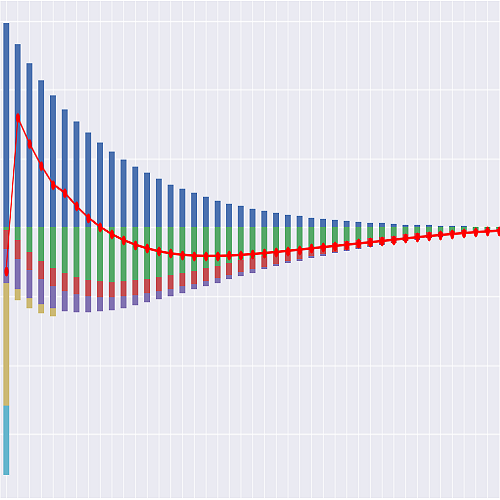
Product Specification#
Status: Draft, 2026-08-29; citations re-verified against the primary documents 2026-08-30
(22 of the 40 entries in sources.md now read Retrieved: yes — see below).
Scope note. This is a standardized composite specification assembled for reference
liability cash-flow modeling of a German Risikolebensversicherung (RLV) — the standalone term
assurance that pays a Todesfallleistung (death benefit) equal to the agreed Versicherungssumme
if the versicherte Person dies inside the Versicherungsdauer and pays nothing at all otherwise.
It does not describe any single insurer’s product, and it could not have. Facts carrying a
source tag — [S#] (primary product documents: Allgemeine Versicherungsbedingungen,
Produktinformationsblatt, Verbraucherinformation, insurer product pages) and [R#]
(product-specific regulatory and actuarial references), both numbered per
_research/risikolebensversicherung.md and resolved in sources.md (same directory; numbering
frozen, never renumbered), and [REG-R#] (the cross-product reference library
references/regulatory-and-actuarial-references.md, whose own R-numbering is distinct) — name the
instrument the claim should be checked against. Values marked std are standardizations
introduced for the reference implementation; each std table row carries a numbered footnote
giving the rationale and, where one can be argued, a plausible range. Claims that no search
corroborated are flagged unverified.
Retrieval conditions — read this before relying on a number, because they changed after it was
written. This specification was drafted with direct HTTP egress from the build environment
blocked by an organisation network policy — gesetze-im-internet.de, bafin.de, gdv.de,
aktuar.de, dejure.org, buzer.de, destatis.de and de.wikipedia.org were all tried and all
refused — and with the session’s shared WebSearch budget exhausted before this product’s
research began, so unlike the two sibling delib products this one had zero searches of its own.
The first draft therefore rested on the authoring model’s own knowledge of German insurance law and
practice, disciplined by std on every level it standardized and unverified on every specific
it could not confirm, with inherited corroboration — an instrument search-corroborated for a
sibling delib product while budget remained, carried across with the sibling named — as its only
second-hand evidence.
That policy has since been lifted and the citations re-verified against the primary documents on
2026-08-30. In sources.md, 22 of this product’s 40 entries now read Retrieved: yes and 18
still read no — 55 %, against 501 of 805 entries (62 %) across delib as a whole. What came in is
the statutory core and three wordings: the VVG, the MindZV, the DeckRV, the VAG, the AGG, the EStG,
the ErbStG, the VVG-InfoV and the HGB read as canonical XML from gesetze-im-internet.de with each
law’s amendment status (Stand) recorded, the VersStG 2021 in HTML beside them; the GDV
Musterbedingungen of 21.07.2025, CosmosDirekt’s AVB LA 803 A (04.26) and Hannoversche’s T25
as PDFs; two carrier Informationsblatt specimens that print a premium and its costs in euro; and
one carrier’s surplus guide. frlib’s counterpart could put eight French carriers side by side
because eight notices d’information were downloaded and read; where an earlier draft of this
passage said this document can put none side by side, it can now put two, in full, and the
industry template they are both variations on.
The 18 that did not come in are the carrier sweep and the secondary literature, and they failed in named ways: Debeka’s cited path now answers HTTP 404, and the replacement library injects its document links client-side so nothing is in the served HTML [S6]; Allianz and LV 1871 publish a product page with no conditions file, the wording reached through a quote flow [S8] [S11]; Dialog keeps its wordings behind the broker channel [S7]; R+V, NÜRNBERGER, Continentale/Europa and the seventeen further carriers were not searched for at all once the three wordings had settled the clause questions [S9] [S10] [S12] [S13]; Finanztest publishes a free summary and sells the test, and the rating houses sell theirs [S16] [S17] R20; a comparison-portal result is generated per query and is not a published document at all [S14], and no address was ever established for the consumer guide beside it [S15]; and the GDV statistics, the BaFin material, the Solvency II texts, the case law and the DAV Sterbetafel papers — whose four addresses were opened and confirmed live, but whose text was not read — remain pointers R12 R18 R19 R22 R23.
Where an entry in sources.md says Retrieved: yes, treat the claim it carries as sound; where it
says no, a delib citation is still a pointer, not a certificate — it names the instrument a claim
should be checked against and does not assert that anyone checked it. Re-verification was not a
formality: it overturned this document’s flat denial of any Rückkaufswert, corrected the claim that
German term-life charges are structurally undisclosed, replaced a guessed Nachversicherung event
list with a carrier’s own, and re-titled § 163 VVG. What has not changed is that levels are not
observed: apart from one direct writer’s published model case [S2], not one Bruttobeitrag or
Zahlbeitrag anywhere in this library is a market observation, and that one case is recorded as a
check rather than adopted as a parameter. Where a mechanic is certain and its level is not, this
document still ships a std parameter with its arithmetic shown rather than a plausible-looking
figure with a source tag it has not earned.
Out of scope, and said so where it matters. Restschuldversicherung /
Restkreditversicherung, the single-premium bank-sold loan-linked group cover, which shares the
falling sum insured of the annuitätisch fallende RLV and nothing else; Sterbegeldversicherung,
the small-sum funeral cover written without a Gesundheitsprüfung, which carries a Wartezeit and
a Rückkaufswert; Risikolebensversicherung mit Beitragsrückgewähr, which has a savings element by
construction and is economically the endowment of products/kapitallebensversicherung/; the
Berufsunfähigkeits- and Unfalltod-Zusatzversicherung riders, described here as options and not
modeled, the standalone disability contract being products/berufsunfaehigkeit/; and betriebliche
Altersversorgung in all five Durchführungswege, Gruppenversicherung and Kollektivverträge.
Product overview and market role#
A German Risikolebensversicherung is life insurance under Kapitel 5 of the VVG (Lebensversicherung, §§ 150–171) — not accident and not health business, even though it pays only on death R1 R4 R7 R8 REG-R22. Every general life provision of that chapter applies unmodified: the 30-day Widerrufsfrist of § 152 R8 REG-R23, the vorvertragliche Anzeigepflicht of § 19 R4 REG-R30, the Selbsttötung rule of § 161 R1 REG-R26, the Bezugsberechtigung of § 159 R7. It is pure protection: a level Bruttobeitrag buys a Versicherungssumme for a fixed term, with no Sparanteil in the endowment’s sense, no Erlebensfallleistung, no maturity value and a Rückkaufswert that is nil or nominal wherever a wording provides for one at all. If the versicherte Person survives, nothing is paid and the contract ends R1 R2 [S1] [S3] [S4].
Four features make the German chassis different from its French, UK and US siblings, and each one changes the shape of the projected cash flows.
The premium is level, and there are two of them. The Bruttobeitrag is struck at the Eintrittsalter and held there for the whole Beitragszahlungsdauer R6 R10; what the customer is billed is the Zahlbeitrag, the Bruttobeitrag less a declared Beitragsverrechnung — the Überschussbeteiligung of § 153 VVG applied as an immediate offset against the premium rather than as a credit to an account there is none of R5 R9 [S5]. Only the Bruttobeitrag is guaranteed, and the insurer may cut the Beitragsverrechnung and raise the bill toward it without any § 163 procedure, without a Treuhänder and without a policyholder right of objection R6 REG-R27. This is the single most important legal fact about the German term-life premium, and a model carrying only one premium stream cannot represent this product.
The cash value is nil or nominal — and the reason is neither that nothing accumulates nor that the contract forbids it. A level premium against a rising death rate overcharges early and undercharges late, and the difference is a Deckungskapital that builds, peaks mid-term and runs off to exactly zero at expiry — small, and after Zillmerung negative or nil through much of the term. § 169 Abs. 1 VVG confines the surrender-value duty on Kündigung to a life insurance “bei dem der Eintritt der Verpflichtung des Versicherers gewiss ist”, and a term assurance’s is not R2 REG-R28 — so no statutory duty attaches. But the wordings still route there: the GDV model conditions and the Hannoversche AVB both convert the contract into a beitragsfreie Versicherung on Kündigung and pay a Rückkaufswert under § 169, less a Stornoabzug, where the paid-up sum fails a contractual minimum [S1] [S4]; Cosmos pays nothing at all [S3]. What is uniform is the size, and the wordings say why in the same words — the Kostenverrechnung leaves “keine oder nur geringe Mittel” [S1] [S3]. “There is no Sparanteil, therefore there is no reserve” is wrong, and a model built on it fails its own closure check — and so is “the German term product has no surrender value, full stop”.
The exclusion list is remarkably short. Beyond the statutory three-year Selbsttötung window R1 and the forfeitures of § 162 VVG R7, a German RLV wording carries essentially one substantive exclusion — the Kriegsklausel — plus a nuclear/ABC clause: no hazardous-sports list, no aviation exclusion, no alcohol or narcotics exclusion, no pre-existing-condition exclusion, hazardous activity being handled at underwriting by a Risikozuschlag. The French notices retrieved for
frlibcarry exclusion lists running to a dozen heads or more; a German wording covers all of it by pricing it, so the German product’s claim rate is a mortality question where the French product’s is partly a coverage question.There is no living-benefit acceleration in the base design. Germany has no counterpart to the French perte totale et irréversible d’autonomie, present in seven of the eight standalone
frlibcontracts: one decrement pays one benefit and there is no interlock to get wrong. What Germany has instead is a vorgezogene Todesfallleistung triggered by a terminal prognosis, and disability is sold as a rider or asproducts/berufsunfaehigkeit/.
Where it sits in the market. The GDV taxonomy puts this product in Risikoversicherungen, alongside Kapitalversicherungen, Rentenversicherungen, fondsgebundene and sonstige Lebensversicherungen REG-R53. The size of that segment could not be established: no contract count, no new business, no premium income, no aggregate versicherte Summe, no average sum insured or premium and — most consequentially for the model — no segment-specific Stornoquote R18 (research gap 13). What can be given is the whole of German life on the GDV basis for 2024: premium income +2,8 % to 94,6 Mrd. €, laufende Beiträge 66,3 Mrd. €, Einmalbeitragsgeschäft about +10 % to 28 Mrd. €, contract count −1,4 % to 80,3 Mio. REG-R53. Two structural remarks stand in for the missing breakdown, both arithmetic rather than observation: a term contract’s premium is tiny relative to its sum insured, so the segment is far larger measured by risk carried than by premium earned and any ranking by premium income understates it; and because its whole technical result is a Risikoergebnis, the MindZV’s 90 % minimum allocation R9 REG-R18 binds it more tightly than it binds any savings product.
Distribution is genuinely three-channel — tied agents and bank branches [S8] [S9], independent brokers [S7] [S10] [S11], direct writers [S3] [S4] [S12] — and the channel is visible in the Brutto/Zahlbeitrag spread, acquisition cost being the largest thing that differs between them. The cleanest natural experiment in German life insurance sits in this product: one group runs a broker-channel carrier and a low-cost direct carrier side by side on the same underwriting and reserving basis [S12]. It was not sampled (research gap 5). And because no German carrier publishes a rate card, the comparison portals are a market participant rather than an observer [S14]: a tariff’s design is shaped by how it ranks in a portal’s default query, which is a Zahlbeitrag query — a plausible structural explanation, unverified, for why the Zahlbeitrag is marketed and the Bruttobeitrag merely disclosed, the consumer-protection line running the other way [S15] [S16] [S17] R20. A portal result is generated per query rather than published, so none was obtained once egress was restored either — which is why the only German premium figures anywhere in this library are the ones a carrier prints in its own Informationsblatt specimen [S2], one model case at one carrier and not a market (gap 1).
Representative specification#
The representative design is a composite, not a copy of any carrier’s tariff — it could not be otherwise, no carrier’s tariff having been read. Every choice below is argued against the structural range the research file could establish, and where the range itself is unobserved the row says so rather than implying a distribution nobody measured.
Product identity and issue rules#
Parameter |
Representative value |
Basis |
|---|---|---|
Design type |
Individual, standalone, medically underwritten, überschussberechtigte Risikolebensversicherung; Neubestand |
|
Legal frame |
Lebensversicherung under Kapitel 5 VVG (§§ 150–171); not a PRIIP, so no Basisinformationsblatt is produced |
|
Documents delivered |
Allgemeine Versicherungsbedingungen; Verbraucherinformation pack; Produktinformationsblatt under the VVG-InfoV |
|
Lives basis (model-point parameter) |
|
mechanic 14; std (1) |
Contracting structure |
Ordinary (Versicherungsnehmer insures his own life, names a Bezugsberechtigter). The Über-Kreuz-Versicherung is an alternative structure, not a product: identical cover, identical cash flows, different Erbschaftsteuer outcome |
|
Three roles |
Versicherungsnehmer (owns and pays), versicherte Person (the life at risk), Bezugsberechtigter (receives). Routinely three different people — the normal case here, not the exception |
|
Consent of the insured life |
§ 150 Abs. 2 VVG: where the benefit “übersteigt … den Betrag der gewöhnlichen Beerdigungskosten”, that person’s schriftliche Einwilligung is required for the contract to be effective, with an exception for betriebliche Altersversorgung and a special rule in Abs. 3 for a parent insuring a minor child |
|
Eintrittsalter (model-point parameter) |
18 to 65 |
envelope std (2) |
Endalter |
75 |
envelope std (2) |
Versicherungsdauer (model-point parameter) |
5 to 40 years |
envelope std (2) |
Beitragszahlungsdauer (model-point parameter) |
Equal to the Versicherungsdauer in the base design; an abgekürzte Beitragszahlungsdauer shorter than the cover period is offered by some tariffs |
mechanic 4 unverified; envelope std (2) |
Versicherungssumme |
10 000 € to 50 000 € minimum; high six to low seven figures without special underwriting |
envelope std (2) |
Versicherungssumme shape (model-point parameter) |
(i) |
mechanic 3; all three unverified as to any carrier |
Age basis |
Alter am Jahrestag (ALB): the attained age at the policy anniversary, |
std (3) |
Currency and territory |
EUR; residence in Germany; worldwide cover subject to the Kriegsklausel |
mechanic 13 unverified |
Wartezeit |
None. Cover attaches from the agreed Versicherungsbeginn; the insurer’s protection against anti-selection is the Gesundheitsprüfung, not a deferral of cover |
mechanic 2 unverified; contrast [ |
Widerrufsfrist |
30 days for life insurance — “Abweichend von § 8 Absatz 1 Satz 1 beträgt die Widerrufsfrist 30 Tage”, § 152 Abs. 1 — extending the general 14 days, and lapsing at the outside 24 months and 30 days after conclusion |
|
Anchor model cell |
Entry age 35, male, non-smoker, Versicherungssumme 300 000 € konstant, term 25 years, premiums for 25 years, annual mode, standard rates, participating, no options |
std (4) |
Footnotes to std rows:
Single life and verbundene Leben are one chassis parameterised by the number of lives, not two products. Both lives are underwritten and both give the § 150 consent R7; the premium sits below two single contracts of the same sum, only one benefit ever being paid, and above one. No ratio is asserted (research gap 15); the model computes the first-death rate from
q_first = q_A + q_B − q_A·q_Bunder an independence assumption, itself std and itself an understatement for a couple sharing a household, a vehicle and a lifestyle.Not one of these envelopes was observed — no carrier’s AVB was read and no carrier’s issue rules are recorded anywhere in the research file (gap 22). They are the ranges German market practice is understood to run on, stated as std so a reader does not mistake them for a survey: Eintrittsalter 18–65, some carriers to 70 or 75; Endalter 75, with 80 and 85 offered; Versicherungsdauer 5–40 years; Mindestversicherungssumme 10 000–50 000 €. A single retrieved AVB would close almost all of this gap.
Germany has no counterpart to the French différence de millésime, where the rating age steps on 1 January irrespective of birth month. German practice is an age at the policy anniversary, which is also this model’s projection step; on a real-date implementation the offset is at most a few months. std, and the age basis registered for every delib model in
tests/de_registry.py.Entry age 35 with a 25-year term is long enough for the Deckungskapital to build and run off visibly and short enough to fit one worked-example table; 300 000 € is the sum at which the Erbschaftsteuer contrast of mechanic 14 becomes the decisive product-design fact; male rather than blended on both sides, so the unisex cross-subsidy the model necessarily carries is visible in the anchor rather than hidden, with the female twin as model point 2 and the smoker twin as model point 3.
Benefit provisions#
Parameter |
Representative value |
Basis |
|---|---|---|
Death benefit |
The Versicherungssumme in force for that policy year, from any cause — accident or illness alike — subject only to the short exclusion list below |
|
Survival benefit |
None. If the versicherte Person survives the term, nothing is paid and the contract ends |
|
Benefit form |
A lump sum paid to the Bezugsberechtigter directly, not through the estate where the nomination is effective, so the beneficiary is paid without waiting for probate |
|
Bezugsberechtigung |
Revocable by default; an unwiderrufliche nomination vests the claim immediately and takes it out of the policyholder’s disposal, with insolvency and gift-tax consequences |
|
Benefit schedule (model-point parameter) |
|
mechanic 3; schedules std (11) |
Selbsttötung |
The insurer is leistungsfrei where the versicherte Person intentionally takes her own life within three years of conclusion, unless the act was committed in a state excluding free determination of the will caused by a krankhafte Störung der Geistestätigkeit. The period may be extended by agreement. Where leistungsfrei, the insurer must nevertheless pay the Rückkaufswert including Überschussanteile under § 169 |
|
What the § 161 substitution is worth here |
Nil or nominal. There is no Rückkaufswert on this product R2, so the German three-year rule — a softening on an endowment — is on a term contract an exclusion in all but name |
|
Tötung durch Leistungsberechtigten (§ 162 VVG — that is the section’s actual heading, not Herbeiführung des Versicherungsfalles, which is § 81) |
The insurer is leistungsfrei where the policyholder intentionally and unlawfully brings about the death of the versicherte Person; a beneficiary who does so is treated as never designated — “gilt die Bezeichnung als nicht erfolgt” |
|
Kriegsklausel |
Correction — the retrieved wordings exclude rather than restrict. Both say the benefit is excluded where death is causally connected with kriegerische Ereignisse, and that the contract then “erlischt … ohne dass eine Leistung anfällt. Die Rückzahlung der Beiträge können Sie nicht verlangen” [S3] § 2 Abs. 6 — there is no Deckungskapital substitution. What is right is the passive-risk carve-out, and it is narrower than “passive war risk remains covered”: cover is restored only for a death outside Germany where the insured person was exposed to those events without active participation, [S3] adding humanitarian missions and named Bundeswehr deployments; [S4] § 18 Abs. 2 is the same rule in fewer words |
mechanic 13; [S3] [S4] |
Nuclear / ABC clause |
A parallel exclusion for death connected with the deliberate use or release of atomic, biological or chemical weapons or substances — and both wordings gate it on scale and on a Treuhänder: it bites only where the act was aimed at endangering more than 1 000 people and produces an unforeseeable change in the Leistungsbedarf such that the promised benefits are no longer securable, “und dies von einem unabhängigen Treuhänder bestätigt wird” [S3] § 2 Abs. 7, [S4] § 18 Abs. 3. Death in Wehr- or Polizeidienst or in innere Unruhen is expressly covered, not excluded [S3] § 2 Abs. 5, [S4] § 18 Abs. 1 |
mechanic 13; [S3] [S4] |
Exclusions beyond these |
None — confirmed against two wordings and the model wording, all of which open with the general rule that liability arises “unabhängig davon, auf welcher Ursache der Versicherungsfall beruht”. No hazardous-sports list, no aviation exclusion, no alcohol or narcotics exclusion, no occupational exclusion, no pre-existing-condition exclusion. [S3] adds one head the earlier draft did not have: death connected with a terrorist act the insured person committed or took part in |
mechanic 13; [S1] [S3] [S4] |
Settlement |
On production of the death certificate and the insurer’s claim documents; where the death falls in the first five (ten) years the § 19 remedies remain open |
|
Prescription |
The general BGB limitation applies; no German decision is cited by date or file number anywhere in this library, and none is invented |
R23; research gap 20 |
A model that hard-codes a constant sum insured cannot represent two of the three shapes the German market sells, which is why the schedule is a first-class external input rather than a flag. The schedule parameters themselves were not established (gap 15): not the nominal rate a German annuitätisch fallende tariff amortises at, not the residual sum at expiry, not the premium reduction relative to the constant shape. A
linear_fallendschedule reaching zero at expiry and anannuitaet_fallendschedule at a 3,0 % nominal rate ship as std.
Underwriting and rating#
Parameter |
Representative value |
Basis |
|---|---|---|
Legal frame |
§ 19 VVG: the applicant must disclose the gefahrerhebliche Umstände known to her that the insurer has asked about in Textform, and nothing else. The duty is question-bounded — there is no free-standing duty to volunteer |
|
Gesundheitsfragen |
Outpatient treatment and consultations over a recent look-back; inpatient treatment, operations and psychotherapy over a longer one; current complaints, medication and pending investigations; height and weight; nicotine consumption |
mechanic 9; look-back periods unverified, none asserted (gap 22) |
Escalation |
Ärztliche Untersuchung, Hausarztbericht, blood tests or an ECG as the sum insured and entry age rise; a vereinfachte Gesundheitsprüfung below a stated sum |
mechanic 9; no threshold asserted (gap 22) |
Finanzielle Angemessenheit |
Above a threshold the insurer also underwrites the financial justification — income, existing cover, the loan being protected — to bound over-insurance |
mechanic 9 unverified |
Raucher / Nichtraucher |
The largest single rating split after age, and the qualifying period is now established at twelve months (gap 22, closed): “Nichtraucher ist, wer mindestens in den letzten zwölf Monaten vor Antragstellung nicht aktiv geraucht oder gedampft hat (nikotinhaltig oder nikotinfrei)”, with a parallel Nicht-Nikotinkonsument class for nicotine in any other form [S3] § 18 Abs. 2. The classification is continuing, not fixed at issue: a switch to smoking is a Gefahrerhöhung the policyholder must notify, the insurer may then charge a higher premium retroactively from the switch at an unchanged sum insured, and the policyholder may take a benefit reduction instead or, if the premium rises by more than ten per cent, terminate within a month [S3] § 18 Abs. 4–6. That carrier waives its statutory rights to terminate or exclude the increased risk, and checks smoking status only at the claim |
mechanic 9; [S3] |
Actuarial sanction for the split |
The DAV publishes DAV 2008 T R and DAV 2008 T NR and states they are suitable for premium calculation differentiated by smoking status — but not for policies written without a Gesundheitsprüfung |
|
Smoker mortality ratio |
2.20 on the best-estimate rate at ages 30–55, reproducing a premium ratio near 2.0 once sum-related and per-policy expenses are added back |
std (12) |
Berufsgruppen |
Occupation is a rating factor but far weaker than on a Berufsunfähigkeitsversicherung. Most tariffs use a small number of classes, or none below a listed set of hazardous occupations attracting a Risikozuschlag or a decline |
mechanic 9; no class list, count or loading asserted (gap 22) |
Hazardous pursuits |
Parachuting, technical diving, motorsport, mountaineering, combat sports, extended stays in high-risk regions — handled by a Risikozuschlag or an individually agreed exclusion at underwriting, not by a standing clause |
mechanics 9, 13 unverified |
Underwriting outcomes |
Accept at standard rates; accept with a Risikozuschlag and/or an individually agreed Leistungsausschluss, subject to the applicant’s acceptance; defer; decline |
R4; mechanic 9 |
Anzeigepflicht remedies |
On a breach the insurer may adjust the contract retrospectively — writing in the Risikozuschlag or exclusion that would have applied — instead of refusing to perform, and for simple or gross negligence this is the usual outcome |
|
Time limits on those remedies |
Five years from conclusion for negligent breach; ten years for intentional or arglistig breach — and the placement was right: “Die Rechte des Versicherers nach § 19 Abs. 2 bis 4 erlöschen nach Ablauf von fünf Jahren nach Vertragsschluss … Hat der Versicherungsnehmer die Anzeigepflicht vorsätzlich oder arglistig verletzt, beläuft sich die Frist auf zehn Jahre”, § 21 Abs. 3. § 19 carries the duty and the remedies and no period. Anfechtung wegen arglistiger Täuschung is preserved by § 22 in one sentence |
|
Vorläufiger Versicherungsschutz |
Provisional cover between application and acceptance, capped in amount and duration and sometimes limited to accidental causes |
mechanic 8 unverified; French analogue [ |
No published smoker/non-smoker ratio was obtained (gap 1). The market’s rule of thumb is that a smoker pays roughly twice a non-smoker’s premium at these ages, and the insured-lives smoker gap at working ages is consistently reported in the two-to-three range unverified; 2.20 on mortality is the mid-point of that range. The gap between 2.20 and the derived premium ratio of about 2.04 is the sum-related and per-policy expense element, which does not scale with mortality — the reason a mortality ratio and a premium ratio are not the same number.
Charges#
German carriers do not disclose their charge structure for this product, and the absence is structural (mechanic 10, research gap 8). Every row below is std. The shape is the standard German three-part one and is not in doubt; no level for any of them is public.
Parameter |
Representative value |
Basis |
|---|---|---|
α — Abschluss- und Vertriebskosten |
25 ‰ of the Beitragssumme, incurred at issue and amortised in the tariff |
|
Höchstzillmersatz |
The Zillmersatz may not exceed 25 ‰ of the Beitragssumme, cut from 40 ‰ by the LVRG with effect from 1 January 2015; the rate in force at conclusion applies for the whole term |
|
Of which Abschlussprovision |
20 ‰ of the Beitragssumme, the rest being non-commission acquisition cost |
std (13) |
β — premium-related Verwaltungskosten (tariff loading) |
5,0 % of each Bruttobeitrag |
std (13) |
β — premium-related administration (actual cost) |
3,0 % of each Zahlbeitrag |
std (14) |
Bestandspflegeprovision |
1,0 % of each Zahlbeitrag from policy year 2 |
std (14) |
γ — sum-related annual Verwaltungskosten |
0,30 ‰ of the Versicherungssumme a year, inflating at 2,0 % a year in the cash flow while the tariff loading is level |
std (13) (14) |
Claim handling |
250 € per death claim |
std (13) |
Effektivkosten / reduction in yield |
Not owed. § 2 Abs. 1 Nr. 9 VVG-InfoV confines the duty to a contract “bei dem der Eintritt der Verpflichtung des Versicherers gewiss ist” — the same test as § 169 Abs. 1 VVG. A reduction in yield would also presuppose a yield |
|
Charge disclosure |
Owed, per contract, in euro. § 2 Abs. 1 Nr. 1 and Abs. 2 VVG-InfoV require the Abschlusskosten as one total and the other costs as a share of the annual premium, the Verwaltungskosten separately again; § 4 Abs. 2 puts them on the Informationsblatt. What does not exist is a published rate card |
R17 [S1] [S2] [S3] |
Premium tax |
None — VersStG 2021 § 4 Abs. 1 Nr. 5 Buchst. a exempts a contract creating claims “im Fall des Todes”. Note Satz 2: the exemption does not extend to an Unfallversicherung rider |
No observed range exists for any of these. The one thing the corpus fixes is the Höchstzillmersatz ceiling of 25 ‰ R10 REG-R16, and the composite assumes a term tariff runs at the cap — which may well be wrong: a slim direct-channel acquisition cost would sit far below it [S3] [S12], and this is the single std charge most likely to be overstated. The 20 ‰ / 5 ‰ split between commission and other acquisition cost exists so the model’s
commissionscolumn is not empty and so neither is double-counted against α.The tariff loading and the actual cost are deliberately different numbers, and the difference is the Kostenüberschuss. A German RLV’s technical result is Risikoüberschuss first and by a wide margin, Kostenüberschuss second and modest, and Zinsüberschuss third and negligible (mechanic 6) — the mirror image of the endowment, where the interest result dominates. Modelling the tariff’s β at 5,0 % and the actual collection cost at 3,0 % makes the cost result appear in
net_cfrather than being assumed away. It is not returned to the policyholder in the base run: the MindZV’s übriges Ergebnis limb carries a different minimum share from the Risikoergebnis limb, and the research file gives no basis on which to split a German term tariff’s expense result R9 REG-R18. That is a stated simplification and a listed pitfall, not an oversight. The 2,0 % inflation on γ against a level tariff loading means the cost result narrows over a long term and eventually reverses, which is a real feature of a 25-year contract.
Termination and values#
Parameter |
Representative value |
Basis |
|---|---|---|
Rückkaufswert |
No statutory duty on Kündigung. § 169 Abs. 1 VVG confines it to a risk “bei dem der Eintritt der Verpflichtung des Versicherers gewiss ist”; a term assurance’s is not. But the wordings still provide one, at a nil or nominal amount: [S1] § 13 Abs. 8 and [S4] § 13 pay “den Rückkaufswert entsprechend § 169” where the paid-up sum fails a minimum, [S4] as Deckungskapital less a 60 % Abzug with a Rückkaufswerte table annexed to the Versicherungsschein; [S3] § 15 Abs. 10 pays nothing |
R2 [S1] [S3] [S4] REG-R28; scope limitation verified from the canonical XML |
Beitragsfreistellung / beitragsfreie Versicherungssumme |
The right exists under § 165 VVG and is exercised — but only on a constant sum insured. [S3] § 15 Abs. 1 computes the paid-up sum from the Deckungskapital with § 169 Abs. 3’s five-year floor and ends the contract only below 300 €; [S4] § 13 Abs. 3 uses 2 500 €. On a falling sum insured there is no Deckungskapital at all and “eine Beitragsfreistellung ist nicht möglich” [S3]. In the early years the amount is “keine oder nur geringe” on either |
|
Effect of a Kündigung |
Not pure termination in the model wordings. [S1] § 13 Abs. 8 and [S4] § 13 Abs. 2 convert the contract, wholly or partly, into a beitragsfreie Versicherung; the contract ends, against a Rückkaufswert where one exists, only if the paid-up sum fails the minimum. [S3] § 15 Abs. 10 does terminate outright — “fällt kein Rückkaufswert an” — and refunds the unexpired part of a prepaid premium |
|
Termination by the policyholder |
§ 168 Abs. 1 VVG: at the end of the current Versicherungsperiode, and § 12 VVG makes that period follow the Zahlweise — “falls nicht die Prämie nach kürzeren Zeitabschnitten bemessen ist, der Zeitraum eines Jahres” — so a monthly-paying contract is terminable monthly. Both retrieved carriers give more: termination “jederzeit zum Ende des laufenden Monats” whatever the Zahlweise [S3] § 15 Abs. 9, [S4] § 13 Abs. 1 |
|
Non-payment path |
§ 166 VVG does not do this work, and its title is Kündigung des Versicherers. Abs. 1 says only that where the insurer terminates, “wandelt sich mit der Kündigung die Versicherung in eine prämienfreie Versicherung um”, with § 165 applying. The demand machinery is § 38 Abs. 1, and its minimum deadline is two weeks, not a month: a Zahlungsfrist in Textform “die mindestens zwei Wochen betragen muss”, itemising the arrears and stating the consequences. § 166 Abs. 3 only obliges the insurer to point out the coming conversion when it sets that deadline |
|
What actually happens here |
Not a collapse into simple termination — that reading was wrong. The conversion produces a real paid-up sum on a constant sum insured and fails only below the carrier’s minimum R3 [S3] [S4]. Where it fails, and on a falling sum insured where no Deckungskapital exists at all, the general German lapse path and a plain Kündigung do reach the same place |
|
Alternatives carriers offer instead |
Beitragsstundung, a temporary Ruhen, a reduction of the Versicherungssumme |
mechanic 11 unverified; research gap 10 |
Expiry |
Cover ceases at the end of the Versicherungsdauer; nothing is payable; no maturity value, no renewal beyond the Endalter and no conversion into a savings contract in the base design |
|
Reinstatement |
No general contractual reinstatement right is asserted; a lapse is final in the composite |
scope std (16) |
Effect on the model |
Lapse is modelled as a pure decrement with no benefit attached, and |
Gap 2, now closed — and it closed against the reading built on it. § 169 Abs. 1 does turn on whether the insurer’s obligation is gewiss, verbatim, so no surrender-value duty attaches to a term assurance on Kündigung. § 165 carries no such limitation, and §§ 152 Abs. 2, 161 Abs. 3 and 165 Abs. 1 Satz 2 each route a term contract to § 169 for the amount. What was wrong is the sentence that followed: “the practical result is corroborated by uniform market practice”. It is not uniform. The GDV model wording and the Hannoversche AVB both pay a Rückkaufswert, less a Stornoabzug, where the paid-up minimum fails [S1] [S4]; Cosmos pays nothing [S3]. The amount is nil or nominal in every wording; the design is not the same in all of them. France, by contrast, is categorical and better evidenced: art. L. 132-23 alinéa 1 forbids a temporaire décès from carrying a rachat or a réduction at all, and was retrieved in full [
frlibR3] — so Germany and France differ here in kind, not only in amount, and a modeller porting this model to France and keeping the § 161 Rückkaufswert substitution would introduce a benefit French law forbids.Nothing in the research file sets out a reinstatement provision, and a final lapse is also the conservative choice on a product with no cash value to reinstate against.
Contractual mechanics#
Bruttobeitrag → Zahlbeitrag: the Überschussbeteiligung as Beitragsverrechnung#
This is the central mechanic of the German term product and the one an implementation gets wrong. The operative rule, in the form the market states it:
Zahlbeitrag(t) = Bruttobeitrag × (1 − v(t)), 0 ≤ v(t) < 1
with v(t) the declared Beitragsverrechnungssatz for the year R5 R9 [S5]. Two carrier
wordings state exactly this identity, independently, and one of them puts numbers on it. Cosmos:
“Die einzelne Versicherung erhält ab Beginn laufende Überschussanteile, die monatlich zugeteilt
werden. Die Überschussanteile (Sofortrabatt) werden in Prozent des Bruttobeitrags festgesetzt
und mit den laufenden Beiträgen verrechnet” [S3] § 3 Abs. 2 b. Hannoversche: “Die Versicherungen
erhalten für jedes Versicherungsjahr jeweils zu dessen Beginn einen Jahresgewinnanteil in
deklarierter Höhe. Der Jahresgewinnanteil wird in Prozent des Tarifbeitrags festgesetzt” and is
credited as a Sofortgutschrift against each instalment [S4] § 20 Abs. 3 b. The Bruttobeitrag —
which both carriers also call the Tarifbeitrag — is computed on first-order
Rechnungsgrundlagen and is what the contract guarantees; the declared share is netted against
it before billing rather than credited to an account there is none of. It follows from § 153 VVG’s
requirement that the allocation be verursachungsorientiert on a product with no reserve to
credit R5 REG-R24, and both wordings cite § 153 by name in their opening sentence.
One observed value of v, and it is worth stating precisely because the library previously had
none (research gap 1, closed for one carrier). Cosmos’s published Muster-Informationsblatt prices
a model case — age 41 at entry, 19-year term, Bankkaufmann, 100 000 € sum insured — at a monthly
Tarifbeitrag of 18,21 EUR against a first-year Zahlbeitrag of 8,20 EUR, so
v = 1 − 8,20/18,21 = 0,550 and the ratio Zahl/Brutto = 0,450. The Comfort variant of the same
tariff family gives 23,68 against 10,66, i.e. v = 0,550 again, and an older specimen of the same
model case gives 19,75 / 8,89 and 25,68 / 11,55 — v = 0,550 in all four [S2]. That the rate is
identical across product variants and stable across editions is § 138 VAG’s Gleichbehandlung
made visible: one declared rate per Gewinnverband, not a per-contract negotiation R11 [S1].
This is one direct writer’s model case and is not generalised: v is not set from it anywhere in
this library, and the model’s v_d remains derived from m and the MindZV minimum. It is used as a
check, and the check is instructive — the observed 0,450 sits at the very bottom of the argued
0.45–1.00 range and well below the representative 0.57.
Why the spread is wide, and why that is not a compliment. An RLV’s technical result is almost
entirely Risikoergebnis, and the MindZV obliges the insurer to allocate at least 90 % of it to
policyholders R9 REG-R18. So: the insurer prices on q1 = (1 + m)·q2, with q2 the best
estimate for a medically selected portfolio and m the aggregate Sicherheitszuschlag R12; actual
claims run at roughly q2, giving a margin of m/(1 + m) of the risk element; and at least 90 % of
that margin must go back, Beitragsverrechnung being the only route available. A wide spread is
evidence of a prudent first-order basis, not of a generous insurer, and a narrow one of a basis
struck close to expected experience — neither is a quality judgement, the nuance the consumer
press tends to lose [S15] [S17].
The counter-intuitive consequence, and the most useful single result in this specification.
Because 90 % of the extra margin is returned, raising the prudence of the first-order basis moves
the Bruttobeitrag a great deal and the Zahlbeitrag hardly at all. Working the std calibration
through three levels of m at entry age 35, 300 000 €, 25-year term:
Sicherheitszuschlag |
First-order / best-estimate |
Bruttobeitrag p.a. |
Zahlbeitrag p.a. |
Zahl / Brutto |
|---|---|---|---|---|
1.00 |
2.00 |
1,180 EUR |
730 EUR |
0.62 |
1.25 |
2.25 |
1,316 EUR |
753 EUR |
0.57 |
1.50 |
2.50 |
1,451 EUR |
775 EUR |
0.53 |
The Bruttobeitrag moves by 23 % across that range; the Zahlbeitrag by 6 %. All six figures are std constructions and none is a market observation; the result they demonstrate is not a construction — it follows from the MindZV 90 % rule R9 — and it is why two German carriers can quote nearly identical Zahlbeiträge on very different Bruttobeiträge.
Modelling ruling. The implementation derives the Zahlbeitrag from the first-order premium
and the MindZV allocation rather than treating v as a free input, so the Beitragsverrechnungssatz
is an output of the surplus mechanic — which is what it is in the real product — and publishes
both premium streams, net_cf built from the billed one and the guaranteed one available as the
stress. The MindZV section numbering is unsettled between the sibling delib research and the
cross-product reference library, so no MindZV section number is cited anywhere in this product’s
documents; the three percentages are inherited and used R9 REG-R18 (gap 4).
Three unrelated things are called “netto” in this product — the Nettoprämie of actuarial usage (the risk premium before loadings), the Nettobeitrag of consumer usage (a synonym for the Zahlbeitrag), and the Nettotarif of distribution usage (a commission-free tariff sold through fee-based advice) — and confusing them is the classic implementation error. These documents use Zahlbeitrag and Nettoprämie and never the bare word Nettobeitrag; the three senses are tabulated in the technical notes, where the notation is fixed [S5] [S15] [S16] REG-R47 unverified.
Only the Bruttobeitrag is guaranteed — the asymmetry#
§ 163 VVG permits an increase of the Bruttobeitrag only on an unforeseen and not merely temporary change in the calculation bases, where the adjustment is necessary to safeguard permanent fulfilment and an independent Treuhänder confirms it; the policyholder may demand a benefit reduction instead, and the adjustment is excluded to the extent the benefits were insufficiently calculated at the outset and a diligent actuary should have recognised it — the insurer may not reprice its way out of its own mispricing R6 REG-R27. On a German RLV Bruttobeitrag that route is essentially never used unverified. What moves the customer’s bill is the Überschussdeklaration: cutting the Beitragsverrechnung raises the Zahlbeitrag toward the Bruttobeitrag with no § 163 procedure, no Treuhänder and no policyholder remedy, because no guaranteed term has changed R6 and § 153 confers an entitlement to participate, not to a level R5. That asymmetry is why the German market publishes both numbers, why the spread is a rated criterion [S17] R20, and why a model treating the Zahlbeitrag as guaranteed is making a behavioural assumption and must label it as one.
§ 138 VAG is what makes the Zahlbeitrag modellable at all. Bei gleichen Voraussetzungen dürfen Prämien und Leistungen nur nach gleichen Grundsätzen bemessen werden R11 REG-R8 — so an insurer declares one rate per tariff generation and rating cell rather than negotiating individual discounts, and the Zahlbeitrag is a deterministic function of the Bruttobeitrag and a declared rate. It also settles a question the model would otherwise guess: the declared rate is struck on the tariff’s own unisex basis, not on the individual policy’s sex, so a man and a woman in one rating cell receive the same declaration though their best-estimate mortality differs. The unisex cross-subsidy therefore appears in the projected cash flows rather than in the price, which is exactly where German law puts it.
Selbsttötung — § 161 VVG, and how it differs from the French rule#
Germany R1 |
France [ |
|
|---|---|---|
Window |
Three years from conclusion |
One year from conclusion |
Effect inside the window |
Insurer leistungsfrei; pays the Rückkaufswert instead |
Cover “de nul effet” — nothing is paid |
What the substitution is worth on a term product |
Nil or nominal — there is no surrender value |
Nil by construction — the product may not have one |
Extension by agreement |
Expressly permitted |
Not provided for; the statutory minimum is the rule |
The two systems reach nearly the same economic answer by opposite routes, and the German answer
applies for three times as long. Two things the model deliberately cannot represent. The
mental-illness exception is not a formality — it is the ground on which German Selbsttötung
claims are actually litigated R23 — so the rule is not a clean contractual switch and a
best-estimate model cannot carry a litigated state of mind; it is applied as a benefit switch over
the first three policy years on the suicide share of deaths. And whether the clock restarts on an
increase is now established for Germany (gap 9, closed): § 161 itself is silent, running its clock
from Abschluss des Versicherungsvertrags, but three wordings say the same thing in the same words —
“Wenn unsere Leistungspflicht durch eine Änderung des Vertrages erweitert wird oder der Vertrag
wiederhergestellt wird, beginnt die Dreijahresfrist bezüglich des geänderten oder wiederhergestellten
Teils neu” [S1] § 5 Abs. 3, [S3] § 2 Abs. 4, [S4] § 19 Abs. 3. The model restarts it for the
increment only, and that is market practice, not a guess. The French statute restarts its one-year
clock for the increment in the same way [frlib R1].
The Rückkaufswert — why it is nil or nominal, and what does not collapse with it#
An earlier draft of this section said that terminating a German RLV returns nothing, full stop. The retrieved wordings show that is too strong, and the correction matters more than the original claim. Two things are true and they are different things.
One: there is almost nothing to pay out — but it is not nothing. An RLV has no Sparanteil in the endowment’s sense, but a level premium charged against a rising mortality rate necessarily overcharges early and undercharges late, and the difference is held as a Deckungskapital that builds, peaks near the middle of the term and runs off to exactly zero at expiry — a low single-digit percentage of the Versicherungssumme at its peak on the std calibration, and negative or nil through much of the term after Zillmerung. The wordings say this in their own voice: the Kostenverrechnung means that “in der Anfangszeit Ihres Vertrages … keine oder nur geringe Mittel” are available, “auch in den Folgejahren … wegen der benötigten Risikobeiträge” [S1] § 14 Abs. 4, [S3] § 16 Abs. 4. Stating “there is no Sparanteil, therefore no reserve” is wrong, and a model built on it will fail its own closure check.
Two: no statutory duty to pay it out attaches on Kündigung — and this, unlike before, is read rather than inferred. § 169 Abs. 1 VVG applies where a policy insures “ein Risiko …, bei dem der Eintritt der Verpflichtung des Versicherers gewiss ist”; a term assurance’s is not R2 REG-R28. Gap 2 is closed and the tag removed.
But the second point does not carry the first, and the market does not treat it as if it did. § 169 defines the Rückkaufswert; it does not abolish it here, and §§ 152 Abs. 2, 161 Abs. 3 and 165 Abs. 1 Satz 2 each send a term contract to it for the amount. The GDV model wording then pays it: Kündigung converts the contract into a beitragsfreie Versicherung, and only where that paid-up sum fails a carrier-set minimum does the policyholder receive “den Rückkaufswert entsprechend § 169 des Versicherungsvertragsgesetzes (VVG)”, less a Stornoabzug [S1] § 13 Abs. 4 and Abs. 8. The Hannoversche AVB does the same at a 2 500 € minimum, with an Abzug of 60 % des Deckungskapitals and a Rückkaufswerte table annexed to the Versicherungsschein — for every tariff except its two falling-sum ones, which build no Deckungskapital [S4] § 13. Cosmos alone terminates outright: “Bei einer vollständig gekündigten Versicherung fällt kein Rückkaufswert an und Ihre Versicherung erlischt” [S3] § 15 Abs. 10. So the honest statement is about magnitude: on a German term assurance the surrender value is nil or nominal, and whether a wording pays it at all is a carrier choice.
Zillmerung on a term product is a peculiar thing — and it is optional. The 25 ‰ cap is a fraction of the Beitragssumme, 25 times the annual premium on a 25-year contract, while the Deckungskapital it is written into is tiny — so the Zillmer charge is large relative to that reserve, and the gezillmerte Deckungsrückstellung of a term contract is negative for a long stretch and never becomes large. Gap 11’s first half is closed: DeckRV § 4 draws no distinction between product types, and both the model wording and the Cosmos AVB apply “das Verrechnungsverfahren nach § 4 der Deckungsrückstellungsverordnung” to a term contract and quote the ceiling as 2,5 Prozent of the premiums payable over the term [S1] § 14 Abs. 2, [S3] § 16 Abs. 2. Two refinements the earlier draft lacked. The clause is conditional: the GDV model carries it in a footnote as to be included “nur bei der Verwendung des Zillmerverfahrens”, so a carrier need not zillmer at all [S1]. And 25 ‰ is not the acquisition cost — it bounds only the part recovered through Zillmerung, because “die restlichen Abschluss- und Vertriebskosten werden über die gesamte Beitragszahlungsdauer verteilt” [S1] § 14 Abs. 3, [S3] § 16 Abs. 3. The Nullstellung question is still not established R10 R21 REG-R16 (gap 11, second half); the model publishes no balance-sheet reserve, so it does not reach these cash flows.
What does and does not follow from the small surrender value. The § 165 paid-up right runs through a minimum-benefit test whose fallback is payment of the Rückkaufswert — but the right itself is live on a constant sum insured and produces a real, small paid-up cover, and only the falling-sum variant is empty, “kalkulationsbedingt kein Deckungskapital” and so “eine Beitragsfreistellung ist nicht möglich” [S3] § 15 Abs. 4. The insurer-side path is § 38 VVG for the Zahlungsfrist and § 166 VVG for the conversion, not § 166 for both R3 R8 REG-R28. And § 168’s termination right runs to the end of each Versicherungsperiode, which follows the Zahlweise — so a monthly-paying contract is terminable monthly, and German term-life lapse is not concentrated at policy anniversaries the way an annual-mode book’s is: a caution for any model assuming anniversary-only exits, and one the reference implementation now expresses in code rather than in prose, the projection having moved to a monthly grid. What carriers offer instead — Beitragsstundung, a temporary Ruhen, a reduction of the sum insured — is unverified (gap 10).
The Rechnungsgrundlagen, and the unisex problem#
The mortality basis is DAV 2008 T, with DAV 2008 T NR and DAV 2008 T R R12
REG-R48, inherited corroboration: derived over 2006 to 2008 from German insurers’ own policy
data with German population statistics; the Richtlinie regulates both the derivation methodology
and the procedure for setting the Sicherheitszuschläge; the variants are suitable for premium
calculation but not for policies written without a Gesundheitsprüfung; adopted 4 December
2008, restated as a Fachgrundsatz dated 29 November 2022. The values are the property of
the Deutsche Aktuarvereinigung, are not public, and are not redistributed here; the technical notes
ship a std proxy and state what a replacement must preserve. Three structural reasons the
effective first-order margin on a contract written today is large, none a criticism of the insurer:
the table was derived on 2006–2008 experience and German mortality has improved since; it is applied
to a medically selected portfolio in its early durations, where selection is strongest and the
table’s own allowance is generic; and the Sicherheitszuschläge sit on top of both — so a
first-order to second-order ratio in the region of two is entirely plausible. The ratio is
std; the reasoning is not numeric. A death-cover basis carries no projected mortality
improvement, improvement being favourable to the insurer — the exact opposite of the annuity tables
REG-R49, and the reason a single “German mortality table” does not exist. Unisex makes it
worse: DAV 2008 T is sex-distinct, so every German unisex term tariff is a blend at a mixing ratio
the carrier chooses from its own expected new-business mix, proprietary and unpublished R13
REG-R34. And no German insurer publishes its own basis — the AVB say the calculation follows
die anerkannten Regeln der Versicherungsmathematik and stop there unverified. frlib reached the
same position for France with one difference: a French carrier published a complete attained-age
gross rate card [frlib S3], and no German carrier publishes anything comparable (gap 1).
Verbundene Leben, the Über-Kreuz-Versicherung, and the decrements#
Risikolebensversicherung auf verbundene Leben pays once, on the first death, and the contract then ends, leaving the survivor with no cover; both lives are underwritten and both give the § 150 consent R7, and no premium ratio against two single contracts is asserted (gap 15). The separation problem is the standard consumer-press criticism: on divorce the contract covers two people who no longer want a joint benefit and cannot halve it, and absent a conversion right into two single contracts the only exit is termination with nothing back unverified.
Über-Kreuz-Versicherung is two contracts, crossed: A owns and is beneficiary of a contract on B’s life and vice versa, each paying on his own contract out of his own funds. The cover is identical to two ordinary single contracts, and the model is indifferent to the structure — worth saying so a reader does not go looking for a mechanic that is not there. The tax outcome is not identical, and that is the whole point. Under the ordinary structure the benefit is an Erwerb von Todes wegen under § 3 Abs. 1 Nr. 4 ErbStG charged against the beneficiary’s Freibetrag R15 REG-R46; under the crossed structure A receives a payment under a contract A owns and paid for, nothing passes from B’s estate, and there is no Erwerb von Todes wegen. Two conditions, both unverified: premiums paid from the surviving partner’s own funds, verifiably, and the § 150 consent R7. On 300 000 € to a spouse the 500 000 € Freibetrag absorbs it and the tax is nil; to an unmarried partner the Freibetrag is 20 000 €, Steuerklasse III applies from 30 %, and the liability is on the order of 84 000 € — 28 % of the sum insured R15 unverified. So it is close to compulsory for unmarried couples and close to pointless for married ones below the spousal allowance, which is why a real German RLV book contains a large share of cross-owned policies REG-R46. Every figure in that arithmetic is unverified (gap 18); the structural conclusion does not depend on the numbers.
Two decrements only: death and lapse — the simplest decrement structure of the ten delib products. A contract ends on death (benefit paid), on lapse or non-payment (nothing paid), or at the end of the Versicherungsdauer (nothing paid). Two behavioural facts follow and neither is in the base run. Anti-selective lapse is real and is not modelled: healthy lives can re-underwrite into a cheaper contract and impaired lives cannot, so a term book’s mortality drifts up relative to a table calibrated on the whole cohort. And the Zahlbeitrag is itself a lapse driver: a cut in the Beitragsverrechnung raises the bill without any change the policyholder agreed to, and his remedy is to leave R6 — so a model that raises the Zahlbeitrag toward the Bruttobeitrag in a stress and leaves the lapse assumption unchanged is understating the stress.
Riders and options#
Parameterized, and off in the base run. Nachversicherungsgarantie is the most important
option on the product: the policyholder may raise the Versicherungssumme without a new
Gesundheitsprüfung on a named life event. The event families that recur across the German market,
now established from a carrier wording (gap 7, closed). [S3] § 13 gives the list in full:
marriage; birth (a multiple birth counting once) or adoption of a child; financing from 50 000 €,
purchase or start of construction of an owner-occupied home; first permanent employment after
finishing study or after finishing vocational training; first self-employment in a chamber-regulated
occupation providing the main income; a permanent rise of at least ten per cent in gross monthly
basic pay; first crossing of the Beitragsbemessungsgrenze in the statutory pension scheme; and
exemption from statutory pension insurance as a self-employed craftsman. Note what is not on it
and was on the earlier draft’s guess: divorce, and loss of other death cover — neither
appears. The restrictions are equally concrete: an exercise window of twelve months after the
event; a per-event cap of 20 % of the original sum insured, at most 50 000 €, with a minimum
increase of 5 000 €; each event usable once, birth or adoption twice, and at most five occasions in
all; and the right ends once the insured person is older than 50. It rests while the contract is
not premium-paying, and is barred once a schwere Krankheit benefit has been claimed. Some tariffs
add an ereignisunabhängige Nachversicherung in the first years unverified — none of the three
retrieved wordings has one. Actuarially it matters because an increase without underwriting is an
increase in expected claims the increment’s tariff does not reflect, bounded only by the trigger and
the caps — [S3] § 13 Abs. 5 prices the increment at the attained rechnungsmäßiges Alter, the
recorded occupation, the remaining term and any agreed Risikozuschlag — and it is the point at
which the § 161 clock restarts for the increment, which all three wordings say expressly R1 [S1]
[S3] [S4]. The implementation carries it as an exercised-increase
schedule — a cumulative uplift by policy year, the increment repriced at the attained age with its
own three-year window — and ships a keine schedule as the base. Dynamik is the same
mechanic with a schedule instead of a trigger, with a right of Widerspruch that typically lapses
after a stated number of consecutive objections unverified, so one input serves both.
Risikozuschlag is rating_factor (footnote 9).
Described, not modeled — and the omissions are deliberate. Verlängerungsoption, extension
at expiry without renewed underwriting at the tariff then in force. Umtauschoption, conversion
into a kapitalbildende Lebensversicherung without a new Gesundheitsprüfung; historically common,
now rare. Vorgezogene Todesfallleistung, early payment on medical evidence of terminal illness
with a limited life expectancy — a growing German option and not a PTIA-style disability
acceleration, the trigger being prognosis, not incapacity. Unfalltod-Zusatzversicherung
(UZV), an additional sum on accidental death within a stated period of the accident; the German
analogue of the French doublement accidentel, present at five of eight carriers in the frlib
corpus [frlib S1, S2, S6, S7, S9]. Berufsunfähigkeits-Zusatzversicherung (BUZ) and
Beitragsbefreiung bei Berufsunfähigkeit, the standalone form being
products/berufsunfaehigkeit/ under §§ 172–177 VVG REG-R29. Vorläufiger
Versicherungsschutz, provisional cover between application and acceptance, capped in amount and
duration and sometimes limited to accidental causes. All unverified, none modelled, and
recorded so a reader knows the omissions are deliberate rather than overlooked.
Überschussverwendung forms other than Beitragsverrechnung. Four are used in the German market for a death-benefit contract. Correction: an earlier draft attributed a four-component surplus vocabulary — Zins-, Risiko-, Kosten- und übrige Überschüsse — to a carrier’s own page about this product [S5]. That page uses no such vocabulary. It names three sources, and so do the regulation and both retrieved wordings: the Risikoergebnis, the übrige Ergebnis and the Kapitalanlageergebnis R9 [S1] [S3] [S4] — of which, on this product, “stehen … keine oder allenfalls geringfügige Beträge zur Verfügung, um Kapital zu bilden” [S3] § 3 Abs. 1 a, so only the first two are live. What the carrier page does establish is that of the four forms below, the German term market runs on two: “meist eines von zwei Modellen … den Todesfallbonus und den Sofortrabatt” [S5] — and both wordings carry exactly that pair, Sofortrabatt while premiums are paid and Todesfallbonus once the contract is paid up [S3] § 3 Abs. 2 b and d, [S4] § 20 Abs. 3 b. Prevalence beyond that pair is unverified.
Form |
Mechanic |
Effect on the model |
|---|---|---|
Beitragsverrechnung |
Surplus netted against the Bruttobeitrag; the customer pays less |
Reduces the billed premium; sum unchanged. The base design |
Summenzuwachs / Bonussumme |
Surplus buys additional paid-up death cover; the sum grows year by year |
Raises the benefit; premium unchanged |
Verzinsliche Ansammlung |
Surplus accumulates with interest and is paid in addition on death |
Creates an account value on a product that otherwise has none |
Todesfallbonus |
A declared bonus sum payable in addition on death |
Raises the benefit only in the year of claim |
The implementation implements Beitragsverrechnung only. Summenzuwachs is the one worth
implementing next, being the only one that changes the benefit rather than the premium. A
non-participating tariff is possible in law — § 153 VVG permits exclusion by express agreement
R5 — is not the market form and none was located unverified; it ships as a model-point
value (surplus_form = keine) so the participating machinery can be switched off and tested against.
Variations across insurers#
The honest headline: two carriers were sampled, and the industry model wording. frlib put eight
French carriers side by side because eight notices d’information were read; the sibling delib
endowment file put six side by side, thinly, from search-result summaries. This product can now put
two side by side, in full, and read the GDV template they are both variations on. Two is not a
market, and every “range” in the next table is still argued rather than observed.
Carrier |
Sells an individual RLV |
AVB located |
Document content established |
Any parameter established |
|---|---|---|---|---|
GDV model wording [S1] |
n/a — template |
yes, Stand 21.07.2025, 18 pp. |
yes, in full — surplus, Selbsttötung, paid-up, Kündigung, cost offset |
ceiling only: 2,5 % Zillmersatz |
CosmosDirekt [S3] |
yes |
yes — LA 803 A (04.26), 11 pp., plus LA 804 A |
yes, in full — and the fullest of the three on NVG, smoker and exclusions |
yes [S2]: Tarifbeitrag 18,21 €, Zahlbeitrag 8,20 €, α 2,41 %, Rechnungszins 0,25 % |
Hannoversche [S4] |
yes |
yes — T25, Stand 09/2025, in a 32 pp. pack |
yes, in full — surplus, Selbsttötung, Kündigung, 60 % Abzug, 2 500 € minimum |
60 % Stornoabzug; 2 500 € paid-up minimum |
HUK-COBURG / HUK24 [S5] |
yes |
no |
guide page retrieved — the two surplus forms, and the Tarifbeitrag as billing ceiling |
no |
Debeka [S6] |
asserted |
no — cited path now 404s; current library page carries no document links |
no |
no |
Dialog [S7] |
asserted |
no — wordings sit behind the broker channel |
no |
no |
Allianz [S8] |
asserted |
no — product page publishes no conditions file |
no |
no |
R+V [S9] |
asserted |
no |
no |
no |
NÜRNBERGER [S10] |
asserted |
no |
no |
no |
LV 1871 [S11] |
asserted |
no — product page publishes no conditions file |
no |
no |
Continentale / Europa [S12] |
asserted |
no |
no |
no |
Seventeen further carriers [S13] |
asserted |
no |
no |
no |
[S13] asserts one thing only — that each of those carriers offers an individual Risikolebensversicherung in Germany. It exists so this table can state honestly that a market of this breadth exists and that none of it was sampled. No [S13] tag appears on any parameter anywhere in this library.
Almost every “range” below is still argued from structure or market knowledge, not observed. The “who sits where” column is the point of a variations table, and it is no longer empty everywhere — the rows a retrieved document reaches now name the carrier. That is one or two observations against a market of forty-odd carriers, so no range below was widened, narrowed or recalibrated to fit them; they are recorded as checks.
Parameter |
Range carried in this specification |
Who sits where |
Tag |
|---|---|---|---|
|
0.45 to 1.00, representative 0.57 |
CosmosDirekt at 0.450, on a published model case at age 41 / 19 years / 100 000 €, in four specimens across two editions and two product variants [S2] |
std; observation does not set it |
Sicherheitszuschlag |
1.0 to 1.5, representative 1.25 |
not established |
std, gap 6 |
Smoker / non-smoker premium ratio |
about 1.8 to 2.5, derived 2.04 |
not established |
std, gap 1 |
Eintrittsalter |
18 to 65, some carriers to 70 or 75 |
not established |
std, gap 22 |
Endalter |
75, with 80 and 85 offered |
not established |
std, gap 22 |
Versicherungsdauer |
5 to 40 years |
not established |
std, gap 22 |
Mindestversicherungssumme |
10 000 to 50 000 € |
not established |
std, gap 22 |
Maximum sum without special underwriting |
high six to low seven figures |
not established |
std, gap 22 |
Smoker qualifying period |
twelve months before application, no smoking or vaping, nicotine-containing or not; a later switch is a Gefahrerhöhung |
CosmosDirekt [S3] § 18 |
gap 22 partly closed |
Vereinfachte Gesundheitsprüfung threshold |
not established at all |
not established |
gap 22 |
Berufsgruppen count |
small, or none below a hazardous-occupation list |
not established |
gap 22 |
Nachversicherung event list |
nine recurring event families |
CosmosDirekt: nine events, but not the nine guessed — no divorce, no loss of other cover [S3] § 13 Abs. 1 |
gap 7 closed |
Nachversicherung cap, window and age limit |
12-month window; 20 % of the original sum, max 50 000 €, min 5 000 €, per event; five occasions in all; ends above age 50 |
CosmosDirekt [S3] § 13 Abs. 1–4 |
gap 7 closed |
Ratenzahlungszuschlag |
2 % / 3 % / 5 % |
market convention, no attribution |
std, gap 21 |
Rückkaufswert |
nil or nominal everywhere; provided for in some wordings and not others |
CosmosDirekt: none at all [S3] § 15 Abs. 10. Hannoversche and the GDV model: paid under § 169 where the paid-up sum fails a minimum, at Hannoversche less a 60 % Abzug [S1] [S4] |
R2; gap 2 closed, and the “uniform” claim withdrawn |
Selbsttötung window |
three years, statutory minimum, extendable; restarts for the increased or reinstated part |
statutory as to the three years; the restart is uniform across all three retrieved wordings [S1] [S3] [S4] |
R1; gap 9 closed |
Versicherungssumme shapes offered |
all three at most carriers |
not established |
mechanic 3 |
Verbundene Leben offered |
widely |
not established |
mechanic 14 |
Lapse rate |
2 % to 8 % in early durations, shipped 6 / 4 / 3 % |
not established |
std, gap 13 |
Four axes vary structurally, even though none was measured, and a reader with one retrieved AVB could place it on them immediately. Channel, through the spread: the direct channel pays no Abschlussprovision to an intermediary, so more of the Bruttobeitrag is available for Beitragsverrechnung [S3] [S4] [S12], while a large composite with tied-agent and broker distribution sits at the narrow end [S8] [S9] — structural reasoning, not sourced. Monoline versus composite, through the MindZV: a specialist term-life carrier’s Risikoergebnis is its entire technical result, so the minimum allocation binds its surplus policy directly rather than competing with an investment result [S7] R9; a composite can move surplus between result sources within the statutory minima and a monoline cannot. Wording vintage inside one carrier: Debeka maintains several parallel wordings of different vintages within one product family and its Überschussbeteiligung clause numbering is tariff-dependent [S6], which is why any specific section number attributed to a German carrier’s AVB is unverified for that reason alone. What the rating houses actually rate [S17] R20 unverified: the Brutto/Zahlbeitrag spread is itself a rated criterion — a wide spread is marked down, because it measures the insurer’s unilateral headroom to raise the billed premium — and so are the Nachversicherungsgarantie event list, caps and age limit, which is why the market has converged on a recognisable list. Neither is used as a numeric parameter anywhere.
What does not vary, and all three are legal facts rather than commercial ones: the absence of any Rückkaufswert and expiry without value R2 [S5] [S15]; the three-year Selbsttötung window, a statutory minimum, extendable by agreement and not shortenable R1; and unisex pricing, compulsory for new business since 21 December 2012 and admitting no carrier variation at all R13 REG-R34.
Regulatory context#
Contract law — the VVG. The product sits in Kapitel 5 (Lebensversicherung, §§ 150–171), whose provisions are largely halbzwingend — a deviation to the policyholder’s disadvantage is ineffective REG-R22. § 150 requires the insured life’s written consent where the benefit exceeds ordinary funeral costs R7 REG-R26, and that funeral-cost boundary is what makes Sterbegeldversicherung a distinct product in German law rather than a small RLV — the reason delib excludes it. § 152 gives a 30-day Widerrufsfrist R8 REG-R23; § 153 the verursachungsorientiert Überschussbeteiligung R5 REG-R24; § 159 the Bezugsberechtigung R7; § 161 the Selbsttötung rule R1; § 162 the forfeitures R7; and §§ 165–169 the paid-up right, the Kündigung right, the Beitragsverzug machinery and the Rückkaufswert R2 R3 R8 REG-R28 — all of which, on this product, terminate in nil. § 19’s question-bounded duty, together with the five-/ten-year extinction of the insurer’s remedies under it in § 21 Abs. 3 unverified, is the whole of the claims-risk story on a term contract R4 REG-R30, and § 163’s near-total absence from this product’s practice is the point R6 REG-R27.
Supervisory law — the VAG. § 138 Abs. 1 requires premiums to be set high enough that the undertaking can meet all its obligations and form adequate Deckungsrückstellungen, and forbids the systematic and permanent use of funds not deriving from premiums to support a tariff — which is why German first-order bases carry margins that later emerge as Überschuss REG-R8. § 138 Abs. 2 is the Gleichbehandlungsgrundsatz that makes the Beitragsverrechnung a per-cell declaration rather than an individual negotiation R11 REG-R8; the BGH tied it to § 153 Abs. 2 VVG on 18 September 2024, Az. IV ZR 436/22 REG-R8. § 139 governs participation in the Bewertungsreserven and the Sicherungsbedarf test R11 REG-R9 — economically empty on this product, the attributable amount scaling with a Deckungsrückstellung that is nil or nominal R5 unverified. § 140 governs the RfB R11 REG-R10, and §§ 141–143 the Verantwortlicher Aktuar, the Treuhänder and the Altbestand / Neubestand split of 29 July 1994 that every German in-force book is organised around REG-R11; this specification is written for Neubestand.
Reserving and the surplus regulations. The DeckRV sets the Höchstrechnungszins — 1,00 % for new business from 1 January 2025, from the Sechste Verordnung of 19 July 2024, BGBl. 2024 I Nr. 250 R10 REG-R14 REG-R15 — and, in § 4, the Höchstzillmersatz of 25 ‰ of the Beitragssumme, cut from 40 ‰ by the LVRG with effect from 1 January 2015, the rate in force at conclusion applying for the whole term R10 REG-R16 REG-R20. The MindZV sets the minimum allocation to the RfB from the three result sources — 90 % of the Risikoergebnis (raised from 75 % by the LVRG with effect from 7 August 2014), 90 % of the Kapitalanlageergebnis struck after deducting the Rechnungszinsen, and 50 % of the übriges Ergebnis, with Alt- and Neubestand treated separately and a mathematically negative minimum replaced by zero R9 REG-R18. The first of those three is the engine of the German term product, and it is why the Brutto/Zahlbeitrag spread is, to a first approximation, a direct function of how prudent the first-order basis is. HGB § 341f and the RechVersV govern the statutory Deckungsrückstellung and its presentation R21 REG-R54; the Zinszusatzreserve machinery of DeckRV § 5 Abs. 3 REG-R17 reaches this product only nominally.
Conduct and disclosure. The VVG-InfoV prescribes the pre-contractual information duties and the Produktinformationsblatt R17 REG-R31. There is no Basisinformationsblatt: a pure Risikolebensversicherung has no investment component and is therefore not a PRIIP R17 REG-R32 unverified. Two consequences follow, and both are structural absences rather than missing documents: there is no Effektivkosten figure for a term product, because a reduction in yield presupposes a yield; and that is a large part of why German term-life charge levels are invisible (gap 8). Distribution sits under the IDD and § 34d GewO REG-R33. BaFin’s Merkblatt 01/2023 (VA) on Wohlverhaltensaufsicht and angemessener Kundennutzen is expressly about kapitalbildende products and does not reach a pure protection contract R19 REG-R35 — recorded so a reader does not import an endowment-conduct standard here; supervisory literature specific to German term assurance was not located (gap 14).
Unisex. The ECJ held on 1 March 2011 in C-236/09 (Test-Achats) that using sex as a risk
factor in insurance is incompatible with Articles 21 and 23 of the Charter, and invalidated the
Gender Directive’s Article 5(2) derogation with effect from 21 December 2012 R13 REG-R34. On
the German side § 19 AGG carries the civil-law prohibition and expressly names private insurance;
§ 20 Abs. 2 Satz 1 AGG, which had allowed sex-differentiated pricing on actuarial data, was
repealed; § 33 Abs. 5 AGG preserves the old treatment for relationships concluded before that date.
Letting a sex field leak into pricing reproduces a tariff unlawful in Germany since 2012 and is
a numbered modeling pitfall.
Taxation — and the one tax that reaches this product. The Todesfallleistung is free of
Einkommensteuer: § 20 Abs. 1 Nr. 6 EStG taxes the Unterschiedsbetrag on a survival or
surrender payment, and a pure death benefit paid to a third party is not investment income of the
policyholder R14 REG-R45 unverified (gap 16). The 12/62 rule, the Halbeinkünfteverfahren and
the 50 % Mindesttodesfallschutz requirement for contracts concluded from 1 April 2009 are rules
about savings contracts, and the last exists precisely to stop savings contracts presenting
themselves as death covers — indirect corroboration that the section does not reach a pure one.
Premiums fall among the sonstige Vorsorgeaufwendungen deductible under § 10 Abs. 1 Nr. 3a EStG
within an annual ceiling in practice already exhausted by health and long-term-care
contributions, so the effective deduction for most taxpayers is nil — and this is now statute
rather than inference (gap 17, closed). § 10 Abs. 1 Nr. 3a EStG names the product expressly, among
contributions “zu Risikoversicherungen, die nur für den Todesfall eine Leistung vorsehen”.
§ 10 Abs. 4 sets the combined ceiling for Nr. 3 and Nr. 3a at 2 800 Euro a year, or 1 900
Euro for anyone whose health cover is wholly or partly paid for by an employer or the state — which
is most employees and pensioners — and Satz 4 disposes of the rest: where the Nr. 3 health and
long-term-care contributions already exceed the ceiling, they are deducted in full and “ein Abzug von
Vorsorgeaufwendungen im Sinne des Absatzes 1 Nummer 3a scheidet aus” R14. What does reach the product is the Erbschaftsteuer:
Germany has no insurance-specific death-benefit tax regime, so the benefit is an ordinary
Erwerb von Todes wegen under § 3 Abs. 1 Nr. 4 ErbStG at the beneficiary’s own Steuerklasse and
Freibetrag R15 REG-R46. That is the sharpest contrast with France in the whole product: French
law carves life insurance out of ordinary succession through CGI arts. 990 I and 757 B, with a
152 500 € per-beneficiary abattement on premiums paid before the insured’s 70th birthday [frlib
R14, R15]; German law does no such thing, which is why the Über-Kreuz-Versicherung exists and
why German term-life tax planning is a contracting-structure question rather than a
beneficiary-designation one. The Erbschaftsteuer figures are now read in the statute (gap
18, closed): § 16 Abs. 1’s Freibeträge are 500 000 € spouse or Lebenspartner, 400 000 € children,
200 000 € grandchildren, 100 000 € the rest of class I, 20 000 € classes II and III; § 19 Abs. 1’s
rates open at 7 % in class I and 30 % in class III; and § 15 Abs. 1 puts “alle übrigen Erwerber” —
an unmarried partner among them — in class III R15. They remain std illustrations downstream
and are never used as model parameters. And there is no Versicherungsteuer: VersStG 2021 § 4
Abs. 1 Nr. 5 Buchst. a exempts a contract creating claims “im Fall des Todes”, so the German premium
bears no premium tax, unlike a French cotisation quoted “TTC” R16.
Prudential, accounting and case law. Solvency II reaches German life business through the VAG, not directly REG-R1 REG-R2 REG-R6; Directive (EU) 2025/2 takes effect on 30 January 2027 and nothing here implements a 2027 basis REG-R3. No capital, risk-margin or stress figure appears anywhere in this product’s documents R22. The statutory accounts run on HGB §§ 341–341o and the RechVersV REG-R54; IFRS 17 has applied to IFRS reporters since 1 January 2023 with no German carve-out REG-R55. Professional standards sit with the DAV’s Fachgrundsätze and its annual Höchstrechnungszins recommendation REG-R56, and the Rechnungsgrundlagen erster und zweiter Ordnung framework — the split this whole product turns on — is set out at REG-R47. German term-life litigation clusters on two questions: whether the applicant’s answers to the Gesundheitsfragen were complete and whether the insurer complied with the § 19 Abs. 5 warning requirement R4; and whether a Selbsttötung inside the three-year window was committed in a state excluding free will R1. Not one decision was located for this product, so none is named and none is invented R23 (gap 20). The BGH’s adjacent life-insurance authority — the Stornoabzug Bezifferung requirement and the Bewertungsreserven judgment of 20 January 2021, IV ZR 318/19 — is recorded in the cross-product library REG-R36 and establishes that the court decides this area regularly and nothing about term assurance.