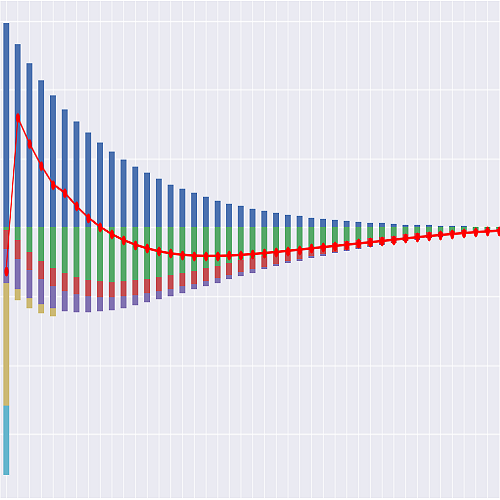
The Projection Space#
The by-policy projection of the WholeLife_KR_S model.
The Space is parameterized by point_id, so Projection[1] is an ItemSpace
projecting model point 1:
>>> Projection[1].result_cf()          # the worked example's anchor cell
>>> Projection.point_id = 5            # or switch the default
t is the 0-based policy-month index: t = 0 is the first policy month, period
t runs from month-end t to month-end t + 1, and the frame is
range(proj_len()) with proj_len() = 12 (omega_age() - age_at_entry() + 1), so the
last index is proj_len() - 1 — 912 on the anchor cell. The contractual policy year is
the 1-based label policy_year(t) = t // 12 + 1, derived and never indexed by, and the
attained 보험나이 is age_at_entry() + t // 12.
Contract terms stay in years; only the grid is monthly. The 납입기간, the 해약공제기간,
loan_year() and reduce_year() are all written in policy years because that is
how the contract writes them, and each has a month-count companion — prem_period_mths(),
surr_chg_period_mths() — for the cells that index the grid. Nothing multiplies a
contractual term by twelve in line.
Values carry a second index, the month-end d = 0 … proj_len() with d = 0 at
issue: pol_val_pp(), surr_chg_pp(), cv_pp(), cum_prem_pp(),
loan_pp() and their companions are values at a point in time rather than flows of a
period, so the flows of month t read d = t as the opening month-end and
d = t + 1 as the closing one — the instant a surrender in that month is paid at. A
계약해당일 is the month-end d = 12y, which is where the published 해약환급금 grids are
quoted and where cv_pp() steps up at 납입완료.
A 종신 contract has no maturity date and no 만기보험금, so the horizon is the terminal age of
the mortality table. Every remaining life dies during the last twelve months, at
attained age omega_age(), where the table rate is 1: mort_rate_mth() spreads that
certainty uniformly over the twelve rather than killing the cohort in the first of them, so
the terminal year is a projected year and not an instant, and nothing is paid there but the
death benefit. There are no tail states.
What the monthly grid moved, and what it did not
The sourced basis is untouched: both disclosed Korean 적용위험률 grids are annual rates
by age [S2] [S8] and the FSS 원칙모형 lapse vector is an annual rate by 경과기간 [REG-R27],
so mort_rate() and lapse_rate() carry them and the monthly decrements
mort_rate_mth() and lapse_rate_mth() are 1 - (1 - q)^(1/12) [std], level
inside a policy year and stepping at each 계약해당일. Twelve monthly exits compound to the
year’s annual rate exactly, so the in-force at every 계약해당일 is unchanged from the
annual-step model this replaced, to 1.1e-14 relative across the shipped model points.
The 계약자적립액 does move, by about 1.2%, and that is the conversion’s substantive
gain. 감독규정 제7-66조제1항제4호 provides that the account accrues monthly before
납입완료 and daily afterwards; an annual grid could carry this product only through
제7-65조제2항’s separate permission to compute it 「연납보험료를 기준으로」, which the model
used to take and record as a [std] departure [REG-R18] [REG-R19]. The monthly grid does
not need the permission: the account accrues at (1 + i)^(1/12) - 1 a month and is built
from a 월납순보험료 struck by monthly equivalence, prem_net_level_mth_pp(). That
premium is not the 연납순보험료 divided by twelve — a monthly equivalence discounts eleven
of each year’s twelve instalments and exposes them to the year’s mortality — and the
resulting account is about half a year’s interest at the 예정이율 above the annual one, which
is exactly the timing an annual grid gave away. The 연납순보험료 survives beside it as
prem_net_level_pp(), because 별표 14 names that quantity and the statutory
표준해약공제액 is computed from it.
The 유지보너스 lapse spike is the one behavioural rate that is not converted: it is 30 percentage points of additional lapse at a bonus date, an election on the day the bonus is credited, so it enters whole in the single month whose end is 납입완료 rather than being smeared over the last paying year.
The age basis is 보험나이
Ages are 보험나이 (boheom nai, insurance age) throughout — the model point’s
issue_age, the mortality table’s index and age(). 보험나이 is the 만 나이 at the
계약일 with a fraction under six months discarded and six months or more rounded up, and it
increments on each 계약해당일 (policy anniversary) rather than on the birthday [REG-R25
제21조]. A monthly grid anchored at issue steps its 계약해당일 exactly twelve months apart,
so t // 12 counts them and the ageing is correct by construction; the attained age is
level through the twelve months of a policy year, interpolating it within the year being a
statement about an age the contract has no concept of. What is not correct by construction is the table: the
public statistics the shipped mort_table.csv is calibrated against — 국가데이터처
완전생명표 and its 기대여명 [REG-R38] — are published on 만나이, and no public mapping
between the two bases exists, so no conversion is applied [std]. The six-month rule
means 보험나이 and 만나이 differ for half of all issue dates, and the resulting bias reads
the table about half a year of ageing too young.
Input data
Inputs are external files: plain CSVs living in the model folder’s parent directory,
products/whole_life/, read at run time rather than stored inside the model. Each table
has a filename Reference and a reader Cells, both on Data, reached
here through the data Reference:
Reference |
Cells |
File |
|---|---|---|
model_point_file |
data.model_point_table() |
model_point_table.csv |
mort_table_file |
data.mort_table() |
mort_table.csv |
lapse_table_file |
data.lapse_table() |
lapse_table.csv |
Naming
Cells names follow lifelib’s basiclife.BasicTerm_S and savings.CashValue_SE
wherever those models have an analogue — pols_* for policy counts, plural nouns for
cash flows, *_rate for rates, *_pp for per-policy amounts, claims(t, kind) with
an uppercase kind string, pols_if_at(t, timing) for the within-month in-force reads.
The technical notes use the compact actuarial symbols of the product specification instead.
t below is the 0-based month index and d the month-end; a cells taking d
is a value at a point in time and not a flow of a period. The mapping is:
Notes symbol |
Cells |
Meaning |
|---|---|---|
(none) |
model_point() |
The selected model point row |
x |
age_at_entry() |
가입나이 (보험나이) at issue |
x + t//12 |
age(t) |
Attained 보험나이 in month t |
t//12 + 1 |
policy_year(t) |
Contractual policy year, 1-based |
omega |
omega_age() |
Terminal age of the table |
T_y |
proj_years() |
Policy years spanned |
T |
proj_len() |
Projected months, 12 T_y |
m |
prem_term(), prem_period() |
납입기간 in years; 0 is 전기납 |
12m |
prem_period_mths() |
납입기간 in months |
(none) |
prem_end() |
Last policy year a premium is due |
n_sc |
surr_chg_period() |
해약공제기간 = min(m, 7) years |
12 n_sc |
surr_chg_period_mths() |
The same, in months |
SA |
sum_assured(), sum_assured_at(t) |
보험가입금액, at issue and in month t |
G |
premium_pp(), premium_at_pp(t) |
Annual 영업보험료, a reporting figure |
G^m |
premium_mth_pp(), premium_mth_at_pp(t) |
Monthly 영업보험료, the month’s income |
(none) |
prem_gross_calc_pp() |
Loaded premium on the model’s own basis |
P |
prem_net_level_pp() |
연납순보험료, the 별표 14 quantity |
P^m |
prem_net_level_mth_pp() |
월납순보험료, what the account consumes |
P20 |
prem_net_20yr_pp() |
연납순보험료 on the 별표 14 20년납 footing |
i |
prem_int_rate |
예정이율, the pricing rate |
j |
prem_int_rate_mth() |
The same, per month |
(declared) |
decl_rate() |
공시이율 on a 금리연동형 contract |
(floor) |
min_guar_rate |
최저보증이율 |
i_acc |
acc_int_rate() |
The rate the account accrues at |
j_acc |
acc_int_rate_mth() |
The same, per month |
q(x+t//12) |
mort_rate(t) |
Annual 적용위험률 in month t |
q^m(t) |
mort_rate_mth(t) |
The monthly decrement applied |
(table q) |
mort_rate_at_age(y) |
Table rate at attained age y |
(table q^m) |
mort_rate_mth_at(u) |
Table monthly rate in month u |
(none) |
mort_be_factor() |
Multiplier on the table rate |
w(t) |
lapse_rate(t) |
Annual 해지율 |
w^m(t) |
lapse_rate_mth(t) |
The monthly decrement applied |
(base w) |
lapse_rate_base(t) |
Before the 유지보너스 spike |
u(t), u^m(t) |
waiver_rate(t), waiver_rate_mth(t) |
납입면제 incidence, annual and monthly |
s |
lapse_spike() |
Additional lapse at a bonus date |
(감액) |
sa_factor(d) |
Proportion of SA in force at d |
V(d) |
pol_val_pp(d) |
계약자적립액 at anniversary d |
(unreduced V) |
pol_val_base_pp(d) |
계약자적립액 before any 감액 |
(prospective V) |
prosp_val_pp(d) |
The same value, prospectively |
SC(d) |
surr_chg_pp(d) |
해약공제액 |
(cap) |
surr_chg_cap_pp() |
표준해약공제액, 별표 14 |
W(d) |
cv_std_pp(d) |
표준형 twin’s 해약환급금 |
k |
cv_floor_ratio() |
Suppression factor |
(none) |
cv_mult(d) |
k before 납입완료, 1 after it |
CV(d) |
cv_pp(d) |
해약환급금 actually payable |
k W(d) |
cv_susp_pp(d) |
Suppressed value at every d |
(bonus) |
bonus_pp(d) |
유지보너스 credited at 납입완료 |
cumprem(d) |
cum_prem_pp(d) |
Premiums paid by anniversary d |
(환급률) |
refund_ratio(d) |
CV(d) / cumprem(d) |
L(d) |
loan_pp(d) |
보험계약대출 balance at month-end d |
D(t) |
loan_draw(t) |
Amount drawn at the start of month t |
i_L, j_L |
loan_int_rate(), loan_int_rate_mth() |
보험계약대출이율 = i + 1.5%, and per month |
l(t) |
pols_if(t) |
In force at the start of month t |
(paying) |
pols_if_pay(t) |
In force and paying premium |
(waived) |
pols_waived(t) |
In force with premiums waived |
l(t)(1-q), l(t+1) |
pols_if_at(t, timing) |
BEF_DECR/BEF_LAPSE/AFT_DECR |
(deaths) |
pols_death(t) |
Expected deaths in month t |
(lapses) |
pols_lapse(t) |
Expected 해지 in month t |
(surrenders paid) |
pols_surr(t) |
Lapses that are not reinstated |
(부활) |
pols_reinstate(t) |
Reinstatements at the start of t |
G lp(t) |
premiums(t) |
Premium income |
(SA - L)D, (CV - L)S |
claims(t, kind) |
Benefit outgo by kind |
ec D(t) |
claim_expenses(t) |
Claim handling expense |
E0, e(t) |
expenses(t) |
Acquisition and maintenance |
(none) |
acq_cost_pp() |
계약체결비용 at issue |
c0, c_r |
commissions(t) |
Commission outgo |
CF(t) |
net_cf(t) |
Net cash flow, income positive |
Three names needed care.
surr_chg_pp is the 해약공제액 and surr_chg_cap_pp the 표준해약공제액 that bounds
it. The cross-library review retired surr_charge_pp for the first; the second is a
Korean quantity with no analogue in any sister library, and the _cap_ in the middle is
what says which of the two a reader is looking at.
cv_floor_ratio is k. The register retired the bare cv_ratio because a Korean
whole life model carries two ratios on the same object — the suppression factor and the
환급률 — and a name that does not say which is which is a bug waiting to be written.
refund_ratio() is the other one.
pol_val_pp is the 계약자적립액, a contractual quantity, and not a reserve. The two
were the same object under a different name until IFRS 17: a pre-2023 상품요약서 writes
「순보험료식 책임준비금에서 해지공제액을 공제한 금액」 and a 2024 one writes 「계약자적립액에서
미상각신계약비를 공제한 금액」 for the identical identity [S2] [S8]. Under K-IFRS 제1117호 the
insurer no longer books a 보험료적립금 as a separate statutory reserve, so the surrender
basis had to be re-anchored on a contractually defined account. This model computes no
책임준비금 at all, and none of pol_val_pp, cv_std_pp or cv_pp may be read as
one.
The 무해지 / 저해지 cliff is a step, not a ramp
CV(d) = k W(d) for d < m and CV(d) = W(d) for d >= m, where W(d) is the
표준형 comparison twin’s surrender value — a non-marketed product with identical
benefits priced with the lapse assumption switched off, which four carriers name in the
same sentence and say they do not sell [S1] [S2] [S3] [S4]. Three consequences follow and
none is optional.
The factor multiplies one policy value, so there is no second account run anywhere in
this model, and CV(t) is independent of the sold form’s own premium. That single fact
is the whole of the 환급률 arithmetic that sells the product: the suppressed form’s
post-완납 surrender value is identical to the 표준형’s while its premiums are lower, so its
refund ratio is mechanically higher — nothing is credited that the 표준형 does not get, the
denominator is simply smaller.
The transition at the anniversary d = m is a step: cv_pp(m) / cv_susp_pp(m) is
exactly 1 / k, and anything between is an interpolation the contract does not have. Both
quantities exist at d = m and the model publishes both.
The step is not a surrender-charge effect. 감독규정 제7-66조제1항제2호 caps the
해약공제기간 at seven years, so on the anchor’s 20년납 contract the charge is fully
amortised by duration 7 — thirteen years before the cliff. The step is the removal of k
and nothing else.
On a 전기납 point (prem_term = 0) the suppressed period runs for life and the step never
happens, which is why one shipped model point is written that way.
Lapse is behavioural, and the lapse vector is the whole argument
No 자동대출납입 was found in any Korean document read for this library. jplib’s
whole life chassis turns on the 自動振替貸付, which advances the premium against the
surrender value at the end of grace and keeps the contract in force, so that lapse there is
a funded event. In Korea, on the evidence retrieved, there is no such test: a policyholder
who misses a 14-day 납입최고기간 loses the contract whatever its cash value, and on a
무해지 form receives nothing at all. That absence is [unverified] rather than
established — the 생명보험 표준약관 is understood to contain such an article and the
retrieved 별표 15 extract does not carry it — and it is the single highest-value item for a
later research pass, because finding one would change this chassis in kind.
So lapse is a behavioural decrement, and which vector it runs on is a supervisory question.
lapse_rate() reads lapse_table.csv by basis. loglinear is the FSS 원칙모형 of
the November 2024 계리가정 decision — a log-linear decay converging on 0.1% at 납입완료,
then an ultimate 0.8% [REG-R27]. flat is the level comparison basis the same
guidance obliges an insurer to disclose against it. The two are shipped side by side
because that comparison is the disclosure, not an afterthought: the problem the supervisor
named was insurers assuming high lapse right up to 완납 on contracts where lapsing pays
nothing, booking CSM that would never be realised. A Korean whole life model that does not
expose the lapse vector as a parameter cannot be used in Korea at all.
Modules that are off in the base run
Six constructions are implemented and switched off, so that the base run reproduces the worked example while the machinery stays visible and testable:
보험계약대출,
loan_utilat 0. Model point 6 draws the contractual maximum — 80% of the payable surrender value — at the start of policy year 10 of a 저해지 contract, the anniversaryd = 9, where the limit is half its 표준형 size; model point 3 makes the same election on a 무해지 contract and draws exactly nothing, because during 납입기간 there is no value to lend against. The rate is a vintage rate, 예정이율 + 1.5% on a 금리확정형 contract and 공시이율 + 1.5% on a 금리연동형 one, so a policy written in a high-rate era carries a high loan rate for life. There is no Korean equivalent of the Japanese loan-excess lapse: the balance is simply deducted from every exit.보험료 납입면제,
waiver_rateat 0 except on model point 7. The trigger is a 50% 장해지급률 aggregated across body parts from one cause, accident or disease alike, and the premiums are deemed paid to the end of 납입기간 for benefit and surrender-value purposes [S2] [S3] [S6] [S8]. That is what makes the waiver an option with value rather than a protection feature: on a suppressed form it is the only route to the cliff that the policyholder does not have to fund.유지보너스,
bonus_rateat 0 except on model point 8, a 7년납 단기납 design crediting 13.8% of total premiums to the 계약자적립액 at 납입완료 [S7]. The supervisor requires an additional lapse of at least 30% at any such bonus date [REG-R27], solapse_spike()turns on with it; turning the bonus on without the spike would misstate the liability in the insurer’s favour, which is exactly what the guidance exists to prevent.금리연동형 crediting,
int_basisfixedexcept on model point 9. The accrual rate becomes a declared 공시이율 floored at a 최저보증이율 of 0.75% [S5], while the net premium stays on the 예정이율 fixed at issue — so the account is genuinely path-dependent and the prospective identitycheck_pol_val_prosp()no longer applies, which is why it is defined as zero there rather than asserted.감액,
reduce_yearat 0 except on model point 10. The reduced portion is treated as surrendered and pays the corresponding 해약환급금 on the basis applying at that duration; the sum assured, the premium and the account all restate pro rata, which is exact here because every one of them is proportional to the 보험가입금액.부활,
reinstate_rateat 0 except on model point 10. A stated proportion of a month’s lapses returns to the paying cohort twelve months later and is not paid a surrender value, which is the substantive effect: 부활 requires that the 해약환급금 has not been drawn, and the 약관 expressly includes the case where there was none to draw — so a 무해지 contract is always reinstatable within three years.
mort_be_factor is the last lever, 1.00 on every point but 10. At 1.00 the base run is a
pricing-table run, not a best estimate: the shipped table is calibrated toward the
insured level implied by the 제10회 경험생명표 summary, and no retrieved source sizes the
margin inside a Korean carrier’s 적용위험률 against its own experience. Claims move
proportionately with it; the terminal rate is held at 1 whatever it is set to, because
omega_age is the horizon of the table and not an experience assumption.
Sign convention
net_cf() is income positive — premiums less claims, expenses and commission —
which is both the notes’ own sign and the library-wide one, so there is no outgo-positive
liability_cf companion to publish: one stream, one sign, one name.
Cells Descriptions#
- sex()[source]#
The sex of the insured, M or F; the two are rated and tabulated separately.
The female premium runs 84%-91% of the male at 보험나이 40 across the three published grids — 87%-91% on their 평준형 rows, down to 84% on the 체감형 and 2종 ones — and the female issue-age ceiling is 3 to 8 years higher at the same payment term everywhere it is stated.
- age_at_entry()[source]#
x: the 가입나이 at issue, on 보험나이, 15 to 65 on the composite envelope.
보험나이 (boheom nai, insurance age) is the 만 나이 at the 계약일 with a fraction under six months discarded and six months or more rounded up, incrementing on each 계약해당일 rather than on the birthday [REG-R25 제21조]. A monthly grid anchored at issue steps its 계약해당일 exactly twelve months apart, so
t // 12counts them and the ageing is correct by construction. The maximum issue age of 65 is much lower than Japan’s 80, and the minimum of 15 is statutory: 상법 제732조 voids a contract on the death of a person under 15.
- sum_assured()[source]#
SA: the 보험가입금액 at issue, level for life on the 평준형 composite.
₩10,000,000 to ₩1,000,000,000 (1,000만원 ~ 10억원) on the composite envelope. One amount pays one benefit: Korea puts no severe-disability acceleration on this chassis, so unlike Japanese whole life there is no second benefit inside the same decrement. The 체증형, 체감형, 전환나이-step and max(가입금액, premiums x ratio) shapes are all real in the market and all excluded from the composite.
- prem_term()[source]#
m: the 보험료 납입기간 in years as entered, with 0 denoting 전기납 (종신납).
The composite menu is 5 / 7 / 10 / 15 / 20 / 30년납, 60 / 65 / 70세납 and 전기납. Korean payment terms are shorter and denser at the front than Japanese ones — 5년납 and 7년납 appear everywhere — and 전기납 is offered but is the default nowhere, which is the 단기납 market structure showing through. On a 전기납 contract there is no 납입완료 date, the suppressed period runs for life and the cliff never occurs; use
prem_period()for the effective number of years.
- prem_period()[source]#
m: the effective 납입기간 in policy years,
proj_years()on a 전기납 contract.A count of policy years and so a 1-based contractual quantity: premiums are due in policy years 1 to m, which are the months
t = 0 ... 12m - 1;prem_period_mths()is that month count. On a 전기납 contract the 납입기간 is every projected year,proj_years()of them.The suppressed period is identical to the premium-paying period on the composite design, so this is also the duration at which
cv_pp()steps up where it steps up at all. Two of the five suppression designs in the source set put the step somewhere else — at seven years on one and at 납입기간 + 3년 on another — which is why the model exposes the date rather than hard-coding it.
- prem_period_mths()[source]#
12 m: the 납입기간 in months — the grid’s own unit for it.
The contract states the 납입기간 in years and the projection steps in months, so the two live in separate cells and nothing converts one into the other by hand. Premiums are due in the months
t = 0 ... prem_period_mths() - 1, the suppressed period runs over the anniversariesd = 1 ... prem_period_mths() - 1, and 납입완료 is the month-endd = prem_period_mths()at which the surrender value steps up.
- prem_end()[source]#
The last policy year in which a premium is due, which is
prem_period().Kept as its own cells because nothing else about the contract stops there: maintenance expense, death claims, surrender benefits and the account all continue for life, and a projection truncated at 납입완료 misses the majority of the liability.
G: the level annual 영업보험료 per policy, a reporting figure and the commission base.
The month’s actual premium income is
premium_mth_pp(), one twelfth of this, paid in advance in the monthst = 0 ... 12m - 1.Level and guaranteed for the whole of 납입기간 on the 금리확정형 composite, with no review and no crediting-rate feedback, which puts every year of it inside any defensible contract boundary. On model point 2 the value is sourced: ₩257,050 a month is published for exactly that cell — 남 40세, 1억원, 종신, 20년납, 월납, 표준형 [S4] — and the annual column in the model point table is 12 times it, no carrier in the set publishing an annual-mode scale. On a monthly grid that multiplication is undone again by
premium_mth_pp(), so the projection collects the published monthly figure itself and the modal discount a real 연납 rate would carry never arises. The anchor’s own premium is that figure times 0.900 [std], a rounding of the 89.9% one carrier publishes for a 50% suppression at its own cell — 남 40세, 5,000만원, 10년납, not this one [S1]. Points 3 and 6 are built the same way, 6 being the anchor with the loan module on; the other six are a [std] loading ofprem_net_level_pp()rounded to the won.prem_gross_calc_pp()reproduces the rule and the fit against the sourced cell is reported in the technical notes.Note that the published figure is already net of the 1.5% 고액계약할인, which bites at the anchor because 1억원 is well above the 3,000만원 threshold [S1]; a model applying the discount again would double-count it.
- prem_susp_ratio()[source]#
The ratio of this form’s premium to the 표준형’s — the price of the suppression.
1.000 표준형; 0.900 at
k = 0.50[std], a rounding of the 89.9% 처브라이프 observation at that suppression factor [S1]; 0.815 atk = 0.30, the DB생명 1종 observation [S4]; and 0.780 atk = 0.00[std], extrapolating the observed relation below the deepest sold design in the set. The observed range across real products is 81.5%-95.4%, deepest discount at deepest suppression. The FSC’s own illustration of a post-2020 design shows 62.2% [REG-R28], much larger than any sold product, and is best read as an illustration of returning the whole give-up as premium rather than as a market observation.
- cv_floor_ratio()[source]#
k: the suppression factor — 1.00 표준형, 0.50 저해지환급형, 0.00 무해지환급형.
A multiplier on one common policy value, not a second reserve basis: from 납입완료 the suppressed and the 표준형 surrender values are identical to the won in every published grid [S1] [S4] [S6]. 0.50 is the composite because it is the modal factor — three carriers — and because 감독규정 제7-66조제4항제2호 attaches two further design conditions only where the value during 납입기간 falls below 50% of the 표준형’s, so a design at exactly 50% sits at the threshold rather than under it [REG-R19]. The 0.30 and 0.00 columns are shipped so the cliff can be seen at all three depths.
- int_basis()[source]#
The crediting basis:
fixed(금리확정형, the composite) orlinked(금리연동형).The composite is 금리확정형 for an evidential reason: the 상품요약서 that publish complete cash values are 금리확정형 [S8], and the one full 약관 retrieved is a 유니버셜 contract whose account mechanics belong to
Pension_KR_SandVA_KR_S[S5].
- decl_rate()[source]#
The declared 공시이율 on a 금리연동형 contract; ignored on a 금리확정형 one.
A Korean declared rate is 공시기준이율 plus or minus a 조정률, and the 공시기준이율 is
외부지표금리 x alpha + 운용자산이익률 x (1 - alpha)with alpha capped at 60% [REG-R23] [REG-R24]. That cap is the modelling point: the rate is majority-weighted to the insurer’s own realised 운용자산이익률 rather than to market yields, which is why a crediting assumption in this library is a slow-moving [std] scalar and not a function of a yield curve. The shipped value on the 금리연동형 point is 2.75%, the 평균공시이율 in force before its 2026 fall to 2.50% [S10] [REG-R48].
- acc_int_rate()[source]#
i_acc: the rate the 계약자적립액 accrues at.
The 예정이율 on a 금리확정형 contract, and the declared 공시이율 floored at the 최저보증이율 on a 금리연동형 one — 감독규정 제7-60조제10호 requires such a product to set a 최저보증이율 or a 최저보증금액, and 연복리 0.75% is the floor stated verbatim in the one full 약관 retrieved [S5] [REG-R16]. The net premium stays on the 예정이율, fixed at issue: only the accrual moves, which is what makes the linked account path-dependent.
- mort_be_factor()[source]#
The multiplier on the table mortality rate; 1.00 in the base run.
1.00 is a choice, not a default: it means the base run is a pricing-table run, not a best estimate. The shipped table is calibrated toward the insured level implied by the 제10회 경험생명표 summary statistics, and no retrieved source sizes the margin a Korean carrier’s 적용위험률 carries against its own experience — the two disclosed grids differ from each other by up to 24% [S2] [S8] - 18%-24% at five of the six published cells and not at all at female 20 - which brackets the level rather than fixing it. A production basis would move claims proportionately.
- waiver_rate(t)[source]#
u(t): the 보험료 납입면제 incidence rate in period t; 0 in the base run.
The transition out of the premium-paying cohort into the waived state, on a 50% 장해지급률 aggregated across body parts from one cause — accident or disease alike — on the 장해분류표 of 생명보험 표준약관 부표 3 [S2] [S3] [S6] [S8] [REG-R25]. Zero once no premium is due, because there is then nothing to waive. The level is [std]: no Korean disability incidence table is public, and the disease riders that extend the trigger — 3대질병 and 6대질병 forms with a 90-day 면책기간 on the cancer limb — are parameterized through the same rate rather than modelled separately.
- waiver_rate_mth(t)[source]#
u^m(t): the monthly 납입면제 incidence,
1 - (1 - u(t))^(1/12)[std].The model point states the incidence annually, because that is the unit a 장해 incidence would be published in if Korea published one. It is a probability over the year, so the constant-force monthly equivalent sits slightly above a twelfth of it and a model dividing by twelve would understate the waived population.
- loan_util()[source]#
The fraction of the contractual 보험계약대출 limit drawn; 0 in the base run.
1.0 draws the contractual maximum. There is no public Korean take-up data of any kind, so both this and
loan_year()are [std] model point inputs; the limit and the rate are sourced.
- loan_year()[source]#
The policy year at whose start the 보험계약대출 is drawn, or 0 for no drawdown.
A contractual, 1-based label read straight from the model point table, so the draw falls in the month
t = 12 (loan_year() - 1), at the 계약해당일d = 12 (loan_year() - 1)that opens it; the model converts the label once, here and inloan_draw(), and never indexes by it. A model point column rather than a fixed Reference, because when the loan is taken is the whole demonstration: a draw during 납입기간 on a 저해지 contract is limited to 80% of the suppressed value, half its 표준형 size, and the same election on a 무해지 contract draws nothing at all. Policy year 1 is rejected: the draw is made off the value at the anniversary it falls on, and atd = 0there is none.
- bonus_rate()[source]#
The 유지보너스 rate credited to the 계약자적립액 at 납입완료; 0 in the base run.
A 단기납 feature rather than a whole-life one: the published rates are 10.8% of total 주보험 premiums on a 5년납 design, 13.8% on a 7년납 and 15.0% on a 10 or 15년납, with a second 18.5% credit at duration 10 on the short terms [S7]. It produces a second step in the surrender-value curve, and it is the feature that produced the 2023-24 refund-ratio competition. Switching it on switches
lapse_spike()on with it, because the supervisor requires an additional lapse of at least 30% at the bonus date [REG-R27].
- reduce_year()[source]#
The policy year at whose closing anniversary a 감액 is made, or 0 for none.
A contractual, 1-based label, like
loan_year(): the reduction falls at the end of the montht = 12 reduce_year() - 1, which is the 계약해당일d = 12 reduce_year(), and the model converts the label once rather than indexing by it. A monthly grid puts the 감액 on its own date, where an annual one could only put it in its year.감액 is universal on this chassis and is a partial surrender: 「그 감액된 부분은 해지된 것으로 보며 … 해지환급금을 계약자에게 지급합니다」 [S5 제20조]. On a suppressed contract that is not a caveat but the main event — a reduction made during 납입기간 pays at
k W(t), and on a 무해지 contract it pays nothing.
- reduce_frac()[source]#
The fraction of the 보험가입금액 surrendered at
reduce_year().The sum assured, the premium and the account all restate pro rata, which is exact on this design rather than an approximation, because each is proportional to the 보험가입금액. The 약관’s own worked example restates 이미 납입한 보험료 by the ratio of the post- to the pre-reduction 계약자적립금 [S5 제20조].
- reinstate_rate()[source]#
The proportion of a year’s lapses reinstated a year later; 0 in the base run.
부활 is available within three years of a 해지, on fresh 고지 and payment of the arrears with interest, and the 약관’s parenthesis is the operative point for this product: the 해약환급금 counts as undrawn 「해지환급금이 없는 경우를 포함」 — so a 무해지 contract is always reinstatable, there having been no value to draw [S5 제26조] [REG-R25 제27조]. That makes lapse on this chassis a non-terminal state. The proportion is [std]; no Korean reinstatement statistic is public. The lag is twelve months, which on a monthly grid is a real interval rather than one step, and the arrears of 제27조 — twelve missed instalments with interest — are still not monetized [std]: recognizing them would need a missed-premium ledger, and what the module exists to produce is a lapse that is not paid a surrender value, which is the substantive effect.
- pols_if_init()[source]#
The number of policies in force at
t = 0, the start of the first policy month: one.Every model point is a single policy, so the whole
result_cf()frame is a per-policy-issued statement and can be scaled by a real portfolio count directly.
- omega_age()[source]#
omega: the terminal age of the mortality table, the first age at which q = 1.
115 on the shipped [std] table, for both sexes. It is a hard model parameter and not a rounding: a 종신 contract has no expiry, so the horizon is the table’s, and projecting a Korean whole life contract to 100 truncates the liability while projecting it to 120 invents one. The 제10회 경험생명표’s own terminal age is not public.
- proj_years()[source]#
T_y = omega - x + 1: the number of policy years the projection spans.
There is no maturity date and no 만기보험금, so the horizon is the mortality table’s and not the contract’s: the last projected policy year is the one at attained age
omega_age(), whose table rate is 1. Kept separate fromproj_len()because a 종신 contract’s own schedules — the 납입기간, the 해약공제기간,loan_year(),reduce_year()— are all written in years, while the projection steps in months.
- proj_len()[source]#
T = 12 (omega - x + 1): the number of policy months projected.
The exclusive end of the frame, counted from
t = 0:result_cf()coverst = 0, ..., proj_len() - 1andlen(result_cf()) == proj_len(). 912 on the anchor cell, a 보험나이-40 life projected to the table’s terminal age 115. It is also the number of month-ends after issue, the value indexdrunning0 ... proj_len().Every remaining life dies during the last twelve months, at attained age
omega_age(), where the table rate is 1:mort_rate_mth()spreads that certainty uniformly over those twelve months rather than killing the cohort in the first of them, so the terminal year has twelve populated rows andpols_if(T)is zero exactly. Nothing is paid at the horizon other than the death benefit.
- policy_year(t)[source]#
y(t) = t // 12 + 1: the contractual policy year of month t, a 1-based label.
Month
t = 0falls in policy year 1. The label exists because the contract’s own schedules are quoted in policy years — the 납입기간m,loan_year()andreduce_year()— and it is derived, never indexed by: every cells of this model is indexed by the 0-based monthtor by the month-endd.
- age(t)[source]#
x + t // 12: the attained 보험나이 in month t.
보험나이 increments on the 계약해당일 and not on the birthday [REG-R25 제21조], and a monthly grid anchored at issue steps its anniversaries exactly twelve months apart, so
t // 12is the number of 계약해당일 passed and the alignment is exact rather than approximate. The attained age is level through the twelve months of a policy year: interpolating it within the year would be modelling an age the contract has no concept of.
- mort_rate_at_age(y)[source]#
The shipped table’s 적용위험률 at attained 보험나이 y, before
mort_be_factor.Read from
mort_table.csv, a [std] construction anchored on the two disclosed carrier grids [S2] [S8] and calibrated to an insured 65세 기대여명 [REG-R38] [REG-R33]; not the 제10회 경험생명표, which is not published. This is the rate the contractual account construction uses, unadjusted:mort_be_factoris a best-estimate lever on the decrement, not a change to the 산출방법서 basis.
- mort_rate(t)[source]#
q(t): the mortality decrement applied in period t, at attained 보험나이
x + t.The table rate times
mort_be_factor(), capped at 1. At the table’s terminal age the rate is held at 1 whatever the factor is:omega_ageis the horizon of the table and a structural property of the projection, not an experience assumption, and scaling it would leave lives alive past the end of the table.There is no separate disability decrement. Korea pays no 고도장해보험금 at the sum assured on this chassis; the disability trigger waives the premium and continues the contract, which is
waiver_rate()and a state rather than an exit.
- mort_rate_mth(t)[source]#
q^m(t): the mortality decrement actually applied in month t.
1 - (1 - q(t))^(1/12)[std] — the uniform-force conversion of the annual best-estimate rate of the policy year monthtfalls in, which is the conversion every monthly model in this library uses. The annual rate is the sourced quantity: both disclosed Korean 적용위험률 grids are annual by age [S2] [S8], so the model reads the annual rate and derives the monthly one, never the other way round. Twelve of these compound back to the year’s annual rate exactly, which is what leaves the in-force at every 계약해당일 where the annual rates put it.At the table’s terminal age the conversion does not apply, the annual rate being 1: a uniform-force reading would kill the whole surviving cohort in the first month of the terminal year and leave eleven empty rows behind it. The certain death is instead spread uniformly over the twelve months —
1 / (12 - j)in thej-th of them, so the last month’s rate is 1 and nobody survives the year — which is the standard UDD reading and keeps the terminal year a projected year rather than an instant [std].
- mort_rate_mth_at(u)[source]#
The table monthly rate in month u from issue, before
mort_be_factor.The contractual basis the 계약자적립액 and the net premium run on, converted to the grid’s own step by the same rule
mort_rate_mth()uses — including the uniform spread at the terminal age. Indexed by the month from issue rather than by attained age, because on a monthly grid the rate of a month depends on how far into the policy year the month sits as well as on the age, andprosp_val_pp()has to walk the months.
- acc_int_rate_mth()[source]#
j_acc = (1 + i_acc)^(1/12) - 1: the rate the account accrues at, per month.
The 연복리 equivalent, so twelve months of accrual compound to the year’s 연복리 rate exactly. 감독규정 제7-66조제1항제4호 provides that the 계약자적립액 accrues monthly before 납입완료 and daily afterwards; both formulas render as images in the 고시 and did not extract, so this is still a [std] reading of them [REG-R19] — but a monthly step is the reading the regulation actually describes for the paying period, where an annual one was an approximation of it.
- prem_int_rate_mth()[source]#
j = (1 + i)^(1/12) - 1: the 예정이율 per month, for the monthly equivalence.
- disc_factor_prem()[source]#
v = 1 / (1 + i): the discount factor of the pricing basis, the 예정이율.
2.50% flat [std], taken as the centre of the 2.25%-2.75% band actually read from six carrier documents [S1] [S2] [S5] [S6] [S7] [S8], on the 0.25 percentage-point grid Korean rate-setting uses, and equal to the 2026 평균공시이율 [REG-R48], which is the regulatory reference rate against which product design is tested. Unlike Japan, Korea publishes the pricing rate — but what carriers publish is a disclosure of it, not the filed 산출방법서.
- epv_death(y)[source]#
A(y): the EPV at attained age y of 1 payable at the end of the year of death.
On the pricing rate and the shipped table, unadjusted by
mort_be_factor. Recursive:A(y) = v [q(y) + (1 - q(y)) A(y + 1)]withA(omega + 1) = 0andq(omega) = 1, soA(omega) = vand the recursion terminates at the table.
- annuity_due(y, n)[source]#
a-due(y, n): the n-year annuity-due of 1 per year at age y, on the pricing rate.
1 + v p(y) a(y + 1, n - 1), zero forn <= 0. Measured in years of premium, soSA A(x) / a(x, m)is an amount per year.
- epv_death_mth(u)[source]#
A^m(u): the EPV at month u from issue of 1 payable at the end of the month of death.
On the pricing rate and the shipped table, unadjusted by
mort_be_factor, walking the monthly grid:A(u) = v_m [q^m(u) + (1 - q^m(u)) A(u + 1)]withA(proj_len()) = 0. It terminates because the last month’s rate is 1 by construction.Indexed by the month from issue rather than by attained age. On an annual grid the attained age was a sufficient index; on a monthly one it is not, the value at a given age depending on how many months of that policy year remain.
- annuity_due_mth(u, n)[source]#
a-due^m(u, n): the n-month annuity-due of 1 per month from month u, pricing rate.
1 + v_m p^m(u) a(u + 1, n - 1), zero forn <= 0. Measured in months of premium, soSA A^m(0) / a^m(0, 12m)is an amount per month — the 월납순보험료 by monthly equivalence, which is what the account recursion consumes.
- epv_death_acc_mth(u)[source]#
A^m(u) on the accrual rate — the same quantity as
epv_death_mth()on i_acc.Identical to
epv_death_mth()on a 금리확정형 contract, where the two rates coincide. It exists so thatprosp_val_pp()can state the prospective form of the account on the rate the account actually accrues at.
- annuity_due_acc_mth(u, n)[source]#
a-due^m(u, n) on the accrual rate; see
epv_death_acc_mth().
- prem_net_level_pp()[source]#
P: the 연납순보험료, fixed at issue by equivalence over the 납입기간.
P a-due(x, m) = SA A(x)on the 예정이율 and the shipped 적용위험률. Three properties of the recursion it feeds are contractual rather than conventional and a model must not lose them: it is net level, so the acquisition cost is not Zillmerised into the account but deducted from it; it runs on the 표준형 net premium, not on the sold form’s lower one; and it is bounded below by nothing, the account being permitted to sit under the surrender charge with the 해약환급금 floored at zero rather than going negative [REG-R19 제7-66조제1항제1호].
- prem_net_level_mth_pp()[source]#
P^m: the 월납순보험료, fixed at issue by equivalence over the 납입기간 in months.
P^m a-due^m(0, 12m) = SA A^m(0)on the 예정이율 and the shipped 적용위험률, both converted to the projection’s own step. This is the premium the 계약자적립액 recursion consumes, and it is notprem_net_level_pp()divided by twelve: a monthly equivalence discounts eleven of each year’s twelve instalments and exposes them to the year’s mortality, which an annual one does not, so the two differ by the timing the annual grid used to give away.prem_net_level_pp()survives beside it as the 연납순보험료, which is the quantity 별표 14 names and the oneprem_gross_calc_pp()loads; that is a statutory and pricing figure rather than a cash flow, and it stays on its annual footing.
- prem_net_20yr_pp()[source]#
P20: the 연납순보험료 recomputed on a 20년납 footing, for 별표 14.
별표 14 주3 recomputes the 연납순보험료 that enters the 표준해약공제액 on a 전기납 basis, or on a 20년납 basis where the 보험기간 is 20 years or more — which for a 종신 contract it always is [REG-R20]. So the statutory surrender-charge cap of every model point here is already normalised to twenty-year pay, whatever the contract’s own payment term, and a 단기납 point’s cap is computed on the same footing as a 20년납 one’s.
- prem_gross_calc_pp()[source]#
G on the model’s own [std] loading rule, for comparison with
premium_pp().prem_loading x P x prem_susp_ratio(). The loading is calibrated once, so that the 표준형 anchor cell reproduces the published 12 x ₩257,050 [S4]; every other shipped point’s premium is generated from this rule and rounded to the won. It is published as its own cells rather than folded intopremium_pp()because the anchor premium is a sourced number and must stay one, and the difference between the two is the fit the technical notes report.No expense basis is behind the loading. Both 상품요약서 in the set define 계약체결비용 and 계약관리비용 and then give no number, and the 산출방법서 that holds the 예정사업비율 is a filed but unpublished 기초서류 [S2] [S5] [S8] [REG-R2].
- surr_chg_cap_pp()[source]#
표준해약공제액: the statutory cap on the surrender charge, from 별표 14.
연납순보험료 x 5% x 해약공제계수 + 보험가입금액 x 10/1000, with the 해약공제계수 for a 보장성보험 equal to the 보험기간 capped at 20 years and the 연납순보험료 recomputed on a 20년납 footing [REG-R20]. A 종신 contract always falls in that case, so the formula collapses to one year’s net premium plus one per cent of the sum assured. The 보험가입금액 that enters it is the 일반사망보험금 taken before any 체증 or 체감 [REG-R21 별표 15 제3호·제8호], which on the 평준형 composite is the face amount itself.This cap has no US or UK analogue at this level of prescription, and it is the reason a Korean surrender-value construction can be defended at all when no insurer publishes an expense rate. The FSC states the same cap as 「보장성보험 월 보험료의 13배 수준」 [REG-R29]; two forms of one rule agreeing to a few per cent is the strongest available check on a parameter nobody publishes.
- surr_chg_period()[source]#
n_sc: the 해약공제기간 = min(m, 7) years.
감독규정 제7-66조제1항제2호: 「해약공제기간은 보험료 납입기간 또는 신계약비 부가기간으로 하되 … 7년 이상일 때에는 7년으로 한다」 [REG-R19]. The duration is fixed by regulation and it is short. On the anchor’s 20년납 contract the charge is fully amortised by duration 7, thirteen years before the cliff — which is why the step at 납입완료 has nothing whatever to do with the surrender charge running off.
- surr_chg_period_mths()[source]#
12 n_sc: the 해약공제기간 in months, the unit
surr_chg_pp()runs off.
- surr_chg_pp(d)[source]#
SC(d): the 해약공제액 embedded in the surrender value at anniversary d,
d = 0at issue.표준해약공제액 x max(0, 1 - d / n_sc)[std] — a straight-line run-off of the unrecovered 계약체결비용, which is what the 약관 defines the deduction to be: 「이미 지출한 계약체결비용 해당액으로서 산출방법서에서 정한 방법에 따라 계산한 금액」 [S5 제2조]. The cap is sourced and exact, the level is set at the cap byacq_cost_pp(), and only the shape between the two ends is standardized, the real run-off living in the unpublished 산출방법서. It scales with any 감액, the 미상각신계약비 of a surrendered portion being written off with it.
- acq_cost_pp()[source]#
계약체결비용: the acquisition cost incurred at issue, per policy [std].
Set at the 표준해약공제액 exactly, which makes
surr_chg_pp()literally the unamortised balance of it and closes the loop between the expense the insurer incurs and the deduction the policyholder bears. Footnote-worthy because nobody publishes the number: 감독규정 제7-45조제11항 exempts a whole-life death-benefit 보장성보험 from publishing a 계약체결비용지수 provided its 계약체결비용 stays within 1.4 x the 표준해약공제액, so a reference implementation sitting at the cap is conservative and defensible [REG-R22]. A research presentation to the FSC’s own public hearing records that competition had pushed some carriers past it [REG-R37].
- comm_init_pp()[source]#
The first-year distributor remuneration per policy [std].
A share of
acq_cost_pp(), capped by 감독규정 제4-32조제5항, under which first-year remuneration may not exceed the first year’s expected premium — with the projected one-year surrender value added to the commission side where the contract deducts 80% or more of the 표준해약공제액, which is exactly what a 무해지 or 저해지 design does [REG-R22] [REG-R29]. The cap binds on the long-payment-term points, where the premium is small against a cap computed on a 20년납 footing — onpoint_id = 4it is the binding constraint. The surrender-value addition is not applied here [std]:cv_pp(1)is zero on eight of the ten shipped points, and on the two where it is not the sum still comes to about half the cap, so carrying it would change no shipped number.
- sa_factor(d)[source]#
The proportion of the issue 보험가입금액 in force at anniversary d, before any 감액 made there.
An anniversary quantity,
d = 0at issue: 1 up to and including the 감액 anniversaryd = reduce_year()— the reduction is paid at that instant on the unreduced value — and1 - reduce_frac()fromd = reduce_year() + 1. Equivalently it is the factor applying throughout the period that closes atd, which is why the period cellssum_assured_at()andpremium_at_pp()read it atd = t + 1. Every quantity proportional to the sum assured — the premium, the account, the surrender charge — is scaled by this one factor, which is exact rather than approximate on a level contract.
- sum_assured_at(t)[source]#
The 사망보험금 in force in period t:
SAscaled by any 감액.Read at the anniversary that closes the period,
d = t + 1: a 감액 made at the start of period t has already cut the benefit the period’s deaths are paid.
G^m: the level monthly 영업보험료 per policy, the month’s actual premium income.
premium_pp() / 12, which on model point 2 recovers the published ₩257,050 a month exactly — that is the figure the carrier prints for the cell, and the annual column in the model point table is twelve times it [S4]. So the monthly grid reads the sourced number directly where the annual grid read a figure derived from it.
The annual 영업보험료 in force in month t, scaled by any 감액; a reporting figure.
Read at
d = t + 1for the same reason assum_assured_at().
The monthly 영업보험료 due at the start of month t, scaled by any 감액.
The premium the contract actually collects in the month, and the one
premiums()andcum_prem_pp()are built from.
- pol_val_base_pp(d)[source]#
V(d): the 계약자적립액 at anniversary d on the issue sum assured,
d = 0at issue.A value at a point in time and not a flow of a period, so its index is the month-end
d = 0 … proj_len()rather than the period indext; the account that opens monthtisV(t)and the one that closes itV(t + 1). The classical net level recursion the product specification states, solved forward on the monthly grid:V(0) = 0 V(d) (1 - q^m) = ( V(d-1) + P^m 1{d <= 12m} ) (1 + j_acc) - q^m SA
with
q^m = q^m(d - 1), the rate of the month just ended, andj_accthe monthly accrual rate.V(T)is defined as zero: in the last month the rate is 1, every remaining life has died and the recursion degenerates.감독규정 제7-65조제1항 says only that 「계약자적립액은 … 산출방법서에 따라 계산한 금액으로 한다」, and 제7-66조제1항제4호 adds that the account accrues monthly before 납입완료 and daily afterwards. Both formulas render as images in the 고시 and did not extract, so this is still a [std] reading of them — but a monthly accrual is the reading the regulation describes for the paying period, where the annual one this model used to run was an approximation of it, defensible only through 제7-65조제2항’s permission to compute the account 「연납보험료를 기준으로」 [REG-R18] [REG-R19].
- pol_val_pp(d)[source]#
V(d): the 계약자적립액 actually held at anniversary d, any 감액 applied.
pol_val_base_pp()scaled bysa_factor(). This is a contractual quantity and not a 책임준비금: under K-IFRS 제1117호 the insurer books no 보험료적립금 as a separate statutory reserve, which is why the 2024 상품요약서 wording re-anchors the surrender basis on 계약자적립액 where the pre-2023 one said 순보험료식 책임준비금 [S2] [S8]. It never produces a cash flow of its own; what it produces iscv_std_pp().
- prosp_val_pp(d)[source]#
The same account at anniversary d, prospectively:
SA A(x+d) - P a-due(x+d, m-d)on i_acc.Equal to
pol_val_base_pp()at every anniversary when the accrual rate is the pricing rate, which is the substantive cross-checkcheck_pol_val_prosp()asserts. The attained 보험나이 at anniversarydisx + d, the age at which perioddopens. On a 금리연동형 contract the two rates differ, the account is genuinely path-dependent, and the prospective form no longer starts at zero — so the check is defined as zero there rather than asserted, and this cells is a diagnostic.
- cv_std_pp(d)[source]#
W(d): the 표준형 twin’s 해약환급금 at anniversary d.
max(0, V(d) - SC(d)). The identity 해약환급금 = 적립금 − 해약공제액 is sourced twice over and the floor is regulatory rather than decorative: 감독규정 제7-66조제1항제1호 says a negative difference 「이를 영(零)으로 처리한다」 [S2] [S8] [REG-R19].This is the quantity the suppression multiplies. Every carrier selling a suppressed form names a comparison product in the same sentence and says it is not sold: 「”표준형”의 경우는 … 동일한 보장내용으로 해지율을 적용하지 않고 … 계산된 상품이며 … 비교안내를 위한 종목으로 실제로 판매하지 않습니다」 [S1], with the same sentence at three more carriers [S2] [S3] [S4]. So there is one account run in this model and one multiplier, never two.
- cv_mult(d)[source]#
The multiplier applying to
cv_std_pp()at anniversary d:k, then 1.kford < mand 1 ford >= m, and the transition is a step. A surrender occurring in policy year m — periodm - 1— is paid at its closing anniversaryd = mon the full value [std ordering]; the suppressed value applies to the anniversariesd = 1 … m - 1, closing policy years 1 to m - 1. Alwayskon a 전기납 contract, where the suppressed period runs for life and the step never happens.
- cum_prem_pp(d)[source]#
cumprem(d): 영업보험료 paid per policy by anniversary d.
An anniversary quantity, like the surrender value it is the denominator of: the premium of policy year
d— the periodd - 1— is the last one included. The denominator of the 환급률, which is the number the product is sold on and the number the supervisor regulates: 감독규정 제7-66조제4항제2호나목 conditions the deepest suppressed designs on their post-완납 환급률 exceeding the greater of 100% and the 표준형’s [REG-R19].
- bonus_pp(d)[source]#
The 유지보너스 credited at 납입완료 and carried thereafter; 0 in the base run.
bonus_rate() x cum_prem_pp(m)from the anniversaryd >= m, an addition to the payable surrender value rather than a change to the account recursion [std] — the credit is made to the 계약자적립액 in the contract, and reproducing that on the annual grid without a published crediting formula would be an invention. Never credited on a 전기납 contract, which has no 납입완료 date.
- cv_pp(d)[source]#
CV(d): the 해약환급금 actually payable at anniversary d, per policy.
cv_mult(d) W(d)plus any 유지보너스. Everything derived from the surrender value is suppressed with it — the 보험계약대출 limit and the 감액 proceeds are computed off this number and not offW— so on a 무해지 contract during 납입기간 both are zero, a point the FSS made in terms in its 2019 소비자경보 and the 표준약관 repeats [REG-R28] [REG-R25 제33조].
- cv_susp_pp(d)[source]#
k W(d): the suppressed value at every anniversary, step or no step.
The value an instant before the step at
d = m, against whichcv_pp()an instant after must stand in the exact ratio1 / k. On the fullest published run — 남 40세, 5,000만원, 10년납, a 50% factor — the payable value goes from ₩25,640,000 at duration 9 to ₩57,655,500 at duration 10, a 2.25 x step in one year, and the 환급률 from 49.9% to 101.0% [S1].
- refund_ratio(d)[source]#
환급률: the payable surrender value over cumulative premiums paid, at anniversary d.
Zero where no premium has yet been paid. The suppressed form’s ratio after the cliff is mechanically higher than the 표준형’s — 116.4% against 94.9% at duration 20 on one published grid [S4] — because the post-완납 values are identical while the premiums are not. Nothing is credited that the 표준형 does not get; the denominator is smaller.
- lapse_rate_base(t)[source]#
The base annual 해지율 in period t, before any bonus-date spike.
Written on the contractual policy year
y = policy_year(t) = t + 1, because that is what the two published endpoints are quoted against: the first-year rate isy = 1, the periodt = 0. On theloglinearbasis, log-linear in the rate from the first-year value to the completion value aty = m, then flat at the ultimate value — the FSS 원칙모형 of the November 2024 계리가정 decision, whose practical convergence point is 0.1% at 납입완료 and whose ultimate rate is 0.8% [REG-R27]. On theflatbasis, a level rate throughout. The endpoints are read fromlapse_table.csv; the shape between them is [std], no Korean lapse curve by duration being public. Two independent bases exist in Korea and they do not agree: the pricing 적용해지율 is disclosed in the 상품요약서 at 연 1%~10% during 납입기간 at one carrier and 연 0%~13.4% at another [S2] [S8], while the valuation basis above is much lower. This is the single largest assumption gap on this product.
- lapse_spike()[source]#
s: the additional 해지율 applied at a 유지보너스 date; 0 unless the bonus is on.
30 percentage points, and it is not a behavioural guess: the supervisor requires an additional lapse of at least 30% at any bonus date on a 단기납 design, or a rate backed out of the 표준형 product’s cumulative persistency, calibrated to the 29.4%-30.2% eleventh-year lapse observed on single-premium bancassurance savings [REG-R27]. Turning the bonus on without turning the spike on would misstate the liability in the insurer’s favour, which is exactly what the guidance exists to prevent.
- lapse_rate(t)[source]#
w(t): the annual 해지율 of the policy year month t falls in.
The base rate plus any bonus-date spike, capped at 1 — the rate as the supervisor states it, by policy year. It is the sourced quantity and the reporting one;
lapse_rate_mth()is what the roll-forward applies.A lapse is not a pure decrement here: unless it is reinstated it pays
cv_pp()net of any 보험계약대출 — and on a 무해지 contract during 납입기간 that is nothing at all, the whole of the accumulated value being forfeited to the fund. That is the consumer-detriment finding behind the 2019 소비자경보 [REG-R28].
- lapse_rate_mth(t)[source]#
w^m(t): the monthly 해지율 applied at the end of month t.
1 - (1 - w_base(t))^(1/12)[std] on the base curve, which is level inside a policy year and steps at each 계약해당일 because the vector the FSS 원칙모형 prescribes is written by 경과기간 in years [REG-R27].The 유지보너스 spike is not converted. It is 30 percentage points of additional lapse at a bonus date — a discrete election on the day the bonus is credited, not a force acting through a year — so it enters whole, in the single month whose end is 납입완료,
t = prem_period_mths() - 1, and nowhere else. The annual grid had to smear it over the twelfth of the contract that is the last paying year; on this grid it sits on its date, which is what the supervisor’s requirement of an additional lapse at any bonus date actually describes [REG-R27].
- loan_int_rate()[source]#
i_L: the 보험계약대출이율 — 예정이율 + 1.5%, or 공시이율 + 1.5% on a 금리연동형.
The formula 「적용이율 + 1.5%」 / 「예정이율 + 1.5%」 is stated at three carriers independently, with a 가산금리 of +1.40%~1.50% at one [S9] [S11] [S13]. It is a vintage rate: because the base is the contract’s own 예정이율, a policy written in a high-rate era carries a high loan rate for life — one carrier’s live published range spans 연 3.5%~10.5% across its in-force book, under a 최고 적용 대출이율 of 9.90% [S11] [S12]. Korea’s sharpest contrast with Japan here is that the rate is standard across the market and the limit is not.
- loan_int_rate_mth()[source]#
j_L = (1 + i_L)^(1/12) - 1: the 보험계약대출이율 per month.
The 연복리 equivalent of the contractual rate, so twelve months of capitalisation compound to the year’s rate exactly. A Korean policy loan accrues 「일별」 in the 약관 and is settled at repayment or at the next exit; a monthly step is the projection’s own approximation of that and is one step closer to it than an annual one [std].
- loan_draw(t)[source]#
D(t): the 보험계약대출 drawn at the start of period t; zero in the base run.
A single drawdown in policy year
loan_year()— the periodloan_year() - 1[std] — of the elected fraction of the contractual limit, which is 80% of the payable 해약환급금 at the anniversary the draw is made at,d = t, net of any existing balance. The observed limits run 50%-85% at one carrier and 50%-80% at another, and the whole value net of the existing loan in the one full 약관; the composite takes 80% [S5 제34조] [S11] [S13] [REG-R25 제33조].Because the limit is a fraction of the payable value it is suppressed with it: half its 표준형 size on a 저해지 contract during 납입기간, and zero on a 무해지 one.
- loan_pp(d)[source]#
L(d): the 보험계약대출 principal and interest at anniversary d,
d = 0at issue.An anniversary quantity, so
L(t)is the balance opening periodt— the balance every benefit of that period is settled net of — andL(t + 1)the balance closing it.L(d + 1) = (L(d) + D(d)) (1 + i_L), compound, with interest capitalised into principal and no repayment modelled [std] — repayment is permitted at any time without fee, and no Korean repayment statistic is public. Identically zero in the base run, where every benefit is therefore gross.The balance is settled first on every exit: deducted from a death claim, from a voluntary 해약 and, 즉시, from the 해약환급금 on 해지 for non-payment [S5 제34조] [REG-R25 제26조]. Korea has no equivalent of the Japanese loan-excess lapse notice — the deduction is automatic and termination is driven by the demand period, not by the balance — so a balance that outgrows the value simply floors the payment at zero.
- pols_waiver(t)[source]#
Policies moving out of the paying cohort into the 납입면제 state at the start of period t.
pols_if_pay(t) u(t). Zero in the base run, and zero once no premium is due.
- pols_pay_exp(t)[source]#
The premium-paying cohort exposed to the period-t decrements, after the waiver exit.
- pols_waived_exp(t)[source]#
The 납입면제 cohort exposed to the period-t decrements, this period’s entrants included.
- pols_if_pay(t)[source]#
The premium-paying cohort in force at the start of period t.
pols_if_init()att = 0, then the survivors of the previous period’s mortality and lapse plus any 부활. Equal topols_if()in the base run, where no policy ever enters the waived state.
- pols_waived(t)[source]#
The 납입면제 cohort in force at the start of period t.
A distinct in-force state with its own persistency: no premium income, full benefit outgo, full account accrual — the premiums are deemed paid to the end of 납입기간 for both the 사망보험금 and the 해약환급금 [S2] [S3] [S6] [S8] — and the ordinary mortality and lapse decrements. Carrying the same lapse rate as the paying cohort is [std]: no Korean persistency statistic distinguishes the two.
- pols_if(t)[source]#
l(t): the number of policies in force at the start of period t, i.e. at time t.
The premium-paying cohort plus the 납입면제 cohort. This is the weight on every cash flow of the same
result_cf()row. It ispols_if_init()att = 0and 0 atproj_len(), because the table terminates and every remaining life dies in the last periodproj_len() - 1.
- pols_if_at(t, timing)[source]#
The number of policies in force at a point inside period t.
"BEF_DECR"l(t), the start of the period, before anything happens; the same number as
pols_if()and the weight on that period’s cash flows."BEF_LAPSE"after deaths and before 해지 — the processing order is death before lapse [std order] — so this is the population surrenders and any 감액 are taken from.
"AFT_DECR"l(t+1) before any 부활, and zero in the last period
proj_len() - 1because the table’s terminal rate is 1 and nobody survives it.
- pols_death(t)[source]#
Expected 사망보험금 claims in period t, falling at the end of the period.
One decrement on one amount. There is no 고도장해 acceleration to add and no separate disability exit: the disability trigger on a Korean 종신보험 waives the premium and the contract continues, which is
pols_waiver().
- pols_lapse(t)[source]#
Expected 해지 at the end of period t, on the survivors of mortality.
The gross count. Those that return under 부활 a year later are
pols_reinstate()and are not paid a surrender value; the rest arepols_surr().
- pols_reinstate(t)[source]#
부활: policies returning to the paying cohort at the start of period t.
reinstate_rate()of the previous period’s lapses, a one-year lag [std] that sits well inside the three-year 부활 window [S5 제26조] [REG-R25 제27조]. Zero in the base run. The 보장개시일 resets on reinstatement, restarting the two-year suicide clock and both contestability clocks — none of which produces a cash flow here, so the resetting is stated and not modelled.
- pols_surr(t)[source]#
The lapses of period t that are actually paid a 해약환급금.
pols_lapse(t)less those reinstated a year later. The 약관 conditions 부활 on the 해약환급금 not having been drawn, so a policy that comes back is one that was never paid out — and the parenthesis 「해지환급금이 없는 경우를 포함」 is what makes a 무해지 contract always reinstatable [S5 제26조].
Premium income at the start of period t, an inflow.
Carried on
pols_pay_exp()alone: the 납입면제 cohort pays nothing while its premiums are deemed paid for every benefit purpose, which is the whole point of the waiver and the reason it is a state rather than a rate adjustment. Zero oncepolicy_year(t)passesprem_end(); nothing else about the contract stops there.
- claims(t, kind=None)[source]#
Benefit outgo in period t, by kind; the total when kind is omitted.
Every kind is settled net of the 보험계약대출 balance opening the period,
loan_pp(t), and the surrender-value kinds are paid on the value at the anniversary that closes it,cv_pp(t + 1)."DEATH"the 사망보험금 at the end of the period of death,
(SA - L) D(t)floored at zero. The benefit is net of any outstanding 보험계약대출 원금과 이자 [S5 제34조] [REG-R25 제33조]. A refused claim is not a zero-payment event in Korea — 상법 제736조 obliges the insurer to pay 「보험수익자를 위하여 적립한 금액」, in practice the 계약자적립액 — but the composite carries no exclusion incidence, so nothing is deducted here for one [std]."LAPSE"the 해약환급금 on voluntary 해지,
(CV(t+1) - L) S(t)floored at zero, paid on the survivors of mortality that are not reinstated. On a 무해지 contract during 납입기간 this is identically zero: there is no surrender cash flow at all until 납입완료, which is precisely why the lapse assumption over that period is worth so much CSM."REDUCTION"the 감액 proceeds,
f (CV(t+1) - L)on the continuing policies at the reduction anniversary — the one closing policy yearreduce_year(), i.e. the periodt = reduce_year() - 1. The reduced portion is treated as surrendered and paid on the basis applying at that duration, so a reduction made during 납입기간 pays atk W(t+1).
Every one of these is floored at zero: a loan can outgrow both the surrender value and, given long enough, the sum assured, and none of them may produce a negative payment.
- claim_expenses(t)[source]#
The claim handling expense on the period’s death claims [std].
₩300,000 per claim, uninflated. No Korean expense rate as a percentage of premium was obtained from any source: both 상품요약서 in the set define 계약체결비용 and 계약관리비용 and then give no number, and the 산출방법서 that holds the 예정사업비율 is a filed but unpublished 기초서류 [S2] [S5] [S8] [REG-R2]. Published as its own
claim_expensescolumn inresult_cf()and deducted explicitly innet_cf(); it is not insideexpenses().
- inflation_factor(t)[source]#
The expense inflation factor in period t:
(1 + pi)^t[std], 1 att = 0.2.0% a year, the Bank of Korea’s own inflation target, chosen because no Korean expense basis exists to anchor anything better. Over an eighty-year whole-life horizon 2% compounds to 4.9, so the assumption is load-bearing on the tail and is held as its own parameter for that reason.
- expenses(t)[source]#
계약체결비용 and 계약관리비용 in period t [std] — acquisition and maintenance.
At issue, the part of
acq_cost_pp()not paid away ascomm_init_pp(). Thereafter the 계약관리비용, which the 약관 subdivides into 유지관련비용 and 기타비용 and quantifies nowhere: ₩5,000 per policy a month — the same ₩60,000 a year — inflating at 2% a year and stepping at the 계약해당일, plus 2% of premium income while premiums are paid. Maintenance continues for life, not to 납입완료 — that is the structural point of this product, a contract on which premiums stop after m years and obligations do not. There is no separate surrender expense; it is folded into maintenance [std]. The claim handling expense is not here: it isclaim_expenses(), published in its own column.
- commissions(t)[source]#
Commission outgo in period t [std].
comm_init_pp()at issue, then 3% of premium income from the start of policy year 2 — the montht = 12— to 납입완료. Renewal commission rides onpremiums(), so it stops when the 납입면제 stops the premium and when the 납입기간 ends. Both levels are standardizations; no Korean carrier publishes a commission scale, and what regulation supplies instead is a cap — first-year remuneration within the first year’s expected premium, and an obligation to offer an instalment structure paying no more than 60% of the 표준해약공제액 a year [REG-R22] [REG-R29]. No renewal commission is paid after 납입완료: a projection that keeps charging it there is charging commission on a premium nobody pays.
- net_cf(t)[source]#
CF(t): the net cash flow of period t, income positive.
Premiums less death claims, surrender and 감액 benefits, claim handling expense, acquisition and maintenance expense and commission. The library-wide sign, which is also the notes’ own, so there is no outgo-positive
liability_cfcompanion.The shape to expect on a suppressed form is a new business strain at
t = 0, a long positive stretch while the premium runs and the surrender value is suppressed, and then a sign change att = prem_end()— policy yearprem_end() + 1, the first period in which the premium stops and nothing else does. The cliff itself moves less cash than a reader expects, and that is the point. The payable value steps up by1 / kat 납입완료, but the FSS 원칙모형 puts the lapse rate at 0.1% in exactly that year, so almost nobody is there to be paid the step; the surrender outgo jumps in the year after it, when the rate returns to its 0.8% ultimate against a value that has doubled. Run the same point on theflatlapse basis and the cliff produces a visible one-year hole instead — which is the whole reason the two bases are shipped side by side [REG-R27].
- check_pols_roll_fwd_resid(t)[source]#
The in-force roll-forward residual in period t; zero everywhere.
l(t) - l(t+1)less deaths and lapses plus the 부활 entering att + 1. The last term is zero in the base run and is what makes the identity close when the module is on: a policy that comes back has not left, and netting it inside the lapse count instead would hide a decrement.
- check_pols_roll_fwd()[source]#
True when the in-force roll-forward closes in every projected period.
The library-wide form of a roll-forward check: no argument, one bool over all t, so one test can call it across every model.
check_pols_roll_fwd_resid()gives the signed residual of the period that failed.
- check_decrement_sum_resid(t)[source]#
The cumulative-decrement residual at period t; zero everywhere.
l(0)plus every 부활 up tot + 1, less every exit up to and including period t, lessl(t+1). Att = T - 1it is the statement that the decrements sum to one: because the table terminates, every policy leaves by one of them,l(T) = 0, and there is no residual population and no tail state anywhere in this model.
- check_decrement_sum()[source]#
True when every policy issued leaves by a modelled decrement, in every period.
- check_pol_val_roll_fwd_resid(t)[source]#
The 계약자적립액 recursion residual over period t; zero everywhere.
(V(t) + P^m 1{t < 12m}) (1 + j_acc) - [q^m SA + (1 - q^m) V(t+1)]on the issue sum assured and the table rate — the roll from the month-end opening monthtto the one closing it. It catches a mis-set 납입기간, a rate applied on the wrong side and an off-by-one in the month the rate is read at. The last month is excluded: there the rate is 1, the recursion degenerates andV(T)is defined as zero rather than solved.
- check_pol_val_roll_fwd()[source]#
True when the account rolls forward on its own basis in every period but the last.
- check_pol_val_prosp_resid(d)[source]#
The retrospective-to-prospective residual at anniversary d; zero everywhere.
V(d) - [SA A^m(d) - P^m a-due^m(d, 12m - d)], the substantive cross-check on the account: the forward recursion and the closed-form prospective value must agree, and they do only if the net premium, the payment period and the discount basis are all consistent — and, on this grid, only if all three are on the monthly footing. A model that kept an annual net premium in a monthly recursion would fail here rather than quietly running an account nobody priced.Defined as zero on a 금리연동형 contract, where the account accrues at the 공시이율 while the net premium is fixed on the 예정이율: the account is then genuinely path-dependent, the prospective form does not start at zero, and the identity is not a property of the contract.
- check_pol_val_prosp()[source]#
True when the account’s retrospective and prospective forms agree at every month-end.
The tolerance carries a twelvefold allowance the annual grid did not need, and the reason is arithmetic rather than modelling.
pol_val_base_pp()is a forward recursion that divides by1 - q^mat every step, and in the terminal yearmort_rate_mth()runsq^m = 1/(12 - j)up to 1, so the twelve divisors multiply out to exactly 12: any rounding already carried in the account is amplified twelvefold over the last twelve month-ends and nowhere else. On the largest shipped model point — ₩1,000,000,000 of cover — that shows as a residual of about ₩110 against an account near ₩1bn, a relative 1.1e-7, and it is float noise rather than a basis disagreement: every month-end before the terminal year closes to a hundredth of a won. Widening the allowance by the amplification factor keeps the check as strong as it was on the annual grid at every duration that is not the last year of a life table.
- check_surr_chg_cap_resid(d)[source]#
The 표준해약공제액 breach at anniversary d; zero everywhere.
Two regulatory bounds in one residual: 해약공제액 may not exceed the 표준해약공제액 of 별표 14 [REG-R20], and it must be gone by the end of the 해약공제기간, which 감독규정 제7-66조제1항제2호 caps at seven years [REG-R19]. Both are properties of the construction here, and asserting them is what keeps a later change to the run-off shape honest.
- check_surr_chg_cap()[source]#
True when the 해약공제액 stays under the statutory cap and dies at the 해약공제기간.
Swept over every month-end of the run,
d = 0 … proj_len(), issue and horizon included.
- check_cv_cliff_resid(d)[source]#
The suppression residual at anniversary d; zero everywhere.
CV(d) - [k W(d) 1{d < m} + W(d) 1{d >= m}] - bonus. It is the wiring of the product’s signature mechanic: one policy value, one multiplier, a step at 납입완료 and nothing in between. A ramp introduced anywhere — the shape two of the five suppression designs in the source set actually use, and which this composite deliberately does not — shows up here rather than quietly changing the answer.
- check_cv_cliff()[source]#
True when the payable value is the multiplier times the twin’s, at every anniversary.
Three things at once: the residual above closes; the suppressed and 표준형 values are identical from 납입완료, which every published grid confirms to the won [S1] [S4] [S6]; and the payable value never exceeds the 표준형 twin’s at any duration, which is what
k <= 1on one common policy value means.That is the value test and not the 환급률 test. 감독규정 제7-66조제4항제2호나목 conditions the deepest designs on their post-완납 refund ratio exceeding the greater of 100% and the 표준형’s [REG-R19], while the FSC’s own announcement of the same amendment frames it the other way — 「전(全) 보험기간 동안 표준형 보험의 환급률 이내로」 [REG-R28]. The two readings differ because the denominators differ: the suppressed form’s premiums are lower, so a value that is never above the 표준형’s produces a ratio that is always above it after 납입완료. Both statements are recorded in
product-spec.mdas they stand and neither is asserted here as a ratio.
- check_loan_roll_fwd_resid(t)[source]#
The 보험계약대출 roll-forward residual over period t; zero everywhere.
L(t + 1) - (L(t) + D(t)) (1 + j_L)— the roll from the month-end opening monthtto the one closing it, on the monthly loan rate. Identically zero in the base run, where there is no loan at all; non-trivial the moment the module is switched on, which is the point of it. It also catches the 무해지 case, where the draw is zero because the payable value is zero and the balance must therefore stay at zero for ever.
- check_loan_roll_fwd()[source]#
True when the loan balance accumulates at the 보험계약대출이율 in every month.
- check_acq_cost_cap_resid(t)[source]#
The acquisition-cost overrun in period t; zero everywhere.
Non-zero only at
t = 0, both charges falling at issue; the argument is carried so that the cells keeps the library’s residual signature. Two published bounds: 계약체결비용 within 1.4 x the 표준해약공제액, the tolerance under which a whole-life death-benefit 보장성보험 need not publish a 계약체결비용지수 [REG-R22 제7-45조제11항]; and first-year remuneration within the first year’s expected premium [REG-R22 제4-32조제5항].
- check_acq_cost_cap()[source]#
True when the acquisition cost and the first-year commission are inside their caps.
- check_net_cf_resid(t)[source]#
The published cash-flow statement’s residual in period t; zero everywhere.
net_cf()less the publishedresult_cf()columns of the same row. It closes the loop between the total benefit outgo and the three kinds that make it up, so a fourth kind added toclaims()and left out of the statement shows up here rather than silently vanishing from it.
- check_net_cf()[source]#
True when the net cash flow equals the sum of its published columns, every period.
- result_cf()[source]#
Result table of cash flows, indexed by the 0-based period index t.
t = 0is the first policy year and the frame isrange(proj_len()), so the last row isproj_len() - 1.pols_ifis the start-of-period count, which is the weight applied to every cash flow on the same row.net_cfcarries the income-positive sign.expensesis acquisition and maintenance; the claim handling expense is beside it inclaim_expenses, as it is in every model in the six libraries.claims_reductionis a column of zeros on every model point but one and is published rather than dropped, because 감액 is universal on this chassis and is the only partial-surrender route Korea offers — 감액완납 and 연장정기보험 appear in no retrieved Korean document.
- result_pols()[source]#
Result table of policy counts and decrement rates, indexed by the same 0-based t.
- result_val()[source]#
Result table of the account, the surrender charge and the surrender value, by period t.
Indexed by the same 0-based
tasresult_cf(), so the two read together — but the value columns are anniversary quantities, and the anniversary that belongs on the row of periodtis the one that closes it,d = t + 1: that is the value a surrender in that period is paid on.loan_ppis the balance at the start of the period,d = t, because that is the balance every benefit of the period is settled net of.cv_ppis the amount payable andcv_susp_ppthe suppressed value at every anniversary, so the step at 납입완료 and the value an instant before it can be read off the same table.refund_ratiois the 환급률 the product is sold on and the ratio the supervisor regulates.