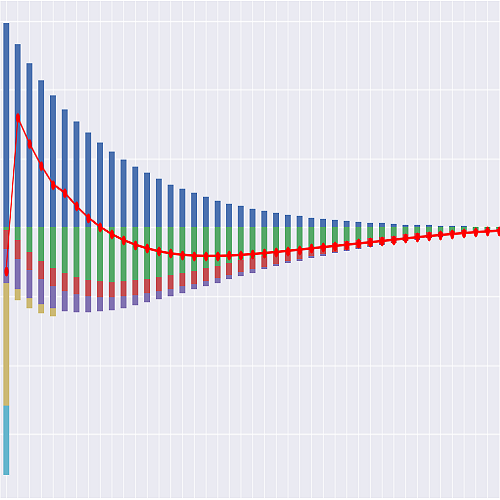
The Projection Space#
The by-policy projection of the WP_UK_S model.
The Space is parameterized by point_id, so Projection[1] is an ItemSpace
projecting model point 1:
>>> Projection[1].result_cf()          # the worked example's scenario A
>>> Projection.point_id = 2            # scenario B, the down market
t counts policy months from issue and is 0-based, as everywhere in lifelib:
t = 0 is the issue month, month t runs from time t to time t + 1, and
the contractual policy year containing it is the 1-based label
policy_year(t) = t // 12 + 1. An in-force model point opens the frame at
t = proj_start() = 12 x duration_inforce(), the elapsed months — so the worked
example’s bond, in force at duration 5, is projected from t = 60, the first month of
its sixth policy year. The state carried into that month (the asset share, the smoothed
payout, the unit price, the guaranteed benefit) is its opening value, read through
asset_share_at(t, "BEF_PREM") and the *_open cells rather than through a row
below the frame. The frame is range(proj_start(), proj_len()): proj_len() is
the number of policy months projected from issue, so the last month is
proj_len() - 1.
A monthly grid with an annual discretion cycle
This is the one thing to hold on to about this model. The notes’ rationale for an annual
grid was that bonus declarations are annual — they are the governing act of
discretion, and a declaration permanently hardens the guarantee. That is a fact about
the product, not about the grid, and it survives the move to monthly steps intact: the
declaration still fires once a policy year, in the twelfth month,
is_declaration_month(). Everything continuous runs monthly around it — the fund
return, the charges, the mortality charge, the decrements, the smoothed payout, the
final bonus and the market value reduction — and everything discretionary stays where
the contract puts it.
So unit_price() and guar_benefit_pp() are step functions of the policy
year, flat for eleven months and stepping in the twelfth; cost_of_bonus_pp() and
shareholder_transfer_pp() are nil in eleven months out of twelve;
bonus_rate() is the annual rate declared for the policy year the month falls
in, and the ±1% gradual-change discipline is applied once a year to it rather than
twelve times. check_declaration_is_annual() asserts all of that, because the way
this conversion goes wrong quietly is by compounding an annual bonus rate monthly: the
model still runs, the roll-forwards still close, and the guarantee is an order of
magnitude too large a decade later.
The annual rates the assumptions are quoted in — the fund return, the annual management
charge, the guarantee charge, mortality, surrender, expense inflation and the ±10%
smoothing cap — are converted with the effective (1 + r)^(1/12) and
1 - (1 - r)^(1/12) forms [std], so twelve months compound back to the annual
figure exactly and the basis does not move with the grid.
Two things the monthly grid genuinely says better than the annual one, and both are
about the guarantee date. First, a guarantee date is a date: an exit in that month
is MVR-free and an exit in the other eleven months of the same policy year is not, which
mvr_applied_pp() can now express. Second, the anti-selective encashment that
follows from it is a dated exercise rather than a year-long elevation of the surrender
rate, which is guarantee_exercise(). That second change moves an assumption’s
shape and not merely its frequency, and its docstring says so.
Input data
Inputs are external files: plain CSVs living in the model folder’s parent
directory, products/with_profits/, read at run time rather than stored inside the
model. The model folder therefore holds nothing but formulas — no _data/, no
IOSpec, no embedded values — so a diff of the model shows logic changes only, and an
input can be edited or swapped without rewriting the model. This follows
annuallife.TradLife_A; contrast basiclife.BasicTerm_S, which keeps its inputs
inside the model through modelx’s IOSpec machinery.
The consequence worth knowing: the model is not portable on its own. Copying the
WP_UK_S folder without its parent’s CSVs produces a model that reads and then fails
on first evaluation.
Each table has a filename Reference and a reader Cells, both on Data,
reached here through the data Reference:
Reference |
Cells |
File |
|---|---|---|
model_point_file |
data.model_point_table() |
model_point_table.csv |
mort_table_file |
data.mort_table() |
mort_table.csv |
lapse_table_file |
data.lapse_table() |
lapse_table.csv |
Naming
Cells names follow lifelib’s basiclife.BasicTerm_S wherever that model has an
analogue — pols_* for policy counts, plural nouns for cash flows, *_rate for
rates, *_pp for per-policy amounts, claims(t, kind) and claim_pp(t, kind)
with an uppercase kind string. The technical notes use compact symbols instead. The
mapping is:
Notes symbol |
Cells |
Meaning |
|---|---|---|
chassis |
chassis() |
UWP_bond or CWP_endowment |
t |
(the cells argument) |
Policy month index, 0-based |
t // 12 + 1 |
policy_year(t) |
Contractual policy year label |
(none) |
duration(t) |
Completed policy years, t // 12 |
(none) |
duration_mth(t) |
Months elapsed since issue, = t |
(none) |
is_declaration_month(t) |
The twelfth month of a policy year |
(none) |
declaration_month(t) |
That month, for the year holding t |
x |
age_at_entry() |
Entry age (ANB) |
x + duration(t) |
age(t) |
Attained age (ANB) |
duration_ifo |
duration_inforce() |
Completed years at valuation |
(none) |
proj_start() |
First projected t, = 12 x duration_ifo |
n |
policy_term() |
Endowment term in years |
(none) |
proj_len() |
Policy months from issue, exclusive end |
(none) |
fund_exhaust_mth() |
Month the bond’s units run out |
(none) |
is_forced_encashment() |
Whether the run ends there |
P(t) |
premium_pp(t) |
Premium received at BOM |
W(t) |
wd_pp(t) |
Partial withdrawal at BOM |
W_AS(t) |
wd_as_pp(t) |
Asset-share reduction for it |
r |
fund_return() |
Earned fund return, annual |
r_m |
fund_return_mth() |
The same, monthly |
c_amc |
amc_rate |
Annual management charge |
(monthly) |
amc_rate_mth() |
The same, monthly |
c_g |
guar_charge_rate(t) |
Guarantee/smoothing charge, annual |
(monthly) |
guar_charge_rate_mth(t) |
The same, monthly |
CumGC(t) |
guar_charge_cum_pp(t) |
Cumulative guarantee charge |
AS(t) |
asset_share(t) |
Asset share at the end of month t |
(the steps) |
asset_share_at(t, timing) |
The asset share inside month t |
AS(t-1) |
asset_share_at(t, “BEF_PREM”) |
The balance month t opens with |
M(t) |
misc_surplus_pp(t) |
Estate distributions; 0 in base |
Q(t) |
unit_price(t) |
With-profits unit price |
U(t) |
units(t) |
Units held |
FV(t), G(t) |
guar_benefit_pp(t) |
Guaranteed benefit |
FV(t-1), G(t-1) |
guar_benefit_open(t) |
The guarantee month t opens with |
(pre-MVR value) |
policy_value_pp(t) |
Guaranteed benefit + final bonus |
(opening value) |
policy_value_open(t) |
The pre-MVR value at its open |
b, b_rev |
bonus_rate(t) |
Declared annual bonus rate |
b_supp |
bonus_supportable(t) |
Rate the guarantee-fill implies |
theta, kappa |
guar_fill_target, bonus_speed |
Bonus-rule parameters |
CB(t) |
cost_of_bonus_pp(t) |
Cost of the declared bonus |
ST(t) |
shareholder_transfer_pp(t) |
CB/9, the 90:10 transfer |
MC(t) |
mort_charge_pp(t) |
Mortality charge to the AS |
DB_g(t) |
death_guar_pp(t) |
Guaranteed death benefit |
q(x+t) |
mort_rate(t) |
Annual mortality rate |
q_m(t) |
mort_rate_mth(t) |
Monthly mortality rate |
w(t) |
surr_rate(t) |
Annual ordinary surrender rate |
w_m(t) |
surr_rate_mth(t) |
Monthly rate, exercise included |
(table) |
surr_rate_base(t) |
Table annual surrender rate |
(spike) |
guarantee_exercise(t) |
MVR-free encashment on the date |
sigma |
smooth_cap |
Year-on-year smoothing cap |
(monthly bounds) |
smooth_cap_dn_mth(), _up_mth() |
Its twelfth roots |
S(t) |
smoothed_payout(t) |
Smoothed target payout |
S(t-1) |
smoothed_payout_open(t) |
The payout month t opens with |
(cap step) |
smoothed_payout_capped(t) |
After the cap, before the corridor |
FB(t), TB(t) |
final_bonus_pp(t) |
Final or terminal bonus |
MVR(t) |
mvr_pp(t) |
Market value reduction, unapplied |
(applied) |
mvr_applied_pp(t) |
Zero where the exit is MVR-free |
(guarantee dates) |
is_guarantee_date(t) |
MVR-free anniversary month |
g_db |
death_benefit_factor |
Bond death uplift, 1.01 |
i_sv, v_sv |
surr_disc_rate |
Endowment surrender discount |
l(t) |
pols_if(t) |
In force at the start of month t |
(none) |
pols_if_at(t, timing) |
BEF_DECR / BEF_SURR / AFT_DECR |
(none) |
pols_death(t) |
Deaths in month t |
(none) |
pols_surr(t) |
Surrenders at the end of month t |
(none) |
pols_maturity(t) |
Maturities, or the truncation |
(payouts) |
claim_pp(t, kind) |
Payout per claim by kind |
SM(t) |
smoothing_account(t) |
Cumulative smoothing cost |
(cash flows) |
premiums, claims, withdrawals |
Probability-weighted flows |
E(t) |
expenses(t) |
Maintenance expense |
ST x l |
shareholder_transfers(t) |
Transfer outgo |
(none) |
net_cf(t) |
Net cash flow, income positive |
Six names needed care.
G is the guaranteed benefit on the endowment chassis and FV the unit face value
on the bond chassis, but every rule that consumes them — the bonus cost, the mortality
charge sum at risk, the final bonus, the MVR — treats them identically. They are
therefore one cells, guar_benefit_pp(), and the chassis decides how it rolls
forward. Keeping two names would have duplicated five rules to no purpose.
MVR is computed whether or not it applies: mvr_pp() is the scale and
mvr_applied_pp() is what an exit actually bears, which is zero on death and on a
guarantee date. Both are needed, because the behavioural deterrent keys off the scale
being positive while the payout keys off what is applied.
FB and TB are the same quantity — the non-guaranteed top-up from the smoothed
payout to the guaranteed benefit — under two names, one per chassis. They are
final_bonus_pp() here.
q(t) and w(t) are the annual mortality and surrender rates, as the tables
quote them, with mort_rate_mth() and surr_rate_mth() carrying the monthly
conversions. That is the library-wide split — a bare *_rate is annual everywhere and
only *_rate_mth is monthly — and it is what keeps the assumption basis stated in the
units it was set in. The same goes for fund_return against
fund_return_mth() and amc_rate against amc_rate_mth().
guarantee_spike, the annual grid’s 2.5x multiplier on a guarantee-date year, is
guarantee_exercise() here: a one-off encashment rate in the guarantee-date
month. The rename is not cosmetic — it is a multiplier on a rate becoming a rate of
its own, because the monthly grid can put the exercise in the month the MVR-free window
is actually open.
There is no av_pp_at in this model, and that is a product statement rather than
an omission. The asset share is a shadow retrospective accumulation that the
policyholder never owns and is never paid; the guaranteed benefit is not a fund either.
Naming either of them the library’s account value would assert something false about
the contract.
The asset share is a state variable, not a cash flow
AS(t) = [AS(t-1) + P(t) - W_AS(t)] (1 + r_m) (1 - c_amc_m - c_g_m) - ST(t) - MC(t) + M(t)
Every item in it is a recorded deduction from or addition to a retrospective
accumulation, and none of them is a policy cash flow. The policy’s actual flows are
premiums, claims, withdrawals, expenses and the shareholder transfer; the asset share
reaches them only through the bonus, smoothing and MVR rules, and the difference between
what is paid and what the asset share says is absorbed by the estate. That difference is
tracked in smoothing_account(), which the base model accumulates without recycling.
asset_share_at() exposes the recursion one step at a time — BEF_RETURN,
AFT_RETURN, AFT_CHARGE, AFT_ST, AFT_MC — because the order is
contractual discipline rather than arithmetic convenience: the shareholder transfer is
charged to asset shares after the charges and before the mortality charge, and the
mortality charge’s sum at risk is measured on the balance after the transfer.
The bonus hardens, and that is what makes guarantees expensive
A declared regular bonus increases the guaranteed benefit permanently. The unit price
therefore never falls — b >= 0 is a contractual floor, not a modelling choice —
and every declaration converts non-guaranteed final bonus into guaranteed benefit
without changing the target payout. That is the whole tension the discretion manages,
and it is why guar_fill_target and bonus_speed are genuine modelling
choices with no public calibration rather than parameters someone measured.
The base projection holds the model point’s snapshot rate level, as the notes specify.
bonus_supportable() and the smoothed setting rule are implemented and switched off
behind bonus_rule_on, so the revision module is available for scenario work
without disturbing the reproduction of the worked example.
Smoothing: the cap, then the corridor
S_raw = AS(t)
S_cap = clamp(S_raw, (1-sigma)^(1/12) S(t-1), (1+sigma)^(1/12) S(t-1))
S(t)  = clamp(S_cap, 0.80 AS(t), 1.20 AS(t))
The cap is applied first and the target corridor second, and the order matters: the cap is what stops a market shock reaching payouts in one step, and the corridor is what stops the cap holding a payout indefinitely away from the asset share. In the notes’ down scenario the cap binds in every month and the corridor then does not, which is exactly the pattern the two rules are designed to produce.
The cap is the notes’ year-on-year ±10% discipline, taken to its twelfth root so that twelve capped months move the payout by exactly ±10% over the policy year. That is the conversion that keeps the rule’s meaning: a flat ±10% per month would be twelve times as loose, and a ±10% applied only at anniversaries would leave the eleven intervening payouts unsmoothed. The notes’ down scenario reaches the same closing payout on this grid as on an annual one for exactly that reason.
The corridor implements the 80-120% target range at model-point level. The regulatory test is a portfolio property — a proportion of policies within the range — and a single-policy model cannot express it, so the deterministic corridor is a [std] reading of it.
Two things the cap cannot say. It is skipped in the first projected month of a
new-business cell, where the opening payout S is nil and the cap would clamp the
payout to nil with it. And on a
premium-paying policy it is only loosely meaningful: a firm’s ±10% discipline is a
like-for-like comparison between successive maturity cohorts — this year’s payout on a
25-year endowment against last year’s — not a comparison of one policy’s own payout
across its own durations. A regular-premium asset share grows far faster than 10% a year
in early durations because premiums, not investment return, dominate it, so the cap’s
upper bound binds and the corridor floor is what actually sets the payout: exactly 80% of
the asset share for most of the first dozen policy years on the endowment cell shipped
here - t = 0 is the one month where the cap is skipped, so the payout there is the
asset share itself. Later the corridor floor stops binding and the capped path alone
carries the payout up towards the asset share at maturity. The single-premium bond
the worked example uses has no such problem, which is why the notes can state the cap
plainly.
Final bonus and MVR are never simultaneous
FB > 0 requires S > FV and MVR > 0 requires S < FV, so the two cannot
both be positive. check_fb_mvr_exclusive() asserts it, because an implementation
that computed them independently could produce both and would then pay a final bonus and
deduct a market value reduction on the same exit.
The MVR also carries a contractual bound: it may not exceed the excess of the unit
value over the underlying asset value, which is max(0, FV - AS).
check_mvr_bound() asserts that too. In the notes’ down scenario the bound is
2,704.05 and the MVR actually applied is 1,328.04 — comfortably inside it, which is the
point of checking rather than assuming.
The MVR is unitised only. It is an adjustment to a unit value, and the notes
define it for the unitised chassis alone; a conventional endowment has no units to
reduce. Applying the same arithmetic there would be arithmetically harmless — it happens
to collapse the surrender payout onto the asset share — but it would report a £19,575
“market value reduction” in policy year 1 of a 25-year endowment, which is not a thing
that exists. mvr_pp() returns zero on that chassis and claim_pp() sets the
surrender value on a surrender basis instead.
What a deterministic run cannot do
This is a deterministic single-scenario projection, and it materially understates the
cost of guarantees, because guarantee cost is convex in the fund return: the average
of the cost over scenarios exceeds the cost at the average scenario. The c_g charge
in the asset share recursion is a charging proxy — a deduction firms make — and not a
valuation of anything. What this model produces is exactly the per-scenario cash flow
vector a market-consistent stochastic valuation consumes; the stochastic layer is out of
scope and is the reason the notes list a deterministic base run as the central model
risk.
Behaviour, where the anti-selection lives
Three behavioural adjustments sit on the base surrender rate, all [std] and all rationalized from the incentive structure rather than measured:
an MVR deterrent of 0.6 on the annual rate while an MVR would be applied — an active MVR penalizes exit;
a guarantee-imminent suppression of 0.8 on the annual rate in the twelve months before a guarantee date, policyholders waiting for the MVR-free window; and
a guarantee-date encashment of 7.5% of the survivors of the guarantee-date month, applied only when the guarantee is in the money (
GB > AS), because MVR-free encashment is worth exercising precisely then and worth nothing otherwise.
The third is the one that matters. Anti-selective exit when guarantees are in the money
is the dominant behavioural risk on with-profits business, and dynamic assumptions of
this kind are a regulatory expectation for the best estimate rather than an optional
refinement. It is also the one place where this grid changes an assumption’s shape
rather than its frequency: on an annual grid it could only be a multiplier on the whole
guarantee-date year’s surrender rate, which spreads MVR-free exits across eleven months
in which the window is shut. guarantee_exercise() puts it in the month the option
is open, at a rate chosen so that the guarantee-date year still sheds roughly what the
annual grid’s 2.5x spike shed.
The MVR deterrent applies on the bond chassis only, because there is no MVR on the other
one. That falls out of mvr_applied_pp() rather than being coded as a special case.
A withdrawal election is not unconditional
The MVR-free allowance is 5% of the original premium a year, and the withdrawing cell
takes the whole of it — a twelfth each month. Against a fund whose growth is only the
declared bonus, that exhausts the fund. wd_pp() therefore caps the withdrawal at
the unit fund it comes out of, and proj_len() stops the projection the month
before exhaustion, where
is_forced_encashment() marks the ending as a real contractual event and the
survivors are paid FV + FB rather than nothing. check_fund_nonneg() asserts the
result, because the failure mode here is silent: an uncapped election turns the unit
holding negative and every number downstream of it stays plausible enough to read past.
What is out of scope, and why
The smoothed-fund (PruFund-style) chassis is not implemented. Its mechanics are
daily and quarterly — a 5% daily and 10% quarterly smoothing limit with a 2.5% gap
trigger — and a monthly grid still smooths away the limits that define the design: a
daily limit needs a daily step, and a trigger that fires and unwinds between two monthly
points is invisible to this projection. Moving from an annual grid to a monthly one
narrows that gap without closing it, so the exclusion stands rather than being quietly
relaxed. Implementing it here would produce something that ran and meant nothing, so
chassis() accepts the two chassis this grid can carry and says so.
Also out of scope, per the notes: paid-up conversion on the endowment chassis, the guaranteed annuity option module on legacy pension cells (long interest-rate optionality that needs the stochastic layer to mean anything), estate reattributions and special bonuses, and the fund-level excess of actual expenses over capped charges, which a single-policy model cannot see.
Cells Descriptions#
- chassis()[source]#
UWP_bond(unitised) orCWP_endowment(conventional).The smoothed-fund chassis of the notes is not implemented: its smoothing limits are a 5% daily and a 10% quarterly movement with a 2.5% gap trigger, and a monthly grid can express none of them - a daily limit needs a daily step, and a trigger that fires between two monthly points is invisible to this projection. See the Space docstring.
- is_unitised()[source]#
True on the unitised bond chassis, where the guaranteed benefit is a unit value.
- duration_inforce()[source]#
Completed policy years at the valuation date; 0 on a new-business cell.
A policy attribute, carried on the model point in the unit a contract speaks in;
proj_start()converts it to the grid’s months. The worked example is an in-force bond at duration 5, so its projection opens att = 60- the first month of its sixth policy year - with the carried-in state as that month’s opening balances.
The single premium of the bond chassis; a pricing input on an in-force cell.
The regular annual premium of the endowment chassis.
- sum_assured()[source]#
The basic sum assured of the endowment chassis; the guarantee floor at outset.
- attaching_bonus()[source]#
Reversionary bonuses already attaching at the valuation date (endowment chassis).
- unit_price_init()[source]#
Q: the with-profits unit price at the valuation date (bond chassis).
On the anchor cell it is
1.02^5 = 1.104081- five declarations at 2% on a unit seeded at £1.0000.
AS: the asset share carried into the projection.
A retrospective accumulation, and the model point’s most important number: it is what the payout machinery is measured against, and nobody is ever paid it.
- smoothed_payout_init()[source]#
S: the smoothed payout carried in; the benchmark the year-on-year cap works from.
On the anchor cell it is £29,500 against an asset share of £30,000 - the payout is already a little below the asset share, which is what the smoothing cap does after a good year.
- guarantee_years()[source]#
The policy anniversaries at which an exit is MVR-free, as a tuple of years.
Read from a semicolon-separated model point column, empty on the endowment chassis.
- wd_rate()[source]#
The partial withdrawal taken each year, as a fraction of the original premium.
Zero in the base run; the MVR-free allowance is 5% a year, and a withdrawing cell takes the whole of it.
- tax_basis()[source]#
life_netorpension_gross.The fund return is quoted net of life-fund tax on a
life_netcell and gross on a pension one; asset shares are accumulated on the basis that applies to the policy. The distinction is carried on the model point and is applied by supplying the return already on the right basis, rather than by grossing up inside the model.
- fund_return()[source]#
r: the earned fund return, on the model point’s tax basis [std].
A scenario level rather than a best estimate: the notes’ worked example is a one-year, two-scenario comparison, and the shipped scenario cells hold their own return for the whole projection, so the first projected year reproduces the notes exactly and the remainder shows what that scenario implies if sustained.
Asset shares, final bonuses and MVR incidence all key off this one number, and a deterministic run understates guarantee cost because the cost is convex in it.
Read the down cell’s tail for what it is. A single year at -15% is a market shock; sixty consecutive years at -15% is not a scenario anyone would value against, and the cell duly exhausts its asset share and leaves the guarantee entirely estate-funded. That end of the projection is a demonstration of the machinery under stress, not a result.
- bonus_rate_init()[source]#
The declared regular or reversionary bonus rate the model point carries.
2.00% on the bond chassis and 1.50% compound on the endowment, both [std]: declarations are not published in firms’ principles and practices documents.
- proj_start()[source]#
The first projected month:
12 x duration_inforce(), the elapsed months.tis 0-based, so a cell in force at duration 5 opens its frame att = 60- the first month of the sixth policy year - and a new-business cell opens it att = 0. Because the conversion is a whole number of years, the frame always opens on a policy anniversary, which is what keeps the declaration months aligned with the contract.
- fund_exhaust_mth()[source]#
The first projected month in which the bond’s unit fund is exhausted; 0 if never.
A level withdrawal election runs the unit holding down, and against a fund whose growth is only the declared bonus it eventually cancels the last unit. This locates that month so
proj_len()can stop before it. Zero on the endowment chassis and on any bond cell taking no withdrawals, which is the ordinary case.Zero is safe as the “never” sentinel even though
t = 0is a real month: the withdrawal is capped at the fund it is cancelled out of, so a bond written att = 0still holds the units its single premium bought at the end of it.
- proj_len()[source]#
The number of policy months projected from issue: the frame’s exclusive end.
The frame is
range(proj_start(), proj_len()), so the last projected month isproj_len() - 1. It is twelve times the endowment’s term, or twelve times the whole-of-life bond’s limiting age - cut short where a withdrawal election has exhausted the unit fund, since a bond with no units is not a bond.
- is_forced_encashment()[source]#
Whether the bond’s projection ends because the unit fund has been exhausted.
It changes what the survivors at the end of the projection are paid. A fund- exhaustion ending is a real contractual event - the last units are cancelled and the bond is encashed - so the survivors are paid out. A limiting-age ending is a modelling truncation, and paying anything there would invent a claim.
- duration_mth(t)[source]#
Months elapsed from issue at the start of month t; equal to t.
tis 0-based and counts from issue, so the identity is trivial - the cells exists so the monthly models in this library share one vocabulary.
- age(t)[source]#
The attained age (ANB) during month t:
x + duration(t).Advances on the policy anniversary rather than monthly, which is what an age-nearest-birthday basis means and how the mortality table is entered.
- policy_year(t)[source]#
The contractual policy year containing month t: the 1-based label
t // 12 + 1.tis the 0-based month index; the policy year is the 1-based label a contract speaks in, and it is what the guarantee dates, the declaration cycle and the lapse table are keyed by. Derived here rather than indexed by, so that no schedule is read a row out.
- is_declaration_month(t)[source]#
Whether month t ends on a policy anniversary, and so carries a declaration.
(t + 1) mod 12 = 0. The bonus declaration is the governing discretion cycle and it is annual: firms declare once a year, and a declaration permanently hardens the guarantee. So the grid runs monthly and the declaration does not - it fires in the twelfth month of each policy year and nowhere else, which is what keeps this a change of grid rather than a change of product.
- declaration_month(t)[source]#
The month whose end carries the declaration for the policy year containing t.
12 x duration(t) + 11. Every month of a policy year reads the rate declared at that month, so a declared rate is a property of the policy year rather than of the month.
- is_guarantee_date(t)[source]#
Whether month t ends on a contractual guarantee date.
A guarantee date is an anniversary, so it falls at the end of a declaration month whose
policy_year(t)is one of the guarantee years. An exit there is MVR-free and pays the full guaranteed benefit plus final bonus, which is the optionguarantee_exercise()is exercising. In the other eleven months of the same policy year the window is shut and an exit bears the market value reduction like any other - a distinction an annual grid could not draw.
P(t): the premium received at the start of month t.
A twelfth of the annual regular premium on the endowment chassis - the model point carries the premium per year, the unit a policy document states it in, and it is collected monthly by direct debit [std] - plus the single premium in the issue month,
t = 0, which an in-force cell never reaches, so it is not double counted.
- wd_pp(t)[source]#
W(t): the partial withdrawal paid at the start of month t.
A twelfth of the annual election, which is taken as a fraction of the original premium - the form the MVR-free allowance is expressed in - and zero in the base run. Within the allowance it is MVR-free. Taking the year’s allowance in twelve instalments rather than one is the ordinary way a bond’s withdrawal facility is operated, and it is what the monthly grid lets the model say.
Capped at the unit fund it is cancelled out of, the opening
FVof the period. The cap is a physical constraint rather than a product rule: a level withdrawal against a fund that is being run down eventually exhausts it, and an uncapped election drives the unit holding - and with it the guaranteed benefit - negative. Note what the cap is measured against: the unit fund, not the pre-MVR policy value, because a partial withdrawal cancels units and the final bonus is only paid on full encashment. The residual final bonus reaches the policyholder in the encashment thatis_forced_encashment()marks.
- wd_as_pp(t)[source]#
W_AS(t): the asset-share reduction for the month’s withdrawal.
Pro rata to the pre-MVR policy value the month opens with, so a withdrawal takes the same proportion of the asset share as it takes of what the policy is worth - not the same cash amount. Zero where nothing is withdrawn or the policy value is nil.
- guar_charge_rate(t)[source]#
c_g: the annual guarantee and smoothing charge on the asset share [std].
0.10% a year, and it stops once cumulative deductions reach the lifetime cap of 2% of the asset share. The cap test is measured on the balance the month opens with rather than on its own closing one, which is what keeps the charge from depending on the balance it is being deducted from; on this grid it is tested every month rather than once a year, so the charge switches off the month the cumulative overtakes the threshold instead of at the following anniversary.
Note what the cap is a fraction of. The notes set it against the current asset share, not against a level struck once at first breach, so on a fund that keeps growing the threshold grows with it: the charge stops the year the cumulative overtakes it and resumes the year after, when the larger asset share has moved the threshold back above. That is the rule as written; a cap frozen at first breach would be a different rule and a materially different charge.
- guar_charge_rate_mth(t)[source]#
c_g monthly:
1 - (1 - c_g)^(1/12)[std].The effective conversion, so twelve months of the charge compound back to the annual rate the notes quote. Zero in a month the lifetime cap has switched the charge off.
- amc_rate_mth()[source]#
c_amc monthly:
1 - (1 - c_amc)^(1/12)[std].The same effective conversion as the guarantee charge, and for the same reason: the annual management charge is quoted per year and must not be restated in monthly units, or the basis moves with the grid.
- guar_charge_cum_pp(t)[source]#
CumGC(t): cumulative guarantee and smoothing deductions to the end of month t.
Nil before the first projected month, so the accumulation opens at zero rather than reading a row below the frame.
- misc_surplus_pp(t)[source]#
M(t): estate distributions credited to the asset share; zero in the base run.
Miscellaneous surplus and estate distributions are allocated annually where a firm operates them; the base model allocates none, so the rate is a monthly one only in the sense that nil is nil at any frequency.
- fund_return_mth()[source]#
r_m = (1 + r)^(1/12) - 1: the monthly earned fund return [std].
The effective conversion of the scenario’s annual return, so twelve months of it compound back to the annual figure exactly. A nominal
r/12would not, and on a -15% scenario the gap is not small.
The asset share at a point inside month t.
"BEF_PREM"the balance the month opens with:
AS(t-1), or the carried-inasset_share_init()in the first projected month. Everything that needs the opening asset share reads it here, so no cells indexes a row below the frame."BEF_RETURN"the opening balance plus the start-of-month premium, less the withdrawal:
AS(t-1) + P(t) - W_AS(t)."AFT_RETURN"after the month’s fund return.
"AFT_CHARGE"after the annual management charge and the guarantee charge, both at their monthly equivalents.
"AFT_ST"after the shareholder transfer, which is charged to asset shares. It is nil in eleven months out of twelve, because a transfer arises only on a declaration. This is the balance the mortality charge’s sum at risk is measured against.
"AFT_MC"after the mortality charge and any estate distribution; the closing asset share of the month, and the same number as
asset_share().
The steps are exposed individually because their order is contractual discipline rather than arithmetic convenience, and the order survives the change of grid unchanged: return, then charges, then the transfer, then the mortality charge on the balance the transfer left.
AS(t): the asset share at the end of month t.
A shadow retrospective accumulation: nobody owns it and nobody is paid it. It drives claim amounts only through the bonus, smoothing and MVR machinery, and the difference between what is paid and what it says is absorbed by the estate.
Floored at zero. The charges and the mortality charge are deductions that do not stop when the balance runs out, so a sustained adverse scenario - the shipped down cell holds its -15% for the whole projection - drives the raw recursion negative. A negative asset share would make the payout target negative and invert the corridor, whose bounds are
0.80 ASand1.20 AS. What a nil asset share actually means is that the fund backing the policy is exhausted and the guarantee is being met entirely by the estate, which is whatsmoothing_account()then records.Nil before the frame opens: the carried-in balance is the opening value of the first projected period,
asset_share_at(t, "BEF_PREM"), not a row of its own.
- unit_price(t)[source]#
Q(t): the with-profits unit price at the end of month t.
Q(t) = Q(t-1)(1 + b)in a declaration month andQ(t) = Q(t-1)in the other eleven: the price is a step function of the policy year, because the declaration that moves it is an annual act of discretion. It never decreases - the non-negative bonus is a contractual floor, which is what makes a declaration irreversible. Constant on the endowment chassis, where the guarantee is carried as an amount rather than a price. The first projected month opens at the carried-in price, and because the frame opens on an anniversary that price is the one the previous declaration left.
- units(t)[source]#
U(t): the units held at the end of month t.
Bought with the month’s premium at the price it opens with and cancelled to fund the month’s withdrawal. Constant in the base run, where the bond is single premium and nothing is withdrawn. Nil on the endowment chassis, which carries its guarantee as an amount rather than as units at a price.
- guar_benefit_pp(t)[source]#
The guaranteed benefit at the end of month t.
The unit face value
U(t) Q(t)on the bond chassis, and the sum assured plus attaching reversionary bonuses on the endowment, whereG(t) = G(t-1)(1 + b)in a declaration month andG(t) = G(t-1)in the other eleven. Two contractual forms, one cells: every rule that consumes it - the bonus cost, the mortality charge’s sum at risk, the final bonus, the MVR - treats them identically, so keeping two names would duplicate five rules to no purpose.
- guar_benefit_open(t)[source]#
The guaranteed benefit month t opens with:
FV(t-1)orG(t-1).The carried-in guarantee in the first projected month - the unit face value the model point holds on the bond chassis, the sum assured plus attaching reversionary bonuses on the endowment - and the previous month’s closing value after that. A declaration is measured against the value its own month opens with, and the withdrawal is capped at it.
- policy_value_pp(t)[source]#
The pre-MVR policy value at the end of month t: guarantee plus final bonus.
What an MVR is measured against.
- policy_value_open(t)[source]#
The pre-MVR policy value month t opens with.
The same guarantee-plus-final-bonus sum as
policy_value_pp(), on the values the month opens with, and what a start-of-month withdrawal is taken pro rata to.
- bonus_supportable(t)[source]#
b_supp: the level bonus rate that fills the guarantee to the target [std].
Project the asset share to the horizon at the expected net return, take
guar_fill_targetof it, and solve for the level rate that grows the current guaranteed benefit to that amount:b_supp = [theta AS_proj / GB(t)]^(1/m) - 1
with
mthe remaining endowment term in years - the term less the policy year the declaration closes,policy_term() - policy_year(t)- or the bond’s bonus-setting horizon. Future premiums are accumulated to the horizon at the same net return. Everything in the rule is annual, because the rate it sets is: the grid is monthly but the discretion cycle is not. Read only at a declaration month, and only whenbonus_rule_onis set.
- bonus_rate(t)[source]#
b: the annual regular or reversionary bonus rate for the policy year holding t.
A declared rate is a property of the policy year, not of the month, so every month of a year reads the rate set at that year’s
declaration_month(). The base projection holds the model point’s snapshot rate level, which is what the notes do. Withbonus_rule_onset, the smoothed setting rule applies once a year instead:b(y) = max(0, b(y-1) + clamp(kappa (b_supp - b(y-1)), -1%, +1%))
The floor at zero is contractual - a declared bonus can be nil but never negative - and the plus or minus one percent is the gradual-change discipline firms state in their principles and practices, which is a discipline per declaration and would be a different rule applied twelve times a year.
- cost_of_bonus_pp(t)[source]#
CB(t): the cost of the bonus declared at the end of month t [std].
Zero in every month but a declaration month, because a cost arises only where a declaration does. On the bond chassis it is the face-value uplift the declaration delivers,
b FVon the face value the declaration month opened with. On the endowment it is the declared addition to the guarantee discounted to the declaration date at the surrender-basis rate, over thepolicy_term() - policy_year(t)years still to run, since the addition is not payable until maturity; the survivorship discount is omitted [std].
ST(t) = CB(t)/9: the 90:10 shareholder transfer, charged to the asset share.
One ninth of the cost of bonus, so that shareholders receive a tenth of each distribution and policyholders nine tenths. It is a real cash outflow from the fund and is reported as its own line, not netted into anything. Like the cost it is taken from, it falls in the declaration month and is nil in the other eleven.
- mort_rate(t)[source]#
q(x + duration(t)): the annual best-estimate mortality rate [std].
The shipped table rate times
mort_be_factor, entered at an attained age that advances on the policy anniversary, so the rate is level across a policy year. Both are placeholders: CMI tables issued after March 2013 are subscriber-restricted, so the table is an ONS-shaped proxy and the factor a crude allowance for population mortality being heavier than insured experience.mort_rate_mth()is what the projection decrements and charges by.
- mort_rate_mth(t)[source]#
q_m(t) = 1 - (1 - q)^(1/12): the monthly mortality rate [std].
Twelve months compound back to the table’s annual rate exactly, so the in-force at each anniversary is what an annual-step roll-forward of the same table would give.
- death_guar_pp(t)[source]#
DB_g(t): the guaranteed death benefit, the mortality charge’s sum-at-risk top.
g_db x FV(t)on the bond chassis, where the death benefit carries a 101% uplift, andG(t)on the endowment. Only the guaranteed element enters the sum at risk [std]: the final bonus is not guaranteed, so charging for it would charge the asset share for a benefit the fund has not promised.
- mort_charge_pp(t)[source]#
MC(t): the mortality charge deducted from the asset share in month t.
q_m x max(0, DB_g(t) - AS_after_ST): the monthly mortality rate times the sum at risk, measured on the balance after the shareholder transfer. Differences between charged and actual mortality accrue to the estate, which is why this is a charge rather than a claim. In the eleven months before a declaration the sum at risk is measured against the guarantee as it then stands; the declaration month’s charge is the first to carry the hardened one.
- smooth_cap_dn_mth()[source]#
The monthly floor factor of the smoothing cap:
(1 - sigma)^(1/12)[std].The notes’ cap is a year-on-year discipline: a payout may not move more than
sigmafrom one year to the next. Twelve of these compound to exactly1 - sigma, so the annual discipline survives the change of grid intact while the payout itself is recomputed every month. Converting the cap instead to a flatsigmaper month would loosen it twelvefold and stop it being the notes’ rule.
- smooth_cap_up_mth()[source]#
The monthly ceiling factor of the smoothing cap:
(1 + sigma)^(1/12)[std].
- smoothed_payout_capped(t)[source]#
S_cap: the asset share after the month-on-month smoothing cap, before the corridor.
clamp(AS(t), (1 - sigma)^(1/12) S(t-1), (1 + sigma)^(1/12) S(t-1))atsigma = 10%. This is what stops a market shock reaching payouts in one step, and it is applied before the corridor. Twelve capped months compound to the notes’+/- 10%year-on-year band exactly, so a payout that is capped every month of a policy year has moved by exactlysigmaover it - which is what the notes’ down scenario does.The cap is skipped where there is no previous payout to compare against - the first month of a new-business cell, where the opening
Sis nil and the cap would otherwise clamp the payout to nil and leave the corridor to do all the work. See the Space docstring on what the cap can and cannot say about a premium-paying policy.
- smoothed_payout(t)[source]#
S(t): the smoothed target payout at the end of month t.
The capped value, then clamped into the target corridor of 80% to 120% of the asset share. The corridor is what stops the cap holding a payout indefinitely away from the asset share; the order - cap first, corridor second - is what produces the pattern the two rules are designed for.
The regulatory target-range test is a portfolio property, a proportion of policies within the range, which a single-policy model cannot express; the deterministic corridor is a [std] reading of it.
- smoothed_payout_open(t)[source]#
S(t-1): the smoothed payout month t opens with.
The carried-in benchmark in the first projected month - nil on a new-business cell, which is what switches the cap off there - and the previous month’s closing payout after that.
- final_bonus_pp(t)[source]#
FB(t) or TB(t): the final or terminal bonus,
max(0, S(t) - GB(t)).The non-guaranteed top-up from the guaranteed benefit to the smoothed payout, and the form the discretion keeps a substantial proportion of the payout in - precisely because it is the part that has not hardened.
- mvr_pp(t)[source]#
MVR(t): the market value reduction scale at the end of month t.
min(max(0, FV - S), max(0, FV - AS)). The first argument recovers the shortfall of the smoothed payout below the unit face value; the second is the contractual bound - the reduction may not exceed the excess of the unit value over the underlying asset value.This is the scale, not what an exit bears:
mvr_applied_pp()is zero where the exit is MVR-free. Both are needed, because the behavioural deterrent keys off the scale being positive while the payout keys off what is applied.Unitised chassis only. A market value reduction is a unit-linked-style adjustment to a unit value, and the notes define it for the unitised chassis alone; a conventional endowment has no units to reduce, and its surrender value is set on a surrender basis instead - see
claim_pp(). Returning zero here rather than applying the same arithmetic keeps the result table honest: on a conventional policy the face value is a maturity guarantee decades away, soFV - Sis a large number that means nothing.
- mvr_applied_pp(t)[source]#
The market value reduction an exit at the end of month t actually bears.
Zero in a guarantee-date month, where the contract promises the full guaranteed benefit without reduction, and zero on death. In the other eleven months of a guarantee year the window is shut and the reduction applies in full: the monthly grid can say when the option is open, where an annual one could only treat the whole year as the date. The death case is handled in
claim_pp()rather than here, because only the surrender payout reads this. Zero throughout on the endowment chassis, which has no units to reduce.
- claim_pp(t, kind)[source]#
The payout per claim at the end of month t, by kind.
"DEATH"g_db (FV + FB)on the bond chassis - the 101% uplift applies to the whole payout - andG + TBon the endowment. Never MVR’d: an MVR is not applied on death on either chassis."SURRENDER"FV + FB - MVR_appliedon the bond chassis, the non-guaranteed exit. On the endowment chassis there is no MVR, and the surrender value targets the smoothed payout - the asset share under the smoothing discipline - capped at the prospective valueG + TB, which is what the policy would be worth if it ran to maturity. Early surrender values are therefore well below the guaranteed maturity benefit, as they are on a real conventional policy."GUARANTEE"GB + FB, what a guarantee-date exit pays. Computed at everytso the two can be compared, but paid only in a month whereis_guarantee_date()- in those months it equals the surrender payout, because the MVR is not applied. The endowment chassis has no guarantee dates, so this is informational there."MATURITY"G + TBat the end of the endowment term, the last projected monthproj_len() - 1. On the bond chassis, which is whole of life, this is zero unless the projection ends in a forced encashment - the withdrawal election has cancelled the last unit - in which case the survivors are paidFV + FB, the residual final bonus included. A limiting-age ending pays nothing, because it is a modelling truncation rather than a contractual event.
- smoothing_cost_pp(t, kind)[source]#
The excess of a payout over the asset share, borne by the estate.
Positive where the smoothing or a guarantee has paid more than the policy earned, negative where it has paid less. Intended broadly neutral over time; the base model accumulates the balance in
smoothing_account()without recycling it.
- surr_rate_base(t)[source]#
The table annual surrender rate applying in month t [std].
Read from the chassis’s own row of the lapse table, whose key is the contractual policy year - a 1-based label, so month t reads row
policy_year(t); policy years beyond the table take its last row. A drafting construction: no public UK with-profits lapse experience was retrieved.
- mvr_deterrent(t)[source]#
0.6 while an MVR would be applied, 1 otherwise [std].
An active market value reduction penalizes exit, and firms may consider exit volumes when setting reductions inside the contractual bound.
- guarantee_exercise(t)[source]#
The one-off MVR-free encashment taken in a guarantee-date month [std].
guarantee_exercise_rateof the survivors of that month, and only when the guarantee is in the money (GB > AS); zero everywhere else. The gate matters: MVR-free encashment is worth exercising precisely when the guaranteed benefit exceeds the asset share and worth nothing otherwise, so exercising unconditionally would invent anti-selection where there is none. This is the dominant behavioural risk on with-profits business.This is where the monthly grid changes the shape of an assumption rather than only its frequency, and deliberately. The annual grid could only express the exercise as a 2.5x multiplier on the whole guarantee-date year’s surrender rate, which spreads MVR-free exits across eleven months in which the window is shut. Here the exercise falls in the month the option is actually open, at a rate [std] set so that a guarantee-date year still sheds about the same proportion of lives as the annual grid’s spike did. Neither number is measured: no public UK with-profits experience was retrieved, and the whole construction is rationalized from the incentive structure.
- guarantee_imminent(t)[source]#
0.8 in the twelve months before a guarantee date [std]: policyholders wait.
The run-up, not the calendar year: any month from which the next guarantee date is between one and twelve months away. On the annual grid this was the single period before a guarantee-date period, which is the same window counted in years.
- surr_rate(t)[source]#
w(t): the annual ordinary surrender rate applying in month t.
The table rate times the two diffuse behavioural multipliers - the MVR deterrent and the guarantee-imminent suppression - capped at 1. The guarantee-date exercise is not in here: it is a dated one-off rather than a rate per year, and it enters through
surr_rate_mth().
- surr_rate_mth(t)[source]#
w_m(t): the monthly surrender rate, exercise included.
1 - (1 - w_ord_m)(1 - exercise)wherew_ord_m = 1 - (1 - w(t))^(1/12): the ordinary monthly rate, and then in a guarantee-date month the MVR-free encashment taken by whoever is left after it. Twelve ordinary months compound back to the annual table rate exactly; the exercise is over and above that, and falls in one month a decade.
- pols_if(t)[source]#
l(t): the number of policies in force at the start of month t.
pols_if(proj_start()) == pols_if_init(), and it is the weight on every flow of that sameresult_cf()row. Zero outside the frame.
- pols_if_at(t, timing)[source]#
The number of policies in force at a point inside month t.
"BEF_DECR"the start of the month, before any decrement;
pols_if()."BEF_SURR"after deaths, before surrenders - the processing order is death before surrender [std].
"AFT_DECR"the end-of-month count, and zero in the last projected month
proj_len() - 1, where the endowment matures and the bond projection is truncated.
- pols_surr(t)[source]#
Surrenders at the end of month t, from the survivors of mortality.
Carries the guarantee-date encashment as well as the ordinary rate, so the exits of a guarantee-date month are visibly larger than its neighbours’ - which is the point of dating the exercise rather than spreading it.
- pols_maturity(t)[source]#
Survivors at the end of the projection: maturities, or the bond’s truncation.
On the endowment chassis these are genuine maturities and are paid. On the bond chassis they are paid where the projection ends in a forced encashment and pay nothing where it ends at the limiting age - see
is_forced_encashment().
- inflation_factor(t)[source]#
The expense inflation factor in month t:
(1 + pi)^duration(t)[std].Steps on the policy anniversary rather than monthly: the expense assumption is quoted per year and inflates per year. One through the first policy year.
Premium income at the start of month t, an inflow.
- withdrawals(t)[source]#
Partial withdrawals paid at the start of month t.
An owner election rather than a claim, which is why it has its own name and column.
- claims(t, kind=None)[source]#
Benefit outgo in month t, by kind; the total when kind is omitted.
"DEATH","SURRENDER"and"MATURITY"weightclaim_pp()by the corresponding decrement."GUARANTEE"is not a separate outgo: a guarantee-date exit is a surrender, paid MVR-free, so it is already inside the surrender line.
- expenses(t)[source]#
E(t): the maintenance expense in month t [std].
£30 a policy a year - a twelfth of it each month - inflating at 3% on each anniversary. Where a fund’s actual expenses exceed the capped charge taken from asset shares, the excess falls to the estate - a fund-level flow a single-policy model cannot see.
The 90:10 shareholder transfer paid out of the fund in month t.
The transfer on the month’s declared bonus - nil except in a declaration month - weighted by the in force, plus a ninth of the final bonus actually paid on the month’s claims, which arises whenever a claim does. The same 90:10 split applied at the point the non-guaranteed part is handed over.
- smoothing_cost(t)[source]#
The estate’s smoothing and guarantee cost on the month’s exits.
Each exiting policy is paid its smoothed payout while the asset share it earned is released; the difference falls on the estate. Positive in a month when guarantees or smoothing pay more than the policies earned - which on a guarantee-date month is both the largest exit and the deepest shortfall at once.
- smoothing_account(t)[source]#
SM(t): the cumulative smoothing and guarantee cost borne by the estate.
Intended broadly neutral over time. The base model tracks the balance without recycling it into credited returns; one insurer operates that recycling, feeding it back subject to a maximum annual deduction from asset shares [S5].
The balance opens at zero in the first projected month rather than reading a row below the frame.
- net_cf(t)[source]#
The net cash flow of month t, income positive.
Premiums less claims, withdrawals, expenses and shareholder transfers. The asset share appears nowhere in it: it is a state variable, not a cash flow, and the payouts it drives are already in
claims.
- check_pols_roll_fwd_resid(t)[source]#
The in-force roll-forward residual in month t; zero everywhere.
The asset share recursion residual in month t; zero everywhere.
AS(t) - max(0, {[AS(t-1) + P - W_AS](1 + r_m)(1 - c_amc_m - c_g_m) - ST - MC
+ M})
, rebuilt in one expression rather than throughasset_share_at(), so that a mis-ordered step - a shareholder transfer taken before the charges, say, or a mortality charge measured on the wrong balance - shows up here. Every rate in it is the monthly equivalent, which is the other thing the check pins down: a stray annual rate left in the recursion would fail here rather than quietly overcharging the asset share twelvefold. The outermax(0, ...)is the zero floorasset_share()applies; the check still validates the ordering in every month the floor is not binding, which is every month of every cell shipped here except the tail of the sustained down scenario.
True when the asset share recursion closes in every projected month.
- check_fb_mvr_exclusive()[source]#
True when no month carries both a final bonus and a market value reduction.
FB > 0requiresS > GBandMVR > 0requiresS < GB, so the two cannot both be positive. An implementation that computed them independently could produce both, and would then pay a final bonus and deduct a reduction on the same exit.
- check_mvr_bound()[source]#
True when the market value reduction stays inside its contractual bound.
It may not exceed the excess of the unit value over the underlying asset value,
max(0, GB - AS). The bound is a conduct rule, not a modelling nicety.
- check_fund_nonneg()[source]#
True when the unit holding and the asset share stay non-negative throughout.
This is the way a with-profits projection goes wrong quietly. A level withdrawal election runs the unit fund down; uncapped, the unit holding turns negative and the guaranteed benefit turns negative with it, and every downstream number - the bonus cost, the mortality charge’s sum at risk, the smoothed payout - stays plausible enough to read past.
wd_pp()caps the withdrawal at the fund andproj_len()stops at exhaustion; this asserts that they worked.
- check_payout_corridor()[source]#
True when the smoothed payout stays inside the 80-120% target corridor.
Deterministic at model-point level; the regulatory test is a portfolio property that a single-policy model cannot express.
- check_declaration_is_annual()[source]#
True when the declared bonus moves the guarantee only in declaration months.
The grid is monthly and the discretion cycle is not: a declaration hardens the guarantee once a policy year, at its anniversary, and nothing declares in the other eleven months. The failure this guards against is compounding the annual bonus rate twelve times a year, which produces a model that still runs, whose roll-forwards still close, and whose guarantee is an order of magnitude too large a decade later.
What is asserted is the quantity a declaration actually moves. On the bond chassis that is the unit price, not the face value: a withdrawal cancels units every month, so the face value falls between declarations for a reason that has nothing to do with discretion. On the endowment chassis, which holds no units, it is the guaranteed benefit itself. Either way the cost of bonus and the shareholder transfer it feeds must be nil outside a declaration month.
Tolerances are relative to the quantity, since these are money amounts and a price rather than probabilities.
- result_cf()[source]#
Result table of cashflows, indexed by the 0-based month t.
The frame is
range(proj_start(), proj_len()), so the first row is the first projected month and the last isproj_len() - 1.pols_ifis the start-of-month count that weights every flow on the row. The asset share is published beside them asasset_sharebecause it is what the payouts are measured against - but it is a state variable, not a cash flow, and it is not part ofnet_cf.
- result_payout()[source]#
Result table of the payout machinery, indexed by the 0-based month t.
The asset share against the guaranteed benefit and the smoothed payout, and the final bonus and market value reduction the gap between them produces. Every column is an end-of-month value, on the same frame as
result_cf().bonus_rateis the annual rate declared for the policy year the month falls in, so it repeats across twelve rows and steps once a year;cost_of_bonus_ppandshareholder_transfer_ppbeside it are nil in eleven of those twelve.