Implementation Notes#
Status: Draft, 2026-08-29; citations re-verified against the primary documents
2026-08-30. Built from
products/risikolebensversicherung/technical-notes.md; the product
it implements is specified in product-spec.md.
This is a mechanics demonstration, not a pricing or reserving result. The mechanics are sourced — at drafting only through corroboration inherited from a sibling delib research file, and since the 2026-08-30 re-verification from the instruments and wordings themselves: the Bruttobeitrag is guaranteed for the term and the Zahlbeitrag is not R5 R6 REG-R24 REG-R27; the MindZV obliges an insurer to allocate at least 90 % of the Risikoergebnis, which on a term product is essentially the whole technical result R9 REG-R18; § 161 VVG makes the insurer leistungsfrei for an intentional self-inflicted death inside three years, substituting a Rückkaufswert that here is nil or nominal R1 REG-R26; § 169 Abs. 1 VVG confines the surrender-value duty on Kündigung to a contract whose insured event is gewiss, and a term assurance’s is not, so the model carries no cash value at any duration — though two of the three retrieved wordings do provide for one, at a nil-or-nominal amount R2 R3 R8 [S1] [S3] [S4] REG-R28; sex may not enter the premium for contracts concluded from 21 December 2012 R13 REG-R34; and the DeckRV Höchstzinssatz of 1,00 % and Höchstzillmersatz of 25 ‰ of the Summe aller Prämien bound the tariff — both are ceilings the composite adopts as rates, and a retrieved carrier prices at 0,25 % R10 REG-R14 REG-R16 [S3].
Almost no level is sourced, and none is adopted. This model was drafted with direct HTTP egress blocked and the session’s
WebSearchbudget exhausted before this product was researched, so every level rested on the authoring model’s own knowledge. The citations have since been re-verified against the primary documents — 22 of the 40 entries insources.mdnow readRetrieved: yesand 18 still readno. On levels it reached exactly one carrier: [S2]’s published model case gives a Tarifbeitrag, a Zahlbeitrag, an α of 2,41 % and a 0,25 % Rechnungszins, which the standardization table below records as checks and not as inputs. The cost-disclosure duty is owed to the applicant and not to the public R17, so there is still no rate card, and no spread ratio, smoker ratio, commission scale or lapse rate was established for any German carrier [S3]–[S13] [S14] [S16] R18. Every price, charge, margin and behavioural level here is therefore still std with a stated rationale, and the DAV tables — DAV 2008 T, with its NR and R variants — are the property of the Deutsche Aktuarvereinigung, are cited by name and are never shipped R12 REG-R48. Replace the decrement and charge tables with company data before drawing any conclusion from the output.
Run it#
python products/risikolebensversicherung/run.py
python products/risikolebensversicherung/run.py 7     # the Einmalbeitrag form
python products/risikolebensversicherung/run.py 8     # the in-force cell, opening at t = 144
import modelx as mx
model = mx.read_model("products/risikolebensversicherung/RLV_DE_S")
model.Projection[1].result_cf()
Projection takes a point_id; Projection[1] is the worked-example anchor cell — entry
age 35, male, non-smoker, 300 000 € konstante Versicherungssumme, 25 years’ cover and 25
years’ premium, annual mode, participating. result_cf() returns a DataFrame indexed by
the 0-based policy month t with eleven columns; result_cf_annual() sums it into
policy years, which is the view the technical notes’ worked example is stated on; and
result_pols() publishes the decrement, rate, benefit, premium and reserve side beside the
monthly frame.
The time index. t counts policy months from issue and starts at 0: month t
runs from time t to time t + 1. proj_len() is the number of projected months,
12 × policy_term, and it is the frame’s exclusive end: result_cf() runs over
range(proj_start(), proj_len()), so its last index is proj_len() − 1 and it has
12 × (policy_term − duration_y) rows — three hundred rows t = 0 … 299 on the anchor,
216 rows t = 144 … 359 on the in-force point 8. proj_start() is 12 × duration_y,
duration_y being an elapsed count of completed policy years that is already 0-based.
The product is annual and stays annual. duration_mth(t) = t, duration(t) = t // 12
and policy_year(t) = duration(t) + 1 are derived and never indexed by, and everything the
contract puts on the anniversary stays there: age(t) = issue_age + duration(t), the
Versicherungssumme schedule, the Nachversicherungsgarantie steps, the § 161 three-year
windows, the Beitragszahlungsdauer, the expense inflation, and the whole first-order
equivalence — whose G, Gn, v_d and Deckungskapital are bit-identical to the
annual-step model this replaced. What the finer grid resolves is timing: mort_rate and
lapse_rate are the policy year’s annual rates and mort_rate_mth and lapse_rate_mth
the monthly rates derived from them at 1 − (1 − r)^(1/12), so twelve of each compound back
to the year’s rate and pols_if at every anniversary is the annual model’s own figure.
What the CSVs are keyed on. benefit_schedule.csv, nvg_schedule.csv and
lapse_table.csv are keyed on policy_year, the contractual 1-based label, and their
values are unchanged by the monthly frame: the readers map through policy_year(t). In
model_point_table.csv, duration_y is an elapsed count of years and policy_term and
prem_term are counts of years; no column there is a point on the frame’s time axis, so no
model-point value moves either. mort_table.csv is keyed on attained age, which is not a
time index, and its rates stay annual. No CSV value changed in the move to the
monthly grid, and none changed in the earlier move to the 0-based frame.
The model and both its Spaces carry
docstrings: model.Projection.doc holds the full mapping between the notes’ actuarial
symbols and the cells names, and model.Data.doc says what each input file is and, for
the mortality table, what it is not and what a replacement must preserve.
The tariff is unisex and the projection is not#
Sex may not enter a German premium for contracts concluded from 21 December 2012 R13 REG-R34, while the DAV 2008 T tables the tariff is built on remain sex-distinct R12 REG-R48. Every German term tariff is therefore a blend at a mixing ratio the carrier chooses from its own expected new-business mix — proprietary, unpublished, and one of the largest single sources of unexplained rate spread between German carriers.
mort_rate_tar prices on a 50/50 blend std and mort_rate projects on the policy’s
own sex, so the cross-subsidy appears in the cash flows instead of in the price. Model
points 1 and 2 differ only in sex: they pay the same premium to the last bit,
beitragsverrechnung_rate() is identical, and their claims_death totals stand at
9 899,20 € against 5 009,05 €. The ratio mort_rate_tar / mort_rate is not 1 + m:
it is 2.25 × (unisex blend / own-sex rate), which on the shipped proxy is 1.6875 for a
male and 3.375 for a female, the blend being 0.75 × q̃(M). What the model does not
do is price on sex, or carry a carrier-specific mixing ratio, none being public;
sex_mix_male is a Reference so a user with a real new-business mix can move it in one
place, and moving it changes every premium and no claim.
No cash value in the model — and yet a Deckungskapital#
§ 169 Abs. 1 VVG confines the surrender-value duty on Kündigung to a policy insuring
“ein Risiko …, bei dem der Eintritt der Verpflichtung des Versicherers gewiss ist”,
which a term assurance’s is not — read verbatim from the canonical XML R2 REG-R28. So
this model carries no account value, no av_pp_at, no surrender cells and no paid-up
state, and a lapse is a pure decrement. claims(t, "LAPSE") and claims(t, "MATURITY")
are published as zero columns rather than dropped — a non-zero lapse row is what a reader
arriving from a US model with cash surrender values will import — and
check_no_cash_value() asserts them everywhere.
Read that zero as an approximation of a small number, not as a rule of German law. An
earlier draft said § 165’s Beitragsfreistellung right and the insurer-side paid-up
conversion “both collapse into the same nil through the minimum-benefit test”. The retrieved
wordings do not bear that out. § 165 carries no gewiss limitation, and on a constant sum
insured the paid-up right produces a real, small cover: the contract ends only below a
paid-up sum of 300 € at Cosmos or 2 500 € at Hannoversche [S3] § 15, [S4] § 13. On
Kündigung, the GDV model wording and Hannoversche convert the contract and pay a
Rückkaufswert under § 169 — less a Stornoabzug, 60 % of the Deckungskapital at
Hannoversche — where that minimum fails; only Cosmos pays nothing at all [S1] § 13 Abs. 8,
[S3] § 15 Abs. 10, [S4] § 13. What is uniform is the size, and both wordings say why in
the same words: the Kostenverrechnung leaves “keine oder nur geringe Mittel” [S1] § 14
Abs. 4, [S3] § 16 Abs. 4. The cash flow is unaffected either way — a Beitragsfreistellung
pays nothing at the time; it converts — so claims_lapse = 0 stands, and changing it
would move the worked example and the golden tests, which is a decision for a later pass,
not a provenance one.
What is not true is that nothing accumulates, and this is the modelling error the
product invites. A level premium charged against a rising death rate overcharges early and
undercharges late, and the difference is a Deckungskapital that peaks near the middle of
the term and runs off to exactly zero at expiry — 7 553,29 €, 2,52 % of the sum
insured, in policy year 15. The reserve takes a policy-year argument and stays an annual
construction on the monthly grid, so every figure here is unmoved by the conversion.
check_res_roll_fwd() asserts the Thiele recursion with
res_pp_at(0) = 0 by the equivalence and res_pp_at(n) = 0 by exhaustion; building on
“no Sparanteil, therefore no reserve” fails it.
What the reserve is not. It is a pricing diagnostic: net, not gezillmert, not
floored, entering no cash flow, and not a Deckungsrückstellung under HGB § 341f — which
requires the prospective method and says nothing about prudent margins, those being DeckRV
§ 5 Abs. 1’s “Die Ableitung von Rechnungsgrundlagen auf der Basis eines besten Schätzwertes
genügt nicht” R21 R10
REG-R54. res_zill_pp_at subtracts the unamortised Zillmer balance and opens at
−z·k·G = −797,132426 € — negative from the first day, which is what Zillmerung on a
contract with almost no reserve looks like R10. The Nullstellung question — whether a
negative individual reserve must be floored for balance-sheet purposes — was not
established, and no reserve of any kind enters result_cf().
The § 161 window is three years, and each increment carries its own#
§ 161 VVG makes the insurer leistungsfrei where the versicherte Person intentionally takes her own life “vor Ablauf von drei Jahren nach Abschluss des Versicherungsvertrags”, substituting the Rückkaufswert nach § 169 — which on this product is nil or nominal, so the German three-year rule is an exclusion in all but name R1 R2 REG-R26. The per-increment restart is no longer a modelling choice: all three retrieved wordings say “Wenn unsere Leistungspflicht durch eine Änderung des Vertrages erweitert wird oder der Vertrag wiederhergestellt wird, beginnt die Dreijahresfrist bezüglich des geänderten oder wiederhergestellten Teils neu” [S1] § 5 Abs. 3, [S3] § 2 Abs. 4, [S4] § 19 Abs. 3. The model applies it as a benefit switch on death claims only, tranche by tranche:
benefit_paid_pp(t) = S0 · f(t) · Σ_j Δu(y_j) · σ_j(t),
σ_j = 1 − suicide_share  if  duration(t) < y_j + 3
so suicide_factor(t) = benefit_paid_pp(t)/benefit_pp(t) is 0,97 through the first
thirty-six months and 1 thereafter on the anchor, and a weighted average strictly
between 0,97 and 1 where one tranche is inside its window and another is not — 0,995
through policy years 6 to 8 and 0,9957142857 through policy years 12 to 14 on model point 9,
whose Nachversicherungsgarantie steps the sum to 1.2 at policy year 6 (month 60) and 1.4
at policy year 12 (month 132). On the in-force point 8 it is 1 at every projected t.
Both clocks are annual and every window boundary therefore falls on an anniversary, so the
monthly grid resolves the switch exactly rather than approximately: duration(t) < 3 is
the same statement as t < 36.
What the model does not do. It does not model the mental-illness exception, the ground
on which German Selbsttötung claims are actually litigated R23 and not something a
best-estimate switch can carry; it does not apply the switch to a lapse or an expiry, both
of which pay nothing anyway; and it does not model Nachversicherungsgarantie take-up as
a decision — take-up is exogenous, a schedule in nvg_schedule.csv, keine in the base
run. The event list, window and caps that were previously unestablished now are: a carrier
wording gives nine events, a twelve-month window, 20 % of the original sum insured or
50 000 € per event, five occasions in all and an end above age 50 [S3] § 13. What the model
does do with an increment is not exogenous: the clock restarts for it — which all three
retrieved wordings provide expressly [S1] [S3] [S4], as does the French statute R1.
Three Versicherungssumme shapes, one mechanic#
German tariffs offer konstant, linear fallend and annuitätisch fallend on the same
underwriting and Rechnungsgrundlagen. All three are one mechanic — a schedule f(t) on
the initial sum — carried as a first-class external input, because a model that
hard-codes a constant sum insured cannot represent two of the three shapes the German
market sells. The falling shapes price lower mechanically: the equivalence integrates B(t), and
nothing is applied as a “discount”. benefit_schedule.csv is term-specific by
construction — an amortisation shape is agreed at issue for a stated term — and the
annuity shape falls slowly then fast: on point 5 the first year’s fall is 8 407,70 €
against 19 236,22 € in the last, the property a linear schedule gets backwards. The
nominal rate is a schedule parameter fixed at issue and does not follow a borrower’s loan;
no German rate was established, so 3,00 % is std (gap 15). Dynamik — a rising
shape — is a different mechanic and is not modelled.
Two lives, one benefit, combined before loading#
The verbundene Leben form is one contract on two lives paying once, on the first
death — a lives = 2 variant on the same chassis, not a second engine, and off in the
base run (model point 10 exercises it). The two lives are combined at table level,
before any loading, on an independence assumption std:
Q̃ = q̃_A + q̃_B − q̃_A·q̃_B, and the same combination is applied to the two unisex blends
before (1 + m)·rf. Combining after loading inflates the cross term; on point 10 the
combined rate is 0,0015156941 against a naive sum of 0,0015162642. The assumption
understates the true first-death rate for a couple sharing a household, a vehicle and
a lifestyle, and no German figure bounds the understatement.
The Über-Kreuz-Versicherung is not in this model, and its absence is deliberate:
it is a contracting structure with identical cover, premiums and cash flows, and only the
Erbschaftsteuer outcome changes R15 REG-R46. No column, cells or CSV refers to it,
and taxation is documented in product-spec.md and computed nowhere.
The last policy year has no lapse#
Lapses fall at the end of the month, after the death decrement, and the end of the last
month t = proj_len() − 1 is the moment cover expires. A lapse and an expiry are then the
same event paying the same nothing, so lapse_rate is 0 through the whole of the final
policy year — duration(t) ≥ proj_len_y() − 1, months 288 to 299 on the anchor — and the
surviving cohort leaves through pols_maturity. The zero covers the year rather than merely
its last month, because that is what the annual-step model this replaced said of it. The
table’s own row for policy year n still reads 3 %: the zero is a property of the last
policy year, not of the assumption.
No cash flow moves either way, but the closure identity is load-bearing: on the anchor it
divides 0,03261764 deaths, 0,53597922 lapses and 0,43140314 expiries, summing
to pols_if_init() = 1 exactly with pols_if(300) = 0 — which is what lets result_cf()
stop at proj_len() − 1 = 299 with nothing left over. The expiring cohort is the annual-step
model’s own figure to the last digit; the split between deaths and lapses moved by 0,00044,
which is the one thing interleaving the two decrements monthly genuinely changes.
Inputs are external files#
The six input CSVs live in this directory, beside run.py — not inside the model
folder. RLV_DE_S/ holds nothing but formulas:
products/risikolebensversicherung/
  model_point_table.csv  mort_table.csv  benefit_schedule.csv     <- inputs live here
  nvg_schedule.csv       lapse_table.csv freq_loading_table.csv
  run.py  model.md  product-spec.md  technical-notes.md  sources.md
  RLV_DE_S/                    <- formulas only
    __init__.py  _system.json  Data/__init__.py  Projection/__init__.py
This follows lifelib’s annuallife/TradLife_A, which keeps its input file beside the
model and reads it at run time. It is the opposite of basiclife/BasicTerm_S, which
stores its inputs inside the model through modelx’s IOSpec machinery — hence no _data/
directory and no embedded values here at all.
Read once, in Data#
Projection is parameterized by point_id, so every Projection[N] is a separate
ItemSpace with its own cells cache, and readers placed there would re-read every file for
every policy. They live instead in an unparameterized Data Space, which Projection
references as data, so each file is read once per model however many policies are
projected. The conventions suite counts the reads and asserts the set against
tests/de_registry.py.
Reference |
Cells |
File |
|---|---|---|
|
|
|
|
|
|
|
|
|
|
|
|
|
|
|
|
|
|
The trade-off: the model is not portable on its own — copy RLV_DE_S/ without the
CSVs and it reads fine, then fails on first evaluation. What you gain is that a diff shows
logic changes only, and an input can be swapped in place: point Data.mort_table_file at
another same-schema file and the projection follows, with no formula change. Tests cover
both halves of that bargain. Every file but the model point table carries a per-row
provenance column — this library’s second ruling, machine-checked, in the same [S#] /
[R#] / [REG-R#] / [std] vocabulary the documents use. model_point_table.csv is the
single exemption, a model point being a configuration rather than an assumption.
File |
Contents |
Provenance |
|---|---|---|
|
Fourteen model points. Point 1 is the worked-example anchor cell. The rest cover both premium forms, all four Zahlweisen, all three sum shapes, an in-force point opening at |
std; exempt from the provenance rule |
|
Second-order annual death rates by |
std Gompertz proxy |
|
|
std — the three German shapes are structural [S15]; no schedule parameter was established (gap 15) |
|
Cumulative |
std — the schedule is a mechanics demonstration and take-up is exogenous. Gap 7 is now closed: [S3] § 13 gives a nine-item event list, a twelve-month exercise window, a per-event cap of 20 % of the original sum insured, at most 50 000 €, at most five occasions in all, and an end above age 50. Two 20 % increments are inside those caps; that both are taken is a model assumption no document supports. The CSV is unchanged [S3] [S11] [S17] |
|
Annual lapse by 1-based |
std, argued from structure, not data: nothing is forfeited by lapsing, exit is frictionless because the Versicherungsperiode follows the Zahlweise R8, and the need amortises. The GDV whole-market Stornoquote R18 is deliberately not used (gap 13) |
|
Ratenzahlungszuschlag and instalment count by Zahlweise: 1.000 / 1.02 / 1.03 / 1.05 |
std — a German market convention with no carrier attribution (gap 21). Whether carriers strike it on the Bruttobeitrag or the Zahlbeitrag was not established; this model loads the billed amount |
The published identities#
Five check_* cells, each a bool over all t with a per-t residual companion
check_*_resid(t), and all five called on every model point by the conventions suite.
The first is delib’s own ruling and is stated here in one line:
check_net_cf(): result_cf() row t satisfies net_cf = premiums − claims_death − claims_lapse − claims_maturity − expenses − commissions.
It is rebuilt from the frame’s own published columns, and by a different route from
net_cf’s own, which subtracts the kind-less claims(t) subtotal. So it crosses the
cells-to-frame boundary — a column dropped, renamed or mis-signed on the way into
result_cf() fails here — and the claims(t, kind) dispatch, where a benefit kind can
exist in the model and not in the subtotal. Which columns are not in it is the other
half of publishing it: prem_gross is the
guaranteed stream and does not enter, and prem_rebate is the difference between the two
premium columns and must not be subtracted again. expenses here excludes
commissions — the opposite convention from frlib.TD_FR_S, whose notes fold commission
into the expense total. The two libraries’ columns look alike and do not mean the same
thing; this identity settles the reading.
Check |
Identity |
|---|---|
|
On |
|
|
|
|
|
The Thiele step |
|
|
Two further identities are scalar rather than per-period — the first-order equivalence
G·ä = A + z·k·G + β·G·ä + γ·Γ and the surplus equivalence
v_d·G·ä = decl_scale·surplus_share·(m/(1+m))·A — and are asserted in the product’s test
module instead. Forcing a scalar identity into a per-t residual would mean inventing a
per-period decomposition the product does not have.
Modules that are off in the base run#
Two behavioural constructions are implemented and switched off, so the base run reproduces the worked example while the machinery stays visible and testable.
Module |
Switch |
Off value |
What it does |
|---|---|---|---|
Premium-shock lapse |
|
|
|
Selective lapse |
|
|
|
Both are driven off the premium and the lapse table alone, never off pols_if, so the
projection stays acyclic: a pricing quantity struck by equivalence must not depend on a
behavioural assumption that depends on the path that depends on the premium. Three further
things are described in the sources and not implemented, each because modelling it
would add an assumption with no source rather than a mechanic: the Summenzuwachs,
verzinsliche Ansammlung and Todesfallbonus surplus forms; the Dynamik and every rider
— UZV, BUZ, Beitragsbefreiung, vorgezogene Todesfallleistung, Verlängerungs- and
Umtauschoption, vorläufiger Versicherungsschutz; and the Kriegsklausel with its ABC
companion, a catastrophe-scenario provision rather than a best-estimate one.
Sign convention#
net_cf is income positive — billed premiums in, claims, expenses and commission out
— the notes’ own orientation and the library-wide sign. liability_cf publishes the same
stream outgo-positive, liability_cf(t) = −net_cf(t) exactly, and both are columns of
result_cf(), so the identity is verifiable in the frame. A Solvency II best estimate is
Σ v(t)·liability_cf(t) plus a risk margin REG-R1 REG-R2 REG-R6; nothing here
discounts a published cash flow — the one place a discount rate appears is the pricing
equivalence and the first-order reserve, neither of which is a cash flow.
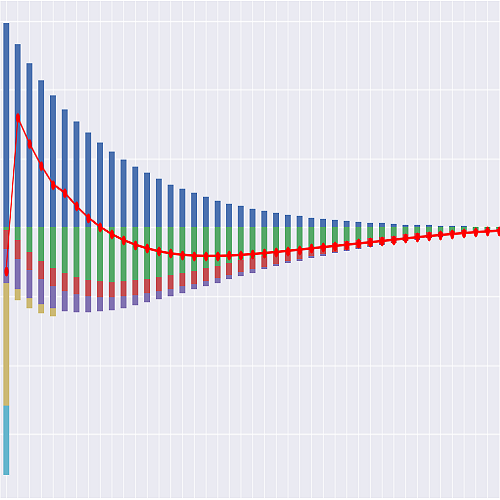
The shape to expect on the anchor, read on result_cf_annual(), is a first-year strain of
−351,88 € — the acquisition cost and initial commission together exceed the first year’s
billed premium — thin positive years while the level premium runs ahead of the natural risk
premium, and a crossover in policy year 14. Within policy year 1 the monthly frame shows
what the annual grid could not: −108,90 € in month 0, where the whole year’s premium is
collected against 826,64 € of acquisition cost and commission, then eleven months of about
−22 € each. The total is −644,78 € on model point 1 and +4 252,82 € on
model point 2, the same cell with sex = F. Neither is a profit measure: the stream is
undiscounted, the tariff was struck at 1,00 % on no-lapse survivorship, and no reserve is
held against the later years. The difference is the unisex cross-subsidy the law
requires, and the model is meant to show that rather than hide it.
Naming#
Cells follow lifelib’s basiclife/BasicTerm_S wherever that model has an analogue —
model_point, proj_len, age, sum_assured, policy_term, pols_if, pols_death,
pols_lapse, pols_maturity, mort_rate, lapse_rate, premiums, claims,
expenses, commissions, inflation_factor, net_cf, result_cf — with *_pp for
per-policy amounts, claims(t, kind) with an uppercase kind, and pols_if_at(t, timing)
for the within-year reads, which is savings/CashValue_SE’s form. The external-CSV layout
and Data.input_dir() come from annuallife/TradLife_A. The full symbol mapping lives in
the Projection Space docstring. Four cases needed care:
Notes |
Cells |
Why |
|---|---|---|
|
|
The three “netto”s. |
|
|
|
|
|
|
|
|
|
The sister model that shares this chassis is frlib’s TD_FR_S — the French
temporaire décès, the same product in another market — and the shared vocabulary is
deliberate: pols_if_at, lapse_cum, suicide_factor, benefit_pp, mort_rate_base,
prem_freq_load, check_no_cash_value and liability_cf mean the same thing on both.
Three differences are named so a reader does not carry one across: the French cotisation
is revisable at attained age and the German Bruttobeitrag is level; the French
product carries a PTIA acceleration and the German one has no living benefit at all;
and expenses includes commission there and excludes it here. Within delib,
KLV_DE_S shares the Überschussbeteiligung chassis in a different Überschussverwendung
form — surplus credited to a Deckungskapital rather than netted against the premium —
and the biometric siblings BU_DE_S and Pflege_DE_S are monthly multi-state models
sharing no recursion with this one. issue_date, instalments and policy_id are
carried and drive no formula: the notes’ attribute table lists all three, and a silently
missing column is worse than an inert one.
Standardizations used#
Everything in this table is std. Where an instrument fixes a bound rather than a level — the DeckRV Höchstzinssatz, the Höchstzillmersatz, the MindZV minimum — the bound is cited and the choice to sit at it is the standardization. Where a retrieved document now gives an observed value for a std parameter, the row records it — and the parameter is unchanged. One direct writer’s published model case is not a market, and recalibrating the composite to it would move the worked example and its golden tests. The observations are checks, not inputs.
Parameter |
Value |
Rationale |
|---|---|---|
|
|
DAV 2008 T is proprietary and is cited, never shipped R12. The 9,5 % slope is the research file’s own construction with no German source, and on model point 14’s forty-year run it is the single most exposed number in the model |
|
0.00040, 0.00020 |
Anchored so the 50/50 blend is the research file’s frozen |
Smoker multiplier |
2.20 |
Mid-point of the two-to-three range reported for insured-lives smoker mortality at working ages unverified; reproduces a premium ratio of 2.007 between points 3 and 1 |
|
1.25 |
The DAV Richtlinie regulates the procedure for setting the Sicherheitszuschläge, not the level R12 (gap 6); DeckRV § 5 Abs. 1 requires that a loading exist — “Die Ableitung von Rechnungsgrundlagen auf der Basis eines besten Schätzwertes genügt nicht” R10. Calibrated so the derived |
|
0.50 |
The mechanism is required by law R13; no carrier discloses its own mix |
|
1.00 |
So the shipped proxy is the best estimate, and there is one unsourced mortality level rather than two stacked |
|
0.90 |
The MindZV minimum allocation from the Risikoergebnis is 90 % R9 REG-R18; modelling the minimum is the conservative choice for the Zahlbeitrag, and it is the only level any instrument fixes |
|
1.00 |
The insurer declares exactly the minimum. No German declaration for this product was located (gap 1); this is the stress lever |
|
0.95 |
A rebate may not exceed the premium. Binds nowhere in the shipped points; it exists so |
|
0.025 |
The Höchstzillmersatz ceiling R10 REG-R16; the composite assumes a term tariff runs at the cap. Two corrections from retrieved documents. (i) The assumption is close to right for one direct writer: its published model case shows acquisition cost at 2,41 % of the Tarifbeitragssumme [S2]. (ii) But the ceiling is mis-typed as the whole α: DeckRV § 4 caps only the part recovered through Zillmerung, and both the GDV model wording and the carrier AVB spread “die restlichen Abschluss- und Vertriebskosten … über die gesamte Beitragszahlungsdauer” [S1] § 14 Abs. 3, [S3] § 16 Abs. 3. Zillmerung is also optional on this line [S1] fn. 28 (gap 8) |
|
0.020 of the Beitragssumme |
Splits the α of the ceiling into commission and other acquisition cost. No German commission scale is public |
|
0.05 of each Bruttobeitrag; 0.00030 of |
Correction: German term-life charge levels are not “structurally undisclosed”. § 2 Abs. 1 Nr. 1 VVG-InfoV requires the Abschlusskosten as one total and the other costs as a share of the annual premium, § 2 Abs. 2 requires them in Euro, and § 4 Abs. 2 puts them on the Informationsblatt; both wordings point the customer there [S1] § 14 Abs. 1, [S3] § 16 Abs. 1 R17. What is missing is a published rate card. There is no Effektivkostenquote — § 2 Abs. 1 Nr. 9 confines that duty to a gewiss risk — and no Basisinformationsblatt, the product not being a PRIIP. Observed check: one specimen gives other annual costs of 48,52 € on a 218,52 € annual Tarifbeitrag, i.e. 22,2 %, of which 35,20 € (16,1 %) administration [S2] — far above this composite’s 5 % β, because the specimen’s figure is a euro amount over a small premium, not a percentage loading. Not recalibrated (gap 8) |
|
0.03 and 0.010 of each Zahlbeitrag |
Deliberately different from |
|
0.02, on sum-related admin only |
The tariff’s γ is level while the modelled one inflates, so the cost result narrows over a long term and eventually reverses — a real feature of a 25-year contract |
|
250 € per death claim |
No German figure is public; worth 0,16 € in the anchor’s first year |
|
0.03 |
No German cause-of-death share was retrieved; stands for “about three per cent of deaths at these ages are suicides”, argued range 0,01–0,05 unverified. The three-year window itself is sourced R1 |
|
3 |
The statutory minimum, extendable by Einzelvereinbarung R1 REG-R26. A Reference so an extended window can be modelled. All three retrieved wordings adopt the statutory three and none extends it [S1] [S3] [S4] |
Lapse table |
6 % / 4 % / 4 % / 3 % a year, zero through the final policy year |
Argued from three structural features (mechanic 17); no German figure supports any of it, argued range 2–8 % in the early durations (gap 13). The final-year zero is a property of the last policy year and lives in the formula, not the table. The annual rate is spread to the month at |
|
1.000 / 1.02 / 1.03 / 1.05 |
A market convention with no carrier attribution (gap 21), applied to the billed amount so the split identity holds at every frequency |
Benefit schedules |
|
The three shapes are structural; no schedule parameter was established (gap 15) |
NVG schedule |
1.2 at year 6, 1.4 at year 12 |
Take-up is exogenous. Gap 7 is closed and the schedule is not consistent with the one wording that fills it: [S3] § 13 caps each event at 20 % of the original sum insured, at most 50 000 €, allows at most five occasions and ends the right above age 50, all within a twelve-month window of a listed event. Two increases of +20 % each is within that; but a cumulative 1.4 by year 12 assumes two qualifying events and full take-up, which no document supports. The schedule is unchanged — it is a mechanics demonstration, off in the base run — and the carrier’s caps are now on the record beside it |
|
|
An independence assumption that understates the true first-death rate for a couple; no German figure bounds it (gap 15) |
|
1.00 standard, 1.75 on point 11 |
A Risikozuschlag is a mortality loading on both orders, not a price loading — which is why the |
|
Model point 7 |
A std construction exercising the premium engine at |
Timing conventions |
A premium instalment on the Zahlweise’s own cycle and the month’s expenses at the beginning of the month, claims and lapses at the end, acquisition cost at issue only where |
The approximation this row used to record is gone. On the annual grid the model booked exits at anniversaries and said so, and the note recorded that the approximation was larger than first assumed: § 168 Abs. 1 with § 12 VVG gives termination at the end of the Versicherungsperiode, but both retrieved carriers allow it “jederzeit zum Ende des laufenden Monats” whatever the Zahlweise [S3] § 15 Abs. 9, [S4] § 13 Abs. 1. The monthly grid expresses exactly that. What remains std is the conversion of the annual rates to the month and the placing of claims at the end of the month |
|
0.0 (references 2.0 and 0.30) |
Both modules off, so the base run reproduces the worked example |
|
1e-10, 1e-9 |
Tolerances scaled by |
The fourteen model points |
— |
The anchor is the research file’s representative composite; the rest are chosen to exercise the mechanics, not to describe a market |
The only quantities not standardizations are the structural rules: the guaranteed Bruttobeitrag and non-guaranteed Zahlbeitrag R6 [S3] [S5], the MindZV’s 90 % minimum from the Risikoergebnis, now citable as § 7 MindZV R9, the three-year § 161 window R1 and its restart for each increment [S1] [S3] [S4], the unisex rule R13, the DeckRV ceilings of 1,00 % and 25 ‰ R10, and the absence of a premium-tax line, VersStG 2021 § 4 Abs. 1 Nr. 5 Buchst. a R16.
One item has moved off that list. “The absence of any surrender, paid-up or maturity
value” was carried here as a structural rule. It is not one. No § 169 Abs. 1 duty
attaches on Kündigung — that much is verified R2 — but § 165’s paid-up right is live on
a constant sum insured, and two of the three retrieved wordings pay a Rückkaufswert where
the paid-up sum fails a contractual minimum [S1] [S4]. The amount is nil or nominal in every
one of them, so claims_lapse = 0 and claims_maturity = 0 remain right as best-estimate
approximations — but they belong in the table above, as standardizations, not here.
Tests#
tests/test_risikolebensversicherung_de.py asserts all twenty-five rows of the notes’
annual worked example — off result_cf_annual(), keyed on the 1-based policy_year — to
the cent and pols_if to six decimals, the twelve months of policy year 1 on the monthly
frame beside them, that the annual view regroups the monthly frame rather than
reprojecting it, the frame’s own shape (list(result_cf().index) == list(range(300)) on
the anchor and range(144, 360) on the in-force point 8), the totals at full precision, the
Bruttobeitrag 1 275,411882 € and the Beitragsverrechnungssatz 0,42527476 reached two
independent ways, the notes’ three rebuilds and three closure identities, the
decl_scale = 0 and Einmalbeitrag variant tables, the five check_* identities with
their residuals, and one test per listed modeling pitfall — the three “netto”s in the
order the model produces them, two premium streams rather than one, the Zahlbeitrag not
guaranteed, no Rückkaufswert, a Deckungskapital that exists, sex never reaching the
price, the Sicherheitszuschlag never reaching the projection, the § 161 switch confined
to three years and to death claims, the clock restarting per increment, the
Ratenzahlungszuschlag applied once, premium cessation not double-counted, the premium
stopping at the Beitragszahlungsdauer, the three sum shapes, two lives combined before
loading, the Kostenüberschuss not returned, the Stornoquote not used, rating_factor
never scaling the benefit, and the Über-Kreuz-Versicherung not a product.
The house style — two Spaces, the external-CSV layout, the read-once Data, the shared
vocabulary, the retired names, the 0-based frame ending at proj_len() − 1, the round trip
and both of delib’s own rulings — is asserted for every model by
tests/test_model_conventions_de.py, which also owns the library’s single model-point
sweep.
python -m pytest tests -q