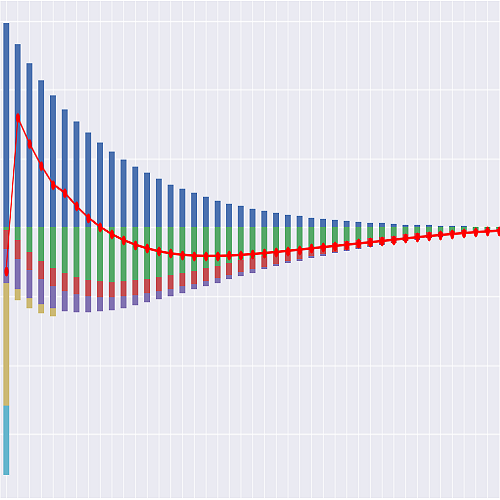
The ULB_UK_S Model#
Reference liability cash flow model for a UK unit-linked investment bond.
ULB_UK_S is the executable counterpart of
products/unit_linked_bond/technical-notes.md in the lifelib-products library. It
projects gross liability cash flows for a single-policy model point of a modern
clean-charge onshore unit-linked bond: a single premium, a death benefit of 100.1% of
the bid value of units, no surrender penalty, and the 5% a year tax-deferred withdrawal
pattern the product is sold on.
The decomposition is the model. UK practice splits this product into two streams and so does this implementation:
the unit fund — the bid value of units, matched by the linked assets, which grows with the fund, bears the tax provision and the fund-based charges, and is drawn down by withdrawals and adviser charges; and
the non-unit cash flow — what actually accrues to the insurer: the annual management charge and any rider charge, less expenses and the death strain, which is only the 0.1% uplift over the unit fund because the rest of the death benefit is funded by cancelling the policyholder’s own units.
Getting that split right is most of the work. Every benefit this contract pays — death, surrender, withdrawal — is funded by cancelling units, so a naive gross presentation would count the same money twice. Equally, the tax provision and the fund-borne further costs reduce the unit fund but are not insurer income: booking them as margin would overstate the insurer’s year-one result by more than the annual management charge itself.
Spaces. The model contains two:
DataReads the three input CSVs and holds their filename References. It takes no parameters, so each file is read once per model.
ProjectionThe by-policy projection, parameterized by
point_id:Projection[1]is an ItemSpace projecting model point 1. It reaches the input tables through itsdataReference, which resolves to the singleDataSpace.
The split matters for more than tidiness. Because Projection is parameterized,
every Projection[N] is a separate ItemSpace with its own cells cache; readers
placed there would re-read every file for every policy. In Data they are evaluated
once, however many policies are projected.
Input data is external: CSVs in the model folder’s parent directory, read at run time rather than stored inside the model. The model folder itself holds no data, so the model and its inputs must travel together.
Projection basis. Monthly steps, indexed by the policy month t counted from
issue and 0-based: t = 0 is the first month, month t runs from time t to
time t + 1, and the frame is t = 0, 1, ..., proj_len() - 1, proj_len() being
the number of projected months. The policy year is the derived 1-based label
t // 12 + 1. Fund growth, the tax provision and the fund-based charges accrue over
the month; withdrawals, adviser charges and any rider charge are unit cancellations at
the end of it; death and surrender follow, deaths before surrenders. Age is age last
birthday. The projection ends at the limiting age or,
sooner, when the unit fund is exhausted — which on the deterministic base run it is,
because a 5% withdrawal against a 5% gross return net of tax and charges cannot be
sustained.
What is sourced and what is not. The contractual mechanics are sourced: the 100.1% death uplift, the surrender value as the bid value of units with no penalty, the 7.5% rolling withdrawal cap, charges accruing daily through the unit price, segmentation into 100 identical policies, and the liability cap to fund assets. Every rate is a standardization. Per-fund charge rate cards are not published, the CMI’s assured-lives tables are restricted to Authorised Users, and no public UK bond persistency study was retrieved, so the charge levels, the mortality basis and the whole surrender table are placeholders. This model is a mechanics demonstration, not a pricing or reserving result.
Verification. tests/test_unit_linked_bond_uk.py asserts the notes’ worked
example to the penny — the month-by-month unit fund recursion, the year-one totals, and
the reconciliation that closes them — plus the insurer-side extraction beside it.
Example
>>> import modelx as mx
>>> model = mx.read_model("products/unit_linked_bond/ULB_UK_S")
>>> model.Projection[1].result_cf()