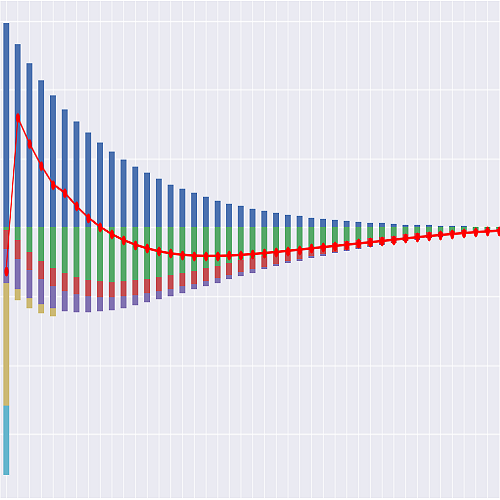
The Projection Space#
The by-policy projection of the Obseques_FR_S model.
The Space is parameterized by point_id, so Projection[1] is an ItemSpace
projecting model point 1:
>>> Projection[1].result_cf()          # the RefOBS-VIA worked-example anchor cell
>>> Projection.point_id = 3            # the prime unique cell
t counts policy months, 0-based: t = 0 is the first policy month and the frame
is t = 0, 1, ..., proj_len() - 1, so proj_len() is the number of projected
months. The policy year is the contractual 1-based label derived from it,
policy_year(t) = t // 12 + 1. The notes carry the in-force probability l(k) at time
k months from issue with l(0) = 1, and the library indexes pols_if() at the
start of the month, so pols_if(t) is exactly the notes’ l(t) — which is the
column their worked-example table prints, and the weight on every cash flow of the same
result_cf() row.
Input data
Inputs are external files: plain CSVs living in the model folder’s parent directory,
products/obseques/, read at run time rather than stored inside the model. The model
folder therefore holds nothing but formulas — no _data/, no IOSpec, no embedded
values — so a diff of the model shows logic changes only, and an input can be edited or
swapped without rewriting the model. This follows annuallife.TradLife_A; contrast
basiclife.BasicTerm_S, which keeps its inputs inside the model through modelx’s
IOSpec machinery.
The consequence worth knowing: the model is not portable on its own. Copying the
Obseques_FR_S folder without its parent’s CSVs produces a model that reads and then
fails on first evaluation.
Each table has a filename Reference and a reader Cells, both on
Data, reached here through the data Reference:
Reference |
Cells |
File |
|---|---|---|
model_point_file |
data.model_point_table() |
model_point_table.csv |
mort_table_file |
data.mort_table() |
mort_table.csv |
select_table_file |
data.select_table() |
select_table.csv |
lapse_table_file |
data.lapse_table() |
lapse_table.csv |
surr_scale_file |
data.surr_scale_table() |
surr_scale_table.csv |
single_prem_file |
data.single_prem_table() |
single_prem_table.csv |
Naming
Cells names follow lifelib’s basiclife.BasicTerm_S and savings.CashValue_SE
wherever those models have an analogue — pols_* for policy counts, plural nouns for
cash flows, *_rate for annual rates and *_rate_mth for monthly ones, *_pp for
per-policy amounts, claims(t, kind) and benefit_pp(t, kind) with an uppercase
kind string. The technical notes use compact actuarial symbols instead. The mapping
is:
Notes symbol |
Cells |
Meaning |
|---|---|---|
(model point row) |
model_point() |
The selected model point |
cell |
cell() |
RefOBS-VIA / TMP / UNI |
entry_age |
age_at_entry() |
Entry age, millesime basis |
x(t) |
age(t) |
Attained age in month t |
y |
policy_year(t) |
Policy year of month t |
(none) |
duration(t) |
Completed policy years |
(none) |
duration_mth(t) |
Months elapsed at BOM, = t |
omega |
omega_age |
Limiting age, 112 |
(none) |
proj_len() |
Number of projected months |
C_0 |
capital_0() |
Capital at issue |
C(y) |
capital_pp(t) |
Guaranteed capital in force |
r |
reval_rate() |
Annual revalorisation rate |
(simple/compound) |
reval_simple() |
Simple uprating variant |
(coupling) |
reval_prem_linked() |
Premiums uprated with it |
P_a(y) |
prem_ann(t) |
Annual premium in year y |
P(t) |
prem_due_pp(t) |
Premium due at BOM of t |
(frequency) |
prem_freq() |
Instalments a year |
(none) |
is_premium_mth(t) |
An instalment falls in t |
(paying period) |
in_paying_period(t) |
Premiums are still due |
K(t) |
cum_prem_pp(t) |
Premiums collected to BOM |
n_car |
carence_months() |
Waiting period, months |
(indicator) |
in_carence(t) |
t < carence_months |
(refund basis) |
refund_pp(t) |
Waiting-period refund |
i_ref |
carence_refund_rate() |
Interest on the refund |
DB_ill(t) |
benefit_pp(t, “ILL”) |
Non-accidental benefit |
DB_acc(t) |
benefit_pp(t, “ACC”) |
Accidental benefit |
(blended) |
benefit_pp(t, “DEATH”) |
Expected benefit per death |
C_red(t) |
benefit_pp(t, “PAID_UP”) |
Paid-up capital on reduction |
C_red(t) |
reduced_capital_pp(t) |
The same amount, per policy |
k_adb |
accident_mult() |
Accidental multiplier |
d_acc |
acc_share |
Accidental share of deaths |
V(t) |
surr_value_pp(t) |
Surrender value |
surr_scale(t) |
surr_scale_pp(t) |
Scale per 5000 EUR, read at t+1 |
pen(t) |
surr_penalty(t) |
Surrender penalty rate |
u(x) |
single_prem_rate(x) |
Single premium per 1 EUR |
rho |
reduction_share() |
Premium-stops made paid-up |
q_base(x, sex) |
mort_rate_base(x) |
Table mortality rate |
f_as |
mort_antiselect_load |
Anti-selection loading, 1.25 |
s(y) |
select_uplift(t) |
Select uplift by duration |
(improvement) |
mort_improve_factor(t) |
Improvement factor, 1 in base |
q(y) |
mort_rate(t) |
Annual mortality rate |
q_m(y) |
mort_rate_mth(t) |
Monthly mortality rate |
w(y) |
lapse_rate(t) |
Annual premium-stop rate |
(table) |
lapse_rate_base(t) |
Table rate before the stress |
beta |
lapse_overrun_beta |
Overrun lapse stress dial |
w_m(y) |
lapse_rate_mth(t) |
Monthly premium-stop rate |
l(t) |
pols_if(t) |
Premium-paying in force |
l_r(t) |
pols_paid_up(t) |
Paid-up in force |
(none) |
pols_all(t) |
pols_if + pols_paid_up |
(none) |
capital_paid_up(t) |
Aggregate paid-up capital |
(none) |
pols_death(t) |
Deaths, premium-paying |
(none) |
pols_death_paid_up(t) |
Deaths, paid-up |
(none) |
pols_exit(t) |
Premium-stops of any kind |
(none) |
pols_convert(t) |
Premium-stops made paid-up |
(none) |
pols_lapse(t) |
Premium-stops surrendering |
(none) |
crossover_mth(basis) |
Month premiums pass capital |
E[premium](t) |
premiums(t) |
Premium income |
E[death outgo](t) |
claims(t, kind) |
Outgo by kind |
E[expenses](t) |
expenses(t) |
Acquisition + maintenance |
(none) |
inflation_factor(t) |
Expense inflation factor |
liability_cf(t) |
liability_cf(t) |
The notes’ outgo-positive CF |
net_cf(t) |
net_cf(t) |
Net cash flow, income positive |
Four names needed care.
The notes’ l(t) and l_r(t) are two population strands: policies still paying
premiums, and policies made paid-up by reduction. pols_if() is the first —
the notes’ l, and what the worked example prints — pols_paid_up() the second,
and pols_all() their sum, which is what the maintenance expense is carried on. On
every model point but one the second strand is empty and the three coincide.
C_red(t) appears twice because it is used twice. reduced_capital_pp() is the
paid-up capital a policy converting in month t is left with, V(t) / u(x(t)), and
capital_paid_up() is the aggregate paid-up capital in force. Carrying the
aggregate alongside the count is what removes the need for a per-conversion cohort
dimension: the paid-up capital depends on when the policy converted, but every paid-up
policy thereafter rolls forward on the same survival factor, so the sum of their capitals
satisfies the same recursion as the count. Death outgo on that strand is then
capital_paid_up(t) x q_m(t).
surr_scale(t) in the notes is the external scale; here surr_scale() is the
model point’s choice of scale — a string naming one insurer’s published grid — and
surr_scale_pp() is the interpolated amount. The two are separate cells because
mixing one insurer’s premium with another’s surrender grid is the single easiest way to
produce a plausible-looking and wrong margin on this product.
C(y) is a constant in most protection models and a function of t here, because
the participation aux benefices moves it every year.
The delai de carence is two benefits, not one
For the first twelve months — t = 0 to t = 11 — a non-accidental death refunds
the premiums collected: a step function, constant at 336.03 through those twelve months
on the anchor cell, because the premium is annual and payable in advance. An accidental
death pays the full guaranteed capital from day one. From t = 12 any death pays the
capital.
Paying the capital inside the waiting period is the central error available on this product: it takes the first month’s expected death outgo from 0.380884 to 3.345618 and policy-year 1 from 4.4274 to 38.8893. Dropping the accident leg is the mirror-image error and understates the first month by 41 %. Accruing the refund base monthly when the premium is annual understates policy year 1 by 26 %. All three are asserted in the test module.
The accidental multiplier — 2 x the capital at one insurer, capped at 20000 EUR —
applies past the waiting period only. Inside it the accidental benefit is already the
full capital, and doubling it there overstates outgo. accident_mult() is used in one
place, benefit_pp(t, "ACC"), past the carence only.
The capital is a state variable
The guaranteed capital is uprated annually out of the participation aux benefices, and
the uprating starts at the first anniversary, not at issue, because PB is allocated to
contracts in force at least a year. So capital_pp(t) == capital_0() for
t < 12, and the year-y capital is C_0 x (1 + r)^(y-1) — or
C_0 x (1 + r (y-1)) where reval_simple() reads the contractual wording as a
simple uplift. Nothing is uprated inside the waiting period on the illness leg: that
benefit is a refund of premiums, not a capital, and carence_refund_rate() is a
different parameter that must not be confused with the revalorisation rate.
Whether the premiums are uprated with the capital is a first-order fork read from the model point, never hard-coded: five of the seven retrieved insurers leave the premium alone, one raises the remaining premiums in the same proportion. Applying the coupling to the wrong cell moves premium income in the wrong direction.
Lapse pays money, which is the whole contrast with the UK sibling
Rachat pays the provision mathematique, so claims_lapse — the "LAPSE" kind
of claims() — is non-zero from the first month and worth 1005.89 over the anchor
cell’s horizon. On WOL_UK_S, where a lapse pays exactly nothing, raising lapse
always lowers the liability; here removing the lapse decrement raises the undiscounted net
stream from 2236.92 to 3165.11, because the premiums a lapser stops paying are worth more
than the reserve handed back. Two consequences are wired in rather than left as prose:
No premium-stop decrement where no premium is due. After
prem_cease_age, past the end of a temporary premium term, on a prime unique cell and in the paid-up state there is nothing to stop paying, solapse_rate()is zero there.check_lapse_gate()asserts it.*Reduction* is not termination. Non-payment produces a paid-up contract wherever the surrender value is sufficient, so a share
reduction_share()of premium-stops converts — a state change with no cash flow — and keeps a death liability the contract still owes. Routing every premium-stop to the exit removes that liability silently.
The overrun
Under primes viageres cumulative premiums grow without bound while the capital grows at
most at the revalorisation rate, so the insured can and often does pay more than the
capital. crossover_mth() finds the month, and it finds two of them: against the
capital at issue, t = 168 on the anchor cell, and against the revalorised capital,
t = 204 — three years apart. Reporting one without saying which is how a published
crossover moves by years. It is reported rather than acted on: the overrun-aware lapse
module that raises the rate past the tipping point is a pure stress dial, and
lapse_overrun_beta is 0 in the base run.
Sign convention
The notes print the stream outgo-positive as liability_cf, so that orientation
survives verbatim in liability_cf() and net_cf() is its exact negative, which
is the library-wide sign. The notes’ worked-example table omits expenses “for clarity” and
prints premium income and death outgo as separate positive columns, so neither
liability_cf nor net_cf equals any column of it.
Cells Descriptions#
- cell()[source]#
RefOBS-VIA,RefOBS-TMPorRefOBS-UNI: the premium-form cell.A label, not a switch. Every cell runs the same engine, and what actually differs between them is
premium_form()and the model point columns that go with it - which is the point the technical notes make about this product: the three cells are the same contract with one column changed.
- sex()[source]#
The sex (M / F) of the selected model point.
Drives the shipped [std] mortality proxy and nothing contractual: no retrieved funeral rate card rates by sex, and acceptance is guaranteed with no medical selection of any kind.
- age_at_entry()[source]#
The entry age, on the *difference de millesime* basis.
Calendar year of subscription less calendar year of birth - not age last birthday and not age nearest birthday. The true basis increments on 1 January; the model increments at the policy anniversary instead [std], which is exact for January issues and is what every shipped model point is. Using age last birthday instead shifts the whole mortality lookup by up to a year at entry.
- capital_0()[source]#
C_0: the guaranteed capital at issue, in EUR.
5000 EUR is the illustrative capital every retrieved standardised table is published at, and is close to the average cost of a French funeral excluding marbrerie.
capital_pp()is the amount in force in a given month, which differs from this from the first anniversary on.
single,temporaryorlifetime: the premium form.This product’s signature, and final at inception - the form cannot be changed later. It decides the paying period, whether a premium-stop decrement applies at all, and whether the contract can overrun its own capital.
- prem_term_y()[source]#
The premium-paying term in years; 1 on a single premium, 0 on a lifetime one.
- prem_cease_age()[source]#
The attained age at which lifetime premiums stop; 0 means they never do.
The retrieved tables disagree: one runs lifetime premiums to attained age 115 with no cessation, one to 95 with none shown, one implies cessation near 90 from equal cumulative figures at 90 and 95, and one sells an explicit “to age 80” form alongside the lifetime one. Never-ceasing is the reference choice [std], because it is the documented design that produces the overrun this product is criticised for; defaulting this to anything non-zero makes that overrun disappear.
The premium in EUR per year - or the whole single premium on a prime unique cell.
A model point input, not a rate-table lookup. The standardised tables are the only public rate card for this product, they state that they have no contractual value, and no insurer publishes the mortality table, technical rate, expense loading or margin behind them. The lifetime premium for a 5000 EUR capital at entry 50 spans roughly 2:1 across the retrieved set, so this and
surr_scale()must come from the same document.
- prem_freq()[source]#
The number of premium instalments a year: 1, 2, 4 or 12.
Premiums are contractually annual and payable in advance, and every published rate card is annual, so 1 is the reference [std]. The instalment options are a documented 2.2 % loading on the annual premium rather than a re-tariffing, so a monthly point carries the loaded figure in
annual_premium()and pays a twelfth of it each month.
- carence_months()[source]#
n_car: the delai de carence in months, 12 in every retrieved contract.
Since 1 July 2025 the market cap for new contracts is one year, against up to two previously. It is the anti-selection device that replaces underwriting on a guaranteed-issue book whose entrants may be 84 years old and know their own health.
- carence_refund_basis()[source]#
gross,net_assistanceornet_instalment: what the refund is net of.Three insurers, three bases: the premiums collected gross, net of the assistance premium, net of instalment charges. Gross is the reference [std]; the other two are carried because they are what two retrieved contracts actually say.
- carence_refund_rate()[source]#
i_ref: interest credited on the refunded premiums, zero in every retrieved contract.
Not the revalorisation rate, and easy to confuse with it. A different rule exists in statute and reaches a different product: the loi Sueur requires the capital paid by the subscriber of an advance-*prestations* contract to bear interest at not less than the legal rate. No retrieved capital contract pays interest on a waiting-period refund.
- accident_mult()[source]#
k_adb: the accidental death multiplier past the waiting period, 1 or 2.
1 at three insurers; 2 from year 2 subject to a 20000 EUR cap at one. It applies past the waiting period only - inside it the accidental benefit is already the full capital, so doubling it there, or applying the multiplier to all deaths, overstates outgo.
- reval_rate()[source]#
r: the annual revalorisation of the guaranteed capital.
1.00 % p.a. contractually guaranteed on the anchor cell - the only guaranteed rate retrieved anywhere - and discretionary at five of the seven insurers, set annually out of the participation aux benefices for contracts in force at least a year. It is zero on the cells priced from tables published sans participation aux benefices, because a non-zero rate would be inconsistent with those tables’ own surrender scales. No insurer’s actually declared PB rate for a funeral contract in any year was found in any public source.
- reval_prem_linked()[source]#
Whether the remaining premiums are uprated with the capital.
No at five insurers, yes, in the same proportion on the remaining premiums, at one. A first-order fork read from the model point and never hard-coded: applying the coupling to a cell that does not have it overstates premium income, and omitting it where it exists understates it.
- reval_simple()[source]#
Whether the uprating is simple on the subscribed capital rather than compound.
The contractual wording is “1 % du capital souscrit”, which reads naturally as a simple uplift, while the same document’s surrender values pin down neither reading. Compounding on the current capital is the reference [std] because that is the form the other retrieved mechanisms take and because the one derivable rate in the file is demonstrably geometric. Which reading the wording intends is [unverified].
- surr_penalty_years()[source]#
The number of years a surrender penalty applies for; 0 in the reference cell.
- surr_penalty_rate()[source]#
The surrender penalty rate inside that period; 0 in the reference cell.
None at two insurers; 5 % in the first ten years, plus a further 5 % charge inside the mathematical provision in the first eight, at one.
rho: the share of premium-stops that become paid-up rather than surrendering.
Zero in the base cell, 0.5 as the variation and 1.0 as the upper stress [std]. Reduction is contractually the normal consequence of non-payment wherever the surrender value is sufficient, and where a surrender value exists, stopping payment and taking nothing is strictly dominated by reducing - so the economically rational value is high. But no public source gives any split between voluntary surrender and paid-up conversion, because none gives any decrement rate at all. Zero keeps the worked example checkable; the parameter is the sensitivity dial, and it dominates the late-duration liability. It must never be approximated by perturbing the lapse rate.
- surr_scale()[source]#
The name of the published surrender-value grid this model point is priced on.
A key into surr_scale_table.csv, not an amount. It must come from the same document as
annual_premium()andreval_rate(): the anchor cell takes its premium, its guaranteed revalorisation rate and its surrender grid from one insurer precisely so that the three are consistent, and feeding one insurer’s premium into another’s grid produces plausible-looking and wrong margins.
- issue_month()[source]#
The calendar month of issue, 1 on every shipped model point.
The difference de millesime age basis increments on 1 January;
age()increments at the policy anniversary instead [std], which is exact for a January issue and off by up to one policy year of mortality otherwise. The column exists so that the approximation is visible in the data rather than buried in a formula.
- proj_len()[source]#
Projection length in months:
12 x (omega_age - entry_age + 1).The number of projected months, and the exclusive end of the frame: the projection runs over
t = 0, 1, ..., proj_len() - 1andlen(result_cf()) == proj_len(). Whole life has no maturity date, so the horizon is a limiting age rather than a contractual one.omega_ageis 112, the tabulation limit of TH 00-02 in the annexe to art. A. 335-1 CA, andmort_rate()is forced to 1 there, so the population is exhausted inside the projection rather than truncated by it. One insurer’s tables run to attained age 115, so the horizon is a modelling convention and not a contractual one;check_truncation()asserts that nothing is left at the end of it.
- duration(t)[source]#
Completed policy years at the start of month t:
t // 12.0-based, as in lifelib: 0 through the whole of the first policy year.
- duration_mth(t)[source]#
Months elapsed from outset at the start of month t; equal to t.
tis 0-based, so the identity is trivial - the cells exists so the monthly models in this library share one vocabulary. Monthtruns from timetto timet + 1, soduration_mth(t) + 1months have elapsed by the end of it.
- policy_year(t)[source]#
y = t // 12 + 1: the policy year containing month t; 1 for t = 0..11.
The contractual, 1-based label, derived from the 0-based index and never confused with it: it is what the premium, lapse and select schedules are keyed by.
- age(t)[source]#
x(t): the attained age in the policy year containing month t.
entry_age + y - 1on the difference de millesime basis, stepping at the policy anniversary [std] rather than on 1 January - seeissue_month().
- mort_rate_base(x)[source]#
q_base(x, sex): the table mortality rate at attained age x.
Keyed by age rather than by month so that the lookup is evaluated once per attained age instead of once per projected month. A [std] INSEE-shaped proxy anchored at
q(M, 50) = 0.0040with 9 % p.a. age progression, which is the technical notes’ walk-through basis exactly. TH 00-02 and TF 00-02 are the homologated regulatory tables for this product; they are cited by name and never redistributed here.
- select_uplift(t)[source]#
s(y): the select uplift on base mortality in the policy year containing month t.
1.60 / 1.30 / 1.15 / 1.00 for policy years 1 / 2 / 3 / 4+ [std]. Policy years beyond the table take its last row. The excess belongs at short durations and the first-year factor is the largest even though a first-year illness death costs only a refund - the deaths still happen, they merely cost less, and moving the excess to year 2 would double-count the protection the waiting period already gives. A flat loading understates the year-2 spike, which is the largest single step in the anchor cell’s death-outgo series.
- mort_improve_factor(t)[source]#
The mortality improvement factor in month t; 1 in the base run [std].
(1 - improvement)^(y - 1). France has no publicly available insured-lives projection model comparable to the CMI’s, so a flat annual reduction is the [std] sensitivity proxy rather than a basis. Improvements lengthen the premium stream and defer the claim at once, which on a viagere cell pull in opposite directions.
- mort_rate(t)[source]#
q(y): the annual mortality rate applied in the policy year containing month t.
q_base(x, sex) x f_as x s(y), capped at 1 and forced to 1 at the limiting age. The anti-selection loading is upward relative to population mortality and that direction is the defensible part: acceptance is guaranteed, with no medical questionnaire and no examination, so the pool cannot be better than the population and self-selects worse, and the only device standing against an applicant who knows their prognosis is the twelve-month waiting period. The magnitude has no public calibration of any kind.
- lapse_rate_base(t)[source]#
The table annual premium-stop rate in month t [std], before the overrun stress.
6 % / 5 % / 3.5 % / 2.5 % for policy years 1 / 2 / 3-5 / 6+; policy years beyond the table take its last row. Declining with duration, because a small-premium prevoyance contract bought for one purpose is stopped early or not at all, and because the surrender value is worth a fraction of the premiums paid for the first two decades - so an early lapser loses most of their money and a late one has nearly reached a full payout. There is no waiting-period completion spike: nothing changes for the policyholder at
t = 12except that the cover becomes worth having.
- lapse_rate(t)[source]#
w(y): the annual premium-stop rate applying at the end of month t.
Zero wherever no premium is due: on a prime unique cell, past the end of a temporary premium term and past
prem_cease_age. There is nothing left to stop paying, and a decrement there silently destroys liability. Otherwise the table rate, optionally stressed by1 + betaonce cumulative premiums have passed the capital, which is off in the base run.
Whether an instalment falls due in month t:
t = 0 (mod 12 / prem_freq).Months 0, 12, 24, … on the annual default; every month at
prem_freq = 12.
- in_paying_period(t)[source]#
Whether month t is inside the premium-paying period of this premium form.
Month 0 only on a prime unique; months 0 to
12 x prem_term_y - 1on a temporaire; every month on a viagere, unbounded whereprem_cease_ageis 0 and otherwise until the anniversary at which the attained age reaches it.
- prem_ann(t)[source]#
P_a(y): the annual premium in the policy year containing month t.
Level and fixed at inception unless
reval_prem_linked(), in which case the remaining premiums rise in the same proportion as the capital - geometrically, or simply wherereval_simple()reads the wording that way.
- prem_due_pp(t)[source]#
P(t): the premium due per policy at the beginning of month t.
One instalment,
P_a(y) / prem_freq, in a premium month inside the paying period, and zero otherwise. Paid-up policies pay nothing and are carried as a separate population strand rather than as a premium of zero, so they do not appear here.
- cum_prem_pp(t)[source]#
K(t): the premiums collected per policy to the beginning of month t.
The premium falls at the beginning of the month and death at the end, so a death in month t has had the month-t premium paid on it. This is the waiting-period refund base, and with an annual premium in advance it is a step function - constant at one year’s premium through months 0 to 11 - not a monthly accrual. Accruing it monthly gives 28.00 rather than 336.03 in the first month on the anchor cell and understates policy-year-1 death outgo by 26 %.
K(0) = P(0): the first month’s premium is the whole of the base att = 0, and nothing is indexed below the frame.
- capital_pp(t)[source]#
C(y): the guaranteed capital in force in the policy year containing month t.
C_0 x (1 + r)^(y-1), orC_0 x (1 + r (y-1))underreval_simple(). The uprating starts at the first anniversary, not at issue, because the participation aux benefices is allocated to contracts in force at least a year - socapital_pp(t) == capital_0()fort < 12, whichcheck_capital_reval()asserts. Uprating at issue would make it 5050.00 in the first year on the anchor cell and overstate the year-1 accidental leg.
- surr_scale_anchors()[source]#
The selected surrender-value scale as a list of
(month, value)anchors.Extracted once per model point and interpolated in pure Python by
surr_scale_pp(), rather than indexing the DataFrame afresh in each of several hundred projected months.
- surr_scale_pp(t)[source]#
The published surrender-value scale for a surrender in month t, per 5000 EUR.
The CSV’s
monthcolumn is elapsed months from issue, 0 at issue and 60, 120, … 540 at the published quinquennial anniversaries; it is not the frame’stand does not move with it. Surrenders fall at the end of month t, by which timeduration_mth(t) + 1months have elapsed, so that is the key this reads: the first projected month,t = 0, is one month into the contract, and the published five-year anchor is reached in montht = 59.Linearly interpolated in elapsed months between the published quinquennial anchors [std] and held flat beyond the last one. The anchors are transcribed from one insurer’s standardised table and already embed that insurer’s own revalorisation, which is why
surr_value_pp()is not additionally scaled bycapital_pp().The production alternative is a prospective provision mathematique on the tariff basis. It is not the reference implementation because no insurer publishes its tariff basis: the whole retrieved set contains one technical rate with a table and one rate alone.
- surr_penalty(t)[source]#
pen(t): the surrender penalty rate applying in month t.
surr_penalty_rateinside the firstsurr_penalty_yearsyears - monthst = 0to12 x surr_penalty_years - 1- and zero after: a flat window, not a decaying scale, which is how the one insurer that charges it writes it.
- surr_value_pp(t)[source]#
V(t): the surrender value per policy in month t - the provision mathematique.
The scale for this model point, pro-rated to the policy’s own capital and net of any penalty. It is a real cash flow, paid on every rachat from the first projected month, which is the whole difference from the UK guaranteed-acceptance sibling where a lapse pays nothing. It is also what an excluded death is paid: suicide in year 1, war, nuclear and murder by a beneficiary do not extinguish the contract, and an exclusion modelled as a zero benefit understates outgo by exactly this amount per excluded death.
- single_prem_rate(x)[source]#
u(x): the single premium per 1 EUR of whole-life capital at attained age x.
Keyed by age rather than by month so that the lookup is evaluated once per attained age. Anchored on the published prime unique rate card and interpolated and extrapolated [std]. It serves twice: it is the tariff behind the prime unique premium form, and it is what turns a mathematical provision into a valeur de reduction.
- reduced_capital_pp(t)[source]#
C_red(t): the paid-up capital a policy converting in month t is left with.
V(t) / u(x(t))- the whole-life cover that the accumulated provision buys as a single premium at the attained age. Fixed at the date of reduction and not uprated afterwards; the aggregate in force iscapital_paid_up().
- in_carence(t)[source]#
Whether month t falls inside the delai de carence:
t < carence_months.Months
t = 0tot = carence_months - 1on the 0-based frame, so the twelve contractual waiting-period months aret = 0 .. 11and the cover changes att = 12.
- refund_pp(t)[source]#
The waiting-period refund per policy in month t, on this cell’s basis.
K(t)gross; net of the assistance premium at one insurer, 12 EUR a year for each year begun - which ispolicy_year(t)on the 0-based frame; net of instalment charges at another, which strips the documented 2.2 % instalment loading and therefore does nothing on an annual-premium cell. Then credited withcarence_refund_rate, which is zero in every retrieved contract, over theduration_mth(t) + 1months elapsed by the end of month t, when the death resolves.
- benefit_pp(t, kind)[source]#
The benefit amount per policy in month t, by kind.
"ILL"the non-accidental death benefit:
refund_pp()inside the delai de carence and the guaranteed capital after it. It is a refund of premiums, not a capital, so it carries no revalorisation."ACC"the accidental death benefit: the full guaranteed capital from day one, and
k_adbtimes it past the waiting period, capped at the contractual maximum. The accident definition is narrow - cerebral and cardio-vascular events are never accidents whatever their origin, and the burden of proof is on the claimant."DEATH"the expected benefit per death on the premium-paying strand, blending the two above by
acc_share. This is whatclaims()multiplies by."PAID_UP"the paid-up capital of a policy converting in month t, which is
reduced_capital_pp(). A paid-up policy is treated as past the waiting period and pays that amount for any cause.
- pols_if(t)[source]#
l(t): premium-paying policies in force at the start of policy month t.
The notes’ in-force probability at time t months from issue, and the column their worked-example table prints;
pols_if(0) == pols_if_init(). Paid-up policies are not counted here: they are a separate strand,pols_paid_up(), because they pay no premium and their benefit is a different amount. Defined one month past the frame - att = proj_len()- so that the roll-forward checks close in the last projected month,proj_len() - 1.
- pols_paid_up(t)[source]#
l_r(t): paid-up (reduit) policies in force at the start of policy month t.
Zero where
reduction_shareis zero, and zero att = 0: nothing is paid-up at issue. Paid-up policies pay no premium, carry no premium-stop decrement - there is nothing left to stop paying - and their capital is fixed at the date of conversion, so they roll forward on mortality alone and take conversions in from the premium-paying strand. Voluntary surrender by a paid-up policyholder is not modeled [std].
- capital_paid_up(t)[source]#
The aggregate paid-up capital in force at the start of month t.
Carrying the aggregate capital alongside the count is what removes the need for a per-conversion cohort dimension: the paid-up capital depends on when the policy converted, but every paid-up policy thereafter rolls forward on the same survival factor, so the sum of their capitals satisfies the same recursion as the count. Death outgo on the strand is then
capital_paid_up(t) x q_m(t). Zero att = 0: nothing is paid-up at issue.
- pols_all(t)[source]#
All policies in force at the start of month t: premium-paying plus paid-up.
The weight on the maintenance expense - a paid-up contract still costs money to administer - and the count the roll-forward closes on.
- pols_if_at(t, timing)[source]#
The number of premium-paying policies in force at a point inside month t.
"BEF_DECR"the start of the month, before any decrement;
pols_if()."BEF_LAPSE"after deaths, before premium-stops - the processing order is death before premium-stop [std].
"AFT_DECR"the end-of-month count, the notes’
l(t + 1).
- pols_death(t)[source]#
Deaths on the premium-paying strand at the end of month t.
Taken against the start-of-month in-force, which is the notes’
l(t) x q_m(y).
- pols_death_paid_up(t)[source]#
Deaths on the paid-up strand at the end of month t; zero where rho is zero.
- pols_exit(t)[source]#
Premium-stops at the end of month t, taken from the survivors of mortality.
What happens to them is the
reduction_sharesplit: a share converts to paid-up and the rest surrenders and is paid the provision mathematique. Neither is a forfeiture, which is the structural difference from the UK sibling.
- pols_convert(t)[source]#
Premium-stops converted to paid-up at the end of month t:
rho x pols_exit(t).A state change, not a cash flow. The contract owes these policies a reduced capital for the rest of the insured’s life, and routing them to the exit instead removes a death liability the contract still has.
- pols_lapse(t)[source]#
Premium-stops that surrender at the end of month t:
(1 - rho) x pols_exit(t).Paid the surrender value, unlike the UK guaranteed-acceptance sibling where a lapse pays nothing at all. See
claims(t, "LAPSE").
- crossover_mth(basis)[source]#
The first month in which cumulative premiums exceed the capital, by basis.
"ISSUE"against the capital at issue,
capital_0():t = 168on the anchor cell, policy year 15."CURRENT"against the revalorised capital in force:
t = 204, policy year 18 - three years later, because the capital has been growing too.
The month it returns is an index on the 0-based frame, so it is a valid answer at 0 and the “never” sentinel is -1, not 0. That case is the prime unique cell alone in the shipped table: the single premium is 85 % of the capital and nothing follows it. A temporaire cell can cross and two of the shipped ones do - a ten-year premium of 651.26 passes 5000 at the eighth instalment - but it stops there, permanently, while a viagere cell goes on paying past the crossover for as long as the insured lives, which is the difference the product is criticised for. Searched rather than closed-form so that the revalorised basis and the premium-linked variant both resolve. Reported rather than acted on - the overrun-aware lapse module is a pure stress dial and
lapse_overrun_betais 0 in the base run.Publishing one of these without saying which is a way to move a stated crossover by years. The standardised tables add a second convention on top: they date their columns by the age at the end of the year, so their “age 65” column is this model’s attained age 64.
E[premium](t): premium income at the beginning of month t, an inflow.
Carried on the premium-paying strand only: paid-up policies pay nothing, and neither does a policy past its cessation age or the end of its temporary term, where
prem_due_pp()is already zero.
- claims(t, kind=None)[source]#
Benefit outgo in month t, by kind; the total when kind is omitted.
"DEATH"death outgo on the premium-paying strand,
pols_death(t) x benefit_pp(t, "DEATH")."DEATH_PAID_UP"death outgo on the paid-up strand,
capital_paid_up(t) x q_m(t)- the aggregate paid-up capital times the monthly mortality rate, which is why that strand carries a capital total as well as a count."LAPSE"surrender outgo,
pols_lapse(t) x surr_value_pp(t). Not zero, at any duration, on any cell: rachat pays the provision mathematique, and a whole-life contract sits in art. L. 132-23 CA’s residual autres assurances sur la vie class, where the insurer may refuse neither rachat nor reduction. The article withholds them from a closed list: temporary death assurance and immediate or in-payment annuities may carry neither; survivorship capitals, pure endowments and deferred annuities without return of premium may carry no rachat. Setting it to zero moves the anchor cell’s undiscounted net stream from 2236.92 to 3242.81.
There is no
"MATURITY"kind, and that is a product fact rather than an omission: the contract ends only on death, on rachat or on lapse, and maturity outgo is identically zero because there is no maturity.
- inflation_factor(t)[source]#
The expense inflation factor in month t:
(1 + pi)^(y - 1)[std].Steps on policy anniversaries, not monthly. Expense inflation has no source at all for this product, and over a horizon this long it runs against a premium that by construction cannot move - unless
reval_prem_linked()is set, the one design in the retrieved set that indexes it.
- expenses(t)[source]#
Acquisition and maintenance expense in month t [std].
The acquisition charge falls once, at issue - the first projected month,
t = 0; maintenance is carried onpols_all(), so a paid-up contract still costs money to administer even though it pays no premium. No French source publishes a currency expense assumption for this product. The anchors are the disclosed charges, which bound expenses from above and leave the margin: acquisition charges of 2.5 % to 5.38 % of the guaranteed capital and ongoing charges of 0.40 % p.a. of the capital plus 0.57 % p.a. while lifetime premiums are paid. The shipped acquisition expense sits inside that range and the maintenance expense at about half the ongoing charge. Claim handling is folded in here rather than charged per death, because no retrieved document separates them.
- liability_cf(t)[source]#
The notes’ outgo-positive cash flow in month t.
claims_death + claims_death_paid_up + claims_lapse + expenses - premiums. This is the orientation the technical notes print, carried verbatim so that a reader can hold the two side by side;net_cf()is its exact negative and is the library-wide sign.
- net_cf(t)[source]#
CF(t): the net cash flow of month t, income positive.
-liability_cf(t)exactly. Note that the notes’ worked-example table omits expenses “for clarity” and prints premium income and death outgo as separate positive columns, so this equals no column of that table.
- check_pols_roll_fwd_resid(t)[source]#
The in-force roll-forward residual in month t; zero everywhere.
pols_all(t) - pols_all(t+1)less deaths from both strands and the premium-stops that actually surrender. Conversions to paid-up are absent because they move policies between strands rather than out of the population - which is the point of running the check on the total, and what makes it catch a reduction modelled as an exit.
- check_pols_roll_fwd()[source]#
True when the in-force roll-forward closes in every projected month.
The library-wide form of a roll-forward check: no argument, one bool over all t, so one test can call it across every model.
check_pols_roll_fwd_resid()gives the signed residual of the month that failed.
- check_surv_annual_resid(t)[source]#
The residual of the annual survivorship identity at a policy-year start.
The monthly decrements must compound back to the annual ones exactly, so the in-force at the start of policy year y+1 is available in closed form from the start of year y:
l x (1 - q(y)) x (1 - w(y)). On the anchor cell that is0.992 x 0.94 = 0.93248at the end of policy year 1, which is the figure the notes’ worked example prints against t = 12.This is the check that catches a misindexed recursion. Rolling the in-force forward with the next month’s rates, or with the rates of the policy year the month falls in rather than the one the decrement belongs to, leaves the monthly product no longer equal to the annual factor, and the residual is non-zero from the first anniversary. Zero except at policy-year starts, and at the last one where the following year would fall outside the projection.
- check_surv_annual()[source]#
True when the monthly decrements compound back to the annual ones in every year.
- check_capital_reval_resid(t)[source]#
The residual of the capital roll-forward in month t.
Two statements in one signed residual. Through the first policy year the capital must still be the capital at issue, because the participation aux benefices is allocated only to contracts in force at least a year - so the residual there is
capital_pp(t) - capital_0(), and an implementation that uprated at issue would report 50.00 on the anchor cell. At every later anniversary the residual is the year’s uprating less the rate it should be, which catches a capital that is uprated at the wrong frequency, or compounded where the model point asks for a simple uplift.
- check_capital_reval()[source]#
True when the capital is flat through year 1 and steps once a year after it.
- check_lapse_gate_resid(t)[source]#
The premium-stop rate applied in a month in which no premium is payable at all.
Zero everywhere, and the residual is the rate itself where it is not. A policy that has no premium falling due anywhere in its current policy year has nothing left to stop paying, so a decrement there destroys liability silently rather than loudly. The gate is re-stated here through
prem_due_pp()rather than throughin_paying_period(), so the check does not merely repeat the branch it is checking.
- check_truncation_resid(t)[source]#
The population left in force when the projection is truncated; zero at the end.
Non-zero only in the last projected month, where it is everything still alive on both strands. Whole life has no maturity, so anything in force at the limiting age is liability dropped off the end of the projection.
mort_rate()is forced to 1 atomega_age, so the population is exhausted inside the horizon; if this were not negligible the limiting age would be too low and the model would be understating the tail rather than merely rounding it.
- result_cf()[source]#
Result table of cashflows, indexed by policy month t = 0 … proj_len() - 1.
pols_ifis the premium-paying count at the start of the month, which is the weight on premium income and on death outgo;pols_paid_upis the reduit strand, empty on every model point wherereduction_shareis zero.claims_deathandclaims_death_paid_upare published separately, and the notes’ singleclaims_deathcolumn is their sum.liability_cfis the notes’ outgo-positive orientation andnet_cfits exact negative.