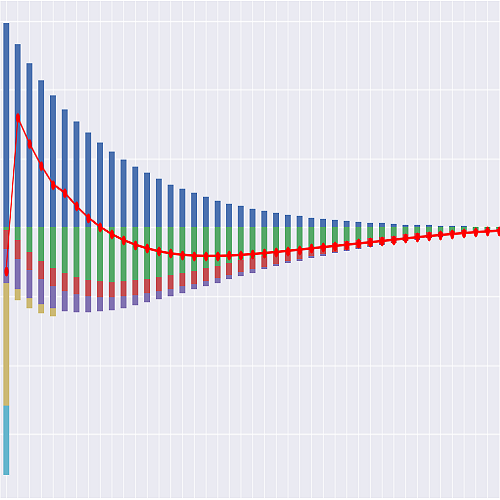
Technical Notes#
Status: Draft, 2026-08-29 (access date for every citation: 2026-08-29).
Scope note. These notes specify a reference liability cash-flow projection model — model name
BU_DE_S, monthly grid — for the standardized composite German selbständige
Berufsunfähigkeitsversicherung defined in product-spec.md (same directory). This is not any
single insurer’s product. [S#] / [R#] tags refer to the source list in sources.md (numbering
carried from _research/berufsunfaehigkeit.md; frozen); [REG-R#] tags refer to the cross-product
reference library references/regulatory-and-actuarial-references.md (its own R-numbering).
std marks a standardization introduced for the reference implementation; unverified marks a
claim no retrieved document corroborates. Parameter values are identical to those in product-spec.md. Cells
names, model-point columns and CSV headers are English lower_snake_case; German terms of art keep
their German form in prose.
Retrieval conditions. These notes were drafted with nothing retrieved — direct HTTP egress
was blocked by an organisation network policy and the session’s WebSearch budget was exhausted
before this product was reached — and their citations have since been re-verified against the
primary documents: the statutes and statutory instruments as canonical XML with each law’s Stand
recorded, the GDV Musterbedingungen and five carrier document sets as PDFs. Of the 43 entries in
sources.md, 26 now say Retrieved: yes and 17 still say no; where an entry says yes the
document was opened and the passage the entry rests on was read, and where it says no the citation
is still a pointer, not a certificate and the number resting on it keeps its unverified or
std tag. The practical consequence for these notes is unusual and is stated once, here:
every biometric level in this model is std, because the DAV 1997 family and DAV 2008 T are the
property of the Deutsche Aktuarvereinigung, are not public and are not redistributed by delib
R16 R17 REG-R50 REG-R48; every charge level is std, because no
Produktinformationsblatt was obtained — not because the disclosure does not exist, which is what
the first draft said and got wrong: VVG-InfoV § 2 requires a German BU insurer to state its
acquisition and administration costs in euro, and it is only the Effektivkosten figure that a pure
risk contract does not carry R12 [S14]; and the premium itself is std, because no German BU
rate card of any kind was obtained. The mechanics below are not std. They are the established
German ones, and each now carries a document that was read.
Model scope and conventions#
Purpose. Project gross best-estimate liability cash flows, undiscounted, for a single-policy model point on an expected (probability-weighted) basis: Bruttobeitrag income, the Beitragsverrechnung credited back out of it, BU-Rente outgo, the Wiedereingliederungshilfe, administration expense and Leistungsbearbeitungskosten. Out of scope, and cited rather than computed: discounting; the Deckungsrückstellung for active lives and the Leistungsrückstellung for claims in payment; Solvency II technical provisions and SCR; IFRS 17; and every tax REG-R47 REG-R1 REG-R55. There is no surrender or paid-up cash flow — see No cash value is modelled below.
Model structure. A four-ledger multi-state chain: aktiv (paying premium, exposed to inception, active-lives mortality and lapse) → leistungspflichtig (receiving the BU-Rente, premium-free, exposed to reactivation and to disabled-lives mortality) → a three-month § 174 run-off (still receiving the BU-Rente, still premium-free, no longer berufsunfähig) → back to aktiv. Death and lapse are the only absorbing exits. The return arc is what makes this a genuine multi-state model rather than a decrement model, and it is the structural difference from delib’s
risikolebensversicherungR3 R16 REG-R50.Projection frequency. Monthly, matching the BU-Rente paid monthly in advance and the retail monthly premium [S1].
tis the policy month,t = 0, 1, …, proj_len() − 1, 0-based:t = 0is the first projected month — the month of inception for a new-business point, the valuation month for an in-force one — and the contractual, 1-based policy year is derived from it,policy_year(t) = duration_mth(t) // 12 + 1, never indexed by.Projection horizon.
proj_len() = 12 × (cover_end_age − entry_age) − duration_init_months, the number of projected months and so the exclusive end of the frame:result_cf()is indexedt = 0 … proj_len() − 1andresult_cf().index[-1] == proj_len() − 1. On the anchor cell that is12 × (67 − 30) = 444monthly rows, the last of themt = 443. Cover ceases at attained agecover_end_age; the last projected month is the last month of attained agecover_end_age − 1.Timing conventions std. Bruttobeitrag and the Beitragsverrechnung credit at the start of the month, and only from the premium-paying population; administration expense at the start of the month; the BU-Rente and the claim-maintenance cost at the start of the month, in advance [S1]; all state transitions and the claim-assessment cost at the end of the month; the Wiedereingliederungshilfe at the end of the month in which the run-off completes.
Age basis. Eintrittsalter, age last birthday, advancing at the policy anniversary:
age(t) = entry_age + duration_mth(t) // 12std (product spec, footnote 5).Claim duration.
zis months since the onset of the BU,z ≥ 1; a life whose BU incepts at end of monthtis in duration cohortz = 1at the start of montht + 1, which is when its first BU-Rente is due ifkarenz_months = 0. The Karenzzeit clock and the Leistungsdynamik clock both run onz.No cash value is modelled. § 169 VVG through § 176 gives this contract a real Rückkaufswert and § 165 a real beitragsfreie BU-Rente R8 R9 R5 REG-R28, but both are the release of a reserve this model deliberately does not compute. A lapse removes the policy and pays nothing: there is no
av_pp_at, no surrender cells, no paid-up state, andclaims(t, "LAPSE")is structurally zero at everyt. That zero is a scope statement, published rather than implied.No death benefit. An SBU pays nothing on death, before or during a claim [S1], so there is no
claims_death—pols_death(t)is a decrement, not a cash flow. A reader coming from a term-life model will look for the column and must not find one.Unisex.
sexis a model-point attribute for decrement and reporting purposes only. It must not enter the premium: sex-differentiated pricing has been unlawful in Germany for new contracts since 21 December 2012 R15 REG-R34. The shipped decrement tables are unisex, so in the base parameterizationsexmoves nothing at all, and that invariance is a test.Currency, sign and rounding. EUR throughout.
net_cf(t)is income-positive (premium +, the surplus credit, claims and expenses −), with the outgo-positive orientation published asliability_cf(t) = −net_cf(t). Intermediates at full double precision; displayed state probabilities to six decimals and cash flows to the cent std. Rounded monthly rows do not re-add to displayed totals; totals are sums of unrounded values.
Model point attributes#
Attribute |
Type |
Meaning |
Exercised by |
|---|---|---|---|
|
int |
Index of |
all |
|
enum { |
State at |
7 ( |
|
int |
Eintrittsalter, age last birthday at inception |
all; 25 – 50 across the table |
|
enum {M, F} |
Decrement and reporting only — never prices REG-R34 |
1 / 2 (the unisex twin) |
|
str |
Key into |
1 / 3 (BG1 vs BG4), 5, 8, 9, 11 |
|
EUR/month |
The agreed BU-Rente at inception |
all; 1 000 – 2 500 |
|
int |
Endalter — the Versicherungsdauer ends at this attained age |
8 (60); 67 elsewhere |
|
int |
Leistungsendalter — the Leistungsdauer ends here |
9 (63 against a cover end of 67) |
|
int |
Karenzzeit, months of deferment of payment |
5 (6), 8 (3), 13 (12) |
|
float p.a. |
Leistungsdynamik, escalation of the BU-Rente in payment, on each anniversary of onset |
all at 0,02; 12 at 0,00 |
|
enum { |
Level Bruttobeitrag, or Beitragsdynamik |
4 ( |
|
float p.a. |
Effective Beitragsdynamik, net of declined increases; 0 on the |
4 (0,03) |
|
enum { |
Payment frequency; keys |
1 (monthly), 4 (annual), 5 (quarterly), 6 (half-yearly) |
|
EUR p.a. |
Bruttobeitrag override; 0 = derive by equivalence |
13 (2 400,00) |
|
float |
Zahlbeitrag / Bruttobeitrag |
all at 0,70; 13 at 0,55 |
|
float |
Risikozuschlag — a multiplier on the Bruttobeitrag only |
11 (1,50) |
|
bool |
AU-Klausel switch |
10 (true) |
|
float |
Inception uplift when the clause is on. Shipped at 1,00 everywhere — no source quantifies it (gap 12) |
10, inertly |
|
int |
Wiedereingliederungshilfe, in monthly Renten; 0 = off |
all at 6; 12 at 0 |
|
int |
Elapsed policy months at |
6 (180), 7 (200) |
|
int |
Months since onset at |
7 (8) |
pols_if_init() is 1.0 for every model point: the model is a per-policy probability projection,
one model point at a time, so pols_if(0) == 1.0 exactly and result_cf()’s first pols_if value
is that. There is no policy_count column.
The shipped model point table. Thirteen points, bu_rente_mth in EUR per month, LD the
Leistungsdynamik and WE the Wiedereingliederungshilfe in monthly Renten. Every column not
shown takes its base value (leistungsdyn_rate 0,02, premium_form level, beitragsdyn_rate
0,00, gross_prem_ann 0, beitragsverrechnung 0,70, risk_factor 1,00, au_klausel false,
au_uplift 1,00, WE 6, duration_init_months 0, claim_duration_init 0).
# |
status |
entry |
sex |
BG |
BU-Rente |
cover/benefit end |
K |
what it exercises |
|---|---|---|---|---|---|---|---|---|
1 |
aktiv |
30 |
F |
BG1 |
1 500 |
67 / 67 |
0 |
the anchor cell, monthly mode |
2 |
aktiv |
30 |
M |
BG1 |
1 500 |
67 / 67 |
0 |
the anchor’s unisex twin — differs in |
3 |
aktiv |
30 |
F |
BG4 |
1 500 |
67 / 67 |
0 |
the occupational factor — differs from the anchor in |
4 |
aktiv |
25 |
F |
BG2 |
1 200 |
67 / 67 |
0 |
the second premium form, |
5 |
aktiv |
40 |
M |
BG3 |
2 000 |
67 / 67 |
6 |
Karenzzeit 6, quarterly mode |
6 |
aktiv |
30 |
F |
BG1 |
1 500 |
67 / 67 |
0 |
in-force active, |
7 |
leistung |
35 |
M |
BG3 |
1 800 |
67 / 67 |
0 |
in-force in claim, |
8 |
aktiv |
50 |
M |
BG5 |
1 000 |
60 / 60 |
3 |
boundary — short term, heaviest class, Endalter 60 |
9 |
aktiv |
45 |
F |
BG2 |
1 500 |
67 / 63 |
0 |
boundary — Leistungsendalter below the Versicherungsdauer |
10 |
aktiv |
33 |
M |
BG1 |
1 500 |
67 / 67 |
0 |
AU-Klausel on with |
11 |
aktiv |
38 |
F |
BG2 |
1 500 |
67 / 67 |
0 |
Risikozuschlag |
12 |
aktiv |
30 |
M |
BG1 |
1 500 |
67 / 67 |
0 |
options off — |
13 |
aktiv |
50 |
F |
BG1 |
2 500 |
67 / 67 |
12 |
premium override 2 400,00 € p.a., |
Model point 1 is the worked example’s anchor cell, as the house style requires. Points 2 and 3 are deliberately one-attribute neighbours of it, so that the unisex invariance and the occupational loading can each be measured against the anchor rather than inferred.
Three columns a reader is most likely to get wrong. berufsgruppe loads the inception rate,
and so reaches the premium only through the equivalence, while risk_factor loads the premium
alone and leaves every claim untouched — they are not two spellings of the same thing.
benefit_end_age is a separate contractual term from cover_end_age, not a synonym.
And leistungsdyn_rate escalates the BU-Rente in payment on the anniversary of onset, while
beitragsdyn_rate escalates the insured BU-Rente and the premium together on the policy
anniversary, before any claim: different quantities, different clocks.
State variables#
Variable |
Description |
Updated |
|---|---|---|
|
Probability aktiv — in force, premium-paying, exposed to inception — at the start of month |
monthly |
|
Probability leistungspflichtig at the start of month |
monthly, two-dimensional |
|
|
derived |
|
Probability in the § 174 three-month run-off, |
monthly |
|
The same population times the monthly BU-Rente it is being paid — a value ledger, because the run-off carries amounts frozen at the Nachprüfung date |
monthly |
|
|
derived |
|
|
derived |
|
The premium-paying count: |
derived |
|
Transitions aktiv → leistungspflichtig at end of month |
monthly |
|
Claim terminations other than death at end of month |
monthly |
|
Run-off completions returning to aktiv at end of month |
monthly |
|
Deaths out of each ledger at end of month |
monthly |
|
Their sum — a decrement, never a cash flow, because an SBU pays nothing on death |
derived |
|
|
derived |
|
The table inception rate at |
lookup |
|
Lapses, from |
monthly |
|
The insured monthly BU-Rente at time |
at anniversaries |
|
The monthly BU-Rente in payment for the duration- |
at claim anniversaries |
|
The level annual Bruttobeitrag — derived by equivalence or overridden |
once per model point |
|
The Bruttobeitrag and Zahlbeitrag instalments due at month |
monthly |
First-order shadow |
|
monthly |
Four absences are product facts, not gaps. There is no account value and no surrender value
R9 R5, so no av_pp_at exists and a lapse carries no cash flow. There is no death benefit
[S1], so no claims_death exists. There is no maturity benefit — survival to the Endalter
pays nothing. And there is no “acknowledged” state: § 173’s once-only befristetes Anerkenntnis
would justify one R2 REG-R29, but this model pays from onset and does not model the decision
delay, so acknowledgement is a timing event with no cash-flow consequence here (pitfall 7).
pols_runoff is the ledger a naive model omits, and omitting it is a first-order error in exactly
the way pols_red is on frlib’s dependance: a recovery does not release the liability in the
month it happens, it releases it three months later R3.
Assumption inputs#
(a) Contractual / guaranteed elements (cited)#
Input |
Value |
Basis |
|---|---|---|
Benefit |
The agreed monthly BU-Rente, paid monthly in advance while berufsunfähig, to the Leistungsendalter |
[S1] R1 |
Trigger |
Inability to exercise the last occupation as arranged, to at least 50 %, expected to last for the contractual Prognosezeitraum — both AVB conventions, not statute, and both left blank in the GDV model conditions. The statute says only “ganz oder teilweise voraussichtlich auf Dauer”; the Prognosezeitraum is set per carrier and reaches three years in one retrieved wording |
|
Degree |
All-or-nothing at 50 %. The modelled object is the incidence of a ≥ 50 % incapacity, not a severity distribution. Confirmed at carrier level: “Bei einem geringeren Grad der Berufsunfähigkeit besteht kein Anspruch auf eine Leistung” |
[S1] [S12] REG-R37 |
Sechs-Monats-Fiktion |
A second and distinct route to the same benefit: six months of actual continuous inability to that degree, after which “gilt die Fortdauer dieses Zustandes als Berufsunfähigkeit” with no prognosis. The six months belongs here and not to the Prognosezeitraum |
[S1] [S12] |
Beitragsbefreiung |
Full waiver of the premium while the BU-Rente is in payment, including through the run-off |
[S1] [S2] |
End of benefit |
At |
|
Reaktivierung |
The cover revives: the Beitragsbefreiung stops, the premium resumes at the same Zahlbeitrag, and a fresh BU may be claimed later |
[S1] |
Karenzzeit |
An agreed deferment of payment on a BU already established — not the prognosis period and not the Fiktion period. It defers the pension only: “Die Karenzzeit gilt nur für die Rente”, the Beitragsbefreiung running from the month after onset regardless |
[S1] [S4] [S9] |
Bruttobeitrag |
The contractually guaranteed maximum premium, computed on first-order bases; level for the term on the |
R10 [S13] [S16] |
Zahlbeitrag |
Bruttobeitrag less the Beitragsverrechnung — the anticipated surplus credited against the premium in advance under § 153 VVG through § 176, with the MindZV risk-result minimum behind it |
|
Death benefit, maturity value, surrender value |
All none as modelled cash flows. None appears in the GDV model conditions either; one retrieved carrier grants a surplus-financed Schlusszahlung at expiry where no BU arose, which is a surplus application and not a guarantee |
[S1]; carrier variant [S12]; scope std |
Unisex |
Sex may not enter premiums or benefits for contracts written from 21 December 2012. The rule is in the AGG, not the VAG: § 33 Abs. 5 AGG permits sex-differentiated premiums only “Bei Versicherungsverhältnissen, die vor dem 21. Dezember 2012 begründet werden” |
|
Premium tax |
None — § 4 Abs. 1 Nr. 5 Buchst. b VersStG exempts the premium where the benefit serves the insured’s or her relatives’ provision |
(b) Insurer-discretionary current elements#
Thin, and on this product the discretion bites in exactly one place — but that one place is worth 43 % of premium income.
Input |
Snapshot value |
Basis |
|---|---|---|
Beitragsverrechnung ratio |
0,70, held constant for the whole projection std (1) |
recalled range 0,50 – 0,80, most commonly 0,60 – 0,75 |
Zahlbeitrag re-rating |
None in the base run — the ratio does not drift std (1) |
the insurer may reduce the Beitragsverrechnung up to the Bruttobeitrag and no further [S13] [S16], and the conditions say so themselves — the surplus “kann auch Null Euro betragen” and the rates are redeclared annually by the board on the Verantwortlicher Aktuar’s proposal [S1] [S12]; frequency and size not established R23 |
Alternative Überschussverwendungen |
Not modelled: no Bonusrente, no verzinsliche Ansammlung, no Überschussrente im Leistungsfall |
|
Surplus account, RfB, declaration mechanic |
None. Correct for BU, because the surplus is applied immediately rather than accumulated — which is what both retrieved carrier wordings do. Bewertungsreserven are near-inert here for a stated reason: before a claim “keine oder allenfalls geringfügige Beträge zur Verfügung stehen, um Kapital zu bilden” [S1] |
|
Nachprüfung intensity |
Folded into the reactivation assumption rather than modelled as a review cycle |
R3 |
Anerkennungsquote |
0,80, as an acceptance factor on the inception rate std (2) |
Holding the ratio constant is the model’s single largest discretionary assumption, and it is the one the product’s own consumer literature warns about. Setting it to 0,70 and freezing it makes the base run reproducible from a stated construction; a user modelling the Zahlbeitrag risk raises
surplus_credittoward zero over time, which raises collected premium toward the Bruttobeitrag — the whole cash-flow effect of the risk, and it moves nothing else.The acceptance factor multiplies the inception rate, not the benefit: a declined claim produces no annuity at all rather than a smaller one. It belongs on top of a gross incidence basis and nowhere else. The shipped inception proxy is gross of declinature by construction; a user substituting a table already net of declinature must set the factor to 1,00, or the effect is counted twice REG-R53. That double-count is pitfall 10.
(c) Behavioural / experience assumptions (the modeller’s view)#
Every input in this class is std. The DAV 1997 family and DAV 2008 T are DAV property, are not public and are not shipped R16 R17 REG-R50 REG-R48; no German insurer publishes a BU lapse rate, expense loading or acquisition cost R12 [S14]. What the shipped proxies must reproduce, and what a replacement built from the real tables must preserve, is stated with each.
Inception — Invalidisierungswahrscheinlichkeit i(x). A two-slope Gompertz form, unisex, gross of declinature, for the reference occupational class BG1, ages 18 – 66:
i(x) = 0.00110 x 1.06^(min(x,45) - 30) x 1.13^(max(x,45) - 45) **[std]**
giving 0,000822 at 25, 0,001100 at 30, 0,001970 at 40, 0,002636 at 45, 0,004857 at 50,
0,008949 at 55, 0,016488 at 60 and 0,034326 at 66. The shape is what the research establishes
and the proxy reproduces it: low and nearly flat to 30, moderate through the forties, and a sharp
acceleration from the mid-forties that makes the last decade before the Endalter dominate the
liability — which is why the Endalter is the single most effective premium lever in the product
R16 R20. The level is a construction, anchored at i(30) = 0.001100 so the worked
example reproduces exactly. A replacement built on DAV 1997 I must preserve the age shape and must
declare whether it is gross or net of declinature.
Occupational loading. Multiplicative on i(x), from occupation_table.csv: BG1 1,00,
BG2 1,40, BG3 2,10, BG4 3,00, BG5 4,50 std. One base table with occupational loadings is
how German BU pricing works [S6]; the anchors 1,00 (office) and 3,00 (reference manual) sit inside
the recalled 2× – 4× band and the rest are interpolated (product spec, footnote 12).
Reactivation — Reaktivierungswahrscheinlichkeit r(z). Annual, by claim duration year only,
from claim_duration_table.csv std:
Claim year |
1 |
2 |
3 |
4 |
5 |
6 |
7 |
8 |
9 |
10 |
11+ |
|---|---|---|---|---|---|---|---|---|---|---|---|
|
0,250 |
0,130 |
0,070 |
0,040 |
0,025 |
0,018 |
0,014 |
0,011 |
0,009 |
0,008 |
0,006 |
The front-loading is the point: reactivation is concentrated in the first one to two years of a claim and is close to zero after about five, so a claim surviving its first two years is very likely to run to the Leistungsendalter R16 REG-R50. A flat reactivation rate is a modelling error, not a simplification, and it is pitfall 4. Two things this proxy does not do, both named rather than hidden: it carries no age-at-disablement dimension, which DAV 1997 RI does R16, and it does not separate recovery from konkrete Verweisung, because no public data separates them and both end the benefit through the same Nachprüfung with the same run-off R3 R29.
Mortality. Two tables in mortality_table.csv, plus a duration select factor std:
mort_rate_actv(x) = 0.00035 x 1.095^(x - 30)          active lives, DAV 2008 T shape [R17]
mort_rate_dis(x)  = 0.00140 x 1.095^(x - 30)          disabled lives, ultimate — 4.00x active
mort_dis_sel_factor(z-year) = 3.0 / 2.0 / 1.6 / 1.4 / 1.3 / 1.2 from claim year 6
so disabled-lives mortality in the first claim year is 12× active-lives mortality at the same
age, falling to 4,8× ultimate. Using one rate for both states is a numbered pitfall and the
reference library names it as such REG-R50. Anchored at mort_rate_actv(30) = 0.000350. The
active table is an insured-lives Todesfall-character shape, not a population table; a replacement
must preserve the excess of disabled over active mortality and the first-year selection.
The direction of prudence, and why it forks. On the first-order basis used to fix the Bruttobeitrag, prudence for a disability product means higher incidence, lower reactivation and lower disabled-lives mortality — a claim that starts more often, ends less often and lasts longer REG-R47. It also means lower active-lives mortality and no lapse, because on this contract an active death and a lapse both release a liability: they are favourable to the insurer, so a prudent basis does not anticipate them. The loads are std:
First-order load |
Value |
Applied to |
|---|---|---|
|
1,30 |
|
|
0,70 |
|
|
0,80 |
disabled-lives mortality — longer claims |
|
0,80 |
active-lives mortality — fewer premium-paying lives lost |
lapse |
0 |
no lapse in the first-order basis |
|
1,00 % p.a. |
the Höchstrechnungszins: DeckRV § 2 Abs. 1 fixes it “auf 1 Prozent” and § 2 Abs. 2 makes the rate used at conclusion apply for the whole term R13. The figure is sourced; the 1 January 2025 commencement is not — the consolidated text carries no commencement date for it, so that date stays |
Lapse — Stornoquote. Annual, by policy year, from lapse_table.csv std:
Policy year |
1 |
2 |
3 |
4 |
5 |
6+ |
|---|---|---|---|---|---|---|
|
0,040 |
0,040 |
0,035 |
0,030 |
0,025 |
0,020 |
German BU lapse is low — the cover is hard to replace once health has changed, which is a powerful anti-lapse force — and the shape follows the research’s own construction of about 4 % in the first two years falling to 2 % std. The 30-day Widerruf REG-R23 sits inside the first year’s rate. Lapse selection is not modelled and that is a stated model risk: BU lapse is strongly selective, because the healthy leave and the impaired cannot, so a non-selective rate understates the average inception rate of the surviving book. Correcting it needs an assumption no source supplies.
Charges std, with the one statutory ceiling marked.
Input |
Value |
Basis |
|---|---|---|
|
2,5 % of the Beitragssumme, charged once at issue |
at the § 4 DeckRV Höchstzillmersatz of 25 ‰ R13 REG-R16; level std |
|
9 % of the Bruttobeitrag, every month a premium is due |
|
|
18,00 € per policy per year, charged 1/12 monthly, level in euro |
|
|
800,00 € per claim inception |
|
|
12,00 € per month a claim is in payment |
|
Expense inflation |
None. A German Verwaltungskostenzuschlag is fixed in the tariff at conclusion |
|
Commission |
Not a separate line — it sits inside |
|
|
annual 1,00; half-yearly 1,02; quarterly 1,03; monthly 1,05 |
German market convention |
Input files. Seven CSVs sit beside run.py, read once per model by the unparameterized Data
Space (the annuallife/TradLife_A layout). Every one but model_point_table.csv carries a
provenance column, one tag per row, as delib’s second ruling requires.
File |
Index |
Value columns |
|---|---|---|
|
|
the 20 model-point attributes above (no |
|
|
|
|
|
|
|
|
|
|
|
|
|
|
|
|
|
|
Cash flow components and recursions#
Notation (defined once, used throughout)#
Symbol |
Meaning |
|---|---|
|
policy month, 0-based, |
|
|
|
|
|
|
|
claim duration in months since onset, |
|
run-off slot, |
|
|
|
|
|
|
|
|
|
|
|
|
|
|
|
|
|
inception, annual and monthly |
|
reactivation, annual and monthly |
|
active-lives mortality, annual and monthly |
|
disabled-lives mortality including the duration select factor |
|
lapse, annual and monthly |
|
|
|
|
|
|
|
|
|
the four first-order safety loads: 1,30 / 0,70 / 0,80 / 0,80 |
|
|
|
|
Annual rates convert to monthly by p_m = 1 − (1 − p)^(1/12), applied to i, r, q^a, q^i
and w alike std. The library’s convention is that mort_rate and lapse_rate are the
annual rates and mort_rate_mth / lapse_rate_mth the monthly ones, and the monthly rate is
strictly below the annual one wherever the annual one is positive.
The decrement rates as composed#
i_m(t)      = 1 - (1 - i(x(t)) x κ x α x υ)^(1/12)
r_m(z)      = 1 - (1 - r(z))^(1/12)
q^a_m(t)    = 1 - (1 - q^a(x(t)))^(1/12)
q^i_m(t,z)  = 1 - (1 - q^i(x(t)) x s(z))^(1/12)
w_m(t)      = 1 - (1 - w(y(t)))^(1/12)
κ, α and υ are the only three multipliers on the inception rate, and their composition is
the model’s published definition of inc_rate(t). ρ (risk_factor) is not among them: it
loads the premium and nothing else.
Benefit amounts#
R(t)       = R x (1 + g_B)^(y(t) - 1)                     insured BU-Rente, escalating pre-claim
R_p(t, z)  = R(t - z) x (1 + g_L)^((z - 1) // 12)          BU-Rente in payment for cohort z
R(t − z) is the insured BU-Rente at the moment of onset, which for a cohort at duration z in
month t is month t − z; on the level form it is simply R. The Leistungsdynamik steps on
each anniversary of onset: cohorts z = 1 … 12 are paid R(t−z), z = 13 … 24 are paid
1,02 × R(t−z), and so on. A model that escalates the BU-Rente on the policy anniversary rather
than the claim anniversary has the wrong clock (pitfall 9).
The run-off carries amounts, not just counts, because a cohort entering the run-off keeps the BU-Rente it was on at the Nachprüfung date and receives no further Leistungsdynamik std — three months is inside one anniversary in every realistic case, so the simplification costs nothing and removes a second duration dimension.
The four-ledger chain#
At end of month t, from the active ledger, in the order mortality, then lapse, then incidence
among the survivors of both std:
surv(t)            = l_a(t) x (1 - q^a_m(t))
pols_lapse(t)      = surv(t) x w_m(t)
base(t)            = surv(t) - pols_lapse(t)
pols_inception(t)  = base(t) x i_m(t)
l_a(t+1)          <- base(t) - pols_inception(t)                 (before the run-off feed)
From each disabled cohort z, deaths first and terminations on the survivors:
dsurv(t, z)        = l_d(t, z) x (1 - q^i_m(t, z))
rec(t, z)          = dsurv(t, z) x r_m(z)
l_d(t+1, z+1)      = dsurv(t, z) - rec(t, z)
l_d(t+1, 1)        = pols_inception(t)
pols_recovery(t)   = Σ_z rec(t, z)
From the run-off slots, at active-lives mortality — these lives have recovered:
l_r(t+1, 1)        = pols_recovery(t)
V_r(t+1, 1)        = Σ_z rec(t, z) x R_p(t, z)
l_r(t+1, k+1)      = l_r(t, k) x (1 - q^a_m(t))          k = 1, 2
V_r(t+1, k+1)      = V_r(t, k) x (1 - q^a_m(t))          k = 1, 2
pols_reactivation(t) = l_r(t, 3) x (1 - q^a_m(t))
l_a(t+1)          += pols_reactivation(t)
with pols_death(t) the sum of the three ledgers’ deaths. pols_recovery feeds the run-off, not
the active ledger: a life that recovers in month t is still paid in months t+1, t+2 and
t+3, and only then rejoins l_a R3 REG-R29.
Closure. Death and lapse are the only exits, so at every t
L(t+1) = L(t) - pols_death(t) - pols_lapse(t)
and over the whole projection Σ_t [pols_death(t) + pols_lapse(t)] + pols_if_at(n − 1, "END") = 1.
Inception, recovery and reactivation are internal transfers and must not appear in that
identity — putting them there is how a multi-state model silently loses mass.
At the Leistungsendalter the benefit stops but the mass is held, not deleted: once
x(t) ≥ benefit_end_age every payment and every claim-maintenance cost is zero while the ledgers
keep rolling, so check_states and check_pols_roll_fwd still close. Those lives do not resume
paying premium std — they are still berufsunfähig, and the Beitragsbefreiung clause is
read here as keyed to the state rather than to the payment. The alternative reading is defensible;
it is named so that a user who takes it knows what to change. On eleven of the thirteen model points
benefit_end_age = cover_end_age and the question does not arise.
Cash flows and net_cf#
premiums(t)         = P_b(t) x L_p(t)
surplus_credit(t)   = (1 - θ) x P_b(t) x L_p(t)
claims(t,"BU_RENTE")      = [ Σ_{z>K} R_p(t,z) l_d(t,z) + Σ_k V_r(t,k) ]  x 1{x(t) < benefit_end_age}
claims(t,"REINTEGRATION") = wiedereingliederung_months x V_r(t,3) x (1 - q^a_m(t))
claims(t,"LAPSE")         = 0                                              [R9] [R5]
expenses(t)         = A x prem_gross_level_pp() x BS_unit x 1{t = 0 and duration_init_months = 0}
                    + β x P_b(t) x L_p(t)
                    + γ / 12 x L(t)
claim_expenses(t)   = c_a x pols_inception(t)
                    + c_m x [ Σ_{z>K} l_d(t,z) + Σ_k l_r(t,k) ] x 1{x(t) < benefit_end_age}
net_cf(t)           = premiums(t) - surplus_credit(t)
                    - claims(t,"BU_RENTE") - claims(t,"REINTEGRATION") - claims(t,"LAPSE")
                    - expenses(t) - claim_expenses(t)
liability_cf(t)     = - net_cf(t)
premiums is the gross Bruttobeitrag and surplus_credit the Beitragsverrechnung returned
out of it, so the cash actually collected is the difference and the Überschussbeteiligung is a
visible line rather than a netting hidden inside the premium. The acquisition charge is levied
once, at t = 0, and only on a new-business point: an in-force point has already incurred it, and
charging it again at the valuation date is pitfall 14.
result_cf() publishes, indexed by t with df.index.name == "t", in this order:
pols_if, pols_actv, pols_dis, pols_runoff, pols_prem, premiums, surplus_credit,
claims_bu_rente, claims_reintegration, claims_lapse, expenses, claim_expenses,
liability_cf, net_cf
result_states() publishes beside it pols_inception, pols_recovery, pols_reactivation,
pols_death, pols_lapse, inc_rate, recov_rate, mort_rate, lapse_rate, bu_rente_pp,
prem_gross_pp and prem_zahl_pp.
The published identities#
Seven check_*() cells, each returning a single bool over all t with a per-t
check_*_resid(t) companion:
Check |
Identity |
|---|---|
|
|
|
|
|
|
|
|
|
|
|
|
|
|
Monthly processing order#
For t = 0, 1, …, proj_len() − 1, in this order:
Anniversary (start of month,
u(t) mod 12 = 0andu(t) > 0). Advancey(t)andx(t). On thedynamikform, escalate the insured BU-Rente and the annual Bruttobeitrag by(1 + g_B). Escalate each disabled cohort whose own claim anniversary falls in this month, i.e.z mod 12 = 1; the run-off values are not escalated std.Premium (start of month).
prem_due(t); thenpremiums(t) = P_b(t) × L_p(t)andsurplus_credit(t) = (1 − θ) × P_b(t) × L_p(t).L_p(t)ispols_actv(t)plus disabled cohortsz ≤ K— a life inside the Karenzzeit is berufsunfähig but is not yet being paid, so the Beitragsbefreiung has not started std.Administration expense (start of month).
β × P_b(t) × L_p(t) + γ/12 × L(t), plus, att = 0on a new-business point only,A × prem_gross_level_pp() × BS_unit.Benefit (start of month).
claims(t, "BU_RENTE")on disabled cohorts past the Karenzzeit and on all three run-off slots — zero oncex(t) ≥ benefit_end_age.Claim-maintenance cost (start of month) on the same paying population.
Look up the rates at
x(t),y(t)and eachz:i_m,q^a_m,w_m,q^i_m(·, z),r_m(z).End of month — active ledger: deaths, then lapses on the survivors, then inceptions on the survivors of both. Charge
c_aon the inceptions.End of month — disabled cohorts: deaths at
q^i_m(t, z), then terminations atr_m(z)on the survivors; the terminations enter run-off slot 1 carrying their BU-Rente as a value.End of month — run-off: deaths at active-lives mortality; slot 1 → 2, slot 2 → 3; slot-3 survivors return to the active ledger and are paid the Wiedereingliederungshilfe.
Roll every ledger to
t + 1. Att = proj_len() − 1the projection ends: no maturity payment, no residual value, and any claim still in payment simply stops [S1].
Known modeling pitfalls#
These are the specific ways an implementation of this product looks right and is wrong. Each one is a test.
Weighting the premium by
pols_ifinstead ofpols_prem. This is the classic German BU error: it charges premium to lives in claim and so silently deletes the Beitragsbefreiung, which is not an option but part of the core cover [S1]. Assertpremiums(t) = prem_gross_pp(t) × pols_prem(t)at everyt, and thatpols_prem(t) < pols_if(t)whereverpols_dis(t) + pols_runoff(t) > 0.Projecting one premium stream instead of two. A model carrying only the Zahlbeitrag silently assumes the Beitragsverrechnung is permanent; one carrying only the Bruttobeitrag overstates collected premium by
1/θ − 1 = 42,86 %R10 [S13] [S16]. Assertcheck_prem_splitandΣ premiums / Σ(premiums − surplus_credit) = 1 / 0,70exactly.One mortality rate for both states. Disabled-lives mortality is materially heavier than active-lives mortality and is itself select on duration R16 REG-R50. Assert
mort_rate_dis(t, 1) / mort_rate(t) = 4,00 × 3,0 = 12,0andmort_rate_dis(t, 61)/mort_rate(t) = 4,80at everyt, and that the ratio is never 1.A flat reactivation rate. Reactivation is front-loaded and near zero after about five years R16 REG-R50. Assert
recov_rate(1) = 0,250,recov_rate(13) = 0,130,recov_rate(49) = 0,025and strict decrease across the first five claim years. A flat rate at the year-1 level roughly halves the projected benefit; at the ultimate level it roughly doubles it.Forgetting the § 174 three-month run-off. A recovery does not stop the annuity in the month it happens; three further monthly payments follow the notice R3 REG-R29. Assert
pols_runoff(t) > 0whereverpols_recovery(t−1) + pols_recovery(t−2) + pols_recovery(t−3) > 0, and that suppressing the run-off strictly reducesΣ claims_bu_rente.Treating recovery and konkrete Verweisung as two decrements. They end the benefit the same way, through the same Nachprüfung, with the same run-off, and no public data separates them R3 R29. Assert the model publishes exactly one claim-termination-other-than-death rate.
Confusing the Karenzzeit with the prognosis period or with the Sechs-Monats-Fiktion. Three different things, and the retrieved wordings keep them in three different clauses: the Prognosezeitraum and the Fiktion are both part of the definition of BU (§ 2 Abs. 1 and Abs. 2 of the conditions), while the Karenzzeit defers payment on a BU already established and defers the pension only — “Die Karenzzeit gilt nur für die Rente” [S1] [S4] [S12]. On the anchor (
K = 0) the first BU-Rente falls in the month after an onset, not six months after: assertclaims(t, "BU_RENTE") > 0at the firsttwithpols_dis(t) > 0.Waiving the premium during the Karenzzeit. The Beitragsbefreiung runs with the benefit, so a life inside the Karenzzeit still pays [S1] std. On model point 5 (
K = 6) assertpols_prem(t) = pols_actv(t) + Σ_{z ≤ 6} pols_dis_dur(t, z)and that this exceedspols_actv(t)at somet; on the anchor assert the two are equal at everyt.Escalating the BU-Rente on the wrong clock. Leistungsdynamik steps on the anniversary of onset, Beitragsdynamik on the policy anniversary before any claim. With
beitragsdyn_rate = 0assertbu_rente_pp(t)is constant at 1 500,00 € whilerente_pay_pp(t, 13) = 1,02 × rente_pay_pp(t, 12)andrente_pay_pp(t, 12) = rente_pay_pp(t, 1).Double-counting the Anerkennungsquote. The shipped inception table is gross of declinature and
accept_factor = 0,80sits on top of it REG-R53. Assert the published compositioninc_rate(t) = inc_rate_base(t) × occ_factor × accept_factor × au_upliftexactly, so that a substitution which is already net is visible rather than silent.Confusing the two rating multipliers.
occ_factorloads the inception rate and reaches the premium only through the equivalence;risk_factorloads the premium alone. On model point 11 (ρ = 1,50) assert every claim and every decrement is identical to the unloaded twin whilepremiumsscales by exactly 1,50; on model point 3 (BG4 against the anchor’s BG1) assertinc_ratescales by exactly 3,00 while the premium ratio is slightly below 3,00, because the flat administration and assessment costs do not scale with the risk.Letting
sexprice. Unlawful in Germany since 21 December 2012 R15 REG-R34. Model points 1 and 2 differ only insex: assert theirprem_gross_level_pp()and every column ofresult_cf()are identical to 1e-12.Running benefit past the Leistungsendalter or premium past the Versicherungsdauer. On model point 9 (
benefit_end_age = 63,cover_end_age = 67) assertclaims(t, "BU_RENTE") = 0andclaim_expenses(t)carries no maintenance component for everytwithage(t) ≥ 63, whilepremiums(t) > 0continues to 67.Charging acquisition cost to an in-force model point. On points 6 and 7 (
duration_init_months > 0) assertexpenses(0)contains no acquisition component and equalsβ × P_b(0) × L_p(0) + γ/12 × L(0)exactly.Deleting the disabled mass at the Leistungsendalter instead of holding it. Deleting breaks both state identities. On model point 9 assert
check_states()andcheck_pols_roll_fwd()areTrueand thatpols_if(t)is continuous acrossage(t) = 63.Paying the Wiedereingliederungshilfe on every recovery. It is paid on the completion of the run-off, so a life that dies inside the run-off never returns to work and is paid nothing [S1] std. Assert
Σ claims_reintegration < wiedereingliederung_months × Σ (pols_recovery(t) × their Rente)strictly, and that it equalswiedereingliederung_months × Σ_t V_r(t,3) × (1 − q^a_m(t)).Inventing a surrender or paid-up cash flow. § 169 and § 165 VVG through § 176 give this contract both, and the model prices neither R8 R9 R5. Assert
claims(t, "LAPSE") = 0,0at everytand that noav_pp_at,cv_ppor surrender cells exist.Assuming the Beitragsdynamik buys proportional cover. The German mechanic prices each increment at the attained age, so a given premium increase buys less than proportional cover and less of it with age
[unverified]. This model instead escalates premium and BU-Rente by the sameg_Band prices the whole escalating stream by one equivalence at inception — which is internally consistent but is not the market’s annual-repricing practice, and understates the premium the market would charge for the cover projected. On model point 4 assert bothbu_rente_ppandprem_gross_ann_ppgrow by exactly1,03a year and record the direction.
Policyholder behaviour modeling#
All dynamic formulas are std reference constructions; there is no German calibration evidence for any of them, and the two that would matter most are the two no source supplies.
Base lapse std. The duration table above, 4 % falling to 2 %. It is low by the standards of every other product in delib, and that is a real product fact rather than a modelling choice: once health has changed the cover cannot be replaced, so an insured with a claimable impairment cannot rationally lapse [S16].
Lapse selection std, not modelled, direction known. BU lapse is strongly selective — the healthy leave, the impaired stay — so a non-selective rate understates the average inception rate of the surviving book, and the understatement grows with duration. The reference construction a user should apply is
i_eff(t) = i(t) × [1 + λ × max(0, w_cum(t) − w_ref)]withw_ref = 0,20andλ = 0,30std; the base run setsλ = 0, because stacking a selection loading on an already-std inception proxy compounds two unsourced choices. It is named in the model risks.Premium-shock lapse std, off. On the
dynamikform the policyholder receives a rising bill each year, and declining two or three consecutive increases extinguishes the option permanently[unverified]. The composite folds take-up into the effectivebeitragsdyn_rate— a policyholder accepting two increases in three is represented by a lower effective rate — rather than modelling a decision. That is the honest treatment of an option whose decline behaviour no source quantifies, and it keeps the equivalence acyclic: a shock-lapse module would make the lapse rate depend on the premium, which depends on the projection, which depends on the lapse rate.Option take-up. The Nachversicherungsgarantie is not modelled at all — it needs a take-up assumption and an anti-selection loading on the incremental cover, and neither is sourceable [S1] [S4] [S5]. The Verlängerungsoption is expressed as the model-point Endalter. The AU-Klausel is present as machinery with its uplift shipped at 1,00, so it is demonstrably inert until a user supplies a number (gap 12).
No dynamic reactivation behaviour. Reactivation depends on claim duration alone here. In reality it depends on the insured’s incentive to return to work, which depends on the ratio of the BU-Rente to her former income — the reason insurers cap the insurable BU-Rente at an Angemessenheitsgrenze on income. One retrieved AVB fixes that ceiling: total BU, EU and Grundfähigkeit entitlement, other private and occupational entitlements included, may not exceed “60 % des regelmäßigen jährlichen Bruttoeinkommens”, and 25 % for Beamte [S9]. Modelling that feedback would need a replacement-ratio elasticity no source supplies.
Worked example#
Configuration. Model point 1, the anchor cell, in full: status = aktiv, entry_age = 30,
sex = F, berufsgruppe = BG1 (Bürotätigkeit, occ_factor 1,00), bu_rente_mth = 1 500,00 €,
cover_end_age = 67, benefit_end_age = 67, karenz_months = 0, leistungsdyn_rate = 0,02,
premium_form = level, beitragsdyn_rate = 0,00, prem_mode = monthly (prem_mode_months = 1,
freq_load = 1,05), gross_prem_ann = 0 so the Bruttobeitrag is derived by equivalence,
beitragsverrechnung = 0,70, risk_factor = 1,00, au_klausel = false, au_uplift = 1,00,
wiedereingliederung_months = 6, duration_init_months = 0, claim_duration_init = 0. Hence
pols_if_init() = 1,0, proj_len() = 12 × (67 − 30) = 444, and the projection runs over
attained ages 30 to 66 inclusive — 444 monthly rows, t = 0 … 443, of which the table below shows
a selection and the totals cover all of them.
Assumptions, each tagged. Inception i(x) = 0,00110 × 1,06^(min(x,45) − 30) × 1,13^(max(x,45) − 45) std, unisex, gross of declinature, anchored at i(30) = 0,001100;
occupational factor κ = 1,00 for BG1 std; acceptance factor α = 0,80 std
R21 R20; AU-Klausel uplift υ = 1,00 std (gap 12), so
inc_rate(t) = i(x(t)) × 1,00 × 0,80 × 1,00. Reactivation r(z) by claim year
0,250 / 0,130 / 0,070 / 0,040 / 0,025 / 0,018 / 0,014 / 0,011 / 0,009 / 0,008 / 0,006 std
R16. Active-lives mortality q^a(x) = 0,00035 × 1,095^(x − 30) std R17, anchored at
q^a(30) = 0,000350; disabled-lives mortality q^i(x) = 0,00140 × 1,095^(x − 30) std R16,
four times the active rate, with duration select factors 3,0 / 2,0 / 1,6 / 1,4 / 1,3 / 1,2 from
claim year 6 std. Lapse 4,0 % / 4,0 % / 3,5 % / 3,0 % / 2,5 % / 2,0 % from policy year 6
std, with no selection loading (λ = 0). All annual rates converted by
p_m = 1 − (1 − p)^(1/12) std. First-order loads for the equivalence: inception × 1,30,
reactivation × 0,70, disabled-lives mortality × 0,80, active-lives mortality × 0,80,
no lapse, rechnungszins 1,00 % p.a. std R13 REG-R14 REG-R15. Charges
std: acq_rate 2,5 % of the Beitragssumme at issue, at the § 4 DeckRV cap REG-R16;
admin_prem_rate 9 % of the Bruttobeitrag; admin_flat_ann 18,00 € per policy per year
charged 1/12 monthly with no inflation; claim_assess_cost 800,00 € per inception;
claim_maint_cost_mth 12,00 € per month in payment. Beitragsverrechnung 0,70, held
constant std. Ratenzahlungszuschlag 1,05 for the monthly mode std.
Wiedereingliederungshilfe 6 monthly Renten on each completed run-off std.
Leistungsdynamik 2 % a year on each anniversary of onset std. No Beitragsdynamik, no
Risikozuschlag, no premium-shock lapse, no lapse selection, no Nachversicherungsgarantie.
The Bruttobeitrag the equivalence produces. No rate card exists, so the premium is an output. The first-order shadow ledgers — inception × 1,30, reactivation × 0,70, disabled-lives mortality × 0,80, active-lives mortality × 0,80, no lapse, discounted at 1,00 % — give, per 1 EUR p.a. of Bruttobeitrag and per policy at inception:
PV_prem  =     29.0716529817      PV_rente = 24,452.4895291302
PV_wgh   =    531.1897520089      PV_cost  =    335.6805156244
PV_admin =    544.5174674852      BS_unit  =         37.0000000000

P = (24,452.4895291302 + 531.1897520089 + 335.6805156244 + 544.5174674852)
    / (29.0716529817 x 0.91 - 0.025 x 37)
  = 25,863.8772642487 / 25.5302042134
  = 1,013.0697368527 EUR p.a.
so the annual Bruttobeitrag is 1 013,07 €, the monthly instalment
P x 1.05 / 12 = 88.6436019746 → 88,64 €, and the Zahlbeitrag actually billed
0.70 x 88.6436019746 = 62.0505213822 → 62,05 €. The Beitragssumme is
P x 37 = 37 483,58 € and the acquisition charge 2,5 % of it. The figures are carried
unrounded through the projection; every displayed row below is stable at two decimals under
either treatment.
That instalment sits inside the 55 – 90 € monthly band the research recalls for an office
occupation at these terms [unverified] [S15], which is a plausibility check on the whole
construction and not a calibration: every input to it is std.
The projection. pols_actv(t) = pols_if(t) − pols_dis(t) − pols_runoff(t) and, because the
anchor cell has karenz_months = 0, pols_prem(t) = pols_actv(t) at every t; both are columns
of result_cf() and are omitted here for width. claims_lapse(t) = 0.00 at every t — there is
no surrender or paid-up cash flow in this model — and is likewise a required column of
result_cf() omitted for width. liability_cf(t) = −net_cf(t) exactly. Amounts in euros,
pols_* to six decimals, cash flows to the cent. The table shows 18 of the 444 monthly rows;
the Total row covers all of them.
t |
age |
pols_if |
pols_dis |
pols_runoff |
premiums |
surplus_credit |
claims_bu_rente |
claims_reintegration |
expenses |
claim_expenses |
net_cf |
|---|---|---|---|---|---|---|---|---|---|---|---|
0 |
30 |
1.000000 |
0.000000 |
0.000000 |
88.64 |
26.59 |
0.00 |
0.00 |
946.57 |
0.06 |
−884.58 |
1 |
30 |
0.996575 |
0.000073 |
0.000000 |
88.33 |
26.50 |
0.11 |
0.00 |
9.44 |
0.06 |
52.22 |
2 |
30 |
0.993162 |
0.000144 |
0.000002 |
88.02 |
26.41 |
0.22 |
0.00 |
9.41 |
0.06 |
51.93 |
3 |
30 |
0.989760 |
0.000213 |
0.000005 |
87.72 |
26.31 |
0.33 |
0.00 |
9.38 |
0.06 |
51.63 |
4 |
30 |
0.986371 |
0.000281 |
0.000010 |
87.41 |
26.22 |
0.44 |
0.02 |
9.35 |
0.06 |
51.33 |
5 |
30 |
0.982994 |
0.000346 |
0.000015 |
87.10 |
26.13 |
0.54 |
0.03 |
9.31 |
0.06 |
51.02 |
6 |
30 |
0.979628 |
0.000409 |
0.000020 |
86.80 |
26.04 |
0.64 |
0.05 |
9.28 |
0.06 |
50.73 |
11 |
30 |
0.962974 |
0.000701 |
0.000042 |
85.30 |
25.59 |
1.11 |
0.11 |
9.12 |
0.07 |
49.29 |
12 |
31 |
0.959678 |
0.000755 |
0.000046 |
85.00 |
25.50 |
1.20 |
0.13 |
9.09 |
0.07 |
49.01 |
59 |
34 |
0.841342 |
0.002980 |
0.000098 |
74.31 |
22.29 |
4.77 |
0.30 |
7.95 |
0.10 |
38.90 |
119 |
39 |
0.758020 |
0.005878 |
0.000124 |
66.66 |
20.00 |
9.71 |
0.38 |
7.14 |
0.15 |
29.29 |
179 |
44 |
0.682155 |
0.009149 |
0.000151 |
59.64 |
17.89 |
15.66 |
0.46 |
6.39 |
0.20 |
19.04 |
239 |
49 |
0.612199 |
0.013550 |
0.000218 |
53.05 |
15.91 |
23.89 |
0.67 |
5.69 |
0.30 |
6.58 |
299 |
54 |
0.546787 |
0.020491 |
0.000347 |
46.62 |
13.99 |
36.69 |
1.06 |
5.02 |
0.47 |
−10.61 |
359 |
59 |
0.484038 |
0.030671 |
0.000541 |
40.14 |
12.04 |
55.29 |
1.66 |
4.34 |
0.73 |
−33.92 |
419 |
64 |
0.420930 |
0.044223 |
0.000811 |
33.32 |
10.00 |
79.84 |
2.48 |
3.63 |
1.08 |
−63.71 |
442 |
66 |
0.395646 |
0.050038 |
0.000931 |
30.55 |
9.17 |
90.30 |
2.85 |
3.34 |
1.25 |
−76.36 |
443 |
66 |
0.394543 |
0.050263 |
0.000936 |
30.44 |
9.13 |
90.71 |
2.87 |
3.33 |
1.25 |
−76.85 |
Total |
286.977233 |
7.397640 |
0.134049 |
24,771.06 |
7,431.32 |
13,151.35 |
409.61 |
3,596.95 |
182.61 |
−0.79 |
The Total row is summed at full precision and then rounded, which is not the same as adding
the rounded cells, and on a 444-row frame the difference is visible rather than notional. Adding
the 444 already-rounded cells instead gives premiums 24 770,99 €, Beitragsverrechnung
7 431,29 €, BU-Rente 13 151,28 €, Wiedereingliederungshilfe 409,65 €, expenses 3 596,99 €,
claim expense 182,64 € and net_cf −0,85 € — a discrepancy of up to 7 cents on a single column,
and of 6 cents on net_cf, which at that magnitude is 8 % of the number itself. The same holds
for the state columns: pols_dis sums to 7.397640 at full precision and to 7.397656 from the
rounded cells. Assert the full-precision totals.
Three features of the shape are worth naming. Month 0 carries the whole acquisition charge —
946,57 € of expense against an 88,64 € instalment — so net_cf(0) is −884,58 € and nothing else
in the projection is remotely like it. The margin decays and then inverts: net_cf runs from
+52,22 € in month 1 down through zero between months 264 and 265 (attained age 52) to
−76,85 € in the last month, which is the level Bruttobeitrag meeting an inception rate
that rises 13 % per year of age after 45. That crossing is the Deckungsrückstellung this model does not compute being
built and then run down, and it is why a level-premium BU contract has a real reserve where a
term-life contract of the same length has a small one R9 REG-R28. And the projection very
nearly breaks even undiscounted: total cash collected — premiums less the
Beitragsverrechnung — is 17 339,74 € against 17 340,53 € of claims and expense, a residue of
0,79 €. That is not an identity and must not be read as one: the equivalence is struck
discounted at 1 % on first-order bases with no lapse, and this total is
undiscounted on best-estimate bases with lapse. The near-cancellation of those three
differences against the 30 % Beitragsverrechnung is a property of the shipped std parameters,
and moving any of them moves it.
Checks.
Month 0, rebuilt with a calculator. The instalment is 1,013.0697368527 × 1.05 / 12 = 88.6436019746. The Zahlbeitrag is 0.70 × that = 62.0505213822 and the
Beitragsverrechnung the remaining 0.30 × that = 26.5930805924; the two add back to the
instalment, which is the check_prem_split identity in one line. Expense is
0.025 × 1,013.0697368527 × 37 = 937.0895065887 of acquisition, plus
0.09 × 88.6436019746 = 7.9779241777 of proportional administration, plus 18 / 12 = 1.50 of
flat administration — 946.5674307664, the table’s 946,57 €. Claim expense is
800 × 0.000073111651 = 0.0584893204. So
88.6436019746 − 26.5930805924 − 0 − 946.5674307664 − 0.0584893204 = −884.5753987046, the
table’s −884,58 €. Every term of net_cf(0) is accounted for and none of it is the model’s own
net_cf formula restated.
The first inception and the first BU-Rente, from the annual rates. The composed inception
rate at age 30 is 0.001100 × 1.00 × 0.80 × 1.00 = 0.000880 — table rate, Berufsgruppe,
Anerkennungsquote, AU-Klausel, and nothing else. Converting the three annual rates to monthly:
i_m   = 1 − (1 − 0.000880)^(1/12) = 0.000073362928
q^a_m = 1 − (1 − 0.000350)^(1/12) = 0.000029171347
w_m   = 1 − (1 − 0.040000)^(1/12) = 0.003396053199
and taking them in the model’s order — mortality, then lapse on the survivors, then incidence on the survivors of both:
pols_inception(0) = (1 − 0.000029171347)(1 − 0.003396053199) × 0.000073362928
                  = 0.000073111651
which is pols_dis(1) in the table (0.000073), so claims_bu_rente(1) = 1,500 × 0.000073111651 = 0.1096674758 → 0,11 €, and claim_expenses(0) = 800 × 0.000073111651 = 0.0584893204. The order
matters and is testable: taking incidence first would give 0.000073362928, a 0,34 % difference in
month 1 that compounds over 444 months. Note also what does not appear — the Karenzzeit is
zero, so the first BU-Rente falls in the month after an onset and not six months after it;
the prognosis period and the Sechs-Monats-Fiktion are both part of the definition of
Berufsunfähigkeit [S1] [S12] and neither defers a payment.
The § 174 run-off, three months wide. The month-1 disabled cohort sits at duration z = 1, so
its disabled-lives mortality carries the first claim year’s select factor and its reactivation
the first claim year’s rate:
q^i_m(1,1) = 1 − (1 − 0.00140 × 3.0)^(1/12) = 0.000350675563
r_m(1)     = 1 − (1 − 0.250)^(1/12)         = 0.023688424223
pols_recovery(1) = 0.000073111651 × (1 − 0.000350675563) × 0.023688424223
                 = 0.00000173129246
and that is exactly pols_runoff(2) in the table (0.000002 displayed), because a claim that ends
at the end of month 1 enters run-off slot 1 at the start of month 2 rather than returning to
pols_actv. It is still paid: claims_bu_rente(2) = 1,500 × (pols_dis(2) + pols_runoff(2)) = 1,500 × (0.000144210608 + 0.000001731292) = 0.2189128510 → 0,22 €. Three months later the
survivors complete the run-off and are paid the Wiedereingliederungshilfe:
claims_reintegration(4) = 6 × 1,500 × pols_runoff_slot(4,3) × (1 − q^a_m) = 0.0155802686 →
0,02 €, the first non-zero cell in that column. A model that returned a recovery straight to the
active ledger would show a zero column there and three missing monthly Renten per recovery.
Closure: the decrements sum to one. Death and lapse are the only exits, so summing the two over all 444 months and adding the survivors must return the policy:
deaths    0.069864886996
lapses    0.536693205531
survivors 0.393441907473   ( = pols_if_at(443, "END") )
----------------------------
total     1.000000000000
Inception, recovery and reactivation are absent from that identity, and that is the point: they are transfers between the three ledgers, not exits, and a model that lists them there has already lost mass. Over the whole projection 6,99 % of the cohort dies, 53,67 % lapses and 39,34 % survives to the Endalter with nothing payable — the lapse figure being large because 2 % a year compounds over 37 years, not because German BU lapse is high.
The Brutto / Zahl ratio survives aggregation. Σ premiums / Σ (premiums − surplus_credit) = 24,771.0595905881 / 17,339.7417134117 = 1.428571428571429, which is 1 / 0.70 to fifteen
figures. It has to be, because freq_load scales the Bruttobeitrag and the
Beitragsverrechnung together and beitragsverrechnung is constant — and a model that carried
only one of the two premium streams would have no way to show it.
The Beitragsdynamik variant. Model point 4 is the second premium form: entry_age = 25,
berufsgruppe = BG2 (occ_factor 1,40), bu_rente_mth = 1 200,00 €, premium_form = dynamik
with beitragsdyn_rate = 0,03, and annual payment (prem_mode_months = 12,
freq_load = 1,00). Everything else is the anchor’s. Hence proj_len() = 12 × (67 − 25) = 504,
so the frame is t = 0 … 503; BS_unit = Σ_{y=1..42} 1,03^(y−1) = 82.0231964511, and the
equivalence gives
P = 1 162,07 € — the Bruttobeitrag of the first year, not of the contract.
Two things this table shows that the anchor’s cannot. The premium falls in months 0, 12, 24, …
and nowhere else, the whole policy year’s Bruttobeitrag in one instalment and with no
Ratenzahlungszuschlag on it: in the eleven months between, premiums and surplus_credit are
exactly zero while claims and the flat administration charge run on. That is why the grid is
monthly and the frequency a parameter rather than a smoothing. And the insured BU-Rente and
the annual Bruttobeitrag escalate by exactly 1,03 on each policy anniversary and on nothing
else: 1,236.00 / 1,200.00 = 1.03 and 1,196.932758 / 1,162.070639 = 1.03 to fourteen
figures, and both are flat within a policy year.
t |
age |
prem_gross_ann_pp |
bu_rente_pp |
pols_if |
premiums |
surplus_credit |
claims_bu_rente |
claims_reintegration |
expenses |
claim_expenses |
net_cf |
|---|---|---|---|---|---|---|---|---|---|---|---|
0 |
25 |
1,162.07 |
1,200.00 |
1.000000 |
1,162.07 |
348.62 |
0.00 |
0.00 |
2,489.01 |
0.06 |
−1,675.62 |
1 |
25 |
1,162.07 |
1,200.00 |
0.996585 |
0.00 |
0.00 |
0.09 |
0.00 |
1.49 |
0.06 |
−1.65 |
11 |
25 |
1,162.07 |
1,200.00 |
0.963088 |
0.00 |
0.00 |
0.93 |
0.09 |
1.44 |
0.07 |
−2.54 |
12 |
26 |
1,196.93 |
1,236.00 |
0.959802 |
1,147.82 |
344.34 |
1.01 |
0.11 |
104.74 |
0.07 |
697.54 |
13 |
26 |
1,196.93 |
1,236.00 |
0.956526 |
0.00 |
0.00 |
1.09 |
0.12 |
1.43 |
0.07 |
−2.71 |
24 |
27 |
1,232.84 |
1,273.08 |
0.921229 |
1,133.87 |
340.16 |
1.86 |
0.18 |
103.43 |
0.08 |
688.16 |
60 |
30 |
1,347.16 |
1,391.13 |
0.840209 |
1,127.48 |
338.24 |
4.35 |
0.27 |
102.73 |
0.11 |
681.77 |
120 |
35 |
1,561.73 |
1,612.70 |
0.758279 |
1,174.26 |
352.28 |
9.63 |
0.40 |
106.82 |
0.16 |
704.97 |
240 |
45 |
2,098.83 |
2,167.33 |
0.615689 |
1,262.94 |
378.88 |
27.34 |
0.79 |
114.59 |
0.29 |
741.05 |
360 |
55 |
2,820.65 |
2,912.71 |
0.494025 |
1,314.17 |
394.25 |
73.12 |
2.41 |
119.02 |
0.65 |
724.71 |
480 |
65 |
3,790.72 |
3,914.45 |
0.379086 |
1,220.31 |
366.09 |
200.78 |
7.37 |
110.40 |
1.43 |
534.24 |
503 |
66 |
3,904.44 |
4,031.88 |
0.355361 |
0.00 |
0.00 |
238.26 |
8.88 |
0.53 |
1.53 |
−249.20 |
Total |
312.698320 |
51,825.40 |
15,547.62 |
28,702.79 |
1,000.94 |
7,516.25 |
242.02 |
−1,184.22 |
Again the Total row is the full-precision sum rounded; adding the 504 rounded cells gives
premiums 51 825,44 €, BU-Rente 28 702,67 € and net_cf −1 184,20 €, and the largest
single-column discrepancy is 12 cents. The month-0 acquisition charge is
0.025 × 1,162.0706385124 × 82.0231964511 = 2 382,92 €, which is the whole of the 2 489,01 € in
that row bar the 9 % proportional loading on the year’s premium and one month of the flat charge:
a 42-year escalating Beitragssumme is 82 times the first year’s premium, not 42 times it, so
the Zillmerung base grows with the escalation rate as well as with the term R13 REG-R16.
What the two options cost. Model point 12 is the anchor with both escalations off —
leistungsdyn_rate = 0,00 and wiedereingliederung_months = 0, everything else identical — and
its equivalence gives P = 865,95 € against the anchor’s 1 013,07 €. The Leistungsdynamik and
the Wiedereingliederungshilfe together are therefore worth 147,12 € p.a., 14,5 % of the
anchor’s Bruttobeitrag, and the split between them is not additive because both are paid out of
the same claim population.
One thing was changed in these notes. The disabled-lives mortality column of
mortality_table.csv is shipped as exactly 4,00 × the (nine-decimal) active column rather
than as the independently rounded 0,00140 × 1,095^(x−30). The two agree to nine decimals and
the difference is immaterial to every figure above; what it buys is that
mort_rate_dis(t, z) / mort_rate(t) is exactly 4.00 × s(z) — 12,0 at claim duration 1 and 4,8
ultimately — at every age, so pitfall 3 can be asserted as an exact identity instead of to a
tolerance. The formula stated above is the construction of the active column; the disabled column
is defined from it.
Valuation and reserve pointers#
This library projects gross best-estimate-style liability cash flows, undiscounted, on a declared grid. The valuation layers consume them and are cited, not reproduced.
The two German statutory reserves. A BU book carries a Deckungsrückstellung for active lives — the prospective difference between future benefits and future premiums on Rechnungsgrundlagen erster Ordnung, at the Rechnungszins capped by the DeckRV — and a Leistungsrückstellung, the Deckungsrückstellung für laufende Renten, for claims in payment, which is the present value of the remaining annuity on disabled-lives bases and is much the larger per life R9 R21 REG-R14. This model computes neither. It does, however, carry the machinery: the first-order shadow ledgers that fix
prem_gross_level_pp()are exactly the ledgers a Deckungsrückstellung recursion runs on, and discountingliability_cfatrechnungszinson those ledgers is the natural extension.Why the active reserve is real here. A level Bruttobeitrag charged against an inception rate that rises about 13 % per year of age after 45 overcharges heavily in the early years, and the excess accumulates. That is the provision pour risques croissants problem in German dress, and it is what makes this product a better mechanics demonstration than a term-life contract R9 REG-R28.
Zillmerung and the surrender value. § 4 DeckRV caps the Zillmersatz at 25 ‰ of the Beitragssumme, cut from 40 ‰ on 1 January 2015, with the rate in use at conclusion applying for the whole term R13 REG-R16 REG-R20; § 169 VVG independently requires acquisition costs to be spread over at least five years for the Mindestrückkaufswert R9 REG-R28. The two rules bind separately and the tighter one governs: the DeckRV says what may be reserved, § 169 what must be paid.
Solvency II. Best estimate plus risk margin under Directive 2009/138/EG and Delegated Regulation (EU) 2015/35, with EIOPA publishing the curves monthly REG-R1 REG-R2 REG-R4;
BEL = Σ_t v(t) × liability_cf(t)over the recursion above. No cost-of-capital rate, contract-boundary rule or standard-formula shock in this library was read from a retrieved instrument, so every such figure is std REG-R2.The contract boundary is not an open question here, and that is worth saying. Unlike a French annually revisable temporaire décès, a German BU contract guarantees the Bruttobeitrag for the whole term; the insurer’s only lever is the Beitragsverrechnung, which can move the Zahlbeitrag up to a contractually fixed ceiling and not beyond [S13] [S16]. The obligation therefore runs to the Endalter and the projection does too.
Statutory accounts and IFRS 17. §§ 341–341o HGB with the RechVersV and BerVersV on the German side REG-R54; fulfilment cash flows plus a contractual service margin under IFRS 17 for IFRS reporters REG-R55. The same expected-cash-flow engine feeds both; grouping, CSM and the risk adjustment are out of scope.
Professional standards. The Verantwortlicher Aktuar certifies that the Deckungsrückstellung is properly calculated and the premiums sufficient, under §§ 141–143 VAG R15 REG-R11, against the DAV’s Fachgrundsätze REG-R56.
Key sensitivities and model risks#
In rough order of leverage for a German BU block:
The inception basis — level and slope. Both are std, and the slope is the more dangerous on a 444-month run because it compounds: the proxy rises 6 % per year of age to 45 and 13 % after, and the last decade before the Endalter carries most of the liability. Nothing in the corpus constrains either number. The Endalter is the same sensitivity seen from the other side, and it is the market’s own dominant premium lever: cutting it from 67 to 60 removes the seven most expensive years of cover.
The reactivation shape. Front-loaded against flat is worth roughly a factor of two on projected benefit in either direction, and no public German source gives the duration profile R16 REG-R50. It also interacts with the run-off: the more reactivation, the more three-month tails, and the tails are pure additional outgo.
The Beitragsverrechnung ratio. At 0,70 the model returns 30 % of every Bruttobeitrag as Überschussbeteiligung. Across the recalled 0,50 – 0,80 range, collected premium moves by ±43 % relative to the base — the single largest parameter uncertainty in the model, and the one gap the corpus most conspicuously leaves open (product spec, footnote 7). It is also the policyholder’s principal risk, and its empirical history is not established R23.
The Leistungsdynamik. Compounding 2 % over a claim that can run thirty years raises the final payment to about 1,70× the first and the total benefit by roughly a third against a level annuity. Turning it off with the Wiedereingliederungshilfe is model point 12, and the premium difference against the anchor is the clean measure of what the two options cost.
The occupational factor. BG1 to BG5 spans 4,5× on the inception rate, and the classification itself is not comparable between carriers [S6]. A model point misclassified by one Berufsgruppe is wrong by 40 % or more in claim cost — a larger error than any assumption on this list can produce on its own.
Lapse level and, more importantly, lapse selection. The level is low, so the level matters less here than in any other delib product; the selection matters more, and it is not modelled. The direction is known and one-sided: the surviving book is sicker than the shipped inception rate assumes, so projected claims are understated, increasingly so with duration.
The acceptance factor. 0,80 scales every claim linearly and interacts with whether the inception basis is gross or net of declinature REG-R53. Getting the interaction wrong is a 20 % error in one direction or the other, and it is invisible in the totals.
The three-month run-off, and the timing simplifications around it. The run-off is small in aggregate but structural, and it is the one place where a German statutory rule reaches directly into a monthly cash flow R3. Beside it sit two deliberate timing simplifications, both stated rather than discovered: the claims-decision delay is not modelled, so the model pays from onset instead of paying a catch-up lump some months later — right in amount, early in timing; and the two-week qualifizierte Mahnung period is not modelled, so lapse falls about a month early REG-R30.
The charge basis. Every level is std and the only sourced number in it is a ceiling R13 REG-R16 — DeckRV § 4 Abs. 1: “Der Zillmersatz darf 25 Promille der Summe aller Prämien nicht überschreiten”, with the base settled as the sum of all premiums, and both retrieved AVB restating it as 2,5 % of the premiums payable over the term [S1] [S6]. Acquisition cost at the cap on a 37-year Beitragssumme is the largest single expense item and is charged entirely in month 0, so it dominates the first-year
net_cfand nothing else in the projection.The Rechnungszins. It touches nothing in the published cash flows — they are undiscounted — and everything in the premium that generates them. At 1,00 % over a 37-year contract it is a material lever on
prem_gross_level_pp(). The rate is now read from DeckRV § 2 Abs. 1 — “auf 1 Prozent festgesetzt” — and its[unverified]is removed; the effective date is not in the consolidated text and keeps its tag R13 REG-R15.