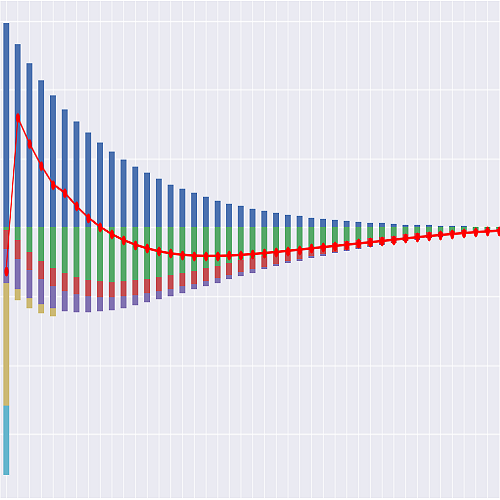
The Projection Space#
The by-policy projection of the IncomeTerm_JP_S model.
The Space is parameterized by point_id, so Projection[1] is an ItemSpace
projecting model point 1:
>>> Projection[1].result_cf()          # the worked example's anchor cell
>>> Projection.point_id = 4            # or switch the default
t counts policy months, 0-based: t = 0 is the first policy month and
t = proj_len() - 1 the last projected one, so the frame is range(proj_len()) and
the contractual policy month is t + 1. proj_len() is the number of projected
months and not the policy term. It is term_m() + guar_m() - 1, because a claim
arising in the last months of cover carries its guaranteed instalments past the expiry
date — see The run-off tail below.
Input data
Inputs are external files: plain CSVs living in the model folder’s parent
directory, products/income_guarantee/, read at run time rather than stored inside
the model. The model folder therefore holds nothing but formulas — no _data/, no
IOSpec, no embedded values — so a diff of the model shows logic changes only, and an
input can be edited or swapped without rewriting the model. This follows
annuallife.TradLife_A; contrast basiclife.BasicTerm_S, which keeps its inputs
inside the model through modelx’s IOSpec machinery.
The consequence worth knowing: the model is not portable on its own. Copying the
IncomeTerm_JP_S folder without its parent’s CSVs produces a model that reads and
then fails on first evaluation.
Each table has a filename Reference and a reader Cells, both on
Data, reached here through the data Reference:
Reference |
Cells |
File |
|---|---|---|
model_point_file |
data.model_point_table() |
model_point_table.csv |
mort_table_file |
data.mort_table() |
mort_table.csv |
lapse_table_file |
data.lapse_table() |
lapse_table.csv |
rate_class_file |
data.rate_class_table() |
rate_class_table.csv |
Naming
Cells names follow lifelib’s basiclife.BasicTerm_S wherever that model has an
analogue — pols_* for policy counts, plural nouns for cash flows, *_rate for
rates, *_mth for the monthly form of an annual rate, *_pp for per-policy
amounts, claims(t, kind) with an uppercase kind string,
pols_if_at(t, timing) for the within-month in-force reads. The technical notes use
compact actuarial symbols instead. The mapping is:
Notes symbol |
Cells |
Meaning |
|---|---|---|
t |
(the cells argument) |
Policy month, 0-based; t = 0 is the first |
x |
issue_age() |
契約年齢, 満年齢 at issue |
x + floor(t/12) |
age(t) |
Attained age in month t |
y(t) = t // 12 + 1 |
policy_year(t) |
Policy year of month t, 1-based |
(none) |
sex(), rate_class() |
Rating factors |
N |
term_m() |
保険期間 in months |
G |
guar_m() |
最低支払保証期間 in months |
T = N + G - 1 |
proj_len() |
Projected months; last t is T - 1 |
A |
annuity_mth() |
年金月額, JPY per month |
P_m |
premium_mth_pp() |
Monthly office premium |
P_due(t) |
prem_due_pp(t) |
Premium falling due at t |
(none) |
model_point() |
The selected model point |
n_pay(m) |
pay_count(m) |
Instalments a claim at m makes |
ends_at(m) |
pay_end(m) |
Month index of that stream’s last |
(table) |
mort_rate_base(t) |
死亡保険用 table rate at age(t) |
(class factor) |
class_factor() |
Rate class multiplier |
q(t) |
mort_rate(t) |
Annual death-and-高度障害 rate |
q_m(t) |
mort_rate_mth(t) |
Monthly equivalent |
w(t) |
lapse_rate(t) |
Annual ordinary lapse rate |
w_m(t) |
lapse_rate_mth(t) |
Monthly equivalent |
lambda |
sel_lapse_lambda |
Selective-lapsation loading |
l_ref |
sel_lapse_ref |
Selective-lapsation threshold |
(none) |
sel_lapse_factor(t) |
Mortality loading on persisters |
l(t) |
pols_if(t) |
In force at the start of t |
l(t)(1-q_m), l(t+1) |
pols_if_at(t, timing) |
BEF_DECR / BEF_LAPSE / AFT_DECR |
D(t) |
pols_death(t) |
Expected new claims in month t |
(none) |
pols_lapse(t) |
Lapses at the end of month t |
(none) |
pols_maturity(t) |
Survivors at expiry, paid nil |
(none) |
pols_reinst(t) |
復活 reinstatements |
(none) |
pols_payer(t) |
Policies actually paying premium |
(none) |
pols_commute(t) |
Claims settled by 一括受取 |
(none) |
pols_living_needs(t) |
リビング・ニーズ accelerations |
(none) |
annuities_open(t) |
Streams opened in month t |
(none) |
annuities_ended(t) |
Streams making their last pay |
R(t) |
annuities_if(t) |
Streams in payment during t |
(none) |
annuities_cum(t) |
Instalments due to date |
i_c |
commute_rate |
Commutation rate p.a. |
v |
commute_disc() |
(1 + i_c) ** (-1/12) |
L(n) |
commute_pp(t) |
Lump sum for one claim at t |
(cap) |
ln_cap |
リビング・ニーズ cap, JPY |
(none) |
ln_benefit_pp(t) |
リビング・ニーズ payout per claim |
(none) |
wop_waived_frac(t) |
Fraction with premiums waived |
P_m l(t) |
premiums(t) |
Premium income |
A R(t) |
claims(t, kind) |
Benefit outgo by kind |
ec D(t) |
claim_expenses(t) |
Claim expense outgo |
ea R(t) |
annuity_expenses(t) |
Annuity administration outgo |
E0, e_m(t) |
expenses(t) |
Acquisition + maintenance |
(none) |
inflation_factor(t) |
Expense inflation factor |
c0, c_r |
commissions(t) |
Commission outgo |
CF(t) |
net_cf(t) |
Net cash flow, income positive |
The References carrying the notes’ scalar assumptions are mort_be_factor (the
chassis’s 0.80 best-estimate factor), expense_acq (E0), expense_maint
(e_m before inflation), expense_claim (ec), expense_annuity (ea),
inflation_rate, comm_init_rate (c0) and comm_renewal_rate (c_r).
Four names needed care.
claims_annuity names a death benefit here. The instalments are paid on the death
of the insured, or on the contractual 高度障害 state carried inside the same decrement as
its accelerated equivalent; the name records the benefit’s form, not its trigger, and
the same column carries a living benefit in LTC_JP_S and Annuity_JP_S. So the
contingency is stated in claims() and in result_cf() rather than inferred.
There is no ``claims_death`` column, and that absence is a product fact: this
contract pays no lump sum on death at any duration — a claim opens an annuity stream
instead of settling one — so the whole death benefit is claims_annuity, and a
zero-valued claims_death would misdescribe the contract rather than document it.
R(t) is spelled annuities_if() rather than pols_annuity because it is
not a population of policies. It is a count of instalments falling due in month
t, per policy issued. pols_if and annuities_if are disjoint quantities that
must never be summed: on the anchor cell annuities_if(419) = 0.016780 while
pols_if(419) = 0.145023, and adding them produces a number with no meaning.
pols_maturity has no symbol in the notes. The notes give the roll-forward as
l(t+1) = l(t)(1-q_m)(1-w_m) for t < N - 1 and, separately, set l(t) = 0 for
t >= N. Those do not reconcile in the last month of cover, t = N - 1: its
survivors neither die nor lapse, their cover simply runs out. pols_maturity()
names them, zero in every month but N - 1, so that
- pols_if(t) + pols_reinst(t+1) - pols_if(t+1)
= pols_death(t) + pols_lapse(t) + pols_maturity(t)
holds for every t; check_pols_roll_fwd() asserts it. It is not a maturity
benefit: nothing is payable on survival, on this product at any duration.
claims_lapse is a column of zeros by product design. The composite is 無解約返戻金型
— there is no 解約返戻金 at any duration, so a lapse moves pols_if() and pays
nothing. The zero is published rather than dropped because a non-zero lapse row
imported from a cash-value chassis is one of the notes’ listed pitfalls, and a column
of zeros states the product fact where a missing column would only hide it. For the
same reason there is no cv_pp and no 自動振替貸付 anywhere in this model: with no cash
value there is no collateral to lend against, and one carrier states the absence in
terms.
The in-payment ledger, and the rule it obeys
The ledger is the whole model. A claim in month m opens a stream of
pay_count(m) = max(N - m, G) monthly instalments whose last falls in month
pay_end(m) = max(N - 1, m + G - 1), and annuities_if() counts the streams
paying in month t:
annuities_if(t) = annuities_if(t-1) - annuities_ended(t) + annuities_open(t)
New claims enter in the same month, because the first instalment falls at the end of the month of the insured event.
The ledger is never decremented. Not by the insured’s mortality — the insured is
dead, and that is what opened the stream. Not by the recipient’s mortality: on the
composite the instalments carry no survival condition, so the stream is an
annuity-certain, confirmed from the contract side by a published factor table that
depends on the payment period and not on the annuitant’s age or sex. Not by lapse: a
policy in claim cannot lapse and premiums have ceased. Applying the surviving-policy
factor (1 - q_m)(1 - w_m) to the ledger — the natural thing to do if it is mistaken
for a population of policies — cuts annuity outgo on the anchor cell from ¥443,313.69
to ¥245,605.66, an understatement of 44.6%, and it is the largest single error
available in this model. check_annuity_ledger() rebuilds the ledger directly from
the claim vector, with no reference to the recursion, and check_annuity_total()
checks the instalments due to date against sum of D(s) x pay_count(s).
The run-off tail
Every stream opened in months 0 ... N - G pays its last instalment in month
N - 1 exactly, whenever it opened, because the expiry date is fixed at issue. It
follows that annuities_if(N - 1) equals the sum of every claim the contract has ever
made — the ledger peaks at exactly t = N - 1, the last month of cover — and that the
only streams surviving into t = N are those opened in the last G - 1 months of
cover. Beyond t = N, annuities_ended(t) = annuities_open(t - G) and the ledger
runs down one month’s claims at a time.
In months N ... T - 1 there is no premium, no maintenance expense, no commission
and no new claim, because pols_if(t) = 0 there: only the annuity instalments and
the annuity administration expense remain. That is why expense_annuity is charged
against the ledger rather than against pols_if — it is the one expense that
survives the end of the policy term, and an implementation that attaches every expense
to the in-force population charges nothing at all in those months.
最低支払保証期間 is a term extension, not a benefit floor. Both readings pay the same
max(N - m, G) instalments, so an undiscounted total cannot tell them apart;
they differ in when. A floor implementation compresses the guaranteed instalments
inside the term and produces zero cash flow after t = N - 1. This model pays them
after expiry, on the same monthly timetable: on the anchor cell ¥2,645.21 of claim
outgo — 0.5967% of the total — falls in months t = 420 ... 442.
Modules that are off in the base run
Five of the notes’ optional constructions are implemented and switched off, so that the base run reproduces the worked example while the machinery stays visible and testable:
一括受取 (full commutation),
commutationon the model point, false on the anchor. The claim is settled at the claim date bycommute_pp(), the present value of thepay_count(m)instalments atcommute_rate[std], and the ledger is then not opened at all for that claim — a full commutation extinguishes the contract, so a model that pays the lump sum and opens the stream doubles the benefit. Partial commutation is out of scope [std scope]: it is barred once the first instalment has been paid, limited to once during the term at two carriers, and refused where the residual 年金月額 falls below ¥50,000, which makes it an election on a claim already open rather than a cash-flow shape. Model point 4 runs it on. Note thatpay_count(m)is read at the 0-based claim monthm.リビング・ニーズ特約,
living_needson the model point, false on the anchor. A [std] proportionln_take_upof the month’s claims is settled instead as an acceleration, at the 年金現価 of the designated 年金月額 less six months’ interest and premium equivalent, capped atln_cap= ¥30,000,000 and barred in the final year. It is carved out of the death decrement rather than added to it, because the insured is by definition within six months of death; the<= 6-month timing shift is ignored on this grid [std]. The product-specific consequence is that because the amount is the present value of an income stream, the cap binds from ``t = 0`` and stops binding only once the unpaid stream falls below it — the opposite pattern to a level sum assured. Model point 5 runs it on.保険料払込免除,
wopon the model point, false on the anchor. A two-state incidence/recovery chain [std] on the premium-paying population, on the accident-plus-180-days-plus-別表4 test. 別表4 is a materially lower bar than the 別表3 高度障害 schedule, so the incidence is not the 高度障害 incidence and deliberately does not reusemort_rate(). Model point 7 runs it on.復活 (reinstatement),
reinstatementon the model point, false on the anchor. A [std] proportionreinst_rateof each month’s lapses returns to in forcereinst_lag_mmonths later — a single-lag approximation of the three-year windowreinst_window_m[std] — paying its arrears with interest. The rate class carries over unchanged on reinstatement, which matters here because the class is a mortality parameter. Model point 8 runs it on.Selective lapsation,
q_eff(t) = q(t) [1 + lambda max(0, 1 - l(t)/l_ref)], withsel_lapse_lambda = 0. The mechanism is weaker than on the protection chassis because there is no periodic no-underwriting renewal to select against, but it is not absent: the rate class is fixed at issue and cannot be changed even if BMI, blood pressure or smoking status changes, so a life whose health deteriorates keeps a preferred rate while a life whose health improves cannot get one and may re-shop.
Two of the notes’ constructions are not implemented and are named so the absence is not read as an oversight. The recipient-mortality variant — one carrier alone conditions second-and-later instalments on the recipient being alive — would need a post-event mortality basis on a life the contract never underwrote, and the 年金開始後用 table stays on the 2007 vintage; it is out of scope [std]. And there is no 更新 on this chassis: no retrieved document offers renewal, one states the absence in terms, and the term is 歳満了 only, so importing the protection chassis’s renewal repricing and its decline decrement would invent a decision, a premium ladder and a decrement the contract does not have.
Sign convention
The notes’ CF(t) is already income positive — they write + = inflow — which
is the library-wide sign of net_cf(), so there is no outgo-positive
liability_cf companion to publish: one stream, one sign, one name.
Read the undiscounted total honestly. On the anchor cell it is negative, and the reason
is not a bug: the premium is a published preferred non-smoker rate while the
assumption basis is a [std] adjustment of a valuation table carrying a 2-sigma
margin, and the pricing basis that would reconcile them is not public. More
importantly, on this product an undiscounted total is close to meaningless — the
benefit is paid over up to 35 years after a claim that itself arises over 35 years,
so the claim leg discounts far harder than the premium leg. Discounting is out of scope
for this library, and a reader who takes the undiscounted total as the liability has
mis-read this product more badly than any other in jplib.
Cells Descriptions#
- issue_age()[source]#
x: the 契約年齢 (issue age), 満年齢 with the fraction truncated.
Age last birthday at the 契約日, worked in one carrier’s booklet as 35歳7カ月 giving a 契約年齢 of 35. Envelope 20-70 on the composite. Note the basis mismatch this creates and does not resolve: 生保標準生命表2018(死亡保険用)is built on a 保険年齢 (age nearest birthday) basis, so reading it at 満年齢 reads it half a year early and understates mortality. The bias is stated rather than corrected in the base run; the optional
sqrt(q_x q_{x+1})shift belongs to the protection chassis and movesqup.
- expiry_age()[source]#
The attained age at which cover ends, 45-90 on the composite.
The term is 歳満了 only — stated to an attained age. No retrieved document offers 年満了 or 更新, so a model point supplying an n-year term would be describing a product the composite does not have, and
term_m()is derived from this rather than read.
- term_m()[source]#
N: the 保険期間 in months,
12 x (expiry_age - issue_age).Derived, not an input. The 保険料払込期間 equals the 保険期間 always on this composite, so there is no 払込満了 step and no separate premium-paying term to carry.
- guar_m()[source]#
G: the 最低支払保証期間 in months, from the composite menu {24, 60}.
Elected at issue and not changeable. It is quoted in years and binds in months, which is one of the reasons this product cannot be run on an annual grid.
- rate_class()[source]#
The preferred-risk rate class code, a key into
rate_class_table.csv.Four classes on the composite —
nonsmoker_preferred(非喫煙者優良体),nonsmoker_standard(非喫煙者標準体),smoker_preferred(喫煙者優良体) andsmoker_standard(喫煙者標準体). Qualification is published and measured rather than declared: BMI 18.0 to under 27.0, 最大血圧 under 140 and 最小血圧 under 90 mmHg, no tobacco in the past year verified by a コチニン (cotinine) test. The class is fixed at issue and cannot be changed later, which is what gives the selective-lapsation module its mechanism.
- class_factor()[source]#
The rate class mortality multiplier [std], read from
rate_class_table.csv.0.70 / 0.90 / 1.05 / 1.35 across the four classes. No carrier publishes a class differential for this product, so this is the least evidenced and the largest lever in the file: annuity outgo on the anchor cell runs ¥443,313.69 at 0.70 and ¥846,803.38 at 1.35, a factor of 1.9 across the composite’s own four classes, on a premium quoted for the cheapest of them. The four are given an internal structure rather than four free numbers — see
check_class_factor_norm().
P_m: the level monthly office premium per policy, JPY.
Level and guaranteed for the whole 保険期間, with no review mechanic and no 更新, so the insurer has no unilateral repricing right and the contract boundary is the full term. On the anchor cell ¥2,565 is a published rate — the 65歳満了 / 保証2年 / 非喫煙優良体型 / 年金月額¥150,000 monthly rate for a male aged 30 — and on several other model points the rate is likewise published. Where no published cell exists the value is [std];
model.mdsays which is which.
The premium frequency:
monthly,semiannualorannual.All three are contractual. The composite defaults to 月払, which is the frequency the only published rate grid is quoted in. The mode changes the timing only:
prem_due_pp()collects12 / fmonths of premium at the start of each payment period. No 前納 or frequency discount is applied, because the discount is insurer-set and unpublished [std scope].
- living_needs()[source]#
Whether the リビング・ニーズ特約 acceleration module is on; false in the base run.
The rider is attached automatically and free at three carriers, so its presence is a product fact; what is switched off in the base run is the [std] acceleration incidence, which no retrieved document gives.
- wop()[source]#
Whether the 保険料払込免除 waiver module is on; false in the base run.
The waiver is in the 主契約, not a rider, so it carries no extra premium: premiums are waived where the insured, from an 不慮の事故 on or after the 責任開始期, comes within 180 days to a 別表4 身体障害の状態. Disease-based waiver is a rider only and is out of scope.
- reinstatement()[source]#
Whether the 復活 module is on; false in the base run.
復活 is available for three years from lapse, on fresh underwriting and arrears with interest. Japanese policies really do come back, which is a genuine difference from the UK composite in
uklib, where a lapsed policy terminates finally.
- pols_if_init()[source]#
l(0) = 1: the model point is a single policy on an expected basis.
Every cash flow below is therefore per policy issued, probability-weighted, which is the sense the ESR 現在推計 (genzai suikei, current estimate) requires.
- proj_len()[source]#
T: the number of projected months,
term_m() + guar_m() - 1.The exclusive end of the frame:
truns0 ... proj_len() - 1, solen(result_cf()) == proj_len().Not the policy term. Where the insured event falls so late that fewer than
Gmonths remain, the annuity payment period is extended past the expiry date until the guarantee has run, so the last instalment any claim can make falls att = N + G - 2, the last row of the frame. On the anchor cell that is 443 months against a term of 420. Terminating the projection at the end of cover (t = N - 1) drops ¥2,645.21 of contractual claim outgo, 0.5967% of the total, all of it in monthst = 420 ... 442— the most natural error to make on this product and the least visible, because every remaining number still looks reasonable.
- policy_year(t)[source]#
y(t): the policy year containing month t,
1 + floor(t / 12).The contractual, 1-based label beside the 0-based month index:
t = 0 .. 11is policy year 1. It is the key intolapse_table.csv, whosepolicy_yearcolumn is 1-based for the same reason.
- age(t)[source]#
The attained age of the insured at the start of policy month t.
x + floor(t / 12)on the 満年齢 basis ofissue_age(), so the issue age holds for the twelve monthst = 0 .. 11. Beyond the last month of cover the value is nominal: cover has expired,pols_if(t)is zero and no rate is read at it.
- inflation_factor(t)[source]#
The expense inflation factor in month t:
(1 + pi) ** (y(t) - 1)[std].Annual steps within the monthly grid, so maintenance expense inflates once a policy year rather than once a month. 1.0% p.a.; no Japanese public source supports any expense level or inflation rate in this model.
- mort_rate_base(t)[source]#
The 死亡保険用 table rate at the attained age of month t, before adjustment.
Read from
mort_table.csv, which is a [std] construction anchored on the individual 生保標準生命表2018(死亡保険用)rates the technical notes quote and attribute — not a copy of the published table, whose publisher prohibits redistribution. The rate includes 高度障害, which is why 高度障害 is not a second decrement here: adding a separate 高度障害 incidence on top of the table double-counts the benefit, and the two annuities are contractually mutually exclusive in any case.
- sel_lapse_factor(t)[source]#
The selective-lapsation loading on mortality in month t [std].
1 + lambda max(0, 1 - l(t) / l_ref). Off in the base run (sel_lapse_lambda = 0), where it returns 1 in every month. The mechanism is weaker here than on the protection chassis, which has a periodic no-underwriting renewal to select against, but it is not absent: the rate class is fixed at issue and cannot be changed, so a life whose health deteriorates keeps a preferred rate while a life whose health improves cannot get one and may re-shop.
- mort_rate(t)[source]#
q(t): the annual best-estimate death-and-高度障害 rate in policy month t.
0.80 x class_factor x q_x^tab, times the selective-lapsation loading. The 0.80 is the protection chassis’s [std] best-estimate factor: 標準生命表2018 is a valuation table carrying a margin sized to about a 2-sigma exceedance probability and capped at 130% of the unadjusted rate, plus a forward improvement allowance, so a best-estimate basis is an adjustment of it whatever else is done. Three separate departures from the statutory basis therefore sit between this projection and a 責任準備金, and no reserve is computed anywhere in this library.Zero from
t = term_m()on: cover has expired and there is nothing left to decrement.
- mort_rate_mth(t)[source]#
q_m(t): the monthly death-and-高度障害 rate,
1 - (1 - q(t)) ** (1/12)[std].The effective convention, not a nominal
q / 12. On the anchor cell at attained age 30 this is about 3.17e-05, which is why the claim and ledger populations are carried to nine decimals: six would leave them with two significant figures – 0.000032 against 0.000031738873, a 0.8% distortion of the first policy year’s claims.
- lapse_rate(t)[source]#
w(t): the annual ordinary lapse rate in policy month t [std].
Read from
lapse_table.csvbypolicy_year(), the 1-based contractual labelt // 12 + 1— 9 / 7 / 6 / 5.5 / 5 percent, the last row applying to policy year 5 and beyond. Zero fromt = term_m()on.A lapse pays nothing: there is no 解約返戻金 at any duration on the composite, so this moves
pols_if()and nothing else. Note that the sign of the lapse sensitivity here is the opposite of the protection chassis’s: on this assumption set expected claims exceed premiums, so lapse relieves the liability — undiscounted net cash flow is -¥269,617.32 at zero lapse against -¥103,051.56 on this table.
- pols_if(t)[source]#
l(t): the policies in force at the start of policy month t.
pols_if_init()att = 0, then the notes’ recursionl(t+1) = l(t)(1 - q_m(t))(1 - w_m(t))fort < N - 1, plus any 復活 reinstatements. This is the weight on the premium, maintenance and commission lines of the sameresult_cf()row — and on nothing else: the annuity instalments carryannuities_if()instead.Zero for every ``t >= term_m()``. Cover ends at the expiry date with nothing payable on survival, and the months after it belong entirely to the run-off of claims that arose inside the term.
- pols_if_at(t, timing)[source]#
The policies in force at a point inside policy month t.
"BEF_DECR"l(t), the start of the month, before any decrement; the same number as
pols_if()."BEF_LAPSE"after deaths, before lapses — the notes’ processing order is death before lapse [std order], so this is the population lapses are taken from.
"AFT_DECR"the end-of-month state, and zero from the last month of cover
t = term_m() - 1on, because its survivors leave with nothing rather than rolling forward.
- pols_death(t)[source]#
D(t) = l(t) q_m(t): expected new claims at the end of policy month t.
One decrement covering death and 高度障害 together, because the table includes 高度障害 and the two annuities are mutually exclusive. No lump sum is paid: except under the two optional settlement modules, the claim opens an annuity stream and does not settle one.
- pols_lapse(t)[source]#
Lapses at the end of policy month t, taken from the survivors of mortality.
失効 follows the 猶予期間, which for 月払 runs to the last day of the month after the 払込期月. Pays nothing: there is no 解約返戻金 at any duration on the composite, and with no cash value there is no 自動振替貸付 to carry the policy through an unpaid premium either.
- pols_maturity(t)[source]#
Survivors whose cover expires at the end of
t = term_m() - 1; zero elsewhere.Not a decrement and not a benefit — the contract simply runs out, with no 満期保険金 and no 解約返戻金 — but needed for the in-force roll-forward to close in the last month of cover. On the anchor cell it is 0.144342 of the original cohort.
- pols_reinst(t)[source]#
復活 reinstatements returning to force at the start of month t; off in the base run.
A [std] proportion
reinst_rateof the lapses of montht - reinst_lag_mcomes back, a single-lag approximation of the three-yearreinst_window_mwindow. The rate class carries over unchanged on reinstatement, which matters here because the class is a mortality parameter; the arrears with interest they pay are inpremiums()throughprem_arrears_pp().
- wop_waived_frac(t)[source]#
The fraction of in-force policies with premiums waived at the start of month t.
A two-state incidence/recovery chain [std],
u(t+1) = u(t)(1 - rec_m) + (1 - u(t)) inc_m, starting fromu = 0. Both rates are placeholders: no public Japanese incidence basis for the accident-plus-180-days-plus-別表4 test appears in the sources. 別表4 is a materially lower bar than the 別表3 高度障害 schedule, so the incidence is deliberately notmort_rate(). Mortality and lapse are assumed independent of the waiver state [std], which is what lets the waived population be carried as a fraction of the in-force rather than as its own decrement. Zero unless the module is on.
- pols_payer(t)[source]#
The in-force policies actually paying premium in policy month t.
l(t)less the waived fraction. Equal topols_if()unless the 保険料払込免除 module is on. Premiums also cease on the annuity event, but that needs no term here: a policy in claim has already leftpols_if().
- pay_count(m)[source]#
n_pay(m) = max(N - m, G): the instalments a claim in month m generates.
mis the model’s own 0-based month index, so the contractual policy month of the event ism + 1: a source that quotes an illustration for policy monthkis read here atm = k - 1, and itsmax(N - k + 1, G)becomesmax(N - m, G). One instalment per monthly payment date from the insured event to the 保険期間満了日, floored at the 最低支払保証期間. The rule reproduces every published illustration in the source set: onN = 420, 420 instalments for a claim atm = 0, 240 atm = 180and 60 atm = 360; 411 atm = 9and 178 atm = 242; and on a 5年 guarantee, 60 for a death 33 years in, where the remaining term is 24 months and the guarantee binds.
- pay_end(m)[source]#
ends_at(m) = max(N - 1, m + G - 1): the month of that stream’s last instalment.
A 0-based month index like
mitself, sopay_count(m) == pay_end(m) - m + 1exactly as in the notes. The whole guarantee mechanic in one expression: form <= N - Gevery stream ends at exactlyN - 1, the last month of cover, whenever it opened, because the expiry date is fixed at issue; only later claims run past it.
- commute_disc()[source]#
v = (1 + i_c) ** (-1/12): the monthly discount factor of the commutation basis.
- annuity_certain_factor(n)[source]#
a(n) = v (1 - v^n) / (1 - v): an n-instalment annuity-certain, monthly in arrears.
The commutation basis is [std] at
commute_rate= 0.65% p.a. effective, and it is the best-evidenced [std] number in the product. No direct writer publishes a discount basis, but one 特約条項 publishes the factor table itself — 年金の現価相当額 = 基本年金額 times a tabulated rate with no dependence on the annuitant’s age or sex — which fits an annual annuity-due less a small constant at about 0.61% p.a., and three carriers publish a worked commutation amount whose ratios cluster at 0.92190, 0.92183 and 0.92133, the last two implying 0.66%. The midpoint of those two independent anchors is 0.635%; 0.65% is that rounded to the nearest 0.05%, and it reproduces the two 300-instalment amounts to +0.12% and +0.18%, inside their published rounding. It does not reproduce the 180-instalment amount, and no single flat rate can produce a near-constant ratio at both 180 and 300 instalments — a fact about the data, not a failure of the fit. Observed range to test over: 0.61%-1.45%.
- commute_pp(t)[source]#
L(n): the 全部一括受取 lump sum settling one claim arising in month t.
A a(n_pay(t)). A full commutation extinguishes the contract, so with the module on the ledger must not open at all for that claim. On the anchor cell a death att = 0commutes ¥63,000,000 of instalments to ¥56,352,381.90, a ratio of 0.894482; at 300 remaining instalments the ratio is 0.922965, against the 0.92133-0.92190 the three published illustrations show.
- ln_benefit_pp(t)[source]#
The リビング・ニーズ特約 payout per accelerated claim in month t.
The 年金現価 of the designated 年金月額 — taken as the whole of it [std] — less six months’ interest and six months’ premium equivalent, capped at
ln_capand barred in the final year before expiry — the twelve monthst = N - 12 ... N - 1. Because the amount is the present value of an income stream, the cap binds from ``t = 0`` on the anchor cell, where the full 年金現価 at issue is ¥56,352,381.90, and stops binding only once the unpaid stream has run down below ¥30,000,000 — the opposite pattern to a level sum assured, where a cap either always binds or never does.
- pols_living_needs(t)[source]#
The claims of month t settled instead as a リビング・ニーズ acceleration.
ln_take_up x D(t)[std]; zero unless the module is on or where the rider is barred. Carved out of the death decrement rather than added to it: the insured is by definition within six months of death, so an added decrement would double-count the benefit. The<= 6-month timing shift the acceleration really produces is ignored on this grid [std].
- pols_commute(t)[source]#
The claims of month t settled by a full 一括受取 lump sum; zero in the base run.
- annuities_open(t)[source]#
The annuity streams opened by the claims of month t.
D(t)less any claim settled as a lump sum instead — a full commutation or a リビング・ニーズ acceleration. They enterannuities_if()in the same month, because the first instalment falls at the end of the month of the insured event: contractually the day before the first monthly policy anniversary falling on or after it, which on a monthly grid is exactly one payment in the month of the event.
- annuities_ended(t)[source]#
The streams whose last instalment fell in month
t - 1.Two cases exhaust it. At
t = N— the first month past the end of cover — every stream opened in months0 ... N - Gends at once, because each of them ran to the fixed expiry date whenever it opened. Beyond that the ledger runs down one month’s claims at a time,annuities_open(t - G).
- annuities_if(t)[source]#
R(t): the annuity streams in payment during policy month t, per policy issued.
R(t) = R(t-1) - ended(t) + opened(t), seeded byR(t) = 0fort < 0. Never decremented — not by the insured’s mortality, not by the recipient’s, not by lapse. It is a count of instalments falling due, not a population of policies, and must never be summed withpols_if().The ledger peaks at exactly
t = N - 1, the last month of cover, where it equals the sum of every claim the contract has ever made: 0.016779783 on the anchor cell. An implementation that ends streams one month early gets that identity wrong and nothing else visibly changes, which is whycheck_annuity_ledger()rebuilds it directly.
- annuities_cum(t)[source]#
The instalments due from
t = 0to month t inclusive, per policy issued.The running total of
annuities_if(). Over the whole projection it reconciles tosum of D(s) x pay_count(s)— 2.955425 on the anchor cell, an average total benefit of ¥26,419,511.96 per claim — which is whatcheck_annuity_total()asserts.
- prem_due_pp(t)[source]#
The office premium falling due per paying policy at the start of month t.
P_mevery month on 月払; on 半年払 and 年払,12 / fmonths’ premium at the start of each payment period and nothing in between, the first falling att = 0. Zero fromt = term_m()on: the 保険料払込期間 equals the 保険期間, and premiums cease on the annuity event in any case — which needs no term here, because a policy in claim has already leftpols_if().
- prem_arrears_pp()[source]#
The arrears with interest one reinstating policy pays [std].
reinst_lag_mmonths of premium accumulated atreinst_int_rateover half the lag. 復活 requires the arrears with interest; the interest rate is nowhere published, so it is standardized at the commutation basis for want of a better one.
Premium income at the start of policy month t, an inflow.
Carried on
pols_payer()and on nothing else. Premiums stop on the annuity event; the benefit does not — netting the two against one combined population would collect ¥7,535.43 of premium on the anchor cell, 1.63% of the total, from policies that are in claim and paying nothing. The 復活 arrears, where that module is on, arrive here too.
- claims(t, kind=None)[source]#
Benefit outgo at the end of month t; every kind here is paid on death.
The contingency is stated rather than left to the column names, because
claims_annuitynames a benefit paid on a living contingency inLTC_JP_SandAnnuity_JP_S. Here the name records the benefit’s form — an annuity — and the trigger is the death of the insured, or the contractual 高度障害 state carried inside the same decrement as its accelerated equivalent. Nothing in this model is paid on survival, on disability as such, or on lapse.There is no ``claims_death`` column, and the absence is a product fact. This contract pays no lump sum on death at all: the claim opens an annuity stream rather than settling one, so the whole death benefit is
claims_annuity. The two lump-sum kinds below are settlements of that same death claim under an optional module, not a second benefit."ANNUITY"the 遺族年金 / 高度障害年金 instalments falling due in month t,
A x annuities_if(t), paid on the death of the insured (or the 高度障害 equivalent). This is the product’s whole benefit in the base run, and it is the only line that continues after the policy term has ended."COMMUTATION"the 全部一括受取 lump sum where that module is on,
commute_pp(t)per commuting claim. Zero in the base run."LIVING_NEEDS"the リビング・ニーズ特約 acceleration where that module is on. Zero in the base run.
"LAPSE"zero, always. There is no 解約返戻金 at any duration on the composite; the kind exists so the zero is stated rather than left to inference.
- claim_expenses(t)[source]#
ec D(t): the claim handling expense on the month’s new claims [std].
¥30,000 per claim, charged once when the claim arises however it is then settled. Kept out of
expenses(), which is acquisition plus maintenance only, and separate fromannuity_expenses(), which is charged per instalment rather than per claim. It is deducted explicitly innet_cf()and published as its ownclaim_expensescolumn.
- annuity_expenses(t)[source]#
ea R(t): the administration expense of the instalments due in month t [std].
¥200 per instalment paid, plus one payment for each claim settled instead by a lump sum. A new item with no analogue on the protection chassis, which pays a lump sum and closes the file: this product pays up to 420 instalments over up to 35 years after the claim. The level is a placeholder — ¥591.08 undiscounted per policy issued on the anchor cell against ¥443,313.69 of claims — but its structure is the point. It is charged against the ledger, not against
pols_if(), and it is the one expense that survives the end of the policy term: an implementation that attaches every expense to the in-force population charges nothing at all in monthst = 420 ... 442, when instalments are still being paid.
- expenses(t)[source]#
E0 and e_m(t): acquisition and inflating maintenance expense in month t [std].
Acquisition and maintenance only — the library-wide meaning of
expenses. The claim expense isclaim_expenses()and the per-instalment annuity administration expense isannuity_expenses(); both are deducted separately innet_cf()and published as their ownresult_cf()columns. The notes’ worked-example table prints those two combined in a single “Claim + ann. exp” column, which is a presentational grouping in the notes and not a definition ofexpenses.¥15,000 per policy at issue — the acquisition charge falls in the first row of the frame,
t = 0— then ¥4,000 p.a. taken as4,000 / 12a month and inflating at 1.0% p.a., both at the start of the month and both on the in-force population. Zero fromt = term_m()on, where there is no in-force population left.Expense is heavy relative to this premium: ¥30,780 of annual premium carries ¥4,000 of maintenance, and the five non-benefit lines total ¥120,768.70 against ¥461,030.83 of premium on the anchor cell — 26.2%. No Japanese public source supports any of these levels.
- comm_init_pp()[source]#
c0: the initial commission per policy issued [std].
50% of the first-year annualized premium, paid upfront at issue. With the acquisition expense it is what produces the deep first-month new business strain in the worked example: -¥28,164.05 at
t = 0against +¥2,203.68 att = 1.
- commissions(t)[source]#
Commission outgo in policy month t [std].
The initial commission at
t = 0, then 5% of premium income fromt = 12, the first month of policy year 2. Both levels are chosen for the reference implementation; nothing about Japanese protection commission is published in the source set.
- net_cf(t)[source]#
CF(t): the net cash flow of policy month t, income positive.
Premiums less the annuity instalments, the annuity administration expense, the claim expense, maintenance and acquisition expense and commission. The notes’ own sign — they write
+ = inflow— which is also the library-wide convention, so there is no outgo-positiveliability_cfcompanion to publish.Note which population multiplies which term: premiums, maintenance and commission carry ``pols_if``; the annuity instalments and the annuity administration expense carry ``annuities_if``, and the two are disjoint. Lapse contributes no term at all — it acts only through
pols_if, andclaims(t, "LAPSE")is identically zero.
- check_pols_roll_fwd_resid(t)[source]#
The in-force roll-forward residual in policy month t; zero everywhere.
l(t) + reinstatements(t+1) - l(t+1) - deaths - lapses - expiries. Expiries are non-zero only att = term_m() - 1, where the survivors neither die nor lapse: their cover runs out and they are paid nothing. Without that term the last month of cover appears to lose lives with no cause.
- check_pols_roll_fwd()[source]#
True when the in-force roll-forward closes in every month of cover.
The library-wide form of a roll-forward check: no argument, one bool over all t, so one test can call the same check across every model.
check_pols_roll_fwd_resid()gives the signed residual of the month that failed.
- check_annuity_ledger_resid(t)[source]#
The in-payment ledger residual in policy month t; zero everywhere.
annuities_if()less an independent rebuild of the same figure — the streamsswiths <= t <= pay_end(s), summed straight off the claim vector with no reference to the recursion. A ledger decremented by mortality or lapse, or one whose streams end a month early, shows up here.
- check_annuity_ledger()[source]#
True when the in-payment ledger closes in every projected month.
No argument, one bool over all t;
check_annuity_ledger_resid()gives the signed residual of the month that failed.
- check_annuity_total_resid(t)[source]#
The cumulative-instalment residual at policy month t; zero everywhere.
annuities_cum()less an independent count built from the claim vector and the contractual instalment schedule: each claim in monthscontributes the number of its instalments falling at or beforet,min(t, pay_end(s)) - s + 1. Att = proj_len() - 1, the last row of the frame, this is the notes’ identitysum over t of R(t) = sum over s of D(s) x n_pay(s).
- check_annuity_total()[source]#
True when the instalments due to date reconcile in every projected month.
- check_pay_count_resid(t)[source]#
The guarantee-arithmetic residual for a claim in month t; zero everywhere.
pay_count(t) - (pay_end(t) - t + 1). The two express the same contractual rule from opposite ends — how many instalments a claim makes, and when the last of them falls — andends_at(m) = max(N - 1, m + G - 1)is the whole guarantee mechanic in one expression. An off-by-one in either is invisible in any total.
- check_pay_count()[source]#
True when the instalment count and the stream end date agree in every month.
- check_expired_cover_resid(t)[source]#
What the model still charges to the in-force population after expiry; zero.
premiums(t) + expenses(t) + commissions(t) + pols_death(t)fort >= N, and zero by construction inside the term. Cover ends at the expiry date with nothing payable on survival, so every line carried onpols_if()must vanish there while the annuity instalments and their administration expense run on — the asymmetry this product exists to model.
- check_expired_cover()[source]#
True when nothing is charged to the in-force population past the policy term.
- check_class_factor_norm_resid(t)[source]#
The rate-class normalization residual; the same at every t.
The mix-weighted mean of the four [std] class factors, less 1. 生保標準生命表2018 is an all-lives basis, so a class split whose weighted mean is not 1.000 silently re-levels the whole table. The illustrative mix
0.25 x 0.70 + 0.35 x 0.90 + 0.10 x 1.05 + 0.30 x 1.35gives exactly 1.000; the mix is [std] and is used to check the normalization, not as a claim about the market. The identity has no time dimension, sotis carried only for uniformity with the othercheck_*_residcells.
- check_class_factor_norm()[source]#
True when the mix-weighted mean of the rate class factors is 1.000.
- check_net_cf_resid(t)[source]#
The cash flow statement residual in policy month t; zero everywhere.
net_cf()less the publishedresult_cf()columns re-added — premiums, less the fourclaims_*splits, the claim expense, the annuity administration expense, maintenance and acquisition expense and commission. It is not a restatement ofnet_cf(): that cells subtracts the totalclaims(), while this rebuild sums the four columns the statement actually prints, so a benefit limb that is computed but never published — or one published twice — shows up here. It is also what makes publishing a bareclaimssubtotal beside its own splits a defect rather than a convenience: the columns would then no longer add tonet_cfwithout knowing which of them to skip.
- check_net_cf()[source]#
True when the published cash flow statement adds to net_cf in every month.
The library-wide name for this check, and the library-wide form: no argument, one bool over all t, with the signed residual of the month that failed at
check_net_cf_resid().
- result_cf()[source]#
Result table of cash flows, indexed by the 0-based policy month t.
The index runs
0 ... proj_len() - 1, so the frame hasproj_len()rows and the contractual policy month of rowtist + 1.pols_ifis the start-of-month in-force probability and the weight on the premium, maintenance and commission lines of the same row;annuities_ifis the ledger and the weight on the two annuity lines. They are disjoint and must never be summed.net_cfcarries the notes’ own income-positive sign, andcheck_net_cf()re-adds the published columns to it.``claims_annuity`` is a death benefit. The instalments are paid on the death of the insured, or on the contractual 高度障害 state treated as its accelerated equivalent — not on survival and not on disability as such. The same column name carries a living benefit in
LTC_JP_SandAnnuity_JP_S, so on this product the contingency is stated here: the name records the benefit’s form, not its trigger. There is no ``claims_death`` column, and that absence is a product fact rather than an omission — the contract pays no lump sum on death, so the whole death benefit is the annuity.claims_lapseis likewise a column of zeros by product design — there is no 解約返戻金 at any duration — and is published rather than dropped.The table is
proj_len()rows long, which isguar_m() - 1months longer than the policy term: the last rows carry annuity instalments and their administration expense alone.
- result_pols()[source]#
Populations and decrement rates, indexed by the 0-based policy month t.
Same frame as
result_cf():truns0 ... proj_len() - 1.