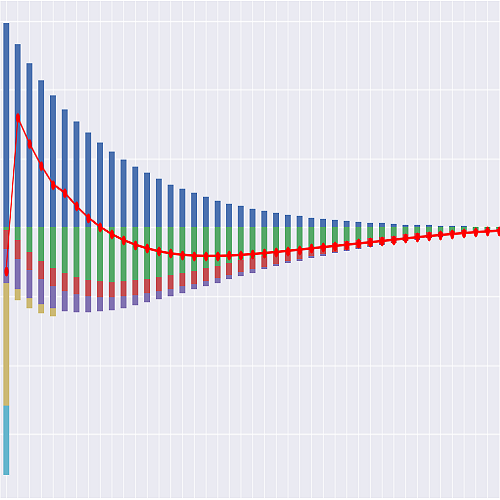
Product Specification#
Status: Draft, 2026-08-29; citations re-verified against the primary documents 2026-08-30.
Scope note. This is a standardized composite specification assembled for reference liability
cash-flow modeling of the German kapitalbildende Lebensversicherung — the classic endowment, the
gemischte Versicherung auf den Todes- und Erlebensfall, which pays a guaranteed
Erlebensfallleistung at the Ablauf (maturity) if the versicherte Person is then alive and a
Todesfallleistung if she dies before it, both increased by the Überschussbeteiligung. It
describes no single insurer’s contract. Source tags — [S#] (primary product documents: AVB,
Basisinformationsblatt, Standmitteilung, insurer product pages) and [R#] (product-specific
regulatory and actuarial references), both numbered per _research/kapitallebensversicherung.md and
resolved in sources.md, numbering frozen; and [REG-R#] (the cross-product library
references/regulatory-and-actuarial-references.md, whose R1–R56 numbering is separate and also
frozen) — name the instrument a claim should be checked against. std marks a standardization
introduced for the reference implementation, each with a numbered footnote giving the rationale and,
where one was established, the observed range; unverified marks a claim no search corroborated.
Read this before relying on a citation. delib was drafted under an organisation network
policy that blocked all direct HTTP egress from the build environment — gesetze-im-internet.de,
bafin.de, gdv.de, aktuar.de, dejure.org and de.wikipedia.org were tried and refused — so no
document was retrieved and the first draft rested on WebSearch result summaries, a budget exhausted
after twenty-four searches on this product, and on the authoring model’s own knowledge of German
insurance law and practice, disciplined by the std and unverified tags. That policy has since
been lifted and the citations re-verified against the primary documents. For this product,
forty-five of the forty-seven entries in sources.md now rest on a document that was opened and
read — 96 %: the statutory core as canonical XML from gesetze-im-internet.de with each
instrument’s amendment status (Stand) recorded, and the carrier material as PDF, six
Bedingungswerke among it. Two entries were not retrieved at all — [S8], HTTP 404 at the cited
die Bayerische URL, and R24, a rechtsportal.de report of the older BGH line answering HTTP 429 —
and several more were retrieved only in part; every entry says which it is. Where an entry says
Retrieved: yes, treat the claim it carries as sound; where it does not, the citation is still a
pointer, not a certificate — it names the instrument a claim should be checked against and does not
assert that anyone checked it. Re-verification also changed this document: it corrected the surplus
base read from Debeka [S3], the Debeka edition dates, the Standmitteilung field list [S2] and the
lapse figures R20, and each correction is marked where it stands. What it did not change is the
thinness of the insurer-by-insurer parameter sweep — of twenty-six named carriers, seven produced a
document and three produced quantified terms. Where a level could not be established it is a
std parameter with a stated rationale rather than a citation, because a [std] number is
honest and a wrong [S#] number is not.
Composite base. The seven carriers that produced a document are set out in Variations across insurers below: Debeka [S3] [S4] [S5] [S6], Gothaer [S7], die Bayerische [S8] [S9], VPV [S18], Allianz [S11], ERGO [S12] and ÖSA [S10]. Only two of those documents are endowment wordings — Gothaer’s, of 2011, and VPV’s, of 2019; the three Debeka Bedingungswerke and both die Bayerische editions are annuity wordings, used only where the rule transfers, which is said wherever a fact is taken from them. The GDV Musterbedingungen [S1] and Muster-Standmitteilung [S2] are the market template, and the GDV states its model conditions are unverbindlich and their use purely optional, so an S1-tagged fact is weaker evidence about a carrier than the same fact from that carrier’s own AVB. Consumer material [S13] [S15] [S16] is context. Betriebliche Altersversorgung, Gruppenversicherung, Sterbegeldversicherung and private Krankenversicherung are outside the delib library entirely.
Product overview and market role#
A German Kapitallebensversicherung is life assurance in Sparte 19 (Leben) of Anlage 1 to the VAG REG-R5, written as an individual contract on a single life against an individual Versicherungsschein — every carrier document located is such a contract, with no subscribing association anywhere in the chain [S3] [S4] [S5] [S7] [S8], a structural difference from the French corpus where five of eight carriers used a contrat de groupe à adhésion facultative. The supervisor’s own one-sentence definition is that the product “combines a Risikolebensversicherung, which pays on death, with a savings process whose proceeds are paid with interest at the end of the contract” [R18-family]; Allianz gives the same structure from the manufacturer’s side, as “a guaranteed interest rate, a savings component and death cover in one product” [S11]. Four features make the German chassis what it is, and each changes the shape of the projected cash flows.
Participation is the default and it is all-or-nothing. § 153 Abs. 1 VVG entitles the policyholder to a share in the surplus and in the Bewertungsreserven unless participation is excluded by express agreement, and such an exclusion can only be made for the whole of it R1 REG-R24. There is no partially participating German endowment, and every carrier document located is participating [S3] [S7] [S9] [S11].
The surplus is declared as a percentage of the contract’s own reserve. Four retrieved wordings agree on the base. Gothaer: “Es werden Jahresanteile zugewiesen. Diese bestehen aus einem Risikoanteil in Promille der Versicherungssumme und in Prozent des Risikobeitrags sowie einem Ertragsanteil in Prozent des maßgeblichen Deckungskapitals” [S7]. VPV, more precisely still: “Das um ein Jahr mit dem Rechnungszins abgezinste Deckungskapital wird mit dem deklarierten Zinsüberschussanteilsatz multipliziert” [S18]. Die Bayerische books its Zinsüberschussanteile at each Bilanztermin, being 31 December, into the Deckungskapital [S9], and Debeka declares in percent of the reserve for its annuity chassis too [S3] — so the reserve is both the base of the declaration and its destination. This is the single most useful mechanical fact in the corpus.
The reserve is normally gezillmert, so it is negative in the early years. Zillmerung reduces the Deckungskapital by the present value of the acquisition costs not yet recovered, and § 4 DeckRV caps the Zillmersatz at 25 ‰ — 2,5 % — of the Beitragssumme, cut from 40 ‰ by the LVRG with effect from 1 January 2015 R7 R28 [S15] REG-R16 REG-R20. That negative early reserve is why § 169 Abs. 3 VVG needs a Mindestrückkaufswert R2.
The guarantee travels with the contract, not with the calendar. The Rechnungszins is fixed at conclusion and stays with the contract for its whole term REG-R14, so a German endowment book is a stack of cohorts running from 4,00 % (July 1994 to June 2000) down to 0,25 % (2022 to 2024) and back up to 1,00 % from 1 January 2025 — the first increase in about thirty years REG-R15 R7 R15. The Sicherungsbedarf machinery of § 139 VAG exists because of the top of that range R8 REG-R9, and the Zinszusatzreserve for the same reason REG-R17.
Market role: a large in-force book with a thin new-business layer. Allianz says of its own historic flagship that it “is rarely newly concluded today, because modern annuity insurance typically offers better flexibility and earnings opportunities” [S11]; the trade characterisation for 2026 is “Klassik wird zur Nische” R26; and Assekurata reports business shifting to capital-market-linked products with fewer guarantees even as surplus participation edges up R25. No quantification of the shift was established: GDV publishes new-business Beitragssumme and Annual Premium Equivalent series R21, but no endowment-specific figure and no time series showing the effect of the 1 January 2005 Alterseinkünftegesetz boundary, so the market-role argument here is qualitative and is labelled as such. For scale, 2024 German life premium income on the GDV basis was +2,8 % to 94,6 Mrd €, laufende Beiträge 66,3 Mrd € roughly flat, Einmalbeitragsgeschäft about +10 % to 28 Mrd € and the contract count −1,4 % to 80,3 Mio; the GDV taxonomy’s Kapitalversicherungen line is this product, and the BaFin basis gives life-segment verdiente Bruttobeiträge of 90,4 Mrd € for the same year on a different population, so the two must never appear in the same table REG-R53. Lapse: the GDV publishes one headline figure, and the retrieved 2024 annual reports it for the 2023 year — “Die Stornoquote (Anzahl) stieg im Jahr 2023 leicht auf 2,56 % (Vorjahr: 2,51 %)” R20. It is a count measure over all life business, not endowment-specific and not split by duration, so it is a market-level indicator and not a surrender decrement. The figures previously recorded here — 2,72 % for 2024 and a second count measure of 1,2 % — are not in the retrieved publication and are withdrawn. The supervisory observation that matters more for this product is BaFin’s: some products show “sehr hohen Stornoquoten … speziell in den ersten Jahren nach Vertragsabschluss, in denen ein großer Teil der Kosten anfällt”, which BaFin treats as evidence of an inadequate Kundennutzen R18.
Retrieval also supplies the endowment-specific market figures this section previously lacked. At 31 December 2023 the Kapitalversicherungen (klassisch) line held 15,7 % of the in-force book by annual premium, down from 17,0 %; new regular-premium business in 2023 was 158 Mio €, a 3,9 % share; and the count of newly issued classic endowments fell from 1.954,9 thousand (26,8 % of all new business) in 2000 to 1.354,2 (18,5 %) in 2005, 742,1 (12,1 %) in 2010, 527,2 (10,3 %) in 2015, 392,3 (8,4 %) in 2020 and 325,3 (7,4 %) in 2023 R20. That series is the quantitative form of the qualitative market-role argument: a large in-force book with a thin and still-thinning new-business layer.
The charge level is a supervised parameter, not a free one. BaFin’s Merkblatt 01/2023 (VA) requires an appropriate Kundennutzen and undertakes to examine closely any undertaking whose Effektivkosten or Aufwendungen für Versicherungsvermittler are notably high against industry norms R17 REG-R35, and “Kosten von kapitalbildenden Lebensversicherungen” is a named focus risk in BaFin’s 2026 risk agenda three years later R18. No numerical threshold was established — not for Effektivkosten, not for commission, not for the required real return — so no figure is attributed to the Merkblatt anywhere in delib, and every charge level here is std.
Representative specification#
The representative design is a single-life, individual, participating endowment with equal death and survival sums, a level annual Beitrag over the full term, priced and reserved at the 1,00 % Höchstrechnungszins on a DAV 2008 T-shaped, medically underwritten basis, gezillmert to the 25 ‰ ceiling, surplus declared annually as a percentage of the Deckungskapital at the balance date and applied by verzinsliche Ansammlung, a surrender value equal to the gezillmert prospective reserve floored by the five-year-spread Mindestrückkaufswert less a pre-declared Stornoabzug, a contractually tabulated beitragsfreie Versicherungssumme subject to a Mindestversicherungsleistung test, and a three-year Selbsttötung window paying the Rückkaufswert. Every choice the corpus does not source carries a std tag with the observed range beside it.
Product identity and issue rules#
Parameter |
Representative value |
Basis |
|---|---|---|
Design type |
Gemischte Versicherung auf den Todes- und Erlebensfall; Sparte 19 (Leben); überschussberechtigt; Neubestand |
|
Legal wrapper |
Individual contract on a single life against an individual Versicherungsschein; document pair Bedingungen + Verbraucherinformationen, with an IPID and a PRIIP-Basisinformationsblatt alongside |
[S3] [S4] [S5] [S7] [S8]; [S18]; [S6] [S10] R19 |
Benefit form (model-point parameter) |
|
1.00 [S3] [S7] [S11]; ratio as a parameter std (1) |
Premium form (model-point parameter) |
(i) |
form (i)–(ii) [S3] [R28-family]; the single-premium point std (2) |
Lives basis, entry age |
Single life — no joint-life basis appears in any located German endowment wording; entry age 25 to 60, an envelope chosen so a 25-year contract issued at the top still matures before age 90 and one at the bottom after the age-62 tax threshold |
[S3] [S4] [S5] [S7] [S8]; entry age not established for any carrier, envelope std |
Versicherungsdauer |
12 to 40 years; the composite runs 25 years |
tax minimum 12 R10 REG-R45; 20–40 as sold and a 25–35 maximum, both from one fused consumer summary [S11] [S12] [S13] [S15] group; term choice std (3) |
Versicherungssumme |
50,000 EUR |
not established; observed minima 2,500 / 5,000 EUR from the same fused summary and probably belonging to a different product; level std (4) |
Rechnungszins |
1.00% for new business written from 1 January 2025; the model point carries its own cohort’s rate |
|
Zillmerung |
On, at the 25 ‰ ceiling; the ceiling is a maximum, not a mandate, so a lower or nil Zillmersatz is open to a carrier |
R7 [S15] REG-R16; no carrier pair evidences it — the two [S9] editions are the same tariff two years apart and both are zillmered, so |
Überschussverwendung |
Verzinsliche Ansammlung; Bonussystem and Beitragsverrechnung carried as variants |
|
Age basis, sex, Wartezeit |
Age last birthday at issue, stepping at the policy anniversary std (6); sex carried for decrements only, since sex may not enter the premium — unisex since 21 December 2012; no Wartezeit std (7) |
|
Anchor model cell |
Male 37, Versicherungsdauer 25 years, Beitragszahlungsdauer 25 years, Versicherungssumme 50,000 EUR, |
std (8) |
Footnotes to std rows:
Tax law forces a floor on the death sum but not equality. § 20 Abs. 1 Nr. 6 Satz 6 EStG, read in the statute for this pass, disapplies the half-income rule where both of two limbs hold: (a) in a contract “mit vereinbarter laufender Beitragszahlung in mindestens gleichbleibender Höhe” the benefit on the insured event is less than 50 % of the sum of the premiums payable over the whole term — the Mindesttodesfallschutz, or “50 %-Regel”; and (b) that benefit fails, at the latest five years after conclusion, to exceed the Deckungskapital or Zeitwert by at least 10 % of the Deckungskapital, the Zeitwert or the premiums paid R12 REG-R45. § 52 Abs. 28 Satz 8 applies the provision to contracts concluded after 31 March 2009 or whose first premium was paid after that date. Equal sums satisfy limb (a) comfortably at any realistic charge level; a savings-dominant design does not. The ratio is therefore a parameter with the floor as a design constraint on every model point, one point being written at
death_ratio = 0.60to exercise it. The tag on the second limb is discharged: its base is any of the three named, its time profile is “spätestens fünf Jahre nach Vertragsabschluss”, and the trailing words that would not parse are its own second sentence — “Dieser Prozentsatz darf bis zum Ende der Vertragslaufzeit in jährlich gleichen Schritten auf Null sinken.” The model still checks limb (a) only, at model-point build time; limb (b) needs a reserve projection at contract design time and is out of scope.No source states the range of abbreviated-payment options offered, so the Beitragszahlungsdauer is a free model-point parameter. The single-premium point is included because Einmalbeitragsgeschäft is now roughly 30 % of German life premium income and growing an order of magnitude faster than regular premium REG-R53; this corpus says nothing about single-premium endowment specifically.
The corpus contradicts itself: a “minimum term” of 12 years and one of 3 to 5 years both appear in the same fused summary, together with the 2,500 / 5,000 EUR minimum sums [S11] [S12] [S13] [S15] group, and the second set most likely belongs to a Sterbegeldversicherung or a short savings contract the same search matched. The honest reading is that the corpus supports a long-term contract of the order of two to three decades and nothing finer; twelve years is a hard floor because it is the condition of the half-income tax rule R10 REG-R45.
See footnote 3 on the provenance of the observed minima. No maximum Versicherungssumme and no premium level of any kind was established. 50,000 EUR is a round mid-market figure chosen so the Beitragssumme over 25 years is of the order of the sum insured, which makes both the Mindesttodesfallschutz test R12 and the Zillmerung visibly material.
Four systems are named, and the corpus says that as a rule “either the verzinsliche Ansammlung or the Bonussystem” applies, without saying which is more common R28; the fourth, Anlage in Fondsanteilen, is named by no source and stays unverified. Retrieval names all four in a carrier’s own wording — Gothaer offers Verzinsliche Ansammlung, Barauszahlung, Gewinnsystem BE and Gewinnsystem BS [S7] — and VPV accumulates with interest as its stated form [S18], which is why verzinsliche Ansammlung is the base case. Any statement that one system is “the market default” would still be unverified: two wordings are not a market.
No German endowment wording located states an age basis. Age last birthday is the ordinary German convention, adopted without a citation; the alternative worth naming is versicherungstechnisches Alter. The choice moves the first-year risk premium by up to one year of mortality and nothing else; the attained age steps at the anniversary whatever the projection step, so a monthly grid does not refine it.
Nothing in the corpus establishes a waiting period for an underwritten German endowment; German Wartezeit constructions belong to Sterbegeldversicherung and simplified-issue covers. The only period that operates like one is the three-year Selbsttötung window of § 161 VVG R4 REG-R26, a benefit substitution rather than an exclusion.
Issue age 37 with a 25-year term makes the Ablauf fall at attained age 62 — the age the half-income tax rule requires for contracts concluded after 31 December 2011 R10 REG-R45 — and comfortably exceeds the twelve-year minimum, so the anchor is a contract a German buyer would actually have been sold; and twenty-five rows is a projection a reader can check by hand.
Benefit provisions#
Parameter |
Representative value |
Basis |
|---|---|---|
Erlebensfallleistung |
The agreed Versicherungssumme at the Ablauftermin named in the Versicherungsschein, plus the accumulated Überschussbeteiligung; the contract ends with the payment |
[S7] § 3 I (3); [S1] § 1 (1); surplus R1; reported as a guaranteed part plus a Schlussüberschuss and a Bewertungsreserven share on the annual Standmitteilung [S2] REG-R25 |
Todesfallleistung |
The agreed death sum on death before the Ablauf, plus the accumulated Überschussbeteiligung; the contract ends with the payment, so no further premium falls due |
[S7] § 3 I (5); [S1] § 1 (1); [S11]. Premium cessation is expressly stipulated only in the Termfixversicherung — “Bei Tod der versicherten Person vor dem Ablauftermin werden keine Beiträge mehr fällig” [S7] § 3 II — where the benefit falls due at the fixed date irrespective of survival and the contract does not end on death |
Schlussüberschussanteil |
Accrued over the term and paid at the Ablauf; treated as payable on death and not on surrender in the base run |
mechanism [S16] [S3]; no rate of any kind was established — level and payability std (12) |
Beteiligung an den Bewertungsreserven |
On termination, half of the amount then determined, allocated by a causation-oriented procedure — but only to the extent the Bewertungsreserven exceed the Sicherungsbedarf from contracts with an interest guarantee |
|
Selbsttötung |
The insurer is leistungsfrei where the versicherte Person intentionally takes her own life within three years of conclusion, unless the act was done in a state excluding free determination of the will caused by a krankhafte Störung der Geistestätigkeit; the period may be extended by agreement. The insurer must nevertheless pay the Rückkaufswert including Überschussanteile under § 169 |
|
Acceleration benefit |
None in the base product. Nothing in the corpus describes a terminal-illness or disability acceleration as a standard feature; the German market attaches a Berufsunfähigkeits-Zusatzversicherung as a separate rider, and § 165 VVG’s practical note records that such riders are regularly lost on Beitragsfreistellung R3 |
scope std |
Payout alternatives |
A Kapitalwahlrecht / annuitisation option at the Ablauf is a live German feature. No located endowment wording sets out one, and no Rentenfaktor for an endowment was established |
not modeled; the annuity chassis is |
No Schlussüberschuss rate of any kind was established — for any insurer, in any year. The corpus establishes what a Schlussüberschussanteil is, that it is declared as a percentage of the Deckungskapital at the allocation date, and that the Gesamtverzinsung is the laufende Verzinsung plus the terminal component [S3] [S16], but not one number. The implementation accrues a std terminal rate on the Deckungskapital and pays it at maturity and on death, and any Gesamtverzinsung printed anywhere in this library is a construction, not a citation. That the terminal share is not paid on surrender is likewise std: the corpus says it is allocated at the Ablauf “or on some earlier exits” [S16] without saying which, and paying nothing is the choice that does not invent an entitlement.
The mechanism is established in full and the amount is not established at all — not for any year, by any insurer R1 R8 R23 REG-R9 REG-R24. In the sustained low-rate environment the Sicherungsbedarf routinely exhausted the Bewertungsreserven, so the exit half share has often been nil: on a 3,25 % or 4,00 % Höchstrechnungszins it has for most of the last decade exceeded the fixed-income valuation reserves outright REG-R9. The base run sets the participation to zero, exposes it as a parameter, and says exactly this. Retrieval narrows the statutory rule: § 139 Abs. 3 VAG cuts back only the reserves “aus … festverzinslichen Anlagen und Zinsabsicherungsgeschäften”, not the whole of the Bewertungsreserven R8. The Sockelbetrag is no longer an open question: three independent retrieved documents carry it — the GDV model Standmitteilung’s “Sockelbeteiligung an Bewertungsreserven” [S2], die Bayerische’s Mindestbeteiligung [S9], and VPV’s “Sie erhalten jedoch einen Mindestwert als Beteiligung an den Bewertungsreserven. Diese Mindestbeteiligung an den Bewertungsreserven wird als zusätzlicher Schlussgewinn festgelegt” [S18]. It is contractual and declaratory, not statutory; its size is still unobserved, and all three documents say it can fall away.
Underwriting and rating#
Parameter |
Representative value |
Basis |
|---|---|---|
Gesundheitsprüfung |
Retained. § 19 Abs. 1 Satz 1 VVG obliges the applicant to disclose the gefahrerhebliche Umstände known to her that the insurer has asked about in Textform — a question-bounded duty; the provision gives the insurer the right to put health questions and to accept with restrictions or only at an increased premium |
|
Rating factors and the Risikozuschlag |
Age, health status, smoking, dangerous hobbies, smoker differentiation being supported at table level by DAV 2008 T R / NR; carried as |
[S11] [S12] [S13] [S15] group; R14 REG-R48; mechanics R5; level std (14) |
Sex |
Not a rating factor. Unisex since 21 December 2012; § 20 Abs. 2 Satz 1 AGG, which allowed sex-differentiated pricing on actuarial data, was repealed |
|
Underwriting is a precondition of the table |
DAV 2008 T R and NR are not suitable for policies written without a Gesundheitsprüfung — a simplified- or guaranteed-issue endowment would need a different basis |
|
Breach of the vorvertragliche Anzeigepflicht |
The insurer may adjust the contract retrospectively — excluding the undisclosed risk or raising the premium by a Risikozuschlag — instead of refusing to perform; for negligent breach this is the usual outcome. The rights lapse five years after conclusion for negligence and ten years for intentional or arglistig breach |
|
Underwriting thresholds |
No age/amount grid was established for any German carrier |
not modeled |
The blank here is the same one frlib found for France and it has the same cause: the grids are not public, and retrieving every source in the corpus did not produce one.
rating_factoris therefore a pure model-point input, exercised on one model point at 1.50 and left at 1.00 elsewhere. The statutory hook for it is § 19 Abs. 4 Satz 2 VVG, under which the anderen Bedingungen — an exclusion or a Risikozuschlag — become part of the contract retrospectively on the insurer’s demand, with § 19 Abs. 6 giving the policyholder an immediate right to cancel if the change raises the premium by more than 10 Prozent R5.
Charges#
Parameter |
Representative value |
Basis |
|---|---|---|
Abschluss- und Vertriebskosten, zillmered |
25 ‰ of the Beitragssumme — the statutory ceiling, used as the composite’s level |
ceiling R7 [S15] REG-R16; the choice to sit at the ceiling std (15) |
Höchstzillmersatz |
May not exceed 25 ‰ (2,5 %) of the Beitragssumme, cut from 40 ‰ by the LVRG with effect from 1 January 2015; the rate an undertaking uses at conclusion applies for the whole term, so a pre-2015 contract keeps its 40 ‰ basis |
|
Verwaltungskosten |
3.0% of the Bruttobeitrag over the Beitragszahlungsdauer, plus 1.5 ‰ of the Versicherungssumme p.a. over the whole Versicherungsdauer |
premium-proportional form established as “a percentage of the ongoing premium” R28, level std (16); the sum-proportional form not established — gap 17; std (17) |
Commission |
Initial 25 ‰ of the Beitragssumme at conclusion; renewal (Bestandsprovision) 1.5% of the Bruttobeitrag from year 2 |
initial set at the statutory zillmering ceiling R7, which is not a commission cap — “Eine Deckelung der Provisionen ist gesetzlich nicht vorgesehen” R29; the Abschluss-/Bestandsprovision trade-off named at ERGO R29; levels std (18) |
Insurer expenses |
Acquisition 300 EUR per policy at issue over and above commission; maintenance 45 EUR p.a. inflating at 1.8% p.a.; claim expense 120 EUR per death, maturity or surrender claim |
std (18) |
Stornoabzug |
A pre-declared schedule falling from 10% of the Deckungskapital in years 1–5 to 2.5% from year 16 |
one of three observed shapes, none of them this one: 5 % of the Deckungskapital plus 0/5/10/15 % by Kapitalmarktsituation, both decaying linearly to nil over the last ten years [S3] R30; 50 € + 0,15 % of premiums paid × years remaining [S9]; 100 € + 0,2 % of (Versicherungssumme − Rückkaufswert) [S18]; schedule std (19) |
Effektivkosten |
Disclosed, not modeled. No supervisory threshold exists; the two observed values are BaFin’s finding that in individual cases 2021 new business carried Effektivkosten “über vier Prozent” R18 and the ÖSA BIB’s own 5,3 % annual cost impact at twenty years [S10] |
Sitting the composite at the statutory ceiling is deliberate: it makes the Zillmerung mechanics maximally visible, makes the § 169 Abs. 3 floor bite where a real contract’s would, and is the one acquisition-cost level in the corpus with a citation behind it — as a ceiling, not an observed level. No actual acquisition-cost level was established for any German carrier. The market data are that Abschlusskosten fell by 7,9 % after the LVRG, on the Procontra LV-Check of insurer balance sheets reported in July 2016, against a Beitragssumme des Neuzugangs down only 5,7 % over the same period, so the fall is not a volume effect R29. No named carrier’s commission rate is established anywhere in this corpus: the only carrier named in the retrieved LVRG reporting is ERGO, and only qualitatively — a stepwise shift under which “eine höhere Bestandsprovision dann eine geringere Abschlussprovision ausgleicht” R29.
The corpus establishes exactly one administration-cost form: “it is customary in life insurance that ongoing costs are charged annually as a percentage of the ongoing premium and/or as a percentage of the Vertragsguthaben” R28. The level is not established, for any carrier.
The sum-insured form was not confirmed by any search result — gap 17. The composite uses a per-mille-of-Versicherungssumme charge anyway, for a reason worth stating rather than hiding: the Vertragsguthaben is negative in the early years on a gezillmert contract, and a percentage of a negative fund is a negative charge. A sum-insured base is the smallest departure from the sourced forms that is well defined at every duration.
No carrier charge level is established — not one Abschluss- or Verwaltungskostenquote, and no commission rate at all (gap 7). The single product-level cost disclosure now in the corpus is the ÖSA Basisinformationsblatt [S10], whose model case (47-year-old, 1.000 € annual premium, 20 years) shows total costs of 6.216 €, an annual cost impact of 5,3 %, entry costs of 2,2 % and ongoing administration of 28,5 % “der Summe aller Anlagebeträge”, and a return of “2,4 % vor Kosten und -2,9 % nach Kosten” — one product of one public-sector insurer, far too narrow to calibrate against but enough to show the order of magnitude BaFin is exercised about. The market aggregate that exists is a Verwaltungskostenquote of 2,4 % on one 2024 measurement and 2,19 % on another, spread from under 2 % to over 4 % REG-R53 — a whole-book ratio, not a tariff parameter. The levels above are placeholders sized so the first-year acquisition outgo (300 EUR plus 25 ‰ of the Beitragssumme) modestly exceeds what the Zillmerung recovers, producing the new-business strain a real German endowment carries.
Three carriers now publish a quantified Stornoabzug, on three incompatible bases, and one of the three is sub judice. Debeka: 5 % of the Deckungskapital as an Ausgleich für kollektiv gestelltes Risikokapital, plus a kapitalmarktabhängige deduction of 0 %, 5 %, 10 % or 15 % of the Deckungskapital according to which of four Kapitalmarktsituationen obtains, both components falling linearly to nil over the last ten years before maturity and both lapsing altogether on a late cancellation after age 62 [S3]; the consumer bodies describe the same clause, omitting the nil case, as “5 Prozent … zusätzlich … 5, 10 oder 15 Prozent des Deckungskapitals” R30. Die Bayerische: “50 EUR plus 0,15 %” of the premiums fallen due multiplied by the years remaining to the original maturity [S9]. VPV: “100 € für erhöhte Verwaltungsaufwendungen” plus “0,2 % der Differenz zwischen Versicherungssumme und dem Rückkaufswert” [S18]. The Debeka clause is the subject of a live Verbraucherzentrale collective action R30 and the BGH remitted the Angemessenheit question rather than deciding it R22. Three figures on three bases are not a market range; the composite’s declining percentage-of-reserve schedule is std, matching one of the three shapes and falling with duration as all three effectively do, which is what Angemessenheit points towards R24.
The Effektivkostenquote (Reduction in Yield) discloses all costs as the reduction they cause in the contract’s annual yield; the basis is § 7 Abs. 2 und 3 VVG i. V. m. §§ 2 und 3 VVG-InfoV, it was introduced by the LVRG and has been mandatory in quotations since 1 January 2015, and under PRIIPs it must appear in the Basisinformationsblatt R9 R19 REG-R31 REG-R32. Reproducing one exactly needs the PRIIPs Annex VI algorithm and a specified holding period, neither of which delib implements, so it is a validation target and not an input.
Termination and values#
Parameter |
Representative value |
Basis |
|---|---|---|
Rückkaufswert and its floor |
The Deckungskapital computed by recognised actuarial rules, on the Rechnungsgrundlagen der Prämienkalkulation — the pricing basis, not a current or reserving basis — as at the end of the current Versicherungsperiode; and on Kündigung at least the Mindestrückkaufswert, the Deckungskapital obtained when the angesetzte Abschluss- und Vertriebskosten are spread evenly over the first five contract years |
|
Stornoabzug |
Permissible only if vereinbart, beziffert and angemessen; a deduction for noch nicht getilgte Abschluss- und Vertriebskosten is unwirksam, with the burden of proof on the insurer. Beziffert does not require a concrete euro amount at conclusion: an unambiguous calculation procedure free of Ermessensspielraum suffices, so a capital-market-dependent deduction is lawful in principle |
|
Überschussanteile on surrender |
The accumulated Überschussguthaben is paid with the Rückkaufswert; the investment return earned and the Überschussbeteiligung are included in the calculation, and the value can be below the premiums paid, especially in the early contract years |
[S11] R4 |
Beitragsfreistellung |
Conversion into a prämienfreie Versicherung at any time, with effect for the end of the current Versicherungsperiode, provided the agreed Mindestversicherungsleistung is reached, the reduction being available in whole or in part. Below the minimum the insurer must instead pay the Rückkaufswert including Überschussanteile under § 169 — the election becomes a surrender |
|
Beitragsfreie Versicherungssumme |
Computed by recognised actuarial rules, on the Rechnungsgrundlagen der Prämienkalkulation, on the basis of the Rückkaufswert under § 169 Abs. 3 bis 5 — so it inherits the five-year spreading floor — and stated in the contract for each Versicherungsjahr; Prämienrückstände are netted at the same date |
|
Mindestversicherungsleistung level |
2,500 EUR |
not established; std (22) |
Insurer termination for arrears |
Where the insurer terminates, the insurance is automatically converted to prämienfrei, and in the § 38 Abs. 2 premium-default case the insurer owes what it would have owed had the contract been paid-up at the claim date. German lapse is therefore a three-way decrement — surrender, Beitragsfreistellung and premium-default conversion — and the implementation models the first as a decrement, the second as a scheduled election and the third not at all, §§ 37 and 38 VVG never having been researched (gap 20) |
|
Not researched, and therefore not asserted |
§ 152 VVG (the 30-day Widerruf) and §§ 37/38 VVG (arrears). § 168 VVG (the Kündigung right and its timing) was read in the re-verification pass with the rest of VVG Kapitel 5, but nothing here is drawn from it. What the corpus does establish is that the value is struck at the end of the current Versicherungsperiode |
gap 20, narrowed; R2 |
Supervisory override |
Guarantees sit under two write-down powers: a fund-level 5 % cap under § 222 VAG and an uncapped reduction under § 314 VAG, which also lets the supervisor temporarily prohibit the Rückkauf |
REG-R12; not modeled |
“Gleichmäßige Verteilung der angesetzten Abschluss- und Vertriebskosten auf die ersten fünf Vertragsjahre” R2 admits two implementations: a straight-line amortisation of the charged acquisition cost in five equal instalments, and a five-year Zillmerung annuitising it over a five-year premium-paying period. The composite takes the straight-line reading, which is what the words literally say; the difference is quantified in
technical-notes.md, where it is a pitfall.Neither the Mindestversicherungsleistung itself nor any carrier’s level was established. The 2,500 EUR figure is the lower of the two minimum sums the fused consumer summary reports, used only as an order of magnitude — and footnote 3 records that those figures probably belong to a different product. One model point is written so the test fails and the paid-up election converts into a surrender, because that branch of § 165 is the one an implementation forgets R3.
Contractual mechanics#
Überschussbeteiligung — the entitlement, the base and the timing#
§ 153 Abs. 1 VVG gives the policyholder a right to participate in the Überschuss and in the Bewertungsreserven, excludable only by express agreement and only in whole; § 153 Abs. 2 requires the insurer to operate it by a verursachungsorientiertes Verfahren, or by other comparable appropriate distribution principles R1 REG-R24. The statute names the principle and does not prescribe the algorithm, which is exactly why the declared rates are insurer-discretionary and why every level in delib is std unless a Tarifblatt supplies one; the BGH tied that Absatz to § 138 Abs. 2 VAG in IV ZR 436/22 of 18 September 2024 REG-R24 REG-R8. A model allocating surplus in proportion to each contract’s own reserve is implementing a causation-oriented procedure.
Four wordings fix the base and three fix the timing, and they no longer agree on the second.
The base is the contract’s own reserve. The Ertragsanteil is “in Prozent des maßgeblichen
Deckungskapitals” [S7]; the Zinsüberschussanteil is the reserve “um ein Jahr mit dem Rechnungszins
abgezinste” multiplied by the declared rate [S18]; the Zinsüberschussanteile are declared in percent
of the reserve and booked into it [S9] [S3]. Both endowment wordings pair that interest component with
a risk component on a different base — ‰ of the sum insured and % of the risk premium at Gothaer,
the Risikojahresbeitrag at VPV — which is why the model’s single reserve-proportional credit is a
std simplification of a two-part declaration. The timing is the balance date: die Bayerische
allocates at each Bilanztermin, being 31 December, and at the end of the accumulation phase, booking
into the Deckungskapital [S9] — an annuity wording, a provenance stated wherever the rule is used —
while Gothaer allocates at the policy’s own Stammtag [S7] and VPV at the start of the policy year
[S18]. The waiting period varies and the model takes the shortest: none at die Bayerische (“Der
Anspruch auf Überschussbeteiligung beginnt sofort mit dem Versicherungsschutz”) [S9], one year at VPV
[S18], three years for Gothaer’s tariff group A [S7] and for Debeka’s Zinsüberschussanteile [S3].
surplus_credit_pp running from t_start() is therefore a std choice among three observed
conventions, not the single sourced fact it was recorded as. The level is discretionary and may be
zero: it cannot be guaranteed and depends on capital-market development, the insured risk and costs
[S1] [S3], and “Die Leistung aus der Überschussbeteiligung kann auch Null Euro betragen” [S9] [S1] — the cleanest
sourced justification in the corpus for treating the surplus rate as an insurer-discretionary current
assumption. Carriers and commentators decompose the surplus into four components [S16] [S15] [S17] R28:
Component |
Arises when |
Minimum policyholder share |
|---|---|---|
Zinsüberschuss |
the investment return exceeds the guaranteed Rechnungszins |
“90 Prozent der nach § 3 Absatz 1 anzurechnenden Kapitalerträge abzüglich der rechnungsmäßigen Zinsen”, § 6 Abs. 1 MindZV R6 REG-R18 |
Risikoüberschuss |
mortality experience is better than priced |
90% of the Risikoergebnis, raised from 75% by the LVRG with effect from 7 August 2014 R6 REG-R18 REG-R20 |
Kostenüberschuss |
the book is administered more cheaply than loaded |
MindZV: 50% of the übriges Ergebnis, of which the cost result is the main part R6 REG-R18 |
Schlussüberschussanteil |
long-run results not fully allocated during the term |
no statutory minimum established [S16] |
What § 6 Abs. 1 deducts is the rechnungsmäßige Zinsen — the technical interest already owed to the contracts — and that is how the guarantee is taken off the top before the policyholder’s interest share is struck R6 REG-R18. (The instrument was read for this pass; the Aufwand für die Diskontierung der Deckungsrückstellung recorded here previously is not what § 6 Abs. 1 says.) The framings differ and the MindZV’s is the one to cite: consumer sources say “half of the Kostenüberschuss” and cite it, wrongly, to § 153 Abs. 3 VVG [S16], where § 8 MindZV requires 50 % of the wider übriges Ergebnis, so any statement that the cost surplus specifically carries a 50 % minimum is unverified (gap 6). And these are minimum allocations to a provision, not to a contract: the Rohüberschuss reaches the RfB first, the minimum is computed separately for Altbestand and Neubestand R6 REG-R10 REG-R11 REG-R18, and between the RfB and the policy sits the insurer’s annual, discretionary declaration [S3] [S9]. A delib model projects the output of that policy and must not present the 90/90/50 quotas as if they determined it.
Überschussverwendung — how the allocated surplus is applied#
Four systems are named, the system is fixed at conclusion, and the precise rules are in the Versicherungsbedingungen, which must be attached to every contract R28 [S15]:
Verzinsliche Ansammlung — the Überschussanteile accumulate with the insurer, bear interest at an Ansammlungszinssatz, and are paid at termination with the guaranteed Versicherungssumme; they compound and so raise the maturity benefit R28, which [S18] states in a wording: the laufende Überschussanteile “werden verzinslich angesammelt und zusammen mit einer garantierten Leistung ausbezahlt”. This produces a separate, visible balance, which the GDV model Standmitteilung reports as the “Bisher erreichte einmalige Zahlung aus laufender Überschussbeteiligung” beside the guaranteed part [S2].
Bonussystem (Summenzuwachs) — the surplus buys additional paid-up insurance, so the sum insured itself grows. The corpus does not spell out the purchase mechanics but states the consequence precisely: “compared with the Bonussystem, the verzinsliche Ansammlung leads to a higher payment at maturity, while the Bonussystem produces higher death benefits” R28 — the discriminating test between the two in a projection.
Beitragsverrechnung — the allocation is set off against the premium, so the policyholder pays only part of it R28. In a projection this reduces the premium cash flow rather than raising the benefit, which changes the sign of the surplus in the cash flow statement.
Anlage in Fondsanteilen — not established by any search result; unverified, not implemented.
The corpus says that as a rule either the first or the second applies R28 and does not say which is more common. The composite runs verzinsliche Ansammlung as the std base case, and the retrieved wordings support that choice from three directions: VPV accumulates the laufende Überschussanteile with interest and pays them with the guaranteed benefit [S18]; Gothaer offers Verzinsliche Ansammlung as the first of its four named systems and describes Gewinnsystem BE as the one that “vor allem die Leistung Ihrer Versicherung im Erlebensfall verstärkt” [S7]; and die Bayerische books its Zinsüberschussanteile straight into the Deckungskapital, calling that form Kapitalzuwachs [S9]. The other two systems are carried as variants.
The laufende Verzinsung is not a surplus rate on top of the guarantee#
This is the commonest arithmetic error in describing a German contract and it is a numbered pitfall in every affected delib product. The laufende Verzinsung is the Garantieverzinsung plus the laufende Zinsüberschussbeteiligung, so a declared 2,70 % on a 1,00 % guarantee implies a 1,70 pp surplus credit, not 2,70 pp on top of 1,00 pp REG-R53. The rates the research established:
Basis |
Rate |
Year |
Tag |
|---|---|---|---|
Allianz, “klassische Lebens- und Rentenversicherungen”, laufende Verzinsung, held constant |
2.70% |
2025 |
|
Allianz Perspektive, laufende Verzinsung |
2.80% |
2025 |
|
Alte Leipziger, klassische Rentenversicherung, laufend / total |
2.25% / 2.45% |
2025 |
|
LVM, laufend / total |
2.40% / 3.10% |
2025 |
|
Market average, klassische private Rentenversicherung, laufend / total |
2.62% / 3.23% (2026); 2.53% / 3.19% (2025) |
2026 / 2025 |
|
Market average, Neue Klassik, laufend / total |
2.65% / 3.32% |
2026 |
|
Market average, Klassik / Neue Klassik |
2.53% / 2.58% |
2025 |
|
Market average, 2026, three incompatible figures |
2.6–2.7% / 2.87% / 2.54% |
2026 |
|
Höchstrechnungszins |
1.00% |
from 2025-01-01 |
The critical caveat, sharpened by retrieval: not one of these rates is an endowment rate.
Assekurata’s figures are stated by Assekurata itself to be “in der klassischen privaten
Rentenversicherung” R25. The 2,70 % the composite uses is not on any Allianz page — the three
retrieved Allianz pages state only the 1,00 % Garantiezins — but is procontra’s report of Allianz’s
declaration for “die klassischen Lebens- und Rentenversicherungen”, i.e. a combined book, and for
2025, not 2026 R26. So the composite’s decl_rate is anchored to a one-year-old trade-press
figure for a book that mixes the two products, and that the endowment shares the annuity’s rate is
unverified (gap 2). It is still the closest thing in the corpus to a manufacturer declaration
touching an endowment book, and it sits at the top of a band running from 2,25 % to 2,65 % on the
retrieved evidence, which is why it is kept. For 2026 about one in three insurers raised the
Überschussbeteiligung R26; the caution in the rest is attributed by Assekurata to “weiterhin
vorhandene stille Lasten in den Kapitalanlagen sowie vorsichtige Prognosen zur Zinsentwicklung”,
and only eleven of the companies it surveys still write classic private annuities as new business
at all R25. For orientation, § 154 VVG requires a Modellrechnung at three rates set by
§ 2 Abs. 3 VVG-InfoV — the Höchstrechnungszins × 1,67, and that rate ± one percentage point
REG-R25 — so at 1,00 % the statutory triple is 1,67 % / 2,67 % / 0,67 %, and the composite’s
2,70 % sits a hair above the middle rate of a German insurer’s own statutory illustration.
Deckungskapital, Zillmerung and the Bewertungsreserven#
The Deckungskapital is the amount that should be held to provide the guaranteed benefits; the Deckungsrückstellung is the balance-sheet quantity of the amount actually held R28, and delib projects the former and references the latter without specifying it. It is computed prospectively, at the Rechnungszins, on the Rechnungsgrundlagen der Prämienkalkulation — the first-order basis, not a current or market basis R2 R28 REG-R47 REG-R54. Under § 341f HGB the Deckungsrückstellung is formed at the versicherungsmathematisch berechneter Wert, including profit shares already allocated but excluding verzinslich angesammelte Überschussanteile, and after deducting the present value of future premiums REG-R54 — which is exactly why the Überschussguthaben is a separate balance in this model and not part of the reserve.
Zillmerung offsets a contract’s one-off acquisition costs against its first premiums. The gezillmerte Nettoprämie is the annual premium whose present value equals that of the benefits plus the zillmerfähige Abschlusskosten; the Deckungskapital is correspondingly reduced by the present value of the acquisition costs not yet recovered, so in the early years a negative Deckungskapital arises R28. The cost is incurred at once because insurers “compensate their distribution partners with an Abschlussprovision as a share of the contractually agreed Beitragssumme at conclusion of the contract, regardless of whether the customer has already paid that premium sum” [R28-family]. And Zillmerung is a per-tariff choice a German insurer makes and publishes: die Bayerische publishes a gezillmert edition (B 520127) and a non-gezillmert one (B 520136) of the same tariff [S9], so the implementation must run with Zillmerung off too.
The Bewertungsreserven leg sits alongside the reserve and is not projected. § 153 Abs. 3 VVG requires the insurer to determine them anew each year, allocate them by a causation-oriented procedure, and on termination allocate and pay out half of the amount then determined R1 REG-R24; § 139 VAG then cuts that back, permitting participation by exiting policyholders only to the extent the Bewertungsreserven exceed any Sicherungsbedarf — the sum, over contracts with an überhöhter Rechnungszins, of the actuarially valued interest obligation less the Deckungsrückstellung R8 REG-R9. The hinge is § 153 Abs. 3 Satz 3 VVG in its LVRG form R1 REG-R20 and the leading decision BGH, 20 January 2021, IV ZR 318/19, which held the cut-back lawful R23 REG-R36. The base run sets the participation to zero (footnote 13) because it is path- and balance-sheet-dependent in a way a gross cash flow model cannot reproduce REG-R24.
Rückkaufswert and Stornoabzug — § 169 VVG#
The claim arises on termination, in particular by Kündigung, Rücktritt or Anfechtung R2; also where the insurer is leistungsfrei for Selbsttötung R4 and where a Beitragsfreistellung request fails the Mindestversicherungsleistung test R3. The calculation rule, as the search summary reported § 169 Abs. 3 VVG, is five requirements at once: a Deckungskapital; computed by recognised actuarial rules; on the Rechnungsgrundlagen der Prämienkalkulation; struck at the end of the current Versicherungsperiode, not at the cancellation date; and, on Kündigung, floored by the Mindestrückkaufswert — the Deckungskapital obtained when the angesetzte Abschluss- und Vertriebskosten are spread evenly over the first five contract years R2 REG-R28. For fondsgebundene and certain other classes the value is instead a Zeitwert R2; that branch governs delib product 3 and not this one.
The five-year spreading and the 25 ‰ cap are different rules and delib keeps them apart. One search summary conflated them, stating that “according to § 169 Abs. 3 VVG the applied acquisition and distribution costs must be spread over at least the first five years and must not exceed 2,5 % of the contractual Beitragssumme”. They do not come from the same instrument: § 169 Abs. 3 VVG fixes how the costs are spread for the surrender floor — a floor on the value — while § 4 DeckRV fixes how much may be zillmered at all — a cap on the charge R2 R7 REG-R16 REG-R28 (gap 5). A model carrying a zillmerised reserve applies both separately, the tighter binding.
The Stornoabzug is subject to three cumulative conditions — vereinbart, beziffert und angemessen — and a deduction for noch nicht getilgte Abschluss- und Vertriebskosten is void, with the burden of proof on the insurer R2 REG-R28; that last limb stops an insurer recovering through the deduction what the five-year spreading denies it. On Bezifferung the BGH has held that the requirement does not compel a concrete euro amount at conclusion: an unambiguous calculation procedure suffices, provided it leaves the insurer no Ermessensspielraum and is free of unilateral determination rights, so a capital-market-dependent deduction is lawful in principle and need not be a constant R22. The citation is now established: BGH, judgment of 18 March 2026, Az. IV ZR 184/24, holding the clause to satisfy § 169 Abs. 5 Satz 1 VVG and not to offend § 307 Abs. 1 Satz 2 BGB — “Vielmehr kann der Versicherer auch auf die Regelung eines Berechnungsverfahrens für den Stornoabzug zurückgreifen” — and remitting the Angemessenheit question to the OLG Koblenz R22. The rider about Ermessensspielraum is not in the retrieved reports and is dropped. The older line required the deduction to be eindeutig erkennbar and struck down clauses that failed to distinguish the Rückkaufswert from the Stornoabzug, left it to discretion, or named it only after the Kündigung R24 — the historical reason delib treats the Stornoabzug as a contractual, pre-declared schedule.
Beitragsfreistellung — § 165 VVG#
The policyholder may at any time, with effect for the end of the current Versicherungsperiode, demand conversion into a prämienfreie Versicherung, provided the agreed Mindestversicherungsleistung is reached R3 REG-R28. If it is not reached, the insurer must instead pay the Rückkaufswert including Überschussanteile under § 169 — below the minimum the paid-up election becomes a surrender, and a model that offers Beitragsfreistellung without the test is wrong R3. The beitragsfreie Versicherungssumme is calculated by recognised actuarial rules, on the Rechnungsgrundlagen der Prämienkalkulation, on the basis of the Rückkaufswert under § 169 Abs. 3 bis 5, and must be stated in the contract for each Versicherungsjahr R3 REG-R28 — so it is a function of the surrender value, inherits the five-year spreading floor, and is contractual and tabulated at issue rather than computed at the election.
Both routes are struck at period end and run off the same Rückkaufswert base R2 R3, but Beitragsfreistellung keeps the contract alive with a reduced sum insured, keeps the policyholder participating in surplus, and pays nothing now, while Kündigung ends the contract, pays now, and — uniquely — attracts the Mindestrückkaufswert floor § 169 Abs. 3 expresses for the Kündigung case R2. The paid-up route also loses attached Zusatzversicherungen R3, and the reduction may be in whole or in part [S7]. GDV’s headline Stornoquote counts conversion to beitragsfrei as part of the lapse rate R20, so that figure is not a surrender rate.
Selbsttötung — § 161 VVG#
In an insurance for the event of death the insurer is leistungsfrei if the versicherte Person intentionally takes her own life before three years have elapsed since conclusion, unless the act was committed in a state excluding free determination of the will caused by a krankhafte Störung der Geistestätigkeit; the period may be extended by individual agreement, and by implication not shortened; and where the insurer is leistungsfrei it must nevertheless pay the Rückkaufswert including Überschussanteile under § 169 R4 REG-R26. The German rule is a benefit substitution, not a forfeiture — unlike art. L. 132-7 of the French Code des assurances, where the cover is de nul effet in the first year and there is no surrender value to fall back on. In a projection a suicide inside the window is a surrender-value payment, not a nil payment, a duration-dependent benefit definition rather than a rate adjustment REG-R26. Whether any carrier extends the period was not established; no carrier’s suicide clause was obtained.
Riders and options#
In scope (modeled or parameterized). The three Überschussverwendung systems the corpus
establishes R28, as a model-point enum with the base run on verzinsliche Ansammlung and one point
on each of the others; the abgekürzte Beitragszahlungsdauer, as a prem_term shorter than
policy_term [S3] [R28-family]; the Einmalbeitrag, as prem_term = 1 REG-R53; the
Beitragsfreistellung election of § 165 VVG, as a scheduled policy year with both branches of the
Mindestversicherungsleistung test exercised R3; the Stornoabzug, as a pre-declared duration
schedule [S3] R22 R24 R30; the Risikozuschlag, as a multiplier on the risk premium R5;
the Zillmerung switch, because one carrier publishes both editions of one tariff [S9]; and the
Beteiligung an den Bewertungsreserven, as a parameter set to zero in the base run R1 R8.
Out of scope, and said so. The Berufsunfähigkeits-Zusatzversicherung and every other
Zusatzversicherung, separate covers with their own decrements which § 165 VVG’s practical note
records are regularly lost on Beitragsfreistellung R3; the Unfall-Zusatzversicherung,
the Beleihung and the Abtretung, none of which any located German endowment wording
describes; the Kapitalwahlrecht / annuitisation option at the Ablauf, because no located
wording sets one out and no Rentenfaktor for an endowment was established (the annuity chassis is
products/klassische_rentenversicherung/); the Anlage in Fondsanteilen system, which no source
mentions unverified; Dynamik, which would reprice sum and premium together on an exogenous
index; and the Vorwegabzug of the Bewertungsreserven before termination, which § 153 Abs. 3
permits by agreement R1 and no carrier document evidences.
Variations across insurers#
Retrieval reshaped this table more than any other part of the specification. Seven carriers now produce a document; three of them produce quantified terms; and, decisively, only two of the documents are endowment wordings at all — Gothaer [S7] and VPV [S18]. The three Debeka Bedingungswerke turned out to be deferred annuities with fund components, and Debeka’s own document library lists no endowment AVB under its live Kapitalbildende Lebensversicherung heading [S6]. Nineteen of the twenty-six named carriers produced nothing at all, and no URL was guessed for any of them.
Feature |
Debeka [S3] [S4] [S5] [S6] |
Allianz [S11] |
Gothaer [S7] |
die Bayerische [S8] [S9] |
VPV [S18] |
ERGO [S12] |
ÖSA [S10] |
|---|---|---|---|---|---|---|---|
Endowment AVB located |
no — the three Bedingungswerke are deferred annuities with fund components |
no |
yes, 12 pp., version 05.12.2011 |
URL only, 404 |
yes, 26 pp., edition 01.2019 |
no |
no |
Edition dates, wording length |
all three 2026-07-01; 21 / 19 / 18 pp |
n/a |
2011-12-05; 12 pp |
2022 / 2025, annuity siblings, 14 pp each |
2019-01; 26 pp incl. Verbraucherinformationen |
n/a |
3 pp (BIB) |
Surplus base published |
yes, for the annuity: % of Deckungskapital at the start of the month, monthly, from year 3 |
no |
yes — Ertragsanteil in % of the Deckungskapital, Risikoanteil in ‰ of the sum insured and % of the risk premium |
yes, for the annuity: booked into the Deckungskapital |
yes — reserve discounted one year at the Rechnungszins × declared rate; risk surplus on the Risikojahresbeitrag |
no |
no |
Surplus timing published |
yes — monthly, deferred to year 3 |
no |
yes — annually at the Stammtag; tariff group A deferred three years |
yes — 31 December Bilanztermin, accruing monthly, no waiting period |
yes — start of the policy year, one-year Wartezeit |
no |
no |
Declared laufende Verzinsung |
not established |
2.70% for 2025, and only via R26 — not on any Allianz page |
not established |
not established |
not established |
not established |
not established |
Stornoabzug published |
yes — 5 % of the Deckungskapital + 0/5/10/15 % by Kapitalmarktsituation, both decaying to nil over the last 10 years |
no |
yes, qualitatively; amount in the Garantiewerttabelle |
yes — 50 € + 0,15 % of premiums paid × years remaining |
yes — 100 € + 0,2 % of (Versicherungssumme − Rückkaufswert) |
no |
no |
Zillmersatz visible |
no |
no |
yes — 4 %, the pre-LVRG 40 ‰ ceiling |
yes — 2,5 %, both editions |
yes — 2,5 % |
no |
no |
Paid-up clause visible |
yes |
no |
yes — full or partial, floor 1.500 EUR |
yes — floor 25 EUR monthly annuity |
yes |
no |
no |
Selbsttötung window |
n/a |
no |
two years, shorter than § 161 VVG |
not established |
not established |
no |
no |
Product-level cost figures |
no |
no |
no |
no |
no |
no |
yes — RIY 5,3 % p.a. at 20 years |
PRIIP-BIB located |
no |
no |
no |
no |
no |
no |
yes |
Parameter ranges, where more than one observation exists:
Parameter |
Observed range |
Who sits where |
Tag |
|---|---|---|---|
Höchstrechnungszins by cohort |
0.25% – 4.00%, currently 1.00% |
market-wide, by year of issue |
|
Declared laufende Verzinsung |
2.25% – 2.80% at named carriers (2025); 2.62% annuity market average (2026) |
Allianz 2.70% at the top of the named range, Alte Leipziger 2.25% at the bottom; “Neue Klassik” 2.65% |
|
Höchstzillmersatz by cohort |
40 ‰ (4 %) before 2015, 25 ‰ (2,5 %) from 1 January 2015 |
Gothaer’s 2011 wording at 4 %, die Bayerische and VPV at 2,5 % |
|
Ratenzahlungszuschlag |
2% half-yearly / 3% quarterly / 5% monthly |
market convention, no carrier attribution |
|
Stornoabzug |
three incompatible bases: 0–20% of the Deckungskapital; 50 € + 0,15 % of premiums × years remaining; 100 € + 0,2 % of (sum insured − reserve) |
Debeka (sub judice), die Bayerische, VPV |
|
Surplus Wartezeit |
none / one year / three years |
die Bayerische / VPV / Gothaer tariff group A and Debeka |
[S9] [S18] [S7] [S3] |
Verwaltungskostenquote, 2024 |
under 2% to over 4%, average 2.19% or 2.4% |
whole-book ratios, market-wide |
|
Effektivkosten |
“über vier Prozent” in individual cases on 2021 new business; 5,3 % p.a. at 20 years on one BIB model case |
BaFin survey; ÖSA |
R18 [S10] |
Contract term as sold; Stornoquote |
12 years (tax minimum) to 40 years; 2.56% (GDV headline, count, 2023) |
market-wide; the GDV measure is neither endowment-specific nor by duration |
Three observations follow, and each shapes a composite choice.
The surplus base is now published by four carriers and they agree on it. The interest surplus is a percentage of the Deckungskapital at Gothaer, VPV, die Bayerische and Debeka [S7] [S18] [S9] [S3], and VPV states the base precisely — the reserve discounted back one year at the Rechnungszins. What they differ on is timing: none at die Bayerische, a one-year Wartezeit at VPV, three years at Gothaer’s tariff group A and at Debeka. Composite: the reserve base, annual period-end crediting, and no waiting period, the last being a std choice among three observed ones rather than the single observation it was recorded as.
No carrier publishes a declared rate for an endowment book. The 2,70 % the composite runs is trade-press reporting of Allianz’s 2025 declaration for a combined classic life-and-annuity book R26, with the endowment identity unverified (gap 2). Three carriers publish a Stornoabzug, on three different bases, and one of the three is sub judice [S3] [S9] [S18] R22 R30. Composite: a declining std schedule on the reserve, which is one of the three shapes and the only one the model’s state variables can express without new columns. The vintage spread the Debeka triple was cited for does not exist — the three wordings share one edition date — and the cohort argument is carried instead by DeckRV § 2 Abs. 2 and § 4 Abs. 4, which fix both ceilings at conclusion for the whole term R7, and by Gothaer’s 4 % clause [S7].
What does not vary is legal rather than commercial: participation as an all-or-nothing statutory default R1; the § 169 calculation rule and its five-year floor R2; the § 165 paid-up right and its Mindestversicherungsleistung test R3; the § 161 three-year window paying the Rückkaufswert R4; and the 25 ‰ Höchstzillmersatz R7. Every one is a statutory fact.
Regulatory context#
Contract law — the VVG. The product sits in Kapitel 5 (Lebensversicherung) of the VVG 2008, whose provisions are halbzwingend under § 171 R1 R4 REG-R22. Five articles do nearly all of the work: § 153 (Überschussbeteiligung: an entitlement excludable only in whole, allocated by a verursachungsorientiertes Verfahren, the Bewertungsreserven redetermined annually and half allocated on termination) R1 REG-R24; § 169 (Rückkaufswert: the Deckungskapital on the pricing basis at the end of the current Versicherungsperiode, floored on Kündigung by the five-year-spread Mindestrückkaufswert, with a Stornoabzug only if vereinbart, beziffert and angemessen) R2 REG-R28; § 165 (prämienfreie Versicherung: the conversion right, the Mindestversicherungsleistung test, the paid-up sum computed on the § 169 value and tabulated per Versicherungsjahr) R3 REG-R28; § 161 (Selbsttötung: three years, extendable, with the Rückkaufswert payable) R4 REG-R26; and § 19 (vorvertragliche Anzeigepflicht, with retrospective adjustment as the usual remedy and five- and ten-year limits) R5 REG-R30. Alongside them § 154 requires a Modellrechnung at three interest rates and § 155 an annual Standmitteilung in Textform disclosing to what extent the profit participation is guaranteed REG-R25 — which is why a published Standmitteilung specimen is a legitimate primary-source class here [S2]. Three provisions the product depends on were never researched — § 152, §§ 37 and 38 and § 150 — the drafting pass having reached them with no retrieval channel and an exhausted search budget, and the re-verification pass having recorded only the sections the specification cites. Nothing is asserted about any of the three anywhere in delib; § 168, the fourth on that list when it was written, has since been read with the rest of Kapitel 5 and nothing rests on it either (gap 20, narrowed).
Prudential — the VAG and the two ministerial regulations. BaFin supervises German life insurers under Solvabilität II as transposed into the VAG, with no second national supervisor REG-R5 REG-R21. § 138 Abs. 1 VAG is the pricing sufficiency rule and the reason a German tariff is priced on prudent, not best-estimate, bases: premiums must be set high enough to meet all obligations and in particular to form adequate Deckungsrückstellungen, and funds not deriving from premium payments may not systematically and permanently support the tariff REG-R8. § 139 Abs. 1 VAG is the structural fact behind the surplus chassis — amounts earmarked for the Überschussbeteiligung go out immediately as Direktgutschrift or into the RfB, and nowhere else REG-R9 — with § 140 VAG ringing the RfB off, its second escape hatch having financed the Zinszusatzreserve out of the free RfB during the low-rate decade REG-R10 REG-R17, and the RfBV governing the collective part that makes cross-cohort smoothing possible without breaching § 138 Abs. 2 VAG REG-R19. § 143 VAG requires the undertaking to notify the supervisor of the Grundsätze für die Berechnung der Prämien und der Deckungsrückstellungen including the Rechnungsgrundlagen — which is why a German tariff’s first-order bases exist as a documented, supervisor-visible object and equally why they are not public REG-R11. The arithmetic is delegated to the DeckRV (§ 2 the Höchstrechnungszins, § 4 the Höchstzillmersatz, § 5 Abs. 3 the Referenzzins behind the Zinszusatzreserve) R7 REG-R14 REG-R16 REG-R17 and the MindZV (the 90 / 90 / 50 minimum allocation to the RfB, computed separately for Altbestand and Neubestand, the Direktgutschrift deducted, a negative minimum replaced by zero) R6 REG-R18. The Höchstrechnungszins is a ministerial regulation because § 88 Abs. 3 VAG empowers the Bundesministerium der Finanzen to fix it — which is also why the DAV’s annual recommendation is a recommendation and not a decision REG-R6 REG-R14 REG-R56; the 1,00 % rate effective 1 January 2025 came from the Sechste Verordnung zur Änderung von Verordnungen nach dem Versicherungsaufsichtsgesetz of 19 July 2024, BGBl. 2024 I Nr. 250 REG-R15 R7 R15 R16. The outer boundary of every guarantee is the Sicherungsfonds — Protektor Lebensversicherungs-AG, used once, in the Mannheimer case of 2003, and then as a portfolio transferred and continued, not a payout — with the § 222 VAG five-per-cent haircut and the uncapped § 314 VAG reduction power behind it REG-R12.
Conduct, disclosure and distribution. BaFin’s Merkblatt 01/2023 (VA) requires an appropriate Kundennutzen, a Renditeziel achievable with sufficient probability for the defined target market, and for retirement-provision products a real investment success — a return net of costs exceeding a justified inflation expectation R17 REG-R35; no numerical threshold was established anywhere in it, and OLG Stuttgart rejected the argument that § 1a VVG obliges an insurer to redesign its own products REG-R31. Cost disclosure runs on two tracks: §§ 2 und 3 VVG-InfoV require the Abschluss- und Vertriebskosten included in the premium to be disclosed as a single total amount in euro, with the Verwaltungskosten separately R9 REG-R31 — which is why a German Produktinformationsblatt can be read as a source of actual charge levels in a way a French encadré cannot, and why the absence of any located German PIB or IPID here is the most valuable gap in the research (gap 9) — while PRIIPs requires a Basisinformationsblatt carrying a total risk indicator, the possible maximum loss, four graded performance scenarios from a profession-agreed standard method for PRIIP Kategorie 4, and the Effektivkosten of a specimen contract R19 R27 REG-R32. Distribution sits under the IDD as transposed across the GewO, the VAG and the VVG REG-R33, which is why a German product’s acquisition cost is structurally a commission to a § 34d GewO intermediary.
Taxation. The tax rules do not enter the projected liability cash flows — delib publishes gross benefits — but they fix the product’s design constraints and its typical term. For contracts concluded from 1 January 2005, the Alterseinkünftegesetz boundary REG-R38, the taxable amount is the Unterschiedsbetrag between the Versicherungsleistung and the Beiträge, and premiums are not deductible R10 R13 REG-R45. The half-income rule: where the benefit is paid after completion of the 60th year of life and at least twelve years after conclusion, only half the Unterschiedsbetrag is taxable, § 20 Abs. 1 Nr. 6 Satz 2 EStG, and for contracts concluded after 31 December 2011 the required age is 62, § 52 Abs. 28 Satz 7 EStG — the locus was an open question before this pass and was cited to § 52 Abs. 36 Satz 9; it is now read in the statute R10 REG-R45; the flat Abgeltungsteuer then does not apply and the personal marginal rate applies to the half amount, § 32d Abs. 2 Nr. 2 EStG R10. The Mindesttodesfallschutz conditions the halving for contracts concluded from 1 April 2009 on a Todesfallleistung of at least 50 % of all premiums payable over the whole term, failing which the earnings are taxed in full R12 REG-R45, the guidance being the BMF-Schreiben of 1 October 2009, IV C 1 - S 2252/07/0001 R11. A German endowment book therefore carries at least three tax cohorts — pre-2005, 2005–2011 and 2012 onwards, with the 1 April 2009 line cutting across the second — and delib’s composite is a post-2011 contract. The pre-2005 regime’s conditions were not established and are not asserted anywhere in delib (gap 13); what can be said is that before 1 January 2005 the rechnungsmäßige und außerrechnungsmäßige Zinsen were entirely free of income tax on maturity, which is why an Altvertrag has an almost nil lapse rate and why the reference model does not represent that cohort REG-R45. On death there is no insurance-specific German regime: the Todesfallleistung is an Erwerb von Todes wegen under § 3 Abs. 1 Nr. 4 ErbStG at the beneficiary’s own Steuerklasse and Freibetrag REG-R46.
Accounting and professional standards. The statutory Deckungsrückstellung is § 341f HGB — formed at the versicherungsmathematisch berechneter Wert, including profit shares already allocated but excluding verzinslich angesammelte Überschussanteile, and after deducting the present value of future premiums, by the prospective method — measured against the § 341e HGB standard of dauernde Erfüllbarkeit REG-R54 REG-R8. § 28 RechVersV gives the surplus system its published anatomy: a Schlussüberschussanteilfonds is formed within the RfB, and the Anhang must disclose the RfB’s development and, for individual Abrechnungsverbände, the festgelegte Überschussanteile and where applicable the Ansammlungszinssatz REG-R54 — the single most useful published source on a named insurer’s surplus system, and the reason a delib document can cite a declared Überschussanteilsatz at all. Above the HGB accounts sit Solvabilität II, technical provisions being a best estimate plus a risk margin with EIOPA publishing the curves monthly and § 83 VAG making their use binding REG-R1 REG-R2 REG-R4 REG-R6, and Richtlinie (EU) 2025/2, which first applies on 30 January 2027 REG-R3; and IFRS 17 has applied since 1 January 2023, this product being the archetypal direct-participating contract measured under the variable fee approach REG-R55. This library computes none of it: no delib model produces a Deckungsrückstellung, a Zinszusatzreserve, an RfB stock, a P&L or an SCR, and the whole accounting and capital layer is cited, never specified. The Verantwortlicher Aktuar of § 141 VAG makes the proposal on the Überschussbeteiligung, which the undertaking must submit to the supervisor and from which it may depart only on written notification with reasons — the governance reason German declared rates cluster as tightly as the market data show REG-R11 REG-R56.