The Projection Space#
The by-policy projection of the CI_UK_S model.
The Space is parameterized by point_id, so Projection[1] is an ItemSpace
projecting model point 1:
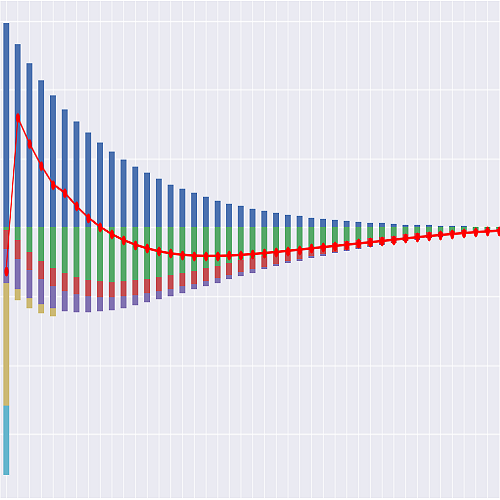
>>> Projection[1].result_cf()          # the worked example's anchor cell
>>> Projection.point_id = 2            # or switch the default
t counts policy months and is 0-based, as everywhere in lifelib: t = 0 is
the issue month, the first projected month, and t = proj_len() - 1 the last, with
proj_len() = 12 x term the number of projected months. Month t runs from time
t to time t + 1; the policy year containing it is t // 12 + 1. The notes
index the in-force probability l(t) at the start of month t with
l(0) = 1, which is exactly the library’s pols_if(): pols_if(t) is the
notes’ l(t) and the end-of-month state l(t + 1) is pols_if_at()
(t, "AFT_DECR"). pols_if(t) is thus the weight on the same result_cf()
row’s cash flows, which is the convention every model in this library shares.
Input data
Inputs are external files: plain CSVs living in the model folder’s parent
directory, products/critical_illness/, read at run time rather than stored inside
the model. The model folder therefore holds nothing but formulas — no _data/, no
IOSpec, no embedded values — so a diff of the model shows logic changes only, and an
input can be edited or swapped without rewriting the model. This follows
annuallife.TradLife_A; contrast basiclife.BasicTerm_S, which keeps its inputs
inside the model through modelx’s IOSpec machinery.
The consequence worth knowing: the model is not portable on its own. Copying the
CI_UK_S folder without its parent’s CSVs produces a model that reads and then fails
on first evaluation.
Each table has a filename Reference and a reader Cells, both on Data,
reached here through the data Reference:
Reference |
Cells |
File |
|---|---|---|
model_point_file |
data.model_point_table() |
model_point_table.csv |
ci_rate_file |
data.ci_rate_table() |
ci_rate_table.csv |
lapse_table_file |
data.lapse_table() |
lapse_table.csv |
Naming
Cells names follow lifelib’s basiclife.BasicTerm_S and savings.CashValue_SE
wherever those models have an analogue — pols_* for policy counts, plural nouns for
cash flows, *_rate for annual rates and *_rate_mth for monthly ones, *_pp
for per-policy amounts, claims(t, kind) and benefit_pp(t, kind) with an
uppercase kind string, pols_if_at(t, timing) for the within-month in-force
reads. The technical notes use compact actuarial symbols instead. The mapping is:
Notes symbol |
Cells |
Meaning |
|---|---|---|
contract_type |
contract_type() |
accelerated or standalone |
issue_age |
age_at_entry(life) |
Issue age (ANB), life 1 or 2 |
a |
age(t, life) |
Attained age (ANB) in month t |
y = t//12 + 1 |
policy_year(t) |
Policy year containing month t |
(none) |
duration(t) |
Completed policy years, y - 1 |
(none) |
duration_mth(t) |
Months elapsed at start of month t |
n |
policy_term() |
Term in years |
12n |
proj_len() |
Months projected, t = 0..12n-1 |
SA |
sum_assured() |
Sum assured at outset |
SA(t) |
benefit_pp(t, “MAIN”) |
Sum assured in month t, indexed |
B_AP |
benefit_pp(t, “AP”) |
Additional-payment benefit |
B_ch |
benefit_pp(t, “CHILD”) |
Children’s-cover benefit |
P |
premium_mth_pp() |
Monthly premium at outset |
P(t) |
premium_pp(t) |
Monthly premium in month t |
(pivot table) |
pivot_interp(x, sex, smoker, c) |
Log-linear pivot lookup |
i_ci(a) |
ci_rate_base(t, life) |
Table CI diagnosis rate |
(1 + tau)^(y-1) |
ci_trend_factor(t) |
CI trend factor |
eta |
sel_lapse_ci_loading |
Anti-selection loading on i_ci |
(none) |
ci_sel_factor(t) |
Anti-selection factor applied |
i_ci x trend x sel |
ci_rate(t, life) |
CI diagnosis rate applied |
q_d(a) |
mort_rate(t, life) |
Best-estimate mortality rate |
k |
overlap_k |
Death/CI overlap factor, 0.10 |
(per life) |
claim_rate_life(t, life) |
q_d(1-k) + i_ci, one life |
q_claim(a) |
claim_rate(t) |
Combined claim decrement |
q_pay(a) |
claim_rate_paid(t) |
The part that pays a benefit |
delta |
survival_slip |
Standalone slippage, 0.03 |
q_m(t) |
claim_rate_mth(t) |
Monthly combined decrement |
q_pay_m(t) |
claim_rate_paid_mth(t) |
Monthly paying decrement |
q_exit_m(t) |
claim_rate_exit_mth(t) |
Monthly non-paying decrement |
a(x) |
ap_rate(t) |
Additional-payment frequency |
a_m(t) |
ap_rate_mth(t) |
The same, monthly |
lambda_ch |
child_freq |
Children’s claim frequency p.a. |
lambda_m |
child_rate_mth() |
The same, monthly |
w(y) |
lapse_rate(t) |
Annual lapse rate in month t |
(table) |
lapse_rate_base(t) |
Table lapse rate before shock |
w_shock |
lapse_rate(t) at a review |
Post-review shock lapse |
w_m(t) |
lapse_rate_mth(t) |
Monthly lapse rate |
rho_review |
review_prem_shock |
Premium change at a review |
(none) |
reviews_passed(t) |
Reviews already applied |
(none) |
review_shock_active(t) |
In the post-review window |
l(t) |
pols_if(t) |
In force at the start of month t |
l(t+1) |
pols_if_at(t, “AFT_DECR”) |
In force at the end of month t |
(none) |
pols_if_at(t, timing) |
BEF_DECR / BEF_LAPSE / AFT_DECR |
(none) |
pols_claim(t) |
Main-benefit claims in month t |
(none) |
pols_lapse(t) |
Lapses at the end of month t |
(none) |
pols_maturity(t) |
Expiries at the end of the term |
idx(t) |
idx_factor(t) |
Cover indexation factor |
idx_p(t) |
idx_prem_factor(t) |
Premium indexation factor |
P x l |
premiums(t) |
Premium income |
SA x q_m x l |
claims(t, “MAIN”) |
Main-benefit outgo |
B_AP x a_m x l |
claims(t, “AP”) |
Additional-payment outgo |
B_ch x lambda_m x l |
claims(t, “CHILD”) |
Children’s-cover outgo |
0 |
claims(t, “LAPSE”) |
Surrender outgo; always zero |
E_cl x q_m x l |
claim_expenses(t) |
Claim handling expense |
E0, E_m(y) |
expenses(t) |
Initial + maintenance expense |
(none) |
inflation_factor(t) |
Expense inflation factor |
CF(t) |
net_cf(t) |
Net cash flow, income positive |
Three names needed care.
The notes write a(x) for the additional-payment frequency and a for the attained
age in the same table. ap_rate() and age() separate them; nothing in the
model is called a.
q_d is the best-estimate mortality rate and is spelled mort_rate(), the
library-wide name, even though on this product mortality never acts as a decrement on
its own: it enters only through claim_rate(), net of the overlap. Keeping the
name makes the input visible where a reader looks for it.
SA is a constant in the notes and a function of t here, because the indexation
option moves it. benefit_pp(t, "MAIN") is that quantity; sum_assured() is the
outset value the model point carries. The additional-payment and children’s benefits
are derived from the indexed sum assured [std] — the notes state their caps
against SA without saying which SA, and applying the cap to a frozen outset
value would make the benefit shrink in real terms while the main benefit did not.
The combined decrement, and why the rates cannot be added
The insured event is death or first CI diagnosis, whichever comes first. Adding
q_d and i_ci double-counts lives that are both diagnosed and die in the same
period: once the CI claim has been paid the subsequent death of that life is not a
second claim, and a death inside the survival period converts the CI claim into a death
claim of the same amount rather than adding one. So
q_claim(a) = i_ci(a)(1 + tau)^(y-1) + q_d(a)(1 - k) [std]
where k is the proportion of deaths preceded by a claimable diagnosis. k = 0.10
flat is a standardization: the cause-of-claim splits that would calibrate it live in
CMI working papers whose datasets are subscriber-restricted. k = 0 maximally
double-counts and k = 0.25 may understate, so the notes rate it the third-largest
lever on the liability and it is a Reference rather than a literal.
On the accelerated contract nothing further is needed: however the overlap
resolves, SA is paid once. The 14-day survival period is cash-flow-neutral there
and is not modelled, which is the notes’ second pitfall — applying the survival-period
slippage delta to the accelerated main benefit is wrong, because a death inside the
period still pays SA as a death claim.
On the standalone contract death pays nothing, and the decrement splits:
q_pay(a)  = i_ci(a)(1 + tau)^(y-1) (1 - delta)
q_exit(a) = q_d(a)(1 - k) + i_ci(a)(1 + tau)^(y-1) delta
with the same total, so the in-force run-off is identical and only the paid part
generates outgo. Note where k goes: onto the non-paying death exit, never onto the
paid decrement. Applying it to q_pay instead is the mirror-image pitfall and
understates claims.
One divergence from the notes’ literal text. The notes convert annual rates to monthly
with 1 - (1 - q)^(1/12) and prescribe q_pay_m for the standalone main benefit,
but converting q_pay and q_exit independently leaves their sum slightly below
the q_m the same notes use for the in-force run-off — the two conventions are
inconsistent at second order. claim_rate_paid_mth() follows the notes literally
and claim_rate_exit_mth() is defined as the residual q_m - q_pay_m, so the
split is exact by construction and the run-off is the notes’.
check_claim_split() bounds the artefact: it asserts the residual really is the
independently converted q_exit to within claim_split_tol, which on the
shipped points it is by four decimal places or better.
The non-terminating benefits
The additional-payment and children’s-cover benefits are the notes’ third and fourth pitfalls, and they are one mistake in two directions. Both are non-depleting — they do not reduce the sum assured — and non-terminating — they do not decrement the in-force. Only the main benefit ends the policy. Modelling them as accelerations of the sum assured is a different product; terminating the policy on one is the same error with the opposite sign.
They are carried as frequency loadings on the in-force, a_m and lambda_m, and
appear in the roll-forward nowhere at all: pols_if_at() never sees them. Note the
monthly conversion is rate / 12 and not 1 - (1 - rate)^(1/12), which is correct
and deliberate: these are claim frequencies — expected events per year, repeatable —
not probabilities of a terminating event, so there is no survival transform to apply.
The treatment deliberately ignores the contractual claim-count caps — one per additional-payment condition, two children’s claims, and the per-child cross-policy limit — because at the [std] frequencies shipped here the probability of reaching a cap is second order. Respecting them exactly would need claim-count state variables.
The rate basis is interpolated, not tabulated
ci_rate_table.csv holds six pivot ages and the notes’ rule is to interpolate
log-linearly between them, so pivot_interp() does exactly that: geometric in the
rate, linear in age. Outside the pivot range it continues the nearest end segment’s
gradient, which is the same expression with the exponent out of [0, 1] — an
extrapolation, and flagged as one, because a 25-year policy issued at 40 stays inside
the pivots but a longer or younger one does not.
Both rate sets are [std] placeholders shaped like the tables the notes name — AC04
and the “16” Series for diagnosis, a scaled population table for mortality — and must
not be presented as CMI or ONS values. The sex and smoker cells are the male
non-smoker pivots times flat factors, which is cruder still: real accelerated-CI
experience is not a flat female factor, since breast cancer makes female incidence
exceed male at the younger ages. The file’s provenance column marks which cells came
from the notes and which from a factor.
The reviewable variant
premium_guarantee = reviewable turns on a 5-yearly review from the fifth
anniversary. Premiums are constant between reviews and multiplied by
1 + rho_review at each one; the snapshot is rho_review = 0, so the variant runs
identically to the guaranteed one until the Reference is moved. Two behavioural
responses hang off the same switch, both [std]:
a review shock lapse in the twelve months after a review that raises premiums by more than 5%,
min(0.30, w(y) + 2.0 max(0, rho - 0.05)); andselective lapsation from the first such shock onward, loading the diagnosis rate by
1 + etaon the lives that remain, because the healthier ones leave first.
The economics are the point of the variant rather than the cash flows: guaranteed premiums mean morbidity deterioration and definition drift fall entirely on the insurer, and the reviewable design transfers that to policyholders at the cost of these two responses.
What this product does not have
No account value, no asset share, no surrender or paid-up value, no bonus, no market
value reduction, and no commission line — the notes fold acquisition cost into the £200
initial expense rather than carrying commission separately as the term assurance
chassis does. There is likewise no interest-sensitive dynamic lapse: with no cash value
and no credited rate there is nothing to arbitrage, so the machinery the accumulation
products in this library carry is deliberately absent. claims(t, "LAPSE") exists and
returns zero so that the absence of a surrender value is stated rather than inferred.
Sign convention
The notes’ Net CF is income positive, which is the library-wide sign of
net_cf(), so there is no outgo-positive liability_cf companion here. One
caveat for a reader checking the worked example by eye: the notes’ Net CF column
excludes the initial expense — at t = 0 it shows 31.88, with the £200 initial
expense noted separately as taking the month to -168.12. net_cf() is the total,
so net_cf(0) is -168.12 and the notes’ column is net_cf(0) + 200.
Cells Descriptions#
- contract_type()[source]#
accelerated(death or CI, whichever first) orstandalone(CI only).On the standalone variant death pays nothing and simply terminates the policy [S4][S11]; a premium-refund-on-death feature exists in some designs and is excluded [std].
- life_basis()[source]#
singleorjoint_first_event.The joint variant is a two-life survivorship product the notes place outside the base model [std scope]. It is not combined with the standalone contract: the notes write the standalone decrement split for one life only, and there is no published basis for splitting a joint first-event decrement into paying and non-paying parts, so the combination raises rather than inventing one.
- age_at_entry(life=1)[source]#
The issue age (ANB) of the first (
life = 1) or second life.Age nearest birthday, attained age advancing on policy anniversaries [std]. Any consistent basis works, but it must be the same one for the diagnosis rates, the mortality rates and the attained-age indexing - a mismatch there is one of the notes’ listed pitfalls.
- sum_assured()[source]#
SA: the sum assured at outset [std], £100,000 on the anchor cell.
benefit_pp()(t, "MAIN")is the amount actually at risk in month t, which differs from this once the indexation option is elected.
- policy_term()[source]#
n: the term in years, 5-50 [S2][S5]; the policy also ends by the 75th birthday.
- cover_basis()[source]#
The cover shape. Level only: decreasing and FIB shapes are out of scope here.
Both exist on the term assurance chassis this product sits on and are implemented in
Term_UK_S; these notes scope them out [std scope].
guaranteed[S1] orreviewable, which turns on the 5-yearly review cycle.
P: the monthly premium per policy at outset [std], £55.00 on the anchor cell.
A placeholder, not a market rate: no UK insurer publishes CI rate cards, so any reference premium is constructed. Profitability conclusions drawn from the worked example are meaningless.
Monthly or annual premium payment.
Inert: the grid is monthly and the notes carry the premium as a monthly amount either way. Carried because the model point attribute table names it.
- children_cover()[source]#
Whether children’s cover is active; automatic on the composite product [S1].
- indexation()[source]#
Whether the increasing-cover option is elected; false in the base run [std].
Declining an increase three years running removes the option [S1][S4]; the base model assumes full take-up while the option is active, so that rule is never reached and is not implemented.
- proj_len()[source]#
The number of projected months,
12 x term; the frame ist = 0 .. proj_len() - 1.The exclusive end of the frame, counted from
t = 0. The policy expires at the end of the last month with no maturity and no surrender value [S1][S4][S5], so there is nothing after it.
- duration(t)[source]#
Completed policy years at the start of month t:
t // 12; 0 during the first year.
- duration_mth(t)[source]#
Months elapsed from issue at the start of month t; equal to t.
tis 0-based and counts from issue, so the identity is trivial - the cells exists so the monthly models in this library share one vocabulary.
- policy_year(t)[source]#
y = t // 12 + 1: the 1-based policy year containing month t; 1 for t = 0..11.
- pivot_interp(x, sex_, smoker_, column)[source]#
Log-linear interpolation of
columnat age x from the pivot table.Geometric in the rate and linear in age:
r(x) = r0 (r1/r0)^((x - x0)/(x1 - x0))
which is the notes’ “interpolate log-linearly between pivot ages” [std] written without a logarithm. Outside the pivot range the nearest end segment’s gradient is continued - the same expression with the exponent outside [0, 1] - which is an extrapolation and should be read as one: the shipped pivots run 40 to 65, so a policy issued young or running long leaves the tabulated region.
- ci_rate_base(t, life=1)[source]#
i_ci(a): the table CI diagnosis rate for
lifein the year containing month t.First diagnosis of a listed condition, total and permanent disability included. A [std] proxy shaped like an insured-lives accelerated-CI diagnosis-rate table - the AC04 and “16” Series values are subscriber-restricted - and not to be presented as a CMI rate.
- mort_rate(t, life=1)[source]#
q_d(a): the best-estimate annual mortality rate for
life[std].Never a decrement on its own: on this product mortality enters only through
claim_rate(), net of the overlap factor. A [std] proxy shaped like a scaled population table, not an ONS value.
- ci_trend_factor(t)[source]#
(1 + tau)^(y-1): the CI trend factor in the year containing month t [std].
Zero trend in the base run. It is the notes’ first-listed sensitivity anyway: diagnosis rates move with medical practice, and the covered event itself moves when the ABI revises its model definitions - the 2021/22 review broadened Alzheimer’s to all dementia, tightened cancer staging and excluded myocardial injury from heart attack. Those are step changes that no trend parameter anticipates, so the basis must be re-mapped at each definition generation rather than trended through one.
- ci_sel_factor(t)[source]#
1 + eta once a review shock has occurred; 1 otherwise [std].
Healthier lives lapse first when premiums rise, so the lives remaining after a review shock carry loaded diagnosis rates. Reachable only on the reviewable variant, and only once a review has actually raised premiums past the shock threshold;
sel_lapse_ci_loadingis 0.10 in the notes and the magnitude is a placeholder.
- ci_rate(t, life=1)[source]#
The CI diagnosis rate applied to
lifein month t: table x trend x selection.
- claim_rate_life(t, life=1)[source]#
The combined annual claim decrement for one life:
i_ci + q_d (1 - k).The overlap term is what stops the two rates being added. See the Space docstring for why, and for the bounds on
k.
- claim_rate(t)[source]#
q_claim(a): the combined annual claim decrement applied to the policy.
One life’s rate on a single-life policy; on a joint first-event policy the joint decrement
1 - (1 - q_1)(1 - q_2)[std] on one policy, which pays once and ends. Capped at 1.
- claim_rate_paid(t)[source]#
q_pay(a): the part of the claim decrement that pays the main benefit.
The whole of it on the accelerated contract, where death and CI both pay
SAand the 14-day survival period is cash-flow-neutral. On the standalone contract only diagnoses that survive the period pay,i_ci(1 - delta); deaths pay nothing and neither do diagnoses followed by death inside the period. The overlap factorkbelongs to the non-paying exit and never appears here - applying it to the paid decrement understates claims, which is the mirror image of the double-counting pitfall.
- claim_rate_mth(t)[source]#
q_m(t) = 1 - (1 - q_claim)^(1/12): the monthly combined decrement [std].
This is what runs the in-force off, on both contract types: the standalone variant terminates on death as well, it simply pays nothing for it.
- claim_rate_paid_mth(t)[source]#
q_pay_m(t) = 1 - (1 - q_pay)^(1/12): the monthly paying decrement.
Equal to
claim_rate_mth()on the accelerated contract, where every claim pays.
- claim_rate_exit_mth(t)[source]#
q_exit_m(t): the monthly decrement that terminates the policy without paying.
Defined as the residual
q_m - q_pay_mrather than by convertingq_exitindependently, so that the paying and non-paying parts sum exactly to the decrement that runs the in-force off. Converting both annual parts independently would leave their sum slightly belowq_m: the notes’ additive annual split and their1 - (1 - q)^(1/12)conversion are inconsistent at second order.check_claim_split()bounds the difference rather than hiding it. Zero on the accelerated contract.
- ap_rate(t)[source]#
a(x) = 0.15 i_ci(a): the annual additional-payment claim frequency [std].
A frequency, not a probability: additional-payment conditions are payable more than once across the schedule, subject to one claim per condition, and they never terminate the policy.
- ap_rate_mth(t)[source]#
a_m(t) = a(x)/12: the monthly additional-payment frequency [std].
Divided by twelve rather than transformed by
1 - (1 - a)^(1/12), because a frequency of repeatable events has no survival transform to apply. The notes use the same approximation and say so.
- child_rate_mth()[source]#
lambda_m = lambda_ch/12: the monthly children’s-cover claim frequency [std].
Flat in age and duration, and zero if children’s cover is not active. Like the additional-payment frequency it is per-year events divided by twelve, not a probability conversion.
- reviews_passed(t)[source]#
The number of premium reviews already applied at month t.
Reviews fall every
review_period_mthsfrom the fifth anniversary [S3][S4], which is the start of montht = 60, so the first bites there - the month that opens the sixth policy year. Always zero on guaranteed-premium business, where the premium cannot be changed at all.
- review_shock_active(t)[source]#
Whether month t falls in the twelve months after a premium-raising review.
The window a review shock lapse applies in. A review that raises premiums by less than the threshold produces no shock at all.
- idx_increase()[source]#
The cover increase offered at each anniversary under the indexation option.
min(max(RPI, 0), 10%)[S1][S4] on a flat 3% RPI scenario [std].
- idx_factor(t)[source]#
idx(t): the cumulative cover indexation factor in month t.
Steps on policy anniversaries, so it is
(1 + increase)^(y - 1); 1 throughout if the option is not elected.
- idx_prem_factor(t)[source]#
idx_p(t): the cumulative premium indexation factor in month t.
The premium rises by
min(1.5 x increase, 15%)for a cover increase ofincrease[S1][S4] - the same x1.5 factor the term assurance chassis carries.
P(t): the monthly premium per policy in month t.
The outset premium, indexed if the option is elected, and multiplied by
1 + rho_reviewonce per review already passed. On guaranteed-premium business - the base run - it is level for the whole term, which is what puts every month of premium inside the Solvency UK contract boundary.
Premium income at the beginning of month t, an inflow.
Carried on the survivors at the start of the month,
pols_if().
- lapse_rate_base(t)[source]#
The table annual lapse rate in month t [std], before any review shock.
10 / 8 / 6 / 6 / 6 / 4 percent by policy year. Protection lapse is duration-skewed - buyer’s remorse, remortgaging, distribution churn - and levels off later; UK CI lapse studies are proprietary, so the levels are calibrations to be replaced with the user’s own experience. Policy years beyond the table take its last row.
- lapse_rate(t)[source]#
w(y): the annual lapse rate applying in month t, review shock included.
min(0.30, w(y) + 2.0 max(0, rho_review - 0.05))in the twelve months after a review that raises premiums by more than 5% [std], and the table rate otherwise. Review-driven shocks are the dominant behavioural risk on reviewable business, where one insurer’s review changes are subject to no stated limit at all; the slope and the cap are placeholders.There is no interest-sensitive dynamic lapse anywhere in this model. With no cash value and no credited rate there is nothing to arbitrage, so the machinery the accumulation products in this library carry is deliberately absent.
- pols_if(t)[source]#
The number of policies in force at the start of policy month t.
The notes’
l(t), and the weight on every cash flow of the sameresult_cf()row.pols_if_init()att = 0, the issue month, then the notes’ recursionl(t + 1) = l(t)(1 - q_m(t))(1 - w_m(t)): the start of monthtis the end of montht - 1. Zero outside the frame0 .. proj_len() - 1.
- pols_if_at(t, timing)[source]#
The number of policies in force at a point inside policy month t.
"BEF_DECR"the start of the month, before any decrement; the same number as
pols_if()and the weight on that month’s cash flows."BEF_LAPSE"after main-benefit claims, before lapses - the notes’ processing order is claim before lapse [std order], so this is the population lapses are taken from.
"AFT_DECR"the notes’
l(t + 1), the end-of-month state, and zero from the last montht = proj_len() - 1on because the cover expires there.
The additional-payment and children’s-cover claims appear at none of these points. They are non-terminating: only the main benefit ends the policy.
- pols_claim(t)[source]#
Main-benefit claims in month t: death, terminal illness or CI diagnosis.
The whole combined decrement, including the standalone contract’s non-paying deaths - they terminate the policy just the same. What is paid on them is
claims()(t, "MAIN").
- pols_lapse(t)[source]#
Lapses at the end of month t, taken from the non-claiming survivors.
Pays nothing: there is no surrender or paid-up value [S1][S4][S5]. The 60-day grace period is not modelled separately - the lapse rates are assumed already to reflect grace-period cures [std].
- pols_maturity(t)[source]#
Policies whose cover expires at the end of the term, month
t = proj_len() - 1.Zero in every other month. Not a decrement and not a benefit - the contract runs out, with no maturity value - but needed for the in-force roll-forward to close; see
check_pols_roll_fwd().
- benefit_pp(t, kind)[source]#
The benefit amount per policy in month t, by kind.
"MAIN"SA(t), the sum assured, indexed if the option is elected.
"AP"the additional-payment benefit
min(25% of SA(t), £25,000)[S1][S4][S11] - £25,000 at the anchor cell, and non-depleting: it does not reduce the main benefit."CHILD"children’s cover
min(50% of SA(t), £25,000)[S1], also non-depleting, and zero if the cover is not active. The £4,000 child funeral benefit is excluded as de minimis [std].
Both caps are struck against the indexed sum assured [std]: the notes state them against
SAwithout saying which, and holding them to a frozen outset value would let the ancillary benefits shrink in real terms while the main one did not. In practice the cash cap binds at the anchor cell either way.
- claims(t, kind=None)[source]#
Benefit outgo in month t, by kind; the total when kind is omitted.
"MAIN"SA(t) x q_pay_m(t) x l, the terminating benefit. On the accelerated contract every claim pays; on the standalone one only diagnoses surviving the 14-day period do."AP"B_AP x a_m(t) x l, non-terminating and non-depleting."CHILD"B_ch x lambda_m x l, likewise."LAPSE"zero, always. There is no surrender or paid-up value [S1][S4][S5]; the kind exists so that the zero is stated rather than inferred.
- claim_expenses(t)[source]#
E_cl x q_m(t) x l: the claim handling expense in month t [std].
£250 per main claim, uninflated, carried on the whole combined decrement rather than on the paying part: a notified death on a standalone contract costs the insurer to assess even though it pays nothing. That is the notes’ own formula. Kept out of
expenses()because the notes’ worked example prints the two as separate columns.
- inflation_factor(t)[source]#
The expense inflation factor in month t:
(1 + pi)^(y - 1)[std].Steps on policy anniversaries, not monthly, which is how the notes write it.
- expenses(t)[source]#
E0 and E_m(y): the initial and maintenance expense in month t [std].
£200 per policy at issue (
t = 0), then £30 per policy per year - a twelfth of it each month - inflating at 3%, both at the beginning of the month. There is no commission line on this product: the notes fold acquisition cost into the initial expense rather than carrying commission separately as the term assurance chassis does.
- net_cf(t)[source]#
CF(t): the net cash flow of month t, income positive.
Premiums less main, additional-payment and children’s claims, claim expense and expenses. The notes’ own sign, and the library-wide one, so there is no outgo-positive
liability_cfcompanion.One caveat for a reader checking the worked example by eye: the notes’ Net CF column excludes the initial expense, showing 31.88 at
t = 0and noting the £200 separately as taking the month to -168.12. This cells is the total, sonet_cf(0)is -168.12 and the notes’ column isnet_cf(0) + 200.
- check_pols_roll_fwd_resid(t)[source]#
The in-force roll-forward residual in month t; zero everywhere.
pols_if(t) - pols_if(t+1) - main claims - lapses - expiries. The additional-payment and children’s-cover claims are absent by design: they are non-terminating, and their appearance here would be the notes’ fourth pitfall. Expiries are non-zero only in the last month, where the survivors neither claim nor lapse - their cover runs out.
- check_pols_roll_fwd()[source]#
True when the in-force roll-forward closes in every projected month.
The library-wide form of a roll-forward check: no argument, one bool over all t, so one test can call it across every model.
check_pols_roll_fwd_resid()gives the signed residual of the month that failed. The tolerance scales withpols_if_init(), since the residual accumulates rounding on that many policies.
- check_claim_split_resid(t)[source]#
How far the residual exit rate is from an independently converted
q_exit.claim_rate_exit_mth()is defined asq_m - q_pay_mso that the split is exact; the notes’ own construction would instead convert the annualq_exitdirectly. The two differ because the notes add the annual parts but convert them geometrically, which cannot both hold. This residual is that inconsistency, made visible: it is zero on the accelerated contract and of order 1e-5 on the standalone one at the shipped rates, growing with the level of the rates.
- check_claim_split()[source]#
True when the paying/non-paying split stays inside
claim_split_tol.No argument, one bool over all t, the library-wide shape of a
check_*cells. Unlike a roll-forward check this one is not an identity that must hold exactly - it bounds a known second-order artefact of the notes’ two conventions - so its tolerance is a Reference rather than a machine epsilon, and moving that Reference is how a user states how much of the artefact they will accept.
- result_cf()[source]#
Result table of cashflows, indexed by policy month
t = 0 .. proj_len() - 1.pols_ifis the start-of-month count, which is the weight applied to every cash flow on the same row.net_cfcarries the notes’ own income-positive sign and includes the initial expense, unlike the notes’ own Net CF column.claims_lapseis a column of zeros by product design - there is no surrender value - and is published rather than dropped.