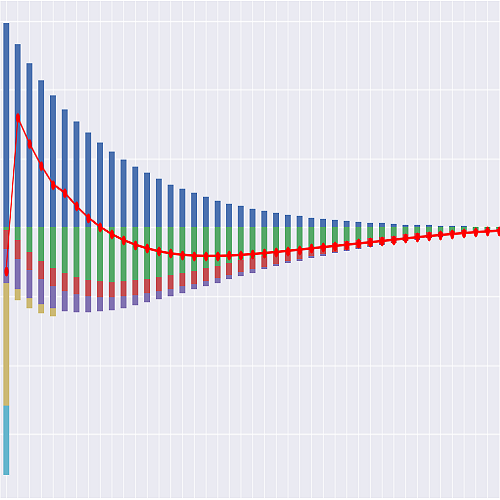
Implementation Notes#
Status: Draft, 2026-08-20. Built from
products/endowment/technical-notes.md; the product it implements is
specified in product-spec.md. The savings machinery underneath it — the
policy value (hokenryō tsumitatekin, 保険料積立金), the surrender value (kaiyaku-henreikin,
解約返戻金), policy loan (keiyakusha kashitsuke, 契約者貸付), automatic premium loan (jidō furikae
kashitsuke, 自動振替貸付) and the grace, 失効 and 復活 chain — is specified once in
whole life technical notes (終身保険) and implemented in
WholeLife_JP_S, whose cells names this model carries wherever
the two express the same quantity — pol_val_pp, cv_pp, surr_charge_pp, reserve_pp,
loan_pp, pols_if_at, check_net_cf. This file states the deltas; where it sets an
inherited parameter to a different number — the loan rate — it names the difference as a
deviation and gives its reason rather than leaving it silent.
This is a mechanics demonstration, not a pricing or reserving result. Three things here are sourced and everything else is constructed. Both annual premiums are twelve times a monthly premium published for exactly the model point they sit on — the 養老保険 (yōrō hoken, endowment assurance) anchor cell [S9] and the education endowment (gakushi hoken, 学資保険) cell [S11]; the assumed interest rate (yotei riritsu, 予定利率) of 1.00% that the cash-value construction runs on is published by product group, before and after a dated revision [S9]; and the staged education money (gakushikin, 学資金) grid is one carrier’s published S型 schedule [S10] [S11]. The surrender-value formula, the expense basis and the surrender curve are published by no carrier for either cell — a sharper gap than the savings chassis faced — so
α, every expense level and the whole lapse table are std. The shipped mortality table is a std construction whoseprovenancecolumn points at the Institute of Actuaries of Japan (日本アクチュアリー会); it is not a copy of 生保標準生命表2018(死亡保険用), which the publisher’s site terms forbid this library to redistribute REG-R21. Replace the tables and the cash-value basis with a company 算出方法書 before drawing any conclusion from the numbers.
Run it#
python products/endowment/run.py            # the 養老 anchor cell (point_id = 1)
python products/endowment/run.py 2          # the 学資 cell
Three lines to the same thing:
import modelx as mx
model = mx.read_model("products/endowment/Endowment_JP_S")
model.Projection[1].result_cf()
Projection takes a point_id; Projection[1] is the worked example’s anchor cell and
Projection[2] its second cell. result_cf() returns a DataFrame indexed by the policy
month t with one column per cash flow line, pols_if first and pols_if_pay and
pols_wv beside it. Two further
result tables sit beside it: result_pols() for the in-force probabilities and decrement
rates, and result_val() for the per-policy value construction — that one indexed by the
anniversary k, one row per policy year, because the values it publishes are annual
quantities and printing each of them twelve times would only look like information.
Three clocks: the month t, the anniversary k, the elapsed month u#
t is the projection index and it counts policy months, 0-based: t = 0 is the first
policy month, t = proj_len() - 1 = 12n - 1 the last, proj_len() is the number of
projected months so len(result_cf()) == proj_len() == 12 * policy_term() and the frame is
range(proj_len()), and the contractual policy year is the 1-based label
policy_year(t) = 1 + t // 12 with duration(t) = t // 12 beside it. Month t runs from
time t to time t + 1: premium (in anniversary months only), maintenance expense and
commission sit at its start; death, staged, maturity and surrender benefits at its end.
age(t) = x + t // 12, pols_if(0) = 1, surrender is suppressed in t = 12n - 1, maturity
falls in that same month, and pols_if(12n) = 0.
Beside it runs k, the anniversary index, in years, k = 0 at issue. Everything that
is a value at a point in time rather than a flow during a period is indexed by k, and
none of those numbers moved when the projection index became a month:
pol_val_pp(k), pol_val_pre_pp(k), surr_charge_pp(k), surr_val_pp(k), cv_pp(k),
reserve_pp(k), benefit_pct(k), benefit_pct_cum(k), prem_cum_pp(k), loan_pp(k) and
edu_epv(k, i). That is deliberate and it is the design decision of the conversion: those
are contractual constructions defined at the 年単位の契約応当日, and restating them as monthly
recursions would invent a within-year rule the 算出方法書 does not publish REG-R2.
Between anniversaries the projection reads them through a third index, u, an elapsed
month, by linear interpolation std: pol_val_pre_at_m(u), pol_val_at_m(u),
surr_charge_at_m(u), cv_at_m(u) and the step function prem_cum_pp_m(u). The flows of
month t read them at u = t + 1, the closing instant of the month — so
claims(t, "LAPSE") reads cv_at_m(t + 1) and death_ben_pp(t) reads
pol_val_pre_at_m(t + 1). At u = 12k each *_at_m cells returns its anniversary value
exactly, which is what makes the annual and the monthly model agree wherever they are both
defined. loan_pp is the exception that proves the rule: the loan rate is a 年利 capitalised
at the 契約応当日, so the balance genuinely does not move between anniversaries and month t
settles against loan_pp(duration(t)) with no interpolation at all.
SC(0) is the deduction at issue and W(n) = S the value at maturity; neither number moved,
and neither did the 学資金 grid at anniversaries 3 / 6 / 12 / 15 / 18 / 20 — each of which is
now the staged claim of the single month t = 12k - 1.
What the conversion changed, and what it did not#
Survivorship at the anniversaries did not change: mortality and surrender are quoted per
annum and applied per month on the effective convention r_m = 1 - (1 - r)^(1/12), so twelve
months compound back to the annual rate exactly and pols_if(12j) reproduces the annual
model’s pols_if(j). Neither did the premium income, because the premium is 年払 on every
shipped point and falls at the same anniversaries it always did. Four things did change, and
each is a modelling improvement rather than an artefact:
The 年払 premium is one month in twelve.
result_cf()is a sawtooth — one large inflow a year against maintenance expense and claims every month — which is the shape of the contract and which the annual grid could not draw.The final-month surrender carve-out. Surrender is suppressed only in
t = 12n - 1, where it would collide with the maturity payment, instead of for the whole final policy year. Eleven months of genuine surrender come back, and the anchor cell’s maturing fraction falls from 0.5042 to 0.4949.The staged benefits are one month wide. Each 学資金 falls in
t = 12k - 1and is zero in the other eleven months of its policy year.Both limbs of the education cell’s death benefit now bind. The premium limb steps up by a whole 年払 premium each anniversary month and the value accretes through the year to overtake it, so the
maxswitches 85 times in 264 months where on the annual grid it never switched at all.
The premium-default proportion feeding the APL is the one rate that is not converted: it is the failure to pay one premium on one date, so it is applied once per premium and is zero in the eleven months between.
The model and its Projection Space both carry docstrings: model.doc describes the
product and the projection basis, and model.Projection.doc holds the full mapping between
the technical notes’ symbols and the cells names.
Two cells, one model#
cell is a model point column and it selects between two genuinely different
constructions, not two parameter sets.
On the endowment cell the contract is an endowment assurance, so the death benefit sits inside the expected present value:
pi     = S x A(x, n) / a-due(x, m)
W(k)   = S x A(x + k, n - k) - pi x a-due(x + k, max(m - k, 0))
DB(t)  = S - L(t)
On the education cell the death payment releases the value rather than adding to it, so the value is built from the survival benefits alone and the death benefit is a return of premiums floored at that value:
EPV(k) = S x [ sum over s > k of g(s) v^(s-k) (s-k)p  +  v^(n-k) (n-k)p ]
pi_g   = EPV(0) / a-due(x, m)
W(k)   = EPV(k) - pi_g x a-due(x + k, max(m - k, 0))
Wb(k)  = W(k) + S x g(k)
DB(t)  = max( P x min(ceil((t + 1)/12), m) - S x G(t // 12) - L(t // 12),  Wb(t + 1) )
DB(t) is where all three clocks meet: a death in month t is paid at the end of it, so the
value limb is the interpolated Wb(t + 1); the premiums due are the
min(ceil((t + 1)/12), m) that have actually fallen by then, which steps up once a policy
year; the loan is the balance outstanding at t // 12; and the staged benefits already
received are those to anniversary t // 12, because a payment falling at the close of month
t is still inside Wb(t + 1).
Both value forms live in pol_val_at(k, i), which branches on cell(); pol_val_pp(k) is
that at i_cv and reserve_pp(k) the same at i_std. Excluding the death benefit from the
education cell’s EPV is the std step, and it is one carrier’s own wording read
literally: its 死亡払戻金 is the 責任準備金相当額 — the amount equivalent to the policy reserve
(sekinin-junbikin, 責任準備金) [S10] — so on that design the decrement is exactly
value-neutral and the composite’s max-form dominates it [S3] [S13].
Both limbs of that max must be evaluated, and on the monthly grid both of them bind on the
shipped cell. On the annual grid the value limb dominated at every anniversary and the
max never switched; read month by month it switches 85 times in 264 — eleven months of
policy year 1, then fewer each year until the value pulls clear for good in policy year 13 —
because the premium limb steps up by a whole 年払 premium each anniversary month and the value
accretes through the year to overtake it. Hard-coding either limb is now right eleven months
a year at best, and the tests assert both the crossover pattern and a copy of the cell with a
raised premium where the refund limb takes over for good.
The policy value must land on its own maturity benefit#
At anniversary k = n there is no future benefit beyond maturity and no future premium on
either
construction, so W(n) = S exactly. That is check_pol_val_terminal(), and it is the
one thing a whole life chassis can never check: a whole life reserve that drifts can hide
for decades, while an endowment reserve that does not converge on its own maturity benefit
is wrong on the first run.
pol_val_db_pp(k) names the death benefit inside the EPV — S on the endowment cell,
zero on the education cell — so that a single recursion covers both, rolling the policy year
from its opening anniversary k to its closing one k + 1:
(W(k) + pi 1{k < m}) (1 + i_cv) = q(k) DB_val + (1 - q(k)) Wb(k + 1)
with W(0) = 0 at issue. It is check_pol_val_roll_fwd_resid(k), an annual check on an
annual construction — on the monthly grid it is the one roll-forward that is not indexed by
t, because restating it per month would require the within-year value rule the contract
does not publish.
That is check_pol_val_roll_fwd(), and it pins the timing as well as the arithmetic:
premium credited at the start of the policy year, interest for the whole year, death benefit
and staged benefit at the end. Its q(k) is the unadjusted table rate, because the policy
value is a contractual quantity on the pricing basis: a best-estimate adjustment to the
projection must not move it. That is testable rather than asserted — model point 4 carries
mort_be_factor = 1.25 and its pol_val_pp series is identical to model point 2’s to the last
bit.
A third identity falls out of i_std defaulting to i_cv, which it does because the
numeric standard valuation rate (hyōjun riritsu, 標準利率) could not be established from any
retrieved official document R4 R5:
reserve_pp(k) - cv_pp(k) = surr_charge_pp(k) exactly at every anniversary, wherever the
value exceeds the
deduction. That is check_surr_charge(); the one branch it does not assert is where the
deduction would exhaust the value and surr_val_pp floors at zero.
Two lives, two decrements, one policy#
The education cell carries waiver of premium (hokenryō haraikomi menjo, 保険料払込免除) on
the policyholder (keiyakusha, 契約者) — a second decrement on a second life who is not the
insured (hihokensha, 被保険者). It has no analogue in uslib or uklib.
mort_rate(t) reads the table at the insured’s x + t // 12; mort_rate_ph(t) reads it at
the policyholder’s y + t // 12. Both are annual rates and both have a monthly companion,
mort_rate_mth(t) and mort_rate_ph_mth(t), which is what the in-force recursion actually
runs on. Reading one table at one age for both is the most likely
implementation error on this product, and on the anchor cell the two ages coincide, so it
would not show there. Model point 2 has an insured aged 0 and a policyholder aged 30, and
the two rates differ by a factor of five in the fifth policy year.
mort_rate_ph(t) is zero from t = 12m on, the premium-paying months being
t = 0 .. 12m - 1. Every waiver trigger in the retrieved 約款 is
conditional on the event falling during 保険料払込期間 [S1] [S10], and the
termination-without-waiver path is the failure mode of that same provision, so after 払込満了
there is nothing for the provision to act on and the composite treats the contract as
continuing through the 契約者’s death by succession [S1] [S7] [S10] [S13]. Carrying the
decrement into the months t >= 12m would move a further 0.8250% of policies out of the
premium-paying state — terminating a share of them wherever wv_frac < 1, and deleting their
maturity benefits — in exactly the years in which 86% of the second cell’s receipts fall.
The waiver produces no outgo line at all. What it produces is the absence of premium
income: premiums(t) is carried on pols_if_pay(t) alone while maint_expenses(t) runs on
pols_if(t), the total, and commissions(t) pays renewal commission on the paying state
only. A waived policy costs the insurer administration and pays the distributor nothing.
Because omitting the waiver altogether leaves every claim column unchanged, neither
booking a phantom “waiver benefit” nor dropping the module is visible in a benefit
reconciliation — so the test runs a copy of the cell with waiver = False and asserts that
every claim column is bit-identical while the premium line moves.
Premiums on a waived policy are deemed paid, so prem_cum_pp(k) and its monthly reading
prem_cum_pp_m(u) keep growing on a policy that pays nothing and cv_pp(k) is the same series in both states [S1] [S10] [S13].
A model that keeps two value series is modelling a contract nobody wrote.
The staged schedule is data#
benefit_schedule() reads the whole grid from benefit_schedule_table.csv, keyed by the
model point’s schedule_id, and benefit_pct(k) is a lookup into it. The file’s key column
is k, the anniversary the payment falls on — a time point in years, already 0-based —
so the payment at k is the staged claim of the single month t = 12k - 1 and
claims(t, "STAGED") returns zero unless (t + 1) % 12 == 0, reading
benefit_pct((t + 1) // 12) when it does. Total receipts range
from 100% to 400% of 基準保険金額 across the six carriers in the source set
[S1] [S3] [S7] [S10] [S13], so a model that treats the grid as anything but data is
modelling one carrier. Model point 3 runs the degenerate J variant — one payment of 100%
at anniversary 18, then maturity — without touching a formula.
schedule_id = none on the endowment cell is a product fact and not a missing value: the
survival benefit there is a single payment at anniversary n. The 満期保険金 is never a schedule row;
it is present on both cells and held separately, so a schedule with no rows still matures.
The staged benefit is not a claim and not a decrement. It is paid on survival at a fixed
anniversary — one month wide on this grid — to everything in force in both states, and it
terminates nothing.
check_staged_value() asserts that it comes out of the policy value rather than beside
it — Wb(k) - W(k) = S g(k) — which is the sourced constraint that each 祝金 reduces the
解約返戻金 [S7]. On the second cell the surrender value falls from ¥1,738,755.93 to
¥1,056,811.08 across the 70% payment; a model that pays the benefit beside the value
inflates every later surrender.
The composite’s seam is printed, not smoothed#
prem_net_level_pp() is the net level premium on i_cv and it is a derived output, never
an input: the gross premium is sourced and the loading is what falls out. On the anchor
cell that loading is ¥35,243.66, or 19.457% of the gross premium — plausible for a thirty-year
endowment, and coherent because the premium and the rate come from the same carrier and the
same release [S9]. On the education cell the same calculation gives a net premium above
the gross one, a loading of −1.745% that no real product carries, because that premium is a
different carrier’s [S11] and that carrier does not publish its 予定利率.
implied_rate() restates each loading as a rate, solved by bisection on
prem_net_level_at(i) — −0.4239% p.a. on the anchor cell and +1.1592% on the education
cell. Both are published
rather than suppressed: the seam belongs to a composite built from several carriers’
documents, and hiding it would make the library less honest rather than more accurate. The
bisection costs about eighty extra evaluations of the EPV cells the first time it runs, so
it is deliberately not on the result_cf() path.
henreiritsu() is the 返戻率 the products are actually sold on, and it is a contractual
ratio: (S x sum of g(k) + S) / (P x m), on one policy that survives, pays every premium,
takes every benefit in cash and receives no dividend. It reads the contractual premium term
and never the projected premium income, because it is undefined on a policy that surrenders
and unbounded on a waived one. It returns 92.0099% on the anchor cell and 113.7849% on the
education cell, against the “approx. 113.7%” published for exactly that plan [S11] — the
carrier truncates where the model rounds. It is not a rate of return, not probability
weighted, not discounted and not net of expenses, so it is not the ratio the cash-flow
statement produces.
What is absent, and why that is a product fact#
There is no cliff. No retrieved document offers a suppressed-surrender-value
(tei-kaiyaku-henreikin-gata, 低解約返戻金型) form of either cell, so there is
no suppression multiplier, no step at 払込満了 and no surrender spike, and no lapse-rate spike
to go
with them. surr_val_pp(k) and cv_pp(k) are the same series and both are published, so
that the absence is stated rather than inferred. Importing the savings chassis’s 0.70
suppression multiplier,
its step at m or its 15% surrender spike would model a product that does not exist here.
Model point 7 is the only shipped point with m < n, so it is where such a step would show;
its value crosses 払込満了 smoothly.
There is no tail and no terminal age. proj_len() is the 保険期間 exactly — 12 x n, the
number of projected months, so the last row is t = 12n - 1 and
len(result_cf()) == proj_len() — everything
closes at the end of that month, pols_if(12n) = 0, and the closing cash flow is a certain
payment of S to the survivors
rather than a decrement. The surrender rate is forced to zero std in that one month: a
surrender at its close and the maturity payment fall at the same instant at the same amount,
so running both double-counts the terminal payment and running the surrender instead of the
maturity misclassifies 61% of the anchor cell’s undiscounted outgo. The carve-out is one
month, not the final policy year — on the annual grid it could only be a whole year, which
suppressed eleven months of genuine surrender and is why the anchor cell’s maturing fraction
moved from 0.5042 to 0.4949 when the grid changed. pols_maturity names the survivors so
that the roll-forward closes in the final month, where they neither die nor surrender.
Model points#
|
Cell |
What it exercises |
|---|---|---|
1 |
endowment |
The worked example’s anchor cell: M30, 30/30, ¥5,000,000, ¥181,140 [S9] |
2 |
education |
The worked example’s second cell: child 0 / 契約者 30, 22/17, S型 grid, waiver [S10] [S11] |
3 |
education |
The degenerate |
4 |
education |
|
5 |
education |
|
6 |
endowment |
F40, 20/20, dynamic surrender on and inert |
7 |
endowment |
M35, 25/15 — 短期払, where |
8 |
endowment |
The automatic premium loan module on |
9 |
endowment |
A 契約者貸付 drawn at half the first year’s surrender value |
Inputs are external files#
Four CSVs live beside run.py, not inside the model folder. Every one of them is still
keyed in years, because every rate and every schedule in them is an annual observation or a
contractual anniversary; the monthly grid derives what it needs from them rather than
restating them. The model folder holds
__init__.py and _system.json per Space and nothing else, so a diff of the model shows
logic changes only. This is the annuallife.TradLife_A layout; basiclife.BasicTerm_S
keeps its inputs inside the model instead. The consequence worth knowing is that the model
is not portable on its own: copy Endowment_JP_S/ without its parent’s CSVs and it reads
cleanly, then fails on first evaluation.
File |
Contents |
Provenance |
|---|---|---|
|
Nine model points indexed by |
Points 1 and 2 sourced [S9] [S10] [S11]; the other seven std |
|
Mortality by sex and attained age, 0 to 60, one |
The library-wide canonical std construction anchored to REG-R18 R1: 22 male and 18 female ANCHOR rows read at quoted ages, the rest log-linearly interpolated in |
|
Annual surrender and premium-default rates keyed by |
std; the industry 解約・失効率 of 5.6% is an amount-weighted all-product ceiling only R9 REG-R31 |
|
The staged 学資金 grids, one row per payment, keyed by |
S型 grid [S10] [S11]; |
What the time-like columns mean#
Three input columns look like time and only one of them is a duration on the projection’s own clock. None of them shifted when the projection index became a month, and each says so here so that a reader can check the readers against the files:
File |
Column |
Decision |
Reason |
|---|---|---|---|
|
|
1-based contractual label; values unchanged |
It is the policy year the 約款-style duration table is written in, values 1, 2, 3. |
|
|
anniversary in years, |
It is a time point, not a period: the 学資金 at |
|
|
attained age; values unchanged |
Not a time index at all — a table key read at |
|
|
lengths in years; values unchanged |
Counts of years, not points on the frame, and they stayed years when the frame became months: |
The readers and the four *_file References live on Data, which takes no parameters, so
each file is read once per model however many model points are projected; Projection
reaches them through its data Reference. Data.input_dir() resolves to
_model.path.parent at run time, so the model works from any checkout location, and an
input can be swapped by repointing a filename Reference with no formula change.
The mortality table is a construction, not a copy#
生保標準生命表2018(死亡保険用)is published by 日本アクチュアリー会 at a stable public URL, free and in
full REG-R18 — a real contrast with uklib, whose CMI tables cannot be read at all
without a subscription — so anyone can retrieve it and check a rate. But the publisher’s
site terms prohibit reproduction and transmission without written consent REG-R21. This
library therefore cites the table by URL, quotes the individual rates its worked
example needs, and ships a table whose provenance column says of each row which of two
things it is: an ANCHOR row read at a quoted age, or an INTERPOLATED row filled log-linearly
in ln q between the two neighbouring anchors and rounded to five decimals.
mort_table.csv is the canonical construction shared across the library, identical row
for row in every jplib product that ships it, so the same cell carries the same value and
the same provenance string wherever it appears. Both sexes are built the same way from their
own sourced anchors — there is no ratio and no derivation of one sex from the other, and
model points 5 and 6, which read the female column, read published female anchors rather
than a multiple of the male ones. The file is restricted to attained ages 0 to 60, which is
every age these nine model points reach: the 養老 anchor cell matures at attained age 60.
Two further distinctions survive that one, both in the Data docstring. The shipped rates
trace a valuation table carrying a margin sized to roughly a 2σ level R2 REG-R20,
not best-estimate experience — which is what mort_be_factor is for. And the table is read at
attained age (man-nenrei, 満年齢) while the published table is built on a nearest-birthday
(hoken-nenrei hōshiki, 保険年齢方式) basis REG-R20, an understatement of up to half
a year of age that the notes name rather than hide.
Modules that are off in the base run#
Five of the notes’ optional constructions are implemented and switched off, so the base run reproduces the worked example while the machinery stays visible and testable. Each is exercised in both positions by the tests.
Module |
Switch |
Off |
On at |
What it does |
|---|---|---|---|---|
Automatic premium loan (自動振替貸付) |
|
|
point 8 |
Scales the table premium-default rate. The advance is applied to the premium, so it moves |
Policy loan (契約者貸付) |
|
|
point 9 (0.50) |
Draws that fraction of |
The refused waiver |
|
|
point 4 (0.90) |
Splits the 契約者 decrement between a transition to the waived state and a termination paying |
Dynamic surrender |
|
|
point 6 |
|
Mortality margins |
|
|
point 4 (1.25, 1.50) |
Two inputs and not one, because the margin points opposite ways on the two lives: on the 契約者 the waiver is a cost, so an overstated rate is prudent, while on an insured child whose death benefit is roughly the reserve already held it is nearly neutral. |
Waived-state persistency |
|
|
point 5 (0.50) |
Multiplies the surrender rate in the waived state. Almost certainly too high at 1.00: a waived policy receives every benefit for no further premium and has a strictly dominant reason to persist. Named so that it can be moved |
Three constructions are named and deliberately not implemented, and the model says so
by name rather than by silence. dividend_type is validated and the value five_year is
rejected: the 5年ごと利差配当 variant [S1] [S10] needs a 配当基準 that sits in the filed but
unpublished 算出方法書 REG-R2, and the notes’ cash flow equation carries no dividend term.
net_cf evaluates the validator, so such a model point fails on its first cash flow rather
than being projected silently under a 有配当 label. Reinstatement (復活) is not modelled
either, and it costs more here than on a protection product: two carriers pay a 学資金 whose
payment date fell while the policy was lapsed once the policy is reinstated [S1] [S10], so
treating every exit as terminal understates later-duration in force, premium income, staged
benefits and the maturity benefit together.
Reduction of the sum assured (gengaku, 減額) is the third, and it belongs to the
chassis rather than to this product: reducing 基準保険金額 is treated as a partial surrender,
the reduced portion releasing its own 解約返戻金 and the future premium being re-rated
[S1] [S2] [S6] [S10]. It is in the composite specification and not implemented — there
is no reduction year, no sum_assured_at and no partial-surrender cash flow, so every
shipped model point carries one sum_assured() for the whole term. The absence is stated
because it is not free here: on the education cell a 減額 re-scales the whole staged 学資金
grid, every payment of which is a percentage of 基準保険金額, and one carrier refuses it
outright once the 学資年金開始日 has arrived [S6]. It is the chassis’s mechanic, so
WholeLife_JP_S is where it should be built first.
Sign convention#
The notes’ CF(t) is already income positive — premiums less every outgo — which is the
library-wide sign of net_cf, so there is no outgo-positive liability_cf companion to
publish here: one stream, one sign, one name.
Naming#
Cells names follow lifelib’s basiclife.BasicTerm_S and savings.CashValue_SE wherever
those models have an analogue: pols_* for policy counts, plural nouns for cash flows,
*_rate for rates, *_pp for per-policy amounts, claims(t, kind) with an uppercase
kind string, pols_if_at(t, timing) for the within-year in-force reads with
pols_if_pay_at(t, timing) and pols_wv_at(t, timing) for the same read on one state. The
full mapping from the notes’ symbols to the cells names is the table in the Projection
docstring, headed Notes symbol. Six library-wide rulings and five local cases needed care
beyond that.
The six rulings are the settled cross-library names, and this product carries its share of
them: mort_rate_at_age(sx, z) is the table lookup keyed by age; mort_be_factor() is the
multiplier turning the shipped valuation table into the projection basis (the model point
column keeps its own name, mort_adj); prem_net_level_pp() / prem_net_level_at(i) are
the actuarial net level premium, which is a pricing quantity and never a cash flow;
check_pols_roll_fwd() / check_pols_roll_fwd_resid(t) is the per-month in-force
roll-forward check; pols_if(t) is the total in force with the premium-paying subset at
pols_if_pay(t) / pols_if_pay_at(t, timing); and expenses(t) is acquisition plus
maintenance only, with claim_expenses(t) deducted explicitly in net_cf(t) and published
as its own column.
Two of those change what a number means rather than only what it is called.
pols_if was the premium-paying state here and is now pols_if_pay + pols_wv, so the
result_cf() weight column is the whole surviving block — which is what the death, staged
and maturity benefits and the maintenance expense have always run on, and what pols_if
means in every other model in the library. And expenses no longer carries the claim
handling expense, so the column is a per-policy servicing cost in this model exactly as it
is in the other eight.
Notes |
Cells |
Why |
|---|---|---|
|
|
They differ only where a staged benefit falls due at anniversary |
|
|
The notes use one symbol shape for the 被保険者’s decrement at |
|
|
This is a traditional guaranteed contract, not an account-value one, so it takes the savings family’s cash-surrender-value name. |
(no symbol) |
|
The notes write the closing payment as |
(no symbol) |
|
The death benefit inside the cash-value EPV — |
Standardizations used#
Everything below is std, and each is a lever a user with a company basis replaces.
Input |
Value |
Where |
|---|---|---|
Cash-value basis rate |
1.00%, the published 予定利率 adopted directly [S9] |
Reference on |
Reference valuation rate |
1.00%, defaulted to |
Reference on |
Acquisition deduction |
0.25 of one annual premium, grading linearly to zero at |
Reference on |
Loan rate |
2.40%, held flat [S9] — the adoption is the standardization; the rate itself is sourced. Deviates from the chassis’s 2.75%, itself a std pick off a different carrier’s vintage schedule; see “Modules that are off in the base run” |
Reference on |
Acquisition expense |
¥50,000 per policy at issue |
Reference on |
Maintenance expense |
¥8,000 p.a. charged as a twelfth a month, inflating at 1.0% once a policy year, on both states |
Reference on |
Claim expense |
¥20,000 per death claim |
Reference on |
Initial commission |
90% of the annual premium |
Reference on |
Renewal commission |
3% of premium, policy years 2 to |
Reference on |
Surrender rates |
4% / 3% / 2% per annum, converted to the month as |
|
Within-year values |
|
|
Premium-default rates |
1.0% / 0.8% / 0.6%, gated to zero by |
|
Mortality basis |
The table construction, |
|
Waiver behaviour |
|
model point |
Staged-benefit timing |
Each payment resolved to the policy anniversary following its stated age, and paid in the single month whose close is that anniversary |
|
Premiums on points 6 and 7 |
The net premium grossed at the anchor cell’s 19.457% implied loading, rounded to the yen — ¥170,217 and ¥350,241; points 3 to 5 carry point 2’s sourced premium and points 8 and 9 point 1’s |
|
α is re-based on one annual premium rather than on the sum assured, because 基準保険金額 is
a benefit-scaling unit and not a sum assured on the education cell — total premiums are 1.85
times it. At α = 0.25 the deduction at issue is ¥45,285 on the anchor cell, within 0.7% of
the level the savings chassis calibrated against a real published surrender-value run, so
the only genuine Japanese surrender-value calibration in this library is carried across
rather than discarded. It satisfies the three sourced quantitative constraints [S7] — below
cumulative premiums at every duration on both cells, capped at the death benefit, reduced by
each 祝金 — but not the fourth, adjectival one, that the early durations return very little:
cv_pp(1) is 55.4% of the first year’s premium on the anchor cell. α is the named lever
and this is a listed model risk.
Two scope limits belong in this list because they change the answer. The APL exhaustion test
and the commission clawback are scoped to the savings chassis by the notes and are not
implemented here; apl_advance_pp(t) is capped at the value still free of loan in their
place. And the 学資金 whose payment date falls during a lapse, which two carriers pay on
reinstatement [S1] [S10], is out of scope with 復活 itself.
Tests#
tests/test_model_conventions_jp.py asserts the house style — the folder layout, the
Data / Projection split, the read-once property, the docstrings, the naming, the
result_cf() conventions, that every model point projects without NaN, and that
read → write → re-read reproduces the same file set and the same numbers.
tests/test_endowment_jp.py asserts this product:
the notes’ worked example on both anchor cells, hard-coded to the yen and to six decimals of in-force so that a reviewer can check it against the notes by eye: the two mortality vectors,
A(30,30)andä(30,30),π= ¥145,896.34 with its 19.457% loading andπ_g= ¥110,458.94 with its −1.745% one, theW/SC/CVtable, the notes’ cash flow rows on each cell, every line of the notes’ traces, the undiscounted column totals, the roll-forward closing to 1.000000000, and what the waiver is worth;henreiritsu()at 92.0099% and 113.7849%, andimplied_rate()at −0.4239% and +1.1592%;every one of the notes’ known modelling pitfalls, one test named after each: that maturity is certain and not a decrement, that the surrender rate is zero in the final month and non-zero in the eleven before it, that
pol_val_pp(n)at the final anniversary issum_assured(), that the two lives read the table at two ages, thatmort_rate_ph(t)is zero fromt = 12mon and by how much that moves the block, that the waiver produces no benefit outgo, that waived premiums are deemed paid, that 高度障害 is inside the death rate while accident-caused 身体障害 is not, that a carve-out terminates the contract, that the staged benefit is paid to both states and terminates nothing, that it comes out of the value, that the schedule is data, that both death-benefit limbs are live, thathenreiritsu()is contractual, and that there is no cliff;the roll-forward identities rebuilt independently of the checks, and all six
check_*()cells with their residuals — the in-force and net-cash-flow ones per month overrange(proj_len()), the policy-value, surrender-charge and staged-value ones per anniversary overrange(policy_term() + 1)— on every one of the nine shipped model points;the conversion itself: that
pols_if(12j)on the monthly grid reproduces the annual model’spols_if(j)at every anniversary, that each*_at_mcells returns its anniversary value exactly atu = 12k, and that premium income is unchanged because the premium is 年払;each optional module in both positions, and the structural product facts: no tail states —
list(result_cf().index) == list(range(12 * n)),pols_if_pay(0) == 1,pols_if_pay(12n) == 0— the 短期払 point wherem < n, the income-positive sign with noliability_cf, theresult_cf()column order, that the enum accessors validate rather than propagating a typo, thatdividend_type = "five_year"is rejected by name on the projection path, and that every shipped assumption row carries its ownprovenance.
The three clocks show in the test module itself: the cash-flow and in-force literals are
0-based months, while the W / SC / CV table, the 学資金 grid and every
prem_cum_pp literal are anniversaries in years and are unchanged from the annual model.
Loop and parameter names say which is meant — t for a month, k for an anniversary, u
for an elapsed month.
python -m pytest tests -q