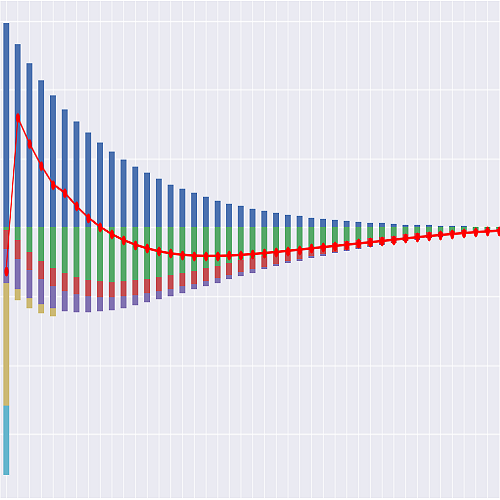
The Riester_DE_S Model#
Reference liability cash flow model for the German klassische Riester-Rentenversicherung.
Riester_DE_S is the executable counterpart of
products/riester_rente/technical-notes.md in the lifelib-products delib library. It
projects gross best-estimate liability cash flows, undiscounted, for a single-policy
model point of a certified Altersvorsorgevertrag under the AltZertG — Schicht 2 of
the German pension system — on a monthly grid, through both phases of the contract:
the accumulation of a Deckungskapital with Überschussbeteiligung, and the lifelong
Leibrente the capital is converted into at Rentenbeginn.
Three things make this the Riester model rather than a translated Schicht-3 one.
The state pays part of the premium, and it is a cash flow. The Zulage is a
contribution paid by the Zentrale Zulagenstelle für Altersvermögen to the provider and
credited to the contract; it is not a benefit and it is not a tax refund. It is published
in its own zulagen column beside premiums, never folded into it, because a
statement that folds the two cannot answer the one question this product is about. The
entitlement is driven by two different lags — the Mindesteigenbeitrag looks back one
calendar year for income, the cash arrives one projection year late — and collapsing
them into one is the first listed modeling pitfall.
There is a 100 % Beitragsgarantie, and it is tested exactly once. guar_pp(k)
accumulates every Altersvorsorgebeitrag credited — the saver’s own contribution, the
Zulagen, and any unsubsidised contribution above the § 10a ceiling — less the biometric
carve-out capped at 20 % of total contributions. It is compared with the account only
at Rentenbeginn, where garantieluecke_conv_pp() is the shortfall the insurer funds.
garantieluecke_pp(k) is published for every k as a diagnostic: it is normally
positive in the early durations of any charged contract, and flooring a death, surrender
or transfer benefit at it is a modeling error, not prudence.
The payout phase is part of the liability. Conversion at k_conv() strikes the
capital, the Schlussüberschussanteil, the Bewertungsreserven share and the applied
Rentenfaktor, elects the Teilkapitalauszahlung of up to 30 %, and applies the
Kleinbetragsrente test — which is computed rather than assumed, so the commutation
rate on a book is an output. The annuity then runs on a generational second-order
annuitant basis to omega_age, one monthly instalment at a time, with the
Rentengarantiezeit — 12m guaranteed instalments — changing who is paid and never how
much.
Spaces. The model contains two:
DataReads the eight input CSVs and holds their filename References. It takes no parameters, so each file is read once per model.
ProjectionThe by-policy projection, parameterized by
point_id:Projection[1]is an ItemSpace projecting model point 1, the worked example’s anchor cell. It reaches the input tables through itsdataReference, which resolves to the singleDataSpace.
The split matters for more than tidiness. Because Projection is parameterized, every
Projection[N] is a separate ItemSpace with its own cells cache; readers placed there
would re-read every file for every policy. In Data they are evaluated once, however
many policies are projected.
Input data is external: plain CSVs in the model folder’s parent directory, read at
run time rather than stored inside the model. The model folder itself holds no data — no
_data/, no IOSpec, no embedded values — so a diff of the model shows logic changes
only, and the model and its inputs must travel together.
Projection basis. Monthly steps over a contract that is almost entirely annual, so the
model runs on two clocks and the argument of a cells says which. t counts projection
months from the 1 January 2027 valuation date and is 0-based, running
0 ... proj_len() - 1 with proj_len() = 12 x proj_len_y() and
proj_len_y() = omega_age - age(0) + 1; k = proj_year(t) = t // 12 is the projection
year, and the contractual contract year is duration_y(k) + 1 = duration_init() + k
+ 1, which is k + 1 only on a point projected from its own inception
(duration_init() == 0).
The annual clock is the contract’s own in every respect that matters: the Zulage is an annual entitlement determined on a calendar year and paid once by the ZfA, the Überschuss is declared annually, the two charges and the interest credit fall once a year, and the Beitragsgarantie is tested once. The Eigenbeitrag keeps it too, because the Ratenzuschlag prices a fractionated payment mode by loading the amount rather than by moving the contribution year. The monthly clock carries the in force, the three decrements, the claims, the expenses, the commission and the Rente instalments.
The decrements carry the library’s two speeds — mort_rate, lapse_rate and
transfer_rate are the annual rates and *_mth their geometric twelfths — so
twelve months compound back to each annual rate exactly and the whole accumulation is
bit-identical to the annual-step model this replaced, on all thirteen model points:
every contribution, both balances, the guarantee accumulator, the capital at Rentenbeginn,
the Garantielücke and the Kleinbetragsrente verdict are unchanged. What the finer grid
buys is the Leibrente, which the AltZertG requires to be lifelong and monthly and which
the annual model compressed into one payment at the start of each payout year on that
year’s opening count — worth 361,74 € of the anchor’s annuity outgo and 573,50 € of model
point 12’s, which has no Rentengarantiezeit to hold the count still. It also dates the
three accumulation exits, which now compete month by month instead of running in sequence
at one year end: 5,62 € moves off the anchor’s death outgo and 2,64 € off its surrender
outgo onto 8,30 € of transfers.
What is sourced and what is not. The statutory mechanics are cited: who is
zulageberechtigt, the Grundzulage / Kinderzulage / Berufseinsteiger-Bonus
structure, the § 86 Mindesteigenbeitrag with its 4 % rate, its 2 100 € ceiling, its
60 € Sockelbeitrag floor and its proportional Kürzung, the ZfA payment lag, the
Beitragserhaltungszusage, the 30 % Teilkapitalauszahlung cap, the five-year floor on
acquisition-cost spreading, the Wechselrecht, the Kleinbetragsrenten-Abfindung and
the schädliche Verwendung consequences of a Kündigung. No carrier-specific
parameter was established for any German Riester product, at any house, for any year,
so every charge, every declared rate, every Rentenfaktor, every behavioural rate and
both decrement tables are standardizations marked [std] in the shipped CSVs and in
the notes. The DAV tables (DAV 2008 T, DAV 2004 R) are the property of the Deutsche
Aktuarvereinigung, are not public and are not redistributed here: they are cited by
name and stood in for by anchored proxies, and Data says what a
replacement must preserve. This model is a mechanics demonstration, not a pricing or
reserving result. Replace the decrement, charge and surplus tables with company data
before drawing any conclusion from the output.
Model points. Thirteen, covering both contribution forms, all four payment frequencies, an at-inception point beside the in-force ones, both Kinderzulage rates running at once, the Sockelbeitrag floor, the Berufseinsteiger-Bonus, the § 86 proportional Kürzung, an unsubsidised second contribution pool, the 20 % biometric carve-out cap, a Beitragsfreistellung, a stressed declared rate on which the Garantielücke binds, a pure lifelong annuity with no lump sum and no guarantee period, and a late entrant at the statutory earliest Rentenbeginn of 62. Model point 1 is the anchor cell of the worked example in the technical notes.
Verification. tests/test_riester_rente_de.py asserts the notes’ worked example to
the cent and pols_if to six decimals, and one test per listed modeling pitfall. The
model publishes six check_* identities — check_net_cf, check_av_roll_fwd,
check_guar_roll_fwd, check_pols_roll_fwd, check_conversion and
check_zulage_lag — and the library’s conventions suite calls all six on every model
point. Their residuals follow their cells’ clock: the cash flow statement and the policy
ledger take a month, and the account, the guarantee accumulator, the conversion and the
ZfA lag take a projection year, because the quantities they check move once a year.
Example
>>> import modelx as mx
>>> model = mx.read_model("products/riester_rente/Riester_DE_S")
>>> model.Projection[1].result_cf()