The Projection Space#
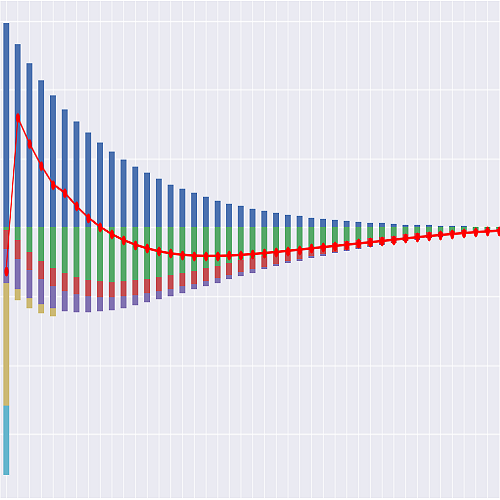
The by-policy projection of the Euro_FR_S model.
The Space is parameterized by point_id, so Projection[1] is an ItemSpace
projecting model point 1:
>>> Projection[1].result_cf()          # the worked example's anchor cell
>>> Projection[7].result_pb()          # the same cell on the low scenario
t counts policy months from the valuation date, 0-based, so t = 0 is the
first projected month whatever the model point’s completed duration, and the frame is
t = 0 … proj_len() - 1 with proj_len() = 12 * proj_years = 480. Month t runs
from time t / 12 to time (t + 1) / 12. Versements and rachats partiels fall
at the beginning of the month; the insurer’s expense accrues through it; the
revalorisation and the prélèvements sociaux land at 31 December only; deaths and
rachats totaux act at the end of the month, deaths first.
Underneath that monthly grid the product carries an annual layer, and the two are
not the same clock. proj_year(t) = t // 12 is the 0-based projection year, and
is_anniv(t) — t % 12 == 11 — is its 31 December, which on this model’s
convention is also the policy anniversary. The attained age is
age(t) = issue_age() + duration(t) with duration(t) = duration_init() + t // 12
the completed policy years, and the contract’s own 1-based policy year — which the lapse
table is indexed by — is policy_year(t) = duration(t) + 1. For a cell issued at the
valuation date (duration_init = 0) that is the library’s t // 12 + 1. Nothing is
indexed by the policy year.
Input data
Inputs are external files: plain CSVs living in the model folder’s parent
directory, products/assurance_vie_euro/, read at run time rather than stored inside
the model. The model folder therefore holds nothing but formulas — no _data/, no
IOSpec, no embedded values — so a diff of the model shows logic changes only, and an
input can be edited or swapped without rewriting the model. This follows
annuallife.TradLife_A; contrast basiclife.BasicTerm_S, which keeps its inputs
inside the model through modelx’s IOSpec machinery.
The consequence worth knowing: the model is not portable on its own. Copying the
Euro_FR_S folder without its parent’s CSVs produces a model that reads and then
fails on first evaluation.
Each table has a filename Reference and a reader Cells, both on
Data, reached here through the data Reference:
Reference |
Cells |
File |
|---|---|---|
model_point_file |
data.model_point_table() |
model_point_table.csv |
mort_table_file |
data.mort_table() |
mort_table.csv |
lapse_table_file |
data.lapse_table() |
lapse_table.csv |
fin_rate_file |
data.fin_rate_table() |
fin_rate_table.csv |
Two clocks, and which cells carries which
A monthly grid is not a monthly product. The crediting machinery is a financial-year statement — art. A132-11 and A132-12 build one compte de participation aux résultats per financial year, art. A132-16 counts financial years, the taux servi is fixed by the board for the closing year and credited at 31 December value date, and the levy is withheld as that interest is inscribed — and none of it becomes monthly. What the finer grid resolves is everything that is not contractually annual: the versements libres programmés and rachats partiels programmés the contract bills monthly, the insurer’s expenses, and the decrements, which now fall in the month they happen.
So the argument of a cells says which clock it is on:
cells that state a financial-year account take
y, the projection year —pm_avg_pp(),fee_pp(),expenses_pp(), the whole compte de participation block,ppb_pp()and its vintage ledger,ts_net(),int_credited_pp(),soc_levy_pp(),r_fin(),ref_rate(),prem_gross_pp(),prem_to_av_pp(),withdrawals_pp(),inflation_factor();cells that state a month take
t— the account and its ledgers, the in force, the claims, everyresult_cf()column, and the*_mth_ppinstalments that carry a year’s amount into its twelve months;the decrement rates take ``t`` and return the year’s annual rate, which is the library-wide convention and is not the same thing as an annual statement.
The two-speed structure that follows is the library’s convention, asserted by
tests/test_model_conventions_fr.py: mort_rate() and lapse_rate() are the
annual rates of the policy year containing month t — the vectors the technical
notes tabulate — and mort_rate_mth() and lapse_rate_mth() are the monthly
rates actually applied, 1 - (1 - r)^(1/12), so that twelve of them compound back to
exactly the annual rate.
Naming
Cells names follow lifelib’s savings.CashValue_SE and basiclife.BasicTerm_S
wherever those models have an analogue — av_pp_at(t, timing) for the within-month
account value, pols_* for policy counts, plural nouns for cash flows, *_rate for
annual rates and *_rate_mth for monthly ones, *_pp for per-policy amounts,
*_mth_pp for the monthly instalment of a per-policy annual amount,
claims(t, kind) with an uppercase kind string. The technical notes use compact
symbols instead. The mapping is:
Notes symbol |
Cells |
Meaning |
|---|---|---|
t |
(the cells argument) |
Projection month, 0-based |
y |
proj_year(t) |
Projection year, |
(none) |
duration_mth(t) |
Months elapsed at BOM, = t |
(none) |
duration(t) |
Completed policy years |
(none) |
is_anniv(t) |
31 December, |
(none) |
proj_len() |
Number of projected months |
(the row) |
model_point() |
The selected model point |
x |
issue_age() |
Age at adhésion (ALB) |
x + d + y |
age(t) |
Attained age in month t |
d |
duration_init() |
Completed years at valuation |
d + y + 1 |
policy_year(t) |
Contractual policy year, 1-based |
AV(t) |
av_pp(t) |
Épargne acquise, start of t |
(the steps) |
av_pp_at(t, timing) |
The balance inside month t |
(fund level) |
av_at(t, timing) |
The same times pols_if(t) |
P_g(y) |
prem_gross_pp(y) |
Versements before charges |
P(y) |
prem_to_av_pp(y) |
Versements credited, year y |
(instalment) |
prem_to_av_mth_pp(t) |
One twelfth of it, month t |
W(y) |
withdrawals_pp(y) |
Rachats partiels, year y |
(instalment) |
withdrawals_mth_pp(t) |
One twelfth of it, month t |
(the weights) |
prem_wt_mth(k) |
Mid-month weight, sums to 0.5 |
B(y) |
pm_avg_pp(y) |
Pro rata temporis base |
c, F(y) |
fee_rate(), fee_pp(y) |
Frais de gestion sur encours |
E(y) |
expenses_pp(y) |
Insurer expenses, year y |
(instalment) |
expenses_mth_pp(t) |
One twelfth of it, month t |
r(y) |
r_fin(y) |
Fund financial return |
Phi(y) |
fin_acct_pp(y) |
Compte financier balance |
T(y) |
tech_acct_pp(y) |
Compte technique balance |
s(y) |
insurer_tech_share_pp(y) |
Insurer’s technical share |
A(y) |
pb_acct_pp(y) |
Compte de participation |
A+(y) |
pb_min_pp(y) |
Statutory minimum PB |
s* |
ts_target() |
Target taux servi |
(target amount) |
pb_target_pp(y) |
What the target costs |
Q(y) |
ppb_pp(y) |
PPB, start of year y |
Q_v(y) |
ppb_vintage_pp(y, v) |
The vintage ledger |
(ledger total) |
ppb_ledger_pp(y) |
The ledger rebuilt |
D(y) |
ppb_dotation_pp(y) |
PPB dotation in year y |
(discretionary) |
ppb_discr_rel_pp(y) |
Release the target wants |
(the clock) |
ppb_forced_pp(y) |
Release the clock forces |
R(y) |
ppb_release_pp(y) |
max of the two |
(FIFO draw) |
ppb_vintage_release_pp(y, v) |
Which vintage paid it |
X(y) |
pb_credited_pp(y) |
PB credited, gross of F(y) |
(before the floor) |
ts_raw(y) |
Rate that implies |
g |
tmg_rate() |
Taux minimum garanti |
(the floor’s cost) |
insurer_topup_pp(y) |
What the TMG costs the insurer |
sigma(y) |
ts_net(y) |
Taux servi credited |
s^(y) |
ts_stat(y) |
Statutory floor rate |
I(y) |
int_credited_pp(y) |
Net revalorisation credited |
(on the anniversary) |
int_credited_mth_pp(t) |
I(y) in month t, else nil |
L(y) |
soc_levy_pp(y) |
Prélèvements sociaux |
(on the anniversary) |
soc_levy_mth_pp(t) |
L(y) in month t, else nil |
(cumulative) |
soc_levy_cum_pp(t) |
The levy ledger |
(cumulative) |
pb_cum_pp(t) |
The effet cliquet ledger |
G(t) |
guar_floor_pp(t) |
Contractual capital floor |
q(y) |
mort_rate(t) |
Annual mortality rate |
q_m(y) |
mort_rate_mth(t) |
Monthly mortality rate |
w(y) |
lapse_rate(t) |
Annual surrender rate |
w_m(y) |
lapse_rate_mth(t) |
Monthly surrender rate |
(table) |
lapse_rate_base(t) |
Base rate by policy year |
(dynamic) |
lapse_dyn_add(t) |
The taux servi gap term |
l(t) |
pols_if(t) |
In force, start of month t |
(none) |
pols_if_at(t, timing) |
BEF_DECR / BEF_LAPSE / AFT_DECR |
(none) |
pols_death(t), pols_lapse(t) |
Decrements in month t |
DB(t) |
db_pp(t) |
Death benefit per policy |
CV(t) |
cv_pp(t) |
Surrender value per policy |
(payout) |
claim_pp(t, kind) |
Either of the two, by kind |
(weighted) |
claims(t, kind) |
Benefit outgo |
CF(t) |
liability_cf(t) |
The notes’ outgo-positive flow |
(none) |
net_cf(t) |
Its negative, income-positive |
(none) |
result_cf_annual() |
result_cf() summed into years |
Six names needed care.
pm_avg_pp is the notes’ B(y), and it is not an average of anything the model
computes: it is the pro rata temporis base, the opening balance plus each month’s
movement weighted by the fraction of the year still to run from the middle of that
month. On a level programmed schedule the twelve weights sum to exactly one half, so it
is the notes’ AV + 0.5 P - 0.5 W to the last bit — derived on the monthly grid
rather than asserted. Calling it av_avg_pp would suggest it was read off
av_pp_at; it is a statement about when money moved, and the name says which
provision it stands in for.
prem_wt_mth(k) = (11.5 - k) / 12 is that weight. The mid-month convention is the
only one of the three candidates that reproduces the notes: beginning-of-month weights
(12 - k)/12 sum to 0.541667 and end-of-month (11 - k)/12 to 0.458333, and either
would move the base by EUR 100 on the anchor cell’s first year — small enough to look
like rounding and large enough to break the annual equivalence.
ts_stat and ts_net are both rates net of the management charge, and that is
the single likeliest place to go wrong. pb_min_pp is gross of fee_pp because the
charge is a credit to the compte technique; the charge is subtracted once, on the
way from the PB amount to the rate the account actually grows by. Applying
(1 + ts_net) (1 - fee_rate) afterwards would cost the policyholder 0.60% a year that
was already taken.
ts_raw and insurer_topup_pp are the two halves of the notes’
max(tmg_rate, ...). ts_raw is what the allocation alone produces; ts_net is
that floored at the TMG; and insurer_topup_pp is the difference in euros — what the
guarantee costs the insurer out of its own resources in a year the allocation cannot
fund it. It is nil on every model point shipped here, and see below for why no
positive-TMG cell is shipped.
withdrawals is an owner election, not a claim. A rachat partiel is money the
policyholder asked for out of a balance the policyholder owns; a rachat total is the
same money, but it ends the contract and is a decrement, so it appears as
claims_lapse. Both leave the fund and both are in liability_cf; keeping them
apart is what lets a reader see the difference between elective drawdown and exit.
claims_lapse rather than claims_surr: the column is named for the kind
argument that produces it, and the decrement that produces it is the library’s
pols_lapse.
What a mid-year dénouement is paid
A death or `rachat total` in a non-anniversary month is paid the `épargne acquise`
with no in-year revalorisation. db_pp(t) = cv_pp(t) = av_pp(t + 1) is unchanged as
a formula — the claim is always struck on the balance closing the month of exit — but on
a monthly grid that balance carries the year’s taux servi only in the anniversary
month. The other eleven months carry the contractual rule instead: the announced floor
rate pro rata temporis, which at tmg_rate() = 0, the value every shipped model
point carries, is nil.
This is the one place the finer grid changes an answer rather than its resolution. An
annual step could only pay a March exit the following 31 December’s balance, which is a
forward-looking payment at a date it is not yet due; it did so because the exit and the
crediting were the same instant, and the technical notes listed it as a pitfall, a
sensitivity and an out-of-scope item at once. The monthly grid removes the constraint,
so the model implements the contract. The documented alternative — the Afer reading, in
which the declared rate accrues pro rata temporis so that
int_credited_mth_pp(t) = int_credited_pp(y) / 12 in every month — is a variant named
in the notes, not the base; it preserves the anniversary equivalence just as exactly,
because the year’s interest still sums to I(y), so only the sources decide between
them. At a positive TMG the in-year floor would be credited month by month and
squared up at 31 December against ts_net; no such cells is shipped, because no
positive-TMG model point is (see below).
What the monthly grid changes, and what it does not
Because the monthly decrement rates compound back to their annual values,
[(1 - q_m)(1 - w_m)]^12 = (1 - q)(1 - w), the in force at every anniversary is
the annual-step recursion term for term — pols_if(12k) here is what an annual-step
model carried at its year k. Because the twelve mid-month weighted
twelfths sum to exactly one half, the crediting base is the notes’
AV + 0.5 P - 0.5 W. And because the
participation aux bénéfices is a financial-year account that lands whole at 31
December, every quantity built on it — the compte financier, the compte technique,
the statutory minimum, the PPB and its vintages, the taux servi, the revalorisation,
the prélèvements sociaux and the closing épargne acquise — is the same number on the
two grids.
What the finer grid changes is the cash flows, and that is the point of it.
Versements and rachats partiels are collected in twelve instalments from a block
that decrements every month; expenses accrue on the in force of each month rather than
of the year’s first day; claims fall at the end of the month of exit; and the year’s
interest is weighted by the December in force rather than the January one. On the anchor
cell over forty years that is premiums -3.6%, withdrawals -4.0%, expenses -3.7%, death
claims -4.1%, surrender claims -0.5% and liability_cf -1.6% against the annual-step
model. result_cf_annual() sums the frame into projection years so the two can be
laid side by side.
The crediting rule is an allocation with three levers
fin_acct_pp(y)           = r_fin(y) (pm_avg_pp(y) + ppb_pp(y))
tech_acct_pp(y)          = fee_pp(y) - expenses_pp(y)
insurer_tech_share_pp(y) = max(0.10 max(tech_acct_pp(y), 0), 0.045 prem_gross_pp(y))
pb_acct_pp(y)            = 0.85 fin_acct_pp(y) + tech_acct_pp(y)
                           - insurer_tech_share_pp(y)
pb_min_pp(y)             = max(0, pb_acct_pp(y) - tmg_rate() pm_avg_pp(y))
Not one operator in this block is touched by the grid: it is a financial-year statement
indexed by y, and it reproduces the annual-step model exactly.
Four points of substance, each of which is a listed pitfall.
The 85% attaches to the financial account and the 90% to the technical account, not the other way round. “90% of the financial account and 85% of the technical result” is the popular form and it is wrong.
The insurer’s technical share has two limbs and the 4.5%-of-premiums limb often
binds. In the worked example’s y = 5 it is EUR 108.00 against EUR 28.43 for the
10% limb. Two model points identical but for their premium stream credit different rates,
and that is the article working as written: the premiums limb vanishes on a paid-up
contract and can exceed the whole technical result on a heavily premium-paying one.
The PPB sits inside the financial base, because art. A132-14 computes the financial
result on average technical provisions and the PPB is one of them. Omitting it
understates the distributable amount by 0.85 r_fin ppb_pp — EUR 41.81 at
worked-example y = 5. The mirror error is accreting the vintages as well, which
distributes the PPB’s return twice: ppb_vintage_pp() changes only by releases.
``ts_stat`` is net of the charge. For the euro support the underwriting result is nil
— the death benefit is the account value — so tech_acct_pp is the loading result
alone.
Then the three levers:
pb_target_pp(y)      = ts_target() pm_avg_pp(y) + fee_pp(y)
ppb_dotation_pp(y)   = max(0, pb_min_pp(y) - pb_target_pp(y))
ppb_discr_rel_pp(y)  = min(max(0, pb_target_pp(y) - pb_min_pp(y)), ppb_pp(y))
ppb_forced_pp(y)     = sum of the vintages whose eight years are up
ppb_release_pp(y)    = max(ppb_discr_rel_pp(y), ppb_forced_pp(y))
pb_credited_pp(y)    = pb_min_pp(y) - ppb_dotation_pp(y) + ppb_release_pp(y)
The statutory floor is what the year’s result alone obliges the insurer to credit.
The PPB moves the credited rate above or below it: a dotation parks this year’s
excess, a release spends an earlier year’s. The TMG is a hard floor under the result,
and because it guarantees technical interest plus PB together it is a floor on
ts_net, not a separate credit stacked on top. A dotation and a forced release can
coexist in one year — this year’s excess goes in while an eight-year-old vintage comes
out — and both happen in the worked example’s first three rows.
Note what a dotation year does: it credits less than ts_stat(y), and that is
legal, because the balance goes to the PPB and not to the insurer. The invariant is an
allocation identity, not a rate inequality, and check_pb_allocation() states it as
one.
The PPB vintage ledger, and why it is a ledger
A dotation carried in financial year v must be applied to mathematical provisions or
paid to policyholders within the eight financial years following. The model
therefore carries ppb_vintage_pp(), a per-vintage balance released FIFO by
ppb_vintage_release_pp(), so that v + 8 is a real deadline on a real balance.
A single-pot PPB with an average age satisfies the rule on average and breaches it on
every vintage; check_ppb_clock() asserts that nothing survives the year after its
deadline.
The vintage clock is not made finer by the monthly grid, and that is deliberate: art.
A132-16 counts financial years, so both the vintage index v and the balance’s own
index y stay on the financial-year clock and the deadline stays a year deadline on a
year balance.
The opening balance is split into ppb_vintages_init equal vintages carried in years
-1, -2, ... , -ppb_vintages_init, so eight equal vintages fall due at y = 7, 6,
... , 0 — a steady-state construction, and [std], since no insurer publishes its
vintage profile. It matters: model point 6 carries the same EUR 4 000 in four vintages
instead of eight, and nothing is forced out until y = 4.
The vintages do not accrete. The return on PPB assets enters the compte financier
through fin_acct_pp(), which is struck on pm_avg_pp + ppb_pp; accreting the
vintages as well would distribute that return twice.
The effet cliquet is not “the account never falls”
What is ratcheted is credited PB, not the balance. Under the garantie nette the
account falls by the management charge in a nil-PB year — the tables insurers publish
for exactly that case prove it — and the ratchet does not undo that.
check_cliquet() therefore asserts the ledger pb_cum_pp() is non-decreasing
and that int_credited_pp(y) >= 0 and ts_net(y) >= tmg_rate(), while
check_guar_floor() separately asserts the weaker contractual floor at every
month. The floor is compared to av_pp(t) + soc_levy_cum_pp(t), because the
published minimum surrender-value tables are stated before social and tax levies.
Behaviour keys on the gap, not on the level
lapse_dyn_add(t) = lapse_dyn_a max(0, ref_rate(y) - ts_net(y) - lapse_dyn_tol)
lapse_rate(t)    = min(lapse_cap, lapse_rate_base(t) + lapse_dyn_add(t))
lapse_rate_mth(t) = 1 - (1 - lapse_rate(t))^(1/12)
French surrender behaviour keys on the gap between the taux servi and the rate
available elsewhere, most visibly the Livret A. The gap is read once a year, at the
year the month falls in, so the annual rate is one rate for the whole policy year and
only lapse_rate_mth() varies within it. The term is one-sided: a taux servi
above the reference rate does not push surrenders below the base, because the base
already reflects needs-driven withdrawals. The sign of the relationship is observed — in
2025 the euro rate was 2.63% against a 2.20% Livret A average and euro supports turned to
a net inflow after five years of net outflow — but the magnitude has no public
calibration and lapse_dyn_a, lapse_dyn_tol and lapse_cap are the most
consequential standardizations in the model. Because the credited rate and the surrender
rate move together, the model has a feedback loop the deterministic run only samples
once.
The table rate itself is keyed by policy_year(), the contract’s own 1-based label,
so the duration-8 tax step is twelve months wide: on the anchor cell, five years in,
it covers t = 24 … 35. Reading the table at t rather than at t // 12 would
put the step in the third month, and that is the likeliest indexing error on this
grid.
What is out of scope, and why
No positive-TMG model point is shipped. No contract in the source set publishes a
TMG — the two Suravenir notices state no guaranteed rate at all, BoursoVie names a TMG
without its value, MACSF names a board-set art. A132-3 rate without giving it, Afer names
a Taux Plancher Garanti without giving it — so the composite’s TMG is 0.00% and every
model point carries it. The lever is implemented as the notes specify, and at
tmg_rate() = 0 the two things the notes call the TMG coincide: the art. A132-12
subtraction of “interest already credited to mathematical provisions”, which belongs to a
taux technique fixed at subscription, and the floor on the year’s total revalorisation,
which is what art. A132-3 actually guarantees. Above zero they are different quantities
and a model point would have to choose; the product specification is explicit that the
taux technique must not be substituted for the TMG, so no such cell is shipped and
insurer_topup_pp is nil throughout.
Also out of scope, per the notes: the HCSF surrender-suspension power, which is precisely
what would change a mass-lapse answer, so a mass-lapse run here is a
pre-management-action result; the exceptional PPB reprise of art. A132-16-1, a
supervised recovery measure with no published trigger; avances, whose terms all three
insurers push into a separate document, so avance_on() validates rather than
guesses; arbitrages to and from the UC compartment, which is the sibling product; the
UC-holding bonus, since no contract publishes its grid; and sub-annual crediting
mechanics finer than the month, such as BoursoVie’s daily compounding — an approximation
the monthly grid narrows rather than removes.
There is no maturity decrement: the euro support has no term, and the contract’s
stated maturity, where one exists, is renewable annually without limit. The projection
simply stops at proj_len(), and the survivors there are paid nothing, because that
ending is a modelling truncation and not a contractual event.
Cells Descriptions#
- issue_age()[source]#
x: the age at adhésion, age last birthday [std].
No retrieved French document fixes an age basis, and it matters little here: mortality drives the timing of the dénouement, not the benefit amount, because the death benefit is the épargne acquise itself.
- duration_init()[source]#
d: completed policy years at the valuation date; 0 on a new-business cell.
The anchor cell is five years in, so the eighth policy anniversary - the tax threshold that drives the surrender step - falls inside the projection, in the twelve months
t = 24 ... 35.
- pols_if_init()[source]#
l(0): policies represented by the model point; 1.0 on a single-policy cell.
Model point 11 carries 250 instead, which is the only difference between it and the anchor cell: every per-policy amount is identical and every cash flow is 250 times as large.
- ppb_pp_init()[source]#
Q(0): the PPB attributed to the model point at the valuation date.
4.0% of the account value on the anchor cell, the ACPR’s end-2025 ratio for individual contracts. The PPB is collective and is not attributed to individual contracts in law; attributing a per-policy share is the device that makes the eight-year clock visible at model-point level [std].
- ppb_vintages_init()[source]#
The number of equal open vintages the opening PPB is split across.
Eight on the anchor cell - a steady-state construction, since a fund that has run the art. A132-16 clock for eight years carries roughly one eighth of its PPB in each open vintage - and four on model point 6, which is the same money in younger vintages and therefore no forced release before
y = 4. [std]: no insurer publishes its own vintage profile, and this is the assumption that decides when the clock bites.
- prem_charge_rate()[source]#
The frais sur versement (entry charge) deducted from each versement.
0.00% on the composite, which is what the bank-distributed and direct contracts charge; 0.50% on model point 9, the observed association-contract level.
- wd_prog_pp()[source]#
The rachat partiel programmé elected per year, before it starts running.
An annual election, billed in twelve monthly instalments: the product specification’s minimum for a programmed partial surrender is EUR 150 a month, which every shipped model point clears.
withdrawals_pp()is what is actually paid in a year - nil beforewd_start_yearand capped at the balance it comes out of - andwithdrawals_mth_pp()is the month’s twelfth of it.
- wd_start_year()[source]#
The first projection year in which the programmed rachat partiel runs.
A point on the annual layer’s time axis, so it is 0-based like
proj_year(t): 5 on the anchor cell means the sixth projected year, the monthst = 60 ... 71, and 98 is the “never” sentinel a paid-up cell carries. It is compared againstproj_year(t), never againstt.
- fee_rate()[source]#
c: the frais de gestion sur encours, per year of the euro-support balance.
0.60% on the composite - a real contract rate in the middle of the observed 0.475% to 0.80% band, and close to the ACPR’s actual ratio of charges paid to average mathematical provisions, 0.63% for individual contracts in 2025. The level is [std]; the charge itself and its 31 December pro rata temporis timing are sourced.
- tmg_rate()[source]#
g: the taux minimum garanti, a floor on the year’s credited rate.
0.00% on every model point shipped here. No public figure exists for the TMG of any contract in the source set, and the nearest public anchor - the ACPR’s average taux technique of 0.32% - is a different quantity, the maximum rate at which the insurer’s commitments are discounted, and must not be substituted. See the Space docstring for why no positive-TMG cell is shipped, and for what a positive TMG would have to do inside the year.
- ts_target()[source]#
s*: the insurer’s target taux servi, net of charges on the balance.
2.30% on the composite: the bottom of the band covering 50% of encours in 2025 (2.3% to 2.9%), which is where an unbonused contract sits when the market mean is 2.63%. A target, not an outcome - the model credits it only where the statutory floor and the PPB allow. Model point 3 targets 2.90%, the top of that band, and drains its PPB in a handful of years trying to pay it. [std]: no insurer’s forward crediting policy is public.
- guarantee_form()[source]#
netorgross: which capital guarantee the contract carries.netis the garantie nette - the floor is versements net of entry charges less the annual management charges - and is the modern design, the one whose arithmetic the published minimum surrender-value tables actually show.grossdrops the charge term. The retrieved documents split cleanly between the two, and both designs run inside one insurer and even inside one notice, so the model carries the choice on the model point rather than fixing it.
- avance_on()[source]#
Whether an avance (policy loan) is outstanding; always False here.
Every retrieved notice pushes the avance terms - the rate, the ceiling, the duration - into a separate document that was not retrieved, so a model point electing one would have to invent them. This validates rather than guessing.
- proj_len()[source]#
The number of projected policy months:
12 * proj_years= 480 [std].The count, so the frame is
t = 0 ... proj_len() - 1- lifelib’sfor t in range(proj_len())- andresult_cf()hasproj_len()rows.proj_yearsstays 40 and stays in years, because the horizon is an annual-layer fact: the euro support has no term, so it is a modelling choice rather than a contract fact, andfin_rate_table.csvcarries exactly forty rows per scenario. Forty years carries the anchor cell from attained age 60 to 99 and covers five full turns of the eight-year PPB clock.
- proj_year(t)[source]#
y: the 0-based projection year containing month t,
t // 12.The index of the model’s annual layer. The compte de participation aux résultats, the PPB and its vintage ledger, the declared taux servi, the revalorisation and the prélèvements sociaux are financial-year statements and are indexed by
y; everything that moves inside the year is indexed by the montht. It is also the key offin_rate_table.csvand the axiswd_start_yearis stated on.
- duration_mth(t)[source]#
Months elapsed from the valuation date at the start of month t; equal to t.
tis 0-based and counts from the valuation date, so the identity is trivial - the cells exists so the monthly models in this library share one vocabulary. Policy time elapsed before the valuation date is carried induration_init()and never in the index, which is why this is not12 * duration_init() + t.
- duration(t)[source]#
Completed policy years at the start of month t:
duration_init + t // 12.0-based, as
durationis throughout lifelib. It counts from the contract’s inception rather than from the valuation date, because everything read off it - the attained age, the lapse table’s eight-year tax threshold - is a fact about the contract and not about the frame.
- is_anniv(t)[source]#
True in the last month of a projection year:
t % 12 == 11.The 31 December of year
proj_year(t), which on this model’s convention is also the policy anniversary. It is where the whole year’s revalorisation and prélèvements sociaux land, where the frais de gestion steps the garantie nette floor down, and where the art. A132-16 eight-year clock ticks. The other eleven months of the year carry none of it.
- age(t)[source]#
The attained age in month t:
issue_age() + duration(t)[std].Age last birthday, stepping at the policy anniversary rather than on the insured’s birthday, which is the library’s convention. It is constant across the twelve months of a policy year, so
mort_ratereads one annual rate a year andmort_rate_mthspreads it.
- policy_year(t)[source]#
The contract’s 1-based policy year in month t:
duration(t) + 1.The contractual label, not the frame’s index, and the library’s 1-based
policy_yearrather than its 0-basedduration: during monthtthe contract is in itsduration_init + t // 12 + 1-th policy year, and that is equally the count of completed policy years at the 31 December that closes it.This is the index the lapse table is read by, and the reason is the tax threshold: the eight-year clock that switches on the reduced rate and the annual allowance runs from the contract’s inception, not from the valuation date. On the anchor cell, five completed years in, policy year 8 covers the twelve months
t = 24 ... 35. It is derived fromtand never indexed by.
- r_fin(y)[source]#
r(y): the fund’s financial return rate in projection year y, from the scenario.
A scenario, not a forecast. The base path is anchored to the ACPR’s observed taux de rendement de l’actif and to the reinvestment picture behind it: the 10-year OAT averaged 3.4% in 2025 while about 60% of fixed-coupon bonds maturing within four years still carried a coupon below 3%. It dominates everything downstream - it sets the compte financier, hence the statutory floor, hence how fast the PPB drains.
The scenario table is an annual path and stays one; the month reaches it through
proj_year(t).
- ref_rate(y)[source]#
The market reference rate the dynamic surrender term keys off, in year y.
2.20% throughout, the 2025 average Livret A rate. It is carried in the scenario table rather than as a Reference because in a different financial scenario the rate available elsewhere is a different rate too.
- prem_gross_pp(y)[source]#
P_g(y): the versements libres programmés received in year y, before charges.
Level, and nil on a paid-up cell. It stays an annual amount because it is the base of the 4.5%-of-premiums limb of the insurer’s technical share, which art. A132-11 states per financial year - so a paid-up contract and a premium-paying one credit different rates on identical funds.
prem_to_av_mth_pp()is what reaches the account in a month.
- prem_to_av_pp(y)[source]#
P(y): the year’s versements credited to the account, net of the entry charge.
- prem_to_av_mth_pp(t)[source]#
The versement credited at the beginning of month t:
P(y) / 12.The contract bills versements libres programmés monthly - the product specification’s minimum is EUR 50 a month - so the year’s amount is collected in twelve equal instalments rather than as one lump. This is one of the two places the finer grid changes a cash flow rather than its resolution: the second to twelfth instalments are paid by fewer policies than an annual grid charged the whole year’s premium to.
- withdrawals_pp(y)[source]#
W(y): the rachat partiel paid during year y, per policy.
Nil before
wd_start_year, then the programmed annual amount. Capped at the balance it comes out of - a physical constraint rather than a product rule, but an uncapped level election against a fund being run down eventually drives the account negative and every number downstream of it stays plausible enough to read past. The cap is struck once a year, on the year-open balance, so that a within-year feedback from the balance into the crediting base is not introduced; it binds on no shipped model point.This is an owner election, not a claim. The money leaves the fund and is in
liability_cf, but it comes out of a balance the policyholder owns and it does not end the contract; a rachat total does, and appears asclaims_lapse.
- withdrawals_mth_pp(t)[source]#
The rachat partiel paid at the beginning of month t:
W(y) / 12.A rachat partiel programmé is billed monthly - the product specification’s minimum is EUR 150 a month - so the year’s election is paid in twelve equal instalments, from the block in force in each of those months.
- prem_wt_mth(k)[source]#
The crediting-base weight of a movement in month k of the year:
(11.5 - k)/12.The fraction of the financial year still to run from the middle of month
k, which is where a movement spread evenly through that month sits on average. Each instalment is one twelfth of the year’s amount, so the twelve weighted twelfths sum to exactly72/144 = 0.5of it - which is what turns the notes’B = AV + 0.5 P - 0.5 Wfrom a [std] assertion into an arithmetic consequence of “spread evenly through the year”.The two neighbouring conventions do not: beginning-of-month weights
(12 - k)/12give 0.541667 and end-of-month(11 - k)/12give 0.458333, either of which moves the anchor cell’s first-year base by EUR 100 and its interest by EUR 2.79 - small enough to look like rounding and large enough to break the anniversary equivalence.
- pm_avg_pp(y)[source]#
B(y): the crediting base of year y, pro rata temporis [std].
AV(12y)plus each of the year’s twelve monthly movements weighted byprem_wt_mth(). The PB is allocated “weighted by the time the sums were present on the fund during the year”, so a payment made evenly through the year earns half a year’s interest; crediting on the closing balance instead would give a full year’s interest on a December payment. The same base carries the management charge, which is what reproduces the published minimum surrender-value tables.On the level programmed schedules shipped here the twelve weighted twelfths collapse to the notes’
AV + 0.5 P - 0.5 Wexactly. It can reach zero only if a withdrawal election has emptied the account, in which case every rate below is nil rather than undefined.
- fee_pp(y)[source]#
F(y): the frais de gestion sur encours charged in year y,
c B(y).Levied whole at 31 December value date on the average balance: the sourced “pro rata temporis” in that charge is about the base, which
pm_avg_pp()already carries, not about the date. It is never a cash flow - it is a credit to the compte technique - and it is insidets_net(), not a further deduction from it. The one place it is visible monthly isguar_floor_pp(), where the garantie nette floor steps down once a year, on the anniversary.
- inflation_factor(y)[source]#
The expense inflation factor in projection year y:
(1 + pi)^y[std].Unity in the first projected year,
y = 0. It steps on the anniversary, not monthly, which is the house rule in this library (ADE_FR_S,Obseques_FR_SandDep_FR_Sall do the same) and which keeps the year’s expense - and therefore the compte technique and the taux servi - identical to the annual-step model’s.
- expenses_pp(y)[source]#
E(y): the insurer’s expenses in year y, per policy [std].
EUR 24 a policy a year inflating at 1.5%, plus 0.35% of the average balance. Actual unit expenses are not public. The proportional part is sized so that the loading margin leaves the statutory compte technique small relative to the compte financier, which is what the market outturn implies: a 0.63% average charge rate against a 2.8% asset return and a 2.63% credited rate leaves little technical margin once distribution costs on encours are paid. The fixed/proportional split is a modelling choice, and it is why a small-balance model point credits materially less: the fixed part dominates its compte technique.
This is the year’s amount and the one the compte technique needs;
expenses_mth_pp()is the month’s twelfth of it, which is the reported cash flow.
- expenses_mth_pp(t)[source]#
The insurer’s expense incurred in month t, per policy:
E(y) / 12.One twelfth of the annual charge accrues each month, so a policy that runs a full year carries the same expense as it did on the annual grid - but it is now borne by the in force of each month rather than of the year’s first day, which is what makes a decrementing block cost less. The amount entering the compte technique stays the year’s total, so the taux servi does not move.
- fin_acct_pp(y)[source]#
Phi(y): the compte financier balance,
r(y) (B(y) + Q(y)).The PPB is inside the base. Art. A132-14 computes the financial result on average technical provisions and the PPB is one of them, so PPB assets earn inside this account. Omitting it understates the distributable amount by
0.85 r_fin ppb_pp. The mirror error is accreting the vintage balances as well, which would distribute the same return twice;ppb_vintage_pp()changes only by releases.
- tech_acct_pp(y)[source]#
T(y): the compte technique balance,
F(y) - E(y).For the euro support the underwriting result is nil - the death benefit is the épargne acquise and nothing more - so this is the loading result alone.
s(y): the insurer’s share of the technical account, art. A132-11.
max(0.10 max(T(y), 0), 0.045 P_g(y)): the greater of 10% of the credit balance and 4.5% of annual premiums. The second limb is the one implementations drop, and with a small technical result and a live premium stream it takes the larger bite - EUR 108.00 against EUR 28.43 at the worked example’sy = 5. It vanishes on a paid-up contract, leaving the insurer only 10% of the technical result, and it can exceed the whole technical result on a heavily premium-paying one, which is the article working as written.
- pb_acct_pp(y)[source]#
A(y): the compte de participation aux résultats, art. A132-11.
0.85 Phi(y) + T(y) - s(y). The 85% attaches to the financial account and the 90% - what is left after the 10% limb - to the technical account, not the other way round. A contract with a contractual PB percentage, 90% at Suravenir Rendement or 100% on Afer’s Fonds Garanti, would replace the first term with that percentage of the ring-fenced fund’s net financial profits; the composite keeps the insurer’s discretion and floors it at the statutory minimum.
- pb_min_pp(y)[source]#
A+(y): the statutory minimum participation aux bénéfices, art. A132-12.
The credit balance of the participation account, less interest already credited to mathematical provisions, floored at zero. With
tmg_rate() = 0on every model point shipped here the subtraction is nil and this ismax(0, pb_acct_pp(y)).
- ts_stat(y)[source]#
s^(y): the statutory floor rate,
(A+(y) - F(y)) / B(y).What the year’s result alone obliges the insurer to credit, expressed as a rate the account grows by - so net of the management charge, which is subtracted once here because
pb_min_ppis gross of it.Note that
ts_net(y) >= ts_stat(y)is not an invariant. A dotation year credits less than this and that is legal: the balance goes to the PPB, not to the insurer. It happens to hold on every row of the worked example only because the forced release always exceeds the dotation there.
- pb_target_pp(y)[source]#
What crediting the target taux servi would cost,
s* B(y) + F(y).Gross of the management charge, because
pb_min_ppis, so that the two are comparable and the dotation and discretionary release fall out of their difference.
- ppb_pp(y)[source]#
Q(y): the PPB attributed to the model point at the start of year y.
Q(y+1) = Q(y) + D(y) - R(y). Bounded below by zero, and it never has to be floored: both candidate releases are bounded by the balance, so the recursion cannot take it negative. A negative PPB is not a permitted state, and the exceptional reprise of art. A132-16-1 - available only on a negative technical account and an uncovered SCR, under an ACPR-approved recovery plan - is a supervised recovery measure, not a projection lever.This is the aggregate balance, and it is a financial-year balance: art. A132-16 counts financial years, so the monthly grid leaves it alone.
ppb_ledger_pp()rebuilds the same number from the vintage ledger, andcheck_ppb_roll_fwd()asserts the two agree - which is the point of keeping them separate.
- ppb_vintage_first()[source]#
The oldest vintage index the ledger carries:
-ppb_vintages_init().The vintage index runs on the same 0-based projection-year clock as
y: a dotation in yearvopens vintagev, and the opening balance’s vintages sit in the years before the frame. Eight equal opening vintages are carried in years -1, -2, … , -8 and fall due aty = 7, 6, ... , 0.
- ppb_vintage_pp(y, v)[source]#
Q_v(y): the remaining balance of the vintage carried in year v, at the start of y.
Both indices are financial years, which is what art. A132-16 counts: the monthly grid does not reach into this ledger. The opening vintages are seeded equal. A vintage opened by a dotation in year
vcarriesD(v)at the start of yearv + 1and is drawn down byppb_vintage_release_pp()thereafter.It changes only by releases. The return on PPB assets is earned inside the compte financier, which is struck on
pm_avg_pp + ppb_pp; accreting the vintages as well would distribute that return twice.
- ppb_vintage_release_pp(y, v)[source]#
How much of year y’s release is drawn from the vintage carried in year v.
FIFO, oldest vintage first. The statute prescribes no release order, but FIFO is the only order that satisfies the eight-year constraint without slack, and it is what makes the ledger testable: releasing LIFO would let an old vintage age past its deadline behind a young one that keeps being spent.
- ppb_ledger_pp(y)[source]#
The PPB rebuilt from the vintage ledger: the sum of the open vintages.
Computed independently of
ppb_pp(), which runs its own aggregate recursion, so thatcheck_ppb_roll_fwd()compares two things rather than restating one.
- ppb_dotation_pp(y)[source]#
D(y): the dotation carried to the PPB in year y,
max(0, A+(y) - target).The excess of the year’s statutory minimum over what the target taux servi costs. It opens vintage
y, whose eight-year clock starts running now. No insurer publishes its dotation policy; only the outer bounds are public [std].
- ppb_discr_rel_pp(y)[source]#
The release the target taux servi wants, capped at the PPB balance.
min(max(0, target - A+(y)), Q(y)): what the insurer would choose to spend to reach its target. When the PPB is exhausted this is nil and the model creditsts_stat(y)- which is exactly what happens fromy = 8of the worked example, and the step down is a model result, not a market forecast.
- ppb_forced_pp(y)[source]#
The release the eight-year clock forces in year y.
The sum of every vintage carried in a year
vwithv + 8 <= y: sums carried to the PPB must be applied to mathematical provisions or paid to policyholders within the eight financial years following the one they were carried in. This is a deadline, and it can exceed what the insurer would have chosen to release - which is the whole reason the ledger is per vintage.
- ppb_release_pp(y)[source]#
R(y): the PPB released in year y,
max(discretionary, forced).A dotation and a forced release can coexist in one year - this year’s excess goes in while an eight-year-old vintage comes out - and both happen in the worked example’s first three rows. Where the forced release wins, the credited rate goes above the target:
y = 5of the worked example wants EUR 426.99 and must release EUR 500.00.
- pb_credited_pp(y)[source]#
X(y): the participation aux bénéfices credited in year y, gross of F(y).
A+(y) - D(y) + R(y). The whole of the year’s statutory minimum is allocated - credited, or carried to the PPB - and nothing of it is lost: that identity, not a rate inequality, is whatcheck_pb_allocation()asserts.
- ts_raw(y)[source]#
The credited rate the allocation alone produces, before the TMG floor.
(X(y) - F(y)) / B(y). The management charge is subtracted once, here, on the way from a PB amount to the rate the account actually grows by; the charge is a credit to the compte technique and is already insideX(y).
- ts_net(y)[source]#
sigma(y): the taux servi credited for year y,
max(g, ts_raw(y)).A net rate in the ACPR’s sense - net of charges on the balance and before social levies - and the frais de gestion sur encours is inside it. Applying
(1 + ts_net) (1 - fee_rate)afterwards would cost the policyholder 0.60% a year that was already taken, which is the likeliest implementation error on this product.It is a rate for the financial year, fixed by the board for the closing year and credited at 31 December value date, so it takes the year index and not the month’s. The TMG enters as a floor rather than as a separate credit, because it guarantees technical interest plus PB together.
- insurer_topup_pp(y)[source]#
What the TMG floor costs the insurer out of its own resources in year y.
(sigma(y) - ts_raw(y)) B(y): the amount the allocation could not fund and the guarantee obliges the insurer to add. Nil on every model point shipped here, because every one carriestmg_rate() = 0; it is published so that the floor’s cost is a number rather than an invisible adjustment, and so thatcheck_pb_allocation()can close exactly when it is not nil.
- int_credited_pp(y)[source]#
I(y): the net revalorisation credited at 31 December,
sigma(y) B(y).The amount the contract’s value actually rises by in the financial year, and the base of the prélèvements sociaux.
int_credited_mth_pp()is where it lands.
- int_credited_mth_pp(t)[source]#
The revalorisation credited in month t:
I(y)at 31 December, nil otherwise.The participation aux bénéfices is fixed for the closing financial year and credited at 31 December value date, so the whole of the year’s interest arrives in one month and eleven months of twelve carry none of it. That is what an annual contractual event looks like on a finer grid, and it is why a mid-year exit is paid the account value without the year’s taux servi - see the Space docstring.
- soc_levy_pp(y)[source]#
L(y): the prélèvements sociaux withheld in year y,
0.172 max(I(y), 0).Taken as the interest is credited, every year, whether or not anything is withdrawn, because the rights are expressed in euros; only the UC part is deferred to dénouement. Levying it only at surrender is the commonest foreign-model error on this product, and levying it on the account rather than on the year’s interest is the next one: 17.2% of EUR 100 000 is EUR 17 200, while 17.2% of the worked example’s first year’s interest -
y = 0, EUR 2 827.60 - is EUR 486.35.The base is the interest actually inscribed on the contract, i.e. net of the management charge, which is [std]: art. L136-7 fixes the timing but not the base, and no retrieved product document says which it is.
- soc_levy_mth_pp(t)[source]#
The prélèvements sociaux withheld in month t:
L(y)at 31 December, else nil.Art. L136-7 II charges the products “lors de leur inscription au bon ou contrat”, and the inscription is the 31 December crediting, so the levy lands in the same month as the interest it is struck on and never before it. Spreading the levy without spreading the interest would tax interest not yet credited.
- soc_levy_cum_pp(t)[source]#
Cumulative prélèvements sociaux deducted before the start of month t.
Non-decreasing, and it moves only in the month after an anniversary. It is added back to the account in
check_guar_floor(), because the published minimum surrender-value tables are stated before social and tax levies.
- pb_cum_pp(t)[source]#
The effet cliquet ledger: PB credited since the valuation date, before month t.
Non-decreasing by construction, since credited PB is definitively acquired and cannot be called back. It steps once a year, in the month after the 31 December that credited the PB. What is ratcheted is this, not the account balance - see
check_cliquet().
- av_pp_at(t, timing)[source]#
The épargne acquise per policy at a point inside month t.
"BEF_PREM"the opening balance,
AV(t); the same number asav_pp()."AFT_PREM"after the month’s versement, credited net of the entry charge.
"AFT_WD"after the month’s rachat partiel.
"AFT_INT"after the 31 December revalorisation - which is nil in eleven months of twelve, so in those months this equals
"AFT_WD". The `frais de gestion` is insideI(y), not a further deduction from this balance.
The prélèvements sociaux are withheld after this last point, and
av_pp(t + 1) = av_pp_at(t, "AFT_INT") - soc_levy_mth_pp(t). The levy is not given a timing string of its own because it is not a movement on the contract in the same sense: it is a tax the insurer withholds and remits, and keeping it out of the timing ladder is what keeps it out ofnet_cf.
- av_pp(t)[source]#
AV(t): the épargne acquise per policy at the start of month t.
AV(t+1) = AV(t) + P_m(t) - W_m(t) + I_m(t) - L_m(t), where the last two terms are nil except in the anniversary month. The social levy is inside this recursion, because it is money that genuinely leaves the contract; a model that defers it to surrender overstates the account and every benefit measured on it.
- av_at(t, timing)[source]#
The fund-level épargne acquise at a point inside month t: per policy times l(t).
Every aggregate in this model is the per-policy amount times the start-of-month in force, which is what makes
check_av_roll_fwd()an exact identity: claims are struck onav_pp(t + 1), the same balance the survivors carry forward.
- guar_floor_pp(t)[source]#
G(t): the contractual capital guarantee floor at the start of month t.
G(t+1) = G(t) + P_m(t) - W_m(t) - F(y) 1{31 December}on the garantie nette, which is the composite’s form: versements net of entry charges, less the annual management charges - so the charge term steps once a year, on the anniversary, which is what “less the annual management charges” says. Thegrossvariant drops the charge term.For an in-force cell the premium history before the valuation date is not carried on the model point, so the floor is seeded at
av_pp_init()[std] - deliberately conservative, since the true floor on a five-year-old contract sits below its account value by the interest already credited.
- mort_rate(t)[source]#
q(y): the annual best-estimate mortality rate of the policy year of month t.
The shipped table rate at
age(t)timesmort_be_factor, and it is the rate the technical notes tabulate - one rate for the twelve months of a policy year.mort_rate_mth()is the rate actually applied in the month. Both are placeholders: the statutory tables annexed to the arrêté du 1er août 2006 are cited in the documents but not redistributed here, so the table is an INSEE-shaped population proxy and the factor a crude allowance for population mortality being heavier than insured experience. The two together give the notes’ placeholderq = 0.0060at male age 60 exactly [std].Mortality here is a timing assumption, not an amount assumption: the death benefit is the épargne acquise, so the basis affects only when the account is released - far less than in any protection product.
- mort_rate_mth(t)[source]#
q_m = 1 - (1 - q)^(1/12): the monthly mortality rate applied in month t [std].
Derived geometrically from the policy year’s annual rate and not by dividing by twelve, which is what makes twelve months compound back to exactly that rate. No retrieved French source states a conversion convention for any decrement, so the constant-force conversion is a standardization - and it is the one that makes the monthly grid reproduce the annual-step model at every anniversary.
- lapse_rate_base(t)[source]#
The table annual surrender rate at the contractual policy year [std].
4% at durations 1-7, 8% at duration 8, 5% at durations 9 and beyond; durations past the table take its last row. The duration-8 step is the tax threshold, not a behavioural guess. The key is
policy_year(), the 1-based contractual label, which is whatlapse_table.csv’spolicy_durationcolumn is stated on - so the step is twelve months wide,t = 24 ... 35on the anchor cell.
- lapse_dyn_add(t)[source]#
The dynamic surrender addition for the policy year of month t [std].
a max(0, ref_rate(y) - ts_net(y) - tol): additive in the gap between the market reference rate and the taux servi, both of which are annual quantities read atproj_year(t), so the addition is one number for the whole policy year rather than drifting month by month. One-sided - a taux servi above the reference rate does not push surrenders below the base, because the base already reflects needs-driven withdrawals. A two-sided variant is a scenario switch, not the base.aandtolhave no public calibration and are the largest unanchored numbers in this model.
- lapse_rate(t)[source]#
w(y): the annual rachat total rate of the policy year containing month t.
The base rate plus the dynamic addition, capped - the rate the technical notes tabulate, and the one
lapse_rate_mth()converts for the month. The cap is what stops a wide taux servi gap producing a surrender rate no fund could meet in an orderly way - and a mass-lapse run here is a pre-management-action number, because the HCSF’s power to freeze surrenders for up to six consecutive months is precisely what would change the answer and is not modelled.
- lapse_rate_mth(t)[source]#
w_m = 1 - (1 - w)^(1/12): the monthly rachat total rate in month t [std].
The same constant-force conversion
mort_rate_mth()takes, on the policy year’s annual rate, so twelve months of it compound back to exactly that rate. There is no shock or contractual surrender date inside a policy year on this product - the duration-8 tax threshold is itself a policy-year boundary - so nothing about the surrender decrement clusters on a month, and the whole of the year’s rate is spread.
- pols_if_at(t, timing)[source]#
The number of policies in force at a point inside month t.
"BEF_DECR"the start of the month, before any decrement;
pols_if()."BEF_LAPSE"after deaths, before rachats totaux - the processing order is death before surrender [std].
"AFT_DECR"the end-of-month count.
Both decrements act at the end of every month, on the monthly rates, and after whatever crediting that month carried - which is the year’s revalorisation in the anniversary month and nothing in the other eleven. So an exit takes the balance its month actually closes on: see the Space docstring on what a mid-year dénouement is paid.
- db_pp(t)[source]#
DB(t): the death benefit per policy, the épargne acquise and nothing more.
av_pp(t + 1): the balance closing the month of death, because the decrement acts at the end of the month after whatever that month credited. In the anniversary month that is the whole year’s taux servi; in the other eleven it is no in-year interest at all, which is the contractual floor rate pro rata temporis at a nil TMG. There is no additional death guarantee on the euro support - the optional riders price the UC capital at risk - and adding an uplift here is a listed pitfall.
- cv_pp(t)[source]#
CV(t): the surrender value per policy, with no penalty.
The same balance as the death benefit, closing the month of exit. The frais de rachat is 0.00% on every retrieved contract, and settlement is two months by statute and thirty days by contract.
- claim_pp(t, kind)[source]#
The payout per claim in month t, by kind.
They are equal, and that equality is the product statement: on the euro support the death benefit is the surrender value. Both are computed so that an implementation which quietly added a death uplift or a surrender charge would show up as a difference rather than disappear into a shared cells.
There is no
"MATURITY": the euro support has no term.
- claims(t, kind=None)[source]#
Benefit outgo in month t, by kind; the total when kind is omitted.
"DEATH"and"LAPSE"weightclaim_pp()by the corresponding decrement. Rachats partiels are not here: they are an owner election and live inwithdrawals().
Versements credited to the fund in month t, an inflow.
The month’s instalment weighted by the in force of that month, which is why a decrementing block pays less over a year than an annual grid charged it.
- int_credited(t)[source]#
The revalorisation credited to the fund in month t; nil but at 31 December.
A state movement, reported beside the flows and not summed into
liability_cf(): it moves the liability, it does not settle it. At fund level it is weighted by the in force of the anniversary month, the policies that actually reach the crediting date.
- soc_levy(t)[source]#
The prélèvements sociaux withheld in month t; nil but at 31 December.
Reported in its own column and excluded from
net_cf(), because it is a policyholder tax the insurer withholds and remits to the State - neither a benefit nor an insurer expense. A fund-level asset projection adds it back as an outflow in one step.
- liability_cf(t)[source]#
CF(t): the notes’ outgo-positive liability cash flow in month t.
claims_death + claims_lapse + withdrawals + expenses - premiums. The revalorisation and the social levy are not in it: the first is a state movement and the second is a tax.
- net_cf(t)[source]#
The net cash flow of month t, income positive:
-liability_cf(t).The library’s sign convention. Both orientations are published so that neither the notes’ reader nor the library’s has to negate anything in their head.
- check_av_roll_fwd_resid(t)[source]#
The fund-level épargne acquise roll-forward residual in month t; zero everywhere.
av(t) + premiums - withdrawals + int_credited - soc_levy - claims_death
- claims_lapse - av(t+1)
, rebuilt from the reported cash flows rather than from the per-policy recursion.
- check_av_roll_fwd()[source]#
True when the fund-level account roll-forward closes in every projected month.
This is the check that catches a misindexed recursion. The identity is exact only because claims are struck on
av_pp(t + 1)- the same balance the survivors carry forward - and only because both decrements act after whatever the month credited. Strike the claims onav_pp(t)instead, or apply a decrement before the anniversary month’s revalorisation, and the residual is that month’s interest on the exiting policies: a number small enough to look like rounding and large enough to be wrong.
- check_ppb_roll_fwd_resid(y)[source]#
The PPB residual in projection year y: the ledger tie plus the roll-forward.
Both terms are zero when the model is right. They are reported as one signed number and asserted separately in
check_ppb_roll_fwd(), so that a cancellation between them cannot pass.
- check_ppb_roll_fwd()[source]#
True when the PPB balance and its vintage ledger agree, every financial year.
Two independent statements, asserted separately. The balance runs its own recursion
Q(y+1) = Q(y) + D(y) - R(y); the ledger is the sum of the per-vintage balances, each rolled forward by its own FIFO draw. Nothing forces them to agree, and a release that drew more or less than the aggregate said - the ordinary consequence of an off-by-one in the FIFO loop - breaks the tie while leaving both numbers plausible. The PPB is also asserted non-negative here.The range is
proj_years, notproj_len(): this is a financial-year statement and restating it at 480 months would cost twelve times as much for the same answer.
- check_ppb_clock_resid(y)[source]#
What is left at the start of year y in vintages whose eight years are up; zero.
A vintage carried in year
vmust be exhausted by the end of yearv + 8, so at the start of yearynothing may survive in any vintage withv <= y - 9. Note the index: a vintage withv = y - 8is due during year y and is still standing at its start - that is whatppb_forced_pp()is about to take out.
- check_ppb_clock()[source]#
True when no PPB vintage survives the year after its eight-year deadline.
This is the check that catches a LIFO release. Releasing newest-first meets the aggregate PPB recursion exactly and satisfies
check_ppb_roll_fwd(), while letting an old vintage sit past its statutory deadline behind young ones that keep being spent - a breach that is invisible in the balance and obvious in the ledger. The clock counts financial years, so the sweep does too.
- check_pols_roll_fwd_resid(t)[source]#
The in-force roll-forward residual in month t; zero everywhere.
- check_pols_roll_fwd()[source]#
True when the in-force roll-forward closes in every projected month.
Rebuilt from the decrements rather than from
pols_if_at(), so that the processing order - deaths first, then surrenders on the survivors - is asserted rather than assumed. Applying both decrements to the start-of-month count instead understates the exits byq_m w_m l(t)a month.
- check_decrements_compound_resid(t)[source]#
How far twelve monthly decrements miss the policy year’s annual ones, in month t.
[(1 - q_m)(1 - w_m)]^12 - (1 - q)(1 - w): zero to floating point, because both monthly rates are the constant-force conversion of the annual rate of the policy year containing montht.
- check_decrements_compound()[source]#
True when twelve monthly decrements compound back to the annual ones, every year.
The conversion itself, asserted directly rather than only through its consequence: it is what makes
pols_if(12k)on this grid equal the annual-step model’spols_if(k), and therefore what makes every anniversary quantity reconcile. It is checked at each year’s first month, because the annual rates are properties of the policy year and do not move inside it.
- check_pb_allocation_resid(y)[source]#
The allocation residual in projection year y; zero everywhere.
I(y) + F(y) + D(y) - R(y) - A+(y) - topup(y): the whole of the year’s statutory minimum is either credited or carried to the PPB, plus whatever an earlier year’s vintage released, plus whatever the TMG obliged the insurer to add.
- check_pb_allocation()[source]#
True when the year’s statutory minimum PB is fully accounted for, every year.
This residual is zero by construction in a correct implementation, since
pb_credited_ppis defined asA+(y) - D(y) + R(y)andint_credited_ppis that less the charge. What it catches is the ways of getting there that are not correct, because the identity is stated in terms of the rate round trip rather than of the amounts: deducting the management charge a second time insidets_net, striking the rate on the closing balance instead of the pro rata temporis base, stacking the TMG on top of the allocation instead of flooring it, or dropping a dotation on the floor. Each of those leaves every printed number plausible and this residual non-zero.Note what the invariant is not.
ts_net(y) >= ts_stat(y)is not an invariant: a dotation year credits less than the statutory floor rate and that is legal, because the balance goes to the PPB and not to the insurer.
- check_cliquet_resid(y)[source]#
The effet cliquet residual in projection year y; zero everywhere.
Three violations rolled into one signed number, each of which can only push it above zero: a break in the cumulative-PB ratchet over the year, negative credited interest, and a credited rate below the TMG. The ratchet is read at the year’s boundaries,
pb_cum_pp(12(y+1))againstpb_cum_pp(12y), because the ledger steps once a year.
- check_cliquet()[source]#
True when credited PB is never negative and the ratchet never falls.
Credited participation aux bénéfices is definitively acquired and cannot be called back, so the credited interest can never be negative. In this implementation the non-negativity is enforced by construction, by the
max(tmg_rate(), ...)ints_net(), so that half of the residual cannot move; the check is published because the constraint is a contractual fact about the product and a re-implementation that let a bad year claw back interest - by netting the management charge against the revalorisation, say, or by carrying a negativepb_acct_ppthrough to the account - would break it. The ratchet half is not by construction: it compares two independent recursions.What this does not say is that the account never falls. Under the garantie nette the balance falls by the management charge in a nil-PB year, and the tables insurers publish for exactly that case prove it. Testing the cliquet as “
av_ppis non-decreasing” is a listed pitfall;check_guar_floor()is the weaker and correct statement about the balance.
- check_guar_floor_resid(t)[source]#
The capital-guarantee shortfall in month t; zero when the floor holds.
max(0, G(t) - (AV(t) + cumulative levies)). The floor is compared to the account before cumulative social levies, because the published minimum surrender-value tables are stated before social and tax levies.
- check_guar_floor()[source]#
True when the contractual capital floor is met in every projected month.
A genuine inequality rather than an identity: nothing in the recursions enforces it, and on a path with a taux servi at or near zero for long enough the garantie nette floor and the account converge and then cross. The monthly grid makes this a stronger statement than the annual one was - the floor steps down at the anniversary while the account only catches up at the same date, so the tightest month of each year is now looked at. On the shipped scenarios it never binds, and knowing that it does not bind is the reason to check it.
- result_cf()[source]#
Result table of cash flows, one row per month,
t = 0 ... proj_len() - 1.pols_ifis the start-of-month count that weights every flow on the row.int_creditedandsoc_levyare published beside the flows and are not innet_cf: the first is a state movement and the second is a policyholder tax the insurer remits, and both are nil in eleven months of twelve.net_cfis income-positive;liability_cfis the notes’ outgo-positive orientation, verbatim.result_cf_annual()sums the same frame into projection years.
- result_cf_annual()[source]#
result_cf()summed into projection years, indexed byy.Every cash flow column is the total of its twelve months;
pols_ifis the count at the start of the projection year,pols_if(12y), which is the number the annual-step model this replaced carried on the same row. It is the monthly frame regrouped, never a second projection.pols_ifis the one column the two grids still agree on, because the monthly decrement rates compound back to the annual ones. The flows do not agree and are not meant to: versements and rachats partiels are now collected from a block that decrements every month, expenses accrue on the in force of each month, claims fall at the end of the month of exit, and the year’s revalorisation is weighted by the December in force. That gap is the point of the finer grid.
- result_pb()[source]#
The crediting machinery, per policy, indexed by the projection year y, 0-based.
The two tables of the notes’ worked example side by side: the compte de participation aux résultats and the statutory floor rate it implies, the PPB dotation, release and balance, the taux servi actually credited, and the épargne acquise the whole apparatus moves. Every column is a financial-year quantity, so this table has
proj_yearsrows however fine the grid underneath it is, and every figure in it is the one the annual-step model produced.One column is offset by a year. The
ppb_ppcolumn isppb_pp(y + 1), the PPB at the end of yeary- the notes’ Table 1 header, which is literallyppb_pp(y+1), because the reader wants the balance the year’s dotation and release leave behind.av_ppandguar_floor_ppon the same row are the start-of-year valuesav_pp(12y)andguar_floor_pp(12y). So on the anchor cell they = 0row showsppb_pp3 637.06 while the cellsppb_pp(0)is the 4 000.00 carried in.