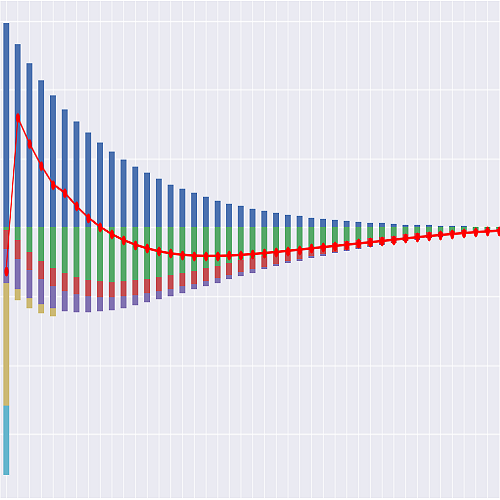
Product Specification#
Status: Draft, 2026-08-20 (all cited sources accessed 2026-08-20).
Scope note. This is a standardized composite specification of Japanese whole life
assurance (shūshin hoken, 終身保険), including its suppressed-surrender-value
(tei-kaiyaku-henreikin-gata, 低解約返戻金型) form, assembled for reference liability cash-flow
modeling. It does not describe any single insurer’s product. Facts carrying a source tag — [S#]
(primary product documents: policy conditions (yakkan, 約款), ご契約のしおり, パンフレット and published rate
pages) and [R#] (regulatory and actuarial references), both numbered per
_research/whole-life.md and resolved in sources.md (same directory; numbering frozen,
never renumbered), and [REG-R#] (the cross-product reference library
references/regulatory-and-actuarial-references.md, whose own R-numbering is distinct) —
were extracted from the cited document. Values marked std are standardizations
introduced for the reference implementation; each std table row carries a numbered
footnote giving the rationale and, where one exists, the observed range across insurers.
Facts the research pass could not verify are flagged unverified. The composite is drawn
from seven carriers’ 約款 and brochures — two of which publish complete numeric
surrender-value tables [S4] [S7], four of which state the suppression factor [S3] [S7] [S9]
[S11], and two of which are deliberately included as counter-examples because they do not
offer the automatic premium loan [S8] [S9] — plus one carrier’s published single-premium
rate page cited only for a scope boundary [S12].
This product is the library’s savings chassis. The endowment product spec (養老保険) inherits its reserve, surrender-value and loan machinery and adds a maturity benefit (manki hokenkin, 満期保険金); the FX whole life product spec (外貨建終身保険) inherits it and adds a variable crediting rate (tsumitate riritsu hendō, 積立利率変動), market value adjustment, MVA (shijō kakaku chōsei, 市場価格調整) and a currency layer. Mechanics specified here are stated once, here.
Product overview and market role#
終身保険 is whole-of-life cover: a level premium buys a death benefit payable whenever the insured dies, with no expiry date and no 満期保険金 [S1] [S3] [S5] [S7] [S9] [S10]. One carrier states the negative flatly in its application terms: this contract has neither dividends nor a maturity benefit [S5]. Participation varies by carrier, and the composite is 無配当. The main contract pays two benefits at the same amount: death benefit (死亡保険金) on death, and severe-disability benefit (kōdo shōgai hokenkin, 高度障害保険金) on the insured reaching the disability state defined in the 約款’s own schedule; paying the second extinguishes the contract retroactively to the date the state was reached [S1] [S3] [S7] [S9]. Because the contract must eventually pay, it accumulates a policy value (hokenryō tsumitatekin, 保険料積立金) and therefore a surrender value (kaiyaku-henreikin, 解約返戻金) — which is what makes it a savings product sold on protection wording, and what makes every mechanic in this document turn on the surrender value rather than on the sum assured.
It is a first-sector (dai-ichi bun’ya, 第一分野) contract — fixed-sum insurance on human survival or death under 保険業法第3条第4項第1号 REG-R1 — which decides the statutory mortality table the reserve must use, 生保標準生命表2018(死亡保険用)for contracts concluded from 1 April 2018 REG-R10 REG-R11 R1, and separates this chassis from the third-sector products: medical (医療保険), cancer (がん保険) and nursing care (介護保険).
Market position: second-largest individual line on every measure, and the largest of the savings-bearing lines. For FY2024, individual insurance (個人保険) new business was 12.43 million policies, of which 終身保険 was 2.31 million (18.6%), behind 医療保険 at 23.8%; new business by sum assured was ¥57.06 trillion, of which 終身保険 was ¥12.997 trillion (22.8%), behind 定期保険 at 43.2%. In force, 終身保険 was 38.48 million policies (19.7% of 195.3 million) and ¥215.10 trillion of sum assured (27.6% of ¥778.99 trillion) R12 REG-R31. The industry 解約・失効率 was 5.6%, but the same report defines it as surrendered-and-lapsed sum assured over opening in-force sum assured, industry-wide across all product types R12 — an amount-weighted, all-product bound, not a whole-life per-policy lapse rate, and used in this library only as a sanity check on a std lapse basis.
Demand is driven by two things a US or UK reader will not assume. First, inheritance tax planning: a death benefit received by an heir is exempt up to ¥5,000,000 multiplied by the number of statutory heirs R9 R10 REG-R44 REG-R45, which is why sums assured cluster in multiples of ¥5,000,000 and why a policy bought at 60 is a normal transaction. Second, the life insurance premium deduction (seimei hokenryō kōjo, 生命保険料控除): three baskets of ¥40,000 capped at ¥120,000 in total, whole life competing for the 一般 basket alongside term cover R11 REG-R43. The 低解約返戻金型 variant adds a third driver — a surrender value engineered to cross 100% of premiums paid shortly after the premium-paying period ends, so the contract is sold as a savings vehicle with a death benefit attached. On the one published table, the 払戻率 runs 70.1% at duration 5, 78.0% at 15 while still suppressed, and 111.5% immediately after the suppression ends [S4].
Representative specification#
Product identity and issue rules#
Parameter |
Representative value |
Basis |
|---|---|---|
Design type |
Level-premium 終身保険; non-participating (mu-haitō, 無配当); carries 保険料積立金 and 解約返戻金; not unit-linked |
[S3] [S5] [S11]; default std (1) |
Policy term (保険期間) |
終身 — whole of life. No expiry, no 満期保険金 |
[S1] [S3] [S5] [S7] [S9] [S10] |
Regulatory class |
第一分野, 保険業法第3条第4項第1号 |
|
低解約返戻金型 switch |
Model-point flag. When on: suppression factor 70%, suppressed period identical to 保険料払込期間, full value from 払込満了 |
Factor: [S3] [S7] [S9] [S11]. Period and full value from 払込満了: [S3] [S6] [S7] [S11]. [S6] states the period only — it does not give the percentage |
Premium-paying period (保険料払込期間) |
終身払, or 年満了 5 / 10 / 15 / 20 年, or 歳満了 to age 50 / 55 / 60 / 65 / 70 / 75 / 80 |
[S5] |
Issue age (契約年齢) |
15–80; 歳満了 options gated by a 10-year minimum payment period (e.g. 60歳払済 to age 50), 20年払 to age 75 |
[S5]; envelope std (2) |
Age basis |
Attained age (man-nenrei, 満年齢) with the fractional year discarded at 契約日; the rating age then increments on each 年単位の契約応当日, not on the birthday |
[S1] [S3] [S9] |
Sum assured (保険金額) |
¥2,000,000–¥50,000,000 in ¥1,000,000 units; a 5-year payment term requires ≥ ¥10,000,000 |
[S5]; adoption std (3) |
Sex |
Male and female rated separately; the female rate is about 92% of the male rate at age 30 on the one published scale |
[S4] |
Lives basis |
Single life; policyholder (契約者) and insured (被保険者) the same person |
[S5]; scope std (4) |
Anchor model cell |
Male, 契約年齢 30, 低解約返戻金型 on, 保険金額 ¥5,000,000, 保険期間 終身, 保険料払込期間 15年, 月払保険料 ¥14,580 (annualized ¥174,960) |
[S4]; annualization std (5) |
Footnotes to std rows:
Participation varies and is part of the product name at every carrier: 無配当 at three [S1] [S3] [S5] [S11], a dividend declared every five years out of investment margin (go-nen goto risa haitō, 5年ごと利差配当) at a fourth [S7], 5年ごと配当 at a fifth [S10], 有配当 at a sixth [S8], and a participating design at a seventh [S9]. 無配当 is the composite default because it is the largest single group and because a dividend is an insurer-discretionary element, not a contractual one REG-R9. The 5年ごと利差配当 design is retained as a parameterized variant, not dropped — see Riders and options.
Only one carrier publishes a complete issue-age × payment-term grid [S5]; a second publishes only the 契約年齢 definition and no envelope at all, because its envelopes live in a 契約概要 that is a separate document [S1]; a third is bound instead by a statutory maximum sum insurable (kanyū gendogaku, 加入限度額) [S9]. The composite adopts the one published grid verbatim, including its asymmetry — 年満了 short-pay is offered to the top of the issue range while 歳満了 short-pay is not [S5]. No carrier in the set publishes a maximum issue age above 80; whether that is universal is unverified.
The band is one carrier’s published range [S5]; its rule that the ¥1,000,000 unit is available only at ages 76–80 is dropped as a single-carrier refinement. The observed alternative is a hard statutory ceiling rather than an underwriting one — ¥7,000,000 where the insured is 15 or under and ¥10,000,000 from 16, reaching a cumulative ¥20,000,000 at ages 20–55 subject to conditions, with over-limit applications declined outright and a breach discovered after issue voiding the excess [S9]. That ceiling has no analogue in the US or UK reference sets, and it is out of the composite because it belongs to one carrier’s statutory position rather than to the product.
One carrier requires 契約者 = 被保険者 [S5]; the others do not make the requirement explicit in the retrieved documents. There is no joint-life whole life in the retrieved set, so the composite is single-life throughout and treats third-party-policyholder arrangements as a tax question rather than a cash-flow one R9.
The anchor is the one model point for which a carrier publishes a complete surrender-value run — male 30, ¥5,000,000, 終身, 保険料払込期間 15年 (= the suppressed period), 月払保険料 ¥14,580, with 解約払戻金 at durations 5 / 10 / 15 / 15+ / 20 / 30 / 40 / 50 [S4]. It is round, internally consistent (14,580 × 180 = ¥2,624,400, the published cumulative premium at 15 years, and every published 払戻率 reproduces to the displayed decimal), and it exhibits the cliff.
WholeLife_JP_Scollects a 年払 premium, standardized as 12 × the monthly figure = ¥174,960; no carrier publishes an annual-mode premium for this cell, so the modal discount a real 年払 scale would carry is not applied. The projection steps in months, but the payment frequency is the 契約者’s choice and not the grid’s: the annual premium falls in one month of twelve rather than being spread across the year. The sum assured sits inside the household 普通死亡保険金 bands of the national survey REG-R32 and is one heir’s worth of the inheritance-tax exemption REG-R44.
Benefit provisions#
Parameter |
Representative value |
Basis |
|---|---|---|
死亡保険金 |
保険金額, level for life, paid on death at any time; net of any outstanding loan or APL balance |
[S1] [S3] [S7] [S9] [S10] |
高度障害保険金 |
Same amount as the death benefit, on the 高度障害状態 defined in the 約款’s 別表; payment extinguishes the contract retroactively to the date the state was reached |
[S1] [S3] [S7] [S9] |
Precedence between the two |
If the insured dies before claiming the 高度障害保険金, only the death benefit is paid |
[S1] |
Benefit shape |
Level only. Step-down and multiplier designs are excluded |
[S9]; scope std (10) |
免責 — suicide |
No benefit where the insured commits suicide within 3 years of the 責任開始期, reset to the latest 復活 |
[S1] [S3] [S7] [S8] [S9] [S10]; statutory frame REG-R34 |
免責 — other |
Intentional act of the 保険契約者 or of the 死亡保険金受取人; war and civil disturbance. On the 高度障害保険金, also the insured’s own intentional act or criminal act |
[S1] [S9] [S10] |
Payment when a benefit is refused |
The 保険料積立金 / policy reserve (sekinin-junbikin, 責任準備金) is paid to the policyholder. Nothing is paid where the policyholder intentionally caused the death; where one of several beneficiaries acted intentionally, the others are paid and the reserve for the withheld share goes to the policyholder |
[S1] [S9] [S10] |
War clause |
Scalable, not absolute: where the increase in affected insureds does not disturb the calculation basis the insurer may pay in full or pay a proportionately reduced amount |
[S1] [S10] |
Contestability (告知義務違反) |
Rescission within 2 years of the 責任開始日 (or of the 復活日); beyond that only where a claim event inside the window is involved |
[S1] [S7] [S9]; statutory ceiling REG-R35 |
Underwriting loadings |
Handled by a 特別条件付保険特約 rather than by declining |
[S3] |
One carrier sells designs in which the death benefit is the 基準保険金額 during 保険料払込期間 and steps down to 50% of it afterwards, and separately doubles the benefit where death follows an 不慮の事故 within 180 days or a listed 感染症 [S9]. Both are that carrier’s designs alone in this set. The composite death benefit is level for life: it is the shape at six of the seven carriers [S1] [S3] [S7] [S8] [S10] [S11], and a step-down at 払込満了 would collide with the 低解約返戻金型 cliff at the same date, making the model point unable to isolate either effect. The step-down design is named here so that a reader meeting it in the market knows it is real and knows this library does not model it.
Options and contract alterations#
Parameter |
Representative value |
Basis |
|---|---|---|
Automatic premium loan, APL (自動振替貸付) |
Elected at outset, on by default; at the expiry of 猶予期間 the insurer advances the premium due against the surrender value and the contract continues |
[S1] [S7] [S10] [S11]; default std (11); election requirement REG-R14 |
APL continuation condition |
The advance plus interest must not exceed the surrender value computed as if the premium had been paid, net of any existing loan |
[S1] [S3] [S10] |
APL interest |
Compound, rolled into principal at each subsequent grace expiry (annually on 年払). Published ceilings 年8% / 半年4% / 月 8/12%. Composite rate 2.75% p.a. |
ceilings [S1] [S7] [S10]; level [S2]; pick std (12) |
APL cancellation window |
An advance already made is treated as never having happened if 解約, 減額 or conversion to 払済保険 is requested within 3 months of the day after grace expiry |
[S1] [S3] [S10] |
Policy loan (契約者貸付) |
Up to 9/10 of the surrender value while premiums are being paid, 8/10 once the contract is 保険料払込済; existing loan and APL principal and interest deducted first; compound interest at a company-set rate |
[S1] [S3] [S7]; limit std (14) |
Reduced paid-up (払済保険) |
The surrender value net of loan and APL balance is applied as a single premium to a reduced sum assured. Term stays 終身; premiums cease; riders terminate |
[S1] [S3] [S7] [S9] [S10] |
Extended term (延長定期保険) |
Surrender value applied as a single premium to term cover for the same sum assured, term set by the amount available, capped at the original 払込満了 date. Out of scope |
[S7]; scope std (13) |
Sum-assured reduction (減額) |
Permitted; the reduced portion is treated as surrendered and pays the corresponding surrender value |
[S1] [S3] [S9] [S10] |
保険料払込期間の変更 |
Offered at two carriers subject to conditions. Out of scope |
[S1] [S10]; scope std (9) |
リビング・ニーズ特約 |
Attached at no extra premium; on a prognosis of 6 months or less, the 指定保険金額 elected by the insured is paid less 6 months’ interest and premium equivalent, capped at ¥30,000,000; the main contract’s sum assured reduces by the amount paid |
[S1] [S3] [S4] [S7] |
Election varies more than any other mechanic in the file: opt-out at four carriers [S1] [S7] [S10] [S11]; opt-in at one, whose booklet states that without the request no APL is made [S3]; absent at two — one has none at all [S8], the other only a requested 保険料振替貸付 [S9]. The composite takes opt-out because it is the majority and because it is the position that changes lapse mechanics. The supervisory guideline requires an APL to be at the policyholder’s election with prompt notice when exercised (監督指針 IV-1-12) REG-R14, so the model implements it as an election with a default value, never as an unconditional no-lapse rule: the model point carries an
apl_electedflag and the off position must be exercised in testing.Only the ceilings are published, identically at three carriers — 年払 up to 8% p.a., 半年払 up to 4% per half year, 月払 up to 8/12% per month [S1] [S7] [S10] — with a fourth publishing a single 年8% ceiling [S3]. One carrier publishes applied rates, banded by 契約日 vintage rather than by current market: 4.00% for contracts to 1999-04-01, 3.25% to 2001-04-01, and 2.75% from 2001-04-02, the same schedule serving both 契約者貸付 and 自動振替貸付 [S2]. The composite takes 2.75% — the band a currently written contract falls in on the only published schedule — and the vintage banding tells the modeller the right thing: the loan rate tracks the vintage’s 予定利率, not the current market. Two carriers review the rate each January and July, the revision applying to existing loans [S7] [S11]; the composite holds it flat and lists the review as a sensitivity.
延長定期保険 appears in one carrier’s documents in the whole set [S7]; five others have no such article in their retrieved 約款 [S1] [S3] [S8] [S9] [S10], and it was not in the chapters retrieved from the seventh [S11]. Treating extended term as a universal Japanese whole life option would be wrong, so it is out of the composite and out of the model. It is specified in the table because a later product may need it, and because during the suppressed period the 70% base makes the solved term correspondingly shorter — a cliff effect worth recording. Its detail at that carrier: not written where the solved term is under one year or the insured is already 80, riders terminate except the proxy-claimant 特約, and 復旧 is available within 3 years [S7].
The 9/10-in-payment, 8/10-paid-up split is stated identically at three carriers [S1] [S3] [S7]. A fourth is tighter — 8/10 less three months’ premium, the deduction waived once the contract is paid up or premiums are waived [S8] — and a fifth publishes no fraction at all, only a company method, with a fixed one-year 貸付期間 that auto-renews by capitalising interest [S9]. The composite takes the three-carrier split. Minimum draw amounts (¥50,000 first, ¥10,000 thereafter at one carrier [S7]) are not modelled.
Termination and values#
Parameter |
Representative value |
Basis |
|---|---|---|
解約返戻金 basis |
A function of both elapsed months and paid months during 保険料払込期間, and of elapsed months alone afterwards; the elapsed count is capped at the paid count while premiums are due. The formula itself is in the unpublished 算出方法書 |
[S1] [S3] [S10]; construction std (15) |
低解約払戻期間 |
Identical to 保険料払込期間. On a 終身払 contract it therefore runs for life |
[S3] [S6] [S7] [S11] |
Suppression factor |
0.70, applied as a multiplier to the ordinary surrender value |
[S3] [S7] [S9] [S11] |
The step at 払込満了 |
A discontinuity, not a ramp: on the one published table the value goes from ¥2,047,650 to ¥2,928,450 across the boundary, a 43.0% jump, and 払戻率 from 78.0% to 111.5% |
[S4] [S7] |
Clawback |
If not all premiums falling in the suppressed period were paid, the suppressed basis continues to apply after the period ends |
[S3] [S4] [S5] [S9] |
満期保険金 |
None |
[S5] |
Grace (猶予期間) |
月払: from the first day of the month following the 払込期月 to the last day of that month. 半年払 / 年払: to the monthly 契約応当日 in the month after that, with named end-of-month substitutions |
[S1] [S3] [S10]; regime std (16) |
Lapse (失効) |
From the day after grace expiry, only where the APL cannot carry the premium. The policyholder may then claim the surrender value |
[S1] [S3] [S10] |
Loan-excess termination |
Where loan and APL principal and interest exceed the surrender value the insurer notifies for a top-up; if unpaid by the end of the month following the notice month the contract lapses from the next day |
[S1] [S3] [S10] |
Reinstatement (復活) |
Within 3 years of lapse, on fresh 告知 and payment of the arrears; barred once the surrender value has been claimed. The 責任開始期 resets, restarting both the suicide clause and the contestability clock |
[S1] [S3] [S7] [S10]; window std (17) |
クーリング・オフ |
8 days from the later of delivery of the disclosure document and the application date, effective on dispatch. Out of scope |
|
Policyholder protection |
On a member insurer’s failure, up to 90% of the 責任準備金 at the failure date |
No carrier publishes a surrender-value formula; the 算出方法書 that holds it is a filed but unpublished 基礎書類 REG-R2. What the 約款 do publish is the argument list — elapsed and paid months, with the elapsed count capped at the paid count during the premium-paying period [S1] [S3] [S10] — and two carriers publish complete numeric tables [S4] [S7]. The library therefore constructs the ordinary surrender value as a std function (a net-level-premium policy value less an acquisition-cost deduction grading to zero) calibrated to reproduce the published table at the anchor cell, with the construction and its fit stated in
technical-notes.md. That is the honest position: the level is sourced at one model point, the shape between points is standardized.Three grace regimes are observed and they are not variants of one rule: the roughly one-month 約款 grace above at four carriers [S1] [S3] [S7] [S10]; a two-month grace at one, whose worked example has a September premium due 9/1–9/30, grace 10/1–11/30 and lapse on 12/1 [S9]; and at one carrier no grace and no lapse at all — a 催告 naming a 解除予定日, the monthly anniversary in the third month after the 払込期月, on which the contract is terminated (解除) and the surrender value paid net of unpaid premiums [S8]. The composite takes the four-carrier grace. The 解除 regime is named but excluded because it differs in kind: a terminated contract cannot be reinstated at all, whereas a 失効 contract can.
3 years at four carriers [S1] [S3] [S7] [S10]; 1 year at one [S9]; none at the carrier that terminates rather than lapsing [S8]. The composite takes 3 years. The window matters more than its length suggests: Japanese policies really do come back, so a lapse decrement on this chassis is not a terminal state, and the reinstatement assumption is a std behavioural input rather than an omission.
The statutory cooling-off applies to every contract in this composite — the exclusion for terms of one year or less cannot bite on a 終身 contract REG-R36.
jplibprojects from the point cover is in force and scopes the window out, stated here rather than silently omitted because it is a real early-duration decrement a first-year study would see.
Contractual mechanics#
Notation used below and carried into technical-notes.md:
x       契約年齢 at issue (満年齢, fractional year discarded)
t       completed policy years since 契約日 — the 年単位の契約応当日, which is where the
        contract defines every value below; `WholeLife_JP_S` projects in months and
        carries this anniversary index beside it, spelled `d`
m       保険料払込期間 in years; m = infinity for a 終身払 contract
SA      保険金額
P       annual premium, level for t < m, zero for t >= m
V(t)    the ordinary (unsuppressed) surrender value at t
CV(t)   the surrender value actually payable at t
k       解約払戻金支払割合, the suppression factor (0.70 when 低解約返戻金型 is on)
L(t)    outstanding 契約者貸付 + 自動振替貸付 principal and interest at t
i_L     the loan / APL interest rate
Death and 高度障害 benefit#
Both benefits are SA, paid net of L(t) [S1] [S9] [S10]. They are alternatives on one
sum: the 高度障害保険金 is not an addition to the death benefit but an acceleration of it on a
disability trigger, and its payment ends the contract retroactively to the date the 高度障害状態
was reached [S1] [S3] [S7] [S9]. If the insured dies before claiming it, only the death
benefit is paid [S1]. For modelling, the two are one decrement on one benefit amount — and,
usefully, the statutory valuation table already works that way: 生保標準生命表2018(死亡保険用)
includes 高度障害 inside the death rate REG-R20 R2, so a projection using it must not
add a separate disability decrement on top.
Where a benefit is refused for an 免責事由, the contract does not simply forfeit: the 保険料積立金 or 責任準備金 is paid to the policyholder instead [S1] [S9] [S10]. The only case in which nothing is paid is where the policyholder intentionally caused the death [S1] [S10]. A model that treats an exclusion as a zero-payment event overstates the insurer’s position; the composite treats a refused death claim as a payment of the policy value.
The suicide exclusion runs three years, at every carrier in the set [S1] [S3] [S7] [S8]
[S9] [S10] — three times the twelve months of the UK composite in uklib. That period is
contractual, not statutory: 保険法第51条第1号 excludes suicide with no time limit at all,
and the three-year 免責期間 is a narrowing of the statute in the insurer’s 約款, permitted because
it favours the policyholder REG-R34. The same asymmetry applies to contestability: the 約款
window is 2 years [S1] [S7] [S9] against a statutory ceiling of 5 years from inception with
a one-month use-it-or-lose-it clock from discovery REG-R35. Both windows restart on 復活
[S1] [S7] [S9] [S10].
解約返戻金 and the 低解約返戻金型 cliff#
The payable surrender value is
CV(t) = k * V(t)     for t <  m      (k = 0.70 when 低解約返戻金型 is on, 1.00 otherwise)
CV(t) =     V(t)     for t >= m
and the transition at t = m is a step. This is the product’s signature and the one
thing a model must not smooth. Two carriers’ published tables agree on it to rounding. On
the anchor cell, ¥2,047,650 the day before the boundary against ¥2,928,450 immediately after
— the pre-cliff figure is quoted one day earlier, which is why the observed ratio is 0.6992
rather than exactly 0.70 [S4]. On the other published pair, the ratios of suppressed to
ordinary value at durations 5, 10, 20 and 30 are 0.7004, 0.6999, 0.7001 and 0.6999 — exact
to rounding at every duration [S7]. That second table also settles what the suppression
is: at duration 40, well past 払込満了, the suppressed and ordinary products have
identical surrender values, ¥8,159,000 [S7]. The suppression is a pure haircut on a
common underlying policy value, not a different policy value — so a model needs one V(t)
and one multiplier, not two reserve runs.
Three consequences follow, and all three are contractual rather than incidental:
Everything derived from the surrender value is suppressed with it. The 払済保険金額, the 契約者貸付
amount and the 自動振替貸付 amount are all computed off CV(t), so during the suppressed period
all three are 30% smaller [S7] [S9] [S11]; where 延長定期保険 exists the solved term is
correspondingly shorter [S7]. The APL consequence is the sharp one and is developed below.
Conversion during the period is permanent. Converting to 払済保険 switches the suppression off for the future — one carrier’s article says so in terms — but the conversion itself is made on the suppressed value, so the resulting 払済保険金額 is permanently smaller [S3] [S7] [S9].
A clawback survives the step. If not all premiums falling in the suppressed period were paid, the suppressed basis continues to apply after the period ends [S3] [S4] [S5] [S9]. A policy carried through the low period by APL advances that were never repaid does not necessarily get the full step-up.
The price of the suppression is disclosed at one carrier, which publishes both premium scales for one identical model point: ¥17,040/month suppressed against ¥20,350/month ordinary — the suppressed form costs 83.7% of the ordinary one [S7]. That is the trade the product makes, and a model that suppresses the value without discounting the premium mis-prices it.
One carrier applies the factor only to the guaranteed part of the value on an 積立利率変動型 chassis: the low-period surrender value is 70% of the surrender value on the 基本保険金額 part plus an unsuppressed amount derived from the excess of the actual 積立金 over the 予定利率-based 積立金 [S11]. That split belongs to the FX whole life (外貨建終身保険), which inherits this chassis and adds the crediting-rate layer; it is named here so that the inheritance is explicit.
復活, 払済保険 and 減額#
復活. Within three years of lapse, on fresh 告知 and payment of the arrears, the contract is restored; cover attaches when the arrears (and, where the declaration comes later, the declaration) are received [S1] [S3] [S10]. Reinstatement is barred once the surrender value has been claimed [S1] [S3] [S10]. The 責任開始期 resets, restarting the suicide and contestability clocks [S1] [S7] [S9] [S10].
払済保険. The surrender value net of L(t) is applied as a single premium to a reduced sum
assured on a company-defined basis [S1] [S3] [S7] [S9] [S10]:
SA_paid_up(t) = (CV(t) - L(t)) / A(x + t)
where A(x+t) is a whole-life single-premium net rate on the insurer’s own basis. The term
stays 終身 and cover continues for life [S3] [S7]. Riders terminate on conversion, except
those a carrier names — one keeps the living-needs and proxy-claimant 特約 [S7]; two terminate
riders outright [S1] [S3]. Eligibility differs: three years of premiums paid and the
contract still inside 保険料払込期間 at one carrier [S10]; two years in force at another [S9]; only
a floor on the resulting sum assured at two more [S1] [S3]. Conversion is irreversible at
one carrier [S3] and reversible within three years by 復旧 at another [S7].
減額. Reducing the sum assured is universal and is treated as a partial surrender: the reduced portion pays the corresponding surrender value [S1] [S3] [S9] [S10] — on the suppressed basis if the reduction is made during the low period [S9].
契約者配当#
On the 無配当 composite there is no dividend layer at all: one carrier’s 約款 says so in a dedicated article, and every rider in that booklet repeats it [S1]. On the participating variant, the legal frame is 保険業法第114条 (any distribution provided for in the 約款 must follow the fair-and-equitable standard set by ordinance) and 施行規則第30条の2, whose second permitted method — identifying the distributable amount by the cause in which it arose — is the legal footing of the three sources of surplus (san-rigen, 三利源: 死差 mortality, 利差 interest, 費差 expense) framing R5 R6 REG-R9. The limit stated honestly: neither the ordinance nor the supervisory guideline names 死差, 利差 or 費差 — 三利源 is Japanese actuarial and industry practice, and this library uses the vocabulary without attributing it to a regulatory text REG-R9. In practice on a 5年ごと利差配当 design a dividend is declared every five years from inception where the investment return on 責任準備金等 exceeds the return assumed in pricing, and while the contract continues it accumulates at a company-set rate as 5年ごと積立配当金, withdrawable on request; it is not promised, varies with performance and may be nil, and riders carry none [S7]. Dividends therefore belong in assumption class (b), insurer-discretionary current elements — and separating them from guaranteed elements is not a modelling nicety but the reason a Japanese illustration must split 保証 from 非保証, since presenting a non-guaranteed element as certain is 断定的判断の提供 under 消費者契約法第4条 REG-R38.
Riders and options#
In scope (modelled or parameterized):
高度障害保険金 — part of the main contract, same amount, no extra premium; modelled as part of the death decrement because the valuation table already includes it [S1] [S3] [S7] [S9] REG-R20.
低解約返戻金型 — a model-point flag with a suppression factor and a suppressed period, not a separate product [S3] [S6] [S7] [S9] [S11].
自動振替貸付 — modelled as an election with a default-on value, with the continuation test above; the off position must be exercised in testing [S1] [S3] [S7] [S10] REG-R14.
契約者貸付 — modelled as an available balance and an interest accrual; take-up is a std behavioural assumption with no public data behind it [S1] [S3] [S7].
払済保険 — modelled as an election at a policyholder-chosen duration, using the surrender value net of loans [S1] [S3] [S7] [S9] [S10].
5年ごと利差配当 — parameterized as an insurer-discretionary cash flow, off in the base run [S7].
リビング・ニーズ特約 — specified and priced at zero, as it is in the market; modelled as an acceleration of the death benefit rather than an additional benefit [S1] [S3] [S4] [S7].
Out of scope: 延長定期保険 (one carrier only) [S7]; 保険料払込期間の変更 [S1] [S10]; 前納 and ステップ払込方式 [S1] [S10]; 保険料払込免除 and its 特定疾病 extension [S3]; 非喫煙割引特約 (a rating question, not a cash-flow one) [S1]; 介護前払特約, payable after 払込満了 from age 65 on public 要介護4–5 as a discounted advance of the death benefit [S3] [S4]; 年金支払移行特約, converting the 責任準備金等 into an annuity or care benefit after 払込満了 [S7] [S11]; 指定代理請求特約 [S7]; the attachable protection riders (定期保険特約, 逓減/逓増定期保険特約, 家計保障定期保険特約, 災害割増特約, 傷害特約) and the third-sector riders (災害入院特約, 疾病入院特約, 三大疾病関連特約), whose shape belongs to the medical (医療保険) [S1] [S3] [S7]; 特別条件付保険特約 [S3]; the 倍額保障 and step-down designs of one carrier [S9]; and the 一時払 and 積立利率変動型 forms, which are scope boundaries rather than riders — see below.
Scope boundaries at the edge of this chassis. Two neighbouring shapes are excluded and named. Single-premium whole life (一時払終身保険) is the same benefit on a single-premium chassis; it matters because it is the one form whose 予定利率 is publicly disclosed and refreshed twice a month [S12], and because it sits on the 標準利率’s quarterly reset calendar rather than the annual one R8 REG-R10. 積立利率変動型終身保険 replaces the fixed 予定利率 with a crediting rate reset monthly off the 10-year JGB 応募者利回り less an explicit asset-management margin, rounded to 0.01% and floored at the 予定利率, the excess buying ratcheting 増加保険金額 [S11]. It stays inside the 標準責任準備金 regime — 施行規則第68条 excludes contracts whose 約款 lets the insurer change the 予定利率, not contracts whose crediting rate floats above a fixed one R6 REG-R7 — and it is the direct ancestor of the FX whole life (外貨建終身保険), which adds the currency and MVA layers REG-R12 REG-R37.
Variations across insurers#
自動振替貸付 — presence and election. Opt-out at four carriers [S1] [S7] [S10] [S11], opt-in at one [S3], absent at two — one has none at all [S8], the other only a requested 保険料振替貸付 [S9]. Composite: opt-out, implemented as an election with a default-on flag, because that is the majority position and because the supervisory guideline requires the feature to be at the policyholder’s election REG-R14. This is the single largest source of divergence in projected lapse experience across the seven carriers.
What the APL advances, and on what cycle. Three months’ premium at a time on 月払 [S1]; to the day before the next half-yearly anniversary [S10]; the premium due [S3] [S7] [S11]. Interest rolls into principal at each subsequent grace expiry [S3] [S7], with a distinct post-払込満了 rule at one carrier [S10]. Composite: the premium due, rolled annually — the rule at two carriers, and the one consistent with a 年払 premium advanced on one date a year and capitalised at the 契約応当日.
Grace and what follows it. One month at four carriers [S1] [S3] [S7] [S10]; two months at one [S9]; and at one carrier neither grace nor lapse but a scheduled 解除 on the monthly anniversary in the third month after the 払込期月, with the surrender value paid net of unpaid premiums [S8]. Composite: the four-carrier one-month grace. The 解除 regime is not a longer grace — it is a different termination, and it cannot be reversed.
復活 window. Three years at four [S1] [S3] [S7] [S10]; one year at one [S9]; none at the 解除 carrier [S8] — a factor of three across those that offer it, and a presence/absence split beyond that. Composite: three years.
Suppression factor and period. 70% wherever it is published — in the 約款 at two carriers [S3] [S9], in the 契約概要 at a third [S7], in the glossary at a fourth [S11]: four independent statements and no disagreement. The period is 保険料払込期間 at three [S3] [S7] [S11] and “before 払込満了” at the fourth [S9]. A fifth sells a 低解約払戻金型 form whose factor could not be read at all, because its special provisions are printed as 「(記載省略)」 in the retrieved booklet [S1]. Composite: 0.70 over 保険料払込期間.
How the suppression is applied on a variable-crediting chassis. One carrier suppresses only the guaranteed part, adding an unsuppressed amount from the excess of the actual 積立金 over the 予定利率-based 積立金 [S11]; the others apply one multiplier to the whole value [S3] [S7] [S9]. Composite: one multiplier, the split deferred to the FX whole life (外貨建終身保険).
契約者貸付 limit. 9/10 in payment and 8/10 paid up at three [S1] [S3] [S7]; 8/10 less three months’ premium at one [S8]; an unpublished company formula with a one-year 貸付期間 at another [S9]. Composite: 9/10 and 8/10.
What happens when the loan exceeds the value. Lapse after a month’s notice at four [S1] [S3] [S7] [S10]; at one, the contract never lapses — the sum assured is reduced instead, by applying the loan against 積立金 (or 0.7 × 積立金 during the low period), so the reduction exceeds the loan balance [S9]. Composite: lapse, with the reduction mechanic named and excluded.
Participation. 無配当 at three [S1] [S3] [S5] [S11], 5年ごと利差配当 at a fourth [S7], 5年ごと配当 at a fifth [S10], 有配当 at a sixth [S8], participating with a dividend chapter in the 約款 at a seventh [S9]. Composite: 無配当 base, 5年ごと利差配当 as an off-by-default variant.
払済保険 eligibility, and whether it can be undone. A floor on the resulting sum assured only, at two [S1] [S3]; two years in force at one [S9]; three years of premiums paid and still inside 保険料払込期間 at another [S10]; and reversibility split — irreversible at one [S3], 復旧 within three years at another [S7]. Composite: available from any duration with a sum-assured floor, irreversible.
延長定期保険. Offered by exactly one of the seven [S7]; no such article appears in five other carriers’ retrieved 約款 [S1] [S3] [S8] [S9] [S10], and it was not in the chapters retrieved from the seventh [S11]. Composite: excluded. This is the clearest case in the file where a feature a US or UK reader would expect to be standard is not.
Death-benefit shape and issue limits. Level for life at six carriers; one sells a step-down design halving the benefit after 払込満了 and a doubling on accidental death or a listed 感染症 [S9]. Issue envelopes are published as a full grid at one carrier [S5], as a statutory 加入限度額 at another [S9], and not at all at a third [S1]. Composite: level benefit, one carrier’s published grid.
What does not vary. Uniform wherever the retrieved documents state it, and at every one of the seven carriers for the first three: a 終身 term with no maturity benefit and no 満期保険金 [S1] [S3] [S5] [S7] [S8] [S9] [S10] [S11]; a death benefit and a 高度障害保険金 at the same amount, the second extinguishing the contract [S1] [S3] [S7] [S9]; a three-year suicide exclusion measured from the 責任開始期 and reset on 復活, at six of the seven [S1] [S3] [S7] [S8] [S9] [S10]. Also without observed disagreement: a two-year contestability window [S1] [S7] [S9]; payment of the 保険料積立金 rather than nothing where a benefit is refused for an 免責事由 [S1] [S9] [S10]; a surrender value that is a function of elapsed and paid months [S1] [S3] [S10]; 減額 treated as a partial surrender [S1] [S3] [S9] [S10]; 払済保険 available in some form wherever the retrieved documents address it [S1] [S3] [S7] [S9] [S10] [S11]; 契約年齢 on 満年齢 with the fraction discarded, incrementing on the 契約応当日 rather than the birthday [S1] [S3] [S9]; and 月払 / 半年払 / 年払 as the mode set [S1] [S3] [S5] [S9] [S10]. Those are the invariant core of the composite, and every one is a fact a model can rely on without a std tag.
Regulatory context#
Prudential — ESR, and what it replaced. From 31 March 2026 Japanese insurers are
supervised on economic-value-based solvency regulation, ESR (keizai-kachi bēsu no
soruvenshī kisei, 経済価値ベースのソルベンシー規制), a three-pillar regime in which assets
are at fair value and liabilities are current estimate (genzai suikei, 現在推計) plus MOCE,
re-measured at each 基準日 on assumptions re-set then and discounted on a prescribed yield
curve, calibrated in principle to 99.5%. Early corrective action triggers when the ESR
falls below 100%, replacing the old SMR (soruvenshī mājin hiritsu, ソルベンシー・マージン比率)
200% trigger REG-R15 REG-R17. The change matters to this product specifically: the
old basis was ロックイン — mortality, lapse and interest fixed at issue — and a 終身保険 written
today has a run-off measured in decades, so a re-projectable, assumption-parameterized
liability model of exactly the kind this library builds is the operative artefact rather
than a one-off pricing exercise REG-R15. jplib computes neither ratio; the
standard-formula coefficients sit in 告示 that were not opened in the research pass and are
unverified REG-R16.
Statutory reserving — cited, not reproduced. 保険業法第116条 obliges an insurer to hold 責任準備金 and empowers the Prime Minister to prescribe the accumulation method and the level of the assumed coefficients for long-term contracts R5 REG-R4. 施行規則第68条 says which contracts are in scope — a level-premium 終身保険 with a fixed 予定利率 is R6 REG-R7 — and 第69条 splits the reserve into 保険料積立金, 未経過保険料, 払戻積立金 and contingency reserve (kiken junbikin, 危険準備金), with a floor of net level premium method (heijun jun-hokenryō-shiki, 平準純保険料式) for anything out of scope R6 REG-R8. 平成8年大蔵省告示第48号 sets the method (平準純保険料式, no Zillmer adjustment), the table (生保標準生命表2018(死亡保険用)for contracts from 1 April 2018) and the 標準利率 machinery, which for ordinary contracts resets off a 1 October 基準日 against the lower of the 3-year and 10-year means of 10-year JGB issue yields, with banded safety coefficients, a 0.5% trigger, 0.25% granularity and effect from the following 1 April R7 R8 REG-R10 REG-R11. The current numeric 標準利率 could not be established from any retrieved official document, and the 安全率係数 table for the annual case is printed as 「[表略]」 in the retrieved redline R8 — so any 標準利率 figure downstream is std or unverified, never asserted. 価格変動準備金 is asset-driven and out of scope REG-R3. This library projects gross cash flows and builds none of these reserves.
What the regime asks a liability model for is set by 保険業法第121条第1項第1号, which requires the appointed actuary (保険計理人) to confirm in an 意見書 that the reserve is soundly accumulated REG-R6; the IAJ practice standard turns that into the 1号収支分析, a forward income-and-outgo analysis over at least ten future years by product segment, under prescribed deterministic scenarios or a stochastic set, with sufficiency tested over the first five REG-R22. That is the shape of this product’s projection: per-policy premiums, claims, expenses, surrenders and loan movements over a long horizon, re-runnable on a re-set basis.
Mortality basis. 生保標準生命表2018(死亡保険用)is the statutory valuation table here R1 REG-R10
REG-R11 REG-R18, and — in sharp contrast with the subscriber-restricted CMI tables
uklib had to proxy — it is published in full, free, at a stable public URL. Two
qualifications must both be kept. It is a valuation table: 2008/2009/2011 experience,
carried forward by an improvement allowance of 2.5% p.a. for five years then 1.0% p.a. for
three, then loaded by a 数学的危険論による補整 sized to hold the probability of experience exceeding
the projected variation to about 2.28% (a 2σ level), capped at 130% of the unadjusted rate
R2 REG-R20 — so a best-estimate basis is a std adjustment of a sourced table,
and each document says which of the two it means. And the IAJ’s site terms prohibit
reproduction and transmission to third parties without written consent REG-R21, so jplib
cites the tables by URL, quotes only the rates its worked example needs, and ships
mort_table.csv as a std construction whose provenance column points at the IAJ
entries. The terminal age on the male 死亡保険用 basis is 109 — a hard parameter for a
whole-life projection, which terminates there R1 REG-R18. The table is built for a
nearest-birthday insurance age (hoken-nenrei, 保険年齢) basis while this product ages on 満年齢
REG-R20 [S1] [S3]; the difference
is handled in technical-notes.md.
The division that shapes this library’s tagging is statutory: the 予定利率, 予定死亡率, 予定事業費率 and the surrender-value formula live in the 保険料及び責任準備金の算出方法書, one of the four 基礎書類 filed under 保険業法第4条第2項 and not published, while the 約款, the ご契約のしおり and the パンフレット are REG-R2. No amount of further research converts footnote 8 or footnote 15 into a sourced value.
Conduct and classification. The supervisory guideline names 低解約返戻金型 products among those needing extra explanation at the point of sale (IV-1-9), requires 解約返戻金 to be disclosed clearly — the amount on the policy schedule or the method in the 約款 (IV-1-10) — and requires a 契約者貸付 limit reasonable against the surrender value with over-loan prevention, and a 自動振替貸付 to be at the policyholder’s election with prompt notice when exercised (IV-1-12) REG-R14. The statutory duty to explain a restriction on cancellation before sale is what makes the suppression period a disclosable feature rather than a pricing detail REG-R39, and presenting a non-guaranteed dividend as certain is 断定的判断の提供 REG-R38. A yen, fixed-予定利率 終身保険 is not a 特定保険契約 under 保険業法第300条の2 — that classification and its FIEA-grade conduct rules attach to the 外貨建 and 変額 designs REG-R37. クーリング・オフ is eight days on a dispatch rule and is scoped out REG-R36. On insurer failure, contracts are covered up to 90% of the 責任準備金 at the failure date, the rate set by ordinance under 保険業法第270条の3; the reduced rate for 高予定利率契約 is unverified REG-R40 REG-R41.
Tax. Two regimes drive design here. Inheritance tax: a death benefit is deemed
acquired by inheritance in the proportion of the premiums the decedent bore (相続税法第3条第1項第1号)
and is exempt for heirs up to ¥5,000,000 × the number of statutory heirs (第12条),
apportioned pro rata above the limit R9 REG-R44; renouncing heirs are counted as if they
had not renounced, adopted children are capped, and a non-heir recipient gets no exemption
at all R10 REG-R45. Premium deduction: the premium sits in the 一般の生命保険料 basket of
the post-2012 three-basket regime, deductible on a banded schedule to ¥40,000 per basket
with an overall income-tax cap of ¥120,000 R11 REG-R43. A surrender received by the
premium payer is 一時所得 — proceeds less premiums paid less a ¥500,000 特別控除, of which half
enters taxable income REG-R46 — which is one reason the surrender decision on a 低解約返戻金型
contract is not driven by the cliff alone. jplib models contractual cash flows, not the
policyholder’s tax position.
Professional standards and the accounting frame. The basis any model uses is
professionally owned by the 保険計理人 appointed under 保険業法第120条 REG-R5, working to the IAJ’s
実務基準 REG-R22; the tables that bind the statutory reserve are produced by the IAJ as the
指定法人 designated under 保険業法第122条の2 and commissioned by the FSA R4 R5. The frame a reader
arriving from uklib or uslib must not import: IFRS 17 is not mandatory in Japan —
IFRS applies as 指定国際会計基準 on a voluntary basis REG-R47. J-GAAP statutory reserving, the ESR
economic balance sheet and IFRS 17 are three separate bases over one set of projected cash
flows, and this product keeps the cash flows basis-agnostic, with discounting, margins and
tax layered on top.