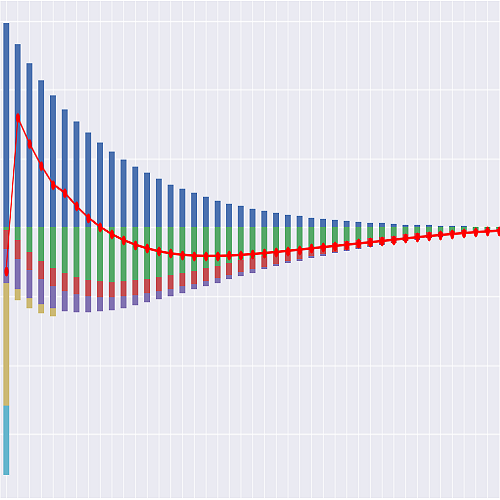
Implementation Notes#
Status: Draft, 2026-09-03. Built from technical-notes.md; the
product those notes describe is specified in product-spec.md, and every
source tag on this page resolves in sources.md. Where the model carries
something the documents do not settle, it is named here rather than absorbed.
This is a mechanics demonstration, not a pricing or reserving result. What is sourced on this product is the contractual machinery: the grade-only trigger with no company-basis limb, the 최초 1회한 장기요양진단급여금 (janggi-yoyang jindan geubyeogeum) that extinguishes its own benefit line without terminating the contract, the survival-tested 간병연금 (ganbyeong yeongeum) with its twelve-month guarantee and 120-month cap, the amount and the 감액 both frozen at first certification, the 납입면제 firing on the same event as the benefit, the bar on surrender once the annuity has started, the nil 해약환급금 during the premium-paying period, and the 계약자적립액 payable on death from a cause the contract does not cover [S1] [S2] [S3] [S4] REG-R17. Almost everything quantitative is std. 보험개발원 publishes neither a 장기요양 incidence table nor a post-onset mortality table, the 경험생명표 is not released in full REG-R33 REG-R34, and no 산출방법서 was retrieved for any Korean long-term-care product — so the office premium is a model-point input, the mortality table is a construction anchored on published summary 기대여명, and the morbidity basis is built in public from the 노인장기요양보험 통계연보 R4 and calibrated against the one disclosed 예정위험률 [S1]. Replace the assumption tables with company data before reading anything off the output.
LTC_KR_S is the modelx implementation: a monthly, single-model-point projection of gross
best-estimate liability cash flows for 간병보험 (ganbyeong boheom, long-term-care
insurance) on the 공적기준 (type ②) design, whose 지급사유 is written by reference to a
장기요양등급 awarded by a 등급판정위원회 under the 노인장기요양보험법 and to nothing else.
The chassis. This product states its deltas against the krlib fixed-benefit (정액)
제3보험 chassis, whose model is Cancer_KR_S. LTC_KR_S does not
inherit from it in modelx — Projection._bases is empty — so the relationship is documentary.
What is inherited in substance is the monthly grid, the timing conventions, the 만나이 basis,
the mortality construction, the 보장개시일 with its 재해 carve-back, the 50% 감액기간, the
무해지환급형 cliff and the log-linear lapse vector. What is replaced is the trigger and with it
the shape of the liability: cancer pays on a pathological event with a date, long-term care
on an administrative determination of a state in which the insured then lives, draws an
annuity, stops paying premiums and dies well above a healthy life’s rate. There is no severity
ladder, no 유사암 tier and no 재진단 clock; there is a compartment chain and a survival-tested
annuity ledger instead.
Run it#
From the repository root:
python products/long_term_care/run.py       # the anchor cell, point_id = 1
python products/long_term_care/run.py 5     # the 100세만기 cell, 치매 rider on
run.py prints the model point, the first thirteen policy months of the statement, the
policy-year-1 and whole-projection totals, the calibration ratio against the one disclosed
예정위험률 and the six check_* identities. Everything it prints is ASCII, so the output lands
on a Windows console under any code page: amounts are labelled KRW, the Korean is romanized
and the thresholds print as the g1 … g6 codes the input tables use. Real output, with the
thirteen-row statement and the policy-year-1 list elided — both are in
technical-notes.md in full:
model point 1: LTC-000001 - ganbyeong boheom, M40 man-nai, to age 90, 20-year pay, frame = 601 rows (t = 0 .. 600)
lump 10,000,000 KRW at g2   annuity 500,000 / 300,000 KRW per month x120 months (12 guaranteed), on = True
premium = 5,600.00 KRW/month (67,200.00 p.a.)   uw loading = 1.00   dementia rider = False   wait = 3 mths   reduction = 12 mths
cv form = mijigeup   lapse form = mujihae   net premium ratio = 0.7932   care mortality multiple = 3.00

first 13 policy months, t = 0 .. 12 (columns claims_dementia, claims_void and claims_maturity omitted here; result_cf() carries them):

    [ the t = 0..12 rows of result_cf(), eleven columns ]

policy year 1 totals, t = 0 .. 11 (unrounded sums):

    [ the ten policy-year-1 lines, net_cf -10,481.10 ]

whole projection, undiscounted:
  premiums                  973,533.06
  ltc benefits              814,977.83
  gyeyakja-jeongnipaek on death 326,783.93
  haeyak-hwangeupgeum on lapse  70,149.78
  expenses + commission      210,476.72
  net_cf                   -448,855.21
  lives ever certified at the benefit grade: 0.02681

model incidence over the disclosed yejeong-wiheomnyul, first-entry basis:
  man-nai 40: ratio 0.240
  man-nai 50: ratio 0.246
  man-nai 60: ratio 0.240

checks: pols_roll_fwd=True nesting=True ann_ledger=True av_continuity=True cv_form=True net_cf=True
Three lines to the same thing:
import modelx as mx
model = mx.read_model("products/long_term_care/LTC_KR_S")
model.Projection[1].result_cf()      # the worked example's anchor cell
result_cf() returns a DataFrame indexed by policy month t with seventeen columns;
result_pols() prints the compartments, the entry and exit counts, the annuity ledger’s count,
the decrement rates and av_pp / cv_pp beside them, which is where the compartment chain
becomes legible. It carries pols_entry_care whole; the two routes into it are cells and not
columns of it, so read pols_entry_care_direct(t) and pols_entry_care_prog(t) directly — the
second overtakes the first at t = 8 on the anchor cell. model.Projection.doc maps the
notes’ symbols to the cells names and states the age basis; model.Data.doc says what each
input file is and, for the mortality table, what it is not. A cold sweep of all nine model
points takes about 40 seconds.
Four compartments, three of which add to pols_if#
The contract is a three-state model — healthy, in long-term care, dead — but the care state is not entered in one step. Only 13.3% of current 1등급 certifications arose from a first application, against 69.5% from a renewal, whereas at 인지지원등급 — a grade nobody can progress down into — the first-application share is 69.8% R4 표2-5, derived: severe-grade lives are in the main people who entered years earlier at a light grade and deteriorated. So the block is carried in three compartments and one counter:
Cells |
What it holds |
Premium |
Lapse |
Mortality |
|---|---|---|---|---|
|
never certified |
pays |
exposed |
|
|
certified below |
pays |
exposed |
|
|
certified at or above it |
waived |
not exposed |
|
|
already paid the 치매 rider |
— |
— |
|
pols_act(t) is the first two together — the premium-paying, lapse-exposed population — and
pols_if(t) = pols_act(t) + pols_care(t). pols_dem is a first-event counter nested
inside the block, never added to it; check_nesting() asserts both the addition and the
nesting.
Zero lapse in the care state is a constraint, not an assumption: the premium is waived and
the 약관 bars surrender once the annuity has started — 「최초 지급사유가 발생한 후에는 이
특약을 해지할 수 없습니다」 [S1]. Within a month the order is certification, then mortality,
then lapse std; pols_*_mid(t) are the counts after the month’s certifications and before
its mortality, which is what the death and lapse decrements are taken from, and pols_if_at(t, timing) publishes the three reads.
인정률 is a prevalence, and converting it is the modelling work#
The one large public dataset counts people holding a certification, not people entering one
R4. Writing P(x) for the all-grade prevalence at 만나이 x, s_G(x) for the share of
certified lives at grade G or above, P_C = s_G P, P_L = P - P_C, and mu_L, mu_C for
the two impaired forces with mu_bar the population average, the compartment identities in a
stationary population are
inflow_C(x) = P_C'(x) + P_C(x) ( mu_C(x) - mu_bar(x) )
inflow_L(x) = P_L'(x) + P_L(x) ( rho(x) + mu_L(x) - mu_bar(x) )
The excess-mortality term is not a refinement. A rising prevalence understates entry,
because the compartment it measures is being drained by an excess mortality the population
around it does not carry — and that drain is what the 간병연금 is exposed to. Using mu_C
alone in place of mu_C - mu_bar overstates entry, which is why mort_force_avg_at exists.
Two equations carry three unknowns, and the closing assumption is the one the sources leave
open: direct_entry_share = 0.20 std, the share of gross inflow into the care state
arriving straight from health rather than by progression, anchored on the split above. Then
i_D(x) = direct_entry_share * inflow_C(x) / ( 1 - P(x) )
rho(x) = ( 1 - direct_entry_share ) * inflow_C(x) / P_L(x)
i_L(x) = inflow_L(x) / ( 1 - P(x) )
which are inc_rate_direct_at, prog_rate_at and inc_rate_light_at. Getting
direct_entry_share wrong changes the lifetime claim count little — 0.05 and 0.50 move
lifetime benefit outgo +0.7% and −1.8% — but it changes when the claim arrives, which on a
contract priced at 2.0% over fifty years is most of the answer.
Three properties belong in front of a reader rather than in a footnote.
Stationarity. The cross-sectional 인정률 is read as the prevalence path a cohort will follow; the certified stock grew 71.8% in six years R4 R18, so it understates entry.
The care compartment leaves only by death, where 107,365 current certifications — 9.2% of the stock — arose from a 등급변경신청 R4 표2-5. No retrieved source gives a transition matrix, so the omission understates entry again.
Below 65 there is no prevalence data at all, the statute admitting an under-65 applicant only through the closed 25-item 노인성 질병 list REG-R55 R2. Below 65 the two entry rates are carried down from their age-65 values on
sub65_factor_at, the log-gradient of the one disclosed 예정위험률 — 13.0% a year for men and 17.9% for women [S1, derived]. The progression rate is not scaled, being a property of a life already certified rather than of the gate, sorho(40) = 0.0340exceedsrho(65) = 0.0153: wrong-looking on a decrement table, right here.
The disclosed 예정위험률, and the ratio the model publishes#
Exactly one retrieved document publishes a Korean long-term-care incidence rate: one carrier’s
예정위험률 at 만나이 40, 50 and 60 by sex, for 요양(1등급) and 요양(2등급) separately [S1]. It
is used for its gradient and its sex ratio below 65, and as a level cross-check — never as
the level. disclosed_inc_ratio_at(x) publishes the comparison rather than hiding it:
on the male anchor cell it is 0.240 at 만나이 40, 0.246 at 50 and 0.240 at 60. So
the disclosed pricing rate is about 4.2 times this model’s best estimate at the same age,
and the ratio is almost flat — a level difference rather than a shape difference. Four things
all push the same way and none of them is quantified by any retrieved source: a 예정위험률 is a
loaded rate and not a best estimate; the conversion reads a cross-section as a cohort path
in a growing scheme; the care compartment is treated as leaving only by death; and the
disclosed card is quoted on 보험나이, about half a year older than this model’s 만나이. It
is the largest single uncertainty in the model and technical-notes.md carries it as a stated
sensitivity rather than closing it with an invented factor.
The construction is nonetheless coherent with the other sourced anchor. The PV at the
예정이율 of the anchor cell’s benefit outgo is 46.03% of the PV of premium income, and the
PV of its expense and commission basis 20.26% against the 20.68% loading
net_prem_ratio() implies. Only the first of those two is evidence: expense_maint is
calibrated to that loading, so 20.26 against 20.68 is a construction and the 0.42-point gap
is the rounding of expense_maint to a whole ₩200. The 46.03% is calibrated to nothing — the
incidence basis comes from the 통계연보 R4 and the ₩5,600 premium from a published rate card
[S2] — and that is the agreement worth having.
The 간병연금 ledger: monthly instalments, an annual test, two freezes#
Instalments are monthly; the cohort certified in month s is paid in months
s … s + n_A - 1, the first twelve guaranteed against death and each later block of twelve
released only by the annual survival test on the anniversary of the 진단확정일 [S1]:
ann_count(t) = sum over u = 0 … n_A-1 of  n_C(t-u) * weight(u)
weight(u)    = 1                                   for u < annuity_guar_mths()
             = S_C(t-u, t-u + 12*floor(u/12))      otherwise
The first instalment falls in the month of certification. care_surv(s, t) is a partial
product of (1 - q_C(u)) and never a ratio of cumulative products: q_C is capped at 1 and
the cap binds from 만나이 108 on the male table and 112 on the female one, so a cumulative
product underflows to zero from there on and the ratio form divides by zero exactly where the
tail of a 종신 variant would live.
ann_pay(t) is the same sum valued at each cohort’s own amount, ann_amount_at(s), which
is what carries the two freezes [S1]:
the amount is the grade blend at the entry age —
annuity_highat 1등급 andannuity_lowat every other grade in the gate, weighted by the age-specific shares — so a life entering at 2등급 and deteriorating to 1등급 keeps the lower rate for all ten years;the 감액 decision is frozen too: a claim starting inside the reduction window stays halved for the whole term of the annuity. Re-testing it at each instalment date overstates every claim arising in the first policy year — ₩64.78 on the anchor cell, ₩1,065.24 at issue age 70 — and is the most easily mis-modelled rule in the product. Evaluate
red_factorats.
ann_tests(t) counts the annual proof-of-life events [S1], and the claim-handling expense is
charged on those, not on every monthly instalment: 0.0990 events against 1.4539 instalments
over the projection, a factor of fifteen in that expense line.
The horizon is the 만기, and the annuity is truncated with it#
t is the policy month and it is 0-based: t = 0 is the first projected month, the one
that carries the office premium, the acquisition expense and the initial commission together
with that month’s own decrements. proj_len() = 12 × (term_age − issue_age) + 1 is the
number of projected months, the frame’s exclusive end — not the last index — so
result_cf() carries proj_len() rows, 601 on the anchor cell, indexed t = 0 … 600, and
the frame is range(proj_len()). The + 1 is the terminal row: the 600 months of cover are
t = 0 … proj_len() − 2 and t = proj_len() − 1 is the 90세 계약해당일 itself, where
pols_if(600) = 0.2102 reaches maturity, pols_maturity records the cover ending, and every
cash flow on the row is zero. That asymmetry is visible in the guards: the cash-flow cells stop
at t >= proj_len() - 1, the in-force counts run to t >= proj_len(), and swapping the two
either puts outgo on the maturity row or drops the row check_pols_roll_fwd() closes on.
The annuity cap and the maturity bind jointly: nothing is paid on the maturity row
t = proj_len() − 1 or after it. An insured certified at 85 on a 90세만기 contract has five
years of term and ten of annuity, and
no retrieved document resolves whether the instalments continue past maturity; the model
truncates, the conservative reading, and understates the benefit for late entrants std. The
만기 is the first sensitivity a user should run rather than a neutral choice: the same cell to
100세만기 raises lump-sum claims 70.6% and annuity claims 59.3% and takes
PV(benefit)/PV(premium) from 0.4603 to 0.6762 on an unchanged premium, because 90세만기
truncates the exposure at the band with the highest certification rate of all.
보장개시일 and 감액기간 are two different mechanisms#
Korean practice keeps them apart and so does the model.
보장개시일. A certification inside the window does not defer the claim: it makes the benefit 무효 and the premiums paid for it come back — 「특약을 무효로 하며, 이미 납입한 보험료를 돌려드립니다」 [S1] [S2] — and unlike the cancer chassis there is no cancellation option and no revival. Those lives are
pols_void(t), a decrement of its own withclaims(t, "VOID")attached, and never reachpols_entry_care. It is carried as a product fact, not for materiality: ₩0.0073 refunded over the projection. The refund is valued atcum_prem_pp(t + 1)and notcum_prem_pp(t)— premium falls at the start of monthtand the void is recognised at the end of it, so a life voided in month 0 has paid one month’s premium and 「이미 납입한 보험료를 돌려드립니다」 returns it.감액기간. Cover has started and the benefit is merely halved:
red_factor(t)returns1 - (1 - red_fraction) * disease_share. The 약관 test is on the cause, not the grade — a 질병-caused certification inside the window is paid at 50%, an 상해/재해-caused one in full [S4] — and the frequency of the two is in no retrieved source, sodisease_share= 0.95 std and the blended factor is 0.525.
Model point 9 carries the other observed combination — 180 days and two years at 50%, the 우체국 design [S1].
The 계약자적립액, and why a pure protection contract carries an account#
감독규정 제7-63조제1항제1호 requires a 제3보험 contract to pay the 계약자적립액, plus the
미경과보험료, on death from a cause the policy does not cover, and terminate REG-R17
REG-R25 제22조. So death here is a decrement with a large cash flow attached: 35.4% of
the anchor cohort dies before maturity and claims_death is ₩326,784 undiscounted, a third of
premium income and larger than the lump sum. Deaths in the care state pay nothing [S1] —
which is why pols_death is split into pols_death_act and pols_death_care, 0.0166 of the
0.3543 cumulative deaths paying nothing.
av_pp(t) has two branches meeting at 납입완료: up to it, the accumulation of the net premium
at the 예정이율 of 2.0% — the one place in krlib where the pricing interest rate is a
retrieved figure, stated in terms in a 기초서류 extract [S1]; after it, the sourced run-off
of av_table.csv, indexed on the fraction of the way from 납입완료 to maturity so one
published progression serves every term and paying period std.
net_prem_ratio() is derived, not assumed: the fraction that, accumulated at the 예정이율,
reproduces the sourced 계약자적립액 at 납입완료 — 0.7931662309087683 on the anchor cell, a
예정사업비 loading of 20.68%. check_av_continuity() asserts the join at t = 240
(₩1,309,056.0000 read two ways) and fails the moment the derivation becomes a round number.
Two reconstruction assumptions are named rather than buried: the 기본형 whose value the 미지급형 progression is 50% of cannot be bought — 「’기본형’은 … 가입이 불가능하며」 [S2] — and its premium is higher, so the two accounts are not in fact the same quantity std; and the run-off between the sourced anchors is linear std, where the real curve bends with the risk cost.
The surrender-value cliff, and four forms under three names#
cv_pp(t) implements three of the four forms on the Korean shelf as a model point field rather
than a switch on a ratio, because reading 「50%」 without reading which side of 납입완료 it
attaches to puts the cliff upside down:
|
during the paying period |
after 납입완료 |
source |
|---|---|---|---|
|
nil |
50% of the 계약자적립액 |
[S2] |
|
50% |
100% |
[S4] |
|
|
the same |
[S1] REG-R19 |
The composite is mijigeup: 63.8% of Korean 보장성 초회보험료 in 2024 H1 was written in a
무·저해지 form REG-R27, so a library modelling only 표준형 would be modelling a minority of
the market. Its legal basis is 감독규정 제7-66조제4항, which lets a 순수보장성보험 priced on a
최적해지율 pay less than the ordinary 계약자적립액 − 해약공제액 floor REG-R19 REG-R28.
On the anchor cell the model reproduces the published 환급률 progression exactly — 0.0% at
years 1, 5, 10 and 15, 48.7% at 20, 54.4% at 30, 50.5% at 40 and 0.0% at 50 [S2] — because
those figures are the input. check_cv_form() asserts the shape rather than the values. The
cliff itself is two steps in one month at t = 240: the lapse rate goes from the 0.1%
convergence point to the 0.8% ultimate, an eightfold jump in pols_lapse, and the value paid
on each lapse goes from nil to ₩654,528, so net_cf turns from +₩2,496.27 to −₩1,284.52.
surr_chg_pp(t) runs the 해약공제액 off straight-line over the premium-paying period capped
at seven years REG-R19 제7-66조제1항, at the supervisor’s rule of thumb of 13 times the
monthly premium for a 보장성보험 REG-R29. The rule of thumb is used rather than 별표 14’s
formula because 별표 15 제9호 computes the notional 보험가입금액 as a ratio of risk premiums
that excludes 「치매 또는 일상생활장해 등 타인의 간병을 필요로 하는 상태」 — read
literally, it excludes long-term-care risk premium from the very ratio that gives a care-only
contract its 보험가입금액 REG-R21.
The waiver is not an independent decrement here#
G_W = G_B. The 납입면제 fires on the same event as the benefit, waiving the main contract
and every attached rider [S3], so unlike the Japanese counterpart there is no band of lives
paying nothing and claiming nothing — the most mis-modelled item in that product does not
exist here. It is implemented by charging premium on pols_act(t) rather than pols_if(t) and
by nothing else; charging the whole block overstates lifetime premium income by ₩414.65 on the
anchor cell, 0.043%, and by far more at the top of the issue-age range.
It is not free, though: it converts a level premium into a stream that stops at an uncertain date and stays stopped for the duration of the care state — the quantity the prevalence-to-incidence conversion cannot pin down. On the anchor cell it almost never bites inside the paying period; at model point 6, issue 65 with a 10-year pay, it does.
Four columns that are zero on purpose#
result_cf() publishes them rather than dropping them: a column that is absent and a column
that is zero say different things, and only one of them can be tested.
claims_maturityis zero at everyton every model point — 「이 상품은 순수보장성보험으로 … 만기환급금이 없습니다」 [S3] — a product fact, not an omission, and the maturity row is where a reader looks for it.claims_lapseis zero for the whole premium-paying period on the 미지급형 form — 240 of the anchor cell’s 601 rows — and then steps to ₩281.90 in one month. Publishing the zeros is what makes the cliff visible as a cliff.claims_dementiais zero on seven of the nine model points, the rider being off.claims_voidis not zero but is of order 1e-3, and is carried as its own column because a voided cover is a different mechanism from a refused claim.
There is no claims column, only the seven claims_* splits: an aggregate beside its own
parts would stop the columns summing to net_cf, and the library retires the name for it.
Modules that are off in the base run#
The 치매진단급여금 rider (
dementia_rider, on at model points 5 and 8). Its incidence is built by the same prevalence-to-incidence identity from a sourced prevalence — the 2023 치매역학조사 band rates, 4.99% at 65-69 rising to 21.18% at 85 and over R7 — rather than as a share of the certification rate, the two triggers being correlated but not proportional.dementia_wait_mths = 15is the one-year 보장개시일 plus the 90-day persistence test written into the definition of the state [S2] [S4], the one-year period being the settled market answer to the 2019 supervisory intervention R10. Two weaknesses are named: no logistic reproduces the near-equal 65-69 and 70-74 anchors (the fit is out by 31% at 70-74), and the sex factor is flat in age where the sourced series crosses over at 80 R7 — so the model does not reproduce the market fact that 치매 covers are priced cheaper for women while 장기요양 covers are dearer [S2].The 간병연금 (
annuity_on, off at model point 4). Switching it off removes most — not all — of the dependence on the post-onset mortality basis, the waiver still stopping premium for the care state’s duration. It is two thirds of the anchor’s benefit; without itnet_cfturns positive.The 간편심사 loading (
uw_loading, 1.40 at model point 8). A premium multiplier only: no retrieved source gives the simplified pool’s incidence, so the extra premium is pure margin here and that pool’s claim cost is understated [S2]. Model point 8’s positivenet_cfof +₩1,152,142 is an artefact of exactly that.The 표준형 lapse vector (
lapse_form,pyojunat model point 7), carried so the two assumptions can be compared, which is what REG-R27 requires an insurer to disclose. Not a small switch: the level 4.0% vector cuts lifetime benefit outgo 61.1% and turnsnet_cfpositive.
Absences that are product facts#
No general death benefit: no retrieved life-side long-term-care contract pays one [S1] [S3], and what
claims_deathcarries is the statutory 계약자적립액, not a sum assured.No policy loan and no 보험료 자동대출납입 during the paying period on the 미지급형 form: with no surrender value to lend against, a missed premium lapses the contract outright REG-R25 제33조 REG-R28 — nothing breaks the fall, and the lapse assumption nonetheless has lapse falling toward 납입완료.
No recovery decrement. The amount is frozen and the instalments are metered on survival, not on continued certification [S1], so a Korean 간병연금 needs a post-onset mortality basis and not a recovery basis. The simplification is the contract’s, not the model’s — and it would not be available for the utilisation-conditioned 지원금 form [S2].
No 갱신형 machinery. Every retrieved document writes the benefit 비갱신형 and attaches renewal to the riders travelling with it [S1] [S2]. The invariance is the finding.
No 간병인사용일당. The daily indemnity for hiring a carer during a hospital stay shares nothing with this product but the word 간병: it is a hospital-days frequency-severity cover R15, out of scope, and its one published rate is a frequency, not a probability [S1].
Inputs are external files#
Eight CSVs in products/long_term_care/, beside run.py, read at run time. The model folder
holds __init__.py, _system.json and its two Space folders and nothing else — no _data/,
no IOSpec, no embedded values — so a diff of the model shows logic changes only. This is the
annuallife.TradLife_A layout; contrast basiclife.BasicTerm_S, which keeps its inputs inside
the model. The consequence: the model is not portable on its own. Copying LTC_KR_S
without its parent’s CSVs produces a model that reads and then fails on first evaluation.
File |
Reference |
Reader |
Contents |
|---|---|---|---|
|
|
|
nine model points, indexed by |
|
|
|
healthy-life annual |
|
|
|
five sourced 인정률 anchors per sex and the fitted logistic |
|
|
|
cumulative grade shares by grade and age band |
|
|
|
the disclosed 예정위험률 at three ages by sex |
|
|
|
the 치매역학조사 prevalence, its logistic and two sex factors |
|
|
|
four lapse parameters |
|
|
|
the 계약자적립액 run-off, four anchors |
No input file is keyed by the time index t, which is why the move to the 0-based frame
left every CSV byte-identical. The keys are point_id, (sex, age), (grade, age),
(sex, param), param and runoff_fraction — attained ages and parameter names, never
policy months. The time-like columns are all inside model_point_table.csv and all of them
are elapsed counts or contract parameters, not positions on the frame’s axis, so none
shifted: term_age and prem_period_years are contract terms; annuity_max_mths (120) and
annuity_guar_mths (12) are lengths of the annuity’s own ledger measured from each cohort’s
certification month s; and wait_mths (3) and red_mths (12) are window lengths measured
from t = 0, read as t < wait_mths() and t >= red_mths(), which are already the correct
0-based boundaries — the 보장개시일 falls at the start of month 3 and the 감액기간 expires at
the start of month 12 on both the old frame and the new one. av_table.csv’s
runoff_fraction is a fraction of the way from 납입완료 to maturity, not a time index; only
its denominator in av_pp moved, from proj_len() − n_P to proj_len() − 1 − n_P, so that
the fraction still reaches exactly 1.0 on the maturity row.
Read once, in Data#
Projection is parameterized by point_id, so every Projection[N] is a separate ItemSpace
with its own cells cache; readers placed there would re-read every file for every policy. They
live in the unparameterized Data Space instead, and
test_inputs_are_read_once_not_once_per_model_point asserts that against the file set in
kr_registry.INPUT_FILES. input_dir() returns _model.path.parent, resolved at run time.
Every assumption CSV carries a provenance column and every cell in it begins with a
citation tag, model_point_table.csv being the only exemption. That escalation of the house
rule is Korea’s: when every row of every decrement file is a standardization, “the column
is populated” stops being a meaningful check and “the row names its authority” starts being
one.
mort_table.csv is a construction, and two multiples sit on top of it#
경험생명표 — the industry experience table, 제10회 applied from 2024-04 — is produced by
보험개발원 and is not published in full: only the summary, the 평균수명 and the 기대여명,
is released REG-R33 REG-R34, and the single-year 완전생명표 qx tables were not retrieved
either REG-R39. mort_table.csv is therefore a std Makeham-Gompertz construction,
q(x) = 1 - exp( -( A + B * c^x ) ), A = 0.0003 [std], c = 1.10 [std]
in which B is solved per sex so that the complete expectation of life at 65 reproduces the
published 경험생명표 65세 기대여명 — 23.7 years for men and 27.1 for women REG-R33 — and
that is the only thing fitted. The construction then reproduces the second published summary
statistic without being asked to: the implied 평균수명 at issue age 40 is 86.4 for men
against the published 86.3, and 90.3 for women against 90.7. That is a cross-check on the
shape, not evidence about any insurer’s experience, and no conclusion about Korean insured
mortality should be drawn from the file. There is no best-estimate factor — the anchor is an
experience statistic, not a valuation margin — which is where this model differs from
Term_KR_S, built from disclosed pricing rates and carrying a mort_be_factor.
Two impaired-life bases sit on top of it as multiples, because no retrieved source gives a post-certification mortality table by grade:
care_mort_mult = 3.0std. The yearbook roll-forward and the application-route estimator agree that the mean duration of a certification is near 4 to 5.5 years R4 R18, derived; at 만나이 82 on the shipped table a mean duration of 4.5 years implies a force of 0.222 against a healthy 0.075, a multiple of 2.96. The one study measuring time from certification to death — 516.2 days, 8.7% inside a month, 45.6% inside a year R11 — is a right-censored decedent cohort and fixes the early shape, not the level. Note the coupling: it is also the excess-mortality term of the incidence identity, so it moves entry and run-off in opposite directions at once, and it is the model’s largest quantified sensitivity — at 1.0, lifetime lump-sum claims fall 37.7%.light_mort_mult = 1.8std, between healthy and care: the mean 인정점수 of certified decedents is 82.1, inside 2등급 R11, so deaths concentrate in the severe grades and a light-grade life is healthier than that cohort. No observed range.dem_mort_mult = 2.5std, for the rider’s own ledger. No source gives it.
Three morbidity files, because it is three different things#
prevalence_table.csvcarries the 연령별 인정률 of the 2024 통계연보 by sex, computed as (계 − 등급외) over population R4 표2-9, 표1-2, derived, with the three std parameters of the logistic fitted through them; the five anchors are carried for provenance. Two features of the sourced curve survive the fit: a gradient of about 17% per year of age, and a sex crossover at about 70 — the reverse of a death-benefit table, independently confirmed by the disclosed 예정위험률 [S1].grade_share_table.csvcarriesshare_ge, the share of certified lives at that grade or above, by grade and age band R4 표2-9, derived, on the six ASCII codesg1…g6thatbenefit_gradeselects from.incidence_table.csvcarries the disclosed 예정위험률 [S1], the only sourced incidence here and the only table not used for its level;dementia_table.csvcarries the 2023 치매역학조사 band prevalences R7, their fitted logistic std and two sourced 65+ sex factors, read once per model whether or not the rider is on.
lapse_table.csv and av_table.csv#
lapse_table.csv ships four parameters, not a curve, because that is what Korea discloses: the
first-year rate std, the 0.1% convergence point at 납입완료 and the 0.8%
post-완납 ultimate the 2024 계리가정 guidance sets for a 무·저해지 form REG-R27, and the
표준형 comparison level std. The durational shape between them is the guidance’s own
log-linear principle model, applied in lapse_rate(t). The instrument itself was not
retrieved, so the functional form is unverified at instrument level R14, secondary while
the two values are verified from the 보도자료 REG-R27.
av_table.csv is the one file whose numbers are a carrier’s own published figures: four
환급률 anchors on the 미지급형 at 40세, 90세만기, 20년납, 월납 [S2], doubled because that form
pays 50% of the notional 기본형 value after 납입완료, and indexed on the fraction of the way
from 납입완료 to maturity so one progression serves every term.
Sign convention#
net_cf(t) is income positive: premiums less every benefit, expense, claim expense and
commission. The technical notes print the same sign, so there is no outgo-positive
liability_cf companion. The shape to expect is a deep month-0 strain — 5.2 months of
acquisition expense plus 7.8 months of initial commission against one month’s premium — then
thin positive margins for twenty years, then a long negative tail from 납입완료 on.
The model projects undiscounted gross best-estimate liability cash flows and nothing else.
The 책임준비금 REG-R3 REG-R10, the 해약환급금준비금 REG-R11, the IFRS 17 CSM and risk
adjustment REG-R60 and the K-ICS 요구자본 REG-R13 are cited and left to a layer that
consumes them; av_pp and cv_pp are published per policy so that layer can be built on them.
The present values in the technical notes are computed outside the model.
Naming#
lower_snake_case throughout, reusing lifelib’s vocabulary: pols_* for policy counts, plural
nouns for cash flows, *_rate for rates, *_pp for per-policy amounts, claims(t, kind) with
an uppercase kind, pols_if_at(t, timing) for the within-month reads, and check_*() with
no argument returning a bool beside its per-t residual check_*_resid(t).
The notes’ symbols, and where they live#
model.Projection.doc carries the full table; the load-bearing rows are these.
Notes symbol |
Cells |
Meaning |
|---|---|---|
|
the index of |
policy month, 0-based; the frame is |
|
|
the number of projected policy months, the frame’s exclusive end, |
|
|
the contractual policy year, the derived 1-based label |
|
|
만나이 at the 계약일, attained 만나이 |
|
|
level monthly office premium, paying months |
|
|
진단급여금 sum insured, the 등급 threshold |
|
|
the three annual mortalities |
|
|
prevalence, all grades / at or above |
|
|
direct entry, light entry, progression |
|
|
the compartments and their sum |
|
|
entrants at or above |
|
|
net cash flow, income positive |
Cells whose names end _at and take an age — mort_rate_at_age, prev_rate_at,
share_ge_at, av_ratio_at — exist because the morbidity construction has to evaluate the
whole basis at 만나이 65 while the life projected is younger. The suffix does two jobs in this
library: pols_if_at(t, timing) is the house’s timing-keyed accessor, used by nine models,
while these are age-keyed; the argument tells a reader which, and no cells takes both.
Names this product settled, and one it did not#
Recorded in RETIRED_NAMES so no krlib model reintroduces them; this model is on the right
side of each.
prem_int_rate, notyejeong_rate— the 예정이율 is the pricing interest rate and must not share a name with a declared crediting rate (공시이율), which this product does not have.pols_maturity, notpols_expiry;surr_chg_pp, notsurr_charge_pp;val_tol, notvalue_tol;check_net_cf, notcheck_cf_ledger;mort_rate_at_age, notmort_rate_table; and noclaimscolumn beside the splits, thoughclaims(t, kind)stays.pols_actis this model’s own name and appears in no other krlib model: it is neitherpols_payer— the lives paying premium and the lives exposed to lapse are the same set here, and two names would have implied two — norpols_healthy, which excludes the light compartment.
The one open item, recorded rather than resolved: this model spells the waiting parameters
wait_mths and red_mths, following the _mths suffix six libraries use in horizon_mths,
prem_period_mths and thirty others, while Cancer_KR_S spells the same two fields
wait_months and reduction_months. A cross-model review should settle the suffix in one
direction; nothing in either model depends on the answer.
The identity check_net_cf() closes#
net_cf(t) = premiums − claims_lump − claims_annuity − claims_dementia −
claims_death − claims_lapse − claims_void − claims_maturity − expenses −
claim_expenses − commissions, read back out of the published result_cf() columns so that
a reader adding up the printed statement gets the printed total.
Reading it back out of the frame rather than recomputing it is the point: it catches a benefit
kind that exists in claims(t, kind) but was never given a column. Here that is a live hazard
— there are seven kinds, two of them (VOID, MATURITY) mechanisms rather than claims and
one (DEATH) not a benefit of the contract at all.
The other five checks:
Check |
What it asserts |
|---|---|
|
|
|
the three compartments are non-negative and add to |
|
|
|
the two branches of |
|
|
All six take no argument, return a real bool, and are True on every one of the nine shipped
model points. Three close to roll_fwd_tol = 1e-12, being identities between policy counts;
check_av_continuity, check_cv_form and check_net_cf close to val_tol = 1e-6, because
they compare won amounts of order 1e6 that have been through a DataFrame round trip — still
far below the one won a reader adding up the printed statement could see.
One thing no check catches: lapse wrongly applied to the care compartment leaves the
roll-forward consistent and claims_annuity unmoved, and shows only as ₩489.73 of surrender
value paid to lives the 약관 forbids from surrendering — which is why cv_pp and pols_lapse
are read together in the test module.
Standardizations used#
Every row is std unless the tag says otherwise; the sourced contractual and pricing parameters live in the other two documents and are not repeated. “Observed range” is what the retrieved documents actually bound, and here several bound nothing at all — which is said rather than papered over.
Parameter |
Value |
Rationale |
Observed range |
|---|---|---|---|
|
3.0 |
at 만나이 82 a mean duration of 4.5 years implies a force of 0.222 against a healthy 0.075, a multiple of 2.96; the duration bracket is 4–5.5 years R4 R18, derived |
none published anywhere. The one decedent-cohort study R11 is right-censored by construction and fixes the early shape only. Model range 1.0–4.0 moves lifetime lump-sum claims −37.7% to +20.1% |
|
1.8 |
between healthy and care; certified decedents’ mean 인정점수 is 82.1, inside 2등급, so deaths concentrate in the severe grades R11 |
none |
|
2.5 |
between the light and care multiples: a CDR 1 diagnosis is lighter than a 1·2등급 certification |
none |
|
0.20 |
the closing assumption of the two-equation, three-unknown identity; the 13.3% / 69.8% first-application split at 1등급 and 인지지원등급 R4 표2-5, derived |
nothing published. 0.05–0.50 moves lifetime benefit outgo +0.7% / −1.8% and the PV ratio 0.4653 → 0.4485: it carries the timing, not the level |
|
1.0 |
a guard rather than an assumption: |
nothing bounds it, because no source gives a progression rate at all |
|
65 |
the statutory 노인 boundary, 노인장기요양보험법 제2조제1호 REG-R54 |
statutory, not a choice |
|
0.95 |
the 감액 test is on the cause; a 질병 certification inside the window is halved, an 상해/재해 one is not [S4] |
the 질병 / 상해 split of certifications is in no retrieved source; |
|
0.50 |
[S4], and invariant wherever a 감액 is stated |
50% in every retrieved document [S1] [S4] |
|
15 |
[S2] [S4]: a one-year 보장개시일 plus the 90-day persistence test inside the definition of the state |
one year is uniform across the market after the 2019 intervention R10; the persistence test is 90 days in both retrieved 약관 |
|
0.02 |
[S1], retrieved: 「연단위 복리 2.0%」 in a 기초서류 extract |
2.0% [S1] against the cancer chassis’s std 2.50%; no other Korean 예정이율 for this product class is published REG-R2 REG-R48 |
|
13.0, 7 |
the supervisor’s rule of thumb for a 보장성보험’s 표준해약공제액 REG-R29, run off over the statutory 해약공제기간 cap REG-R19 제7-66조제1항 |
별표 14’s formula is unusable here: 별표 15 제9호 excludes 간병 risk premium from the ratio that gives a care-only contract its 보험가입금액 REG-R21 REG-R20 |
|
5.2 |
13.0 − 7.8, so acquisition plus initial commission is exactly the 표준해약공제액 |
no Korean carrier publishes an expense rate at all |
|
7.8 |
60% of the 13-month 표준해약공제액 — the cap the 2019 사업비·모집수수료 reform sets on annual commission, now 감독규정 제4-32조제8항 REG-R29 REG-R22 |
the 60% cap is the only published bound; no commission scale is disclosed |
|
0.03 |
renewal commission rides on |
none published |
|
₩200 per policy per month |
set so the PV of the whole expense and commission basis at the 예정이율 lands on the 20.68% loading |
none published; the calibration target is itself derived from [S1] and [S2] |
|
₩30,000 per claim event |
first certification, each annual survival test, a dementia diagnosis — not per monthly instalment |
none published; the unit is higher than a cancer chassis’s because the evidence is a 장기요양인정서 produced by a public body |
|
0.02 |
the Bank of Korea inflation target, stepping at each 계약해당일 |
no Korean expense-inflation assumption was retrieved |
|
fitted per sex |
three-parameter logistic, least squares through five sourced 인정률 R4 |
refitting the male ceiling at 0.35 / 0.50 / 0.95 moves lifetime outgo −0.3% / +0.5% / −0.3%; nothing above 만나이 88.5 is sourced |
|
fitted; 0.9568, 1.0346 |
logistic through five sourced band prevalences, with the R7, derived 65+ sex factors applied flat in age |
the fit is out by 31% at the 70-74 anchor, and the sourced sex series crosses over at 80 where the model’s factors do not |
|
0.08, 0.04 |
the first-year level and the level of the 표준형 comparison vector, both standardizations |
no Korean durational persistency series for a 보장성 contract was retrieved. The 표준형 comparison at a level 4.0% changes lifetime benefit outgo by −61.1% |
|
0.001, 0.008 |
REG-R27, the guidance’s own values for a 무·저해지 form |
prescribed; the permitted alternatives (선형-로그, 로그-로그) carry quarterly disclosure of the difference |
|
3, 12 |
90 days and one year on a monthly grid [S2] [S4] |
90 days at three carriers against 180 days at 우체국, and a one-year 감액 against a two-year one — both combinations shipped, the second at model point 9 [S1] |
processing order |
certification, then mortality, then lapse |
a life certified in the month is certified before it can die of the state |
fixed by the contract’s own sequence, not by a disclosure |
annuity truncation at maturity |
instalments stop on the maturity row |
the conservative reading |
no retrieved document resolves it; understates the benefit for entrants inside the last ten years of term |
|
1e-12, 1e-6 |
count identities against won amounts read back out of a |
both far below one won |
Model point premiums are inputs, not assumptions: the two anchors are [S2]-derived — ₩5,600
male and ₩8,400 female, each built from two rows of one published card — and the other seven
sit at approximately the anchor’s implied discounted benefit ratio, a configuration choice
recorded in technical-notes.md.
Tests#
tests/test_long_term_care_kr.py asserts the notes’ worked example hard-coded, so a
reviewer checks it by eye rather than by re-running the model:
The anchor cell’s derived scalars —
proj_len() = 601and therefore 601 rows, indexedt = 0 … 600,prem_period_mths() = 240,net_prem_ratio() = 0.7931662309087683,comm_init_pp() = 43,680.0,sub65_gradient() = 0.12221178050285361— and the assumption values the first rows use, at the precision the notes print them:mort_rate(0) = 0.00097601273,lapse_rate_mth(0) = 0.006924382628299419,P(40) = 0.00038039917723430234,i_D(40) = 0.0000022292964462128687,rho(40) = 0.03396845379835368.The
t = 0 … 12cash flow statement to six decimals and the compartment table to ten, including the rows the notes single out:t = 0,t = 1andt = 2carrying a non-zeroclaims_voidand no other benefit,t = 3as the first payable certification, andt = 12whereclaims_lumpsteps from 2.198380 to 4.601130 as the 감액 expires whileclaims_annuitydoes not, the earlier cohorts being frozen at ₩207,495.74.The policy-year-1 aggregate — ₩64,670.302783 of premium against −₩10,481.095370 of net cash flow — the strongest single target in the file, one set of rates driving a whole cycle.
The milestone rows, the cliff at
t = 240in particular:cv_pp(239) = 0againstcv_pp(240) = 654,528.0, a 환급률 of 48.700000%, andnet_cfturning from +2,496.2682 to −1,284.5196.The undiscounted totals — ₩973,533.0572 of premium, ₩268,065.6927 + ₩546,912.1402 of benefit, ₩326,783.9323 of 계약자적립액 on death and −₩448,855.2128 of net cash flow — with the cohort decomposition: 0.026808014544 ever certified, 0.354308072159 deaths, 0.435534876925 lapses and 0.210156424636 reaching the 90세 계약해당일.
The zero columns asserted as zeros rather than left implied:
claims_maturityat everyt,claims_dementiaon the seven points where the rider is off, andclaims_lapsefort < 240on the anchor cell.
Each of the notes’ pitfalls earns a test named after it: that the prevalence-to-incidence ratio
is 10.5× at 65 and 3.8× at 85 rather than a constant; that dropping mu_bar inflates the
inflow at 65 by 8.2% while dropping the excess-mortality term cuts lump-sum claims 37.7%; that
P_C' needs the full product rule, whose symptom is claims_lump falling between t = 239
and t = 240; that the 감액 is frozen at first certification (₩64.78 on the anchor, ₩1,065.24
at issue age 70); that the annuity’s first instalment falls in the month of certification and
ann_tests totals 0.0990 against ann_count’s 1.4539; that care_surv is a partial product;
that premium rides on pols_act (₩414.65); that lapse applied to pols_care leaves
claims_annuity untouched and check_pols_roll_fwd() closing while paying ₩489.73 the 약관
forbids; that a certification inside the 보장개시일 window is a decrement; that widening
benefit_grade from g2 to g5 multiplies benefit outgo by 2.43 rather than scaling one
rate; and that proj_len() is a row count and not the last index. The optional modules are
asserted in both positions of their switch, and all nine model points are projected end to
end with the six check_*() cells True.
tests/test_model_conventions_kr.py adds the house style, parametrized over
kr_registry.MODELS rather than restated here: the two-Space layout, external inputs with no
orphan CSV, the provenance column and its citation tag on every assumption CSV, the
docstrings and their required phrases, the 만나이 basis registered for this model, the
result_cf() contract — indexed by t, contiguous, ending at proj_len() − 1, first column
pols_if, all names lower_snake_case and no NaN — the read-once property, the round trip
through mx.write_model, and that every check_*() is True on every model point.
python -m pytest tests -q