The UL_US_S Model#
Reference liability cash flow model for U.S. current-assumption universal life.
UL_US_S is the executable counterpart of
products/universal_life/technical-notes.md in the lifelib-products library. It
projects gross liability cash flows for a single-life, flexible-premium adjustable
(universal) life policy on the current-assumption chassis: a declared credited rate
above a contractual minimum, a monthly deduction of per-policy, per-unit and cost-of-
insurance charges, Guideline Premium Test death benefit options A and B, a nine-year
surrender charge run-off, and no maturity date – charges and premiums cease at
attained age 121 and coverage continues for life.
Spaces. The model contains two:
DataReads the eight input CSVs and holds their filename References. It takes no parameters, so each file is read once per model.
ProjectionThe by-policy projection, parameterized by
point_id:Projection[1]is an ItemSpace projecting model point 1. It reaches the input tables through itsdataReference, which resolves to the singleDataSpace.
The split matters for more than tidiness. Because Projection is parameterized,
every Projection[N] is a separate ItemSpace with its own cells cache; readers
placed there would re-read every file for every policy. In Data they are evaluated
once, however many policies are projected.
Input data is external: CSVs in the model folder’s parent directory, read at run time rather than stored inside the model. The model folder itself holds no data, so the model and its inputs must travel together.
Projection basis. Monthly steps. Policy month t is 0-based and runs
0, 1, ..., proj_len() - 1, where t = 0 is the issue month of a new-business
model point and proj_len() = 12 * (omega_age - age_at_entry() + 1) - duration_mth_init()
is the number of months projected, so the projection ends with the policy year in which
the insured attains omega_age (120), the last age of the mortality table, where the
annual rate is 1.0. Policy month t runs from the monthiversary at time t to the
next; policy_year(t) = duration(t) + 1 is the 1-based contractual label, derived and
never indexed by. For an in-force model point duration_mth_init() is the number of
completed policy months already elapsed at t = 0, so duration_mth(t) =
duration_mth_init() + t. The contract itself has no maturity date [S2][S3];
pols_maturity(t) is therefore identically zero and the projection is truncated by
mortality, not by the contract.
Within each month the notes’ monthiversary order is followed exactly. At the beginning
of the month (BOM): surrender-charge amortization, gross premium and its load,
withdrawal and withdrawal fee, death benefit and corridor test, net amount at risk,
monthly deduction, shortfall test. At the end of the month (EOM): one month’s interest
on the post-deduction balance, loan interest accrual, then the decrements – death
before lapse. Premiums, expenses and premium taxes therefore fall at BOM and are
weighted by pols_if(t); death claims are weighted by
pols_if(t) * mort_rate_mth(t) and surrender payments by
pols_if(t) * (1 - mort_rate_mth(t)) * lapse_rate_mth(t). net_cf(t) is
income-positive – premiums less claims, withdrawals, expenses and premium taxes –
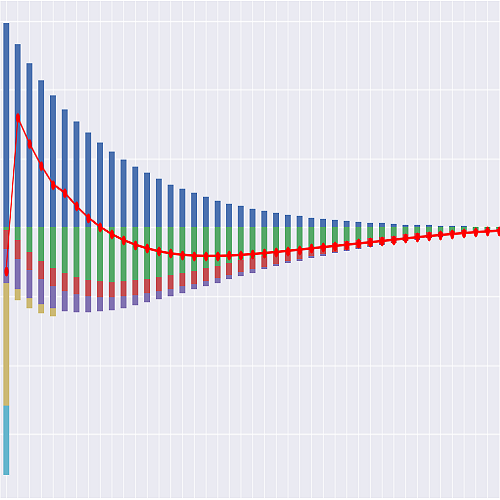
and result_cf() publishes the flows in the columns premiums, claims_death,
claims_lapse, withdrawals, expenses and premium_taxes. A partial
withdrawal is a payment on the owner’s election, not a claim, so it is
withdrawals(t) and not a kind of claims(t, kind).
Reversing the deduction/interest order overstates the account value by about one
month’s interest on the deduction every month, which compounds over the eighty-plus
years this projection runs; the notes list it first among the modelling pitfalls, and
check_av_roll_fwd() pins the order.
What is sourced and what is not. The contractual mechanics come from a specimen policy [S3] and the composite product spec: the guaranteed maximum monthly COI scale at the anchor cell, the $7.50 per-policy and $0.26/$0.156 per-unit charges, the Guideline Premium Test corridor factor table, the specimen’s net-amount-at-risk convention (death benefit discounted one month at the guaranteed rate, account value measured before the deduction), the nine-year monthly surrender-charge amortization, the 0.75% loan spread, and the cessation of charges at attained age 121. Everything else is a standardization introduced for the reference implementation: the 2.00% guaranteed and 4.00% current credited rates, the 6% current premium load, the 60% current-to-guaranteed COI factor, the $9.00 per $1,000 initial surrender charge, the best-estimate mortality table, the rate-class factors, the base lapse vector, the surrender-charge-expiry lapse shock, the dynamic-lapse formula, the premium persistency scale, the $75 per policy per year maintenance expense inflating at 2.5%, and the 2.5% percent-of-premium expense. Insurers do not publish current credited rates or current COI scales, so the two assumptions that matter most for this product are both [std]. This model is a mechanics demonstration, not a pricing or reserving result. Replace the assumption tables with company data before drawing any conclusion from the output.
Not implemented. Modules the technical notes describe but do not specify completely enough to project, all named here and in the README so their absence is not mistaken for an oversight:
The grace and lapse-for-insufficiency cascade. The trigger and the required cure payment are complete formulas and are implemented as the diagnostics
is_shortfall()andcure_premium_pp(), but the notes leave the in-grace account value treatment (deductions accrue “due and unpaid”) and the cash flow of a cure payment undetermined, so no policy is terminated for insufficiency and no in-grace state is carried – the notes’grace_flag(t)has no cells. This absence bites on a shipped model point. Point 2 enters shortfall in policy year 57 and stays there for the last 356 of its 1,032 months: deductions keep being taken from an account value that is already empty, which ends about $1.84m overdrawn. Cash flows past the trigger month of a model point in shortfall are not meaningful. What the model does not do is let that negative balance reach the death benefit:av_pp_db_basis()floors it at zero [std], so an Option B death benefit is never below the face amount and no death claim is ever negative.Reinstatement – a contractual provision only, out of scope in the notes.
NGE revision. The notes’ rule
i_cr(t) = max(i_guar, earned_rate(t) - spread)needs an earned-rate input the notes do not supply; the base run holds the snapshot scale level, which is what the notes prescribe.New policy loans and loan repayments. Loan interest accrual on an opening balance is implemented (the notes give the formula); no loan utilization pattern is given, so
loan_bal_pp(t)only rolls forward the model point’s opening balance.Face increases and decreases, option changes, and the surrender-charge layering that goes with them. Withdrawal-driven face reduction under Option A is implemented.
Riders.
rider_charge_pp(t)is the notes’ placeholder term, zero in the base model.MEC status has no cash flow consequence for the insurer, so
is_mec()flags and does not project. The flag does latch, though: 7702A status is permanent once the 7-pay test fails, so once true it stays true for the rest of the projection.Withdrawal utilization. The mechanics are complete – the fee, the notes’ annual free-amount rule with its
wd_used_yearstate, and the Option A face reduction – but the notes give no utilization pattern, so every shipped model point withdraws nothing.
Model points. model_point_table.csv carries three points, all on the anchor
configuration M35 / StdNT / $100,000, because the specimen gives a guaranteed COI
scale for that cell alone. Point 1 is the technical notes’ worked-example anchor:
Option A, $1,800 planned annual premium, no opening account value and no loan. Point 2
switches the death benefit to Option B, which makes the corridor and the increasing
net amount at risk live – and, from policy year 57, the shortfall trigger too, so it
doubles as the model point that exhibits the missing grace cascade above. Point 3 is
an in-force cell at 120 completed policy months
with an opening account value of $15,000 and a $2,000 loan, which exercises the
duration offset, the expired surrender charge and the loan roll-forward. A model point
on any other issue age, sex or class requires coi_rates.csv to be extended first; a
test asserts every model point in the table actually projects.
Verification. Model point 1 is the anchor cell of the worked example in the
technical notes, and tests/test_universal_life_us.py asserts every cell of all
three of its rows – account value, net premium, death benefit, net amount at risk,
cost of insurance, monthly deduction, post-deduction balance and credited interest –
to the cent, together with the notes’ issue-month (t = 0) trace at full precision.
Example
>>> import modelx as mx
>>> model = mx.read_model("products/universal_life/UL_US_S")
>>> model.Projection[1].result_cf()