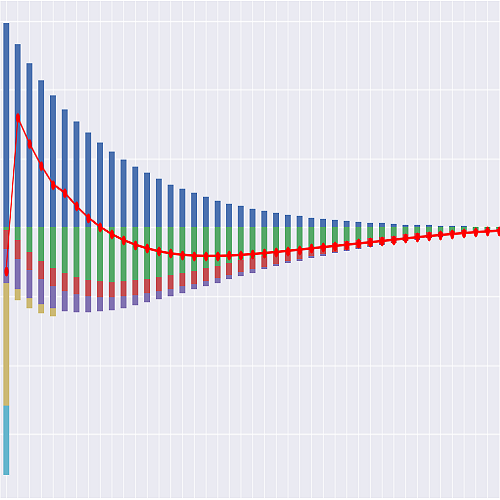
Implementation Notes#
Status: Draft, 2026-08-29; citations re-verified against the primary documents 2026-08-30.
Built from products/fondsgebundene_rentenversicherung/technical-notes.md;
the product it implements is specified in product-spec.md.
This is a mechanics demonstration, not a pricing, reserving or disclosure result. The mechanics are common ground in German practice and several are cited: the Beitragsverrechnung order and the purchase of Anteileinheiten at the Anteilspreis [S1], the Höchstzillmersatz of 25 ‰ of the Beitragssumme R12 R13 REG-R16 and the even spreading of the acquisition charge over the first five contract years R1 REG-R28, the Beitragsrückgewähr death benefit [S2], the Zeitwert Rückkaufswert and the conditions on a Stornoabzug R1 REG-R36, the survival of the fund-based charges into a beitragsfrei contract R3, the
max(guaranteed, current)Rentenfaktor rule [S4] R22, and the unisex tariff REG-R34. delib was drafted with HTTP egress blocked and nothing retrieved; the citations have since been re-verified against the primary documents, and eighteen of the forty-four entries insources.mdnow record a document that was opened and read, twenty-four record none. That verifies mechanics of the kind cited above and none of the levels below. The levels are almost entirely std: no lapse rate and no expense or commission scale was established anywhere, and outside the single carrier whose rates could be read [S2] [S15] no charge rate and no Rentenfaktor was established at any carrier — that one tariff is a comparator the Standardizations table below measures the shipped levels against, not their source. The DAV tables behind both mortality bases — DAV 2008 T for the Risikobeitrag R17 REG-R48, DAV 2004 R behind the Rentenfaktor R16 REG-R49 — are Deutsche Aktuarvereinigung property and are cited by name, never shipped. Replace the charge scale, the decrement tables and the fund path with a real tariff and company data before drawing any conclusion from a number. Nothing here is an Effektivkostenquote and nothing here may be compared with a PRIIPs performance scenario R8 R9 REG-R32.
Run it#
python products/fondsgebundene_rentenversicherung/run.py
python products/fondsgebundene_rentenversicherung/run.py 7    # the beitragsfrei cell
Three lines to the same thing:
import modelx as mx
model = mx.read_model("products/fondsgebundene_rentenversicherung/FRV_DE_S")
model.Projection[1].result_cf()
Projection takes a point_id and Projection[1] is the worked-example anchor cell.
result_cf() returns a tidy DataFrame indexed by policy month t with one column per cash
flow line, and result_fund() the per-policy unit side — the Anteilspreis, the unit count,
the four within-month Fondsguthaben balances, the Beitragsrückgewähr base, the net amount
at risk and the three decrement rates, which is roughly what a German Standmitteilung
reports [S17]. model.doc describes the product and the basis, model.Projection.doc maps
the notes’ symbols onto the cells names, and model.Data.doc says what each input file is and
what a replacement must preserve.
The time index and the frame#
t is the 0-based policy month counted from the contract’s own inception: t = 0 is
the inception month, period t runs from time t to time t + 1, and t = 60 means the
same thing on every model point — the first month after the acquisition-charge instalment
ends. proj_len() = 12 × (annuity_age − entry_age) is the number of policy months and
so the frame’s exclusive end, so result_cf() covers range(proj_start(), proj_len())
— the last row is t = proj_len() − 1, which is 359 on the anchor cell, and
len(result_cf()) is proj_len() − proj_start(). That is lifelib’s own convention
(basiclife/BasicTerm_S, savings/CashValue_SE: for t in range(proj_len())), and it is
what the conventions suite asserts for every model point.
proj_start() = duration_init_m — 0 for new business and 96 for the in-force cell.
duration_init_m is an elapsed count and is therefore already 0-based, so it is the first
projected index itself and needs no + 1; an in-force model point simply opens partway
through a frame whose origin is still inception. pols_if(proj_start()) == pols_if_init()
exactly, and pols_if(proj_len()) = 0, one past the last row.
The contractual policy year is the 1-based label policy_year(t) = t // 12 + 1, derived
from t and never indexed by, and age(t) = entry_age + policy_year(t) − 1 = entry_age + t // 12. Because a 0-based frame has no t = −1, the opening Anteilspreis is its own cells,
unit_price_open(t) — unit_price_init at t = proj_start() and unit_price(t − 1) after it
— which is what av_pp and units_bought_pp read; the ledgers cum_prem_pp and
cum_charge_acq_pp likewise seed inside the frame’s first month rather than one before it.
What the CSVs did and did not do#
File |
Column |
Decision |
|---|---|---|
|
|
Unchanged. An elapsed count, 0-based by nature; 96 stays 96 and is now |
|
|
Shifted −1: a point on the frame’s time axis. Model point 7 goes beitragsfrei at |
|
|
Shifted −1: model point 9 tops up at |
|
|
Shifted −1: model point 9 withdraws at |
|
|
Unchanged. Ages, a term in years and a frequency in months — none is a point on the frame |
|
|
Unchanged. The contractual 1-based label; |
|
|
Unchanged, for the same reason |
|
|
Unchanged. A count of months, not an index |
|
|
Unchanged. An attained age |
|
|
Unchanged. An age at Rentenbeginn |
No provenance column was touched, and no row order changed.
The insurer guarantees the number of units, not their value#
Everything else follows from that sentence, and it is what makes this a unit-linked model rather than a translation of the general-account ones beside it. There is no Rechnungszins in the accumulation phase, no Deckungskapital, no Zinsüberschuss — and, because § 125 VAG makes the covering assets a segregated Anlagestock held in the very units the liability is denominated in R15 REG-R7, no investment-mismatch term anywhere in the model. The state variable is therefore the unit count, and euro are derived from it:
units_pp(t + 1) = units_pp(t) + units_bought_pp(t) − units_cancelled_pp(t)
av_pp(t)        = units_pp(t) × unit_price_open(t)
check_units_roll_fwd() asserts the first line and check_av_roll_fwd() the account identity
that carries the price. They look redundant and are not, which is why both ship: the unit
identity has no price term in it at all, so it fails when a charge is taken in euro without
the matching units being cancelled while every euro total still looks plausible; the account
identity fails when the return is applied at the wrong point in the order. An implementation
can pass either one alone. The fund’s TER is a third category and is deliberately given no charge_* cells: borne
inside the Anteilspreis, it never appears in a policy ledger, so
fund_return_net_ann(t) = gross − ter nets it off the assumed return instead. Charging it
explicitly double-counts; ignoring it overstates the policyholder’s return.
net_cf is the non-unit stream#
Every benefit paid before Rentenbeginn — the death benefit up to the fund, the
Rückkaufswert, the Teilentnahme, the capital released at Rentenbeginn — is funded by
cancelling the policyholder’s own units, so a gross presentation counts the same money
twice. delib’s first ruling requires every model to publish check_net_cf(); the identity
here is one line:
net_cf = charge_acq + charge_admin_prem + charge_admin_fund + charge_policy_fee
         + charge_risk + stornoabzug − expenses − commissions − death_strain
Charges in, the insurer’s own expenses, its commission and the death strain out, and nothing
else. expenses excludes commission and commissions is its own cells and its own
result_cf() column — the delib convention, stated the same way on KLV_DE_S, Basis_DE_S,
Riester_DE_S and RLV_DE_S, and the opposite of the frlib chassis, where commission sits
inside the expense total. Taking both conventions at once double-counts the commission.
check_net_cf_resid(t) does not restate that formula: it rebuilds the first two terms by a
different route, as premiums − prem_to_av, which is what the Beitragsverrechnung leaves
behind — so the check crosses the unit / non-unit boundary rather than asserting the code
against itself. The gross flows are published beside it rather than dropped. premiums, prem_to_av,
claims_death, claims_lapse, claims_maturity, withdrawals and av_releases are
result_cf() columns, all excluded from net_cf, and check_benefit_funding() asserts
that they net exactly:
claims_death + claims_lapse + claims_maturity + withdrawals + stornoabzug
    = av_releases + death_strain
Booking the whole Fondsguthaben as an insurer outgo is this product’s first-order failure
mode — every column still looks reasonable and the liability is overstated by the entire fund
— and publishing the excluded columns is what lets a reader see what was excluded. The scale
of it on the anchor: 64 869,36 € of benefits against 40 586,28 € of premiums, of which
4,39 € is an insurer cost. Seven check_*() cells travel with the model, each a bool
over all t with a check_*_resid(t) companion — check_net_cf, check_prem_split,
check_units_roll_fwd, check_av_roll_fwd, check_benefit_funding, check_pols_roll_fwd,
check_acq_charge — and all seven are True on all thirteen model points.
The acquisition charge, its window, and the in-force cell#
charge_acq_total() = alpha_rate × beitragssumme() — 2,50 % of the sum of premiums
payable, the Höchstzillmersatz itself R12 REG-R16 — spread in equal instalments over
acq_window_months() = min(alpha_spread_months, 12 × prem_term_y) months at the policy’s own
premium frequency R1 REG-R28. The composite takes the cap rather than a guessed interior
point, so the reference implementation demonstrates the binding constraint. On the anchor
cell that is 1 800,00 € over 60 instalments of 30,00 € — 15 % of each of the first sixty
premiums, t = 0 … 59, and nothing from t = 60, where the Anlagebeitrag steps from
162,00 € to 192,00 €. That cliff is the characteristic shape of a German unit-linked
contract’s early values and it is why this model runs monthly: an annual grid cannot place
the sixtieth month.
The instalment count is the window divided by the frequency — 60 monthly, 20 quarterly, 10
half-yearly, 5 annual, and 24 on model point 12, whose premium term is two years; a
shortened term still spread over sixty months would understate every instalment.
check_acq_charge() closes the ledger against an expectation counted rather than
accumulated — instalment dates elapsed times the instalment, plus the Zuzahlungskosten on
any Zuzahlung received — so a window running one month too long fails there.
beitragssumme() is the sum of premiums payable at the initial level and is invariant:
it does not shrink on lapse or Beitragsfreistellung and does not grow with a
Beitragsdynamik increment or a Zuzahlung. A real tariff re-zillmers each accepted
increment over its own sixty months, and an increment cannot be assumed at inception; the
bias that leaves is stated rather than hidden. Letting S follow the premiums actually paid
would make the acquisition charge a function of the lapse assumption — wrong, and circular.
An in-force model point opens after the window has closed: model point 6 starts at
t = 96, so charge_acq(t) is zero at every projected month and commissions(96)
carries no Abschlussprovision, comm_acq_pp and expense_acq_pp both falling at t = 0
and only there. That is the whole of the difference between an in-force cell and a
new-business one on this chassis.
The Beitragsrückgewähr, and two mortality bases at once#
The composite death benefit is max(Fondsguthaben, Summe der gezahlten Beiträge) [S2], so
the net amount at risk is max(cum_prem_pp(t) − F, 0) — positive early, vanishing once the
fund overtakes the premiums paid (t = 94 on the anchor cell), returning after a market
fall. That makes cum_prem_pp a genuine state variable rather than a reporting
convenience, and the risk charge a quantity recomputed every month. It is the premiums
paid, gross: cum_prem_pp(59) = 12 000,00 € against 9 720,00 € actually invested, so
reading the floor off the invested amount would understate the death benefit by 19 %.
The floor at zero in nar_pp() is load-bearing. Without it the contract would pay the
insurer a negative charge in every month the fund is above the floor and death_strain would
turn negative, silently booking the fund’s growth as insurance profit. And
db_pp(t) = av_pp_at(t, "BEF_DECR") + nar_pp(t) rather than max(floor, fund): writing it as
a sum keeps the two sides apart, the first term being the policyholder’s money and the second
the insurer’s.
The Risikobeitrag is priced on a death table and the conversion guarantee on an annuity
table. mort_rate_tariff_at_age reads mort_table.csv, a std first-order DAV 2008 T
proxy R17 REG-R48; rentenfaktor_guar reads rentenfaktor_table.csv, standing in for
DAV 2004 R R16 REG-R49. No cells reads both files — the arithmetic form of the
statement that a German fondsgebundene contract carries two mortality bases at once; a model
pricing the death charge on an annuitant table understates it. The projection then decrements
on a third rate, the second-order best estimate mort_be_factor = 0.75 times the tariff
rate REG-R47. The wedge is the Risikoergebnis, and because the factor is flat it is
exactly 25 % of the Risikobeitrag collected — 5,849973 less 4,387480 = 1,462493 € on the
anchor — a closed form a reader can check with a calculator. One basis for both makes the
risk result identically zero.
The two monthly conversions are deliberately different. Mortality is split linearly,
mort_rate_mth = mort_rate / 12, because the tariff’s Risikobeitrag is q(x)/12 times the
riskiertes Kapital and charge and decrement must share the split, or the model manufactures a
risk result out of a rounding convention. Lapse is split geometrically,
1 − (1 − lapse_rate)^(1/12), because nothing is priced off it and the annual rate is the
observable to reproduce; the fund return compounds geometrically for the same reason, while
gamma_rate_mth() is gamma_rate_ann() / 12 because a German tariff quotes charge rates
nominally.
The Rückkaufswert is the Fondsguthaben#
§ 169 VVG sends a fondsgebundene contract to the Zeitwert, and on a pure unit-linked
contract with no insurer-given guarantee the Zeitwert is the fund R1 REG-R28. There
is no discounting, no Rechnungszins, no mortality basis, no Zillmerung residue and no
second-basis Mindestrückkaufswert anywhere in this model — the cleanest surrender rule of
the ten delib products. The protection sits earlier, in the sixty-month spreading, which is
why the surrender value is positive from the first month. A Stornoabzug is permissible only if vereinbart, beziffert and angemessen, and
never for unamortised acquisition costs R1 REG-R36. stornoabzug_pp(t) is therefore
a flat rate on the Fondsguthaben and deliberately not a function of
charge_acq_total() − cum_charge_acq_pp(t): that prohibition is what stops an insurer
recovering through the deduction what the five-year spreading denies it. Only std_high
carries a rate and only model point 5 uses it.
Beitragsfreistellung is a model point election, pup_month, not a cohort decrement —
the one place the model reproduces a mechanic exactly on one cell rather than approximately on
all of them. A paid-up policy’s fund and its Beitragsrückgewähr base both depend on the
month it went paid-up, so a cohort rate would need one sub-cohort per month: a
two-dimensional recursion over 360 months for a second-order effect. The std 1 % p.a.
rate is recorded and not implemented, and the omission biases charge income upward.
Storno and Beitragsfreistellung stay two different things: one an exit paying the
Rückkaufswert, the other a change of state paying nothing R2 R3.
The last month, the age at Rentenbeginn, and the reduction in yield#
lapse_rate_mth(proj_len() − 1) = 0 std. The end of the last projected month is
Rentenbeginn, so a
surrender and an annuitisation are the same event releasing the same Fondsguthaben, and the
whole surviving cohort is booked as pols_maturity. No cash flow moves either way; the
convention decides only the split between the lapse total and the maturity count, and it is
what the closure identity reproduces — deaths 0,04377181 plus lapses 0,65322937 plus maturity
0,30299882 = 1,00000000. It is frlib’s convention on TD_FR_S and delib adopts it.
age(proj_len() − 1) = annuity_age − 1, because the annuity begins at the end of that month,
and the Rentenfaktor is read at annuity_age: 25,00 at 67 on the anchor, not the 24,45 an
off-by-one fetches at 66, a 2,2 % understatement of the pension. The rule applied is
max(rentenfaktor_guar(), rentenfaktor_curr()) [S4] R22 — a guarantee with upside, so a
model applying only the guaranteed factor understates the benefit whenever the current tariff
is richer. On std_2026 the two are equal, so the max() is exercised without an unsourced
uplift; model point 13 carries rich_current, 12 % higher, where it visibly bites. Only the
conversion terms are guaranteed; the capital they multiply is the market’s, so a
guaranteed Rentenfaktor is not a guaranteed pension.
reduction_in_yield() is the product’s defining metric, because on a contract with no
Rechnungszins the charge stack is the economics. It is gross_return_ref() − irr_ann(),
computed on a single persisting contract — no survivorship, no lapse — because a reduction
in yield is a statement about one policy. On the anchor 5,0000 % less 3,6593 % =
1,3407 % p.a., and across the four shipped charge scales it moves by a factor of five.
It is a delib-defined measure and not the statutory Effektivkostenquote, which is aligned
to the total-cost-indicator method of the PRIIPs RTS over a specified recommended holding
period R7 R9 REG-R31 REG-R32; this model implements neither.
Inputs are external files#
The six input CSVs live in this directory, beside run.py — not inside the model folder.
FRV_DE_S/ holds nothing but formulas:
products/fondsgebundene_rentenversicherung/
  model_point_table.csv  mort_table.csv  lapse_table.csv     <- inputs live here
  charge_table.csv  fund_scenario_table.csv  rentenfaktor_table.csv
  run.py
  product-spec.md  technical-notes.md  model.md  sources.md  <- the documents
  FRV_DE_S/                                                  <- formulas only
    __init__.py  _system.json                                   (model docstring)
    Data/__init__.py                (reads the CSVs, once per model)
    Projection/__init__.py          (the by-policy projection)
This follows lifelib’s annuallife/TradLife_A, which keeps its inputs beside the model and
reads them at run time. It is the opposite of basiclife/BasicTerm_S, which stores its
inputs inside the model through modelx’s IOSpec machinery — hence no _data/ directory and
no embedded values here at all.
Read once, in Data#
Projection is parameterized by point_id, so every Projection[N] is a separate ItemSpace
with its own cells cache; readers placed there would re-read every file for every policy. They
live instead in an unparameterized Data Space, which Projection references as data —
so each file is read once per model however many policies are projected. The conventions suite
counts the reads over a full sweep and asserts the file set, not merely the count.
Data.input_dir() resolves the location from _model.path.parent at read time, so it works
wherever the repository is checked out.
Reference |
Cells |
File |
|---|---|---|
|
|
|
|
|
|
|
|
|
|
|
|
|
|
|
|
|
|
The trade-off: the model is not portable on its own — copy FRV_DE_S/ without the CSVs and
it reads fine, then fails on first evaluation — but a diff of the model shows logic changes
only, and an input can be swapped in place. Every file but
model_point_table.csv carries a provenance column, one tag per row, asserted by the
conventions suite: delib’s second ruling, the citation discipline reaching the data files
rather than stopping at the prose. The model point table is the one exemption, a model point
being a configuration and not an assumption.
File |
Contents |
Provenance |
|---|---|---|
|
Thirteen model points. Point 1 is the anchor cell (M37 / monthly 200,00 € / 30 years / Rentenbeginn at 67 / Beitragsrückgewähr / |
anchor cell std, the notes’ worked example |
|
First-order annual death rates, ages 18–100 |
std Gompertz proxy |
|
Annual lapse: 6 % in years 1–5, 3 % in 6–10, 2 % in 11–12, 3 % from 13 |
std — no German unit-linked Stornoquote was established anywhere. The front-loading is inferred from the exit terms R1 R2 REG-R45; the ×2.5 tax step lives in |
|
Four tariffs: |
std but for |
|
Gross return and TER by |
std deterministic paths. Not forecasts and not PRIIPs scenarios R8 R9 REG-R32 — and note that on the profession’s own standard a German Schicht-3 unit-linked annuity is a PRIIP Kategorie 4 product whose scenarios come from a stochastic capital-market model, not from an underlying’s own return history R18 |
|
Guaranteed and current factors by |
std and derived, not observed: |
Modules that are off in the base run#
Module |
Switch |
Off value |
What it does |
|---|---|---|---|
Dynamic lapse |
|
|
|
Ablaufmanagement |
|
|
A linear ramp of the gross return from the scenario’s rate to |
Überschussbeteiligung |
— |
not implemented |
A unit-linked contract’s surplus arises from the risk and cost results only R5 R14 REG-R9 REG-R18; the model computes the risk result and credits none of it back. The omission biases the projected Fondsguthaben downward, the honest direction for a charge demonstration |
Hybrid and guarantee designs — statisches and dynamisches Hybrid, Zwei- and
Drei-Topf-Hybride, i-CPPI, Wertsicherungsfonds — are described in the product
specification and deliberately not implemented: each is a rule for reallocating between a
guaranteed pot and a risky pot along a path, and a deterministic projection has one smooth
path, so the rule either never triggers or triggers on a hand-chosen shock. What would have to
be added is named instead — a multi-scenario asset model, a monthly reallocation rule, a
guaranteed pot accreting at a Rechnungszins, a Wertsicherungsfonds return model — and that
is a different model. kapitalwahl is a fourth switch and changes no cash flow by design:
both routes release the same Fondsguthaben, the annuity being published rather than
projected. It is carried because the two tax regimes genuinely differ R19 R20 REG-R41
REG-R45 and because take-up is the largest behavioural unknown here; no take-up rate was
established, so the base run annuitises.
Sign convention#
net_cf is income positive — charges in, expenses, commission and the death strain
out — the notes’ own orientation and the library-wide sign. liability_cf publishes the
same stream outgo-positive, liability_cf(t) = −net_cf(t) exactly, and both are
result_cf() columns so the identity is verifiable in the frame rather than only in prose.
A Solvency II best estimate of the non-unit liability is Σ v(t) × liability_cf(t) over the
relevant risk-free term structure, with the unit liability — the Fondsguthaben itself,
backed one-for-one by the Anlagestock — added at market value R15 REG-R6 REG-R7.
Nothing here discounts.
expenses excludes commission: it is the issue expense at t = 0, the inflating monthly
maintenance expense, and the per-event expenses of a death, a surrender and an annuitisation.
The Abschluss- and Bestandsprovision are commissions, their own column, and net_cf
subtracts each once — the delib convention, and the opposite of the frlib chassis, where
commission sits inside the expense total; taking both at once charges the commission twice.
The worked example fixes the reading:
expenses(0) = 200,00 + 4,00 + 0,0075 + 0,2571 = 204,26 € and
commissions(0) = 1 800,00 + 3,00 = 1 803,00 €, together the 2 007,26 € of acquisition and
first-month cash. Expect on a new-business cell a large negative net_cf in the inception
month t = 0 — −1 966,22 € on the anchor, commission and issue expense falling there while
the charge that funds them arrives over sixty months —
then a thin positive margin growing with the fund. On the Einmalbeitrag cell the sign
reverses: t = 0 is +1 060,45 €, the 3 250,00 € withheld at inception more than covering
the acquisition cost with no recovery to wait for.
Naming#
Cells follow lifelib’s basiclife/BasicTerm_S where it has an analogue and
savings/CashValue_SE for the account-value vocabulary: pols_* for policy counts, av_* for
the account value, *_pp for per-policy amounts, *_rate for rates, claims(t, kind) with an
uppercase kind string, and av_pp_at(t, timing) / pols_if_at(t, timing) for the
within-month reads. The technical notes use compact actuarial symbols; the full mapping is in
the Projection Space docstring. The chassis is shared with
frlib/products/assurance_vie_uc/UC_FR_S, the French unités de compte contract, and the
On UC_FR_S column says where a shared name means the same thing there and where it does
not:
Notes |
Cells |
On |
Why |
|---|---|---|---|
|
|
names shared, readings differ: there |
The fund at the start of the month, at four named points inside it, and weighted by |
|
|
|
The state variable and its two movements; delib puts every cancellation in one cells because the identity checking them has no price term |
|
|
|
The riskiertes Kapital / the French garantie plancher amount at risk, floored at zero in both, and the only part of a death benefit the insurer funds |
|
|
same |
The unit-side total the benefit-funding identity reconciles against; an owner election, never |
Three German terms of art keep their German form in the cells names, each naming a quantity
with a statutory definition and no English equivalent that would not mislead:
beitragssumme(), the base of the Höchstzillmersatz and not “total premiums”;
stornoabzug(t), a deduction whose validity conditions are statutory and not a “surrender
charge” — the euro amount retained, with the fraction it is struck at as stornoabzug_rate(),
which is the spelling RV_DE_S and Riester_DE_S use for that rate too; and the three
rentenfaktor_*(), euro per 10 000 € and not an annuity factor. Five further cases needed
care:
Notes |
Cells |
Why |
|---|---|---|
|
|
Two rates: the first-order table prices the Risikobeitrag, the second-order one produces the claims, and their difference is the Risikoergebnis. |
|
|
The library requires an annual |
|
|
The instalment, the ledger and the total the ledger must reach — |
|
|
The guaranteed floor and what a death actually pays; keeping them apart makes |
(expense / commission) |
|
Two lines, not one. |
sex and kapitalwahl drive no formula — the tariff is unisex from 21 December 2012
REG-R34 and the capital option is a reporting split — but both are exposed as documented
cells rather than dropped, because the notes’ model point attribute table lists them.
Standardizations used#
Every entry is std, and the rationale is what makes it honest.
Standardization |
Value |
Rationale |
|---|---|---|
Acquisition rate, composite, and the Zuzahlungskosten |
2.50 % of the Beitragssumme; 2.50 % of a Zuzahlung |
The rate is the Höchstzillmersatz — “Der Zillmersatz darf 25 Promille der Summe aller Prämien nicht überschreiten”, § 4 Abs. 1 Satz 2 DeckRV R12 REG-R16 — and taking the cap demonstrates the binding constraint instead of inventing a level. It turns out to be the level one real tariff charges: 2,50 % der kumulierten Anlage [S15]. The Zuzahlungskosten is set equal to it, and on a single premium it is the whole acquisition charge, which is what a real wording does — “Bei Verträgen gegen Einmalbeitrag und bei Zuzahlungen entnehmen wir alle Abschluss- und Vertriebskosten sofort” [S2] |
Premium-based admin |
4.00 % |
Middle of an argued 2 %–10 % range. 6,90 % of each premium observed at one carrier [S15]; no other carrier level was established |
Fund-based admin |
0.30 % p.a., taken as |
Middle of an argued 0.10 %–1.20 % range. 0,42 % p.a. of the fund observed at one carrier [S15]. Divided, not compounded, because a German tariff quotes a nominal monthly charge |
Stückkosten |
3.00 € per month |
Middle of an argued 0–5 € range; 18 € per year — 1,50 €/month — observed at one carrier [S15], so the composite is the dearer of the two. A euro amount, which is why it consumes a small paid-up fund — and why BaFin warns that a large absolute Stückkosten charge makes the Effektivkosten vary sharply with premium size R10 |
Stornoabzug, composite |
0.00 % |
§ 169 Abs. 5 VVG permits one only where it is vereinbart, beziffert and angemessen and voids any deduction for unamortised acquisition cost R1 REG-R36; zero avoids an unsourced number on a contested clause. A real one exists and is a flat 150 €, not a percentage [S2], so both the level and the shape are standardizations. 2.00 % on |
The three charge variants |
|
The ends of the argued range plus the commission-free tariff [S18]; the gap to |
Mortality proxy |
|
DAV tables are not redistributed R17 REG-R48. Anchored at |
|
0.75, flat |
Crude, and said to be. It buys a Risikoergebnis that is exactly 25 % of the Risikobeitrag REG-R47 |
Monthly conversions |
mortality |
Charge and decrement must share a split; the lapse and return annual rates are the observables to reproduce |
Lapse table, the 40 % cap and the zero final month |
6 / 3 / 2 / 3 % by duration band; |
No German unit-linked Stornoquote exists in this corpus; the front-loading is inferred from the exit terms R1 R2. The cap stops a dynamic module producing an absurd rate; the zero final month is because a surrender and an annuitisation are then one event |
Tax-threshold lapse step |
×2.5 for twelve months from |
The 12/62 rule is statutory — EStG § 20 Abs. 1 Nr. 6 Satz 2, which names the 60th year of life, raised to the 62nd by § 52 Abs. 28 “für Vertragsabschlüsse nach dem 31. Dezember 2011”, and applying on surrender as well as at maturity R20 REG-R45. It is the strongest single driver of German surrender behaviour; keying it on duration alone fires fourteen years early on the anchor. The ×2.5 magnitude is std |
Fund paths and TER |
5.00 % gross, 0.45 % TER on |
Round, clearly-labelled assumptions. Not forecasts, not PRIIPs scenarios R8 R9 REG-R32 |
Kickback credited back, and the Ausgabeaufschlag |
0.00 % p.a.; fully waived |
A passive fund pays no trail. The two questions this once sidestepped are answered: insurers do receive rebates out of the fund’s Verwaltungsvergütung and must test them for Fehlanreize and consider passing them back R10 R15, and the market pays a weighted mean just over 0,30 % p.a. of the fund, up to over 1,20 %, on about a third of new business R11 — so 0 % models the cheap end of a real flow. Only the PRIIPs treatment of a credited rebate is still open R7 R8. The Ausgabeaufschlag waiver is confirmed: “Ausgabeaufschläge und Depotkosten fallen nicht an”, and units are bought at the Rücknahmepreis [S2] |
Guaranteed Rentenfaktor |
25,00 € per 10 000 € at 67, from |
Derived arithmetic, not a market observation — and now measurable against one. The 0 % Rechnungszins on DAV 2004 R is confirmed for a fondsgebundene tariff [S2] [S10] R16. The level is not: at this model’s own anchor cell the observed guaranteed factor is 22,91 € against the shipped 25,00 €, and the observed factor falls with the deferment — 25,22 / 24,12 / 22,91 / 21,83 € at 12 / 20 / 30 / 40 years to age 67 — where the shipped table is flat in it [S15]. Not changed in this pass: the table, the worked example and the golden tests move together |
Current Rentenfaktor |
equal to guaranteed ( |
Exercises the |
Expenses and commission ( |
acquisition commission 2.50 % of |
No German commission scale was established. The acquisition commission equals the acquisition charge, so the model shows the financing problem the Höchstzillmersatz and the five-year spread exist to regulate. |
Timing, processing order and the negative-fund safeguards |
premium in advance, return, fund charges, Teilentnahme, Risikobeitrag, deaths before lapses; |
The Bewertungsstichtag lag disappears on a monthly grid; observing the amount at risk before the charge that prices it makes |
Beitragsfreistellung as an election |
|
A cohort rate needs one sub-cohort per paid-up month for a second-order effect; the std 1 % p.a. is recorded, not implemented, and the omission biases charge income upward |
Modules off in the base run |
|
Base-run values, so the worked example reproduces with the machinery still there |
The thirteen model points |
see the input table above |
Configurations, not assumptions — which is why they are the one provenance-exempt file |
The quantities that are not standardizations are the acquisition-charge cap, § 4 Abs. 1
Satz 2 DeckRV R12 REG-R16, and the five-year spreading, § 169 Abs. 3 VVG — which reaches this
contract through Abs. 4’s “im Übrigen gilt Absatz 3” and through tariff practice rather than
directly R1 R13 REG-R28; the Beitragsverrechnung order, read verbatim at [S2] § 14
Abs. 1 as well as [S1]; the Beitragsrückgewähr shape [S2] § 2 Abs. 7; the
max(guaranteed, current) factor rule [S2] § 2 Abs. 2, [S4] R22; the Zeitwert
Rückkaufswert, § 169 Abs. 4, and the conditions on a Stornoabzug, Abs. 5 R1 REG-R36; the
survival of the fund-based charges into a beitragsfrei contract R3 [S2] § 14 Abs. 2; the
unisex tariff REG-R34, now visible in a real Rechnungsgrundlage [S2]; and the rule that the
insurer guarantees units and not their value, which VAG § 124 Abs. 2 Satz 2 Nr. 1 and § 125
Abs. 5 make structural [S1] R15 REG-R7.
Three shapes this model implements differently from the one tariff that could be read, none
of them changed in this pass and all of them recorded so a calibration pass knows where to look:
the acquisition charge falls to zero at t = 60, where a real tariff continues a slice of it for
the whole premium term as a percentage [S2] § 18 Abs. 2; the Stornoabzug is a percentage of the
fund, where a real one is a flat euro amount [S2] § 17 Abs. 4; and a Teilentnahme reduces the
fund but not the Beitragsrückgewähr floor, where a real clause reduces both [S2] § 2 Abs. 7.
Tests#
tests/test_fondsgebundene_rentenversicherung_de.py asserts the notes’ worked example — all
seventeen printed rows of Panel A to the cent and pols_if to six decimals, its
expenses and commissions columns among them, Panel B’s benefit
columns, Panel C’s per-policy unit side, and every column total at full precision — the notes’
three independent rebuilds (t = 0 from the tariff alone, t = 60 at the cliff, the
reduction in yield as a savings account), the four closure identities, the Einmalbeitrag
variant’s printed table, the four-tariff reduction-in-yield comparison, the seven check_*()
identities with their residuals, and one test per listed modeling pitfall — eighteen of
them, named for the pitfall they guard. The library-wide house style — layout, docstrings,
naming, the retired-name register, the check_net_cf ruling, the provenance ruling, the
model point sweep and the round trip — is asserted separately, once, in
tests/test_model_conventions_de.py, which owns the only whole-table sweep in the library.
python -m pytest lifelib/libraries/delib/tests -q