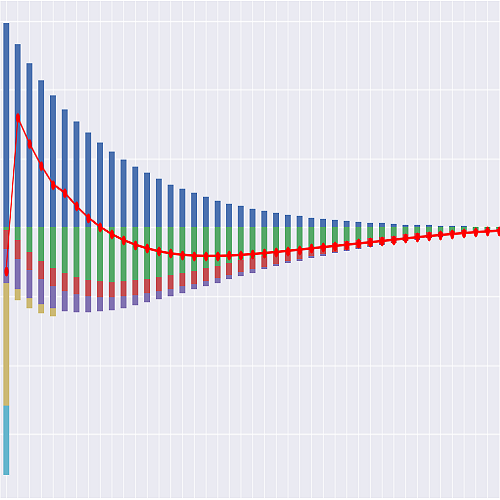
The CI_KR_S Model#
Reference liability cash flow model for Korean critical illness assurance (CI보험).
CI_KR_S is the executable counterpart of
products/ci_insurance/technical-notes.md in the lifelib-products library. It projects
gross liability cash flows for a single-policy model point of the standardized composite
CI보험 (CI boheom, critical illness insurance), also sold as 중대질병보험 — a level
premium 종신보험 carrying an acceleration clause, under which a contractually defined
중대한 질병 pays a stated fraction of the death benefit early and the contract continues
on the balance.
What this model exists to demonstrate is the acceleration. One decrement produces
two payments at two dates on one sum assured: the 선지급 (seonjigeup, advance
payment) of accel_rate times the 기본보험금 at the CI date, and the residual death
benefit 1 - accel_rate times the same base whenever death follows. Between them the
contract is still in force with no premium, a surrender value that has jumped to its
unsuppressed level and a reserve that has to carry the residual, so the projection runs
two cohorts — pre-CI and post-CI — and the post-CI one is indexed by the month it
accelerated in, because the residual it carries was fixed at that date and 「지급사유 발생
당시」 is a date rather than a policy year.
It states its deltas against the whole life chassis (종신보험) and does not restate it. The 계약자적립액 recursion, the 해약환급금 built from it net of a 해약공제액 capped by the 표준해약공제액, the 저해지환급형 suppression and its step at 납입완료, the 보험계약대출 and the 납입면제 are the chassis’s and are implemented here on the chassis’s terms. What is new is the acceleration, the residual with its 105%-of-account floor, the release of the suppression by a CI event as well as by 납입완료, and a morbidity decrement that is several times the mortality one.
Spaces. The model contains two:
DataReads the four input CSVs and holds their filename References. It takes no parameters, so each file is read once per model.
ProjectionThe by-policy projection, parameterized by
point_id:Projection[1]is an ItemSpace projecting model point 1, the technical notes’ worked-example anchor cell. It reaches the input tables through itsdataReference, which resolves to the singleDataSpace.
The split matters for more than tidiness. Because Projection is parameterized, every
Projection[N] is a separate ItemSpace with its own cells cache; readers placed there
would re-read every file for every policy. In Data they are evaluated once, however
many policies are projected.
Input data is external: CSVs in the model folder’s parent directory, read at run time rather than stored inside the model. The model folder itself holds no data, so the model and its inputs must travel together.
Projection basis. Monthly steps, on 보험나이 (boheom nai, insurance age). The
time index t is
0-based and counts months: t = 0 is the first policy month, month t runs from
time t to time t + 1, the attained age is age_at_entry() + t // 12 — 보험나이
increments on the 계약해당일, so the floor division is exact — the contractual policy year
label is t // 12 + 1, and proj_len() is the number of months, twelve times
proj_years(), so the frame is
range(proj_len()) and result_cf() carries proj_len() rows indexed
0 … proj_len() - 1. The contract’s state — the 계약자적립액, the 해약공제액, the
해약환급금, the 기본보험금, the 보험계약대출 limit — is carried on a second, month-end
index running 0 … proj_len() with 0 at issue, which does not move with the frame; month
t opens at month-end t and closes at month-end t + 1, and a 계약해당일 is the
month-end 12 y.
Annual assumptions stay annual. Every rate the sources tabulate — the 적용위험률, the
CI incidence, the 해지율, the 납입면제 incidence — holds the annual figure of the policy
year the month falls in, and its _mth companion applies 1 - (1 - q)^(1/12) so that
twelve months compound back to exactly that figure. Contractual terms quoted in policy
years — the 납입기간, the 해약공제기간, the CI cover period to the 100세 계약해당일, the
first-year 감액 — are unchanged and multiplied out into months where the grid needs them.
The two exceptions are named: the table’s terminal age, where q = 1 admits no twelfth
root and the certain death is spread uniformly over the year; and the 90-day
보장개시일, which is a date and now falls where the contract puts it rather than being
smeared across the whole first year.
Premium, maintenance expense
and renewal commission fall at the start of the month; acquisition expense and initial
commission at issue; the CI acceleration, death claims and claim expense at the end of
the month of the event; surrenders at the end of the month, after the CI transition and
after deaths. A life accelerating in month t joins the post-CI cohort at the
start of month t + 1, so the two payments are at least one step apart — a month
where the annual grid made it a year, which is the single largest number the conversion
moves on this product. That cohort is labelled by the month-end its acceleration was paid
at, t + 1; the first policy year’s reduced 감액 cohorts take the negative labels
-(t + 1), one for each of the twelve months.
What is sourced and what is not. The contractual mechanics are sourced: the acceleration and its exact complement, the once-only rule across the whole trigger set, the 105% 계약자적립금 floor under the residual, the 90-day 중대한 암 보장개시일 and the absence of a waiting period on everything else, the first-year halving for breast cancer, the premium waiver on any CI/LTC 지급사유, the release of the 저해지 suppression by that same event, the CI cover ending at the 100세 계약해당일 while death cover runs 종신, and the statutory 표준해약공제액 that caps the surrender charge. The quantitative basis is not, and in Korea it structurally cannot be: the 산출방법서 is filed and never published, 경험생명표 is released only as summary statistics, and there is exactly one disclosed Korean CI morbidity table in public — a 2011 상품요약서 giving six rates at three ages. This model is a mechanics demonstration, not a pricing or reserving result. Replace the assumption tables with company data before drawing any conclusion from the output.
Mortality and morbidity. mort_table.csv and ci_incidence_table.csv are
[std] constructions anchored on that one disclosed grid, with every row tagged in its
provenance column. The three headline rates — 중대한 암, 중대한 급성심근경색증,
중대한 뇌졸중 — carry the source tag at ages 20, 40 and 60 and are interpolated and
extrapolated everywhere else; the remaining triggers and the 장기요양상태 limb are
standardizations throughout. See Data for what each row rests on.
Model points. Nine, covering both sexes, the 보험나이 15-60 issue-age envelope, the ₩10,000,000-₩200,000,000 sum-assured envelope, both acceleration fractions, all three surrender-value forms, both first-year reduction scopes, both lapse bases, the policy loan and the best-estimate levers. Model point 1 is the anchor cell of the worked example in the technical notes.
Example
>>> import modelx as mx
>>> model = mx.read_model("products/ci_insurance/CI_KR_S")
>>> model.Projection[1].result_cf()