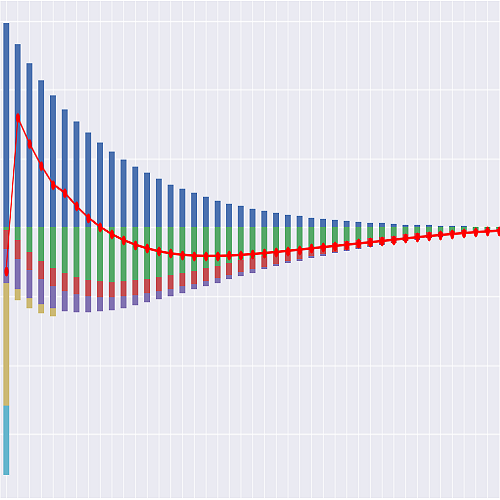
Technical Notes#
Status: Draft, 2026-08-26 (all cited sources accessed 2026-08-26).
Scope note. These notes specify a reference liability cash-flow projection model for
the standardized composite PER individuel assurantiel defined in product-spec.md (same
directory). This is not any single insurer’s contract. [S#] / [R#] tags refer to the
source list in sources.md (numbering carried from _research/per-assurance.md);
[REG-R#] tags refer to the cross-product reference library
references/regulatory-and-actuarial-references.md (its own frozen R-numbering).
std marks standardizations introduced for the reference implementation;
unverified marks claims not confirmed against a retrieved document. Parameter values
are identical to those in product-spec.md. The model is PER_FR_S, on a monthly
grid; the annuity that a liquidating plan buys is projected by Rente_FR_S and is
specified in products/rente_viagere/technical-notes.md, not here.
Model scope and conventions#
Purpose. Project gross best-estimate liability cash flows for single-policy PER model points in the accumulation phase: versements in; death, early-release, transfer-out and maturity benefits out; expenses. The account value and its two supports are state variables and the glide path drives their split. Reserves are not computed here (see Valuation and reserve pointers). In the last projected month,
t = proj_len − 1, the account is settled — a capital payment, a conversion to a rente viagère, or both; the annuity’s own cash flows belong toRente_FR_S, and this model hands over an amount and records it.Time index std.
tis 0-based and counts plan months, as in lifelib’sbasiclife/BasicTerm_Sand the five frlib models that were monthly from the start:t = 0is the first projected month, monthtruns from timetto timet + 1, and the frame ist = 0, 1, …, proj_len − 1withproj_len = 12nthe number of projected months rather than the last index.n = proj_years = retirement_age − age(0)is the declared horizon, still in years, because the contract states it in years. Because every contractual schedule is annual, the plan year is derived and used as a lookup key:dur(t) = duration_ifo + t // 12are the completed ancienneté years at the start of montht, and the contractual, 1-based label the ancienneté schedules are written in is the plan’s own yeary(t) = dur(t) + 1, nevertitself. Where these notes say “the plan year” as contract language, its months are the twelvet = 12j … 12j + 11of the projected plan yearj = y − 1 − duration_ifo. Nothing is indexed by the plan year. An in-force cell opens the frame att = 0like any other; its history is carried induration_ifo, not in a frame offset.Two months of each plan year carry its annual events, and they are not the same month. The plan-year start is
t ≡ 0 (mod 12), where the versement arrives and the balance is rebalanced onto the glide path. The anniversary is the last month of the plan year,t ≡ 11 (mod 12), where the management charge is levied and, att = 12n − 1, where the plan is liquidated. The garantie plancher base moves at those two months and nowhere else.Projection frequency std: monthly, on plan months — with the plan-year start and the plan anniversary still the two event dates. A monthly grid is not a monthly product. Every contractual mechanic of this plan is annual — the versement, the glide-path rebalancing read off a grid keyed by whole years to the horizon, the management charge on the end-of-year balance [S3] [S7], the annual statement R5 R. 224-2, the liquidation at the declared horizon — and the model keeps every one of them there. What the finer grid adds is everything that is not contractually annual: death, déblocage anticipé and transfer out falling in the month they happen and settled on the balance the plan actually holds then, the two supports accruing month by month so that a mid-year exit is not paid a year-end balance, and maintenance expense falling where it is incurred. An annual step remains a well-defined special case of the recursions below and reproduces every anniversary value exactly — see Anniversary equivalence — but it is not what the reference model runs. The sub-annual rebalancing the sample shows [S7] is now expressible and is still not modelled; that is a choice, argued in product-spec footnote 8, not a constraint.
Timing conventions std. Monthiversary (BOM) processing. Versement and glide-path rebalancing at the beginning of the month that opens a plan year; investment return credited over every month on the start-of-month balances; the management charge on the post-crediting balance in the anniversary month only (the [S3] convention); decrements and benefit payments at the end of every month (EOM), in the processing order below. State variables are stored at EOM;
l⁻(t), the in-force probability, is read at the start of monthtso that it weights that month’s cash flows.Decrement conversion std. Every decrement and every credited return in this product is published, calibrated and tabulated annually, and the monthly rates the recursions apply are derived from them at the constant-force conversion, so that twelve months compound back to exactly the annual figure:
q_m(t)    = 1 − (1 − q(t))^(1/12)              mortality
w_e,m(t)  = 1 − (1 − w_e(t))^(1/12)            déblocage anticipé
w_r,m(t)  = 1 − (1 − w_r(t))^(1/12)            transfer out
r_eu,m    = (1 + r_eu)^(1/12) − 1              euro credit,  0,277395 % a month
r_uc,m    = (1 + r_uc)^(1/12) − 1              UC credit,    0,407412 % a month
Unsuffixed
q,w_e,w_r,r_eu,r_ucstay the annual quantities these notes tabulate, which is the library register’s rule. Dividing an annual rate by twelve is a different assumption and a wrong one:12 q_m = 0,0050115on the anchor cell against a statedq = 0,00500, so a twelfth would overstate the plan year’s mortality by 0,23 %. The management charge is the one annual quantity that is not converted: it is a contractual event on a date, it lands whole in the anniversary month, and spreading it would move the garantie plancher base — see Crediting and charges.Currency and basis. EUR; single-policy model points projected on an expected basis,
pols_ifmultiplying per-policy amounts. Account quantities are per policy (av_pp,av_euro_pp, …) and cash-flow outputs are aggregate — never multiply a claims column bypols_iftwice.Age basis. Attained age at the valuation date, integer, incremented once per plan year std — the age steps at the plan anniversary, not on the birthday and not monthly, so
age(t) = age(0) + t // 12. No retrieved French document fixes a model age basis; the regulatory non-annuity tables are applied with the annexed décalage d’âge age shifts REG-R23, which the shipped proxy does not reproduce.Tax is outside the projection. The deductibility election changes the holder’s exit taxation, not the insurer’s gross benefit R13 R19 R20 R21.
deduction_electedis carried and never enters a cash flow.Rounding. Intermediate values at full precision; reported cash flows to the cent std.
Model point attributes#
Attribute |
Type |
Example (worked configuration) |
|---|---|---|
|
int |
1 |
|
enum {M, F} |
M |
|
int, attained age at the valuation date, |
52 |
|
int, the declared horizon R5 D. 224-3 |
64 |
|
int, completed years since the first versement |
2 |
|
enum {c1, c2, c3} R3 L. 224-2 |
c1 |
|
enum {prudent, equilibre, dynamique, offensif} R6 |
equilibre |
|
currency p.a., paid in the first month of each plan year to the horizon |
3 000.00 |
|
currency, euro support carried into |
0.00 |
|
currency, UC bucket carried into |
16 600.00 |
|
currency, garantie plancher base carried into |
16 000.00 |
|
bool, floor in force to the 70th birthday [S1] [S3] |
True |
|
enum {capital_single, capital_staged, annuity, mixed} R3 L. 224-5 |
mixed |
|
float in [0, 1], share of the balance converted to a rente |
0.30 |
|
int, annual instalments under |
1 |
|
bool — recorded, never used in a cash flow |
True |
compartment earns its place because it changes two operative rules, not one: c3
rights may be delivered only as a life annuity R3 L. 224-5 [S2], and they are
excluded from the main-residence early-release case R3 L. 224-4 I 6°. A c3 model
point must therefore force exit_form = annuity and use a reduced early-release rate.
State variables#
Variable |
Description |
Updated |
|---|---|---|
|
Per-policy euro-support balance, |
carried in at BEF_REBAL; rebalanced and credited the versement at BOM in a plan-year start month; credited the month’s return at BEF_CHARGE; charged at EOM in an anniversary month |
|
Per-policy UC balance |
same |
|
|
derived |
|
Garantie plancher base: versements net of loading, less all charges taken, less benefits paid — the [S1] drafting, not the [S3] one, which adds euro-fund interest |
two months of twelve: up at the plan-year start, down at the anniversary, flat in between |
|
Target euro (low-risk) share in month |
steps at the anniversary, from |
|
Gross amount switched between supports at the rebalancing; nil in every other month |
plan-year start month |
|
`arb_rate × |
switch_pp(t) |
|
Management charge on the post-crediting balance; nil in every other month |
anniversary month |
|
|
— |
|
|
— |
|
|
steps at the anniversary |
|
|
steps at the anniversary |
|
|
steps at the anniversary |
|
The monthly rates actually applied, |
every month |
|
In-force probability at the end of month |
EOM decrements |
Assumption inputs#
Three classes are distinguished. Class (a) is contractual or statutory; class (b) is the insurer’s current discretionary scale; class (c) is the modeler’s view of experience.
(a) Contractual / guaranteed elements (cited)#
Input |
Value |
Basis |
|---|---|---|
Guaranteed technical rate on the euro support |
0,00 % — the maximum a PER tariff may use |
R9 A. 142-1 [S1] [S7] |
Euro-support capital floor |
Versements net of loading, less charges levied, less benefits paid; not a floor at gross premiums. [S3] drafts the same floor with euro-fund interest net of charges added — see the garantie plancher recursion below |
[S1] [S7] |
UC guarantee |
None; the number of units is guaranteed, not their value |
[S1] [S2] |
Glide-path minimum (équilibré) |
euro share 0 % / 20 % / 50 % / 70 % by band; band edges std (product-spec footnote 7) |
R6 art. 1 [S2] [S7] |
Right to release early |
Only on the seven L. 224-4 cases, no surrender right otherwise; paid as a single payment of all or part of the eligible rights, no charge |
R3 L. 224-4 R5 D. 224-4 [S2] [S3] [S4] [S7] |
Transfer-out indemnity |
1 % of acquired rights while the plan is under five years old at the exit date, |
R3 L. 224-6 R5 R. 224-6 [S1]–[S8] |
Death closes the plan |
Benefit = account value, floored by the garantie plancher to the 70th birthday, capped €762 245 |
R3 L. 224-4 II [S1] [S3] |
Exit menu |
Capital in one payment or fractionné, annuity, or a mix; c3 annuity only |
|
Annuity basis |
Technical rate 0 %; TGF05 / TGH05 or a certified experience table that may not be cheaper |
|
Small-annuity commutation |
Monthly quittance ≤ €110, scaled by the months in the payment period |
(b) Insurer-discretionary current elements (snapshot; maxima disclosed, levels not capped REG-R30)#
Input |
Symbol |
Value |
Basis |
|---|---|---|---|
Entry loading on each versement |
|
2,50 % |
[S8] [S10]; adoption std, product-spec (10) |
Euro management charge |
|
0,70 % p.a. |
[S8] [S9]; adoption std (11) |
UC management charge |
|
0,70 % p.a. |
[S8] [S9]; adoption std (11) |
Arbitrage charge on the rebalancing |
|
0,30 % of the amount switched |
[S1]; adoption std (9) |
Frais d’arrérages |
|
1,50 % of each gross instalment |
[S8]; adoption std (13) |
Euro-fund gross asset return |
|
3,38 % p.a. |
[S9]; adoption std, product-spec (5) |
UC gross return, net of fund-level charges |
|
5,00 % p.a. |
std, product-spec (5) |
Annuity conversion factor, male 64, annual in arrears, no reversion |
|
22,0000 |
std, product-spec (17) |
PPB stock and release policy |
— |
not modelled |
simplification std (1) |
The euro credit is set at the asset return and the charge taken on the post-crediting balance; no provision pour participation aux bénéfices stock is carried. The only retrieved gross-charge-net triple shows the served rate exceeding asset return less charge by 7 basis points [S9], i.e. a PPB release, and a PER’s PPB horizon is fifteen years rather than eight because the commitments sit in a comptabilité auxiliaire d’affectation REG-R16 R8 L. 142-4. Modelling that stock is a scenario extension: four of the seven sampled contracts have no contractual PB clause at all [S4] [S5] [S6] [S7]. The machinery this replaces — the compte de participation aux résultats, the PPB dotation-and-release lever and its vintage clock — is specified in
products/assurance_vie_euro/technical-notes.md; see The euro leg is cross-referenced, not re-implemented below for what to take from it and what not to.
(c) Behavioral / experience assumptions (modeler’s view)#
The homologated tables are cited, never shipped: TH 00-02 / TF 00-02 for the death benefit during accumulation and TGH05 / TGF05 for the annuity REG-R21 REG-R22 REG-R23.
Input |
Recommended basis |
Basis tags |
|---|---|---|
|
INSEE-derived proxy, sex-distinct; 0,00500 flat in the worked example |
|
|
1,60 % p.a., flat |
std (3) |
|
1,00 % p.a., flat |
std (3) |
|
does not exist — there is no surrender right |
R3 L. 224-4 [S2] [S3] [S4] [S7] |
Maintenance expense |
€30 per plan p.a., inflating 1,80 % p.a. |
std (4) |
Annuity election at the horizon |
|
std, product-spec (16) |
Profile-change and horizon-change behavior |
not modelled |
std (5) |
TH 00-02 / TF 00-02 are homologated and public but are not redistributed here REG-R22 REG-R23; the shipped CSV is an INSEE-derived proxy REG-R24 anchored so that the model reproduces the flat 0,00500 used in the worked example. Population mortality is heavier than insured experience, and the décalage d’âge age shifts the regulatory tables carry REG-R23 are not reproduced. No observed range exists: no sampled contract publishes a mortality basis, and the one published rate card [S7] is a gross premium scale, not a set of decrement rates.
No public split of accumulation-phase exits exists [research §18]. The one citable anchor is aggregate: early releases and transfers together were €1 651 m against €63,0 bn of accumulation-phase provisions in 2024, i.e. 2,62 % R22, which the split 1,60 % / 1,00 % reproduces to 2,60 %. Two caveats travel with it: it is an amount ratio adopted as a policy decrement rate, which assumes exiting plans carry the average balance; and it is contaminated by the market’s growth phase — the book was growing 18,7 % a year R22 — so it is not a steady-state rate.
No insurer’s unit cost is public; only the charge cap is [research §18] REG-R30. The €20 association fee [S8] is a one-off at adhesion, nil for in-force cells.
The declared retirement date may be changed at any time R5 D. 224-3, re-allocating the whole balance immediately [S3] [S4]. The base model holds
retirement_agefixed; a scenario overlay can shift it and re-read the grid.
Why the exit decrements are not called lapses. The house vocabulary reserves
lapse_rate and claims_lapse for a contractual surrender right, and this contract has
none — the accumulation phase carries no surrender right except in the statutory cases
[S2] [S3] [S4] [S7], the plan being blocked until the L. 224-1 maturity R3 L. 224-1. The
two exit decrements are named for what they are.
early_release_rate— déblocage anticipé under one of the seven L. 224-4 cases R3. Not a lapse in four respects: it requires a listed triggering event; it bears no charge [S2] [S3] [S7]; it may be partial, leaving the plan in force R5 D. 224-4; and its main-residence limb is closed to compartment 3 R3 L. 224-4 I 6°. The base model treats it as a full exit paying the whole account value, the partial case being a documented extension.transfer_out_rate— a transfer of acquired rights to another PER R3 L. 224-6. The plan ends for this insurer but the savings do not leave the regime: the blocage, the compartments and the exit conditions travel with the money. It pays a transfer value, not a surrender value, and its formula differs from the early-release one by the 1 % indemnity in the first five years.
Using one decrement for both, or naming either lapse_rate, silently attaches the wrong
payment formula to half the exits.
Cash flow components and recursions#
Notation (defined once, used throughout)#
Symbol |
Meaning |
|---|---|
|
plan month index, 0-based: |
|
completed ancienneté years at the start of month |
|
the plan’s own 1-based year, |
|
whole years to the horizon in month |
|
target euro (low-risk) share in month |
|
versement received at the beginning of a plan-year start month, |
|
2,50 %, 0,70 %, 0,70 %, 0,30 %, 1,50 % |
|
euro and UC annual gross returns, 3,38 % and 5,00 % |
|
the monthly rates actually credited, |
|
per-policy support balances after the BOM steps |
|
the two support balances carried into month |
|
per-policy total account value at EOM |
|
per-policy total carried into month |
|
gross amount switched at the rebalancing; nil outside a plan-year start month |
|
garantie plancher base, |
|
the base carried into month |
|
|
|
|
|
the monthly rates actually applied, |
|
transfer indemnity rate: 1 % while |
|
in force at the end of month |
|
in force at the start of month |
|
annuity conversion factor at the horizon, 22,0000 std, product-spec (17); an undiscounted count of annual instalments |
|
|
|
maintenance expense, |
The glide path#
k(t)  = n - t // 12
a(t)  = grid[allocation_profile, k(t)]
with the équilibré grid a = 0 % for k > 10, 20 % for 10 ≥ k > 5, 50 % for
5 ≥ k > 2, 70 % for k ≤ 2 R6 art. 1 std band edges. The grid is an input
table, not a formula: the model reads allocation_grid.csv, keyed by
(allocation_profile, years_to_horizon) with columns euro_share and uc_share, so
that the other three profiles and any insurer ladder finer than the four regulatory bands
[S1] substitute without touching the code.
The grid’s key is whole years to the horizon, so a(t) is constant through the twelve
months of a plan year and steps only at the anniversary. That is also the reason the
rebalancing stays annual on a grid that could now express any frequency: a sub-annual
rebalancing re-imposes the same target inside the year, correcting drift rather than
de-risking faster. See Key sensitivities for what it would cost.
The plan-year rebalancing and the versement#
At the month that opens a plan year, t ≡ 0 (mod 12):
m(t)      = a(t) · A⁻(t) − E_eu⁻(t)
arb(t)    = arb_rate · |m(t)|
E_eu(t)   = E_eu⁻(t) + m(t)              + a(t) · V_net
E_uc(t)   = E_uc⁻(t) − m(t) − arb(t) + (1 − a(t)) · V_net      (m ≥ 0)
with the roles of the two supports exchanged when m(t) < 0. In the other eleven months
of the plan year m(t) = 0, arb(t) = 0 and V_net = 0, so E_eu(t) = E_eu⁻(t) and
E_uc(t) = E_uc⁻(t): nothing contractual happens at the beginning of an ordinary month.
A ⁻ marks the balance carried into the month — the model point’s opening state in
the first projected month, t = 0, and the previous month’s closing balance afterwards,
so that nothing is indexed at t = −1. Two conventions, both std: the arbitrage charge is taken from the
source support, so the destination receives the full switch and the post-rebalancing
euro share lands at or just above the regulatory minimum rather than just below it;
and the versement is allocated directly at the target mix and bears no arbitrage charge,
which is what “allocation of both contributions and existing balance” means in the one
contract publishing its ladder [S1]. Under a de-risking profile a(t) is non-decreasing,
so m(t) is normally positive (UC → euro); it can turn negative after a UC fall, and the
formula is symmetric.
Crediting and charges#
Crediting happens every month; the charge happens in the anniversary month alone:
av_euro_pp_at(t, "BEF_CHARGE") = E_eu(t) · (1 + r_eu,m)
av_uc_pp_at(t, "BEF_CHARGE")   = E_uc(t) · (1 + r_uc,m)

av_euro_pp_at(t, "EOM") = av_euro_pp_at(t, "BEF_CHARGE") · (1 − c_eu)   if t ≡ 11 (mod 12)
                        = av_euro_pp_at(t, "BEF_CHARGE")                otherwise
av_uc_pp_at(t, "EOM")   = av_uc_pp_at(t, "BEF_CHARGE")   · (1 − c_uc)   if t ≡ 11 (mod 12)
                        = av_uc_pp_at(t, "BEF_CHARGE")                  otherwise

A(t)                    = av_euro_pp_at(t, "EOM") + av_uc_pp_at(t, "EOM")
Twelve monthly credits and one anniversary charge reproduce the annual factor exactly,
(1 + r_m)^12 (1 − c) = (1 + r)(1 − c), which is why every anniversary balance is the
annual-step model’s.
The credit is spread and the charge is not, and both halves of that are decisions
std. The euro fund is contractually credited once a year with an effet cliquet
[S3] [S7], which argues for the anniversary; but every sampled contract that says what
happens to a mid-year exit revalues it pro rata temporis at the served rate [S7],
credits weekly and definitively acquires each Friday [S1], or compounds daily [S2].
Spreading geometrically is the monthly realisation of exactly that, and without it a
mid-year death, release or transfer would be paid on a balance carrying no return since
the last anniversary. The charge goes the other way: it is levied on the end-of-year
balance after crediting — the [S3] convention, “annually at 31 December on both”, which
these notes and product-spec.md already adopt — and it stays whole in the anniversary
month. Spreading it would leave A(t) at the anniversary unchanged, because the monthly
factors still compound, but it would move the garantie plancher base, which accumulates
a sum of charges rather than a product of factors: measured on this model, a monthly
levy at 1 − (1 − c)^(1/12) moves g at the anniversary by up to 71,95 € on the
anchor cell, 88,13 € on model point 3 and 531,57 € on model point 12 — and the
worked example below prints g = 47 267,36. A monthly levy remains a documented variant
(product-spec footnote 12); it is a new assumption, not a finer grid.
The price of that decision, stated: a mid-year exit is valued gross of the plan year’s charge. On the anchor cell’s last plan year the balance at month 142 is 0,387 % above the anniversary value the annual grid paid; at the anniversary month itself the exit is valued post-charge and agrees exactly. The contractual position is genuinely split — [S2] charges the euro fund pro rata temporis and [S7] accrues daily and levies annually — and an implementation wanting the other answer would accrue monthly and true up at the anniversary, which is this convention plus a true-up and breaks the floor identity’s tie to the annual figures.
The euro support rises in the base run, but it is not monotone by construction, and
the difference matters. A. 142-1 caps the tariff’s technical rate at 0 % — “un taux
d’intérêt technique au plus égal à 0 %” R9 A. 142-1 — which is a
maximum, not a floor on what is credited; a PER euro fund has no guaranteed
accumulation rate at all, only a capital floor gross of charges plus profit sharing
[S1] [S7] (product-spec, Euro-fund crediting). Since the charge is taken on the
post-crediting balance, av_euro_pp grows over a plan year only while
r_eu > c_eu / (1 − c_eu), which is 0,7049 % at c_eu = 0,70 %. The base run’s
3,38 % clears that comfortably; at a credited 0 % the support would fall by the charge
each year. (Within a plan year the euro balance rises every month and then steps down once,
in the anniversary month, by the charge.) The effective euro rate net
of charge is 1,0338 × 0,9930 − 1 = 2,6563 % — not 3,38 − 0,70 = 2,68 %, and not the
2,75 % actually served in 2025, whose extra seven basis points came from a PPB release
[S9] the base model does not carry.
The euro leg is cross-referenced, not re-implemented#
r_eu above is a flat credited rate, and the participation aux bénéfices machinery
that would produce one is deliberately absent from this model. What it replaces is
specified, with the same citation discipline, in
products/assurance_vie_euro/technical-notes.md — sections The compte de participation aux résultats, The crediting rule, the TMG and the PPB lever and The PPB and its
eight-year clock. In outline: the minimum PB is built each year on the two accounts of
art. A. 132-11 REG-R14 REG-R15 — 85 % of the financial account plus the technical
account less the insurer’s share — and the rate actually served is then moved above or
below that statutory floor by dotations to and releases from the provision pour
participation aux bénéfices, with a taux minimum garanti as a hard floor underneath and
each PPB vintage due to be spent within eight years REG-R16.
Three things a reader should take from those notes rather than from these.
The crediting rate is an output of a fund-level system, not an input. Here it is an input, at a single observed figure carried flat, which is the (b)-table’s “PPB stock and release policy — not modelled std” and assumption footnote (1). Nothing in this model produces
r_eu, and no sensitivity run on it is a projection of what an insurer would credit.The PPB is a two-way lever, and its clock is longer here. The eight-year release deadline the euro-fund notes model is fifteen years for PER commitments, which sit in a comptabilité auxiliaire d’affectation REG-R16 R8 L. 142-4. A PPB layer lifted from
Euro_FR_Sonto this product has to have that clock changed.A PER euro fund and an assurance vie euro fund are not the same contract. Four of the seven sampled PER contracts have no contractual PB clause at all [S4] [S5] [S6] [S7], and the garantie plancher and glide path specified here have no counterpart in the euro-fund product. Take the crediting chassis from those notes; do not take the liability.
The one number in this model that a PPB would have changed is visible: [S9]’s triple is a
3,38 % asset return, a 0,70 % charge and a 2,75 % rate served, and the seven basis
points between 2,6563 % and 2,75 % are the release this model does not carry.
The garantie plancher base#
g(t) = g⁻(t) + V_net(t) − arb(t) − charges taken in month t
where the charges taken are E_eu(t)·(1+r_eu,m)·c_eu + E_uc(t)·(1+r_uc,m)·c_uc in an
anniversary month and nil in every other.
The formula is unchanged in form by the monthly grid, and its three moving terms are
non-zero in only two months of the twelve: the base steps up by V_net − arb in the
month that opens a plan year and down by the charge in the anniversary month, and is
flat in between. A mid-year death is therefore floored on the base as it stood at the last
anniversary plus this year’s versement, while the account value beside it has grown every
month — which is why the month at which the floor stops biting can now be located exactly
(model point 10 crosses at month 26; see Known modeling pitfalls).
Two contractual draftings exist and this is [S1]’s, not [S3]’s. [S1] guarantees a
death benefit “not less than premiums net of charges minus benefits already paid” — no
interest limb — and [S7] states expressly that its guarantee is not a floor at gross
premiums. [S3] drafts the same guarantee the other way: the settled amount “cannot be less
than contributions net of loading plus euro-fund interest net of management charges”.
The recursion above is [S1]’s alone. These notes are the source of truth for the
modelled quantity, and product-spec.md’s Death benefit during accumulation table
carries the same drafting for that reason.
The difference is not cosmetic. Under [S1]’s drafting
A(t) − g(t) = [A⁻(0) − g⁻(0)] + Σ gross investment return credited to date
so the floor bites only where cumulative investment return is negative, which is what
check_floor_identity() asserts. Under [S3]’s drafting the euro leg of that return
accrues to the floor as well, so on an all-euro plan the floor would track the account
value and the identity above would fail by construction. Implementing [S3] means adding
the euro credit net of its charge to g(t) and dropping the identity, not adjusting a
parameter.
The cover ceases at the member’s 70th birthday [S1] [S3] and is capped at €762 245 across
contracts [S3]. The cessation is tested on the plan year, age(t) + 1 < 70, so the
cover is off for the whole plan year that ends on the 70th birthday std — unchanged
from the annual grid. The month-exact alternative (cover in force until the birthday month)
was considered and declined: the age basis here is an integer attained age incremented once
per plan year, so there is no sub-annual age to test one against, and introducing one would
be a second modelling change beside the grid change. Measured, the two rules give identical
cash flows to the cent on model point 9, the only shipped cell that retires at 70.
Decrements and benefits at EOM#
d_death(t)    = l⁻(t) · q_m(t)
d_release(t)  = l⁻(t) · (1 − q_m(t)) · w_e,m(t)
d_transfer(t) = l⁻(t) · (1 − q_m(t)) · (1 − w_e,m(t)) · w_r,m(t)
l(t)          = l⁻(t) · (1 − q_m(t)) · (1 − w_e,m(t)) · (1 − w_r,m(t))
with l⁻(0) = 1 and l⁻(t) = l(t−1) for t > 0.
An ordered dependent-decrement convention std, matching the library’s house
treatment, and the whole chain is re-applied every month at the converted monthly
rates. Because [(1 − q_m)(1 − w_e,m)(1 − w_r,m)]^12 = (1 − q)(1 − w_e)(1 − w_r) exactly,
the in force at every anniversary is identical to the annual-step model’s.
The split between the three decrements moves, and the total does not. Walking the
ordered chain twelve times with small steps dilutes the later decrements less than walking
it once with large ones. Over the anchor cell’s first plan year deaths fall from 0,005000
to 0,004941 (−1,19 %), releases from 0,015920 to 0,015884 (−0,23 %) and transfers
rise from 0,009791 to 0,009886 (+0,98 %), while the three still sum to the same
0,030711 the annual grid removed. Reading a fall in claims_death as an error is the
mistake this paragraph exists to prevent; the total decrement, and so l at every
anniversary, is unchanged.
Per-policy benefit amounts, all measured on the end-of-month balance A(t) — the
balance the plan actually holds in the month of exit, which is what the finer grid buys:
max(A(t), g(t)) on death while the floor is in force, else A(t)
R3 L. 224-4 II [S1] [S3]; the whole of A(t) on early release,
with no charge R5 D. 224-4 [S2] [S3] [S7]; and A(t) · (1 − ι(t))
on transfer out R3 L. 224-6.
The exposure convention#
These notes index the in-force probability at the end of the period, as l(t). The
library indexes the published exposure at the start of the period, because that is the
weight the period’s own cash flows carry. Both live in the model, under different names:
Notes |
Cells |
Meaning |
|---|---|---|
|
|
in force at the start of month |
— |
|
the intra-month steps of the ordered decrement |
|
|
in force at the end of month |
The two series are one period apart, pols_if_at(t, "AFT_DECR") = pols_if(t+1), and the
one rule worth carrying away is that result_cf()["pols_if"] weights its own row: a
cash flow divided by that row’s pols_if is a per-policy amount for the same month. The
survivors who settle at the horizon are l(12n−1) = pols_if_at(12n−1, "AFT_DECR"), after
the final month’s decrements, which is why claims_maturity does not carry the same weight
as premiums in the same row.
result_cf_annual() sums the monthly frame into plan years and publishes pols_if as the
count entering the plan year, pols_if(12·t_year) — which is exactly the column the
annual-step model carried on the same row — and av_pp as the balance closing it,
av_pp(12·t_year + 11), which is what av_pp(t) meant on the annual grid. Everything else
in that frame is a sum of twelve months.
Settlement at the horizon#
In the last projected month, t = 12n − 1 — the horizon anniversary — the survivors
l(12n−1) settle. The settlement is a contractual event on a contractual date and is
not spread over the final plan year std: the capital leg, the conversion and the
commutation test all fall whole in that month, on the survivors of that month. With
θ = annuity_share and A = A(12n−1):
capital_leg   = (1 − θ) · A                           no exit charge  [S1][S2][S3][S7][S8]
annuity_cap   = θ · A
rente_gross   = annuity_cap / a_x                     0 % technical rate  [R9]
rente_net     = rente_gross · (1 − c_arr)             frais d'arrérages   [S8]
commute if      rente_net / 12 ≤ C_thr                                    [R10]
commuted      = rente_net · a_x
claims_maturity = capital_leg + ( commuted  if commuted else 0 )
annuity_conversion = 0 if commuted else annuity_cap
Two things follow from the 0 % technical rate. First, a_x is an undiscounted
expected-instalment count — the tariff table’s curtate expectation of life at the annuity
age, not a discounted annuity factor — a count of annual instalments, which is what
fixes the annuity’s own payment frequency; the projection grid does not, and paying
quarterly or monthly means replacing annuity_factor.csv rather than changing a step.
Second, commuting at the conversion basis returns
the converted capital less the arrérage charge exactly:
rente_net · a_x = annuity_cap · (1 − c_arr). Commutation is therefore nearly
value-neutral, which is why it is common — €272 m of 2024 individual-PER benefits at an
average €16 200 R22. Where the annuity is not commuted, annuity_conversion is handed
to Rente_FR_S; the annuity reserve, the 0,80 % p.a. charge on annuity reserves [S7],
reversion, annuités garanties and revaluation through the profit-sharing account are
specified in products/rente_viagere/technical-notes.md.
Monthly processing order std#
The annual order with the month inserted, not a new order. Each step is tagged with where it lands.
Every month — read
k(t)anda(t)from the allocation grid. Annual content: both are keyed by whole years to the horizon and step only at the anniversary.Plan-year start month only (
t ≡ 0 mod 12) — receiveV; deduct the entry loading;V_netis available to allocate. Nil in the other eleven months.Plan-year start month only — rebalance the carried-in balance to
a(t): computem(t), takearb(t)from the source support, movem(t)to the destination.m(t) = arb(t) = 0in every other month.Plan-year start month only — allocate
V_netat the target mix,a(t)to euro and1 − a(t)to UC.Every month — credit each support at
r_eu,m/r_uc,mon its start-of-month balance. Monthly.Anniversary month only (
t ≡ 11 mod 12) — take the management charge on each post-crediting support balance. Nil in the other eleven months.Every month — update
g(t)withV_net(t), lessarb(t), less the charges of step 6. The formula runs every month; its three terms are non-zero in two of them.EOM, every month — decrements in the order death, early release, transfer out, at
q_m,w_e,m,w_r,m; payclaims_death,claims_early_release,claims_transferon the exiting probabilities, valued onA(t), the balance held in the month of exit.EOM, every month — maintenance expense
E(t) = (30/12)·1,018^(t/12)on the in force at the start of the month. Monthly.t = 12n − 1only — settle the survivors: capital leg, annuity conversion, commutation test. Annual, on the horizon anniversary; not spread.Roll
l(t).age,dur(t),y(t)andk(t)advance only wheret ≡ 11 → 0.
Anniversary equivalence#
Because the three monthly decrement rates compound back to their annual values, the two monthly credit factors compound back to theirs, and the charge sits at the year boundary, the recursions above collapse over the twelve months of one plan year to the annual-step recursions, term for term:
l(t + 12)  = l(t) · (1 − q) · (1 − w_e) · (1 − w_r)
E_eu(t+12) = [E_eu(t) + …] · (1 + r_eu) · (1 − c_eu)
g(t + 12)  = g(t) + V_net − arb − charge
Every anniversary state and the entire settlement are therefore identical on the two
grids, to floating point — verified against a pre-conversion snapshot of the annual-step
model across all twelve shipped model points: worst relative deviation 1,8 × 10⁻¹⁴ on
av_euro_pp, av_uc_pp, A, the death benefit and the management charge at
t = 12y + 11, 2,5 × 10⁻¹⁵ on g, 1,4 × 10⁻¹⁴ absolute on l, and the same on
every field of result_settlement() including claims_maturity of 47 987,47. So are the
plan-year totals of the credited return and of premiums, and every quantity that is one
value per plan year: k, a, m, arb, q, w_e, w_r, ι, y and the attained age.
A monthly run can be checked against an annual one on those columns alone.
Nothing else agrees, and nothing else should. Claims fall at the end of the month of
exit and are valued on the balance held then, so on the anchor cell claims_death falls
2,49 % (2 160,30 → 2 106,52), claims_early_release 1,54 % (6 878,40 → 6 772,42) and
claims_transfer 0,35 % (4 225,92 → 4 211,07); maintenance expense accrues monthly on a
decrementing block, so the aggregate falls 0,61 % (334,87 → 332,82) while the per-policy
total rises 0,82 % (397,87 → 401,14) on the monthly-compounded inflation factor; and the
split between the three decrements moves while their total does not. liability_cf and
net_cf follow. The cash flows are where the finer grid does its work.
Known modeling pitfalls#
These are the ways an implementation of this product looks right and is wrong. Each is a test.
Off-by-one on the glide-path band. Bands are read on years remaining, and the boundary values 10, 5 and 2 belong to the tighter band std. Bands are read at
k(t) = n − t // 12, so asserta = 20 %atk = 10,50 %atk = 5,70 %atk = 2at the rebalancing months — and assert that every month of a plan year reads the same band. The looser reading understates the euro share for a full year at each of three transitions.Charging arbitrage on the versement. New money is allocated at the target mix and is not a switch. Assert
arbitrage_charge_pp(t) = 0in a plan year whose account opens exactly on target, even though a versement was paid — and= 0in the eleven months of every plan year that are not its first, where there is no switch at all.Taking the arbitrage charge from the destination, which leaves the post-rebalancing euro share below the regulatory minimum. The assertion has to be stated by direction, because the source-charging convention above and a share at or above the line cannot both hold on a reverse switch. Assert
av_euro_pp_at(t, "BOM") ≥ a(t) · av_pp_at(t, "BOM")wherem(t) ≥ 0— the ordinary de-risking switch, where the UC bucket is the source and the euro destination receives the switch in full — andav_euro_pp_at(t, "BOM") ≥ a(t) · av_pp_at(t, "BOM") − (1 − a(t)) · arb(t)wherem(t) < 0, the euro support being the source and so bearing the charge out of the balance being measured. Both are measured in a rebalancing month (pitfall 4).check_euro_share_min()tests exactly that pair, againsteuro_share_min_bound(t). An unconditional≥ a(t)is wrong and one shipped model point breaks it: point 2 opens 40 % euro against a 20 % minimum, sells euro down to the grid, and lands at3 988 / 19 988 = 19,95 %. That is the gap these notes leave open, not a defect in the model; a firm that resolves it by charging the UC side in both directions changes one branch of the rebalancing and nothing else.Testing the minimum at the wrong moment — the sharpest pitfall on the monthly grid. The minimum binds at the rebalancing date, not continuously; between dates the mix drifts with relative performance, and on a monthly grid there are eleven months of that drift rather than an instant. In the worked example the euro share is 70,0006 % after the rebalancing that opens the last plan year, month 132, and falls monotonically to 69,67 % at the anniversary, month 143 — so the residual
av_euro_pp_at(t, "BOM") − a(t)·av_pp_at(t, "BOM")is negative by construction in eleven months of twelve, and acheck_euro_share_min()looping over the whole frame fails on every model point while nothing is wrong. Restrict it to the months wheret ≡ 0 (mod 12). Re-imposing the target every month would invent a rebalancing frequency the contract does not have; see Key sensitivities for what it would cost.Setting the capital floor at gross premiums. The guarantee is versements net of loading and net of charges taken [S1] [S3] [S7]. Assert
av_pp(t) − death_floor_pp(t) = [A⁻(0) − g⁻(0)] + Σgross investment return — the opening gap being the state carried intot = 0, not a row of the frame — and that the floor stops at the 70th birthday and caps at €762 245 [S1] [S3]. The identity closes month by month, not merely at anniversaries, and the base is flat between the two months that move it.Calling either exit a lapse. There is no surrender right R3 L. 224-4, no surrender charge and no market value adjustment. Assert
claims_early_release(t)is the whole account value and that nolapse_rateorclaims_lapseexists.Getting the transfer indemnity window wrong. It is measured from the first versement, not from the projection start R3 L. 224-6. Assert
claims_transfer(t) / (d_transfer(t) · av_pp(t))equals 0,99 whiley(t) = duration_ifo + t // 12 + 1 < 5and 1,00 afterwards. The window is measured in the plan’s own 1-based year, not in the projection index, and on the monthly grid it is exactly a month test:y(t) < 5if and only if12·duration_ifo + t < 48, becauseduration_ifois a whole number of years. Nothing about it changes with the grid.Double-counting exits. Assert
d_death(t) + d_release(t) + d_transfer(t) + l(t) = l⁻(t)exactly, every month — in cells names,pols_if(t)less the three decrements equalspols_if_at(t, "AFT_DECR"). Readingpols_ifas the end-of-period count here is the second pitfall hiding inside the first: see The exposure convention. And note what the monthly grid does not break: the three decrements are re-split by the finer chain — deaths −1,19 %, releases −0,23 %, transfers +0,98 % over the anchor’s first plan year — while their total, and solat every anniversary, is unchanged. A test that pins a single decrement total to the annual grid’s figure will fail, and correctly.Discounting the annuity conversion. A PER tariff may not use a positive technical rate R9 A. 142-1. Assert
a_xequals the undiscounted sum of survival probabilities on the tariff table. A 2 % rate would shorten the factor from 22,0000 to(1 − 1,02⁻²²) / 0,02 = 17,658— a fall of 19,7 % — and so inflate the annuity, which isannuity_cap / a_x, by22 / 17,658 − 1 =24,6 %. Quoting the fall in the factor as the rise in the annuity is itself the arithmetic slip; the two are not the same number.Commuting on a different basis from the conversion, or testing the threshold annually. Assert
commuted = annuity_cap · (1 − c_arr)exactly — commuting at a book value manufactures a gain out of nothing — and remember €110 is a monthly quittance scaled by the months in the payment period R10, so an annual frequency tests against €1 320.Mixing per-policy and aggregate.
av_ppis per policy and already excludes decrements; multiplying a claims column bypols_ifagain understates every benefit by the square of the survival factor.Running the plan past the horizon, or putting tax in it. The projection ends at the declared retirement age: the frame’s last row is
t = proj_len − 1 = 12n − 1,k(t)never goes negative and no versement arrives after settlement —premium_pp(proj_len)andyears_to_horizon(proj_len), one month past the frame, are both nil. Readingproj_lenas the last index rather than the row count runs the plan one month past its own horizon. Note also thatpremium_pp(proj_len − 1)is now nil for an ordinary reason: the last versement falls in the month that opens the last plan year,proj_len − 12, not in the last month. And the deduction election, the age-graded fractions and the social levies change what the holder keeps, never what the insurer pays R19 R20 R21.Dividing an annual rate by twelve. Every decrement and every return in this product is published annually and must be converted at the constant force,
1 − (1 − q)^(1/12)for a decrement and(1 + r)^(1/12) − 1for a return. A twelfth overstates the anchor cell’s plan-year mortality by 0,23 % and its euro credit by 3,4335 % against a stated 3,38 %, and it destroys the anniversary equivalence. Assert the conversion in the direction that is true —1 − (1 − q_m)^12 = q— and never12·q_m = q, which is a linearity the conversion does not have.Levying the management charge monthly. The single most likely way to get this conversion wrong, because it looks harmless: the account value at every anniversary survives it untouched, since
(1 + r_m)^12 (1 − c_m)^12 = (1 + r)(1 − c)whenc_m = 1 − (1 − c)^(1/12). What does not survive is the garantie plancher base, which accumulates a sum of charges rather than a product of factors: twelve monthly charges do not add to the annual one, andgat the anniversary moves by up to 71,95 € on the anchor cell and 531,57 € on model point 12. The charge is a contractual event on a date; it lands whole in the anniversary month.
Policyholder behavior modeling#
All dynamic formulas are std: no public French experience exists for PER lapse, early-release, transfer or annuitisation rates by duration or age [research §18].
Base rates.
early_release_rate1,60 % andtransfer_out_rate1,00 %, flat, anchored on the 2,62 % aggregate of R22 — assumption footnote (3). These are annual rates and are spread over their twelve months atw_e,mandw_r,m, the constant-force conversion, so twelve months compound back to the calibrated annual figure exactly.Transfer-out step at the five-year point. The indemnity falls from 1 % to nil at the fifth anniversary R3 L. 224-6 and a rational holder waits. A multiplier of 0,7 in the years before the anniversary and 1,3 in the anniversary year is the reference shape std — off in the base run so the worked example stays transparent. It is a multiplier on the annual rate, applied before the monthly conversion, so it grades once a plan year as the behaviour it models does and not once a month. The pair is chosen so that the two adjacent years average to exactly 1,00 and turning the shape on does not quietly move the flat 1,00 % calibration; note that it is mean-preserving over those two years only, and that a run with several pre-anniversary years at 0,7 averages below 1 and would have to be rescaled.
Early release is event-driven, not price-driven. Its causes are death of a spouse, invalidity, serious illness of a dependent child, over-indebtedness, exhaustion of unemployment rights, business liquidation and purchase of the main residence R3 L. 224-4. Only the last is discretionary, and none responds to investment performance; a dynamic moneyness multiplier would be a category error here.
The horizon is the behavioral variable. The holder may move the declared retirement date at any time R5 D. 224-3, re-cutting the whole allocation immediately [S3] [S4]. That is the largest behavioral lever on this product and it has no public calibration.
Annuity election.
annuity_share = 0,30std; the 2024 payment-phase amounts split 47 % annuity, 28 % capital, 25 % commuted small annuity R22, the third being an annuity election that reverses at settlement. Commutation is the insurer’s option exercised with the annuitant’s agreement R10 A. 160-2; the base model commutes deterministically whenever the test passes, and acommutation_agreement_ratestd is the natural refinement.
Worked example#
Anchor cell (product-spec, Anchor model cell): male, age 52 at t = 0, retirement age
64, so n = proj_years = 12, proj_len = 144 months, the frame is t = 0 … 143 and
k(0) = 12; duration_ifo = 2, so the plan is already in its third year at t = 0 and
y(0) = 3; compartment c1; équilibré profile; av_euro_init = 0,00,
av_uc_init = 16 600,00 R22, death_floor_init = 16 000,00 std;
premium = 3 000,00 paid in the first month of each plan year to the horizon —
months t = 0, 12, …, 132 — V_net = 2 925,00 after the 2,50 % loading [S8]. Assumptions:
r_eu = 3,38 % [S9] carried flat std, c_eu = c_uc = 0,70 % [S8] [S9],
r_uc = 5,00 % std, arb_rate = 0,30 %
[S1], q = 0,00500 flat std, w_e = 1,60 % and w_r = 1,00 % std, transfer
indemnity 1 % while y(t) < 5 R3 L. 224-6. Account columns are per policy, in
euros, to the cent; l(t) to six decimals.
The four annual rates above are converted at the constant force to the rates the recursion applies:
q_m    = 1 − (1 − 0,00500)^(1/12) = 0,00041762      12·q_m = 0,0050115, 0,23 % too much
w_e,m  = 1 − (1 − 0,01600)^(1/12) = 0,00134321
w_r,m  = 1 − (1 − 0,01000)^(1/12) = 0,00083718
r_eu,m = (1 + 0,0338)^(1/12) − 1   = 0,00277395
r_uc,m = (1 + 0,0500)^(1/12) − 1   = 0,00407412
and twelve of each compound back to 0,00500, 0,01600, 0,01000, 3,38 % and 5,00 % exactly.
The twelve months of the first plan year (t = 0 … 11)#
The table that makes the monthly grid legible, per policy. Three things to read off it:
the versement arrives once, in month 0; the management charge falls once, in
month 11, on the post-crediting balance, and it is the same 143,51 the annual grid levied;
and the garantie plancher base is flat in between, moving only when those two do.
l⁻(t) is the count each month opens with, which is result_cf()’s pols_if on the same
row.
t |
V_net |
credited |
charge |
av_pp |
g(t) |
l⁻(t) |
|---|---|---|---|---|---|---|
0 |
2 925.00 |
79.55 |
0.00 |
19 604.55 |
18 925.00 |
1.000000 |
1 |
0.00 |
79.87 |
0.00 |
19 684.42 |
18 925.00 |
0.997404 |
5 |
0.00 |
81.18 |
0.00 |
20 007.17 |
18 925.00 |
0.987087 |
10 |
0.00 |
82.85 |
0.00 |
20 418.06 |
18 925.00 |
0.974341 |
11 |
0.00 |
83.19 |
143.51 |
20 357.74 |
18 781.49 |
0.971812 |
The month-0 decrement is the check on the rate conversion: l⁻(1) = (1 − 0,00041762) · (1 − 0,00134321) · (1 − 0,00083718) = 0,997404 ✓, and twelve such months land on
l(11) = 0,969289 — the annual model’s l(0), exactly. The last row is the annual grid’s
first row: av_pp = 20 357,74 and g = 18 781,49, to floating point.
The same frame on the plan year (y = 0 … 11)#
This is the table the annual-step model printed, value for value: every quantity in it
is a rebalancing or an anniversary quantity, and not one of them moved. What changed is the
index each is read at. Row y is months t = 12y … 12y + 11; k, a(y), V_net and
arb are read at the rebalancing month t = 12y, and the three balances and l at
the anniversary month t = 12y + 11. result_state_annual() publishes exactly this.
The row labels are the 0-based projected plan year, so the first is y = 0 and the last is
y = 11. The last column is l, the in force at the end of the plan year — the
pols_if_eoy column, not result_cf()’s pols_if, which on row t carries l⁻(t). See
The exposure convention.
| y | months t | k | a(y) | V_net | arb | av_euro_pp | av_uc_pp | av_pp | l | |—|—|—|—|—|—|—|—|—|—|—| | 0 | 0–11 | 12 | 0 % | 2 925.00 | 0.00 | 0.00 | 20 357.74 | 20 357.74 | 0.969289 | | 1 | 12–23 | 11 | 0 % | 2 925.00 | 0.00 | 0.00 | 24 275.75 | 24 275.75 | 0.939522 | | 2 | 24–35 | 10 | 20 % | 2 925.00 | 14.57 | 5 584.66 | 22 673.50 | 28 258.16 | 0.910668 | | 3 | 36–47 | 9 | 20 % | 2 925.00 | 0.20 | 6 402.30 | 26 010.29 | 32 412.59 | 0.882701 | | 4 | 48–59 | 8 | 20 % | 2 925.00 | 0.24 | 7 255.25 | 29 475.54 | 36 730.79 | 0.855592 | | 5 | 60–71 | 7 | 20 % | 2 925.00 | 0.27 | 8 141.84 | 33 077.41 | 41 219.24 | 0.829316 | | 6 | 72–83 | 6 | 20 % | 2 925.00 | 0.31 | 9 063.37 | 36 821.28 | 45 884.65 | 0.803847 | | 7 | 84–95 | 5 | 50 % | 2 925.00 | 41.64 | 25 053.10 | 25 402.28 | 50 455.38 | 0.779161 | | 8 | 96–107 | 4 | 50 % | 2 925.00 | 0.52 | 27 399.17 | 27 827.98 | 55 227.15 | 0.755232 | | 9 | 108–119 | 3 | 50 % | 2 925.00 | 0.64 | 29 848.43 | 30 315.50 | 60 163.93 | 0.732038 | | 10 | 120–131 | 2 | 70 % | 2 925.00 | 36.80 | 45 335.35 | 19 695.53 | 65 030.89 | 0.709557 | | 11 | 132–143 | 1 | 70 % | 2 925.00 | 0.56 | 48 832.72 | 21 255.68 | 70 088.40 | 0.687766 |
Settlement#
Settlement of the survivors in the last projected month, t = 143 — the horizon
anniversary — with annuity_share = 0,30, a_x = 22,0000 std and c_arr = 1,50 %
[S8]. Every value below is the annual grid’s, unchanged: the settlement is a contractual
event on a date the finer grid does not move.
Quantity |
Value |
|---|---|
|
70 088.40 |
|
49 061.88 |
|
21 026.52 |
|
955.75 |
|
941.41 |
monthly equivalent |
78.45 |
commutation test against €110 R10 |
78.45 ≤ 110 → commute |
|
20 711.12 |
|
69 773.00 |
|
47 987.47 |
|
47 267.36 |
What the finer grid moved#
The three claim aggregates and the expense scale are the only figures in this example that changed, and the annual grid’s numbers are kept beside them as the comparison.
Over the twelve plan years, per model point |
Annual grid |
Monthly grid |
|---|---|---|
|
2 160.30 |
2 106.52 (−2,49 %) |
|
6 878.40 |
6 772.42 (−1,54 %) |
|
4 225.92 |
4 211.07 (−0,35 %) |
|
334.87 |
332.82 (−0,61 %) |
|
397.87 |
401.14 (+0,82 %) |
|
47 987.47 |
47 987.47 (unchanged) |
|
30 500.77 |
30 500.77 (unchanged) |
Two effects, both of them the point of the exercise. A mid-year exit is now settled on the
balance it actually holds in the month of exit rather than at the year end, which takes all
three claim lines down; and the ordered decrement chain, walked twelve times with small
steps, re-splits the three decrements — deaths −1,19 %, releases −0,23 %, transfers
+0,98 % over the first plan year — while leaving their total, and l at every anniversary,
exactly where it was. The two expense figures move in opposite directions and both are
printed for that reason: per policy the total rises, because 1,018^(t/12) compounds every
month instead of stepping once a year; in aggregate it falls, because the charge is now
borne by the in force of each month rather than of the plan-year start.
Checks. (i) The floor identity. av_pp(143) − death_floor_pp(143) = 70 088.40 − 47 267.36 = 22 821.04, and the opening gap 16 600.00 − 16 000.00 = 600.00 — the state
carried into t = 0 — plus the gross investment return credited over the 144 months,
22 221.04, is the same number; the sum now runs over months and lands on the same total.
The garantie plancher is therefore 32,6 % below the account value and never bites in
this scenario [S1] [S3]. (ii) The band crossing at month 84, re-derived. That plan year
opens with av_pp = 45 884.65 carried in and k = 5, so the target euro share steps from
20 % to 50 %: the target euro balance is 0,50 × 45 884.65 = 22 942.32 against 9 063.37
held, a switch of 13 878.95, an arbitrage charge of 0,003 × 13 878.95 = 41.64 taken
from the UC side, and a BOM euro balance of
9 063.37 + 13 878.95 + 0,50 × 2 925.00 = 24 404.82 — every figure identical to the annual
grid’s, because the rebalancing is an annual event on an annual balance. Twelve months of
crediting and the anniversary charge give
24 404.82 × 1,0338 × 0,9930 = 25 053.09 at month 95, one cent below the table’s
25 053.10 because the model carries the carried-in balance unrounded — intermediates are
at full precision and only reported cash flows are rounded. The BOM euro share is
24 404.82 / 48 768.01 = 50,0427 %, at or just above the regulatory minimum as the
source-charging convention requires. Relative performance then moves it, and on the monthly
grid the drift is visible month by month rather than only at the year end: the last plan
year opens at 70,0006 % at month 132 and closes at 48 832.72 / 70 088.40 = 69,67 % at
month 143, eleven months of drift below the 70 % target that held at the rebalancing date.
(iii) The commutation identity. 941.414625 × 22 = 20 711.12, which is also
21 026.52 × 0,985 — commuting at the conversion basis returns the converted capital less
the arrérage charge, and the total maturity claim of 69 773.00 is av_pp(143) less
0,015 × 21 026.52 = 315.40. The anchor cell’s annuity, at €78.45 a month, is a live
instance of the market pattern: the average PER annuity in payment is €1 300 a year, about
€108 a month, just under the €110 threshold R22 R10, and the cliff for this cell sits
at annuity_share = 42,06 % — at 50 % the annuity would be €1 569.02 a year, €130.75 a
month, above the threshold and paid as a rente.
Per-policy expenses run E(t) = (30/12) · 1,018^(t/12) std, so E(0) = 2.50,
E(143) = 3.0922 and the undiscounted 144-month total before survivorship is 401.14.
Cash flow outputs (per plan month t)#
l⁻(t) below is the count the month opens with, which is the pols_if column of
result_cf() on the same row; l(12n−1) is the count the final month closes with,
pols_if_at(12n−1, "AFT_DECR"). V(t) and E(t) are the monthly amounts: V(t) = V in
the month that opens a plan year and 0 otherwise, E(t) = (30/12)·1,018^(t/12) every
month. result_cf_annual() sums these rows into plan years.
Output |
Formula |
|---|---|
|
|
|
|
|
|
|
|
|
|
|
|
|
|
|
claims + |
|
|
On the monthly frame only the twelve versement months are cash-positive; the statement
that a contributing plan is cash-positive in every plan year but the settlement one is read
off result_cf_annual(), where plan years 0–10 are positive and year 11 is −47 395.16
(annual grid: −47 412.01).
Valuation and reserve pointers#
This library projects gross best-estimate liability cash flows; valuation layers are cited, not reproduced.
The French statutory provision. The provision mathématique is the difference between the actuarial present values of the two parties’ commitments, including future management costs REG-R6 — not a net-premium reserve. For the annuity phase, one contract states it as “la valeur des engagements de rente, fonction de la table de mortalité et du taux d’intérêt technique à 0 %” [S3], which at a 0 % rate is a pure life-contingent instalment count with no interest offset.
Profit sharing. The statutory minimum PB is determined globally, not contract by contract, from a compte de participation aux résultats credited with 85 % of the financial balance and the technical balance less the insurer’s share REG-R14 REG-R15; sums parked in the PPB must be released within eight years — fifteen for commitments under a comptabilité auxiliaire d’affectation, which is what a PER is REG-R16 R8 L. 142-4. UC commitments are outside that machinery REG-R15. The ring fence itself carries a policyholder priority claim and an ACPR-supervised recovery plan on under-coverage R8 L. 142-4 to L. 142-6 REG-R10 — a constraint a single-policy model cannot see and a fund-level projection must.
Solvency II and IFRS 17 — cited, not specified. Technical provisions, SCR and risk margin REG-R1 REG-R2 and the risk-free term structure used to discount REG-R5 were not researched for this product unverified; IFRS 17 measures fulfilment cash flows plus a contractual service margin from 2023 REG-R45, its variable fee approach for direct participating contracts being unverified here. The engine is this same projection.
Tax, plainly. Deductibility at entry under CGI art. 163 quatervicies R13 REG-R42 changes the taxation of the exit — pension regime with the 10 % abatement, or rente viagère à titre onéreux on an age-graded fraction, or the flat levy on gains R19 R20 R21 — but not the gross liability cash flows. The insurer pays the same euro amount either way; the difference is withheld or assessed downstream. Tax therefore appears in no recursion above, and
deduction_electedis carried solely so a downstream tax layer can find it. The same applies to the death-benefit levies, where the trigger is the age at death, not the age at which premiums were paid, and a PER pays inheritance duty on the whole benefit after 70 R15 REG-R41.Professional standards. NPA 1 and NPA 2 are pratiques recommandées of the Institut des actuaires; NPA 2 applies to any actuarial model under a proportionality principle REG-R43 REG-R44.
Key sensitivities and model risks#
The glide path is the product’s dominant financial lever. Moving the équilibré grid to the prudent one raises the euro share from 0/20/50/70 to 30/60/80/90 R6, replacing most of a 5,00 % UC return with a 3,38 % euro return over the anchor cell’s twelve years. The grid is an input table for exactly this reason.
The rebalancing frequency is now a modelling choice, not a constraint. On an annual projection step it was forced; on the monthly grid the model could rebalance as often as the sample does — quarterly to semi-annually [S1] [S3] [S7] — and it does not, because
allocation_grid.csvis keyed by whole years to the horizon: a sub-annual rebalancing re-imposes the same target inside the year, so it corrects drift rather than de-risking faster, and turning it on is an assumption change rather than a finer grid. Measured on this model, moving the anchor cell to semi-annual, quarterly or monthly rebalancing changes its final balance by −0,0095 %, −0,0142 % and −0,0175 % and its twelve-year arbitrage charge from 95,75 to 96,06, 96,21 and 96,40; on the 32-year model point 12 the balance moves −0,0228 %, −0,0343 % and −0,0422 %. Small, but no longer unmeasurable — which is itself the argument for stating it.The declared horizon. Changing
retirement_agere-cuts the whole allocation instantly R5 D. 224-3 [S3] [S4] and changes the number of years the plan compounds. No public data exists on how often holders move it [research §18].The two exit decrements dominate the run-off. At 2,60 % a year combined they remove about a quarter of the book over twelve years — far more than mortality. Both rates are std on a single aggregate anchor R22 contaminated by the market’s growth phase.
Charge levels, not charge structure, drive the outcome. The sampled entry loading spans 0 % to 4,80 % and the euro management charge 0,50 % to 2,30 % [S1]–[S8]; the composite sits near the middle. The encadré discloses maxima and caps nothing REG-R30, so a charge level is never a contractual constant.
The annuity factor is a placeholder.
a_x = 22,0000is std; no sampled insurer publishes a rate card and TGH05 / TGF05 were not extracted R12 REG-R21. The commutation cliff atannuity_share = 42,06 %moves directly witha_x.Mortality is a proxy. The shipped decrement CSV is an INSEE-derived std proxy REG-R24; the regulatory tables are cited, not shipped REG-R22 REG-R23. The only published rate card in the sample is a gross premium scale on a no-underwriting death rider [S7] and must not be read as a mortality basis.
No PPB stock. The base model credits the asset return directly, so
r_euis an assumption rather than an output. Where an insurer smooths — and the one retrieved triple shows seven basis points of it [S9] — the crediting path and the PPB balance are one two-lever system, with a fifteen-year release horizon here against the general eight REG-R16. That system is specified inproducts/assurance_vie_euro/technical-notes.mdand summarised above under The euro leg is cross-referenced, not re-implemented.Two options are outside the base run. The 15 % transfer-value reduction dominates the 1 % indemnity by an order of magnitude in a rising-rate scenario R5 R. 224-6 [S8], and one contract’s annuity table frozen at adhesion for deductible C1 sums [S1] is a long-dated longevity option given away for nothing. Neither is visible in a base run; valuing either needs a stochastic layer.