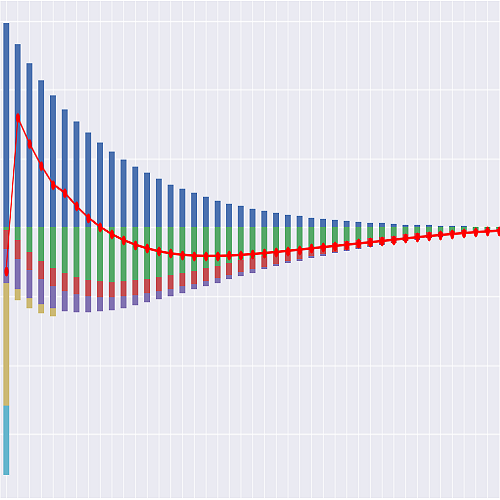
The PA_UK_S Model#
Reference liability cash flow model for UK pension annuities.
PA_UK_S is the executable counterpart of
products/pension_annuity/technical-notes.md in the lifelib-products library. It
projects gross best-estimate liability cash flows for a single UK pension annuity in
payment: instalments to the annuitant and to a dependant, guarantee-period payments,
value-protection lump sums and maintenance expense.
Mortality is the model. After outset the contract has no premiums, no surrender value, no account value and no policyholder options at all. The only decrements are deaths; the only stochastic drivers are longevity and, on the indexed options, inflation. That is not an omission — it is the design property that makes the liability eligible for the Solvency UK matching adjustment, whose conditions effectively require this shape.
The U.S. counterpart in the same library is SPIA_US_S, and the two share the
payout chassis: a life-contingent instalment stream, a certain-period floor rather
than a second stream, a refund-style death benefit measured against instalments already
paid, and survival measured at the payment point rather than at the end of the month.
Where they part is the UK-specific machinery: a dependant’s stream at a stated
percentage with an overlap rule, escalation on four bases including a
path-dependent RPI ratchet, and value protection in place of a cash refund — plus
the absence of anything resembling SPIA’s commutation right, because a UK pension
annuity has no surrender value at any time.
Spaces. The model contains two:
DataReads the two input CSVs and holds their filename References. It takes no parameters, so each file is read once per model.
ProjectionThe by-contract projection, parameterized by
point_id:Projection[1]is an ItemSpace projecting model point 1. It reaches the input tables through itsdataReference, which resolves to the singleDataSpace.
The split matters for more than tidiness. Because Projection is parameterized,
every Projection[N] is a separate ItemSpace with its own cells cache; readers
placed there would re-read every file for every contract. In Data they are
evaluated once, however many contracts are projected.
Input data is external: CSVs in the model folder’s parent directory, read at run time rather than stored inside the model. The model folder itself holds no data, so the model and its inputs must travel together.
Projection basis. Monthly steps from the annuity start date, on the library’s
0-based frame: t = 0 is the first projected month, month t runs from time t
to time t + 1, the policy year containing it is t // 12 + 1, and proj_len()
is the number of months projected, so the frame is t = 0 ... proj_len() - 1. State
variables — survival, the cumulative instalment schedule and the value-protection
balance — are indexed by a time point k with k = 0 at the start date, which
does not move with the frame. Escalation applies at the start of the month containing
the policy anniversary, first at t = 12; arrears instalments require survival at the
end of the payment month and advance instalments at the start of it; deaths are
decremented at end of month. Age is age last birthday. The limiting age is 115, and
the projection stops one month before the youngest covered life would reach it —
stopping on the annuitant’s age alone would truncate a younger dependant’s tail.
What is sourced and what is not. The contractual mechanics are sourced: the
instalment formula, the four escalation bases and the RPI catch-up ratchet, the
dependant’s percentage and the overlap rule, the guarantee period as an annuity-certain
floor, value protection and its exclusivity with the guarantee, the v + delta <= 1
bound, and the absence of any surrender value. Every rate is a standardization. The
SAPS and PMA16/PFA16 annuitant tables are restricted to CMI Authorised Users and the
CMI projections model software with them, so the mortality basis shipped here is a
[std] proxy — an ONS-shaped population table with a flat annuitant adjustment and a
deterministic improvement scale — and no insurer publishes an annuity rate card, so the
starting income is a model point input. This model is a mechanics demonstration, not
a pricing or reserving result. Replace the basis with licensed tables before drawing
any conclusion from the output.
Verification. tests/test_pension_annuity_uk.py asserts the notes’ worked
example row by row to the penny, including the £43,209.50 value-protection lump sum on
the month-16 death and the dependant’s stream starting at the next payment date.
Example
>>> import modelx as mx
>>> model = mx.read_model("products/pension_annuity/PA_UK_S")
>>> model.Projection[1].result_cf()