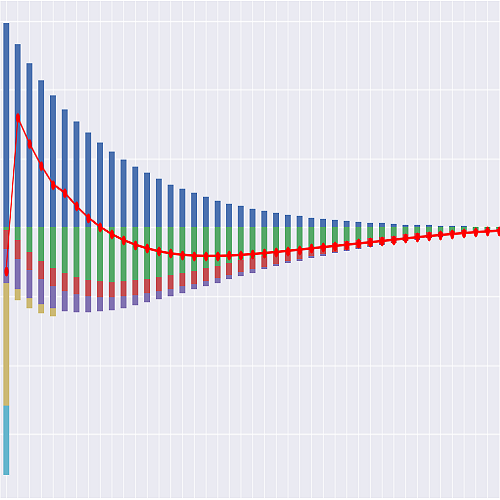
The Projection Space (TradLife_A_EX1)#
Per-policy projection, present values and Solvency II life-risk results.
This Space is TradLife_A.Projection with the Solvency
II life-risk outputs added and a new inner projection child Space. The
parameters (idx, scen_id), the inherited cashflow Cells (from
TradLife_A.BaseProj) and present-value Cells (from
TradLife_A.PV) are unchanged; see
TradLife_A.Projection.
New child Space
InnerProj re-runs the
cashflows under a single prescribed life stress, anchored at a valuation
time t0.
Cells Summary#
New Cells#
risk_life_sub() is the capital requirement for a single life
sub-risk – the loss in TradLife_A.PV.pv_net_cf under
the stress, floored at zero. risk_life() aggregates the sub-risks
with the correlation matrix from
life_corr().
risk_margin() is the Solvency II risk margin: the cost-of-capital
rate coc_rate() applied to
the projected risk_life(), discounted to t.
|
Life underwriting capital requirement for sub-risk |
|
Aggregated life underwriting capital requirement at valuation time |
|
Solvency II risk margin at valuation time |
Cells Descriptions#
- risk_life_sub(t, risk)[source]#
Life underwriting capital requirement for sub-risk
riskat timet.The capital requirement for a single life sub-risk is the loss in the value of in-force business caused by applying the prescribed Solvency II life stress: the baseline present value of net cashflows less the stressed present value, floored at zero.
\[\mathrm{risk\_life\_sub}(t, risk) = \max\left(\mathrm{pv\_net\_cf}_{base}(t) - \mathrm{pv\_net\_cf}_{risk}(t),\; 0\right)\]Both present values are taken at the valuation time
tfrom the inner projectionInnerProj, which is anchored att.InnerProj[t]is the unstressed (baseline) run, whileInnerProj[t, risk]applies the life shock selected byrisk. For the lapse risk the requirement is the worst loss across the three prescribed lapse shocks (up, down and mass).The individual sub-risk requirements are aggregated into the total life underwriting requirement by
risk_life().This mirrors
SCR_life.Life(and, for the lapse shocks,SCR_life.LapseRisk) in thesolvency2library, withTradLife_A.PV.pv_net_cfstanding in for the net asset value.- Parameters:
t – Valuation time at which the inner projection is anchored.
risk – A
LifeRiskIDvalue selecting the life sub-risk (e.g.MORT,LONGV,LAPSE,EXPS).
See also
- risk_life(t)[source]#
Aggregated life underwriting capital requirement at valuation time
t.The individual life sub-risk requirements
risk_life_sub()are combined with the prescribed life-risk correlation matrix:\[\mathrm{risk\_life}(t) = \sqrt{\sum_{i,j} Corr_{i,j}\, \mathrm{risk\_life\_sub}(t, i)\,\mathrm{risk\_life\_sub}(t, j)}\]where
iandjrange over the life sub-risks and \(Corr_{i,j}\) is the correlation coefficient between them, supplied per pair bylife_corr().This mirrors
SCR_life.SCR_lifein thesolvency2library, parameterized by the valuation timet. The aggregation is kept on native scalar types (a tuple of integer risk codes, withrisk_life_sub()andlife_corr()returningfloat) so the Space stays efficient when compiled with Cython.- Parameters:
t – Valuation time at which the inner projections are anchored.
See also
- risk_margin(t)[source]#
Solvency II risk margin at valuation time
t.The risk margin is the cost of holding the future life underwriting capital over the run-off of the in-force business: the cost-of-capital rate
coc_rate()applied to each future aggregated life SCRrisk_life(), discounted tot.\[\mathrm{risk\_margin}(t) = \mathrm{CoC} \sum_{s=t}^{\mathrm{proj\_len}} \frac{\mathrm{risk\_life}(s)} {\prod_{u=t}^{s}\left(1 + \mathrm{disc\_rate}(u)\right)}\]The cost of capital for the capital held over year
[s, s+1]is taken to be incurred ats + 1, so eachrisk_life(s)is discounted bys - t + 1periods (the standard EIOPA convention). This is evaluated by the recursion\[\mathrm{risk\_margin}(t) = \frac{\mathrm{CoC}\cdot\mathrm{risk\_life}(t) + \mathrm{risk\_margin}(t + 1)} {1 + \mathrm{disc\_rate}(t)}\]which terminates at
0oncetis beyondTradLife_A.BaseProj.proj_len. Att = 0it is the risk margin at the valuation date.- Parameters:
t – Valuation time at which the risk margin is evaluated.
See also