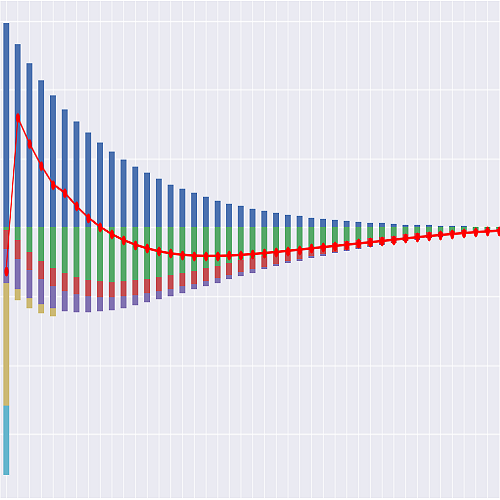
The VA_KR_S Model#
Reference liability cash flow model for a Korean variable annuity (변액연금보험).
VA_KR_S is the executable counterpart of
products/variable_annuity/technical-notes.md in krlib. It projects gross
liability cash flows for a single-contract model point of an individual deferred
변액연금보험 (byeonaek yeongeum boheom) written on a 특별계정 (teukbyeol
gyejeong, separate account), through a two-period contract: the 연금개시 전 보험기간,
in which the premium net of a front-end deduction buys units and the policyholder
carries the whole investment risk, and the 연금개시 후 보험기간, in which the money has
moved to the 일반계정 (ilban gyejeong, general account) and is run at the 공시이율.
The product is an investment wrapper plus two written options. The 최저사망보험금보증 (GMDB) floors the death benefit at 이미 납입한 보험료 and is compulsory under 감독규정 제7-60조제7호 [REG-R16]; the 최저연금적립금보증 (GMAB) floors the annuity consideration at the 연금개시나이 계약해당일 and, since April 2016, is elective [R2], so the model carries it as a switch and ships both forms. Neither guarantee reaches the 해약환급금, which carries no floor at any duration [S1] [S6] [S7 제50조제3항] — the single most important fact about this product for a liability model.
Spaces. The model contains two:
DataReads the eight input CSVs and holds their filename References. It takes no parameters, so each file is read once per model however many contracts are projected.
ProjectionThe by-contract projection, parameterized by
point_id:Projection[1]is an ItemSpace projecting model point 1, the technical notes’ anchor cell. It reaches the input tables through itsdataReference, which resolves to the singleDataSpace.
The split is not tidiness. Projection is parameterized, so every Projection[N]
is a separate ItemSpace with its own cells cache and readers placed there would re-read
every file for every model point.
Input data is external: plain CSVs in the model folder’s parent directory, read at
run time rather than stored inside the model, following annuallife.TradLife_A. The
model folder holds nothing but formulas, so a diff shows logic changes only — and the
model is not portable without its parent’s CSVs.
Projection basis. Monthly steps on 보험나이 (boheom nai, insurance age). t
counts projection months from t = 0, the month containing the 계약일 and the first
premium, to t = proj_len() - 1, the last month before attained age omega_age =
120 [std]; proj_len() is the number of projected months, so the frame is
range(proj_len()) and the policy year containing month t is t // 12 + 1.
Ages increment on the policy anniversary, so age(t) = age_at_entry() + t // 12.
Annuitisation falls at t_ann() = (annuity_age() - age_at_entry()) * 12, the
연금개시나이 계약해당일; the 특별계정 exists for t < t_ann() and is empty after it.
Within a month, in the order the 약관 sets out [S7 제2조] [S7 제36조]: the premium is paid and the 계약체결비용, the 납입 중 계약관리비용 and the 기타비용 are taken out of it in the 일반계정, so they never enter the fund; what is left is the 특별계정 투입보험료 and it buys units. Then the 월공제액 — 위험보험료, 납입 후 계약관리비용 and both guarantee charges — is cancelled out of the 계약자적립액 pro rata across the funds, and any 중도인출 with it. Then, at the three annual 계약해당일 inside 「연금지급개시일 − 3년」, the mandatory pre-annuitisation de-risking tops the 채권형 fund up to 80% of the account [S1]. Then each fund grows at its own gross asset return net of its 특별계정 운용보수, which is deducted inside the 기준가격 rather than by cancelling units [S7 제43조제2호]. Decrements close the month, death first, then lapse [std].
Which account each cash flow falls in. The model states it rather than implying it.
net_cf() is the whole-contract external cash flow — what
crosses the boundary of the insurer, on either side of the 특별계정 / 일반계정 line — and
check_net_cf() reconstructs it as the sum of the two accounts’
own ledgers, net_cf_gen() and
net_cf_sep(), in which every internal transfer permitted by
감독규정 제5-7조 [REG-R15] appears twice with opposite signs and cancels. A model that
cannot do that has not represented the boundary.
What one deterministic path can and cannot say. The charges are exact on every path,
because they are contractual rates on modelled bases. The guarantee costs are not:
max(0, K - AV(T)) evaluated at one terminal account value is the option’s intrinsic
value, a lower bound on its expected cost by Jensen’s inequality, and it is exactly zero
whenever the path lands the account above the strike. At the base run’s 투자수익률 of
2.50% the anchor cell’s account is above premiums paid at annuitisation, so the base
run reports a GMAB cost of zero while collecting the full guarantee charge; model
points 4 and 5 run the two other mandated illustration returns, −1.00% and 3.75% [R2]
[REG-R48], so the reader sees the guarantee on both sides of the strike. The statutory
보증준비금 is a CTE(70) over a thousand scenarios or a standard factor, whichever is
greater [REG-R10] [REG-R26] [R1]; this model publishes neither and no number it
prints is a reserve. This model is a mechanics demonstration, not a pricing or
reserving result. Replace the assumption tables with company data before drawing any
conclusion from the output.
What is sourced and what is not. The fee stack is one carrier’s 상품요약서 [S2] — 계약체결비용 5.17%, 계약관리비용 3.50% inside the premium period and 1.33% after it, the 0.40%/0.60% 운용보수 and the ₩830,000 해약공제 — because the surrender charge is the unamortised acquisition cost [R2] and the two may not come from different carriers. The guarantee design and both guarantee charges are a second carrier’s 상품안내장 [S1] — GMDB 0.07% of the account, GMAB 0.25% of the account plus 0.30% of 보험료총액 for at most seven years — with the mandatory 채권형 ladder and the 「개시일 − 3년」 de-risking rule. The commission scale is the 2017 industry census [R1]. Every return assumption is [std]: no Korean realised-return series was retrieved [R10] [S11], so the base run sets the 투자수익률 to the 2026 평균공시이율 [REG-R48] and works back to a gross asset return. The mortality table is a [std] Makeham construction anchored on the only published 제10회 경험생명표 statistic, 65세 기대여명 23.7/27.1 [REG-R33]; the qx table itself is not public [REG-R34] and this file must never be presented as it. The lapse scale is calibrated to [R1]’s seven-year persistency of under 30%; the dynamic (in-the-moneyness) form [R1] prescribes for reserving is not modelled, no functional form having been published.
Not implemented. Named so the gaps cannot be mistaken for oversights. The
고도재해장해급여금 of ₩10,000,000 [S1] [S2] is charged for — the 위험보험료 is a
modelled deduction — and never paid, because no 장해 incidence rate on this contract’s
basis was retrieved: the 참조순보험요율 display is a 장기손해보험 one and does not reach
the life side [REG-R34] [REG-R61]. The roll-up, step-up and
ratchet GMAB bases are specified in product-spec.md and not run; only premium
refund at 100% is. The GLWB / 실적배당 종신연금, in which the money stays in the
separate account through the payout phase at a charge of 3.30% of the guarantee base
[S2], is a different product and is out of scope. The daily 기준가격 and 좌수 ledger
is collapsed onto a monthly grid, and with it the two-business-day pricing lag on every
transaction [S7 제39조] [S7 제50조제2항]. 펀드자동재배분, 펀드자동전환옵션, 조기연금개시,
일반계정 전환, 보험계약대출, 감액, 납입 일시중지 and the 성과·장기유지 보너스 are all
described in the specification and not modelled. The annuity is held level after it
starts, though the contract moves it with the 공시이율 [S5], and the 연금생명표 is not
re-struck at annuitisation though the contract permits it in the policyholder’s favour
[S1].
Example
>>> import modelx as mx
>>> model = mx.read_model("products/variable_annuity/VA_KR_S")
>>> model.Projection[1].result_cf()