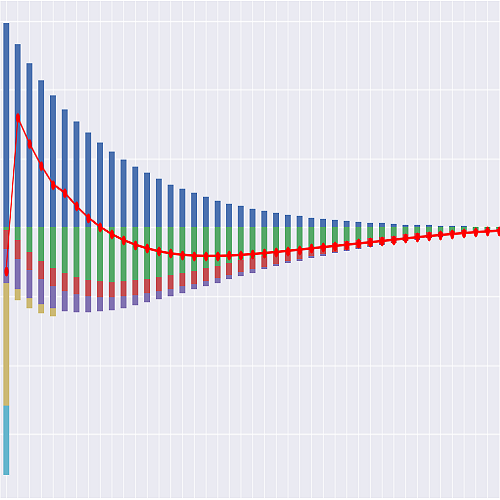
Technical Notes#
Status: Draft, 2026-08-20 (all cited sources accessed 2026-08-20).
Scope note. These notes turn the standardized composite whole life assurance (shūshin
hoken, 終身保険) of product-spec.md (same directory) into a reference liability cash-flow
projection on paper. This is not any single insurer’s product. [S#] and [R#] tags resolve
against sources.md, whose numbering is carried verbatim from _research/whole-life.md and
is frozen; [REG-R#] tags resolve against the cross-product reference library
references/regulatory-and-actuarial-references.md, whose own R-numbering is distinct.
std marks a standardization introduced for the reference implementation; unverified
marks a claim that could not be confirmed against a retrieved document. Every parameter
value here is identical to product-spec.md’s. Three parameters appear here that the
specification does not name, all of them internal to the surrender-value construction that
specification footnote 15 defers to this document: the cash-value basis rate i_cv, the
acquisition-deduction rate α, and the reference valuation rate i_std. Each is std
and each is derived, not asserted, below.
This is the library’s savings chassis. The policy value, the surrender value (kaiyaku-henreikin, 解約返戻金), the suppressed-surrender-value (tei-kaiyaku-henreikin-gata, 低解約返戻金型) cliff and the automatic premium loan, APL (jidō furikae kashitsuke, 自動振替貸付) are specified once, here. The endowment technical notes (養老保険) and the FX whole life technical notes (外貨建終身保険) state deltas against this file.
Model scope and conventions#
Purpose. Project gross best-estimate liability cash flows per policy — premiums, death and severe disability (kōdo shōgai, 高度障害) claims, surrender benefits, expenses and commission — for a single-policy model point, in the sense the ESR current estimate (genzai suikei, 現在推計) requires: probability-weighted future cash flows on assumptions re-set at each 基準日, gross of reinsurance REG-R15. It is also what the 保険計理人’s 1号収支分析 consumes REG-R6 REG-R22. Discounting, MOCE, required capital and every statutory reserve are out of scope and are cited, not reproduced — see Valuation and reserve pointers, which sets out both the 1号収支分析 and the reserving chain.
Projection frequency. Monthly, on policy months (
WholeLife_JP_S). The contract is quoted in years — the sum assured is level for life, the premium is level and annual, the 保険料払込期間 and the lapse curve are stated in policy years — so the monthly step is finer than the guarantees rather than finer than the product, and the contractual value construction stays annual (see the second bullet below). What the finer grid buys is three things the annual step could not do. The 年払 premium falls in one month out of twelve instead of being smeared across a year, which is what a 年払 contract actually looks like. The 払込満了 cliff is one month wide rather than one year: the surrender value steps up by1 / kat the anniversary and the behavioural surge lands in the month after the last premium, beside the step that provokes it. And the [std ordering] the annual grid needed — paying every surrender in policy yearmthe post-step value, because the step and the grid landed on the same year — is retired: eleven of those twelve months are inside the 保険料払込期間 and are paid the suppressed value, which is what the contract says.Time index [0-based].
tis the 0-based policy-month index:t = 0is the first policy month, monthtruns from timetto timet + 1, and the frame ist = 0 … T − 1, whereTis the number of policy months projected (proj_len(), the exclusive end of the frame). The contractual policy year is the 1-based labely(t) = 1 + ⌊t/12⌋andduration(t) = ⌊t/12⌋is the count of completed policy years; both are derived and never indexed by. The attained age in monthtisx + ⌊t/12⌋, so it steps on the anniversary.The contractual values stay annual, and that is the point of the split. Everything this product guarantees is defined at a 年単位の契約応当日, so the value family keeps the anniversary index
d = 0 … T_ywithd = 0at issue, whereT_y = ω − x + 1is the number of policy years:W(d),SC(d),V(d),CV(d),CV*(d),cumprem(d)and the loan balanceL(d)are amounts at a point in time on that clock, and none of their numbers moved whentbecame a month. The 保険料積立金 construction is calibrated to one carrier’s published annual surrender-value run, so re-deriving it monthly would move a fitted number rather than a modelled one. A benefit falling between anniversaries readsV(u), the value at elapsed monthu, by linear interpolation in the elapsed months std: the 算出方法書 that would state the real within-year rule is a 基礎書類 filed with the 金融庁 and is not published REG-R2, and linear interpolation is the market’s ordinary convention for a value quoted by policy year. A surrender in monthtis paid onCV(t + 1)on that reading, and is settled net of the loan balance at the anniversary⌊t/12⌋, which is the balance actually outstanding.Timing conventions std. Premium at the start of the anniversary months
t = 0, 12, …, 12(m − 1), in advance and zero in the eleven months between each pair; maintenance expense at the start of each month, a twelfth of the annual amount, inflating once a policy year; renewal commission with the premium it is a percentage of; acquisition expense and initial commission at issue, the start of montht = 0; death claims and claim expenses at the end of the month of death; surrenders at the end of the month, after deaths, valued on the surrender value at that instant; the 払込満了 surrender surge as a one-off proportion in the single montht = 12m.Rate conversion std. Mortality and ordinary surrender are quoted per annum and applied per month on the effective convention
r_m = 1 − (1 − r)^(1/12), so twelve months compound back to the annual rate exactly and survivorship at every anniversary is what an annual projection of the same bases produces. Three things are not converted, because they are not rates per unit time: the cliff surge, which is a decision taken on a date; the premium default that feeds the APL, which is the failure to pay one premium on one date; and the loan interest, which the 約款 capitalises once a year at the 契約応当日.Age basis. 契約年齢 is attained age (man-nenrei, 満年齢) with the fractional year discarded at 契約日, incrementing on each 年単位の契約応当日 rather than on the birthday [S1] [S3] [S9]. A projection stepped on anniversaries therefore steps the rating age correctly by construction, and the attained age in period
tisx + texactly — no select adjustment, no half-year offset. The mortality table does not share this basis: 生保標準生命表2018(死亡保険用)is built for use on a nearest-birthday insurance age (hoken-nenrei, 保険年齢) 方式 REG-R20. The reference implementation reads the table at the 満年齢 attained age with no adjustment std, because no public mapping between the two bases exists; the resulting bias understates mortality by up to half a year of age. On the male table half a year of age is worth 3.6–5.0% ofqbetween attained ages 35 and 65, but under 2% in magnitude between 23 and 31, where the curve flattens and dips, and as much as 14% between 15 and 16, whereqis smallest and climbing steeply. Named here, not hidden.Currency. JPY throughout. Amounts are written ¥ with thousands separators. There is no currency layer on this product; the FX whole life (外貨建終身保険) adds one.
Model points. Single-policy model points projected on an expected (probability-weighted) basis: survivorship multiplies per-policy cash flows.
point_idparameterizesProjection;point_id = 1is the worked-example anchor cell. No aggregation logic is specified here.Termination. There is no maturity date and no 満期保険金 [S1] [S3] [S5] [S7] [S9] [S10]. The projection runs to the terminal age of the mortality table, with ω = 109 for males and 113 for females on 生保標準生命表2018(死亡保険用), the first age at which
q(ω) = 1.00000REG-R18 R1. On the monthly grid that isT = 12(ω − x) + 1months: the table’s terminal rate is 1, so its monthly equivalent1 − (1 − 1)^(1/12)is 1 as well and every life still in force at the start of the terminal policy year dies in its first month. The frame stops at that month rather than carrying eleven rows of zeros after it. Nothing is paid there other than the death benefit, andl(T) = 0. There are no tail states.Contract boundary. The premium is level and guaranteed for the whole of 保険料払込期間 and the insurer has no unilateral repricing right [S1] [S3] [S7] [S10], so all
myears of premium and the whole-of-life benefit are inside any defensible boundary. Japan’s ESR 柱1 告示 were not opened in the research pass and their boundary text is unverified REG-R16; the model therefore does not implement a boundary test, it projects the whole contract and says so.Rounding. Intermediate values at full precision; displayed cash flows to two decimal places std, which is the precision the tests assert. Contractual amounts a policyholder actually receives are integral yen, but the model does not round them: a probability-weighted expected value has no contractual denomination.
Model point attributes#
Attribute |
Type |
Anchor cell ( |
|---|---|---|
|
str |
|
|
enum {M, F} |
M |
|
int, 満年齢, 15–80 |
30 |
|
JPY, ¥2,000,000–¥50,000,000 in ¥1,000,000 units |
5,000,000 |
|
int years, or 0 for 終身払 |
15 |
|
JPY, level for policy years 1 … m |
174,960 |
|
bool — 低解約返戻金型 elected |
true |
|
解約払戻金支払割合 |
0.70 |
|
bool — 自動振替貸付 elected (default on) |
true |
|
fraction of |
0.00 |
|
enum {none, five_year} |
none |
There is no issue date (契約日) attribute, and that is a product fact rather than an
omission: the projection runs on policy years, 契約年齢 is fixed at 契約日 and increments on the
年単位の契約応当日 rather than the birthday [S1] [S3] [S9], and the one intra-year date that
matters — the 払込満了日 — is an anniversary by construction. Six further model-point columns
carry the optional modules rather than the contract (default_rate, pol_loan_year,
lapse_spike, dyn_lapse, mort_adj, pua_year); each is specified in the assumption
tables below. The mort_adj column is read by the mort_be_factor cells, which carries
the library-wide name for the multiplier; the column keeps its own spelling.
prem_term = 0 denotes 終身払, for which m is treated as infinite: no 払込満了 date exists, the
suppressed period runs for life [S4], and the cliff never occurs. That point must be in the
table, because it is the one configuration in which the product’s signature mechanic is
absent by construction.
The anchor premium is sourced, not constructed: ¥14,580 per month for this exact cell is
published [S4], and the annual figure is 12 × that std (product-spec.md footnote 5).
No carrier publishes an annual-mode scale, so the modal discount a real 年払 rate would carry
is not applied and the annual premium is slightly overstated — the direction is stated, not
corrected.
State variables#
Variable |
Description |
Updated |
|---|---|---|
|
In-force probability at the start of month t; |
monthly recursion |
|
Mortality rate (incl. 高度障害), annual and |
table lookup at |
|
Ordinary voluntary surrender rate, annual and per month |
assumption table |
|
The 払込満了 surge: a one-off proportion in the single month |
model point |
|
Premium-default rate, applied once per premium at an anniversary month (optional module; 0 in base) |
model point |
|
|
closed form |
|
|
interpolation |
|
The payable 解約返戻金, at an anniversary and at an elapsed month |
closed form |
|
|
closed form |
|
平準純保険料式 policy reserve, reference quantity only — never a cash flow |
closed form |
|
Of |
monthly recursion |
|
In-force probability on APL at the start of month t, having defaulted at anniversary s |
monthly recursion |
|
Outstanding APL principal and interest per policy in that cohort, at anniversary d; |
annual recursion |
pols_if_apl and loan_apl_pp are indexed by the entry anniversary s and not collapsed
to a cohort average. That is deliberate: the APL exhausts at a duration that depends on when
the loan started, so an average balance would let early entrants ride on late entrants’
headroom and would move the termination by decades. The triangle is the honest structure.
Note which of the two moves monthly and which does not. The population on APL is
decremented every month like any other in-force population; the balance compounds once a
year, because the 約款 states a 年利 capitalised at the 契約応当日, and the continuation test
that spends it is the question the insurer asks when an annual premium goes unpaid. A benefit
in month t is therefore settled net of loan_apl_pp(⌊t/12⌋, s).
The base run carries no loan, no APL cohort and no 契約者貸付: default_rate ≡ 0 and
pol_loan_util = 0, so loan_pp ≡ 0, loan_apl_pp ≡ 0 and every benefit is gross. Both
modules are exercised in both positions in testing.
Assumption inputs#
Three classes, kept apart on purpose. The split is not a modelling nicety here: a Japanese illustration must separate guaranteed (保証) from non-guaranteed (非保証) elements, because presenting a non-guaranteed element as certain is 断定的判断の提供 under 消費者契約法第4条 REG-R38.
(a) Contractual / guaranteed elements (cited; the insurer cannot change them)#
Input |
Value |
Basis |
|---|---|---|
Death benefit |
|
[S1] [S3] [S7] [S9] [S10] |
高度障害保険金 |
Same amount, on the 別表 disability state; extinguishes the contract |
[S1] [S3] [S7] [S9] |
Premium |
Level and guaranteed for policy years 1 … m; none thereafter |
[S1] [S3] [S7] [S10] |
保険期間 |
終身 — no expiry, no 満期保険金 |
[S1] [S3] [S5] [S7] [S9] [S10] |
解約払戻金支払割合 |
0.70 during 低解約払戻期間; 1.00 thereafter |
[S3] [S7] [S9] [S11] |
低解約払戻期間 |
Identical to 保険料払込期間, i.e. |
[S3] [S6] [S7] [S11] |
Clawback |
Suppressed basis persists past |
[S3] [S4] [S5] [S9] |
解約返戻金 arguments |
A function of elapsed months and paid months while premiums are due |
[S1] [S3] [S10] |
APL continuation test |
Advance plus interest must not exceed the surrender value computed as if the premium had been paid, net of existing loan |
[S1] [S3] [S10] |
APL interest ceiling |
年8% / 半年4% / 月 8/12%; a fourth carrier publishes the 年8% ceiling alone |
three ceilings [S1] [S7] [S10]; 年8% [S3] |
契約者貸付 limit |
9/10 of |
[S1] [S3] [S7] |
Loan-excess termination |
Contract lapses where loan and interest exceed the surrender value and the top-up is unpaid |
[S1] [S3] [S10] |
免責 — suicide |
3 years from the 責任開始期, reset on 復活 |
[S1] [S3] [S7] [S8] [S9] [S10]; statutory frame REG-R34 |
Refused claim |
The 保険料積立金 / policy reserve (sekinin-junbikin, 責任準備金) is paid to the policyholder, not nothing |
[S1] [S9] [S10] |
復活 window |
3 years from lapse, barred once the surrender value is claimed |
[S1] [S3] [S7] [S10] |
Policyholder protection |
90% of the 責任準備金 on insurer failure |
(b) Insurer-discretionary current elements#
Unlike a UK guaranteed-premium term policy, this class is not nearly empty — it is where the product’s economics live, and every item in it is a rate the insurer sets and may change.
Input |
Snapshot value |
Basis |
|---|---|---|
APL / 契約者貸付 interest |
2.75% p.a., compound, held flat |
level [S2]; ceilings [S1] [S7] [S10]; pick std |
Rate-review calendar |
Reviewed each January and July at two carriers, the revision applying to existing loans; not modelled |
[S7] [S11]; flat std |
Assumed pricing interest rate (yotei riritsu, 予定利率) |
1.75% p.a. — a 2010 disclosure, carried as documentation |
[S11]; current value unverified |
Cash-value basis rate |
1.468% p.a. — solved from the published surrender table |
derived std, below |
Acquisition deduction |
0.0090 of |
derived std, below |
契約者配当 |
None — the composite is 無配当. Variant: 5年ごと利差配当, off in the base run, declaring |
[S1] [S3] [S5] [S11]; variant [S7]; legal frame REG-R9; spread and period std, below |
払済保険 conversion basis |
The insurer’s own single-premium net rate |
[S1] [S3] [S7] [S9] [S10] |
Why i_cv is not 1.75%. The 予定利率, 予定死亡率, 予定事業費率 and the surrender-value formula all
live in the 保険料及び責任準備金の算出方法書, a filed but unpublished 基礎書類 REG-R2 — no amount of further
research turns them into sourced values. What is public is a complete numeric
surrender-value run for one model point [S4], and a second carrier’s matched suppressed and
ordinary pair [S7]. The library therefore constructs V(d) in closed form and calibrates
it to the published table, and the calibrated rate lands at 1.468%, not at the 1.75%
disclosed in a 2010 booklet. The gap is informative rather than embarrassing: the published
table is a 2025 rate page [S4] and the disclosure is fifteen years older [S11]. i_cv is
the live model input; 1.75% is carried as a documented fact and a sensitivity anchor, and
appears nowhere in the cash-flow recursion.
The dividend spread, and why it is 0.25%. On the 5年ごと利差配当 variant the declaration is
made every five years from inception where the investment return on 責任準備金等 exceeds the
return assumed in pricing, accumulates at a company-set rate as 5年ごと積立配当金 and may be nil
[S7]. The rate is a 三利源 calculation inside the unpublished 算出方法書 REG-R2 and no carrier
publishes it, so div_spread = 0.25% p.a. std, applied over div_period = 5
years of V(d). The five-year period is not a standardization — it is in the product name
[S7] [S10]. The only interest-margin figures recovered anywhere in the research pass bracket
the pick from both sides: a 0.2% asset-management deduction inside one carrier’s 積立利率
formula [S11], and a 0.05% 契約者配当金積立利率 at another [S2]. Neither is a 利差 declaration
rate, so the pick is a standardization and not a reading; it moves only the dividends
column, which is zero on every model point but one.
(c) Behavioral / experience assumptions (modeler’s view)#
Mortality. 生保標準生命表2018(死亡保険用)is the sourced basis, read from the publisher’s own PDF REG-R18 R1. Two facts must be carried together and never blurred. First, the table includes 高度障害 inside the death rate REG-R20 R2 — so a projection using it must not add a separate disability decrement, and the two benefits are one decrement on one amount. Second, it is a valuation table: 2008/2009/2011 experience carried forward by an improvement allowance of 2.5% p.a. for five years then 1.0% p.a. for three, then loaded by a 数学的危険論による補整 sized to hold the exceedance probability to about 2.28% (a 2σ level), capped at 130% of the unadjusted rate REG-R20 R2. A best-estimate basis is therefore a std adjustment of a sourced table.
Input |
Value |
Basis |
|---|---|---|
Base table |
生保標準生命表2018(死亡保険用), sex-distinct, |
|
|
1.00 in the base run |
|
Terminal age ω |
109 (M) / 113 (F) |
|
Improvement overlay |
None |
mort_be_factor = 1.00 is a choice, not a default: it means the base run is a
valuation-table run, not a best estimate, and it is taken so that every mortality rate the
worked example quotes is a published one that anyone can download and check. The 2σ margin
pushes rates up and the built-in improvement allowance pushes the best-estimate multiplier
further down,
but no retrieved source sizes either against current insured experience, so no defensible
single haircut exists. mort_be_factor is the named lever; a production basis would sit
somewhere below 1.00 and would move claims proportionately.
The shipped table is a construction, and every figure below is computed on it. The
IAJ’s site terms prohibit reproduction, alteration and transmission of the tables
without written consent REG-R21, so jplib does not distribute a copy of the file.
mort_table.csv is a std construction whose provenance column tags every row, and
it is the canonical jplib death table: one file, built once from the union of the
anchors every product in this library sources, shipped identically by all of them, so a
rate quoted in two products carries the same number and the same provenance in both.
This product ships the age range it reads, 15 to ω.
Every row is one of two kinds and its provenance says which. An ANCHOR row is a rate
quoted and attributed to REG-R18; an INTERPOLATED row is filled by log-linear
interpolation in ln q between the two neighbouring anchors, evaluated in double
precision and rounded to five decimal places. Nothing is extrapolated: each sex runs from
an age-0 anchor to a terminal anchor, so every interpolated age lies strictly between two
sourced ones. Over the range shipped here, 27 of the 95 male rows and 24 of the 99 female
rows are anchors; the remaining 68 and 75 are the standardization, and they are not IAJ
values.
How far an interpolated row sits from the published rate is not known and is not
asserted. The library reads the anchors and constructs the rest, so it has nothing to
measure the fill against, and an earlier revision of these notes quoted a comparison
against the full published table that the library cannot support. What is known is where
the fill is thinnest: past age 90 the anchors are five and then four years apart while q
is turning over, the widest gap in the file. Of the rates the worked example below prints,
q(30) … q(34) and q(45) are anchors and q(43) and q(44) are interpolated — which
is why the assumption list quotes only the first five as read from the publisher’s PDF. A
user who has downloaded the IAJ PDF replaces mort_table.csv with a same-schema file and
changes no formula.
Surrender. No carrier publishes a lapse or surrender curve by duration; this is the single largest assumption gap for the product. The only public benchmark is the industry 解約・失効率 of 5.6% for FY2024 R12 REG-R31, and the same report defines it as surrendered-and-lapsed sum assured over opening in-force sum assured, industry-wide across all product types — an amount-weighted, all-product bound, not a per-policy whole-life rate. It is used here as a sanity ceiling and nothing more.
The rows of lapse_table.csv are keyed by the contractual policy year, the 1-based label
t + 1, so the first projected period t = 0 reads the policy_year = 1 row:
Policy year ( |
1 |
2 |
3 … m−1 |
m |
m+1 … |
|---|---|---|---|---|---|
Period |
0 |
1 |
2 … m−2 |
m−1 |
m … |
|
4% |
3% |
2% |
17% |
2% |
The shape is reasoned, not fitted: a 低解約返戻金型 owner who surrenders during the low period
takes a 30% haircut on a value that is already below cumulative premiums (70.1% of premiums
paid at duration 5 on the published table [S4]), so early surrender is strongly suppressed;
at the anniversary d = m the value steps up by a factor of 1/k and crosses 100% of premiums
paid, and the product has been sold on exactly that crossing. The m-year entry is 2% + s
with the
cliff spike s = 15% std, held as a separate parameter so that it can be switched off
and the sensitivity read directly.
Premium default and the APL (optional module, off in the base run).
Input |
Value |
Basis |
|---|---|---|
|
0 in the base run; 1% p.a. in policy years 1 … m, i.e. |
|
APL clawback on the defaulting cohort |
On — the suppressed basis persists past |
[S3] [S4] [S5] [S9] |
Reinstatement (復活) |
Not modelled; every exit is terminal |
std, below |
Expenses and commission (levels all std; no carrier publishes an expense basis at all — 予定事業費率 is named in the 保険契約者保護機構 boilerplate [S1] [S7] and never quantified).
Input |
Value |
|---|---|
Acquisition expense |
¥50,000 per policy at issue std |
Initial commission |
90% of the annual premium at issue std |
Renewal commission |
3% of premium, policy years 2 … m, falling in the anniversary months |
Maintenance expense |
¥8,000 p.a. taken as ¥8,000/12 a month, for life, inflating 1.0% a year std |
Claim expense |
¥20,000 per death claim std |
Surrender expense |
None — folded into maintenance std |
Expense inflation of 1.0% std is deliberately below the 3% a UK or U.S. model would
carry; importing 3% into a Japanese whole-life run over an eighty-year horizon compounds to
a different product. Maintenance expense continuing after 払込満了, for life is the
structural point: this is a whole life contract on which premiums stop after m years and
obligations do not.
Cash flow components and recursions#
Notation (defined once, used throughout)#
Symbol |
Meaning |
|---|---|
|
0-based policy-month index, t = 0 … T − 1; the contractual policy year is |
|
anniversary index in years, d = 0 … T_y, |
|
an elapsed month at which an interpolated value is read; |
|
契約年齢 at issue; number of policy months projected, |
|
保険料払込期間 in years (∞ for 終身払); |
|
保険金額; annual premium, payable at the start of the months |
|
annual mortality and ordinary surrender rates in month t; |
|
the 払込満了 surge, a one-off proportion in the month |
|
in-force probability at the start of month t; |
|
of those, the part still paying premium in cash in month t, after that month’s defaults into the APL state ( |
|
expected deaths in month t; expected surrenders in month t, ordinary plus any surge |
|
whole-life EPV of 1 at age y and n-year annuity-due, on |
|
net level premium on the cash-value basis, |
|
prospective net level premium policy value at anniversary d |
|
解約控除 — acquisition-cost deduction ( |
|
ordinary, unsuppressed surrender value ( |
|
解約払戻金支払割合 — 0.70 when 低解約返戻金型 is on, 1.00 otherwise |
|
payable 解約返戻金 ( |
|
premiums paid per policy by anniversary d, |
|
loan + APL principal and interest at anniversary d; it compounds once a year, so a benefit in month t is settled net of |
|
cash-value basis rate; loan rate; reference valuation rate |
|
acquisition-deduction rate, per unit of |
|
acquisition expense; maintenance; initial and renewal commission; claim expense |
|
net cash flow of month t, income-positive ( |
Dimensional check. q, w, s, u, k, α, c0, c_r, l and lp are
dimensionless — but q and w are rates per year while q_m, w_m, s and u apply to
a month, and the last two are applied unconverted because they are proportions rather than
rates. i_cv, i_L, i_std are per annum; A and ä are pure numbers (ä in years of
premium, so SA × A / ä is ¥ per year, which is what makes P an annual amount); SA, P,
W, SC, V, CV, L, E0, ec are ¥ and e_m is ¥ per month; every term of
CF(t) is ¥ per policy issued per month. No term mixes a per-annum rate with a stock
without an explicit period count.
責任準備金 and 解約返戻金 — two quantities, one relationship#
They are different objects and a model that conflates them is wrong in both directions.
責任準備金 is statutory. For an in-scope contract — and a level-premium 終身保険 with a fixed 予定利率 is in scope R6 REG-R7 — it is accumulated net level premium method (heijun jun-hokenryō-shiki, 平準純保険料式), with no Zillmer adjustment, on the standard valuation rate (hyōjun riritsu, 標準利率) and 生保標準生命表2018(死亡保険用)R7 R8 REG-R10 REG-R11:
π*        = SA × A*(x) / ä*(x, m)                     on (i_std, 標準生命表2018)
reserve_pp(d) = SA × A*(x + d) − π* × ä*(x + d, max(m − d, 0))
解約返戻金 is contractual. Its formula is in the unpublished 算出方法書 REG-R2; what the 約款 publish is its argument list — elapsed months and paid months, the elapsed count capped at the paid count while premiums are due [S1] [S3] [S10]. The library constructs it as a policy value of the same form on a different basis, less a 解約控除 grading to zero std:
π         = SA × A(x) / ä(x, m)                       on (i_cv, 標準生命表2018)
W(d)      = SA × A(x + d) − π × ä(x + d, max(m − d, 0))
SC(d)     = α × SA × max(0, m − d) / m
V(d)      = max(0, W(d) − SC(d))
all four at the anniversary d, d = 0 at issue: W(0) = 0 by construction and
W(T) = 0 because the table terminates.
The relationship is then exact and testable. When the two basis rates coincide (i_std = i_cv, which is the base-run default so that the identity can be asserted),
reserve_pp(d) − V(d) = SC(d) for every anniversary d ≥ 1
— the whole difference is the 解約控除, which is precisely what 平準純保険料式 forbids the reserve to
carry REG-R10. (At d = 0 both sides are zero: the reserve is nil and the floor in V
absorbs SC(0), which is what check_reserve_identity_resid tests.) When they do not
coincide the ordering can fail: with a 標準利率 below the
pricing basis the statutory reserve exceeds the cash value by far more than SC(d), and in
a deep negative-spread (逆ざや) configuration the reserve can exceed even the sum assured.
reserve_pp ≥ V ≥ CV is therefore not a model invariant and must not be asserted as
one. reserve_pp produces no cash flow; it exists so the identity above can be checked.
The 低解約返戻金型 cliff#
CV(u) = k × V(u)     for u <  12m     (k = 0.70 when 低解約返戻金型 is on)
CV(u) =     V(u)     for u >= 12m
and the transition at the anniversary d = m is a step, not a ramp. Two carriers’ published tables
agree on it to rounding, and one of them settles what the suppression is: at duration 40,
well past 払込満了, the suppressed and ordinary products have identical surrender values
[S7]. So there is one V(d) and one multiplier — not two reserve runs. Everything
derived from the surrender value is suppressed with it: the 払済保険金額, the 契約者貸付 amount and the
APL amount are all computed off CV(d) [S7] [S9] [S11].
Two quantities coexist at the anniversary d = m and a model must publish both: k × V(m),
the value an instant before the step (the published ¥2,047,650 figure), and CV(m) = V(m),
the value an instant after (¥2,928,450) [S4]. The ratio CV(m) / (k × V(m)) must equal
exactly 1 / k; anything between is an interpolation the contract does not have.
The monthly grid puts the step where the contract puts it, and retires a std in doing
so. On an annual step the step and the grid landed on the same year, so the notes had to
rule that a surrender anywhere in policy year m was paid at the anniversary d = m on the
full value — an ordering convention, not a reading of the clause. Here the suppression
ends at the elapsed month u = 12m: a surrender at u = 12m − 1 is still inside the
保険料払込期間 and is paid k × V(u), and one at u = 12m is not and is paid V(m). Eleven of
the twelve months of policy year m move from the post-step side to the pre-step side, and on
the anchor cell that is the single largest difference between the two grids.
The behavioural surge moves with it. The 15% spike std is not a rate spread over a
year but the proportion of owners who were waiting for the step, so it falls as a one-off in
the single month after the last premium, t = 12m, beside the step that provokes it — on
the anchor cell, month 180, where the surrender outgo is ¥313,122.87 against ¥3,480.77 the
month before. The annual grid put the surge in policy year m, which is a year before the
event that causes it.
自動振替貸付 as a state#
Where the premium is unpaid at grace expiry and there is a surrender value, the insurer lends the premium against that value and applies it to the premium, and the contract continues in force [S1] [S3] [S7] [S10] [S11]. Lapse on this chassis is therefore a funded event, not a behavioural one. The trigger, stated the same way at three carriers [S1] [S3] [S10], is an annual test — one annual premium, one 契約応当日 — and stays annual on the monthly grid:
the APL fires at anniversary d iff CV*(d + 1) >= L(d) + P × (1 + i_L)
where CV*(d) is the surrender value computed as if the premium had been paid, and the
anniversary that matters is the one the advanced premium would carry the contract to, d + 1
std; L(d) is the existing balance at d. The accumulation is compound, with interest
capitalised into principal at each subsequent grace expiry, annually on a 年払 contract
[S3] [S7]:
L(d + 1) = (L(d) + A(d)) × (1 + i_L), A(d) = P if the APL fires and d < m, else 0
Once d >= m no premium is due, so A(d) = 0 and the balance rolls up on interest alone
against a value that is still growing, which is why exhaustion after 払込満了 takes decades
rather than years.
What the monthly grid changes about this module is the population, not the ledger: the
cohort on APL is decremented every month like any other in-force population, while its
balance and its test move once a year. A benefit falling in month t is settled net of
L(⌊t/12⌋, s), the balance actually outstanding at the anniversary that opened its policy
year.
Exhaustion. If the test fails at anniversary d, the contract lapses in the month
t = 12d and the policyholder may claim the surrender value net of the loan [S1] [S3] [S10]
— the value at that anniversary, which is the last one the loan had not yet overtaken:
benefit on APL failure = max(0, CV*(d) − L(d))
floored at zero, because the loan can exceed the value. The same test, with A(t) = 0, is
the loan-excess termination the 約款 describe for a 契約者貸付 that outgrows the value [S1]
[S3] [S10]; the notice-and-top-up period is not modelled std.
The clawback. Where not all premiums falling in the suppressed period were paid, the
suppressed basis continues to apply after the period ends [S3] [S4] [S5] [S9]. A cohort
carried through the low period by APL advances has by definition not paid them, so std
the APL cohort’s value is k × V(d) for all d — it never steps up at m. This is not
a refinement; it moves the exhaustion by sixteen years on the anchor cell (below).
Processing order (month t = 0 … T − 1)#
Start of month — premium. Collect
P × lp(t)in the anniversary monthst = 0, 12, …, 12(m − 1), and nothing in the eleven between each pair. On the APL cohort the premium is not collected in cash: the advance is applied to it, so it produces nonet_cfentry and appears only as growth inL. That is why the weight here islp(t)and notl(t)— the APL cohort is in force and not paying.Start of month — expenses.
e_m(t) × l(t), a twelfth of the annual amount inflating once a policy year; renewal commissionc_r × P × lp(t)in the same anniversary months as the premium, for policy years 2 … m. Att = 0additionallyE0andc0 × P(per policy issued,l(0) = lp(0) = 1). Maintenance is carried on the whole in-force populationl(t), because the APL cohort still has to be administered; commission follows the premium actually collected, so it is carried onlp(t)std.At an anniversary month — premium default and the APL test (module on). The default proportion
uis applied once per premium, never spread; for each entry cohort, apply the trigger above and advance or terminate.Cash values. Read
V(t + 1)andCV(t + 1)at the end of the month, interpolating between the anniversaries that bracket it std.End of month — deaths.
D(t) = l(t) × q_m(t); outgo(SA − L(⌊t/12⌋)) × D(t), floored at zero; claim expenseec × D(t).End of month — ordinary surrenders, applied to survivors of mortality [std order: death before lapse]:
l(t) × (1 − q_m(t)) × w_m(t).End of month — the cliff surge, applied to the survivors of that, and only in the month
t = 12m:l(t) × (1 − q_m(t)) × (1 − w_m(t)) × s(t). Both exits are paidmax(0, CV(t + 1) − L(⌊t/12⌋)), andS(t)is their sum.At an anniversary — loan roll-up.
L(d + 1) = (L(d) + A(d)) × (1 + i_L).Update in force.
l(t + 1) = l(t) × (1 − q_m(t)) × (1 − w_m(t)) × (1 − s(t))
Because the two conversions are the effective ones,
lat every anniversary is exactly what an annual projection of the same bases gives — the arithmetic check that the grid changed and the basis did not.At
t = T − 1, the first month of the terminal policy year, the table’s rate is 1 and so is its monthly equivalent, sol(T) = 0and the projection ends. No maturity payment, no tail states.
Net cash flow#
Income-positive, per policy issued:
CF(t) = P × lp(t) × 1{t mod 12 = 0 and t < 12m}       (premiums, once a year)
      − (SA − L(d)) × D(t)                            (death and 高度障害 claims)
      − ec × D(t)                                     (claim expense)
      − max(0, CV(t + 1) − L(d)) × S(t)               (surrender benefits)
      − e_m(t) × l(t)                                 (maintenance expense)
      − c_r × P × lp(t) × 1{t mod 12 = 0, 12 <= t < 12m}   (renewal commission)
      − (E0 + c0 × P) × 1{t = 0}                      (acquisition)
with d = ⌊t/12⌋, the anniversary that opened the month’s policy year.
Premium and renewal commission are weighted by lp(t), not l(t). That is the whole
content of step 1: an APL advance is a loan asset and not cash income, so a policy sitting
in the APL state contributes to l(t), to maintenance expense and to every benefit, and to
neither of these two lines. Weighting premium by l(t) would book the advanced premium as
income and net the loan off the later claim — counting it twice — and would make net_cf
move in the year an advance is made, which the pitfalls list below says it must not. The two
weights coincide in the base run, where default_rate ≡ 0, which is exactly why the
distinction has to be written down rather than discovered when the module is switched on.
net_cf is income-positive throughout; where the notes elsewhere print an outgo-positive
stream that orientation survives as liability_cf, with net_cf(t) == −liability_cf(t).
The result columns are premiums, claims_death, claims_lapse, claim_expenses,
expenses, commissions, dividends and net_cf, with pols_if first. expenses is
acquisition plus maintenance; the claim handling expense is claim_expenses beside it.
dividends is a column of zeros on the 無配当 composite and is published rather than dropped,
because the 5年ごと利差配当 variant is a real product in the source set.
Roll-forward identity. Because the table terminates, every policy leaves by one of the two decrements, so
Σ_t D(t) + Σ_t S(t) = 1 and l(T) = 0
check_decrement_sum() takes no argument and returns a bool over all t; the per-t
signed residual lives at check_decrement_sum_resid(t).
Policyholder behavior modeling#
All dynamic forms are std reference constructions; there is no public calibration evidence for any of them on this product.
Base surrender. The duration table in class (c), with the cliff spike held as its own parameter. The suppression is a behavioural instrument as much as a pricing one: it costs the policyholder 30% of the value to leave early and buys a 16.3% cheaper premium in exchange (¥17,040 against ¥20,350 per month on the one carrier that publishes both scales for one identical cell [S7]).
The spike at 払込満了 is an assumption, not a mechanic. The step in
CVis contractual; the surge in surrenders at the step is class (c) and nothing else. Nothing in any retrieved document quantifies it. Settings = 0and re-running is the correct way to read its effect.Dynamic surrender on the 払戻率 std (optional module, off in base). The economically natural driver is the ratio of the value to premiums paid:
w_dyn(t) = w(t) × min(3.0, max(1.0, 1 + β × max(0, CV(t+1) / cumprem(t+1) − 1)))
with
β= 2.0 std andcumprem(d) = P × min(d, m), both read at the anniversaryd = t + 1that closes the period, which is where the surrender is paid. On the anchor cell the ratio crosses 1 exactly at the cliff, so this module reproduces the spike endogenously instead of imposing it — a useful cross-check on thes= 15% choice, not a replacement for it.Premium default and the APL. Modelled as a decrement
u(t)out of the premium-paying cohort into an APL cohort, not as a lapse. A policy does not lapse while the cash value can carry the premium, so a whole-life lapse model that applies a lapse rate to unpaid premiums without first running the APL test is modelling a decrement the contract does not have.Reinstatement (復活) is not modelled std. Within three years of lapse, on fresh 告知 and payment of arrears, a Japanese policy comes back [S1] [S3] [S7] [S10] — the composite’s lapse is genuinely not a terminal state, unlike the UK reference set’s. Treating every exit as terminal understates later-duration in force and therefore both premium income and claims. The bias is stated rather than corrected because no retrieved source gives a reinstatement rate.
契約者貸付 take-up. Static
pol_loan_utilonly, base 0. There is no public take-up data. Where it is non-zero, the loan is drawn at the anniversarydtopol_loan_util × CV(d), subject to the contractual 9/10 (in payment) and 8/10 (paid-up) caps [S1] [S3] [S7], accrues ati_L, and nets off every benefit.払済保険 election. Modelled as an election at a chosen anniversary
d: the contract stops paying premiums,SAis replaced by(CV(d) − L(d)) / A(x + d)on the insurer’s own single- premium basis, and the suppression switches off for the future — but the conversion itself is made on the suppressed value, so the resulting 払済保険金額 is permanently smaller [S3] [S7] [S9]. Off in the base run.リビング・ニーズ特約 (a tokuyaku, rider) is not an extra benefit. It accelerates the death benefit on a six-month prognosis and reduces
SAby the amount paid [S1] [S3] [S4] [S7]. Zero incidence in the base run std; modelling it as an addition would double-count.免責 incidence is zero in the base run std. Where a claim is refused for an 免責事由 the contract does not forfeit — the 保険料積立金 is paid to the policyholder instead [S1] [S9] [S10]. Only a policyholder who intentionally caused the death receives nothing. A model that treats an exclusion as a zero-payment event overstates the insurer’s position.
Worked example#
Anchor cell (point_id = 1). Male, 契約年齢 30 (満年齢), 保険金額 ¥5,000,000, 保険期間 終身, 保険料払込期間 15
years, 低解約返戻金型 on, annual premium ¥174,960 (= 12 × the published ¥14,580 monthly premium
for exactly this cell [S4]). T = 109 − 30 + 1 = 80 policy years, so the frame is
t = 0 … 79 and the attained ages are 30 to 109.
Assumption values used, in full: q from 生保標準生命表2018(死亡保険用)男 REG-R18 R1 with
mort_be_factor = 1.00 — q(30) = 0.00068, q(31) = 0.00069, q(32) = 0.00070, q(33) =
0.00072, q(34) = 0.00074, all five anchor rows of mort_table.csv, read from the
publisher’s PDF and quoted here because the worked example needs them; lapse_rate = 4% /
3% / 2% … 2% std, with the 15% cliff surge held apart as a one-off proportion in the
single month t = 180;
default_rate = 0 (base run); E0 =
¥50,000, c0 = 0.90, c_r = 0.03, e(t) = ¥8,000 × 1.01^t, ec = ¥20,000, all
std; i_cv = 1.468%, α = 0.0090, k = 0.70; i_L = 2.75%, unused
in the base run because loan_pp ≡ 0.
Calibration of the cash-value construction#
π = SA × A(30) / ä(30, 15) on i_cv = 1.468% and the shipped male table gives A(30) = 0.47678817, ä(30, 15) = 13.49765934, so π = ¥176,618.83. i_cv was solved so that
V(15) = SA × A(45) reproduces the published post-step value, and α was set to a round
0.0090 — an initial deduction SC(0) of ¥45,000, 25.7% of one annual premium — grading
linearly to SC(15) = 0. The fit against the eight published points [S4] is then, by
anniversary (d, equivalently the duration in completed policy years):
duration |
model |
published 解約払戻金 |
difference |
model 払戻率 |
published 払戻率 |
|---|---|---|---|---|---|
5 |
613,589.14 |
613,850 |
−260.86 (−0.042%) |
70.14% |
70.1% |
10 |
1,306,475.85 |
1,309,400 |
−2,924.15 (−0.223%) |
74.67% |
74.8% |
15 (pre-step) |
2,050,042.31 |
2,047,650 |
+2,392.31 (+0.117%) |
78.11% |
78.0% |
15 (post-step) |
2,928,631.87 |
2,928,450 |
+181.87 (+0.006%) |
111.59% |
111.5% |
20 |
3,128,399.27 |
3,123,700 |
+4,699.27 (+0.150%) |
119.20% |
119.0% |
30 |
3,547,057.08 |
3,544,650 |
+2,407.08 (+0.068%) |
135.16% |
135.0% |
40 |
3,977,949.06 |
3,983,950 |
−6,000.94 (−0.151%) |
151.58% |
151.8% |
50 |
4,386,411.27 |
4,404,300 |
−17,888.73 (−0.406%) |
167.14% |
167.8% |
Two closed-form parameters reproduce a carrier’s whole published run to within 0.41% at every duration and to 0.006% at the step. Cumulative premium checks out independently: 15 × ¥174,960 = ¥2,624,400, the published 払込保険料累計 [S4]. Note that the published 払戻率 figures truncate rather than round (2,928,450 / 2,624,400 = 111.586%, printed 111.5%).
What this construction is not. π = ¥176,618.83 exceeds the gross premium of
¥174,960 — a negative expense loading, which no real product carries. The construction uses
the valuation table’s margin-loaded q as a stand-in for the insurer’s unpublished 予定死亡率,
and SC(d) absorbs the difference. It reproduces the contractual value; it is not a
pricing model and π is not the priced net premium.
First months of the base run#
Per policy issued, income-positive, to two decimal places. The index is the 0-based policy
month t; the contractual policy year is y(t) = 1 + ⌊t/12⌋, and CV(t + 1) below is the
interpolated surrender value at the end of the month std, which is the amount a
surrender there is paid.
t |
y(t) |
age |
|
premiums |
claims_death |
claims_lapse |
claim_exp |
expenses |
commissions |
net_cf |
|
|---|---|---|---|---|---|---|---|---|---|---|---|
0 |
1 |
30 |
1.000000 |
174,960.00 |
283.42 |
26.53 |
1.13 |
50,666.67 |
157,464.00 |
−33,481.75 |
7,812.66 |
1 |
1 |
30 |
0.996547 |
0.00 |
282.44 |
52.88 |
1.13 |
664.36 |
0.00 |
−1,000.82 |
15,625.31 |
2 |
1 |
30 |
0.993107 |
0.00 |
281.47 |
79.04 |
1.13 |
662.07 |
0.00 |
−1,023.71 |
23,437.97 |
11 |
1 |
30 |
0.962671 |
0.00 |
272.84 |
306.48 |
1.09 |
641.78 |
0.00 |
−1,222.20 |
93,751.86 |
12 |
2 |
31 |
0.959347 |
167,847.39 |
275.90 |
253.75 |
1.10 |
645.96 |
5,035.42 |
+161,635.25 |
104,344.55 |
… |
|||||||||||
179 |
15 |
44 |
0.706653 |
0.00 |
480.29 |
3,480.77 |
1.92 |
541.52 |
0.00 |
−4,504.50 |
2,928,631.87 |
180 |
16 |
45 |
0.705369 |
0.00 |
520.63 |
313,122.87 |
2.08 |
545.94 |
0.00 |
−314,191.52 |
2,931,914.84 |
181 |
16 |
45 |
0.598466 |
0.00 |
441.73 |
2,954.44 |
1.77 |
463.20 |
0.00 |
−3,861.14 |
2,935,197.82 |
expenses is acquisition and maintenance only and the claim handling expense stands
beside it in its own claim_expenses column, which is the settled column vocabulary across
the three libraries; the dividends column is zero throughout on this cell and is omitted.
Two columns are non-zero in one month out of twelve, and that is the shape of a 年払 contract rather than an artefact: the premium and the renewal commission fall at the anniversary and nowhere else, while claims, surrenders and maintenance run every month against them.
The anniversary surrender values are the same numbers the annual-grid model published,
because the value construction did not move: CV(1) = 93,751.86, CV(2) = 220,864.08,
CV(3) = 349,867.80, CV(4) = 480,764.69, CV(5) = 613,589.14, CV(14) = 1,896,979.14,
CV(15) = 2,928,631.87, CV(16) = 2,968,027.59. What is new is the reading between them —
CV(1) at the elapsed month 1 is ¥7,812.66, a twelfth of the way from a first-anniversary
value of nil to ¥93,751.86, which is what “解約返還金がない場合があります” in the first months
[S1] looks like on a grid fine enough to show it.
Trace, t = 0 (the first policy month). q(0) = 0.00068 is the annual table rate and
q_m(0) = 1 − (1 − 0.00068)^(1/12) = 0.0000566843 the decrement applied, so
D(0) = 0.0000566843; death claims = 5,000,000 × 0.0000566843 = 283.42; claim expense =
20,000 × that = 1.13. Survivors of mortality = 0.9999433157, and
w_m(0) = 1 − (1 − 0.04)^(1/12) = 0.0033960532, so S(0) = 0.9999433157 × 0.0033960532 = 0.0033958607. V(0) = max(0, W(0) − SC(0)) = max(0, −45,000) = 0 and
V(1) = 175,931.231 − 42,000 = 133,931.231, so the interpolated V at elapsed month 1 is
133,931.231 / 12 = 11,160.94 and CV(1) = 0.70 × 11,160.94 = 7,812.66; surrender benefits
= 7,812.66 × 0.0033958607 = 26.53. Expenses = 50,000.00 + 8,000/12 = 50,666.67; commission =
0.90 × 174,960 = 157,464.00. CF(0) = 174,960.00 − 283.42 − 1.13 − 26.53 − 50,666.67 − 157,464.00 = −33,481.75. Update: l(1) = 1 × 0.9999433157 × 0.9966039468 = 0.996547.
Trace, t = 12 (the first month of policy year 2). The premium falls again — one of the
twelve months that carry it — at 174,960 × 0.959347 = 167,847.39, and the renewal
commission with it at 0.03 × 167,847.39 = 5,035.42. The attained age steps to 31, so
q(12) = 0.00069 and q_m(12) = 0.0000575182; claims = 275.90. The lapse rate steps to 3%,
so w_m(12) = 0.0025350, and surrender benefits = 253.75 on the interpolated value
¥104,344.55. Maintenance = (8,000 / 12) × 1.01 × 0.959347 = 645.96.
CF(12) = 167,847.39 − 275.90 − 1.10 − 253.75 − 645.96 − 5,035.42 = +161,635.25.
Trace, the cliff at t = 180 — one month wide. 払込満了 is the anniversary d = 15, which
is the elapsed month 180. l(180) = 0.705369; the ordinary surrender decrement of that month
takes 0.001186355 and the cliff surge takes a further 0.105611722 — 15% of the survivors
of it, in one month, as a one-off proportion and not a rate. Both are paid the post-step
value at the end of the month, CV(181) = 2,931,914.84, so surrender benefits =
0.106798077 × 2,931,914.84 = 313,122.87 and
CF(180) = −520.63 − 2.08 − 313,122.87 − 545.94 = −314,191.52. The month before produced
−4,504.50 and the month after −3,861.14.
The cliff is the largest single feature of this cash-flow stream and on this grid it is one
month wide. The annual grid could say it cost a year and could not say what a month of it
looked like. Two things it also gets right that the annual grid had to approximate. The
eleven months of policy year 15 that close before 払込満了 are inside the 保険料払込期間 and are
paid the suppressed value — a surrender at the end of month 178 gets
CV(179) = 2,037,287.04, and one a month later gets CV(180) = 2,928,631.87, the step itself
— where the annual grid paid the whole of policy year 15 post-step under a stated
[std ordering] rule. And the surge falls after the step rather than in the year before
it. The ratio the
implementation must reproduce exactly is still CV(15) / (0.70 × V(15)) = 1.4285714286 = 1 / 0.70.
Roll-forward check. Over the full 949 months, t = 0 … 948, Σ D(t) = 0.303360114 and
Σ S(t) = 0.696639886, summing to 1.000000000, with l(T) = 0. Undiscounted totals per
policy issued: premiums 2,212,542.21; death claims 1,516,800.57; claim expenses 6,067.20;
surrender benefits 1,667,588.91; expenses 326,003.34; commission 218,591.47; Σ CF(t) =
−1,522,509.28. Undiscounted, the contract loses money; discounting is out of scope and
is what makes the sign meaningful.
Why the totals moved, and why the premium did not. Premium income is identical to the annual grid’s ¥2,212,542.21, because the premium is annual and falls at the same anniversaries on the same survivorship. What moved is the benefit side, and almost all of it is the cliff ruling: claims are settled in the month they arise rather than at a year-end, and eleven twelfths of policy year 15’s surrenders are now paid the suppressed value. The undiscounted result improves by ¥37,326.01, 2.4% of it.
The same statement by policy year. result_cf() grouped on ⌊t/12⌋, with l read at the
anniversary. Note where the cliff sits: policy year 16, the year opened by 払込満了, and not
policy year 15.
y − 1 |
|
premiums |
claims_death |
claims_lapse |
claim_exp |
expenses |
commissions |
net_cf |
|---|---|---|---|---|---|---|---|---|
0 |
1.000000 |
174,960.00 |
3,337.21 |
2,017.67 |
13.35 |
57,849.82 |
157,464.00 |
−45,722.06 |
1 |
0.959347 |
167,847.39 |
3,263.99 |
4,668.65 |
13.06 |
7,641.95 |
5,035.42 |
+147,224.31 |
2 |
0.929925 |
162,699.62 |
3,224.80 |
5,401.15 |
12.90 |
7,516.71 |
4,880.99 |
+141,663.08 |
13 |
0.736765 |
128,904.33 |
5,511.41 |
26,907.95 |
22.05 |
6,641.76 |
3,867.13 |
+85,954.04 |
14 |
0.720939 |
126,135.49 |
5,821.61 |
29,562.69 |
23.29 |
6,563.72 |
3,784.06 |
+80,380.12 |
15 |
0.705369 |
0.00 |
5,335.43 |
345,505.53 |
21.34 |
5,594.79 |
0.00 |
−356,457.10 |
16 |
0.586532 |
0.00 |
5,666.09 |
35,031.24 |
22.66 |
5,446.56 |
0.00 |
−46,166.56 |
自動振替貸付 trace (module on)#
The premium plus a year’s interest is P × (1 + i_L) = 174,960 × 1.0275 = ¥179,771.40. The
whole module is on the anniversary clock — one annual premium, one 契約応当日, one test —
so it reads exactly as it did on the annual grid, and every number in this trace is
unchanged. Take a policy that stops paying at the anniversary s, with L(s) = 0.
s = 1 (the anniversary opening policy year 2, the month t = 12), 低解約返戻金型 on
(k = 0.70).
d = 1:  CV*(2) = 0.70 × 315,520.1189 = 220,864.08  >=  0 + 179,771.40       -> fires
        L(2) = (0 + 174,960) × 1.0275 = 179,771.40
d = 2:  CV*(3) = 0.70 × 499,811.1402 = 349,867.80  <  179,771.40 + 179,771.40
                                                   = 359,542.80             -> fails
        lapse in the month t = 24; benefit = max(0, CV*(2) − L(2))
                                          = 220,864.08 − 179,771.40 = 41,092.68
One advance. The same default on the ordinary form (k = 1.00) passes at d = 2
(499,811.14 ≥ 359,542.80) and goes on passing: it takes thirteen advances, carrying the
policy to d = 13 and failing at d = 14 — the month t = 168 — where
L(14) + P × (1 + i_L) = 2,764,330.63 + 179,771.40 = 2,944,102.03 finally exceeds
CV*(15) = 2,928,631.87 — reaching the last
premium year all but intact and then paying nothing, because the loan has consumed the
value. One advance against thirteen, from the same default, at the same duration, on the
same underlying policy value. That is what running the APL test against 70% of the value
rather than against the value does, and it is why a 低解約返戻金型 contract is simultaneously the
one with the strongest incentive to persist to 払込満了 and the one with the least headroom to
get there.
The first anniversary at which the APL can fund a single premium is d = 1 on both forms
(CV(1) is 93,751.86 suppressed and 133,931.23 unsuppressed, both under 179,771.40): in the
first policy year the APL cannot carry the policy at all, on either form.
The clawback, priced. A policy defaulting at s = 9 (the anniversary opening policy year
10) takes six advances, d = 9 … 14, policy years 10 … 15; after m no premium is due and
the balance rolls up on interest alone. With the clawback applied — the correct treatment,
since the cohort did not pay its low-period premiums — its value stays at 0.70 × V(d) for
ever and the loan overtakes it at d = 52, the month t = 624. With the clawback wrongly
omitted, the value steps up at m and the same policy survives to d = 68.
Sixteen years of in-force, on one boolean.
What the monthly grid changes here is only when the population leaves: the cohort is
decremented month by month while it is carried, and it terminates in the single month
12 × apl_fail_year(s) rather than being attributed to a year.
Valuation and reserve pointers#
This library projects gross liability cash flows. Every valuation layer consumes them and is cited, never reproduced.
標準責任準備金. 保険業法第116条 obliges the reserve and empowers the Prime Minister to prescribe the accumulation method and the level of the assumed coefficients for long-term contracts R5 REG-R4. 施行規則第68条 fixes the scope — a level-premium 終身保険 with a fixed 予定利率 is in it R6 REG-R7 — and 第69条 splits the reserve into 保険料積立金, 未経過保険料, 払戻積立金 and contingency reserve (kiken junbikin, 危険準備金), with 平準純保険料式 as the floor for anything out of scope R6 REG-R8. 平成8年大蔵省告示第48号 sets the method (平準純保険料式, no Zillmer adjustment), the table (生保標準生命表2018(死亡保険用)for contracts concluded from 1 April 2018) and the 標準利率 machinery, which for ordinary contracts resets off a 1 October 基準日 against the lower of the three-year and ten-year means of 10-year JGB issue yields, with banded safety coefficients, a 0.5 percentage-point trigger, 0.25% granularity and effect from the following 1 April R7 R8 REG-R10 REG-R11. The current numeric 標準利率 could not be established from any retrieved official document, and the 安全率係数 table for the annual case is printed as 「[表略]」 in the retrieved redline R8 — so
i_stdis std and defaults toi_cvso that thereserve_pp − V = SCidentity is exactly testable. 危険準備金 is prescribed by sub-class (保険リスク, third sector (dai-san-bun’ya, 第三分野) 保険リスク, 予定利率リスク, 最低保証リスク) R6 REG-R8 and is not modelled. 価格変動準備金 under 保険業法第115条 is asset-driven and out of scope entirely REG-R3.ESR. From 31 March 2026 insurers are supervised on 経済価値ベースのソルベンシー規制, with liabilities at 現在推計 plus MOCE, re-measured at each 基準日 on assumptions re-set then, discounted on a prescribed curve and calibrated in principle to 99.5%; early corrective action triggers below 100%, replacing the old ソルベンシー・マージン比率 200% trigger REG-R15 REG-R17. This projection is the 現在推計 cash-flow engine and nothing more:
BEL = Σ_t v(t) × [outgo(t) − income(t)]over the recursion above, withv(t), MOCE and the standard-formula coefficients all out of scope — the 柱告示 were not opened and their coefficients are unverified REG-R16. The regime change matters to this product specifically: the old basis was ロックイン, with mortality, lapse and interest fixed at issue, and a 終身保険 written today runs off over eighty years, so a re-projectable, assumption-parameterized liability model is the operative artefact rather than a one-off pricing exercise REG-R15.The 意見書 chain. 保険業法第121条第1項第1号 requires the appointed actuary (保険計理人) to confirm in an 意見書 that the reserve is soundly accumulated REG-R6; the IAJ 実務基準 turns that into the 1号収支分析, a forward income-and-outgo analysis over at least ten future years by product segment under prescribed deterministic or stochastic scenarios, with sufficiency tested over the first five REG-R22. That is the shape of the output above.
Accounting. IFRS 17 is not mandatory in Japan — IFRS applies as 指定国際会計基準 on a voluntary basis REG-R47. J-GAAP statutory reserving, the ESR economic balance sheet and IFRS 17 are three bases over one set of projected cash flows, and this model keeps the cash flows basis-agnostic.
Disclosure, not valuation, but binding on the model’s outputs. The supervisory guideline names 低解約返戻金型 products among those needing extra explanation at the point of sale, requires the 解約返戻金 amount or its method to be disclosed, and requires the 自動振替貸付 to be at the policyholder’s election with prompt notice (監督指針 IV-1-9, IV-1-10, IV-1-12) REG-R14; the statutory 説明義務 covering a restriction on cancellation is what makes the suppression period a disclosable feature rather than a pricing detail REG-R39. That is why
apl_electedis a model-point flag with a default and never an unconditional no-lapse rule.
Key sensitivities and model risks#
In rough order of leverage on this product:
The cash-value construction.
i_cvandαare two std parameters carrying the entire surrender-benefit stream, which totals ¥1,667,589 against ¥2,212,542 of undiscounted premium income on the anchor cell — the largest outgo line after death claims. They are calibrated to one carrier’s published table for one model point [S4]; the fit at other issue ages, sexes and payment terms is unverified, because no carrier publishes a second complete run. A user with a real 算出方法書 replacespol_val_ppand changes nothing else.The cliff surge
s. 15% std, with no public data of any kind behind it. It moves the surrender outgo of the single montht = 12mlinearly and it is the assumption a reviewer should challenge first. Settings = 0removes it cleanly. On the monthly grid it is visibly a one-off proportion rather than a rate, which is worth knowing before calibrating it against anything expressed per annum.The APL, and whether it is on. The mechanic is the difference between a lapse model and a funded-termination model. Election varies more than any other feature across the seven carriers — opt-out at four [S1] [S7] [S10] [S11], opt-in at one [S3], absent at two [S8] [S9] — so
apl_electedis a genuine product variable, not a modelling switch.The 予定利率 / 標準利率 gap. Neither current value could be established R8 [S11] REG-R10. On a level-premium 終身保険 the spread between the pricing rate and the valuation rate is what determines whether the statutory reserve behaves at all; a deep 逆ざや inverts the
reserve_pp ≥ Vordering and no model should assert it.Mortality margin.
mort_be_factor = 1.00means the base run is on a valuation table with a roughly-2σ margin and an eight-year improvement allowance already inside it REG-R20. Claims move proportionately withmort_be_factor; on an eighty-year whole-life run they are the largest single outgo.The horizon itself. ω = 109 (M) / 113 (F). More than three quarters of the expected death claims on the anchor cell fall after policy year 40, i.e. from the month
t = 480. Any truncation of the projection is a direct understatement.Expense inflation over eighty years. 1.0% std compounds to a factor of 2.19 over the run; 3% compounds to 10.33. There is no published Japanese expense basis to anchor either.
復活. Not modelled, so in force after a lapse is understated. Japanese policies come back for three years [S1] [S3] [S7] [S10]; the UK reference set’s terminal lapse is not the right intuition here.
Known modeling pitfalls:
The cliff is a step, not a ramp.
CV(d) = k × V(d)ford < mandV(d)ford >= m, withCV(m) / (k × V(m))exactly1 / k[S3] [S7] [S9] [S11]. Interpolating, grading or smoothing across the boundary is wrong; so is a 終身払 point, for whichmis infinite and the step never happens [S4].Off-by-one at the boundary — and the monthly grid moves where it falls. The suppression ends at the elapsed month
12m, so a surrender settled atu < 12mis paidk × V(u)and one settled atu >= 12mis paidV(u). Eleven of the twelve months of policy yearmclose before 払込満了 and are therefore paid the suppressed value; only the last of them closes on the step. The annual grid, which could not draw that line, ruled [std ordering] that the whole of policy yearmwas paid post-step. Both quantities exist atd = mand the published table prints both — ¥2,047,650 an instant before and ¥2,928,450 an instant after [S4] — so a model must be able to produce both and must not lose either.One policy value, one multiplier. The suppression is a pure haircut on a common underlying value: at the anniversary
d = 40the suppressed and ordinary products have identical surrender values [S7]. Running two reserve bases, or twopol_val_ppseries, is wrong.Lapse is a funded event. Applying a lapse rate to unpaid premiums without first running the APL continuation test models a decrement the contract does not have [S1] [S3] [S10]. The premium-default decrement and the voluntary-surrender decrement are different objects with different consequences.
The APL advance is not cash income. No cash reaches the insurer; a loan asset is created. Booking the advanced premium as
premiumsand netting the loan off the claim double-counts it.net_cfmust be unchanged by an APL advance in the year it is made. Mechanically this is the choice of weight: premium and renewal commission are carried onlp(t)and everything else onl(t). The two are equal in the base run, so an implementation that weights premium byl(t)reproduces the worked example exactly and fails only once the APL module is switched on.The APL test runs on the suppressed value.
CV*(d), notV(d). On the anchor cell a default ats = 1— policy year 2 — buys one advance atk = 0.70and thirteen atk = 1.00; running the test onVoverstates headroom by more than a decade of in force [S7] [S9] [S11].The clawback survives the step. A cohort carried through the low period by unrepaid APL advances keeps the suppressed basis after
m[S3] [S4] [S5] [S9]. On the anchor cell that is the difference between exhaustion at the anniversaryd = 52and atd = 68— the monthst = 624andt = 816.Premiums stop at
m; nothing else does. Maintenance expense, death claims, surrender benefits and the cash value all continue for life. A projection that ends at 払込満了, or that keeps charging renewal commission after it, misses the majority of the liability.Terminal age and table basis. ω = 109 (M) / 113 (F) on 生保標準生命表2018(死亡保険用) REG-R18; projecting to 100 (a U.S. habit) or to 120 truncates or invents. The table is a valuation table with a roughly-2σ margin REG-R20, and it is built for 保険年齢 while this product ages on 満年齢 [S1] [S3] [S9] — both must be stated wherever the basis is described.
高度障害 is inside the death rate, and リビング・ニーズ accelerates. 生保標準生命表2018(死亡保険用) already includes the severe-disability benefit REG-R20 R2, so a separate disability decrement double-counts; and the living-needs rider reduces the sum assured by what it pays [S1] [S3] [S4] [S7], so treating it as an additional benefit double-counts again.
Everything is floored at zero.
V(d) = max(0, W(d) − SC(d))is negative in principle at the issue anniversaryd = 0; the death benefitSA − L(d)and the surrender benefitCV(t + 1) − L(d)can both go negative once a loan has outgrown the value [S1] [S3] [S10]. None of them may produce a negative payment.reserve_ppis notcv_pp. 平準純保険料式 admits no Zillmer adjustment REG-R10, so the statutory reserve carries no 解約控除;reserve_pp(d) − V(d) = SC(d)holds only when the two basis rates coincide, andreserve_pp ≥ V ≥ CVis not an invariant under 逆ざや.reserve_ppmust never appear innet_cf.