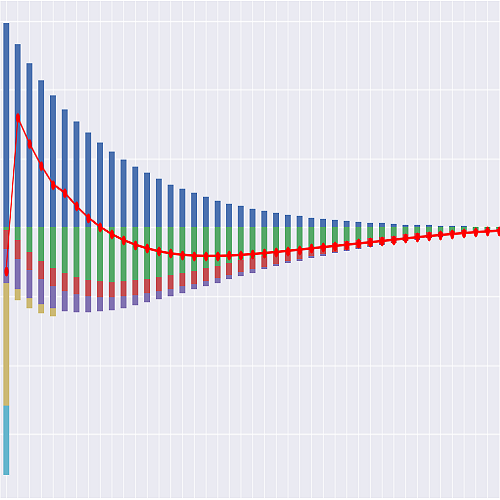
The Sofort_DE_S Model#
Reference liability cash flow model for the German sofortbeginnende Rentenversicherung.
Sofort_DE_S is the executable counterpart of
products/sofortrente/technical-notes.md in the lifelib-products library. It projects
gross best-estimate liability cash flows for a single model point of a German
sofortbeginnende private Rentenversicherung — the immediate payout annuity bought
outright with one Einmalbeitrag — on a monthly grid, undiscounted. One payment in
at inception; a stream of instalments out until death, floored by a Rentengarantiezeit
or a Kapitalrückgewähr, lifted by a declared Überschussrente, and extended past the
annuitant’s death by a Hinterbliebenenrente where one was bought.
Three things make this the payout model rather than a shortened accumulation one.
There is no behavioural assumption in it at all. Once the Rentenbezug has begun the policyholder has no right of termination, no Rückkaufswert, no Beitragsfreistellung and no capital option (§ 168 Abs. 3 VVG, with § 169 displaced and § 165 inapplicable), so the model carries no lapse rate, no paid-up state, no surrender cells and no account value. The only decrement is death. That is a statutory fact about the product, not a modeling simplification, and it makes this the one model in the library whose answer depends purely on the mortality basis and the surplus assumption.
The Rentengarantiezeit is a certain floor, not a second stream. Inside the guarantee
period the instalment is payable whether the annuitant is alive or not, so the payment
weight is max(certain_floor(t), lives_if(t)) and never certain_floor(t) +
lives_if(t); the additive reading pays 1 + l for the whole guarantee and nearly
doubles the first ten years’ outgo. The survivor’s leg carries a (1 - certain_floor)
gate for the same reason. check_guarantee_certain() and
check_payment_factor() assert both, on every model point.
The mortality surface is generational and the tariff is unisex. q is read at
(attained age, birth cohort) rather than at (attained age, projection year), so
two annuitants of the same age and different cohorts are priced on different mortality;
and the tariff annuity factor is struck on a blended unisex basis while the projection
decrements on the model point’s own sex, because German new business has been unisex
since 21 December 2012. The first-order margin reaches the improvement trend as well
as the level, which is what prudence means for an annuity.
Spaces. The model contains two:
DataReads the five input CSVs and holds their filename References. It takes no parameters, so each file is read once per model.
ProjectionThe by-policy projection, parameterized by
point_id:Projection[1]is an ItemSpace projecting model point 1. It reaches the input tables through itsdataReference, which resolves to the singleDataSpace.
The split matters for more than tidiness. Because Projection is parameterized, every
Projection[N] is a separate ItemSpace with its own cells cache; readers placed there
would re-read every file for every model point. In Data they are evaluated once,
however many points are projected.
Input data is external: CSVs in the model folder’s parent directory, read at run time rather than stored inside the model. The model folder itself holds no data, so the model and its inputs must travel together.
Projection basis. Monthly steps, t counted in complete months from
Vertragsbeginn, on a 0-based frame: a new-business point opens at t = 0, which
is both the month the Einmalbeitrag arrives and — under the representative vorschüssig
convention — the month the first instalment is paid. An in-force point opens at
t = duration_mth_init(), the months it has already run. proj_len() is the
exclusive end of the frame — the frame is range(t_start(), proj_len()), its last
month index is proj_len() - 1 and it carries proj_len() - t_start() rows — taken
as the maximum of the annuitant’s survival horizon, the guarantee period’s own end and
the second life’s horizon where a survivor’s annuity is in force.
What is sourced and what is not. The mechanics are sourced: the conversion of the Einmalbeitrag at a factor struck once at inception on DAV 2004 R and a Rechnungszins at or below the Höchstrechnungszins; the Rentengarantiezeit as a tariff-level feature; the Kapitalrückgewähr as the Einmalbeitrag less the instalments already paid; the Hinterbliebenenrente as a rider on a second life; the statutory Überschussbeteiligung continuing through the payout phase; and the absence of any surrender or paid-up value. Every level is a standardization. No search was run for this product — the session’s search budget was exhausted before it began — so no annuity rate, no charge, no surplus declaration and no portfolio mix was established at any carrier for any year. DAV 2004 R and DAV 2004 R-Bestand are the property of the Deutsche Aktuarvereinigung, are not public and are not redistributed here: they are cited by name and a documented [std] proxy ships in their place. This model is a mechanics demonstration, not a pricing or reserving result. Replace the decrement, charge and surplus tables with company data before drawing any conclusion from the output.
Model points. Fourteen, covering the plain Leibrente, each death-benefit option in turn, a joint-life cell with a younger second life, all four payment frequencies, both payment timings, all four Überschussverwendung forms, a five-year Aufschubzeit, an in-force point carrying an annuity struck in 2012 on a 1,75 % tariff, a pre-2025 Höchstrechnungszins vintage, both ends of the issue-age envelope and a cell with the Überschussrente switched off. Model point 1 is the anchor cell of the worked example in the technical notes.
Verification. tests/test_sofortrente_de.py asserts the notes’ worked example — the
anchor cell’s cash flows to the cent and its probabilities to six decimals — the derived
guaranteed instalment and the annuity factor behind it, and one test per listed modeling
pitfall.
Example
>>> import modelx as mx
>>> model = mx.read_model("products/sofortrente/Sofort_DE_S")
>>> model.Projection[1].result_cf()