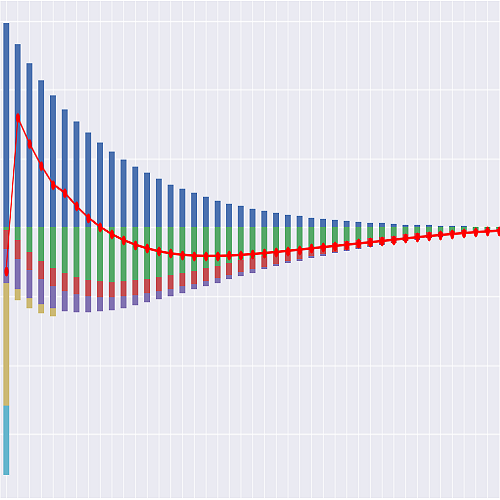
The MYGA_US_S Model#
Reference liability cash flow model for U.S. fixed deferred annuities (MYGA).
MYGA_US_S is the executable counterpart of
products/fixed_deferred_annuity/technical-notes.md in the lifelib-products
library. It projects gross liability cash flows for a single-contract model point of a
single-premium, book-value multi-year guaranteed annuity: one purchase payment credited
in full, an insurer-declared effective annual rate guaranteed for a five-year period, a
declining surrender charge, a 10% annual free-withdrawal allowance, a two-sided market
value adjustment, and underneath all of it the NAIC Model #805 minimum guaranteed
surrender value.
This is the deferred annuity base chassis of the library. The fixed-indexed annuity, variable annuity and registered index-linked annuity notes reference the surrender benefit composition order and the Model #805 floor construction specified here.
Spaces. The model contains two:
DataReads the seven input CSVs and holds their filename References. It takes no parameters, so each file is read once per model.
ProjectionThe by-contract projection, parameterized by
point_id:Projection[1]is an ItemSpace projecting model point 1. It reaches the input tables through itsdataReference, which resolves to the singleDataSpace.
The split matters for more than tidiness. Because Projection is parameterized, every
Projection[N] is a separate ItemSpace with its own cells cache; readers placed there
would re-read every file for every model point. In Data they are evaluated once,
however many contracts are projected.
Input data is external: CSVs in the model folder’s parent directory, read at run time rather than stored inside the model. The model folder itself holds no data, so the model and its inputs must travel together.
Projection basis. Monthly steps. t counts policy months from 0, t = 0, 1,
..., proj_len() - 1: t = 0 is the first policy month and month t runs from time
t to time t + 1. The contract year is the 1-based label policy_year(t) = t // 12
+ 1, so anniversaries fall at the start of t = 12, 24, ... and the closing account
value at the first anniversary is av_pp(11). Monthly is the library-wide grid, and
for this product it is also the coarsest one that hits every contract anniversary exactly
while still resolving the guarantee-period-end window and the shock-lapse boundary to
within one step [std].
The month’s processing order follows the technical notes exactly. At the beginning of
the month (BOM): roll the free-withdrawal counters; apply the guarantee-period boundary
(the 30-day window, the rate redeclaration and, under rollover, a fresh surrender
charge and MVA schedule); take the elective withdrawal, giving av_pp_at(t,
"BEF_INV"); take annuitization elections — valued on that same pre-crediting account
value, because the notes place the election at BOM while naming the post-crediting
SV(t) for the transfer, and the two cannot both hold on a monthly grid [std];
update the IRC 72 tax basis. At the end of
the month (EOM): credit interest, giving av_pp(t); roll the Model #805 floor
mgsv_pp(t); and apply decrements in the order annuitization, mortality, surrender
[std], with every decrement benefit valued on the post-crediting account value.
The issue instant is not a row. The single premium, the acquisition commission and the
premium tax are beginning-of-month flows of t = 0 — the notes’ “at t = 0” — and
the opening state of month 0 is av_pp_init(), mgsv_pp_init() and
pols_if_init(), read as av_pp_at(0, "BEF_WD") and pols_if(0); av_pp(0)
and mgsv_pp(0) are the closing balances of month 0, one month of crediting later.
result_cf() therefore has exactly proj_len() rows, t = 0 .. proj_len() - 1.
pols_if(t) is the count in force at the start of month t, the library-wide
convention (pols_if(0) == pols_if_init(), as in Term_US_S), and it is the
weight applied to that same month’s cash flows, so the pols_if column of
result_cf() reconciles with the row it sits on. The technical notes’ end-of-month
l(t) is unchanged and is read as pols_if_at(t, "AFT_DECR"). Likewise
lapse_rate(t) is the annual total surrender rate and lapse_rate_mth(t) the
monthly one, pairing as mort_rate / mort_rate_mth do.
proj_len() is 12 * (maturity_age - age_at_entry()), the number of projected
months; the last month, t = proj_len() - 1, ends at the contract anniversary at
attained age 100 [std] — the last attained age in the sourced
cap band on the renewal surrender charge, tabulated as 4% at 94 down to 0% at 98-100
[S1][S2]. The cap reaches zero at 98; 100 is where the sourced band stops, which is why
it is the horizon. The technical notes state no projection horizon; the choice is the
model’s, and the survivors at that point are annuitized out through pols_maturity()
so the in-force roll-forward closes.
Undiscounted. Like every model in this library, this one projects gross liability cash flows only. Reserves and discounting are a separate layer; the notes’ Valuation and reserve pointers section cites VM-22, A-820/AG 33 and IRC 807 rather than reproducing them. The contractual discounting that lives inside a benefit formula — the geometric MVA factor — is part of the product and stays.
What is sourced and what is not. The contractual elements come from the composite specimen: the 4.45% initial declared rate, the 0.25% GMIR and the 2.80% GMSV rate [S11]; the 9/8/7/6/5 initial surrender charge schedule and the 10% free-withdrawal allowance [S10]; the 5/4/3/2/1 renewal schedule and its attained-age cap [S1][S2]; the linear duration MVA and its application base [S8][S9]; the symmetric cap at the surrender charge [S2]; the 30-day guarantee-period-end window [S1][S2][S5][S6]; the death benefit at full account value [S1][S2][S13]; and the Model #805 construction — 87.5% of gross consideration accumulated at the contract GMSV rate, with the indexed statutory rate floored at 15 basis points, not 1% [R1 4.A, 4.B]. The prescribed base lapse table and the dynamic lapse functional form are VM-22 [R2 6.B.5].
Everything behavioural and expense-related is a standardization: the mapping of VM-22 Table 6.5 onto a five-year architecture, the 1.0% annuitization take-up at each window, the 0% partial withdrawal base run, the 2.00% acquisition commission, the $50 per contract per year maintenance expense inflating at 2.5%, the 0% premium tax, the 0.35 best-estimate MVA factor on dynamic lapse, the exogenous reference-yield and competitor-rate scenarios, the illustrative mortality table, and the attained age 100 projection horizon. This model is a mechanics demonstration, not a pricing or reserving result. Replace the assumption tables with company data before drawing any conclusion from the output.
Not implemented. Named here so the gaps cannot be mistaken for oversights.
The RMD module (the notes give the charge and MVA exemption but no RMD amount formula);
the nursing-home and terminal-illness waiver withdrawals (no incidence basis is given);
the VM-22 Table 6.2 age-banded partial-withdrawal rates (the retrieved table is the
Qualified column only and its 80-and-over row was truncated, and the notes say not to
present it as a non-qualified assumption); the greatest_of free-withdrawal rule (the
notes describe it but give no formula); the gross-up solve for a contract promising a
stated net check (wd_pp is gross by construction); the Model #805 section 6 paid-up
annuity leg (noted but not implemented in the notes themselves); and check_margin(),
because the product carries no contract charges and the model projects no asset side, so
the notes define no margin decomposition to check. check_av_roll_fwd() and
check_pols_roll_fwd() are implemented — no argument, returning a bool over every
projected month, with the signed per-month residual under
check_av_roll_fwd_resid(t) / check_pols_roll_fwd_resid(t). Stochastic scenario
generation is out
of scope: the reference yield and competitor rate are read from a deterministic scenario
table.
Model points. model_point_table.csv carries seven contracts on the same anchor
cell — male 60 ANB, non-qualified, $100,000 single premium, 5-year guarantee period —
that differ only in the switches the technical notes make first-class parameters, because
the cross-carrier divergence in those switches is the notes’ own headline finding. Point 1
is the worked example anchor; point 2 repeats it under the stress reference yield that
forces the symmetric cap and the nonforfeiture floor to bind; points 3 to 7 carry the
Camp B annual-redeclaration architecture, the registered-contract conventions, the
net-of-charges MGSV convention with its interest-only free withdrawal and
interest-credited cap [S5][S6][S8][S9], the asymmetric cap and the declared-differential
MVA. Between them they exercise all three MVA families, all five cap rules, both renewal
architectures, both Model #805 withdrawal conventions and both free-withdrawal rules, so
no branch of the notes’ parameter set is dead code. A test asserts every point projects.
Verification. tests/test_fixed_deferred_annuity_us.py asserts every row and column
of the notes’ worked example table (all seven months, money to the cent), both surrender
traces line by line including the capped MVA and the binding Model #805 floor, the
geometric branch factors from one registered contract [S4], the in-force and account
value roll-forwards, and one test per entry in the notes’ Known modeling pitfalls list.
Example
>>> import modelx as mx
>>> model = mx.read_model("products/fixed_deferred_annuity/MYGA_US_S")
>>> model.Projection[1].result_cf()