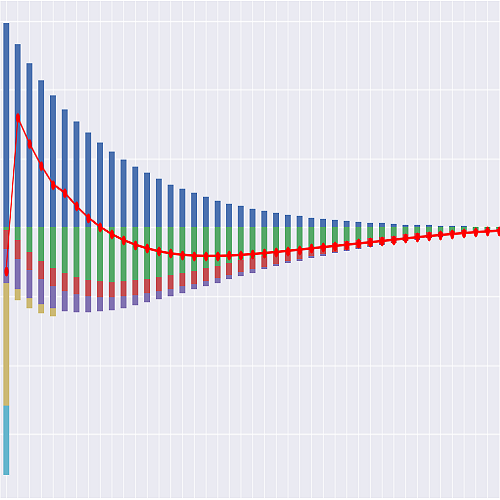
Sources#
Source ids [S#]/[R#] are carried verbatim from _research/basisrente.md (the citation ground
truth for this product) and are frozen — never renumber. Unused sources are omitted, so the
numbering had a gap at S12 (the GDV Musterbedingungen service index), which the drafting
session omitted because whether the GDV publishes a Basisrente model condition set at all was
never established (gap 5). That gap is now closed and S12 is restored below: the GDV
service index was retrieved on 2026-08-30 and it publishes a Basisrente Musterbedingung, a
Basisrente BUZ Musterbedingung and two Basisrente Muster-Standmitteilungen. All four were
retrieved in full. They are the spine this composite was written without, and several entries
below now rest on them. Every id — S1–S16 and R1–R24 — appears below. Original access date
for all sources: 2026-08-29; the retrieval pass recorded per entry ran on 2026-08-30.
Cross-product [REG-R#] tags are listed in their own section at the end.
Retrieval conditions — read this before relying on a single entry below. They are the conditions of house-rules section 3, and they are not what they were when this file was written:
This file was drafted with no retrieval at all. Direct HTTP egress from the build environment was blocked by an organisation network policy:
WebFetchandcurlwere refused with HTTP 403 at the egress gateway for every host outside a short package-registry allowlist, and every host that matters here was tried and refused —gesetze-im-internet.de(EStG § 10 and § 22, AltZertG, ZPO § 851c, VVG, DeckRV),bafin.de,gdv.de,aktuar.de,bundesfinanzministerium.de,bzst.de, the authority that certifies Basisrentenverträge, andde.wikipedia.org. There was no search channel either: the session’sWebSearchbudget — a hard cap of 200 calls shared across all delib work — was exhausted before this product was reached, two sibling delib research files having consumed it. So the first draft of every entry below rested on the authoring model’s own knowledge of German insurance law and practice, with no fetch, no search, no snippet and no summary behind it, disciplined by std and unverified tags rather than by a document.That policy has since been lifted and the citations were re-verified against the primary documents. On 2026-08-30 the German statutes and regulations this product turns on were read as canonical XML at
gesetze-im-internet.de, each with its amendment status (Stand) recorded on its entry and the sections it is cited for read; two carriers’ Allgemeine Versicherungsbedingungen, the GDV Musterbedingungen, filled-in Muster-Produktinformationsblätter, the consolidated BMF-Schreiben, a BFH judgment and an independent Effektivkosten study were retrieved as PDF or HTML and read. The same pass across the whole library read all fifteen German instruments delib cites as canonical XML and checked 950 statutory section references, of which 950 were correct; 62 % of delib’s source entries now sayRetrieved: yes.Where this file ends the pass. Of the forty entries below — S1–S16 and R1–R24 — twenty answer
Retrieved: yes, seven record part of what they cite as read and the rest as not, and thirteen are stillRetrieved: no. Those thirteen name what happened, and none of them is a paywall or a subscription login: four are amending acts (R5, R6, R7, R8) that have no consolidated page of their own atgesetze-im-internet.de, and for three of the four the effect is read instead in the consolidated law; one is the DAV 2004 R table R17, which delib has never seen and which is not published free of charge; five are carrier document sets — an index whose links are injected by script and resolve to no PDF [S3], a host that answers HTTP 403 to this build environment [S8], two carriers of which nothing was opened [S6] [S10], and the residual list for which nothing was searched [S11]; and three are market and supervisory material — a BaFin document not found at the address recorded R21, the GDV and BMF stock and new-business statistics, of which not one was opened, and rating pages that answer 200 with navigation and marketing copy and no rating table R24.
A Retrieved: yes entry is a certificate; a Retrieved: no entry is still a pointer. Where
the line says yes, the document was opened and the passage the entry rests on was read, and the
edition, Stand, page count or quoted wording on the entry comes from the document itself. Where
it says no, an R1 tag on a sentence about § 10 Abs. 1 Nr. 2 Buchst. b EStG means only this is
the instrument that claim must be checked against; it does not mean anyone read it, the URL is
either a canonical form offered and marked unverified or the entry says URL: not established,
and no document number, edition, page count or publication date has been invented anywhere in this
file. The re-verification changed things, and the changes are on the entries themselves: the
conversion basis of the guaranteed Rentenfaktor [S1] R17, one carrier’s product name [S4] and
the Kleinbetragsrente threshold R23 are corrections to what the drafted text said, not
confirmations of it.
Primary product sources#
S1 — Cosmos Lebensversicherungs-AG (CosmosDirekt), Allgemeine Bedingungen for the Basisrente — tariffs LA 1100 A, LA 1079 A, LA 936 A, LA 1099 A#
Publisher / doc type: Cosmos Lebensversicherungs-AG, the direct-writing arm of Generali Deutschland; Allgemeine Versicherungsbedingungen for Basisrente tariffs, in the carrier’s
LA nnnn Ahouse numberingURL:
https://www.cosmosdirekt.de/resource/blob/88924/af678e39611b9b44f5dfb3b0cebb895c/allgemeine-bedingungen-basisrente-la-1079-a--data.pdf(LA 1079 A, the klassisch wording) andhttps://www.cosmosdirekt.de/resource/blob/88926/1c398c12d5d98869dc0f23218bf20bf3/allgemeine-bedingungen-fondsgebundene-basisrente-la-1100-a--data.pdf(LA 1100 A, the fondsgebunden wording). Two further Basisrente documents sit under the sameresource/blobscheme and were retrieved with them: LA 1080 A (Hinterbliebenen-Zusatzversicherung, blob 89028) and the Muster-PIBs for both forms (blobs 89376 and 89378). LA 936 A and LA 1099 A were not located and are not asserted to existRetrieved: yes (PDF, 7 pp. each, editions LA 1079 A (10.15) and LA 1100 A (10.15), read 2026-08-30). Both wordings were read in full, §§ 1, 2, 6, 7 and 8 closely
Used for: the most productive single source in this file. It supplies, as read text rather than as inference: the three premium forms — LA 1079 A § 6 carries Zuzahlungen and premium adjustment, § 7 Abs. 2 the Einmalbeitrag, which the model’s
prem_formandzuzahlung_ppimplement; the tariff family RBA/RBAE (no death benefit) beside RBH/RBHE (spouse or registered partner), where a death in the Aufschubzeit converts the garantiertes Deckungskapital into a lifelong survivor’s annuity and never a lump sum, which isclaims_deathas a survivor’s single premium; the absence of a capital option — “Darüber hinaus erfolgen keine Auszahlungen. Ein Kapitalwahlrecht existiert nicht” (§ 1 Abs. 11) — and of any Rückkaufswert on either a Kündigung or a Beitragsfreistellung (§ 7 Abs. 1 and 3); the five-year spreading of acquisition costs, “Die bei der Beitragskalkulation in Ansatz gebrachten Abschluss- und Vertriebskosten verteilen wir in gleichmäßigen Jahresbeträgen mindestens auf die ersten fünf Vertragsjahre” (§ 8 Abs. 1), which iszill_spread_y = 5(gap 8, closed); the surplus shape — a Zins-Überschussanteil in per cent of the überschussberechtigtes Deckungskapital and a Grund-Überschussanteil in ‰ of the aufgelaufene Beitragssumme, accumulated as a Bonussumme in the Aufschubzeit, with a Schluss-Überschussanteil and a Bewertungsreserven-share in per cent of the Bonus-Deckungskapital falling due only at the end of the Aufschubzeit (§ 2 Abs. 2 b–d), which closes gap 17’s inference; the two payout-phase Überschusssysteme, jährliche Rentensteigerung (dynamische Rente) and Zusatzrente (flexible Rente) (§ 2 Abs. 2 e); and a transfer to another provider free of charge on three months’ notice (§ 7 Abs. 7–11), which with R18 closes gap 13. It also contradicts the entry as it stood. The conversion convention here is not an interest basis of 0 % p.a.: LA 1079 A § 1 Abs. 1 fixes the garantierter Rentenfaktor “auf Grundlage einer anerkannten Sterbetafel (DAV 2004R) sowie des tariflichen Garantiesatzes (Rechnungszins) von 1,25 Prozent p. a.” — the tariff’s own Rechnungszins, which for an October 2015 wording is that year’s Höchstrechnungszins. The 0 % figure was a Schicht-3 observation carried over from_research/klassische_rentenversicherung.mdand it does not describe this carrier’s Basisrente. The corrected statement is that the guaranteed factor is struck at inception on first-order DAV 2004 R at the tariff’s Rechnungszins, which moves with the guarantee vintage R16
S2 — Allianz Lebensversicherungs-AG, BasisRente KomfortDynamik — specimen persönlicher Vorschlag#
Publisher / doc type: Allianz Lebensversicherungs-AG; a distributed specimen quotation (“Berechnung BasisRente KomfortDyn”) hosted by a broker rather than by the carrier, dated by its path to February 2025 unverified, together with the carrier’s Vorsorgekonzept KomfortDynamik product page
URL: product page
https://www.allianz.de/vorsorge/vorsorgekonzept/komfortdynamik/; the specimen at a broker path recorded in the research fileRetrieved: partly. The product page: yes (HTML, ~531 kB, read 2026-08-30). The broker-hosted specimen quotation: no — the broker path recorded in the research file was not re-derivable and no substitute was found; both charge figures therefore remain uncorroborated
Used for: three claims, of which the retrieved page settles one outright. First, the layer is a tax wrapper around a common chassis — the page sells one Vorsorgekonzept across PrivatRente, BasisRente and RiesterRente — which is the argument in
product-spec.mdfor reusing the Schicht-3 chassis and inmodel.mdfor namingRV_DE_Sas the sibling. Second, the hybrid asset form with selectable guarantee levels, now confirmed verbatim: “Dafür stehen zum Rentenbeginn neben einem Garantieniveau von 80 % der eingezahlten Beiträge auch ein Garantieniveau von 60 % für noch höhere Chancen oder 90 % für noch höhere Sicherheit zur Verfügung”, with 100 % reserved by law to Riester — so the 60 / 80 / 90 % ladder with 80 % as the default is a read fact, and the third row of the asset-form table no longer carries a tag. Third, the two charge figures — an Abschlussprovision of 1 575 € on the specimen and total costs relative to the capital formed of at most 0,95 € per 100 € — remain unverified, because the specimen itself was not reached; they are no longer the corpus’s only charge anchor, since [S13] now supplies a filled-in Muster-PIB with an Effektivkosten figure and a full charge schedule
S3 — Allianz Lebensversicherungs-AG, the BasisRente product family#
Publisher / doc type: Allianz Lebensversicherungs-AG; AVB, Produktinformationsblätter and Verbraucherinformationen for the carrier’s Basisrente tariffs, marketed as BasisRente Klassik, BasisRente Perspektive and BasisRente InvestFlex
URL: the carrier’s Muster-PIB index for the family,
https://www.allianz.de/service/vorsorge/muster-produktinformation-allianz-basisrente/Retrieved: no — the index page returns 200 with its document links injected by script, so no Muster-PIB PDF could be resolved from it; no AVB, PIB or Verbraucherinformation of this carrier was opened. The product names are, however, no longer unverified: BasisRente InvestFlex, in both a no-guarantee and an 80 %-Beitragsgarantie form, is named as an Allianz Basisrente tariff in the Fraunhofer ITWM study at [S16], and BasisRente Perspektive and the 60/80/90 % guarantee ladder are on the carrier’s own pages at [S2]
Used for: the family’s existence and its tariff names. It appears in the variations table of
product-spec.mdas the second column’s document set, and is named because Allianz is the largest German life writer, so its Basisrente wordings remain the most consequential documents this corpus has not opened. Every substantive Allianz claim in the product documents is sourced to [S2] or [S16] instead
S4 — Alte Leipziger Lebensversicherung a. G., AL_RoyalBasisRente (Klassik and Fonds)#
Publisher / doc type: Alte Leipziger Lebensversicherung a. G., Oberursel; AVB, Produktinformationsblatt, Verbraucherinformation
URL:
https://www.alte-leipziger.de/Allgemeine-Bedingungen-fondsgebundene-Basisrentenversicherung-pm2401.pdf; the sibling wordings sit under the same flat scheme —...-moderne-flexible-basisrente-pm2153.pdfand...-fondsgebundene-Basisrentenversicherung-mit-flexiblen-Garantien-pm2405.pdfRetrieved: yes for pm 2401 (PDF, 21 pp., edition pm 2401 – 06.2026, read 2026-08-30); the other two wordings were located but only their identity was taken
Used for: the correction of this entry’s own product name, and the carrier’s tariff codes. The retrieved wording is titled “Allgemeine Bedingungen für die fondsgebundene Basisrente (Tarif FR70)”, and the Fraunhofer study at [S16] names the family ALfonds-Basis, tariff FR70 without a Beitragsgarantie and tariff FR75 with an 80 % one. “AL_RoyalBasisRente” is not the current market name and is withdrawn as a claim; it is retained in the heading only because the id is frozen. The entry still carries the sentence in
product-spec.mdnaming this carrier as a first target for a checker, because it is repeatedly placed at the top of independent Basisrente ratings R24
S5 — NÜRNBERGER Lebensversicherung AG, Basis-Rente with Berufsunfähigkeits-Zusatzversicherung#
Publisher / doc type: NÜRNBERGER Lebensversicherung AG; AVB for the Basisrente main contract and separate AVB for the BUZ rider; the carrier’s Muster-PIB for the fund-linked Basisrente
URL:
https://www.nuernberger.de/medien/4allportal/lv052_030_p.pdf— the Muster-Produktinformationsblatt for the NÜRNBERGER Fondsgebundene Basisrente, certification number 006590, Stand 01.01.2025. The AVB for the Basisrente main contract and for the BUZ rider sit in the same4allportalscheme but no Basisrente AVB document id was located; the carrier’s Schicht-3 wording GN331451 (tariff NIR3301) was retrieved and is not a BasisrenteRetrieved: the Muster-PIB yes (PDF, 2 pp., Stand 01.01.2025, read 2026-08-30); the AVB and the BUZ AVB no — not located at any address on the carrier’s own site
Used for: the corpus’s first quantified Basisrente charge schedule and its first Rentenfaktor level, both from the retrieved Muster-PIB, and both reported in full at [S13]. The tariff is NFX3208T [S16]. On the BUZ, this entry no longer carries gap 18: a Basisrente BUZ wording has now been read — not this carrier’s, but the GDV Musterbedingung at [S12], whose § 9 Abs. 2 states the 50 % rule in contractual terms, “Die Zusatzversicherung ist so gestaltet, dass stets mehr als 50 % der Beiträge auf Ihre Hauptversicherung entfallen”. That is the invariant
buz_prem_share < 0.50, now cited rather than asserted. What remains unreached is this carrier’s own BUZ wording, which would show how a principal Berufsunfähigkeit writer words the rule in practice
S6 — Volkswohl Bund Lebensversicherung a. G., Basisrente#
Publisher / doc type: Volkswohl Bund Lebensversicherung a. G., Dortmund; AVB, Produktinformationsblatt
URL: not established — the carrier’s Basisrente pages were reached but no AVB or PIB PDF was resolved from them
Retrieved: no — no AVB and no PIB of this carrier was opened. Its tariff names are established at second hand: the Fraunhofer study at [S16] names BFR (FondsPur) without a Beitragsgarantie and BGR with an 80 % one, and gives Effektivkosten for both
Used for: existence, tariff names, and one of the five carriers in the Effektivkosten comparison at [S16]. Named in the variations table of
product-spec.mdas a broker-channel carrier with a large Basisrente book R24, the broker channel being where this product is sold
S7 — LV 1871 (Lebensversicherung von 1871 a. G.), Basisrente#
Publisher / doc type: Lebensversicherung von 1871 a. G., München; AVB, Produktinformationsblatt; the current market name is MeinPlan Basisrente
URL:
https://www.lv1871.de/basisrente/(product page); the carrier’s PRIIPs Basisinformationsblätter index is athttps://www.lv1871.de/service/kundenservice/basisinformationsblaetter/Retrieved: the product page yes (HTML, read 2026-08-30); no AVB and no PIB. The page names the tariff MeinPlan Basisrente, offers an ETF and fund line-up including ETF-Portfolio Plus and Expertenpolice, and advertises combination “mit umfassendem Berufsunfähigkeitsschutz” — so the MeinPlan attribution is confirmed and the tag goes; “Golden Basic” is not on the current line-up and is withdrawn
Used for: the asset-form row of
product-spec.mdthat names a fondsgebundene Basisrente with an open fund and ETF universe and no Beitragsgarantie. The form itself is no longer unverified: [S16] computes Effektivkosten for a no-guarantee fund-linked Basisrente at five separate carriers, so the form is demonstrably a market staple. What stays unverified is the claim that it dominates new business, for which no figure exists anywhere in the corpus (gap 3)
S8 — Swiss Life Deutschland, Basisrente (Swiss Life Maximo family)#
Publisher / doc type: Swiss Life AG, Niederlassung für Deutschland; AVB, Produktinformationsblatt
URL:
https://www.swisslife.de/privatkunden/altersvorsorge/basisrente.html— the obvious canonical form on the carrier’s own siteRetrieved: no — the carrier’s host answers HTTP 403 to this build environment on every path tried on 2026-08-30, so nothing of this carrier was opened and the entry is kept as a known reference. The Maximo product name accordingly stays unverified
Used for: nothing beyond existence. Cited beside [S2] in the asset-form table of
product-spec.mdas a second large broker-channel writer of the hybrid form with a selectable guarantee level. That the hybrid form with a selectable guarantee level exists is now established at [S2] and [S16]; the attribution of it to this carrier is not
S9 — Continentale Lebensversicherung AG, Basisrente (Rente Invest Basis family)#
Publisher / doc type: Continentale Lebensversicherung AG, Dortmund; AVB, Produktinformationsblatt
URL:
https://www.continentale.de/basisrenteRetrieved: the product page yes (HTML, read 2026-08-30); no AVB and no PIB. The page offers “drei Anspar-Wege” — a klassisch, a hybrid and a fund-linked accumulation route to one guaranteed lifelong annuity — and names the fund-linked tariff BasisRente Invest. The entry’s product name is therefore corrected: it is BasisRente Invest, not “Rente Invest Basis”, and the tag goes
Used for: existence, the corrected tariff name, and the three-accumulation-route structure, which is the same klassisch / hybrid / fondsgebunden triple the asset-form table of
product-spec.mdsets out. Named in the variations table ofproduct-spec.md
S10 — Stuttgarter Lebensversicherung a. G., Basisrente#
Publisher / doc type: Stuttgarter Lebensversicherung a. G.; AVB, Produktinformationsblatt
URL: not established — the carrier’s Basisrente path was tried on 2026-08-30 and returned HTTP 404, and no replacement path was resolved
Retrieved: no — nothing of this carrier was opened. Its Basisrente tariff is named at second hand in the Fraunhofer study at [S16], as BasisRente performance+, in a no-guarantee and an 80 %-Beitragsgarantie form
Used for: the single sentence in
product-spec.mdrecording that a fourth asset form — an index-linked Basisrente — is plausible from one carrier’s tariff naming and was not established (gap 12). That naming is now weakened rather than confirmed: the tariff the study observes is performance+, not performance-safe, and no index-safe Basisrente tariff was found at this carrier at all. The possibility of an index-linked Basisrente — the bridge to delib product 4 (indexpolice) — is therefore still open, but it no longer has even a tariff name behind it, and the documents continue to assert nothing
S11 — The carriers for which nothing whatever was established#
Publisher / doc type: Debeka, R+V, HDI, Gothaer, Zurich Deutscher Herold, ERGO, AXA, Generali / Dialog, Barmenia, Universa, Württembergische, Signal Iduna, Baloise, DEVK, Provinzial, HUK-Coburg, Hannoversche, CosmosDirekt (beyond [S1]), die Bayerische, Condor — each writes, or has written, a Basisrente and therefore publishes AVB, a Produktinformationsblatt and a Verbraucherinformation for it
URL: not established for any of them
Retrieved: no — not one document of any carrier on this list was opened on 2026-08-30. None was individually searched for; the retrieval effort went to the carriers that [product-spec.md] actually cites
Used for: a statement of coverage rather than a fact. It carries the sentence in
product-spec.mdthat twenty named German life writers whose Basisrente documents exist were not reached, and not one contributes a single fact (gap 1). That sentence stands for these twenty. Gap 1 as a whole no longer does: two carriers’ Basisrente wordings [S1] [S4], one carrier’s filled-in Muster-PIB [S5] [S13] and the GDV model conditions [S12] have now been read, so the composite is no longer built without a single carrier document. One carrier not on this list — WWK Lebensversicherung a. G. — supplies the second retrieved Muster-PIB at [S13]
S12 — GDV, Musterbedingungen and Muster-Standmitteilungen for the Basisrente#
Publisher / doc type: Gesamtverband der Deutschen Versicherungswirtschaft e. V., Berlin; non-binding model conditions and model annual statements for the German life market (”Diese Bedingungen sind für die Versicherer unverbindlich; ihre Verwendung ist rein fakultativ”)
URL: service index
https://www.gdv.de/gdv/service/musterbedingungen, from which four Basisrente documents resolve under thegdv.de/resource/blob/...scheme: the Basisrente AVB (blob 6292), the BUZ zur Basisrente (blob 6330), the Hinterbliebenenrenten-Zusatzversicherung zur Basisrente (blob 6338) and the Muster-Standmitteilungen for a Basisrentenversicherung (klassisch) (blob 6314) and (mit BUZ) (blob 6310)Retrieved: yes — the index (HTML, ~94 kB), the Basisrente AVB (PDF, 18 pp., Stand: 21.07.2025), the BUZ AVB (PDF, 11 pp., Stand: 15.11.2022) and the klassisch Muster-Standmitteilung (PDF, 8 pp., 02.2017 form), all read 2026-08-30
Used for: this entry did not exist in the drafted file, because whether it existed at all was gap 5. It does exist, and it is now the spine of several other entries. From the Basisrente AVB: the payout shape and the age floor (§ 1 Abs. 1); the combination of up to twelve monthly annuities into one payment where the monthly annuity is small (§ 1 Abs. 2), which closes gap 19; the Kleinbetragsrente commutation right and the fact that it is the insurer’s right, not the policyholder’s (§ 1 Abs. 3), reported at R23; the Kündigung that converts to a paid-up contract and pays no Rückkaufswert, with a single-premium contract simply continuing unchanged (§ 9), and partial termination and partial premium-freezing above a minimum annuity (§ 9 Abs. 2, § 10 Abs. 4); the paid-up annuity computed “unter Zugrundelegung des Betrages des Deckungskapitals, das sich bei gleichmäßiger Verteilung der … angesetzten Abschluss- und Vertriebskosten auf die ersten fünf Vertragsjahre ergibt” (§ 10 Abs. 1), which closes gap 8; the charge menu of § 11, which is the closed list of AltZertG § 2a and includes the Verrechnungsverfahren of DeckRV § 4 capped at “2,5 % der von Ihnen während der Laufzeit des Vertrages zu zahlenden Beiträge”; and the annual-information field list of § 14, which is [S15]. From the BUZ AVB: the 50 % rule in contractual terms (§ 9 Abs. 2), the rider’s termination with the main contract, and the rule that a BUZ Rückkaufswert is never paid out but raises the main contract’s benefits (§ 9 Abs. 3) — the material gap 18 said had not been reached
S13 — Produktinformationsblatt under § 7 AltZertG (the standardised PIB)#
Publisher / doc type: each provider, on a form and a computational method prescribed by law and administered by the Produktinformationsstelle Altersvorsorge gGmbH (PIA), Kaiserslautern; the mandatory pre-sale document for a certified Basisrentenvertrag
URL: there is no single URL — the individual PIB is quotation-specific and never public, but § 7 Abs. 4 AltZertG requires every provider to publish a Muster-PIB for assumed terms of 12, 20, 30 and 40 years on its own website. Two were retrieved: NÜRNBERGER,
https://www.nuernberger.de/medien/4allportal/lv052_030_p.pdf, and WWK,https://www.wwk.de/medien/dokumente/produktinformationsblaetter/basisrente-invest-protect-50/fvg22_eb_lz20_50bg.pdfRetrieved: yes, two Muster-PIBs (NÜRNBERGER, PDF, 2 pp., certification number 006590, Stand 01.01.2025; WWK, PDF, 2 pp., certification number 006421, Stand 03.01.2024), read 2026-08-30. No individual PIB was obtained, and none can be: it exists only inside a quotation
Used for: gap 2 and gap 7, both of which this entry can now answer. The Muster-PIB is on the form and computational method of the AltvPIBV R11, and it carries the Effektivkosten — the reduction in yield in percentage points — and a Chancen-Risiko-Klasse computed by PIA. The CRK scale is 1 to 5, CRK 1 the lowest; the Effektivkosten are computed against a reference gross return fixed by the CRK (2 / 3 / 4 / 5 / 6 % for CRK 1 to 5) and the benefit scenarios against four returns per CRK (for CRK 4: −1 %, 2 %, 5 % and 6 %) — all of it AltvPIBV §§ 5, 8 and 10, so gap 7 is closed. The NÜRNBERGER sheet is the first quantified Basisrente in the delib corpus and every figure below is read off it: a Musterkunde born 1988, contract from 01.01.2025, 30 years’ accumulation to age 67, 100 € a month, so 36 000 € paid; CRK 4; Effektivkosten 1,77 percentage points (”Eine beispielhafte Wertentwicklung von 5,00 % wird durch die renditemindernden Größen von 1,77 Prozentpunkten auf eine Effektivrendite von 3,23 % verringert”); garantiertes Kapital für Verrentung 18 000,00 €; garantierte monatliche Altersleistung 44,89 € at a guaranteed Rentenfaktor of 24,94 € per 10 000 € of capital — the first Rentenfaktor level anywhere in this corpus, which is gap 4; Abschluss- und Vertriebskosten 900,00 € = 2,50 % der vereinbarten Beiträge, plus 2,50 % on each Zuzahlung; Verwaltungskosten of 7,00 % der eingezahlten Beiträge and up to 3,80 % p.a. of the fund (fund charges included; current burden 1,10 %); 1,50 % of the annuity p.a. in the payout phase; Versorgungsausgleich up to 500,00 €; and “Ein Anbieterwechsel ist bei diesem Produkt ausgeschlossen”. The WWK sheet, a 20-year single-premium contract with a 50 % Beitragsgarantie, is CRK 4 with Effektivkosten of 4,95 percentage points, and likewise excludes an Anbieterwechsel. Read the Effektivkosten on a Muster-PIB as a ceiling, not an expectation. They are computed on the maximum permitted charge parameters, and the Fraunhofer ITWM study at [S16] puts the realistic figure for the same five carriers’ fund-linked Basisrenten at 1 – 1,5 percentage points against Muster-PIB figures of 3,0 – 4,6. That distinction is the single most important thing this entry now carries
S14 — Basisinformationsblatt (PRIIPs key information document)#
Publisher / doc type: each provider; the PRIIPs KID for an insurance-based investment product
URL: not established for a Basisrente. A carrier’s Basisinformationsblatt index was reached (
https://www.lv1871.de/service/kundenservice/basisinformationsblaetter/) and one Basisinformationsblatt was retrieved in full — NÜRNBERGERhttps://www.nuernberger.de/medien/4allportal/gn339322_p.pdf, tariff NR3361DV, Stand 01.01.2026 — but that document is a Schicht-3 contract with a Kapitalwahlrecht, not a BasisrenteRetrieved: one specimen of the document type, yes; none for a Basisrente, no. The retrieved specimen establishes the form — purpose statement, product type, recommended holding period, a summary risk indicator on a scale of 1 to 7, performance scenarios and a cost table — but it establishes nothing about a Basisrentenvertrag
Used for: the record in
product-spec.mdthat the document type exists and what it carries. Gap 6 is narrowed but not closed. What is now established, from § 7 Abs. 2 AltZertG R11, is that the individual Produktinformationsblatt “ersetzt das Informationsblatt zu Versicherungsprodukten nach § 4 der VVG-Informationspflichtenverordnung” and that no Modellrechnung under § 154 VVG is to be performed for a certified contract, and none may be attached — so the AltZertG PIB does displace at least one neighbouring disclosure. Whether it also displaces the PRIIPs Basisinformationsblatt is still not established: no Basisrente KID was found at any carrier, which is consistent with the product being outside PRIIPs but does not prove it. Nothing downstream asserts either arrangement
S15 — Annual statement to the policyholder (jährliche Information, § 7a AltZertG)#
Publisher / doc type: each provider; the statutory annual information for a certified contract
URL: the statute itself,
https://www.gesetze-im-internet.de/altzertg/__7a.html; the GDV Muster-Standmitteilung for a Basisrentenversicherung (klassisch) at [S12]Retrieved: yes — § 7a AltZertG as canonical XML (Stand: zuletzt geändert durch Art. 5 G v. 25.10.2023 I Nr. 294), and the GDV Muster-Standmitteilung (PDF, 8 pp.), both read 2026-08-30. The paragraph address § 7a is correct and the tag goes
Used for: one sentence in the regulatory-context section of
product-spec.md, which can now name the fields instead of gesturing at them. § 7a Abs. 1 requires the provider to inform the contract partner annually of (1) the use made of the contributions paid, (2) the amount of capital built up, (3) the actual costs incurred in the past contribution year, (4) the investment return earned, and (5), until the payout phase begins, the capital expected to be available at its start after costs, projected on the contributions actually paid and the Wertentwicklungen of the individual PIB — plus a statement on ethical, social and environmental considerations. The GDV model conditions restate that list at § 14 and add that the capital figure is a Gesamtkapital including allocated surplus, non-guaranteed Schlussüberschüsse and the non-guaranteed Bewertungsreserven-share. That is the same state-variable listresult_pols()publishes, and it is now sourced
S16 — Consumer, comparison and rating material#
Publisher / doc type: Finanztip, Stiftung Warentest / Finanztest, the Verbraucherzentralen, Verivox, CHECK24, Handelsblatt and the rating houses at R24; consumer guides, comparison-portal pages and product ratings — secondary in every case, and S-numbered in frlib’s convention because they describe the product rather than regulate it. One independent study is now added to this entry and is the only member of it that was read: Fraunhofer-Institut für Techno- und Wirtschaftsmathematik ITWM, Kaiserslautern, Studie – Reale Effektivkosten für ausgewählte Basisrentenprodukte, 4 December 2023
URL:
https://www.itwm.fraunhofer.de/content/dam/itwm/de/documents/PressemitteilungenPDF/2023/20231204_Studienbericht_Fraunhofer_ITWM_Muster-PIB.pdf; not established for any of the consumer and comparison sourcesRetrieved: the Fraunhofer study yes (PDF, 12 pp., 04.12.2023, read 2026-08-30). No consumer guide, comparison-portal page or product rating was retrieved, and none was searched for
Used for: the study supplies what the consumer material was supposed to and did not — a comparative charge observation across named carriers. It computes Effektivkosten for the fund-linked Basisrenten of Allianz (BasisRente InvestFlex), Alte Leipziger (ALfonds-Basis FR70 / FR75), NÜRNBERGER (NFX3208T), Stuttgarter (BasisRente performance+) and Volkswohl Bund (BFR FondsPur / BGR), in a no-guarantee and an 80 %-Beitragsgarantie form, at 30 and 40 years, both on the Muster-PIB’s maximum-charge convention and on realistic charge parameters. Without a guarantee the Muster-PIB figures run 3,00 – 4,58 percentage points and the realistic ones 1,0 – 1,5; with an 80 % guarantee the Muster-PIB figures run 2,5 – 3,5 and the realistic ones 1 – 2,3, or 1 – 1,5 once fund kickbacks are counted. Its own conclusion is the caution this file carries: Muster-PIB Effektivkosten are “als Obergrenze sicher sehr zuverlässig” but “überschätzt in der Regel tatsächlich realistische Werte deutlich”. What is still not established is everything else in this entry. Every price point, every market share and every buyer-profile statement in
product-spec.mdremains unverified general knowledge or a std construction, marked at the point of use, and gap 3 stands as to market size and channel mix
Regulatory and actuarial references (product research numbering)#
Every German statute and regulation cited in this section was retrieved on 2026-08-30 as
canonical XML from gesetze-im-internet, with the law’s Stand attached, and read at the section
the entry relies on. Each entry says which. Two cautions carry across the whole section.
First, the per-section HTML page gesetze-im-internet.de/<law>/__NNN.html is a frameset shell of
about 5 kB carrying no statutory text; it is kept in each entry as the human-facing link and
is not what was read. Second, the entries that are not statutes — the amending acts at
R5–R8, the BFH judgments at R19, the BaFin material at R21 and the market statistics at
R22 — were not retrieved as documents, and say so individually. Where an entry is still
unconfirmed it now says why, rather than resting on the blanket condition the drafting session
was under.
R1 — EStG § 10 Abs. 1 Nr. 2 Buchst. b — the definition of a Basisrentenvertrag#
Publisher / doc type: Bundesministerium der Justiz / juris; statutory provision
URL:
https://www.gesetze-im-internet.de/estg/__10.html(the human-facing link; a frameset shell, not the text)Retrieved: yes (canonical XML, Stand: neugefasst durch Bek. v. 8.10.2009 I 3366, 3862, zuletzt geändert durch Art. 7 G v. 29.6.2026 I Nr. 197; § 10 read in full 2026-08-30)
Used for: more than any other instrument in this product, and now quoted rather than paraphrased. The five prohibitions are Satz 2 of Nr. 2 Buchst. b, verbatim: “Die Ansprüche nach Buchstabe b dürfen nicht vererblich, nicht übertragbar, nicht beleihbar, nicht veräußerbar und nicht kapitalisierbar sein.” That is the absence of a Rückkaufswert, a Kapitalwahlrecht, a Teilkapitalauszahlung, a policy loan, an assignment and a commutation, which
model.mdpublishes as structural absences andcheck_no_capital()asserts. The payout shape and the age floor are Doppelbuchst. aa: “die Zahlung einer monatlichen, auf das Leben des Steuerpflichtigen bezogenen lebenslangen Leibrente nicht vor Vollendung des 62. Lebensjahres”, and the 60/62 split is Absatz 6 of the same section — “Absatz 1 Nummer 2 Buchstabe b Doppelbuchstabe aa ist für Vertragsabschlüsse vor dem 1. Januar 2012 mit der Maßgabe anzuwenden, dass der Vertrag die Zahlung der Leibrente nicht vor der Vollendung des 60. Lebensjahres vorsehen darf” — so both floors and their boundary date are confirmed and the tags go; model points 1 and 6 sit either side of it. The closed list of permitted survivors is Satz 2 of aa: “Hinterbliebene in diesem Sinne sind der Ehegatte des Steuerpflichtigen und die Kinder, für die er Anspruch auf Kindergeld oder auf einen Freibetrag nach § 32 Absatz 6 hat”, with the orphan’s annuity limited to the period in which the child qualifies under § 32 — which is whyclaims_deathis a survivor’s single premium and never a lump sum. Two further readings the drafted entry did not have: Satz 3 permits combining up to twelve monthly payments into one and the commutation of a Kleinbetragsrente im Sinne von § 93 Absatz 3 Satz 2 oder 4 (see R23, and gap 19, closed), and Satz 5 shuts the door — “Neben den genannten Auszahlungsformen darf kein weiterer Anspruch auf Auszahlungen bestehen”. One correction. The 50 % majority test is not in this section. The statute requires only that a supplementary cover be ergänzend; the 50 % test is administrative, and its text is at R18: “Die ergänzende Absicherung ist nur dann unschädlich, wenn mehr als 50 % der Beiträge auf die eigene Altersversorgung des Steuerpflichtigen entfallen”. The invariantbuz_prem_share < 0.50should be cited to R18 and [S12], not to this entry
R2 — EStG § 10 Abs. 3 — the Höchstbetrag, its knappschaftliche peg, and the employee reductions#
Publisher / doc type: Bundesministerium der Justiz / juris; statutory provision
URL:
https://www.gesetze-im-internet.de/estg/__10.html(human-facing link only)Retrieved: yes (canonical XML, same Stand as R1; § 10 Abs. 3 read 2026-08-30)
Used for: the single annual Höchstbetrag and its peg, both now verbatim — Satz 1 and 2: “Vorsorgeaufwendungen nach Absatz 1 Nummer 2 sind bis zu dem Höchstbeitrag zur knappschaftlichen Rentenversicherung, aufgerundet auf einen vollen Betrag in Euro, zu berücksichtigen. Bei zusammenveranlagten Ehegatten verdoppelt sich der Höchstbetrag.” That confirms the knappschaftliche peg, the doubling on joint assessment and the rounding convention (
aufgerundet, up to a whole euro) thatproduct-spec.mduses to reproduce the series. The 2026 ceiling is now confirmed end to end: the Sozialversicherungsrechengrößen-Verordnung 2026 R20 sets the knappschaftliche BBG at 124 800 € p.a., and 124 800 × 24,7 % = 30 825,60, rounded up to 30 826 € — which is the figure in the table and at model point 9. The 2025 line reproduces the same way from 118 800 €. The two employee mechanisms are Satz 3 (the reduction by the Gesamtbeitrag to the general RV, for the employee groups of Nr. 1 and the § 22 Nr. 4 recipients of Nr. 2) and Satz 5 (the tax-free employer share subtracted afterwards). The argument that the ceiling moves every year so the premium should too is unchanged, and is why the model carries a Beitragsdynamik and a Zuzahlung rather than a level premium
R3 — EStG § 10 Abs. 2 and Abs. 2a — certification and data transmission as conditions of relief#
Publisher / doc type: Bundesministerium der Justiz / juris; statutory provision
URL:
https://www.gesetze-im-internet.de/estg/__10.html(human-facing link only)Retrieved: yes (canonical XML, same Stand as R1; § 10 Abs. 2 and Abs. 2a read 2026-08-30)
Used for: the statement in
product-spec.mdthat the Sonderausgabenabzug is conditional on certification and on electronic transmission of the contribution data, so that an uncertified contract, however economically identical, gets no relief at all — which is what makes the prohibitions bind the insurer’s product design rather than merely the policyholder’s rights. Both paragraph addresses are now exact and the tag goes. Certification is Abs. 2 Satz 2: “Vorsorgeaufwendungen nach Absatz 1 Nummer 2 Buchstabe b werden nur berücksichtigt, wenn die Beiträge zugunsten eines Vertrags geleistet wurden, der nach § 5a des Altersvorsorgeverträge-Zertifizierungsgesetzes zertifiziert ist, wobei die Zertifizierung Grundlagenbescheid im Sinne des § 171 Absatz 10 der Abgabenordnung ist” — the Grundlagenbescheid character being a detail the drafted entry did not have. Data transmission is Abs. 2a: the provider must transmit the contributions paid in the year and the certification number to the central body under § 93c AO
R4 — EStG § 22 Nr. 1 Satz 3 Buchst. a Doppelbuchst. aa — the Besteuerungsanteil#
Publisher / doc type: Bundesministerium der Justiz / juris; statutory provision
URL:
https://www.gesetze-im-internet.de/estg/__22.html(human-facing link only)Retrieved: yes (canonical XML, Stand: neugefasst durch Bek. v. 8.10.2009 I 3366, 3862, zuletzt geändert durch Art. 7 G v. 29.6.2026 I Nr. 197; § 22 Nr. 1 Satz 3 Buchst. a read in full, including the statutory cohort table, 2026-08-30)
Used for: the payout-side rule of the layer. The Kohortenprinzip is Satz 3 of Doppelbuchst. aa: “Der der Besteuerung unterliegende Anteil ist nach dem Jahr des Rentenbeginns und dem in diesem Jahr maßgebenden Prozentsatz aus der nachstehenden Tabelle zu entnehmen”. The whole cohort table was read and every percentage in
product-spec.mdnow matches it, so the tags go: bis 2005 50,0; 2020 80,0; 2021 81,0; 2022 82,0; 2023 82,5; 2024 83,0; 2025 83,5; 2026 84,0; then half a point a year to 2058 100,0. The Rentenfreibetrag is Sätze 4 to 7, and they say more precisely what the documents claim: the difference between the annual annuity and the taxable part “gilt ab dem Jahr, das dem Jahr des Rentenbeginns folgt, für die gesamte Laufzeit des Rentenbezugs” — a euro amount frozen in the first full year — and, decisively for the payout-phase Überschussverwendung, “Regelmäßige Anpassungen des Jahresbetrags der Rente führen nicht zu einer Neuberechnung und bleiben bei einer Neuberechnung außer Betracht”, so a dynamische Rente’s increases are fully taxable while a structural change in the annuity is not. That is the tax dimension the choice of surplus system has here and lacks in Schicht 3. On gap 16: aa applies to “Rentenversicherungen im Sinne des § 10 Absatz 1 Nummer 2 Buchstabe b” without distinguishing aa from bb, so a BU-Rente from a Basisrentenvertrag is on the same cohort basis; the drafted reading is confirmed. No delib model computes tax: this instrument explains the economics and justifies the model point, and reaches no cash flow
R5 — Alterseinkünftegesetz (AltEinkG), 2004#
Publisher / doc type: Deutscher Bundestag / Bundesgesetzblatt; enabling statute
URL: not established. No Bundesgesetzblatt citation is given, because none was confirmed (gap 23, still open for this entry)
Retrieved: no — the AltEinkG is an amending act, not a consolidated instrument, so it has no gesetze-im-internet page of its own; no attempt was made to reach the Bundesgesetzblatt itself, and none of the claims below was read anywhere
Used for: the opening of the regulatory-context section of
product-spec.md— the statute effective 1 January 2005 that built the three-layer architecture, introduced nachgelagerte Besteuerung for the first layer and created the Basisrente so that the self-employed would have a vehicle with the statutory scheme’s tax treatment, following the report of the commission chaired by Bert Rürup, from which the market name. Two corroborations are now available at one remove: the cohort table at R4 begins “bis 2005 50,0”, which fixes 2005 as the transition’s first year, and § 10 Abs. 3 Satz 4 begins its phase-in at 2013 on a schedule that only makes sense from a 2005 start. The Bundesverfassungsgericht decision the statute responded to remains unverified as to year and case: it was not searched for
R6 — Wachstumschancengesetz (2024) — the half-point step and the 2058 endpoint#
Publisher / doc type: Deutscher Bundestag / Bundesgesetzblatt; amending statute
URL: not established; no Bundesgesetzblatt citation (gap 23, still open for this entry)
Retrieved: no — an amending act with no consolidated page of its own; it was not retrieved. Its effect, however, is now read directly in the consolidated law: the statutory table at R4 runs 2021 81,0 → 2022 82,0 → 2023 82,5 → 2024 83,0, i.e. one point a year to 2022 and half a point from 2023, ending at 2058 100,0
Used for: the amendment that cut the annual step from one percentage point to half a point with effect from the 2023 cohort — which is why 2023 is 82,5 % and not 83 % — and moved the 100 % year from 2040 to 2058. Both of those are now confirmed in the statute itself, so the substance of the entry no longer depends on the amending act being identified. What remains unverified is the attribution: that it was the Wachstumschancengesetz of 2024 that made the change, and that it did so retrospectively for 2023. That was not checked against any Bundesgesetzblatt citation
R7 — Jahressteuergesetz 2022 — the full Sonderausgabenabzug from 2023#
Publisher / doc type: Deutscher Bundestag / Bundesgesetzblatt; amending statute
URL: not established; no Bundesgesetzblatt citation (gap 23, still open for this entry)
Retrieved: no as to the amending act. Its effect is read directly in § 10 Abs. 3 EStG R2: Satz 4 sets 2013 at 76 %, and Satz 6 reads “Der Prozentsatz in Satz 4 erhöht sich in den folgenden Kalenderjahren bis zum Kalenderjahr 2022 um je 2 Prozentpunkte je Kalenderjahr; ab dem Kalenderjahr 2023 beträgt er 100 Prozent”
Used for: the rule that 100 % of the capped contribution is deductible from the assessment period 2023, brought forward from 2025 — confirmed by the statute. It is a genuine simplification of the specification: for any model point written at 2023 or later no phase-in factor is needed, so
product-spec.mdcarries the current rule and a note that pre-2023 cohorts differ. The entry’s phase-in figures were wrong and are corrected. It read “94 % in 2021 and 96 % in 2022”. On the statutory schedule — 76 % in 2013 rising two points a year to 2022 — 2021 is 92 % and 2022 is 94 %. The old figures were the pre-2023 original schedule’s 2023 and 2024 values, shifted two years. The corrected series is 2020 90 %, 2021 92 %, 2022 94 %, 2023 onwards 100 %
R8 — Jahressteuergesetz 2007 — the age floor from 60 to 62#
Publisher / doc type: Deutscher Bundestag / Bundesgesetzblatt; amending statute
URL: not established; no Bundesgesetzblatt citation (gap 23, still open for this entry)
Retrieved: no as to the amending act. The split itself is now read in the consolidated law: § 10 Abs. 1 Nr. 2 Buchst. b Doppelbuchst. aa gives 62, and § 10 Abs. 6 gives 60 “für Vertragsabschlüsse vor dem 1. Januar 2012” R1
Used for: the 60/62 split at the end of 2011, which is a model-point attribute rather than a formula:
conclusion_yearfixes which floor applies, and model point 6 is a 2009 contract converting at 60 while every new-business point converts at 67. Both figures and the boundary date are confirmed and the tags go; what stays unconfirmed is only the attribution of the change to the Jahressteuergesetz 2007, which was not checked. The entry also carries the resolution recorded at gap 22 — the commissioning brief said 63, the research file resolved it against 60, and the statute settles it: 60 for pre-2012 contracts, 62 after, and 63 appears nowhere
R9 — AltZertG § 5a — certification of Basisrentenverträge#
Publisher / doc type: Bundesministerium der Justiz / juris; statutory provision
URL:
https://www.gesetze-im-internet.de/altzertg/__5a.html(human-facing link only; this one is a 4 kB shell that the sweep classified THIN, so it is emphatically not what was read)Retrieved: yes (canonical XML, Stand: zuletzt geändert durch Art. 5 G v. 25.10.2023 I Nr. 294, with a change by Art. 5 G v. 26.5.2026 I Nr. 156 noted as textually recorded but not yet documented; §§ 5a, 2 and 2a read 2026-08-30)
Used for: certification as a formal conformity check and a condition of the relief; and the load-bearing part is now provable from the text rather than inferred from a silence. § 5a reads in full: “Die Zertifizierungsstelle erteilt die Zertifizierung nach § 2 Abs. 3, wenn ihr die nach diesem Gesetz erforderlichen Angaben und Unterlagen vorliegen sowie die Vertragsbedingungen des Basisrentenvertrags dem § 2 Absatz 1 oder Absatz 1a sowie dem § 2a entsprechen und der Anbieter den Anforderungen des § 2 Absatz 2 entspricht.” The conditions imported are therefore § 2 Abs. 1 or 1a and § 2a only; § 2 Abs. 1 in turn does nothing but require the contract to satisfy § 10 Abs. 1 Nr. 2 Buchst. b Doppelbuchst. aa EStG. The Riester Beitragserhaltungsgarantie lives in § 1 Abs. 1 Satz 1 Nr. 3, which § 5a does not reach — so a Basisrente may be sold with a full guarantee, a partial one or none at all, which is why the two subsidised layers diverged after the interest-rate collapse and why
Riester_DE_SandBasis_DE_Sare different models rather than one with a switch. The 1 January 2010 start date for compulsory certification was not established and stays unverified; nothing in the retrieved text dates it. The certifying authority is the Bundeszentralamt für Steuern, named in that role at R11 and in the GDV model conditions at [S12]
R10 — AltZertG § 1 and § 2 Abs. 2 — what certification is, and the guarantee it does not extend#
Publisher / doc type: Bundesministerium der Justiz / juris; statutory provisions
URL:
https://www.gesetze-im-internet.de/altzertg/__1.html(human-facing link only)Retrieved: yes (canonical XML, same Stand as R9; §§ 1, 2 and 2a read 2026-08-30)
Used for: the Riester conditions § 5a does not pick up. Two are now located exactly. The Beitragserhaltungsgarantie is § 1 Abs. 1 Satz 1 Nr. 3 — the undertaking that at the start of the payout phase “zumindest die eingezahlten Altersvorsorgebeiträge für die Auszahlungsphase zur Verfügung stehen” — and the five-year spreading is § 1 Abs. 1 Satz 1 Nr. 8, “die vorsieht, dass die angesetzten Abschluss- und Vertriebskosten gleichmäßig mindestens auf die ersten fünf Vertragsjahre verteilt werden, soweit sie nicht als Prozentsatz von den Altersvorsorgebeiträgen abgezogen werden”. Both sit in the Altersvorsorgevertrag definition, and § 5a reaches neither. Gap 8 is resolved, and in the affirmative, but by a different route. The AltZertG does not impose the five-year spreading on a Basisrente. VVG § 165 Abs. 2 does: the paid-up benefit is computed on the Rückkaufswert of § 169 Abs. 3, whose floor is “das Deckungskapital, das sich bei gleichmäßiger Verteilung der angesetzten Abschluss- und Vertriebskosten auf die ersten fünf Vertragsjahre ergibt” R14 — and since a Beitragsfreistellung is the only exit a Basisrente has, the floor binds it. The GDV model conditions state exactly that at § 10 Abs. 1, and CosmosDirekt’s LA 1079 A at § 8 Abs. 1 [S1] [S12].
zill_spread_y = 5is therefore a cited fact, not a std choice. § 2a is the third thing this entry now carries: a Basisrentenvertrag “darf ausschließlich die nachfolgend genannten Kostenarten vorsehen” — a closed list of six charge bases plus three event charges — which is the statutory shape of the model’s charge set. And the statement repeated in every delib document that mentions certification, that certification is expressly not a seal of quality, is consistent with § 2 Abs. 3, which defines it as the Feststellung that the terms match §§ 2 Abs. 1/1a and 2a and nothing more
R11 — AltZertG § 7 and the Produktinformationsstelle Altersvorsorge#
Publisher / doc type: Bundesministerium der Justiz / juris; Produktinformationsstelle Altersvorsorge gGmbH (PIA), Kaiserslautern; statutory provision and the body administering it
URL:
https://www.gesetze-im-internet.de/altzertg/__7.html(human-facing link only); the implementing regulation is the AltvPIBV,https://www.gesetze-im-internet.de/altvpibv/BJNR141300015.htmlRetrieved: yes — § 7 and § 7a AltZertG as canonical XML (same Stand as R9) and the AltvPIBV in full, both read 2026-08-30
Used for: the pre-sale information regime behind [S13], which the entry can now set out instead of gesturing at. § 7 Abs. 1 lists fifteen mandatory fields, of which the ones that matter here are Nr. 7 the Chancen-Risiko-Klasse, Nr. 9 the cost schedule broken out by each § 2a heading, Nr. 10 the Angaben zum Preis-Leistungs-Verhältnis (under which the Effektivkosten sit), Nr. 12 the insolvency safeguard, Nr. 13 information on Anbieterwechsel and Kündigung, and Nr. 14 the consequences of a Beitragsfreistellung. § 7 Abs. 4 requires a Muster-PIB for assumed terms of 12, 20, 30 and 40 years, published on the provider’s own website — which is why two could be retrieved at [S13] when no individual PIB can be. § 7 Abs. 2 adds a point the drafted entry did not have: the PIB replaces the VVG-InfoV product information sheet, and “Eine Modellrechnung nach § 154 des Versicherungsvertragsgesetzes ist für zertifizierte Altersvorsorgeverträge und für zertifizierte Basisrentenverträge nicht durchzuführen”, nor may one be attached — so REG-R25’s Modellrechnung does not apply to this product. The AltvPIBV supplies the mechanics: § 5 puts every contract in CRK 1 to 5 on the PIA simulation, computed separately for each of the four assumed terms; § 8 Nr. 3 defines the Effektivkosten as “die Minderung der Wertentwicklung des Vertrags bis zum Beginn der Auszahlungsphase durch Kosten in Prozentpunkten”; and § 10 fixes the returns they are computed against — 2 / 3 / 4 / 5 / 6 % for CRK 1 to 5 for the Effektivkosten, and four scenarios per CRK for the benefit projections, −1 %, 2 %, 5 % and 6 % for CRK 4. Gap 7 is closed.
product-spec.md’s statement that delib does not implement the PIA simulation stands unchanged
R12 — ZPO § 851c — Pfändungsschutz bei Altersrenten#
Publisher / doc type: Bundesministerium der Justiz / juris; statutory provision
URL:
https://www.gesetze-im-internet.de/zpo/__851c.html(human-facing link only; a 6 kB shell)Retrieved: yes (canonical XML, Stand: neugefasst durch Bek. v. 5.12.2005 I 3202, zuletzt geändert Art. 2 G v. 22.12.2025 I Nr. 349; §§ 851c and 851d read 2026-08-30)
Used for: the third leg of the product in
product-spec.md, beside the relief and the prohibitions. The four conditions of Abs. 1 are confirmed verbatim: the benefit must be paid “in regelmäßigen Zeitabständen lebenslang und nicht vor Vollendung des 60. Lebensjahres oder nur bei Eintritt der Berufsunfähigkeit”; “über die Ansprüche aus dem Vertrag nicht verfügt werden” darf; “die Bestimmung von Dritten mit Ausnahme von Hinterbliebenen als Berechtigte ausgeschlossen ist”; and “die Zahlung einer Kapitalleistung, ausgenommen eine Zahlung für den Todesfall, nicht vereinbart wurde” — the same four features § 10 demands. The § 851c age is 60, not 62 — gap 10 confirmed and now quotable, and the two provisions must still not be merged. Gap 9 is closed, and the reason the practitioner ladders contradicted each other is now visible. Abs. 2 as it currently stands has only two bands, not the multi-rung ladder the summaries carried: annual savings are protected up to 6 000 € for a debtor from 18 to the completed 27th year and 7 000 € from 28 to the completed 67th, subject to an aggregate ceiling of 340 000 € — which also confirms the figure REG-R40 carried as unverified. Abs. 2 Satz 2 requires the amounts to be re-set every fifth year on 1 July in the Pfändungsfreigrenzenbekanntmachung, which is why any figure printed anywhere has a shelf life; and Satz 3 protects three tenths of any Rückkaufswert above the protected amount, up to three times the aggregate ceiling. The protection is a by-product of the prohibitions, and it is the principal non-tax reason a self-employed person buys the product
R13 — ZPO § 851d, SGB II § 12, SGB XII § 90 — insolvency and means-testing#
Publisher / doc type: Bundesministerium der Justiz / juris; statutory provisions
URL:
https://www.gesetze-im-internet.de/zpo/__851d.htmlfor the first of the three; not established for SGB II § 12 or SGB XII § 90Retrieved: ZPO § 851d yes (canonical XML, same Stand as R12, read 2026-08-30); SGB II § 12 and SGB XII § 90 no — neither book is in the statutory cache and neither was fetched
Used for: the surrounding protection — old-age provision whose realisation is contractually excluded being exempt from the means test — which with R12 is the market’s insolvenzfest and Hartz-IV-fest claim. § 851d is not what the entry assumed. It reads in full: “Monatliche Leistungen in Form einer lebenslangen Rente oder monatlicher Ratenzahlungen im Rahmen eines Auszahlungsplans nach § 1 Abs. 1 Satz 1 Nr. 4 des Altersvorsorgeverträge-Zertifizierungsgesetzes aus steuerlich gefördertem Altersvorsorgevermögen sind wie Arbeitseinkommen pfändbar.” It is the Riester counterpart of § 851c and reaches a Basisrentenvertrag only through VVG § 168 Abs. 3 Nr. 2 R14; it is not an insolvency provision. The two SGB addresses stay unverified and the means-test conditions were not established. The social-insurance treatment of the annuity in payment (gap 21) was likewise not established: the ~18 % figure is unsupported. The direction is not in doubt
R14 — VVG § 165 Prämienfreie Versicherung (the Beitragsfreistellung), § 168 Kündigung des Versicherungsnehmers, § 169 Rückkaufswert#
Publisher / doc type: Bundesministerium der Justiz / juris; statutory provisions
URL:
https://www.gesetze-im-internet.de/vvg_2008/__165.html,.../__168.html,.../__169.html(human-facing links only; §§ 165 and 153 are 4–5 kB shells)Retrieved: yes (canonical XML, Stand: zuletzt geändert durch Art. 12 G v. 26.5.2026 I Nr. 156; §§ 153, 163, 165, 168, 169 and 171 read 2026-08-30)
Used for: the exits, and what becomes of them here. § 165 survives intact and is the product’s only behavioural exit, which is the whole of
bf_rate,pols_paidupand the premium-free account block — and the reasonmodel.mdinsists a freeze is a transfer between ledgers rather than a decrement. § 165 Abs. 2 adds the computational rule that carrieszill_spread_y: the paid-up benefit is calculated “unter Zugrundelegung des Rückkaufswertes nach § 169 Abs. 3 bis 5”, whose floor is the reserve on a five-year spreading of acquisition and distribution costs (see R10). § 169 is inoperative as a payment: there is a Deckungskapital and no duration at which any part of it is payable as capital, which is why the model has no surrender cells, no Stornoabzug and no floor underprem_to_av_pp— but its Abs. 3 is very much operative as the measure of the paid-up benefit, which is a distinction the drafted entry did not draw. § 168 is the entry’s error and is corrected. The termination right does not “survive but have nothing to pay out”: it is disapplied by statute. § 168 Abs. 3 reads “Die Absätze 1 und 2 sind nicht auf einen für die Altersvorsorge bestimmten Versicherungsvertrag anzuwenden, 1. wenn die Vertragsparteien bei einem nach § 5a des Altersvorsorgeverträge-Zertifizierungsgesetzes zertifizierten Basisrentenvertrag die Verwertung der Ansprüche gemäß § 10 Absatz 1 Nummer 2 Satz 1 Buchstabe b des Einkommensteuergesetzes ausgeschlossen haben”. The practical outcome the documents describe is nonetheless right, because carriers grant a contractual termination anyway and word it as a conversion: CosmosDirekt LA 1079 A § 7 Abs. 1 and the GDV model conditions § 9 Abs. 3 both say a Kündigung turns the contract paid-up and pays no Rückkaufswert [S1] [S12]. Where the statutory disapplication bites visibly is the single-premium contract, which LA 1079 A § 7 Abs. 2 declares “auf Grund der gesetzlichen Restriktionen … über die gesamte Vertragsdauer nicht kündbar”. How individual AVB word the exits is no longer unverified — two wordings were read — and the outcomes are settled
R15 — VVG § 153 — Überschussbeteiligung#
Publisher / doc type: Bundesministerium der Justiz / juris; statutory provision
URL:
https://www.gesetze-im-internet.de/vvg_2008/__153.html(human-facing link only; a 5 kB shell)Retrieved: yes (canonical XML, same Stand as R14; § 153 read 2026-08-30)
Used for: the policyholder’s statutory entitlement to a share of the Überschuss and of the Bewertungsreserven, which a Basisrente holds on exactly the same terms as any other German life contract — the layer changes the tax and the exits, not the surplus machinery. The half-share is Abs. 3 Satz 2: “Bei der Beendigung des Vertrags wird der für diesen Zeitpunkt zu ermittelnde Betrag zur Hälfte zugeteilt und an den Versicherungsnehmer ausgezahlt”. Abs. 4 is the sentence this product turns on, and the drafted entry did not have it: “Bei Rentenversicherungen ist die Beendigung der Ansparphase der nach Absatz 3 Satz 2 maßgebliche Zeitpunkt.” So the allocation date for an annuity contract is the end of the accumulation phase as a matter of statute, not merely because no earlier exit exists — which is exactly the single-date
terminal_bonus_rateinfund_at_conv(). CosmosDirekt’s LA 1079 A § 2 Abs. 2 c) implements it and adds two further trigger dates the model does not carry: death, where a survivor’s benefit is insured, and a transfer to another provider [S1]. Gap 17 is closed by observation. The claim that the Überschussverwendung options are narrower in the Aufschubphase was an inference; two retrieved wordings now show it. LA 1079 A applies the annual surplus to a Bonussumme and offers a cash-paying system at no point before Rentenbeginn, and at Rentenbeginn offers only dynamische Rente or Zusatzrente [S1]
R16 — Deckungsrückstellungsverordnung (DeckRV) — Höchstrechnungszins and Höchstzillmersatz#
Publisher / doc type: Bundesministerium der Justiz / juris, with amendment by the Bundesministerium der Finanzen; regulation
URL: now established:
https://www.gesetze-im-internet.de/deckrv_2016/— the Deckungsrückstellungsverordnung of 18 April 2016, whose slug the drafting session could not findRetrieved: yes (canonical XML, Stand: zuletzt geändert durch Art. 1 V v. 19.7.2024 I Nr. 250; §§ 2 and 4 read 2026-08-30)
Used for: the two numbers in this model that are not standardizations, both now quotable. The Höchstrechnungszins is § 2 Abs. 1: “wird der Höchstzinssatz für die Berechnung der Deckungsrückstellungen auf 1 Prozent festgesetzt” — the current text reads 1 %, and the amending regulation of 19 July 2024 is the instrument that raised it from 0,25 %. That it applies at conclusion and stays with the contract is § 2 Abs. 2 Satz 1, verbatim: “Bei Versicherungsverträgen mit Zinsgarantie gilt der von einem Versicherungsunternehmen zum Zeitpunkt des Vertragsabschlusses verwendete Rechnungszins für die Berechnung der Deckungsrückstellung für die gesamte Laufzeit des Vertrages.” That is the
gtd_ratecolumn and the guarantee-vintage ladder model points 6, 7 and 8 exercise. The Höchstzillmersatz is § 4 Abs. 1 Satz 2: “Der Zillmersatz darf 25 Promille der Summe aller Prämien nicht überschreiten”, and § 4 Abs. 4 fixes it at conclusion for the whole term in the same way. The GDV model conditions restate the cap in customer language as “2,5 % der von Ihnen während der Laufzeit des Vertrages zu zahlenden Beiträge” [S12]. What stays unverified: that the 1 January 2025 effective date is the amending regulation’s, that the DAV recommends 1,00 % for 2026, that the LVRG cut the Zillmersatz from 40 ‰ in 2015, and the full vintage ladder — none of those is in the retrieved text, and none was separately checked
R17 — DAV 2004 R — the annuity table#
Publisher / doc type: Deutsche Aktuarvereinigung e. V. (DAV), Köln; actuarial table and its derivation guideline
URL: not established. The DAV’s own host was not reached on 2026-08-30 and the table is in any case not published free of charge
Retrieved: no — the table itself was not opened and delib has never seen it. Its use is now corroborated at one remove, in three retrieved documents: CosmosDirekt LA 1079 A § 1 Abs. 1 names “einer anerkannten Sterbetafel (DAV 2004R)” as the basis of the guaranteed Rentenfaktor [S1], the GDV model conditions leave the table name as a per-company blank on the same sentence [S12], and BMF Rz. 19 requires the contract to oblige the provider “vor Rentenbeginn die Leibrente auf Grundlage einer anerkannten Sterbetafel zu berechnen und dabei den während der Laufzeit der Rente geltenden Zinsfaktor festzulegen” R18
Used for: the mortality basis of the whole product. That DAV 2004 R is a Generationentafel — the improvement inside the table rather than applied on top — is why
mort_rate_at_agetakes a calendar year and whycal_year(t)is carried; that first-order probabilities carry prudential margins and price the guaranteed Rentenfaktor while second order is the best estimate is the wedgemort_be_factorandann_bonus_ratesit either side of. The conversion basis in this entry was wrong and is corrected. The “DAV 2004 R at 0 % p.a.” was a Schicht-3 observation and does not describe a Basisrente: CosmosDirekt’s Basisrente wording strikes the guaranteed factor on DAV 2004 R at “des tariflichen Garantiesatzes (Rechnungszins) von 1,25 Prozent p. a.”, the tariff’s own rate [S1]. A guaranteed Rentenfaktor level now also exists in the corpus and gap 4 is closed as to existence: NÜRNBERGER’s Muster-PIB gives 24,94 € of monthly annuity per 10 000 € of capital, guaranteed, at age 67 on a 2025 contract [S13]. The table is not public and delib does not redistribute it:mort_table.csvis a std proxy anchored atqx(67) = 0.014000, and the entry carries what a replacement must preserve. The std view that a non-surrenderable annuity should select lighter than a Schicht-3 portfolio stays unverified: still no evidence either way
R18 — BMF-Schreiben on Vorsorgeaufwendungen and Altersbezüge#
Publisher / doc type: Bundesministerium der Finanzen; consolidated administrative circular, Einkommensteuerrechtliche Behandlung von Vorsorgeaufwendungen, BMF vom 24.05.2017 (BStBl I S. 820), IV C 3 – S 2221/16/10001 :004 – 2017/0392623, as amended by BMF v. 06.11.2017 (BStBl I S. 1455), v. 28.09.2021 (BStBl I S. 1833), v. 16.12.2021 (BStBl I 2022 S. 155) and v. 28.12.2023 (BStBl I 2024 S. 209)
URL:
https://amtliche-handbuecher.bundesfinanzministerium.de/esth/2024/C-Anhaenge/Anhang-01a/II/inhalt.html— the circular as reproduced in the Amtliches Einkommensteuer-Handbuch 2024, Anhang 1a II. Theesth.andao.mirrors of the same host answer with a bot-check page and are not usableRetrieved: yes (HTML, ~1,15 MB, read 2026-08-30; Rz. 16 to 34 and the ergänzende Absicherung section read closely). Gap 23 is closed for the BMF file number
Used for: the operational detail the statute does not spell out — and the entry can now give it rather than disclose its absence. All four of the points it listed as unestablished are answered. The 50 % test and how it is computed, Rz. 38: “Die ergänzende Absicherung ist nur dann unschädlich, wenn mehr als 50 % der Beiträge auf die eigene Altersversorgung des Steuerpflichtigen entfallen. Für das Verhältnis der Beitragsanteile zueinander ist regelmäßig auf den konkret vom Steuerpflichtigen zu zahlenden (Gesamt‑)Beitrag abzustellen. Dabei dürfen die Überschussanteile aus den entsprechenden Risiken die darauf entfallenden Beiträge mindern.” The denominator is the actual total premium, and rider surplus may be netted off the rider’s share. Rz. 42 adds that the old-age cover and the supplementary cover must sit in one contract, failing which they are independent policies taxed under § 10 Abs. 1 Nr. 3a. Two allocation rules bear directly on the model’s survivor and BUZ switches: Rz. 39 assigns a Beitragsbefreiung on disability to the old-age side, provided it only continues to build the annuity, and Rz. 41 does the same where “die Hinterbliebenenversorgung ausschließlich aus dem bei Tod des Steuerpflichtigen vorhandenen Altersvorsorge-(Rest)kapitals finanziert” is — which is precisely CosmosDirekt’s RBH design [S1], so that survivor form consumes none of the 50 %. A change of provider, Rz. 29: “Der Vertrag darf zulassen, dass die Ansprüche des Leistungsempfängers aus dem Vertrag unmittelbar auf einen nach § 5a AltZertG zertifizierten Vertrag … des Leistungsempfängers auch bei einem anderen Unternehmen übertragen werden. Dabei ist lediglich die Übertragung innerhalb der jeweiligen Produktgruppe … zulässig. Dieser Vorgang ist steuerfrei nach § 3 Nummer 55d EStG.” So a transfer is permitted, not required — the contract may allow it — it is tax-free, it must stay within Basisrente-Alter or Basisrente-Erwerbsminderung, and the transferred capital is not a fresh contribution. Gap 13 is closed, and the two forms it takes in the market are both visible: CosmosDirekt grants it free of charge [S1], NÜRNBERGER and WWK exclude it on their PIBs [S13]. The administrative tolerance for a small annuity, Rz. 16: “Abweichend hiervon ist eine vertragliche Vereinbarung, wonach bis zu zwölf Monatsleistungen in einer Auszahlung zusammengefasst werden können, zulässig” — with the Kleinbetragsrente commutation at Rz. 34, available only from the start of the payout phase and no earlier than the age floor. Gap 19 is closed. Two further readings worth carrying: Rz. 18 forbids a planned decline in the annuity and requires that the annuity computed at the start of the payout phase on the guaranteed capital plus irrevocably allocated surplus “während der gesamten Auszahlungsphase nicht unterschritten werden darf”; and Rz. 21–22 exclude a Auszahlungsplan, and a Auszahlungsplan followed by partial annuitisation, from qualifying as a lifelong annuity at all. What the entry still does not carry is the Rentenfreibetrag mechanics: those are in a different circular, on § 22 rather than § 10, which was not retrieved
R19 — BFH, 19 May 2021 — the Doppelbesteuerung judgments#
Publisher / doc type: Bundesfinanzhof; two decisions of the same day, X R 33/19 (ECLI:DE:BFH:2021:U.190521.XR33.19.0) and X R 20/19
URL:
https://www.bundesfinanzhof.de/en/entscheidungen/entscheidungen-online/decision-detail/STRE202110106/for X R 33/19; the companion sits at.../STRE202110105/Retrieved: yes for X R 33/19 (HTML, ~130 kB, read 2026-08-30, Leitsätze and grounds); the companion was located but only its file number was taken. The case numbers and the date of 19 May 2021 are confirmed and the tags go
Used for: the framing of the tax section in
product-spec.md, which the Leitsätze now support directly. Leitsatz 1 holds the 2005 system change and the basic architecture of the transition constitutional. Leitsatz 2 sets the test: a taxpayer who proves double taxation in his own case may have a constitutional claim to relief in the payout phase, and “Eine solche doppelte Besteuerung ist nicht gegeben, wenn die Summe der voraussichtlichen steuerfrei bleibenden Rentenzuflüsse mindestens ebenso hoch ist wie die Summe der aus versteuertem Einkommen aufgebrachten Altersvorsorgeaufwendungen”, on the Nominalwertprinzip. Leitsätze 3 and 4 fix what may enter each side. On the facts the appeal was dismissed as unfounded, and the appellant was a Freiberufler who had paid at the ceiling since 1984 — this product’s own buyer. One qualification the entry should carry: the proposition that the schedule will produce double taxation for later cohorts is not in the Leitsätze; it is the court’s press framing of what its method implies, and it is on that footing thatproduct-spec.mduses it. The legislative response was R7 and R6
R20 — Sozialversicherungsrechengrößen-Verordnung — the BBG series#
Publisher / doc type: Bundesministerium für Arbeit und Soziales, with the consent of the Bundesrat; annual regulation. The current instruments are the Sozialversicherungsrechengrößen-Verordnung 2026 (SVBezGrV 2026) and its 2025 predecessor
URL:
https://www.gesetze-im-internet.de/svbezgrv_2026/BJNR1160A0025.htmlandhttps://www.gesetze-im-internet.de/svbezgrv_2025/BJNR16D0A0024.htmlRetrieved: yes — both, read 2026-08-30. § 3 Abs. 1 of the 2026 regulation sets the Beitragsbemessungsgrenze “in der knappschaftlichen Rentenversicherung auf 124 800 Euro jährlich; umgerechnet auf den Monat ergeben sich 10 400 Euro”; the 2025 regulation gives 118 800 Euro
Used for: the inputs to the Höchstbetrag arithmetic at R2. Gap 11 is closed for the two years that matter. 124 800 × 24,7 % = 30 825,60, rounded up under § 10 Abs. 3 Satz 1 EStG to 30 826 € — the 2026 ceiling and model point 9’s premium; 118 800 × 24,7 % = 29 343,60 → 29 344 € for 2025. The 2023 and 2024 lines reproduce on the same arithmetic from 107 400 € and 111 600 €, which were not separately retrieved and are the two figures in the series that still rest on arithmetic alone. Its real weight in these documents is unchanged and is a warning: this instrument has to be re-read every year for this product in a way that is not true of any other delib product, which is why the Höchstbetrag appears in the “living texts” paragraph of
product-spec.mdand in the model risks oftechnical-notes.md. That the Bemessungsgrenzen are uniform across the former East and West from 2025 stays unverified — the retrieved sections give a single national figure for the knappschaftliche branch, which is consistent with it but does not state it
R21 — BaFin — Wohlverhaltensaufsicht and value for money#
Publisher / doc type: Bundesanstalt für Finanzdienstleistungsaufsicht; supervisory Merkblatt, thematic publications and articles
URL: not established.
bafin.deis reachable from this build environment, but the Merkblatt path tried on 2026-08-30 returned HTTP 404 and no replacement was locatedRetrieved: no — no BaFin document was opened; the supervisory material is still carried over from
_research/kapitallebensversicherung.md, where it concerned the endowment chassis rather than this layer. The reason has changed — the host no longer refuses the environment; the document was simply not found at the address the sibling file recordedUsed for: the single statement in
product-spec.mdthat a Basisrente is squarely inside the conduct-supervision perimeter for capital-forming life products sold through commissioned intermediaries, the Effektivkosten on the § 7 AltZertG Produktinformationsblatt being the number that supervision runs on. The second half of that is now sourced elsewhere: § 7 Abs. 1 Satz 2 Nr. 9 and 10 AltZertG make the cost schedule and the Effektivkosten mandatory pre-sale disclosure, and the AltvPIBV fixes how they are computed R11. Nothing Basisrente-specific was established from BaFin and gap 15 stands
R22 — GDV and BMF statistics on the Basisrente stock and new business#
Publisher / doc type: Gesamtverband der Deutschen Versicherungswirtschaft; Bundesministerium der Finanzen; annual statistics
URL: not established. The GDV’s own site is reachable — its Musterbedingungen index was retrieved at [S12] — but no statistical publication on the Basisrente stock or new business was located on it, and none was searched for
Retrieved: no — not one statistic was opened
Used for: nothing quantitative, which is still the point. The entry carries the disclosure in
product-spec.mdthat no market statistic of any kind was established — contract stock, new business, average contribution, the klassisch/fondsgebunden split and the distribution-channel split are all unverified general knowledge given as orders of magnitude — and the instruction that nothing downstream may cite a delib figure for the size of the Basisrente market. Gap 3 is narrowed on one point only: [S16] observes fund-linked Basisrente tariffs, with and without an 80 % guarantee, at five large carriers at once, which is evidence that the fund-linked form is a market staple. It is not a market share and may not be reported as one
R23 — EStG § 93 Abs. 3 — the Kleinbetragsrente, and its reach into Schicht 1#
Publisher / doc type: Bundesministerium der Justiz / juris; statutory provision
URL:
https://www.gesetze-im-internet.de/estg/__93.html(human-facing link only)Retrieved: yes (canonical XML, same Stand as R1; § 93 Abs. 3 read 2026-08-30)
Used for: the de-minimis exception to the Kapitalisierungsverbot, which the retrieved text now settles in every particular. § 93 Abs. 3 Satz 1: “Auszahlungen zur Abfindung einer Kleinbetragsrente zu Beginn der Auszahlungsphase gelten nicht als schädliche Verwendung.” Satz 2 Nr. 1 defines it as an annuity which, on an even annuitisation of the whole capital available at the start of the payout phase, “eine monatliche Rente ergibt, die 1,5 Prozent der monatlichen Bezugsgröße nach § 18 des Vierten Buches Sozialgesetzbuch nicht übersteigt”. The 1 % / 1,5 % contest is resolved: the current law is 1,5 %. Both readings were right at different times — the GDV model conditions of 21 July 2025 still print 1 % [S12], and the figure was raised by the 2026 amendment that also added the Auszahlungsplan limb of Satz 2 Nr. 2 for payouts from 1 January 2027 REG-R44. Satz 3 requires all of the taxpayer’s contracts at one provider to be aggregated for the test. Schicht 1 is not excluded from it, and the cross-reference is now exact. § 10 Abs. 1 Nr. 2 Satz 3 EStG permits the commutation of “eine Kleinbetragsrente im Sinne von § 93 Absatz 3 Satz 2 oder 4” — not “Satz 2 and 3”, which is what this entry said. The older form survives in the documents that pin an earlier version: BMF Rz. 34 says “in Anlehnung an § 93 Absatz 3 Satz 2 und 3 EStG” R18, and CosmosDirekt’s LA 1079 A § 1 Abs. 2 pins “die im Jahr 2009 geltende Fassung” [S1]. The earlier delib drafting that recorded no de-minimis exception at all stays withdrawn; REG-R42 had the correct position throughout. Two further points the retrieved sources add: the commutation is available only from the start of the payout phase and no earlier than the age floor, and — per the GDV model conditions § 1 Abs. 3 — it is drafted as the insurer’s right (”Wir sind allerdings berechtigt”), not the policyholder’s, so it is not an option the policyholder can elect. And an Abfindung is in fact offered in the market: LA 1079 A § 1 Abs. 2 provides for one, which is the half of gap 19 this entry left open. The modelling consequence is unchanged and remains a std decision:
Basis_DE_Sdoes not implement the commutation branch, becauseRiester_DE_Salready carries the mechanic. Its stated reasons no longer hold — the threshold is no longer contested and a carrier’s AVB has now been read — so the decision should be defended as a scope choice rather than as an evidential one. What the test module asserts is that decision — model point 10, at 300,00 € a year, projects a small annuity and no lump sum — and the unimplemented branch is a named model risk
R24 — Independent rating and market-analysis houses#
Publisher / doc type: Institut für Vorsorge und Finanzplanung (IVFP), Altenstadt; Franke und Bornberg, Hannover; Morgen & Morgen, Hofheim; Assekurata, Köln; comparative product ratings and market studies
URL:
https://www.ivfp.de/rating/basisrente/for the IVFP; not established for the other threeRetrieved: no. The IVFP’s rating page answers 200 but its body is navigation and marketing copy with no rating table, and not one rating, score or ranking was obtained from any of the four houses
Used for: naming, in the variations section of
product-spec.md, the four houses a checker should go to for comparative analysis in this layer — the IVFP publishing the best-known Basisrente rating — and for the disclosure that not one rating, score, ranking or figure was established, so no downstream document may invent one. The two carriers described as highly rated or broker-strong ([S4], [S6]) still rest on this entry and are still unverified: their Basisrente tariffs are now named from an independent study [S16], but that study ranks nothing
Cross-product references ([REG-R#])#
[REG-R#] tags resolve against the cross-product German reference library
references/regulatory-and-actuarial-references.md (its own R1–R56 numbering, frozen; research
provenance in _research/regulatory-actuarial.md). That page still records Fetched: no on
every entry, and the ones marked there as search-corroborated were corroborated by a
search-result summary, never by a retrieved document. It is rewritten on its own schedule, not
here. Several of the instruments it points at have now been retrieved and read for this
product, and where that is so the bullet below says which local entry carries the reading.
Entries cited by the Basisrente documents:
REG-R1 — Directive 2009/138/EG (Solvabilität II): the framework the undiscounted cash flows feed, cited and never computed.
REG-R2 — Delegierte Verordnung (EU) 2015/35: why no contract-boundary rule, cost-of-capital rate or standard-formula shock in this library rests on a retrieved text.
REG-R4 — EIOPA risk-free term structures: the curves a best estimate would discount
liability_cfon.REG-R5 — VAG 2016 and its Sparten: the undertaking writing this contract is a Solvency II life insurer.
REG-R6 — VAG §§ 74–110 and § 40: best estimate plus risk margin, and the SFCR — the valuation layer that consumes these cash flows.
REG-R7 — VAG §§ 124/125: the Sicherungsvermögen the klassisch form’s assets sit in, and the record that the AnlV quotas no longer bind this insurer.
REG-R8 — VAG § 138: premium adequacy, the rule that makes the Höchstrechnungszins a pricing cap and not merely a reserving one.
REG-R9 — VAG § 139: the Überschussbeteiligung and the Sicherungsbedarf test on Bewertungsreserven — why making the declared rate endogenous would need the insurer’s whole HGB result.
REG-R10 — VAG §§ 140/145: the RfB the declared surplus is drawn from.
REG-R14 — DeckRV and its § 2: the Höchstrechnungszins as the statutory ceiling on
gtd_rate. Retrieved and quoted at R16; the current text reads 1 %, and § 2 Abs. 2 fixes the rate at conclusion for the whole term.REG-R15 — the Höchstrechnungszins rate history: the guarantee-vintage ladder from 2,75 % down to 0,25 % and back to 1,00 %, which is what makes an in-force model point carry its cohort’s rate rather than today’s. Only the current 1 % was retrieved; the ladder itself is still unread and unverified.
REG-R16 — DeckRV § 4: the Höchstzillmersätze, 25 ‰ and the pre-2015 40 ‰ — the two shipped tariffs. The 25 ‰ is retrieved and quoted at R16; the pre-2015 40 ‰ is not in the current text and stays unverified.
REG-R17 — DeckRV § 5 Abs. 3: the Referenzzins and the Zinszusatzreserve, an HGB reserve that bites hardest on exactly this business and that delib does not compute.
REG-R18 — MindZV: the 90 / 90 / 50 minimum allocation under the declared rate this model takes as a scenario.
REG-R19 — RfBV: the collective part of the RfB, behind the same scenario.
REG-R20 — LVRG 2014: the reduction of the Zillmersatz to 25 ‰ and the wider cost reform.
REG-R22 — VVG 2008 and § 171: the contract law that governs throughout, and the halbzwingend character of the provisions the product turns on.
REG-R23 — VVG §§ 8 and 152: the 30-day Widerruf, which applies here as to any German life contract and is not modelled.
REG-R24 — VVG § 153: the statutory Überschussbeteiligung and the half-share in the Bewertungsreserven, beside R15.
REG-R25 — VVG §§ 154/155: the Modellrechnung and the Standmitteilung, the disclosure counterpart of [S15]. Corrected here: § 7 Abs. 2 AltZertG disapplies the § 154 Modellrechnung for a certified Basisrentenvertrag altogether and forbids attaching one to the PIB R11.
REG-R27 — VVG § 163: the premium- and benefit-adjustment channel, recorded as a model risk on the guaranteed Rentenfaktor and not implemented.
REG-R28 — VVG §§ 165–170: the prämienfreie Versicherung, the Kündigung, the Rückkaufswert and the Stornoabzug — the last two inoperative here, which is the product’s defining absence.
REG-R29 — VVG §§ 172–177: the Berufsunfähigkeitsversicherung chapter a BUZ is written under; its mechanics belong to
BU_DE_S.REG-R30 — VVG §§ 19, 37, 38, 157, 158: misstatement, payment default and the age-error rule, which apply unchanged and are not modelled.
REG-R31 — VVG §§ 6, 7 and 214 with the VVG-InfoV: the product-level cost-disclosure regime the § 7 AltZertG Effektivkosten sits on top of.
REG-R32 — PRIIPs: the regime behind the Basisinformationsblatt at [S14], reaching the unit-linked and hybrid forms.
REG-R33 — IDD and § 34d GewO: the distribution regime this product depends on, which is predominantly brokered.
REG-R34 — Unisex (EuGH C-236/09, AGG): why
sexis a reporting-only model point column and may not enter pricing for contracts concluded from 21 December 2012.REG-R35 — BaFin Merkblatt 01/2023 (VA): angemessener Kundennutzen, the conduct perimeter this product sits in, beside R21.
REG-R36 — the BGH line of authority: the narrowing of the Treuhänderklausel, recorded as a model risk on the guaranteed Rentenfaktor.
REG-R38 — AltEinkG and the Drei-Schichten-Modell: the layer architecture, beside R5.
REG-R39 — EStG § 10 Abs. 1 Nr. 2 Buchst. b and Abs. 3: the cross-product entry for the five prohibitions and the ceiling, and the best-corroborated fact in the tax section because REG-R40 reaches the same product shape from a different statute in a different research sweep. It is the entry that says in terms that a Basisrente model offering only a level regular premium models the wrong product.
REG-R40 — ZPO §§ 850b and 851c: the Pfändungsschutz conditions and the 340 000 € aggregate ceiling, both now retrieved and confirmed at R12, where the annual savings bands are also printed for the first time — 6 000 € to the completed 27th year and 7 000 € thereafter to the completed 67th. The summaries contradicted each other because the ladder was replaced by these two bands; the figures are re-set every fifth year.
REG-R41 — EStG § 22 Nr. 1 Satz 3 Buchst. a and § 55 EStDV: the Besteuerungsanteil, the Rentenfreibetrag and the Ertragsanteil comparator, beside R4.
REG-R42 — EStG § 10a and Abschnitt XI (§§ 79–99): cited here for one thing only — its record that the Kleinbetragsrenten-Abfindung of § 93 Abs. 3 is available for Riester and Basisrente alike, and that both products need a commutation test at annuitisation. Confirmed at R23 from the statute, where the threshold is also fixed at 1,5 % of the monthly Bezugsgröße and the cross-reference corrected to § 93 Abs. 3 Satz 2 oder 4. It is the entry that corrects this product’s earlier reading; the Riester subsidy machinery itself belongs to
Riester_DE_S.REG-R43 — AltZertG, the BZSt, the AltvPIBV and the PIA: certification, the Produktinformationsblatt and the CRK scale, beside R9 and R11.
REG-R44 — the Altersvorsorgereformgesetz 2026: the reform that closes Riester to new business from 1 January 2027 and leaves the Basisrente untouched — the one piece of forward-looking context in
product-spec.md.REG-R45 — EStG § 20 Abs. 1 Nr. 6: the Unterschiedsbetrag and the 12/62 rule — Schicht-3 mechanics that reach a Basisrente at no point in its life.
REG-R46 — ErbStG and SGB V §§ 226, 229, 240: the social-insurance treatment of an annuity in payment (gap 21), stated as a driver of the after-tax comparison and not asserted.
REG-R47 — Rechnungsgrundlagen erster und zweiter Ordnung, and the DAV’s ownership of the tables: the first-order/second-order distinction the conversion wedge is built on, and the reason no DAV table ships.
REG-R49 — DAV 2004 R and DAV 2004 R-Bestand: the generational annuity bases, beside R17, and what a replacement for
mort_table.csvmust preserve.REG-R50 — DAV 1997 I / RI / TI: the Berufsunfähigkeit decrement family a BUZ would need, which lives in
BU_DE_S.REG-R52 — Destatis: the only freely reusable German mortality series, the intended base for a user-supplied replacement table.
REG-R53 — the German life market in numbers: named beside R24 as where comparative figures would come from, and from which none was obtained for this product.
REG-R54 — HGB §§ 341–341o and the RechVersV: the statutory Deckungsrückstellung the model’s
av_atand annuity obligation stand behind, and which delib does not compute.REG-R55 — IFRS 17: a profit-participating Basisrente is a direct-participating contract measured under the variable fee approach; nothing here implements it.
REG-R56 — DAV Fachgrundsätze and the annual Höchstrechnungszins recommendation: the professional practice the 1,00 % for 2026 rests on.
Provenance note#
Extraction details — one entry per source with an extended content block, the twenty-two
mechanic sections, and the twenty-five-item gaps-and-caveats register — live in
_research/basisrente.md. That file is the citation ground truth for the S# and R# numbering
used here, and it was written with no research channel of any kind: egress was blocked and
the session’s search budget was already exhausted when this product was reached. The entries
above are no longer in that position. On 2026-08-30 the German statutes and regulations this
product turns on were read as canonical XML with their Stand attached; two carriers’ Basisrente
Bedingungswerke, the GDV’s Basisrente and BUZ Musterbedingungen, two filled-in Muster-PIBs,
the consolidated BMF-Schreiben on Vorsorgeaufwendungen and an independent Effektivkosten study
were retrieved and read. Each entry says what was opened and what was not.
Where the register now stands. Closed by a retrieved document: gap 2 (an Effektivkosten figure and a full charge schedule, [S13] [S16]); gap 4 (a guaranteed Rentenfaktor level, 24,94 € per 10 000 € at 67 on a 2025 contract, [S13]); gap 5 (the GDV does publish Basisrente model conditions, [S12]); gap 7 (the PIB’s field list, scenario set and five-class CRK scale, R11); gap 8 (the five-year spreading reaches this product through VVG § 165 Abs. 2, R10 R14); gap 9 (the § 851c ZPO protected amounts, R12); gap 13 (a provider transfer is permitted but not compulsory, R18 [S1]); gap 18 (a Basisrente BUZ wording and the 50 % rule in contractual terms, [S12]); gap 19 (up to twelve monthly annuities may be combined, and a Kleinbetragsrenten-Abfindung is offered in the market, R1 R18 [S1]); and gap 23 for the BMF file number, R18. Narrowed: gap 1 (four carrier or model wordings read, sixteen carriers still unreached); gap 3 (the fund-linked form is observed at five carriers, but no market statistic); gap 6 (the PIB displaces the VVG-InfoV sheet and the § 154 Modellrechnung, but its relation to the PRIIPs KID is still unestablished); gap 11 (2025 and 2026 confirmed from the Sozialversicherungsrechengrößen-Verordnung, 2023 and 2024 still arithmetic). Unchanged: gap 10 — the § 851c age condition (60) and the § 10 EStG floor (62) are different provisions and must not be merged; gap 12, gap 15, gap 21; and gap 23 for the Bundesgesetzblatt citations, which are still not given because none was confirmed.
Two items are living texts and move on their own schedule (gap 24): the Höchstbetrag changes every year with the Sozialversicherungsrechengrößen-Verordnung R20, and the Besteuerungsanteil changes every year by construction R4 R6. A third has now been seen moving: the Kleinbetragsrente threshold of § 93 Abs. 3 EStG stood at 1 % of the monthly Bezugsgröße in the GDV model conditions of July 2025 and reads 1,5 % in the statute as amended in 2026 R23. Check all three, and every paragraph number in these documents, before relying on anything here.