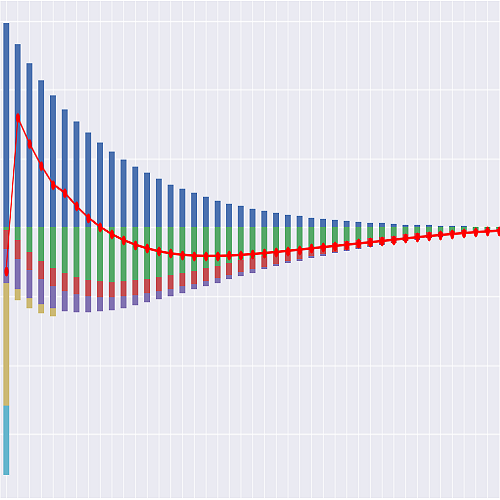
The PER_FR_S Model#
Reference liability cash flow model for the French PER individuel assurantiel.
PER_FR_S is the executable counterpart of
products/per_assurance/technical-notes.md in the lifelib-products library. It
projects gross best-estimate liability cash flows for single-policy model points on the
composite plan d’épargne retraite those notes specify: a compartment-1 PER assurantiel
with a fonds en euros support and a unités de compte bucket, run on the gestion
pilotée par horizon glide path, with an entry loading, separate euro and UC management
charges, an arbitrage charge on the annual rebalancing, a garantie plancher death
floor, and a settlement at the declared horizon split between capital and rente
viagère.
Accumulation with a two-way exit. That sentence is the product. The plan is
blocked until the L. 224-1 maturity, so there is no surrender right and no
lapse_rate anywhere in this model. What leaves the book instead are two distinct
statutory exits, and they are not the same thing: a déblocage anticipé under one of the
seven L. 224-4 cases, which pays the whole account value and bears no charge, and a
transfer out to another PER, which pays a transfer value net of a 1% indemnity for
the first five years from the first versement. Modelling either as a lapse, or both
with one decrement, attaches the wrong payment formula to half the exits.
Spaces. The model contains two:
DataReads the five input CSVs and holds their filename References. It takes no parameters, so each file is read once per model.
ProjectionThe by-policy projection, parameterized by
point_id:Projection[1]is an ItemSpace projecting model point 1. It reaches the input tables through itsdataReference, which resolves to the singleDataSpace.
The split matters for more than tidiness. Because Projection is parameterized, every
Projection[N] is a separate ItemSpace with its own cells cache; readers placed there
would re-read every file for every policy. In Data they are evaluated once, however
many policies are projected.
Input data is external: CSVs in the model folder’s parent directory, read at run time rather than stored inside the model. The model folder itself holds no data, so the model and its inputs must travel together.
The glide path is an input table, not a formula. allocation_grid.csv is keyed by
(allocation_profile, years_to_horizon) and gives the target euro share, so the four
regulatory profiles, and any insurer ladder finer than the four regulatory bands, are a
table edit rather than a code change. That is the product’s dominant financial lever and
it is the one thing a reader of this model will want to change first.
Projection basis. Monthly steps, on plan months. t counts plan months from
the valuation date and is 0-based: t = 0 is the first projected month and the
frame is t = 0, 1, …, proj_len() - 1, where proj_len() = 12 x proj_years() is the
number of projected months and proj_years() = retirement_age - age_init() the declared
horizon in years. An in-force cell opens the frame at t = 0 like any other; its
history is carried in duration_ifo, not in a frame offset. Everything contractual
about the plan is nevertheless annual, so the plan year is derived and used as a lookup
key: duration(t) = duration_ifo + t // 12 are the completed ancienneté years,
plan_year(t) = duration(t) + 1 the 1-based label the ancienneté schedules are
written in, years_to_horizon(t) = proj_years() - t // 12 the key into the glide path,
and the attained age age_init() + t // 12, which steps at the anniversary.
The annual events land whole on their own month of the plan year, and there are two such
months rather than one. In the month that opens a plan year, t % 12 == 0, the
versement arrives and the balance is rebalanced to the glide-path target. In the month
that closes it, t % 12 == 11, the management charge is taken on the post-crediting
balance — and at t = proj_len() - 1, the horizon anniversary, the survivors settle.
Every month in between, investment return is credited to both supports and the decrements
death, early release and transfer out fall at the end, in that order.
Decrements and returns follow suit in two speeds. mort_rate(t),
early_release_rate(t) and transfer_out_rate(t) are the annual rates of the
plan year containing month t — the vectors the technical notes tabulate — and
mort_rate_mth(t), early_release_rate_mth(t) and transfer_out_rate_mth(t) are
the monthly rates actually applied, 1 - (1 - q)^(1/12); the two credited returns take
the same treatment in interest form, (1 + r)^(1/12) - 1. The management charge is the
documented exception: it is not spread, because the garantie plancher base
accumulates a sum of charges rather than a product of factors and twelve monthly charges
do not add to the annual one.
Because the monthly rates and factors compound back to the annual ones and the charge sits
at the year boundary, every anniversary state and the whole settlement are exactly what an
annual-step model would carry — verified to 1.8e-14 relative across all twelve model
points. The cash flows are not, and are not meant to be: claims fall at the end of the
month of exit and are valued on the balance held then, maintenance expense accrues
monthly on a decrementing block, and the split between the three decrements moves while
their total does not. That is what the finer grid is for. result_cf_annual() sums the
frame into plan years and result_state_annual() reads it at the two months that
determine each of its columns, so the two grids can be read side by side.
What is sourced and what is not. The mechanics are sourced: the blocage and the seven early-release cases, the 1%/five-year transfer indemnity, the 0% maximum technical rate, the regulatory de-risking grid, the euro capital floor stated net of loading and net of charges, death closing the plan, the exit menu and the compartment-3 annuity-only rule, and the €110 monthly commutation threshold. Every rate is a standardization: the charge levels are contractual maxima rather than levels, no insurer publishes an annuity rate card, TH 00-02 / TF 00-02 and TGH05 / TGF05 are cited but not shipped, and no public French experience exists for PER early-release, transfer or annuitisation behaviour. This model is a mechanics demonstration, not a pricing or reserving result.
Where the annuity goes. A liquidating plan that does not commute hands
annuity_conversion to Rente_FR_S, and the annuity’s own reserve, its 0.80% p.a.
charge, reversion, annuités garanties and revaluation are specified in
products/rente_viagere/technical-notes.md. This model commutes to a stated amount and
records what it hands over; it does not re-implement the payout chassis.
Verification. tests/test_per_assurance_fr.py asserts the notes’ worked example
row by row to the cent — the glide-path band crossings, the arbitrage charge and which
support pays it, the two supports’ crediting and charging, the garantie plancher base,
the three decrements, and the settlement with its commutation identity — and, on the
monthly grid, the month-by-month table of the first plan year, the constant-force rate
conversions, and that every plan-year state reproduces the annual-step model exactly.
Example
>>> import modelx as mx
>>> model = mx.read_model("products/per_assurance/PER_FR_S")
>>> model.Projection[1].result_cf()