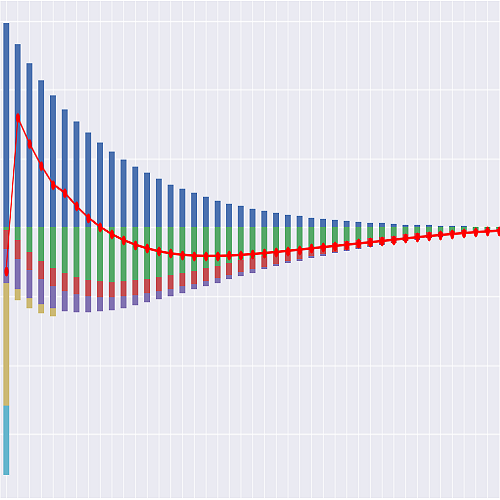
Product Specification#
Status: Draft, 2026-08-26 (all cited sources accessed 2026-08-26; see sources.md).
Scope note. This is a standardized composite specification assembled for reference
liability cash flow modeling of the French contrat obsèques (funeral contract) in its
capital form (contrat en capital). It does not describe any single insurer’s product.
Facts carrying a source tag — [S#] (primary product documents: conditions générales,
notice d’information, document d’information clé, and the CCSF tableaux comparatifs)
and [R#] (regulatory/actuarial references), both numbered per _research/obseques.md, and
[REG-R#] (the cross-product reference library
references/regulatory-and-actuarial-references.md, whose own R-numbering is distinct) —
were extracted from the cited document and resolve against sources.md. Values marked
std are standardizations introduced for the reference implementation; each std in a
parameter table carries a numbered footnote giving the rationale and, where the research file
recorded one, the observed range across insurers. Facts the research file could not verify
are flagged unverified. Euro amounts are printed with a decimal point and no thousands
separator so that every figure is machine-checkable; the source documents use the French
decimal comma (336,03 €) and the figures are transcribed unchanged.
Three product cells are specified. They are the same contract with one model point column changed — the premium form, which is this product’s signature:
RefOBS-VIA — primes viagères, a level premium payable for life.
RefOBS-TMP — primes temporaires, a level premium payable for a stated term.
RefOBS-UNI — prime unique, a single payment at outset.
The contrat en prestations (services form), in which the same whole-life capital is tied to a named, personalised list of funeral goods and services, is described here and declared out of model scope — see Riders and options.
Product overview and market role#
The capital-form contrat obsèques is an individual whole-life assurance (assurance vie entière) on the subscriber’s own head, written under the Code des assurances (branche 20 Vie-Décès) or, for mutuelles, under Livre II du Code de la mutualité [S1] [S8] [S9] [S13]. The enabling provision is art. L. 132-1 CA — a person’s life may be insured by themselves or by a third party R7. Subscriber and insured are the same person in every retrieved contract [S1] [S8]; one insurer additionally permits a member to insure a spouse, ascendant or descendant [S9] [S12]. Cover is lifelong and has no maturity date: the contract ends only on death, on rachat (surrender) or on lapse [S1] [S8] [S9] [S11]. There is no survival benefit of any kind.
What makes it a contrat obsèques rather than a small whole-of-life policy is one sentence of statute. Art. L. 2223-33-1 CGCT: “Les formules de financement d’obsèques prévoient expressément l’affectation à la réalisation des obsèques du souscripteur ou de l’adhérent, à concurrence de leur coût, du capital versé au bénéficiaire.” — the capital paid to the beneficiary is earmarked to the funeral, up to its cost R2 REG-R38. Art. L. 2223-33 CGCT makes such a formule de financement d’obsèques the only lawful way to pre-arrange and pre-pay a funeral: advance offers of funeral services are otherwise prohibited R1, and a funeral operator has been barred since the décret n° 95-653 du 9 mai 1995 from holding a client’s money in advance of death R21.
Market and benchmark. All market figures come from secondary summaries of a CCSF opinion that could not itself be retrieved R11, and are therefore unverified: more than 5.3 million contracts in force in 2023, a portfolio of 1.8 bn €, about 190 000 deaths covered a year — roughly 30 % of French deaths — and an average capital of about 5000 € R14 R15. A widely quoted figure of 5.7 million active contracts in 2024 could not be sourced to France Assureurs and is likewise unverified REG-R49. Seven insurers independently state, in the same footnote of their standardised tables, that a 5000 € capital “est proche du coût moyen des obsèques en France hors marbrerie” [S5] [S6] [S7] [S10] [S14] [S15] [S16]; a secondary study puts the average French funeral at 4730 € in 2025, split 5044 € inhumation / 4434 € crémation R22; and up to 5965 € may be drawn from the deceased’s bank account for funeral costs, with 1500 € deductible from the estate R17.
The structural point that shapes everything below. Since 1 July 2025 every French funeral insurer publishes a standardised comparison table (tableau d’exemples normalisés) giving, for a 5000 € guaranteed capital and entry ages 50 / 60 / 70, the annual premium, the cumulative premiums by age at death and the surrender values by duration, for each premium form on offer R13 R15. Sixteen such tables from seven insurers were retrieved. They are the closest thing to a public rate card that exists for any French life product, and they are the numerical backbone of this specification. Each carries the line that it has no contractual value and that the surrender values are shown sans participation aux bénéfices [S5] [S6] [S7] [S10] [S14] [S15] [S16] — excellent for calibrating a mechanics demonstration, worthless as a pricing basis.
Contrast with the UK over-50s sibling. The UK guaranteed-acceptance whole of life plan in
uklib/products/whole_of_life is the same idea — guaranteed acceptance, a small fixed sum, a
first-year return-of-premium moratorium, premiums ceasing at a stated age. Three things differ,
and all three are first-order. (1) The capital is not level: it is uprated annually out of
the participation aux bénéfices [S1] [S2] [S15] [S16] or, at one insurer, by contract [S14].
(2) There is a surrender value, equal to the provision mathématique [S1] [S8] [S9] [S12],
because a whole-life funeral contract falls in art. L. 132-23 CA’s residual autres assurances
sur la vie class, where the insurer may refuse neither réduction nor rachat. The article
withholds them from a closed list: temporary death assurance and immediate or in-payment life
annuities may carry neither réduction nor rachat, and survivorship capital and
annuity contracts, pure endowments and deferred annuities without return of premium may carry
no rachat R10. (3) Non-payment produces réduction (a paid-up contract), not forfeiture,
wherever the surrender value is sufficient R7 [S1] [S8] [S9]. The UK design’s “lapse is free”
arithmetic does not carry over.
Representative specification#
Table 1 — Chassis, legal form, eligibility#
Parameter |
Representative value |
Basis |
|---|---|---|
Product type |
Individual whole-life assurance (assurance vie entière), branche 20 Vie-Décès; non-linked; participating; capital earmarked to the funeral |
|
Lives assured |
Single life, subscriber = insured |
[S1] [S8]; one insurer allows a relative [S9] [S12] |
Cover term |
None — cover to death; no maturity, no renewal, no conversion |
[S1] [S8] [S9] [S11] |
Underwriting |
Guaranteed acceptance — no medical questionnaire, no medical examination |
[S1] [S11] [S12] [S13] |
Entry ages |
18–84 (différence de millésime) |
[S1]; band choice std (a) |
Age basis |
Différence de millésime — calendar year of subscription minus calendar year of birth |
[S1] [S8] [S9] |
Residence |
Metropolitan France, Monaco and the DROM; stays abroad limited |
[S1]; variants [S8] [S11] |
Prohibited lives |
No death cover on a child under 12, an adult under tutelle, or a person in psychiatric hospitalisation; premiums fully refunded |
|
Anchor model point |
Male, entry age 50, capital 5000 €, primes viagères 336.03 €/year, revalorisation 1.00 % p.a. |
[S14]; cell std (b) |
Footnotes:
(a) std entry band 18–84: observed windows are 18–84 [S1], 18–80 inclusive [S9] [S11] [S12], a band that depends on the premium form — 10-year temporary under 80, 15-year under 75, 20-year under 70, 25-year under 65, lifetime premiums from 40 to under 86 [S8] — and a 20-year term capped at entry 69 [S14]. 18–84 is the widest fully documented single band; the form-dependent band is carried as a variation. All standardised tables are published at entry ages 50, 60 and 70 [S5] [S6] [S7] [S10] [S14] [S15] [S16].
(b) std anchor cell: entry 50 is the lowest published entry age and 5000 € the unanimous illustrative capital. Premium, revalorisation rate and surrender-value scale are all taken from one document [S14] so that the three are mutually consistent — it is the only retrieved contract carrying a guaranteed uprating together with surrender values that already reflect it. Which insurer to anchor on is the standardization.
Table 2 — Capital amounts and caps#
Parameter |
Representative value |
Basis |
|---|---|---|
Guaranteed capital range |
2000 – 10000 €, free choice |
[S1]; nine fixed steps 2000/3000/…/10000 € at another insurer [S8] |
Illustrative capital |
5000 € |
[S5] [S6] [S7] [S10] [S14] [S15] [S16] |
Aggregate cap per insured |
10000 € across all funeral capitals with the same insurer |
[S1] [S8]; 17580 € at a third [S12] |
Minimum after a reduction in cover |
2000 €, and not below the contract’s valeur de réduction |
[S1] |
Capital increases |
Permitted to age 84; the increment is priced at the age of the request and carries its own fresh waiting period |
[S1]; one increase per year to age 86 elsewhere [S8] |
Guarantee fund (FGAP) |
70000 € in aggregate per insured across capital contracts with a failed undertaking |
[S11]; membership under art. L. 423-1 CA [S1] |
Modeled capital |
5000 € at issue, uprated annually (Table 5) |
[S14]; per-policy model, aggregate caps not modeled std (c) |
Footnotes:
(c) std aggregate caps not modeled: they bind at the level of the insured across contracts (10000 € [S1] [S8], 17580 € [S12]), not per policy, and are immaterial to a per-policy expected-value projection. They matter only to the primes manifestement exagérées exposure discussed under Regulatory context.
Table 4 — Délai de carence and benefit structure#
Parameter |
Representative value |
Basis |
|---|---|---|
Délai de carence / délai d’attente |
12 months from the effective date |
[S1] [S8] [S9] [S11] [S12] [S13] |
Accidental death |
Full capital from day 1, waiting period does not apply |
[S1] [S8] [S9] [S11] [S13] R21 |
Non-accidental death inside the waiting period |
Refund of the premiums collected, to the balance beneficiaries |
[S1]; net of the assistance premium at [S8]; net of instalment charges at [S9] |
Interest on the refund |
None in any retrieved contract |
[S1] [S8] [S9]; the “refund with interest” design is unverified (f) |
Death from month 13 |
Full guaranteed capital as uprated (Table 5), any cause |
[S1] [S8] [S9] |
Accident definition |
“Toute atteinte corporelle … non intentionnelle …, provenant de l’action soudaine et imprévisible d’une cause extérieure”; cerebral and cardio-vascular events are never accidents, whatever their origin; burden of proof on the claimant |
[S1] for all three. A near-identical core wording — “l’action violente, soudaine et imprévisible, d’une cause extérieure et non intentionnelle” — at [S8], which carries no cerebral / cardio-vascular carve-out and excludes acute and chronic illness and harm from medical or surgical treatment instead. The market description adds myocardial infarction, coronary conditions and emotional shock R21 |
Accidental-death enhancement |
1× the capital |
[S1] [S9] [S14]; 2× from year 2, capped at 20000 €, at one insurer [S8] |
Suicide |
Excluded in the first 12 months, and again for the year following a capital increase |
[S1] [S8] [S12] [S13] |
Other exclusions |
War, civil war, military conflict; nuclear transmutation and radiation; murder of the insured by a beneficiary (that beneficiary’s share) |
[S1] [S8] [S12] |
Amount paid in an excluded case |
The valeur de rachat / provision mathématique — not zero, not the capital |
[S1] [S8] [S12] |
Waiting period on a capital increase |
A fresh period of the same length on the increment only |
[S1] [S8] [S9] [S13] |
Market cap on the waiting period |
One year maximum for new contracts from 1 July 2025, against up to two years previously |
R13 R14 R15; unverified against R11 |
Footnotes:
(f) unverified refund with interest: no retrieved contract pays interest on premiums refunded inside the waiting period [S1] [S8] [S9]. A different rule exists in statute and must not be confused with it — art. 8 of the loi Sueur requires the capital paid by the subscriber of an advance-prestations contract to bear interest at not less than the legal rate R6.
carence_refund_ratedefaults to zero std.
Table 5 — Revalorisation of the capital#
Parameter |
Representative value |
Basis |
|---|---|---|
Mechanism |
Participation aux bénéfices credited annually to the guaranteed capital |
|
Frequency and eligibility |
Annually, for contracts in force at least one year |
[S1] [S9] |
Effect on premiums |
Premiums unchanged in the reference cell |
[S5] [S6] [S7] [S14] [S16] |
Rate, reference cell |
1.00 % p.a., contractually guaranteed: “le contrat prévoit une revalorisation annuelle de 1 % du capital souscrit sans augmentation de la cotisation” |
[S14] |
Compounding |
Compound on the current capital |
std (g) |
Illustrative discretionary rate |
1.2854 % p.a., derived from a KID performance scenario (3000 € → 3038.56 / 3633.50 / 4400.77 € at 1 / 15 / 30 years) |
[S11], derivation in |
One insurer’s PB formula |
90 % of technical and financial profits, after a 1 % management charge on funds under management and after the technical interest guaranteed at inception (art. A 335-1 CA) |
[S16] REG-R23 |
Premium-linked variant |
Capital and remaining premiums uprated at the same rate, credited to the provision mathématique on 1 April of the following year |
[S9] [S10] [S11] |
Post-mortem revalorisation |
Capital uprated from death until receipt of the payment documents, at the lower of the 12-month average TME and the last TME at 1 November of the preceding year |
Footnotes:
(g) std compound: the wording is “1 % du capital souscrit”, which reads naturally as 1 % of the subscribed capital — a simple uplift — while the same document’s surrender values run to 7854.08 € against a 5000 € original capital at 45 years [S14], which pins down neither reading. Compounding on the current capital is adopted because that is the form the other retrieved mechanisms take (PB credited to the provision mathématique, which then earns in its turn [S9] [S16]) and because the one derivable rate in the file is demonstrably geometric [S11]. Which reading the wording intends is unverified;
reval_simpleis the variation flag.
Table 6 — Rachat, réduction and non-payment#
Parameter |
Representative value |
Basis |
|---|---|---|
Surrender right |
Yes; total surrender only, no partial. At any time [S1] [S9] [S11]; at one insurer only once one annual premium has been paid [S8] |
[S1] [S8] [S9] [S11]; statutory basis R10 |
Surrender value |
The provision mathématique at the effective date of the request |
[S1] [S8] [S9] [S12] |
Surrender penalty |
None in the reference cell |
[S1] [S11]; 5 % in the first 10 years, plus a 5 % charge inside the provision in the first 8, at one insurer [S8] |
Payment deadline |
30 days |
[S1] [S8]; 2 months at [S9] [S11]; statutory maximum 2 months REG-R31 |
Beneficiary acceptance |
Acceptance makes the designation irrevocable and blocks surrender |
[S1] [S8] [S11] |
Non-payment path |
10 days, then a 40-day formal notice; at expiry either termination (surrender value nil or insufficient) or réduction |
R7 [S1] [S8] [S9] |
Cover during the 40 days |
Suspended — no death capital is payable in that window |
[S1] |
Valeur de réduction |
Paid-up capital computed from the provision reached, the attained age, the technical rate and the contractual loadings |
[S8]; from entry age, completed premium years, capital and premium form at [S1] |
Automatic substitution |
Surrender substituted for réduction where the surrender value falls below half the monthly SMIC |
[S1] (art. R. 132-2 CA); 50 % of SMIC at [S8]; general power at R10 |
Assistance guarantees on réduction |
Cancelled |
[S1] [S8] [S9] |
Renonciation (cooling-off) |
30 calendar days from being informed the contract is concluded; full refund of all premiums |
Observed surrender values for a 5000 € capital, transcribed as printed — all nine published
quinquennial anchors, because these six grids are exactly the ones shipped as
surr_scale_table.csv and an omitted anchor is an interpolated guess in the model (see
technical-notes.md, Rachat and réduction):
Insurer, entry age, form |
5 yr |
10 yr |
15 yr |
20 yr |
25 yr |
30 yr |
35 yr |
40 yr |
45 yr |
Basis |
|---|---|---|---|---|---|---|---|---|---|---|
CNP, 50, viager |
650.15 |
1275.19 |
1876.68 |
2460.79 |
3004.02 |
3484.41 |
3876.12 |
4176.77 |
4399.53 |
[S5] |
CNP, 50, prime unique |
4162.06 |
4282.64 |
4398.69 |
4511.38 |
4616.18 |
4708.86 |
4784.43 |
4842.43 |
4885.41 |
[S5] |
AXA Serenova, 50, viager |
784.01 |
1574.90 |
2346.97 |
3151.33 |
3980.74 |
4828.57 |
5659.93 |
6429.96 |
7135.11 |
[S14] |
AXA Serenova, 50, temporaire 10 ans |
2701.65 |
5767.93 |
6003.11 |
6256.67 |
6530.11 |
6824.80 |
7142.86 |
7485.99 |
7854.08 |
[S14] |
Sogecap BUDGET, 70, viager |
1148 |
2067 |
2808 |
3369 |
3775 |
4129 |
4473 |
5000 |
5000 |
[S15] |
Mutex NÉOBSIA, 50, temporaire 25 ans |
981 |
1958 |
2933 |
3938 |
5074 |
5057 |
5043 |
5033 |
5026 |
[S2] |
Three shapes, all first-order for the model. Lifetime-premium values rise steadily but stay well below the capital for decades — 88 % of the capital after 45 years at entry 50 [S5]; the one lifetime grid that does reach exactly 5000 € at 40 and 45 years is an entry-70 case, by which duration the insured is 110 [S15]. Paid-up contracts — a single premium, or a temporary term that has expired — sit just below the capital and drift up towards it: the prime unique value grows from 4162.06 € at 5 years to 4885.41 € at 45 [S5], the mathematical provision of a paid-up whole life converging on the sum assured. Where the capital is uprated the surrender value overshoots the original capital — 7854.08 € against 5000 € at 45 years [S14] — while one temporary-premium grid peaks at 5074 € at 25 years and then declines, because a 0.40 % p.a. charge on the guaranteed capital keeps running after the last premium [S1] [S2].
A common expectation that primes viagères carry no surrender value is not supported by any retrieved document: five insurers publish lifetime-premium surrender values [S5] [S6] [S10] [S14] [S15], which is what art. L. 132-23 CA requires. That article withholds rachat only from a closed list — temporary death assurance and immediate or in-payment life annuities, which may carry neither réduction nor rachat, and survivorship capital and annuity contracts, pure endowments and deferred annuities without return of premium, which may carry no rachat. A whole-life contract is none of those; it sits in the residual autres assurances sur la vie class, where “l’assureur ne peut refuser la réduction ou le rachat” R10. The model therefore carries a surrender value for every premium form.
Table 7 — Charges#
The three insurers that disclose a charge structure disclose three different structures.
Charge |
Mutex NÉOBSIA [S1] |
VIASANTÉ / UCR [S8] |
Macif [S9] [S12] |
|---|---|---|---|
Entry / on premiums |
5 % of every premium |
acquisition max 10 % of the annual premium (10.3 % lifetime) and in any case ≤ 2.5 % of the guaranteed capital; collection admin max 20 % of the annual premium |
max 5.38 % of the capital guaranteed at subscription (4.89 % on top-ups), as an annual percentage over the average contract duration |
Ongoing |
0.40 % p.a. of the guaranteed capital for life, plus 0.57 % p.a. while lifetime premiums are paid or 0.80 % p.a. while temporary premiums are |
max 0.4 % p.a. of the guaranteed capital plus 3.3 % p.a. of the annual premium |
none |
Exit |
none |
5 % inside the mathematical provision in the first 8 years; 5 % surrender penalty in the first 10 |
none |
Instalment / assistance |
none / included |
not stated / 12 €/year outside the above |
yes / included |
One insurer puts a single number on the whole thing: a PRIIPs reduction in yield of 1.77 % p.a. over a 30-year holding (24.08 % over 1 year, 4.86 % over 15), classified entirely as an entry cost with zero ongoing, exit, transaction and performance costs; total costs 75 € / 1120 € / 1493 € at 1 / 15 / 30 years on a premium of 247.60 €/year, and a risk class of 2 of 7 [S11]. Nothing in the retrieved set caps a French life charge — art. A. 132-8 CA requires maxima to be disclosed in the encadré, not limited REG-R30 — which is why every expense level in the technical notes is std.
Contractual mechanics#
Notation is shared with technical-notes.md. Let t be the policy month (t = 1, 2, …),
y = policy year = floor((t−1)/12) + 1, C(y) the guaranteed capital in policy year y,
P the level annual premium, CumPrem(t) the premiums collected to the beginning of month
t, and n_car the waiting period in months.
Death benefit and the délai de carence#
From the effective date, accidental death pays the full guaranteed capital. Non-accidental death inside the waiting period pays a refund of the premiums collected. Any death from month n_car + 1 pays the guaranteed capital [S1] [S8] [S9] [S11] [S13]:
  DB_acc(t)   = k_adb x C(y)          k_adb = 1 for t <= n_car; 1 or 2 thereafter [S8]
  DB_illn(t)  = CumPrem(t)            if t <= n_car
              = C(y)                  if t >  n_car
The refund is of premiums collected, so with an annual premium in advance it is a step function, constant through the first twelve months, not a monthly accrual. Two insurers net it down — of the assistance premium [S8], of instalment charges [S9]; the reference cell takes the gross basis [S1] and carries the netting as a parameter.
The accident definition is narrow, and deliberately so: cerebral and cardio-vascular events are never accidents whatever their origin, and the burden of proving the accidental cause lies on the claimant [S1] — the market description adding myocardial infarction, coronary conditions and emotional shock R21, and the other contract that defines an accident narrowing it a different way, by excluding acute and chronic illness and harm from medical or surgical treatment [S8]. On a claim inside the waiting period the insurer requires a medical certificate stating whether the cause was illness, accident or suicide [S1] [S8] [S9]. The waiting period is the anti-selection device that replaces underwriting R21; it is the whole of the insurer’s protection against a guaranteed-issue book whose entrants may be 84 years old and know their own health.
Revalorisation of the capital#
  C(y) = C_0 x (1 + r)^(y-1)                            reference cell, r = 1.00 % [S14]
  C(1) = C_0                                            no uprating in the first year [S1] [S9]
and, in the premium-linked variant, P(y) = P_0 × (1 + r)^(y−1) on the remaining premiums
[S9] [S10] [S11]. The uprating comes out of the participation aux bénéfices, whose statutory
machinery — the obligation at art. L. 331-3 CA REG-R14, the compte de participation aux
résultats at arts. A. 132-10 to A. 132-15 REG-R15 and the eight-year release horizon of the
provision pour participation aux bénéfices at art. A. 132-16 REG-R16 — is set out once for
the whole library in ../assurance_vie_euro/technical-notes.md and is not restated here.
What is specific to this product is where the money lands: on the guaranteed capital, not
on an account value, and generally with the premium left alone [S1] [S2] [S14] [S15] [S16].
A separate statutory duty is easy to confuse with it. Art. L. 132-5 CA requires the contract to state the conditions under which the guaranteed capital is revalued from the date of death until the payment documents are received, or until deposit at the Caisse des dépôts R8; two insurers state the rate identically as the lower of the twelve-month average TME computed at 1 November of the preceding year and the last TME available at that date [S1] [S8]. Art. L. 132-23-1 CA sets the clock it runs against — fifteen days to request documents, one month from a complete file to pay, penalty interest at twice then three times the legal rate REG-R31 — and where a contract goes unclaimed the revalorisation continues until deposit with the Caisse des dépôts, the proceeds becoming State property after twenty years there REG-R39.
Rachat, réduction and non-payment#
A rachat is total only and pays the provision mathématique at the effective date of the
request [S1] [S8] [S9] [S12]; no partial surrender and no avance appears in the retrieved
capital contracts. Non-payment does not ordinarily terminate the contract: art. L. 132-20 CA
gives the insurer no action to compel payment, requires a registered letter ten days after the
due date, and provides that at the expiry of a further forty days continued non-payment produces
either termination — where the surrender value is nil or insufficient — or réduction R7.
Every retrieved contract implements exactly that [S1] [S8] [S9], with cover suspended during
the forty days [S1]; one insurer splits by contract year, terminating in year 1 and reducing
from year 2 [S8]. Réduction leaves a paid-up whole-life contract with a smaller capital, no
further premiums and a continuing death liability; the reference implementation computes the
paid-up capital as the whole-life cover that the accumulated provision buys as a single premium
at the attained age, using the published prime unique rate card [S5] as that scale — see
technical-notes.md.
Beneficiary designation and the earmarking rule#
The default architecture is two-tier in every retrieved capital contract. The first-rank beneficiary is the funeral firm that carried out the services, failing that whoever paid its invoice, up to the costs actually incurred and within the guaranteed capital; the balance goes to the freely designated beneficiaries and, failing them, to a standard cascade — surviving spouse, then PACS partner, then concubin notoire, then children in equal shares, then the heirs [S1] [S8] [S9] [S12]. One insurer requires a named designation to be followed by the words “à charge pour ce ou ces bénéficiaires de financer les obsèques de l’assuré à concurrence de leur coût et dans la limite du capital garanti” [S12] — the drafting device that carries art. L. 2223-33-1 CGCT into the beneficiary clause R2 REG-R38. The designated operator may be changed at any time [S12] R5; the documents required on death include a detailed paid invoice from the funeral operator [S1] [S8] [S9]; payment deadlines run from 8 days [S1] to 30 days [S8] [S9]. The national file created by art. L. 2223-34-2 CGCT R4 is operated as an AGIRA search, and insurers must respond to a request within 3 business days R19.
Riders and options#
In scope (modeled):
The accidental / non-accidental split inside the waiting period [S1] [S8] [S9] — an integral benefit, not a rider.
The 2× accidental-death enhancement from year 2, capped at 20000 €, as a variation flag [S8].
Revalorisation of the capital, with and without the matching premium uprating [S14] [S9].
Rachat at the provision mathématique, with an optional first-ten-years penalty [S8].
Réduction to a paid-up capital on premium cessation [S1] [S8] [S9] R7.
Described, out of model scope:
The contrat en prestations (services form). The same whole-life capital tied to a defined and personalised list of funeral goods and services which a named operator undertakes to deliver R21 [S3] [S13]; observed packages at 3500 / 4500 / 6000 € [S3] and at capital equivalents of 3800 € and 4580 € [S13]. It is out of scope because the tariff is the same object: one insurer’s prestations table reproduces its capital table’s premiums exactly for a 5000 € capital at entry age 50 — 356 / 405 / 494 / 678 / 1240 € for the 25/20/15/10/5-year terms in both [S2] [S3]. The two forms differ in who receives the money and in the contractual service list, not in the cash-flow mechanics. Two statutory duties attach to it and to nothing else in this file: art. L. 2223-34-1 CGCT makes any clause promising advance funeral services without a detailed and personalised description of them “réputée non écrite” R3, and art. L. 2223-35-1 CGCT requires the contract to let the subscriber change, at any time during life, the nature of the funeral, the mode of burial, the content of the services and supplies, the designated operator and any mandataire, with only the general conditions’ management charges payable for changes at equivalent services, on pain of a 15000 € fine per infringement R5.
Assistance guarantees — repatriation, formalities help, psychological support — included in the premium at two insurers [S1] [S9] and priced at 12 €/year at a third [S8]. Not a cash benefit; cancelled on réduction [S1] [S8] [S9].
Capital increases [S1] [S8]: an anti-selective option on a guaranteed-issue book, mitigated by the fresh waiting period on the increment. Flagged as a model risk, not projected.
Couple discount, excluded from the quoted premiums at one insurer [S14]; and choice and change of the funeral operator [S12] R5 — a payee question with no amount effect.
Post-mortem revalorisation [S1] [S8] R8 REG-R31 — a settlement-lag uplift; excluded from the base projection and pointed at in the technical notes.
Variations across insurers#
The seven insurers whose documents were retrieved diverge on six axes, and a configurable model must carry all six as model point columns rather than as code branches.
Premium forms offered. Five temporary terms plus lifetime but no single premium [S1]; seven forms including the single premium [S5]; only two temporary terms, neither lifetime nor single [S16]; lifetime, “to age 80”, 10-year and 5-year [S9] [S10]. Chosen: all three families available, selected by
premium_formstd.Revalorisation coupling. Capital only at five insurers [S1] [S5] [S14] [S15] [S16]; capital and remaining premiums in the same proportion at one [S9] [S10] [S11]. Chosen: capital only, with
reval_prem_linkedas the switch.Waiting-period benefit basis. Gross premiums collected [S1]; net of the assistance premium [S8]; net of instalment charges [S9]. Chosen: gross std.
Exclusion benefit. Valeur de rachat [S1] [S8] versus provision mathématique [S12] — in practice the same quantity, but one insurer substitutes the net premiums collected where they exceed the surrender value [S8].
Surrender penalty. None [S1] [S11] versus 5 % in the first ten years plus a 5 % charge inside the provision in the first eight [S8]. Chosen: none std.
Accidental-death multiplier. 1× everywhere [S1] [S9] [S14] except one insurer, where accidental death from year 2 pays double the capital subject to a 20000 € cap [S8].
Two further divergences are recorded but not modeled. Entry-age bands are form-dependent at one insurer — lifetime premiums only from age 40, temporary terms narrowing as the term lengthens [S8] — which is a new-business eligibility rule, not a projection rule. And a snippet describing a contract with capitals from 1000 € to 15000 €, revalued annually, with no waiting period where the premium is paid in one instalment, is unverified: the publisher’s page returned HTTP 403 on both attempts and no document was retrieved [S19].
Why these representative choices. One wording [S1] is the cleanest single chassis — an individual whole-life contract, capital 2000–10000 €, entry 18–84 with no medical selection, six premium forms, a one-year waiting period with premium refund, a fully specified charge structure, PB credited to the capital, surrender at the provision mathématique, and a published worked grid. It publishes no single premium, and in one distribution its lifetime form is marked NA [S2], so a second rate card [S5] supplies the missing arm. The numerical anchor for the worked example is a third document [S14], chosen because premium, revalorisation rate and surrender-value grid are mutually consistent inside it. Between them these three pin down every quantity the model needs except the pricing basis itself, which no insurer publishes.
Regulatory context#
Funeral-specific statute (CGCT). Art. L. 2223-33 prohibits advance offers of funeral services except formules de financement d’obsèques R1; art. L. 2223-33-1 earmarks the capital to the funeral up to its cost R2 REG-R38; art. L. 2223-34-1 voids any advance-services clause without a detailed and personalised description, and imposes on such contracts an annual PB allocation of at least 85 % of the credit balance of the financial account, pro-rated by mathematical provisions and net of technical interest credited R3; art. L. 2223-34-2 creates the national file R4; art. L. 2223-35-1 guarantees the lifelong freedom to modify, on pain of a 15000 € fine R5.
Three cautions. First, the loi Sueur does less than it is usually credited with: the retrieved JORF text of loi n° 2008-1350 du 19 décembre 2008 contains the amendment to L. 2223-33 (art. 7), the legal-interest floor added to L. 2223-34-1 (art. 8) and the national file (art. 9), and not the “detailed and personalised description” or the faculty to modify R6. Those come from loi n° 2004-1343 du 9 décembre 2004 R21 and, per Légifrance’s own legislative history, from loi n° 2005-1564 du 15 décembre 2005 art. 15 (V) R5; the current wording of L. 2223-34-1 comes from loi n° 2013-672 du 26 juillet 2013 arts. 73–74 R3. A widespread attribution of L. 2223-35-1 to the 2004 statute R21 conflicts with Légifrance and is not followed. Second, the 85 % PB floor is drafted for the prestations form — “tout contrat prévoyant des prestations d’obsèques à l’avance” — and whether it reaches a pure capital contract is not settled by the retrieved text R3; the arrêté that was to specify its calculation was not located. Third, from 1 October 2026 every funeral operator must hand families a standardised neutral information notice under décret n° 2026-770 du 13 août 2026 and an arrêté of the same date R20 — a duty on the operator, not on the insurer.
Contract law (Code des assurances / Code de la mutualité). Art. L. 132-1 enables the cover and L. 132-3 prohibits it on certain lives R7; L. 132-5 requires the PB allocation conditions and the post-mortem revalorisation rules to be stated R8; L. 132-5-1 gives 30 days’ renonciation with a full refund, extended where the notice was not delivered and capped at eight years R7 REG-R29; L. 132-13 keeps the death capital outside rapport à succession and réduction pour atteinte à la réserve, “à moins que [les primes] n’aient été manifestement exagérées eu égard à ses facultés” R7; L. 132-20 sets the non-payment path R7; L. 132-21 requires the contract to state how surrender, transfer and paid-up values are computed and caps settlement at two months REG-R31; L. 132-22 prescribes the annual statement R9 REG-R31; L. 132-23 makes whole-life contracts rachetables and réductibles R10. The mutualité-code contracts run the same architecture under arts. L. 223-8, L. 223-19-1, L. 223-20-1, L. 223-22, L. 223-22-1 and R. 223-9; those articles could not be retrieved — the code’s landing page loads but the articles do not R23 — so everything attributed to them rests on the insurer notices [S8] [S9] and the article texts themselves are unverified.
Conduct. The CCSF opinion of 8 October 2024 R11 — not retrieved, HTTP 403 on three attempts — is reported by four independent secondary sources R13 R14 R15 R16 as committing insurers, from 1 July 2025, to publish the standardised examples table, to cap the délai de carence at one year, to offer temporary alternatives systematically alongside lifetime premiums, to limit exclusion clauses, and to state the surrender value payable when death falls within an exclusion, with an effectiveness review in July 2026. The opinion is non-binding R13. All of that is unverified against the opinion itself; the one part independently corroborated is the table, of which sixteen were retrieved from seven insurers. The pre-contractual documents are prescribed: the note d’information by art. A. 132-4 CA and the one-page encadré by art. A. 132-8 CA, the latter requiring charge maxima in four categories to be disclosed REG-R30. Funeral firms selling these contracts must be registered as insurance intermediaries R21.
Prudential. Solvabilité II as transposed into the Code des assurances governs the valuation basis REG-R1 REG-R2 REG-R4; the best estimate is the probability-weighted average of future cash flows discounted at the EIOPA risk-free term structure REG-R5. The French statutory balance sheet persists alongside it, with the provision mathématique — the difference between the present values of the two parties’ commitments, including future management costs — the first of eleven named technical provisions REG-R6, and the provision this contract’s surrender value is contractually equal to [S1] [S8] [S9]. Any guaranteed technical rate is capped by art. A. 132-1 CA at the lower of 3.5 % and 60 % of the reference TME for contracts with periodic premiums REG-R17; the only technical bases published anywhere in the retrieved set are a rate of 0.75 % with table TH 00-02 at one insurer [S8] and 0 % in another’s worked example [S1]. TH 00-02 and TF 00-02 are the regulatory non-annuity tables homologated by the arrêté du 20 décembre 2005 REG-R22 and reproduced in the annexe to art. A. 335-1 CA, which also fixes the décalage d’âge schedules and permits only homologated or actuary-certified tables REG-R23. They are cited by name and never redistributed here: the decrement inputs shipped with this product are std proxies built from INSEE population data REG-R24.
Tax. Applicability is verified from four primary documents [S1] [S9] [S11] [S13]: death benefits arising from premiums paid before the insured’s 70th birthday fall under art. 990 I CGI; premiums paid from the 70th birthday fall under ordinary inheritance duty under art. 757 B CGI; a surrender is taxed on its gain under art. 125-0 A CGI; social levies apply under art. L. 136-7 CSS [S1]. The verified thresholds — a 152500 € allowance per beneficiary then 20 % up to 700000 € and 31.25 % above under 990 I, and a single global 30500 € allowance under 757 B — are carried on the cross-product entry REG-R41 alone, because this product’s own research file could not fetch the CGI articles R24. The primes manifestement exagérées exposure R7 is real at high entry ages, is a fact-specific judicial test that no retrieved document quantifies, and is bounded here by the aggregate capital caps (10000 € [S1] [S8], 17580 € [S12]) and by the single premiums (at most 4819.56 € for 5000 € of cover at 70 [S5]).
Professional standards and accounting. NPA 2 Modèles actuariels is the recommended-practice standard against which a published model, its worked example and its test suite are judged REG-R44. IFRS 17 applies to IFRS reporters from 1 January 2023 with no French carve-out REG-R45.