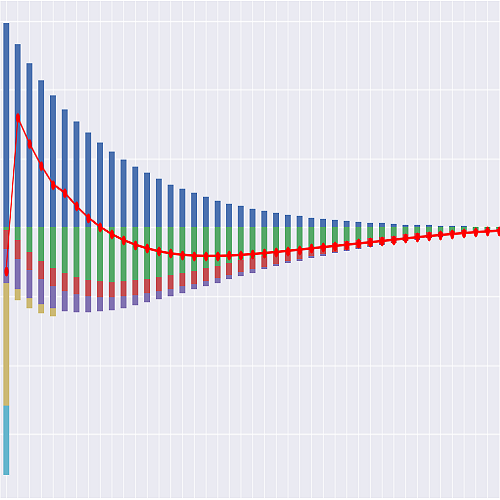
The Pension_KR_S Model#
Reference liability cash flow model for a Korean tax-qualified pension savings contract.
Pension_KR_S is the executable counterpart of
products/pension_savings/technical-notes.md in the lifelib-products library. It
projects gross best-estimate liability cash flows for a single-policy model point of
연금저축보험 (yeongeum jeochuk boheom, tax-qualified pension savings insurance) — the
insurance leg of the statutory 연금저축계좌 wrapper of 소득세법 제20조의3제1항제2호: a
deferral phase in which a level monthly 기본보험료, net of two published percentage
charges, accumulates into a 계약자적립액 credited at the 공시이율 over a stepped
최저보증이율 floor; an annuitisation step at the 연금개시일 with a 100.1%-of-premiums
minimum fund; and a payout phase of 종신연금형 (life annuity with a guarantee period) or
확정기간연금형 (annuity-certain) instalments.
The product is an account, not a net-level-premium reserve, and the model is built that way. The 계약자적립액 is a contractual balance: charges come off the premium, the remainder is credited at the declared rate, and nothing else moves. There is no survivorship release, because there is no mortality risk to release — every retrieved life-insurer 연금저축보험 pays the fund and nothing more on death before annuitisation, and the composite’s surrender charge is nil, so death and surrender pay the same amount at every deferral duration. Mortality enters this contract in exactly one place: the annuity factor struck at the 연금개시일 on the annuitant basis (연금사망률), which the model also uses as the in-force decrement.
Spaces. The model contains two:
DataReads the nine input CSVs and holds their filename References. It takes no parameters, so each file is read once per model.
ProjectionThe by-policy projection, parameterized by
point_id:Projection[1]is an ItemSpace projecting model point 1. It reaches the input tables through itsdataReference, which resolves to the singleDataSpace.
The split matters for more than tidiness. Because Projection is parameterized, every
Projection[N] is a separate ItemSpace with its own cells cache; readers placed there
would re-read every file for every policy. In Data they are evaluated once per
model, however many policies are projected.
Input data is external: CSVs in the model folder’s parent directory, read at run time rather than stored inside the model. The model folder itself holds no data, so the model and its inputs must travel together.
Projection basis. Monthly steps, on 보험나이 (boheom nai, insurance age). t
counts completed policy months since issue, 0-based: the 기본보험료 falls at
t = 0 .. m - 1 where m = 12 x the 납입기간 in years, the 계약자적립액 accumulates
over t = 0 .. n where n = annuitisation_t(), the
annuity instalment is paid monthly from t = n, and
proj_len() is the number of projected periods — the
exclusive end of the frame, 12 x proj_years() — so
result_cf() runs t = 0 .. proj_len() - 1. The contractual policy year is the
derived 1-based label policy_year(t) = t // 12 + 1 and the 보험나이 is
age(t) = issue_age() + t // 12, exact because 보험나이 increments on the 계약해당일.
Contract terms stay in years: the 납입기간, the 납입유예 and the 연금개시나이 are annual
quantities the model converts to month counts where the grid needs one, and the annual
assumptions stay annual — credit_rate(t), mort_rate(t) and lapse_rate(t) are
the yearly figures the technical notes tabulate, with credit_rate_mth,
mort_rate_mth and lapse_rate_mth companions that compound back to them over
twelve months. Statutory annual figures stay annual too — the 별표 14 표준해약공제액 is
struck on the 연납보험료 and the 소득세법 세액공제 limit and 연금수령한도 are per-year
amounts, each apportioned across the twelve months of the year rather than restated.
The tax layer is carried but is not a cash flow. 연금저축 relief is a 세액공제 —
a tax credit of 16.5% or 13.2% of contributions up to ₩6,000,000 a year — and a
withdrawal that misses the statutory 연금수령 conditions bears 16.5% 기타소득세.
Neither is an insurer cash flow, so neither enters net_cf(); both are published as
their own cells and in result_tax(), because between them they are what drives the
lapse assumption and the annuitisation election on this product.
What is sourced and what is not. The contractual mechanics are sourced: the charge
schedule as percentages of the 기본보험료, the nil 해약공제액, the death benefit as the
fund, the 100.1% minimum fund at annuitisation, the two annuity forms and their bases, the
0.5% 연금수령기간 관리비용 and the 공시이율 / 최저보증이율 machinery. The mortality basis
is not a published table: the 경험생명표 is produced by 보험개발원 and released only
as summary statistics, so mort_table.csv is a [std] Makeham construction fitted to
the six annuitant rates two carriers publish in their 상품요약서 and calibrated to the
annuity factors implied by a published illustration, with a provenance column on every
row. The lapse curve, the best-estimate mortality factor, the cash expenses and the policy
loan rate are standardizations introduced for the reference implementation. This model
is a mechanics demonstration, not a pricing or reserving result. Replace the assumption
tables with company data, and the mortality basis with the filed 산출방법서 basis, before
drawing any conclusion from the output.
Model points. Nine. Point 1 is the anchor cell of the worked example in the technical notes. The other eight exercise the female basis, a 20-year guarantee with no deferral gap, three 확정기간연금형 terms, the low and high ends of the issue-age envelope, the minimum 연금개시나이 of 55 on the guaranteed-rate scenario, the 연금개시시점 mortality vintage, the 연금저축추가납입특약 with the postal insurer’s front-end 해지공제액 on a hybrid crediting-rate scenario, and — on one point — a 납입유예 payment holiday with the 100.1% guarantee withdrawn, a 보험계약대출, a participating contract with a declared dividend and the annuitant-mortality ratchet.
Verification. tests/test_pension_savings_kr.py asserts the notes’ worked example —
the annuitisation quantities, the deferral rows, the fund and surrender value at
납입완료, and the payout rows — to the precision the notes display, and every product fact
the notes list as a modelling pitfall.
Example
>>> import modelx as mx
>>> model = mx.read_model("products/pension_savings/Pension_KR_S")
>>> model.Projection[1].result_cf()