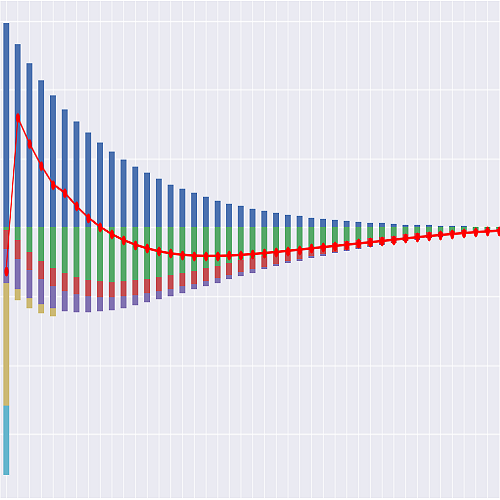
Product Specification#
Status: Draft, 2026-08-26 (all cited sources accessed 2026-08-26).
Scope note. This is a standardized composite specification assembled for reference
liability cash-flow modeling of the French eurocroissance support — a savings
engagement inside an assurance vie or capitalisation contract that gives rise to a
provision de diversification (a technical provision in which savers hold individualised
rights expressed in parts) and carries a capital guarantee at a contractual maturity
only. It does not describe any single insurer’s support. Facts carrying a source tag —
[S#] (insurer and third-party product documents) and [R#] (regulatory/actuarial
references), both numbered per _research/eurocroissance.md and resolved against
sources.md in this directory — were extracted from the cited document. [REG-R#] resolves
against the cross-product reference library
references/regulatory-and-actuarial-references.md (its own frozen R-numbering). Values
marked std are standardizations introduced for the reference implementation; each
std table row carries a numbered footnote giving the rationale and, where the research
recorded one, the observed range across insurers. Facts that could not be confirmed
against a retrieved document are flagged unverified.
The documentation position, stated up front, because it shapes every page below. Eurocroissance is a very small product with almost no public contractual documentation: no insurer’s notice d’information, conditions générales or PRIIPs document d’information clé for a eurocroissance support could be retrieved [S10]. What is fully retrievable is the law, which fixes the mechanics of this product in far more detail than those of a fonds en euros, because eurocroissance is a statutory construct rather than a market convention. The mechanics anchors are arts. L. 134-1 to L. 134-5 R1, R. 134-1 to R. 134-12 R2, A. 134-1 to A. 134-7 R3, loi PACTE art. 72 R4, décret n° 2019-1437 R5 and décret n° 2025-1333 R7, all read in full; parameter levels come from insurer marketing pages [S1]–[S7], two third-party fact pages [S8] [S9] and one published actuarial mémoire R13; every insurer-level parameter the code does not fix is std.
Product overview and market role#
A eurocroissance engagement is not a contract; it is a support inside an ordinary assurance-vie or capitalisation contract, defined by the kind of engagement the insurer takes on. A single policy’s premiums may simultaneously create fonds en euros engagements, unités de compte engagements and diversification-provision engagements R1 L. 134-1 REG-R19. Insurers may write these engagements in case of life or death, excluding temporary death assurance; they may carry a guaranteed annuity or capital at a maturity fixed in the contract, and they always give rise to a provision de diversification absorbing fluctuations in the value of the backing assets R1 L. 134-1. The engagements sit in one or more comptabilités auxiliaires d’affectation (ring-fenced auxiliary accounts) kept by derogation from the Code de commerce R1 L. 134-2; their assets are carried at realisation (market) value R2 R. 134-8; no creditor of the insurer other than the policyholders and beneficiaries of those operations may claim on them R1 L. 134-4; and Chapter IV applies separately to each auxiliary account R2 R. 134-11.
Article L. 134-1 permits two modalities, and the difference between them is the whole product R1 R4:
Modality 1° — the guaranteed annuity or capital is expressed in euros and in parts of the diversification provision. A provision mathématique (PM) equal to the maturity guarantee discounted at a regulated rate is carved out of every premium; the remainder buys parts. The surrender value is
PM + parts × part value, so the saver holds a floor at every instant R2 R. 134-2, R. 134-5.Modality 2° — the guaranteed annuity or capital is expressed only in parts before maturity, with a euro guarantee at the maturity. There is no provision mathématique and no guarantee whatsoever before maturity; the surrender value is purely
parts × part valueR1 L. 134-1 R2 R. 134-2, R. 134-5 R13.
Modality 2° is the loi PACTE structure: art. 72 of loi n° 2019-486 rewrote L. 134-1 to create it, permitted existing 1° engagements to be transformed into 2° by agreement without the tax consequences of a dénouement, and applies to contracts concluded from 1 January 2020 R4 R12 CGI 125-0 A I 2°. Décret n° 2019-1437 rewrote the whole regulatory chapter with effect from 1 January 2020, old-regime contracts remaining writable until 1 October 2020 R5 R2 R. 134-1 transitional REG-R20. In the words of the actuarial mémoire that models both regimes side by side, the reform’s structural change is that the continuous guarantee disappears, and with it the provision mathématique — producing one common return for all savers instead of a return differentiated by entry date, maturity and guarantee level R13.
Market role. Eurocroissance is the third French savings compartment, between the fonds en euros (capital guaranteed at every instant, effet cliquet) and unités de compte (no guarantee at all). It has never sold. Retrieved sizings: €7.1 bn at end-2022 and €7.6 bn at mid-2023 across more than 470 000 contracts R21; €11.1 bn (+24 %) across 673 000 contracts (+26 %) at end-2024 R14; €11.3 bn across more than 700 000 contracts at March 2025 [S9]; no published figure for end-2025, because France Assureurs’ January 2026 release carries no eurocroissance line R16. Against a French life market of €1 989 bn at end-2024 R14 and €2 107 bn at end-2025 R16 — unit-linked provisions alone were €587.1 bn R15 — eurocroissance is about 0.5 % of the market. It is also close to invisible in the statistics: ACPR’s weekly life-flows collection explicitly excludes eurocroissance products R18, its annual revaluation study does not break them out R19, and the one complete data set, the annual A. 134-7 return by maturity year and guarantee level, goes to the ACPR and the ministry and is not published R3. Sia Partners’ 2023 verdict stands: only a handful of insurers offer the new eurocroissance R21.
Published 2025 net returns, net of management charges and gross of tax and social levies, span 0.90 % to 3.40 % across seven supports [S9] — G Croissance 2020 (Generali) 3.40 %, cross-checked at 3.40 % [S8]; Agipi eurocroissance (AXA) 3.00 %; Fonds Croissance (AXA) 2.50 %, quoted by the insurer itself as a 2.50 %–4.50 % range averaging 3.13 % [S3]; Afer eurocroissance 2.16 %; Croissance Allocation Long Terme (Spirica) 0.90 %. The premium over the same insurer’s fonds en euros is of the order of 25–60 bp (AXA euro 2.25 %–4.25 % against Fonds Croissance 2.50 %–4.50 % [S3]; Generali euro-fund average 2.55 % for life [S6]) — close to the +30 bp piloting objective the mémoire assumes R13. The dispersion the product is supposed to have, and the euro fund is not, shows in G Croissance 2020’s history: 0.52 % (2020), 0.05 % (2022), 3.67 % (2023), 3.55 % (2024), 3.40 % (2025) [S8].
This specification standardizes a single composite: a eurocroissance support with a
100 % guarantee of net premiums at a 10-year maturity [S1] [S2], written on two
chassis held in two separate auxiliary accounts — Chassis A (1° engagement, the
pre-2020 generation) and Chassis B (2° engagement, the post-PACTE generation) — so that
the same asset path can be run through both and the effect of the reform read off directly.
The model these chassis feed is EC_FR_S, on a monthly grid.
Representative specification#
Structure common to both chassis#
Parameter |
Representative value |
Basis |
|---|---|---|
Legal form |
Support inside an assurance-vie or capitalisation contract; L. 134-1 engagement |
|
Ring-fencing |
One comptabilité auxiliaire d’affectation per chassis; policyholder priority over all other creditors |
R1 L. 134-2, L. 134-4; one account per chassis std (1) |
Asset valuation inside the account |
Realisation (market) value under R. 343-11 / R. 343-12 |
|
Technical provisions admitted inside the account |
PM (R. 343-3 1°), provision de gestion (4°), frais d’acquisition reportés (7°), provision de diversification (9°), provision collective de diversification différée (10°), provision pour garantie à terme (11°) |
|
Guarantee level |
100 % of net premiums |
[S1] [S2]; 80 % observed [S8], 80 %–100 % [S7] |
Guarantee maturity |
10 years from the first payment |
[S1] [S2]; 8–30 [S8], 8–40 [S7] |
Initial part value |
€10.00 |
|
Minimum part value |
€5.00 |
requirement R2 R. 134-1, R. 134-10 II; level std (2) |
Non-surrender (lock-up) period |
0 years; contractual cap |
cap R2 R. 134-5; level std (3) |
Surrender / transfer indemnity |
0 %; statutory cap 5 % of the present value of the mutual engagements, and the contract may provide for none at all once it has been in force more than ten years |
cap and the ten-year permission R10 R. 132-5-3; level std (3) |
Anchor model cell |
€10 000 gross single premium at issue; free additional premium of €2 000 gross at the end of policy year 3; male, age 57 at entry |
Footnotes to std rows:
L. 134-2 permits 1° and 2° engagements to be grouped in the same auxiliary account R1. They are separated here because the part value is common to all engagements of one account R2 R. 134-2, so grouping would force one part-value path across both chassis and destroy the comparison this composite exists to make. Separation also mirrors the market: G Croissance 2014 and G Croissance 2020 are distinct funds [S5] [S8].
The contract must fix a minimum part value, strictly positive and expressed in euros, and disclose it before the first payment R2 R. 134-1, R. 134-10 II 1°. No public figure was found for any insurer. €5.00, i.e. 50 % of the €10.00 initial part value R13, is the reference, and it is load-bearing: it is the floor below which the part value cannot be reduced to absorb a debit balance R2 R. 134-4, and therefore the second limb of the guarantee under Chassis A.
The code caps a contractual non-surrender period at the lesser of the guarantee maturity and eight years R2 R. 134-5 and the surrender indemnity at 5 % of the present value of the mutual engagements; R. 132-5-3 further permits the contract to provide no indemnity at all once it has been in force more than ten years, which is a permission and not a prohibition R10. The reference contract charges none at any duration, and
EC_FR_Sreturns zero beyond ten years unconditionally std, which is that permission taken up rather than a rule the article imposes. No retrieved insurer document states a lock-up; AXA says surrender is available at any time and carries no penalty [S2], and Generali’s third-party sheet shows none either [S8]. Zero and zero are the reference. The mémoire notes no explicit penalty is needed, because the surrendering saver already walks away from his share of the PCDD R13.Pure modeling anchor, sized on the mémoire’s own cohort: €10 000 initial premium, free additional premiums of €2 000 paid by 15 %–30 % of savers, age 57 at subscription R13. The additional premium sits at the end of year 3 so that the worked example exercises the mid-contract split of a versement.
Chassis A — 1° engagement: euros and parts (legacy cell)#
Parameter |
Representative value |
Basis |
|---|---|---|
Engagement type |
Guarantee expressed in euros and in parts |
|
Provision mathématique |
|
|
Discount rate |
90 % of the last TECn published by the Banque de France, |
article R3 A. 134-1; the remaining-term re-reading std, |
Reference TEC10 |
2.50 % to year 5, 1.00 % from year 6 (rate-shock scenario) → |
std (5) |
Surrender / transfer value before maturity |
|
|
Maturity amount |
the same quantity — |
|
Effective floor |
|
|
Insufficient representation |
The insurer completes the representation by contributing assets backing its own reserves and provisions, releasable when representation permits |
R1 L. 134-3; roll-forward treatment std (6) |
Encours charge base |
Not available on the provision de diversification — R. 134-3 3° permits that levy only where the account holds no 1° engagements |
|
Guarantee revaluation out of the participation account |
Permitted only if both: PD attaching to 1° guarantees > 1.5 × (zero-rate PM − actual PM), and (PD − its minimum) > 10 % of PM |
|
Conversion of parts into PM |
At most once every five years, and only if after conversion (PD − its minimum) > 15 % of that engagement’s PM |
No TEC series value was retrieved. The level is anchored on the ACPR’s macro backdrop for its 2024 revaluation study — the 10-year OAT averaged 3.0 % in both 2023 and 2024 R19 — haircut for the shorter effective maturity and rounded; the 90 % factor is statutory R3 A. 134-1. The step down to 1.00 % in year 6 is a deliberate rate shock, so that the worked example exercises the rate-driven transfer of value from the diversification provision to the mathematical provision.
L. 134-3 says the insurer “completes” the representation and may re-allocate assets out when representation permits, without fixing how the contributed assets and their return are attributed R1. The reference treatment is an outstanding balance carrying no return to the savers, repaid in full as soon as the account’s own assets cover
PM + parts × minimum part value— consistent with the re-allocation cap set for the separate R. 134-12 mechanism, affectation-date realisation value plus the assets’ share of net investment income while inside the account R7 II.
Chassis B — 2° engagement: parts only, guarantee at maturity (primary cell)#
Parameter |
Representative value |
Basis |
|---|---|---|
Engagement type |
Guarantee expressed only in parts before maturity, in euros at maturity |
|
Provision mathématique |
none |
|
Surrender / transfer value before maturity |
|
|
Pre-sale disclosure |
The absence of any guarantee before maturity must be stated in “caractères très apparents”, with the maturity, the euro amount of the guarantee at maturity, any non-surrender period and the settlement arrangements |
|
Maturity amount |
|
|
Maturity settlement |
Notice three months before maturity; unless the holder decides otherwise expressly, settled as a benefit or arbitraged into a support whose PRIIPs synthetic risk indicator is ≤ 2 |
|
Provision pour garantie à terme (PGT) |
|
|
Encours charge base |
A levy on the provision de diversification is available, because the account holds no 1° engagements |
|
Documented example |
AXA Fonds Croissance: 100 % of net invested capital guaranteed at a 10-year minimum maturity; capital loss before maturity may be total or partial; SRI 2/7; surrender at any time without penalty |
[S1] [S2] |
Charges (prélèvements)#
Deductions may be taken only on the six bases listed at R. 134-3 R2: 1° premiums and incoming transfers or arbitrages; 2° amounts arising from the R. 134-4 conversion of parts into PM; 3° the provision de diversification, and only where the auxiliary account holds no 1° engagements; 4° the number of parts; 5° the balance of the participation account or alternatively the performance of the financial management of the account’s assets; 6° benefits paid and outgoing transfers or arbitrages. Base 3° is therefore unavailable in Chassis A and base 2° is meaningless in Chassis B.
Charge |
Representative value |
Basis |
|---|---|---|
Entry charge (frais sur versements, base 1°) |
2.00 % of each premium, deducted before rights are created |
|
Recurring charge (base 4°, levy in number of parts) |
0.80 % p.a. of parts, taken at the start of each policy year on the opening part value |
|
Performance charge (base 5°, second limb) |
10 % of positive financial-management performance |
|
Conversion charge (base 2°) |
0.50 % of amounts converted from parts into PM |
[S8]; Chassis A only |
Exit charge (base 6°) |
0 % — permitted by the code, shown by neither insurer |
R2 R. 134-3 6° [S2] [S8]; level std (9) |
Guaranteed-rate ceiling |
Any rate the insurer guarantees on these contracts is subject to the art. A. 132-3 ceiling |
[S4] REG-R18 |
The mémoire uses 2 % of premiums and states that a levy on premiums plus encours plus performance “est une pratique courante du marché actuellement” R13. Generali shows frais sur versements of 4.50 % maximum [S8]; AXA publishes no percentage [S1] [S2]. The entry charge reduces the guaranteed amount too, because the guarantee is a percentage of premiums net of the charges permitted by R. 134-3 1° R2 R. 134-2.
The mémoire levies 0.8 % p.a. of (PM + PD) R13. That base is unlawful in a 1° account: R. 134-3 3° permits a levy on the PD only where the account holds no 1° engagements, and no base permits a levy on the PM R2. The reference implementation routes the same economic charge through base 4°, the number of parts, available in both chassis. The consequence should not be smoothed away: in Chassis A the recurring charge bites on the diversification provision only, a small fraction of the account, so the insurer’s recurring income is far lower than on Chassis B — one reason the 2014-regime product had poor economics for the insurer R13.
The mémoire charges 10 % of positive financial income and passes 100 % of negative performance to savers R13. The consolidated R. 134-3 5° as retrieved states no caps and reads “ou alternativement” — a choice between the participation-account limb and the financial-performance limb R2. The mémoire’s statement that PACTE made the two levies simultaneous, capped at 15 % and 10 %, is unverified; the retrieved code text governs. Neither insurer shows an exit charge [S2] [S8], so zero is adopted.
Fund-level machinery#
Item |
Representative value |
Basis |
|---|---|---|
Participation account (compte de participation aux résultats) |
Struck at least annually; a credit balance may go to (i) the PM by revaluing the guarantees, (ii) the PD by awarding new parts or raising the part value, (iii) the PCDD. A debit balance is absorbed by a reprise of the PCDD or by reducing the part value, within the limit of its minimum value |
|
Statutory minimum PB |
Does not apply: art. A. 132-12 excludes art. L. 134-1 contracts |
|
Credit-balance allocation route |
Raise the part value; no new parts awarded |
choice std (10) |
PCDD (provision collective de diversification différée) |
Collective smoothing reserve for the surrender value; no individual rights; must be used within fifteen years |
|
PCDD in the base configuration |
0 |
std (11) |
Insurer asset contribution (apport d’actifs, trade name transfert de richesse) |
Up to 10 % of the diversification provision at the affectation date; enters at realisation value; endows the PCDD by the same amount; re-allocation capped at the lowest of (a) affectation-date value + share of net investment income + R. 134-3 5° levies, (b) 10 % of total PD, (c) total PCDD; no later than the sixteenth year following affectation; affectations happen on the participation-account striking dates, after the balance has been allocated |
|
Apport d’actifs in the base configuration |
0 |
std (11) |
Intermediate valuation |
The diversification provision must be re-struck at an intermediate value at least monthly in every month in which the participation account is not struck; a surrender is priced on the next striking or intermediate value, i.e. on a forward part value |
|
Supervisory return |
Annual ACPR return by 30 April, separately for 1° and 2° engagements, by maturity year and by guarantee level on a scale of the proportion of premiums guaranteed, origin 0, step 5 percentage points; aggregated by ACPR, not published |
R. 134-4 lets the credit balance reach the PD by awarding new parts or by raising the part value R2. Raising the part value is the reference route because it is what an annual-grid model can express without a per-cohort parts ledger. The choice is not neutral: because the part value is common to all engagements of an account R2 R. 134-2, returns can be differentiated by guarantee level or committed term only through the number of parts awarded or through differentiated PCDD distribution R2 R. 134-2, R. 134-4 R13 — and the mémoire’s own model differentiates neither, which it flags as its most consequential simplification R13. Raising the part value forgoes the first of the two routes; the second is the fund-level PCDD extension, held at zero here.
Both are collective, fund-level items with no individual rights R8 R. 343-3 10° R7 I, so a per-policy model cannot represent them without a fund-level extension; the technical notes give the recursions. For reference, the mémoire’s piloting recipe is to target the insurer’s own euro-fund net rate +0.30 % and put everything else in the PCDD, and its transfert de richesse level is 10 % of net premiums for the first three years, credited to the PCDD R13.
Contractual mechanics#
Premium, parts and the part value. Premiums and incoming transfers or arbitrages, net of the entry charge permitted by R. 134-3 1°, create individual rights expressed in a number of parts of the diversification provision and, for 1° engagements only, in provision mathématique R2 R. 134-2. The number of parts equals the diversification provision divided by the part value, which is common to all engagements of the auxiliary account R2 R. 134-2. The insurer guarantees the number of parts but not their value [S1] R13: the count changes only on further premiums, surrenders, death, charges taken in parts, or a profit allocation made in parts R2 R. 134-3 4°, R. 134-4.
Splitting a versement under Chassis A. For a 1° engagement, a net premium P_net paid
at time t raises the guaranteed amount by g × P_net and is split so that the share
carried to the provision mathématique accumulates at the regulated rate to exactly that
increment at the maturity:
pm_added    = g × P_net × (1 + i_pm(t))^-(n-t)
pd_added    = P_net − pm_added
parts_added = pd_added / part_value(t)
This is the operative form of R. 134-2: the PM is the maturity guarantee discounted at the rate fixed by arrêté R2 R3 A. 134-1. It has an unpleasant property the market discovered the hard way — when the rate is low and the term short, the discount factor is close to 1 and the guaranteed leg absorbs almost the whole premium, leaving little to invest in risk assets, which is one reason the 2014-regime product could not out-earn a mature fonds en euros R13.
The annual rebalancing. The PM is not accumulated; it is re-struck at every account
striking from the then-current guaranteed amount and the then-current regulated rate. Two
effects therefore transfer value between the provisions every year: a time effect — one
year less of discounting, so the PM rises mechanically toward the guarantee — and a rate
effect — a fall in the TEC raises the discounted guarantee, so the PM rises again. Under
Chassis A the diversification provision is the residual: it absorbs both effects on top
of whatever the assets did. When the residual would fall below parts × minimum part value, the part value stops at its contractual minimum R2 R. 134-4 and the insurer
completes the representation out of its own reserves R1 L. 134-3. Under Chassis B there is
no PM to squeeze the parts; the same shortfall appears instead as a provision pour
garantie à terme on the insurer’s balance sheet, outside the participation account and
outside the savers’ value R3 A. 134-2 R13.
The participation account. A compte de participation aux résultats is struck; its credit balance is allocated to the PM (by revaluing the guarantees, subject to the two A. 134-3 tests), to the PD (new parts or a higher part value), or to the PCDD; a debit balance is absorbed by a reprise of the PCDD or by reducing the part value down to, but not below, its contractual minimum R2 R. 134-4. Asset affectations and re-affectations completing the account’s representation are made on the dates the participation account is struck, after its balance has been allocated R2 R. 134-4 R7 III — that sentence fixes the annual processing order a model must use.
Early surrender (rachat) — the single most important product fact. Before the
maturity, Chassis A (1°) pays PM(t) + parts(t) × part value(t) less any indemnity
R2 R. 134-5: the PM is a floor, so the 2014-regime product carried a guarantee at every
instant. Chassis B (2°) pays parts(t) × part value(t) less any indemnity
R2 R. 134-5: there is no guarantee whatsoever before maturity, and the pre-sale
documentation must say so in “caractères très apparents” R2 R. 134-10 I 3°. AXA states the
point plainly on its own product page — before maturity the amounts invested fluctuate and
“le risque de perte en capital peut être total ou partiel” [S1], and surrender is available
at any time without penalty but exposed to that loss [S2]. The part value used is the one
struck at the next participation account, or the next monthly intermediate value divided
by the parts then outstanding, whichever comes first, so a surrender is priced on a
forward part value, never a same-day one R3 A. 134-5. The statutory hardship exits of
L. 132-23 survive any contractual non-surrender period R1 R2 R. 134-5, and surrender
must be settled within two months REG-R31 L. 132-21.
Maturity (échéance). For 1° engagements the amount due is the R. 134-5 value,
PM(n) + parts(n) × part value(n); for 2° engagements it is
max( parts(n) × part value(n), the guarantee ) — the only point at which the guarantee
bites R2 R. 134-6. Unless the holder decides otherwise expressly, the amount is settled
as a benefit or arbitraged into a support with a PRIIPs synthetic risk indicator of 2 or
below R2 R. 134-6 R3 A. 134-6 REG-R33; three months before maturity the holder
must be told where the money will go and how to change that R2 R. 134-6. If the contract
offers an annuity, the capital constitutif is that amount expressed in euros, the rights
become an ordinary R. 343-3 1° provision mathématique and leave the auxiliary account
R2 R. 134-6 — from that point the liability is a rente viagère.
Death before maturity. Chapter IV contains no death-specific valuation article:
R. 134-5 and R. 134-6 speak of the surrender or transfer value before maturity and of the
amount due at maturity R2. The maturity guarantee is therefore not given to a death
claim, and the death benefit is the current provision value — PM + parts × part value
under Chassis A, parts × part value under Chassis B R2 R13. A death floor is a
complementary guarantee under R. 134-7, priced and provisioned outside the auxiliary
account with its individualised premium disclosed before the first payment R2 R. 134-7,
R. 134-10 II 2°. L. 134-1 excludes temporary death assurance from the chapter altogether
R1.
Riders and options#
In scope (modeled as flags):
Garantie décès plancher — a complementary death guarantee ensuring the beneficiaries receive at least the net invested savings; AXA carries one on Fonds Croissance [S1] [S2]. Provisioned outside the auxiliary account R2 R. 134-7, with its individualised premium disclosed before the first payment R2 R. 134-10 II 2°. Modeled as
death_floor_flagwith a floor equal to cumulative net premiums; the rider premium level is std (no public figure).Annuity option at maturity — the maturity amount becomes the capital constitutif of a rente viagère; the rights leave the auxiliary account and become an ordinary R. 343-3 1° mathematical provision R2 R. 134-6, priced on the regulatory generational tables TGH05 / TGF05 REG-R21 REG-R23. Modeled as
annuity_option_flag; the annuity itself is out of scope — see../rente_viagere/technical-notes.md.
In scope, computed and reported but never exercised:
Conversion of parts into PM (Chassis A only) — the saver locks in more guarantee at the cost of upside R2 R. 134-4. Permitted at most once every five years, and only if after conversion the excess of the diversification provision over its minimum exceeds 15 % of that engagement’s mathematical provision R3 A. 134-4. A charge may be levied on the converted amounts R2 R. 134-3 2°; Generali’s sheet shows frais de conversion of 0.50 % [S8]. The election itself is out of scope:
conversion_headroom()computes the A. 134-4 headroom and reports it, and nothing exercises the conversion. There is no election field inmodel_point_table.csv— seemodel.md.Guarantee revaluation out of the participation account —
gate_revalue_ok()evaluates both A. 134-3 tests and reports the verdict; the reference credit-balance route raises the part value instead R3 A. 134-3.
Out of scope for the composite: commercial bonus devices — contractual promotions,
not the statutory apport d’actifs: AXA’s Eurocroissance + adds +2 % to the base
rate on 2026 payments (and +0.5 % on pre-2026 euro savings), conditional on at least 45 % of
savings in unités de compte or on piloted/convention management, held to 31 December 2026
and through to the attribution date, no later than 1 April 2027; money-market funds and
PACTE-transfer initial payments are excluded [S3] [S4]. It is a marketing term rather than a
term of the statutory mechanics this composite specifies, and it has no counterpart in
EC_FR_S — no uplift Reference, no cells, no model-point column and no eligibility flag.
Also out of scope: temporary death assurance, which L. 134-1 excludes R1;
PER wrappers carrying a eurocroissance support (AXA’s PER “Ma Retraite” eurocroissance
credited 3.25 % for 2025 [S3]) — see ../per_assurance/; the fonds en euros and
unités de compte compartments of the same policy — see ../assurance_vie_euro/ and
../assurance_vie_uc/; capitalisation contracts written on the same terms R1 L. 134-1; and
the provision de gestion and provision pour frais d’acquisition reportés, admitted into
the auxiliary account by R. 134-9 R2 but not computed here.
Variations across insurers#
Only three insurers’ eurocroissance terms could be documented at all, and only one of them (Generali, and that through a third party) with charge levels [S8].
Feature |
AXA France — Fonds Croissance [S1] [S2] [S3] [S4] |
Generali — G Croissance 2020 [S8], G Croissance 2014 [S5] |
Predica / Crédit Agricole — Objectif Programmé [S7] |
|---|---|---|---|
Regime |
post-PACTE (2°: insurer commits to the number of parts, not their value) |
2020 vintage built for PACTE; 2014 vintage old regime |
2014 regime (launched 16 October 2014) |
Guarantee level |
100 % of net invested capital |
80 % |
80 %–100 %, saver’s choice |
Guarantee term |
10 years minimum from first investment |
8 to 30 years, saver’s choice |
8 to 40 years, saver’s choice |
Entry charge |
not published |
4.50 % max |
not published |
Annual management charge |
not published (returns quoted net) |
1.00 % |
not published |
Conversion charge |
not published |
0.50 % |
not published |
Surrender penalty |
none stated |
none shown |
not published |
Death floor |
garantie décès plancher — at least net invested savings |
not documented |
not documented |
SRI |
2 / 7 |
not documented |
not documented |
2025 net return |
2.50 %–4.50 %, average 3.13 % |
3.40 % (2020), 2.20 % (2014) |
closed to new business since 1 October 2020 unverified |
Commercial bonus |
Eurocroissance + |
none documented |
none documented |
Four further supports are known to exist from the cross-market rate table with no product documentation retrieved: Générations Croiss@nce durable (Generali), Agipi eurocroissance (AXA France), Afer eurocroissance (Abeille Assurances) and Croissance Allocation Long Terme (Spirica) [S9].
What actually varies, and what does not:
Fixed by law, identical across insurers. The two modalities and their surrender and maturity formulas R1 R2 R. 134-5, R. 134-6; the six permitted charge bases R2 R. 134-3; the part value being common to all engagements of an auxiliary account R2 R. 134-2; the 90 %-of-TEC discount ceiling and its irreversible per-account method choice R3 A. 134-1; the PGT definition R3 A. 134-2; the 15-year PCDD clock R9; the 5 % surrender-indemnity cap R10; the 10 % / 16-year asset-contribution limits R7; the SRI ≤ 2 maturity default R3; and the social levy at the guarantee maturity R11.
The guarantee level
gis the sharpest observed difference — 80 % against 100 % [S8] [S1] — and it decides how much of the fund can sit in risk assets. The ACPR’s own reporting granularity forgis a scale of the proportion of premiums guaranteed with origin 0 and a step of 5 percentage points R3 A. 134-7, the natural grid for a model’s parameterisation.The maturity range offered: 10 years fixed at AXA [S1] [S2], 8–30 at Generali [S8], 8–40 at Predica [S7]. There is no statutory minimum maturity in the current code. The 8-year figure repeated in the trade press [S9] R21 traces to the 8-year assurance-vie tax threshold REG-R40 and to the denomination arrêté contemplated by R. 134-1 R2, which does not appear in the codified law. What the code does say is that a contractual non-surrender period may not exceed the lesser of the guarantee maturity and eight years R2 R. 134-5.
The minimum part value — nowhere published, for any insurer, and load-bearing R2 R. 134-1 — and the charge structure, which the code constrains only by base and not by level R2 R. 134-3. The disclosure regime caps nothing either: the encadré requires maximum charge amounts or percentages in four categories to be disclosed, not limited REG-R30. Every charge level here is either read from a third-party fact page [S8] or std.
The PCDD piloting rule and the credit-balance allocation route, discretionary, unpublished, and the biggest driver of the credited return R13. A structural consequence a modeler must respect: because the part value is common, savers with different maturities and different guarantee levels in the same auxiliary account all receive the same rate of return; differentiation is possible only through the number of parts or through differentiated PCDD distribution R2 R. 134-2, R. 134-4 R13. Any model that gives per-policy returns inside one 2° account is modelling something that does not exist.
Commercial bonus devices [S3] [S4] — openly marketed, conditional on unit-linked allocation, and not the statutory apport d’actifs.
A naming caution. The term “bonus de mutualisation” appears in none of the retrieved documents. The code calls the mechanism apport d’actifs R7 R1 L. 134-3; practitioners call it transfert de richesse R13 R21. Separately, the mémoire tests whether pooling two maturity cohorts in one auxiliary account creates a “bénéfice de mutualisation” and concludes it does not — pooling is very slightly value-destructive before any operational simplification gain, because it shifts the short-maturity cohort onto a longer and riskier asset allocation R13.
The denomination question. R. 134-1 provides that an arrêté fixes a dénomination and minimum conditions, “notamment en matière d’échéance et de niveau de garantie en capital”, for use of that name in documents intended for third parties R2. Searching the full consolidated Code des assurances for “eurocroissance” and “euro-croissance” returns zero hits, and the A. 134 chapter contains no denomination article R3. The widely repeated claim that the name is reserved for a 100 % guarantee, with 80 %-guarantee funds having to be called “croissance” [S9] R21, therefore could not be traced to any retrieved legal text and is unverified — the more so because Generali markets an 80 %-guarantee fund as “G Croissance” and AXA a 100 %-guarantee fund as “Fonds Croissance” [S8] [S1].
Regulatory context#
The statutory chapter. Arts. L. 134-1 to L. 134-5 R1, R. 134-1 to R. 134-12 R2 and A. 134-1 to A. 134-7 R3 are the product. Chronology: ordonnance n° 2014-696 du 26 juin 2014 created Chapter IV R1 L. 134-5 R22 — not retrieved; the arrêté du 12 septembre 2014 fixed the first A. 134 series R6; loi PACTE art. 72 rewrote L. 134-1 on 22 May 2019 R4; décret n° 2019-1437 R5 REG-R20 and the arrêté du 26 décembre 2019 R3 rewrote the R. 134 and A. 134 chapters from 1 January 2020; the arrêté du 22 décembre 2022 rewrote A. 134-6 R3; and décret n° 2025-1333 du 26 décembre 2025 reinstated R. 134-12, the asset-contribution mechanism, from 27 December 2025 R7. That last article is eight months old at the access date, and its reinstatement implies the mechanism was absent from the code beforehand; when it lapsed, and what governed in the interval, was not established.
Prudential. Art. R. 343-3 carries three technical provisions that exist only for L. 134-1 engagements: 9° provision de diversification, 10° provision collective de diversification différée, 11° provision pour garantie à terme R8 REG-R6. R. 134-9 admits into the auxiliary account only R. 343-3 items 1°, 4°, 7°, 9°, 10° and 11° R2. Because the account’s assets are held at realisation value R2 R. 134-8, the provision pour risque d’exigibilité REG-R7, the provision pour dépréciation durable and the réserve de capitalisation have no purpose inside it, and the technical and financial result becomes volatile by construction — the asset value determines the liability value, the exact inverse of a fonds en euros R13. Under Solvabilité II, technical provisions are best estimate plus risk margin, discounted on the EIOPA risk-free term structures REG-R1 REG-R2 REG-R5; this library treats the capital layer as cited-not-specified. The mémoire reports that removing the continuous guarantee improves the insurer’s solvency indicator by roughly 20–26 points, worth about 13 %–20 % more equity exposure at unchanged solvency R13.
Participation aux bénéfices and guaranteed rates. Eurocroissance sits outside the statutory minimum PB machinery: art. A. 132-12 excludes art. L. 134-1 contracts REG-R15. What governs instead is R. 134-4, which fixes the destinations of the participation account’s balance but no percentages and no time limits R2 REG-R19 — so any modeled split is std. The one hard timing constraint is A. 132-16: sums carried to the PCDD must be used “dans les conditions fixées à l’article R. 134-4 et dans un délai de quinze ans” R9, against eight years for a euro fund’s provision pour participation aux bénéfices REG-R16 — the largest smoothing advantage eurocroissance has over the euro fund R21. Separately, any rate the insurer guarantees is subject to the art. A. 132-3 ceiling [S4] REG-R18, keyed to the maximum technical rate of arts. A. 132-1 / A. 132-1-1 REG-R17. The rate used to discount the eurocroissance maturity guarantee is a different and more permissive object: A. 134-1 lets the PM be computed at a rate above the pricing rate, capped at 90 % of the TEC and floored at zero R3. A model that discounts the guarantee at the A. 132-1 maximum technical rate has used the wrong article.
Conduct and disclosure. R. 134-10 fixes what must be disclosed before the first premium, arbitrage or transfer, in “caractères très apparents”: the guarantee maturity; the euro amount of the guaranteed capital or annuity at maturity; where applicable the absence of any guarantee before maturity; any non-surrender period; the maturity settlement arrangements — plus the minimum part value in euros, the individualised premium for any complementary guarantee, and the settlement, arbitrage and transfer delays R2. These sit on top of the general regime: the note d’information and the one-page encadré REG-R30, the thirty-day renonciation right REG-R29, and the annual-statement and publication duties of L. 132-22, under which information on art. L. 134-1 engagements must be updated at least quarterly and a specific statement is due one month before a contract’s term REG-R31.
Taxation and social levies. Income tax follows the ordinary assurance-vie regime of CGI art. 125-0 A — gains taxed on dénouement or partial surrender, gain = sums repaid minus premiums R12 REG-R40. Converting a contract so that premiums buy unit-linked rights or diversification-provision rights does not produce the tax consequences of a dénouement, which preserves fiscal seniority on a move into eurocroissance R12 CGI 125-0 A I 2°. Death benefits follow CGI 990 I: a €152 500 abatement per beneficiary, then 20 % up to €700 000 of the taxable share and 31.25 % above R12 REG-R41. The genuinely product-specific rule is the social levy: CSG/CRDS on diversification-provision engagements is levied “à l’atteinte de la garantie” — when the contractual maturity is reached — on a base of the surrender value of those engagements at that moment less the premiums allocated to them net of premiums already included in partial surrenders R11 CSS L. 136-7 II 3° b). Euro-denominated rights are levied annually on inscription; everything else on dénouement or death R11. Eurocroissance therefore sits between the two: no annual social-levy drag, but a levy event at maturity even if the contract is not surrendered.
Macroprudential, standards, accounting. The HCSF may, on a proposal of the Governor of the Banque de France, limit the payment of surrender values and defer or restrict arbitrages for up to six consecutive months REG-R13; a mass-surrender stress must respect that ceiling. Actuarial model work falls under the Institut des actuaires’ NPA 2, Modèles actuariels REG-R44. French listed insurers report under IFRS 17 from 2023, and eurocroissance is an archetypal direct-participating contract, so the variable fee approach is the expected measurement model — its mechanics were not read from a retrieved text and are unverified here REG-R45.