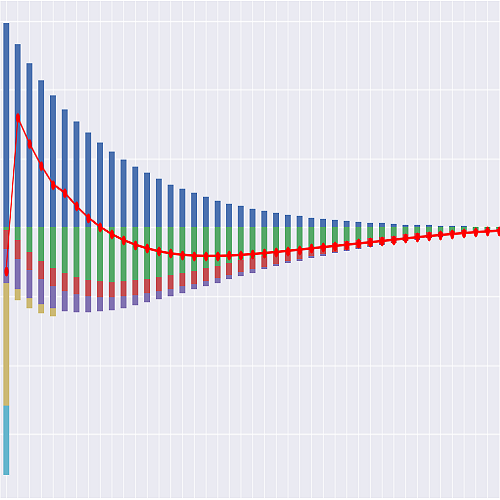
The Projection Space#
The by-policy projection of the FRV_DE_S model.
The Space is parameterized by point_id, so Projection[1] is an ItemSpace
projecting model point 1:
>>> Projection[1].result_cf()          # the worked example's anchor cell
>>> Projection.point_id = 7            # or switch the default
t counts policy months from the contract’s own inception and is 0-based:
t = 0 is the inception month, so t = 60 means the same thing on every model point —
the first month after the acquisition-charge instalment ends. The frame runs
t = proj_start() ... proj_len() - 1 with proj_start() = duration_init_m — 0 for new
business, 96 for the in-force cell — and proj_len() = 12 x (annuity_age - entry_age),
which is the number of policy months from inception and so the frame’s exclusive
end. There is nothing after t = proj_len() - 1: the end of that month is
Rentenbeginn, the units are cancelled, the Fondsguthaben is converted at the
Rentenfaktor and the contract leaves this model. The contractual policy year is the
1-based label policy_year(t) = t // 12 + 1, derived and never indexed by.
Input data
Inputs are external files: plain CSVs living in the model folder’s parent directory,
products/fondsgebundene_rentenversicherung/, read at run time rather than stored
inside the model. The model folder therefore holds nothing but formulas — no _data/,
no IOSpec, no embedded values — so a diff of the model shows logic changes only, and an
input can be edited or swapped without rewriting the model. This follows
annuallife.TradLife_A; contrast basiclife.BasicTerm_S, which keeps its inputs
inside the model through modelx’s IOSpec machinery.
The consequence worth knowing: the model is not portable on its own. Copying the
FRV_DE_S folder without its parent’s CSVs produces a model that reads and then fails
on first evaluation.
Each table has a filename Reference and a reader Cells, both on
Data, reached here through the data Reference:
Reference |
Cells |
File |
|---|---|---|
model_point_file |
data.model_point_table() |
model_point_table.csv |
mort_file |
data.mort_table() |
mort_table.csv |
lapse_file |
data.lapse_table() |
lapse_table.csv |
charge_file |
data.charge_table() |
charge_table.csv |
fund_scenario_file |
data.fund_scenario_table() |
fund_scenario_table.csv |
rentenfaktor_file |
data.rentenfaktor_table() |
rentenfaktor_table.csv |
Naming
Cells names follow lifelib’s basiclife.BasicTerm_S and savings.CashValue_SE
wherever those models have an analogue — pols_* for policy counts, av_* for the
account value, *_pp for per-policy amounts, claims(t, kind) with an uppercase
kind string, av_pp_at(t, timing) and pols_if_at(t, timing) for the
within-month reads. Three German terms of art keep their German form in the cells names
too — beitragssumme, stornoabzug, rentenfaktor — because each names a
quantity with a statutory or contractual definition and no English equivalent that would
not mislead. expenses is the insurer’s own outgo excluding commission and
commissions is its own cells and its own result_cf() column, which is what
expenses means on every delib model that has a commission to publish. The technical
notes use compact actuarial symbols. The mapping is:
Notes symbol |
Cells |
Meaning |
|---|---|---|
(none) |
model_point() |
The selected model point row |
t0 |
proj_start() |
duration_init_m (0-based) |
n |
proj_len() |
Policy months from inception; the frame’s exclusive end |
y(t) |
policy_year(t) |
t // 12 + 1 (1-based label) |
x(t) |
age(t) |
Attained age in month t |
S |
beitragssumme() |
Sum of premiums payable |
B(t) |
prem_pp(t) |
Gross Beitrag due in month t |
Z(t) |
topup_pp(t) |
Zuzahlung in month t |
d(t) |
dynamik_factor(t) |
Beitragsdynamik factor |
alpha(t) |
charge_acq_pp(t) |
Acquisition instalment |
(ledger) |
cum_charge_acq_pp(t) |
Acquisition charge to date |
beta B(t) |
charge_admin_prem_pp(t) |
Premium-based admin charge |
A(t) |
prem_to_av_pp(t) |
Anlagebeitrag - what buys units |
C(t) |
cum_prem_pp(t) |
Cumulative gross premiums paid |
p(t) |
unit_price(t) |
Anteilspreis at the END of t |
p_open(t) |
unit_price_open(t) |
Anteilspreis at the START of t |
i(t) |
fund_return_net_mth(t) |
Monthly return net of the TER |
(scenario) |
fund_return_gross_ann(t) |
Gross annual return |
(scenario) |
fund_ter_ann(t) |
Fund TER, netted off the return |
u(t) |
units_pp(t) |
Units at the START of month t |
du(t) |
units_bought_pp(t) |
Units bought with A(t) |
(cancellations) |
units_cancelled_pp(t) |
Units cancelled for charges |
F(t) |
av_pp(t) |
Fondsguthaben, u(t) p_open(t) |
F_tau(t) |
av_pp_at(t, timing) |
BEF_CHARGE / AFT_CHARGE / AFT_WD / BEF_DECR |
(in force) |
av_at(t, timing) |
av_pp_at(t, timing) pols_if(t) |
gamma_m |
gamma_rate_mth() |
gamma_rate_ann() / 12 |
gamma_m F(t) |
charge_admin_fund_pp(t) |
Fund-based admin charge |
SK |
charge_policy_fee_pp(t) |
Stueckkosten |
W(t) |
withdrawals_pp(t) |
Teilentnahme |
D(t) |
db_floor_pp(t) |
Guaranteed minimum death benefit |
K(t) |
nar_pp(t) |
Riskiertes Kapital |
(none) |
db_pp(t) |
What a death claim actually pays |
q_I(t) |
mort_rate_tariff_mth(t) |
First-order monthly death rate |
q(t) |
mort_rate_mth(t) |
Second-order monthly death rate |
f |
mort_be_factor |
0.75; q(t) = f q_I(t) |
(table) |
lapse_rate_base(t) |
Table lapse rate |
(tax) |
lapse_tax_step(t) |
x 2.5 in the threshold year |
w(t) |
lapse_rate_mth(t) |
Monthly lapse rate; w(n-1) = 0 |
l(t) |
pols_if(t) |
In force at the START of month t |
l(t)(1-q), l(t+1) |
pols_if_at(t, timing) |
BEF_DECR / AFT_DEATH / AFT_DECR |
sigma |
stornoabzug_rate() |
Stornoabzug rate |
R_g, R_c, R |
rentenfaktor_guar(), rentenfaktor_curr(), rentenfaktor_applied() |
Euro of monthly annuity per 10 000 EUR of Fondsguthaben |
(none) |
av_maturity_pp() |
Fondsguthaben at Rentenbeginn |
(none) |
annuity_mth_pp() |
The monthly annuity it buys |
net_cf(t) |
net_cf(t) |
Non-unit cash flow, income positive |
liability_cf(t) |
liability_cf(t) |
The same stream, outgo positive |
net_cf is the non-unit stream
This is the convention everything else hangs on. Every benefit this contract pays before Rentenbeginn is funded by cancelling the policyholder’s own units, so a gross presentation would count the same money twice:
net_cf(t) = charge_acq(t) + charge_admin_prem(t) + charge_admin_fund(t)
            + charge_policy_fee(t) + charge_risk(t) + stornoabzug(t)
            - expenses(t) - commissions(t) - death_strain(t)
Charges in, expenses, commission and the death strain out. expenses excludes
commission, which is commissions() and its own result_cf() column: that is the
library-wide split, stated on KLV_DE_S, Basis_DE_S, Riester_DE_S and
RLV_DE_S too, and the opposite of the frlib chassis, where commission sits inside the
expense total. Whichever convention a model takes, taking both at once double-counts the
commission.
The death strain is the whole of the insurer’s cost per death: the death benefit is
observed before that month’s Risikobeitrag, so what the insurer funds out of its own
pocket is exactly the riskiertes Kapital nar_pp(t) and nothing else. Everything that
moves through the unit fund — premiums, prem_to_av, claims_death, claims_lapse,
claims_maturity, withdrawals, av_releases — is published as a
result_cf() column and is excluded from net_cf, and
check_benefit_funding() asserts that those columns net exactly:
claims_death + claims_lapse + claims_maturity + withdrawals + stornoabzug
    = av_releases + death_strain
Booking the whole Fondsguthaben as an insurer outgo is the first-order failure mode of a unit-linked liability model, and it is the reason the gross columns are published rather than dropped: a reader can see what was excluded.
The fund’s TER is a third category again. It never leaves the Anteilspreis, so it appears nowhere in the ledger and is netted off the assumed gross return instead. Charging it explicitly double-counts; ignoring it overstates the policyholder’s return.
Withheld from the premium, or cancelled out of the fund
The Beitragsverrechnung withholds the acquisition instalment and the premium-based administration charge before units are bought:
A(t) = B(t) + Z(t) - alpha(t) - beta B(t) then du(t) = A(t) / p_open(t)
while the fund-based administration charge, the Stückkosten and the Risikobeitrag are
levied after the month’s return, by cancelling units that already exist. The
distinction is not cosmetic and it is the model’s most easily-hidden error: a model that
nets the fund-based charge out of the Beitrag gives the right answer while premiums are
paid and the wrong answer the moment they stop. Model point 7 goes beitragsfrei at
t = 120 on a zero-return fund; from there premiums(t) is zero while
charge_admin_fund(t) and charge_policy_fee(t) continue, and the fund decays. That
decay is the product fact § 165 VVG makes possible, not a modelling artefact.
check_units_roll_fwd() and check_av_roll_fwd() look redundant and are not.
The unit identity has no price term at all — u(t+1) = u(t) + du(t) - cancelled(t)
— so it fails if a charge is taken in euro without cancelling the matching units. The
account identity carries the return and fails if the price is applied at the wrong point
in the month. An implementation can pass either one alone.
Two mortality bases, and the wedge between them
The Risikobeitrag is priced on a death table, the first-order DAV 2008 T proxy in
mort_table.csv, read through mort_rate_tariff_at_age(). The projection
decrements on the second-order best estimate, mort_be_factor = 0.75 times it. The
difference is the Risikoergebnis, and because the factor is flat it is exactly
(1 - 0.75) = 25 % of the Risikobeitrag collected — a closed-form check a reader can
do with a calculator, and the reason the ratio is flat rather than age-varying. A model
that uses one basis for both makes the risk result identically zero and deletes the
mechanic.
The conversion guarantee rests on a third basis, an annuity table (DAV 2004 R),
reached through rentenfaktor_guar() and rentenfaktor_table.csv. No cells
reads both files, which is the arithmetic form of the statement that a German
fondsgebundene contract carries two mortality bases at once.
The two monthly conversions are deliberately different, and mixing them is a listed
pitfall. Mortality is split linearly, mort_rate_mth = mort_rate / 12, because the
tariff’s own Risikobeitrag is q(x)/12 times the riskiertes Kapital and the charge
and the decrement must rest on the same split or the model manufactures a risk result out
of a rounding convention. Lapse is split geometrically, 1 - (1 - lapse_rate)^(1/12),
because nothing is priced off it and the annual rate is the observable to reproduce. The
fund return is compounded geometrically for the same reason the lapse rate is: it is
an effective annual rate, while a German tariff’s charge rates are nominal.
The acquisition charge, its window, and the in-force cell
charge_acq_total() = alpha_rate x beitragssumme() — 2.50 % of the sum of premiums
payable, which is the Höchstzillmersatz — spread in equal instalments over
acq_window_months() = min(alpha_spread_months, 12 x prem_term_y) months at the
policy’s own premium frequency. On the anchor cell that is 1 800,00 € over 60 monthly
instalments of 30,00 €, which is 15 % of each of the first 60 premiums, ``t = 0 … 59``,
and nothing from ``t = 60``. On model point 12, whose premium term is two years, the
window is 24 months
and the instalment count is 24, not 60; on the quarterly, half-yearly and annual cells it
is 20, 10 and 5 instalments of the corresponding size.
beitragssumme() is the sum of premiums payable at the initial level. It does not
shrink when a contract lapses or goes beitragsfrei, and it does not grow with a
Beitragsdynamik increment — a real tariff re-zillmers each accepted increment over its
own sixty months, and an increment cannot be assumed at inception. The bias that leaves,
an understated acquisition charge on a dynamic contract, is stated rather than hidden.
An in-force model point opens after the window has closed. Model point 6 starts at
t = 96, so charge_acq(t) is zero at every projected month and
commissions(96) carries no Abschlussprovision: the acquisition commission and the
issue expense fall at t = 0 and only there, and t = 0 is not in that model point’s
frame. That is the whole of the difference between an in-force cell and a new-business one
on this chassis.
The Beitragsrückgewähr, and why cum_prem_pp is a state variable
On the composite death benefit the floor is the premiums paid, so the net amount at
risk is max(C(t) - F(t), 0) — positive early and after a market fall, vanishing once
the fund overtakes the premiums paid. That makes cum_prem_pp a genuine state variable
of this product rather than a reporting convenience, and it makes the risk charge a
quantity that has to be recomputed every month. C(t) is the premiums paid, gross:
on the anchor cell cum_prem_pp(59) = 12 000,00 € against sum of prem_to_av_pp over
the same months of 9 720,00 €, so reading the floor off the premiums invested would
understate the death benefit by 19 %.
The floor is chosen by db_form: fund gives no floor and therefore no
Risikobeitrag at all (model points 2 and 13); prem_return is the composite;
pct_fund is a multiple of the fund, so the net amount at risk grows with it; and
sum_assured is a fixed garantierte Mindesttodesfallleistung, which on a decaying
paid-up fund makes the risk charge grow without limit — model point 7 exists to show
that. The floor at zero in nar_pp() is not decoration: without it the contract
would pay the insurer a negative charge in every month the fund is above the floor and
the death strain would turn negative, silently booking the fund’s growth as insurance
profit.
The Rückkaufswert is the Fondsguthaben
§ 169 VVG sends a fondsgebundene contract to the Zeitwert, and on a pure unit-linked
contract with no insurer-given guarantee the Zeitwert is the Fondsguthaben. There
is no discounting, no Rechnungszins, no mortality basis, no Zillmerung residue and no
second-basis Mindestrückkaufswert anywhere in this model — the protection for the
policyholder sits earlier, in the sixty-month spreading of the acquisition charge, which
is why the surrender value is positive from the first month. A Stornoabzug is
permissible only if agreed, quantified and appropriate, and never for unamortised
acquisition costs: stornoabzug_pp(t) is therefore a flat rate on the
Fondsguthaben and is deliberately not a function of
charge_acq_total() - cum_charge_acq_pp(t). Only std_high carries a non-zero rate,
and only model point 5 uses it.
The last month, and the age at Rentenbeginn
lapse_rate_mth(proj_len() - 1) = 0. The end of the last projected month is
Rentenbeginn, so a surrender and an annuitisation are the same event releasing the same
Fondsguthaben, and the whole surviving cohort is booked as pols_maturity. No cash
flow moves either way; the convention only decides the split between the lapse total and
the maturity count, and it is what the closure identity reproduces. It is frlib’s
convention on TD_FR_S and delib adopts it.
age(proj_len() - 1) = annuity_age - 1, because the annuity begins at the end of
that month. The Rentenfaktor is read at annuity_age and not at age(proj_len() -
1): on
the anchor cell 25.00 at 67, not the 24.45 an off-by-one would fetch at 66. The rule
applied is max(guaranteed, current) — a guarantee with upside, so a model that
applies only the guaranteed factor understates the benefit whenever the current tariff is
richer. On std_2026 the two are equal, so the max() is exercised without injecting
an unsourced uplift; model point 13 carries rich_current, where the current factor is
12 % higher and the max() visibly bites.
The reduction in yield
reduction_in_yield() is the product’s defining metric, because on a contract with
no Rechnungszins the charge stack is the economics. It is the reference gross return
less the internal rate of return the policyholder’s own money actually earns, computed on
a single persisting contract — no survivorship, no lapse — because a reduction in
yield is a statement about one policy.
It is a delib-defined measure and it is not the statutory *Effektivkostenquote*. The German figure is aligned to the total-cost-indicator method of the PRIIPs RTS over a specified recommended holding period, and this model implements neither. Any level it produces is arithmetic on this library’s own [std] charge stack and must never be quoted as a market figure.
Modules that are off in the base run
Three constructions are implemented and switched off, so the base run reproduces the worked example while the machinery stays visible and testable:
Dynamic lapse,
lapse_dyn_beta = 0, with 0.15 as the reference value.lapse_dyn_add(t) = beta x max(0, 1 - av_pp(t)/cum_prem_pp(t))raises the lapse rate while the contract is under water against the premiums paid. Unit-linked lapse is market-sensitive precisely because the exit is at fund value on short notice. Switched on it bites hardest on model point 12, whose stress path leaves the fund far below the premiums paid for years.The *Ablaufmanagement* glide, off unless
ablauf_flag. A linear ramp of the gross return from the scenario’s rate tommkt_return_ann = 1.50 %over the lastglide_months = 60months. With one fund and a deterministic return, a reallocation and a change of assumed return are the same thing, so this is the honest representation of what is known — and nothing about a real Ablaufmanagement was established, not whether it is opt-in, not the ramp length, not the destination.The *Überschussbeteiligung*. A unit-linked contract’s surplus arises from the risk and cost results only, and the model computes the risk result but credits none of it back. The omission biases the projected Fondsguthaben downward, which is the honest direction for a charge demonstration.
Beitragsfreistellung is a fourth case and is different in kind: it is a model point
election, pup_month, and not a cohort decrement. A paid-up policy’s fund and its
Beitragsrückgewähr base both depend on the month it went paid-up, so a cohort-level
paid-up rate would need one sub-cohort per month — a two-dimensional recursion over 360
months for a second-order effect. The model reproduces the mechanic exactly on one cell
rather than approximately on all of them, and the [std] 1 % p.a. paid-up rate a cohort
implementation would use is recorded and not implemented. Omitting it biases the
projected charge income upward.
Sign convention
net_cf() is income positive, which is the library-wide sign and the notes’ own
orientation. liability_cf() publishes the same stream outgo-positive,
liability_cf(t) = -net_cf(t) exactly, so a best-estimate non-unit liability is
sum v(t) liability_cf(t) over whatever discount curve the valuation layer supplies,
with the unit liability added at market value. Both are columns of result_cf(), so
the identity is verifiable in the frame rather than only in prose.
The shape to expect is a large negative net_cf in the inception month t = 0 — on
the anchor cell -1 966,22 €, because the 2.50 % acquisition commission and the issue
expense both fall
there while the acquisition charge that funds them arrives over sixty months — then a
thin positive margin that grows with the fund as the kapitalbezogene charge compounds
against it.
Cells Descriptions#
- sex()[source]#
The insured’s sex, M or F. Reporting only — it must not enter pricing.
German life tariffs are unisex for contracts written from 21 December 2012, so neither
mort_rate_tariff_at_age()norrentenfaktor_guar()reads this cells: both are indexed by age alone. It is carried because a Standmitteilung reports it and because a reserving basis may still be sex-specific even where the tariff may not be.
- entry_age()[source]#
Age last birthday at inception.
The age basis steps at each policy anniversary, so
age(t) = entry_age() +
policy_year(t) - 1 = entry_age() + t // 12
and the attained age in the last projected month,t = proj_len() - 1, isannuity_age() - 1.
- duration_init_m()[source]#
Policy months already elapsed at the valuation date; 0 for new business.
An elapsed count, so it is 0-based by nature and
proj_start() ==
duration_init_m()
exactly. It fixesproj_start(), and through it everything that keys off the policy month counted from inception — the acquisition window above all. Model point 6 opens at duration 96, past the window, and is the cell that shows what that costs an insurer: nothing, because the charge and the commission it funded are both behind it.
- pols_if_init()[source]#
Policies in force at the projection’s opening: the weight the model point carries.
pols_if(proj_start()) == pols_if_init()exactly, which is the library’s start-of-period convention asserted in the conventions suite.
- annuity_age()[source]#
Age at Rentenbeginn.
It fixes
proj_len()and it is the row read fromrentenfaktor_table.csv— notage(proj_len() - 1), which is one lower because the annuity begins at the end of the last projected month.
- prem_form()[source]#
The premium form:
laufend(recurring) oreinmal(single).The two differ in more than the number of instalments. A Einmalbeitrag has no Beitragssumme to zillmer against and no five-year spreading to obey, so its acquisition charge is the Zuzahlungskosten rate levied once on receipt, which is what
charge_acq_total()returns for it.
- prem_pp_base()[source]#
The Beitrag the policy states, per instalment, at the initial level.
It already contains whatever Ratenzahlungszuschlag the tariff applied for paying more often than annually, so nothing in this model loads it again — re-applying the fractionation loading is a listed pitfall.
prem_pp()is what is actually due in a given month, after the frequency, the premium term, any Beitragsfreistellung and any Beitragsdynamik.
- prem_mode_months()[source]#
Payment frequency in months: 1, 3, 6 or 12.
It decides both which months carry a premium and how many acquisition instalments the sixty-month window holds — 60 monthly, 20 quarterly, 10 half-yearly, 5 annual.
- prem_term_y()[source]#
Premium-paying term in years; 0 on a single premium.
It caps both the premium stream and the acquisition window: a two-year premium term spreads the acquisition charge over 24 months, not 60.
- dynamik_rate()[source]#
Beitragsdynamik: the contractual annual premium increase; 0 when off.
[std] at 3 % on the one model point that carries it — no carrier’s dynamic step was established. It raises the premium and therefore the Anlagebeitrag, but it does not raise
beitragssumme(), because a real tariff re-zillmers each accepted increment over its own sixty months and an increment cannot be assumed at inception.
- pup_month()[source]#
The 0-based policy month from which the contract is beitragsfrei; 0 = never.
The column carries a point on the frame’s own time axis, so it moved with the frame: model point 7 goes paid-up at
t = 120. Zero is the “never” sentinel, not the inception month — a contract beitragsfrei from inception is not a contract, so nothing is lost by spending the value that way.Beitragsfreistellung is a model point election on this chassis, not a cohort decrement, and the reason is in the Space docstring. From
pup_monththe premium and the charges withheld from it stop, while the fund-based charges, the Stückkosten and the Risikobeitrag continue by unit cancellation — which is why a paid-up unit-linked contract decays.
- db_form()[source]#
The Todesfallleistung shape:
fund,prem_return,pct_fundorsum_assured.The four shapes German insurers use, in ascending order of the risk they impose: the fund itself (no net amount at risk, no Risikobeitrag at all), Beitragsrückgewähr (the composite, and the only shape with any corroboration in this library’s corpus), a percentage of the fund, and a fixed garantierte Mindesttodesfallleistung.
- db_pct()[source]#
The multiple of the Fondsguthaben used by the
pct_funddeath benefit.[std] at 1.10 on the two model points that carry it, chosen to give a positive net amount at risk that grows with the fund rather than vanishing as the Beitragsrückgewähr one does. Commonly quoted market values are 100 %, 105 % and 110 %; none was established.
- sum_assured()[source]#
The garantierte Mindesttodesfallleistung used by the
sum_assureddeath benefit.[std] at 40 000 EUR on the one model point that carries it, chosen large enough that the net amount at risk stays positive over a decaying paid-up fund. This is the shape that turns the contract into a savings-plus-term-cover package and the one whose risk charge grows without limit as the fund falls.
- rentenfaktor_id()[source]#
The key into
rentenfaktor_table.csvnaming this policy’s conversion factors.
- unit_price_init()[source]#
The Anteilspreis at the projection’s opening,
unit_price_open(proj_start()).100.00 EUR on every new-business cell, which makes the unit counts readable; 118.40 on the in-force cell, where it is the price a Standmitteilung would report.
- units_init()[source]#
Anteileinheiten held at the projection’s opening.
Zero on new business. On the in-force cell, 190.0 units at 118.40 EUR — a Fondsguthaben of 22 496,00 EUR against 24 000,00 EUR of premiums paid, so the cell opens with a positive net amount at risk and a live Risikobeitrag.
- cum_prem_init()[source]#
Gross premiums paid before the valuation date — the Beitragsrückgewähr base.
Seeds
cum_prem_pp(). Nonzero only on the in-force cell, where getting it wrong would silently mis-state the death benefit for the whole remaining term.
- topup_month()[source]#
The 0-based policy month of a Zuzahlung; 0 = none.
A point on the frame’s time axis, so it moved with the frame: model point 9 tops up at
t = 120. Zero is the “none” sentinel rather than the inception month, a Zuzahlung at inception being indistinguishable from a larger first Beitrag.
- topup_amount()[source]#
The Zuzahlung — an additional single premium into an existing contract.
It buys units like a premium, pays its own Zuzahlungskosten and no beitragsbezogene charge, and raises the Beitragsrückgewähr base. It does not raise
beitragssumme(), for the same reason a Beitragsdynamik increment does not.
- wd_month()[source]#
The 0-based policy month of a Teilentnahme; 0 = none.
A point on the frame’s time axis, so it moved with the frame: model point 9 withdraws at
t = 240. Zero is the “none” sentinel rather than the inception month.
- wd_amount()[source]#
The Teilentnahme — a partial withdrawal during the Aufschubzeit.
An owner election, not a claim, so it is published as
withdrawals()and never asclaims_wd. It is a partial surrender with a partial surrender’s tax consequences, and it is settled by cancelling units at the closing Anteilspreis.
- ablauf_flag()[source]#
Whether Ablaufmanagement — the de-risking glide before Rentenbeginn — is on.
Represented as a linear ramp of the gross return down to
mmkt_return_annover the lastglide_monthsmonths. With one fund and a deterministic return that is arithmetically the same thing as a reallocation, and it is the honest representation of what is known: no ramp length, destination or opt-in rule was established.
- kapitalwahl()[source]#
Whether the Kapitalwahlrecht is elected at Rentenbeginn.
A reporting split only, and deliberately so. Both routes release the same Fondsguthaben from this model — the annuity is published, not projected — so the flag changes no cash flow. It is carried because the two tax regimes genuinely differ and because take-up is the largest behavioural unknown in the product; no take-up rate was established, so the base run annuitises and this is an election rather than an assumption.
- proj_start()[source]#
The first projected policy month,
duration_init_m()— 0-based.0 for new business, 96 for the in-force cell:
tcounts policy months from the contract’s own inception witht = 0the inception month, so the elapsed-month count is the first projected index and needs no+ 1. Because the origin is inception rather than the valuation date, a singlecharge_acq_pp()rule serves the new-business and the in-force cell without a duration offset.
- proj_len()[source]#
The number of projected policy months from inception,
12 x (annuity_age() - entry_age()).The library’s reading of
proj_len(): a period count, so it is the frame’s exclusive end.result_cf()coverst = proj_start() ... proj_len() - 1andresult_cf().index[-1] == proj_len() - 1on every model point. The end of monthproj_len() - 1is Rentenbeginn; there is not = proj_len()row.
- policy_year(t)[source]#
The policy year containing month t,
t // 12 + 1.The contractual label, and 1-based by contract: policy year 1 is
t = 0 ... 11. It is derived fromtand never indexed by, and it is the key into the annual tables —lapse_table.csvandfund_scenario_table.csv— whose ownpolicy_yearcolumn is that same 1-based label.
- age(t)[source]#
Attained age in month t,
entry_age() + policy_year(t) - 1 = entry_age() + t // 12.At
t = proj_len() - 1this isannuity_age() - 1, because the annuity begins at the end of that month. Reading the Rentenfaktor off this cells instead of offannuity_age()is a listed pitfall and would fetch 24.45 in place of 25.00 on the anchor cell.
- alpha_rate()[source]#
Abschluss- und Vertriebskosten rate on the Beitragssumme.
2.50 % on
std_gross— the *Höchstzillmersatz* itself, and the only number in the whole charge stack with any corroboration. The composite takes the cap rather than a guessed interior point, on the ground that a reference implementation should demonstrate the binding constraint. Zero on the Nettotarif.
- alpha_spread_months()[source]#
Months over which the acquisition charge is spread — 60 on every shipped tariff.
§ 169 VVG requires the angesetzte Abschluss- und Vertriebskosten to be spread evenly over the first five contract years, and a unit-linked tariff implements that inside the Beitragsverrechnung: only one sixtieth may be withheld per month, so units are bought from the start and the surrender value is positive from the first month.
- beta_rate()[source]#
Beitragsbezogene Verwaltungskosten: the rate on each gross Beitrag.
Withheld from the premium before units are bought, for the whole premium-paying term, and it stops when premiums stop. [std] at 4.00 % on the composite against an argued range of 2 % to 10 %; no carrier level was established.
- gamma_rate_ann()[source]#
Kapitalbezogene Verwaltungskosten (Gammakosten): the annual rate on the fund.
[std] at 0.30 % p.a. against an argued range of 0.10 % to 1.20 %. This is the charge that continues after premiums stop, the one that makes a paid-up unit-linked policy decay, and — because it compounds against the whole accumulated fund — the dominant component of the reduction in yield on a long contract.
- gamma_rate_mth()[source]#
The monthly Gammakosten rate,
gamma_rate_ann() / 12.Divided, not compounded, because a German tariff quotes a nominal monthly charge rate. The fund return on the same contract is compounded geometrically because it is an effective annual rate. That asymmetry is deliberate; collapsing it is a listed pitfall. On the composite,
0.0030 / 12 = 0.00025.
- policy_fee_mth()[source]#
Stückkosten: the fixed euro charge per policy per month.
[std] at 3.00 EUR against an argued range of 0 to 5 EUR. A euro amount rather than a rate, which is why it is the charge that can consume a small paid-up Fondsguthaben — the reason insurers set a minimum fund below which Beitragsfreistellung is refused.
- zuzahlung_charge_rate()[source]#
Zuzahlungskosten: the acquisition charge on a Zuzahlung or a Einmalbeitrag.
[std] at 2.50 % on the composite. A Zuzahlung pays this and no beitragsbezogene charge — it is not a regular Beitrag — and on a single-premium contract this rate is the whole of the acquisition charge, levied once on receipt.
- stornoabzug_rate()[source]#
Stornoabzug: the deduction from the Rückkaufswert on surrender.
Permissible only if vereinbart, beziffert and angemessen, and never for unamortised acquisition costs — a deduction of that kind is ineffective under § 169 VVG, which is why
stornoabzug_pp()is a flat rate on the Fondsguthaben and deliberately not a function of the unrecovered acquisition charge. [std] at zero on the composite, because many unit-linked tariffs have none at all and a non-zero one would be an unsourced number attached to a contested clause; 2.00 % onstd_high, the only shipped tariff that carries one.
- dynamik_factor(t)[source]#
The Beitragsdynamik multiplier in month t,
(1 + dynamik_rate())^(y(t) - 1).Steps at each policy anniversary, so it is 1.0 for the whole of policy year 1,
t = 0 ... 11. Off (identically 1.0) on twelve of the thirteen model points.
- prem_pp(t)[source]#
The gross Beitrag per policy due in month t; zero in a month with no instalment.
A premium falls when the frequency says so, the premium term has not expired and the contract is not yet beitragsfrei. On a single-premium contract the whole Einmalbeitrag falls at
proj_start()and nothing after it.The amount is
prem_pp_base()times the Beitragsdynamik factor and nothing else: the stated instalment already contains any Ratenzahlungszuschlag, so loading it again would charge the fractionation twice.
- beitragssumme()[source]#
The Beitragssumme: the sum of premiums payable, at the initial level.
prem_pp_base() x (12 / prem_mode_months()) x prem_term_y()on a recurring-premium contract — 200.00 x 12 x 30 = 72 000,00 EUR on the anchor cell — and the Einmalbeitrag itself on a single-premium one.It is the base of the acquisition charge and it is invariant: it does not shrink when the contract lapses or goes beitragsfrei, and it does not grow with a Beitragsdynamik increment or a Zuzahlung. Letting it follow the premiums actually paid is a listed pitfall — it would make the acquisition charge a function of the lapse assumption, which is both wrong and circular.
- acq_window_months()[source]#
The months over which the acquisition charge is spread,
min(60, 12 x term).The five-year statutory spread, cut short where the premium term is shorter than five years: model point 12 pays for two years, so its window is 24 months and not 60. Zero on a single-premium contract, whose acquisition charge is a one-off.
- acq_instalments()[source]#
The number of acquisition instalments: the window divided by the premium frequency.
60 on the anchor cell, 20 quarterly, 10 half-yearly, 5 annual, 24 on the two-year premium term, and 1 on a single premium. The count matters because the instalment is
charge_acq_total() / acq_instalments(), so spreading a shortened window over sixty months would understate every instalment and leave the ledger short at the end.
- charge_acq_total()[source]#
The whole Abschluss- und Vertriebskosten charge, before any Zuzahlungskosten.
alpha_rate() x beitragssumme()on a recurring-premium contract — 2.50 % of 72 000,00 = 1 800,00 EUR on the anchor cell — andzuzahlung_charge_rate() x prem_pp_base()on a single-premium one, where there is no Beitragssumme to zillmer against and no five-year spread to obey.
- charge_acq_pp(t)[source]#
The acquisition charge withheld from month t’s premium, per policy.
One instalment of
charge_acq_total() / acq_instalments()on each premium date inside the window, nothing after it, plus the Zuzahlungskosten on any Zuzahlung falling in the month. On the anchor cell that is 30,00 EUR for t = 0 … 59 and 0,00 from t = 60 — 15 % of each of the first sixty premiums, then a cliff. That cliff is the characteristic shape of a German unit-linked contract’s early values and it is the reason this model runs monthly.An in-force model point opening after the window sees zero at every projected month, which is correct: the charge and the commission it funded are both behind it.
- cum_charge_acq_pp(t)[source]#
Cumulative acquisition charge withheld to and including month t, per policy.
The ledger
check_acq_charge()closes against an independently counted expectation. It opens atcharge_acq_pp(proj_start())in the frame’s first month, so on an in-force model point it measures the charge taken inside the projection and not the charge the contract has already paid. The seed sits in the first month itself rather than atproj_start() - 1, which on a new-business cell would bet = -1.
- charge_admin_prem_pp(t)[source]#
Beitragsbezogene Verwaltungskosten withheld from month t’s premium, per policy.
beta_rate() x prem_pp(t)— 4.00 % of 200.00 = 8,00 EUR on the anchor cell, every month a premium falls and none in between. Charged on the regular Beitrag only: a Zuzahlung pays its own charge and no second one.
- prem_to_av_pp(t)[source]#
The Anlagebeitrag: what is left of the month’s money to buy units, per policy.
B(t) + Z(t) - alpha(t) - beta B(t). On the anchor cell 162,00 EUR while the acquisition instalment runs (t < 60) and 192,00 EUR after it — the step att = 60is the whole point of the sixty-month window.
- cum_prem_pp(t)[source]#
Cumulative gross premiums paid to and including month t, per policy.
The Beitragsrückgewähr base, seeded at
cum_prem_init(). It is the premiums paid, not the premiums invested: on the anchor cellcum_prem_pp(59) = 12 000,00 EURagainst 9 720,00 EUR actually put into units, so reading the death benefit off the invested amount would understate it by 19 %. A Zuzahlung counts.The seed is added inside the frame’s first month rather than read from
cum_prem_pp(proj_start() - 1), which on a new-business cell would bet = -1.
- fund_return_gross_ann(t)[source]#
The assumed gross annual fund return in month t, before the TER.
Read from
fund_scenario_table.csvby(scenario_id, policy_year). [std] and a scenario rather than a forecast: nothing in this product’s corpus supplies a return, and PRIIPs deliberately does not — its scenarios are derived from an underlying’s own return history, so nothing here may be compared with one.Where
ablauf_flagis set, the Ablaufmanagement glide overrides it in the lastglide_monthsmonths with a linear ramp down tommkt_return_ann, reaching the money-market rate exactly in the final month.
- fund_ter_ann(t)[source]#
The fund’s TER (Gesamtkostenquote) in month t, as an annual rate.
A return item, never a policy charge. It is borne inside the Anteilspreis and accrues to the fund manager, so it appears in no
charge_*cells and in noresult_cf()column: the model nets it off the gross return instead. Charging it explicitly double-counts the fund’s costs; ignoring it overstates the policyholder’s return. 0.45 % p.a. on the active composite fund, 0.15 % on the ETF.
- fund_return_net_ann(t)[source]#
The annual fund return net of the TER,
gross - ter.4.55 % p.a. on the base path — 5.00 % gross less a 0.45 % TER. Netting rather than compounding the two is the [std] convention and is immaterial at these levels.
- fund_return_net_mth(t)[source]#
The monthly fund return,
(1 + fund_return_net_ann(t))^(1/12) - 1.Compounded geometrically, because the annual rate is an effective rate and twelve monthly steps must reproduce it. The charge rates on the same contract are divided by twelve instead, because a German tariff quotes them nominally. On the base path
(1.0455)^(1/12) - 1 = 0.00371482 per month.
- unit_price_open(t)[source]#
The Anteilspreis at the start of policy month t.
unit_price_init()in the frame’s first month andunit_price(t - 1)in every month after it. It is a cells of its own rather than aunit_price(t - 1)written at every call site because on a new-business cellproj_start()is 0, and nothing in a 0-based frame may be indexed att = -1. Units bought out of month t’s premium are bought at this price; everything cancelled during the month is cancelled atunit_price().
- unit_price(t)[source]#
The Anteilspreis at the end of policy month t.
unit_price_open(t) x (1 + fund_return_net_mth(t)), seeded byunit_price_open(proj_start()) = unit_price_init(). The whole of the fund’s own cost lives in this recursion and nowhere else.
- units_pp(t)[source]#
Anteileinheiten held per policy at the start of month t.
The state variable of the product: what the insurer guarantees is the number of units, not their value, so the recursion is carried in units and euro are derived.
units_pp(proj_start()) = units_init(); thereafter the closing fund of montht - 1divided by that month’s closing price.
- units_bought_pp(t)[source]#
Units bought in month t with the Anlagebeitrag, at the opening price.
prem_to_av_pp(t) / unit_price_open(t). Premium is in advance, so the month’s investment return accrues on the units it buys.
- units_cancelled_pp(t)[source]#
Units cancelled in month t for charges and any Teilentnahme, at the closing price.
The fund-based administration charge, the Stückkosten, the Teilentnahme and the Risikobeitrag, all divided by
unit_price(t). Together withunits_bought_pp()this closescheck_units_roll_fwd(), an identity with no price term in it at all — which is exactly why it catches a charge taken in euro without the matching units being cancelled.
- av_pp(t)[source]#
The Fondsguthaben per policy at the start of month t, before the premium.
units_pp(t) x unit_price_open(t). The within-month balances areav_pp_at(); the closing fund of the surviving cohort isav_pp(t + 1) x pols_if(t + 1)and not any of them.
- av_pp_at(t, timing)[source]#
The Fondsguthaben per policy at a named point inside month t.
The four points of the monthly processing order, in order:
"BEF_CHARGE"after the premium has bought units and the month’s return has accrued.
"AFT_CHARGE"less the fund-based administration charge and the Stückkosten.
"AFT_WD"less any Teilentnahme. This is the balance the net amount at risk is measured against, so it is the fund the Risikobeitrag prices.
"BEF_DECR"less the Risikobeitrag. The closing balance: what a death, a surrender or an annuitisation releases, and what rolls into
units_pp(t + 1).
The
min(.., remaining)floors inside the charges are [std] safeguards, not tariff terms; none of the thirteen shipped model points triggers one, and a contract that did would in practice have had its cover terminated.
- av_at(t, timing)[source]#
The in-force Fondsguthaben at a named point inside month t.
av_pp_at(t, timing) x pols_if(t)— the per-policy balance weighted by the start-of-month exposure, which is the weight every cash flow on thatresult_cf()row carries. For the fund the survivors carry into montht + 1, readav_pp(t + 1) x pols_if(t + 1)instead: the decrements have acted by then and this cells has not applied them.
- charge_admin_fund_pp(t)[source]#
Kapitalbezogene Verwaltungskosten in month t, per policy.
gamma_rate_mth() x av_pp_at(t, "BEF_CHARGE")— taken by cancelling units, on the fund as it stands after the premium and the month’s return. It continues when premiums stop, which is what makes a paid-up unit-linked contract decay; a model that netted it out of the Beitrag instead would be right untilt = 120on model point 7 and wrong from then on.
- charge_policy_fee_pp(t)[source]#
Stückkosten in month t, per policy, floored at the remaining balance.
A flat euro amount taken by cancelling units, independent of the premium and of the fund, so on a small decayed Fondsguthaben it is the charge that bites hardest. The floor at the remaining balance is a [std] safeguard against a negative fund and is triggered by no shipped model point.
- charge_risk_pp(t)[source]#
The Risikobeitrag in month t, per policy: the price of the death cover.
mort_rate_tariff_mth(t) x nar_pp(t), floored at the remaining balance, taken by cancelling units. Priced on the first-order death table — never on the annuity table behind the Rentenfaktor, and never on the projection’s own best-estimate decrement, because the difference between the two is the Risikoergebnis.It is recomputed every month because both the death benefit and the Fondsguthaben move. On the
funddeath-benefit shape it is identically zero, there being no net amount at risk to price.
- stornoabzug_pp(t)[source]#
The Stornoabzug per surrendering policy in month t.
stornoabzug_rate() x av_pp_at(t, "BEF_DECR")— a flat rate on the Fondsguthaben, and deliberately not a function of the unrecovered acquisition charge: § 169 VVG makes a deduction for noch nicht getilgte Abschluss- und Vertriebskosten ineffective, which is precisely what stops an insurer recovering through the deduction what the five-year spreading denies it. Zero on every shipped tariff butstd_high.
- withdrawals_pp(t)[source]#
The Teilentnahme per policy in month t, floored at the balance available.
An owner election, not a claim, which is why it is published under this name and never as
claims_wd. It is settled by cancelling units at the closing Anteilspreis, after the fund-based charges and before the net amount at risk is measured — so a withdrawal raises the net amount at risk on a Beitragsrückgewähr contract and therefore the following months’ Risikobeitrag.
- db_floor_pp(t)[source]#
The guaranteed minimum Todesfallleistung in month t, per policy.
The floor the fund is compared against, by
db_form:fund0.00 — the benefit is the Fondsguthaben itself, so there is nothing to guarantee and no Risikobeitrag.
prem_returnthe Beitragsrückgewähr:
cum_prem_pp(t), the gross premiums paid. The composite, and the only shape with corroboration anywhere in this corpus.pct_funddb_pct()times the Fondsguthaben, so the floor and the net amount at risk both grow with the fund.sum_assureda fixed garantierte Mindesttodesfallleistung, independent of the fund.
- nar_pp(t)[source]#
The riskiertes Kapital in month t:
max(db_floor_pp(t) - fund, 0).Measured against
av_pp_at(t, "AFT_WD")— the fund before that month’s Risikobeitrag — so the insurer’s non-unit cost per death is exactly this amount and nothing else.The floor at zero is load-bearing. Without it the contract would pay the insurer a negative charge in every month the fund is above the guarantee and
death_strain()would turn negative, which books the fund’s growth as insurance profit. On the Beitragsrückgewähr shape this quantity is positive early, vanishes once the fund overtakes the premiums paid, and returns after a market fall.
- db_pp(t)[source]#
The Todesfallleistung actually paid on a death in month t, per policy.
av_pp_at(t, "BEF_DECR") + nar_pp(t): the closing Fondsguthaben the death releases, plus the net amount at risk the insurer funds. Splitting it that way rather than writingmax(floor, fund)is what keeps the unit and non-unit sides apart — the first term is the policyholder’s own money and the second is the insurer’s.
- mort_rate_tariff_at_age(x)[source]#
The first-order annual death rate at attained age x, from
mort_table.csv.The tariff’s own basis — a DAV 2008 T proxy,
0.00080 x 1.10^(x - 37)— and the price of the death cover. This cells andrentenfaktor_guar()are the model’s two mortality reads, and no cells reads both: a German fondsgebundene contract prices its death charge on a death table and its conversion guarantee on an annuity table, and using one for both misprices one of them.
- mort_rate_at_age(x)[source]#
The second-order annual death rate at attained age x, the projection’s decrement.
mort_be_factor x mort_rate_tariff_at_age(x)with a flatmort_be_factor = 0.75. Flat is crude and is stated as such; what it buys is that the Risikoergebnis is exactly 25 % of the Risikobeitrag collected, which a reader can verify with a calculator. What a replacement basis must preserve is the direction: a first-order death table carries its margin above best estimate.
- mort_rate_tariff(t)[source]#
The first-order annual death rate in month t, at
age(t).0.00080 in policy year 1 of the anchor cell, whose entry age is the proxy’s anchor age.
- mort_rate_tariff_mth(t)[source]#
The first-order monthly death rate,
mort_rate_tariff(t) / 12.Split linearly, not geometrically, because the tariff’s Risikobeitrag is
q(x)/12times the riskiertes Kapital and the charge and the decrement must rest on the same split. At q = 0.00080 the two splits differ by 0.04 % — a difference that would land entirely in the risk result, which is exactly the quantity the model is trying to measure.
- mort_rate(t)[source]#
The best-estimate annual death rate in month t, at
age(t).0.00060 in policy year 1 of the anchor cell: 0.75 x 0.00080.
- mort_rate_mth(t)[source]#
The best-estimate monthly death rate,
mort_rate(t) / 12.The projection’s decrement, and 0.00005 in policy year 1 of the anchor cell. Split the same way as the tariff rate, for the reason given in
mort_rate_tariff_mth().
- lapse_rate_base(t)[source]#
The table annual lapse rate for the policy year containing month t.
[std] throughout — no German unit-linked Stornoquote was established anywhere. 6 % in years 1 to 5, 3 % in 6 to 10, 2 % in 11 and 12, 3 % from 13. The front-loading is a structural inference: the acquisition charge is being taken, the value is furthest below the premiums paid, and § 168 VVG makes the exit near-frictionless.
- lapse_tax_step(t)[source]#
The tax-threshold multiplier on the lapse rate in month t: 2.5, or 1.0.
Under § 20 Abs. 1 Nr. 6 EStG only half the Unterschiedsbetrag is taxable where the contract has run at least twelve years and payment falls after completion of the 62nd year of life. Surrenders are suppressed as the threshold approaches and spike once both limbs are met, so the multiplier applies for the twelve months of the policy year
max(13, 62 - entry_age() + 1).Keying the spike on duration alone is wrong, and is a listed pitfall: the anchor cell passes duration 12 at age 48, fourteen years before the tax benefit exists, so its step falls in policy year 26 —
t = 300to311, where the base 3.0 % becomes 7.5 %. On model point 12 the step never fires, because the projection ends att = 143and the step year begins att = 144.
- lapse_dyn_add(t)[source]#
The dynamic-lapse addition in month t; zero in the base run.
lapse_dyn_beta x max(0, 1 - av_pp(t) / cum_prem_pp(t))— the rate rises while the contract is under water against the premiums paid. Unit-linked lapse is market-sensitive precisely because the exit is at fund value on short notice, and the feedback it introduces is real: a falling fund raises lapse, which removes the policies whose charges would have recovered the acquisition cost.lapse_dyn_beta = 0in the base run and 0.15 is the reference value. No German calibration evidence for a coefficient of any size exists in this corpus.
- lapse_rate(t)[source]#
The annual lapse rate applied in month t.
min(lapse_cap, lapse_rate_base(t) x lapse_tax_step(t) + lapse_dyn_add(t))with a [std] cap of 40 %. Annual by the library’s convention; the monthly rate the projection actually uses islapse_rate_mth().
- lapse_rate_mth(t)[source]#
The monthly lapse rate,
1 - (1 - lapse_rate(t))^(1/12); zero in the last month.Split geometrically, unlike the mortality rate, because nothing is priced off the lapse rate and the annual rate is the observable that twelve monthly steps must reproduce: 0.514301 % at 6 % p.a. and 0.253505 % at 3 %.
lapse_rate_mth(proj_len() - 1) = 0[std]: the end of the last projected month is Rentenbeginn, so a surrender and an annuitisation are the same event releasing the same Fondsguthaben, and the whole surviving cohort is booked aspols_maturity(). No cash flow moves either way; the convention decides the split between the lapse total and the maturity count.
- pols_if(t)[source]#
Policies in force at the start of month t.
pols_if(proj_start()) = pols_if_init()exactly, and the count on aresult_cf()row is the weight applied to every cash flow on that same row, so dividing a flow by it recovers the per-policy amount. End-of-month state ispols_if_at().pols_if(proj_len()) = 0, one past the frame’s last index: the survivors of the last projected month leave aspols_maturity()and there is nothing after Rentenbeginn in this model.
- pols_if_at(t, timing)[source]#
The in-force count at a named point inside month t.
"BEF_DECR"the start-of-month count,
pols_if(t)."AFT_DEATH"after deaths and before lapses — the ordering, deaths first, is [std].
"AFT_DECR"after both, which for
t < proj_len() - 1ispols_if(t + 1). Att = proj_len() - 1it is the surviving cohort before the maturity sweep, and so equalspols_maturity(proj_len() - 1)rather thanpols_if(proj_len()), which is zero.
- pols_death(t)[source]#
Expected deaths in month t, on the best-estimate basis.
pols_if(t) x mort_rate_mth(t). The tariff’s first-order rate prices the charge; this rate produces the claims. Their difference is the Risikoergebnis.
- pols_lapse(t)[source]#
Expected surrenders in month t, on the survivors of the month’s deaths.
Zero in the last month by construction, where the whole surviving cohort is booked as
pols_maturity()instead.
- pols_maturity(t)[source]#
Policies reaching Rentenbeginn: zero except in the last projected month.
At
t = proj_len() - 1it is the whole surviving cohort,pols_if_at(t, "AFT_DECR"), since the lapse rate is zero there. Namedpols_maturityand notpols_expiryper the library’s register: it is the count whose cover ends at the scheduled end of the contract, and what is paid for it isclaims(t, "MATURITY").
Gross premium income in month t, including any Zuzahlung.
(prem_pp(t) + topup_pp(t)) x pols_if(t). It is published because the reader needs it, and it is excluded fromnet_cf(): almost all of it is the Anlagebeitrag, which is the policyholder’s money passing into the unit fund. What the insurer keeps out of it ischarge_acq()andcharge_admin_prem(), andcheck_prem_split()asserts that the three account for the whole premium.
- charge_acq(t)[source]#
Abschluss- und Vertriebskosten collected in month t, in force.
Zero for
t >= 60on every model point but 9, where a Zuzahlung books its Zuzahlungskosten here —charge_acq(120) = 312.63. Zero at every projected month of an in-force cell that opens past the window.
- charge_admin_fund(t)[source]#
Kapitalbezogene Verwaltungskosten collected in month t, in force.
The charge that survives Beitragsfreistellung, and the one that grows with the fund — on a thirty-year contract it is the dominant term in the reduction in yield.
- charge_risk(t)[source]#
Risikobeitrag collected in month t, in force.
Priced on the first-order table.
sum(charge_risk) - sum(death_strain)is the Risikoergebnis and equals(1 - mort_be_factor) x sum(charge_risk)exactly.
- stornoabzug(t)[source]#
Stornoabzug retained from surrenders in month t, in force.
Income to the insurer, so it is a plus in
net_cf(), and simultaneously part of the account value released — which is why it appears on both sides ofcheck_benefit_funding(). Zero on every model point but 5.
- withdrawals(t)[source]#
Teilentnahmen paid in month t, in force.
An owner election funded entirely by cancelling the policyholder’s own units, so it is outside
net_cf()altogether.
- claims(t, kind)[source]#
Benefit outgo in month t by kind:
"DEATH","LAPSE"or"MATURITY"."DEATH"pols_death(t) x db_pp(t)— the closing Fondsguthaben plus the net amount at risk."LAPSE"the Rückkaufswert: the Fondsguthaben, less any Stornoabzug. There is no formula behind it beyond that — § 169 VVG sends a fondsgebundene contract to the Zeitwert, and on a pure unit-linked contract the Zeitwert is the fund.
"MATURITY"the Fondsguthaben released at Rentenbeginn, whether it buys the annuity or is taken under the Kapitalwahlrecht: both routes release the same capital from this model.
All three are funded from the unit fund and are therefore outside
net_cf(); only the death benefit’s net-amount-at-risk component, published separately asdeath_strain(), is an insurer cost.
- av_releases(t)[source]#
The Fondsguthaben released from the unit fund in month t, in force.
Every exit’s closing balance plus any Teilentnahme. It is the unit-side total that
check_benefit_funding()reconciles against the benefits actually paid: the two differ by exactly the death strain, which the insurer funds, and by the Stornoabzug, which it retains.
- death_strain(t)[source]#
The insurer’s own cost of the death benefit in month t:
pols_death(t) x nar_pp(t).The only part of any benefit this contract pays that is not the policyholder’s own money. Because the death benefit is observed before the month’s Risikobeitrag, it is exactly the riskiertes Kapital — no more and no less — which is the discretization that makes the risk result a clean number.
- expense_acq_pp(t)[source]#
The issue expense per policy issued, at t = 0:
expense_issue, 200,00 EUR.The insurer’s own acquisition cost excluding the commission, which is
comm_acq_pp()— the splitexpenses()andcommissions()publish separately, and which is why this cells is not the whole 2 000,00 EUR of acquisition cash that leaves at inception.It falls at
t = 0, the inception month, and only there, so an in-force model point whose frame opens att = 96never incurs it.
- comm_acq_pp(t)[source]#
The Abschlussprovision per policy issued, at t = 0:
comm_acq_rate x S.On the anchor cell 2.50 % of a 72 000,00 EUR Beitragssumme = 1 800,00 EUR, and zero at every other month.
The commission is set equal to the acquisition charge deliberately, both at 2.50 % of the Beitragssumme: the insurer pays it at inception and recovers exactly that, undiscounted, over the following sixty months, so the model shows in one number the financing problem the Höchstzillmersatz and the five-year spread exist to regulate. No German commission scale was established, so any other level would be an unsourced number pretending to be an observation.
comm_acq_rateis a flat scalar, so that equality holds onstd_grossand fails on the two low-load tariffs: onstd_nettoandstd_lowthe assumed commission exceeds the tariff’s own acquisition charge and those cells carry a projected loss. That is the flat assumption showing, not a product fact — a real Nettotarif pays no acquisition commission at all, the adviser being paid a fee by the client under a separate Vergütungsvereinbarung. It is left flat because the alternative is a second unsourced commission scale, and it is said here rather than left to be discovered in a negativenet_cftotal.It falls at
t = 0, the inception month, and only there, so an in-force model point whose frame opens att = 96never incurs it.
- expense_maint_pp(t)[source]#
Maintenance expense per policy in month t, inflating from inception.
expense_maint_mth x (1 + expense_infl)^(t/12)— 4,00 EUR a month at 2 % p.a., and exactly 4,00 EUR in the inception montht = 0. Inflated off the policy month rather than the projection’s own start, so an in-force cell picks up the inflation its elapsed duration has already accrued.
- expenses(t)[source]#
Total insurer expense in month t, excluding commission.
Five components: the issue expense at
t = 0; the inflating monthly maintenance expense; and the per-event expenses of a death, a surrender and an annuitisation.Commission is not in here. It is
commissions(), its ownresult_cf()column, andnet_cf()subtracts the two separately — the delib convention, and the opposite of the frlib chassis, where commission sits inside the expense total. Folding it back in while leaving thecommissionscolumn in the frame would charge it twice.
- commissions(t)[source]#
Commission outgo in month t, published beside
expenses().The Abschlussprovision at
t = 0—comm_acq_pp()on the count in force in that month, and nil on an in-force model point whose frame opens later, the commission being sunk — plus the Bestandsprovisioncomm_renew_rate x prem_pp(t)on every gross Beitrag collected. Both [std]: no German unit-linked commission scale was established.
- net_cf(t)[source]#
The non-unit net cash flow in month t, income positive.
charges collected + stornoabzug - expenses - commissions - death_strain. Every benefit paid before Rentenbeginn is funded by cancelling the policyholder’s own units and is therefore absent from this line; what the insurer earns is the charge stack and what it bears is its own expenses, its commission and the net amount at risk.On the anchor cell the inception month
t = 0is -1 966,22 EUR — the acquisition commission and the issue expense both fall there while the acquisition charge that funds them arrives over sixty months — after which the margin turns positive and grows with the fund.
- liability_cf(t)[source]#
The same stream outgo positive,
-net_cf(t)exactly.The orientation a valuation layer consumes: the non-unit best estimate is
sum v(t) x liability_cf(t)over whatever discount curve it supplies, with the unit liability — the Fondsguthaben itself, backed one-for-one by the Anlagestock — added at market value. This model discounts nothing.
- rentenfaktor_guar()[source]#
The garantierter Rentenfaktor: euro of monthly annuity per 10 000 EUR of fund.
Read from
rentenfaktor_table.csvat ``annuity_age()``, not atage(proj_len() - 1), which is one lower: the annuity begins at the end of the last projected month. On the anchor cell 25.00 at age 67; the off-by-one would fetch 24.45.[std] and derived rather than observed —
10 000 / (12 T_eff)at a 0 % Rechnungszins — and it is fixed for the life of the contract. A reduction under § 163 VVG with an independent Treuhänder’s confirmation is recorded as a model risk and not implemented.
- rentenfaktor_curr()[source]#
The aktueller Rentenfaktor on the insurer’s tariff at Rentenbeginn.
Equal to the guaranteed factor on
std_2026, so themax()is exercised without injecting an unsourced uplift, and 12 % higher onrich_current, where it visibly bites. Both are [std].
- rentenfaktor_applied()[source]#
max(rentenfaktor_guar(), rentenfaktor_curr())— the factor actually applied.The German rule is a guarantee with upside: the guaranteed factor is a floor, and where the insurer’s current tariff is richer at Rentenbeginn the current one applies. A model that applies only the guaranteed factor understates the benefit whenever that happens.
Note what is and is not guaranteed here. Only the conversion terms are; the capital they multiply is the market’s. A guaranteed Rentenfaktor is therefore not a guaranteed pension, and any document implying otherwise is wrong.
- av_maturity_pp()[source]#
The Fondsguthaben per policy at Rentenbeginn.
av_pp_at(proj_len() - 1, "BEF_DECR"): the closing balance of the frame’s last month, after that month’s charges. It is what the surviving cohort releases, and what the Rentenfaktor converts.
- annuity_mth_pp()[source]#
The monthly annuity the Fondsguthaben buys at Rentenbeginn, per policy.
av_maturity_pp() / 10 000 x rentenfaktor_applied().This model stops here. The annuity is published, not projected: the payout phase — the Überschussrente, the Rentengarantiezeit, the Rentenbezugskosten — belongs to
products/sofortrente/. Under the Kapitalwahlrecht the same capital is taken as a lump sum instead, which is why that flag changes no cash flow here.
- gross_return_ref()[source]#
The reference gross fund return over the projection, annualised.
The geometric mean of the scenario’s gross returns over the projected months, before the TER and before every policy charge. It is the yardstick the reduction in yield is measured against, and on a level path it is simply that path’s rate — 5.00 % on the base scenario.
- irr_ann()[source]#
The internal rate of return the policyholder’s own money earns, annualised.
Solved by bisection on a single persisting contract — no survivorship and no lapse — because a reduction in yield is a statement about one policy rather than about a cohort. The premiums and any Zuzahlung are accumulated from the start of their month to Rentenbeginn, any Teilentnahme is accumulated from the end of its month and subtracted, and an in-force cell’s opening Fondsguthaben enters as an inflow at the projection’s start; the accumulated value is matched to
av_maturity_pp().The opening-fund term matters only on an in-force model point — it is zero on every new-business cell — but without it the measure would credit that cell’s charges with growing money the projection never received.
- reduction_in_yield()[source]#
The charge stack expressed as an annual reduction of the contract’s return.
gross_return_ref() - irr_ann(). The product’s defining metric, because on a contract with no Rechnungszins the charge stack is the economics: everything the policyholder does not get is either a charge or the fund’s own TER, and this number is both of them together.It is a delib-defined measure and it is not the statutory *Effektivkostenquote*. The German figure is aligned to the total-cost-indicator method of the PRIIPs RTS over a specified recommended holding period, and this model implements neither. Any level it produces is arithmetic on this library’s own [std] charge stack and must never be quoted as a market figure.
- check_net_cf_resid(t)[source]#
The residual of the cash flow statement’s own reconciliation in month t; zero.
delib’s first ruling.
net_cf(t)must be reconstructible from the partsresult_cf()publishes, so that the headline number of a cash flow model is not the one quantity nothing checks. The identity is:net_cf = charge_acq + charge_admin_prem + charge_admin_fund + charge_policy_fee + charge_risk + stornoabzug - expenses - commissions - death_strain
and this residual rebuilds the first two terms by a different route — as
premiums - prem_to_av, which is what the Beitragsverrechnung leaves behind — so the check crosses the unit / non-unit boundary rather than restating the formula. A charge added to the ledger and not tonet_cf, or an account-value benefit wrongly booked as an insurer outgo, fails here.
- check_net_cf()[source]#
True when the cash flow statement reconciles in every projected month.
No argument, one bool over all t, the library-wide shape;
check_net_cf_resid()gives the signed residual of the month that failed.
- check_prem_split_resid(t)[source]#
The Beitragsverrechnung residual in month t; zero.
premiums - (prem_to_av + charge_acq + charge_admin_prem). What is withheld from a German unit-linked premium is the acquisition instalment and the premium-based administration charge, and what is left buys units: nothing else may come out of the premium. A model that also netted the Stückkosten or the fund-based charge out of the Beitrag — the single most common way to get this product wrong — fails here.
- check_prem_split()[source]#
True when the premium splits exactly three ways in every projected month.
- check_units_roll_fwd_resid(t)[source]#
The unit roll-forward residual at the end of month t; zero.
units_pp(t+1) - (units_pp(t) + units_bought_pp(t) - units_cancelled_pp(t)).This identity has no price term in it at all, which is what makes it worth publishing beside
check_av_roll_fwd_resid(). Units move only when they are bought or cancelled, so a charge taken in euro without cancelling the matching units fails here while every euro total in the frame still looks plausible.
- check_units_roll_fwd()[source]#
True when the unit count rolls forward exactly in every projected month.
- check_av_roll_fwd_resid(t)[source]#
The account-value roll-forward residual in month t; zero.
av_pp_at(t, "BEF_DECR") - [ (av_pp(t) + prem_to_av_pp(t)) (1 + i(t)) - charges - withdrawal ].The companion to
check_units_roll_fwd_resid(), and not redundant with it: this one carries the price, so it fails if the month’s return is applied at the wrong point in the order — to the fund before the premium is credited, or after the charges are taken instead of before. An implementation can pass either identity alone.
- check_av_roll_fwd()[source]#
True when the Fondsguthaben rolls forward exactly in every projected month.
- check_benefit_funding_resid(t)[source]#
The unit / non-unit funding residual in month t; zero.
claims_death + claims_lapse + claims_maturity + withdrawals + stornoabzug - (av_releases + death_strain).Everything this contract pays before Rentenbeginn comes from one of exactly two places: the policyholder’s own Fondsguthaben, or the insurer’s pocket. This identity says so arithmetically, and it is the check that catches the product’s first-order failure mode — booking the whole account value as an insurer outgo, which would leave every column in the frame looking reasonable and the liability overstated by the entire fund.
- check_benefit_funding()[source]#
True when every benefit is funded from the fund or the insurer, in every month.
- check_pols_roll_fwd_resid(t)[source]#
The in-force roll-forward residual in month t; zero.
pols_if(t) - (pols_death(t) + pols_lapse(t) + pols_maturity(t) + pols_if(t+1)). Everyone who starts a month either dies, surrenders, reaches Rentenbeginn or is still there at the start of the next one. Summed over the projection it is the closure identity — the three exits account for the whole opening cohort — and att = proj_len() - 1it is what thelapse_rate_mth(proj_len() - 1) = 0convention closes.
- check_pols_roll_fwd()[source]#
True when the in-force count rolls forward exactly in every projected month.
- check_acq_charge_resid(t)[source]#
The acquisition-charge ledger residual at the end of month t; zero.
cum_charge_acq_pp(t)against an expectation counted rather than accumulated: the number of instalment dates elapsed, times the instalment, plus the Zuzahlungskosten on any Zuzahlung already received. Because the count is closed form and the ledger is a recursion, the two disagree if the window runs one month too long, if a shortened premium term is still spread over sixty months, or if an instalment is charged in a month with no premium.At
t = proj_len() - 1on a new-business cell it says that the whole acquisition charge has been collected and no more:alpha_rate x beitragssumme()exactly, which on the anchor is 1 800,00 EUR.
- check_acq_charge()[source]#
True when the acquisition-charge ledger matches its counted expectation everywhere.
- result_cf()[source]#
Result table of cash flows, indexed by policy month t.
pols_ifis the start-of-month count and is the weight applied to every cash flow on the same row, so dividing a flow by it recovers the per-policy amount. The frame isrange(proj_start(), proj_len())—t = proj_start() ... proj_len() - 1— and stops there: the end of the last month is Rentenbeginn.The columns fall into three groups and the grouping is the point.
premiumsandprem_to_avare the money coming in and the part of it that goes straight into the unit fund. The sixcharge_*columns plusstornoabzugare what the insurer keeps.claims_*,withdrawalsandav_releasesare the unit fund paying itself out, and are excluded fromnet_cf— onlydeath_strain, the net amount at risk the insurer funds, crosses over.expensesandcommissionsare two columns and not one:expensesexcludes commission on every delib model that has a commission to publish.liability_cfisnet_cfoutgo positive, published so the sign convention is verifiable in the frame.
- result_fund()[source]#
Result table of the unit fund and the decrements, indexed by policy month t.
The per-policy view the cash flow table weights: the Anteilspreis, the unit count, the four within-month Fondsguthaben balances, the Beitragsrückgewähr base, the net amount at risk, and the three decrement rates. This is roughly what a German Standmitteilung reports, which is not a coincidence — the statement’s line items are this model’s state vector.