The Projection Space#
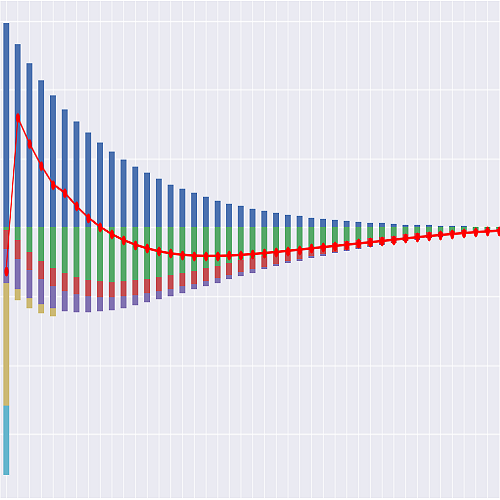
The by-policy projection of the RV_DE_S model.
The Space is parameterized by point_id, so Projection[1] is an ItemSpace
projecting model point 1:
>>> Projection[1].result_cf()          # the worked example's anchor cell
>>> Projection.point_id = 6            # or switch the default
Two clocks: a monthly frame over a mostly annual product
t counts policy months from inception and is 0-based: t = 0 is the first
policy month. proj_len() = 12 x proj_len_y() is the exclusive end of the frame, so
result_cf().index[-1] == proj_len() - 1, and proj_len_y() = omega_age() - issue_age
is the number of policy years behind it. A life annuity has no term, so the projection
ends where the annuitant cannot survive further rather than at a fixed horizon: on the
anchor cell, t = 0 ... 851, seventy-one policy years running to attained age 121. A
new-business model point opens at t = 0; an in-force point that has run duration_init
complete policy years opens at t = t_start() = 12 x duration_init, carrying its opening
balances on the model point. That is what lets one generational mortality surface and one
declared-rate path serve a book of mixed vintages.
Almost nothing on this product is monthly, and the argument of a cells says which it is.
Cells that state an annual account take a 0-based policy year k — the premium and its
whole decomposition, the Deckungskapital, the Ansammlungsguthaben, the § 169 Abs. 3
spread account, the declared rate and the interest surplus, the surrender value, the death
benefit, the Beitragsfreistellung election and the Überschussrente step. Cells that
state a month take t — the in force, the three decrements, the claims, the annuity
instalment, the expenses and every result_cf() column. duration(t) = t // 12 is the
bridge, policy_year(t) = duration(t) + 1 is the contractual 1-based label,
age(t) = age_y(duration(t)) and calendar_year(t) = calendar_year_y(duration(t)) both
step on the anniversary, and is_anniv(t) = (t % 12 == 11) marks the month the annual
machinery acts in.
The decrement rates keep the library’s two speeds: mort_rate(t) and lapse_rate(t)
return the annual rate of the policy year — the vectors the notes tabulate and
result_pols() prints — while mort_rate_mth(t) and lapse_rate_mth(t), each
1 - (1 - r)^(1/12), are what the recursion applies, so twelve of each compound back to
the year. That is what leaves the whole annual layer bit-identical to the annual-step
model this replaced, on all fourteen model points: pols_if at every anniversary, both
account balances, the § 169 floor, the surrender value, the conversion capital and the
Rentenfaktor are unchanged, and result_pols() is row for row the table it was.
Two rates of 1 are certainties rather than rates and are placed in the anniversary month
instead of being twelfth-rooted: the terminal q = 1 of the mortality proxy, which is the
table’s closure convention, and the § 165 cash-out, which is a dated contractual act.
Spreading either geometrically would empty the cohort eleven months early.
What the monthly grid changed, and what it did not
It did not change the premium. § 12 Abs. 1 VVG makes the Versicherungsperiode the year
for this tariff, the Beitrag is payable in advance for it, and the Deckungskapital the
whole model turns on is defined at anniversaries and nowhere between them — so
prem_due(t) is true in the first month of each policy year and nowhere else, and premium
income is identical to the annual-step model’s. The Ratenzahlungszuschlag remains the whole
of what the Zahlweise does here. (KLV_DE_S is the contrast: there the echt reading
makes the period genuinely monthly, two model points differ in nothing else, and the
instalment stream is in the frame.)
It did not change what a claim is paid. § 169 Abs. 3 VVG strikes the value zum Schluss
der laufenden Versicherungsperiode and not at the cancellation date, so a policy leaving in
any month of policy year k is paid cv_pp(k) or db_pp(k) — the year-end value it
paid the year’s premium in advance for. What moved is when the claim falls and how many
policies are exposed to it.
Three things did change, and they are the point of the conversion.
The annuity is monthly, and is now paid monthly.
annuity_pp(t)is one instalment,G + U(k), paid in advance at the beginning of the month onpols_annuity(t). The annual-step model paid12 (G + U)at the start of each payout year — a compression carried as a [std] that was generous to the payout phase by roughly half a year’s interest on a year’s annuity and by a full year of survivorship on instalments a decedent did not live to collect. On the anchor cell the annuity outgo falls from 23 485,03 € to 23 115,89 €, and it falls on every one of the ten model points that reach a Rentenbeginn. The Rentengarantiezeit is now12mguaranteed instalments rather thanmannual lumps.The decrements compete monthly. Deaths and surrenders are taken in the same order as before — deaths first, surrenders on the survivors of them — but twelve times a year rather than once, so a life that the annual ordering would have counted as a death may surrender first. The total exits are unchanged at every anniversary; the split moves, by 16,87 € of claims from death to lapse on the anchor cell.
Expenses are borne for the months a policy was there.
expenses_pp(t)is a twelfth of the year’s amount, inflated by(1 + expense_infl())^duration(t), so a policy leaving mid-year no longer bears a full year of administration. The anchor cell’s expenses fall from 1 669,77 € to 1 646,77 €.
The Rentenbeginn falls at the end of the deferment period of n = aufschub_y years,
which is the end of month 12n - 1 and the same instant as the start of month 12n.
Accumulation months are t < 12n; payout months are t >= 12n. The Kapitalabfindung
is paid in month 12n - 1; the first annuity instalment falls in month 12n. On the
anchor cell n = 17, the Rentengarantiezeit covers t = 204 ... 323 and the
survivor-weighted annuity runs from t = 324 to t = 851.
Two frames, and the third
result_cf() is the monthly cash flow statement and carries the six flows that cross
the contract boundary. result_cf_annual() sums it into policy years, which is the view
the technical notes’ worked example is stated on. result_pols() is the annual state
behind both — the rates, the premium decomposition, the three account balances per policy and
at fund level, the year’s credits, the surrender value and the death benefit — indexed by the
1-based policy_year. The account movements av, av_sur, prem_to_av,
int_credited and bonus_credited live there and not in the cash flow statement: they
move once a year, and a cash flow statement whose columns do not all sum to its bottom line is
one a reader has to know which columns to skip.
Input data
Inputs are external files: plain CSVs living in the model folder’s parent directory,
products/klassische_rentenversicherung/, read at run time rather than stored inside the
model. The model folder therefore holds nothing but formulas — no _data/, no IOSpec, no
embedded values — so a diff of the model shows logic changes only, and an input can be
edited or swapped without rewriting the model. This follows annuallife.TradLife_A;
contrast basiclife.BasicTerm_S, which keeps its inputs inside the model.
The consequence worth knowing: the model is not portable on its own. Copying the
RV_DE_S folder without its parent’s CSVs produces a model that reads and then fails on
first evaluation.
Each table has a filename Reference and a reader Cells, both on Data,
reached here through the data Reference:
Reference |
Cells |
File |
|---|---|---|
model_point_file |
data.model_point_table() |
model_point_table.csv |
mort_file |
data.mort_table() |
mort_table.csv |
decl_rate_file |
data.decl_rate_table() |
decl_rate_table.csv |
rentenfaktor_file |
data.rentenfaktor_table() |
rentenfaktor_table.csv |
charge_file |
data.charge_table() |
charge_table.csv |
lapse_file |
data.lapse_table() |
lapse_table.csv |
freq_load_file |
data.freq_load_table() |
freq_load_table.csv |
param_file |
data.param_table() |
param_table.csv |
Naming
Cells names follow lifelib’s basiclife.BasicTerm_S and savings.CashValue_SE
wherever those models have an analogue — pols_* for policy counts, av_* for account
values, plural nouns for cash flows, *_rate for rates, *_pp for per-policy amounts,
claims(t, kind) with an uppercase kind string, av_pp_at(t, timing) and
pols_if_at(t, timing) for the within-year reads. The technical notes use compact
actuarial symbols instead. The mapping is:
Notes symbol |
Cells |
Meaning |
|---|---|---|
(none) |
model_point() |
The selected model point row |
N = omega - issue_age |
proj_len_y() |
Number of policy years |
12 N |
proj_len() |
Exclusive end, in months |
t0 = 12 duration_init |
t_start() |
First projected month |
k0 = duration_init |
k_start() |
First projected policy year |
(none) |
duration_mth(t) |
Elapsed policy months, = t |
k(t) |
duration(t) |
0-based policy year of month t |
t + 1 (contractual) |
policy_year(t) |
1-based policy year label |
(none) |
is_anniv(t) |
Last month of a policy year |
x(k) |
age_y(k) |
Attained age in policy year k |
x(t) |
age(t) |
The same, read at a month |
tau(k) |
calendar_year_y(k) |
Calendar year of policy year k |
tau(t) |
calendar_year(t) |
The same, read at a month |
omega |
omega_age() |
Terminal age of the proxy |
n |
(model point aufschub_y) |
Deferment years |
m |
(model point rgz_years) |
Rentengarantiezeit years |
kappa |
(model point kapitalwahl_rate) |
Commutation take-up |
l(t) |
pols_if(t) |
In force at the start of month t |
l(t) - D, l(t+1) |
pols_if_at(t, timing) |
BEF_DECR / BEF_LAPSE / AFT_DECR |
a(t) |
pols_annuity(t) |
Count the instalment is paid on |
P(k) |
prem_pp(k) |
Gross premium in policy year k |
P_sched(k) |
prem_pp_sched(k) |
The premium as written at issue |
(none) |
prem_due(t) |
Whether P falls due in month t |
phi |
freq_load() |
Ratenzahlungszuschlag |
(sum of P_sched) |
beitragssumme_pp() |
Zillmer base |
alpha_total |
alpha_total_pp() |
Total acquisition charge |
alpha(k) |
charge_acq_pp(k) |
Zillmered acquisition charge |
alpha~(k) |
charge_acq_spread_pp(k) |
Evenly spread acquisition charge |
beta(k) |
charge_prem_pp(k) |
Premium charge |
gamma(k) |
charge_admin_pp(k) |
Reserve-based charge |
rho(k) |
charge_risk_pp(k) |
Risikobeitrag |
(none) |
nar_pp(k) |
Net amount at risk |
S(k) |
prem_to_av_pp(k) |
Sparbeitrag |
C(k) |
charge_from_av_pp(k) |
Charge met from the account |
V(k) |
av_pp(k) |
Deckungskapital per policy |
V after prem / after int |
av_pp_at(k, timing) |
BEF_PREM / AFT_PREM / AFT_INT |
A(k) |
av_sur_pp(k) |
Ansammlungsguthaben per policy |
Vtilde(k) |
av_spread_pp(k) |
Sec. 169(3) parallel account |
Delta(k) |
spread_diff_pp(k) |
Vtilde(k) - V(k) |
i |
int_rate_guar() |
Rechnungszins |
d(k) |
decl_rate(k) |
Declared laufende Verzinsung |
b(k) |
bonus_rate(k) |
max(0, d(k) - i) |
q*(t) |
mort_rate_guar(t) |
First-order mortality, annual |
q(t) |
mort_rate(t) |
Best-estimate mortality, annual |
q^m(t) |
mort_rate_mth(t) |
The monthly rate applied |
(table) |
mort_rate_at_age(x) |
Base-year table rate at age x |
(trend) |
improve_rate(x) |
Annual improvement at age x |
w(t) |
lapse_rate(t) |
Surrender rate, annual |
w^m(t) |
lapse_rate_mth(t) |
The monthly rate applied |
Dcheck(k) |
db_base_pp(k) |
Start-of-year death measure |
D(k) |
db_pp(k) |
Death benefit of policy year k |
Rbar(k) |
cv_tariff_pp(k) |
Tariff surrender value |
Runder(k) |
cv_floor_pp(k) |
Sec. 169(3) floor |
R(k) |
cv_pp(k) |
Surrender value paid |
K |
capital_conv_pp() |
Conversion capital |
f_g |
annuity_rate_guar() |
Garantierter Rentenfaktor |
f_c |
annuity_rate_curr() |
Aktueller Rentenfaktor |
f |
annuity_rate_appl() |
max(f_g, f_c) |
G |
annuity_guar_mth_pp() |
Garantierte Rente, monthly |
U(k) |
annuity_sur_mth_pp(k) |
Ueberschussrente, monthly |
G + U(k) |
annuity_pp(t) |
The instalment paid in month t |
net_cf(t) |
net_cf(t) |
Net cash flow, income positive |
liability_cf(t) |
liability_cf(t) |
The same stream, outgo positive |
Five namings needed care.
db_base_pp and db_pp are two different quantities with deliberately similar names.
db_base_pp(k) is the death benefit measured on start-of-year balances and exists
only to strike the Risikobeitrag, because a risk charge computed on the post-charge
balance would make the recursion circular. db_pp(k) is what a death claim actually pays,
on end-of-year balances. Both are published so the difference is visible rather than
buried, and both take a policy year: a death in any month of year k is paid
db_pp(k).
charge_* and expense_* are not synonyms. A charge is a deduction the tariff
makes from the premium or the Deckungskapital: it moves money inside the contract and
produces no cash flow. An expense is the insurer’s own best-estimate outgo and is a cash
flow. expenses(t) is invariant to beta_rate and gamma_rate; av_pp(k+1) is
not. Booking the Kostenbeitrag as an expense inflates outgo by the whole charge load and
is the commonest way to make a German model look conservative.
av_pp and av_sur_pp are two accounts, not one balance split in two. The
Deckungskapital carries the guarantee and is credited at int_rate_guar(); the
Ansammlungsguthaben is the verzinsliche Ansammlung side account and is credited at
decl_rate(k) on its own balance plus bonus_rate(k) on the Deckungskapital’s
post-premium base. Each has its own roll-forward check, and both checks are annual.
pols_if and pols_annuity differ inside the Rentengarantiezeit and nowhere else.
pols_if(t) is the start-of-month count and the weight on every cash flow of the same
result_cf() row; pols_annuity(t) is the count the annuity instalment is paid on,
which inside the guarantee window is the annuitised count and not the survivors.
mort_rate and mort_rate_mth — and lapse_rate and lapse_rate_mth beside them —
are the library’s two speeds and not two spellings of one rate. The unsuffixed name is the
annual rate of the policy year, which is what the notes tabulate and what a reader
checking against a table wants; the _mth name is the geometric twelfth the recursion
applies. Nothing in this model applies an unsuffixed decrement rate, and nothing divides one
by twelve.
The declared rate contains the guarantee
This is the first thing to get right about a German profit-participating contract and the first listed modeling pitfall. The laufende Verzinsung is the Garantieverzinsung plus the laufende Zinsüberschussbeteiligung, not a surplus on top of the guarantee, so:
bonus_rate(k) = max(0, decl_rate(k) - int_rate_guar())
and the two credits together deliver decl_rate(k) on the post-premium Deckungskapital
and never more. On the anchor cell that is 1,00 % into int_credited_pp and 1,55 % into
bonus_credited_pp against a 2,55 % declaration. On model point 6 — a 2,75 % legacy
vintage against the same declaration — bonus_rate(k) is zero in every policy year
while int_credited_pp(k) is the largest in the table. A model that credits 1,00 % and a further
2,55 % puts 56,82 € into the anchor cell’s first year against 40,82 €, and reaches 63 768,69 €
of accumulated value at the Rentenbeginn against 58 788,98 € — 8,5 % too much, the whole of it
sitting in the Ansammlungsguthaben.
The guarantee vintage is a model-point attribute
int_rate_guar() reads the model point, not a Reference. A German life book is a layered
stack of guarantee vintages: the Höchstrechnungszins applies to contracts concluded while
it is in force and existing contracts keep the rate they were written on. Points 1, 6 and 14
credit 1,00 %, 2,75 % and 0,90 % in the same run, from the same tables. Re-running point 6 on a
single global 1,00 % rate moves its Deckungskapital at Rentenbeginn by −7,7 % and its
Ansammlungsguthaben by +156 %, while the conversion capital moves by −0,8 %: the vintage error
is a misallocation between the two accounts, not a hole in the total, and it therefore
survives a reasonableness check on the headline figure.
The within-year order, which no source fixes
Premium in advance, then the charges, then the Rechnungszins on what is left — all of it once a policy year, on the anniversary:
av_pp_at(k, "AFT_PREM") = av_pp(k) + prem_to_av_pp(k) - charge_from_av_pp(k)
int_credited_pp(k)      = int_rate_guar() * av_pp_at(k, "AFT_PREM")
av_pp_at(k, "AFT_INT")  = av_pp_at(k, "AFT_PREM") + int_credited_pp(k)
This ordering is a standardization. No document in this product’s corpus fixes the
sequence of premium credit, charge deduction and interest accrual, and it is the single most
consequential such choice in the model: crediting interest on the opening balance alone
changes year-one interest by the whole of i x (prem_to_av_pp(0) - charge_from_av_pp(0)).
Two further conventions inside the decomposition are [std] and are worth naming.
charge_risk_pp and charge_admin_pp are struck on start-of-year balances, or the
recursion is circular. And charges are met from the premium where there is one and from
the *Deckungskapital* where there is not: charge_from_av_pp(k) is what makes a
Beitragsfreistellung cost something instead of being free.
The Sec. 169(3) floor, carried as a difference
The surrender value is floored at the Deckungskapital that results from spreading the charged acquisition costs evenly over the first five contract years. The two accounts differ only in that charge, so the model carries the difference rather than a second full recursion:
spread_diff_pp_at(k, "AFT_INT") = (Delta(k) + alpha(k) - alpha~(k)) * (1 + i)
with gamma and rho taken at the same euro amount in both accounts [std], which
is what makes the difference exact. Two consequences are not obvious. The difference is
large in the first five years — on the anchor cell the whole 25 ‰ is taken in the first
year against one fifth of it — and it never returns to zero, because the spread account earns
the Rechnungszins on the amounts not yet deducted. So on a zillmered tariff with a positive
Rechnungszins the floor sits above the tariff Deckungskapital at every duration.
The floor is the § 169 Abs. 3 Deckungskapital alone: profit shares sit on top of the
statutory minimum rather than inside it. That reading lets the floor bind early and stop
binding once the Ansammlungsguthaben has outgrown the interest residual and the
Stornoabzug, so both branches of cv_pp(k) = max(cv_tariff_pp, cv_floor_pp) are
exercised on the anchor cell alone — it binds through policy year 4 (k = 3) and not
after. The
alternative reading, in which the floor also carries the Ansammlungsguthaben, is not
implemented and would make the floor bind at every duration.
Beitragsfreistellung is an election, not a decrement
Beitragsfreistellung is a deterministic election in the contractual policy year
pup_year — policy year k = pup_year - 1 — rather than a rate: a scalar per-policy
account cannot carry two sub-populations with different Deckungskapital, and no source
establishes a rate. Both statutory branches are implemented and both are exercised:
Conversion (model point 7).
prem_pp(k) = 0from the paid-up year, the Deckungskapital is reset topup_value_pp()— the § 165 rule that the paid-up benefit is computed on the § 169 Abs. 3–5 value — the Ansammlungsguthaben is untouched,spread_diff_ppis set to zero because the two accounts have merged, andcharge_admin_ppswitches togamma_pup_rate. No Stornoabzug is taken [std]: Abs. 5 is drafted for a payout on Kündigung, and here the contract continues. The reset is real money and is published aspup_uplift(k).Cash-out (model point 8). Where the paid-up annuity would fall below the Mindestversicherungsleistung, § 165 has the contract cashed out at the surrender value including profit shares instead of made paid-up. The whole surviving cohort then leaves in the last month of policy year
k = pup_year - 2through the surrender decrement, atcv_pp(k). That is the one placelapse_ratereturns 1, andlapse_rate_mthplaces the certainty in the anniversary month rather than spreading it: § 165 makes the cash-out fall at the end of the Versicherungsperiode, not a twelfth of the way into it.
pup_year is the contractual policy year of the election, so the contract is paid up
from k = pup_year - 1. pup_uplift(k) is booked in the transition year
k = pup_year - 2, weighted by pols_if(12 (pup_year - 1)), because that is the year
whose roll-forward needs it: the uplift is the step between
av_pp_at(pup_year - 2, "AFT_INT") and the reset av_pp(pup_year - 1), and
check_av_roll_fwd() closes in every policy year only if it is credited there. The
technical notes describe the same amount from the receiving year’s point of view.
A Beitragsfreistellung is not a lapse. The paid-up contract keeps its guarantee vintage and
its guaranteed Rentenfaktor and pays a reduced benefit; the surrendered one is gone for
cash. On point 7 pols_if is unbroken through the paid-up year and the conversion itself
moves no policy: lapse_rate in policy year pup_year - 2 is the ordinary duration-9
table rate of 3,5 % and not 1. What is not true is that surrender ceases: a beitragsfrei
contract keeps its § 168 VVG Kündigung right, so the surrender claims of policy year
pup_year are positive on point 7 and stay positive from the paid-up year on.
The Rentenbeginn
Everything happens at the end of the last accumulation month t = 12n - 1 — which is the
end of policy year k = n - 1 — on the survivors of that month’s decrements:
capital_gross_pp = av_pp_at(n - 1, "AFT_INT") + av_sur_pp_at(n - 1, "AFT_INT")
capital_conv_pp  = max(guar_capital_pp, capital_gross_pp + val_reserve_pp)
annuity_rate_appl = max(annuity_rate_guar, annuity_rate_curr)
annuity_guar_mth_pp = capital_conv_pp / 10 000 * annuity_rate_appl
val_reserve_pp is the Bewertungsreserven crystallisation, which § 153 Abs. 3 VVG makes
hälftig and which the transition to annuity payment is a key point for; the rate is a
placeholder. The commuting policyholders receive capital_conv_pp — the same capital the
annuitants convert, Bewertungsreserven included: the corpus gives no basis for paying them
less, and inventing one would be a charge no source supports. Both account balances go to
zero from k = n.
The applied factor is max(garantierter, aktueller), guaranteed for the whole payment
period, and it is a written option on the insurer’s own future annuity tariff. Both
branches ship: the current factor wins on the anchor cell at 32,00 € against 28,00 €, and
the guarantee binds on point 13, whose guar_capital_pp floor binds at the same time.
The Rentengarantiezeit is paid to the dead
Inside the guarantee window the instalment is due whether or not the annuitant is alive, so it is weighted by the annuitised count and not by survivors:
pols_annuity(t) = pols_annuitization(12n - 1)  for 12n <= t < 12n + 12m
                = pols_if(t)                   for t >= 12n + 12m
Because pols_if(t) <= pols_annuitization(12n - 1) throughout the payout phase this is
max(pols_if(t), 1{12n <= t < 12n + 12m} pols_annuitization(12n - 1)), which is how
check_annuity_guarantee() states it — and stating it that way is what makes the check
independent of the definition it is checking. On the anchor cell the two differ at
t = 204 ... 323 and coincide from t = 324.
The window is 12m guaranteed instalments, not m annual lumps. That is what a Rentengarantiezeit is — a Rente is a monthly payment and the guarantee is a guarantee of monthly payments — and it is a thing the annual grid could only approximate.
Modules that are recorded and not applied
annuity_admin_rateships incharge_table.csvat 1,5 % of each instalment and is not applied. The Rentenfaktor is exogenous here and already carries the tariff’s payout loading, so deducting a further administration charge from the annuity would charge it twice.annuity_payments(t)is(G + U(k)) a(t)exactly.annuity_due_factor()is a diagnostic and nothing else. It is the annuity-due present value on the shipped mortality proxy at the guarantee interest basis, published so that the gap between the [std] Rentenfaktor and the [std] annuity table is visible rather than hidden. They are not calibrated to each other, and the *Rentenfaktor* is authoritative: it fixes the benefit amount, while the mortality proxy fixes only how long that amount is paid. No cash flow reads it.No Bonusrente ledger, no Zuzahlung, no survivor’s-annuity or BU rider, no § 163 VVG adjustment of the guaranteed Rentenfaktor, no dynamic surrender, no premium-default path and no tax. Each is named in the technical notes where it belongs.
No death benefit after the *Rentenbeginn*. Beitragsrückgewähr in der Rentenbezugsphase was not established by any source in this product’s corpus and is not asserted:
claims(t, "DEATH")is zero for everyt >= 12non every model point. What the corpus does establish for post-Rentenbeginn death is the Rentengarantiezeit, which is modelled.
Sign convention
net_cf() is income positive — premiums in, benefits, annuity instalments and
expenses out — which is the notes’ own orientation and the library-wide sign.
liability_cf() publishes the same stream outgo-positive, liability_cf(t) =
-net_cf(t) exactly, so a best estimate is sum v(t) liability_cf(t) over whatever
discount curve the valuation layer supplies. Both are columns of result_cf(), so the
identity is verifiable in the frame rather than only in prose.
av, av_sur, prem_to_av, int_credited and bonus_credited are state
movements reported, not cash flows summed: the Sparbeitrag and the two credits move money
inside the contract and never cross the boundary, and they move once a policy year, so they
are reported in result_pols(). The six that do cross it are premiums, the three
claims_*, annuity_payments and expenses, they are the whole of
result_cf()’s flow columns, and those six are exactly what check_net_cf()
reconciles.
Cells Descriptions#
- model_point()[source]#
The selected model point as a Series, from model_point_table.csv.
Thirty columns; the projection reads them through this one cells so that a model point is fetched once per ItemSpace. Point 1 is the technical notes’ worked-example anchor.
- omega_age()[source]#
The terminal age of the shipped mortality proxy, from param_table.csv.
121 [std].
mort_rateis 1 atomega_age - 1, so the projection ends with no survivors andcheck_decrement_closure()closes onpols_if_init()exactly.
- proj_len_y()[source]#
N: the number of projected policy years,
omega_age() - issue_age.A life annuity has no term, so the horizon is the age at which the annuitant cannot survive further rather than a fixed number of years — truncating one at, say, 40 years silently drops the tail the Rentenfaktor was priced for. 71 on the anchor cell, whose last policy year ends at attained age 121.
- proj_len()[source]#
The exclusive end of the frame, counted in policy months:
12 x proj_len_y().The library-wide reading of
proj_len(), asserted intests/test_model_conventions_de.py:result_cf()coverst = t_start() ... proj_len() - 1andresult_cf().index[-1] == proj_len() - 1. This is lifelib’s ownfor t in range(proj_len()). 852 on the anchor cell, whose last row ist = 851.
- t_start()[source]#
The frame’s first month:
12 x duration_init.duration_initis an elapsed count of completed policy years, so the conversion is a multiplication and no model point column changed. 0 for new business; 168 on an in-force point that has run fourteen years.
- k_start()[source]#
The frame’s first policy year:
duration_inititself.The annual clock’s counterpart to
t_start(). Every cells taking a policy yeark— the premium, the charges, both accounts, the § 169 floor, the surrender value and the death benefit — is defined from here.
- duration_mth(t)[source]#
The number of complete policy months elapsed at the start of month t:
titself.Published rather than inlined because it is the name the rest of the library uses for the elapsed-month count, and because a model whose frame starts partway through a contract must say once, in one place, that
tis counted from inception and not from the frame’s own start.
- duration(t)[source]#
k(t): the 0-based policy year month t falls in,
duration_mth(t) // 12.The bridge between the two clocks. Every annual construction in this model — the premium, the Deckungskapital, the Ansammlungsguthaben, the § 169 Abs. 3 account, the declared rate, the surrender value and the death benefit — takes this
k, and every monthly one takest.
- is_anniv(t)[source]#
Whether month t is the last month of its policy year:
t % 12 == 11.The month the annual machinery acts in. Two decrements are certainties rather than rates — the § 165 cash-out and the terminal
q = 1of the mortality proxy — and a certainty cannot be spread geometrically over twelve months without emptying the cohort eleven months early, so both are placed here instead.
- policy_year(t)[source]#
The contractual, 1-based policy year of month t:
duration(t) + 1.The label the input files are keyed on, and derived rather than indexed by.
- age(t)[source]#
x(t): the attained age in month t,
age_y(duration(t)).Age last birthday at issue stepping on the policy anniversary, which is the age basis the tariff is written on: the monthly grid does not refine it, and a model that stepped the age monthly would read a mortality rate the table does not publish.
- calendar_year_y(k)[source]#
tau(k): the calendar year of policy year k,
issue_year + k.The second index of the generational mortality surface and of the declared-rate path. Because it is derived from the model point’s own
issue_year, one surface and one declared path serve a book of mixed vintages: policy year 0 of a 2005 contract and policy year 0 of a 2026 contract read different calendar years from the same table.Like the attained age, it steps on the anniversary and not in a calendar month. A policy-year grid and a calendar-year grid coincide only for contracts written on 1 January, and reconciling the two is a valuation-date question this model does not pose.
- pols_if_init()[source]#
The number of policies the model point represents;
pols_ifat the frame’s start.
- int_rate_guar()[source]#
i: the contract’s Rechnungszins, read from the model point.
Not a global assumption. The Höchstrechnungszins applies to contracts concluded while it is in force and an existing contract keeps the rate it was written on, so a German life book is a layered stack of guarantee vintages: 1,00 % on the 2026 points, 2,75 % on point 6 and 0,90 % on point 14, in one run from one set of tables.
- mort_be_factor()[source]#
The loading from the first-order table to the best estimate, from param_table.csv.
1.15 [std], and above one on purpose. For an annuity, prudence means assuming mortality lower than expected, so the first-order (tariff) table sits below best estimate and the second-order rate is the tariff rate loaded upward. The safety margin of the real construction runs in two dimensions, level and trend; only the level is reproduced here.
- roll_fwd_tol()[source]#
The relative tolerance the
check_*identities close to, from param_table.csv.1e-9, scaled by the magnitude of the quantities being compared. A float comparison tolerance, not an actuarial assumption.
- freq_load()[source]#
phi: the Ratenzahlungszuschlag for the model point’s Zahlweise [std].
1,000 annual, 1,020 half-yearly, 1,030 quarterly, 1,050 monthly.
The loading is what a sub-annual *Zahlweise* costs, and it is the whole of what this model takes from the *Zahlweise*. The premium is charged once a policy year, at the start of it, on a monthly grid exactly as on the annual one, because § 12 Abs. 1 VVG makes the Versicherungsperiode the year for this tariff — and the Deckungskapital the whole model turns on is defined at anniversaries and nowhere between them. The instalments themselves are therefore still not modelled and
n_instalmentsin the table remains documentation; what a finer grid would buy here is an unearned-premium convention on mid-year exits that no source in this product’s corpus establishes. CompareKLV_DE_S, whose Zahlweise is in the frame: there theechtreading makes the Versicherungsperiode genuinely monthly and two model points differ in nothing else, which is what justifies the instalment stream.
- prem_pp_sched(k)[source]#
P_sched(k): the premium schedule as written at inception, per policy.
Zero after the Rentenbeginn and after the paying term; the Einmalbeitrag in the first year (
k = 0) on theeinmalform; otherwise the loaded gross premium grown by the Dynamik.It ignores any later Beitragsfreistellung on purpose. The § 4 DeckRV zillmer base is the sum of all premiums payable under the contract as written, and a later election does not retrospectively shrink that base — which is why
beitragssumme_pp()sums this cells and notprem_pp().
- prem_pp(k)[source]#
P(k): the gross premium actually charged per policy in year k, at the start of it.
The schedule, switched off from the paid-up row where the contract has been made premium free. Not further multiplied by a survival factor: deaths and surrenders fall at the end of the year, so a claimant has already paid the year’s premium.
- beitragssumme_pp()[source]#
The Beitragssumme: the sum of the premiums payable under the contract as written.
sum of P_sched(u) for u = 0 .. min(prem_term_y, aufschub_y) - 1, so the frequency loading is inside it. 51 000,00 € on the anchor cell. This is the § 4 DeckRV base on which the acquisition charge is struck, and it is fixed at inception: a later Beitragsfreistellung does not shrink it.
- alpha_total_pp()[source]#
The total acquisition charge:
alpha_rate x beitragssumme_pp().The Höchstzillmersatz is 25 ‰ of the Beitragssumme for contracts concluded from 1 January 2015 and 40 ‰ before, the rate at conclusion applying for the whole term; the model uses the cap itself [std], which is what makes the year-one Sparbeitrag small and the § 169 Abs. 3 floor bite. 1 275,00 € on the anchor cell.
- alpha_cum_pp(k)[source]#
The acquisition charge already amortised at the start of period k.
alpha_amort_pp_initat the frame’s start, then a running total ofcharge_acq_pp(). It never exceedsalpha_total_pp(), which is what themax(0, .)incharge_acq_pp()guarantees.
- prem_cum_pp(k)[source]#
The premiums paid per policy before the start of period k.
prem_cum_pp_initat the frame’s start, then a running total ofprem_pp(). The Beitragsrückgewähr base: on theprem_refunddeath-benefit form the benefit isprem_cum_pp(k) + prem_pp(k), the premiums paid including the year of death, because the year’s premium fell due at the start of it.
- prem_due(t)[source]#
Whether the year’s premium falls due at the beginning of month t.
duration_mth(t) % 12 == 0— the first month of each policy year and no other. The Versicherungsperiode of this tariff is the year (§ 12 Abs. 1 VVG) and the Beitrag is payable in advance for it, so a monthly grid moves when the exposed count is measured and not when the money arrives. Seefreq_load()for why the Ratenzahlungszuschlag is the whole of what the Zahlweise does here.
Premium income in month t, an inflow:
prem_pp(duration(t)) x pols_if(t), or zero.Non-zero only where
prem_due()makes the year’s premium payable. The count is the in-force at the start of the policy year, which ispols_if(12k)— so the premium income of this model is bit-identical to the annual-step model it replaced.
- charge_acq_pp(k)[source]#
alpha(k): the zillmered acquisition charge taken in period k.
min(P(k), max(0, alpha_total_pp() - alpha_cum_pp(k)))— as much of the outstanding acquisition charge as the year’s premium can meet, and no more. On the anchor cell the whole 1 275,00 € comes out of the first year’s premium (k = 0) and nothing thereafter, which is what Zillmerung means and why that year’s Sparbeitrag is thin.
- charge_acq_spread_pp(k)[source]#
alpha~(k): the same charge spread evenly over the first five contract years.
alpha_total_pp() / alpha_spread_yearsfork = 0 .. 4, zero after. This is the § 169 Abs. 3 VVG treatment, and it enters no account of its own: it drivesspread_diff_pp(), the difference between the tariff Deckungskapital and the statutory surrender floor. 255,00 € on the anchor cell.
- charge_prem_pp(k)[source]#
beta(k): the premium charge,
beta_rate x P(k)[std].4,0 % of each gross premium. An internal deduction, not an expense: it reduces the Sparbeitrag and produces no cash flow.
- charge_admin_pp(k)[source]#
gamma(k): the reserve-based administration charge on the start-of-year balance.
gamma_rate x av_pp(k)while premiums are being paid andgamma_pup_rate x av_pp(k)while the contract is premium-free [std] — a paid-up contract still bears administration cost, and the higher premium-free rate is what makes Beitragsfreistellung cost something instead of being free. Struck on the start-of-year balance so the recursion stays acyclic.
- nar_pp(k)[source]#
The net amount at risk at the start of period k:
max(0, db_base_pp - av_pp).What the insurer would have to find out of its own funds if the policyholder died: the death benefit less the reserve already held against it. On the
deckungskapitaldeath-benefit form it is identically zero, because the benefit is the reserve — a good invariance test, and the reasoncharge_risk_pp()vanishes on points 2 and 12. On theprem_refundform it falls towards zero as the Deckungskapital catches up with the premiums paid.
- charge_risk_pp(k)[source]#
rho(k): the Risikobeitrag,
mort_rate_guar(k) x nar_pp(k), accumulation phase only.On the first-order basis, not the best estimate: the tariff’s own mortality fixes the risk charge and the guaranteed benefits, while the second-order basis drives the projection’s decrements. Using one basis for both is a listed pitfall. Zero after the Rentenbeginn, where no death benefit is payable.
The rate is read at
mort_rate_guar(12 * k)— the first month of policy yeark, which is where the monthly clock and the annual one meet.mort_rate_guarreturns the year’s rate at every month of that year, so the argument selects the year and not a month, and the charge is the annual one the tariff strikes.
- charge_due_pp(k)[source]#
The total charge falling due in period k:
alpha + beta + gamma + rho.What the tariff deducts, before asking where it comes from.
charge_from_prem_pp()andcharge_from_av_pp()split it between the premium and the Deckungskapital.
- charge_from_prem_pp(k)[source]#
The part of the year’s charge the premium meets:
min(P(k), charge_due_pp(k)).
- charge_from_av_pp(k)[source]#
C(k): the part of the year’s charge the premium could not meet, taken from the account.
Zero while a premium is being paid that covers the charges; the whole of
charge_due_pp()once the contract is premium-free, which is how a paid-up contract pays for its own administration [std].
- prem_to_av_pp(k)[source]#
S(k): the Sparbeitrag, the premium net of what the charges took from it.
P(k) - charge_from_prem_pp(k). This is the amount credited to the Deckungskapital — the premium “insofar as it is not required for risk and expense cover”. 1 600,63 € of the anchor cell’s 3 000,00 € first premium, the rest being the whole zillmered acquisition charge.
- prem_to_av(k)[source]#
The Sparbeitrag for the model point as a whole:
prem_to_av_pp(k) x pols_if(12 k).Reported in
result_pols()as a state movement, not a cash flow: it moves money from the premium into the account and never crosses the contract boundary.Weighted by the in-force at the start of the policy year, which is the population the year’s premium was collected from — the same weight the annual-step model used, so this and the four movements beside it are unchanged by the conversion.
- av_pp(k)[source]#
V(k): the Deckungskapital per policy at the start of period k.
av_pp_initat the frame’s start, thenav_pp_at()at"AFT_INT"of the previous year — with two exceptions. In the paid-up rowk = pup_year - 1on a converting contract the balance is reset topup_value_pp(), the § 165 paid-up value computed on the § 169 Abs. 3–5 basis. And fromk = nit is zero: at the Rentenbeginn the whole balance is converted into the annuity or paid out as the Kapitalabfindung.
- av_pp_at(k, timing)[source]#
The Deckungskapital per policy at a point inside period k.
"BEF_PREM"V(k), the opening balance; the same number as
av_pp()."AFT_PREM"after the premium has been credited and the charges taken:
av_pp(k) + prem_to_av_pp(k) - charge_from_av_pp(k). This is the base the Rechnungszins and the interest surplus are both applied to."AFT_INT"the end-of-year balance, after the Rechnungszins. It is the balance a death claim and a surrender are measured on, the balance that rolls into V(k+1), and — at
k = n - 1— half of the conversion capital.
The order premium, then charges, then interest on what is left is a standardization: no document in this product’s corpus fixes it, and it is the most consequential such choice in the model.
- int_credited_pp(k)[source]#
The Rechnungszins credited per policy:
int_rate_guar() x av_pp_at(k, "AFT_PREM").The guaranteed part of the year’s crediting. The declared laufende Verzinsung is this plus
bonus_credited_pp()’s interest-surplus component, never this plus the whole declared rate.
- int_credited(k)[source]#
The Rechnungszins for the model point as a whole, a state movement not a cash flow.
- av(k)[source]#
The Deckungskapital for the model point as a whole at the start of policy year k.
av_pp(k) x pols_if(12 k): the per-policy balance times the in-force at the year’s own anniversary. The account is an annual construction and the fund built on it is too; the months in between move the population, not the balance.
- av_release(k)[source]#
The Deckungskapital leaving the fund at the end of period k.
The end-of-year balance carried out by the policies that leave — deaths and surrenders before the Rentenbeginn, and in the last accumulation row
k = n - 1the whole balance, because the annuitants’ account is converted into the annuity and the commuters’ is paid out. Zero in the payout phase, where there is no account left. Read bycheck_av_roll_fwd()and by nothing else.The leavers are counted over the whole policy year,
pols_if(12k) - pols_if(12(k+1)), whatever months inside it they left in, and each carries the balance struck at the year’s end. That is § 169 Abs. 3 VVG read literally — the value is struck zum Schluss der laufenden Versicherungsperiode and not at the cancellation date — and it is consistent with a premium payable in advance for the whole period: the policy paid for the period and is credited with it.
- av_sur_pp(k)[source]#
A(k): the Ansammlungsguthaben per policy at the start of period k.
The verzinsliche Ansammlung side account: a second, parallel balance holding the declared surplus, with its own credited rate, settling at year end and on exit. Zero from
k = n, the balance having gone into the conversion capital. It is untouched by a Beitragsfreistellung.
- av_sur_pp_at(k, timing)[source]#
The Ansammlungsguthaben per policy at a point inside period k.
"BEF_PREM"and"AFT_PREM"are both the opening balance — no premium is credited to this account — and"AFT_INT"is the balance after the year’s surplus credit, which is what a death claim including surplus, a surrender and the conversion all read.
- bonus_credited_pp(k)[source]#
The surplus credited per policy at the end of period k.
bonus_rate(k) x av_pp_at(k, "AFT_PREM") + decl_rate(k) x av_sur_pp(k): the interest surplus on the Deckungskapital’s post-premium base, plus the full declared rate on the side account’s own balance [std].The first term is where the German arithmetic lives.
bonus_rateismax(0, decl_rate - int_rate_guar), applied to the same base the guarantee is applied to, so the guarantee and the surplus together deliver the declared laufende Verzinsung and never more. On a 2,75 % vintage against a 2,55 % declaration the term is zero at every k, and that is the correct answer rather than a missing credit.
- bonus_credited(k)[source]#
The surplus credit for the model point as a whole, a state movement not a cash flow.
- av_sur(k)[source]#
The Ansammlungsguthaben for the model point as a whole at the start of policy year k.
- av_sur_at(k, timing)[source]#
The fund-level Ansammlungsguthaben inside year k:
av_sur_pp_at x pols_if(12 k).
- av_sur_release(k)[source]#
The Ansammlungsguthaben leaving the fund at the end of period k.
The same shape as
av_release(): the balance carried out by the policies that leave, and the whole balance atk = n - 1. Read bycheck_av_sur_roll_fwd()alone.
- spread_diff_pp(k)[source]#
Delta(k):
av_spread_pp(k) - av_pp(k)at the start of period k.The two accounts differ only in the acquisition charge, so the model carries the difference rather than a second full recursion — with
gammaandrhotaken at the same euro amount in both [std], which is what makes the difference exact.Zero at the frame’s start. That is exact for new business and is a simplification for an in-force point, where the interest the spread account earned on the amounts not yet deducted is discarded; every in-force model point therefore opens at
duration_init >= alpha_spread_years, once the charge is fully amortised under both treatments. Zero again from the paid-up rowk = pup_year - 1on a converting contract, the two accounts having merged at the paid-up value.
- spread_diff_pp_at(k, timing)[source]#
The difference recursion inside period k.
"AFT_INT"is(Delta(k) + alpha(k) - alpha~(k)) x (1 + i): the year’s excess of the zillmered charge over the evenly spread one, added to the running difference and rolled forward at the Rechnungszins."BEF_PREM"and"AFT_PREM"are the opening difference.The difference is large in the first five years — on the anchor cell the whole 25 ‰ is taken in the first year against one fifth of it — and it never returns to zero, because the spread account earns interest on what has not yet been deducted.
- av_spread_pp(k)[source]#
Vtilde(k): the § 169 Abs. 3 Deckungskapital per policy at the start of year k.
- av_spread_pp_at(k, timing)[source]#
The § 169 Abs. 3 Deckungskapital inside year k:
av_pp_at + spread_diff_pp_at.
- mort_rate_at_age(x)[source]#
The first-order base-year death rate at attained age x, for the model point’s sex.
q_basefrom mort_table.csv, a [std] Gompertz proxy anchored atq_base(M, 50) = 0.002000. The real basis is DAV 2004 R, which is the property of the Deutsche Aktuarvereinigung, is not public and is not redistributed here.
- improve_rate(x)[source]#
The annual mortality improvement rate at attained age x, from mort_table.csv.
1,5 % below age 60, grading linearly to 0,5 % at 100 and to zero at 110 [std] — a deliberate simplification of the Starttrend / Zieltrend structure the German construction uses, documented as one rather than presented as a replication.
- mort_rate_guar(t)[source]#
q*(t): the first-order annual death rate, on the generational surface.
q_base(sex, x(t)) x (1 - improve(x(t)))^(tau(t) - mort_base_year).DAV 2004 R is a Generationentafel: mortality is indexed by birth cohort and the expected future improvement is built into the table rather than applied on top of it. That is why this cells depends on
calendar_year()as well asage(). A period-table proxy, priced at an annuitisation decades ahead, understates the liability by a margin that dwarfs every other assumption — on the anchor cell the annuitant reaches 67 in 2043, thirty-eight improvement years after the proxy’s 2005 base.This is the basis the Risikobeitrag and the guaranteed benefits are struck on, and not the basis the projection’s decrements run on.
It takes a month and returns that month’s policy year’s annual rate, which is the library convention wherever a grid is monthly: the rate the notes tabulate keeps its own name, and the rate the recursion applies is spelled
_mth. Flat across the twelve months of a policy year, because both the attained age and the calendar year step on the anniversary.
- mort_rate(t)[source]#
q(t): the best-estimate annual death rate,
mort_rate_guar(t) x mort_be_factor().The second-order basis, which drives
pols_death()and hence every decrement. The factor is above one because for an annuity prudence means assuming mortality lower than expected, so the first-order table sits below best estimate. Capped at 1, and equal to 1 at attained ageomega_age() - 1, which is what ends the projection with no survivors.The annual rate, flat across a policy year;
mort_rate_mth()is what the monthly recursion applies.
- mort_rate_mth(t)[source]#
q^m(t): the monthly death rate,
1 - (1 - q(t))^(1/12).The rate the in-force recursion applies. It is a geometric twelfth and never
q(t) / 12: twelve of it compound back to the year’s annual rate exactly, which is what leavespols_ifat every anniversary equal to the annual-step model’s and with it every account balance, every reserve and every premium. Dividing by twelve would undershoot the annual rate and leave a cohort that never quite runs off.One exception, and it is a certainty rather than a rate.
mort_rateis 1 at attained ageomega_age() - 1, which is the mortality proxy’s closure convention — nobody survives the table’s last year — and not an experience rate. Twelfth-rooting it would kill the whole cohort in the first month of that policy year and stop the annuity eleven months early; the certainty is placed in the anniversary month instead, so the survivors are paid the table’s last full year of annuity and then die, which is what the table says.
- decl_rate(k)[source]#
d(k): the declared laufende Verzinsung for the model point’s scenario in year k.
Read from decl_rate_table.csv at
(decl_scenario_id, calendar_year_y(k)), clamped to the table’s calendar range so a projection running past its last declared year holds that year flat. 2,55 % level on thebasepath, 1,50 % onlow[std].The declared rate contains the guarantee. It is the Garantieverzinsung plus the laufende Zinsüberschussbeteiligung, never a surplus on top of the guarantee.
- bonus_rate(k)[source]#
b(k): the interest-surplus rate,
max(0, decl_rate(k) - int_rate_guar()).1,55 % on the anchor cell’s 1,00 % vintage against a 2,55 % declaration; zero in every policy year on point 6’s 2,75 % vintage against the same declaration, because a contract already guaranteed more than the declared rate receives no interest surplus. That is a real and important German result, not a modelling artefact, and it is what the
max(0, .)exists to produce.
- lapse_rate(t)[source]#
w(t): the annual surrender rate in period t.
From lapse_table.csv, holding the last row for durations beyond the table. Zero from the *Rentenbeginn*: there is no surrender in the payout phase.
The table’s
durationcolumn is the contractual policy year, 1-based, so the lookup goes throughpolicy_year(): the frame’s first montht = 0reads duration 1, and so do the eleven months after it. Every level is [std]; the one shaped feature is the duration-12 step, at the twelve-year threshold § 20 Abs. 1 Nr. 6 EStG puts on the halving of the taxable gain, so German Schicht-3 surrenders are suppressed approaching duration 12 and spike at it — which the model reads across months 132 to 143.It also carries the § 165 cash-out branch: where a Beitragsfreistellung would leave a paid-up annuity below the Mindestversicherungsleistung, the rate is 1 in the policy year before the paid-up one and the whole surviving cohort leaves at the surrender value.
This is the annual rate, flat across a policy year;
lapse_rate_mth()is what the recursion applies.
- lapse_rate_mth(t)[source]#
w^m(t): the monthly surrender rate,
1 - (1 - w(t))^(1/12).A geometric twelfth, for the same reason as
mort_rate_mth(): twelve of it compound back to the year’s rate, so every anniversary count is the annual-step model’s.The § 165 cash-out is the exception, and for the same reason the terminal
q = 1is. An annual rate of 1 there is not an experience rate but a dated contractual act: § 165 VVG has the contract cashed out at the end of the Versicherungsperiode in which the election would have fallen. Spreading that certainty geometrically would empty the cohort in the year’s first month, eleven months before the election; it is placed in the anniversary month instead.
- db_base_pp(k)[source]#
Dcheck(k): the death benefit measured on start-of-year balances.
Used for one thing only — striking the Risikobeitrag through
nar_pp(). A risk charge computed on the post-premium, post-charge balance would make the recursion circular, since that balance depends on the charge. Comparedb_pp(), which is what a claim actually pays and reads end-of-year balances: the two are different quantities with deliberately similar names.
- db_pp(k)[source]#
D(k): the death benefit per policy actually paid on a death in period k.
Three documented designs, on end-of-year balances: Beitragsrückgewähr (the premiums paid, including the year’s), the accumulated Deckungskapital, or the larger of the two; plus the Ansammlungsguthaben where
db_incl_surplusis set.Zero after the *Rentenbeginn*. Beitragsrückgewähr in der Rentenbezugsphase was not established by any source in this product’s corpus, so it is not asserted; what the corpus does establish for post-Rentenbeginn death is the Rentengarantiezeit, which is modelled in
pols_annuity().
- surr_charge_pp(k)[source]#
The Stornoabzug:
stornoabzug_rate x (av_pp_at + av_sur_pp_at)at"AFT_INT".A flat percentage of the pre-deduction value with no duration term, which is the shape § 169 Abs. 5 VVG allows: a deduction is permitted only if agreed, quantified and appropriate, and an agreement of a deduction in respect of not-yet-amortised Abschluss- und Vertriebskosten is void. A duration-graded deduction that unwound over the first years would be exactly the void kind. 2,0 % on
zillmer_25and nil onzillmer_40[std]; whatever it is set to,cv_pp()cannot fall belowcv_floor_pp().
- cv_floor_pp(k)[source]#
Runder(k): the § 169 Abs. 3 VVG floor — the five-year-spread Deckungskapital.
av_spread_pp_at(k, "AFT_INT"), and the Deckungskapital alone: § 169 Abs. 3 speaks of the reserve, and profit shares sit on top of the statutory minimum rather than inside it, which is the reading § 165 Abs. 2’s “surrender value … including profit shares” supports. The alternative reading, in which the floor also carries the Ansammlungsguthaben, is not implemented and would make the floor bind at every duration.
- cv_pp(k)[source]#
R(k): the surrender value per policy,
max(cv_tariff_pp(k), cv_floor_pp(k)).On the anchor cell the floor binds through k = 3 — the zillmered account has not yet caught up with the evenly spread one — and stops binding once the Ansammlungsguthaben has outgrown the interest residual and the Stornoabzug. Both branches are therefore exercised on the anchor cell alone, which is why the floor is not merely present but tested.
- paid_up(k)[source]#
True where the contract has been made premium-free by
pup_year.pup_yearis the contractual policy year of the Beitragsfreistellung, 1-based, with 0 meaning “never”, so the paid-up row isk = pup_year - 1and the contract is premium-free from there on.A deterministic election on the model point, not a decrement rate: a scalar per-policy account cannot carry two sub-populations with different Deckungskapital, and no source establishes a rate. A portfolio model needs the sub-population split this one does not have.
- pup_value_pp()[source]#
The § 165 paid-up value: the § 169 Abs. 3–5 value at the end of row
pup_year - 2.max(av_pp_at, av_spread_pp_at)at"AFT_INT"of that year — the § 165 rule that the premium-free benefit is calculated on the calculation basis of the premium calculation, on the basis of the surrender value under § 169 paragraphs 3 to 5. No Stornoabzug is taken on this route [std]: Abs. 5 is drafted for a payout on Kündigung, and here the contract continues.
- pup_cashout()[source]#
True where the paid-up annuity would fall below the Mindestversicherungsleistung.
§ 165 VVG gives the conversion right only where the agreed minimum insurance benefit is reached; below it the insurer must pay the surrender value attributable to the insurance, including profit shares, under § 169. The test here is
pup_value_pp() / 10 000 x annuity_rate_guar() < min_annuity_mth: the monthly annuity the paid-up value would buy at the guaranteed factor, against a 30,00 € threshold [std]. True on model point 8, whose paid-up value at duration 2 buys 5,45 € a month.
- pup_uplift(k)[source]#
The Deckungskapital credited by the paid-up reset, booked in the transition year.
(pup_value_pp() - av_pp_at(k, "AFT_INT")) x pols_if(k + 1)in the transition rowk = pup_year - 2, and zero everywhere else and on every point that never converts. It is the step between the zillmered end-of-year balance and the § 169 Abs. 3–5 paid-up value the contract restarts from, and it is real money rather than a bookkeeping entry: without it the fund-level roll-forward ofcheck_av_roll_fwd()would not close at thatk.Booked in the row before the paid-up row
k = pup_year - 1because that is the row whose roll-forward needs it; the technical notes describe the same amount from the receiving row’s point of view.
- pols_if(t)[source]#
l(t): the number of policies in force at the start of period t.
pols_if_init()at the frame’s start —t = 0for new business andt = t_start()for an in-force point — thenl(t+1) = l(t) - deaths - surrenders - commutations, month by month. This is the weight on every monthly cash flow of the sameresult_cf()row; the annuity is weighted bypols_annuity()instead, which differs inside the Rentengarantiezeit.pols_if(12k)— the count at an anniversary — is bit-identical to the annual-step model’spols_if(k), because both decrements compound geometrically and the order within a month is the annual model’s order within a year: deaths first, surrenders on the survivors of them. What the finer grid changes is the split between the two, not the total: competing monthly means a life that would have died in the annual model’s year-end ordering may surrender first, so deaths fall and surrenders rise by the same count.pols_if(proj_len())— one past the frame’s last row — is defined and is zero, becausemort_rateis 1 in the policy year at attained ageomega_age() - 1. It is read bycheck_decrement_closure()and by nothing else, andresult_cf()stops atproj_len() - 1.
- pols_if_at(t, timing)[source]#
The number of policies in force at a point inside period t.
"BEF_DECR"l(t), the start of the month, before any decrement; the same number as
pols_if()and the weight on that month’s cash flows."BEF_LAPSE"after deaths, before surrenders — the processing order takes deaths at the end of the month and surrenders after them [std order], so this is the population surrenders are taken from. It is the annual-step model’s order, one twelfth of the way along.
"AFT_DECR"l(t+1), the end-of-month state, after deaths, surrenders and — at the last accumulation month
t = 12n - 1— the commutation split.
- pols_death(t)[source]#
l(t) q^m(t): expected deaths in month t, at the end of it.
On the second-order basis, at the monthly rate. The claimant has already paid the year’s premium, which fell due in advance at the start of the Versicherungsperiode, so
premiums()is not further multiplied by a survival factor. Deaths continue through the payout phase and movepols_if(), but pay nothing:db_ppis zero after the Rentenbeginn.
- pols_lapse(t)[source]#
Surrenders at the end of period t, taken from the survivors of the year’s deaths.
Zero in the payout phase, where
lapse_rate()is zero. A Beitragsfreistellung is not counted here: it is an election that keeps the contract alive, not a decrement. The one place the two meet is the § 165 cash-out branch, where the whole surviving cohort leaves through this decrement at the surrender value, in the anniversary month.
- pols_surv_rb()[source]#
The policies surviving to the Rentenbeginn:
l - deaths - surrendersatn - 1.The population the Kapitalwahlrecht splits. Struck at the end of the last accumulation month
t = 12n - 1, after that month’s decrements and before the commutation — the same instant as the annual-step model’s end of rown - 1, and the same number.
- pols_commutation(t)[source]#
The policies taking the Kapitalabfindung at the Rentenbeginn.
kapitalwahl_rate x pols_surv_rb()in the last accumulation montht = 12n - 1and zero at every other t. The rate is a model-point attribute, not a behavioural formula: the annuitise-or-commute decision is a tax comparison — the Ertragsanteil on each instalment against half the Unterschiedsbetrag taxed once — and this model computes no tax, so the rate stands in for a calculation it does not perform.
- pols_annuitization(t)[source]#
The policies converting to the annuity at the Rentenbeginn.
(1 - kapitalwahl_rate) x pols_surv_rb()in the last accumulation montht = 12n - 1and zero elsewhere. It ispols_if(12n)by construction, and it is the count the Rentengarantiezeit instalments are paid on however many annuitants are still alive.
- pols_annuity(t)[source]#
a(t): the count the annuity instalment is paid on in period t.
Zero before the Rentenbeginn; the annuitised count inside the Rentengarantiezeit,
12n <= t < 12n + 12m, because there the instalment is due whether or not the annuitant is alive; the survivors after it. Weighting the guaranteed months by survivors is a listed pitfall, and on the anchor cell the two differ overt = 204 ... 323and coincide fromt = 324.The window is counted in months now, which is what the Rentengarantiezeit is: ten guaranteed years are 120 guaranteed monthly instalments, and the annual grid could only state them as ten annual lumps.
- capital_gross_pp()[source]#
The accumulated value per policy at the Rentenbeginn, before the Bewertungsreserven.
av_pp_at(n - 1, "AFT_INT") + av_sur_pp_at(n - 1, "AFT_INT"): both accounts, at the end of the last accumulation policy yeark = n - 1, after that year’s crediting. The contract value used for annuitisation includes the Überschussbeteiligung. Unchanged by the conversion: the Rentenbeginn is an anniversary — month12n— and both accounts are annual constructions struck there.
- val_reserve_pp()[source]#
The Bewertungsreserven crystallised at the Rentenbeginn, per policy.
val_reserve_rate x capital_gross_pp(), 1,5 % [std]. The mechanic is cited twice over — participation in the Bewertungsreserven is hälftig under § 153 Abs. 3 VVG and the transition to annuity payment is a key point for it — and no amount, ratio or reserve level was established anywhere, so the rate is a placeholder sized to be visible without dominating. Policyholders also participate during the payout phase; that continuing participation is not modelled.
- capital_conv_pp()[source]#
K: the conversion capital per policy,
max(guar_capital_pp, capital_gross + val_reserve).The contract value used for annuitisation, including Überschussbeteiligung and Bewertungsreserven, subject to a minimum guaranteed contract value stated in the general contract data. The floor is inoperative on the anchor cell, whose
guar_capital_ppis nil, and binds on point 13.The commuting policyholders receive this same amount: the corpus gives no basis for paying them less than the annuitants convert, and inventing one would be a charge no source supports.
- annuity_rate_guar()[source]#
f_g: the garantierter Rentenfaktor, in euro a month per 10 000 € of capital.
Fixed at inception on the tariff bases — a recognised mortality table (DAV 2004 R) and an interest basis the carrier chooses, in the one document that states it below the then-current Höchstrechnungszins. A model-point attribute, because it is a property of the contract’s vintage and not of the projection. It is a floor, not the applied factor.
- annuity_rate_curr()[source]#
f_c: the aktueller Rentenfaktor at the annuitant’s attained age at Rentenbeginn.
Read from rentenfaktor_table.csv at
(rf_scenario_id, issue_age + aufschub_y). German insurers derive the current factor of a deferred contract from the tariff they are then writing for immediately beginning annuities, which is why the immediate-annuity document is the direct evidence for the deferred contract’s conversion basis. Every level here is [std]: no market factor was established for any carrier in any year.
- annuity_rate_appl()[source]#
f: the applied Rentenfaktor,
max(annuity_rate_guar(), annuity_rate_curr()).At the start of annuity payments a second Rentenfaktor is compared with the guaranteed one and the higher of the two is guaranteed for the annuity payment period. That
maxis a written option on the insurer’s own future annuity tariff, and the deterministic path does not price it.Both branches ship: 32,00 € on the anchor cell, where the current factor wins over a guaranteed 28,00 €, and the guarantee binding on point 13. A model applying the guaranteed factor alone understates the anchor cell’s annuity by 12,5 %.
- annuity_guar_mth_pp()[source]#
G: the garantierte Rente, monthly, per policy.
capital_conv_pp() / 10 000 x annuity_rate_appl()— the conversion rule in one line. Struck once, at the Rentenbeginn, and level for life thereafter; only this part is guaranteed, the Überschussrente beside it is not.
- annuity_sur_mth_pp(k)[source]#
U(k): the Überschussrente, monthly, per policy, by Überschussverwendung.
The argument is the policy year, because all three escalations are annual: an Überschussrente is redeclared once a year and steps on the anniversary, so the twelve instalments of a payout year are equal and the monthly grid refines when they are paid rather than what they are.
konstantsur_ann_rate x G, level. Set from a whole-period projection at outset and falling if the insurer earns less.volldynamischG x ((1 + sur_ann_growth)^j - 1)withj = k - nthe completed payout years: nil in the first payout year and rising with actual surplus development thereafter.teildynamischtheta sur_ann_rate G + G ((1 + theta sur_ann_growth)^j - 1): a stated combination of the two, half of each attheta = 0.5.
The three systems and their directions are established; no level, rate or split was established for any of them, so all three parameters are [std].
- annuity_pp(t)[source]#
The annuity instalment per policy in month t:
G + U(k), zero before the Rentenbeginn.The *Rente* is monthly, and is now paid monthly. The Rentenfaktor is quoted in euro a month per 10 000 € of capital and every carrier document in the corpus states the annuity that way, so this is where the product’s central quantity finally appears undisguised. The annual-step model this replaced paid
12 x (G + U)at the start of each payout year, a compression carried as a [std] that was generous to the payout phase by roughly half a year’s interest on a year’s annuity, every year, and by a full year of survivorship on instalments a decedent did not live to collect. That standardization is gone, and with it the only place in this model where a stated payment frequency was not the one modelled.The instalment is paid in advance, at the beginning of the month, on the count
pols_annuity()gives.Usteps once a year, on the anniversary, because the Überschussrente is redeclared annually.No administration charge is deducted.
annuity_admin_rateships in the charge table at 1,5 % and is not applied: the Rentenfaktor is exogenous here and already carries the tariff’s payout loading, so deducting again would charge it twice.
- annuity_payments(t)[source]#
The annuity outgo in month t:
annuity_pp(t) x pols_annuity(t).Weighted by the count the instalment is paid on, which inside the Rentengarantiezeit is the annuitised count and not the survivors.
- annuity_due_factor()[source]#
A diagnostic: the annuity-due factor on the shipped proxy at the guarantee basis.
sum over the payout **months** of v^(s/12) x s/12 p_xwithv = 1 / (1 + int_rate_guar())and survivorship frommort_rate_mth(), evaluated at the annuitant’s attained age at Rentenbeginn. No cash flow reads it.It is a monthly annuity-due factor because the annuity is monthly, which is what the monthly grid finally lets it be: the implied Rentenfaktor is now
10 000 / annuity_due_factor()with no twelve in it, where the annual-step model needed10 000 / (12 x annuity_due_factor())and carried the in-advance approximation the twelve stood for.It exists because this model publishes a [std] Rentenfaktor and a [std] annuity table, and those two are not calibrated to each other. The Rentenfaktor is authoritative: it fixes the benefit amount, while the mortality proxy fixes only how long that amount is paid. Publishing the factor the proxy would imply makes the gap visible rather than hidden. Anyone substituting a real DAV 2004 R must re-strike the Rentenfaktoren with it or accept an inconsistency the model will not flag.
- claims(t, kind=None)[source]#
Benefit outgo in month t, by kind; the total when kind is omitted.
The counts are monthly and the amounts are annual, which is the whole shape of this conversion in one cells: a claim is recognised in the month it happens, and what it is paid is the value struck at the end of that Versicherungsperiode — § 169 Abs. 3 VVG’s zum Schluss der laufenden Versicherungsperiode, the year for this tariff, and the year the Beitrag was paid in advance for.
"DEATH"db_pp(duration(t)) x pols_death(t). Zero after the *Rentenbeginn*, wheredb_ppis zero."LAPSE"cv_pp(duration(t)) x pols_lapse(t), the surrender value on the survivors of the month’s deaths. Zero in the payout phase, where there is no surrender."COMMUTATION"capital_conv_pp() x pols_commutation(t), the Kapitalabfindung under the Kapitalwahlrecht, paid in the last accumulation month12n - 1and in no other. The commuters receive the same capital the annuitants convert, Bewertungsreserven included.
The annuity itself is not a claim kind: it is a recurring benefit with its own weighting rule and is published as
annuity_payments().
- expense_acq_pp()[source]#
The acquisition expense per policy at issue, from param_table.csv: 400,00 € [std].
- expense_maint_pp()[source]#
The maintenance expense per policy per year in the accumulation phase: 45,00 € [std].
- expense_annuity_pp()[source]#
The administration expense per policy per year in the payout phase: 30,00 € [std].
- expense_claim_pp()[source]#
The settlement expense per death, surrender or commutation event: 120,00 € [std].
- expenses_pp(t)[source]#
The per-policy administration expense in month t, inflated: a twelfth of the year’s.
expense_maint_pp()in the accumulation phase andexpense_annuity_pp()in the payout phase, divided by twelve and times(1 + expense_infl())^duration(t).Two decisions are stated by that formula. The level is a twelfth of the annual amount rather than a monthly amount of its own, so a year of it on a closed cohort is exactly the annual-step model’s charge; and the inflation factor steps on the anniversary, not monthly, because it compounds from inception in policy years and a twelfth-rooted inflation would be a different assumption wearing the same number. The expense of a policy that leaves mid-year is now borne only for the months it was there, which is the refinement the finer grid buys here.
- expenses(t)[source]#
The insurer’s own outgo in period t: acquisition, administration and settlement.
Acquisition falls once, in the frame’s first month and only for new business — an in-force model point’s acquisition cost was incurred before the valuation date. Administration is per policy per month on the exposed count, which is
pols_if(t)while premiums accumulate andpols_annuity(t)once the annuity is in payment. Settlement falls on every death, surrender and commutation, in the month it happens.These are expenses, not charges. The Kostenbeiträge the tariff deducts —
charge_acq_pp,charge_prem_pp,charge_admin_pp,charge_risk_pp— move money inside the contract and are not here:expenses(t)is invariant tobeta_rateandgamma_ratewhileav_pp(t+1)is not. Booking the charges as expenses inflates outgo by the whole charge load and is the commonest way to make a German model look conservative.
- net_cf(t)[source]#
The net liability cash flow of period t, income positive.
premiums - claims_death - claims_lapse - claims_commutation - annuity_payments -
expenses
. The six components are exactly the six that cross the contract boundary; the account movements beside them inresult_cf()—prem_to_av,int_credited,bonus_credited— are internal and are reported, not summed.The shape to expect on the anchor cell is strongly positive in the first month of each accumulation year and mildly negative in the other eleven, a large negative spike at
t = 203where the Kapitalabfindung falls, and a long negative annuity tail thereafter.
- liability_cf(t)[source]#
The same stream as
net_cf(), outgo positive:-net_cf(t)exactly.The orientation a valuation layer consumes: a Solvency II best estimate is
sum v(t) liability_cf(t)over the relevant risk-free term structure, plus a risk margin. Published as a column besidenet_cf()so the sign convention is verifiable in the frame rather than only in prose.
- check_net_cf_resid(t)[source]#
The cash-flow-statement residual in month t; zero everywhere.
net_cfas published inresult_cf(), less the same frame’s ownpremiums - claims_death - claims_lapse - claims_commutation - annuity_payments - expenses. It is rebuilt from the frame rather than from the cells, so it fails if a published column and the headline number ever stop being the same arithmetic — which is the failure the identity exists to catch.
- check_net_cf()[source]#
True when the published cash flow statement reconciles in every projected year.
delib’s first ruling: every model in this library publishes the identity that reconstructs its headline number from the statement’s own parts, so that
net_cfis not the one quantity nothing checks. It also assertsliability_cf(t) == -net_cf(t)exactly, which is the library-wide sign convention.
- check_pols_roll_fwd_resid(t)[source]#
The in-force roll-forward residual in month t; zero everywhere.
pols_if(t) - pols_if(t+1) - pols_death(t) - pols_lapse(t) - pols_commutation(t). The recursion and the three exits are formed separately, so they agree by algebra when — and only when — every one of them is read at the samet. What it catches is a misindexed recursion: rolling forward withw(t-1), or dropping the commutation from the recursion while still paying the Kapitalabfindung, both leave a residual here.
- check_pols_roll_fwd()[source]#
True when the in-force roll-forward closes and
pols_ifstays non-negative.
- check_decrement_closure_resid(t)[source]#
The cumulative decrement-closure residual at the end of period t; zero.
The deaths, surrenders and commutations up to and including
t, pluspols_if(t+1), less the original cohort. Built by direct summation over the exit cells, with no reference to the recursion that producedpols_if, which is what makes it more than the telescope ofcheck_pols_roll_fwd(): it catches a wrong starting cohort, an exit counted in two places, and a policy that commutes at the Rentenbeginn and reappears in the annuity — the arithmetic form of paying the capital twice.At the last row
t = proj_len() - 1it closes onpols_if_init()exactly withpols_if(proj_len()) = 0, becausemort_rateis 1 in the policy year at attained ageomega_age() - 1. A projection truncated before then would fail here rather than silently drop the annuity tail.
- check_decrement_closure()[source]#
True when exits and survivors account for the whole cohort at every projected t.
- check_av_roll_fwd_resid(k)[source]#
The Deckungskapital roll-forward residual in policy year k; zero everywhere.
av(k) + prem_to_av(k) - charge_from_av(k) + int_credited(k) + pup_uplift(k) -
av_release(k) - av(k+1)
, at fund level.It ties the account to the cash flow statement: the Sparbeitrag that left the premium must arrive here, the charge the premium could not meet must leave here, and the balance the leavers took with them must equal what the death and surrender claims paid out. It closes across the Beitragsfreistellung reset only because
pup_uplift()is published, and across the Rentenbeginn only because the whole balance is released there.It is an annual identity and it is stated annually, one residual per policy year rather than one per month. The Deckungskapital of this tariff is defined at anniversaries; a monthly residual for it would first have had to invent a monthly reserve, which is the error the two-clock split exists to make impossible. Every term is weighted at the anniversary counts
pols_if(12k)andpols_if(12(k+1)), so the identity closes on the same numbers the annual-step model closed on.
- check_av_roll_fwd()[source]#
True when the Deckungskapital rolls forward exactly in every projected policy year.
- check_av_sur_roll_fwd_resid(k)[source]#
The Ansammlungsguthaben roll-forward residual in policy year k; zero everywhere.
av_sur(k) + bonus_credited(k) - av_sur_release(k) - av_sur(k+1). Nothing else touches the side account: no premium is credited to it, no charge is taken from it, and it is untouched by a Beitragsfreistellung. A model that credited the declared rate to the Deckungskapital as well as here would leave a residual at every k.
- check_av_sur_roll_fwd()[source]#
True when the Ansammlungsguthaben rolls forward exactly in every projected year.
- check_prem_split_resid(k)[source]#
The premium-decomposition residual in policy year k; zero everywhere.
Two identities in one number, the larger in absolute value being returned:
prem_pp = prem_to_av_pp + charge_from_prem_pp— every euro of premium is either saved or spent on a charge — andcharge_due_pp = charge_from_prem_pp + charge_from_av_pp— every euro of charge is met either from the premium or from the account. Together they are what stops a charge from being taken twice or from vanishing.
- check_prem_split()[source]#
True when the premium and the charge both decompose exactly in every projected year.
- check_cv_floor_resid(k)[source]#
The surrender-value residual in policy year k:
cv_pp - max(cv_tariff_pp, cv_floor_pp).Zero everywhere by construction; what the companion
check_cv_floor()adds is the one-sided assertion that the value never falls below the § 169 Abs. 3 floor however large the Stornoabzug is set — which is the statutory content, since a deduction in respect of unamortised acquisition costs is void. Annual, like the value it checks.
- check_cv_floor()[source]#
True when the surrender value is the floored tariff value in every projected year.
- check_annuity_conv_resid(t)[source]#
The conversion residual:
annuity_guar_mth_pp x 10 000 - capital_conv_pp x f.A scalar identity — the conversion is struck once, at the Rentenbeginn — evaluated at every
tso that it has the same shape as the other checks.fis rebuilt here asmax(annuity_rate_guar(), annuity_rate_curr())rather than read fromannuity_rate_appl(), so the check is independent of the cells it is checking.
- check_annuity_conv()[source]#
True when the Rentenbeginn conversion obeys all three of its rules.
The conversion arithmetic itself; that the applied Rentenfaktor is never below the guaranteed one, which is the whole content of
max(garantierter, aktueller); and that the conversion capital is never below the minimum guaranteed contract value stated in the general contract data.
- check_annuity_guarantee_resid(t)[source]#
The Rentengarantiezeit weighting residual in period t; zero everywhere.
pols_annuity(t)lessmax(pols_if(t), 1{12n <= t < 12n + 12m} x pols_annuitization(12n - 1)), which is zero before the Rentenbeginn. Stating the identity with themaxis what makes it independent of the definition it checks: it holds becausepols_if(t) <= pols_annuitization(12n - 1)throughout the payout phase, so a model that weighted the guaranteed months by survivors would fail here at everytinside the window where a death has occurred.
- check_annuity_guarantee()[source]#
True when the annuity is weighted by the annuitised count inside the guarantee period.
- result_cf()[source]#
Result table of monthly cash flows, indexed by the 0-based policy month t.
The frame runs from the model point’s first projected month —
t = 0for new business,t = t_start()for an in-force point — toproj_len() - 1, contiguously;proj_len()is the exclusive end, as in lifelib’srange(proj_len()). 852 rows on the anchor cell.pols_ifis the start-of-month count and the weight on every cash flow of the same row;pols_annuityis the count the annuity instalment is paid on, which differs inside the Rentengarantiezeit. The six columns that cross the contract boundary arepremiums, the threeclaims_*,annuity_paymentsandexpenses, and those six are exactly whatcheck_net_cf()reconciles.liability_cfisnet_cfoutgo-positive.The account movements are not here.
av,av_sur,prem_to_av,int_creditedandbonus_creditedmove once a policy year, so they live inresult_pols()with the rest of the annual state: a state table that moves once a year should not be printed twelve times over, and a cash flow statement whose columns do not all sum to its bottom line is one a reader has to know which columns to skip.result_cf_annual()sums this frame into policy years.
- result_cf_annual()[source]#
result_cf()summed into policy years, indexed by the 1-basedpolicy_year.A regrouping of the monthly frame and never a second projection: every cash flow column is the sum of that policy year’s twelve months, while
pols_ifandpols_annuityare the counts at the year’s start, which is the only reading under which a count and a flow can share a row. This is the view the technical notes’ worked example is stated on.
- result_pols()[source]#
The annual state behind the monthly cash flows, indexed by the 1-based policy year.
Everything on this product that moves once a year and on the anniversary: the two mortality bases side by side, the surrender rate, the premium and its decomposition, the three account balances per policy and at fund level, the year’s credits, the surrender value with its two branches, the death benefit and the annuity instalment. Nothing here is a monthly quantity, and nothing here changed when the grid did — the account movements are weighted at the anniversary counts, so this table is row for row the one the annual-step model published.
mort_rateandlapse_rateare the annual rates the notes tabulate; the rates the recursion applies aremort_rate_mthandlapse_rate_mth, which belong to the monthly frame and are not printed here.