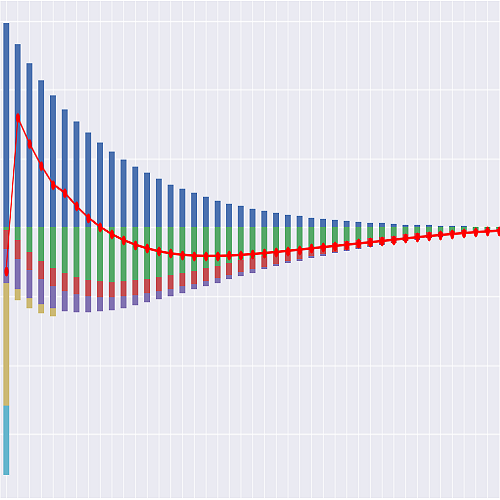
Technical Notes#
Status: Draft, 2026-08-29; citations re-verified against the primary documents 2026-08-30.
Scope note. These notes specify a reference liability cash-flow projection model — model name
FRV_DE_S, monthly grid — for the standardized composite German fondsgebundene
Rentenversicherung defined in product-spec.md (same directory). This is not any single
insurer’s product. [S#]/[R#] tags refer to the source list in sources.md (numbering carried
from _research/fondsgebundene_rentenversicherung.md; frozen); [REG-R#] tags refer to the
cross-product reference library references/regulatory-and-actuarial-references.md (its own
R-numbering). std marks a standardization introduced for the reference implementation;
unverified marks a claim no retrieved document or search result confirmed. Parameter values are
identical to those in product-spec.md. Cells names, model-point columns and CSV headers are
English lower_snake_case; German terms of art keep their German form in prose, and three of
them — Rentenfaktor, Beitragssumme, Stornoabzug — keep it in the cells names too, because
each names a quantity with a statutory definition and no English equivalent that would not
mislead.
The retrieval condition, once, because it governs every number below. delib was drafted
with all HTTP egress blocked and this product’s search budget already spent, so nothing cited here
was retrieved and the first draft rested on the authoring model’s own knowledge of German practice,
disciplined by std and unverified. The citations have since been re-verified against the
primary documents: eighteen of the forty-four entries in sources.md now say Retrieved: yes
— one carrier’s complete Bedingungswerk and its Basisinformationsblätter [S2] [S15] and the
statutory core in canonical text among them — two say partly, and twenty-four still say no,
most of those because no address for the document was ever established. Treat a claim as sound
where its entry says Retrieved: yes, and as a pointer rather than a certificate — an instrument
named, not one anybody checked — where it does not. The mechanics are common ground in German
practice and several are now read in a real wording. The levels are almost entirely std:
no lapse rate was established anywhere, and outside the one carrier that could be read not one
charge rate and not one Rentenfaktor was established at any carrier.
Model scope and conventions#
Purpose. Project gross best-estimate liability cash flows, undiscounted, on a monthly grid, for a single-policy model point on an expected (probability-weighted) basis. Discounting, the Deckungsrückstellung, Solvency II technical provisions and capital are out of scope and are referenced, never computed (see Valuation and reserve pointers).
net_cfis the non-unit stream, and that is the single most important convention here. Every benefit this contract pays before Rentenbeginn — the death benefit up to the fund, the Rückkaufswert, the Teilentnahme, the capital released at Rentenbeginn — is funded by cancelling the policyholder’s own units, so a gross presentation would count the same money twice.net_cf(t)is therefore charges collected, less insurer expenses, less commission, less the death strain.expensesexcludes commission, which is published as its owncommissionscells and column — the delib convention, stated the same way onKLV_DE_S,Basis_DE_S,Riester_DE_SandRLV_DE_S, and the opposite of the frlib chassis. The gross flows are still published —premiums,prem_to_av,claims_death,claims_lapse,claims_maturity,withdrawalsandav_releasesare allresult_cf()columns — andcheck_benefit_funding()asserts that they net exactly. This is the same decompositionfrlib/products/assurance_vie_ucuses for a French unités de compte contract; what is German about it is that the Anlagestock rule makes the unit assets and the unit liability move together by law R15 REG-R7, so the model has no investment-mismatch term.Projection frequency. Monthly. Sourced in substance rather than chosen: the dominant premium frequency is monthly, the Risikobeitrag and the kapitalbezogenen Verwaltungskosten are levied monthly by unit cancellation, and the Abschluss- und Vertriebskosten instalment runs for exactly 60 months R1 REG-R28. An annual grid cannot place the month-60 cliff.
Projection horizon. The Aufschubzeit only.
proj_len() = 12 × (annuity_age − entry_age)is the number of policy months from inception and so the frame’s exclusive end; the last projected month ist = proj_len() − 1, the month in which Rentenbeginn falls. At the end of it the units are cancelled, the Fondsguthaben is converted at the Rentenfaktor and the contract leaves this model. The payout phase — the Überschussrente, the Rentengarantiezeit, the Rentenbezugskosten — belongs toproducts/sofortrente/.The frame is 0-based in policy months counted from inception, and an in-force model point opens partway through it.
tis the policy month index from the contract’s own inception witht = 0the inception month, sot = 60means the same thing on every model point: the first month after the acquisition-charge instalment ends. Periodtruns from timetto timet + 1. The frame isrange(proj_start(), proj_len())—t = proj_start() … proj_len() − 1— withproj_start() = duration_init_m, which is0for new business and96for the in-force cell;duration_init_mis an elapsed count and is already 0-based, so it is the first projected index. That is what lets a singlecharge_acq_pp(t)rule serve both without a duration offset, and it is why the library’s conventions suite asserts frame contiguity and the last index rather than the first. The contractual policy year is the 1-based labelpolicy_year(t) = t // 12 + 1, derived fromtand never indexed by; it is what the annual input tables are keyed on.Timing conventions std. Premium in advance at the start of the month; units bought at the Anteilspreis at the start of the month; the month’s investment return then accrues; the fund-based charges, the Stückkosten, any Teilentnahme and the Risikobeitrag are taken at the end of the month at the closing Anteilspreis; decrements act at the end of the month, deaths before lapses. The Bewertungsstichtag lag a real contract carries — how many dealing days after receipt units are bought — disappears on a monthly grid and is not modelled.
The net amount at risk is observed once a month, before the risk charge that prices it. The death benefit is therefore the floor as observed before that month’s Risikobeitrag, so the insurer’s non-unit cost per death is exactly the riskiertes Kapital and nothing else. That half-month discretization is std and is the same one
UC_FR_Smakes for the French garantie plancher.Age basis. Age last birthday at inception, stepping at each policy anniversary:
policy_year(t) = t // 12 + 1,age(t) = entry_age + policy_year(t) − 1 = entry_age + t // 12. Att = proj_len() − 1the attained age isannuity_age − 1, because the annuity begins at the end of that month. The Rentenfaktor is read atannuity_age, not atage(proj_len() − 1), and getting that wrong is a listed pitfall.One fund. The composite carries a single composite fund; with a deterministic return a multi-fund split is arithmetically identical to one fund at the weighted return. Fondswechsel and Ablaufmanagement are therefore represented as changes to the assumed return, not as reallocations, and the model cannot show dispersion between funds.
Currency and precision. EUR throughout. Unit counts are carried at full precision and reported to six decimals, money to the cent std.
pols_ifto six decimals.Out of scope, and said so rather than left to be discovered. No Überschussbeteiligung credit (the omission understates the projected Fondsguthaben); no hybrid or guarantee mechanism of any kind; no Widerruf window; no stochastic asset model, so nothing here may be compared with a PRIIPs performance scenario R8 R9 REG-R32; no tax computation — the tax rules enter only through the lapse shape; and no payout-phase machinery beyond the annuity the Rentenfaktor buys.
Model point attributes#
Columns of model_point_table.csv, indexed by point_id. The last column names the model points
that exercise the attribute non-trivially, so a reader can find the row that tests it.
Attribute |
Type |
Meaning |
Exercised by |
|---|---|---|---|
|
int |
index; model point 1 is the worked example’s anchor cell |
all |
|
str |
label, e.g. |
all |
|
enum {M, F} |
reporting only. German tariffs are unisex for contracts from 21 December 2012 REG-R34, so this must not enter pricing |
1, 4, 9 |
|
int (ALB) |
age at inception |
all |
|
int |
policy months already elapsed at the valuation date; 0 for new business. An elapsed count, already 0-based, so it is |
6 |
|
float |
policies the model point represents |
all |
|
int |
age at Rentenbeginn; fixes |
13 (70), all others 67 |
|
enum { |
recurring or single premium |
2 ( |
|
EUR |
the instalment the policy states, or the Einmalbeitrag. Already contains whatever Ratenzahlungszuschlag the tariff applied |
all |
|
int {1, 3, 6, 12} |
payment frequency in months |
3 (3), 4 (6), 5 (12) |
|
int |
premium-paying term in years; 0 for |
12 (2 years against a 12-year deferment) |
|
float |
Beitragsdynamik, annual premium increase at each anniversary; 0 = off |
10 (3 %) |
|
int |
0-based policy month from which the contract is beitragsfrei; 0 = never (the sentinel, not the inception month) |
7 (120) |
|
enum { |
Todesfallleistung shape |
2, 13 ( |
|
float |
multiple of the fund used by |
4, 12 (1.10) |
|
EUR |
garantierte Mindesttodesfallleistung used by |
7 (40,000) |
|
str |
key into |
5 ( |
|
str |
key into |
7 ( |
|
str |
key into |
13 ( |
|
EUR |
Anteilspreis at the projection’s opening, i.e. |
6 (118.40); 100.00 elsewhere |
|
float |
units held at the projection’s opening |
6 (190.0); 0 elsewhere |
|
EUR |
premiums paid before the valuation date — the Beitragsrückgewähr base |
6 (24,000.00) |
|
int |
0-based month of a Zuzahlung; 0 = none (the sentinel) |
9 (120) |
|
EUR |
the Zuzahlung |
9 (20,000.00) |
|
int |
0-based month of a Teilentnahme; 0 = none (the sentinel) |
9 (240) |
|
EUR |
the Teilentnahme |
9 (15,000.00) |
|
bool |
Ablaufmanagement return glide on |
8 |
|
bool |
Kapitalwahlrecht elected at Rentenbeginn — a reporting split, since both routes release the same Fondsguthaben from this model |
13 |
Two columns are assumptions in disguise and are tagged where they are used rather than in the
file, because model_point_table.csv is the library’s one provenance-exempt input: sum_assured
and db_pct are std levels chosen to exercise the two death-benefit shapes with a positive
net amount at risk, and dynamik_rate is std at 3 % because no carrier’s dynamic step was
established.
The thirteen model points. 1 anchor (new business, monthly, Beitragsrückgewähr); 2 single
premium with a fund-only death benefit, so charge_risk is structurally zero; 3 quarterly;
4 half-yearly with a 110 % death benefit; 5 annual on the top-of-range charge tariff, which is
also the only point with a non-zero Stornoabzug; 6 in-force at duration 96, past the
acquisition window; 7 beitragsfrei from t = 120 with a fixed Mindesttodesfallleistung on a
zero-return fund — the decay case; 8 Ablaufmanagement; 9 Zuzahlung and Teilentnahme;
10 Beitragsdynamik; 11 Nettotarif on an ETF fund; 12 a two-year premium term inside a
twelve-year deferment on the stress path, which is the acquisition-spread boundary; 13 a
Rentenbeginn at 70 with a current Rentenfaktor above the guaranteed one, so the max() bites.
State variables#
Variable |
Description |
Updated |
|---|---|---|
|
first projected month, |
once |
|
projected months from inception, |
once |
|
sum of premiums payable over the premium term at the initial level — the acquisition-charge base R12 REG-R16 |
once |
|
Anteilspreis at the end of month |
monthly |
|
Anteilspreis at the start of month |
monthly |
|
Anteileinheiten per policy at the start of month |
monthly recursion |
|
Fondsguthaben per policy at the start of month |
derived |
|
the within-month balances: |
within month |
|
|
derived |
|
cumulative gross premiums paid to and including month |
monthly |
|
cumulative acquisition charge withheld — the ledger |
monthly |
|
guaranteed minimum death benefit under |
monthly |
|
riskiertes Kapital, |
monthly |
|
policies in force at the start of month |
monthly decrements |
|
|
within month |
|
the three exits; |
monthly |
There is no Deckungskapital, no guaranteed-value state and no paid-up-benefit state. That is a statutory fact about the product, not a simplification: § 169 VVG sends a fondsgebundene contract to the Zeitwert R1 REG-R28, and § 165 VVG’s conversion to a prämienfreie Versicherung recomputes nothing on this chassis R3.
Assumption inputs#
(a) Contractual / guaranteed elements (cited)#
Input |
Value |
Basis |
|---|---|---|
What is guaranteed |
The number of Anteileinheiten, never their value |
|
Beitragsverrechnung order |
gross Beitrag → less the acquisition instalment → less the premium-based admin charge → the remainder is the Anlagebeitrag and buys units |
[S1] |
Acquisition-charge cap |
2.50 % of the Beitragssumme — the Höchstzillmersatz of 25 ‰ |
|
Acquisition-charge spreading |
Evenly over the first five contract years, i.e. |
|
Death benefit (base) |
|
[S2] |
Risikobeitrag base |
|
[S1] |
Risikobeitrag mortality basis |
A death table — DAV 2008 T, first order — not the annuity table |
|
Rentenfaktor rule |
|
[S4] R22 |
Rentenfaktor conversion basis |
DAV 2004 R, generational, at an underlying rate of currently 0 % p.a. |
[S10] (classic tariff, transfer is an inference); R16 REG-R49 |
Rückkaufswert |
The Zeitwert, which on a pure unit-linked contract is the Fondsguthaben |
|
Stornoabzug |
Only if vereinbart, beziffert and angemessen; never for untilgte acquisition costs |
|
Kündigung |
At any time for the end of the current Versicherungsperiode |
|
Beitragsfreistellung |
Premium-based charges stop; fund-based charges, the Stückkosten and the Risikobeitrag continue by unit cancellation |
|
Unisex |
Sex may not enter the premium or the benefit |
|
Überschussbeteiligung |
Risk and cost results only; not projected |
(b) Insurer-discretionary current elements#
Thin, and thinner than on the sibling general-account products, because the discretion on this contract bites through the charge scale and the current Rentenfaktor, not through a declared rate.
Input |
Snapshot value |
Basis |
|---|---|---|
Charge scale ( |
|
levels std (1) |
Charge variants |
|
std (1) |
Kickback credited back |
0.00 % p.a. — the composite’s fund is passive and pays no trail |
std (2) |
Current Rentenfaktor |
|
std (3) |
Ablaufmanagement |
A linear glide of the gross return from the scenario’s rate to |
std (4) |
Überschuss credit |
None. Omitting it biases the projected Fondsguthaben downward |
Every level here is still std, and it can now be calibrated against one real tariff and one market distribution. The anchor is the 25 ‰ Höchstzillmersatz — “Der Zillmersatz darf 25 Promille der Summe aller Prämien nicht überschreiten”, § 4 Abs. 1 Satz 2 DeckRV R12 REG-R16 — and the composite takes the cap. The observed comparators, from DEVK’s Basisinformationsblätter for a 1 000 € annual premium [S15]: acquisition 2,50 % der kumulierten Anlage (equal to
std_gross’s α), Verwaltungskosten 6,90 % der jeweils eingezahlten Anlage (against β = 4,00 %), 0,42 % des Werts Ihrer Anlage pro Jahr (against γ = 0,30 %), and 18 EUR pro Jahr (against a 3,00 €/month fee, i.e. 36 €/yr).std_grossis therefore a cheap tariff, not an average one — its implied reduction in yield of roughly 1 % p.a. sits below the market’s lower quartile of 1,30 % at exactly this model point, where the weighted mean is 1,90 % and insurers above 4 % exist at every age-and-term combination R11, and where the DEVK sheet reports 1,4 %–3,4 % over 30 years [S15]. Every observed level falls inside the argued range thatstd_highandstd_lowbracket. Nine of the ten other named carriers still supply no level [S3]–[S14] [S16] [S18] R23 R24.std_nettois the commission-free tariff [S18], and the difference between its reduction in yield andstd_gross’s is the acquisition load; note that a real net tariff’s published Effektivkosten excludes the client’s separate adviser fee R10, so the delib gap is cleaner than a market comparison would be.Both questions this footnote called unresolved now have answers, and the zero is a choice rather than an evasion. BaFin establishes that insurers receive Rückvergütungen out of the fund’s Verwaltungsvergütung, must test them for Fehlanreize, and must consider passing them back through reduced calculated costs, an RfB allocation above the MindZV minimum, a Kostenüberschussanteil or a dedicated Überschussanteil R10 R15 REG-R33; one carrier’s AVB uses them “zur Deckung etwaiger Verwaltungskostenverluste” and puts the remainder into the RfB [S2]; and the market levels are known — rebates on about a third of new business at a weighted mean just over 0,30 % p.a. of the Fondsguthaben, up to over 1,20 %, of which about 52 % is returned on average, with a further 19 % of business carrying rebates paid directly to the intermediary at about 0,50 % R11. So
0.00 %models the cheap end of a real and material flow, and the composite’s argued 0 %–0,50 % range understates the observed one. How a credited rebate enters the PRIIPs cost calculation is the one limb still open R7 R8 REG-R32.Setting the current factor equal to the guaranteed one keeps the base run reproducible from the derivation alone while still exercising the
max(). The 12 % uplift onrich_currentis a round figure chosen so themax()visibly bites; it is not a market observation — and the consumer literature suggests a much wider real spread, guaranteed factors of 50–70 % of the current one being described as common[unverified]R22, sostd_2026is the conservative end andrich_currentis nowhere near the generous one.The Ablaufmanagement parameters are established at two carriers, and they disagree — which is why the module is switchable. DEVK runs it as an opt-out default, over the last five years, in monthly tranches on an explicit 1/60, 1/59, 1/58 … schedule, into a low-risk target fund, free of charge and with fund switching suspended while it runs [S2]; Allianz offers it as an option over the last three years [S3]. The composite’s 60-month linear glide matches the observed default at one carrier in span and destination; the tranche schedule differs, since 1/60 of a shrinking balance is not a linear glide of the return.
(c) Behavioral / experience assumptions (modeler’s view)#
Every input in this class is std. No German unit-linked lapse rate, paid-up rate, Kapitalwahlrecht take-up or expense loading was established anywhere in this corpus.
Mortality — two bases, and the wedge between them is the product. The tariff prices the
Risikobeitrag on a first-order death table; the projection decrements on the
second-order best estimate REG-R47. That two-basis structure is confirmed in a real
tariff — DEVK uses “Sterbetafel DAV 2004 R” for the annuity and a separate order for the
Risikobeiträge [S2] — but the table this library names for the risk charge is not the one
that tariff uses. DEVK prices the monthly Risikobeiträge on “einer mit 65 Prozent gewichteten
geschlechtsunabhängigen Ausscheideordnung auf Basis der Sterbetafel DAV 1994 T”, and keeps
DAV 2008 T R17 REG-R48 for its underwritten Risiko-Zusatzversicherung. On an unwritten
Beitragsrückgewähr cover, a first-order basis can be an old heavy table scaled down as
easily as a modern table loaded up; the shipped proxy stands for either. Both orders are
unisex, which is REG-R34 showing in a real Rechnungsgrundlage. DAV tables are the property
of the Deutsche Aktuarvereinigung, are not public and are not redistributed by this library.
The shipped mort_table.csv is a std Gompertz-form proxy of the first-order table:
mort_rate_tariff_at_age(x) = 0.00080 × 1.10^(x − 37), ages 18–100
anchored at q(37) = 0.00080 exactly, which is the number the worked example rests on and
which a substitute table must preserve if the example is to reproduce. The 10 % per year of age
is an insured-lives death gradient, not a population one — a German term insurer’s book is
selected, and a proxy built on population mortality overstates claims at the working ages this
product lives at REG-R48 REG-R52. The best estimate is a flat ratio:
mort_be_factor = 0.75 mort_rate(t) = 0.75 × mort_rate_tariff(t)
A flat ratio is crude and is stated as such; what it buys is that the Risikoergebnis is exactly
(1 − 0.75) = 25 % of the Risikobeitrag collected, which is a closed-form check a reader can
verify with a calculator. What a replacement must preserve: a first-order margin above the
best estimate for a death cover, which is the opposite direction from the annuity table
REG-R47.
Monthly conversion, and the asymmetry between mortality and lapse std. Mortality is split
linearly, mort_rate_mth(t) = mort_rate(t)/12, because the tariff’s own Risikobeitrag is
q(x)/12 × riskiertes Kapital and the charge and the decrement must rest on the same split or the
model manufactures a risk result out of a rounding convention. Lapse is split geometrically,
lapse_rate_mth(t) = 1 − (1 − lapse_rate(t))^(1/12), because nothing is priced off it and the
annual rate is the observable that must be reproduced over twelve months. Both conventions are
stated, and mixing them across the two mortality bases is a listed pitfall.
Lapse — and the tax threshold that shapes it. No German unit-linked Stornoquote was established (gap 18 of the research file). What is structurally true is that unit-linked lapse is front-loaded, because the acquisition charge is being taken and the value is furthest below premiums paid, and that the exit is near-frictionless: § 168 VVG permits termination for the end of the current Versicherungsperiode and § 169 pays the fund R1 R2 REG-R28. On top of that sits the German tax threshold, which the reference library names as the strongest single driver of German surrender behaviour REG-R45: under § 20 Abs. 1 Nr. 6 EStG only half the Unterschiedsbetrag is taxable where the contract has run at least twelve years and payment falls after completion of the 62nd year of life, so surrenders are suppressed as the threshold approaches and spike when both limbs are met R20 REG-R45.
Policy year |
1–5 |
6–10 |
11 |
12 |
13+ |
|---|---|---|---|---|---|
|
6.0 % |
3.0 % |
2.0 % |
2.0 % |
3.0 % |
lapse_tax_step(t)  = 2.5  in the twelve months of the policy year in which
                          BOTH duration 12 is complete AND attained age 62 is reached;
                          1.0 otherwise                                        [std]
# the 12/62 threshold itself is statutory: EStG § 20 Abs. 1 Nr. 6 Satz 2 with
# § 52 Abs. 28 (62 for contracts concluded after 31 December 2011; 60 before).
# Its magnitude, 2.5, is [std].
lapse_rate(t)      = min( lapse_cap, lapse_rate_base(t) × lapse_tax_step(t) + lapse_dyn_add(t) )
lapse_rate_mth(t)  = 1 − (1 − lapse_rate(t))^(1/12)
lapse_rate_mth(proj_len() − 1) = 0                                             [std]
with lapse_cap = 40 % std. The step year is max(13, 62 − entry_age + 1) in policy years
— on the anchor cell that is policy year 26, t = 300 … 311, where the base 3.0 % becomes
7.5 % and the monthly rate 0.253505 % becomes 0.647574 %. Keying the spike on duration alone is
wrong and is a listed pitfall: the anchor cell passes duration 12 at age 48, fourteen years
before the tax benefit exists. On model point 12 the step never fires at all, because the
projection ends at t = 143 and the step year begins at t = 144.
In the final month the lapse rate is zero. The end of month proj_len() − 1 is
Rentenbeginn, so a surrender and an annuitisation are the same event releasing the same
Fondsguthaben; the whole surviving cohort is booked as pols_maturity. No cash flow moves
either way, but the convention decides the split between Σ pols_lapse and
pols_maturity(proj_len() − 1) and it is what the closure identity below reproduces. It is
frlib’s convention on TD_FR_S and delib adopts it.
Fund return. No document in this corpus supplies one, and PRIIPs deliberately does not: its
scenarios are derived from the underlying’s own return history under the RTS, not chosen by the
insurer R8 R9 REG-R32. fund_scenario_table.csv therefore carries std paths by
(scenario_id, policy_year):
The table’s policy_year key is the contractual 1-based label, reached through
policy_year(t) = t // 12 + 1, so it is unaffected by the 0-based frame.
|
Gross return p.a. |
TER p.a. |
Purpose |
|---|---|---|---|
|
5.00 % level |
0.45 % |
the base run std |
|
5.00 % level |
0.15 % |
the low-cost fund, for the Nettotarif cell |
|
0.00 % level |
0.45 % |
isolates the charge stack: every movement is a charge |
|
−20.00 % in year 1, then 5.00 % |
0.45 % |
a fall that puts the fund far below premiums paid |
fund_return_net_ann(t) = gross_return_ann(t) − ter_ann(t)                      [std]
fund_return_net_mth(t) = (1 + fund_return_net_ann(t))^(1/12) − 1
unit_price(t)          = unit_price_open(t) × (1 + fund_return_net_mth(t))
unit_price_open(t)     = unit_price_init            at t = t₀
                       = unit_price(t − 1)          for t > t₀
On the base path that is 4.55 % p.a. net of fund costs and 0.371482 % per month. The TER is netted off the return and is never a policy charge: it lives inside the unit price and never appears in the ledger, so charging it explicitly double-counts and ignoring it overstates the policyholder’s return. The return is compounded geometrically because it is an effective annual rate; the charges are divided by twelve because a German tariff quotes a nominal monthly rate — an asymmetry that is deliberate and is a listed pitfall. This is a scenario, not a forecast, and nothing in delib produces a distribution, so nothing in delib may be compared with a PRIIPs performance scenario.
Expenses and commission (all levels std; no German commission scale was established).
Input |
Value |
Basis |
|---|---|---|
Acquisition commission |
2.50 % of the Beitragssumme, paid at |
std (5) |
Issue expense |
200.00 EUR at |
std (5) |
Maintenance expense |
4.00 EUR per policy per month, inflating at |
std (5) |
Expense inflation |
2.0 % p.a., applied as |
|
Renewal commission |
1.5 % of each gross premium |
std (5) |
Claim expense |
150.00 EUR per death claim |
|
Surrender expense |
50.00 EUR per surrender |
|
Annuitisation expense |
100.00 EUR per policy converting at Rentenbeginn |
|
Dynamic-lapse coefficient |
0 in the base run; 0.15 as the reference value |
std (6) |
The acquisition commission is set equal to the acquisition charge deliberately. The insurer pays 2.50 % of the Beitragssumme at inception and recovers exactly that, undiscounted, over the following sixty months — so the model demonstrates in one number the financing problem the Höchstzillmersatz and the five-year spread exist to regulate, and
t = 0of the worked example is a large negativenet_cf. No German commission scale was established, so any other level would be an unsourced number pretending to be an observation.The dynamic module is off in the base run and is specified under Policyholder behavior modeling below.
Cash flow components and recursions#
Notation (defined once, used throughout)#
Symbol |
Cells |
Meaning |
|---|---|---|
|
— |
0-based policy month index from inception, |
|
|
|
|
|
|
|
|
Anteilspreis at the end and at the start of month |
|
|
monthly return net of the fund’s TER |
|
|
units per policy at the start of month |
|
|
Fondsguthaben per policy, |
|
|
gross Beitrag due; Zuzahlung |
|
|
Anlagebeitrag — what actually buys units |
|
|
acquisition instalment, plus Zuzahlungskosten on any |
|
|
premium-based rate; |
|
|
sum of premiums payable at the initial level |
|
|
cumulative gross premiums paid to and including month |
|
|
guaranteed minimum death benefit; riskiertes Kapital |
|
|
first-order (the price) and second-order (the decrement) monthly death rates |
|
|
0.75; |
|
|
monthly lapse rate; |
|
|
policies in force at the start of month |
|
|
Teilentnahme |
|
|
Stornoabzug rate on the Fondsguthaben |
|
|
euro of monthly annuity per 10 000 € |
The Beitragsverrechnung#
B(t) = prem_pp_base · d(t)   if t < 12·prem_term_y, (pup_month > 0 ⇒ t < pup_month), (t − t₀) mod prem_mode_months = 0
     = 0                     otherwise
d(t) = (1 + dynamik_rate)^(y(t) − 1)                        Beitragsdynamik, 1.0 when off

S    = prem_pp_base × (12 / prem_mode_months) × prem_term_y      laufend
     = prem_pp_base                                              einmal

N_α  = min(60, 12 × prem_term_y) / prem_mode_months          acquisition instalments
α(t) = alpha_rate · S / N_α        on the first N_α premium dates      laufend
     = zuzahlung_rate · B(t₀)      at t = t₀, once                     einmal
     + zuzahlung_rate · Z(t)       whenever a Zuzahlung falls

A(t) = B(t) + Z(t) − α(t) − β · B(t)
S is the sum of premiums payable, at the initial level. It does not shrink when a
contract lapses or goes beitragsfrei, and it does not grow with a Beitragsdynamik increment,
because a real tariff re-zillmers each accepted increment over its own sixty months and an
increment cannot be assumed at inception R12 REG-R16. The bias — the acquisition charge on a
dynamic contract is understated — is stated rather than hidden. β is charged on the regular
Beitrag only; a Zuzahlung pays its own charge and no second one.
pup_month, topup_month and wd_month carry 0 as the never / none sentinel and not as
the inception month — t = 0 is a legal index on the 0-based frame, so the guard has to be
written out, as it is in B(t) above and in W(t) below.
The unit fund#
Δu(t) = A(t) / p_open(t)                                   units bought, at the opening price
p(t)  = p_open(t) · (1 + i(t))
F_BEF_CHARGE(t) = ( u(t) + Δu(t) ) · p(t)

charge_admin_fund_pp(t) = γₘ · F_BEF_CHARGE(t)
charge_policy_fee_pp(t) = min( SK, F_BEF_CHARGE(t) − charge_admin_fund_pp(t) )
F_AFT_CHARGE(t) = F_BEF_CHARGE(t) − charge_admin_fund_pp(t) − charge_policy_fee_pp(t)

W(t)  = min( wd_amount, F_AFT_CHARGE(t) )   if wd_month > 0 and t = wd_month, else 0
F_AFT_WD(t) = F_AFT_CHARGE(t) − W(t)

K(t)  = max( D(t) − F_AFT_WD(t), 0 )
charge_risk_pp(t) = min( qᴵ(t) · K(t), F_AFT_WD(t) )
F_BEF_DECR(t) = F_AFT_WD(t) − charge_risk_pp(t)

u(t + 1) = F_BEF_DECR(t) / p(t)
The min(·, remaining) floors are std safeguards, not tariff terms: they keep the
Fondsguthaben non-negative on a contract whose fixed charges outrun a decayed fund. None of
the thirteen shipped model points triggers one, and a model point that did would in practice
have its cover terminated; the safeguard exists so that a user’s own model point cannot produce a
negative fund silently.
The death-benefit floor is the model point’s db_form:
fund          D(t) = 0                                     → K(t) ≡ 0, no Risikobeitrag
prem_return   D(t) = C(t)                                   Beitragsrückgewähr        [S2]
pct_fund      D(t) = db_pct × F_AFT_WD(t)
sum_assured   D(t) = sum_assured
prem_return is the composite. The net amount at risk is then max(C(t) − F_AFT_WD(t), 0),
positive early and after a market fall and vanishing once the fund overtakes the premiums paid,
which is why cum_prem_pp is a state variable of this product and why the charge has to be
recomputed every month. It is the premiums paid, gross — not the premiums invested.
Decrements and the in-force recursion#
pols_death(t)    = l(t) · q(t)
pols_lapse(t)    = l(t) · (1 − q(t)) · w(t)
pols_maturity(t) = l(t) · (1 − q(t))                 at t = n − 1, where w(n − 1) = 0
                 = 0                                 for t < n − 1
l(t + 1) = l(t) · (1 − q(t)) · (1 − w(t)),   l(t₀) = pols_if_init(),   l(n) = 0
Deaths act before lapses std. pols_if_at(t, ·) exposes "BEF_DECR" (= l(t)),
"AFT_DEATH" and "AFT_DECR" (= l(t+1) before the maturity sweep), so the ordering is
inspectable rather than buried in one expression. Closure identity, which
check_pols_roll_fwd() asserts every month and a test asserts in total:
Σ_{t=t₀..n−1} [ pols_death(t) + pols_lapse(t) + pols_maturity(t) ] = pols_if_init()
Benefits, funding and the non-unit cash flow#
claims(t, "DEATH")    = pols_death(t)    · ( F_BEF_DECR(t) + K(t) )
claims(t, "LAPSE")    = pols_lapse(t)    · F_BEF_DECR(t) · (1 − σ)
claims(t, "MATURITY") = pols_maturity(t) · F_BEF_DECR(t)
stornoabzug(t)        = pols_lapse(t)    · F_BEF_DECR(t) · σ
withdrawals(t)        = l(t) · W(t)
death_strain(t)       = pols_death(t) · K(t)
av_releases(t)        = ( pols_death(t) + pols_lapse(t) + pols_maturity(t) ) · F_BEF_DECR(t)
                        + l(t) · W(t)
The death benefit is the floor as observed before that month’s Risikobeitrag, so the
insurer’s non-unit cost per death is exactly K(t). The Rückkaufswert is the
Fondsguthaben less a Stornoabzug if one is validly agreed R1 REG-R28; with σ = 0 on the
composite it is the Fondsguthaben exactly, and claims_lapse is then the whole release.
premiums(t)  = ( B(t) + Z(t) ) · l(t)
prem_to_av(t)= A(t) · l(t)
charge_*(t)  = charge_*_pp(t) · l(t)                       for the four unit-side charges
expenses(t)  = expense_issue · l(t) · 1{t = 0}
               + expense_maint_pp(t) · l(t)
               + expense_claim · pols_death(t)
               + expense_surr  · pols_lapse(t)
               + expense_annuitisation · pols_maturity(t)
commissions(t) = comm_acq_rate · S · l(t) · 1{t = 0}
               + comm_renew_rate · B(t) · l(t)

net_cf(t) = charge_acq(t) + charge_admin_prem(t) + charge_admin_fund(t)
            + charge_policy_fee(t) + charge_risk(t) + stornoabzug(t)
            − expenses(t) − commissions(t) − death_strain(t)

liability_cf(t) = − net_cf(t)
net_cf is income-positive, as it is in every model in this library. expenses and
commissions are two lines and not one, each subtracted once, which is what expenses means on
every delib model that has a commission to publish. The acquisition commission and the issue
expense fall at t = 0, the inception month, and only there, so an in-force model point
whose frame opens at t = 96 never incurs either — which is correct, and which is the same
reason its charge_acq(t) is zero at every projected month.
Three amounts that move on this contract are not insurer cash flow. The Anlagebeitrag and
every account-value benefit are the policyholder’s money passing through the unit fund; the fund’s
TER never leaves the unit price and accrues to the fund manager; and any Überschuss credit
would be a policyholder credit, which this model does not project. Publishing premiums,
prem_to_av, claims_* and av_releases as columns while excluding them from net_cf makes
that exclusion visible rather than merely asserted.
Rentenbeginn#
R_g = rentenfaktor_guar(annuity_age)      read at annuity_age, not at age(n − 1)
R_c = rentenfaktor_curr(annuity_age)
R   = max( R_g, R_c )
av_maturity_pp() = F_BEF_DECR(n − 1)
annuity_mth_pp() = av_maturity_pp() / 10 000 × R
The shipped rentenfaktor_table.csv is std and derived, not observed. The 0 %
Rechnungszins it rests on is no longer an inference from a classic tariff: a fondsgebundene AVB
states it — “bei der Kalkulation der zu Vertragsbeginn garantierten Rentenfaktoren … einen
Zinssatz von 0,0 Prozent”, on DAV 2004 R [S2] [S10] R16 REG-R49. At 0 % a monthly annuity of
R per 10 000 € for an expected T years has present value 12·T·R, so R = 10 000 / (12·T);
the table sets
T_eff(x) = 33.3333 − 0.75 · (x − 67),     ages 60–75,
rentenfaktor_guar(x) = 10 000 / (12 · T_eff(x))
which gives exactly 25.00 at age 67, 22.47 at 62 and 26.81 at 70.
Observed values are now available, and the table does not reproduce them. At the same Rentenbeginn age of 67 and the same 0 % rate, one carrier’s guaranteed factors are 25,22 / 24,12 / 22,91 / 21,83 € for deferments of 12 / 20 / 30 / 40 years [S15]. Two consequences:
Level. At delib’s anchor cell — a 37-year-old with a 30-year deferment — the observed factor is 22,91 against the table’s 25.00, so the shipped table is about 9 % generous there. It is close at short deferments (25,22 at twelve years) and generous at long ones.
Shape. The observed factor falls with the deferment at a fixed Rentenbeginn age, which is the generational DAV 2004 R showing through: a later birth cohort lives longer at 67. The shipped table is a function of
annuity_agealone and is flat in the deferment, so it cannot reproduce that gradient at all — the entry-age-60 and long-deferment model points are priced on the same factor when a real tariff would separate them.
Neither is changed here. rentenfaktor_table.csv feeds annuity_mth_pp(), the worked example
and the golden tests, and moving it moves all three; that is a deliberate decision, not a
provenance fix. Read the other way, 25.00 at a 0 % Rechnungszins prices the guarantee as though
the insurer holds the capital for 33⅓ years and earns nothing on it; the market’s own answer at
the anchor cell is 36⅜ years — the Sicherheitsabschlag made concrete, and slightly deeper in
reality than in the model R16 R22 REG-R49. rentenfaktor_curr equals rentenfaktor_guar on
std_2026 and is 12 % higher on rich_current; consumer sources describe real guaranteed factors
at 50–70 % of the current one [unverified] R22, so both settings are conservative.
This model stops here: the annuity is published, not projected.
Reduction in yield#
The product’s defining metric, and the reason the library publishes it: on a contract with no
Rechnungszins, the charge stack is the economics. reduction_in_yield() is a scalar:
gross_return_ref() = ( Π_{t=t₀..n−1} (1 + fund_return_gross_ann(t))^(1/12) )^(12 / (n − t₀)) − 1

irr_ann() solves, by bisection on k:
   Σ_t (B(t) + Z(t)) · (1 + k)^((n − t)/12)
   − Σ_t W(t) · (1 + k)^((n − 1 − t)/12)
   + F(t₀) · (1 + k)^((n − t₀)/12)                    =  av_maturity_pp()
with both sums over t = t₀ … n − 1. A premium falls at the start of its month and is
accumulated to the end of month n − 1, which is n − t months; a Teilentnahme falls at that
month’s end, one month later, hence n − 1 − t.
reduction_in_yield() = gross_return_ref() − irr_ann()
on a single persisting contract — no survivorship, no lapse — because a reduction in yield is
a statement about one policy’s own money. The F(t₀) term is the Fondsguthaben the projection
opens with: it is zero on every new-business cell and matters only on the in-force one, where
without it the measure would credit the charge stack with money the projection never received as
premium. It is a delib-defined measure and it is not the
statutory Effektivkostenquote: the German figure is aligned to the total-cost-indicator method
of Annex VI to Delegated Regulation (EU) 2017/653 over a specified recommended holding period,
and this model implements neither R7 REG-R31 REG-R32. Any level it produces is arithmetic on
delib’s own std stack and must never be quoted as a market figure R10 R23 R24.
result_cf() and the published identities#
result_cf() returns a DataFrame indexed by t (index.name == "t"), contiguous over
range(proj_start(), proj_len()) — so index[-1] == proj_len() − 1 — with these columns in this
order:
pols_if, premiums, prem_to_av, charge_acq, charge_admin_prem, charge_admin_fund,
charge_policy_fee, charge_risk, stornoabzug, withdrawals, claims_death, claims_lapse,
claims_maturity, av_releases, death_strain, expenses, commissions, net_cf, liability_cf
pols_if is first and pols_if(proj_start()) == pols_if_init() exactly. Every flow on row t is
weighted by that row’s pols_if, so dividing a flow by it recovers the per-policy amount; the
end-of-month count is pols_if_at(t, "AFT_DECR"), and the closing fund of the surviving cohort is
av_pp(t+1) × pols_if(t+1), not av_at(t, ·).
Seven check_*() cells are published, each a bool over all t with a per-t
check_*_resid(t) companion:
Check |
Identity |
|---|---|
|
delib ruling 1. |
|
|
|
|
|
|
|
|
|
|
|
|
check_units_roll_fwd() and check_av_roll_fwd() look redundant and are not: the unit identity
has no price term at all, so it fails if a charge is taken in euro without cancelling the
matching units, while the account identity carries the return and fails if the price is applied
at the wrong point in the month. An implementation can pass either alone.
Monthly processing order#
For t = t₀ … n − 1, in this order:
Advance
y(t),x(t); read the charge row, the scenario row,qᴵ(t),q(t)andw(t).Open the month:
u(t)units,F(t) = u(t)·p_open(t).Premium in advance.
B(t)if a premium is due (not afterprem_term_y, not frompup_month), plus anyZ(t). UpdateC(t) = C(t−1) + B(t) + Z(t), seeded inside the frame’s own first month asC(t₀) = cum_prem_init + B(t₀) + Z(t₀)— there is not₀ − 1to read on a new-business cell, wheret₀ = 0.cum_charge_acq_ppis seeded the same way.Withhold, in order: the acquisition instalment
α(t), thenβ·B(t). The remainder isA(t).Buy units at the opening price:
Δu(t) = A(t)/p_open(t).Investment return.
p(t) = p_open(t)·(1 + i(t)); unit count unchanged; strikeF_BEF_CHARGE(t).Cancel units for the fund-based admin charge
γₘ · F_BEF_CHARGE(t).Cancel units for the Stückkosten
SK, floored at the remaining balance.Settle any Teilentnahme
W(t), floored at the remaining balance.Observe
D(t)andK(t) = max(D(t) − F_AFT_WD(t), 0).Cancel units for the Risikobeitrag
qᴵ(t)·K(t), floored at the remaining balance.Decrements at the end of the month, deaths before lapses; at
t = n − 1,w(n − 1) = 0and the survivors are booked aspols_maturity(n − 1).Book the benefits at
F_BEF_DECR(t)plusK(t)on a death, lessσon a lapse.Roll forward
u(t+1)andl(t+1).Extract the non-unit row and accumulate
net_cf(t).
At t = n − 1 the units are cancelled, av_maturity_pp() is struck and annuity_mth_pp() is
published. There is no t = n row.
Known modeling pitfalls#
These are the specific ways an implementation of this product looks right and is wrong. Each one becomes a test.
Netting the fund-based charge out of the premium instead of cancelling units. A model that deducts
γfrom the Beitrag gives the right answer while premiums are paid and the wrong answer the moment they stop. Assert that on model point 7charge_admin_fund(t) > 0andcharge_policy_fee(t) > 0at everyt ≥ 120, wherepremiums(t) = 0.Charging the fund’s TER as a policy charge. It is inside the unit price R7 REG-R32: charging it explicitly double-counts, ignoring it overstates the return. Assert
unit_price(t)/unit_price_open(t) = (1 + gross − ter)^(1/12)exactly onbase, and that nocharge_*column contains a TER term.Pricing the Risikobeitrag on the annuity table. The death charge is priced on a death table, DAV 2008 T R17 REG-R48; the conversion guarantee rests on DAV 2004 R R16 REG-R49. Assert that
mort_rate_tariff_at_agereadsmort_table.csvandrentenfaktor_guarreadsrentenfaktor_table.csv, and that no cells reads both.Using one mortality basis for the charge and for the decrement. That makes the Risikoergebnis identically zero and deletes the mechanic. Assert
Σ charge_risk − Σ death_strain = (1 − mort_be_factor) · Σ charge_riskexactly, and that it is strictly positive on the anchor.Mixing the monthly conversions.
qᴵandqmust use the same split, or the model manufactures a risk result out of a rounding convention: atq = 0.00080,q/12 = 0.00006667against1 − (1−q)^(1/12) = 0.00006669, a 0.04 % difference that lands entirely in the risk result and grows withq. Assertmort_rate_mth(t) = mort_rate(t)/12andlapse_rate_mth(t) = 1 − (1 − lapse_rate(t))^(1/12), and thatlapse_rate_mth < lapse_ratewherever the annual rate is positive.Forgetting to floor the net amount at risk at zero.
max(D − F, 0), notD − F. Without the floor the contract pays the insurer a negative charge in every month the fund is above the floor, and the death strain turns negative — the model silently books the fund’s growth as insurance profit. Assertnar_pp(t) ≥ 0at everyt, and that on model points 2 and 13 (db_form = fund)charge_risk(t) = 0.00at everyt.Running the acquisition instalment past its window, or spreading it over sixty months when the premium term is shorter. Assert that the instalment is zero for
t ≥ 60on every model point, and that on model point 12 the instalment count is 24, not 60. Two exceptions have to be stated rather than asserted away, and both follow from theα(t)definition above:charge_acq(120)is non-zero on model point 9, where the Zuzahlung pays 2.50 % Zuzahlungskosten — 500.00 per policy — which this model books incharge_acq; andΣ charge_acq_pp = alpha_rate × beitragssumme()holds on eleven points but not on point 6, where the in-force frame opens past the window (0.00 against 2,775.00, which is pitfall 8), nor on point 9, where the Zuzahlungskosten make it 3,380.00 against 2,880.00.Charging an in-force model point again for acquisition. Model point 6 opens at
t = 96. Assertcharge_acq(t) = 0at every projectedtand thatcommissions(96)contains no Abschlussprovision andexpenses(96)no issue expense — the whole of the difference between it and a new-business cell.Letting the Beitragssumme follow the premiums actually paid.
Sis the sum of premiums payable, at the initial level; it does not shrink on lapse or Beitragsfreistellung and does not grow with a Beitragsdynamik increment R12 REG-R16. Assertbeitragssumme()is invariant topup_month, tolapse_rateand todynamik_rate.Conflating Storno with Beitragsfreistellung. They are two different things: one is an exit paying the Rückkaufswert, the other a change of state paying nothing R2 R3 REG-R28. Assert that on model point 7
pols_ifis continuous acrosst = 120whilepremiumssteps to zero and the unit-side charges continue.Inventing a Rückkaufswert formula. The Zeitwert of a pure unit-linked contract is the Fondsguthaben: no discounting, no Rechnungszins, no mortality basis, no Zillmerung residue, no second-basis Mindestrückkaufswert R1 REG-R28. Assert
claims_lapse(t) = pols_lapse(t) × av_pp_at(t, "BEF_DECR")exactly whereverσ = 0.Building the Stornoabzug out of unamortised acquisition costs. § 169 Abs. 5 VVG makes exactly that deduction ineffective and puts the burden of proof on the insurer R1 REG-R28 REG-R36. Assert
stornoabzug(t) = σ × pols_lapse(t) × av_pp_at(t, "BEF_DECR")and that it is not a function ofcharge_acq_total() − cum_charge_acq_pp(t).Booking the whole Fondsguthaben as an insurer outgo.
net_cfis the non-unit stream; the fund is the policyholder’s money passing through. Assertcheck_benefit_funding()andcheck_net_cf(), and that no account-value benefit appears insidenet_cf.Getting the age at Rentenbeginn off by one.
age(proj_len() − 1) = annuity_age − 1, because the annuity begins at the end of that month. Assert exactly that, and thatrentenfaktor_guar()is read atannuity_age: on the anchor 25.00 at 67, not 24.45 at 66.Applying only the guaranteed Rentenfaktor. The rule is
max(guaranteed, current)[S4] R22. Assert equality on the anchor and, on model point 13,rentenfaktor_applied() = rentenfaktor_curr() = 1.12 × rentenfaktor_guar().Re-applying a Ratenzahlungszuschlag.
prem_ppis the instalment the policy states and already contains whatever loading the tariff applied. Assertpremiums(t) = prem_pp × pols_if(t)exactly in a premium month on model points 3, 4 and 5, and0.00in the intervening months.Letting the Beitragsrückgewähr base be the premiums invested rather than the premiums paid. Assert
cum_prem_pp(59) = 12,000.00on the anchor — 60 × 200.00 — againstΣ_{t<60} prem_to_av_pp(t), which is 9,720.00, a 19 % understatement of the death benefit.Letting a fixed charge drive the fund negative. The Stückkosten and the Risikobeitrag are floored at the remaining balance std. Assert
av_pp_at(t, τ) ≥ 0at everytand every timing on every model point, and that no shipped point actually triggers a floor.
Policyholder behavior modeling#
All formulas are std reference constructions. There is no German calibration evidence for any of them, and the research file’s gaps register records that as gaps 18 and 19.
Base lapse std. The duration table above: 6 % p.a. in years 1–5, 3 % thereafter, dipping to 2 % in years 11–12. The front-loading is a structural inference from the exit terms — the acquisition charge is being taken, the value is furthest below premiums paid, and § 168 VVG makes the exit near-frictionless R1 R2 REG-R28 — not an observation.
The tax-threshold step std. A ×2.5 multiplier for twelve months from the later of duration 12 and attained age 62 R20 REG-R45. This is the one behavioural feature the cross-product reference library actively requires of every German Schicht-3 model, and the reason is that a lapse assumption flat in duration ignores the strongest single driver of German surrender behaviour. Keying it on duration alone is pitfall 5’s twin: on the anchor cell duration 12 arrives fourteen years before the tax benefit does.
Dynamic lapse std, off in the base run. Unit-linked lapse is market-sensitive, because the exit is at fund value on short notice. The reference module raises the rate when the contract is under water against the premiums paid:
lapse_dyn_add(t) = lapse_dyn_beta × max( 0, 1 − av_pp(t) / cum_prem_pp(t) )
with
lapse_dyn_beta = 0in the base run and 0.15 as the reference value. Switched on, it bites hardest on model point 12, whose stress path leaves the fund far below premiums paid for years, and it introduces a feedback the deterministic run only samples once: a falling fund raises lapse, which removes the policies whose charges would have recovered the acquisition cost.Beitragsfreistellung is a model-point election, not a cohort decrement, and that is a deliberate limitation. A paid-up policy’s fund and its Beitragsrückgewähr base both depend on the month it went paid-up, so a cohort-level paid-up rate would need one sub-cohort per month — a two-dimensional recursion over 360 months for a second-order effect. The model therefore carries
pup_monthon the model point and reproduces the mechanic exactly on one cell (point 7) rather than approximately on all of them. A std paid-up rate of 1 % p.a. is what a cohort implementation would use; it is recorded and not implemented, and omitting it biases the projected charge income upward, because a paid-up contract stops paying the premium-based charges.What the model deliberately does not do. No Kapitalwahlrecht take-up rate: the base run annuitises, which is a modelling choice made so that the Rentenfaktor is the thing the worked example demonstrates, and not an estimate of behaviour — no take-up rate was established anywhere R20. No Abrufphase: the Rentenbeginn is fixed, and whether deferral restates the guaranteed factor was not established. No Widerruf decrement: the 30-day window sits inside the year-1 lapse rate R6 REG-R23. No Fondswechsel behaviour beyond the Ablaufmanagement glide.
Worked example#
Configuration. Model point 1, the anchor cell of model_point_table.csv:
policy_id = DE-FRV-0001; sex = M (reporting only — the tariff is unisex REG-R34);
entry_age = 37; duration_init_m = 0, so proj_start() = 0; pols_if_init = 1.0;
annuity_age = 67, so proj_len() = 12 × (67 − 37) = 360 months and the frame is
t = 0 … 359;
prem_form = laufend; prem_pp = 200.00 EUR; prem_mode_months = 1; prem_term_y = 30;
dynamik_rate = 0.00; pup_month = 0; db_form = prem_return, so db_pct and sum_assured are
unused; charge_id = std_gross; scenario_id = base; rentenfaktor_id = std_2026;
unit_price_init = 100.00 EUR; units_init = 0.0; cum_prem_init = 0.00 EUR;
topup_month = 0, topup_amount = 0.00; wd_month = 0, wd_amount = 0.00;
ablauf_flag = False; kapitalwahl = False. Hence beitragssumme() = 200.00 × 12 × 30 = 72 000,00 €, the acquisition charge at the cap is 0.025 × 72 000 = 1 800,00 €, and the
instalment is 1 800,00 / 60 = 30,00 € per month — 15 % of each of the first 60 premiums,
t = 0 … 59, and nothing from t = 60.
Assumptions, each tagged. Charges, from row std_gross of charge_table.csv, every level
std except where noted: acquisition rate alpha_rate = 2.50 % of the Beitragssumme, which
is the Höchstzillmersatz R12 REG-R16 and, as it happens, the rate one real tariff charges
[S15], spread over alpha_spread_months = 60 — the statutory five-year shape of § 169 Abs. 3 VVG
R1 REG-R28, which a real tariff applies to only part of its acquisition cost, taking the
rest as a percentage of every premium for the whole term [S2]; premium-based admin
beta_rate = 4.00 % of each gross Beitrag, against 6,90 % observed [S15]; fund-based admin
gamma_rate_ann = 0.30 % p.a., taken monthly as gamma_rate_mth = 0.30 %/12 = 0.025 % of the
Fondsguthaben; Stückkosten policy_fee_mth = 3.00 € per month, taken by cancelling units;
Zuzahlungskosten zuzahlung_charge_rate = 2.50 % (not exercised on this cell);
Stornoabzug stornoabzug_rate = 0.00 % R1 REG-R28. Fund, from row base of
fund_scenario_table.csv: gross return 5.00 % p.a. std, fund TER = 0.45 % p.a.
std, so fund_return_net_ann = 4.55 % p.a. and fund_return_net_mth = (1.0455)^(1/12) − 1 = 0.371482 % per month; Kickback credited back 0.00 % std; no Ablaufmanagement glide.
Mortality: the tariff basis is a std first-order death proxy mort_rate_tariff_at_age(x) = 0.00080 × 1.10^(x − 37), anchored at q(37) = 0.00080. It stands for whichever first-order death
table a carrier uses — DAV 2008 T is the modern one R17 REG-R48; the one fondsgebundene tariff
whose bases could be read prices its Risikobeiträge on 65 % of DAV 1994 T [S2] — so
mort_rate_tariff(0) = 0.00080 and mort_rate_tariff_mth(0) = 0.00080/12 = 0.00006667; the
best-estimate decrement is mort_be_factor = 0.75 std times it, so mort_rate(0) = 0.00060
and mort_rate_mth(0) = 0.00005. Lapse, all std: lapse_rate_base 6.0 % p.a. in policy
years 1–5, 3.0 % in 6–10, 2.0 % in 11–12 and 3.0 % from 13, converted as
lapse_rate_mth = 1 − (1 − lapse_rate)^(1/12) — 0.514301 % monthly at 6 % and 0.253505 % at 3 %;
the tax step lapse_tax_step = 2.5 applies in policy year 26 (t = 300 … 311), the year in which
attained age 62 is reached and duration 12 is long past R20 REG-R45, giving 7.5 % p.a. and
0.647574 % monthly there; lapse_cap = 40 %; lapse_dyn_beta = 0 (module off);
lapse_rate_mth(359) = 0, because the end of month t = 359 is Rentenbeginn. Expenses, all
std: acquisition commission comm_acq_rate = 2.50 % of the Beitragssumme = 1 800,00 €
plus expense_issue = 200,00 €, both at t = 0; maintenance expense_maint_mth = 4,00 € per
month inflating at expense_infl = 2.0 % p.a. as 4.00 × 1.02^(t/12); renewal commission
comm_renew_rate = 1.5 % of each gross premium; expense_claim = 150,00 € per death;
expense_surr = 50,00 € per surrender; expense_annuitisation = 100,00 € at Rentenbeginn.
Conversion: rentenfaktor_guar(67) = 25.00 and rentenfaktor_curr(67) = 25.00 from row
std_2026, both std and derived from T_eff(67) = 33.3333 at a 0 % Rechnungszins
[S10] R16 R22 REG-R49, so rentenfaktor_applied() = 25.00. No Überschussbeteiligung, no
Zuzahlung, no Teilentnahme, no Beitragsdynamik, no behaviour modules.
360 months is far too long to print in full, so the table below shows a representative set
of months — the first six, t = 0 … 5, which are the Beitragsverrechnung in detail;
t = 11, 23 and 58–60, which straddle the acquisition-charge cliff; t = 119 and 239;
t = 299–300, which straddle the tax-threshold lapse step; and t = 358–359, the last two —
together with the full-precision totals over all 360 months. Totals are summed at full precision and then rounded, not summed from
the rounded cells. Money is shown to the cent, pols_if and unit counts to six decimals.
The table#
Three panels of the same projection. Every figure is the model’s own output, rounded
for printing only; the Total row is the sum over all 360 months at full precision, then
rounded. Panel A carries the full month list; Panels B and C carry a subset of it, the
intermediate months adding nothing to either.
Panel A — the non-unit ledger. stornoabzug and withdrawals are 0.00 in every month
of this cell — the composite tariff has no Stornoabzug and this model point takes no
Teilentnahme — and are omitted here, though still published as columns, because a zero
column states a product fact where a missing one would hide it.
t |
pols_if |
premiums |
prem_to_av |
charge_acq |
charge_admin_prem |
charge_admin_fund |
charge_policy_fee |
charge_risk |
expenses |
commissions |
net_cf |
|---|---|---|---|---|---|---|---|---|---|---|---|
0 |
1.000000 |
200.00 |
162.00 |
30.00 |
8.00 |
0.04 |
3.00 |
0.00 |
204.26 |
1,803.00 |
-1,966.22 |
1 |
0.994807 |
198.96 |
161.16 |
29.84 |
7.96 |
0.08 |
2.98 |
0.01 |
4.25 |
2.98 |
33.64 |
2 |
0.989641 |
197.93 |
160.32 |
29.69 |
7.92 |
0.12 |
2.97 |
0.01 |
4.23 |
2.97 |
33.49 |
3 |
0.984502 |
196.90 |
159.49 |
29.54 |
7.88 |
0.16 |
2.95 |
0.01 |
4.22 |
2.95 |
33.35 |
4 |
0.979390 |
195.88 |
158.66 |
29.38 |
7.84 |
0.20 |
2.94 |
0.01 |
4.20 |
2.94 |
33.21 |
5 |
0.974304 |
194.86 |
157.84 |
29.23 |
7.79 |
0.24 |
2.92 |
0.02 |
4.19 |
2.92 |
33.08 |
11 |
0.944340 |
188.87 |
152.98 |
28.33 |
7.55 |
0.46 |
2.83 |
0.03 |
4.10 |
2.83 |
32.26 |
23 |
0.887098 |
177.42 |
143.71 |
26.61 |
7.10 |
0.88 |
2.66 |
0.05 |
3.92 |
2.66 |
30.69 |
58 |
0.738908 |
147.78 |
119.70 |
22.17 |
5.91 |
1.93 |
2.22 |
0.10 |
3.45 |
2.22 |
26.58 |
59 |
0.735054 |
147.01 |
119.08 |
22.05 |
5.88 |
1.95 |
2.21 |
0.10 |
3.44 |
2.21 |
26.47 |
60 |
0.731221 |
146.24 |
140.39 |
0.00 |
5.85 |
1.98 |
2.19 |
0.11 |
3.33 |
2.19 |
4.53 |
119 |
0.625891 |
125.18 |
120.17 |
0.00 |
5.01 |
4.02 |
1.88 |
0.00 |
3.14 |
1.88 |
5.89 |
239 |
0.459656 |
91.93 |
88.25 |
0.00 |
3.68 |
7.71 |
1.38 |
0.00 |
2.81 |
1.38 |
8.58 |
299 |
0.385184 |
77.04 |
73.96 |
0.00 |
3.08 |
9.16 |
1.16 |
0.00 |
2.60 |
1.16 |
9.64 |
300 |
0.384018 |
76.80 |
73.73 |
0.00 |
3.07 |
9.19 |
1.15 |
0.00 |
2.68 |
1.15 |
9.58 |
358 |
0.304251 |
60.85 |
58.42 |
0.00 |
2.43 |
9.82 |
0.91 |
0.00 |
2.27 |
0.91 |
9.98 |
359 |
0.303239 |
60.65 |
58.22 |
0.00 |
2.43 |
9.84 |
0.91 |
0.00 |
32.53 |
0.91 |
-20.27 |
Total |
202.931416 |
40,586.28 |
37,413.08 |
1,549.75 |
1,623.45 |
2,033.18 |
608.79 |
5.85 |
1,319.97 |
2,408.79 |
2,087.87 |
Panel B — the benefits, and what funds them. All of these are paid by cancelling the
policyholder’s own units, so none enters net_cf; only death_strain — the riskiertes
Kapital the insurer funds — crosses the unit / non-unit boundary. liability_cf is
net_cf outgo-positive.
t |
claims_death |
claims_lapse |
claims_maturity |
av_releases |
death_strain |
liability_cf |
|---|---|---|---|---|---|---|
0 |
0.01 |
0.82 |
0.00 |
0.83 |
0.00 |
1,966.22 |
1 |
0.02 |
1.64 |
0.00 |
1.65 |
0.00 |
-33.64 |
5 |
0.06 |
4.84 |
0.00 |
4.89 |
0.01 |
-33.08 |
11 |
0.11 |
9.48 |
0.00 |
9.57 |
0.02 |
-32.26 |
23 |
0.23 |
18.18 |
0.00 |
18.38 |
0.04 |
-30.69 |
59 |
0.65 |
40.13 |
0.00 |
40.70 |
0.07 |
-26.47 |
60 |
0.72 |
20.10 |
0.00 |
20.73 |
0.08 |
-4.53 |
119 |
1.90 |
40.75 |
0.00 |
42.64 |
0.00 |
-5.89 |
239 |
9.43 |
78.11 |
0.00 |
87.54 |
0.00 |
-8.58 |
300 |
19.90 |
237.76 |
0.00 |
257.66 |
0.00 |
-9.58 |
358 |
31.15 |
99.47 |
0.00 |
130.61 |
0.00 |
-9.98 |
359 |
31.19 |
0.00 |
39,298.91 |
39,330.11 |
0.00 |
20.27 |
Total |
3,047.80 |
22,522.64 |
39,298.91 |
64,864.97 |
4.39 |
-2,087.87 |
Panel C — the Fondsguthaben, per policy. The unit side, which Panel A weights by
pols_if. av_pp_at(t, "AFT_WD") equals av_pp_at(t, "AFT_CHARGE") throughout, there
being no Teilentnahme, and is omitted. t = 93 and 94 are added to the list because
they straddle the month the fund overtakes the premiums paid and the Risikobeitrag falls
to zero for the rest of the contract. Balances have no total, being balances.
t |
unit_price |
units_pp |
av_pp |
av BEF_CHARGE |
av AFT_CHARGE |
av BEF_DECR |
cum_prem_pp |
nar_pp |
lapse_rate_mth |
mort_rate_mth |
|---|---|---|---|---|---|---|---|---|---|---|
0 |
100.371482 |
0.000000 |
0.00 |
162.60 |
159.56 |
159.56 |
200.00 |
40.44 |
0.00514301 |
0.00005000 |
1 |
100.744344 |
1.589679 |
159.56 |
322.75 |
319.67 |
319.67 |
400.00 |
80.33 |
0.00514301 |
0.00005000 |
5 |
102.249694 |
7.885561 |
803.31 |
968.90 |
965.66 |
965.64 |
1,200.00 |
234.34 |
0.00514301 |
0.00005000 |
59 |
124.916609 |
83.728674 |
10,420.39 |
10,621.70 |
10,616.05 |
10,615.91 |
12,000.00 |
1,383.95 |
0.00514301 |
0.00007321 |
60 |
125.380652 |
84.984001 |
10,615.91 |
10,848.06 |
10,842.35 |
10,842.20 |
12,200.00 |
1,357.65 |
0.00253505 |
0.00008053 |
93 |
141.700579 |
131.144920 |
18,514.53 |
18,776.02 |
18,768.33 |
18,768.33 |
18,800.00 |
31.67 |
0.00253505 |
0.00009744 |
94 |
142.226971 |
132.450597 |
18,768.33 |
19,030.76 |
19,023.00 |
19,023.00 |
19,000.00 |
0.00 |
0.00253505 |
0.00009744 |
239 |
243.489783 |
274.678167 |
66,633.79 |
67,074.04 |
67,054.27 |
67,054.27 |
48,000.00 |
0.00 |
0.00253505 |
0.00030580 |
358 |
378.539129 |
340.534729 |
128,428.63 |
129,098.43 |
129,063.16 |
129,063.16 |
71,800.00 |
0.00 |
0.00253505 |
0.00079315 |
359 |
379.945333 |
340.950641 |
129,063.16 |
129,735.32 |
129,699.88 |
129,699.88 |
72,000.00 |
0.00 |
0.00000000 |
0.00079315 |
Where the totals differ from summing the rounded cells. Rounding each of the 360 cells
to the cent and then adding changes fourteen of the nineteen column totals, by one to twelve
cents: av_releases 64,864.85 against 64,864.97, charge_admin_prem 1,623.35 against
1,623.45, death_strain 4.33 against 4.39, net_cf 2,087.84 against 2,087.87, pols_if
202.931410 against 202.931416. The gap is worst where the cells are smallest — death_strain
is a hundredth of a cent a month for most of the projection and rounds to zero 360 times —
which is why the rule is to sum first and round afterwards.
Independent checks#
Three rebuilds of cells in the table a different way, from the parameters rather than from the recursion, and then the identities that close.
1. The inception month t = 0, from the tariff alone. Beitragssumme 200.00 x 12 x 30 = 72,000.00;
acquisition charge 2.50 % of it = 1,800.00; over 60 instalments = 30.00 a month, which
is 15 % of each premium. Premium admin 4.00 % x 200.00 = 8.00. The Anlagebeitrag is
200.00 - 30.00 - 8.00 = 162.00 and at the opening Anteilspreis of 100.00 buys
1.620000 units. The month’s return is (1.0455)^(1/12) - 1 = 0.0037148195588312, so the
price closes at 100.371481956 and the fund at 1.62 x 100.371481956 = 162.601800769.
Gammakosten 0.0030/12 x 162.601800769 = 0.040650450; Stückkosten 3.000000000;
fund 159.561150318. The Beitragsrückgewähr floor is the premium paid, 200.00, so the
riskiertes Kapital is 40.438849682 and the Risikobeitrag 0.00080/12 x 40.438849682 =
0.002695923. The month closes at 159.558454395 — Panel C’s av BEF_DECR at t = 0,
159.56 — and 159.558454395 / 100.371481956 = 1.589679 units, Panel C’s units_pp at
t = 1. Nine decimals are carried here because six do not close the chain: the Gammakosten
at 0.040650 would leave 159.561151.
2. t = 60 — the cliff, and the risk charge at a second age. The acquisition instalment
has stopped, so the Anlagebeitrag is 200.00 - 8.00 = 192.00, up from 162.00, and
charge_acq is 0.00. Opening fund 10,615.913263 plus 192.00, times 1.0037148195588312, is
10,848.062710117; less 0.00025 x that = 2.712015678 and 3.00 gives 10,842.350694440.
The attained age is 37 + 5 = 42, so the tariff rate is 0.00080 x 1.10^5 =
0.001288408 and its twelfth 0.000107367333. Premiums paid are 61 x 200.00 = 12,200.00,
so the riskiertes Kapital is 1,357.649305560 and the Risikobeitrag 0.145767186;
weighted by pols_if(60) = 0.73122052 that is 0.10658796, Panel A’s 0.11. The same row
carries a second step: claims_lapse halves from 40.13 to 20.10, because t = 60 opens
policy year 6 and the lapse rate drops from 6.0 % to 3.0 %, the monthly rate from
0.514301 % to 0.253505 %.
3. The reduction in yield, as a savings account. Accumulate 200.00 a month for 360
months at the model’s own IRR of 3.6592629 % p.a., monthly factor
(1.036592629)^(1/12) - 1, and the balance at the end of t = 359 is 129,699.8842 — av_maturity_pp()
to the cent. Do it at the scenario’s gross 5.00 % and the balance is 163,739.57. The
34,039.69 between them is what the charge stack and the fund’s own TER cost this
policyholder over thirty years, and 5.0000 % - 3.6593 % = 1.3407 % per annum is that cost
as a yield. It is a delib measure on delib’s own std stack and is not the statutory
Effektivkostenquote.
The identities that close. Four, each exact:
decrements     deaths 0.04377181 + lapses 0.65322937 + maturity 0.30299882 = 1.00000000
risk result    charge_risk 5.849973 - death_strain 4.387480 = 1.462493 = 0.25 x 5.849973
acquisition    60 x 30.00 = 1,800.00 = 2.50 % x 72,000.00 = cum_charge_acq_pp(359)
net_cf         charges 5,821.018511 - expenses 1,319.970596
               - commissions 2,408.794247 - strain 4.387480    = 2,087.866187
benefit funding  3,047.802205 + 22,522.641344 + 39,298.911744 = 64,869.355293
                 av_releases 64,864.967813 + strain 4.387480 = 64,869.355293
The decrement line is the closure the lapse_rate_mth(359) = 0 convention produces: the last
month’s survivors are pols_maturity, not lapses, and no cash flow depends on which. The
risk-result line is a quarter of the charge exactly, and only because mort_be_factor is
flat; a model decrementing on the tariff basis would print zero there and look healthy doing
it. The acquisition line closes on the Höchstzillmersatz, and the charge_acq column
totals 1,549.75 rather than 1,800.00 because it is weighted by pols_if — the sixty
instalments are collected on an average of 0.860971 of a policy, so roughly one in seven of
them is never collected at all, which is the insurer’s acquisition-cost problem in one number:
it pays 1,800.00 at inception and collects 1,549.75. The shortfall is an average over the
sixty months and not the attrition at the end of them: by t = 59 pols_if is 0.735054, so
about one policy in four has already gone. The last line is the one that matters most:
64,869.36 of benefits against 40,586.28 of premiums, and only 4.39 of it an insurer cost —
the rest is the policyholder’s own units coming back.
The annuity the contract exists for. The Fondsguthaben at Rentenbeginn is
129,699.88 EUR. The Rentenfaktor is read at annuity_age = 67, not at age(359) = 66;
guaranteed and current are both 25.00, so rentenfaktor_applied() = 25.00 and the monthly
annuity is 129,699.88 / 10,000 x 25.00 = 324.25 EUR. The off-by-one would fetch 24.45 and
understate the pension by 2.2 %.
What the model stage changed in these notes#
Three places where the notes as drafted disagreed with the model that implements them, and in each the model was right:
result_cf()publishesliability_cfas a nineteenth column, afternet_cf. The column list above named seventeen while the recursion definedliability_cf(t) = -net_cf(t)beside them, and the cross-model naming review then splitcommissionsout ofexpensesas an eighteenth; the conventions suite asserts that identity on the frame, so the cells has to be a column or the sign convention is unverifiable.Pitfall 7’s two assertions were too broad.
charge_acq(t) = 0fort ≥ 60fails on model point 9, whose Zuzahlung att = 120pays 500.00 of Zuzahlungskosten that the notes’ ownalpha(t)books there; andsum charge_acq_pp = alpha_rate x beitragssumme()fails on point 6 (0.00 against 2,775.00, the in-force frame opening past the window) and on point 9 (3,380.00 against 2,880.00). The pitfall now asserts the instalment and names both exceptions.The reduction-in-yield equation gained the opening Fondsguthaben. Without it the measure credits the charge stack with money an in-force cell never received as premium. The term is zero on every new-business cell, so nothing above moves.
Valuation and reserve pointers#
This library projects gross best-estimate-style liability cash flows, undiscounted, on a declared grid. The valuation layers consume them and are cited, not reproduced.
The German statutory Deckungsrückstellung. For a fondsgebundene contract the reserve is in two parts that must not be confused: the unit liability, which is the Fondsguthaben itself, backed one-for-one by the Anlagestock R15 REG-R7, and a non-unit reserve for the future administration and risk cash flows the charges are supposed to cover. This model produces the second stream and does not discount it. The Höchstrechnungszins of the DeckRV does not bind the accumulation phase — § 2 Abs. 1 applies only “[b]ei Versicherungsverträgen mit Zinsgarantie”, and a pure unit-linked contract has none R12 REG-R14 REG-R15; the Höchstzillmersatz does, and it is a parameter of the model rather than of the valuation R12 REG-R16. The Zinszusatzreserve has nothing to attach to on the unit side REG-R17.
§ 169 VVG is a payment floor, not a reserve — and on this contract the floor is Abs. 4’s Zeitwert, not Abs. 3’s five-year rule. Abs. 3 carries the five-year spreading as a minimum on the Deckungskapital branch and reaches a unit-linked contract only “im Übrigen”, that is to the extent a benefit is guaranteed; § 4 DeckRV governs what the insurer may reserve R1 R12 REG-R16 REG-R28. On this design the two do not conflict, because the tariff takes the acquisition charge in exactly the sixty instalments the payment floor implies, so the Rückkaufswert is the Fondsguthaben at every duration and no
max()against a floor is needed. The statute now answers the question this bullet left open: on a contract with no guaranteed benefit there is no Abs. 3 floor to reach, and the protection operates through the tariff’s Kostenverrechnung clause instead — which is what a real wording does [S2] § 18 Abs. 2. Both readings still give the same numbers here.Solvency II. Technical provisions are a best estimate — the probability-weighted average of future cash flows discounted at the relevant risk-free term structure — plus a risk margin REG-R1 REG-R2 REG-R6, with EIOPA publishing the curves monthly REG-R4.
BEL_non_unit = Σ_t v(t) × liability_cf(t)over the recursion above, with the unit liability added at market value. The contract boundary is an open question on this product and this library does not resolve it: the Beitragsdynamik is optional at each anniversary and the insurer’s charge scale is revisable in some tariffs, both of which bear on where the boundary falls, and no boundary rule in this library rests on an article anybody read: the Delegated Regulation was retrieved for the re-verification pass, but only Artt. 37–39, the risk-margin articles, were read from it, and the contract-boundary articles were not REG-R2.The Rentenfaktor is an option and this model does not value it. A guaranteed conversion rate applied thirty years forward to an unknown capital is a written option on longevity and on interest rates, and a deterministic projection prices none of it. The
max(guaranteed, current)rule makes it explicitly one-sided, and that rule is now read in a wording rather than inferred: “Der tatsächliche Rentenfaktor ist der höhere Wert aus dem zu Rentenbeginn aktuellen Rentenfaktor und dem zu Vertragsbeginn garantierten Rentenfaktor” [S2] [S4] R22. A stochastic run — the same recursion with a scenario-dependent unit price and a scenario-dependent current factor — is what a time-value-of-options-and-guarantees calculation consumes. The supervisor treats the conversion terms as a Kundennutzen parameter in their own right, the reference point being “das Verhältnis zwischen dem am Ende der Ansparphase zur Verfügung stehenden Kapital und den vom Kunden voraussichtlich bezogenen Rentenleistungen” R10, so a valuation layer is not the only reason to care what the factor is.IFRS 17 and professional standards. A fondsgebundene contract is the archetypal direct-participating contract and would be measured under the variable fee approach; the VFA mechanics were not read and are
[unverified]REG-R55. German statutory reporting runs under HGB §§ 341–341o and the RechVersV, which report unit-linked business separately REG-R54. The DAV’s Fachgrundsätze and the responsible actuary’s certifications under §§ 141–143 VAG frame the professional obligations REG-R11 REG-R56.
Key sensitivities and model risks#
In rough order of leverage for a German unit-linked block:
The assumed fund return. It is the single largest number in the model and it has no source at all — PRIIPs deliberately supplies none, deriving its scenarios from the underlying’s own history R8 R9 REG-R32. It drives the Fondsguthaben, the fund-based charge income, the net amount at risk (and so the risk charge), and the annuity the Rentenfaktor buys. The
zeroscenario is shipped precisely so a reader can see the charge stack with the return switched off, and the four scenarios together bracket what the assumption is worth.The charge stack, and the acquisition charge above all. Every level is std and the whole first-order economics of the product is return minus charges. The
std_nettovariant on the same chassis isolates the acquisition load. The stack can now be located in the market, and it sits low: BaFin’s survey puts the Effektivkosten of the most-sold fondsgebundene products at a weighted mean of 1,90 % p.a. at entry age 37 over 30 years — this model’s anchor cell — with quartiles at 1,30 / 1,64 / 2,35 % and insurers above 4 % at every age-and-term combination R11 REG-R35, and one real tariff reports 1,4 %–3,4 % over the same term [S15].std_gross’s implied ~1 % p.a. is below the observed lower quartile. Any statement that starts “a German unit-linked contract costs…” and ends in a delib number is therefore describing a cheap tariff, not a typical one.The guaranteed Rentenfaktor — and this is the largest known error in the model. 25.00 at age 67 is derived arithmetic, and at the anchor cell the observed value is 22,91 [S15], so the shipped table is about 9 % generous there. It is linear in the annuity, so that is a 9 % overstatement of the pension the model reports. Worse, the shipped table is flat in the deferment where a real one falls with it — 25,22 / 24,12 / 22,91 / 21,83 at 12 / 20 / 30 / 40 years to the same age 67 — so the error grows with the term and the model prices short and long deferments alike. The table is not changed in this pass, because
rentenfaktor_table.csv, the worked example and the golden tests move together. A reader who needs a market level should take the observed values above rather than the shipped ones, or go to a current Basisinformationsblatt [S15] R23.The lapse shape. No German unit-linked Stornoquote was established. On this product the direction of the exposure is the opposite of a protection block’s: lapses in the first five years remove policies before the insurer has recovered the commission it paid at inception, so early lapse destroys value while late lapse merely shortens a profitable tail. The tax-threshold step is the least arbitrary part of the table, because the threshold itself is statutory R20 REG-R45; its magnitude is not.
mort_be_factor, and the two mortality bases. A flat 0.75 ratio makes the Risikoergebnis exactly 25 % of the Risikobeitrag, which is analytically convenient and biologically crude; the real wedge varies by age. Because the Beitragsrückgewähr net amount at risk vanishes once the fund overtakes the premiums paid, the whole of this exposure sits in the first decade of the anchor cell, and it is far larger on model point 7, where a fixed Mindesttodesfallleistung on a decaying fund makes the risk charge grow without limit.The one-fund simplification. Fondswechsel, multi-fund splits and Ablaufmanagement all collapse into a single return path, so the model cannot show dispersion between funds and cannot represent a Wertsicherungsfonds at all. That is also why the hybrid designs are named and not implemented: their whole content is what they do on paths this projection does not generate.
The unmodelled Überschussbeteiligung. A unit-linked contract’s surplus arises from the risk and cost results only, because MindZV § 3 Abs. 1 computes the creditable investment income “ohne die der Lebensversicherung für Rechnung und Risiko der Versicherungsnehmer zuzuordnenden Erträge und Aufwendungen”, and § 3 Abs. 5 of a real AVB confirms that “[v]or Rentenbeginn … keine Bewertungsreserven” arise R5 R14 [S2] REG-R9 REG-R18. The statutory minima are 90 % of the Risikoergebnis and 50 % of the übriges Ergebnis. The model computes the risk result and credits none of it back, so the projected Fondsguthaben is biased downward — the honest direction for a charge demonstration, and the direction to keep in mind when comparing the reduction in yield with a published Effektivkosten figure. Two facts limit the size of the omission: a real pre-Rentenbeginn credit is a premium-based Grundüberschussanteil that a paid-up or single-premium contract does not receive at all [S2], and BaFin found in 2025 that more than half of German life insurers declare no Risikoüberschussbeteiligung even on adequately priced new products R11.
Provenance, restated after the pass of 2026-08-30. The mechanics of this model are no longer uncited. Read verbatim in a German fondsgebundene AVB [S2]: the Beitragsverrechnung split, the Beitragsrückgewähr death benefit, the
max(guaranteed, current)factor rule, the Zeitwert Rückkaufswert, the Stückkosten taken by unit cancellation, the decay of a paid-up contract, the Rücknahmepreis and waived Ausgabeaufschlag, and the 0 % Rechnungszins on DAV 2004 R behind the Rentenfaktor. Read in the canonical statutes: the 25 ‰ cap (DeckRV § 4 Abs. 1), the Zeitwert branch (VVG § 169 Abs. 4), the Stornoabzug conditions (Abs. 5), the termination right (§ 168), the paid-up right (§ 165), the 12/62 rule and the 15 % Teilfreistellung (EStG § 20 Abs. 1 Nr. 6 with § 52 Abs. 28), and the MindZV percentages. The levels remain std, and two are now known to be wrong against the one tariff that could be read: the guaranteed Rentenfaktor (item 3) and the death table behindq_tariffR17. A calibration pass against a real Produktinformationsblatt — the document that carries a carrier’s charge rates, and the one limb of [S16] still missing — remains required before any quantitative use of this model.