Implementation Notes#
Status: Draft, 2026-08-29. Built from
products/basisrente/technical-notes.md; the product it implements is
specified in product-spec.md, and the sources are in
sources.md.
This is a mechanics demonstration, not a pricing or reserving result. What is sourced here is the shape of the product and almost none of its levels. The contractual mechanics are cited — the five prohibitions and the absence of any Rückkaufswert at any duration R1 R14 REG-R39 REG-R28; the confinement of survivor cover to a spouse, registered partner or Kindergeld-eligible child, and the rule that everything paid to a survivor is paid as an annuity R1; the Beitragsfreistellung right of § 165 VVG R14; the Höchstzillmersatz of 25 ‰ of the Beitragssumme R16 REG-R16; the Höchstrechnungszins ladder that fixes each cohort’s
gtd_rateR16 REG-R14 REG-R15; the statutory Überschussbeteiligung R15 REG-R24; and themax(garantiert, aktuell)conversion rule R17 [S1] — and every level here is still a standardization. Carrier documents have since been reached — two carriers’ Basisrente Bedingungswerke, the GDV’s model conditions, and two Muster-Produktinformationsblätter with a full charge schedule, a guaranteed Rentenfaktor and an Effektivkosten figure [S1] [S4] [S12] [S13] — but no level in this model was re-calibrated against them in this pass, because a change to a level moves the worked example and its golden tests with it. Where a retrieved figure and a shipped level diverge it is recorded at the end of Standardizations used. No carrier’s declared-rate history was reached. The DAV tables (DAV 2004 R here) are the property of the Deutsche Aktuarvereinigung, are not public, and are cited by name and never redistributed R17 REG-R47 REG-R49. Replace the decrement, charge and surplus tables with company data before drawing any conclusion from the numbers. On provenance: delib was drafted under a policy that blocked all egress, on the authoring model’s own knowledge disciplined by std and unverified tags, and its citations have since been re-verified against the primary documents;sources.mdrecords per entry what was opened and what was not, twenty of its forty entries carryingRetrieved: yesand thirteen stillRetrieved: no.
Run it#
python products/basisrente/run.py         # the anchor cell
python products/basisrente/run.py 5       # the Einmalbeitrag variant
python products/basisrente/run.py 13      # the cell where the guaranteed Rentenfaktor binds
Three lines to the same thing:
import modelx as mx
model = mx.read_model("products/basisrente/Basis_DE_S")
model.Projection[1].result_cf()
Projection takes a point_id; Projection[1] is the worked-example anchor cell.
result_cf() returns a tidy DataFrame indexed by projection month t with one column
per cash flow line; result_cf_annual() is the same stream summed into projection years, which
is the view the technical notes print; and result_pols() is the annual state — the two
ledgers, the decrement and crediting rates, the per-policy amounts and the Deckungskapital —
which is what a reader needs to follow the worked example’s independent checks.
The frame is monthly and 0-based, and the model runs on two clocks. t = 0 is the first
projected month — the month that opens at the valuation date — and proj_len() is the
number of projected months, the frame’s exclusive end: result_cf() runs
t = 0 … proj_len() − 1, len(result_cf()) == proj_len(), and result_cf().index[0] == 0 on
every model point, in force or new business. k = proj_year(t) = t // 12 is the projection
year and proj_len() = 12 × proj_len_y(). The contractual policy year is the 1-based
label duration(t) + 1, and duration_y(k) = duration_init + k stays the count of completed
policy years, 0 in a new-business point’s first projected year. On the anchor cell
proj_len_y() = 77 (attained ages 45 to 121), proj_len() = 924, ret_y() = 22,
ret_t() = 264 and the last row is t = 923. The model and both
its Spaces carry docstrings — model.Projection.doc holds the full mapping between the
technical notes’ symbols and the cells names, and model.Data.doc says what each input file
is and, for the mortality table, what it is not.
Which clock a cells is on, and what the monthly grid buys#
The argument says which. t is a month on everything that happens on a date: the in force
and the decrements, the claims, the expenses, the commission and the Rente instalments.
k is a projection year on everything the contract states per Versicherungsjahr: the
Beitrag and the Zuzahlung, the four account charges, the declared rate, both blocks of the
Deckungskapital and their interest credit, the Rentenfaktor conversion and the
Überschussrente. Nothing is on both, and proj_year(t) is the only place the two meet.
mort_rate(t) is the annual rate of the year the month falls in and
mort_rate_mth(t) = 1 − (1 − mort_rate(t))^(1/12) is what the recursion applies, so twelve
months compound back to the annual rate exactly and pols_if(12k) is the annual-step
model’s pols_if(k) to the last bit. The consequence is that the whole Aufschubphase is
unchanged: the premium, the Zuzahlung, the commission, the four charges, both account blocks,
the fund at Rentenbeginn and the annuity struck on it are bit-identical on all thirteen model
points.
What the finer grid buys is the Rente. A Rentenfaktor is quoted in euro a month and a
Leibrente is paid monthly; the annual-step model booked twelve instalments together at the
start of each payout year on the opening in-force count, named that as its own twelfth pitfall
and as a stated approximation, and was generous to the year of death by up to a full year’s
annuity. ann_mth_pp(t) = ann_pp(k) / 12 is now paid to whoever is alive at the start of each
month, which takes 4 290,52 € — 1,6 % — off the anchor’s annuity outgo, and 11 390,42 € off
model point 9’s. Two smaller things follow: a Rentengarantiezeit is 12m guaranteed
instalments beginning in the month after the death that triggered them rather than in the
following year, worth +116,29 € on model point 4 and +562,91 € on model point 12; and a policy
that dies in the third month of a year bears three twelfths of that year’s maintenance expense
rather than the whole of it, worth −35,45 € on the anchor.
What the grid deliberately does not change is the contribution. The Ratenzahlungszuschlag
is how a German tariff prices a fractionated mode — it loads the amount, not the
Versicherungsperiode — so prem_due(t) puts the whole year’s Beitrag and Zuzahlung in the
first month of the projection year whatever prem_mode says, and the account they are credited
to is a Deckungskapital struck per Versicherungsjahr. Splitting the cash into instalments
while crediting the account annually would make the fund’s cash and the account’s credit
disagree inside the year for no gain in fidelity.
The product is a list of prohibitions, and the model is too#
This is the one thing a reader arriving from KLV_DE_S or RV_DE_S will get wrong, and it is a
set of absences rather than a parameter, so nothing in the output points at it. The
entitlement is nicht vererblich, nicht übertragbar, nicht beleihbar, nicht veräußerbar
and nicht kapitalisierbar R1 REG-R39 — arithmetically:
Limb |
What the model does not have |
|---|---|
nicht kapitalisierbar |
No |
nicht veräußerbar |
No surrender decrement and no |
nicht beleihbar |
No |
nicht übertragbar |
No assignment decrement. Two transfers are permitted and neither is modelled: the Versorgungsausgleich, and a direct transfer of the accumulated capital to another certified Basisrente-Alter contract at the same or another provider, which BMF Rz. 29 permits as a contract term and § 3 Nr. 55d EStG makes tax-free R18. One retrieved carrier grants it free of charge on three months’ notice [S1]; two others exclude it on their PIBs [S13] |
nicht vererblich |
No death benefit at all in the base run, and no lump sum to anyone at any date |
check_no_capital() asserts the consequence at every t: the total of claims(t) is
exactly the sum of its three permitted kinds, and claims(t, "DEATH") is zero wherever the
survivor rider is off or t ≥ ret_t(). The absences themselves cannot be asserted from inside
the model — a missing cells has no formula — so tests/test_basisrente_de.py asserts the name
list instead. The mirror error is subtler: computing a Rückkaufswert internally “for
reference” and flooring the Deckungskapital at it. prem_to_av_pp(t) is negative in the
first years of a heavily zillmerised contract and is not floored, because there is no
Rückkaufswert for a floor to protect — which is why a German Deckungskapital starts near
zero.
A Beitragsfreistellung is not a lapse#
§ 165 VVG survives intact on this contract and is its only behavioural exit R14, but it
removes the premium, not the policy: the contract stays certified, stays protected, keeps
being credited and still converts at Rentenbeginn. So the model carries two ledgers and
pols_if(t + 1) = pols_if(t) × (1 − mort_rate_mth(t)) with bf_rate absent from the
identity. The freeze itself stays annual: § 165 VVG takes effect “für den Schluss der
laufenden Versicherungsperiode” and § 12 Abs. 1 VVG makes that period the Versicherungsjahr,
so pols_freeze(t) is non-zero only where is_anniv(t) — which is also what keeps the paying
ledger bit-identical to the annual-step model’s at every anniversary.
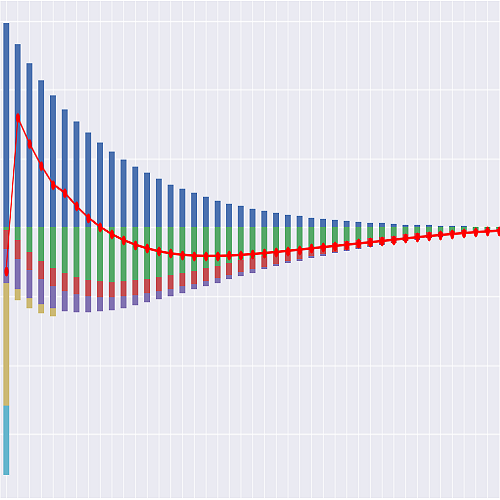
On the anchor the two series come apart completely: by k = 22 the in-force count has fallen
only to 0,932780 while the premium-paying count has fallen to 0,512516, and the 0,420265
difference is a cohort still in force, still credited and still converting.
check_pols_roll_fwd() asserts both limbs — that the ledgers sum to pols_if and that
pols_if decrements on mortality alone. The two ledgers carry different account values, and that asymmetry is the whole economic
content of the freeze: av_pp_at is per premium-paying policy, av_pu_at is the
premium-free block at fund level, and a premium-free policy keeps paying the Stückkosten
and the reserve charge γ out of its own reserve while it stops paying β and the Zillmerung
instalment α. They must not be averaged into one per-policy figure — a policy that froze at
duration 5 and one that froze at duration 15 hold different reserves — and on the anchor
av_pp(9) is 82 934,50 € against 39 549,19 € for the premium-free block’s average policy. Only
the fund-level total rolls forward on mortality alone,
av_at(k + 1, "BEF_PREM") = av_at(k, "AFT_INT") × (1 − mort_rate(12k)) at the year’s annual
rate — which is exactly what its twelve monthly rates compound to — and that is
check_av_roll_fwd(). It closes across a freeze, because a freeze moves reserve
between the blocks without removing any, and it closes whether or not the survivor rider is
on, because the reserve of a policy terminated by death leaves the fund either way: as a
claim where an eligible survivor exists, as a mortality profit where none does. That single
identity is the arithmetic content of nicht vererblich. A model point opens entirely
premium-paying or entirely premium-free (paidup_at_init, model point 7); a part-paid-up
book is two model points. And no Wiederinkraftsetzung is modelled — premiums can in
practice be resumed within a window R14, but none was established, so the premium-free block
is absorbing: conservative on premium income, and a standardization rather than a contract
fact.
The declared rate is the total credited rate#
cred_rate(k) = max(gtd_rate, decl_rate(k)) — a maximum, not a sum. A German laufende
Verzinsung is quoted as the total rate credited to the Deckungskapital, already including the
contract’s Rechnungszins R15 R16 REG-R24; adding one to the other is the notes’ sixth
pitfall and over a twenty-two-year deferment it is worth a great deal.
The guarantee is a cohort fact fixed at conclusion and carried on the model point, so a
book spanning the 2,75 % vintage of 2006 and the 1,00 % vintage of 2025 has both branches of
the max live at once REG-R14 REG-R15. The shipped model points carry four distinct
vintages — 1,00 %, 1,75 %, 2,25 % and 2,75 % — and both branches are exercised: on the anchor
the declared path (2,60 % / 2,40 % / 2,20 %) binds in every year, while on model point 8 the
2,75 % guarantee stands above the whole declared path and binds in every year. The reserve
charge γ is netted inside the same crediting step, (1 + cred_rate(k) − gamma_av), and
the Stückkosten are taken before it.
Charges are insurer income; expenses are insurer outgo#
Four amounts are struck against the policyholder’s Deckungskapital — the Zillmerung
instalment α, the premium charge β, the reserve charge γ and the Stückkosten u — and all four
are insurer income. All four are annual and take k. The insurer’s own outgo is a
different list and is monthly: the acquisition expense, the commission, and a twelfth of the
annual maintenance expense or annuity administration in each month. Booking a
charge as both is the notes’ fourth pitfall, and it is why expenses(t) is invariant to
beta_prem, gamma_av and zill_rate: raising all three moves not one euro of expenses or
commissions, and moves net_cf only through the smaller annuity that a smaller fund buys
at Rentenbeginn — 245 916,54 € of annuity claims against 265 725,57 €.
The Zillmerung is spread over five years and capped at 25 ‰ of the Beitragssumme
R16 REG-R16. alpha_amort_pp(k) is equal at k = 0 … 4, zero from k = 5, and the five
instalments sum to zill_rate × beitragssumme_pp() exactly. The window is a window of the
contract, not of the projection, so model point 6 — in force at duration_init = 17 —
sees alpha_amort_pp(k) = 0 in every year; on a single-premium contract the five instalments
still run and the debit outlives the one premium that paid for it. One arithmetic coincidence
in the worked example is not a coincidence: commissions(0) = 0.025 × S = 4 094,85 € is the
same number as alpha_total_pp(), because the initial commission rate and the
Höchstzillmersatz are both 2,5 %. That is the German design — what the insurer pays out at
inception is sized to what it may write into the reserve — and it is why moving
comm_init_rate without moving zill_rate opens a first-year hole that nothing closes.
The conversion at Rentenbeginn#
One date in the contract’s life, and nothing happens at it that the policyholder chooses:
fund_at_conv()         = av_at(ret_y(), "BEF_PREM") x (1 + terminal_bonus_rate)
rentenfaktor_applied() = max(rentenfaktor_gtd, rentenfaktor_curr()) x rf_option_factor()
ann_pp(ret_y())        = fund_at_conv() / pols_if(ret_t()) / rf_unit
                         x rentenfaktor_applied() x ann_freq
ann_mth_pp(t)          = ann_pp(proj_year(t)) / ann_freq
with rf_unit = 10000 and ann_freq = 12. ann_pp is an annual amount and is nobody’s
payment: the factor is quoted in euro a month, and ann_mth_pp — 630,16 € on the anchor against
the 7 561,91 € a year it sums to — is the instalment actually paid, monthly in advance from
t = ret_t() = 264. The annual figure stays as the cells the conversion and the
Überschussrente are stated on, because both are annual terms, so the twelve instalments of a
payout year are equal and the thirteenth is (1 + b) times the twelfth. There is no lump sum, no election switch, no take-up
assumption and no notice period — three simplifications that follow from the ban on
capitalisation rather than from a modelling choice R1. The Schlussüberschussanteil is
allocated at this single date and at no other, which is a contract fact: with no surrender
there is no earlier exit for a terminal bonus to attach to R15. The max is a genuine
discontinuity, so the projection is sensitive to whichever factor is
higher and completely insensitive to the other. Both branches ship: the anchor converts at
the current 31,50 € against a guaranteed 28,00 € (which would have given 6 721,70 € instead of
7 561,91 €), while model point 13 converts at its guaranteed 34,00 € against a low-scenario
current 27,72 €, the guarantee there being worth 824,65 € a year against the current factor’s
3 640,01 €. Model point 6, a 2009 tariff converting at 60, is the second such cell.
The conversion basis is not the projection basis, and that is deliberate.
rentenfaktor_gtd was struck at inception on first-order DAV 2004 R R17 [S1]; the
projection runs on the best estimate, mort_rate(t) = mort_be_factor × mort_rate_base(t). The
wedge between them is the payout phase’s Risikoüberschuss, and ann_bonus_rate — a
teildynamische Rente — is what gives it back, so ann_pp(ret_y()) is exactly invariant to
mort_be_factor while claims_annuity is not: dropping the factor from 0.85 to 0.70 leaves the
annuity at 7 561,9135 € to the last bit and lifts the annuity claims from 265 725,57 € to
292 090,33 €. A model that converted on its own best-estimate mortality would abolish the wedge,
and with it the whole German payout-phase surplus mechanic. check_conversion() inverts the
identity at ret_y() and is zero at every other k, so it catches a factor applied per policy
instead of per fund, an ann_freq of 1, an rf_unit of 1 000 — and a second conversion, of
which there can be none.
Death, the survivor channel and the Rentengarantiezeit#
With the survivor rider off — surv_annuity_rate = 0, the base design and the anchor’s setting
— a death in the Aufschubphase pays nothing, and claims_death is a column of zeros,
published rather than dropped, because a column of zeros states the product fact where a missing
column would only hide it. With the rider on,
claims(t, "DEATH") = elig_surv_prob × mort_rate_mth(t) × av_at(proj_year(t), "AFT_INT") —
the released reserve, weighted by the probability that an eligible survivor exists at the moment
of death R1, with av_at(k, "AFT_INT") the annual reserve and mort_rate_mth(t) the
month’s share of the deaths, so the month decides when the reserve is released and not how much.
It is not a lump sum to a beneficiary: everything paid to a survivor must be
paid as an annuity, so what is booked is the reserve leaving this contract as the single
premium of a survivor’s annuity, itself a new liability — an immediate annuity, Sofort_DE_S —
that this model does not project. The cover is paid for through rf_option_factor(), a
reduction in the Rentenfaktor, rather than by scaling the death benefit, which is how a German
tariff prices it: model point 3 converts at 31.50 × 0.930 = 29,295 €.
A Rentengarantiezeit runs guarantee_period_y years from Rentenbeginn, not from each
death, so every continuation ends on the same date and pols_gtd is a one-line recursion
closing at gtd_end_t() — t = 299 on model point 4, the 120th instalment of a ten-year
guarantee that opens at ret_t() = 180, with pols_gtd(300) = 0 however late the death that
started it. On the monthly grid the window is what the contract says it is, 12m guaranteed
instalments, and a continuation begins in the month after the death that triggered it rather
than in the following year — which is why turning the grid up moves 116,29 € onto model
point 4 while it takes money off every other column. Each death contributes elig_surv_prob of
a continuation, and where none exists the payments simply cease. They are never commutable:
claims(t, "SURVIVOR") = ann_mth_pp(t) × pols_gtd(t) is a stream, and nothing in this model
discounts a continuation into a capital sum.
Mortality is generational, and the terminal age is absorbing#
DAV 2004 R is a Generationentafel: the improvement lives inside the basis rather than
being applied on top of it R17 REG-R49. So mort_rate_at_age(x, y) takes a calendar year as
well as an age, cal_year_y(k) is carried on every model point, and two points that reach the
same attained age in different calendar years see different rates — model points 6 and 9 both
reach age 60, in 2029 and 2036, at 0.00467744 and 0.00420787. Treating the basis as a period
table is the notes’ fifteenth pitfall.
mort_rate(t) is 1.0 wherever age(t) ≥ omega_age(), whatever mort_be_factor says.
Without that rule the generational trend carries the shipped table’s own terminal rate below 1
in every calendar year after the base year — 0.19920354 at age 120 in 2101 — and would leave a
residue in force after the end of the table; with it, pols_if(proj_len()) = 0 exactly, the
decrements sum to 1,000000, and there is no tail state and nothing left to pay.
mort_rate_mth(t) = 1 − (1 − mort_rate(t))^(1/12) is the geometric twelfth and never
mort_rate(t) / 12: twelve geometric twelfths compound back to the annual rate exactly, which
is what keeps pols_if(12k) equal to the annual-step model’s pols_if(k) to the last bit,
while twelve arithmetic ones leave a residue that grows with the rate and is largest exactly
where this product’s cash flows are — in the tail of a lifelong annuity. A rate of 1 is a
certainty and is not twelfth-rooted: at the terminal age the whole cohort dies in that year’s
last month, so the Rente is paid for the whole terminal year and pols_if(proj_len()) is
still zero.
Inputs are external files#
The seven input CSVs live in this directory, beside run.py; Basis_DE_S/ holds only
formulas:
products/basisrente/
  model_point_table.csv  mort_table.csv  surplus_table.csv    <- inputs live here
  rentenfaktor_table.csv  charge_table.csv  behaviour_table.csv  option_table.csv
  run.py  model.md  product-spec.md  technical-notes.md  sources.md
  Basis_DE_S/  <- formulas only: __init__.py  _system.json  Data/  Projection/
This follows lifelib’s annuallife/TradLife_A, which keeps its input file beside the model and
reads it at run time, and is the opposite of basiclife/BasicTerm_S, which stores its inputs
inside the model through modelx’s IOSpec machinery — hence no _data/ and no embedded values.
Read once, in Data#
Projection is parameterized by point_id, so every Projection[N] is a separate ItemSpace
with its own cells cache, and readers placed there would re-read every file for every policy.
They live instead in an unparameterized Data Space, which Projection references as data
— so each file is read once per model however many policies are projected, and the conventions
suite counts the reads and asserts the file set.
Reference |
Cells |
File |
|---|---|---|
|
|
|
|
|
|
|
|
|
|
|
|
|
|
|
|
|
|
|
|
|
|
||
works wherever the repository is checked out. The trade-off: the model is not portable on its |
||
own — copy |
||
and what you gain is that a diff shows logic changes only and an input can be swapped in place. |
||
Every file but |
||
delib’s second ruling, asserted by the conventions suite; a model point is a configuration |
||
rather than an assumption, and that is the only exemption. |
Two of the seven carry a time-like key, and they are keyed differently. surplus_table.csv
is keyed on t itself — the model’s projection index, read as the projection year k, the
grid the declared rate is quoted on — so it is 0-based like the frame and its first row is
t = 0; behaviour_table.csv is keyed on dur, the contractual policy year
duration(t) + 1, which is 1-based, so its first row stays dur = 1 and its values were
not moved. Neither file was re-keyed when the grid went monthly: both are annual tables of an
annual contract, and both are read through the annual clock. mort_table.csv is keyed on attained age and rentenfaktor_table.csv on the
conversion age; neither is a time index. On model_point_table.csv, duration_init and
zuzahlung_end_dur are elapsed policy-year counts and are already 0-based by nature, so
neither shifts; conclusion_year is a calendar year, and entry_age and ret_age are ages.
File |
Contents |
Provenance |
|---|---|---|
|
Thirteen model points, 25 attributes each. Point 1 is the worked-example anchor cell (M45 → 67, concluded 2026, 6 000 € annual + 4 000 € Zuzahlung, 2 % Dynamik, |
anchor cell std, the technical notes’ worked example |
|
First-order |
std DAV 2004 R-shaped proxy |
|
|
std — 2,60 % / 2,40 % / 2,20 % declared, 1,0 % Überschussrente. A scenario, not a forecast: no declared rate specific to a Basisrente was established anywhere in the delib corpus, and the sibling files’ rates are Schicht-3 and endowment figures that must not be relabelled |
|
|
std — 31,50 € at 67, graded 3,5 % per year of age; the |
|
One row per tariff: the four account charges, the Schlussüberschussanteil, and the insurer’s own expense and commission scale |
|
|
|
std, and no observed range exists: no German insurer publishes a Beitragsfreistellung rate or a Zuzahlung take-up for this product (gap 3). The shape is argued from the product’s structure; the levels are invented |
|
One multiplicative factor per option key |
std — the Ratenzahlungszuschlag on the laufender Beitrag alone, and the Rentenfaktor reductions for a Rentengarantiezeit and a survivor’s annuity, anchored on a Schicht-3 illustration that is unverified and expressly not transferable |
The published checks#
Six identities, each a bool over the whole projection with a per-period residual companion,
compared against roll_fwd_tol = 1e-9 scaled by the run’s own magnitude so the tolerance means
the same thing on a 300 € contribution and on a 30 826 € one.
The residual’s argument follows its cells’ clock. Three take a month — the cash flow statement, the two policy ledgers and the nicht kapitalisierbar limb are statements about payments and payments are monthly — and three take a projection year, because the Deckungskapital, the conversion and the Überschussrente move once a Versicherungsjahr and have nothing to say about a month. Calling one with the other’s index is a category error rather than a rounding question, which is why the two families are named in the table below.
delib ruling 1 — the check_net_cf() identity, in one line: net_cf(t) = premiums + zuzahlungen − claims_death − claims_annuity − claims_survivor − expenses − commissions, read
from result_cf()’s own published columns rather than from the cells that produced them, so
a column added to the frame but not to net_cf, a mis-signed column, or one whose cells and
frame entry have drifted apart all leave a residual; pols_if, pols_paying and av are two
counts and a balance and are excluded by construction. The headline number of a cash flow model
must not be the one quantity nothing checks.
Check |
Clock |
The identity it closes |
|---|---|---|
|
month |
the line above, at every |
|
month |
|
|
month |
no payment other than a monthly annuity instalment, a guarantee continuation or a survivor’s single premium; |
|
year |
|
|
year |
the whole fund converts exactly once, at |
|
year |
|
check_no_capital() is structural rather than arithmetic — trivially zero on the anchor by
construction, and published anyway, because what it guards against is not a slip but an edit.
Modules that are off in the base run#
Three constructions are implemented and inert on the anchor, so the base run reproduces the worked example while the machinery stays visible and testable.
Module |
Switch |
Off |
What it does |
|---|---|---|---|
Survivor’s annuity |
|
|
Turns on |
Rentengarantiezeit |
|
|
Turns on the |
BUZ |
|
|
Read by |
elig_surv_prob = 0.55 is a Projection Reference and is inert on the anchor, carried so
that model points 3, 4 and 12 can exercise it: on model point 3, setting it to zero removes the
whole of claims_death and moves no other column, the annuity staying reduced by the option
factor because a German tariff pays for the cover out of the annuity whether or not a survivor
is ever found. Three further constructions are not implemented and each absence is a
decision: the Wiederinkraftsetzung (no window was established), a provider transfer (gap 13)
and the Versorgungsausgleich (gap 14).
A fourth is not implemented and is the one that is easy to misread as a prohibition: the
Kleinbetragsrenten-Abfindung. German law permits it in Schicht 1 — § 10 Abs. 1 Nr. 2 Satz 3
EStG carries an express de-minimis exception to the Kapitalisierungsverbot, on the
§ 93 Abs. 3 Satz 2 oder 4 EStG mechanics R1 R23 REG-R42 — so its absence here is a
std decision and not a consequence of nicht kapitalisierbar. Two of the three reasons it
was given have since been answered. The threshold is no longer contested: § 93 Abs. 3 Satz 2 Nr. 1
puts it at 1,5 % of the monthly Bezugsgröße of § 18 SGB IV R23. Whether a Basisrente AVB
offers the Abfindung, and on whose election, is no longer unknown: one retrieved wording offers it
[S1], and the GDV model conditions draft it as the insurer’s right and not the policyholder’s
[S12] — which is itself a reason a projection cannot assume take-up. The reason that stands is the
third: Riester_DE_S already carries the mechanic, computing the test rather than assuming it. So every model point here annuitises
its whole capital, model point 10 — 300,00 € a year — included. check_no_capital() is
therefore a statement about this implementation and not about German law, and a user who needs
the branch should copy Riester_DE_S’s is_kleinbetrag() / commutation_pp() pair. This is a
named model risk.
Sign convention#
net_cf is income positive — laufende Beiträge and Zuzahlungen in, death benefits,
annuity instalments, survivor continuations, expenses and commission out — which is the
library-wide sign. liability_cf publishes the same stream outgo-positive,
liability_cf(t) = −net_cf(t) exactly, and both are columns of result_cf() so the identity is
verifiable in the frame rather than only in prose. A Solvency II best estimate is
Σ v(t) × liability_cf(t) over the relevant risk-free term structure, plus a risk margin
REG-R1 REG-R2 REG-R6; nothing here discounts, and no Deckungsrückstellung,
Zinszusatzreserve or SCR is computed REG-R14 REG-R17. Unlike TD_FR_S, expenses does
not include the commission: the notes’ cash flow statement carries them as two lines and
net_cf subtracts each once.
The shape to expect on the monthly frame is a saw-tooth: the whole Versicherungsjahr’s
Beitrag and Zuzahlung land in the first month of each projection year and nothing else does,
so that month is strongly positive and the other eleven — a twelfth of the maintenance expense
and the month’s deaths — are slightly negative, at −5,00 € on the anchor’s first year against
+4 450,15 € in its first month. result_cf_annual() gives back the familiar annual shape: a
first-year strain that is all commission — the Zillmerung instalment of 818,97 € is an
account deduction and costs the insurer nothing — then twenty-one years of positive
accumulation-phase margin, then a long negative payout tail from k = 22, now paid one
instalment at a time.
Naming#
Cells follow lifelib’s basiclife/BasicTerm_S wherever that model has an analogue and
savings/CashValue_SE for the account-value vocabulary: pols_* for policy counts, plural
nouns for cash flows, *_rate for rates, *_pp for per-policy amounts, claims(t, kind) with
an uppercase kind string, pols_if_at(t, timing) and av_pp_at(t, timing) for the within-year
reads, and check_*() as a bool over all t with check_*_resid(t) beside it. The notes use
compact actuarial symbols; the mapping lives in the Projection docstring, and four cases
needed care:
Notes |
Cells |
Why |
|---|---|---|
|
|
Per paying policy, the premium-free block at fund level, and the fund-level total. Not three spellings of one quantity: only the third rolls forward on mortality alone, and collapsing the first two is the third pitfall |
|
|
Emphatically not |
|
|
Three different amounts: the laufender Beitrag with its frequency loading, the behavioural Zuzahlung with its take-up, and the total contribution including a BUZ premium that enters no cash flow |
|
|
The generational table rate at an age and calendar year, that rate in the year month |
The chassis, and who else in delib is on it. The mechanics here are those of an ordinary
German deferred annuity: RV_DE_S (klassische_rentenversicherung) is the same chassis
without the Schicht-1 constraints — full Kapitalwahlrecht, a Rückkaufswert, free
beneficiary designation — and KLV_DE_S carries the Überschussbeteiligung machinery both
inherit. The survivor’s single premium this model books and does not project is an immediate
annuity, Sofort_DE_S; the BUZ it carries only as a premium share is BU_DE_S; the asset
forms it does not model are FRV_DE_S and Index_DE_S. Riester_DE_S is the other certified
layer and the useful contrast: a statutory Beitragserhaltungsgarantie and a permitted 30 %
Teilkapitalauszahlung, neither of which this product has, and a Kleinbetragsrenten
commutation, which it does have in law REG-R42 and does not have in this model.
The model point’s policy_id and sex drive no formula — pricing is unisex for contracts
concluded from 21 December 2012 REG-R34 — and are exposed rather than dropped, because a
silently missing column is worse than an inert one.
Standardizations used#
Every row is std — a parameter or convention chosen where the sources are silent, proprietary or unreachable. Nothing here is a market observation.
Standardization |
Value |
Rationale |
|---|---|---|
Mortality table |
|
DAV 2004 R is the DAV’s property and is cited, never shipped R17. Anchored at |
Improvement trend, and the terminal age |
1,5 % p.a. flat across ages from |
The trend keeps the basis generational, which is what a replacement must preserve; DAV 2004 R’s own trends are age-dependent, so this is a simplification and a stated model risk. 121 is the age German annuity tables are conventionally carried to, and the absorbing rule is what makes the decrements sum to one |
Best-estimate factor |
|
A round step from the shipped first-order table to a best estimate; the single largest unanchored number in the payout phase |
Declared laufende Verzinsung |
2,60 % (t 1–10), 2,40 % (11–20), 2,20 % after |
A scenario set above the 1,00 % Höchstrechnungszins by a plausible surplus margin and graded down, so the guarantee does not bind on the anchor. No Basisrente declared rate exists anywhere in the corpus |
Schlussüberschussanteil and Überschussrente |
4,0 % of the fund at Rentenbeginn; |
The single-date allocation is a contract fact R15 and the 4,0 % has nothing behind it. The uplift makes a teildynamische Rente: volldynamisch would consume the whole first-order margin and konstant none, and 1,0 % is deliberately in between |
Aktueller Rentenfaktor |
31,50 € at 67, graded 3,5 % per year; |
Set above the guaranteed 28,00 € so |
Guaranteed Rentenfaktoren |
26,00 € to 34,00 € across the model points |
Inside the argued 24 € – 34 € band for a klassisch tariff converting at 67. One market level now exists and it sits at the bottom of that band: a guaranteed 24,94 € per 10 000 € at 67 on a 2025 fund-linked contract [S13]. The shipped values were not re-calibrated in this pass — a change would move the worked example and its golden tests — so the anchor’s 28,00 € should be read as above the one observed level (gap 4) |
Account charges β, γ, u |
7,5 % of each Beitrag and Zuzahlung; 0,35 % p.a. of the Deckungskapital; 36,00 € p.a. per policy, inflating |
Mid-points of the argued 5 % – 10 % and 0,2 % – 0,6 % bands, and a placeholder Stückkosten charged to both ledgers, which is the economic content of a freeze |
Zuzahlung acquisition charge |
2,5 % of each Zuzahlung |
A top-up carries its own single charge instead of a share of the Zillmerung; whether Zuzahlungen enter the Beitragssumme at all was not established (gap 8) |
Zillmerung spread, and the Beitragssumme it runs on |
|
The five years are no longer std. The AltZertG’s own rule does not reach a Basisrente, but VVG § 165 Abs. 2 with § 169 Abs. 3 does, and two retrieved wordings state it R10 R14 [S1] [S12] — with the qualification, from the GDV conditions, that a premium term shorter than five years shortens the spread, which this model does not implement. Whether Zuzahlungen enter |
The option factors |
Ratenzahlungszuschlag 1,000 / 1,020 / 1,030 / 1,050; |
The frequency ladder is a German market convention carried from the sibling delib corpus, with no tariff sheet behind it. The two Rentenfaktor reductions are anchored on a Schicht-3 illustration that is unverified and expressly not transferable, and the survivor factor has no anchor at all |
Insurer expense scale |
Acquisition 250,00 € at inception; maintenance 60,00 € and annuity administration 36,00 € p.a., inflating at 1,5 % |
Round-number placeholders; the payout phase is administratively cheaper than the accumulation phase |
Commission scale |
2,5 % of |
The initial rate is sized to the Zillmerung cap, which is the German design — and a carrier’s published Abschluss- und Vertriebskosten of “2,50 % der vereinbarten Beiträge” now sits exactly on it [S13]. [S2]’s 1 575 € specimen stays unverified; no renewal level was established, and the one retrieved schedule has no renewal line at all |
Beitragsfreistellung rate |
4,0 % (years 1–5), 3,0 % (6–10), 2,0 % (11+) |
Shape argued from the product’s structure — penalty-free and reversible early, nothing realisable to leave for late. The levels are invented (gap 3) |
Zuzahlung take-up |
0.70 (1–5), 0.85 (6–15), 0.90 (16+) |
A utilisation rate, not a contract term. Rising because the contract and the habit bed in |
Eligible-survivor probability |
|
In substance a marriage-survival probability. One of the most consequential std numbers in the whole delib library |
Annuity timing |
One instalment a month, in advance, on |
The compression onto an annual grid is gone: the monthly step pays the instalment to whoever is alive at the start of each month, which is what the contract promises and is worth 4 290,52 € of the anchor’s payout phase. What stays std is vorschüssig against nachschüssig — no German convention was established (gap 21) — and paying in arrears instead would move the annuity by about one month’s interest |
Processing order and age basis |
The contribution in the year’s first month, interest at year end, death at the end of each month, the freeze after the last month’s deaths; age last birthday at conclusion, stepping on the anniversary |
The order is declared once and asserted, because every roll-forward identity depends on it. No German age convention was established, and mortality here drives the annuity’s duration rather than a benefit amount, so a half-year offset is second order |
The thirteen model points |
— |
Configurations, not observations: no carrier’s entry ages, premium minima, permitted Rentenbeginn range or option terms were established (gap 1, gap 8) |
The Kleinbetragsrenten-Abfindung left unimplemented |
— |
Schicht 1 permits the commutation at 1,5 % of the monthly Bezugsgröße R23 REG-R42; the model omits it because |
The only quantities that are not standardizations are the 25 ‰ and 40 ‰ Höchstzillmersätze
R16 REG-R16 REG-R20, the gtd_rate ladder of Höchstrechnungszins vintages R16
REG-R14 REG-R15, the five-year Zillmerung spread R14 [S1] [S12], and the structural
rules — the five prohibitions and the absences they impose, the Beitragsfreistellung right, the
closed list of permitted survivors, the annuity-only payout as this model implements it, the
max conversion, the single-date terminal bonus and the 50 % BUZ ceiling. The annuity-only payout
is the one item on that list that law only mostly compels: the Kleinbetragsrenten-Abfindung is
the exception, and leaving it out is the std row above. The single-date terminal bonus has
since acquired a statutory address as well as a structural one: VVG § 153 Abs. 4 makes the end of
the accumulation phase the allocation date for an annuity contract R15.
Two levels a retrieved document does not agree with, left unchanged in this pass. A carrier’s published Muster-PIB gives a guaranteed Rentenfaktor of 24,94 € per 10 000 € at 67 on a 2025 contract, below the 28,00 € the anchor guarantees and well below model point 13’s 34,00 € [S13]; and the same sheet’s Verwaltungskosten are 7,00 % of premiums paid and up to 3,80 % p.a. of the fund, against this model’s β of 7,5 % and γ of 0,35 %, with 1,50 % of the annuity in the payout phase against a flat 36,00 € here. The comparison is not like for like — that carrier’s product is fund-linked and its fund percentage includes fund charges — but the direction is clear and it is recorded rather than acted on, because moving a level moves the worked example and its golden tests.
Tests#
tests/test_basisrente_de.py asserts the eighteen printed rows of the notes’ worked example to
the cent and pols_if to six decimals — its golden dictionaries are keyed by the 0-based t,
so the anchor’s rows run 0 to 76 — the totals over all seventy-seven years at full
precision (and that the sum of the rounded cells really does differ, in three of the six money
columns), the Einmalbeitrag variant’s ten printed rows and its own totals, the model point 13
conversion table with both branches of the max, the notes’ three independent checks rebuilt
from the charge scale up, the two closure identities — decrements summing to 1,000000 and the
Total row reconciling — and all six check_* identities with their residuals. Beyond the worked
example it asserts one test per listed modeling pitfall: no surrender value at any duration
and none of the names that would carry one; the Beitragsfreistellung absent from the in-force
roll-forward; the two account blocks not averaged; the account charges invariant in expenses;
the Zillmerung spread over five contract years and capped; the declared rate as a max and
not a sum; the premium stream keyed to the policy duration and stopping at Rentenbeginn; the
Ratenzahlungszuschlag on the laufender Beitrag alone; no death benefit with the rider off;
the death benefit conditional on an eligible survivor and never a lump sum; the conversion
invariant to mort_be_factor; the annuity booked in advance on the opening count; both branches
of max(garantiert, aktuell); the Rentengarantiezeit running from Rentenbeginn and never
commuted; the generational table; the guarantee vintage attaching at conclusion; and the BUZ
carried as a premium share that reaches no cash flow.
python -m pytest lifelib/libraries/delib/tests/test_basisrente_de.py -q
python -m pytest lifelib/libraries/delib/tests/test_model_conventions_de.py -q -k Basis_DE_S