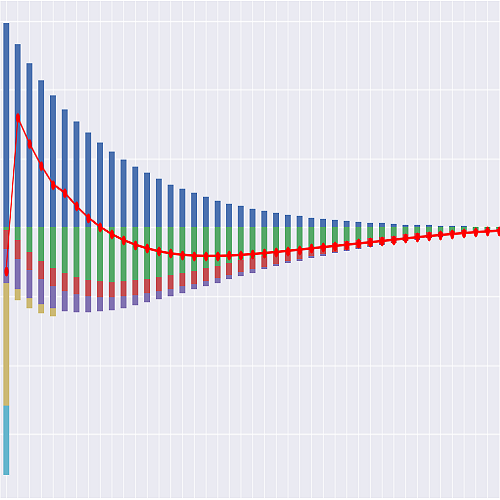
Technical Notes#
Status: Draft, 2026-09-03 (all cited sources accessed 2026-09-03).
Scope note. These notes turn the standardized composite whole life assurance
(jongsin boheom, 종신보험) of product-spec.md (same directory) into a reference
liability cash-flow projection on paper, and then into WholeLife_KR_S beside it. They
describe no single insurer’s contract. [S#] and [R#] tags resolve against sources.md,
whose numbering is carried verbatim from _research/whole-life.md and is frozen; [REG-R#]
tags resolve against the cross-product reference library
references/regulatory-and-actuarial-references.md, whose own R1–R60 numbering is
separate and also frozen. std marks a standardization introduced for the reference
implementation; unverified marks a claim that could not be confirmed against a retrieved
document. Every parameter value here is identical to product-spec.md’s, and every
number in the worked example is read off the shipped model rather than recomputed by hand.
Three quantities appear here that the specification names but does not fix, all three
internal to the surrender-value and expense construction it defers to this document: the
gross-to-net loading θ, the acquisition-cost ratio a against the 표준해약공제액 cap, and
the first-year commission share c₀. Each is std, and each is derived, bounded or
calibrated below rather than asserted.
This is the library’s savings/protection chassis. Five mechanics are specified once, here, and inherited rather than restated:
the 계약자적립액 (gyeyakja jeongnibaek, the policyholder account) recursion, the contractual successor of the 보험료적립금 (boheomnyo jeongnipgeum, policy reserve);
the 해약환급금 (haeyak hwangeupgeum, surrender value) and its 해약공제액, capped by the 표준해약공제액 of 보험업감독규정 별표 14 REG-R20;
the 무해지환급형 / 저해지환급형 suppressed forms — nil, or a stated fraction
k, during 납입기간, stepping up at 납입완료. A cliff, not a curve, carried as a model point column so the suppressed and the ordinary run appear side by side in one projection;the 보험계약대출 (policy loan) as a modelled state, unavailable during 납입기간 on a 무해지환급형 contract because there is no value to lend against; and
보험료 납입면제 (premium waiver), a distinct in-force state in which premiums cease and are deemed paid for benefit and surrender-value purposes.
The CI technical notes (CI보험) inherit the whole of
it and add an accelerated critical-illness payment; the pension savings technical notes
(연금저축보험) inherit the accumulation half. The
term life technical notes (정기보험) carry the
protection chassis and its 갱신형 / 비갱신형 split, and share this document’s
surrender-value regime, because 감독규정 제7-69조 and 제7-70조 apply 제7-65조 through
제7-68조 to 장기손해보험 and to 제3보험 mutatis mutandis — one surrender-value regime
governs all ten krlib products REG-R19.
Model scope and conventions#
Purpose. Project gross best-estimate liability cash flows per policy — premiums, death claims, surrender benefits, 감액 proceeds, expenses and commission — undiscounted and gross of reinsurance. Korea runs three measurement bases over one such stream and all three are live: IFRS 17 (K-IFRS 제1117호, mandatory since 2023-01-01) REG-R60, K-ICS in the same quarter REG-R13, and the 해약환급금준비금, which has no counterpart anywhere else in this repository REG-R11. Discounting, the risk adjustment, the CSM, 요구자본 and every reserve are out of scope and are cited, not reproduced — see Valuation and reserve pointers.
Time index.
tis 0-based and counts policy months:t = 0is the first policy month, periodtruns from month-endtto month-endt + 1, the frame ist = 0 … proj_len − 1withproj_len = 12 × proj_years, and the contractual policy year is the derived 1-based labelpolicy_year(t) = ⌊t/12⌋ + 1, which is never indexed by. The anchor projects 912 rows. Values at a point in time — the accountV, the surrender chargeSC, the surrender valuesWandCV,cumpremand the loan balanceL— carry a second index, the month-endd = 0 … Twithd = 0at issue; the flows of monthtreadd = tas the opening month-end andd = t + 1as the closing one. A 계약해당일 is the month-endd = 12y, which is where every published 해지환급금 grid is quoted and where the value steps up at 납입완료.Contract terms stay in years. The 납입기간
m, the 해약공제기간n_sc, the 보험계약대출 drawdown year and the 감액 year are all written in policy years, because that is how the contract writes them; each has a month-count companion —prem_period_mths,surr_chg_period_mths— for the cells that index the grid. Only the grid is monthly.Projection frequency. Monthly (
WholeLife_KR_S), and on this product the change of grid is not cosmetic. 감독규정 제7-66조제1항제4호 provides that the 계약자적립액 accrues monthly before 납입완료 and daily afterwards REG-R19. An annual grid could carry this product only through 제7-65조제2항’s separate permission to compute the account on an annualised premium basis — 「연납보험료를 기준으로 하여 산출할 수 있다」 REG-R18 — a permission the model used to take and to record as a std departure. The monthly grid does not need it.What the monthly grid moved, and what it did not. The sourced decrement basis is untouched and stays annual: both disclosed 적용위험률 grids are annual by age [S2] [S8] and the FSS 원칙모형 lapse vector is annual by 경과기간 REG-R27, so
q(t)andw(t)carry them and the monthly decrementsq^m(t)andw^m(t)are1 − (1 − q)^(1/12)std, level inside a policy year and stepping at each 계약해당일. Twelve monthly exits compound to the year’s annual rate exactly, so the in-force at every 계약해당일 reproduces the annual-step model this replaced, to a relative 1.1e-14 across the shipped model points. The 계약자적립액 does move, by about 1.2%: it now accrues at(1 + i)^(1/12) − 1a month and is built from a 월납순보험료 struck by monthly equivalence, which is not the 연납순보험료 divided by twelve — a monthly equivalence discounts eleven of each year’s twelve instalments and exposes them to the year’s mortality, and the difference is about half a year’s interest at the 예정이율, which is exactly the timing an annual grid gave away. The 연납순보험료 survives beside it, because 별표 14 names that quantity and the statutory 표준해약공제액 is computed from it. Two smaller consequences: the 14-day 납입최고(독촉)기간 still collapses, now into the month rather than the year [S5 제25조] REG-R25 제26조; and 미경과보험료, required on termination by 제7-66조제5항 REG-R19, is still not added, there being none on a grid with premiums in advance and surrenders at the month-end std — but the unearned amount a real contract would owe is now at most one month’s premium rather than one year’s.Timing conventions std. Premium at the start of each month, in advance, for the months
t = 0 … 12m − 1, on the paying cohort only; maintenance expense, the premium-related expense and renewal commission at the start of each month; acquisition expense and initial commission at issue, in montht = 0; death claims and claim expenses at the end of the month of death; surrenders and any 감액 at the end of the month, after deaths, on the surrender value at the month-endd = t + 1that closes it; 부활 twelve months after the lapse it follows.Age basis: 보험나이. 보험나이 (boheom nai, insurance age) is the 만 나이 at the 계약일 with a fraction under six months discarded and six months or more rounded up, and it increments on each 계약해당일 rather than on the birthday [S5 제21조] REG-R25 제21조. A monthly grid anchored at issue steps its 계약해당일 exactly twelve months apart, so
⌊t/12⌋counts them, the ageing is correct by construction, and the attained age in monthtisx + ⌊t/12⌋exactly — level through the twelve months of a policy year, because interpolating it within the year would be modelling an age the contract has no concept of. The table does not share that basis and no conversion is applied std: the statisticsmort_table.csvis calibrated against REG-R38 are on 만나이, and no public mapping exists. The six-month rule means the two differ for half of all issue dates, so the model reads the table about half a year of ageing too young — worth roughly 4.6% ofqbetween attained ages 40 and 60, against a 9.3% step for a full year. Named, not hidden.Currency. KRW throughout, written ₩ with thousands separators and the Korean 만원 / 억원 convention alongside where a Korean reader expects it: the anchor’s ₩100,000,000 is 1억원.
run.pyprintsKRWand pure ASCII.Model points. Single-policy, projected on an expected (probability-weighted) basis: survivorship multiplies per-policy cash flows.
point_idparameterizesProjectionandpoint_id = 1is the worked-example anchor cell. Ten points ship; no aggregation logic is specified here.Termination and horizon. There is no expiry, no 만기보험금 and no survival benefit at any age [S1] [S2] [S4] [S8]. The projection runs to the terminal age of the mortality table:
T = ω − x + 1with ω = 115 for both sexes, the first age at whichq(ω) = 1.Tis the number of policy years projected — the exclusive end of the frame,t = 0 … T − 1— and ω is itself std, the 제10회’s terminal age being no more public than its rates REG-R33 REG-R34. Every remaining life dies in the last periodt = T − 1, nothing is paid there but the death benefit, and there are no tail states.Contract boundary. The premium is level and guaranteed for the whole of 납입기간 with no unilateral repricing right on a 금리확정형 contract [S2] [S8], so the whole contract sits inside any defensible boundary and no boundary test is implemented. (The question is real on this library’s 갱신형 products and is specified in term life (정기보험), not here.)
Rounding. Intermediate values at full double precision; displayed cash flows and surrender values to two decimal places std, policy counts to six or ten, rates to eight or ten — the precision
tests/test_whole_life_kr.pyasserts. Contractual amounts a policyholder receives are integral won; the model does not round them, a probability-weighted expected value having no contractual denomination.Sign convention.
net_cfis income-positive — premiums less claims, claim expenses, expenses and commission. That is both these notes’ sign and the library-wide one, so there is no outgo-positiveliability_cfcompanion: one stream, one sign, one name.
Model point attributes#
Attribute |
Type |
Anchor cell ( |
|---|---|---|
|
str |
|
|
enum {M, F} |
M |
|
int, 보험나이, 15–65 |
40 |
|
KRW, ₩10,000,000–₩1,000,000,000 in ₩1,000,000 units |
100,000,000 (1억원) |
|
int years, or 0 for 전기납 (종신납) |
20 |
|
KRW, level for years 1 … m |
2,776,140 |
|
해약환급금 suppression factor, 1.00 / 0.50 / 0.30 / 0.00 |
0.50 — 저해지환급형 |
|
the suppressed form’s premium as a fraction of the 표준형’s |
0.90 |
|
enum { |
|
|
공시이율 on a |
0.025 |
|
enum { |
|
|
납입면제 incidence p.a. during 납입기간 |
0.0 |
|
보험계약대출 take-up fraction, and the year of the draw |
0.0 / 0 |
|
유지보너스 credited at 납입완료, as a fraction of premiums paid |
0.0 |
|
감액 year, and the fraction of |
0 / 0.0 |
|
부활 proportion of the previous year’s lapses |
0.0 |
|
multiplier on the table rate |
1.0 |
There is no issue-date attribute, and that is a product fact rather than an omission: the projection runs on policy years, 보험나이 is fixed at the 계약일 and increments on the 계약해당일 rather than on the birthday [S5 제21조] REG-R25 제21조, and the one intra-year date that matters is the 납입완료일, an anniversary by construction.
prem_term = 0 denotes 전기납 (종신납): m becomes the whole projection, no 납입완료
date exists, the suppressed period runs for life and the cliff never happens —
cv_mult(d) = k at every anniversary. That configuration must be in the shipped table because it
is the one in which the product’s signature mechanic is absent by construction
(point_id = 5).
The anchor premium is derived from a sourced one, not invented. DB생명 publishes
₩257,050 a month for the 표준형 at exactly this cell — 남 40세, 1억원, 20년납, 월납 [S4] —
and the annual figure is 12 × that = ₩3,084,600 std, which is point_id = 2. The
anchor’s ₩2,776,140 is 0.900 × ₩3,084,600 std — a rounding of the 89.9% ratio
처브라이프 publish at that suppression factor, on their own 5,000만원 / 10년납 cell rather
than this one [S1] — inside the observed 81.5%–95.4% envelope [S1] [S2] [S4] [S6]. No carrier
publishes an annual-mode scale, so the modal discount a real 연납 rate would carry is not
applied: the annual premium is slightly overstated and the first year’s interest credit
correspondingly understated. Stated, not corrected.
Two attributes need a note. cv_floor_ratio is the suppression factor k and
refund_ratio(d) is the 환급률; the cross-library register retired the bare name
cv_ratio because a Korean whole life model carries two ratios on the same object. And
prem_susp_ratio is a price input, not a value input: it scales the premium, never the
surrender value. The model’s own loading rule reproduces the anchor premium to 0.0010%
— ₩2,776,167.83 against ₩2,776,140 — and the projection uses the model-point value.
State variables#
Month quantities are indexed by t, month-end quantities by d.
Variable |
Description |
Updated |
|---|---|---|
|
In-force probability at the start of month |
monthly recursion |
|
Of those, the cohort still paying premium in cash; the weight on premium and commission |
monthly recursion |
|
Of those, the cohort in the 납입면제 state: in force, paying nothing, accruing value as if paying |
monthly recursion |
|
Expected deaths and 해지 in month |
decrement |
|
Of the lapses, those paid a surrender value — |
decrement |
|
부활 at the start of month |
decrement |
|
The annual 적용위험률 at attained 보험나이 |
table lookup |
|
Its monthly conversion |
closed form |
|
The annual 해지율 of the policy year |
assumption |
|
Its monthly conversion, plus the bonus-date spike in the single month one applies |
closed form |
|
납입면제 incidence during 납입기간 only, annual and converted |
assumption |
|
|
forward recursion |
|
|
closed form |
|
|
closed form |
|
|
closed form |
|
|
closed form |
|
Premiums paid by month-end |
recursion / ratio |
|
보험계약대출 balance at month-end |
monthly recursion |
|
The 감액 step-down factor at month-end |
closed form |
Three of these carry design decisions worth stating explicitly.
There is exactly one policy value in this model. pol_val_pp is the 표준형 twin’s
계약자적립액 and the suppression is a multiplier on the surrender value derived from it —
not a second account run, not a second reserve basis. Every carrier that sells the form
names the comparison product in the same sentence and says it is not sold: 「”표준형”의
경우는 … 동일한 보장내용으로 해지율을 적용하지 않고 … 계산된 상품이며 … 비교안내를
위한 종목으로 실제로 판매하지 않습니다」 [S1], with the same sentence at three more
carriers [S2] [S3] [S4]. The published grids confirm it arithmetically: every pre-완납
suppressed/표준형 ratio is exactly k (1,164,500 / 2,329,000 = 0.50000 [S1]; 1,526,128 /
5,087,095 = 0.30000 [S4]) and every post-완납 pair is identical to the won [S1] [S4]
[S6].
pols_waived is a state, not a rate adjustment. The waiver’s wording forces it:
「그러나 이 경우에도 보험료가 … 정상적으로 납입된 것으로 하여 사망보험금 및 해지환급금을
계산합니다」 [S2], verbatim at two more carriers [S3] [S8]. A waived policy pays nothing and
accrues everything, so it cannot be represented by scaling the premium; and on a suppressed
form it is the only route to the cliff the policyholder does not have to fund.
pols_reinstate makes lapse non-terminal, because the 약관 counts the surrender value
as undrawn 「… 또는 해지환급금이 없는 경우를 포함합니다」 [S5 제26조] REG-R25 제27조 —
so a 무해지 contract is always reinstatable within three years. Treating every exit as
terminal understates later-duration in force; the parameter exists and is zero in the base
run.
The base run carries no loan, no waiver, no bonus, no 감액 and no 부활, so
loan_pp ≡ 0, pols_waived ≡ 0, pols_surr ≡ pols_lapse, sa_factor ≡ 1 and every
benefit is gross. Each module is exercised on at least one shipped model point.
Assumption inputs#
Three classes, kept apart on purpose. The split is not a modelling nicety in Korea: the 보험가격지수 exists precisely because a Korean consumer cannot see the pricing basis REG-R22 제7-45조제7항, the 산출방법서 that holds the guaranteed elements is a filed but unpublished 기초서류 REG-R2, and the November 2024 계리가정 decision draws a hard line between an assumption an insurer may choose and one the supervisor now sets REG-R27.
(a) Contractual / guaranteed elements (cited; the insurer cannot change them)#
Input |
Value |
Basis |
|---|---|---|
사망보험금 |
|
[S5 제34조] [S6] REG-R25 제33조 |
보험기간 |
종신 — no expiry, no 만기보험금, no survival benefit at any age |
[S1] [S2] [S3] [S4] [S6] [S8] |
Premium |
Level and guaranteed for years 1 … m; none thereafter |
[S2] [S8] |
Severe-disability benefit |
None. Korea puts no 고도장해보험금 at the sum assured on this chassis |
[S2] [S3] [S6] [S8] |
보험료 납입면제 |
On a 50% 장해지급률 aggregated across body parts from one cause, accident or disease; premiums cease and are deemed paid to the end of 납입기간 for benefit and surrender-value purposes |
[S2] [S3] [S6] [S8] REG-R25 부표 3 |
해약환급금 identity |
계약자적립액 − 해약공제액, floored at zero — a negative difference 「이를 영(零)으로 처리한다」 |
[S2] [S8] REG-R19 제7-66조제1항제1호 |
해약공제액 |
미상각신계약비, 「이미 지출한 계약체결비용 해당액으로서 산출방법서에서 정한 방법에 따라 계산한 금액」, capped at the 표준해약공제액 |
|
표준해약공제액 |
연납순보험료 × 5% × 해약공제계수 + 보험가입금액 × 10/1000; for a 보장성보험 the 계수 is the 보험기간 capped at 20, and the 연납순보험료 is recomputed on a 20년납 footing for a term of 20 years or more |
|
보험가입금액 entering the cap |
The 일반사망보험금, taken before any 체증 or 체감 |
|
해약공제기간 |
납입기간 or 신계약비 부가기간, capped at 7년 |
|
Suppression factor |
Applies for elapsed duration < 납입기간; |
[S1] [S4] [S6] [S7] [S8] |
What |
The 표준형 twin’s 해약환급금 — a non-marketed comparison product with identical benefits priced with the lapse assumption switched off |
[S1] [S2] [S3] [S4] |
Post-cliff equality |
From 납입완료 the suppressed and 표준형 values are identical in every published grid |
[S1] [S4] [S6] |
Clawback |
Where premiums falling in the suppressed period were unpaid, they must be made good before the post-cliff basis applies |
[S2] [S3] [S8] |
Waived premiums |
Count as paid for the surrender-value computation |
[S2] [S3] [S6] [S8] |
보험계약대출 limit |
Within the 해약환급금 net of existing principal and interest, 「그러나, 순수보장성보험 등 보험상품의 종류에 따라 보험계약대출이 제한될 수 있습니다」 |
[S5 제34조] REG-R25 제33조 |
Loan settlement |
Deducted from any benefit, from the 해약환급금, and 즉시 on 해지 |
[S5 제34조] REG-R25 제26조·제33조 |
감액 |
The reduced portion is treated as surrendered and pays the corresponding 해약환급금 |
[S5 제20조] REG-R25 |
납입최고(독촉)기간 |
14일 이상 from the day after the 계약해당일; the contract is 해지 the day after it ends |
[S5 제25조] REG-R25 제26조 |
부활 |
Within 3년 of 해지, on fresh 고지 and arrears with interest; available even where the 해약환급금 was nil |
[S5 제26조] REG-R25 제27조 |
면책 — suicide |
No death benefit where the insured takes their own life within 2년 of the 계약일; zero incidence modelled |
[S1] [S3] [S6] [S7]; REG-R49 제659조 REG-R50 제732조의2 |
Refused claim |
The insurer must still pay 「보험수익자를 위하여 적립한 금액」 — in practice the 계약자적립액 |
|
Minimum death benefit |
At least cumulative premiums paid, except where the 납입기간 ends at age 80 or below — which the anchor (완납 at 보험나이 60) satisfies |
The suppression is a regulatory dispensation, not a contractual gimmick, and the
condition attached to it is what makes the lapse vector a first-class model input.
제7-66조제4항 permits an insurer to pay less than the 제1항 value that 별표 14 floors
only where the premium or benefit was computed 「최적해지율을 사용하여」 — using a
best-estimate lapse rate REG-R19. 제4항제1호 bars the form outright for a 변액보험 (so
VA_KR_S may not use it), and 제4항제2호 attaches two further conditions only where the
surrender value during 납입기간 is less than 50% of an otherwise identical 표준형
product’s REG-R19. The anchor sits exactly at that threshold and not below it, which
is the most likely reason three independent carriers chose 50% [S1] [S6] [S7].
(b) Insurer-discretionary current elements#
Unlike a UK guaranteed-premium term policy, this class is not nearly empty — it is where the product’s economics live. Korea differs from Japan in one respect that matters throughout: the pricing rate is published, in the 상품요약서, and so is a sample of the 적용위험률 and the 적용해지율 envelope [S2] [S8]. What is not published is the 산출방법서 itself, so a disclosure of a parameter is what this library has, never the filing REG-R2.
Input |
Model value |
Basis |
|---|---|---|
예정이율 |
2.50% p.a., 연복리, flat |
Disclosed range 2.25%–2.75% at six carrier documents [S1] [S2] [S5] [S6] [S7] [S8]; centre std, and equal to the 2026 평균공시이율 REG-R48 |
최저보증이율 ( |
0.75% p.a., floor on a |
Stated verbatim in the one full 약관: 「최저보증이율은 연복리 0.75%를 적용」 [S5 제32조] |
공시이율 ( |
2.75% on the one |
Mechanism sourced [S5 제32조] REG-R18 제7-65조제3항 REG-R24 별표 27; the level std |
Accrual rate |
|
|
보험계약대출이율 |
예정이율 + 1.5% = 4.00% p.a., compound, flat, and a vintage rate |
Formula at three carriers independently [S9] [S11] [S13]; level std |
보험계약대출 limit |
80% of the payable 해약환급금 |
Observed 50%–85% [S11] and 50%–80% [S13]; pick std |
Gross-to-net loading |
1.4642 |
std, calibrated once so the 표준형 anchor reproduces 12 × ₩257,050 [S4] |
Acquisition-cost ratio |
1.00 — 계약체결비용 set at the 표준해약공제액 |
|
First-year commission share |
0.65 of 계약체결비용, capped at one year’s premium |
Cap sourced REG-R22 제4-32조제5항; share std |
Renewal commission |
3.0% of premium, years 2 … m |
|
계약관리비용 per policy |
₩5,000 a month for life, inflating at 2.0% on each 계약해당일 |
|
유지관련비용 on premium |
2.0% of premium collected |
|
Claim handling expense |
₩300,000 per death claim |
|
Expense inflation |
2.0% p.a., the Bank of Korea target |
|
유지보너스 |
13.8% of total premiums at 납입완료 on the one 7년납 point |
Published 10.8% / 13.8% / 15.0% by 납입기간 [S7]; off in the base run |
계약자배당 |
None. The composite is 무배당, as is every product in the retrieved set |
Why the expense parameters are all std, and what bounds them. Both 상품요약서 in the set define 계약체결비용 and 계약관리비용 in words and then give no number [S2] [S8]; the 약관 defines 부가보험료 and 해약공제액 by reference to the 산출방법서 [S5 제2조] REG-R2. No Korean expense rate as a percentage of premium was obtained from any source in this research pass. Four public handles bound the standardization instead, and the model is built to sit inside all four:
The 표준해약공제액 itself REG-R20. The model sets 계약체결비용 exactly at it —
acq_cost_ratio = 1.00— so the acquisition cost is by construction recoverable within the statutory surrender charge and no more.The 1.4 × disclosure tolerance of 제7-45조제11항, under which a whole-life death-benefit 보장성보험 need not publish a 계약체결비용지수 provided its 계약체결비용 stays within 1.4 × the 표준해약공제액 REG-R22. On the anchor that outer bound is ₩4,349,380.75 and the model sits at ₩3,106,700.54, comfortably inside it.
check_acq_cost_cap()asserts it.The first-year remuneration cap of 제4-32조제5항: first-year distributor remuneration may not exceed the first year’s expected premium, with the projected one-year surrender value added to the commission side where the contract deducts 80% or more of the 표준해약공제액 — which is exactly what a 무·저해지 design does REG-R22 REG-R29. The model caps
comm_init_pp()at1.00 × premium_pp()and the same check asserts it. On the anchor the cap does not bind: 0.65 × ₩3,106,700.54 = ₩2,019,355.35 against a premium of ₩2,776,140.The 보험가격지수, whose observed range of 85.4%–110.9% across two carriers at this very cell bounds how far a Korean whole-life product’s total loading can sit from the industry mean [S2] [S8].
The 60%-a-year instalment structure of 제4-32조제8항 REG-R22 REG-R29 governs how the cost is paid rather than how much it is; it is cited and not modelled.
(c) Behavioral / experience assumptions (modeler’s view — all std)#
Mortality. The 제10회 경험생명표 (gyeongheom saengmyeongpyo), produced by 보험개발원
and applied to new business from 2024-04, is not published in full: only 평균수명
and 기대여명 are released, and even those reached this library through a trade newspaper
REG-R33 REG-R34. The 참조순보험요율 the bureau files for life mortality are likewise
never published, becoming visible only as the 보험가격지수 REG-R4 REG-R22. There is
therefore no published Korean insured mortality rate to anchor a proxy on — the sharp
contrast with jplib, where the 生保標準生命表 is free to read and only its redistribution
is restricted.
mort_table.csv is accordingly a std construction and its provenance column says
so row by row. Three kinds of row:
Row kind |
Construction |
Basis |
|---|---|---|
ANCHOR (보험나이 20, 40, 60) |
The mean of the only two Korean insured rates in the public domain at those ages |
Rates sourced [S2] [S8]; the mean std |
CONSTRUCTED below 60 |
Log-linear in |
|
CONSTRUCTED above 60 |
Gompertz in |
Targets from REG-R38 plus the reported 제10회 gap REG-R33; the form std |
TERMINAL |
|
std; the 제10회 terminal age is not public |
Two unfitted checks are worth recording because neither was used in the calibration: the resulting 평균수명 at birth is 85.4 (M) / 90.4 (F) against the 86.3 / 90.7 reported for the 제10회 REG-R33. No row of this file is a 경험생명표 value and the table must never be presented as one.
Input |
Value |
Basis |
|---|---|---|
Base table |
|
|
|
1.00 in the base run |
|
Terminal age ω |
115, both sexes |
|
Improvement overlay |
None |
|
만나이 → 보험나이 conversion |
None applied |
std; no public mapping exists |
mort_be_factor = 1.00 is a choice, not a default: the base run is a pricing-table run,
not a best estimate. The two disclosed grids differ by up to 24% — 18%–24% at five of
the six published cells (남 40세 0.000780 [S2] against 0.00092 [S8], 여 60세 0.001730
against 0.00214) and not at all at 여 20세, where both print 0.00018 — so they bracket
rather than fix a level, and one is labelled 「무배당 예정 경험사망률」, the
giveaway that it is a 경험생명표 derivative carrying a 무배당 loading rather than the table
[S2] [S8]. A production basis would sit below 1.00 and move claims proportionately;
point_id = 10 runs at 0.90 so the lever is exercised.
Lapse — and this is the assumption the whole product turns on. Two independent public bases exist in Korea, they are disclosed, and they do not agree.
The pricing basis is published in the 상품요약서, which has no counterpart anywhere else in this repository. One carrier: 「「…(해지환급금 일부지급형)」에 적용한 해지율은 **1%~10%**이며, 일반형에는 적용해지율이 적용되지 않습니다」 [S2]. Another: 「적용해약률은 … 보험료 납입기간 중 **연 0%~연 13.4%**를 적용합니다. 보험료 납입기간 이후에는 **연 1.0%~연 11.3%**의 해약률을 적용합니다」 [S8]. Neither publishes the shape, only the envelope.
The valuation basis was set by the supervisor in November 2024 and it is far lower. The problem the FSS named: with no experience on 무·저해지 business, insurers assumed high lapse right up to 완납 on contracts where lapsing pays nothing, booking CSM that would never be realised and pricing low enough to tilt the market toward the form REG-R27 R3. The remedy: among models converging to zero at 완납 the 로그-선형 (log-linear) 모형 is the 원칙모형, with a convergence point of 0.1% at 납입완료, an ultimate rate of 0.8% after it, permission to depart only against audited disclosure of the difference in CSM, BEL, K-ICS ratio and net income, and an additional lapse of at least 30% at a 단기납 bonus date REG-R27 R3 R7.
lapse_table.csv therefore ships both, as three parameters each rather than a rate per
policy year — the convergence point is 납입완료, which is a model point attribute:
|
|
|
|
Basis |
|---|---|---|---|---|
|
0.10 |
0.001 |
0.008 |
Endpoints REG-R27 R3 and the top of the disclosed 1%~10% envelope [S2]; the interpolation std |
|
0.04 |
0.04 |
0.04 |
std level comparison basis, inside both disclosed envelopes [S2] [S8] |
Writing y = t // 12 + 1 for the contractual policy year of month t, the annual rate is
w(t) = w1 * (wm / w1) ^ ((y - 1) / (m - 1))      for 1 <= y <= m
w(t) = wu                                        for y > m
and the monthly grid applies its uniform-force conversion
w^m(t) = 1 - (1 - w(t)) ^ (1/12)
so that the twelve months of a policy year compound back to exactly that year’s w(t).
On the anchor that is w(0) = 0.10 exactly, w(228) = 0.001 exactly in the policy year
납입완료 falls in, and a flat 0.008 from t = 240; the corresponding monthly rates are
0.0087416, 0.0000834 and 0.0006691. Dividing by twelve instead would be wrong here in a way
it rarely is: across a vector spanning two orders of magnitude the two conventions disagree
by 4.9% of the rate in the first year alone, and only the compounding one reproduces the
supervisor’s tabulated annual figure. The 표준형 twin is priced with no lapse assumption at
all [S1], which is why the flat basis is level rather than shaped: it is a comparison, not
a second estimate.
Everything else in class (c).
Input |
Base value |
Note |
|---|---|---|
납입면제 incidence |
0 in the base run; 0.4% p.a. during 납입기간 on |
std. No Korean 장해 incidence at the 50% 장해지급률 threshold was retrieved |
보험계약대출 take-up |
0; a single draw of 100% of the contractual room at |
std. No Korean take-up data is public |
Loan repayment |
None modelled |
std. Repayment is free of fee at every carrier that states one [S11] [S13], so a real book repays; the model does not |
부활 rate |
0; 20% of the lapses of twelve months earlier on |
|
감액 |
Off; 50% of |
|
자동대출납입 (APL), 감액완납, 연장정기보험 |
Not modelled, because none was found in any retrieved Korean document |
unverified [S5] — see below |
청약철회, 품질보증해지, 위법계약해지권; 우량체 / 건강등급 discounts, 선납, 중도인출, 추가납입 |
Out of scope; the projection starts from cover in force, and each is named in |
The single sharpest Korea/Japan difference, and it is a negative finding. jplib’s
whole life chassis turns on the 自動振替貸付, which advances the premium against the
surrender value at the end of grace, so lapse there is a funded event. No 자동대출납입
provision was found in any Korean document retrieved for this library. The 생명보험
표준약관 is understood to contain such an article, but the retrieved 별표 15 extract does not
carry it REG-R25, and the one full Korean 약관 in the set handles non-payment through a
월대체보험료 deduction from the account — a 유니버셜 mechanic, not an APL [S5 제24조].
WholeLife_KR_S therefore models lapse as a behavioural decrement at the end of a 14-day
납입최고기간, and the absence is tagged unverified: the highest-value single item for
the next research pass, because a 표준약관 article found later would change this chassis
in kind. The consumer consequence runs the opposite way to Japan’s — in Korea there is
no buffer at all, and a 무해지 policyholder who misses fourteen days receives nothing,
which is the finding behind the FSS’s 2019 소비자경보 R4 REG-R28.
Cash flow components and recursions#
Notation#
Defined once, used throughout, and identical to product-spec.md’s. The
Projection docstring carries the same table mapping every symbol to its cells name.
Symbol |
Meaning |
Cells |
|---|---|---|
|
the 0-based month index, |
|
|
the month-end, |
(the value cells’ argument) |
|
가입나이 (보험나이); policy years projected, |
|
|
납입기간 in policy years, a 1-based count, |
|
|
해약공제기간 |
|
|
보험가입금액 at issue, and in month |
|
|
annual 영업보험료 (a report and the commission base); the monthly premium, the month’s income, level for |
|
|
연납순보험료 over |
|
|
예정이율 and its monthly equivalent; the account accrual rate and its monthly equivalent; 보험계약대출이율 |
|
|
the annual 적용위험률, 해지율 and 납입면제 incidence of the policy year month |
|
|
their monthly conversions |
|
|
whole-life EPV of 1 at 보험나이 |
|
|
their monthly counterparts, indexed by months from issue and payable monthly, on |
|
|
in force at the start of month |
|
|
deaths; 해지; 해지 paid a value; 부활 |
|
|
계약자적립액 at month-end |
|
|
해약공제액 at |
|
|
표준형 twin’s 해약환급금, |
|
|
suppression factor; the multiplier actually applied at month-end |
|
|
해약환급금 payable at |
|
|
유지보너스 credited at 납입완료 |
|
|
premiums paid by month-end |
|
|
보험계약대출 balance at month-end |
|
|
계약체결비용; first-year commission share; renewal rate; per-policy 계약관리비용; claim expense; expense inflation |
|
|
net cash flow of month |
|
Dimensional check. q, q^m, w, w^m, u, u^m, k, κ, ρ, c₀, c_r, l,
lp, lw and the sa_factor are dimensionless; i, i_acc, i_L, π are per annum and
j, j_acc, j_L are their per-month equivalents; A and ä are pure numbers, the annual
pair in years of premium and the monthly pair A^m, ä^m in months of it, so SA × A / ä
is ₩ per year and SA × A^m / ä^m is ₩ per month; SA, G, G^m, P, P^m, V,
SC, W, CV, B, L, AC, e, ec are ₩; every term of CF(t) is ₩ per policy
issued per month. The annual rates are probabilities and are converted by compounding,
never by dividing — the sister model LTC_KR_S divides its transition intensities by twelve
for the opposite reason, those being rates per year and not probabilities. No term mixes a
per-annum rate with a stock without an explicit period count.
계약자적립액 — the account recursion this chassis defines#
The 표준형 twin’s account is the classical net-level recursion on the monthly grid, with the death benefit falling at the end of the month:
V(0)                 = 0
V(d) * (1 - q^m(d-1)) = ( V(d-1) + P^m * 1{d <= 12m} ) * (1 + j_acc) - q^m(d-1) * SA
V(T)                := 0
on the month-end index d, solved forward; q^m(d-1) is the monthly conversion of the
table rate at attained age x + ⌊(d−1)/12⌋, the rate of the policy year the month just ended
falls in, and j_acc = (1 + i_acc)^(1/12) − 1. Rearranged as the model computes it,
V(d) = ( ( V(d-1) + P^m * 1{d <= 12m} ) * (1 + j_acc) - q^m * SA ) / (1 - q^m)
Read as a roll over month t — the form check_pol_val_roll_fwd_resid(t) asserts — the
same statement is
( V(t) + P^m * 1{t < 12m} ) * (1 + j_acc) = q^m(t) * SA + (1 - q^m(t)) * V(t+1)
This is the step 감독규정 제7-66조제1항제4호 names. The rule requires the account to accrue monthly until 납입완료 and daily after it; the annual-step model this replaced needed 제7-65조제2항’s separate permission to carry a monthly-premium product’s account on an annual one — 「연납보험료를 기준으로 하여 산출할 수 있다」 REG-R18 — and the monthly grid does not. The account is 1.2% higher at every 계약해당일 in consequence, which is twelve instalments earning interest from the month each is paid rather than one notional annual premium earning it from the start of the year. Only the daily accrual after 납입완료 remains a std approximation REG-R19.
P and P^m are different numbers and both are needed. 별표 14 writes the
표준해약공제액 in terms of the 연납순보험료, so prem_net_level_pp() stays annual and the
surrender charge is untouched by the conversion; the account consumes
prem_net_level_mth_pp(), solved from P^m · ä^m(0, 12m) = SA · A^m(0) on the monthly
counterparts of the same EPVs. 12 P^m is 2.4% above P, which is the ordinary modal
loading of paying monthly in advance, and confusing the two would silently move both the
account and the statutory cap.
Three further properties are contractual rather than conventional and a model must not lose them.
It is net level premium. The acquisition cost is not Zillmerised into the account;
it is deducted from it, and the deduction is what 별표 14 caps REG-R20. The
consequence is visible in the worked example’s first row: V(1) is ₩173,073.54 while
SC(1) is ₩3,069,716.01, so W(1) = max(0, V − SC) = 0 and the surrender value is nil for
the first fifteen months — which is what every published Korean grid shows at duration 1
[S1] [S4] [S6] [S8], and the monthly grid dates the crossing to d = 15 rather than leaving
it somewhere inside policy year 2.
It runs on the 표준형 net premium, not on the sold form’s lower one. CV(d) is
therefore independent of the sold form’s own premium, and that single fact is the whole
of the 환급률 arithmetic that sells the product: the suppressed form’s post-완납 surrender
value is identical to the 표준형’s while its premiums are lower, so its refund ratio is
mechanically higher. Nothing is credited that the 표준형 does not get; the denominator is
smaller.
It is bounded below by nothing. The account may be smaller than the surrender charge, in which case the 해약환급금 is zero and never negative REG-R19 제7-66조제1항제1호.
Two identities are asserted rather than assumed. check_pol_val_roll_fwd() re-derives the
recursion residual over every month. check_pol_val_prosp() compares the forward account
against its prospective form at every month-end,
prosp_val_pp(d) = SA * A^m_acc(d) - P^m * ä^m_acc(d, max(12m - d, 0))
on the accrual rate, and asserts equality to val_tol × SA. Its tolerance carries a factor of
twelve and nothing else: in the terminal policy year q = 1, the recursion divides by
1 − q^m twelve times over, and whatever float noise the account carries into that year is
multiplied by exactly that. Every month-end before it closes to a hundredth of a won, and the
largest residual over the anchor’s 912 months is ₩0.73 on a ₩100,000,000 sum assured.
It is defined as zero on a
금리연동형 point, and that is not a dodge: once the crediting rate can differ from the
pricing rate the account is genuinely path-dependent and the retrospective and prospective
forms are different numbers. On point_id = 9 — 여 45세, 금리연동형 at 2.75% against a
2.50% pricing rate — the forward account at d = 240 runs 9.12% above its prospective
form (₩54,077,741.85 against ₩49,559,710.78). A model that asserts the identity
unconditionally will fail there and, worse, may be “fixed” by discounting the account on the
wrong rate.
The 금리연동형 variant, and why the crediting rate is a slow scalar. 공시이율 =
공시기준이율 ± 조정률, the 공시기준이율 being
외부지표금리 × α + 운용자산이익률 × (1 − α) on a three-month weighted moving average with
α capped at 60%, uniform across a product class of which 보장성보험(종신보험) is one, and
floored by a mandatory 최저보증이율 REG-R18 REG-R24 별표 27 REG-R23 REG-R16. The α
cap is the modelling point: a Korean declared rate is majority-weighted to the insurer’s
own realised 운용자산이익률, not to market yields, which is why decl_rate is a
slow-moving std scalar and not a function of a yield curve.
해약공제 and the 표준해약공제액 cap#
별표 14 states the cap in one line REG-R20:
표준해약공제액 = 연납순보험료 × 5% × 해약공제계수 + 보장성보험의 보험가입금액 × 10/1000
For a 보장성보험 the 해약공제계수 is the 보험기간 capped at 20 years REG-R20 주2, and a 종신 contract’s 보험기간 always exceeds 20, so the coefficient is 20 and 5% × 20 = 1.0. For this product the formula therefore collapses to one year’s net premium plus one per cent of the sum assured:
SC* = 0.05 * 20 * P20 + 0.01 * SA = P20 + 0.01 * SA
with SA taken as the 일반사망보험금 before any 체증 or 체감 REG-R21 별표 15 제3호,
제8호. The level of the charge is set at the cap std, and only its shape between
the ends is standardized — a straight line to n_sc:
SC(d) = SC* * max(0, 1 - d / (12 * n_sc)) * sa_factor(d), n_sc = min(m, 7) years
with d the month-end, so SC(0) = SC* at issue and SC(12 n_sc) = 0. The monthly grid
runs the line off in 84 steps rather than seven on a 20년납 contract, which puts the balance
at the month a surrender is actually taken instead of at the last 계약해당일 before it.
The duration is fixed by regulation and it is short. 제7-66조제1항제2호: 「해약공제기간은
보험료 납입기간 또는 신계약비 부가기간으로 하되 … 7년 이상일 때에는 7년으로 한다」
REG-R19. On the anchor’s 20년납 contract the charge is fully amortised by the month-end
d = 84 — thirteen years before the cliff. That separation is the single most important
structural fact in this section, because it means the step at 납입완료 has nothing whatever to
do with the surrender charge running off: by then it has been gone for over a decade.
check_surr_chg_cap() asserts both limbs — never above SC*, and exactly zero from
12 n_sc.
That is the honest position on the three components: the cap is sourced and exact, the level is set at the cap and defended by the four public bounds in class (b), and only the shape between the ends is std.
해약환급금 and the 무해지 / 저해지 cliff#
W(d)  = max( 0, V(d) - SC(d) )                          the 표준형 twin's value
kappa(d) = k    for d <   12m   (and for all d on a 전기납 contract)
kappa(d) = 1    for d >= 12m
CV(d) = kappa(d) * W(d) + B(d)                          the payable value
CVs(d) = k * W(d)                                       the suppressed value at every d
on the month-end index, and the transition at d = 12m is a step, not a
ramp. CV(12m) / (k W(12m)) is exactly 1 / k and anything between is an interpolation
the contract does not have. Both quantities exist at d = 12m and the model publishes both,
cv_pp and cv_susp_pp, side by side in result_val() so the step can be read off one row
rather than inferred — the row of month 12m − 1, whose closing month-end that is. The
monthly grid is what makes the claim checkable: the two month-ends either side of the cliff
are one month apart, so a doubling between them is visibly a single-row event rather than an
artefact of comparing two balances a year apart.
std ordering rule. A surrender occurring in the last paying month — t = 12m − 1 — is
paid at the end of it on CV(12m), the full value. The suppressed value applies to the
month-ends d = 1 … 12m − 1. This
is a convention and it is stated because it is worth real money: on the
anchor the difference between the two readings of that one month is a factor of two on
₩52,023,973.59.
check_cv_cliff() asserts three things: that CV(d) − B(d) = κ(d) W(d) at every month-end,
that the payable value net of any bonus never exceeds the 표준형 twin’s, and that at
d = 12m they are equal. It deliberately does not assert the FSC press-release framing 「전(全)
보험기간 동안 표준형 보험의 환급률(기납입보험료대비) 이내로」 REG-R28, because the
denominators differ and the two statements can disagree: on point_id = 3 the 무해지 form’s
post-완납 환급률 is 1.081135 against the 표준형’s 0.843286, which satisfies
제7-66조제4항제2호 나목 as recorded in the 고시 REG-R19 and contradicts the press-release
reading. product-spec.md records both statements as they stand and so does this document;
neither resolves them, because the operative article text and the press-release sentence
were retrieved from different documents and no third document reconciles them.
Everything derived from the surrender value is suppressed with it. The 보험계약대출
limit and the 감액 proceeds are computed off CV(d), so during 납입기간 both are k times
their 표준형 size — and on a 무해지 contract the policy loan does not exist at all,
which the FSS said in terms in its 2019 alert and the 표준약관 repeats as 「순수보장성보험 등
보험상품의 종류에 따라 보험계약대출이 제한될 수도 있습니다」 R4 REG-R28 REG-R25 제33조
— the one full 약관 in the set carries the same sentence without 도 [S5 제34조].
point_id = 3 is that case and draws exactly nothing.
유지보너스, and the lapse spike that is not optional#
On a 단기납 design the insurer credits a persistency bonus to the 계약자적립액 at 납입완료:
10.8% (5년납) / 13.8% (7년납) / 15.0% (10·15년납) of total 주보험 premiums, with a
second 18.5% credit at duration 10 on the 5·7년납 forms [S7]. The model carries the first
credit only, and as an addition to the payable surrender value from the month-end
d ≥ 12m rather than as a credit inside the account recursion std, no crediting
formula being published:
B(d) = bonus_rate * cumprem(12m) for d >= 12m on a term-pay contract, else 0
The supervisor requires an additional lapse of at least 30% at any such bonus date, or a
rate backed out of the 표준형 product’s cumulative persistency, calibrated against the
29.4%–30.2% eleventh-year lapse observed on single-premium bancassurance savings REG-R27
R3. lapse_spike() therefore turns on with the bonus and cannot be switched on
separately: on point_id = 8 the monthly lapse rate of the single month the bonus is credited
in — t = 83, the last month of the 7년납 period — is 0.300083 against a converted base of
0.000083.
The spike is the one decrement that is not converted to a monthly force, and deliberately.
It is a lump of elective exits on a date, not a rate spread over a year: the supervisor’s
「30% 이상」 is an additional lapse, and spreading it over twelve months would both delay it
and, through the compounding, change its size. So it is added to that one month’s converted
base rate and to no other — the same treatment the sister model Term_KR_S gives its renewal
decline, and the opposite of what LTC_KR_S does with its transition intensities, which are
rates per year and are divided by twelve.
Turning the bonus on without the spike would misstate the liability in the insurer’s favour,
which is exactly what the guidance exists to prevent.
보험계약대출 as a modelled state#
L(0)     = 0
L(t+1)   = ( L(t) + Delta(t) ) * (1 + j_L)
Delta(t) = util * max( 0, 0.80 * CV(t) - L(t) )   in month t = 12 * (loan_year - 1), else 0
L is indexed by the month-end, so L(t) is the balance opening month t and L(t+1)
the balance closing it; the draw is made at the opening month-end and reads the payable
value there. The roll runs on j_L = (1 + i_L)^(1/12) − 1, so twelve months compound back to
exactly the annual 보험계약대출이율 the 약관 quotes. Every payment is made net of the
opening balance and floored at zero:
death benefit    = max(0, SA(t) - L(t))
surrender payout = max(0, CV(t+1) - L(t))
감액 proceeds     = reduce_frac * max(0, CV(t+1) - L(t))
Four features of the Korean loan matter and none is optional. The rate is a vintage rate — 「예정이율 + 1.5%」 on a 금리확정형 contract, 「공시이율 + 1.5%」 on a 금리연동형 one, at three carriers independently [S9] [S11] [S13] — so one carrier’s live range spans 연 3.5% ~ 10.5% across its in-force book [S11]. The limit is a fraction of the payable value, so on a suppressed form it is suppressed too. There is no early-repayment fee [S11] [S13]. And the loan is settled first on every exit, 즉시 on 해지 [S5 제34조] REG-R25 제26조: Korea has no equivalent of the Japanese loan-excess-lapse notice, so the balance never terminates the contract — it absorbs the payout instead.
No repayment is modelled std and the draw is a single event, so the balance compounds
untouched: on point_id = 6 a draw of ₩8,265,310.25 at the month-end d = 108 — the start
of policy year 10 — crosses the ₩100,000,000 sum assured at d = 871, seven months into
policy year 73, and reaches ₩114,044,264.36 by d = 911, so every later payment floors at
zero. The crossing month is a number the annual grid could not produce at all; it could only
say which policy year the balance overtook the cover in. A real book repays; this one does
not, and the floor is where it shows.
check_loan_roll_fwd() asserts the recursion over every month.
보험료 납입면제 as a state transition#
Within month t, before the premium is taken:
waiver(t)   = lp(t) * u^m(t)                    moves out of the paying cohort
lp_exp(t)   = lp(t) - waiver(t)                 pays the premium this month
lw_exp(t)   = lw(t) + waiver(t)                 accrues value, pays nothing
Both cohorts then carry the same mortality and the same lapse rate std — no Korean source distinguishes the persistency of a waived contract — and both roll forward together:
lp(t+1) = lp_exp(t) * (1 - q^m(t)) * (1 - w^m(t)) + R(t+1)
lw(t+1) = lw_exp(t) * (1 - q^m(t)) * (1 - w^m(t))
l(t)    = lp(t) + lw(t)
The premium is weighted by lp_exp(t), everything else by l(t). That is the whole
content of the waiver in cash-flow terms: a waived policy contributes to the in-force
count, to maintenance expense and to every benefit, and to neither premium nor commission.
The two weights coincide in the base run, where u ≡ 0, which is exactly why the
distinction has to be written down rather than discovered when the module is switched on.
point_id = 7 runs it at 0.4% p.a. — converted month by month like every other decrement, so
twelve compound back to it — and reaches pols_waived(240) = 0.044660. The monthly grid also
places the transition in the month of the 장해 rather than at the next 계약해당일, which is
what the deemed-paid rule actually says.
감액 as a partial surrender#
감액 is universal and the 약관 treats the reduced portion as terminated: 「그 감액된 부분은
해지된 것으로 보며, 이로써 회사가 지급하여야 할 해지환급금이 있을 때에는 … 지급합니다」
[S5 제20조]. On a suppressed contract the accompanying warning is the main event rather than
a caveat: a reduction made during 납입기간 pays at k W(d), and on a 무해지 contract it
pays nothing at all. The reduction falls at the end of policy year reduce_year — the
month t = 12 × reduce_year − 1 — on the 계약해당일 d = 12 × reduce_year that closes it,
the same contractual date the annual grid used and now located to the month:
claims(t, "REDUCTION") = reduce_frac * max(0, CV(t+1) - L(t)) * l_after_decrements(t)
                                              in month t = 12 * reduce_year - 1
sa_factor(d) = 1 - reduce_frac     for d > 12 * reduce_year
The restatement is exact here because every quantity carrying the 가입금액 is
proportional to it: SA, G, V(d), SC(d) and therefore W(d) all step down by
the same factor from the month-end 12 × reduce_year + 1. The 약관’s pro-rata restatements of 이미 납입한 보험료,
중도인출 누적액 and 초과납입액 [S5 제20조] matter only on designs whose death benefit is a
function of premiums paid, which the 평준형 composite is not. point_id = 10 reduces 50%
of a ₩1,000,000,000 cover at duration 15.
부활 as a twelve-month re-entry#
R(t) = reinstate_rate * S(t - 12)       into the paying cohort at the start of month t
Sp(t) = S(t) - R(t + 12)                the lapses actually paid a surrender value
The substantive effect is not the count but the payment: a reinstated policyholder is
not paid a surrender value, because 부활 requires that the 해약환급금 has not been drawn and
the 약관 expressly includes the case where there was none to draw [S5 제26조] REG-R25
제27조. A twelve-month lag is a std simplification of a three-year
window — the same year it always was — and no arrears cash flow is modelled for the twelve
instalments that now fall inside it std. The monthly grid makes that omission visible as
twelve missing rows where the annual grid could state it as “no instalment falls inside a
one-year gap”. point_id = 10 runs it at 20%.
Processing order (month t = 0 … T − 1, i.e. policy years 1 … T_y)#
The order is explicit because two steps in it are worth money and one is a convention.
Start of the month — the in-force split.
l(t) = lp(t) + lw(t). This is theresult_cf()row’spols_ifand the weight on every non-premium cash flow in it.Start of the month — 납입면제 transition.
waiver(t) = lp(t) × u^m(t)moves out of the paying cohort before the premium is taken.Start of the month — premium.
premiums(t) = G^m(t) × lp_exp(t)fort < 12m, in advance, on the paying cohort only. Zero fromt = 12monwards, for ever.Start of the month — expenses and commission. Acquisition expense and initial commission at
t = 0only, onl(0); the commission is computed on the annualized premium, because that is the unit a Korean commission scale is written in. Maintenance expensee × (1 + π)^⌊t/12⌋ × l(t)at the start of every month, for life. The premium-related expense on every premium collected, monthst = 0 … 12m − 1; the renewal commission on the premium of monthst = 12 … 12m − 1(policy years 2 … m).Start of the month — 보험계약대출 draw, where one is elected, off
CV(t), the value at the opening month-end.Cash values.
V(t+1),SC(t+1),W(t+1),CV(t+1)at the month-end that closes the month.End of the month — deaths.
D(t) = l(t) × q^m(t), paidmax(0, SA(t) − L(t))each, plusec × D(t)of claim expense.End of the month — 해지, on the survivors of mortality — death before lapse [std order]:
S(t) = l(t) × (1 − q^m(t)) × w^m(t), of whichSp(t) = S(t) − R(t + 12)is paidmax(0, CV(t + 1) − L(t)).End of the month — 감액, at the same month-end, on those continuing after both decrements.
End of the month — loan roll-up.
L(t + 1) = (L(t) + Δ(t)) × (1 + j_L).Start of month
t + 12— 부활.R(t + 12)of montht’s lapses returns to the paying cohort, and is not paid a surrender value.Update in force, per the two-cohort recursion above.
In the terminal policy year the table’s rate is 1 and
q^m(t) = 1 / (12 − t mod 12)spreads that certain death evenly over its twelve months, sol(T) = 0att = T − 1and the projection ends.V(T) := 0by definition. No maturity payment, no tail states.
Death before lapse is a std ordering and it is not neutral: reversing it applies the
lapse rate to the full in-force count instead of to survivors, moving both the surrender
outgo and the roll-forward. Asserted by check_pols_roll_fwd().
The account recursion runs on its own clock. V(d) is a function of d, P^m, j_acc
and q^m alone — not of l(t), w(t) or u(t) — because it is a per-policy contractual
quantity. That is why the 표준형 twin can be priced 「해지율을 적용하지 않고」 [S1] and still
be the same object the sold form’s value is a fraction of.
Net cash flow#
Income-positive, per policy issued:
CF(t) =   G^m(t) * lp_exp(t) * 1{t < 12m}                    (premiums)
        - max(0, SA(t) - L(t)) * D(t)                        (claims_death)
        - max(0, CV(t+1) - L(t)) * Sp(t)                     (claims_lapse)
        - reduce_frac * max(0, CV(t+1) - L(t)) * l_aft(t)    (claims_reduction)
        - ec * D(t)                                          (claim_expenses)
        - ( AC - c0*AC ) * 1{t = 0} * l(0)                   (expenses: acquisition)
        - e * (1 + pi)^floor(t/12) * l(t)                    (expenses: maintenance)
        - 0.02 * premiums(t)                                 (expenses: premium-related)
        - min(c0 * AC, G) * 1{t = 0} * l(0)                  (commissions: initial)
        - c_r * premiums(t) * 1{12 <= t <= 12m - 1}          (commissions: renewal)
result_cf() publishes these as pols_if, premiums, claims_death, claims_lapse,
claims_reduction, claim_expenses, expenses, commissions, net_cf — pols_if first,
net_cf last, no claims subtotal column, so the columns sum exactly to net_cf.
expenses is acquisition plus maintenance plus the premium-related component; the claim
handling expense stands beside it, the settled vocabulary across the six libraries.
claims_reduction is zero on the anchor and published rather than dropped, 감액 being
universal on this chassis. check_net_cf() asserts the ledger at every t.
Two roll-forward identities close the projection.
l(t) - l(t+1) - D(t) - S(t) + R(t+1) = 0                    check_pols_roll_fwd()
                                                            (R(t+1) = 0 unless t+1 >= 12)
l(0) + sum R - sum (D + S) - l(t+1)  = 0                    check_decrement_sum()
Because the table terminates, every policy leaves by one of the two decrements, so
Σ D(t) + Σ S(t) = 1 in the base run and l(T) = 0. Each check_*() takes no
argument and returns a bool over all t, with the per-t signed residual at
check_*_resid(t). Nine of them ship and all nine are True on all ten model points.
Optional modules (all off in the base run)#
Module |
Switch |
Base |
Exercised on |
|---|---|---|---|
보험계약대출 |
|
0 |
|
보험료 납입면제 |
|
0 |
|
유지보너스 + the mandatory ≥ 30% lapse spike |
|
0 |
|
금리연동형 crediting |
|
|
|
감액 |
|
0 |
|
부활 |
|
0 |
|
|
|
|
|
Best-estimate mortality lever |
|
1.00 |
|
Each module is implemented and switched off so the base run reproduces the worked example
while the machinery stays visible and testable. Nothing here is a placeholder: every one
produces a signature number asserted in tests/test_whole_life_kr.py.
Policyholder behavior modeling#
All dynamic forms are std reference constructions. There is no public calibration evidence for any of them on this product, and the one place where a supervisor has substituted its own judgement — the lapse vector — is precisely the place where that absence became a systemic problem.
Base surrender. The
loglinearvector of class (c): 10% in policy year 1 decaying log-linearly to 0.1% at 납입완료, then 0.8% for life. It is the FSS 원칙모형 REG-R27 R3 with its start pinned to the top of a disclosed 적용해지율 envelope [S2]. The disclosed pricing envelopes are much higher — 1%–10% [S2], 0%–13.4% [S8] — and the two bases serve different purposes and cannot be reconciled from public data. This is the single largest assumption gap for this product.The 표준형 twin carries no lapse assumption at all [S1] — which is what makes it a pure account run-off, and why the
flatbasis here is level rather than shaped.The shape between the ends is std and it does the work. The endpoints are regulatory; the log-linear interpolation is this library’s. Alternatives — 선형-로그, 로그-로그 — are permitted to a Korean insurer only against audited disclosure of the difference in CSM, BEL, K-ICS ratio and net income, external validation, quarterly FSS reporting and an on-site inspection REG-R27 R3. The shipped
flatbasis runs that comparison in one line; it is exercised below.No dynamic lapse function is implemented std. The natural driver here is the 환급률 crossing 1, which on the anchor happens at the month-end
d = 280, three years and four months after the cliff; a form keyed onrefund_ratio(d)would generate a spike there endogenously, and the monthly grid would place it in the month it belongs to. It is deliberately not shipped: the November 2024 decision fixes the base vector, and an overlay on a supervised assumption is a departure requiring the disclosure regime above REG-R27. The hook islapse_rate(t); adding one changes no other formula.The spike at a 유지보너스 date is a mechanic, not a behaviour, in one direction only. The bonus credit is contractual [S7]; the ≥ 30% additional lapse is a supervisory requirement on the assumption REG-R27. Modelling the first without the second is not a simplification, it is an error, and
lapse_spike()is wired tobonus_rate()so it cannot be done by accident.Lapse is behavioural and terminal only by choice. With no APL in evidence [S5] REG-R25, a Korean policyholder who misses the 14-day 납입최고기간 loses the contract whatever its cash value. But 부활 within three years is available even where the 해약환급금 was nil [S5 제26조] REG-R25 제27조, so the exit is not terminal in the contract.
reinstate_rateis zero in the base run, which understates later-duration in force and therefore both premium income and claims. The bias is stated rather than corrected because no retrieved source gives a Korean reinstatement rate.보험계약대출 take-up is static, and the loan does not terminate the contract. Korea has no loan-excess-lapse notice [S5] REG-R25, so unlike
jplib’s APL the loan cannot end the policy — it only absorbs the payout, which onpoint_id = 6it eventually does in full.The premium waiver is an option with value, not a protection feature. Because waived premiums count as paid [S2] [S3] [S6] [S8], the waiver is the only route to the cliff the policyholder does not have to fund. On a 무해지 contract that asymmetry is extreme: the waiver converts a contract worth nothing on surrender into one that steps to the full 표준형 value at 납입완료 without another won being paid. No incidence rate for the 50% 장해지급률 trigger was retrieved, so the 0.4% p.a. on
point_id = 7is std and its purpose is to exercise the state, not to size the option.The disease riders that extend the waiver trigger are not modelled. 3대질병, 6대질병 and their 90-day 면책기간 belong to the incidence machinery of cancer (암보험) and CI (CI보험) [S1] [S2] [S3] [S5] [S6].
면책 incidence is zero in the base run std, and refusal is not forfeiture. On an 면책사유 the insurer must still pay 「보험수익자를 위하여 적립한 금액」, in practice the 계약자적립액 REG-R50 제736조 REG-R25 제22조. The composite carries no exclusion incidence, so nothing is deducted; treating an exclusion as a zero-payment event overstates the insurer’s position by the account, not by the claim.
Worked example#
The anchor cell#
point_id = 1 — 남자, 보험나이 40세, 보험가입금액 ₩100,000,000 (1억원),
보험기간 종신, 납입기간 20년, 월납, 저해지환급형 k = 0.50, monthly premium
₩231,345.00 (annual ₩2,776,140). T_y = 115 − 40 + 1 = 76 policy years and
T = 912 months — t = 0 … 911 — attained 보험나이 40 to 115.
Every optional module is off: waiver_rate = loan_util = bonus_rate = reduce_frac = reinstate_rate = 0, int_basis = fixed, lapse_basis = loglinear, mort_be_factor = 1.00.
The premium is 0.900 × ₩3,084,600 std, a rounding of the 89.9% ratio published at a
50% suppression [S1], and ₩3,084,600 is 12 × the published
₩257,050 monthly rate for exactly this cell [S4], which is point_id = 2 — the 표준형
comparison twin, same cell, k = 1.00. The two run side by side throughout.
Assumption values used, in full. i = i_acc = 2.50% std on the disclosed
2.25%–2.75% band [S1] [S2] [S5] [S6] [S7] [S8]; q from mort_table.csv 남 at attained
보험나이 with mort_be_factor = 1.00, std construction anchored on [S2] [S8] and
calibrated to REG-R38 and REG-R33; w the loglinear vector, endpoints REG-R27 R3
and [S2], interpolation std; SC* from 별표 14 REG-R20 with the 7-year 해약공제기간
of REG-R19; AC = SC* and c₀ = 0.65 std inside REG-R22; c_r = 3.0%,
e = ₩5,000 a month inflating at 2.0% a year, 2.0% of premium, ec = ₩300,000 per claim, all
std; i_L = 4.00% [S9] [S11] [S13], unused here because loan_pp ≡ 0.
Derived scalars, at full precision.
Quantity |
Cells |
Value |
|---|---|---|
Terminal age ω |
|
115 |
Number of policy years |
|
76 |
Number of policy months |
|
912 (frame |
납입기간 |
|
20 |
납입기간 in months |
|
240 |
해약공제기간 |
|
7 |
해약공제기간 in months |
|
84 |
|
|
0.332153184440 |
|
|
15.766511588794 |
연납순보험료 |
|
₩2,106,700.5378440050 |
월납순보험료 |
|
₩179,777.0581452671 |
연납순보험료, 20년납 footing |
|
₩2,106,700.5378440050 |
영업보험료 |
|
₩2,776,140.0000000000 |
영업보험료 |
|
₩231,345.00 |
Loaded premium on the model’s own rule |
|
₩2,776,167.8347600726 |
표준해약공제액 |
|
₩3,106,700.5378440050 |
계약체결비용 |
|
₩3,106,700.5378440050 |
First-year commission |
|
₩2,019,355.3495986033 |
Acquisition expense at |
|
₩1,087,345.1882454017 |
Accrual rate |
|
0.025 |
Accrual rate |
|
0.0020598316 |
Loan rate |
|
0.04 |
12 P^m = ₩2,157,324.70 is 2.4% above P, and that is not a rounding. A monthly
equivalence discounts eleven of each year’s twelve instalments and exposes them to the
year’s mortality, where an annual one collects the whole premium at the anniversary; the
account built from P^m is correspondingly about half a year’s interest at the 예정이율
above the one an annual grid produced. P survives because 별표 14 names the 연납순보험료
and the statutory SC* is computed from it, and because prem_gross_calc_pp loads it.
P₂₀ = P here because m = 20 exactly — the one configuration in which the two annuities
coincide, and part of why the anchor is the regulator’s own reference cell REG-R9
REG-R20. prem_gross_calc_pp() misses the sourced premium by 0.0010%
(₩2,776,167.83 against ₩2,776,140.00, a fit of 1.0000100), and the projection uses the
sourced number. On the 표준형 twin the same rule gives ₩3,084,630.93 against ₩3,084,600 —
the identical relative error, because θ was calibrated on that cell once and applied
unchanged.
Two cross-checks on the statutory cap, neither used to fit it. The FSC states the same
cap as 「보장성보험 월 보험료의 13배 수준」 REG-R29, and 13 × ₩257,050 = ₩3,341,650; the
model’s ₩3,106,700.54 is 7.0% below that rule of thumb. And the net-premium ratio the
model computes is P / G_표준형 = 0.682974, not the 80% product-spec.md uses to
illustrate the cap — so the specification’s ₩3,470,000 illustration and the model’s
₩3,106,700.54 differ by 10.5%, entirely because the model derives P from equivalence
rather than assuming a loading ratio. The model’s is what is projected.
The anchor’s mortality and lapse rates, policy years 1 … 25. One row per policy year,
read at its first month t = 12(y − 1) and level through all twelve: 보험나이 steps on the
계약해당일 and both vectors are published by year, so a within-year drift in either would be
an invention. The annual rates are the sourced quantities; q^m and w^m are their
1 − (1 − q)^(1/12) conversions std, and are what the roll-forward applies.
y |
attained age |
|
|
|
|
|---|---|---|---|---|---|
1 |
40 |
0.00085000 |
0.0000708609 |
0.1000000000 |
0.0087416110 |
2 |
41 |
0.00092944 |
0.0000774863 |
0.0784759970 |
0.0067873987 |
3 |
42 |
0.00101630 |
0.0000847311 |
0.0615848211 |
0.0052828967 |
4 |
43 |
0.00111127 |
0.0000926530 |
0.0483293024 |
0.0041195089 |
5 |
44 |
0.00121513 |
0.0001013173 |
0.0379269019 |
0.0032168852 |
6 |
45 |
0.00132869 |
0.0001107917 |
0.0297635144 |
0.0025147858 |
7 |
46 |
0.00145286 |
0.0001211524 |
0.0233572147 |
0.0019675882 |
8 |
47 |
0.00158864 |
0.0001324832 |
0.0183298071 |
0.0015404689 |
9 |
48 |
0.00173710 |
0.0001448737 |
0.0143844989 |
0.0012066846 |
10 |
49 |
0.00189944 |
0.0001584246 |
0.0112883789 |
0.0009456007 |
11 |
50 |
0.00207696 |
0.0001732450 |
0.0088586679 |
0.0007412367 |
12 |
51 |
0.00227106 |
0.0001894523 |
0.0069519280 |
0.0005811815 |
13 |
52 |
0.00248330 |
0.0002071776 |
0.0054555948 |
0.0004557737 |
14 |
53 |
0.00271538 |
0.0002265638 |
0.0042813324 |
0.0003574797 |
15 |
54 |
0.00296914 |
0.0002477657 |
0.0033598183 |
0.0002804169 |
16 |
55 |
0.00324662 |
0.0002709551 |
0.0026366509 |
0.0002199869 |
17 |
56 |
0.00355003 |
0.0002963183 |
0.0020691381 |
0.0001725919 |
18 |
57 |
0.00388180 |
0.0003240603 |
0.0016237767 |
0.0001354155 |
19 |
58 |
0.00424458 |
0.0003544050 |
0.0012742750 |
0.0001062517 |
20 |
59 |
0.00464125 |
0.0003875960 |
0.0010000000 |
0.0000833716 |
21 |
60 |
0.00507500 |
0.0004239036 |
0.0080000000 |
0.0006691237 |
22 |
61 |
0.00551816 |
0.0004610138 |
0.0080000000 |
0.0006691237 |
23 |
62 |
0.00600277 |
0.0005016124 |
0.0080000000 |
0.0006691237 |
24 |
63 |
0.00653292 |
0.0005460469 |
0.0080000000 |
0.0006691237 |
25 |
64 |
0.00711315 |
0.0005947038 |
0.0080000000 |
0.0006691237 |
q(40) = 0.00085 and q(60) = 0.005075 are ANCHOR rows — the mean of 하나생명’s
0.000780 [S2] and KDB생명’s 0.00092 [S8] at 40, and of 0.004550 and 0.00560 at 60; the rates
are sourced, the mean is std. Everything between is log-linear in ln q. w(0) = 0.10
and w(19) = 0.001 at 납입완료 are exact by construction, and w(20) = 0.008 is the FSS
ultimate rate REG-R27.
The first policy year of the base run, and the milestone months#
Per policy issued, income-positive, to two decimal places — the precision the tests assert.
The statement runs to t = 911; printed here are the whole of policy year 1 and the turn
into year 2, then the months around 납입완료 and four spread over the sixty years after it.
t |
age |
|
premiums |
claims_death |
claims_lapse |
claim_expenses |
expenses |
commissions |
net_cf |
|---|---|---|---|---|---|---|---|---|---|
0 |
40 |
1.000000 |
231,345.00 |
7,086.09 |
0.00 |
21.26 |
1,096,972.09 |
2,019,355.35 |
−2,892,089.79 |
1 |
40 |
0.991188 |
229,306.42 |
7,023.65 |
0.00 |
21.07 |
9,542.07 |
0.00 |
212,719.63 |
2 |
40 |
0.982454 |
227,285.81 |
6,961.76 |
0.00 |
20.89 |
9,457.99 |
0.00 |
210,845.18 |
3 |
40 |
0.973797 |
225,283.00 |
6,900.42 |
0.00 |
20.70 |
9,374.64 |
0.00 |
208,987.24 |
4 |
40 |
0.965216 |
223,297.84 |
6,839.61 |
0.00 |
20.52 |
9,292.04 |
0.00 |
207,145.67 |
5 |
40 |
0.956710 |
221,330.17 |
6,779.34 |
0.00 |
20.34 |
9,210.16 |
0.00 |
205,320.34 |
6 |
40 |
0.948280 |
219,379.84 |
6,719.60 |
0.00 |
20.16 |
9,129.00 |
0.00 |
203,511.08 |
7 |
40 |
0.939924 |
217,446.70 |
6,660.39 |
0.00 |
19.98 |
9,048.55 |
0.00 |
201,717.77 |
8 |
40 |
0.931641 |
215,530.59 |
6,601.70 |
0.00 |
19.81 |
8,968.82 |
0.00 |
199,940.27 |
9 |
40 |
0.923432 |
213,631.37 |
6,543.53 |
0.00 |
19.63 |
8,889.79 |
0.00 |
198,178.42 |
10 |
40 |
0.915295 |
211,748.88 |
6,485.87 |
0.00 |
19.46 |
8,811.45 |
0.00 |
196,432.10 |
11 |
40 |
0.907229 |
209,882.98 |
6,428.71 |
0.00 |
19.29 |
8,733.81 |
0.00 |
194,701.17 |
12 |
41 |
0.899235 |
208,033.52 |
6,967.84 |
0.00 |
20.90 |
8,746.77 |
6,241.01 |
186,057.00 |
t |
age |
|
premiums |
claims_death |
claims_lapse |
claim_expenses |
expenses |
commissions |
net_cf |
|---|---|---|---|---|---|---|---|---|---|
60 |
45 |
0.708946 |
164,011.16 |
7,854.53 |
9,201.72 |
23.56 |
7,193.89 |
4,920.33 |
134,817.12 |
120 |
50 |
0.637513 |
147,485.53 |
11,044.60 |
5,535.20 |
33.13 |
6,835.34 |
4,424.57 |
119,612.69 |
228 |
59 |
0.597934 |
138,328.95 |
23,175.67 |
1,223.61 |
69.53 |
7,121.96 |
4,149.87 |
102,588.32 |
239 |
59 |
0.594843 |
137,614.06 |
23,055.90 |
2,579.03 |
69.17 |
7,085.15 |
4,128.42 |
100,696.39 |
240 |
60 |
0.594563 |
0.00 |
25,203.75 |
20,722.80 |
75.61 |
4,417.45 |
0.00 |
−50,419.61 |
241 |
60 |
0.593914 |
0.00 |
25,176.21 |
20,734.74 |
75.53 |
4,412.62 |
0.00 |
−50,399.10 |
276 |
63 |
0.570828 |
0.00 |
31,169.90 |
21,116.60 |
93.51 |
4,500.69 |
0.00 |
−56,880.71 |
468 |
79 |
0.402873 |
0.00 |
91,539.53 |
19,702.26 |
274.62 |
4,360.59 |
0.00 |
−115,877.00 |
708 |
99 |
0.067131 |
0.00 |
114,443.72 |
4,053.15 |
343.33 |
1,079.70 |
0.00 |
−119,919.90 |
911 |
115 |
0.000000 |
0.00 |
4.21 |
0.00 |
0.01 |
0.00 |
0.00 |
−4.22 |
The age column is x + ⌊t/12⌋ and the contractual policy year is ⌊t/12⌋ + 1. The
claims_reduction column is identically 0.00 on this cell and is omitted from the
display; it is published in result_cf() rather than dropped, because 감액 is universal on
this chassis and point_id = 10 uses it.
Five rows do something. t = 0 carries the whole acquisition cost against one
month’s premium and is the only negative month before 완납 — ₩2,892,089.79 of strain,
12.5 times the month’s premium, where an annual step netted the same charge against a year
and printed ₩531,338. t = 12 is the 계약해당일 closing policy year 1, where three things
move at once: the attained 보험나이 turns 41, the expense inflation factor makes its first
step, and the renewal commission starts. t = 239 is the last paying month and the
cliff: the payable surrender value doubles at the month-end that closes it. t = 240 is
the first premium-free month, where the stream turns permanently negative — premium and
commission both go to zero in the same row while every outgo continues. t = 911 is the
horizon: the table’s terminal rate has run the surviving cohort to nothing over the last
twelve months, and nothing is paid but the death benefit.
Surrender values at the same month-ends#
Keyed by the month-end d, not by the month: these are values at a point in time, and
the row of month t in result_val() carries the month-end d = t + 1 that closes it. A
계약해당일 is d = 12y, which is where every published 해지환급금 grid is quoted;
d = 1 and d = 6 are printed because a monthly account has values inside the policy
year that an annual grid could not state at all.
d |
|
|
|
|
|
|
|
|---|---|---|---|---|---|---|---|
1 |
173,073.54 |
3,069,716.01 |
0.00 |
0.00 |
0.00 |
231,345.00 |
0.000000 |
6 |
1,043,988.88 |
2,884,793.36 |
0.00 |
0.00 |
0.00 |
1,388,070.00 |
0.000000 |
12 |
2,101,396.55 |
2,662,886.18 |
0.00 |
0.00 |
0.00 |
2,776,140.00 |
0.000000 |
24 |
4,249,377.45 |
2,219,071.81 |
2,030,305.64 |
1,015,152.82 |
1,015,152.82 |
5,552,280.00 |
0.182835 |
36 |
6,444,786.36 |
1,775,257.45 |
4,669,528.91 |
2,334,764.46 |
2,334,764.46 |
8,328,420.00 |
0.280337 |
48 |
8,688,485.75 |
1,331,443.09 |
7,357,042.66 |
3,678,521.33 |
3,678,521.33 |
11,104,560.00 |
0.331262 |
60 |
10,981,357.96 |
887,628.73 |
10,093,729.24 |
5,046,864.62 |
5,046,864.62 |
13,880,700.00 |
0.363589 |
72 |
13,324,313.14 |
443,814.36 |
12,880,498.78 |
6,440,249.39 |
6,440,249.39 |
16,656,840.00 |
0.386643 |
84 |
15,718,292.14 |
0.00 |
15,718,292.14 |
7,859,146.07 |
7,859,146.07 |
19,432,980.00 |
0.404423 |
96 |
18,164,272.12 |
0.00 |
18,164,272.12 |
9,082,136.06 |
9,082,136.06 |
22,209,120.00 |
0.408937 |
108 |
20,663,275.63 |
0.00 |
20,663,275.63 |
10,331,637.81 |
10,331,637.81 |
24,985,260.00 |
0.413509 |
120 |
23,216,376.79 |
0.00 |
23,216,376.79 |
11,608,188.39 |
11,608,188.39 |
27,761,400.00 |
0.418141 |
132 |
25,824,712.38 |
0.00 |
25,824,712.38 |
12,912,356.19 |
12,912,356.19 |
30,537,540.00 |
0.422836 |
144 |
28,489,495.44 |
0.00 |
28,489,495.44 |
14,244,747.72 |
14,244,747.72 |
33,313,680.00 |
0.427595 |
180 |
36,836,090.86 |
0.00 |
36,836,090.86 |
18,418,045.43 |
18,418,045.43 |
41,642,100.00 |
0.442294 |
216 |
45,745,067.40 |
0.00 |
45,745,067.40 |
22,872,533.70 |
22,872,533.70 |
49,970,520.00 |
0.457721 |
228 |
48,848,924.03 |
0.00 |
48,848,924.03 |
24,424,462.02 |
24,424,462.02 |
52,746,660.00 |
0.463052 |
239 |
51,755,813.04 |
0.00 |
51,755,813.04 |
25,877,906.52 |
25,877,906.52 |
55,291,455.00 |
0.468027 |
240 |
52,023,973.59 |
0.00 |
52,023,973.59 |
52,023,973.59 |
26,011,986.79 |
55,522,800.00 |
0.936984 |
241 |
52,110,834.07 |
0.00 |
52,110,834.07 |
52,110,834.07 |
26,055,417.03 |
55,522,800.00 |
0.938548 |
252 |
53,080,662.78 |
0.00 |
53,080,662.78 |
53,080,662.78 |
26,540,331.39 |
55,522,800.00 |
0.956016 |
276 |
55,226,450.40 |
0.00 |
55,226,450.40 |
55,226,450.40 |
27,613,225.20 |
55,522,800.00 |
0.994663 |
288 |
56,314,255.07 |
0.00 |
56,314,255.07 |
56,314,255.07 |
28,157,127.53 |
55,522,800.00 |
1.014255 |
300 |
57,411,045.18 |
0.00 |
57,411,045.18 |
57,411,045.18 |
28,705,522.59 |
55,522,800.00 |
1.034008 |
360 |
63,000,180.99 |
0.00 |
63,000,180.99 |
63,000,180.99 |
31,500,090.50 |
55,522,800.00 |
1.134672 |
480 |
74,269,001.52 |
0.00 |
74,269,001.52 |
74,269,001.52 |
37,134,500.76 |
55,522,800.00 |
1.337631 |
720 |
92,405,944.03 |
0.00 |
92,405,944.03 |
92,405,944.03 |
46,202,972.01 |
55,522,800.00 |
1.664288 |
900 |
98,673,877.93 |
0.00 |
98,673,877.93 |
98,673,877.93 |
49,336,938.96 |
55,522,800.00 |
1.777178 |
912 |
0.00 |
0.00 |
0.00 |
0.00 |
0.00 |
55,522,800.00 |
0.000000 |
Read the step off month-ends 239 and 240. cv_pp goes from ₩25,877,906.52 to
₩52,023,973.59 — exactly 1 / k = 2.0 on the same underlying value — while cv_std_pp
moves from ₩51,755,813.04 to ₩52,023,973.59, one month’s accrual of 0.5%. The whole of
the step is the removal of k, and the monthly grid is what makes that arithmetically
obvious: an annual step compared the doubling against a 6.5% year and a reader could still
wonder whether some of it was growth. The surrender charge reached zero at d = 84,
thirteen years earlier, so nothing about the step is a surrender-charge effect either.
cv_susp_pp continues on the other side of the boundary — ₩26,011,986.79 at d = 240 — so
both quantities are visible at the boundary rather than inferred. Both sit on the
result_val() row of month t = 239.
The surrender value becomes payable inside a policy year, which is a statement an annual
grid could not make: cv_std_pp is nil at d = 12 and positive from d = 15, the third
month of policy year 2, because that is when the account overtakes the unamortised
해약공제액. The suppression applies to it from that instant.
Month-end 1 is nil in both columns, the surrender charge biting exactly as the
regulation bounds it: V(1) = ₩173,073.54 against SC(1) = ₩3,069,716.01, so
max(0, V − SC) is zero and 「이를 영(零)으로 처리한다」 does the flooring REG-R19. Every
published Korean grid in the set shows nil at duration 1 [S1] [S4] [S6] [S8].
Month-end 912 is zero throughout: at the terminal age everyone has died and V(T) is
defined as zero, so refund_ratio(912) is 0.000000 and not a crossing.
The 환급률 crosses 100% at d = 280 — the fourth month-end of policy year 24, a date
rather than a year. The 표준형 twin, point_id = 2, reaches the identical policy value
and crosses at d = 347, the eleventh month-end of policy year 29 — five and a half years
later, on the same account, purely because its denominator is ₩257,050 a month instead of
₩231,345. That is the whole of the refund-ratio argument that sells this product, stated
in two numbers.
Hand traces#
Five months, written out term by term, so that a reader with a calculator can reproduce a
row and watch the processing order do its work. Flows carry the month index t; the
account, the deduction and the surrender values carry the month-end d, and the one that
closes month t is d = t + 1. All arithmetic is on the printed rates and on the
full-precision values above. j_acc = (1 + 0.025)^(1/12) − 1 = 0.0020598316 and
P^m = ₩179,777.0581452671.
Trace, month t = 0 (policy year 1) — the acquisition month.
l(0) = 1.0000000000,  q^m(0) = 0.0000708609,  w^m(0) = 0.0087416110
premiums   = 231,345.00 x 1.0000000000 = 231,345.00
D(0)      = 1.0000000000 x 0.0000708609 = 0.0000708609
claims_death   = max(0, 100,000,000 - 0) x 0.0000708609 = 7,086.09
claim_expenses = 300,000 x 0.0000708609 = 21.26
V(1)  = ( (0.0000 + 179,777.0581) x 1.0020598363 - 0.0000708609 x 1e8 )
        / (1 - 0.0000708609) = 173,073.5392
SC(1) = 3,106,700.5378 x (1 - 1/84) = 3,069,716.0076
W(1)  = max(0, 173,073.5392 - 3,069,716.0076) = 0.0000
CV(1) = 0.50 x 0.0000 = 0.0000
survivors of mortality = 1.0000000000 x (1 - 0.0000708609) = 0.9999291390562
S(0)  = 0.9999291390562 x 0.0087416110 = 0.0087409915159
claims_lapse   = 0.0000 x 0.0087409915159 = 0.00
expenses  = 5,000 x 1.0000 x 1.0000000000 = 5,000.00
          + (3,106,700.5378 - 2,019,355.3496) = 1,087,345.1882   (acquisition)
          + 0.02 x 231,345.0000 = 4,626.90
                                         = 1,096,972.09
commissions = min(0.65 x 3,106,700.5378, 1.00 x 2,776,140.00) = 2,019,355.35
CF(0) = 231,345.00 - 7,086.09 - 0.00 - 21.26 - 1,096,972.09 - 2,019,355.35 = -2,892,089.79
l(1)  = 0.9999291390562 x (1 - 0.0087416110) = 0.9911881475403
The first month is the only negative one before 완납, and the reason is distributional: ₩3,106,700.54 of acquisition cost against ₩231,345.00 of premium. The commission cap of 제4-32조제5항 does not bind — 0.65 × the cost is ₩2,019,355.35, inside the first year’s expected premium of ₩2,776,140 — and the residual ₩1,087,345.19 is booked as acquisition expense. The surrender value is nil, so the first month’s lapse costs nothing in cash: the first-year lapse benefit is zero by construction, on the suppressed and the standard form alike.
The strain is ₩2,892,089.79, 12.5 times the month’s premium. An annual step netted the same charge against a whole year’s premium and printed ₩531,338, which is a true statement about a year and not about the cash flow that happens at issue.
Trace, month t = 1 — the first ordinary month.
l(1) = 0.9911881475,  q^m(1) = 0.0000708609,  w^m(1) = 0.0087416110
premiums   = 231,345.00 x 0.9911881475 = 229,306.42
D(1)      = 0.9911881475 x 0.0000708609 = 0.0000702365
claims_death   = max(0, 100,000,000 - 0) x 0.0000702365 = 7,023.65
claim_expenses = 300,000 x 0.0000702365 = 21.07
V(2)  = ( (173,073.5392 + 179,777.0581) x 1.0020598363 - 0.0000708609 x 1e8 )
        / (1 - 0.0000708609) = 346,515.8719
SC(2) = 3,106,700.5378 x (1 - 2/84) = 3,032,731.4774
W(2)  = max(0, 346,515.8719 - 3,032,731.4774) = 0.0000
CV(2) = 0.50 x 0.0000 = 0.0000
survivors of mortality = 0.9911881475 x (1 - 0.0000708609) = 0.9911179110127
S(1)  = 0.9911179110127 x 0.0087416110 = 0.0086639671883
claims_lapse   = 0.0000 x 0.0086639671883 = 0.00
expenses  = 5,000 x 1.0000 x 0.9911881475 = 4,955.94
          + 0.02 x 229,306.4220 = 4,586.13
                                         = 9,542.07
commissions = 0.00
CF(1) = 229,306.42 - 7,023.65 - 0.00 - 21.07 - 9,542.07 - 0.00 = 212,719.63
l(2)  = 0.9911179110127 x (1 - 0.0087416110) = 0.9824539438244
Nothing is exceptional in this row and that is what it is for: one month’s premium, one
month’s decrements, one month’s maintenance expense and no commission at all, the
renewal commission being a policy-year-2 charge that starts at t = 12. The account has
still not overtaken the unamortised 해약공제액, so the surrender value is nil and the
month’s lapses cost nothing.
Trace, month t = 12 — the 계약해당일 closing policy year 1.
l(12) = 0.8992350000,  q^m(12) = 0.0000774863,  w^m(12) = 0.0067873987
premiums   = 231,345.00 x 0.8992350000 = 208,033.52
D(12)      = 0.8992350000 x 0.0000774863 = 0.0000696784
claims_death   = max(0, 100,000,000 - 0) x 0.0000696784 = 6,967.84
claim_expenses = 300,000 x 0.0000696784 = 20.90
V(13)  = ( (2,101,396.5549 + 179,777.0581) x 1.0020598363 - 0.0000774863 x 1e8 )
        / (1 - 0.0000774863) = 2,278,300.3596
SC(13) = 3,106,700.5378 x (1 - 13/84) = 2,625,901.6451
W(13)  = max(0, 2,278,300.3596 - 2,625,901.6451) = 0.0000
CV(13) = 0.50 x 0.0000 = 0.0000
survivors of mortality = 0.8992350000 x (1 - 0.0000774863) = 0.8991653215643
S(12)  = 0.8991653215643 x 0.0067873987 = 0.0061029935543
claims_lapse   = 0.0000 x 0.0061029935543 = 0.00
expenses  = 5,000 x 1.0200 x 0.8992350000 = 4,586.10
          + 0.02 x 208,033.5211 = 4,160.67
                                         = 8,746.77
commissions = 0.03 x 208,033.5211 = 6,241.01
CF(12) = 208,033.52 - 6,967.84 - 0.00 - 20.90 - 8,746.77 - 6,241.01 = 186,057.00
l(13)  = 0.8991653215643 x (1 - 0.0067873987) = 0.8930623280099
Three things move on this row and on no other: the attained 보험나이 turns 41 and with it
the annual q, the expense inflation factor makes its first step to 1.02, and the renewal
commission starts at 3% of the month’s premium. On an annual grid all three were simply
“year 2”; here each is a date.
l(12) = 0.899235 is the annual-step model’s own l(1) to the last bit: twelve monthly
exits at 1 − (1 − q)^(1/12) compound to the year’s annual rate exactly, so the 계약해당일
survivorship is unchanged and only the exposure inside the year has moved.
Trace, month t = 239 (the last paying month) — the cliff.
l(239) = 0.5948434384,  q^m(239) = 0.0003875960,  w^m(239) = 0.0000833716
premiums   = 231,345.00 x 0.5948434384 = 137,614.06
D(239)      = 0.5948434384 x 0.0003875960 = 0.0002305590
claims_death   = max(0, 100,000,000 - 0) x 0.0002305590 = 23,055.90
claim_expenses = 300,000 x 0.0002305590 = 69.17
V(240)  = ( (51,755,813.0357 + 179,777.0581) x 1.0020598363 - 0.0003875960 x 1e8 )
        / (1 - 0.0003875960) = 52,023,973.5884
SC(240) = 0.00   (d >= 12 n_sc = 84)
W(240)  = max(0, 52,023,973.5884 - 0.0000) = 52,023,973.5884
CV(240) = 1.00 x 52,023,973.5884 = 52,023,973.5884
survivors of mortality = 0.5948434384 x (1 - 0.0003875960) = 0.5946128794463
S(239)  = 0.5946128794463 x 0.0000833716 = 0.0000495737987
claims_lapse   = 52,023,973.5884 x 0.0000495737987 = 2,579.03
expenses  = 5,000 x 1.4568 x 0.5948434384 = 4,332.87
          + 0.02 x 137,614.0553 = 2,752.28
                                         = 7,085.15
commissions = 0.03 x 137,614.0553 = 4,128.42
CF(239) = 137,614.06 - 23,055.90 - 2,579.03 - 69.17 - 7,085.15 - 4,128.42 = 100,696.39
l(240)  = 0.5946128794463 x (1 - 0.0000833716) = 0.5945633056476
The ratio the implementation must reproduce exactly is CV(240) / CVs(240) = 2.0,
i.e. 1 / k. Both quantities exist at the month-end d = 240 and the model publishes both.
The std ordering rule pays the surrenders of the last paying month on the full value;
paying them on ₩26,011,986.79 instead would halve claims_lapse in that row.
The monthly grid is what makes the step legible for what it is. cv_std_pp moves from
₩51,755,813.04 to ₩52,023,973.59 across the boundary — one month’s accrual, 0.5% —
against a payable value that doubles. An annual step compared the doubling against a 6.5%
year, and a reader could still wonder whether some of the step was growth.
Trace, month t = 240 — the first premium-free month, and where the stream turns.
l(240) = 0.5945633056,  q^m(240) = 0.0004239036,  w^m(240) = 0.0006691237
premiums   = 231,345.00 x 0.5945633056 = 0.00
D(240)      = 0.5945633056 x 0.0004239036 = 0.0002520375
claims_death   = max(0, 100,000,000 - 0) x 0.0002520375 = 25,203.75
claim_expenses = 300,000 x 0.0002520375 = 75.61
V(241)  = ( (52,023,973.5884 + 0.0000) x 1.0020598363 - 0.0004239036 x 1e8 )
        / (1 - 0.0004239036) = 52,110,834.0667
SC(241) = 0.00   (d >= 12 n_sc = 84)
W(241)  = max(0, 52,110,834.0667 - 0.0000) = 52,110,834.0667
CV(241) = 1.00 x 52,110,834.0667 = 52,110,834.0667
survivors of mortality = 0.5945633056 x (1 - 0.0004239036) = 0.5943112681279
S(240)  = 0.5943112681279 x 0.0006691237 = 0.0003976677418
claims_lapse   = 52,110,834.0667 x 0.0003976677418 = 20,722.80
expenses  = 5,000 x 1.4859 x 0.5945633056 = 4,417.45
                                         = 4,417.45
commissions = 0.00
CF(240) = 0.00 - 25,203.75 - 20,722.80 - 75.61 - 4,417.45 - 0.00 = -50,419.61
l(241)  = 0.5943112681279 x (1 - 0.0006691237) = 0.5939136003861
Premiums stop at 12m and nothing else does. In one row the income line goes from
₩137,614.06 to zero, commission from ₩4,128.42 to zero, and every outgo continues:
maintenance expense for life, death claims for life, surrender benefits for life on a value
that is still growing. net_cf swings by ₩151,116.00 between t = 239 and t = 240 —
a month either side, where the annual grid’s ₩1,819,705.57 compared two whole years — and is
negative in every one of the remaining 671 months. A projection that ends at 납입완료 misses
the entire liability.
Surrender outgo is eight times the previous month’s, because the annual rate returned from its 0.1% convergence point to the 0.8% ultimate against a value that has just doubled.
Undiscounted totals per policy issued, t = 0 … 911#
Column |
Total |
|---|---|
|
338.873413 |
|
37,680,384.400292 |
|
50,620,740.892497 |
|
9,294,573.995749 |
|
0.000000 |
|
151,862.222677 |
|
4,604,344.667170 |
|
3,070,402.823829 |
|
−30,061,540.201631 |
Roll-forward check. Over the full 912 months Σ D(t) = 0.5062074089 and
Σ S(t) = 0.4937925911, summing to 1.0000000000 with l(912) = 0; every policy leaves
by one of the two decrements because the table terminates. pols_if sums to 338.873413
policy-months of exposure — 28.24 policy-years, against the annual grid’s 28.70, because the
monthly step stops counting a whole year of exposure for a life that leaves in its first
month. All nine check_*() cells return True.
Against the annual grid this replaced. Premium income falls 1.37%, from ₩38,202,010.27,
which is the whole of the change and is not a rounding: an annual step collected a full
year’s premium from lives that died or lapsed during the year. Death claims fall 0.38% with
it, by less, because the benefit is now paid in the month of death rather than a year later
on a cohort thinned in between. net_cf is 0.88% more negative. The in-force at every
계약해당일 is unchanged to a relative 1.1e-14, which is the statement that the change of
grid re-timed the exposure and left the survivorship the sourced annual rates imply.
Reading the shape of the result#
net_cf is income-positive, so the total of −₩30,061,540.20 says outgo exceeds
income by ₩30.1m per policy issued over 76 undiscounted years. That is the expected shape
of a whole-life stream and not a defect. The contract must eventually pay ₩100,000,000 to
someone: expected death claims of ₩50.62m plus surrender benefits of ₩9.29m come to
₩59.92m of benefit against ₩37.68m of premium, and the ₩22.23m gap is closed by nothing in
this model, because everything that closes it — the investment return on the account,
discounting, the CSM — belongs to a layer this projection deliberately stops before. There
is no liability_cf.
Four features of the stream are worth reading off directly. The liability is back-ended
even by whole-life standards: 69.6% of expected death claims — 0.352136 of 0.506207 —
fall from t = 480 on, when the insured is over 79 and has paid no premium for twenty
years. The premium-paying period is profitable and the rest is not: Σ net_cf over
t = 0 … 239 is +₩27,631,707.90 and over t = 240 … 911 is −₩57,693,248.10. The
surrender benefit is small relative to the death benefit — ₩9.29m against ₩50.62m —
because the loglinear lapse vector empties out long before the value is large; on the
flat basis the same product pays ₩23.29m of surrender benefit and only ₩17.70m of death
claims, which is a different product economically on the same contract. And expenses are
dominated by the first month: ₩1,096,972.09 of the ₩4,604,344.67 total, 23.8% of the
lifetime expense in a single month — which is what the 표준해약공제액 exists to bound, and
which the monthly grid states as the one-row cliff it is.
Calibration against the published grid#
The model’s 표준형 surrender value cv_std_pp(d) against DB생명’s published 1종 표준형 grid
at the identical cell — 남 40세, 1억원, 20년납, 월납 [S4]. A published grid quotes a
policy year, so this table is keyed by the year and the model is read at the 계약해당일
d = 12y:
policy year |
model |
published 해지환급금 |
model / published |
|---|---|---|---|
1 |
0.00 |
0 |
— (both nil) |
3 |
4,669,528.91 |
5,087,095 |
0.9179 |
5 |
10,093,729.24 |
10,940,547 |
0.9226 |
10 |
23,216,376.79 |
25,283,000 |
0.9183 |
15 |
36,836,090.86 |
40,501,000 |
0.9095 |
20 |
52,023,973.59 |
57,838,000 |
0.8995 |
40 |
74,269,001.52 |
86,326,000 |
0.8603 |
60 |
92,405,944.03 |
104,604,000 |
0.8834 |
The monthly account improves the fit at every sourced duration, by the same 1.2% it raises the whole account. That is not a coincidence and it is worth naming: the published grid is a real Korean contract, whose own 계약자적립액 accrues monthly as 제7-66조제1항제4호 requires, and the annual grid was reading it with an annual account.
Durations 3 to 20 sit in a 0.899–0.923 band — a level offset, not a shape error — and the first year is nil in both, which is the surrender charge biting exactly as 별표 14 bounds it. The offset is what a construction that sets 계약체결비용 at the statutory cap should produce against a real product that presumably charges less: a higher deduction and a slightly lower value at every duration.
The widening past duration 20 has a stated cause and is not a fit failure. The [S4] product carries a 전환나이 60세 step-up in its death benefit, so its late-duration values belong to a rising benefit the 평준형 composite does not have. The tell is in the grid itself: its duration-60 value of ₩104,604,000 exceeds the ₩100,000,000 sum assured, which a level whole-life account cannot do. The table records the divergence rather than tuning the model to close it.
The flat basis, and the disclosure the guidance obliges#
Re-running the identical cell with lapse_basis = flat — 4.0% level, the comparison basis
the November 2024 decision requires an insurer to disclose against the 원칙모형 REG-R27 —
changes the product:
Quantity |
|
|
|---|---|---|
|
0.0012742750 / 0.0010000000 / 0.0080000000 |
0.04 / 0.04 / 0.04 |
|
1,223.61 |
36,851.71 |
|
2,579.03 |
74,889.03 |
|
20,722.80 |
74,727.62 |
|
+100,696.39 |
−1,267.84 |
|
0.594843 |
0.424042 |
|
9,294,573.996 |
23,294,606.96 |
|
50,620,740.892 |
17,702,650.52 |
|
−30,061,540.20 |
−10,160,522.69 |
The cliff moves far less cash than a reader expects on the base vector, and that is the
finding. On the loglinear basis the payable value doubles at the month-end d = 240 but
the annual lapse rate of the month closing there, t = 239, is 0.1%, so claims_lapse
is only ₩2,579.03 — against ₩1,223.61 eleven months earlier and ₩20,722.80 the month after,
when the rate returns to 0.8% against a value that has already doubled. The step is in the
value, and the cash the step moves is set by the rate the supervisor fixed. On the flat
basis the same step lands on a 4% annual rate and turns the last paying month negative:
net_cf(239) falls from +₩100,696.39 to −₩1,267.84, so the best month of the
projection becomes a loss-making one. That contrast is the disclosure the guidance
obliges REG-R27, and it is the reason the base vector is not a free choice for a Korean
insurer.
One second-order effect is worth naming because a reader may misread the headline. The
flat run’s undiscounted net_cf is better — −₩10.16m against −₩30.06m — but only
because a 4% lapse rate empties the book before the expensive years: Σ claims_death falls
by 65.0%. A high lapse rate looks profitable undiscounted on a product whose 환급률 has not
yet crossed 1, and the sign reverses once the value exceeds premiums paid — which is exactly
why the K-ICS 대량해지위험 shock splits by whether surrender reduces or increases net
assets REG-R36 R7.
The other nine model points, and what each one is for#
# |
Cell |
What it demonstrates |
Signature number |
|---|---|---|---|
1 |
M40, 1억, 20년납, |
the anchor |
cliff ratio exactly 2.0 at the month-end |
2 |
M40, 1억, 20년납, |
the 표준형 comparison twin |
환급률 crosses 100% at |
3 |
M40, 1억, 20년납, |
무해지 + the loan that cannot exist |
|
4 |
F30, 5,000만, 30년납, |
female, long pay, the long horizon |
|
5 |
M65, 1,000만, 전기납, |
no 납입완료, so no cliff at all |
|
6 |
M40, 1억, 20년납, |
the loan on a suppressed value |
|
7 |
M45, 1억, 20년납, waiver 0.4% p.a. |
납입면제 as a state |
|
8 |
M40, 1억, 7년납, bonus 13.8% |
단기납 유지보너스 + the mandatory spike |
|
9 |
F45, 1억, 20년납, 금리연동형 2.75% |
the declared-rate account |
|
10 |
M50, 10억, 10년납, |
감액 + 부활 + the level basis + the SA ceiling |
|
Point 3 is the one to read next after the anchor. On a 무해지 contract the payable
value is zero throughout 납입기간, so the policy loan the point elects draws exactly
nothing — loan_util = 1.0, loan_draw(108) = 0.0 — which is the FSS’s 2019 consumer
alert reproduced as arithmetic R4 REG-R28. At d = 240 the value steps from zero to the
full ₩52,023,973.59 and the 환급률 to 1.081135, above the 표준형 twin’s 0.843286:
제7-66조제4항제2호 나목 is the article that permits it REG-R19.
Valuation and reserve pointers#
This library projects gross liability cash flows. Every valuation layer consumes them and is cited, never reproduced. Korea is the only market in this repository running three of them at once.
IFRS 17 — K-IFRS 제1117호, mandatory since 2023-01-01, not voluntary as in Japan REG-R60. The liability is fulfilment cash flows plus a risk adjustment plus the CSM, discounted on a 국고채-based curve with 관찰금리 to a 20-year last observable maturity extending to 30 years over three years from 2025, an LTFR of 4.55% and a liquidity premium of 91bp, and every assumption is re-set at every reporting date REG-R27 REG-R60.
result_cf()is the fulfilment-cash-flow engine and nothing more;v(t), the risk adjustment and the CSM roll-forward are out of scope. This product is the reason the November 2024 계리가정 decision exists: the supervisor’s own framing — 「무·저해지 상품은 납입기간 중 해지 시 환급금이 없거나 적은 상품임에도 완납 직전까지 해지가 발생한다고 가정하여 …」 — is a description of this contract’s economics REG-R27 R7.K-ICS — the 신지급여력제도, live in the same quarter. 요구자본 comes from five risk modules, of which the life module alone carries seven shock-based sub-risks including 해지위험액 and 사업비위험액; the floor is 100% and the 적기시정조치 ladder starts below it REG-R13 REG-R14; the industry ratio after 경과조치 at 2025-09-30 was 210.8% overall and 201.4% for life insurers REG-R30. The 대량해지위험 shock bears directly on this product’s design: it splits by whether surrender reduces or increases net assets, adding +35%p or +25%p to the next year’s lapse rate on 순자산 감소상품 and applying × (1 − 40%) on 순자산 증가상품, against a flat 25% (보장성) or 35% (저축성) mass-lapse on the 표준형 REG-R36 R7. Those figures come from 시행세칙 별표 22, which was not retrieved, so they are second-hand and unverified as regulatory text REG-R26 REG-R36 — a gap that matters most to exactly this product, whose 고환급형 forms are what the test is about.
해약환급금준비금 — Korea’s own, with no counterpart anywhere else in this repository. At every balance-sheet date the insurer compares, company-wide, the IFRS 17 잔여보장요소 against the aggregate contractual 해약환급금 computed under 제7-66조제1항 — on that rule even for the 제7-66조제4항 products that may contractually pay less — and appropriates the shortfall inside 이익잉여금 REG-R11. So a 무해지 contract whose contractual surrender value is zero still enters the test at its 별표-14-floored value. The reserve stood at ₩23.7조 at end-2022 and ₩32.2조 at end-2023 REG-R36 R7 and is graded by K-ICS ratio, a well-capitalised insurer appropriating only 80% REG-R11.
WholeLife_KR_Sdoes not compute it; it is named because it is why a Korean insurer’s economics here depend on the surrender value, and becausecv_std_pp(t)is precisely the quantity the test needs.책임준비금. 보험업법 제120조 delegates the mechanics entirely REG-R3, and 감독규정 제6-11조 delegates the calculation to the FSS Governor — ten paragraphs of the pre-2023 article, which carried accumulation rules, having been deleted on 2022-12-21 REG-R10. That deletion is the visible trace of the switch from a locked-in statutory reserve to a current-estimate one, and it is why
pol_val_pphere is a 계약자적립액 and not a reserve. The same drift shows in the product documents — a pre-2023 상품요약서 writes 「순보험료식 책임준비금에서 해지공제액을 공제한 금액」 and a 2024 one 「계약자적립액에서 미상각신계약비를 공제한 금액」 for the identical identity [S2] [S8] — and in the renaming of the filing from 「보험료 및 책임준비금 산출방법서」 to 「보험료 및 해약환급금 산출방법서」 between the 2023 and 2026 editions REG-R9. The causal reading is unverified; the wording change is sourced twice.The 산출방법서, and why no further research fixes the pricing basis. 보험업법 제5조제3호 names the 기초서류, and the 산출방법서 — where the 예정이율, the 적용위험률, the 예정사업비율 and the surrender-value formula actually live — is not published REG-R2; 감독규정 제7-64조 lists its five 필수기재사항, the third being the 해약환급금 calculation and, where 계약체결비용 exceeds the 표준해약공제액 at the 기준연령 요건, a comparison of the two REG-R18. No amount of further research converts an expense or pricing parameter in this document into a sourced value; what research can do, and did, is bound them by published caps and published cash values. The 선임계리사 who verifies the 기초서류 is, since 2022, barred from product development and from the CEO and CFO roles — a harder separation of pricing from sign-off than the UK Chief Actuary split REG-R5.
Disclosure, not valuation, but binding on the model’s outputs. 제7-45조제7항 requires a 보장성보험 to publish a 보험가격지수 and a 보장범위지수 REG-R22 — how a Korean consumer sees the price of a product whose pricing basis is confidential; the two observed at this cell are 85.4% / 86.2% and 110.3% / 110.9% [S2] [S8]. And the 무(저)해지 form drew an FSS 소비자경보 in 2019, warning that it is unsuitable as savings and cannot support a policy loan during the payment period R4 REG-R28 — which is why
point_id = 3exists.
Key sensitivities and model risks#
In rough order of leverage on this product:
The lapse vector, and it is not close. It is the assumption the supervisor took away from insurers on exactly this product REG-R27 R3, and switching the anchor from
loglineartoflatmoves undiscountednet_cffrom −₩30,061,540.20 to −₩10,160,522.69, expected death claims from ₩50.62m to ₩17.70m and surrender benefits from ₩9.29m to ₩23.29m. Two of those move in opposite directions, so no single-signed intuition survives. The shape between the two regulatory endpoints is std and no Korean lapse curve by duration is public.The suppression factor
kand where the cliff falls.kis a model point column and the market runs 0.00 / 0.30 / 0.50 / 1.00 [S1] [S4] [S6] [S7] [S8]. Where the cliff falls is not universal: at 납입완료 on three of the five observed designs, at seven years on a formula design whose payment period runs to twenty [S2], and at 납입기간 + 3년 on a third [S3]. The composite hard-codes 납입완료 and a model reproducing another carrier must expose that date as a parameter.The expense and acquisition-cost block.
AC = SC*,c₀ = 0.65,c_r = 3.0%, ₩5,000 a month + 2.0% of premium, ₩300,000 a claim, 2.0% inflation stepping at the 계약해당일 — every one std, because no Korean expense rate as a percentage of premium was obtained from any source.expensesandcommissionstogether total ₩7,674,747.49 of the ₩37.68m premium stream, 20.4%, and the first month alone is ₩3,116,327.44 of it; the ₩300,000-a-claim handling expense is a further ₩151,862.22, published in its own column, which takes the block to ₩7,826,609.71 and 20.8%. The four public bounds in class (b) constrain it; nothing fixes it.The mortality table is a construction and
mort_be_factoris the lever. Every row ofmort_table.csvis std; the two disclosed carrier grids differ by up to 24% and bracket rather than fix a level [S2] [S8]; and the 제10회 경험생명표 is not published REG-R33 REG-R34. Claims move proportionately withmort_be_factor, and on a 76-year run they are the largest single outgo at ₩50.62m.The 보험나이 / 만나이 gap. No conversion is applied and none is public. The table is read about half a year of ageing too young, systematically, which understates
qby roughly 4.6% at the ages that matter most on this cell. It is a one-directional bias and it is not corrected.The horizon itself. ω = 115 is std. 69.6% of expected death claims fall from
t = 480on, so any truncation of the projection is a direct and large understatement, and moving ω moves the tail rather than the shape.The 예정이율, and the account’s sensitivity to it. 2.50% is the std centre of a sourced 2.25%–2.75% band [S1] [S2] [S5] [S6] [S7] [S8]. It enters twice — through
P(equivalence) and through the accrual — so it moves the surrender value in the same direction from both ends, and the 환급률 crossing date with it. A market-wide 예정이율 cut in 2025 and again for 2026 was reported in search results and could not be confirmed against any retrieved carrier document unverified; the 평균공시이율 series that is sourced fell from 2.75% to 2.50% for 2026, its first fall since the 2.50% → 2.25% step in 2021 [S10] REG-R48.Expense inflation over 76 years. 2.0% std compounds to a factor of 4.42; a UK or US habit of 3% would compound to 9.18. No published Korean expense basis anchors either. 부활 is likewise not modelled, so later-duration in force is understated — Korean lapse is genuinely non-terminal, including on a 무해지 contract where there was no value to draw [S5 제26조] REG-R25 제27조.
The absence of an APL is unverified. If a 자동대출납입 article is found in the 생명보험 표준약관 in a later research pass, the lapse mechanics of this chassis change in kind: lapse becomes a funded event with a continuation test, as in
jplib, and every suppressed-form conclusion about who reaches 납입완료 has to be re-derived.
Known modeling pitfalls#
The mistakes a modeller would actually make on this product. Each is specific and checkable,
and each is either asserted by a check_*() cells or by a test in
tests/test_whole_life_kr.py.
The cliff is a step, not a ramp.
CV(d) = k W(d)ford < 12mandW(d)ford ≥ 12m, withCV(12m) / (k W(12m))exactly1 / k— 2.0 on the anchor at the month-endd = 240, against ₩25,877,906.52 one month earlier [S1] [S4] [S6] [S8]. Interpolating, grading or smoothing across the boundary is wrong. So is assuming the step always exists: on a 전기납 pointmis the whole projection,cv_mult(d) = kfor life, and the cliff never happens (point_id = 5).Off-by-one at the boundary. Surrenders in the last paying month —
t = 12m − 1— are paid on the full value; the suppressed value applies to the month-endsd = 1 … 12m − 1std. Both quantities exist atd = 12m— ₩52,023,973.59 and ₩26,011,986.79 — and the model publishes both ascv_ppandcv_susp_pp. A model that loses either cannot state the ordering rule it is using. On the monthly grid the off-by-one costs one month, where on an annual grid it cost a year.One policy value, one multiplier. The suppression is a pure haircut on a common underlying account: at 납입완료 the suppressed and 표준형 values are identical to the won in every published grid [S1] [S4] [S6]. Running two account recursions, or deriving the suppressed form’s value from the suppressed form’s own premium, is wrong — and it is wrong in a way that destroys the product’s economics, because
CV(d)being independent of the sold premium is the whole of the refund-ratio argument.The step is not the surrender charge running off. The 해약공제기간 is capped at 7년 by 제7-66조제1항제2호 REG-R19, so on the anchor’s 20년납 contract
surr_chg_pp(d) = 0fromd = 84— thirteen years before the cliff. Attributing the step to amortisation, or grading the charge to12minstead of to12 min(m, 7), is a common and detectable error:check_surr_chg_cap()fails on it.PandP₂₀are different annuities. 별표 14 주3 recomputes the 연납순보험료 on a 20년납 footing for a 보험기간 of 20 years or more REG-R20. They coincide only whenm = 20, which the anchor satisfies — so a model tested only on the anchor will not catch the confusion. Test it on the 7년납 and 10년납 points, where reusingPin the cap formula overstates the statutory surrender charge.The 보험가입금액 entering the cap is taken before any 체증 or 체감 REG-R21 별표 15 제8호, and is the 일반사망보험금 for a 보장성보험 covering 일반사망 REG-R21 제3호. On a design with a 전환나이 step this is not the benefit in force at duration
d.Premiums stop at
12m; nothing else does. Att = 240premium and renewal commission go to zero in the same row while maintenance expense, death claims and surrender benefits all continue for life.net_cfswings by ₩151,116.00 across that boundary — a month either side, where the annual grid compared two whole years and printed ₩1,819,705.57 — and is negative in all 672 remaining months. A projection that stops at 납입완료, or that keeps charging renewal commission past it, misses the majority of the liability. So does one that keeps the premium-related expense running on zero premium.The policy loan does not exist on a 무해지 contract during 납입기간. There is no value to lend against, so
loan_drawmust be exactly zero even atloan_util = 1.0— which ispoint_id = 3R4 REG-R28 REG-R25 제33조. A model that computes the limit offcv_std_ppinstead ofcv_pplends against a value the policyholder cannot claim, and on a 저해지 contract lends exactly twice too much.Everything is floored at zero, and on this product the floor bites.
W(d) = max(0, V(d) − SC(d))is zero atd = 1on the anchor; the death benefitSA(t) − L(t)and the surrender payoutCV(t+1) − L(t)both go negative once an unrepaid loan outgrows the value, which happens onpoint_id = 6at the month-endd = 871— the seventh month of policy year 73, a date an annual grid could only place in a year — where the balance exceeds the ₩100,000,000 sum assured. None of the three may produce a negative payment.Booking the 유지보너스 without the mandatory lapse spike. The supervisor requires an additional lapse of at least 30% at any bonus date REG-R27 R3; on
point_id = 8that takeslapse_rate_mth(83)— the single month the bonus is credited in — from 0.000083 to 0.300083. The spike is not converted to a monthly force and must not be: it is a lump of exits on a date, so it is added to that one month and spread over no others. Turning the bonus on alone misstates the liability in the insurer’s favour, which is precisely what the guidance exists to prevent.lapse_spike()is wired tobonus_rate()so the pair cannot be separated by accident.The prospective identity does not hold on a 금리연동형 point. Once the crediting rate differs from the pricing rate the account is path-dependent: on
point_id = 9pol_val_pp(240)runs 9.12% aboveprosp_val_pp(240).check_pol_val_prosp()is defined as zero there rather than asserted. Asserting it unconditionally fails; “fixing” it by discounting the account on the pricing rate silently changes the product.pol_val_ppis a 계약자적립액, not a reserve, and never a cash flow. Under K-IFRS 제1117호 the insurer books no 보험료적립금 REG-R60 REG-R10, and the model computes no 책임준비금, no CSM, no 요구자본 and no 해약환급금준비금. None ofpol_val_pp,cv_std_pporcv_ppmay be read as a reserve or appear innet_cf.Waived premiums count as paid, and a waived policy is a state. 「보험료가 … 정상적으로 납입된 것으로 하여 사망보험금 및 해지환급금을 계산합니다」 [S2] [S3] [S8]. Modelling the waiver by scaling the premium down, or by suppressing the account accrual, breaks the one route to the cliff the policyholder does not have to fund. The premium is weighted by the paying cohort and everything else by the whole in-force count; the two are equal in the base run, so an implementation that weights premium by
pols_if(t)reproduces this worked example exactly and fails only once the waiver module is switched on.Lapse is behavioural in Korea, not funded. There is no 자동대출납입 in any retrieved Korean document [S5] REG-R25, so no continuation test precedes the decrement and a policyholder who misses fourteen days loses the contract whatever its cash value. Importing
jplib’s APL machinery models a mechanic Korea has not been shown to have — and the reverse import is just as wrong:jplib’s lapse rate applied without the APL test models a decrement that contract does not have.감액완납 and 연장정기보험 are not Korean features on this evidence. Neither appears in the 60-article 약관 or in any 상품요약서 in the set [S5], and both are unverified rather than established. A reader arriving from
jplib— where 払済保険 and 延長定期保険 are both in the 約款 — will reach for them. What Korea offers in that slot is 감액, a partial surrender payingk W(d)during 납입기간 and nothing at all on a 무해지 contract [S5 제20조].A refused claim is not a zero payment. 상법 제736조 obliges the insurer to pay 「보험 수익자를 위하여 적립한 금액」, in practice the 계약자적립액 REG-R50 REG-R25 제22조. Modelling an exclusion as forfeiture overstates the insurer’s position by the account, not by the claim. The composite carries no exclusion incidence, so nothing is deducted.
There is no 고도장해 benefit to add. Korea puts no severe-disability acceleration at the sum assured on this chassis [S2] [S3] [S6] [S8]; the slot is filled by the premium waiver, which continues the contract instead of extinguishing it. Adding a disability decrement at
SA— the Japanese habit — invents a benefit and double-counts a decrement.The 환급률 test and the value test are not the same test.
check_cv_cliff()asserts that the payable value never exceeds the 표준형 twin’s, whichk ≤ 1guarantees. It does not assert the press-release framing 「전(全) 보험기간 동안 표준형 보험의 환급률 이내로」 REG-R28, because the denominators differ: onpoint_id = 3the 무해지 form’s post-완납 환급률 is 1.081135 against the 표준형’s 0.843286, which satisfies 제7-66조제4항제2호 나목 as recorded in the 고시 REG-R19 and contradicts the press-release reading. Both statements are recorded as they stand and neither is resolved here; a model that asserts the press-release form will fail on a legal design.Dividing an annual probability by twelve is not the monthly rate. Every decrement on this chassis is tabulated as an annual probability and converted by
1 − (1 − q)^(1/12), so that twelve months compound back to exactly the year’s figure. Dividing instead understates the early months and overstates the late ones, and on theloglinearlapse vector — which spans two orders of magnitude — the two conventions differ by 4.9% of the first year’s rate. The one decrement that is not converted is the 유지보너스 spike, because it is a date, not a rate; and the one that is divided is none of these — the sister modelLTC_KR_Sdivides its transition intensities by twelve precisely because they are rates per year rather than probabilities.