The Projection Space#
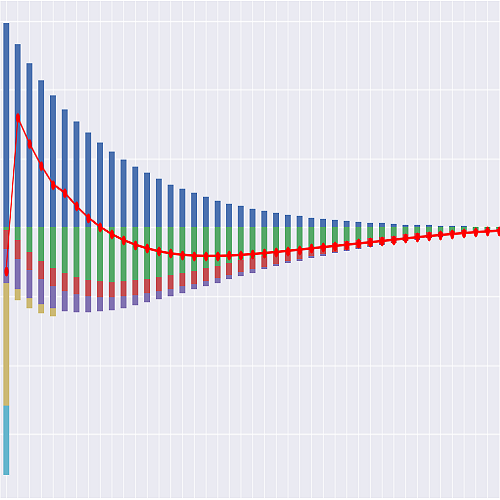
The by-policy projection of the WOL_UK_S model.
The Space is parameterized by point_id, so Projection[1] is an ItemSpace
projecting model point 1:
>>> Projection[1].result_cf()          # the O50 worked-example anchor cell
>>> Projection.point_id = 5            # the underwritten cell
t counts policy months, 0-based: t = 0 is the first policy month (the issue
month), policy month t runs from time t to time t + 1, and the frame is
t = 0, 1, ..., proj_len() - 1. The policy year is the contractual, 1-based label
policy_year(t) = t // 12 + 1. The notes index the in-force probability l(t) at
the start of month t with l(0) = 1, and so does pols_if(): pols_if(t)
is the notes’ l(t) — the column their worked-example table prints, and the weight on
every cash flow of the same result_cf() row.
Input data
Inputs are external files: plain CSVs living in the model folder’s parent
directory, products/whole_of_life/, read at run time rather than stored inside the
model. The model folder therefore holds nothing but formulas — no _data/, no
IOSpec, no embedded values — so a diff of the model shows logic changes only, and an
input can be edited or swapped without rewriting the model. This follows
annuallife.TradLife_A; contrast basiclife.BasicTerm_S, which keeps its inputs
inside the model through modelx’s IOSpec machinery.
The consequence worth knowing: the model is not portable on its own. Copying the
WOL_UK_S folder without its parent’s CSVs produces a model that reads and then fails
on first evaluation.
Each table has a filename Reference and a reader Cells, both on Data,
reached here through the data Reference:
Reference |
Cells |
File |
|---|---|---|
model_point_file |
data.model_point_table() |
model_point_table.csv |
mort_table_file |
data.mort_table() |
mort_table.csv |
lapse_table_file |
data.lapse_table() |
lapse_table.csv |
Naming
Cells names follow lifelib’s basiclife.BasicTerm_S and savings.CashValue_SE
wherever those models have an analogue — pols_* for policy counts, plural nouns for
cash flows, *_rate for annual rates and *_rate_mth for monthly ones, *_pp
for per-policy amounts, claims(t, kind) and benefit_pp(t, kind) with an
uppercase kind string. The technical notes use compact actuarial symbols instead.
The mapping is:
Notes symbol |
Cells |
Meaning |
|---|---|---|
cell |
cell() |
O50 or UW |
entry_age |
age_at_entry() |
Entry age (ALB) |
a(t) |
age(t) |
Attained age (ALB) in month t |
y |
policy_year(t) |
Policy year containing month t, t // 12 + 1 |
(none) |
duration(t) |
Completed policy years, t // 12 |
(none) |
duration_mth(t) |
Months elapsed at start of month t, t |
omega |
omega_age |
Limiting age, 120 |
(none) |
proj_len() |
Months projected; frame 0 .. proj_len() - 1 |
SA |
sum_assured() |
Sum assured at outset |
SA(t) |
cover_pp(t) |
Sum assured in force in month t |
P |
premium_mth() |
Monthly premium at outset |
P(t) |
premium_pp(t) |
Monthly premium due in month t |
T_cess |
cessation_mths() |
Premium-paying months, t < T_cess |
CumPrem(t) |
prem_cum_pp(t) |
Cumulative premiums paid, end of month t |
(escalation) |
esc_cover_step() |
Annual cover increase |
(escalation) |
esc_prem_step() |
Annual premium increase |
(moratorium) |
moratorium_mths() |
O50 moratorium, 12 months |
in_moratorium(t) |
in_moratorium(t) |
Indicator t < moratorium |
DB_na(t) |
benefit_pp(t, “NON_ACC”) |
Non-accidental death benefit |
DB_ac(t) |
benefit_pp(t, “ACC”) |
Accidental death benefit |
(blended) |
benefit_pp(t, “DEATH”) |
Expected benefit per death |
PU |
benefit_pp(t, “PAID_UP”) |
Paid-up payout on conversion |
k_adb |
adb_multiplier() |
Accidental multiplier, 1 or 2 |
delta_acc |
acc_share |
Accidental share of deaths, 3% |
delta_su |
suicide_share |
Suicide share of year-1 deaths |
N_paid(t) |
payments_made(t) |
Monthly payments made by end of month t |
N_expected |
payments_expected() |
Payments expected to cessation |
paid_up |
pu_eligible(t) |
Pro-rata paid-up qualifies |
t* |
crossover_mth() |
Month CumPrem passes SA; -1 if never |
(basis) |
mort_basis() |
population or assured |
(loading) |
mort_loading() |
Anti-selection loading |
q(y) |
mort_rate(t) |
Annual mortality rate applied |
q_m(y) |
mort_rate_mth(t) |
Monthly mortality rate |
(improvement) |
mort_improve_factor(t) |
Improvement factor, 1 in base |
w(y) |
lapse_rate(t) |
Annual lapse rate in month t |
(table) |
lapse_rate_base(t) |
Table lapse rate before beta |
beta |
lapse_crossover_beta |
Crossover lapse stress dial |
w_m(y) |
lapse_rate_mth(t) |
Monthly lapse rate |
l(t) |
pols_if(t) |
Full-cover in force, start of month t |
(none) |
pols_pu(t) |
Paid-up policies in force |
(none) |
pu_benefit(t) |
Paid-up cover in force |
(none) |
pols_all(t) |
pols_if + pols_pu |
(none) |
pols_death(t) |
Deaths on full cover |
(none) |
pols_death_pu(t) |
Deaths on paid-up cover |
(none) |
pols_exit(t) |
Would-be lapses |
(none) |
pols_convert(t) |
Would-be lapses made paid-up |
(none) |
pols_lapse(t) |
Lapses that actually terminate |
(none) |
pols_maturity(t) |
Survivors at the limiting age |
E[premium](t) |
premiums(t) |
Premium income |
E[death outgo](t) |
claims(t, kind) |
Death outgo by kind |
E[expenses](t) |
expenses(t) |
Acquisition + maintenance |
(commission) |
commissions(t) |
Initial commission |
(none) |
inflation_factor(t) |
Expense inflation factor |
CF(t) |
net_cf(t) |
Net cash flow, income positive |
Three names needed care.
The notes’ l(t) is a single in-force probability, but the pro-rata paid-up variant
splits the population in two: policies still on full cover, and policies made
paid-up at a reduced payout. pols_if() is the first strand — the notes’ l,
and what the worked example prints — pols_pu() the second, and pols_all()
their sum, which is what the maintenance expense is carried on. On every model point but
one the second strand is empty and the three coincide.
SA is a constant in the notes and a function of t here, because the escalating
variants move it. sum_assured() is the outset value the model point carries and
cover_pp() the amount in force in month t.
pols_maturity is borrowed from the term models and means something different here.
Whole of life has no maturity: the cells is the population still alive when the
projection is truncated at the limiting age, so it is a truncation artefact rather
than a benefit, and it pays nothing. It exists so the roll-forward closes in the last
month; a test asserts it is negligible, which is the real statement — if it were not,
the limiting age would be too low.
Two cells, two bases, and why they must not be swapped
cell = "UW" is underwritten guaranteed whole of life: full underwriting, level
premiums for life, the sum assured paid once on death or earlier terminal illness.
cell = "O50" is over-50s guaranteed acceptance: no underwriting at all, a fixed cash
sum, a twelve-month moratorium, and premiums ceasing at the anniversary on or after the
90th birthday while cover continues.
They share this engine and not their mortality basis. Full underwriting restores
select experience, so the UW cell takes an assured-lives shape. Guaranteed acceptance
removes underwriting, so the O50 pool cannot be better than the population and
self-selects worse; it takes a population shape with an anti-selection loading of 120%
[std]. The CMI analyses non-underwritten whole of life separately from underwritten
business for exactly this reason. Feeding either cell the other’s basis produces
plausible-looking but wrong margins, and the FCA’s price differential between the two
designs — £71.73 against £8.10 per £1,000 of cover — is the scale of that error. The
basis is therefore derived from cell() rather than being a free parameter.
The moratorium is a discontinuity, not a curve
During the O50 cell’s first twelve months a non-accidental death returns the
premiums paid — not the cash sum, not an annualized premium — while an accidental
death pays the full cash sum from day one. From t = 12 (the thirteenth policy month)
the full cash sum becomes payable for any death, and expected death outgo jumps about
elevenfold on the anchor cell between t = 11 and t = 12. That step is the
signature of the product and must not be smoothed: an annual-grid implementation has to
split policy year 1 explicitly, and the notes list smoothing it as a pitfall.
Note where the year-one outgo actually comes from. At t = 0 the blended benefit is
0.97 x £30 + 0.03 x £5,000 = £179.10: five sixths of it is the small accidental
tail paying the full cash sum, not the premium refund. An implementation that dropped
the accidental split would understate year-one claims by about that much.
The accidental-multiplier variant doubles the accidental benefit, but only on and after
the first anniversary [S7] — inside the moratorium the accidental benefit is already
the full cash sum, and doubling it there, or applying the multiplier to all deaths,
overstates outgo. adb_multiplier() is applied in one place, in
benefit_pp(t, "ACC"), past the moratorium only.
Lapse pays nothing, which is the whole economics
There is no surrender value at any duration on either cell, so a lapse produces no cash
flow at all: its entire effect is through pols_if(). Every lapse therefore
extinguishes a liability for nothing, the best estimate falls monotonically as assumed
lapses rise, and the FCA records that without the continuing-payer cross-subsidy
insurers would need to rely on lapses to remain profitable. Two consequences are wired
into the model rather than left as prose:
No lapse after premiums cease. There are no premiums to stop paying once the O50 cell reaches cessation, so
lapse_rate()is zero from there. Applying a lapse decrement past cessation silently destroys liability, and the notes list it as a pitfall.The pro-rata paid-up variant is a different product. Once half the expected payments have been made, a would-be lapse converts to a paid-up policy at
SA x N_paid / N_expectedinstead of forfeiting everything. That converts lapse profit into a retained pro-rata liability and collapses most of the lapse sensitivity, which is why it is a variant rather than an adjustment. It is carried as a second population strand:pols_pu()counts the policies andpu_benefit()carries their aggregate cover, which is enough because paid-up policies neither lapse nor escalate — so the two roll forward on the same survival factor and no per-conversion cohort dimension is needed.
The crossover
On the O50 cell cumulative premiums eventually exceed the cash sum. crossover_mth()
finds the month: on the anchor cell t = floor(5000/30) = 166, the month in which the
167th monthly premium is paid — thirteen years and eleven months of premiums, which is
the FCA’s stylised example exactly. It is searched rather
than closed-form so that an escalating variant still resolves, and it is reported rather
than acted on — the notes’ crossover-aware lapse module, which raises lapse past the
tipping point, is a pure stress dial and is off in the base run
(lapse_crossover_beta is 0). Total premiums are capped at P x T_cess, so a
crossover exists only where the cash sum is below that cap.
Sign convention
The notes’ cash flow table is income positive, which is the library-wide sign of
net_cf(), so there is no outgo-positive liability_cf companion. The notes’
worked-example table prints premium income and death outgo as separate positive columns
and omits expenses entirely “for clarity”; result_cf() carries all of them, so
net_cf will not equal any column of that table.
Cells Descriptions#
- cell()[source]#
O50(over-50s guaranteed acceptance) orUW(underwritten guaranteed).The two cells share this engine and not their mortality basis, their lapse table, their expense levels or their benefit rules. See the Space docstring.
- age_at_entry()[source]#
The entry age of the selected model point, age last birthday.
ALB rather than the age nearest birthday every other model in this library uses: the underwritten cell’s specimen defines entry age x as “before the (x+1)th birthday”, which is ALB, and the over-50s documents price on “age at outset” without stating a basis [std]. All age lookups here are on that one basis.
- sex()[source]#
The sex (M / F) of the selected model point.
Carried for the basis lookup. The over-50s documents state age and smoker status as the rate factors and do not rate by sex, so on that cell this drives the shipped [std] proxy table and nothing contractual.
- smoker()[source]#
The smoker status (NS / S).
The underwritten specimen distinguishes three smoking states; they are collapsed to two here [std].
- sum_assured()[source]#
SA: the sum assured or cash sum at outset.
cover_pp()is the amount in force in a given month, which differs from this on the escalating variants.
P: the monthly premium at outset, guaranteed never to increase.
A model point input, not a rate-table lookup: no insurer publishes whole of life premium rate tables, so any shipped scale would be a [std] snapshot calibrated to the handful of public quote anchors.
- escalation()[source]#
level,fixed_5pct(the UW increasing-cover variant) orrpi.The underwritten variant raises cover 5% and premium 10% a year - two percent of premium for each one percent of cover - and the over-50s RPI variant raises the cash sum by RPI capped at 10% and the premium by 1.5 x RPI capped at 15%.
- cessation_mths()[source]#
T_cess: the number of premium-paying months from outset; 0 means premiums for life.
An elapsed count, not a month index: premiums are due in months
t < T_cessandt = T_cessis the first premium-free month. The over-50s cells cease at the anniversary on or after the 90th birthday [std] and cover continues; the underwritten cell has no cessation at all.
- moratorium_mths()[source]#
The over-50s moratorium in months, 12; zero on the underwritten cell.
A count of months: the moratorium covers policy months
t < moratorium_mths(). The underwritten cell has a suicide clause over the same window instead, which is a different rule with a different denominator - seebenefit_pp().
- adb_multiplier()[source]#
k_adb: the accidental death multiplier past the moratorium, 1 or 2.
The 2 is one insurer’s variant and applies to accidental death on and after the first anniversary only. Inside the moratorium the accidental benefit is already the full cash sum, so doubling it there - or applying the multiplier to all deaths - overstates outgo.
- pu_variant()[source]#
Whether the pro-rata paid-up variant applies.
Once half the expected payments have been made, a would-be lapse converts to a paid-up policy instead of forfeiting everything. Requires a premium cessation date, since
N_expectedis measured to it; the underwritten cell has none, so the combination raises rather than dividing by zero.
- proj_len()[source]#
The number of projected months:
12 x (omega_age - entry_age).The exclusive end of the frame: policy months run
t = 0, 1, ..., proj_len() - 1, so the last projected month is the last month of ageomega_age - 1andresult_cf()hasproj_len()rows.Whole of life has no maturity date, so the horizon is a limiting age rather than a contractual one. The shipped mortality tables reach 1 well before
omega_age, so the population is exhausted inside the projection rather than truncated by it;check_truncation()asserts that, because a limiting age set too low would silently drop liability off the end.
- duration_mth(t)[source]#
Months elapsed from outset at the start of month t; equal to t.
tcounts from 0, so the identity is trivial - the cells exists so the monthly models in this library share one vocabulary.
- policy_year(t)[source]#
y = floor(t/12) + 1: the 1-based policy year containing month t; 1 for t = 0..11.
A contractual label, derived from
tand never indexed by: the lapse table is keyed by it, and the escalation and inflation steps county - 1 = duration(t).
- mort_basis()[source]#
The mortality basis the cell takes:
populationfor O50,assuredfor UW.Derived from
cell()rather than left as a free parameter, because feeding either cell the other’s basis produces plausible-looking but wrong margins. See the Space docstring.
- mort_loading()[source]#
The anti-selection loading on the table rate: 120% for O50, 100% for UW [std].
Guaranteed acceptance removes underwriting, so the pool cannot be better than the population and self-selects worse. No insurer discloses its guaranteed-acceptance pricing basis, so the loading is a placeholder to be calibrated - and a deliberately modest one, since population mortality is already heavier than insured experience.
- mort_improve_factor(t)[source]#
The mortality improvement factor in month t; 1 in the base run [std].
(1 - improvement)^(y - 1)withy - 1 = duration(t) = t // 12, so the factor steps at policy anniversaries. The market-standard expression is a CMI projections model with a chosen long-term rate, but that model is subscriber-restricted, so a flat annual improvement is the [std] sensitivity proxy. Improvements lengthen exactly the part of the liability that is pure outgo - past the crossover and past premium cessation - so this is not a second-order dial on this product.
- mort_rate(t)[source]#
q(y): the annual mortality rate applied in the policy year containing month t.
The cell’s table rate at the attained age, times the anti-selection loading and the improvement factor, capped at 1. Both shipped bases are [std] proxies shaped like the tables the notes name and are not published tables.
- esc_cover_step()[source]#
The annual increase in the sum assured under the escalation variant.
5% on the underwritten increasing-cover variant, and RPI floored at 0 and capped at 10% on the over-50s RPI variant. Scaled by
esc_take_up, which is 1 in the base run: holders may decline an increase, with three declines removing the option, but a deterministic run cannot represent a take-up probability, so full take-up is assumed and the decline rule is not implemented.
- esc_prem_step()[source]#
The annual increase in the premium under the escalation variant.
10% on the underwritten variant - two percent of premium for each one percent of cover - and
1.5 x RPIcapped at 15% on the over-50s RPI variant. Floored at 0: the source defines an increase only, with no decrease [std].
- cover_pp(t)[source]#
SA(t): the sum assured or cash sum in force in month t.
SA x (1 + step)^(y - 1)withy - 1 = duration(t), so it steps at policy anniversaries (t = 12, 24, ...). On the RPI variant the cash sum continues to index after premiums cease at 90, which is why this carries no cessation test - the premium step, being applied to a zero premium, stops of its own accord.
P(t): the monthly premium due at the beginning of month t.
Due in months
t < cessation_mths()- the T_cess premiums of the premium-paying period - and zero fromt = cessation_mths()on. Zero too on a paid-up policy, which is carried as a separate population strand rather than as a premium of zero, so it does not appear here.
- prem_cum_pp(t)[source]#
CumPrem(t): cumulative premiums paid per policy to the end of month t.
The premium falls at the beginning of the month and death at the end, so a death in month t has had the month-t premium paid on it - which is why the moratorium refund at
t = 0is one month’s premium and not nothing. This is the refund base: a year-one non-accidental claim pays cumulative premiums paid, not the cash sum and not an annualized premium.
- in_moratorium(t)[source]#
Whether month t falls inside the over-50s moratorium,
t < moratorium_mths().Always False on the UW cell, whose moratorium is 0 months.
- payments_made(t)[source]#
N_paid(t): the number of monthly payments made by the end of month t.
min(t + 1, T_cess): the month-t premium is paid at its start, sot + 1payments have been made by its end until cessation caps the count.
- payments_expected()[source]#
N_expected: the payments expected over the premium-paying period.
The pro-rata paid-up denominator, so it is the cessation month; zero where premiums are payable for life, in which case the variant does not apply.
- pu_eligible(t)[source]#
Whether a would-be lapse in month t converts to paid-up instead of terminating.
The pro-rata paid-up rule: at least half the expected payments must have been made [S9]. Before that halfway point a lapse is a total loss and the base lapse rate applies; after it, forfeiture is strictly dominated, so all would-be lapses are assumed to convert [std].
- crossover_mth()[source]#
t*: the first month in which cumulative premiums exceed the cover in force.
t* = floor(SA/P)under level premiums, the month in which thefloor(SA/P) + 1-th premium is paid:t = 166on the anchor cell, the 167th monthly premium, thirteen years and eleven months of premiums, which is the FCA’s stylised example exactly - but searched rather than closed-form so that an escalating variant still resolves. Returns-1where the crossover never happens, which is the case whenever the cash sum exceeds the total premiums payable to cessation;0is a real month, so it cannot be the sentinel.Reported, not acted on: the crossover-aware lapse module that would raise lapse past the tipping point is a pure stress dial and is off in the base run.
- lapse_rate_base(t)[source]#
The table annual lapse rate in month t [std], before the crossover stress.
Read from the cell’s own row of the lapse table, which is keyed by the contractual 1-based policy year
policy_year(t) = t // 12 + 1; policy years beyond the table take its last row. Both tables are drafting constructions - no public UK whole of life lapse study was retrieved - and on a product with no surrender value they are the single largest lever on the liability.
- lapse_rate(t)[source]#
w(y): the annual lapse rate applying at the end of month t.
Zero once premiums have ceased, from
t = cessation_mths()on: there is nothing left to stop paying, and applying a lapse decrement there silently destroys liability - the notes list it as a pitfall. Otherwise the table rate, optionally stressed by1 + betapast the crossover, which is off in the base run.
- pols_if(t)[source]#
l(t): full-cover policies in force at the start of policy month t.
The notes’ in-force probability, and the column their worked-example table prints.
pols_if(0)ispols_if_init(); each later month is the previous one net of that month’s deaths and lapses. Zero outside the frame0 <= t < proj_len(). Paid-up policies are not counted here: they are a separate strand,pols_pu(), because their benefit is a reduced amount. On every model point without the pro-rata paid-up variant the two coincide withpols_all().
- pols_pu(t)[source]#
Paid-up policies in force at the start of month t.
Zero without the pro-rata paid-up variant, and zero at
t = 0: every policy starts on full cover. Paid-up policies pay no premium, carry no lapse decrement and do not escalate, so they roll forward on mortality alone and take conversions in from the full-cover strand.
- pu_benefit(t)[source]#
The aggregate paid-up cover in force at the start of month t.
Carrying the aggregate benefit alongside the count is what removes the need for a per-conversion cohort dimension: the paid-up payout depends on when the policy converted, but every paid-up policy thereafter rolls forward on the same survival factor, so the sum of their payouts satisfies the same recursion as the count. Death outgo on the strand is then
pu_benefit(t) x q_m(t). Zero att = 0, likepols_pu().
- pols_all(t)[source]#
All policies in force at the start of month t: full cover plus paid-up.
The weight on the maintenance expense, and the count the roll-forward closes on.
- pols_if_at(t, timing)[source]#
The number of full-cover policies in force at a point inside month t.
"BEF_DECR"the start of the month, before any decrement;
pols_if()."BEF_LAPSE"after deaths, before lapses - the notes’ processing order is death before lapse [std].
"AFT_DECR"the end-of-month count, the notes’
l(t+1); zero in the last projected month, where the survivors arepols_maturity().
- pols_death(t)[source]#
Deaths on full cover at the end of month t, against the start-of-month in-force.
- pols_death_pu(t)[source]#
Deaths on paid-up cover at the end of month t; zero without the pro-rata paid-up value.
- pols_exit(t)[source]#
Would-be lapses at the end of month t, taken from the survivors of mortality.
What happens to them depends on
pu_eligible(): they either terminate for nothing or convert to paid-up.
- pols_convert(t)[source]#
Would-be lapses converted to paid-up at the end of month t.
All of them once the pro-rata paid-up halfway point is passed [std], none before it, and none at all without the variant. A state change, not a cash flow.
- pols_lapse(t)[source]#
Lapses that actually terminate the policy at the end of month t.
Pays nothing. There is no surrender value at any duration on either cell, so this moves
pols_if()and produces no cash flow whatever - which is the arithmetic meaning of a lapse-supported product.
- pols_maturity(t)[source]#
Policies still in force when the projection is truncated at the limiting age.
Not a maturity - whole of life has none - and not a benefit: it pays nothing. It is the truncation residual, non-zero only in the last projected month
t = proj_len() - 1, and it exists so that the roll-forward closes there.check_truncation()asserts it is negligible, which is the substantive statement: a limiting age set too low would drop liability off the end of the projection instead.
- benefit_pp(t, kind)[source]#
The benefit amount per policy in month t, by kind.
"NON_ACC"the non-accidental death benefit. On the O50 cell it is
CumPrem(t)inside the moratorium and the cash sum after it; on the UW cell it is the sum assured, with the suicide refund handled under"DEATH"."ACC"the accidental death benefit: the full cash sum from day one, and
k_adbtimes it past the moratorium. On the UW cell there is no accidental split, so this is the sum assured."DEATH"the expected benefit per death on the full-cover strand, blending the two above by the accidental share on O50, and the sum assured with the suicide refund by the suicide share inside the first twelve months (
t < suicide_mths) on UW. This is whatclaims()multiplies by."PAID_UP"the pro-rata paid-up payout for a policy converting in month t,
SA x N_paid / N_expected. Zero without the variant.
E[premium](t): premium income at the beginning of month t, an inflow.
Carried on the full-cover strand only: paid-up policies pay nothing, and neither do over-50s policies past cessation, where
premium_pp()is already zero.
- claims(t, kind=None)[source]#
Death outgo in month t, by kind; the total when kind is omitted.
"DEATH"outgo on the full-cover strand,
deaths x benefit_pp(t, "DEATH")."DEATH_PU"outgo on the paid-up strand,
pu_benefit(t) x q_m(t)- the aggregate paid-up cover times the monthly mortality rate, which is why the strand carries a benefit total as well as a count."LAPSE"zero, always. There is no surrender value at any time on either cell; the kind exists so the zero is stated rather than inferred.
- expense_acq_pp()[source]#
The acquisition expense per policy at issue [std]: £150 on O50, £300 on UW.
- expense_maint_pp()[source]#
The annual maintenance expense per policy [std]: £30 on O50, £50 on UW.
Premiums are level and small - £30 a month on the anchor cell - while this inflates, so the expense margin erodes mechanically over a twenty-year-plus horizon. A per-policy expense error compounds accordingly.
- inflation_factor(t)[source]#
The expense inflation factor in month t:
(1 + pi)^(y - 1)[std].y - 1 = duration(t) = t // 12: it steps on policy anniversaries, not monthly, which is how the notes write it.
- expenses(t)[source]#
Acquisition and maintenance expense in month t [std].
The acquisition charge falls once, at issue (
t = 0). Maintenance is carried onpols_all(), so a paid-up policy still costs money to administer even though it pays no premium - which is part of why the pro-rata paid-up variant is expensive.
- commissions(t)[source]#
Initial commission in month t [std]: a share of the first year’s premiums.
Policy year 1 is
t = 0..11. The existence of commission is sourced - an intermediary is “paid by commission as a percentage of total annual premium” - and the level is a standardization.
- net_cf(t)[source]#
CF(t): the net cash flow of month t, income positive.
Premiums less death outgo, expenses and commission. The notes’ own sign and the library-wide one, so there is no outgo-positive
liability_cfcompanion.Note that the notes’ worked-example table prints premium income and death outgo as separate positive columns and omits expenses “for clarity”, so
net_cfwill not equal any column of that table. Lapse contributes nothing at all: it movespols_if()and pays no cash.
- check_pols_roll_fwd_resid(t)[source]#
The in-force roll-forward residual in month t; zero everywhere.
pols_all(t) - pols_all(t+1)less deaths from both strands, lapses that actually terminate, and the truncation residual in the last month. Conversions to paid-up are absent because they move policies between strands rather than out of the population - which is the point of running the check on the total.
- check_pols_roll_fwd()[source]#
True when the in-force roll-forward closes in every projected month.
The library-wide form of a roll-forward check: no argument, one bool over all t, so one test can call it across every model.
check_pols_roll_fwd_resid()gives the signed residual of the month that failed. The tolerance scales withpols_if_init(), since the residual accumulates rounding on that many policies.
- check_truncation()[source]#
True when the population left at the limiting age is negligible.
Whole of life has no maturity date, so the projection ends at a limiting age rather than at a contractual one, and anything still in force there is liability dropped off the end. The shipped mortality tables reach 1 well before
omega_age, so the residual should be vanishing; if it is not, the limiting age is too low and the model is understating the tail rather than merely rounding it.
- result_cf()[source]#
Result table of cashflows, indexed by policy month
t = 0 .. proj_len() - 1.One row per projected month,
proj_len()rows in all.pols_ifis the full-cover count at the start of the month, which is the weight on premium income and on full-cover death outgo;pols_puis the paid-up strand, empty on every model point without the pro-rata paid-up variant.claims_lapseis a column of zeros by product design - there is no surrender value - and is published rather than dropped.
- result_pols()[source]#
Result table of policy counts, benefits and rates, indexed by policy month
t.The same frame as
result_cf():t = 0 .. proj_len() - 1.