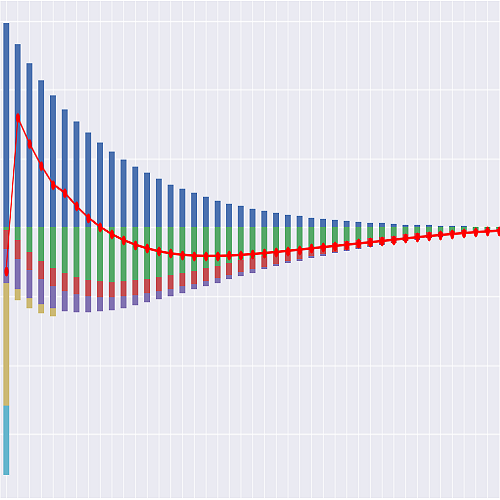
Technical Notes#
Status: Draft, 2026-08-26 (all cited sources accessed 2026-08-26).
Scope note. These notes specify the reference liability cash-flow projection model
EC_FR_S, on a monthly grid, for the standardized composite eurocroissance support
defined in product-spec.md (same directory). This is not any single insurer’s support.
[S#]/[R#] tags refer to the source list in sources.md (numbering carried verbatim from
_research/eurocroissance.md); [REG-R#] tags refer to the cross-product reference library
references/regulatory-and-actuarial-references.md. std marks standardizations
introduced for the reference implementation; unverified marks claims not confirmed against
a retrieved document. Parameter values are identical to those in product-spec.md.
Two facts about the sourcing govern how these notes must be read. First, no contractual
document for any eurocroissance support was retrieved [S10]: the mechanics come from the
Code des assurances R1 R2 R3 and from one published actuarial mémoire R13, and
every insurer-level parameter is either a third-party fact-sheet figure [S8] or std.
Second, this product is a fund-level construct — the part value is common to all
engagements of an auxiliary account R2 R. 134-2, and the PCDD and the provision pour
garantie à terme are collective R8 — so a single-policy projection is an abstraction that
must be handled explicitly; see “Known modeling pitfalls”. The sibling euro-fund notes at
../assurance_vie_euro/technical-notes.md were drafted in parallel with these, so where the
two products are compared here the comparison is made against the Code des assurances
directly rather than against that document.
Model scope and conventions#
Purpose. Project gross best-estimate liability cash flows (premiums in; surrender, death and maturity claims out; charges; the insurer’s asset contributions) for single-policy eurocroissance model points on the two composite chassis — Chassis A (1° engagement: provision mathématique plus parts) and Chassis B (2° engagement: parts only, guarantee at maturity). Reserves are not computed here.
Projection frequency std: monthly, on policy months, with the policy anniversary still the single date every annual event lands on. A monthly grid is not a monthly product. Every contractual mechanic of the composite is annual and the model keeps it there: the striking of the compte de participation aux résultats and the allocation of its balance R2 R. 134-4, the R. 134-3 base 5° performance levy taken at that striking, free versements, and the R. 134-12 apport d’actifs, all on the anniversary; the base 4° parts levy and scheduled versements at the opening of the policy year, where
product-spec.mdputs them. What the finer grid adds is what A. 134-5 already required and the annual grid could not express: the re-striking of the diversification provision at an intermediate value in every month in which the participation account is not struck, and a forward part value for an exit R3 A. 134-5 — so the conversion removes a documented simplification rather than adding one. It also puts mortality and rachat in the month they happen and maintenance expense where it is incurred. An annual step remains a well-defined special case of the recursions below and reproduces every anniversary value exactly — see Anniversary equivalence — but it is not what the reference model runs.Time index std.
tis 0-based and counts policy months, as in lifelib’sbasiclife/BasicTerm_S: monthtruns from timetto timet + 1,t = 0is the issue month, and the frame ist = 0 … T − 1withT = proj_len = 12 nthe number of policy months projected; the last row is the month that ends at the échéance. Because every contractual schedule is annual, the policy year is derived and used as a lookup key:dur(t) = t // 12is the completed policy years at the start of monthtand the contractual policy year is the 1-based labeldur(t) + 1; where these notes say “policy year y” as contract language, the months aret = 12(y − 1) … 12y − 1. Nothing is indexed by the policy year. The anniversary is the last month of a policy year,t ≡ 11 (mod 12), and that is where every annual event lands. An in-force cell opens att = 12 × duration_ifo; elapsed time is recorded in whole policy years, so the frame always opens in the first month of a policy year. The issue instant is not a row: the initial versement creates the rights and strikes both provisions as the opening state of the first projected month, writtenA_open(t),pd_open(t),N_open(t),mg_open(t)below and reached in the model asown_assets_at(t, "BOM")and its siblings; its cash flows are beginning-of-month flows of that first month. A few quantities are indexed by a month boundaryminstead —TEC,i_pm(m), the discount factor and the remaining termrem(m) = (T − m)/12years — withm = 0at issue andm = Tat the échéance, so monthtopens atm = tand is struck atm = t + 1.Decrement and return conversion std. Every assumption in this product is published and tabulated annually — the mortality table by attained age, the rachat total and rachat partiel vectors by policy year, the scenario return by year — and the monthly figures the recursion applies are derived from them at the constant-force conversion, so that twelve compound back to exactly the annual figure:
q_m(t)   = 1 − (1 − q(t))^(1/12)          w_m(t)  = 1 − (1 − w(t))^(1/12)
w_pm(t)  = 1 − (1 − w_p(t))^(1/12)        r_m(t)  = (1 + r(t))^(1/12) − 1
The unsuffixed symbols keep the annual meaning these notes tabulate. No retrieved French source states a conversion convention for any decrement, so the conversion is std.
The provisions are state variables, not cash flows. Policy cash flows are premiums, claims, charges and expenses;
pm,pd,partsandpart_valuedrive claim amounts through the surrender, maturity and death formulas R2 R. 134-5, R. 134-6.Two liability layers. The savers’ layer (
pm,pd) is inside the auxiliary account. The insurer’s layer (pgt,insurer_contribution,pcdd) is not the savers’ money: the PGT is funded from own funds and sits outside the participation account R3 A. 134-2 R1 L. 134-3, and the PCDD is collective with no individual rights R8 R. 343-3 10°. Both are reported separately and never enter a benefit.Timing conventions std. Monthiversary (BOM) processing. The charge in number of parts and the scheduled versement fall at the beginning of the month, in the months that open a policy year (
t ≡ 0 mod 12); a rachat partiel at the beginning of every month; the asset return accrues over the month; at the end of the month (EOM) the two provisions are re-struck andpdandpart_valuedetermined, and any insurer contribution is computed on that striking; decrements and claims follow at EOM after the striking. On the anniversary only (t ≡ 11 mod 12), and before the striking, the participation account is struck and its balance allocated, the base 5° performance levy is taken on the policy year’s accumulated financial performance, the insurer’s asset affectations are made, and any free versement is paid and the provisions re-struck on the post-versement state — in the processing order below. State variables are stored at EOM.Age basis. Âge atteint (age last birthday) std — art. A. 335-1 applies the homologated tables with the annexed décalages d’âge rather than fixing a model age basis REG-R23. Age changes on the policy anniversary, not on the birthday and not monthly:
x + dur(t)is the age entering the policy year of monthtandx + dur(t) + 1the age attained at the anniversary that closes it. The annual mortality rate is read at the latter — the notes’q(x + t + 1), which keeps the age rule the annual assumption was built on — and applied monthly atq_m.Currency and rounding. EUR; single-policy model points projected on an expected (probability-weighted) basis,
pols_ifmultiplying per-policy amounts. Intermediate values at full precision; currency to the cent, parts and part values to four decimals std.
Model point attributes#
Attribute |
Type |
Example (worked configuration) |
|---|---|---|
|
int |
1 (Chassis A), 2 (Chassis B) |
|
enum { |
|
|
int (âge atteint) |
57 |
|
enum {M, F} |
M |
|
int, years to the échéance |
10 |
|
int, completed policy years at valuation — an elapsed count, already 0-based, and the first projected period of an in-force cell |
0 |
|
currency, initial versement; the opening state of the first projected period |
10,000.00 |
|
currency, free additional versement, and the contractual policy year at whose end it is paid (1-based, so policy year |
2,000.00 / 3 |
|
%, |
100 % |
|
%, base R. 134-3 1° |
2.00 % |
|
% p.a., base R. 134-3 4° |
0.80 % |
|
% of positive financial performance, base R. 134-3 5° |
10 % |
|
%, base R. 134-3 6° |
0.00 % |
|
currency, part value at the account’s inception and its contractual floor R2 R. 134-1 |
10.0000 / 5.0000 |
|
float / currency / currency — parts, PM and account assets at valuation (in-force cells) |
— (new business) |
|
int, non-surrender period, capped at |
0 |
|
%, capped at 5 %; R. 132-5-3 lets the contract provide for no indemnity at all once ten years have elapsed R10, and the reference contract charges none at any duration. |
0.00 % |
|
bool — garantie décès plancher [S1] [S2] |
true |
|
bool — conversion into a rente viagère at |
false |
State variables#
Every state variable below is the closing value of month t; its opening value is
written X_open(t), which is X(t−1) in every month but the first projected one and, in
that one, the state the initial versement or the in-force extract creates.
Variable |
Description |
Updated |
|---|---|---|
|
Guaranteed amount payable at the échéance = |
on each versement and exit |
|
Auxiliary-account assets attributable to the policy, at realisation value, excluding any outstanding insurer contribution R2 R. 134-8 |
monthly recursion |
|
Provision mathématique = |
EOM re-strike, every month |
|
Provision de diversification, the savers’ individualised rights R8 R. 343-3 9° |
EOM residual, floored, every month |
|
Number of parts de provision de diversification R2 R. 134-2 |
levy at the opening of a policy year; on versements and exits |
|
Valeur de la part, |
EOM; the A. 134-5 intermediate value in eleven months of twelve |
|
Outstanding L. 134-3 asset contribution completing the representation (Chassis A) |
EOM |
|
Provision pour garantie à terme, insurer’s own funds (Chassis B) R3 A. 134-2 |
EOM |
|
Provision collective de diversification différée, fund-level R8 R. 343-3 10° R9 |
anniversary apport, fund extension |
|
In-force probability at the start of month |
EOM decrements, at |
|
Cumulative net versements, the base of the death floor [S1] [S2] |
on each versement and rachat partiel |
Assumption inputs#
Three classes are distinguished. Class (a) is contractual or statutory; class (b) is the insurer’s current discretionary scale, exercised inside the R. 134-4 destinations R2; class (c) is the modeler’s view of experience.
(a) Contractual / guaranteed elements (cited)#
Input |
Value |
Basis |
|---|---|---|
Guarantee level |
100 % of net versements / 10 years |
[S1] [S2]; 80 % and 8–30 [S8]; 80 %–100 % and 8–40 [S7] |
Guarantee run-down for exits |
|
|
PM definition (Chassis A) |
|
|
PM discount rate |
≤ 90 % of the last TECn, linear interpolation between bracketing maturities, longest TEC beyond the curve, floor 0 %, method choice irreversible per account. As retrieved, A. 134-1 fixes n as the holder’s guarantee maturity (per-engagement method 1°) or the account’s 1°-engagement duration (method 2°); this model applies method 1° and re-reads n as the remaining term at each valuation date — on a monthly grid, at every month boundary |
haircut, interpolation and floor R3 A. 134-1; the remaining-term re-reading and its monthly frequency std, note below |
Reference TEC10 |
2.50 % at month boundaries |
std, product-spec (5) |
Minimum part value |
€5.00 — the part value may not be reduced below it to absorb a debit balance |
requirement R2 R. 134-1, R. 134-4; level std, product-spec (2) |
Surrender value |
Chassis A |
|
Maturity amount |
at the échéance, the close of the last projected month |
|
Death benefit |
The current provision value; the maturity guarantee does not apply. Any death floor is a complementary guarantee provisioned outside the account |
|
Surrender indemnity |
0 %; statutory cap 5 % of the present value of the mutual engagements, and the contract may provide for none once ten years have elapsed |
cap and the ten-year permission R10; level std, product-spec (3) |
Permitted charge bases |
The six of R. 134-3 only; base 3° unavailable in a 1° account |
|
PGT (Chassis B) |
|
article R3 A. 134-2 R10; the omission std |
PCDD release horizon / apport d’actifs |
15 years / ≤ 10 % of the PD at the affectation date, endowing the PCDD, re-allocated by year 16 |
|
Assets at realisation value |
R. 343-11 / R. 343-12 |
The n − k re-reading of A. 134-1 — std. The article as retrieved gives the index
maturity as the holder’s guarantee maturity (method 1°) or the auxiliary account’s
1°-engagement duration (method 2°), and says nothing about how that maturity is re-read at
valuation dates after inception R3 A. 134-1. Two readings are
available: hold n fixed at the original term for the life of the engagement, or take the
remaining term at each valuation date, which is the horizon the guarantee is
actually discounted over.
These notes and EC_FR_S take the second — the first would discount a one-year promise at a
ten-year constant-maturity rate at the échéance, and A. 134-1’s own method 2° keys the
index to a duration, which shortens as the engagements run off. The reading is
std; it is not stated in the article. product-spec.md states A. 134-1 as retrieved,
and these notes are the source of truth for the value i_pm takes in the model. The
choice is numerically invisible on a flat curve — the worked example’s TEC is flat, so both
readings give i_pm = 2.25 % then 0.90 % — and live on a sloped one, which is why shipped
model point 10 runs the sloped scenario.
The monthly frequency of the re-strike is also std, and is the same article read
finer. R. 134-2 defines the PM as the guaranteed amount discounted at the A. 134-1 rate,
a definition that has a value at every instant rather than only at a striking, and A. 134-5
requires the diversification provision to be re-struck at an intermediate value at least
monthly — which on Chassis A is impossible without a PM for the residual to be taken
against. So the model re-strikes pm every month at the fractional remaining term
rem(t + 1). Holding it flat between annual strikings would make it a step function and
push a whole year of time effect onto the anniversary, so the intermediate part value would
be wrong in exactly the direction A. 134-5 exists to prevent. Two things follow. The
remaining maturity the curve is interpolated at moves month by month, while the curve
row does not: tec_curve.csv publishes one curve per elapsed year and the model reads
row m // 12, the dernier TEC publié, because interpolating a curve level between
published years would invent data the file does not contain. The consequence is a clean
split of the PM’s movement into a time effect that accrues monthly and a rate effect
that lands whole on the anniversary; the worked example below shows it. And the funding
identity pm(t) × (1 + i_pm(t+1))^rem(t+1) = mg(t) then closes in every month rather
than only at anniversaries.
(b) Insurer-discretionary current elements#
Input |
Value |
Basis |
|---|---|---|
Entry charge (base 1°) |
2.00 % of each versement |
|
Parts levy (base 4°) |
0.80 % p.a. of parts, taken in the first month of each policy year on the opening part value |
|
Performance levy (base 5°) |
10 % of the policy year’s positive financial-management performance, taken on the anniversary; 0 % of negative |
|
Exit charge (base 6°) / conversion charge (base 2°) |
0.00 % / 0.50 % of amounts converted (Chassis A) |
std, product-spec (9); [S8] |
Credit-balance allocation |
Raise the part value; no new parts awarded |
std, product-spec (10) |
PCDD piloting target |
Insurer’s own euro-fund net rate +0.30 %; everything above it to the PCDD |
|
Apport d’actifs level |
10 % of net premiums for the first three years |
|
Credited-return context |
2025 net returns 0.90 %–3.40 % across seven supports; AXA Fonds Croissance 2.50 %–4.50 %, average 3.13 % |
[S9] [S3] [S8] |
Commercial bonus uplift |
+2.00 % on new money in the promotion year, subject to a ≥ 45 % unit-linked condition. Not an input to |
[S3] [S4]; out of scope std |
(c) Behavioral / experience assumptions (modeler’s view)#
The regulatory tables the code points to — TH 00-02 / TF 00-02 for non-annuity contracts REG-R22, TGH05 / TGF05 for annuities REG-R21, applied under art. A. 335-1 with the annexed décalages d’âge REG-R23 — are cited by name and never shipped; A. 132-18 also permits an insurer’s own table certified by an independent approved actuary R10, so no single market basis exists. The reference decrement table is a std proxy built from the freely redistributable INSEE series REG-R24.
Input |
Recommended basis |
Basis tags |
|---|---|---|
Base mortality |
80 % × a std smooth Makeham curve shaped like the INSEE quotients de mortalité REG-R24 and anchored so that the 80 % factor gives exactly 0.5000 % at male 57, the worked example’s entry age; sex-distinct, age last birthday; no improvement in the base run. It is not the INSEE series itself — |
proxy std; shape from REG-R24; tables cited and never shipped REG-R22 REG-R23 |
Full surrender (rachat total) |
2.5 % p.a., level |
|
Partial surrender (rachat partiel) |
6 % of average encours in years 1–2, then 3 %; dynamic multipliers per Policyholder behavior modeling. Annual, and spread over the twelve months at |
|
Asset return |
4.0 % p.a. base; the worked example uses an explicit shock path. Annual, and spread over the twelve months at |
scenario std |
Asset management fees |
0.20 % equities, 0.10 % bonds, deducted from the asset return |
|
Insurer expenses |
Acquisition 5 % of premiums; maintenance 0.20 % p.a. of |
|
Worked-example decrements |
|
std — isolates the provision mechanics |
Deterministic single-scenario projection is the base. The maturity guarantee is a put option on the auxiliary account and its cost requires stochastic market-consistent valuation; the mémoire runs 1 000 risk-neutral scenarios for exactly this reason R13.
Cash flow components and recursions#
Notation (defined once, used throughout)#
Symbol |
Meaning |
|---|---|
|
0-based policy month index ( |
|
completed policy years |
|
gross and net scheduled versement at the beginning of month |
|
the initial versement and its net amount, paid at inception: the opening state of the first projected month, not a step in its roll forward |
|
the opening value of a state variable: |
|
entry 2.00 %, parts levy 0.80 % p.a., performance levy 10 %, exit 0.00 % |
|
guaranteed amount payable at |
|
PM discount rate at month boundary |
|
|
|
provision mathématique, provision de diversification |
|
|
|
the annual gross asset return of the policy year containing month |
|
the month’s financial performance |
|
parts levy, in the first month of a policy year; performance levy, on the anniversary, on |
|
|
|
the annual rates the tables above give: mortality read at the age attained at the anniversary that closes the policy year of month |
|
the end-of-month in-force count — |
The guaranteed amount#
mg_open(0) = g × P_net,0 and mg(t) = mg_open(t) + g × P_net(t) − exits(t), where
exits(t) runs
the guarantee down pro rata to surrenders and deaths R13. In a single-policy expected-value
projection with no partial surrender, mg(t) is constant between versements.
Provision mathématique and the split of a versement (Chassis A)#
pm is re-struck every month, never accumulated R2 R. 134-2:
pm(t) = mg(t) × (1 + i_pm(t+1))^-rem(t+1)    (Chassis A)
pm(t) = 0                                     (Chassis B)
Month t closes at boundary t + 1, which is rem(t + 1) = (T − t − 1)/12 years — a
fractional number of them in eleven months of twelve — short of the échéance, so
that is the horizon the striking discounts over.
A free versement paid on the anniversary of policy year y, immediately after the
striking at month t = 12y − 1, splits as follows and buys parts at the part value just
struck:
pm_added = g × P_net × (1 + i_pm(t+1))^-rem(t+1)   pd_added = P_net − pm_added
parts_added = pd_added / u(t)
A scheduled versement paid at the beginning of month t splits the same way one
month earlier, at i_pm(t) over rem(t), and buys parts at the opening value u_open(t).
In the last projected month, t = T − 1, the discount factor is 1, so
pm(T−1) = mg(T−1) identically: the provision
mathématique accumulated at the regulated rate reaches the guarantee exactly at the
échéance, which is what makes the Chassis A guarantee pre-funded by construction.
Account assets, charges and the monthly re-striking#
L(t)   = f_p × pd_open(t) × 1{t ≡ 0 mod 12}   (base 4°)   A_a(t) = A_open(t) − L(t)
I(t)   = A_a(t) × r_m(t)        I_ytd(t) = I(t) + I_ytd(t−1) × 1{t ≢ 0 mod 12}
F(t)   = f_perf × max( I_ytd(t), 0 ) × 1{t ≡ 11 mod 12}   (anniversary, base 5°)
A(t)   = A_a(t) + I(t) − F(t)   (before any versement)
N(t)   = N_open(t) × (1 − f_p × 1{t ≡ 0 mod 12})
Two of the six R. 134-3 bases keep an annual rhythm inside this monthly recursion, for two
different reasons. L(t) falls in the first month of each policy year because that is
where product-spec.md states it taken, on the opening part value: it is a contract term,
not an assumption, and while (1 − f_p)^(1/12) a month would compound back to the same
parts count it would change the cash taken, because the levy is valued on the
then-current pd. F(t) falls on the anniversary on the policy year’s accumulated
performance because R. 134-3 5° levies on the balance of the participation account and
R. 134-4 strikes that account at least annually R2; a monthly levy would tax a positive
month inside a losing year, which the asymmetric max(·, 0) exists not to do, and would
have taken money in the worked example’s policy year 6. A policy exiting between
anniversaries therefore pays no performance levy for the part year, which is what the
article’s annual striking implies.
The two provisions are then re-struck, the diversification provision taking the residual and stopping at its contractual floor R2 R. 134-4:
pd(t) = max( A(t) − pm(t), N(t) × u_min )   u(t) = pd(t) / N(t)
C(t)  = max( pm(t) + pd(t) − A(t), 0 )
G(t)  = max( mg(t) × (1 + i_pm(t+1))^-rem(t+1) − pd(t) − D(t), 0 )   (Chassis B) [R3 A. 134-2]
All four are struck every month. In the eleven months of a policy year in which the
participation account is not struck, pd(t) and u(t) are A. 134-5’s valeur
intermédiaire; in the twelfth they are the striking of the account itself.
C(t) is the outstanding contribution the insurer must make to complete the representation
R1 L. 134-3; it carries no return to the savers and is repaid in full as soon as A(t)
covers pm(t) + N(t) × u_min std, product-spec (6). The surrender value
pm(t) + pd(t) therefore exceeds A(t) by exactly C(t) while the contribution is
outstanding. On Chassis B, pm ≡ 0, so pd(t) = max(A(t), N(t) × u_min) and the shortfall
against the guarantee appears instead as the PGT G(t), which is on the insurer’s balance
sheet, outside the participation account, and is not part of any benefit.
The PGT’s mortality driver is switched off — std. A. 134-2 admits exactly two
cash-flow drivers into the present value of the 2° guarantees: guarantee maturities and
mortality R3 A. 134-2. G(t) above, and pgt() in the model,
discount the guaranteed amount to t and apply no survival factor, so the present value
is the amount for a guarantee certain to be reached. The simplification is prudent — it
overstates the provision — and it is invisible on the worked example, where mort_rate = 0;
it is live on every decrement-bearing cell. On shipped model point 6 at the anniversary
closing policy year 7 — month t = 83 — the reported
pgt is 2,739.35, against 2,477.36 with the five-year survival factor 0.972660
that the shipped std table gives. A fund-level implementation of A. 134-2 should carry
PV(t) = Σ_i mg_i(t) × (1 + i_pm(t+1))^-rem_i(t+1) × rem_i(t+1) p_(x_i+dur(t)+1) over the
account’s 2°
engagements; in this single-policy model the mortality decrement reaches the projection
through pols_if in result_cf() instead of through the provision.
Exit and maturity values#
surrender_value(t) = ( pm(t) + N(t) × u(t) ) × (1 − f_x)   A ;  ( N(t) × u(t) ) × (1 − f_x)   B
maturity_value(T−1)= pm + N × u at t = T−1                 A ;  max( N × u, mg ) at t = T−1   B
death_value(t)     = pm(t) + N(t) × u(t)                   A ;  N(t) × u(t)                   B
death_payout(t)    = max( death_value(t), cum_prem_net(t) )      if death_floor_flag [S1] [S2]
rider_claim(t)     = death_payout(t) − death_value(t)            outside the account [R2 R. 134-7]
Surrender and maturity forms are R. 134-5 and R. 134-6 verbatim R2; the death forms follow from Chapter IV containing no death valuation article R2 R13. A surrender is priced on the forward part value the article requires — the striking of the month in which the request falls, which is the next striking or intermediate value after it R3 A. 134-5. The monthly grid delivers that rather than standardizing it away: on the worked example’s Chassis B a saver surrendering in month 65 receives 11,430.63, not the 9,899.22 the anniversary striking at month 71 reports.
Fund-level items (extension, held at zero in the base run)#
D_open(t)     = D(t−1) + apport(t)                                (PCDD at start of period)
target_use(t) = ( euro_fund_rate(t) + 0.30 % ) × ( pm_open(t) + pd_open(t) ) − Δpm_rate(t)
D_target(t)   = D_open(t) + balance(t) − target_use(t)
D(t)          = max( min( D_open(t), D_target(t) ), 0 )
dotation(t)   = D(t) − D_open(t)
apport(t)     ≤ 0.10 × pd(t)   → credited to D_open(t), never to pd(t)     [R7 R. 134-12]
The piloting rule is the mémoire’s: run the fund at 30 bp above the insurer’s own euro fund
and put everything else in the PCDD R13. Note that the first argument of the min is the
PCDD at the start of the year — last year’s close plus the year’s transfert de richesse
— and not the start-of-year figure plus the participation balance: the min is a cap
that holds the reserve at its opening level whenever the balance exceeds the target use, and
a version that added the balance inside both arguments would degenerate to
D_open(t) + balance(t) − max(target_use(t), 0) and let the PCDD grow without limit R13.
The PCDD must be used within fifteen years R9; the apport must be re-allocated out no later than the sixteenth year following affectation, capped on the way out by the lowest of the affectation-date value plus its share of net investment income plus the base-5° levies, 10 % of total PD, and total PCDD R7 II. The term “bonus de mutualisation” appears in no retrieved document; the code calls this apport d’actifs R7, practitioners transfert de richesse R13 R21.
Monthly processing order std#
The order is not free: R. 134-4 and R. 134-12 III both say that asset affectations and re-affectations completing the account’s representation are made on the dates the participation account is struck, after its balance has been allocated R2 R7. That is still true, within the anniversary month — the finer grid changes where in the year each step falls, never the order of the steps that share a date.
The twelve steps below are the steps of month t, each tagged with the rhythm it
keeps. In the first projected month the opening quantities A_open, pd_open, N_open,
mg_open are the state the initial versement creates — this is where the issue instant
sits — and in every later month they are the previous month’s close.
BOM, annual — first month of the policy year. Parts levy
L(t) = f_p × pd_open(t)wheret ≡ 0 (mod 12), else nil;N(t) = N_open(t) × (1 − f_p)in that month andN_open(t)in the other eleven; assets reduced byL(t)(base R. 134-3 4°).BOM, annual assumption spread. Partial surrenders paid at
w_pm(t)on the opening provisions (base 6° on the way out), andmg,Nand the death-floor base run down pro rata.BOM, annual — first month of the policy year. Scheduled versements received net of the entry charge (base 1°) and split per the versement rule, at
i_pm(t)overrem(t)and at the opening part value.Over the month. Asset return
r_m(t) = (1 + r(t))^(1/12) − 1accrues on the balance after steps 1–3:I(t) = A_a(t) × r_m(t).EOM, monthly. Accumulate the policy year’s performance,
I_ytd(t) = I(t) + I_ytd(t−1)unlesstopens the policy year.Anniversary only — performance levy.
F(t) = f_perf × max(I_ytd(t), 0)(base 5°), nil in the other eleven months.Anniversary only — strike the participation account and allocate its balance: raise
u(the reference route), award new parts, revalue the guarantees subject to the two A. 134-3 tests, or endow the PCDD R2 R. 134-4.EOM, monthly. Re-strike
pm(t)frommg(t)and the currenti_pm(t+1)overrem(t+1);pd(t)= residual, floored atN(t) × u_min;u(t) = pd(t) / N(t). In eleven months of twelve this is A. 134-5’s intermediate value; in the twelfth it is the striking of step 7.Anniversary only — asset affectations:
C(t)(Chassis A) orG(t)(Chassis B), after step 7; the apport d’actifs endowing the PCDD falls here. (C(t)andG(t)are themselves read off the month’s striking and so are reported every month.)Anniversary only — free versements (the worked example’s top-up on the anniversary that closes policy year 3,
t= 35) split at the just-strucki_pm(t+1)andu(t), and the provisions are re-struck on the post-versement state.EOM, annual assumptions spread. Claims: deaths at
q_m, then surrenders atw_m, each priced on the month’s own striking — which is the forward value A. 134-5 requires for a request made within the month — and the maturity in the last projected montht = T − 1;l(t) = pols_if(t) × (1 − q_m(t)) × (1 − w_m(t))withpols_if(0) = 1andpols_if(t) = l(t−1)thereafter, survivors maturing att = T − 1, wherel(T−1) = 0.EOM, monthly. Maintenance expense accrues at one twelfth of 0.20 % p.a. on the month’s own
pm + pd, weighted byl(t); acquisition costs fall in the month their versement does.
Anniversary equivalence#
Because (1 − q_m)^12 = 1 − q and (1 − w_m)^12 = 1 − w exactly, the in-force recursion
collapses over any twelve months of one policy year to
l(t + 12) = l(t) × (1 − q) × (1 − w) — the annual-step recursion, term for term — so
pols_if(12k) is the count an annual step carried entering policy year k + 1. Because
(1 + r_m)^12 = 1 + r, and because no cash moves inside a policy year except a rachat
partiel, the twelve monthly I(t) sum to A_a × r and compound the account to
A_a × (1 + r), so the anniversary performance levy f_perf × max(I_ytd, 0) is the annual
model’s F(t) to the cent. And the two contractual placements — the parts levy at the
opening of the policy year, the top-up on the anniversary — put the same cash at the same
instant on both grids.
Every anniversary value is therefore identical on the two grids, to floating point —
A, pm, pd, N, u, mg, cum_prem_net, C, G, D, pm + pd, the surrender,
death and maturity amounts, the A. 134-4 headroom, the A. 134-3 gates, L and F, each at
t = 12k + 11 (and l at t = 12k). Measured against a pre-conversion snapshot of the
annual-step model over all eleven shipped model points, the largest absolute difference is
1.3 × 10⁻¹⁰ EUR on figures of order 10,000.
Three things do not agree, and none of them should:
the cash flows, which now fall where they happen rather than at the year end — a claim at the end of the month of exit, a versement in its own month;
the maintenance expense, which accrues at one twelfth a month on the month’s own provision and in-force instead of once at the year-end striking. Twelve accruals cover exactly the year the annual grid charged once for, so the annual model’s extra opening-striking charge — it needed
n + 1point-in-time charges to covernyears of service — is dropped. Over a whole projection the shipped cells carry −0.2 % to −1.3 % of it, and model point 9 +0.9 %, its five annual versements stepping the provision up at the opening of each of its first five policy years so that the mid-year balances exceed the previous year end;on a cell that takes rachats partiels — shipped point 5 alone — the asset-fed values, because
w_pmspreads the exit cash over twelve months instead of taking it all at the opening of the policy year, so more capital earns return early and the withdrawal base itself grows within the year. At the anniversariesAruns +0.21 to +3.05 EUR above the annual model, at most 0.031 %;uat maturity is 25.097 against 25.0768, +0.08 %; total rachats over fifteen years are 3,878.27 against 3,869.49, +0.23 %. What still agrees exactly there is everything whose run-down is purely multiplicative —mg,cum_prem_net,pm,Nandl— because(1 − w_pm)^12 = 1 − w_p. The asymmetry is real and is the price of reading a rate on an average encours as a continuous drip; an implementation that must have bit-exactness on all eleven points can gatew_pmto the opening month at the full annual rate, at the cost of the realism.
Known modeling pitfalls#
These are the specific ways an implementation of this product can look right and be wrong. Each should become a test.
Treating the Chassis B surrender value as guaranteed. The single most important product fact. Before the maturity a 2° engagement pays
parts × part valueand nothing else R2 R. 134-5; a model that floors the surrender value atg ×premiums, or at the discounted guarantee, is modelling a contract that does not exist. Test: on the worked example’s year-6 shock, Chassis B must surrender for 9,899.22, i.e. 84.18 % of net versements, not 11,760.00. (Policy year 6 closes at montht= 71.)Letting the PGT reach a policyholder. The PGT is the insurer’s own-funds provision, outside the participation account R3 A. 134-2 R13. A model that adds
pgtto a benefit, or lets it feed the profit-sharing computation, is wrong. Test:pgtappears in no benefit column and in no participation balance.Accumulating the PM instead of re-striking it.
pm(t)ismg(t)discounted at the currenti_pm(t+1)R2 R. 134-2. Rollingpm(t−1)forward at last year’s rate silently removes the rate effect — +587.44 of the +824.18 policy-year-6 move (t= 59 tot= 71) in the worked example.Levying an encours charge on the PD in a 1° account. R. 134-3 3° permits that levy only where the auxiliary account holds no 1° engagements, and no base permits a levy on the PM R2. Test: with
engagement_modality = euro_and_parts, the recurring charge base must be the number of parts and the levy opening policy year 1 —L(0)— must be 15.64, not 78.40. The other eleven months of the year carry none of it.Forgetting that the entry charge cuts the guarantee. The guarantee is a percentage of premiums net of the R. 134-3 1° charge R2 R. 134-2 R13. Test:
mgafter the top-up on the anniversary of policy year 3,mg(35), is 11,760.00, not 12,000.00.Omitting the minimum part value. A debit balance may reduce the part value only within the limit of its minimum R2 R. 134-4. Without the floor, Chassis A’s
pdgoes negative in policy year 6 (A(71) − pm(71) = −1,095.35). Test:part_value ≥ 5.0000in every month on both chassis. The monthly grid adds when: the floor first binds in month 66, not at the anniversary.Paying the maturity guarantee to a death claim. Chapter IV has no death valuation article; the death benefit is the current provision value R2 R13, and a death floor is a complementary guarantee provisioned outside the account R2 R. 134-7. Test: the policy-year-6 Chassis B death payout (
t= 71) with the rider is 11,760.00, of which 1,860.78 is a rider claim reported outside the auxiliary-account columns.Applying the maturity
max(·, mg)before the maturity, or at all on Chassis A. Themaxexists only in the last projected month,t = T − 1, and only on Chassis B R2 R. 134-6. On Chassis A the maturity amount ispm + parts × part valuethere, more thanmgwhenever the parts retain any value — 12,765.89 against a guarantee of 11,760.00 here.Crediting the insurer’s contribution to the savers.
C(t)completes the representation and is releasable when representation permits R1 L. 134-3; the reference treatment gives it no return to the savers std. A model that rolls the topped-up balance forward as savers’ assets manufactures return out of the insurer’s capital.Giving per-policy returns inside one auxiliary account. The part value is common to all engagements of the account R2 R. 134-2, so savers with different maturities and guarantee levels in one account earn the same rate; differentiation is possible only through the number of parts or through differentiated PCDD distribution R2 R. 134-4 R13. Test: two model points in the same account share one
part_valuepath.Ignoring the A. 134-3 and A. 134-4 gates. Revaluing the guarantees out of the participation account requires both A. 134-3 tests to pass; converting parts into PM requires the A. 134-4 15 %-of-PM headroom and a five-year cooling period R3. Test: at
t = 59— the anniversary closing policy year 5 — both A. 134-3 tests pass; att = 71the second fails (pd − N × u_min = 0.00against10 % × pm = 1,134.60).Using the wrong discount article, or a same-day part value. The PM rate is A. 134-1’s 90 %-of-TEC ceiling with a zero floor R3 — read here at the remaining maturity, which is std and not the article — not the A. 132-1 maximum technical rate REG-R17 and not the A. 132-3 TMG ceiling REG-R18; and the part value used for an exit is a forward value R3 A. 134-5, which this model now delivers: an exit in month
tis priced on montht’s own striking, never on the anniversary before it. Test: the Chassis B surrender in month 65 is 11,430.63, not the 9,899.22 of month 71.Paying an annual amount twelve times. The hazard the finer grid creates: an amount the contract settles once a year, read by a per-
tcash-flow cell, is paid in every month. Every annual item here is gated — the base 4° levy and the scheduled versement ont ≡ 0 (mod 12), the base 5° levy, the free versement and the apport d’actifs ont ≡ 11 (mod 12). Test: each is zero in every month the contract does not name.
Cash flow outputs (per month t, probability-weighted by pols_if)#
pols_if(t) below is the start-of-month in-force count — the notes’ l(t−1), and
pols_if_init in the first projected month — and is the
exposure every flow on that same result_cf() row is weighted by. The end-of-month count
l(t)
is pols_if_at(t, "AFT_DECR") in the model; it weights the maintenance expense and nothing else.
Output |
Formula |
|---|---|
|
|
|
|
|
|
|
|
|
partial rachats at |
|
|
|
|
|
own-funds items, reported separately, never in a claim column |
result_cf_annual() sums that frame into policy years — every cash flow column the total
of its twelve months, pols_if the count entering the year — so the monthly grid can be
laid beside the annual-step model this one replaced row for row. It is the frame
regrouped, not a second projection: pols_if and premiums agree on it exactly on
every shipped model point, withdrawals on every cell that takes no rachat partiel, and
expenses and the claim columns deliberately do not.
liability_cf prints outgo-positive; net_cf(t) = −liability_cf(t) is income-positive, and
result_cf() is indexed by t with pols_if first. Because pols_if is the
start-of-period
count, result_cf()["pols_if"].iloc[0] equals pols_if_init() on every model point, and
dividing any flow on a row by that row’s pols_if recovers the per-policy amount.
The first row carries the initial versement, the entry charge on it and the acquisition
commission, as well as the first month’s own levy, return and striking. That is the
merge of the issue instant into the first month: no row is lost from any total, and the
frame has 12(n − duration_ifo) rows.
Policyholder behavior modeling#
All dynamic formulas are std — no eurocroissance lapse experience is public, and the product is too small and too young to have any R14 R21. The shapes are rationalized from the incentive structure the code creates.
Base full surrender 2.5 % p.a. R13 observes 2 %–3 %; partial surrender 6 % of average encours in years 1–2 then 3 % R13 observes 6 % then 2 %–4 %. Both are annual rates and are spread over their twelve months at
w_mandw_pm. Every overlay below is a multiplier on the annual rate, applied before the monthly conversion, so each grades once a year as the behaviour it stands for does and not once a month.Guarantee-imminent suppression (Chassis B).
w(t) = w_base(t) × 0.5over every month of the two policy years before the échéance — the years withn − (dur(t) + 1) ≤ 2still to run — whenever the guarantee is in the money,N(t) × u(t) < mg(t)std. The in-the-money test is read on the month’s own striking, which is what the behavioural statement says; on every shipped model point that agrees with the anniversary reading in every month, the gate’s state being slow-moving relative to a month. A saver who surrenders in that state gives up the entire guarantee R2 R. 134-5 — the strongest exit deterrent in the product.Maturity. 100 % of survivors take the maturity amount in the base run std, as the mémoire also assumes; it notes that modelling annuitisation or reinvestment instead could amplify or damp its results R13. The statutory default is in fact an arbitrage into an SRI ≤ 2 support unless the holder decides otherwise R2 R. 134-6 R3 A. 134-6, so a “roll into a low-risk support” variant is the natural extension.
Duration-8 tax spike. The assurance-vie annual abattement (€4 600 / €9 200) becomes available at eight years REG-R40, so the rate of policy year 8 — the months
t = 84 … 95on a new-business cell,dur(t) + 1 = 8— isw_base × 1.5std wheren > 8.Lock-up, and the last policy year. Where
lock_up_years > 0,w(t) = w_p(t) = 0fordur(t) < lock_up_years— policy years 1 tolock_up_years— except for the L. 132-23 hardship exits, which are not separately modeled std R1 R2 R. 134-5. Both rates are likewise nil over the whole of the last policy year,dur(t) ≥ n − 1, where the survivors take the maturity amount instead. Both exclusions are read ondur(t)and not on the month: stating the second as “the last month” would open eleven months the annual grid closed and move the whole maturity claim. The thirty-day renonciation right REG-R29 is now expressible on this grid and is nonetheless still out of scope — it is a cancellation of the contract ab initio rather than a decrement, and no retrieved document gives its take-up.No surrender-penalty deterrent is modeled, because the reference indemnity is zero [S2] [S8]; the mémoire’s point that the loss of the PCDD share is itself the penalty R13 bites only where the PCDD extension is switched on. Any mass-surrender stress must respect the HCSF power to limit surrender payments for up to six consecutive months REG-R13.
Worked example#
Configuration. One model point per chassis, same asset path, two separate auxiliary
accounts. Gross initial versement €10 000.00 at inception and a free additional versement
of €2 000.00 on the anniversary that closes policy year 3 — month t = 35 — R13; entry charge 2.00 % R13, so net
versements are 9 800.00 and 1 960.00 and cumulative net versements are 11 760.00;
guarantee level g = 100 % of net versements at a maturity n = 10 years
[S1] [S2]; initial part value €10.0000 R13; minimum part value €5.0000 std;
parts levy 0.80 % p.a. and performance levy 10 % of positive financial performance
R13; exit charge and surrender indemnity 0 % [S2] [S8]; male age 57 R13.
mort_rate = 0 and lapse_rate = 0 throughout, so pols_if(t) = 1 and the per-policy
provision path is the cash-flow path std. The annual gross asset return r(t) is
4.00 % over policy years 1–5 (months t = 0–59), −25.00 % over policy year 6
(t = 60–71) and 6.00 % after; the monthly returns the recursion applies are
1.04^(1/12) − 1 = 0.327374 %, 0.75^(1/12) − 1 = −2.368842 % and
1.06^(1/12) − 1 = 0.486755 %, and twelve of each compound back to 4.00 %, −25.00 %
and 6.00 % exactly. TEC10 = 2.50 % on the curves published at years 0–5 and
1.00 % from year 6 at every maturity, so the A. 134-1 discount rate i_pm = 90 % × TEC = 2.25 % then
0.90 % R3 std. The policy-year-6 double shock — equities down and rates down together —
is what makes the rebalancing visible.
The frame is 120 monthly rows. The two tables below print its anniversary rows,
t = 11, 23, … , 119 — row t = 12y − 1 is the close of policy year y, and is the row
the annual-step model this one replaced carried for the same policy year. Every number
in them is unchanged by the change of grid; only the index moved. A third table then
prints the twelve months of policy year 6, which is what the annual grid could not report
at all. Each of the first two also has an opening line that is not a row of the
frame: it is the state the initial versement creates, which the model reaches as
own_assets_at(0, "BOM") and its siblings.
Chassis A (1° engagement: euros and parts)#
L is 0.80 % × pd_open taken in the opening month of the policy year, t = 12(y−1);
pm(t) = mg(t) × (1 + i_pm(t+1))^-rem(t+1); pd(t) = max(A(t) − pm(t), parts(t) × 5.00).
The r(t) column is the policy year’s annual return; the account compounds at
r_m = (1 + r)^(1/12) − 1 twelve times over, which lands on the same anniversary balance.
t |
policy year |
r(t) |
parts levy (at |
own assets |
|
|
parts |
part value |
insurer contrib. |
surrender value |
|---|---|---|---|---|---|---|---|---|---|---|
opening |
— |
— |
0.00 |
9,800.00 |
7,845.00 |
1,955.00 |
195.5001 |
10.0000 |
0.00 |
9,800.00 |
11 |
1 |
4.00 % |
15.64 |
10,136.60 |
8,021.51 |
2,115.09 |
193.9361 |
10.9061 |
0.00 |
10,136.60 |
23 |
2 |
4.00 % |
16.92 |
10,483.98 |
8,202.00 |
2,281.99 |
192.3846 |
11.8616 |
0.00 |
10,483.98 |
35 |
3 |
4.00 % |
18.26 |
12,802.49 |
10,063.85 |
2,738.65 |
212.8127 |
12.8688 |
0.00 |
12,802.49 |
47 |
4 |
4.00 % |
21.91 |
13,240.69 |
10,290.29 |
2,950.40 |
211.1102 |
13.9756 |
0.00 |
13,240.69 |
59 |
5 |
4.00 % |
23.60 |
13,692.90 |
10,521.82 |
3,171.08 |
209.4213 |
15.1421 |
0.00 |
13,692.90 |
71 |
6 |
−25.00 % |
25.37 |
10,250.65 |
11,346.00 |
1,038.73 |
207.7460 |
5.0000 |
2,134.08 |
12,384.73 |
83 |
7 |
6.00 % |
8.31 |
10,795.42 |
11,448.11 |
1,030.42 |
206.0840 |
5.0000 |
1,683.11 |
12,478.53 |
95 |
8 |
6.00 % |
8.24 |
11,369.69 |
11,551.14 |
1,022.18 |
204.4353 |
5.0000 |
1,203.63 |
12,573.32 |
107 |
9 |
6.00 % |
8.18 |
11,975.03 |
11,655.10 |
1,014.00 |
202.7998 |
5.0000 |
694.07 |
12,669.10 |
119 |
10 |
6.00 % |
8.11 |
12,613.13 |
11,760.00 |
1,005.89 |
201.1774 |
5.0000 |
152.75 |
12,765.89 |
The t = 35 row is stated after the anniversary versement. Immediately before it,
A = 10,842.49, pm = 8,386.54, pd = 2,455.95, parts = 190.8455, u = 12.8688; the
versement then splits as pm_added = 1 960.00 × 1.0225^-7 = 1,677.31, pd_added = 282.69
and parts_added = 282.69 / 12.8688 = 21.9672, and mg rises from 9,800.00 to 11,760.00.
Performance levies are 39.14, 40.48, 41.86, 51.12, 52.87, 0.00, 61.45, 64.72, 68.17, 71.80,
each taken on the anniversary t = 11, 23, … , 119 on that policy year’s accumulated
performance; the parts levies in the column above are taken twelve months earlier, at
t = 0, 12, … , 108.
Chassis B (2° engagement: parts only, guarantee at maturity)#
pm ≡ 0, so pd(t) = max(A(t), parts(t) × 5.00) and the shortfall shows as the PGT.
t |
policy year |
parts levy (at |
|
parts |
part value |
|
|---|---|---|---|---|---|---|
opening |
— |
0.00 |
9,800.00 |
980.0000 |
10.0000 |
0.00 |
11 |
1 |
78.40 |
10,071.58 |
972.1600 |
10.3600 |
0.00 |
23 |
2 |
80.57 |
10,350.68 |
964.3827 |
10.7330 |
0.00 |
35 |
3 |
82.81 |
12,597.52 |
1,132.9370 |
11.1193 |
0.00 |
47 |
4 |
100.78 |
12,946.62 |
1,123.8735 |
11.5196 |
0.00 |
59 |
5 |
103.57 |
13,305.40 |
1,114.8825 |
11.9344 |
0.00 |
71 |
6 |
106.44 |
9,899.22 |
1,105.9635 |
8.9508 |
1,446.78 |
83 |
7 |
79.19 |
10,350.30 |
1,097.1158 |
9.4341 |
1,097.81 |
95 |
8 |
82.80 |
10,821.95 |
1,088.3388 |
9.9435 |
729.20 |
107 |
9 |
86.58 |
11,315.08 |
1,079.6321 |
10.4805 |
340.02 |
119 |
10 |
90.52 |
11,830.69 |
1,070.9951 |
11.0464 |
0.00 |
Again the t = 35 row is post-versement: immediately before it pd = 10,637.52,
parts = 956.6677 and u = 11.1193, and the whole net 1 960.00 buys
1 960.00 / 11.1193 = 176.2694 parts. Performance levies are 38.89, 39.96, 41.07, 49.99,
51.37, 0.00, 58.92, 61.61, 64.41, 67.35 on the anniversaries t = 11, 23, … , 119.
What the monthly grid inserts: the twelve months of policy year 6#
The two tables above are the anniversary rows, and the annual grid could print those. What
it could not print is what happens inside the year the shock falls in, t = 60 … 71 —
and on this product that is where the interesting month is. Every figure below is the
month’s own striking, which is the value A. 134-5 requires an exit in that month to be
priced on.
t |
own assets |
|
|
part value |
surrender value |
|
|---|---|---|---|---|---|---|
60 |
13,343.77 |
10,541.34 |
2,802.42 |
13.4897 |
13,343.77 |
0.00 |
63 |
12,417.78 |
10,600.15 |
1,817.63 |
8.7493 |
12,417.78 |
0.00 |
65 |
11,836.43 |
10,639.53 |
1,196.90 |
5.7614 |
11,836.43 |
0.00 |
66 |
11,556.04 |
10,659.28 |
1,038.73 |
5.0000 |
11,698.00 |
141.96 |
70 |
10,499.36 |
10,738.63 |
1,038.73 |
5.0000 |
11,777.36 |
1,278.00 |
71 |
10,250.65 |
11,346.00 |
1,038.73 |
5.0000 |
12,384.73 |
2,134.08 |
Three facts the annual grid could not state. The part-value floor first binds in month
66, not at the anniversary — u falls 13.4897 → 8.7493 → 5.7614 and then stops. The
L. 134-3 contribution starts at 141.96 in month 66 and climbs to 2,134.08 by month 71,
rather than arriving whole at the year end. And the pm move splits cleanly in two: it
accretes from 10,541.34 to 10,738.63 over eleven months at the unchanged 2.25 % — the
time effect — and jumps to 11,346.00 in the twelfth, where the TEC curve is re-published
at 1.00 % — the rate effect, +607.37 in one month. The year-on-year +236.74 / +587.44
decomposition below is unchanged; the monthly grid says when each half happens.
On Chassis B over the same months, pd slides from 12,886.29 (month 60) to 9,899.22 (month
71) and the PGT first becomes positive in month 68, at 61.48, reaching 1,446.78 at the
anniversary:
t |
|
part value |
|
surrender value |
|---|---|---|---|---|
60 |
12,886.29 |
11.6516 |
0.00 |
12,886.29 |
65 |
11,430.63 |
10.3355 |
0.00 |
11,430.63 |
68 |
10,637.40 |
9.6182 |
61.48 |
10,637.40 |
71 |
9,899.22 |
8.9508 |
1,446.78 |
9,899.22 |
A saver who surrendered in month 65 would have received 11,430.63, not the 9,899.22 the annual grid reported for the year — the clearest possible demonstration that A. 134-5’s forward part value is a real number and not a rounding of the anniversary’s.
Exit values, and what the two chassis pay#
Event |
Chassis A |
Chassis B |
|---|---|---|
Surrender at |
12,384.73 (105.31 % of net versements) |
9,899.22 (84.18 %) |
Surrender at |
11,836.43 |
11,430.63 |
Death at |
12,384.73 |
9,899.22 |
Death at |
12,384.73 (rider claim 0.00) |
11,760.00 (rider claim 1,860.78, outside the account) |
Maturity at |
12,765.89 = 11,760.00 + 1,005.89 |
11,830.69 = |
Guarantee binding at maturity? |
yes, by construction ( |
no — the account recovered to 0.60 % above |
Insurer’s own-funds cost, peak at an anniversary |
contribution 2,134.08 at |
PGT 1,446.78 at |
Insurer’s own-funds cost, peak over all months |
contribution 2,134.08 at |
PGT 1,486.65 at |
Social-levy base at maturity R11 |
12,765.89 − 12,000.00 = 765.89 |
11,830.69 − 12,000.00 < 0, i.e. nil |
The social-levy base is the surrender value at the moment the guarantee is reached less the premiums allocated to those engagements R11 CSS L. 136-7 II 3° b); whether “primes versées” means gross or net of the entry charge was not resolved from the retrieved text, so the table uses gross premiums (12,000.00) and the alternative net figures are 1,005.89 and 70.69 respectively — unverified.
Checks. (i) The PM unwinds exactly onto the guarantee: pm(119) = 11,760.00 × 1.009^0 = 11,760.00 = mg(119), and the Chassis A maturity payout is that plus the parts at
their floor,
201.1774 × 5.0000 = 1,005.89, giving 12,765.89 — reproduced independently of the asset
path. (ii) The policy-year-6 PM move decomposes cleanly into its two drivers: at the
unchanged
2.25 % rate pm(71) would have been 11,760.00 × 1.0225^-4 = 10,758.56, a time effect of
+236.74 on pm(59) = 10,521.82; re-striking at 0.90 % gives 11,760.00 × 1.009^-4 = 11,346.00, a rate effect of +587.44; the two sum to +824.18, which is exactly
11,346.00 − 10,521.82. On the monthly grid the time effect is visible as it accrues,
pm(60) = 10,541.34 through pm(70) = 10,738.63, and the rate effect lands whole in month
71. (iii) The policy-year-6 asset roll is A(71) = (13,692.90 − 25.37) × (1 − 0.25) = 10,250.65 — twelve months at 0.75^(1/12) − 1 compounding to exactly
1 − 0.25 — with no performance levy, because the policy year’s accumulated financial
performance was negative; pd(71) would have been 10,250.65 − 11,346.00 = −1,095.35
without the floor, so
the floor binds at 207.7460 × 5.0000 = 1,038.73 and the insurer’s contribution is
11,346.00 + 1,038.73 − 10,250.65 = 2,134.08. (iv) The parts count closes:
212.8127 × 0.992^7 = 201.1774 on Chassis A and 1,132.9370 × 0.992^7 = 1,070.9951 on
Chassis B — seven levies, one at the opening of each of the last seven policy years, and
nothing in the other eighty-four months. (v) The A. 134-3 gates behave as expected: at
t = 59, pd = 3,171.08 > 1.5 × (11,760.00 − 10,521.82) = 1,857.27 and pd − N × u_min = 2,123.98 > 10 % × pm = 1,052.18, so revaluing the guarantees is permitted; at t = 71 the second test fails,
0.00 ≤ 1,134.60. (vi) The A. 134-4 conversion headroom at t = 59 is the C solving
pd − C − N × u_min = 15 % × (pm + C), i.e. 474.52, on which the 0.50 % frais de
conversion [S8] would be 2.37. (vii) The rate conversions themselves:
1.04^(1/12) − 1 = 0.00327374 and twelve of them compound to 4.00 % exactly; on the
decrement-bearing cells 1 − (1 − 0.00243005)^(1/12) = 0.00020273 compounds back to
0.00243005, and 1 − (1 − 0.06)^(1/12) = 0.00514301 back to 6.00 %.
Two sensitivities worth stating in numbers. At g = 80 % — Generali’s published level
[S8] — the same path leaves pm(71) = 9,076.80 and cuts the policy-year-6 Chassis A
contribution
from 2,134.08 to 829.17, a 61 % reduction in the insurer’s own-funds cost, which is why
the guarantee level and not the charge scale is the product’s real dial. And on Chassis B, an
apport d’actifs of the statutory maximum 10 % of the PD at t = 71 — 989.92, credited to
the PCDD, not to the savers’ PD R7 R. 134-12 — would reduce the PGT from 1,446.78 to
456.86 without changing any policyholder value by one cent.
Valuation and reserve pointers#
This library projects gross best-estimate liability cash flows; valuation layers are cited, not reproduced.
French statutory balance sheet. Inside the auxiliary account only R. 343-3 items 1°, 4°, 7°, 9°, 10° and 11° are admitted R2 R. 134-9 R8 REG-R6. Assets are at realisation value R2 R. 134-8, so the provision pour risque d’exigibilité REG-R7 and the réserve de capitalisation have no role inside it, and the technical result is volatile by construction R13. The PGT is computed per auxiliary account, on the A. 132-18 tables R10 at a rate at most 90 % of the TEC at the account’s 2°-engagement duration, counting no cash flows other than guarantee maturities and mortality R3 A. 134-2 — a deliberately narrow basis a model must not “improve” by adding lapses or expenses. The shipped per-policy
pgtnarrows it further, omitting the survival factor on the second of those two drivers std; see “The PGT’s mortality driver is switched off” above.Solvabilité II. Technical provisions are best estimate plus risk margin REG-R1 REG-R2, discounted on the EIOPA risk-free term structures REG-R5; no numeric curve is reproduced here and any flat discount rate in this library is std. Future discretionary benefits — the part-value uplift the participation account can deliver — belong in the best estimate; the maturity guarantee is an option whose cost needs a stochastic market-consistent valuation, which is why the mémoire runs 1 000 scenarios R13. In the worked example that guarantee costs the insurer 2,134.08 (Chassis A) or 1,446.78 (Chassis B) on one scenario; its cost is convex in the asset shock and in the level of rates, so a deterministic run understates it.
IFRS 17 and professional standards. Eurocroissance is an archetypal direct-participating contract, so the variable fee approach is the expected measurement model; its mechanics were not read from a retrieved text and are unverified REG-R45, and the fulfilment cash flows are this same projection. NPA 2, Modèles actuariels, is the standard this documentation, worked example and test suite sit under REG-R44.
Key sensitivities and model risks#
The guarantee level
g. It sets how much of the account is locked into the guaranteed leg and therefore how much can bear risk. Atg= 100 % andi_pm= 2.25 %, the PM is 80.1 % of the initial net versement; atg= 80 % it is 64.0 %. This is the single largest dial and the sharpest observed difference across insurers [S1] [S8].The level of the TEC.
i_pmis 90 % of it R3 A. 134-1, and a 150 bp fall adds 587.44 topm(71)— the anniversary closing policy year 6 — in the worked example, more than twice the time effect, and all of it in the single month the curve is re-published. A model with a flat TEC assumption is not modelling this product’s dominant risk.The minimum part value. Nowhere published for any insurer R2 R. 134-1; it sets the floor of the diversification provision and therefore both the Chassis A maturity payout (12,765.89 against a bare guarantee of 11,760.00) and the point at which the insurer must start contributing assets. A pure std.
Asset allocation and the shape of the shock. The mémoire covers the guarantee with zero-coupon OATs to the maturity and puts the remainder in equities R13; the shape of the shock, not just its size, drives the result, because the two provisions respond to different risk factors.
The PCDD piloting rule. Discretionary, unpublished, bounded only by the fifteen-year release horizon R9, and the biggest driver of the credited return R13. Held at zero here, which understates the smoothing the real product delivers.
Charge structure and its legal base. The permitted bases differ by chassis R2 R. 134-3, so the same economic charge cannot always be levied the same way; the levels are std because no statutory ceiling on any French life charge appears in the retrieved texts REG-R30.
Unanchored decrements. No eurocroissance lapse experience is public, so the guarantee-imminent suppression and the duration-8 spike are std shapes; the mortality table is an INSEE-based std proxy REG-R24, the regulatory tables being cited but never shipped REG-R21 REG-R22 REG-R23 and A. 132-18 permitting certified insurer tables R10.
Single-policy abstraction. The part value, the PCDD, the PGT and the apport d’actifs are all account-level quantities R2 R. 134-2 R3 A. 134-2 R7, which a per-policy model can only approximate — and the mémoire records that pooling two maturity cohorts in one account produces no mutualisation benefit R13. The code’s requirement of an intermediate valuation at least monthly and of a forward part value for exits R3 A. 134-5 is now honoured by the monthly grid; what remains an abstraction is the account-level nature of these four quantities.
Data-provenance limits. No contractual document exists in the source set [S10], the end-2025 market size is not published R16, ACPR excludes the product from its weekly flows R18, and the A. 134-7 return that would settle every parameter goes to the regulator unpublished R3. A calibration pass against a real notice d’information is required before any quantitative use.