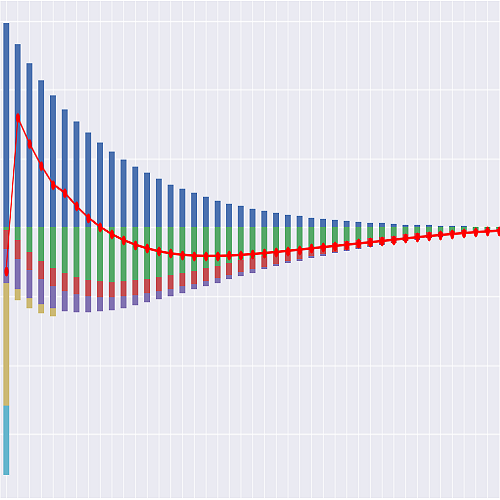
Implementation Notes#
Status: Draft, 2026-08-26. Built from
products/assurance_vie_euro/technical-notes.md; the product it
implements is specified in product-spec.md.
This is a mechanics demonstration, not a pricing or reserving result. The mechanics are sourced — the art. A132-11 allocation and which limb attaches to which account R5 R14, fn 12 REG-R15, the art. A132-12 minimum benefit R5 REG-R15, the eight-year PPB release horizon R5, art. A132-16 R6 REG-R16, the
effet cliquet[S1] [S9], thegarantie nettecapital floor and its measurement before levies [S3] [S5] [S6] [S7], the death benefit being theépargne acquiseand nothing more [S3], the absence of afrais de rachat[S2] [S3] [S10] [S13], and the annual timing of theprélèvements sociauxon euro-denominated rights R9, art. L136-7 II. Every rate is a std standardization: no insurer publishes its dotation or release policy R5 REG-R16, no French euro-fund lapse experience is public R15, no contract in the source set publishes a TMG [S1] [S2] [S3] [S4] [S11], and the statutory mortality tables annexed to the arrêté du 1er août 2006 REG-R23 are cited but not redistributed — the shipped table is an INSEE-shaped proxy REG-R24.
Run it#
python products/assurance_vie_euro/run.py            # the worked example's anchor cell
python products/assurance_vie_euro/run.py 7          # the same cell, low scenario
python products/assurance_vie_euro/run.py 8          # the high scenario, PPB building
import modelx as mx
model = mx.read_model("products/assurance_vie_euro/Euro_FR_S")
model.Projection[1].result_cf()
result_pb() gives the crediting machinery — the compte de participation aux résultats,
the statutory floor rate it implies, the PPB dotation, release and balance, and the
taux servi credited — one row per projection year. result_cf() gives the cash
flows, one row per month, and result_cf_annual() the same frame summed into
projection years, which is what a reader lays beside the annual-step model this replaced.
The time index#
t is 0-based and counts policy months, the library convention. t = 0 is the
first projected month for every model point — new business and in force alike, since this
model’s frame always opens at the valuation date and carries the elapsed time in
duration_init rather than in the index. Month t runs from time t/12 to (t + 1)/12;
pols_if(t) and av_pp(t) are the count and the balance at its start, so
av_pp(0) == av_pp_init() and pols_if(0) == pols_if_init(), and av_pp(t + 1) — which
the death and surrender benefits are struck on — is the balance at its end.
proj_len() is the number of projected months, 12 × proj_years = 480, so the frame
is t = 0 … 479 and result_cf() has 480 rows indexed 0 … 479 with
index.name == "t". result_pb() and result_cf_annual() have 40 rows indexed 0 … 39
with index.name == "y", because every column in them is a financial-year quantity.
The product has two clocks and they are not the same clock, which is the whole of the
conversion to a monthly grid. The crediting machinery — the compte de participation aux résultats, the statutory minimum, the PPB and its eight-year vintage ledger, the declared
taux servi, the frais de gestion, the prélèvements sociaux — is a financial-year
statement, and stays one. The account movements, the expenses and the decrements are
continuous, and are monthly. Four derived clocks read off t and none of them is the
index:
proj_year(t) = t // 12, the 0-based projection yeary: the index of the annual layer, and the axisfin_rate_table.csvandwd_start_yearare stated on;is_anniv(t),t % 12 == 11: the 31 December of yeary, which on this model’s convention is also the policy anniversary and where every annual contractual event lands whole;duration(t) = duration_init + t // 12, the 0-based completed policy years, andage(t) = issue_age + duration(t), soage(0)is the attained age at the valuation date and the age steps at the anniversary and never inside the year;policy_year(t) = duration(t) + 1, the contract’s 1-based contractual policy year — equally its completed policy years at the 31 December that closes it — and the label the lapse table and the eight-year tax threshold are keyed to. This is the library’s 1-basedpolicy_year, not its 0-basedduration; for a cell issued at the valuation date it is simplyt // 12 + 1.
One published column is offset by a year, deliberately. In result_pb() the ppb_pp
column is ppb_pp(y + 1), the PPB at the end of year y — the notes’ Table 1 header
is literally ppb_pp(y+1), because the reader wants the balance the year’s dotation and
release leave behind — while av_pp and guar_floor_pp on the same row are the
start-of-year av_pp(12y) and guar_floor_pp(12y). So the anchor cell’s y = 0 row shows
ppb_pp 3,637.06 even though the cells ppb_pp(0) is the 4,000.00 carried in. The
result_pb() docstring says the same thing.
The PPB vintage index v runs on the financial-year clock, like y: a dotation in
year y opens vintage y, and the opening balance’s ppb_vintages_init vintages sit at
v = −1, −2, … , −ppb_vintages_init, falling due at y = 7, 6, … , 0 for the default
eight. Art. A132-16 counts financial years, so the monthly grid does not reach into that
ledger.
Two input columns are on the projection-year axis and are read at proj_year(t): the
y key of fin_rate_table.csv, which runs 0 to 39 — it is spelled y and not t
precisely because t is a month everywhere else in this model — and wd_start_year in
model_point_table.csv (5 on the anchor cell, 98 as the “never” sentinel, 0 on the
drawdown cell). Two are not: policy_duration in lapse_table.csv is the contractual
1-based label 1 … 9 that policy_year(t) maps onto, and duration_init in
model_point_table.csv is an elapsed count in years, 0-based by nature. mort_table.csv
is keyed by attained age.
Decrements run at two speeds, which is the library’s convention: mort_rate(t) and
lapse_rate(t) are the annual rates of the policy year containing month t — the
vectors the technical notes tabulate, constant across the year’s twelve months — and
mort_rate_mth(t) and lapse_rate_mth(t) are the monthly rates actually applied,
1 − (1 − r)^(1/12), so that twelve of them compound back to exactly the annual rate.
That, together with the crediting machinery landing whole at 31 December, is why
pols_if(12y) and every financial-year quantity on this grid are exactly what the
annual-step model this replaced carried; check_decrements_compound() asserts the
conversion directly.
The rate is an allocation, not an assumption#
That sentence is the model.
fin_acct_pp(y)           = r_fin(y)·(pm_avg_pp(y) + ppb_pp(y))
tech_acct_pp(y)          = fee_pp(y) − expenses_pp(y)
insurer_tech_share_pp(y) = max(0.10·max(tech_acct_pp(y), 0), 0.045·prem_gross_pp(y))
pb_acct_pp(y)            = 0.85·fin_acct_pp(y) + tech_acct_pp(y) − insurer_tech_share_pp(y)
pb_min_pp(y)             = max(0, pb_acct_pp(y) − tmg_rate()·pm_avg_pp(y))
This block is grid-invariant. It is a financial-year statement indexed by y, and not
one operator in it changed when the projection went monthly; every figure it produces is
the annual-step model’s, to the last bit.
Every year the insurer builds the account art. A132-11 prescribes, and the whole of that
balance must reach policyholders R5 REG-R15. What the insurer chooses is only when:
what it does not credit this year is carried to the provision pour participation aux bénéfices, and what it carried in an earlier year it may credit now. Four points of
substance, each a listed pitfall in the notes:
The rule |
The popular error |
|
|---|---|---|
Which percentage, which account |
85% of the |
“90% of the financial account and 85% of the technical result” — EUR 3,319.09 against the correct EUR 3,071.86 at worked-example |
The insurer’s technical share |
The greater of 10% of the credit balance and 4.5% of annual premiums — which is why |
Dropping the premiums limb — EUR 108.00 against EUR 28.43 at |
The financial base |
|
Omitting the PPB (−EUR 41.81 at |
The charge |
Subtracted once, between the PB amount and the rate |
|
Then the three levers on one rate:
pb_target_pp(y)     = ts_target()·pm_avg_pp(y) + fee_pp(y)
ppb_dotation_pp(y)  = max(0, pb_min_pp(y) − pb_target_pp(y))
ppb_discr_rel_pp(y) = min(max(0, pb_target_pp(y) − pb_min_pp(y)), ppb_pp(y))
ppb_forced_pp(y)    = Σ_v { ppb_vintage_pp(y, v) : v + 8 ≤ y }
ppb_release_pp(y)   = max(ppb_discr_rel_pp(y), ppb_forced_pp(y))
pb_credited_pp(y)   = pb_min_pp(y) − ppb_dotation_pp(y) + ppb_release_pp(y)
ts_net(y)           = max(tmg_rate(), ts_raw(y))
int_credited_mth_pp(t) = int_credited_pp(y) if is_anniv(t) else 0
The last line is all the monthly grid does here: the rate is fixed for the closing
financial year and credited at 31 December value date, so the whole of the year’s
revalorisation arrives in one month and eleven months of twelve carry none of it — which
is also why a dénouement in one of those eleven is paid the account value without it.
A dotation and a forced release coexist in the worked example’s first three rows —
this year’s excess goes in while an eight-year-old vintage comes out — and where the
forced release wins the credited rate goes above the target: y = 5 wants EUR 426.99
and must release EUR 500.00, so it credits 2.3589% against a 2.30% target.
Note what the invariant is not. ts_net(y) ≥ ts_stat(y) is not an invariant: a dotation
year credits less than the statutory floor rate and that is legal, because the balance goes
to the PPB and not to the insurer R5 — model point 5, which opens with no PPB, does
exactly that at y = 0. check_pb_allocation() therefore states an allocation identity,
I(y) + F(y) + D(y) − R(y) − A⁺(y) − topup(y) = 0, not a rate inequality.
What a mid-year dénouement is paid#
db_pp(t) = cv_pp(t) = av_pp(t + 1): the claim is always the balance closing the month of
exit. On a monthly grid that has a consequence the annual grid could not express. In the
anniversary month the closing balance carries the whole year’s taux servi, exactly
as before. In the other eleven months of twelve it carries no in-year revalorisation
at all — which is the contractual rule, the announced floor rate pro rata temporis
[S1] [S2] [S3], nil at the tmg_rate() = 0 every shipped model point carries.
That is the one place the finer grid changes an answer rather than its resolution, and it
retires a pitfall, a sensitivity and an out-of-scope bullet the annual model carried at
once. An annual step could only pay a March exit the following 31 December’s balance,
which is a forward-looking payment at a date it is not yet due; it did so because the exit
and the crediting were the same instant. Measured on the anchor cell over forty years,
that correction together with the monthly collection of instalments moves claims_death
−4.14%, claims_lapse −0.55% and liability_cf −1.57%.
The Afer variant [S11] — the declared rate accrued pro rata temporis, one twelfth a
month — is a documented alternative rather than the base, and it is the bracket on what is
left uncertain: it gives claims_death −3.52%, claims_lapse +0.18% and liability_cf
−0.88% instead. It preserves the anniversary equivalence just as exactly, because the
year’s interest still sums to I(y), so nothing measurable decides between them — only
the sources do, and they favour the floor rate: BoursoVie’s credit of the annual PB to
sums surrendered during the year is expressly conditional on the adhesion being in force
on the following 1 January [S1], which a rachat total is not.
The PPB vintage ledger, and why it is a ledger#
A dotation carried to the PPB in financial year v must be applied to mathematical
provisions or paid to policyholders within the eight financial years following the one
it was carried in R5, art. A132-16 R6, art. A331-9 REG-R16. The model therefore
carries ppb_vintage_pp(y, v), a per-vintage balance drawn down FIFO by
ppb_vintage_release_pp(y, v), so v + 8 is a real deadline on a real balance — a
single-pot PPB with an average age meets the rule on average and breaches it on every one.
Both indices are financial years, and stay so on a monthly grid: A132-16 counts
financial years, so nothing here is made finer.
The statute prescribes no release order std. FIFO is the only order that satisfies the
eight-year constraint without slack, and it is what makes the ledger testable: releasing
newest-first would satisfy the aggregate recursion Q(y+1) = Q(y) + D(y) − R(y) exactly
while letting an old vintage sit past its deadline behind young ones that keep being spent.
check_ppb_clock() catches that; check_ppb_roll_fwd() cannot. The two are deliberately
separate recursions — ppb_pp(y) runs the aggregate, ppb_ledger_pp(y) sums the vintages
— because nothing forces them to agree, and an off-by-one in the FIFO draw breaks the tie
while leaving both numbers plausible. The anchor cell’s clock closes exactly:
|
Forced |
Want, uncapped |
Discretionary |
Released |
Drawn from |
|---|---|---|---|---|---|
0–2 |
500.00 |
−137.06 → −32.52 |
0.00 |
500.00 |
vintages −8 … −6, one a year |
3–5 |
500.00 |
77.81 → 426.99 |
77.81 → 426.99 |
500.00 |
vintages −5 … −3, one a year |
6 |
500.00 |
606.30 |
606.30 |
606.30 |
500.00 from vintage −2, then 106.30 from vintage −1 |
7 |
393.70 |
736.57 |
650.58 |
650.58 |
393.70 from vintage −1, then the three dotations |
8–11 |
0.00 |
869.58 → 1,059.09 |
0.00 |
0.00 |
the PPB is exhausted; |
The two middle columns are the two halves of ppb_discr_rel_pp(y) = min(max(0, pb_target_pp(y) − pb_min_pp(y)), ppb_pp(y)). “Want, uncapped” is the raw difference
s* B(y) + F(y) − A⁺(y); “Discretionary” is that difference floored at zero and capped
at the balance. They separate exactly twice on this cell and for different reasons — at
y = 0 to y = 2 the want is negative, which is what a dotation year is (the three
dotations named below are its mirror image), and from y = 7 the cap binds, partially
and then to nothing. Neither is the release: y = 6 wants 606.30 and gets it, y = 5
wants 426.99 and must release 500.00 because the clock outranks the target.
Twelve-year releases of EUR 4,256.88 against an opening EUR 4,000.00 plus three dotations
(137.06, 87.30, 32.52) of EUR 256.88. The opening balance is split into ppb_vintages_init
equal vintages carried in years −1, −2, … , −ppb_vintages_init std — a
steady-state construction, since a fund that has run the clock for eight years carries
roughly one eighth of its PPB in each open vintage, and no insurer publishes its own
profile. It matters: model point 6 carries the same EUR 4,000 in four vintages, and
nothing is forced out before y = 4.
The effet cliquet is not “the account never falls”#
What is ratcheted is credited PB, not the balance [S1] [S9]. Under the garantie nette the account falls by the management charge in a nil-PB year, and the minimum
surrender-value tables insurers publish for exactly that case prove it: Suravenir’s
994.00 … 952.99 is 1 000 × (1 − 0.006)ⁿ truncated to the cent [S3], and MACSF’s
965.15 … 955.52 is 970 × 0.995ⁿ [S2]. Conflating the two is a pitfall, so the model
publishes two separate checks:
check_cliquet()—pb_cum_ppis non-decreasing over each year,int_credited_pp(y) ≥ 0andts_net(y) ≥ tmg_rate(). The ledgerpb_cum_pp(t)carries a monthly index and steps once a year, in the month after the 31 December that credited the PB, so the ratchet is read at the year’s boundaries. Half of this is zero by construction, because themax(tmg_rate(), …)ints_netenforces the non-negativity; it is published because the constraint is a contractual fact, and a re-implementation that netted the charge against the revalorisation, or carried a negativepb_acct_ppthrough to the account, would break it. The ratchet half compares two independent recursions and is not by construction.check_guar_floor()— the weaker and correct statement about the balance,av_pp(t) + soc_levy_cum_pp(t) ≥ guar_floor_pp(t)at every month: a genuine inequality that nothing in the recursions enforces, measured before cumulative social levies because the published minimum surrender-value tables are [S1] [S2] [S3]. The floor steps down once a year, at the anniversary, while the account only catches up at the same date, so the monthly sweep looks at the tightest month of each year rather than at the year-end alone. On the anchor cell it reaches EUR 99,061.85 att = 144against EUR 139,600.82 — it never binds on a path with a positivetaux servi, and knowing that it does not bind is the reason to check it.
Prélèvements sociaux are inside the account and outside net_cf#
The 17.2% levy [S3] is withheld as the interest is credited, every year, whether or
not anything is withdrawn, because the rights are expressed in euros; only the UC part is
deferred to dénouement R9, art. L136-7 II. This is the euro fund’s signature mechanic
and the commonest foreign-model error. It sits inside the account roll-forward,
because it is money that genuinely leaves the contract each year and a model that defers
it to surrender overstates the account and every benefit measured on it — and outside
net_cf, because it is a policyholder tax the insurer withholds and remits to the State
rather than a benefit or an insurer expense. Its own soc_levy column lets a fund-level
asset projection add it back in one step.
The base is the interest actually inscribed on the contract, i.e. net of the management
charge std: art. L136-7 fixes the timing but not the base R9, and no retrieved
product document says which it is (product-spec footnote 13). The next error along is
levying it on the account: 17.2% of EUR 100,000 is EUR 17,200, while 17.2% of the
worked example’s EUR 2,827.60 at y = 0 is EUR 486.35.
On the monthly grid the annual timing is visible rather than implicit. Art. L136-7 II
charges the products “lors de leur inscription au bon ou contrat”, and the inscription is
the 31 December crediting, so soc_levy_mth_pp(t) is nil in eleven months of twelve and
carries the whole of the year’s levy in the twelfth, moving with the interest it is struck
on. The soc_levy column of result_cf() is zero in 440 of its 480 rows, and that shape
is what an annual contractual event looks like on a finer grid.
Behaviour keys on the gap, not on the level#
lapse_dyn_add(t)  = lapse_dyn_a·max(0, ref_rate(y) − ts_net(y) − lapse_dyn_tol)
lapse_rate(t)     = min(lapse_cap, lapse_rate_base(t) + lapse_dyn_add(t))
lapse_rate_mth(t) = 1 − (1 − lapse_rate(t))^(1/12)
lapse_rate(t) is the annual rate, and lapse_rate_mth(t) is what the recursion
applies. The gap the dynamic term keys on is read once a year, at proj_year(t), so the
annual rate is one number for the whole policy year and only the monthly conversion varies
inside it.
The duration-8 step in lapse_rate_base is the tax threshold, not a behavioural
guess: the reduced 7.5% rate and the EUR 4,600 / EUR 9,200 annual allowance both switch on
at eight years R10 R11 REG-R40. It is indexed by
policy_year(t) = duration_init + t // 12 + 1, the contract’s 1-based policy year,
not by t — the anchor cell is five years in, so the step is twelve months wide and
covers t = 24 … 35. A model reading the table at t would put it in the third month
instead of the third year, which is the likeliest indexing error this grid can make.
The dynamic term is additive in the gap between the market reference rate and the
taux servi, one-sided, and capped. The sign of the relationship is observed rather than
assumed: in 2025 the euro rate was 2.63% while the Livret A averaged 2.20% and fell to 1.7%
in August and 1.5% in February 2026 R14 R15, and euro supports turned to a
+EUR 6.4 bn net inflow after five consecutive years of net outflow R15. The magnitude
has no public calibration, and lapse_dyn_a = 4.0, lapse_dyn_tol = 0.25 point and
lapse_cap = 30% are the most consequential std values in the model. Because the
credited rate and the surrender rate move together, the model carries a feedback loop the
deterministic run samples only once.
What is out of scope, and why#
No positive-TMG model point is shipped, and that is a decision rather than an omission.
No contract in the source set publishes a TMG: the two Suravenir notices state no
guaranteed interest rate at all [S3] [S4], BoursoVie names a TMG “annoncé en début d’année”
without its value [S1], MACSF names a board-set art. A132-3 rate without giving it [S2],
and Afer names a Taux Plancher Garanti without giving it [S11]. So the composite’s TMG is
0.00% std and every model point carries it.
The lever is implemented as the notes specify, and at tmg_rate() = 0 the two things the
notes call the TMG coincide: the art. A132-12 subtraction of “interest already credited to
mathematical provisions” R5 REG-R15, which belongs to a taux technique fixed at
subscription, and the floor on the year’s total revalorisation, which is what art.
A132-2/A132-3 actually guarantees R3 R4 REG-R18. Above zero they are different
quantities, and the product specification is explicit that the ACPR’s average taux technique of 0.32% must not be substituted for a TMG R14 (product-spec footnote 7). A
positive-TMG cell would have to choose, so none is shipped and insurer_topup_pp — the
cells that would carry the guarantee’s cost to the insurer — is nil throughout. On a
monthly grid a positive TMG would also have to be credited month by month inside the year
and squared up at 31 December against ts_net; no such cells is shipped either, for the
same reason. Also out of scope, per the notes:
The HCSF surrender-suspension power under art. L631-2-1 5° ter R8 REG-R13. No published trigger a deterministic model could key off, and precisely what would change a mass-lapse answer — so a mass-lapse run here is a pre-management-action number.
The exceptional PPB
repriseof art. A132-16-1 REG-R16, available only on a negative life technical account and an uncovered SCR: a solvency-stress management action, not a projection assumption.Avances. All three insurers push the terms into a separate document that was not retrieved [S1] [S2] [S3], soavance_on()validates rather than inventing a rate, a ceiling and a duration.Arbitragesand the UC compartment, which is the sibling productassurance_vie_uc; and the UC-holding bonus, often 100 bp and sometimes above 200 bp R14, because no retrieved contract publishes its grid.Sub-annual crediting finer than the month, such as BoursoVie’s daily compounding [S1]: an approximation the monthly grid narrows rather than removes.
There is no maturity decrement: the euro support has no term, and the contract’s stated
maturity, where one exists, is renewable annually without limit [S6]. The projection stops
at proj_len() and the survivors are paid nothing, because that ending is a modelling
truncation and not a contractual event.
Inputs are external files#
The four input CSVs live in this directory, beside run.py — not inside the model
folder. Euro_FR_S/ holds nothing but formulas:
products/assurance_vie_euro/
  model_point_table.csv        <- inputs live here
  mort_table.csv
  lapse_table.csv
  fin_rate_table.csv
  run.py
  model.md
  product-spec.md              <- the documents this model implements
  technical-notes.md
  sources.md
  Euro_FR_S/                   <- formulas only
    __init__.py                   (model docstring)
    _system.json
    Data/__init__.py              (reads the CSVs, once per model)
    Projection/__init__.py        (the by-policy projection)
This follows lifelib’s annuallife/TradLife_A. Projection is parameterized by
point_id, so the CSV readers live in an unparameterized Data Space and each file is
read once per model rather than once per model point; a test counts the reads.
Reference |
Cells |
File |
|---|---|---|
|
|
|
|
|
|
|
|
|
|
|
|
File |
Contents |
Provenance |
|---|---|---|
|
Eleven model points. Point 1 is the notes’ worked example — M55 at duration 5, EUR 100,000, EUR 2,400 p.a. in, EUR 3,000 p.a. out from year |
anchor cell std, product-spec “Anchor model cell”; variants from the notes’ pitfalls and sensitivities |
|
Base annual mortality by sex and age 18–120, capped at 1 |
std Makeham proxy shaped like French population mortality REG-R24, anchored so that the 80% best-estimate factor gives the notes’ |
|
Base annual surrender by completed policy duration: 4% at 1–7, 8% at 8, 5% at 9+, spread over the policy year’s twelve months at |
levels std, no public French euro-fund lapse experience R15; the duration-8 step is the tax threshold R10 R11 REG-R40 |
|
Three scenarios × 40 years of |
std scenarios anchored to the ACPR’s |
Note what is not in a file. The crediting rule that actually drives this product — the
target taux servi, the dotation and release policy, the FIFO order, the expense loadings,
the dynamic-surrender coefficients — lives in model point columns and Projection
References rather than in a rate table. That is not an oversight: none of it is
published. Only the outer bounds of the discretion are public — at least 85% of the
compte financier and the A132-11 technical share must reach policyholders R5, and the
PPB must be released within eight years REG-R16 — and between those bounds every value is
a standardization. Putting them where a reader trips over them is better than filing them
in a table that looks like data. Each rate table does carry a provenance column saying in
words what its numbers are; no formula reads it, and it is there so a file lifted out of
this directory still says what it is.
The worked example#
tests/test_assurance_vie_euro_fr.py asserts every row of all four tables to the cent and
every rate to the fourth decimal of a percentage. The notes’ Tables 1 and 2 are
financial-year statements, and the monthly grid leaves every figure in them exactly where
the annual grid put it; what changed is the index each is read at. The year-5 trace, where
every lever is active at once — year 5 being the twelve months t = 60 … 71:
Step |
Value |
|---|---|
|
124,054.884701 |
|
744.329308 |
|
460.046913 |
|
3,522.729293 |
85% of it |
2,994.319899 |
|
284.282396 |
|
108.000000 |
|
3,170.602295 |
|
1.955806% |
|
3,597.591656 |
Discretionary release wanted / vintage falling due |
426.989361 / 500.000000 |
|
3,670.602295 |
|
2.358853% |
|
2,926.272987 |
|
503.318954 |
|
126,177.838734 |
The whole of that int_credited_pp and soc_levy_pp lands in one month, t = 71.
The other eleven months of year 5 move the account by the level instalments alone,
EUR 200.00 in and EUR 250.00 out, netting to −EUR 50.00 a month — and the
mid-month-weighted base, 124,054.8847, is literally the balance at the middle of the year,
the opening of month 66.
Policy year 5 ( |
Annual grid |
Monthly grid |
|---|---|---|
|
124,354.88 |
124,354.88 |
|
2.3589% |
2.3589% |
|
126,177.84 |
126,177.84 |
Premiums |
1,771.44 |
1,723.18 |
|
2,214.30 |
2,153.97 |
Death claims |
862.56 |
829.63 |
Surrender claims |
4,613.46 |
4,561.82 |
Expenses |
339.56 |
330.31 |
|
6,258.43 |
6,152.55 |
Every state figure is unchanged and every flow figure moved down, which is the whole of what the conversion did: the instalments are collected from a block that decrements every month, the expense is borne by the in force of each month, and a claim falls at the end of the month of exit carrying no in-year revalorisation.
The taux servi from a different direction —
0.85·fin/base + (technical share)/base − fee_rate + (PPB flow)/base — gives
2.413706% + 0.142100% − 0.600000% + 0.403047% = 2.358853% at y = 5, and
2.082500% + 0.145673% − 0.600000% + 0.000000% = 1.628173% at y = 8 with the PPB
exhausted. The twelve-year account identity: credited interest EUR 31,800.82 and social
levies EUR 5,469.74, whose ratio is 0.172000 exactly, and
100,000.00 + 28,800.00 − 21,000.00 + 31,800.82 − 5,469.74 = 134,131.08 — the same total
reached the other way from PB credited gross of the charge, EUR 40,538.97, less frais de gestion of EUR 8,738.15.
Read year 8 for what it says. At r_fin = 2.45% and a 0.60% charge the most the account
could grow by is 1.85%; the model credits 1.6282%, and the 0.2218-point wedge is exactly
0.15 × 2.45% = 0.3675% retained from the compte financier less the 0.1457% of the
technical account that flows back R5, art. A132-11. A 2.30% target is not payable on a
2.45% asset return without the PPB, and the model steps down rather than pretending
otherwise. The two management actions that would soften it — realising capital gains into
the year’s financial account, and the réserve de capitalisation REG-R6 — are outside it.
Sign convention#
net_cf is income-positive, the library’s convention. liability_cf is the notes’
outgo-positive CF(t), published verbatim, and net_cf(t) == −liability_cf(t) exactly:
liability_cf = claims_death + claims_lapse + withdrawals + expenses − premiums. Two
things are reported beside the flows and are not in either: int_credited, a state
movement rather than a settlement, and soc_levy, a policyholder tax. withdrawals is an
owner election, not a claim — money the policyholder asked for out of a balance the
policyholder owns — while a rachat total ends the contract and appears as
claims_lapse. Both leave the fund; keeping them apart is what lets a reader see the
difference between elective drawdown and exit.
Naming#
Most names carry across from the notes unchanged; these needed care.
Notes symbol |
Cells |
Why |
|---|---|---|
|
(the cells argument), |
|
(none) |
|
|
|
|
Not an average of anything the model computes: it is the opening balance plus each month’s movement at the mid-month weight |
|
|
Both are net of the management charge. |
(the |
|
The two halves of |
|
|
The ledger, the FIFO draw and the ledger’s total — the last computed independently of |
|
|
The year’s amounts; |
|
|
The unsuffixed name stays the annual rate the notes tabulate, read at |
|
|
Named for the |
|
|
The contract’s 1-based contractual policy year — equally its completed years at the 31 December that closes it — which is what the tax threshold and the lapse table are keyed to. The library’s 1-based |
(none) |
|
|
Standardizations used#
Everything in this list is std: the 2.30% target taux servi and holding it level;
the crediting rule itself — dotation of the excess over the target, discretionary release
up to the target, FIFO order, no year-on-year cap on the rate; the per-policy attribution
of a collective PPB and its split into eight equal vintages; the 0.60% management charge
level and the pro rata temporis charge base; the nil TMG and nil entry charge on the
composite; the garantie nette as the composite’s guarantee form and its seeding at
av_pp_init for an in-force cell; the monthly grid and the mid-month weight
(11.5 − k)/12 from which the notes’ 0.5 follows; the constant-force conversion
1 − (1 − r)^(1/12) of every annual decrement, since no retrieved French source states
one; the contractual pro rata temporis floor rate paid to a mid-year exit, nil at a zero
TMG, with the Afer top-up named as the documented alternative; collecting the versement
and the rachat partiel programmé in twelve equal instalments and striking the withdrawal
cap once a year on the year-open balance; accruing the expense a twelfth a month while the
inflation factor steps at the anniversary; the levy base being interest net of the charge;
the mortality table, the 80% best-estimate factor and age last birthday; the lapse levels
and all three dynamic-surrender parameters; expenses of EUR 24 a policy a year inflating at
1.5% plus 0.35% of the average balance; the three financial scenarios;
proj_len() = 480 projected months (40 years);
death before surrender as the processing order; and no avance take-up, no UC-holding
bonus and no PPB accretion on the vintages.
Tests#
tests/test_assurance_vie_euro_fr.py asserts all four tables of the worked example row by
row, the year-5 trace at full precision, the taux servi decomposition from the other
direction, the twelve-year levy and account identities, the month-0 aggregate
roll-forward, the guarantee floor and the decrement extract — then one test per pitfall the
notes list: the charge deducted twice, the closing-balance crediting base, the statutory
split reversed, the 4.5%-of-premiums limb dropped, the PPB left out of the financial base
or accreted, a LIFO release or an overdue vintage, the statutory minimum lost rather than
allocated, the levy deferred to surrender or struck on the account, the cliquet tested as
“the account never falls”, a death-benefit uplift, and the mid-year exit taking a full
year’s rate — which is now asserted the other way round, as
claim_pp(t, "LAPSE") == av_pp_at(t, "AFT_WD") in a non-anniversary month.
Then one test per timing decision the monthly grid forced: that twelve monthly decrement
rates compound back to the annual ones and that pols_if(12y) therefore reproduces the
annual recursion written out from the model’s own annual vectors, on every model point;
that the mid-month weights sum to exactly one half and the two neighbouring conventions do
not; that the versement and the rachat partiel are collected in twelve instalments and
the withdrawal cap is struck once a year; that the expense accrues a twelfth a month while
its inflation factor steps at the anniversary; that the frais de gestion and the
prélèvements sociaux land whole at 31 December and nowhere else; that the annual layer is
keyed by y and the monthly layer by t, cells by cells; that result_cf_annual() is the
monthly frame regrouped; and that the duration-8 surrender step is twelve months wide.
Then the variants each shipped model point carries, and all eight invariant checks on every
one of the eleven. The frame is pinned there too: result_cf() is indexed 0 … 479 and
has proj_len() = 480 rows on every model point, and result_cf_annual() and
result_pb() 40.
python -m pytest tests -q