Implementation Notes#
Status: Draft, 2026-08-29. Built from
technical-notes.md; the product it implements is specified in
product-spec.md.
This is a mechanics demonstration, not a pricing or reserving result. The mechanics are the established German ones and each carries the instrument it must be checked against — the benefit trigger being the statutory Pflegegrad of §§ 14, 15 SGB XI rather than a definition the insurer writes R2 R6, the five-grade Leistungsstaffel scaling one vereinbarte Pflegerente and the Beitragsbefreiung im Leistungsfall [S4], the level Beitrag a Lebensversicherer may adjust only on the narrow § 163 VVG route and never under § 203 VVG R11 REG-R27, the 1,00 % Höchstrechnungszins and 25 ‰ Höchstzillmersatz of the DeckRV R13 REG-R14 REG-R16, the § 169 VVG Rückkaufswert with its five-year cost spread and its Stornoabzug conditions R11 REG-R28, and the unisex pricing rule REG-R34. Every level is a standardization. This model was drafted with nothing retrieved — egress from the build environment was blocked and the session’s search budget was exhausted before the product was researched — and its sources have since been re-verified against the primary documents: one carrier’s Bedingungswerk and Produktbeschreibung were read in full [S4], as were the statutes and the DAV’s own reports, and 27 of the 36 entries in
sources.mdnow readRetrieved: yes. What was not retrieved is the one thing that would fix a level: no Tarifblatt and no premium quotation for any German Pflegerentenversicherung, because none is published [S9] [S13]. DAV 2008 P, the German market’s standard multi-state Pflegetafel, is published by the Deutsche Aktuarvereinigung — the earlier statement here that it is not public was wrong — but it is the DAV’s property and is not redistributed here R15 REG-R51, and neither is DAV 2008 T or DAV 2004 R R16 REG-R48 REG-R49. So every biometric rate, every charge, every lapse rate and the premium itself is std, and the premium is an output of a stated first-order basis rather than a table lookup. Replace the decrement, expense and surrender tables with company data before drawing any conclusion from the numbers.
Run it#
python products/pflegerentenversicherung/run.py        # the anchor cell
python products/pflegerentenversicherung/run.py 5      # the statutory bahr Leistungsstaffel
python products/pflegerentenversicherung/run.py 12     # an in-force policy already in claim
import modelx as mx
mx.read_model("products/pflegerentenversicherung/Pflege_DE_S").Projection[1].result_cf()
Projection takes a point_id; Projection[1] is the worked-example anchor cell. result_cf()
returns a tidy DataFrame indexed by policy month t carrying pols_if first, the three-way
split of it a reader follows the projection with, and one column per cash flow line;
result_states() publishes the five Pflegegrad ledgers, the Karenz ledger, the flows between
them and the four annual rates beside it. model.Projection.doc holds the full symbol mapping and
model.Data.doc says what a replacement for each shipped table must preserve.
The grid is monthly and t is 0-based: t = 0 is the month of issue and
age(t) = age_at_entry + t // 12, so the attained age steps at the policy anniversary. The frame
starts at duration_mth_init() — 0 for new business, the elapsed duration for an in-force
point — and runs to proj_len() - 1, where proj_len() is the number of projected months, the
frame’s exclusive end counted from t = 0: 12 × (110 − 45) = 780 on the anchor cell, so
range(0, 780) — 780 rows, t = 0 … 779, attained ages 45 to 109, in about seven seconds. It
depends on the entry age and the terminal age alone, so an in-force point opening at
duration_mth_init() = d0 publishes a shorter frame of proj_len() - d0 rows and still ends at
its own proj_len() - 1: duration_mth_init shortens the frame at the front, never at the back —
and since proj_len() depends on the entry age, that last index is the point’s own, not the
anchor’s 779. Reading proj_len() as the last index, or as a horizon duration_mth_init shifts,
is a listed pitfall.
The input CSVs carry no column keyed by t. lapse_table.csv and surrender_table.csv are
keyed by policy_year, the 1-based contractual Versicherungsjahr that the model reaches through
policy_year(t) = t // 12 + 1; mort_table.csv and incidence_table.csv are keyed by attained
age; and model_point_table.csv’s duration_mth_init is an elapsed count of complete months,
0-based by nature. wartezeit_months and karenz_months are contractual lengths in months,
not frame indices, so they do not shift either: the gate stays t < wartezeit_months, and month
wartezeit_months is the first covered month. None of them moved with this change.
Nine states, and only two of them absorbing#
This is what a reader arriving from RLV_DE_S, BasicTerm_S or any single-decrement protection
model will get wrong, and it is why the product is worth modelling. A Pflegerente is a
multi-state contract whose benefit is a step function of the state, not a cover paying on an
event:
   aktiv ──►  PG1  ⇄  PG2  ⇄  PG3  ⇄  PG4  ⇄  PG5
     │  ▲      │        │        │        │       │
     │  └──────┘  Reaktivierung / Herabstufung     │
     ▼           ▼        ▼        ▼        ▼      ▼
   storno                    tot   (absorbing)
The model carries the Pflegegrad explicitly, in pols_pg(t, g), with a second ledger
pols_karenz(t, g, z) for lives inside a deferred period and a third, pols_act(t), for active
lives. Every transition above is internal to pols_if — lives leave the in-force population
only by death or surrender — which check_pols_roll_fwd() and, independently, check_states()
assert. Two consequences drive the implementation.
The paying state has three exits and only death is absorbing. A life in Pflegegrad g can
die, deteriorate to g + 1 or be downgraded to g − 1; out of grade 1 the downgrade is a
Reaktivierung back to the active state, where the life resumes paying its Beitrag and becomes
exposed to lapse again. A model that lets the paying state be exited only by death overstates
the liability; one that treats every downgrade as a termination understates it, and both errors
produce a plausible-looking frame. On the anchor cell the Reaktivierung flow is 0,013768 of a
policy over the whole projection and the Herabstufung flow out of grade 2 — the flow that ends an
annuity and revives a premium on the delib_std grid — is 0,020835: both small, both non-zero,
which is why the tests assert the flow and never a non-monotone stock.
The transitions are allocated, not added. Every shipped rate is annual; every month is stepped
with forces held constant over the month, the competing transitions sharing one survival
probability in proportion to their forces — p_stay = exp(−Σμ/12) and
p_j = (μ_j / Σμ) × (1 − p_stay) — so p_stay + Σ p_j = 1 exactly, by construction. That is
what makes check_states() an identity rather than an approximation, and why p_pg_stay,
p_pg_death, p_pg_worse and p_pg_better are four published cells rather than folded into the
recursion. Adding monthly rates, or applying q/12, differs wherever the forces are large — which
on this product is exactly where the money is.
The Wartezeit and the Karenzzeit are different devices#
They are routinely conflated in consumer material and they are implemented in two different places.
The Wartezeit runs from inception and denies cover: inc_force(t) is exactly zero while
t < wartezeit_months(), and inc_rate(t) is left alone so it stays the tariff-comparable table
rate at every age — a gate on the force, one line, no ledger.
The Karenzzeit runs from onset and defers an admitted claim, so it is a clock per
onset rather than a gate on the aggregate — which is why it needs its own ledger dimension,
pols_karenz(t, g, z) with 1 ≤ z ≤ K. Lives in it are subject to the same transitions as a
served life: they die, deteriorate and recover exactly as if the annuity were running, they simply
are not paid, and the clock is discarded on reactivation, because a recovered life who relapses
starts a new onset. Where karenz_months() == 0 the ledger is empty and pols_grad degenerates to
pols_entry, which is the base run. The cost of the device is the gap between the two: over model
point 7’s projection graduations are 0.228177 against entries of 0.253723, 89,9 %, the
shortfall being deaths and recoveries recorded inside the six-month deferral — larger than six
months of a four-year spell suggests, because mortality is highest immediately after onset. The
model uses an aggregate in-care mortality with no select period after onset, so it understates
how much a Karenzzeit removes, and point 7’s reduction is a floor rather than an estimate.
The waiver runs with the Leistungsstaffel, not with the diagnosis#
pols_waived(t) is the Beitragsbefreiung population and it is not everyone in care: it is
Σ_{g : waiver_flag(g)} pols_pg(t, g), restricted to the premium term, with waiver_flag(g) being
benefit_pct(g) > 0. Three consequences fall out of the benefit schedule, each a distinct way to
get the premium stream wrong:
a life inside its Karenzzeit is not waived, because no annuity is yet payable;
a Pflegegrad 1 life is not waived on
delib_std, whereπ_1 = 0, and is waived onbahr, where it is 10 % — the same life, two schedules, opposite answers;a life downgraded out of the insured grades leaves the waived population and starts paying again, so
pols_premis structurally non-monotone.
Wiring the waiver to membership of the care ledger instead gets all three wrong at once and still
closes every count. check_waiver() asserts the split — pols_prem + pols_waived = pols_in_term —
and is arithmetically trivial while pols_prem is a difference; it is published because the
failure it guards is not a slip in the subtraction but a disagreement about who belongs on which
side, so it is read with the tests that assert the membership itself. The waiver is also in the
price, through tar_pols_prem(t): on a contract issued at 45 and claiming at 82 it removes four
years or so of remaining Beitrag, and that cost sits inside the level premium.
Two ledgers for one population. esc_pg(t, g) is the escalation-weighted counterpart of pols_pg(t, g): the identical
recursion with one extra factor of (1 + d)^(1/12) on the surviving weights, entrants joining at
weight 1. Carrying the Leistungsdynamik as a value ledger rather than as a
duration-since-onset cohort dimension keeps the model O(n) instead of O(n²); the price is that
it reports only the aggregate escalation, which is all the cash flow needs. The annuity is weighted
on esc_pg and never on pols_pg — using the head count would silently drop the escalation on
every model point that carries one, and no total in the frame would look wrong. With
leistungsdynamik = 0 the two ledgers are identical at every t and g, which
check_esc_ledger() asserts as an equality on the base run and as a domination
(esc_pg ≥ pols_pg) wherever the dynamic is positive.
The dynamic costs more than a four-year spell suggests. On model point 8, d = 2 % raises the
projected annuity total from 13 200,11 € to 15 101,44 € — +14,4 % — and the equivalence premium
from 64,198409 € to 72,038378 €, +12,2 %: ln(1.144)/ln(1.02) = 6,8 years of payment-weighted
elapsed duration against a mean spell in an insured grade of 5,45 years, because the escalation
compounds over elapsed time in care, Pflegegrad 1 months included where nothing is paid, and
because deterioration puts the largest benefit percentages at the end of a spell.
The Beitrag is a priced quantity, and the pricing engine is a separate ledger#
The library publishes undiscounted cash flows. The Beitrag is nevertheless a priced
quantity, so the model carries a second, self-contained actuarial-value engine — the tar_* cells
— whose only output is premium_mth_pp(). That engine discounts; the projection does not, and
rechnungszins() and disc_factor(t) are read by nothing else. Where premium_mth is positive on
the model point that is the premium and the engine is never consulted, which is how model points
10, 11 and 12 carry the premium they were actually sold at. Where it is 0.0 — a sentinel, not a
free contract — P is struck by equivalence on the first-order (erster Ordnung) bases: every
rate times its prudence margin, the sexes blended at unisex_mix_male = 0.50 because sex may not
enter a German premium REG-R34, and no lapse at all, which is both German first-order
practice and what keeps the model acyclic. Everything that scales with P is linear in it, so
P·U = A + P·D1 + P·a1 + β·P·U + G + C   →   P = (A + G + C) / [U(1 − β) − D1 − a1]
    = (17,789.761930 + 892.884210 + 69.389246) / (313.500018 x 0.970 − 12.000000)
    = 18,752.035386 / 292.095018 = 64.198409 EUR a month
prem_net_level_pp() = A / U = 56.745649, so the whole expense loading is 13,13 %, of which
the Zillmerung allowance a1 = 0.025 × 12 × (85 − 45) = 12.000000 units of P alone is 2,53 € a
month: strike a1 out of the denominator and the premium falls to 61,665 €. U is 26,13 years’
worth of discounted premium.
check_prem_equiv() closes the same equivalence from the tariff ledgers month by month rather
than from the closed form, which is what makes it a real identity: substituting a best-estimate
rate into one leg, dropping the Zillmerung term, forgetting the waiver in tar_pols_prem or
valuing the annuity on tar_pols_pg instead of tar_esc_pg all make the sum miss zero. Only the
sum is the identity — individual months are large and of both signs — and on the anchor cell it
is −9,3e−12. Where the model point supplies its own Beitrag the residual is zero by construction.
The Risikozuschlag multiplies the gross premium and never the benefit, so claims is
invariant to it: point 13 prices at 283,130286 € against an unrated 188,753524 €, exactly 1,50 ×.
There is no published German rate card for this product to reproduce — the single largest
difference between this model and frlib’s TD_FR_S, which reproduces a real attained-age grid. The
premium here is computed, and the notes sanity-check its level against an argued 50,00–100,00 €
band rather than against a citation.
The Zillmerung is charged on the Beitragssumme, not on the annual premium.
acq_expense_pp() is acq_permille / 1000 × beitragssumme(), with the per-mille set exactly at
the § 4 DeckRV Höchstzillmersatz of 25 ‰ so the ceiling binds visibly REG-R16 REG-R20. A
lifelong-premium contract has no finite Beitragssumme without a convention, and
beitragssumme_cap_age = 85 std is that convention —
P × 12 × (min(prem_end_age, 85) − age_at_entry), and the Einmalbeitrag itself where there is
one. On the anchor cell that is 30 815,24 € and a charge of 770,38 €, all of it at t = 0.
Charging the per-mille on an annual premium instead understates it by a factor of the paying term
— here forty-fold — and is a listed pitfall. Because the charge falls at t = 0 only, an
in-force model point never incurs it: its frame opens at duration_mth_init() > 0 and the cost
was incurred before the valuation date, which is worth knowing before comparing an in-force point’s
first row with a new-business point’s.
Inputs are external files#
The nine input CSVs live in this directory, beside run.py, and Pflege_DE_S/ holds nothing
but formulas — __init__.py, _system.json, Data/__init__.py and Projection/__init__.py, no
_data/, no IOSpec, no embedded values. This follows lifelib’s annuallife/TradLife_A, which
keeps its inputs beside the model; it is the opposite of basiclife/BasicTerm_S, which stores its
inputs inside the model through modelx’s IOSpec machinery.
Read once, in Data#
Projection is parameterized by point_id, so every Projection[N] is a separate ItemSpace with
its own cells cache; readers placed there would re-read every file for every policy. They live
instead in an unparameterized Data Space that Projection reaches through a data
Reference, so each file is read once per model however many policies are projected, and a test
counts the reads against a registered file set. Data.input_dir() resolves the location from
_model.path.parent, so it works from any checkout. The trade-off: the model is not portable
on its own — copy Pflege_DE_S/ without the CSVs and it reads fine, then fails on first
evaluation. What you gain is that a diff shows logic changes only, and an input can be swapped in
place: point Data.mort_table_file at another same-schema file and the projection follows.
Reference |
Cells |
File |
Contents and provenance |
|---|---|---|---|
|
|
|
Fourteen model points. Point 1 is the worked-example anchor cell (F / entry 45 / aktiv / 1 000 € a month at PG5 / |
|
|
|
The Leistungsstaffel by schedule and Pflegegrad. |
|
|
|
Annual active-life mortality by sex, ages 18–109. std Gompertz proxy |
|
|
|
Annual incidence into any Pflegegrad by sex and age. std |
|
|
|
The whole in-care basis in five rows: |
|
|
|
Annual lapse from the active state by policy year 1–40, year 40’s rate applying thereafter: 6,0 / 5,0 / 4,0 / 3,5 / 3,0 % then 2,5 / 2,0 / 1,5 %. std, and no lapse rate for a German Pflegerente at any duration was established; the shape is argued from the Zillmerung, and the 14-day Widerruf sits inside year 1 REG-R23 |
|
|
|
The guaranteed Rückkaufswert as a fraction of premiums paid to date, by Versicherungsjahr |
|
|
|
|
|
|
|
|
Every file but the model point table carries a provenance column, one tag per row — delib’s
second ruling, and it is machine-checked.
What a replacement biometric basis must preserve, whether it is DAV 2008 P under licence or a company table: (a) incidence by attained age, sex and grade of entry, because a stroke or a fracture enters directly at grade 3 or 4; (b) deterioration dominating recovery above age 75; (c) mortality in care as a grade-increasing multiple of active mortality; and (d) transition probabilities out of each state summing, with the stay probability, to one.
The published identities#
Six check_*() cells, each a no-argument bool over all t with a per-t residual
check_*_resid(t), all scaled by roll_fwd_tol from basis_table.csv.
check_net_cf — delib ruling 1, in one line:
net_cf(t) = premiums(t) − claims(t,"ANNUITY") − claims(t,"LAPSE") − claims(t,"DEATH") − expenses(t) − claim_expenses(t).
Every term of that is a column of result_cf(), and the residual re-derives the headline number
from the three claims kinds separately rather than from their subtotal, so a benefit that
stops being included in claims(t), or a column added to the frame without being subtracted, fails
here instead of silently changing the answer. The largest residual in the anchor frame is 1,4e−14.
Check |
Identity |
|---|---|
|
|
|
|
|
|
|
|
|
|
check_pols_roll_fwd and check_states are not one statement made twice: the first telescopes the
three ledgers’ own recursions, the second is assembled by direct summation with no reference to
them, so it catches a wrong seeding of an in-force point, a life counted in two grades at once, an
entrant into care who never leaves the active ledger and a Karenz cohort that graduates twice.
Because mort_rate is forced to 1,0 at the limiting age it also closes at the far end:
read one month past the last projected row, at t = proj_len() = 780,
pols_dead_cum(780) = 0.493968 and pols_lapse_cum(780) = 0.506032 sum to 1,000000000000.
Modules that are off in the base run#
Five constructions are implemented and switched off through the model point, so the base run reproduces the worked example while the machinery stays visible and testable.
Module |
Switch |
Off value |
On at |
What it does |
|---|---|---|---|---|
Wartezeit |
|
|
point 7 (36) |
Zeroes |
Karenzzeit |
|
|
point 7 (6) |
Populates |
Leistungsdynamik |
|
|
point 8 (0.02) |
Escalates the annuity in payment at |
Beitragsrückgewähr |
|
|
point 9 ( |
Makes |
Stornoabzug |
|
|
point 10 (0.05) |
Reduces the Rückkaufswert by a contractual fraction. Zero in the base run because a deduction is admissible only if agreed, appropriate and quantified in the contract R11 REG-R28, and no level for any German Pflegerenten tariff was established |
Model point 9 is the option worth reading twice. At a Rechnungszins of 1,00 % a gross return of nominal premiums on a death forty years away is close to the whole premium, and with a lifelong Beitragszahlungsdauer the equivalence’s denominator collapses to 3,6 of 313,5 units. The point therefore pays to age 65, which is how the German market writes such a tariff, and its premium is 622,92 € a month — 9,7 times the anchor’s. The implemented form is the gross one, with no offset for annuity already paid: the market’s commoner form nets the annuity off, but that netting is floored at zero per life and these ledgers are aggregates, so netting in aggregate would let a life that received a large annuity subsidise one that received none. The option therefore overstates the death benefit, and that is stated rather than hidden.
Four constructions the notes describe are not implemented, each for a stated reason. No
Überschussbeteiligung in any application form — the surplus chassis belongs to
products/kapitallebensversicherung/, and a Beitragsverrechnung here would need a declared-rate
assumption this corpus supplies nothing for R11 REG-R24. No Beitragsdynamik, whose
acceptance rate on each offer is a behavioural assumption with nothing behind it. No
Beitragsfreistellung R11 REG-R28, so every voluntary exit is a surrender. And no § 163
VVG re-rating REG-R27, a management action conditional on emerging experience rather than a
projected assumption.
Sign convention#
net_cf is income positive — Beitrag in, Pflegerente, Rückkaufswert, any
Beitragsrückgewähr and both expense lines out — the notes’ own orientation and the library-wide
sign. liability_cf publishes the same stream outgo-positive, liability_cf(t) = −net_cf(t)
exactly, and both are columns of result_cf() so the identity is verifiable in the frame rather
than only in prose. A Solvency II best estimate is Σ v(t) × liability_cf(t) over the relevant
risk-free term structure, plus a risk margin REG-R1 REG-R2 REG-R4; nothing in this library
discounts, and rechnungszins appears only inside the equivalence.
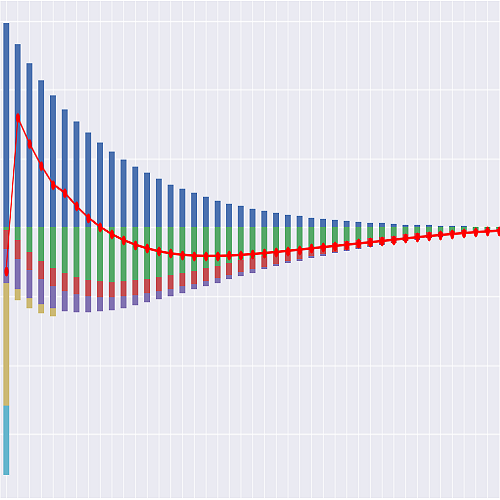
The shape to expect on the anchor cell is the product’s economic story in three phases. Month 0 is
−710,11 €, almost all of it the 25 ‰ Zillmerung allowance charged in one go —
expenses(0) = 770,380907 + 2,000000 + 1,925952 = 774,306859 € against a 64,20 € instalment. From
t = 1 the contract runs positive, the level Beitrag far above the risk premium, the monthly
margin decaying from 59,93 € to 3,45 € by age 65. net_cf crosses zero between t = 251 and
t = 252, attained age 66, and the last three decades are run-off: annuity outgo peaks at
49,82 € in month 407 (age 78) and the population in care at 0.092120 in month 417 (age 79).
Undiscounted the contract collects 15 857,95 € and pays 17 385,60 €, for −1 527,65 € — not a
loss but the consequence of publishing an undiscounted stream whose income falls thirty years
before its outgo. That crossing is where the Deckungskapital this model does not compute peaks,
and it is the whole economic content of an ageing reserve on a life chassis.
expenses is acquisition and administration only. The Leistungsbearbeitungskosten are
claim_expenses, a separate column because they scale with annuity payments made rather than
with policies: a Pflegegrad 1 life on delib_std generates none, and neither does a life inside
its Karenzzeit. Its level is low, and that is a product fact rather than optimism — the
Pflegegrad is determined by the Medizinischer Dienst or MEDICPROOF and not by the insurer R6,
so the Nachprüfung is documentation rather than the adversarial re-assessment that drives a
Berufsunfähigkeitsrente’s claims cost REG-R29.
Naming#
Cells follow lifelib’s basiclife/BasicTerm_S and savings/CashValue_SE wherever those models
have an analogue: pols_* for policy counts, plural nouns for cash flows, *_rate for annual
rates with *_rate_mth for their monthly equivalents, *_pp for per-policy amounts,
claims(t, kind) with an uppercase kind string, pols_if_at(t, timing) for the end-of-month
read, and check_*() / check_*_resid(t) for the identities. The technical notes use compact
actuarial symbols; the full mapping lives in the Projection Space docstring. The monthly
multi-state biometric chassis is shared with frlib’s Dep_FR_S (assurance dépendance) and,
inside this library, with BU_DE_S — three models that are not interchangeable, and whose
differences are worth naming rather than glossing:
This model |
|
|
Note |
|---|---|---|---|
|
|
|
The ledger dimension differs: a Pflegegrad here, a two-level French severity there, a claim-duration cohort in BU. Only this model’s is a benefit schedule |
|
|
— |
Both run from inception; the French one forks by cause of onset. |
|
in-claim revalorisation |
|
The escalation of the annuity in payment |
|
|
|
Impaired-life mortality by state; only this model states it as a multiple of the active force. |
|
same names |
same names |
The three identities mean the same thing on all three models |
Six names needed care:
Notes |
Cells |
Why |
|---|---|---|
|
|
The same population counted two ways: a head count and an escalation-weighted value. The annuity is weighted on the second and never on the first |
|
|
In force, in force inside the premium term, waived, and paying. |
|
|
The active-life table rate and the in-care rate derived from its force. Publishing one rate for both states is the error the pair exists to prevent |
|
|
The table rate, which stays tariff-comparable at every age, and the force the Wartezeit gates to zero |
|
|
Onsets and graduations out of the Karenz ledger. Equal when |
|
|
The Stornoabzug is a fraction here, so it takes the |
policy_id, duration_mth(t) and pols_if_init() drive little or nothing here and are exposed as
documented cells rather than dropped: a silently missing column is worse than an inert one.
Standardizations used#
Everything in this table is std. The product is unusually std-heavy, which is correct
rather than a defect: the mechanics are established and cited above, and it is only the levels
that no retrievable document supplies. After the provenance pass of 2026-08-30, four of these
rows now have a published comparator — the Leistungsstaffel, the first-order margins, the
incidence slope and the Stornoabzug implied by surrender_table.csv’s companion parameter. Every
one of them is recorded in the Basis column and none was changed: these are pricing inputs, and
moving one moves the worked example and the golden tests with it.
Standardization |
Value |
Rationale |
|---|---|---|
Leistungsstaffel |
0 / 30 / 50 / 75 / 100 % |
Inside the observed 0–10 / 10–30 / 30–50 / 60–75 / 100 % market range |
Vereinbarte Pflegerente |
1 000,00 € a month |
The round number at the lower end of the 1 000–1 500 € the market sells |
Active-life mortality |
Gompertz |
DAV 2008 T and the DAV 2008 P active-life table are DAV property and are not shipped R15 R16. The anchors are what a replacement must preserve, not the functional form |
Incidence |
|
DAV 2008 P is not shipped R15. The slope is anchored on prevalence doubling every five years above 75, |
|
0.20 / 0.38 / 0.24 / 0.13 / 0.05 |
Entrants skew lower than the stock, which Destatis puts at 13,8 / 40,4 / 29,6 / 11,8 / 4,3 % for end-2023 R18 — this table previously quoted 9 / 44 / 27 / 14 / 6 % — because deterioration moves people up over a spell. Using the stock as the entry mix is a listed pitfall, and the model’s own stock share at grades 4 and 5 (21,0 % and 17,6 %) exceeding the entry share is the arithmetic statement of it. No source supplies an entry mix or a per-grade sojourn time [S14] |
|
0.28 / 0.24 / 0.20 / 0.16 / 0.00 and 0.10 / 0.06 / 0.04 / 0.02 / 0.01 a year |
Deterioration dominating recovery is property (b) a replacement must preserve. Levels are construction; there is no age-at-onset dimension, which a real Pflegetafel has |
Recovery damping |
|
Encodes the one thing about Reaktivierung not in doubt: real after acute events at younger ages, small at the ages where most claims arise R6 |
|
1.5 / 2.5 / 3.5 / 6.0 / 9.0 on the force |
Carries the research file’s order of magnitude — two to three times an active life at grade 2, five to ten at grade 5 |
Terminal age |
|
A modelling choice, not a table fact — the DAV tables run higher. It buys a closed system: |
Monthly step |
constant forces over the month, exits allocated in proportion to them |
One convention applied uniformly to mortality, incidence, deterioration, recovery and lapse. |
Processing order |
classify → collect Beitrag → pay Rente → start-of-month expenses → transitions → advance the Karenz clock → lapse last, on the survivors of the insured decrements and the reactivation inflow |
Both orderings close |
Lapse table |
6,0 % falling to 1,5 % by year 21, active state only, zero after the premium term |
No lapse rate for a German Pflegerente at any duration was established. The shape is argued from the Zillmerung; nothing in care lapses, because a claimant with a waived premium has no premium to default on and a live annuity to forfeit |
Rückkaufswert table |
0 / 0 / 0.05 / 0.12 / 0.20 of premiums paid, rising to 0.70 by year 40 |
The shape encodes the 25 ‰ Zillmerung allowance REG-R16 and the § 169 Abs. 3 five-year spread REG-R28; no level was established. Whether a pure-risk Pflegerente falls inside § 169 at all is an open question the library states rather than assumes away — § 169 Abs. 1 owes the value where “der Eintritt der Verpflichtung des Versicherers gewiss ist”, and the one carrier’s wording retrieved grants it anyway R11 [S4]. The companion |
|
85 |
A lifelong-premium contract has no finite Beitragssumme without a convention. The ceiling the per-mille sits at is cited REG-R16; the base it is struck on is not |
Expense levels |
25 ‰ once, 3,0 % of premium, 2,00 € a month inflating at 1,5 %, 1,50 € per annuity payment |
No charge level of any kind was established for any German Pflegerenten tariff. The acquisition rate sits exactly at the § 4 DeckRV ceiling so the ceiling binds visibly; the rest are placeholders, and the instalment loading is folded into |
First-order margins |
incidence × 1.25, deterioration × 1.15, recovery × 0.80, in-care mortality × 0.85, active mortality × 0.90, no lapse |
The direction is cited REG-R8 REG-R47, and prudence forks by risk: more claims, faster progression, fewer recoveries, longer annuities, and more active lives surviving to claim. Published levels do exist and this table used to say they did not: the DAV’s Gesamtzuschlag on incidence runs 24,5 / 21,4 / 20,5 / 24,0 / 31,2 % by minimum Pflegegrad, its Gesamtabschlag on Invalidensterblichkeit 28,5 / 24,2 / 24,2 / 24,3 / 25,7 %, and on Aktivensterblichkeit 13,6 % R15 REG-R8. |
|
0.50 |
Sex may not enter a premium concluded from 21 December 2012 REG-R34. Pricing a 50 / 50 mix while writing 60 / 40 is a named model risk — the mismatch is the cross-subsidy, and the mix is endogenous to the price |
|
1,00 % a year |
§ 2 Abs. 1 DeckRV, “wird der Höchstzinssatz … auf 1 Prozent festgesetzt”, read from the consolidated regulation whose |
No Ratenzahlungszuschlag |
— |
The consequence runs the wrong way and is stated rather than hidden: annual mode prices very slightly below monthly here, through the discounting alone, which is the opposite sign to a real German tariff |
Age basis |
age last birthday advancing at the policy anniversary |
The model carries no dates; a date-based implementation carries a fractional offset of at most one year |
Timing |
Beitrag and Pflegerente both in advance; surrender and death benefits at the end of the month |
German Renten are monatlich vorschüssig, and paying in advance puts the annuity on the same weight as the premium it replaces, which is what lets |
The fourteen model points |
— |
Configuration rather than observation: no rate card, no commercial envelope and no carrier wording was obtained for this product |
The only quantities that are not standardizations are the structural rules and two cited
numbers: the Pflegegrad trigger and its five-grade scale, thresholds 12,5 / 27 / 47,5 / 70 / 90 and
module weights 10 / 15 / 40 / 20 / 15 % read from § 15 SGB XI R2 REG-R51; the Beitragsbefreiung
running with the annuity [S4]; the level Beitrag adjustable only under § 163 VVG R11 REG-R27;
the unisex rule REG-R34; the § 169 VVG surrender frame R11 REG-R28; the 25 ‰
Höchstzillmersatz of § 4 Abs. 1 DeckRV R13 REG-R16; and the 1,00 % Höchstrechnungszins of
§ 2 Abs. 1 DeckRV R13 REG-R14 REG-R15. The bahr grid’s 10 / 20 / 30 / 40 / 100 % has been
struck off that list: § 127 SGB XI fixes no percentage schedule, only a Geldleistung at every
grade with a 600 € floor at grade 5 and a ceiling at the SGB XI benefit level, so the shipped bahr
schedule is a market convention and is std like the rest R8.
Tests#
tests/test_pflegerentenversicherung_de.py asserts the fourteen printed rows of the notes’ worked
example to the cent and the policy counts to six decimals, the full-precision totals against the
sum-of-rounded-cells the notes also print, the equivalence premium of 64,198409 € reached two
independent ways from A, U, G and C, month 0 rebuilt term by term, the first month’s
decrements from the annual rates through the forces, the first annuity payment grade by grade, the
closure identity, the shape of the frame — proj_len() == 780 on the anchor cell, index
range(0, proj_len()), last index proj_len() - 1, 780 rows — the male twin’s ten printed rows and
totals, the four-cell variant table, the six
check_* identities with their residuals, and one test per numbered modeling pitfall —
seventeen of them. The whole-model-point-table sweep is not here:
tests/test_model_conventions_de.py owns the library’s single sweep.
python -m pytest lifelib/libraries/delib/tests/test_pflegerentenversicherung_de.py -q
python -m pytest lifelib/libraries/delib/tests/test_model_conventions_de.py -q -k Pflege_DE_S