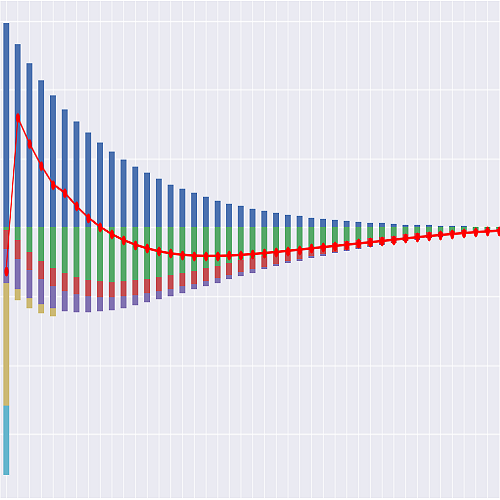
The Projection Space#
The by-policy projection of the Index_DE_S model.
The Space is parameterized by point_id, so Projection[1] is an ItemSpace
projecting model point 1:
>>> Projection[1].result_cf()          # the worked example's anchor cell
>>> Projection.point_id = 8            # or switch the default
Two clocks: a monthly frame over an annual Indexjahr
t counts policy months from issue, 0-based. proj_len() = 12 x proj_len_y() is
the exclusive end of the frame, with proj_len_y() = ann_start_age - entry_age the
number of policy years, so result_cf().index[-1] == proj_len() - 1 and the frame of an
in-force point at dur_init = 8 has 228 rows while still reporting proj_len() = 324.
A new-business point starts at t = 0; an in-force point starts at
t = t_start() = 12 x dur_init, because t is counted from the policy’s own inception
and not from the valuation date.
Almost nothing on this product is monthly, and the argument of a cells says which clock
it is on. Cells that state an annual construction take a 0-based policy year k:
the premium and all three of its charges, the Deckungskapital and its § 169 Abs. 3
shadow, the whole Indexjahr — Cap, Partizipationsquote, the sum of the twelve capped
returns, the Indexrendite and the Indexgutschrift — the option budget and the safe-arm
credit, the Höchststandsicherung ledger, the guaranteed capital, the death benefit, the
surrender value and the maturity benefit. Cells that state a month take t: the in
force, the two decrements, the claims, the expenses and every result_cf() column.
duration(t) = t // 12 is the bridge, policy_year(t) = duration(t) + 1 is the
contractual 1-based label, age(t) = age_y(duration(t)) steps on the anniversary, and
is_anniv(t) = (t % 12 == 11) marks the month the annual machinery acts in.
The one place the finer grid earns its keep is the *Indexjahr* itself. Its twelve
monthly returns were already the mechanic and were already read month by month — but only
inside a single cells, invisible from the frame. index_month(t),
index_return_mth(t) and index_return_capped_mth(t) now put them on the frame, one
row each, so the asymmetry the product turns on — capped above, not floored below — can
be read off month by month instead of inferred from a year’s sum. What that cannot change
is the settlement: index_credit_pp(k) is struck at the year end and nowhere inside
it, because that is the contract.
The decrement rates keep the library’s two speeds: mort_rate(t) and lapse_rate(t)
return the annual rate of the policy year, and mort_rate_mth(t) and
lapse_rate_mth(t), each 1 - (1 - r)^(1/12), are what the recursion applies. Twelve
of each compound back to the year, which leaves the whole annual layer bit-identical to
the annual-step model this replaced, on all thirteen model points: the account, the ledger,
the guaranteed capital, every Indexgutschrift, the surrender value and premium income are
unchanged. What moved is the split of a year’s exits between death and surrender, now
competing month by month rather than in one fixed annual order, and the expenses, which a
policy leaving mid-year now bears only for the months it was there.
At the end of month proj_len() - 1 the accumulation contract ends: the capital falls
due at Rentenbeginn as claims(12n - 1, "MATURITY"), and whether it is taken as a
Kapitalabfindung or converted at the Rentenfaktor changes what is reported, not
the cash flow. The Rentenphase itself is products/sofortrente/.
Two frames, and the third
result_cf() is the monthly cash flow statement and carries the five flows that
cross the contract boundary. result_cf_annual() sums it into policy years.
result_index() is the annual state behind both — the Indexjahr, the three
credits, the account, the ledger and the guaranteed capital — indexed by the 1-based
policy_year. The account movements live there and not in the cash flow statement:
they move once a year, and a statement whose columns do not all sum to its bottom line is
one a reader has to know which columns to skip.
Input data
Inputs are external files: plain CSVs living in the model folder’s parent directory,
products/indexpolice/, read at run time rather than stored inside the model. The
model folder therefore holds nothing but formulas — no _data/, no IOSpec, no embedded
values — so a diff of the model shows logic changes only, and an input can be edited or
swapped without rewriting the model. This follows annuallife.TradLife_A; contrast
basiclife.BasicTerm_S, which keeps its inputs inside the model.
The consequence worth knowing: the model is not portable on its own. Copying the
Index_DE_S folder without its parent’s CSVs produces a model that reads and then
fails on first evaluation.
Each table has a filename Reference and a reader Cells, both on
Data, reached here through the data Reference:
Reference |
Cells |
File |
|---|---|---|
model_point_file |
data.model_point_table() |
model_point_table.csv |
index_return_file |
data.index_return_table() |
index_return_table.csv |
index_param_file |
data.index_param_table() |
index_param_table.csv |
surplus_rate_file |
data.surplus_rate_table() |
surplus_rate_table.csv |
election_file |
data.election_table() |
election_table.csv |
mort_file |
data.mort_table() |
mort_table.csv |
lapse_file |
data.lapse_table() |
lapse_table.csv |
freq_load_file |
data.freq_load_table() |
freq_load_table.csv |
Naming
Cells names follow lifelib’s basiclife.BasicTerm_S and savings.CashValue_SE
wherever those models have an analogue — pols_* for policy counts, av_pp and
av_pp_at(t, timing) for the account value and its within-year reads, plural nouns for
cash flows, *_rate for rates, *_pp for per-policy amounts, claims(t, kind)
with an uppercase kind string. The technical notes use compact actuarial symbols
instead. The mapping is:
Notes symbol |
Cells |
Meaning |
|---|---|---|
(none) |
model_point() |
The selected model point row |
n = ann_start - entry |
proj_len_y() |
Number of projected policy years; last one is n - 1 |
12 n |
proj_len() |
Exclusive end, in months |
t0 = 12 dur_init |
t_start() |
First projected month |
k0 = dur_init |
k_start() |
First projected policy year |
(none) |
duration_mth(t) |
Elapsed policy months, = t |
k(t) |
duration(t) |
0-based policy year of month t |
t + 1 (contractual) |
policy_year(t) |
1-based policy year label |
(none) |
is_anniv(t) |
Last month of a policy year |
m(t) |
index_month(t) |
Month of the Indexjahr, 1-12 |
x(k) |
age_y(k) |
Attained age in policy year k |
x(t) |
age(t) |
The same, read at a month |
l(t) |
pols_if(t) |
In force at the start of month t |
l(t)(1-q), l(t+1) |
pols_if_at(t, timing) |
BEF_DECR / AFT_DEATH / AFT_LAPSE |
(year end) |
pols_surv_year_end(k) |
Survivors the Indexjahr credit is given to |
q_d(t) |
mort_rate(t) |
Annual death rate |
q^m_d(t) |
mort_rate_mth(t) |
The monthly rate applied |
w_l(t) |
lapse_rate(t) |
Annual surrender rate applied |
w^m_l(t) |
lapse_rate_mth(t) |
The monthly rate applied |
(table) |
lapse_rate_base(t) |
The table rate before the terminal-year override |
phi |
freq_load() |
Ratenzahlungszuschlag |
P_b(k) |
prem_base_pp(k) |
Annual-mode premium due |
P(k) |
prem_gross_pp(k) |
Premium actually collected |
(none) |
prem_due(t) |
Whether P falls due in month t |
BS |
prem_sum() |
Beitragssumme |
alpha(k) |
prem_charge_acq_pp(k) |
Acquisition charge, tariff |
alpha_5(k) |
prem_charge_acq_min_pp(k) |
The same on the 5-year spread |
beta P(k) |
prem_charge_adm_pp(k) |
Premium administration charge |
P+(k) |
prem_to_av_pp(k) |
Premium credited to the account |
Pi(k) |
prem_paid_pp(k) |
Cumulative annual-mode premium |
A(k) |
av_pp(k) |
Deckungskapital at the start |
(within year) |
av_pp_at(k, timing) |
BEF_PREM / AFT_PREM / AFT_CHARGE / AFT_GUAR / AFT_CREDIT |
gamma, F(k) |
exp_av_rate, av_charge_pp(k) |
Reserve charge rate; amount |
i_g, I(k) |
guar_rate(), guar_int_pp(k) |
Rechnungszins; guaranteed interest |
(shadow) |
av_min_pp(k), av_min_pp_at(..) |
The 169 Abs. 3 account |
G(k) |
index_base_pp(k) |
Participating capital of the Indexjahr |
b(k) |
surplus_rate(k) |
Declared Ueberschussanteilsatz |
w(k) |
elect_index(k) |
Fraction elected to the index |
B(k) |
opt_budget_pp(k) |
Option budget, spent |
U(k) |
surplus_credit_pp(k) |
Safe-arm credit |
r(k,m) |
index_return(k, m) |
The month’s index return |
r(t) |
index_return_mth(t) |
The same, read at a month |
C(k), q(k) |
index_cap(k), index_quote(k) |
Monthly Cap; Partizipationsquote |
min(r, C) |
index_return_capped(k, m) |
Capped above, not floored below |
min(r, C) |
index_return_capped_mth(t) |
The same, read at a month |
S(k) |
index_sum(k) |
Sum of the twelve capped months |
Y(k) |
index_return_year(k) |
Compounded raw year return |
rho(k) |
index_credit_rate(k) |
The Indexrendite |
X(k) |
index_credit_pp(k) |
The Indexgutschrift |
(diagnostic) |
index_budget_ratio() |
Credits over budget |
K(k) |
credit_cum_pp(k) |
Hoechststandsicherung ledger |
guar_level Pi(k) |
guar_floor_pp(k) |
The Beitragsgarantie |
Gamma(k) |
guar_cap_pp(k) |
Guaranteed capital |
D(k) |
db_pp(k) |
Death benefit |
V(k) |
cv_pp(k) |
Surrender value |
(169 Abs. 3) |
min_surr_pp(k) |
Minimum surrender value |
(Stornoabzug) |
surr_charge_pp(k) |
Surrender charge |
M(n-1) |
mat_pp(k) |
Benefit at Rentenbeginn |
claims_death, … |
claims(t, kind) |
Benefit outgo by kind |
(released) |
av_released(k) |
Account taken out by the exits |
E(t) |
expenses(t) |
Insurer expense outgo |
net_cf(t) |
net_cf(t) |
Net cash flow, income positive |
liability_cf(t) |
liability_cf(t) |
The same stream, outgo positive |
Charges and expenses are two different things
A charge is a deduction from the policyholder’s Deckungskapital
(prem_charge_acq_pp, prem_charge_adm_pp, av_charge_pp); an expense is the
insurer’s own cash outgo and appears in net_cf (exp_acq_pp, exp_maint_pp).
They are of the same order here by construction, so the Kostenüberschuss is small. The
model does not close the MindZV loop — it does not compute a cost result, return half
of it to the policyholder and raise the declared rate — so changing an expense assumption
changes net_cf without changing what the policyholder receives. That is a stated
limitation of the reference implementation, not an oversight.
The two steps that define the product
Step 2 of the annual processing order: the participating base is struck on the
opening balance, index_base_pp(k) = av_pp(k), before the year’s premium. That
is why a new-business point credits nothing in its first year k = 0 however well the
index does, and it is a [std] reading — whether the base is the whole Deckungskapital, an
index-participating sub-account or the accumulated Überschussguthaben alone was not
established, and a different reading rescales every credit in the model.
Step 12: the credit lands at the end of the *Indexjahr* and goes to the
survivors, pols_surv_year_end() — the opening cohort of the year less every death
and every surrender in any of its twelve months — while the premium, the charges and the
guaranteed interest are struck on the year’s opening in-force pols_if(12k). The
decrementing lives paid the premium and earned the guaranteed interest before they left;
they did not see the Indexjahr out. av_released(k) is the account those exits carry
out of the fund, and it exists as a cells precisely so that check_av_roll_fwd() is exact
rather than approximate.
The asymmetry that follows is the product’s own rule, and a model that pays two exits at
the same instant the same amount has lost it: death and surrender are struck on
av_pp_at(k, "AFT_GUAR"), the account before the year’s credits, because a
mid-year exit forfeits the running Indexjahr [std]; the maturity is struck on
av_pp(n), including them, because that contract ran the Indexjahr to its
end, and it is then floored at the Beitragsgarantie plus the whole locked-in ledger.
The monthly grid dates that forfeiture. On the annual grid every exit fell at a year end and the forfeiture was a statement about an amount; here a surrender in month 7 of an Indexjahr is a row of the frame, and the incentive the product carries — to surrender just after a year closes rather than just before — is visible in the projection rather than only in prose. What the grid does not do is pro-rate the payoff: no carrier convention for that was established, so the forfeiture stays a [std] all-or-nothing rule and the monthly grid says exactly when it bites.
What is deliberately not here
No unit account, unit price or fund value — the capital is in the Sicherungsvermögen and the surrender value is a reserve. No Beitragsfreistellung sub-population: German lapse is a three-way decrement and this model carries surrender only. No Dynamik, no Zuzahlungen, no Rentengarantiezeit, no Schlussüberschussanteil and no Bewertungsreserven share. No dynamic surrender: on this contract the account cannot fall from the index, so the usual driver is absent, and the driver that is present — a run of zero Indexjahre — has no published calibration, so inventing one would put a large unevidenced number at the centre of the result. No discounting, no Deckungsrückstellung, no Zinszusatzreserve, no technical provisions and no tax.
Cells Descriptions#
- sex()[source]#
"M"or"F": the row of the best-estimate mortality table to read.Never a rating factor. Sex may not enter a premium, a charge or a benefit in a contract written after 21 December 2012, and none of them depends on it here; it selects a decrement only. Because the death benefit of this product is the account value with a floor rather than a sum at risk, mortality is a timing assumption and the choice moves the result very little.
- dur_init()[source]#
Completed policy years at the valuation date; 0 for new business.
The frame starts at
t_start() = dur_init(), becausetis the policy’s own elapsed duration and both are 0-based counts of completed years. An in-force point brings its state with it —av_pp_init,guar_locked_init,prem_paid_init— rather than having it re-derived, which is what makes the in-force cells independent evidence about the recursion rather than a replay of it.
- pols_if_init()[source]#
Policies in force at
t_start(): 1.0, a single-policy model point.Named rather than written as a literal because it is the scale of the roll-forward tolerances and the quantity
result_cf()’s firstpols_ifvalue must equal.
- prem_freq()[source]#
The payment frequency: annual, half_yearly, quarterly or monthly.
It selects the Ratenzahlungszuschlag in
freq_load()and does nothing else.
- guar_locked_init()[source]#
The Höchststandsicherung ledger already accumulated at
t_start().Every credit — index or safe-arm — made before the valuation date. Zero for new business. It is carried separately from
av_pp_init()because the two answer different questions: the account says what the policy is worth, the ledger says how much of it can never be lost.
- prem_paid_init()[source]#
Annual-mode premiums already paid at
t_start(); the base of the guarantee so far.
- guar_level()[source]#
Garantieniveau: the Beitragsgarantie as a fraction of the Beitragssumme.
The wrapper sets the floor, not the index module: a Schicht 3 contract may be sold at 60 %, 80 %, 90 % or 100 %, while a Riester contract must guarantee 100 % of contributions and allowances by statute. Every euro of guarantee not promised is a euro that can back risk assets and therefore a larger option budget — a feedback this model does not carry, so the Garantieniveau sensitivity it reports is only the maturity-floor effect.
- guar_rate()[source]#
i_g: the contract’s Rechnungszins, a cohort fact and not today’s rate.The Höchstrechnungszins history the shipped points span — 1.00 % for 2025-2026, 0.90 % for a 2017-2021 cohort, 0.25 % for 2022-2024 — is why a book of this product cannot be projected on one rate. At 0.25 % the rate equals the reserve charge and the account falls in a year that credits nothing, which is model point 13.
- payoff_form()[source]#
"cap"(the monthly Cap design) or"quote"(the Partizipationsquote).The two designs are not interchangeable and fail differently: the Cap gives away the large monthly moves and is hurt by volatility even in a year that ends well, while the Quote gives away a constant fraction in every state. Model points 1 and 2 run them on the identical index path so the difference is visible rather than argued.
- death_min_rate()[source]#
The Mindesttodesfallschutz floor on the death benefit, as a fraction of
BS.0.50 on the shipped points that carry it: the standard formulation of the condition that a contract concluded from 1 April 2009 must satisfy for the favourable half-income treatment of a Kapitalabfindung. It is a floor on the benefit and never a sum at risk added to it.
- ann_option()[source]#
"annuity"or"cash": how the terminal capital is reported.It changes
ann_monthly_pp()and nothing else. The Kapitalwahlrecht is a configuration of the model point, not a take-up rate: modelling it as a rate would stand in for a tax comparison this model does not perform.
- surr_charge_on()[source]#
1 if the contractual Stornoabzug applies to this policy, 0 if not.
A Stornoabzug is effective only if it is agreed, appropriate and quantified in the contract, so a tariff without the clause is a real configuration and not a special case.
- k_start()[source]#
k0: the first projected policy year,dur_init()— the elapsed years.New business starts at 0; an in-force point starts partway through its own term, at the count of policy years it has already completed. Every annual construction in this model — the premium and its charges, the account, the Indexjahr, the Höchststandsicherung ledger, the death benefit and the surrender value — is defined from here.
- t_start()[source]#
t0: the frame’s first month,12 x k_start().dur_initis an elapsed count of policy years, so the conversion is a multiplication and no model point column changed. The frame’s start is a product fact and is not fixed per model, which is why the conventions suite asserts contiguity and the last index rather than the first.
- proj_len_y()[source]#
n: the number of projected policy years,ann_start_age() - entry_age().Policy year
n - 1is the last and ends at Rentenbeginn, at timen, when the capital falls due. There is no policy yearn: the whole surviving cohort has matured, whileav_pp(n)andguar_cap_pp(n)are defined, being the time-nper-policy amounts the maturity benefit is struck on.
- proj_len()[source]#
The exclusive end of the frame, counted in policy months:
12 x proj_len_y().The library’s reading of
proj_len()and lifelib’s own:result_cf()coverst = t_start() ... proj_len() - 1, soresult_cf().index[-1] == proj_len() - 1. It is not the row count of an in-force point — one atdur_init = 8publishes 228 rows and still reports 324.
- duration_mth(t)[source]#
The number of complete policy months elapsed at the start of month t:
titself.Published rather than inlined because it is the name the rest of the library uses for the elapsed-month count, and because a model whose frame starts partway through a contract must say once, in one place, that
tis counted from inception and not from the frame’s own start.
- duration(t)[source]#
k(t): the 0-based policy year month t falls in,duration_mth(t) // 12.The bridge between the two clocks. Everything annual on this product — the premium, the account, the whole Indexjahr, the ledger, the guarantee, the death benefit and the surrender value — takes this
k; the in force, the decrements, the claims and the expenses taket.
- is_anniv(t)[source]#
Whether month t is the last month of its policy year:
t % 12 == 11.The month the annual machinery acts in: the Indexjahr closes, the Indexgutschrift is struck and locked in, the safe-arm credit is made and the account rolls to its next opening balance.
- policy_year(t)[source]#
The contractual, 1-based policy year of month t:
duration(t) + 1.Derived and never indexed by; the input tables that are keyed by duration are keyed on the 0-based
duration(t)instead, which is what they were already keyed on.
- index_month(t)[source]#
m(t): which month of its Indexjahr month t is, 1-based:t % 12 + 1.The Indexjahr is aligned with the policy year [std], so month 1 opens on the anniversary and month 12 closes on the next one. This is the column of index_return_table.csv that month t reads — see
index_return_mth()— and it is the one thing the annual grid could not name: the twelve capped returns were a sum computed inside a single row, and they are now twelve rows of the frame.
- age(t)[source]#
x(t): the attained age in month t,age_y(duration(t)).Age last birthday stepping on the policy anniversary, the basis the delib registry fixes for the whole library: the monthly grid does not refine it, and a model that stepped the age monthly would read a mortality rate the table does not publish.
- prem_sum()[source]#
BS: the Beitragssumme, on the annual-mode premium.prem_gross_pp x prem_term_yon the level form and the single premium itself on the single form — the premiums payable over the whole contract, counted from issue and not fromt_start(), because a Beitragssumme is a contract fact that an in-force point brings with it.The Ratenzahlungszuschlag does not enter it. A frequency surcharge is the price of paying in instalments, not more insurance bought, so it may not inflate the acquisition charge or the Mindesttodesfallschutz floor: on model point 4 the premium collected is 2,520.00 EUR a year while
prem_sum()is 2,400.00 x 32 = 76,800.00 EUR. Getting that wrong is a numbered pitfall.
- freq_load()[source]#
phi: the Ratenzahlungszuschlag multiplier for this policy’s payment frequency.1.000 annual, 1.020 half-yearly, 1.030 quarterly, 1.050 monthly [std] — the market convention, no carrier tariff having been established. It multiplies the premium collected and nothing else; see
prem_sum().
- prem_base_pp(k)[source]#
P_b(k): the annual-mode premium due in period k, per policy.The level form pays
prem_gross_ppin the firstprem_term_y()policy years, i.e. atk < prem_term_y(), which may be shorter than the projection — model point 13 stops paying after policy year 12 (k = 11) and runs to policy year 22. The single form pays the whole premium in the first projected period and nothing afterwards.
- prem_gross_pp(k)[source]#
P(k): the premium actually collected in period k,P_b(k) x phi.Annual in advance, at the start of the policy year. This is the amount that reaches
premiums()and out of which the contractual charges are taken; the amount that drives the Beitragssumme isprem_base_pp().
- prem_charge_acq_pp(k)[source]#
alpha(k): the acquisition charge deducted from the premium in period k.min(acq_cost_rate, zill_cap_rate) x BSspread evenly over the firstmin(zill_years, prem_term_y())premium-paying years, i.e. overk < spread— 2.5 % of the Beitragssumme at the DeckRV Höchstzillmersatz of 25 per mille, over five years, so 324.00 EUR a year on the anchor’s 64,800.00 EUR. On a single premium it is taken in full in the first projected period, there being only one premium to take it from.This is a charge, a deduction from the policyholder’s account. The insurer’s own acquisition expense is
exp_acq_pp(), falls in one lump at inception, and is the Zillmer strain the five-year recovery works off.
- prem_charge_acq_min_pp(k)[source]#
alpha_5(k): the same charge on the five-year spread of § 169 Abs. 3 VVG.Acquisition and distribution costs must be spread over at least the first five years for the purpose of the Mindestrückkaufswert, whatever the tariff does — so this profile is written with the literal 5 and not with
zill_years, which is a tariff parameter and not a statutory one. Withzill_years = 5the two coincide exactly and the floor is a no-op, which is the point: delib’s charge profile is already at the statutory floor. Setzill_years = 1and the floor bites.A single premium is taken once, so there is no second premium over which to spread anything and the two profiles coincide there by construction rather than by parameter.
- prem_charge_adm_pp(k)[source]#
beta P(k): the premium-based administration charge, 3 % of the premium collected.Verwaltungskosten taken as the premium is credited. [std]: no German insurer publishes a charge level for this product.
- prem_to_av_pp(k)[source]#
P+(k): the part of the premium credited to the account.P(k) - alpha(k) - beta P(k). On the anchor’s first five years that is2,400.00 - 324.00 - 72.00 = 2,004.00 EUR, and 2,328.00 EUR thereafter. Negative values are possible in principle on a tariff whose charges exceed the premium; none of the shipped points is one.
- prem_to_av(k)[source]#
The premium credited to the account at fund level:
P+(k) x l(k).Struck on the opening in-force of the policy year,
pols_if(12k), because the lives that decrement during the year have already paid the year’s premium in advance.
- prem_paid_pp(k)[source]#
Pi(k): cumulative annual-mode premiums paid to time k, the start of period k.Starts at
prem_paid_init()and addsP_b(k)each year, soPi(n)— the value at Rentenbeginn — is the whole Beitragssumme for a policy that pays throughout. Non-decreasing by construction, which is half of whyguar_cap_pp()is monotone.
- prem_due(t)[source]#
Whether the year’s premium falls due at the beginning of month t.
duration_mth(t) % 12 == 0— the first month of each policy year and no other. The Beitrag of this tariff is payable in advance for the Versicherungsperiode, which is the year (§ 12 Abs. 1 VVG), and the Indexjahr the whole product turns on is struck on the balance standing at the anniversary: splitting the premium without splitting the Indexjahr would credit a policy with a year it did not pay for. The Ratenzahlungszuschlagfreq_load()is what a sub-annual Zahlweise costs, and it remains the whole of what the Zahlweise does here.
Premium income in month t, an inflow:
P(k) x l(t), or zero.Non-zero only where
prem_due()makes the year’s premium payable, so the count is the in-force at the start of the policy year and premium income is bit-identical to the annual-step model this replaced. Not further multiplied by(1 - q_d): decrements fall at the end of a month, so a life that dies in the first month of a policy year has paid that year’s premium.
- surplus_rate(k)[source]#
b(k): the declared Überschussanteilsatz for period k.2.50 % a year of
G(k), level over the projection [std]. This rate is the option budget. The insurer earns a return on the Sicherungsvermögen, the MindZV forces at least 90 % of the excess over the guarantee into the policyholders’ share, the insurer declares a rate out of that, and a contract in the index arm has the declared amount spent on options instead of credited as interest. An Indexpolice therefore has exactly the same risk budget as a classic contract of the same vintage and spends it differently.Holding it level is the strongest single simplification in this model: in reality the rate moves with the investment result, and the feedback from the Garantieniveau through the asset mix to the declared rate is not modelled at all.
- elect_index(k)[source]#
w(k): the fraction of year k’s declared surplus directed to the index arm.The Wahlrecht, read from this policy’s election path. A fraction in [0, 1] rather than a flag, because some tariffs permit a partial election and all-or-nothing is then the special case
w in {0, 1}. It is a behavioural assumption and not a contractual one: whether real policyholders revisit the election at all is not established, andalways_indexis a modelling choice made so that the base run demonstrates the index mechanic rather than a claim about behaviour.
- index_base_pp(k)[source]#
G(k): the participating capital of Indexjahr k — the opening balance.av_pp(k), struck before the year’s premium and before the year’s charges. Two consequences, both intended: a new-business point credits nothing in its first periodk = 0however well the index does, because the base is zero; and a premium paid during a year participates only from the following one.Whether the base is the whole Deckungskapital, a defined index-participating sub-account or the accumulated Überschussguthaben alone was not established for any carrier. delib takes the whole capital [std]. This is the largest unquantified uncertainty in the product file: a different reading rescales every credit in the model, and it is a documentary gap rather than a modelling choice.
- opt_budget_pp(k)[source]#
B(k): the option budget of Indexjahr k,w(k) b(k) G(k).The money the insurer spends buying the option package that replicates the promised payoff. It is spent, not credited: if the Indexjahr ends at or below zero it has bought options that expired worthless, and that — the opportunity cost of one year’s surplus — is the whole of the policyholder’s downside.
- surplus_credit_pp(k)[source]#
U(k): the safe-arm credit of year k,(1 - w(k)) b(k) G(k).The part of the declared surplus not elected to the index arm, credited to the account as interest and guaranteed from the moment it is credited. Zero throughout on the anchor, which elects the index arm in every year; the whole of the surplus on model point 11, which reduces the contract to a klassische Rentenversicherung.
- pols_surv_year_end(k)[source]#
The policies surviving to the end of policy year k, before any maturity.
pols_if_at(12k + 11, "AFT_LAPSE"): the opening cohort of the year less every death and every surrender in any of its twelve months. This is the population the Indexgutschrift and the safe-arm credit are given to, because both are struck at the end of the Indexjahr and a life that left during it was not there for the payoff.On the annual grid this was
pols_if_at(k, "AFT_LAPSE")and it is the same number: the two decrements compound geometrically, so the count at an anniversary is unchanged. What the monthly grid adds is that the lives which forfeited the year’s credit are now dated — and the forfeiture is a month’s event rather than a year-end lump.
- surplus_credit(k)[source]#
The safe-arm credit at fund level:
U(k) x pols_surv_year_end(k).On the survivors, not on the opening in-force: like the index credit, it is struck at the end of the Indexjahr, and the lives that died or surrendered during the year were not there for it.
- index_return(k, m)[source]#
r(k, m): the index return of month m of Indexjahr k, as a decimal.Read from row
(index_id(), k)of index_return_table.csv, columnm01…m12. The Indexjahr is aligned with the policy year [std]: the contractual Indexstichtag need not fall on the policy anniversary, no carrier’s convention was established, and an annual-grid model has no other defensible alignment.
- index_return_mth(t)[source]#
r(t): the index return of month t, read on the monthly frame.index_return(duration(t), index_month(t))— the same number the annual grid summed inside a single row, now addressable as a row of the frame. It is what the monthly grid buys on this product: the Indexjahr’s twelve months are the mechanic, and until now they were invisible outside one cells.
- index_return_capped_mth(t)[source]#
min(r(t), C(k)): month t’s return capped above and not floored below.The monthly view of
index_return_capped(), so that the asymmetry the product turns on can be read off the frame month by month rather than inferred from a year’s sum. Twelve of these sum toindex_sum(), which is the contract’s formula and is what the test module asserts.
- index_cap(k)[source]#
C(k): the monthly Cap of Indexjahr k.3.00 % on the equity path [std], the midpoint of an argued 1.5-5.0 % band that no carrier document could confirm; 6.00 % on the low-volatility house path, which is cheaper to buy options on. The Cap is fixed before the Indexjahr begins and is then binding for its whole length.
It is not a marketing parameter but the solution of a pricing equation: given the option budget, the index’s implied volatility and dividend yield and the risk-free rate, there is exactly one Cap at which the twelve-month capped-sum payoff costs the budget. That is why caps move from year to year with no change in the contract, and it is why the Cap and
surplus_rate()may not be chosen independently — seeindex_budget_ratio().
- index_quote(k)[source]#
q(k): the Partizipationsquote of Indexjahr k, used by thequotedesign.60 % on the equity path and 100 % on the house path [std]. A participation rate near or above 100 % on a volatility-targeted index is not generosity: it is what the same budget buys when the underlying is engineered to be cheap, and it moves the give-up from somewhere the purchaser can see to somewhere they cannot.
- index_return_capped(k, m)[source]#
min(r(k, m), C(k)): the month’s return capped above and not floored below.The asymmetry is the product, and it must never be softened. A month in which the index rises 8 % contributes
C; a month in which it falls 8 % contributes the whole -8 %. An implementation that floors the month at zero credits something in every year with an up-month in it, and gets the research file’s Example B — where the sum is -2.60 % and the correct credit is nothing — spectacularly wrong.
- index_sum(k)[source]#
S(k): the sum of the twelve capped monthly returns of Indexjahr k.Summed, not compounded. Summation is close to compounding for small numbers and is not the same thing, and the contractual formula is a sum: on the research file’s Example A the twelve capped returns sum to exactly +8.90 % while compounding the same twelve gives 8.9599 %, an error small enough to look like rounding and large enough to be wrong at every duration.
- index_return_year(k)[source]#
Y(k): the compounded raw index return of the year,prod(1 + r) - 1.The uncapped, unfloored movement of the index itself. It drives the Partizipationsquote design and is otherwise a diagnostic — and the diagnostic that matters most, because on the research file’s Example B
Y(9) = +6.4402 %while the Cap design credits zero. The index rose and the credit was nothing; that is the feature the product is most criticised for and the one most often misdescribed.
- index_credit_rate(k)[source]#
rho(k): the Indexrendite of Indexjahr k — the rate the credit is struck at.max(S(k), 0)in the Cap design,max(q(k) Y(k), 0)in the Partizipationsquote design. The floor is on the year, not on the month, and in the Cap design it is on the sum of capped returns and not on the compounded raw return: applying it toYinstead is a numbered pitfall that credits 6.44 % where the contract credits nothing.Never negative: the worst imaginable Indexjahr credits zero and leaves the capital untouched. That floor is what makes this a life-insurance product rather than a bet, and it is the only reason the arm has a positive expectation at all — with a 3 % cap on a 17 %-volatility index the expected value of a capped month is negative.
- index_credit_pp(k)[source]#
X(k): the Indexgutschrift per policy,rho(k) w(k) G(k).Credited at the end of the Indexjahr and locked in: once made it is permanently part of the guaranteed capital, earns the guaranteed rate thereafter like any other part of the Deckungskapital, and enters the base of every later Indexjahr. That is the Höchststandsicherung, and it is what makes a year-by-year floor add up to a path-independent guarantee.
Zero in the first period of a new-business point even when
index_credit_rate(0)is positive, becauseG(0) = 0.
- index_credit(k)[source]#
The Indexgutschrift at fund level:
X(k) x pols_surv_year_end(k).On the survivors of both decrements. A life that died or surrendered during the Indexjahr forfeits it [std]: the payoff exists only at the year end, and whether a carrier pro-rates it, refunds the unspent option budget or simply keeps it was not established. Crediting the year to the lives that left is a numbered pitfall and is caught by
check_av_roll_fwd().
- index_budget_ratio()[source]#
Total index credits over total option budget, per policy, over the projection.
The diagnostic that answers the one question the shipped parameters cannot: are the Cap and the declared surplus rate mutually consistent? They are not free parameters — the Cap is the level at which the option strip costs the budget — so on a long enough path the credits should average the budget and this ratio should sit near 1.
A value far from 1 means the pair is off, and it says which way: above 1 the model is handing the policyholder more than the budget could buy, below 1 it is charging for options it does not deliver. On a single deterministic path the ratio is also sampling noise, so read it as an order-of-magnitude check and not as a calibration. Returns 0.0 where nothing was elected to the index arm, there being no budget to compare against.
- av_pp(k)[source]#
A(k): the Deckungskapital per policy at time k, the start of period k.av_pp_init()atk_start(), thenav_pp_at(k - 1, "AFT_CREDIT"). Defined atk = proj_len_y(), Rentenbeginn, where it is the balance the maturity benefit is struck on.Not monotone, and it must not be asserted to be. What ratchets is the ledger of credits, not the balance: with the reserve charge at or above the guaranteed rate the account falls in a year that credits nothing, which is exactly model point 13’s 0.25 % cohort once its premiums stop. Testing the lock-in as “the account never falls” is a numbered pitfall.
- av_pp_at(k, timing)[source]#
The Deckungskapital per policy at a point inside period k.
"BEF_PREM"A(k), the opening balance — and the baseG(k)the Indexjahr is struck on."AFT_PREM"after the premium net of its charges has been credited.
"AFT_CHARGE"after the reserve charge
gammaon the post-premium balance."AFT_GUAR"after the guaranteed interest
i_g. This is the balance every exit is measured on: a death or a surrender takes the account before the year’s index and safe-arm credits, because a mid-year exit forfeits the running Indexjahr [std]."AFT_CREDIT"after the Indexgutschrift and the safe-arm credit, i.e.
A(k + 1). The maturity benefit is struck here and the two other exits are not, which is the product’s own asymmetry and not a rounding of it.
- av_charge_pp(k)[source]#
F(k): the reserve charge of period k,gammaon the post-premium balance.0.25 % a year of
av_pp_at(k, "AFT_PREM")[std] — Verwaltungskosten taken from the account rather than from the premium. A charge, not an expense: it reduces the policyholder’s Deckungskapital and does not appear innet_cf.
- av_charge(k)[source]#
The reserve charge at fund level:
F(k) x l(12k), on the year’s opening in-force.
- guar_int_pp(k)[source]#
I(k): the guaranteed interest of period k,i_gon the post-charge balance.The Rechnungszins of the policy’s own cohort. This is the only interest an Indexpolice credits in the index arm: the declared surplus is not added on top of it, it is spent. A model that credits the guarantee and the declared rate and the index payoff has spent the same money three times.
- guar_int(k)[source]#
The guaranteed interest at fund level:
I(k) x l(k).On the opening in-force of the policy year, because the decrementing lives earned the year’s guaranteed interest before they left — their benefit is struck on
av_pp_at(k, "AFT_GUAR"), which includes it. That is the one thing the monthly grid deliberately does not refine: the Rechnungszins of this tariff is credited per Versicherungsjahr, and pro-rating it would be a crediting rule no wording states.
- av_at(k, timing)[source]#
The account at fund level at a within-year point:
av_pp_at(k, timing) x l(k).Struck on the year’s opening in-force at every timing, so that the difference between two timings is a movement of the same population. The count changes through the year, and that change is carried by
av_released()rather than by re-weighting the balance.
- av(k)[source]#
The Deckungskapital at fund level at time k:
A(k) x pols_if(12k).Zero at
k = proj_len_y(), the whole surviving cohort having matured — which is whycheck_av_roll_fwd()closes in the final year only if the maturity is accounted for inav_released().A balance, not a cash flow. It is published in
result_index()because a reader cannot follow this product without it, and it is not summed intonet_cf.
- av_released(k)[source]#
The account the year’s exits carry out of the fund in period k.
av_pp_at(k, "AFT_GUAR") x (deaths + surrenders of policy year k) + av_pp(k + 1) x
maturities
: deaths and surrenders take the balance before the year’s credits, maturities take it after them. The exits are counted over the whole policy year, whatever months inside it they fell in, because the balance they carry out is an annual construction — the account of this tariff is defined at anniversaries and nowhere between them.This is deliberately not what the exits are paid. The death floor pays more than the account releases, the Stornoabzug pays less, and the Beitragsgarantie at Rentenbeginn pays more. Those three differences are insurer money and they belong in
net_cf, not in the account roll-forward — which is exactly what makescheck_av_roll_fwd()an exact identity rather than an approximate one.
- av_min_pp(k)[source]#
The shadow Deckungskapital on the statutory five-year acquisition-cost spread.
The same recursion as
av_pp()withprem_charge_acq_min_pp()in place of the tariff charge — the credits are identical, so only the acquisition profile differs. It exists to producemin_surr_pp(), the § 169 Abs. 3 VVG floor under the surrender value, and it is a shadow: it is not the reserve, it is not published in the cash flow statement, and it never touches a death or a maturity benefit.An in-force point starts it at
av_pp_init()for want of a second opening state in the model point table. That understates the floor for a policy whose first five years are behind it, and it is a stated simplification rather than a claim.
- av_min_pp_at(k, timing)[source]#
The shadow account at a point inside period k; timings as
av_pp_at().Identical in structure, so that a reader comparing the two accounts is comparing one number — the acquisition charge — and not two recursions.
- credit_cum_pp(k)[source]#
K(k): the Höchststandsicherung ledger — every credit ever made, cumulated.guar_locked_init()atk_start(), thenK(k) = K(k - 1) + X(k - 1) + U(k - 1). Both index and safe-arm credits enter it, because both are guaranteed from the moment they are credited. Monotone non-decreasing by construction, credits being non-negative.This is the quantity that makes the annual floor add up to something: a plain maturity guarantee lets the insurer recover a bad year with a good one, while here every credited amount is permanent, so the cost of the guarantee rises with every good year. It is also what the Deckungsrückstellung means by “profit shares already allocated”.
- guar_floor_pp(k)[source]#
The Beitragsgarantie accrued to time k, the start of period k.
guar_level() x prem_paid_pp(k)— a fraction of the premiums actually paid so far, so it grows with the premium stream and is complete only once the last premium is in. On the anchor it reaches0.90 x 64,800.00 = 58,320.00 EURatk = proj_len_y().
- guar_cap_pp(k)[source]#
Gamma(k): the guaranteed capital,guar_floor_pp(k) + credit_cum_pp(k).The Beitragsgarantie plus every locked-in credit — the second term dominating after a few good years.
It is owed at *Rentenbeginn* and at no earlier date. That is what Neue Klassik means, and it is the reason the insurer can hold a materially riskier asset mix behind it and generate the surplus that becomes the option budget. A model that reserves this product as though it guaranteed
i_gon the reserve at every balance date overstates the guarantee; a model that letsguar_cap_ppinto a death or surrender benefit has made the same mistake in the cash flows.av_pp(k) < guar_cap_pp(k)at intermediatekis permitted and is ordinary.
- mort_rate(t)[source]#
q_d(t): the annual death rate at the attained age of month t.A [std] Gompertz proxy anchored at
qx(M, 40) = 0.001200; DAV 2008 T and DAV 2004 R are proprietary and are cited by name rather than shipped. Mortality here is a timing assumption: the death benefit is the account value with a floor, not a sum at risk, so the rate decides when capital leaves and hardly at all how much.The annual rate, flat across a policy year because the attained age steps on the anniversary;
mort_rate_mth()is what the monthly recursion applies.
- mort_rate_mth(t)[source]#
q^m_d(t): the monthly death rate,1 - (1 - q_d(t))^(1/12).A geometric twelfth and never
q_d(t) / 12: twelve of it compound back to the year’s rate exactly, which is what leavespols_ifat every anniversary equal to the annual-step model’s and with it the whole account, the Höchststandsicherung ledger and every Indexgutschrift. Dividing by twelve would undershoot and leave a cohort that never quite runs off.
- lapse_rate_base(t)[source]#
The table surrender rate for period t, before the terminal-year override.
5 % in policy years 1-2 (
k = 0, 1), 3 % in policy years 3-11, 6 % in policy year 12 (k = 11), 2 % from policy year 13 [std]; the table is keyed on the 0-based policy year, so the lookup goes throughduration(t)and the twelve months of a year all read the same row. The year-12 step is the § 20 Abs. 1 Nr. 6 EStG threshold, at which only half the Unterschiedsbetrag becomes taxable and at the personal rate rather than by final withholding — the strongest single driver of German surrender behaviour, and the reason a rate flat in duration is a numbered pitfall. The mean over the anchor’s 27 years is about 2.6 %, inside the market-wide GDV band; no index-specific rate exists at all.
- lapse_rate(t)[source]#
w_l(t): the surrender rate actually applied in period t.lapse_rate_base()except through the whole final policy year,duration(t) == proj_len_y() - 1, where it is 0 [std]: that year ends at Rentenbeginn, and the whole surviving cohort is booked as a maturity.Unlike a term product, where the two paid the same nothing, here they pay different amounts — a surrender carries the Stornoabzug and forfeits the running Indexjahr, a maturity carries neither and takes the Beitragsgarantie floor — so this convention moves real money and is a modelling decision rather than bookkeeping. It is the library’s convention, shared with
KLV_DE_SandRLV_DE_S, and the monthly grid does not change it: a within-final-year surrender is now expressible, but no source establishes one, and the zero keeps the final-year cohort a single population with a single benefit.
- lapse_rate_mth(t)[source]#
w^m_l(t): the monthly surrender rate,1 - (1 - w_l(t))^(1/12).A geometric twelfth, for the same reason as
mort_rate_mth(): twelve of it compound back to the year’s rate, so every anniversary count is the annual-step model’s and every Indexgutschrift is struck on the same population it was.
- pols_if(t)[source]#
l(t): policies in force at time t, the start of period t.pols_if_init()att_start(), thenpols_if_at(t - 1, "AFT_LAPSE"), month by month. This is the weight on every cash flow of the sameresult_cf()row, which is what makes it a start-of-month count: no decrement has been applied when a month opens, so the frame opens atpols_if_init()exactly.pols_if(12k)at an anniversary is bit-identical to the annual-step model’spols_if(k), because both decrements compound geometrically and the order inside a month is the annual model’s order inside a year: deaths first, surrenders on the survivors of them. What the finer grid changes is the split of a year’s exits between the two, not their total.pols_if(proj_len())is zero, not the surviving cohort: at the end of the last month the survivors mature and leave throughpols_maturity(). Zero outsidet_start() .. proj_len().
- pols_if_at(t, timing)[source]#
The number of policies in force at a point inside period t.
"BEF_DECR"l(t), the start of the month, before any decrement — the same number aspols_if()and the weight on that month’s cash flows."AFT_DEATH"after the month’s deaths, before surrenders. Death and surrender are sequential and not competing here: the surrender rate is applied to the survivors of death [std], which is the annual model’s own order taken a twelfth at a time.
"AFT_LAPSE"after both, so
l(t + 1)before any maturity. Read at the last month of a policy year it ispols_surv_year_end(), the population the Indexjahr credit is given to; in the final policy year the surrender rate is zero, so that is the maturing cohort.
- pols_lapse(t)[source]#
Expected surrenders in month t, taken from the survivors of the month’s deaths.
Zero through the final policy year, where the survivors leave as maturities instead. A surrender in any month of policy year
kis paidcv_pp(k)and forfeits that year’s Indexgutschrift — the payoff exists only at the Indexjahr end — which is the behavioural asymmetry the annual grid could state but not date.
- pols_maturity(t)[source]#
The cohort reaching Rentenbeginn: the survivors of both decrements at the last month.
Zero in every other month. The name is the library’s — a count whose cover ends at the scheduled end of the contract, whether or not anything is paid for it — and here something very much is paid for it.
- db_pp(k)[source]#
D(k): the death benefit per policy in period k.max(av_pp_at(k, "AFT_GUAR"), death_min_rate() x BS)— the account before the year’s index and safe-arm credits, floored at the Mindesttodesfallschutz fraction of the Beitragssumme.Two things this is not. It is not a sum at risk: the standard Todesfallleistung in the Aufschubphase of a German deferred annuity is a return of the accumulated capital, which is why the Risikoüberschuss is small, underwriting is light and the three-year suicide exclusion is close to inoperative. And it carries no pro-rata index credit: the payoff exists only at the Indexjahr end [std], so a death in month 7 forfeits it.
- min_surr_pp(k)[source]#
The § 169 Abs. 3 VVG Mindestrückkaufswert per policy in period k.
av_min_pp_at(k, "AFT_GUAR"): the account with acquisition costs spread evenly over the first five contract years, so that an early surrender value cannot be extinguished by front-loaded costs. A floor under the tariff value, not a value in its own right.It is a different rule from the DeckRV Höchstzillmersatz with a different function — the DeckRV governs what may be reserved, § 169 VVG what must be paid — and conflating the two is a numbered pitfall. With
zill_years = 5they coincide and this floor is a no-op.
- surr_charge_pp(k)[source]#
The Stornoabzug deducted from the surrender value in period k.
2 % of the floored base [std], applied only where the model point carries
surr_charge_on = 1. A Stornoabzug is effective only if it is agreed, appropriate and quantified in the contract; one carrier’s retrieved structure in the sibling research was a 5 % base deduction plus a capital-market-dependent component, and the observed band runs from 0 % to 20 %, so 2 % is a deliberately mild [std].
- cv_pp(k)[source]#
V(k): the surrender value per policy in period k.max(av_pp_at(k, "AFT_GUAR"), min_surr_pp(k)) - surr_charge_pp(k). A general-account reserve, not a unit value: locked-in index credits are inside it, because by then they are guaranteed capital, while the running Indexjahr is not, because its payoff is determined only at the year end.A behavioural incentive the annual grid quietly assumes away: with no credit in the year of exit the product rewards surrendering just after an Indexjahr ends and penalises surrendering just before one, and an annual grid with exits at the year end silently gives every surrender the favourable date.
- mat_pp(k)[source]#
M(n - 1): the benefit per policy at Rentenbeginn; zero in every other period.max(av_pp(n), guar_cap_pp(n))— the time-naccount including the final Indexjahr’s credits, floored at the Beitragsgarantie plus the whole locked-in ledger. It is a flow of the last policy yeark = n - 1, whose end is timen, paid in the frame’s last month. This is the one date at which the guarantee is owed, and the only benefit in the model that sees it.On the anchor the floor does not bind; on model point 9, whose 100 % guarantee is written against a flat index path, it does — and a model with no floor and a model with a floor that never binds look identical on every other point.
- claims(t, kind=None)[source]#
Benefit outgo in month t, by kind; the total when kind is omitted.
The counts are monthly and the amounts are annual, which is the shape of this conversion in one cells: a claim is recognised in the month it happens, and what it is paid is the policy year’s own amount — because the account this product pays out of is defined at anniversaries and the Indexjahr is settled only at the year end.
"DEATH"D(k) x pols_death(t), the account before the year’s credits with the Mindesttodesfallschutz floor."LAPSE"V(k) x pols_lapse(t), the § 169 Abs. 3-floored reserve less the Stornoabzug. Zero through the final policy year by construction."MATURITY"M(n - 1) x pols_maturity(12n - 1), the capital falling due at Rentenbeginn, and zero in every other month.
All three fall at the end of the month. Two exits at the same instant take different amounts — the maturity includes the year’s Indexjahr and the other two do not — and that is the product’s own rule.
- rentenfaktor()[source]#
The Rentenfaktor applied at Rentenbeginn: the greater of the two.
max(rentenfaktor_guar, rentenfaktor_curr)— a guarantee with upside, the chassis rule of the German deferred annuity. The two are set equal in the base run [std] so that the max-of-two rule is exercised by a test rather than by the base path.
- ann_monthly_pp()[source]#
The monthly Leibrente the terminal capital buys, per policy; reported, not paid.
M(n - 1) / 10,000 x rentenfaktor()where the Kapitalwahlrecht is not exercised, and 0.00 where it is. It is not a cash flow of this model: the Rentenphase is a separate contract state and a separate model.Neither this number nor the factor behind it is authoritative. The factor is a [std] 25.00 EUR per 10,000 EUR and the mortality it is quoted against is a [std] period-table proxy, while the real basis is DAV 2004 R, generational in age and calendar year. A period proxy priced at a 40-year-old’s annuitisation twenty-seven years out understates the liability by a margin that dwarfs every other assumption here, which is why the model reports an annuity and does not compute one.
- exp_acq_pp(t)[source]#
The insurer’s acquisition expense per policy: 2.5 % of
BSat inception [std].Incurred in full at ``t_start()`` and only for a new-business point — an in-force point’s acquisition expense was paid before the valuation date. This is the Zillmer strain: the insurer pays it at once and recovers it through
prem_charge_acq_pp()over five years, and setting the expense equal to the charge is what makes the strain visible innet_cfrather than assumed away.
- exp_maint_pp(k)[source]#
Maintenance expense per policy: 36.00 EUR a year inflating at 1.5 % [std].
Stückkosten,
exp_fixed_pp x (1 + exp_infl)^k, inflated from issue and not from the valuation date —kis the elapsed policy years, so an in-force point carries the inflation its duration has already accumulated. It is the year’s amount;expenses()charges a twelfth of it each month, and the inflation factor steps on the anniversary because it compounds in policy years.
- expenses(t)[source]#
Total insurer expense outgo in month t, at the start of it.
(exp_acq_pp(t) + exp_maint_pp(duration(t)) / 12) x l(t). The maintenance level is a twelfth of the year’s amount rather than a monthly amount of its own, so a year of it on a closed cohort is exactly the annual-step model’s charge; what the finer grid buys is that a policy leaving mid-year bears administration only for the months it was there. No claim expense is modelled: no source gives one and it would be immaterial beside a benefit that is the account value.An expense, not a charge: this is the insurer’s own cash going out, and it is the only expense line in
net_cf. The deductions from the policyholder’s account —prem_charge_acq_pp,prem_charge_adm_pp,av_charge_pp— are charges and appear nowhere in this cells.
- net_cf(t)[source]#
The net liability cash flow of period t, income positive.
Premiums less death, surrender and Rentenbeginn benefits less expenses — the library’s sign convention, applied to every model in it.
The shape to expect is a large first-month strain, the acquisition expense falling in one lump against the year’s premium, then thin positive months while the account builds, then a very large negative final month when the whole surviving cohort’s capital falls due at once.
guar_int,surplus_credit,index_creditandavare reported beside it and are not in it: they are movements of the policyholder’s account, and they reach the insurer’s cash flow only later, through a benefit.
- liability_cf(t)[source]#
The same stream as
net_cf(), outgo positive:-net_cf(t)exactly.The orientation a valuation layer consumes: a Solvency II best estimate is
sum v(t) liability_cf(t)over the relevant risk-free term structure, plus a risk margin. Published as a column besidenet_cfso the sign convention is verifiable in the frame rather than only in prose.
- check_net_cf_resid(t)[source]#
The cash flow statement’s reconciliation residual in month t; zero everywhere.
net_cf(t) - [ premiums(t) - claims(t) - expenses(t) ], withclaims(t)the kind-less total.net_cf()names the three kinds one by one while this identity takes the total, so the two agree only if theclaims(t, kind)dispatch and the cash flow statement carry the same list of kinds.What it catches is therefore a benefit that exists in the model and not in the statement — a fourth kind added to
claims()and forgotten innet_cf()— and, read againstresult_cf(), the pitfall this product invites above all: addingguar_int,surplus_creditorindex_creditintonet_cf. Those are movements of the policyholder’s account, not the insurer’s cash, and any of them entering here would leave a residual the size of the credit.delib requires this cells of every model in the library: no model’s headline number may be reconciled only in prose.
- check_net_cf()[source]#
True when the cash flow statement reconciles in every projected month.
The library-wide form: no argument, one bool over all
t;check_net_cf_resid()gives the signed residual of the month that failed.
- check_av_roll_fwd_resid(k)[source]#
The account roll-forward residual at fund level in policy year k; zero everywhere.
av(k + 1) - [ av(k) + prem_to_av(k) - av_charge(k) + guar_int(k) + surplus_credit(k) + index_credit(k) - av_released(k) ].This is the identity the product is most easily got wrong on, because every term is struck on a different population. The premium, the charge and the guaranteed interest are on the opening in-force, the two credits are on the survivors of both decrements, and
av_releasedcarries the balance the exits took with them — atAFT_GUARfor a death or a surrender and atAFT_CREDITfor a maturity. Give the Indexjahr credit topols_if(12k)instead of topols_surv_year_end()and the residual is exactly the credit the leavers should not have had.It is an annual identity and it is stated annually, one residual per policy year rather than one per month: the account of this tariff is defined at anniversaries and the Indexjahr is settled only at the year end, so a monthly residual for it would first have had to invent a monthly account. That is the error the two-clock split exists to make impossible.
It closes in the final policy year too, where
av(n)is zero and the whole balance leaves through the maturity term ofav_released().
- check_av_roll_fwd()[source]#
True when the account roll-forward closes in every projected policy year.
Tolerance is relative to the balance, the account running to five figures while the residual should be zero to machine precision.
- check_pols_roll_fwd_resid(t)[source]#
The in-force roll-forward residual in month t; zero everywhere.
pols_if(t) - pols_if(t + 1) - pols_death(t) - pols_lapse(t) - pols_maturity(t). The recursion applies the two rates in sequence while the three exits are formed separately, so the two agree by algebra when — and only when — every one of them is read at the samet. What it catches is a misindexed recursion: rolling forward withw^m_l(t - 1)orq^m_d(t + 1), or applying the surrender rate to the opening in-force instead of to the survivors of death.In the last month
pols_if(12n)is zero,pols_lapseis zero and the survivors leave throughpols_maturity, so the identity closes there as well — and that is the month in which an implementation that lets the cohort simply vanish, or that double-counts it as both a lapse and a maturity, fails.
- check_pols_roll_fwd()[source]#
True when the decrements roll forward and close over the whole projection.
Two conditions, not one: the per-year residual above is zero at every
t, and the three exits summed over the projection account for the whole opening cohort,sum(deaths + surrenders + maturities) == pols_if_init(). The second is the stronger statement — it is built by direct summation over the exit cells, with no reference to the recursion that producedpols_if— and it is what catches a life that leaves twice or never leaves at all.
- check_surplus_alloc_resid(k)[source]#
The surplus-allocation residual in policy year k; zero everywhere.
opt_budget_pp(k) + surplus_credit_pp(k) - surplus_rate(k) x index_base_pp(k).This is the product’s whole economics in one line. The year’s declared surplus is either spent on the option package or credited as interest — never both, and never neither. An implementation that credits the declared rate and runs the index participation has spent one budget twice, and the result looks entirely plausible until this residual is taken: it is exactly the surplus that was double-counted.
- check_surplus_alloc()[source]#
True when the declared surplus is allocated exactly once in every policy year.
- check_lock_in_resid(k)[source]#
The Höchststandsicherung violation in policy year k; zero when the ratchet holds.
The sum of three one-sided terms, each zero unless it is breached: the fall in
guar_cap_ppfromktok + 1, a negative Indexgutschrift, and a negative safe-arm credit. Negative when the lock-in fails, and its size is the size of the breach.What it must not be is a statement about the account balance. It is the credits that ratchet, not
av_pp: with the reserve charge at or above the guaranteed rate the balance falls in a year that credits nothing, which is ordinary and is model point 13. Writing this check onav_ppwould make a correct implementation fail and a wrong one — one that let a bad Indexjahr claw back a credit — pass.
- check_index_credit_resid(k)[source]#
The payoff-bound violation in policy year k; zero when the Indexrendite is in range.
0 <= rho(k) <= 12 C(k)in the Cap design — the year cannot credit less than nothing and cannot credit more than twelve capped months — and0 <= rho(k) <= q(k) max(Y(k), 0)in the Partizipationsquote design. Returns the sum of the two one-sided breaches, so it is zero when both hold and negative otherwise.It is the arithmetic guard on the payoff formula itself. An implementation that floors each month at zero stays inside the upper bound and is still wrong, which is why the Example B assertions in the product’s own test module sit beside this check rather than being replaced by it; but one that compounds the capped returns, or that applies the Cap to the annual return instead of the monthly one, or that forgets the floor altogether, breaks a bound here.
- check_index_credit()[source]#
True when the Indexrendite is inside its contractual bounds in every policy year.
- result_cf()[source]#
Result table of monthly cash flows, indexed by the 0-based policy month t.
The frame runs
t = t_start() ... proj_len() - 1, contiguous, and stops: monthproj_len() - 1is the last month of the last policy year and ends at Rentenbeginn, where the capital falls due asclaims_maturity.pols_ifis the start-of-month count and the weight on every cash flow of the same row, so the first row’s value ispols_if_init()exactly.premiums,claims_death,claims_lapse,claims_maturityandexpensesare the cash flow statement and sum tonet_cf;liability_cfisnet_cfoutgo-positive, published so the sign convention is verifiable in the frame.The account movements are not here.
guar_int,surplus_credit,index_creditandavmove once a policy year — the Indexjahr is settled at its end and nowhere inside it — so they live inresult_index()with the rest of the annual state. They are credits to the policyholder’s account that reach the insurer’s cash flow only later, through a benefit, and summing them intonet_cfis a numbered pitfall thatcheck_net_cf()catches.result_cf_annual()sums this frame into policy years.
- result_cf_annual()[source]#
result_cf()summed into policy years, indexed by the 1-basedpolicy_year.A regrouping of the monthly frame and never a second projection: every cash flow column is the sum of that policy year’s twelve months while
pols_ifis the count at the year’s start, which is the only reading under which a count and a flow can share a row. This is the view the technical notes’ worked example is stated on.
- result_index()[source]#
The annual state behind the monthly cash flows, indexed by the 1-based policy year.
Everything on this product that happens once a year, on the anniversary: the Indexjahr — its Cap, the sum of its twelve capped returns, its raw compounded return and the Indexrendite the credit is struck at — the option budget and the safe-arm credit beside it, the three credits at fund level, the account, the Höchststandsicherung ledger and the guaranteed capital, and the two per-policy amounts an exit is paid.
Nothing here changed when the grid did: the account and the Indexjahr are annual constructions weighted at anniversary counts, so this table is row for row the one the annual-step model published. The twelve monthly returns behind
index_sumare now readable off the monthly frame throughindex_return_mth()andindex_return_capped_mth().