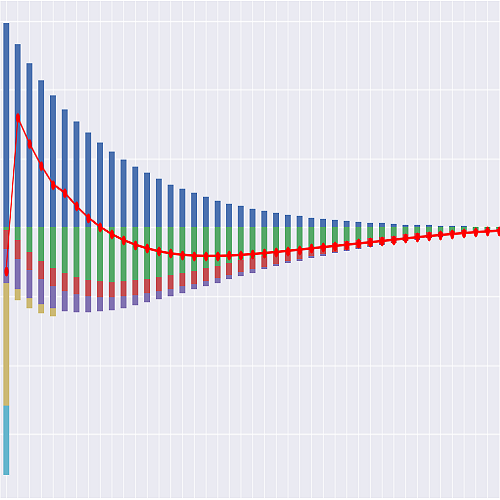
The ADE_FR_S Model#
Reference liability cash flow model for French assurance emprunteur (ADE).
ADE_FR_S is the executable counterpart of
products/assurance_emprunteur/technical-notes.md in the lifelib-products library. It
projects gross best-estimate liability cash flows for a single-policy model point of
assurance des emprunteurs — the death, PTIA, ITT and IPT cover a French borrower buys
alongside a mortgage — on a monthly grid, for one insured head on one fixed-rate
amortising loan.
This is the most intricate model in the library, and the reason is that four separate mechanisms have to run at once.
The loan is deterministic and the model computes it. Nothing is read from an
échéancier: given capital_initial, loan_rate_annual and loan_term_months,
echeance() is the level instalment and
crd() the capital restant dû at every month.
check_crd() asserts the amortisation closes both ways — the
annuity form against the roll-forward crd(k) = crd(k-1) (1 + i) - ech, and
crd(T) = 0 at the final instalment. crd is the only thing linking the loan to the
insurance: the death and PTIA benefits of month t are crd(t + 1) x quotite, the
balance at the end of that month.
The state space is four-state — healthy, ITT (incapacité temporaire totale), IPT
(invalidité permanente et totale) and dead — which is the income_protection /
IP_UK_S three-state chassis with a fourth state and a duration-triggered forced
transition. The in-claim population is two-dimensional: ITT termination rates depend
on how long the claim has run, so the model carries l_itt(t, z) cohort by cohort, and
at the 1 095-day cap the surviving cohort is assessed rather than advanced — 35 % of
it passes to IPT and the rest returns to healthy. Collapsing the duration dimension, or
letting cohort 36 advance to cohort 37, are the notes’ two most costly pitfalls.
The guarantees end at different ages. Décès runs to 85, PTIA and ITT/IPT to 70 in the base cell, and the loan over 240 months — so a cover can stop while the loan, and the premium, run on. At the first month where the ITT/IPT cover has ceased, any claim in payment is moved into healthy rather than deleted: those lives are alive, still death covered, and still paying. The premium is nivelé and does not fall.
Résiliation — the loi Lemoine substitution decrement — is a real lapse out of healthy, low in year 1 and three times higher from year 2, and it pays nothing: this product has no surrender value and no maturity benefit.
Spaces. The model contains two:
DataReads the seven input CSVs and holds their filename References. It takes no parameters, so each file is read once per model.
ProjectionThe by-policy projection, parameterized by
point_id:Projection[1]is an ItemSpace projecting model point 1. It reaches the input tables through itsdataReference, which resolves to the singleDataSpace.
The split matters for more than tidiness. Because Projection is parameterized, every
Projection[N] is a separate ItemSpace with its own cells cache; readers placed there
would re-read every file for every policy. In Data they are evaluated once, however
many policies are projected.
Input data is external: CSVs in the model folder’s parent directory, read at run time rather than stored inside the model. The model folder itself holds no data, so the model and its inputs must travel together.
Projection basis. Monthly steps, matching the monthly échéance that the incapacity
benefit replaces. Policy month t is 0-based: t = 0 is the first projected
month and the frame is t = 0, 1, ..., proj_len() - 1, where
proj_len() = loan_term_months is the number of months projected. The contractual
policy year is the 1-based label t // 12 + 1. Premiums fall at the beginning of the
month and are paid by lives in healthy only — premiums are waived in claim. The
instalment, the transitions and all benefit fall at the end of the month, so month t
opens on the loan balance crd(t) and closes on crd(t + 1) — crd keeps its own
0-based time-point index, crd(0) = capital_initial at adhesion — and a claim
incepting at end of month t is first paid at end of month t + 1. All cover and
any claim in payment terminate at the loan’s contractual expiry with no value.
Model points come in three kinds. status = healthy cells start the whole
population in healthy; status = itt cells start it in an ITT cohort at a stated claim
duration and status = ipt cells in IPT, and those two are the disabled-life annuities
a claims-in-payment reserve is quoted as. An in-force portfolio needs all three.
What is sourced and what is not. The contractual mechanics are sourced: the two premium bases, the two indemnity bases, the franchise menu, the 1 095-day ITT cap, the 66 % barème croisé IPT threshold, the cover-end ages, waiver of premium in claim, the level nivelé premium, cancellation à tout moment, and expiry without value. Every rate is a standardization. No French decrement, incidence or termination table for this product was retrieved — insurer rate cards are proprietary and the homologated TH 00-02 / TF 00-02 tables are cited by name but are not redistributable — so the mortality, PTIA, ITT inception, ITT termination, IPT mortality, résiliation and CRD premium tables shipped here are [std] proxies built from INSEE-shaped population data and carry no authority. This model is a mechanics demonstration, not a pricing or reserving result. Replace the basis with licensed tables before drawing any conclusion from the output.
Verification. tests/test_assurance_emprunteur_fr.py asserts the notes’ fifteen
month worked example to the cent, its column sums, the loan spine, the ITT cohort
survival through the 1 095-day cap, the present values over the full 240 months, and one
test per modelling pitfall the notes name.
Example
>>> import modelx as mx
>>> model = mx.read_model("products/assurance_emprunteur/ADE_FR_S")
>>> model.Projection[1].result_cf()