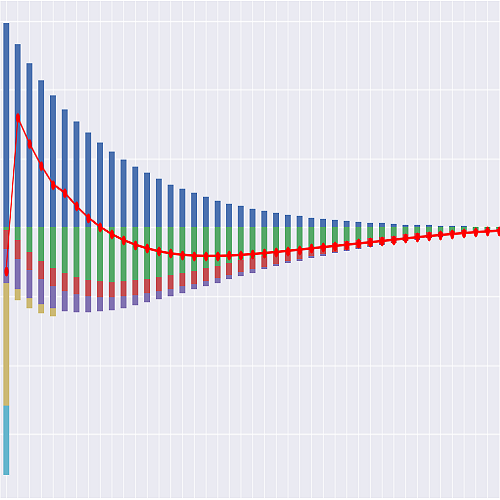
Technical Notes#
Status: Draft, 2026-08-03.
Scope note: Standardized composite for reference modeling, not any insurer’s product.
[S#]/[R#] cite sources.md (provenance: _research/indexed-ul.md); [REG-R#] cites
the cross-product reference library references/regulatory-and-actuarial-references.md
(research provenance: _research/regulatory-actuarial.md, same R-numbering).
std marks standardizations introduced for
the reference implementation. Parameter values here are identical to those in
product-spec.md; unverified flags carry over.
Model scope and conventions#
Product: the representative baseline of
product-spec.md: flexible-premium UL chassis + one AG 49-A Benchmark-Index-Account-style indexed account (1-yr S&P 500 PTP, cap 10.00% current [S2], 100% par [S2], 0% floor [S2] R1) + fixed account (4.50% current / 1.00% guaranteed [S2]). Standard loans only std.Base chassis: the UL-pattern monthly mechanics — monthiversary processing order, NAAR convention (DB discounted one month at the guaranteed rate, AV measured before the monthly deduction), deduction-before-interest recursion — follow the universal-life reference notes (
products/universal_life/technical-notes.md); these notes specify only what the indexed crediting engine adds or changes std.Projection frequency: monthly. All policy processing occurs on the monthiversary (“monthly policy date”), consistent with segment creation on monthly policy dates [S3] std.
Time index: policy month t is 0-based. t = 0 is the issue month; policy month t runs from monthiversary t to monthiversary t + 1; the frame is t = 0, 1, …, proj_len − 1 with proj_len = 12 × (121 − issue age) − duration_mth (the months already elapsed) the number of projected months. Policy year is the 1-based contractual label ⌊t/12⌋ + 1, attained age x = issue age + ⌊t/12⌋, and an in-force model point carries its elapsed months as a separate offset (duration_mth). A state variable X_t is the value at monthiversary t (X_0 the opening value), so the recursions below step from X_t to X_{t+1}.
Timing: beginning-of-month (BOM) processing for premium, deductions, sweeps, and segment events; interest credited over the month (end-of-month effect). Decrements (death, lapse) applied at end of month after crediting std.
Rate conversions: an effective annual rate i is applied monthly as (1+i)^(1/12) − 1 std.
Decrement conversions: an annual decrement rate q is converted to monthly as q_m = 1 − (1 − q)^(1/12) std.
Age basis: age nearest birthday (ANB) std (spec Table 1, F1); attained age increments on policy anniversaries std.
Model points: single-policy model points, projected on expected decrements (probability-weighted in-force), one segment ladder per model point. Seriatim or grouped runs are an implementation choice outside these notes.
Projection horizon: to attained age 121 std, unverified maturity inference (spec F5).
Currency/rounding: USD; no rounding in the recursion (display rounding only) std.
Model point attributes#
Attribute |
Type |
Example |
|---|---|---|
Issue age (ANB) |
int |
45 |
Sex |
enum {M, F} |
M |
Risk class |
enum (per spec Table 1) |
Non-Tobacco |
Face amount F |
currency |
250,000 |
DB option |
enum {A, B} |
A |
Planned annual premium |
currency |
10,000 std example |
Premium mode |
enum |
annual, paid at BOM of the first month of each policy year (t ≡ 0 mod 12) std |
Indexed allocation w_ix |
percent of sweepable balance |
100% std |
Issue date / duration offset |
date, months |
t = 0 |
Existing loan balance |
currency |
0 |
Tax test |
enum {GPT, CVAT} |
GPT std (spec F4) |
MNLP rate (no-lapse premium per $1,000 face p.a.) |
rate table lookup |
20.80 for M/NT/45/band 1 [S3] (band-1 rate as placeholder — the 250,000 example face is a higher band whose rate is not public std) |
State variables#
Symbol |
Description |
Initial value |
|---|---|---|
FA_t |
Fixed (holding) account balance |
0 |
S_{k,t} |
Balance of segment k (k indexed by creation month m_k; 12-month term) |
created at sweep |
AV_t |
Account value = FA_t + Σ_k S_{k,t} + LCA_t |
0 |
LCA_t |
Loan collateral account (standard loans) |
0 |
L_t |
Loan principal + accrued interest |
0 |
SC_t |
Surrender charge (per spec Table 3, F17 schedule) |
$25/$1,000 × F/1,000 std |
CSV_t |
Cash surrender value = AV_t − SC_t − L_t |
— |
CumP_t / CumMNLP_t |
Cumulative premiums less withdrawals & loans / cumulative MNLP |
0 / 0 |
DB_t |
Current death benefit (post-corridor) |
— |
l_t |
In-force probability (survivorship of death & lapse) |
1.0 |
7-pay / GPT accumulators |
per issue |
Assumption inputs#
The model distinguishes three assumption classes explicitly:
(a) Contractual / guaranteed elements (from product-spec.md, all cited there):
guaranteed minimum fixed rate 1.00% [S2]; guaranteed minimum cap 2.00% [S2]; guaranteed
participation 100% [S2]; floor 0% [S2] R1; guaranteed maximum charges (premium load 8%
std, policy fee $15 std, per-unit $0.40 all years std, COI at 2017 CSO
ANB ultimate std/REG-R17); surrender charge schedule std; loan charged rate
3.00% std; corridor factors R4; MNLP rates [S3]. Guaranteed-basis projections use
only this class.
(b) Current non-guaranteed scales (insurer-declared; snapshots, re-declarable — NGE discipline per ASOP 2 REG-R26): fixed account 4.50% [S2]; cap 10.00% [S2] (snapshot — observed 10.00–13.75% across carriers/dates [S2] [S3] [S4] [S5] [S7], and the cap is re-set at each segment start [S3] [S4]); premium load 5% std; policy fee $10 [S3] [S5]; per-unit $0.30 years 1–10 std; current COI = 65% of guaranteed std; loan credited rate 2%/3% std. In projection, current scales are held level unless a cap-re-declaration model (option-budget-driven, below) is switched on std.
(c) Behavioral / experience assumptions (model-owner best estimates; recommended public bases):
Best-estimate mortality: 2015 VBT (sex/smoker-distinct, ANB, RR table fit to class) REG-R18, validated/adjusted with ILEC 2012–2019 A/E experience REG-R19; guaranteed elements use 2017 CSO REG-R17. VM-20 prudent estimates credibility-blend company experience toward the industry (VBT) tables REG-R3 REG-R23.
Base lapse and surrender: LIMRA/SOA U.S. individual life persistency study (2009–2013 observations) REG-R20 and the 2015–2021 UL premium persistency and lapse/surrender study (24 companies, ~80% of market for lapse; 14 companies for premium persistency) REG-R21. Numeric base-lapse levels in this library are placeholders std: 6%/yr durations 1–10 grading to 4%/yr, with a surrender-charge-expiry spike (below).
Premium persistency (flexible-premium behavior — the assumption unique to UL-type products REG-R21): planned premium paid with annual persistency factor 98% std, compounding (i.e., expected premium_y = planned × 0.98^(y−1)).
Expense (insurer own-expense, distinct from policy charges): per-policy maintenance $75/yr + $150 per issue std placeholders; premium tax 2.0% of premium std placeholder. Calibrate to company studies; no public source in the research set.
Index scenarios: see “Stochastic index scenarios vs illustrated-rate projections”.
Cash flow components and recursions#
Notation (defined once; monthly step t → t+1, policy month t = 0, 1, 2, …, proj_len − 1)#
Symbol |
Meaning |
|---|---|
P_t |
premium received at BOM t |
l_prem |
premium load rate (current 5% std) |
NP_t = P_t (1 − l_prem) |
net premium |
e_pol, e_unit |
policy fee $10/mo; per-unit charge $0.30 per $1,000 (mos of yrs 1–10) |
coi_t |
current monthly COI rate per $1,000 NAAR (65% of guaranteed std) |
NAAR_t |
net amount at risk |
MD_t |
total monthly deduction |
i_fix, i_g |
fixed-account current rate 4.50% [S2]; guaranteed 1.00% [S2] |
c, p, f |
cap 10.00% [S2]; participation 100% [S2]; floor 0% [S2] |
I(t) |
index level at monthiversary t (S&P 500 price return) [S2] [S3] |
S_{k,t} |
balance of segment k created at m_k, maturing at m_k + 12 |
W_t |
partial withdrawal (gross of $25 fee [S3]) |
B_t |
new standard loan taken at t |
i_L^c, i_L^e |
loan charged 3.00%; collateral credited 2.00%/3.00% std |
κ_x |
§7702 corridor factor at attained age x R4 |
q^d_t, q^w_t |
monthly death / lapse rates (class (c) assumptions) |
v_g = (1+i_g)^(−1/12) |
one-month discount at guaranteed rate std |
Core recursions#
Fixed (holding) account:
FA_{t+1} = [ FA_t + NP_t − MD^FA_t − W^FA_t − B^FA_t − Sweep_t + Roll^FA_t ] × (1+i_fix)^(1/12)
Segment k (created at m_k with S_{k,m_k} = Sweep_{m_k} share; term 12 months):
S_{k,t+1} = S_{k,t} − MD^seg_{k,t} − W^seg_{k,t} − B^seg_{k,t}      (no interim interest)
r_k       = I(m_k+12) / I(m_k) − 1                                  [S2] [S3]
cr_k      = max(f, min(c, p × r_k))                                 [S2] [S3] [R1]
Credit_k  = cr_k × S_{k, m_k+12}                                    **[std]** credit base
matured value = S_{k,m_k+12} × (1 + cr_k)  → new segment (or FA per instructions)
Credit-base variation (not baseline): one carrier’s contractual formula credits (adjusted index change %) × (segment’s adjusted beginning value) − (interest already credited at the guaranteed minimum during the segment), where the adjusted beginning value subtracts withdrawals, loan transfers, and one-half of monthly deductions and index-account charges taken during the segment [S3].
Net amount at risk and COI (discounting convention std, consistent with the universal-life base chassis; AV_t is measured before the monthly deduction):
NAAR_t = max(0, DB_t × v_g − AV_t)          v_g = (1+i_g)^(−1/12)
COI_t = coi_t × NAAR_t / 1000
Death benefit (Option A baseline std):
DB_t = max(F, κ_x × AV_t)                  κ_x per §7702(d): 2.50 at ages 0–40 → 1.00 at 90–95 [R4]
death claim outflow = DB_t − L_t
Cash surrender value and policyholder cash flows:
CSV_t = AV_t − SC_t − L_t
surrender outflow at t = CSV_t ;  withdrawal outflow = W_t − $25 fee [S3]
Liability cash flow (insurer perspective, month t) std sign convention (inflow +):
CF_t = l_t·[ P_t − E_t ] − l_t·q^d_t·(DB_t − L_t) − l_t·q^w_t·CSV_t − l_t·(W_t − fee) + net loan cash flows
where E_t = insurer own expenses (class (c)); policy charges are internal transfers
within AV, not direct cash flows — they emerge in profit as margins, but the *gross
liability cash flow* projection tracks premiums in, benefits/withdrawals out.
Option-budget economics and cap re-declaration#
The AG 49-A “Hedge Budget” is “the total annualized amount assumed to be used to generate the Indexed Credits of the account, expressed as a percent of the account value,” required to be consistent with the insurer’s actual hedging program R1. Economically: the general-account net investment earnings rate (NIER) funds the purchase of index options; the cap is what that budget buys R1 R6. For the baseline account (100% par, 0% floor), the embedded position per $1 of segment value is a one-year call spread, and the cap c satisfies approximately std formulation of the sourced concept R1 R6:
HB ≈ [ C(K = I_0) − C(K = I_0(1+c)) ] / I_0 HB ≈ NIER − target spread
where C(K) is the one-year call price at strike K. Charge-funded accounts add an explicit asset charge that funds a Supplemental Hedge Budget — e.g., a 1.0% strategy charge buys a 13.25% cap vs 10.25% without [S5]; 0.80%/yr buys 12.0% vs 10.0% [S2] — the mechanism AG 49-A uses to bound their illustrated rates R1. Dynamic hedging is the production mechanism per insurer marketing [S8]. A cap re-declaration module (optional std) resets c each segment year so the call-spread cost matches a projected hedge budget; otherwise the model holds the current cap level.
Stochastic index scenarios vs deterministic illustrated-rate projections#
Deterministic (illustration-style): apply a level annual credited rate to every maturing segment. The rate must respect AG 49-A for anything presented as an illustration: BIA maximum illustrated rate = min(arithmetic mean of 25-year geometric average credited rates computed daily over lookback windows starting 66 years prior; 145% of NIER); other accounts capped by reference to the BIA; alternate scale = min(illustrated − 100 bps, fixed rate) shown with equal prominence R1. Research snapshots usable as the level rate: 6.40% carrier-published 1988–2023 lookback for the 10%-cap account [S2]; carrier current illustrated rates 5.61%–7.38%, e.g. 6.59% [S6]. Baseline deterministic rate: 6.40% [S2].
Stochastic (best-estimate/valuation-style): simulate I(t) (real-world lognormal std: μ = 6.0%, σ = 16% p.a. placeholders std), apply the crediting formula path by path, average outcomes. Because the cap truncates the entire right tail while the 0% floor only offsets losses (cr = max(0, min(c, r)) is piecewise linear, not globally concave), at realistic parameters — cap near the mean index return — the mean credited rate falls materially below the formula applied at the mean return; historical frequency of 0% credits for single-index allocations was 12.55%–23.81% in a carrier’s 2005–2017 issue-date study [S8]. Deterministic-at-illustrated-rate projections therefore overstate credits relative to the stochastic mean at matched expected index growth — a first-order model risk (below). Risk-neutral scenarios are used only when valuing the embedded option/hedges, not for gross cash flow projection std.
Guaranteed floor accumulation test (variation, not baseline)#
Some designs guarantee a retrospective cumulative accumulation: one carrier’s “2% cumulative average upon death or termination” [S7]; another’s in-segment 0.75% (with a 2% declared-account minimum) [S3]. Modeling: carry a shadow account accumulating premiums less deductions/withdrawals at the guarantee rate; on death/surrender pay max(actual value, shadow value) std implementation convention. The baseline (0% annual floor [S2] R1) needs no shadow account.
Policyholder behavior modeling#
All dynamic formulas are std (no retrieved source prescribes them); levels are placeholders to be calibrated to REG-R20 REG-R21 data and company experience.
Base lapse (annual, converted monthly): 6% durations 1–10, 4% thereafter std; a surrender-charge-expiry spike multiplier 2.0 applied in policy year 11 std (rationale: the 10-year surrender charge period [S1] [S5] [S7] creates a cliff in surrender economics; UL lapse/surrender experience by duration is available in REG-R21 for calibration).
Dynamic lapse std: multiply base lapse by min(2.0, max(0.5, 1 + 3.0 × (r_alt − r_cred,t))) where r_cred,t is the policy’s trailing credited rate and r_alt a competitor/market alternative rate. Rationale: caps and declared rates are NGEs; uncompetitive re-declarations (caps fell 13.75% → 12.00% between two print dates of one product [S3] [S4]) plausibly drive excess lapse.
Premium persistency std: planned premium paid with 98% annual persistency, plus a funding-stop state (probability 1%/yr std) after which the policy runs charge-only. Rationale: premium persistency is the UL-specific behavior dimension; the 2015–2021 LIMRA/SOA study is the recommended public calibration base REG-R21.
NLG-tested behavior std: while the no-lapse guarantee is in effect and CSV ≤ 0, lapse is suppressed (policyholders paying MNLP-level premiums persist); on NLG expiry, apply a shock lapse 25% std for underfunded policies.
Loan utilization (baseline scenario: none std; distribution-scenario module): from a start age (e.g., 65 std), borrow a level amount annually via standard loans; the Overloan Protection Rider caps loan-driven lapse risk [S3].
Withdrawal behavior: none in baseline std; scenario module mirrors loans.
Worked example#
One segment year; parameters as specified (cap 10.00% [S2], par 100% [S2], floor 0% [S2]; credit base = remaining balance at maturity std). Segment created at month m with $12,000 from the sweep; its pro-rata share of monthly deductions is $15.00 in each of the 12 segment months std example values. Two index scenarios (A: +12%, B: −15%).
Item |
Scenario A (up year) |
Scenario B (down year) |
|---|---|---|
Segment balance at creation, S_{k,m} |
12,000.00 |
12,000.00 |
Monthly deductions charged to segment |
15.00 × 12 = 180.00 |
15.00 × 12 = 180.00 |
Balance at maturity before credit, S_{k,m+12} |
11,820.00 |
11,820.00 |
Index at segment start, I(m) |
4,500.00 |
4,500.00 |
Index at maturity, I(m+12) |
5,040.00 |
3,825.00 |
Index change r = I(m+12)/I(m) − 1 |
+12.00% |
−15.00% |
Credited rate = max(0%, min(10.00%, 100% × r)) |
10.00% (cap binds) |
0.00% (floor binds) |
Index credit = rate × 11,820.00 |
1,182.00 |
0.00 |
Matured segment value → new segment |
13,002.00 |
11,820.00 |
Notes: deductions taken mid-segment earned no index credit (they left the segment before maturity) std; under the adjusted-beginning-value variant the credit base would add back half of the 180.00 of deductions, giving credit 10.00% × (12,000.00 − 90.00) = 1,191.00 in Scenario A (before netting the in-segment guaranteed interest that design credits) [S3]. Under the guaranteed-cap-only scenario (class (a)), the Scenario A credit would be 2.00% × 11,820.00 = 236.40 [S2 guaranteed cap].
Valuation and reserve pointers#
This library projects gross liability cash flows; measurement layers are cited, not reproduced:
Statutory: VM-20 net premium reserve plus deterministic/stochastic reserves as applicable; IUL is reserved as a UL (life) product under VM-20; projections must include cash flows of assets hedging indexed credits, under the clearly-defined-hedging-strategy (CDHS) framework, with margins increased where hedging documentation is incomplete R3 REG-R3. Implementation guidance: AAA VM-20 practice note REG-R23; governing standard ASOP 52 REG-R31; enabling statute Model #820 REG-R1. A quantified analogue for hedge inefficiency exists on the annuity side (VM-21/VM-22 index credit hedge margin: reduce hedge payoffs by ≥1.5% multiplicatively, or ≥20% absent credible experience) — stated for annuities, not VM-20 life business R3.
Interest-indexed UL filings/opinion: Model #585 Section 10 (assets held, falling-rate risk, annual actuarial opinion) R10 REG-R5. Cite this to Model #585 only. The AP&P Appendix A print of the same regulation, item A-585, was read in full and carries the valuation half only — definitions and valuation requirements, with no nonforfeiture provisions, no mandatory policy provisions, no annual-report-to-policyowner requirements and no interest-indexed UL section; the sole indexed rule in it is the ¶8.c exclusion of externally-referenced guarantees from the GMP solve REG-R155.
Illustration testing (if the model doubles as an illustration engine): Model 582 self-support/lapse-support and DCS limits R2; AG 49-A rate limits R1; ASOP 24 REG-R30; AAA illustrations practice note R8.
Tax reserves: IRC §807 — greater of net surrender value and 92.81% of the NAIC-method reserve, capped at statutory REG-R16.
Model governance for the implementation itself: ASOP 56 (modeling) REG-R32; cash-flow analysis standard ASOP 7 REG-R27.
Key sensitivities and model risks#
Dominant assumptions (in rough order for an accumulation-funded model point):
Credited-rate level and dynamics — cap re-declaration is the insurer’s primary lever; caps on the same product fell from 13.75% to 12.00% between print dates [S3] [S4]; guaranteed minima (2.00% cap [S2]) are far below current levels, so the guaranteed-basis projection diverges dramatically.
Deterministic vs stochastic crediting — using the illustrated rate (6.40% [S2], market range 5.61%–7.38% [S6]) as a level credit overstates mean credits vs a stochastic run at matched expected index growth (cap truncation; 0%-credit frequency 12.55%–23.81% historically for single allocations [S8]).
Premium persistency — flexible premiums mean the funding pattern is behavior, not contract; it drives account growth, NLG status, MEC/GPT headroom, and lapse REG-R21.
Lapse (level + dynamic + SC-expiry spike) — high sensitivity of both cash flows and any illustration lapse-support test R2 REG-R21.
COI margin vs mortality — current-vs-guaranteed COI spread is a major profit and re-rating lever [S3] REG-R26; best-estimate mortality from 2015 VBT/ILEC REG-R18 REG-R19.
Loan design and utilization — participating loans embed an index-vs-5%-charge spread bet [S5] [S7]; heavy late-life loans plus a 0%-credit sequence can force lapse absent overloan protection [S3].
Known modeling pitfalls:
Segment bookkeeping: monthly segment ladders (up to 12 concurrent [S3] [S4]) must track per-segment index start levels; collapsing to a single annual segment mis-times credits and distorts mid-segment surrender values [S3].
Deduction sourcing vs credit base: conventions differ by carrier (pro-rata remaining balance std vs adjusted-beginning-value with half-weighting [S3]); pick one and keep DB/CSV/credit formulas consistent.
Floor ≠ guarantee confusion: a 0% annual floor [S2] is not the same guarantee as an in-segment 0.75% credit [S3] or a 2% retrospective cumulative test [S7]; mixing them double-counts guarantees.
Illustrated-rate anchoring: AG 49-A bounds what may be illustrated, not what will be credited R1 R6; a projection model should treat the illustrated rate as a disclosure constraint, not a best-estimate assumption.
Corridor/MEC interplay: high funding triggers corridor DB increases (raising NAAR and COI) R4 and 7-pay/MEC status R5; omitting these overstates late-duration account values and understates charges.
Maturity mechanics: age-121 behavior is unverified (spec F5); confirm before relying on tail cash flows.
Wrong CRVM engine on the formulaic track: “All Other routes to CRVM” is not an instruction to run the SVL §5.A / A-820 ¶11 modified-net-premium routine. An indexed UL policy takes the A-585 guaranteed-maturity-premium adaptation, and one A-830 reaches through a secondary guarantee takes the ¶¶29–32 segmented construction instead. Both substitutions are silent — they produce a number REG-R155 ¶8 REG-R154 ¶¶2, 30.
Index credits inside the guaranteed maturity premium: the GMP solve is on guarantees at issue “excluding guarantees linked to an external referent”, so the current cap (10.00% [S2]) — a nonguaranteed element in any case — is doubly out of it, and the index-linked crediting is out with it. Feeding a credited-rate assumption into the GMP changes both the GMP solve and the GMF path, and so both legs of the reserve at once. What the rule leaves open for the guaranteed cap and floor is a modeling decision to be documented — [std, derived], not sourced REG-R155 ¶¶4, 8.c.