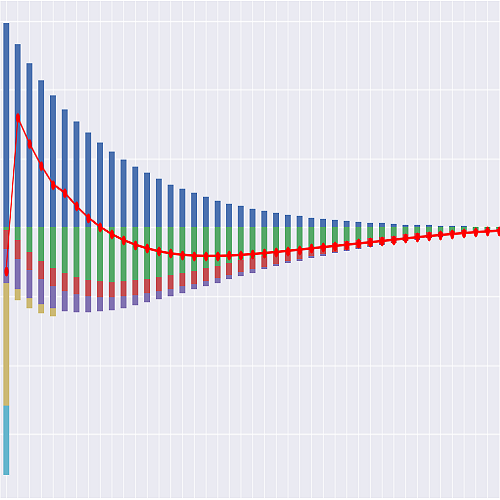
The WOL_UK_S Model#
Reference liability cash flow model for UK whole of life assurance.
WOL_UK_S is the executable counterpart of
products/whole_of_life/technical-notes.md in the lifelib-products library. It
projects gross best-estimate liability cash flows for single-policy model points of the
two cells those notes specify, which share one engine:
RefWOL-UW — underwritten guaranteed whole of life. Full underwriting, guaranteed level premiums payable for life, the sum assured paid once on death or earlier terminal illness, suicide inside twelve months refunding premiums instead.
RefWOL-O50 — over-50s guaranteed acceptance. No underwriting at all, a fixed cash sum, a twelve-month moratorium during which non-accidental death returns the premiums paid rather than the cash sum, premiums ceasing at the anniversary on or after the 90th birthday while cover continues, and a crossover past which cumulative premiums exceed the cash sum.
Neither cell has an account value, a unit fund or a surrender value. Both are pure
decrement protection models: premiums in, death benefits and expenses out, weighted by
survivorship. That is the deliberate contrast with WholeLife_US_S, the U.S.
whole life model in the same library, which is built around a guaranteed cash value
schedule, three-factor dividends, paid-up additions and policy loans. None of that
machinery exists here, and a lapse on either UK cell pays exactly nothing.
The arithmetic consequence is the product’s defining economics: every lapse extinguishes a liability for nothing. The FCA records that without the continuing-payer cross-subsidy insurers would need to rely on lapses to remain profitable, so the best estimate falls as assumed lapses rise — which makes lapse the assumption to govern hardest, and makes one plan’s pro-rata paid-up value variant [S9], which converts late lapses into paid-up liabilities instead of forfeitures, a different product rather than a small adjustment.
Spaces. The model contains two:
DataReads the three input CSVs and holds their filename References. It takes no parameters, so each file is read once per model.
ProjectionThe by-policy projection, parameterized by
point_id:Projection[1]is an ItemSpace projecting model point 1. It reaches the input tables through itsdataReference, which resolves to the singleDataSpace.
The split matters for more than tidiness. Because Projection is parameterized,
every Projection[N] is a separate ItemSpace with its own cells cache; readers
placed there would re-read every file for every policy. In Data they are evaluated
once, however many policies are projected.
Input data is external: CSVs in the model folder’s parent directory, read at run time rather than stored inside the model. The model folder itself holds no data, so the model and its inputs must travel together.
Projection basis. Monthly steps. Policy month t is 0-based and runs
0, 1, ..., proj_len() - 1, where proj_len() = 12 x (omega_age - entry_age) is
the number of projected months: t = 0 is the issue month, pols_if(0) is
pols_if_init(), and the policy year is the contractual label t // 12 + 1. Whole
of life has no maturity, so the projection is truncated at a limiting age rather than
ending at a contractual date. Premiums and expenses fall at the beginning of the month;
deaths at the end, against the beginning-of-month in-force; lapses at the end after
deaths. Escalation steps at policy anniversaries (t = 12, 24, ...). Age is age last
birthday, unlike every other model in this library — the underwritten cell’s specimen
defines entry age that way.
What is sourced and what is not. The contractual mechanics are sourced: the moratorium and its return-of-premiums benefit, accidental death paying the full cash sum from day one, premium cessation at 90 with cover continuing, the absence of any surrender value, the suicide clause, the escalation ratios and the pro-rata paid-up value formula. Every rate is a standardization. The CMI’s current tables are restricted to Authorised Users, so the two mortality bases shipped here are [std] proxies shaped like the tables the notes name, and no insurer publishes premium rate tables, so the premium is a model point input. This model is a mechanics demonstration, not a pricing or reserving result. Replace the basis with licensed tables and company experience first.
Verification. tests/test_whole_of_life_uk.py asserts the notes’ eleven-row
worked example to the penny and the in-force column to five decimals, including the
moratorium discontinuity between t = 11 and t = 12 and the crossover at
t = 166, the 167th monthly premium.
Example
>>> import modelx as mx
>>> model = mx.read_model("products/whole_of_life/WOL_UK_S")
>>> model.Projection[1].result_cf()