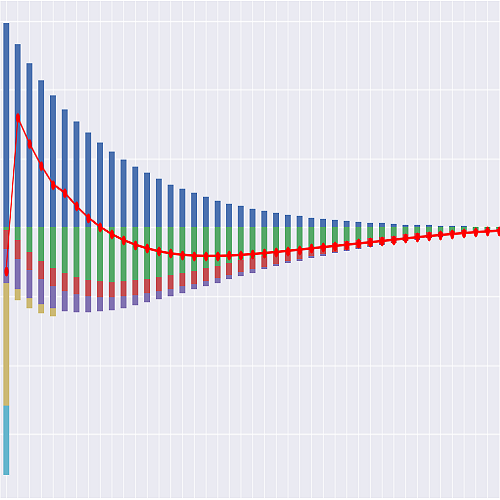
Product Specification#
Status: Draft, 2026-08-29 (sources accessed 2026-08-29); citations re-verified against the primary documents 2026-08-30.
Scope note. This is a standardized composite specification assembled for reference liability
cash-flow modeling of a German klassische aufgeschobene private Rentenversicherung — the classic
deferred private annuity of Schicht 3, in which a premium accumulates in the Deckungskapital
(policy reserve) of the insurer’s general account at a guaranteed Rechnungszins (technical interest
rate), participates in the Überschussbeteiligung (profit participation), and is converted at a
contractually fixed Rentenbeginn (annuity commencement date) into a lifelong Leibrente at a
Rentenfaktor (annuity factor) — or taken instead as a lump sum under the Kapitalwahlrecht. It
does not describe any single insurer’s contract. Facts carrying a source tag — [S#] (primary
product documents: AVB, Verbraucherinformation, Kundeninformation, GDV Musterbedingungen,
insurer product pages, surplus declarations) and [R#] (product-specific regulatory and actuarial
references), both numbered per _research/klassische_rentenversicherung.md and resolved in
sources.md (numbering frozen, never renumbered), and [REG-R#] (the cross-product reference
library, whose own numbering is separate and also frozen) — are attributed to the cited document.
Values marked std are standardizations introduced for the reference implementation, each with
a numbered footnote giving the rationale and, where the research file recorded one, the observed
range. Claims no retrieved document confirms are flagged unverified.
Retrieval conditions — read this before relying on a single number below. This specification
was drafted under an organisation network policy that blocked direct HTTP egress from the build
environment: WebFetch and curl were refused with HTTP 403 for gesetze-im-internet.de,
bafin.de, gdv.de, aktuar.de and every insurer host named here, the only channel was
WebSearch result summaries, and the session’s shared budget was exhausted after eighteen queries
on this product. The first draft therefore rested on the authoring model’s own knowledge of German
insurance law and practice, tagged std wherever it standardized a level and unverified
wherever it could not confirm a specific. That policy has since been lifted, and the citations
were re-verified against the primary documents on 2026-08-30. Of the forty-three entries in
sources.md, thirty-six now read Retrieved: yes — the VVG, EStG and DeckRV sections read as
canonical XML with each law’s amendment Stand recorded, and the AVB, Verbraucherinformationen,
Kundeninformationen and one Überschussdeklaration read as PDFs with their § numbering intact.
Four entries were reached only in part: the two DAV documents under a transfer cap and a defective
character mapping R12 R13, and two multi-URL entries where one link of each failed R14 R19.
Three could not be opened at all: a Zurich product page that answers with an empty body [S17], a
DEVK asset path that refuses with HTTP 403 [S19], and a paywalled trade-press article R23.
Read every claim below against its own entry: where the entry says Retrieved: yes the
citation is a document that someone opened at the passage cited; where it does not, the citation
remains a pointer, not a certificate — it names the instrument the claim should be checked
against without asserting that anyone checked it. The re-verification changed things, and the
entries record what: the annuity-factor basis once attributed to [S8] is not in that document, the
living URL at [S11] now serves a successor design, [S1] leaves the pre-annuity death benefit blank,
and [S4] carries a Beitragsrückgewähr während der Rentenzahlungszeit the library had recorded as
unmentioned by any source. Each is stated on its entry in sources.md, and model.md lists where
the shipped model diverges from a retrieved document. One of those retractions has not been
carried into the body of this file: the CosmosDirekt conversion-basis sentence under The
guarantee is a rate below still quotes a search summary the retrieved AVB does not contain [S8].
What has not changed is the asymmetry this file is built around — the corpus establishes the
mechanics of this product thoroughly and its levels barely at all. No charge parameter, no issue
envelope and no behavioural rate was established at any carrier for any year; every one of those is
std below and none is presented as a market rate. The Rentenfaktor levels R19 R24 and
the declared surplus rate [S15] the pass did establish are market observations the model does not
adopt, and are labelled as such where they appear.
The composite draws on ten carriers and one industry body — the GDV [S1] [S2] [S3] [S10], Zurich [S4]–[S7] [S16] [S17], CosmosDirekt [S8], NÜRNBERGER [S9], Debeka [S11] [S12], Allianz [S13], Mecklenburgische [S14], Konzern Versicherungskammer [S15], Stuttgarter [S18] and DEVK [S19] — each of which is listed with what it establishes, and what it does not, in Variations across insurers below. Where a row there reads “not established”, that is the finding, not an omission.
Product overview and market role#
A klassische aufgeschobene private Rentenversicherung is a life insurance contract under the VVG on a single life in which the insurer’s obligation is an annuity payable for the annuitant’s lifetime, beginning at a contractually fixed date, with an accumulation period before it [S1] [S4] [S8] [S9]. The insurer’s own placement is Schicht 3 — Private Vorsorge: Zurich’s scope line reads “Aufgeschobene Rentenversicherung — Private Vorsorge (Schicht 3) und Rückdeckungsversicherung (Schicht 2)” [S4]. Schicht 3 is the unsubsidised layer of the Drei-Schichten-Modell introduced by the Alterseinkünftegesetz from 1 January 2005 REG-R38: no § 10 EStG deduction, no state Zulage, no certification under the Altersvorsorgeverträge-Zertifizierungsgesetz. The boundary is visible in the GDV’s own taxonomy, which maintains separate model conditions for the Basisrente and for certified Altersvorsorgeverträge [S3]; this product is the one without a statutory qualification clause in its title [S1] [S2].
Four features make the German chassis what it is, and each changes the shape of the projected cash flows.
Two phases with a hard boundary. The Aufschubzeit accumulates a Deckungskapital; the Rentenbezugsphase pays an annuity; the Rentenbeginn separates them [S1] [S4] [S8] [S11]. Three distinct things happen at that one date and a model must sequence all three: the accumulated value is struck including surplus and Bewertungsreserven [S9]; the Rentenfaktor is determined by comparing two factors [S4] [S13]; and the Kapitalwahlrecht election takes effect [S12] R21.
The guarantee is a rate, and a property of the contract’s vintage rather than of the market. The Rechnungszins is capped for new business by the Höchstrechnungszins of § 2 Deckungsrückstellungsverordnung R7 R11 REG-R14, and the rate applicable at conclusion then stays with the contract for its whole term REG-R14. A German life book is a layered stack of guarantee vintages — 4,00 % for 07/1994–06/2000 down to 0,25 % for 2022–2024 and back to 1,00 % from 2025 REG-R15 — so the Rechnungszins is a model-point attribute, not a global assumption. The retrieved wordings show both halves of that. CosmosDirekt’s LA 904 A, an 01.17 tariff, states “der tarifliche Garantiesatz von 0,90 Prozent p. a.” [S8] — which is exactly the 2017–2021 cap, and so is a contract carrying its own vintage rather than today’s. An insurer may also guarantee less than its vintage cap, and does: Debeka’s safest post-2016 variant guarantees 0,5 % R22.
The Rentenfaktor is a guarantee with upside, not a fixed conversion rate. It is fixed at inception on the Rechnungsgrundlagen then in force R24; at Rentenbeginn a second, current factor is computed and the higher of the two is guaranteed for the annuity payment period [S4]. A model applying only the guaranteed factor understates the benefit whenever the current tariff is richer.
The classic tariff is the market’s reference chassis rather than a live new-business product. Debeka, Allianz, Zurich and Generali are all reported to have stopped distributing the classic form, Debeka replacing it from 1 July 2016 with five “Chance” variants and Allianz with the KomfortDynamik premium-guarantee hybrid R22 [S12] [S13] — yet Zurich publishes a Verbraucherinformation für Konventionelle Versicherungen for the deferred annuity in the Fassung 01/2026, on DAV 2004R at a Rechnungszins of 1,00 %, having published the same wording in Fassung 07/2015 and 01/2025 [S4] [S5] [S7] [S16]. The tension resolves once the distinction between distribution and maintenance is drawn: what R22 reports, in 2016, is that the carriers stopped selling the classic form actively — of Allianz it says only that it would offer it “wenn dies ausdrücklich vom Kunden gewünscht werde” — while a wording reissued across three vintages is plainly still maintained (gap 9, narrowed). That is exactly why the right unit of description is a composite of a chassis, and it is the role a lifelib reference model is for: the in-force book still runs on this design.
Market size. German life insurers, Pensionskassen and Pensionsfonds together took premium income of 94,6 Mrd € in 2024, up 2,8 %, of which laufende Beiträge were 66,3 Mrd €, roughly flat, and Einmalbeitragsgeschäft about 28 Mrd €, up about 10 %; the contract count fell 1,4 % to 80,3 Mio REG-R53. On the BaFin basis the life segment’s verdiente Bruttobeiträge were 90,4 Mrd € — a different population on a different basis, and the two must never appear in one table REG-R53. The GDV taxonomy reports Rentenversicherungen as one class covering both this product and the immediate annuity, so no figure isolating the classic deferred annuity was established REG-R53. For credited-rate context, the average laufende Verzinsung for 2025 was 2,53 % Klassik / 2,58 % Neue Klassik; for 2026 the sources give 2,6–2,7 %, 2,87 % and 2,54 % — three incompatible averages REG-R53.
Representative specification#
The representative design is the chassis the corpus supports as a whole: a single-life deferred
annuity on the general account, Schicht 3, against a level recurring premium over a fixed
Aufschubzeit [S4] [S11], with verzinsliche Ansammlung as the accumulation-phase surplus system
R24, a Beitragsrückgewähr death benefit in the premiums-only form named by the GDV model
wording [S1] R24, conversion at max(garantierter, aktueller Rentenfaktor) [S4] R24, and
Rückkaufswert and Beitragsfreistellung as separate decrements under §§ 169 and 165 VVG R1
R2. Every number in it that is not source-tagged is std.
Product identity and issue rules#
Parameter |
Representative value |
Basis |
|---|---|---|
Design type |
Single-life deferred annuity on the general account (konventionell, klassisch); profit-participating; Schicht 3 |
[S1] [S4] [S8] [S9] [S11] |
Legal wrapper |
Individual contract on the insurer’s own AVB. A Konsortialversicherung edition of the same wording exists and changes the parties, not the cash flows |
[S4] [S5] [S7]; [S6] |
Lives basis |
Single life. The survivor’s annuity is a separate Zusatzversicherung with its own GDV model conditions, not a benefit of the base contract |
[S10] |
Premium form (model-point parameter) |
(i) |
|
Entry ages |
18 to 62 |
std (2) |
Aufschubdauer |
5 to 40 years |
std (2) |
Rentenbeginn age |
62 to 72; representative 67 |
std (2) |
Age basis |
Age last birthday at inception, stepping at the policy anniversary |
std (3) |
Sex |
Recorded, and may not enter the tariff: sex-based premium and benefit differences are prohibited for contracts concluded from 21 December 2012 |
|
Premium envelope |
600 € to 24 000 € a year recurring; 5 000 € to 250 000 € single |
std (2) |
Anchor model cell |
Male, issue age 50, issue year 2026, Aufschubdauer 17 years (Rentenbeginn at 67), 3 000,00 € recurring annual premium, Rechnungszins 1,00 %, Beitragsrückgewähr death benefit, Rentengarantiezeit 10 years, Kapitalwahlrecht take-up 30 % |
std (4) |
The market split between recurring and single premium was not established (gap 13). The aggregate is that Einmalbeitragsgeschäft is about 30 % of German life premium income and grew about 10 % in 2024 against a flat recurring book REG-R53. The recurring form is the one [S11]’s accumulation mechanics describe; the single-premium form is a model-point value because the aggregate says it cannot be ignored.
The entire issue envelope is unestablished at every carrier (gap 13): no premium limits, no Aufschubdauer limits, no entry ages, no Rentenbeginn window. These are round-number placeholders chosen so the model point table can carry an interior anchor and boundary points either side, and should be replaced wholesale by anyone with a Tarifblatt. The one age with an external anchor is 67, the Regelaltersgrenze.
No German source states an age convention for this product; age last birthday, stepping at the anniversary, is the delib-wide convention registered as
age_basis = "ALB"intests/de_registry.py, and it matters less here than in a protection product because the Rentenfaktor rather than a mortality lookup fixes the benefit amount.Issue age 50 with a 17-year Aufschubzeit puts four things inside one projection: the whole accumulation phase in seventeen rows; the § 20 Abs. 1 Nr. 6 EStG twelve-year threshold at duration 12 and its age-62 partner at duration 13 REG-R45, together the strongest driver of German Schicht-3 surrender behaviour; the Rentenbeginn at 67; and a payout phase long enough for the Rentengarantiezeit to expire inside it.
Benefit provisions#
Parameter |
Representative value |
Basis |
|---|---|---|
Payment timing |
Monthly in advance — “Wir zahlen die Rente monatlich, jeweils zum Monatsersten” [S9] § 1 Abs. 1. The GDV wording leaves the frequency to agreement, yearly to monthly [S1] § 1 Abs. 1 |
[S9]; annual-grid compression std (8) |
Conversion capital |
The contract value used for annuitisation includes any Überschussbeteiligung and Bewertungsreserven, subject to a minimum guaranteed contract value stated in the general contract data |
[S9] |
Rentenfaktor applied |
|
[S9] § 1 Abs. 1; [S14] § 2 Abs. 3 and 6; [S18]; restated by R24 |
garantierter Rentenfaktor |
Fixed at inception on the Rechnungsgrundlagen then in force, with a Sicherheitsabschlag making it lower than the current factor. Representative 28,00 € per month per 10 000 € at Rentenbeginn 67 |
mechanic [S11] § 52, [S14] § 2 Abs. 6, R24; level std (9), against a 2025 market average of 24,33–27,18 by term R24 |
Its interest basis |
0,1 % p.a. at one carrier, on that carrier’s own annuity table Debeka 07/16 R (RF), against a tariff Rechnungszins of 1 % for the guaranteed benefits — a deliberate prudential margin below the Höchstrechnungszins |
[S11] § 52 Abs. 1 against § 28 Abs. 2 |
aktueller Rentenfaktor |
The carrier’s then-current immediate-annuity tariff: “maßgeblich sind Rechnungszins und Sterbetafel in der Beitragskalkulation vergleichbarer, dann bei uns zum Verkauf geöffneter Rentenversicherungen mit sofort beginnender Rentenzahlung”, with a most-favourable rule where several comparables exist and a Treuhänder review of the factor |
[S9] § 1 Abs. 1; [S14] § 2 Abs. 5; level std (9), against a 2025 market average of 27,27–30,40 by term R24 |
Annuity in payment |
The sum of a garantierte Rente and an Überschussrente; only the guaranteed part is a promise — for the RfB-financed part “wird die Rentenhöhe jeweils nur für ein Versicherungsjahr zugesagt” |
[S4] § 3 Abs. 7; R20 |
Überschussverwendung in payment |
Policyholder’s choice of konstante, teildynamische or volldynamische Rente, elected before the Rentenbeginn and not changeable after it. Carrier names: Garantie-PLUS-Rente / Bonus-PLUS-Rente / Bonusrente [S4] § 3 Abs. 7; teildynamische Bonusrente / dynamische Überschussrente [S9] § 2 Abs. 5 c); Bonusrente / Überschussrente [S15] |
|
Bewertungsreserven in payment |
Participation continues during the annuity payment period, allotted at each policy year end from the first — a contractual promise, not a § 153 rule |
[S4] § 3 Abs. 2; [S9] § 2 Abs. 5 c); [S15] |
Rentengarantiezeit |
10 years representative; 5, 10, 15, 20, 25 or 30+ offered; typically 15 years for retirement ages 61–70 and 10 for 71 and above; most choose 10 to 20 |
R24; in the tariff name at NÜRNBERGER [S9]; selectable with a floor at Allianz [S13] |
Death benefit before Rentenbeginn |
Beitragsrückgewähr — “die eingezahlten Beiträge (Beitragsrückgewähr) ohne Zinsen und ohne die Beiträge etwa eingeschlossener Zusatzversicherungen” — in the premiums-only form. Documented alternatives: premiums plus the attributable Überschussbeteiligung; the accumulated Deckungskapital; the greater of the two; and no benefit at all, which is the GDV base case where no extension is bought |
[S8] § 1 Abs. 1; [S4] § 1 Abs. 2–3; [S9] § 1 Abs. 3; three forms R24. The GDV model wording leaves § 1 Abs. 3 blank for the carrier to fill [S1] |
A |
Established for the classic product: the contract value plus final surplus and Bewertungsreserven, “mindestens jedoch die sogenannte Beitragsrückgewähr”. The same clause warns the refund need not equal premiums actually paid — rider premiums are excluded and later contract changes re-base it |
[S9] § 1 Abs. 3; hybrid form [S14] § 2 Abs. 9 a) |
Death benefit timing |
Payable on death, with the Bewertungsreserven measured for the month of, or before, notification [S15]. Whether the with-surplus form includes the whole Ansammlungsguthaben is carrier-specific: at Zurich the verzinsliche Ansammlung is paid out on death, surrender or commutation |
[S4] § 3 Abs. 6; [S15] § 1.2–1.3 |
Death after Rentenbeginn |
Three documented mechanics, and the policyholder chooses among them: the Rentengarantiezeit; the survivor’s-annuity rider, which begins only after any guarantee period expires; and Beitragsrückgewähr in der Rentenbezugsphase, offered as an alternative to the Rentengarantiezeit — premiums paid less rider premiums less annuities already received at their inception-guaranteed level, the claim lapsing once instalments exceed premiums. The reference model implements only the Rentengarantiezeit; the refund is a known omission, not an absent one |
[S4] § 1 Abs. 4–5; [S10] § 1 Abs. 3; R24 |
Kapitalwahlrecht |
The policyholder may take the accumulated capital as a lump sum instead of the annuity at Rentenbeginn |
|
Its notice period |
Established, and carrier-specific: three years before the Rentenbeginn where the payout phase carries no death cover, otherwise not before the twelfth policy year or five months before the first annuity date [S4] § 2 Abs. 2–3; after twelve years, five months before at a twelve-year term [S8] § 1 Abs. 2; two months [S14] § 2 Abs. 7. The model treats the election as a decision at one known date with no notice mechanic |
[S4] [S8] [S14]; simplification std (11) |
Every source describes the annuity as monthly, and one states the timing: “Wir zahlen die Rente monatlich, jeweils zum Monatsersten” — monthly in advance [S9] § 1 Abs. 1. The choice is worth about half a month’s interest on the annuity’s present value and shifts every payout cash flow by one period, so it is adopted explicitly: monthly in advance, compressed onto the annual grid as one payment at the start of each policy year.
Market levels are established and the model’s are not them. R24 gives 2025 averages of 24,33–27,18 guaranteed and 27,27–30,40 current, by deferment term to age 67, and R19 gives a current-factor average of 29,09 for 2021 falling to 25,97 for 2022. The values used here — guaranteed 28,00 €; current 32,00 € base, 25,50 € low, 35,00 € high, all at Rentenbeginn 67 — remain anchors chosen so the worked example reproduces exactly and the
max()rule is exercised in both directions, not market rates, and thebasecurrent factor sits above every observed average.model.mdrecords the divergence; the tables are unchanged.The
maxform is offered as a model-point value because a classic AVB states it — the contract value plus final surplus and Bewertungsreserven, “mindestens jedoch die sogenannte Beitragsrückgewähr” [S9] § 1 Abs. 3 — and because a German contract is not eligible for the § 20 Abs. 1 Nr. 6 half-income treatment unless the Todesfallleistung meets the Mindesttodesfallschutz test REG-R45. The base case stays the plain Beitragsrückgewähr [S8].Notice periods are documented and range from two months to three years [S4] [S8] [S14]. The election is still modelled as taking effect at Rentenbeginn with no notice mechanic; on an annual grid a notice period inside the last policy year moves nothing, but Zurich’s three-year requirement does not fit inside one year, so this is now a stated simplification rather than a consequence of the grid.
Underwriting and rating#
There is no underwriting. A deferred annuity’s biometric risk is longevity, which underwriting cannot select against in the insurer’s favour, and the pre-Rentenbeginn death benefit is the premiums paid or the accumulated fund, so there is no sum at risk to underwrite — a structural consequence of the benefit shape [S19] R24 rather than a documented carrier practice, since no source in this corpus states an underwriting rule for a German deferred annuity. It is tagged std because the implementation acts on it: no rating factor, no select period and no substandard loading anywhere in the model. The Berufsunfähigkeits-Zusatzversicherung carried in the same pre-contractual pack has its own special conditions and its own underwriting [S4]. Rating runs on entry age and Aufschubdauer through the tariff, and sex may not be a rating factor for contracts concluded from 21 December 2012 REG-R34. Four statutory rules reach the contract without being tariff parameters: the Anzeigepflicht of § 19 VVG, whose remedies § 21 Abs. 3 VVG extinguishes “nach Ablauf von fünf Jahren nach Vertragsschluss”, ten years where the duty was breached intentionally or fraudulently, and not at all for insured events occurring inside the period — confirmed at article level, Stand: Art. 12 G v. 26.5.2026; § 157 VVG, under which an age misstatement changes the benefit in the ratio of the premium for the true age to the agreed premium; § 150 VVG, requiring the written consent of the insured where a policy is on another person’s death above ordinary funeral costs; and § 161 VVG, excluding intentional suicide within three years while still requiring payment of the Rückkaufswert including profit shares under § 169 REG-R26 REG-R30. The model wordings do apply the rule to this product, and cap it against the death benefit: [S1] § 5 Abs. 2 pays the surrender value computed for the date of death, without the Abzug, “allerdings nicht mehr als eine für den Todesfall vereinbarte Kapitalleistung” — so in a Beitragsrückgewähr design the premium refund is the ceiling, and the exclusion can only reduce the benefit, never inflate it. [S4] § 6 and [S8] § 11 do the same. The mechanic is therefore established and is not modelled, because a single deterministic decrement carries no cause of death.
Charges#
This is the weakest area of the corpus. No charge parameter was established for this product at any German carrier (gap 14) — not the Abschluss- und Vertriebskosten rate, the Verwaltungskosten in any form, the Ratenzahlungszuschlag, the payout-phase administration charge or the Effektivkosten disclosure — and no Produktinformationsblatt or Basisinformationsblatt (PRIIP-KID) for a classic deferred annuity appears in the corpus at all. The two figures it does contain — an Abschlussprovision of 1 575 € on an Allianz specimen quotation, and total costs relative to the capital formed of at most 0,95 € per 100 € — come from third-party analyses of Schicht-1 and Schicht-2 variants and are unverified as Schicht-3 levels; neither survived the 2026-08-30 retrieval pass, because R23 is paywalled and [S13] does not carry them, so they now rest on search summaries alone R23. What the retrieved AVB do establish is the charging mechanism rather than any level: four carriers state the Zillmerverfahren under § 4 DeckRV with the cap in identical words, “auf 2,5 % der … zu zahlenden Beiträge beschränkt”, the balance of the acquisition costs spread over the premium-paying term and the other costs over the whole contract [S1] § 14, [S4] § 11, [S8] § 8, [S9] § 16. Every carrier refers the actual amounts to the Kostenausweis nach § 2 VVG-InfoV or the Persönlicher Vorschlag, neither of which is a public document — which is why this gap is structural and will not close from published wording.
Parameter |
Representative value |
Basis |
|---|---|---|
Charge structure |
Premium-based deductions, not asset-based ones, in the classic chassis: costs and the Risikobeitrag come out of the premium and the Sparanteil forms the Deckungskapital — “die eingezahlten Beiträge abzüglich der tariflichen Kosten und Risikobeiträge” |
[S8] § 1 Abs. 2; [S11] § 27 Abs. 1 |
Abschluss- und Vertriebskosten (α) |
25 ‰ of the Beitragssumme, zillmered — charged against the earliest premiums until exhausted |
|
Legacy α vintage |
40 ‰ for contracts concluded before 1 January 2015; the rate used at conclusion applies for the whole term |
|
Verwaltungskosten on premium (β) |
4,0 % of each gross premium |
std (12) |
Verwaltungskosten on the reserve (γ) |
0,20 % p.a. of the Deckungskapital |
std (12) |
Risikobeitrag (ρ) |
The tariff mortality rate on the net amount at risk, |
structure [S8] § 1 Abs. 2, [S11] § 27 Abs. 1; level follows the table |
Stornoabzug |
2,0 % of the computed surrender value. A deduction is permitted only if agreed, quantified (beziffert) and appropriate (angemessen), and a deduction for not-yet-amortised acquisition and distribution costs is void. Observed market forms: none at all [S8] § 7 Abs. 10, [S9] § 14 Abs. 4; a flat 250 EUR, waived at attained age 62 or after twenty years [S4] § 10 Abs. 3; 5 % of the Deckungskapital for collectively provided risk capital plus 0/5/10/15 % keyed to the ten-year swap spread, both tapering linearly to nil over the last ten years of the Aufschubzeit [S11] § 34 Abs. 4–5 |
|
Payout-phase administration |
1,5 % of each annuity instalment |
std (12) |
Effektivkosten |
Required by the German disclosure regime; no value established for this product |
gap 14 |
Every charge level above is a placeholder and none is a market rate. Two have an anchor of a kind: the α rate is the statutory ceiling of § 4 DeckRV — 25 ‰ of the Beitragssumme since 1 January 2015, 40 ‰ before REG-R16 REG-R20 — though using a ceiling as a tariff rate is a modelling choice; and the Stornoabzug is a percentage because § 169 Abs. 5 requires it to be beziffert and angemessen R1 REG-R28 and forbids it from recovering unamortised acquisition costs, which is what makes the § 169 Abs. 3 floor rather than the deduction the operative constraint on early surrender values. The retrieved wordings show that neither the percentage form nor the absence of a duration term follows from the statute: two of four carriers levy nothing, one levies a flat euro amount and one levies percentages that taper to nil. A flat, duration-free rate is therefore a modelling simplification of a documented spread, and calling it a reading of § 169 Abs. 5 was wrong. The β, γ and annuity-administration rates have no anchor at all and are sized so the total load is of the order the one Schicht-1/2 figure implies (0,95 € per 100 € [S13] R23).
Termination and values#
Parameter |
Representative value |
Basis |
|---|---|---|
Kündigung / Rückkaufswert |
Available at any time for the end of the current insurance period while recurring premiums are payable. The base measure is the Deckungskapital computed by recognised actuarial rules on the calculation bases of the premium calculation |
|
The statutory floor |
§ 169 Abs. 3 VVG, at article level: “bei einer Kündigung des Versicherungsverhältnisses jedoch mindestens der Betrag des Deckungskapitals, das sich bei gleichmäßiger Verteilung der angesetzten Abschluss- und Vertriebskosten auf die ersten fünf Vertragsjahre ergibt; die aufsichtsrechtlichen Regelungen über Höchstzillmersätze bleiben unberührt” — a floor on the value, not a cap on the charge, and expressly independent of the supervisory Zillmer rules. Restated by five carriers |
R1; [S1] § 12 Abs. 3, [S4] § 10 Abs. 3, [S8] § 7 Abs. 3, [S9] § 16 Abs. 4, [S11] § 34 Abs. 2; REG-R28 |
Stornoabzug |
Permitted only if agreed, quantified and appropriate; a deduction for unamortised acquisition costs is void; the burden of proof is on the insurer |
|
§ 169 Abs. 6 |
The insurer may in defined cases reduce surrender values to be paid out — a solvency valve, not modeled |
|
Surrender in the payout phase |
None. § 168 Abs. 1 gives the right where laufende Prämien are payable, Abs. 2 on a single premium where the occurrence of the obligation is certain; a life annuity already in payment is neither |
|
Beitragsfreistellung |
The policyholder may at any time, for the end of the current insurance period, demand conversion into a premium-free insurance, provided the agreed Mindestversicherungsleistung is reached |
|
Its value |
Calculated by recognised actuarial principles on the calculation basis of the premium calculation, on the basis of the Rückkaufswert under § 169 Abs. 3 to 5, and stated in the contract for each insurance year |
|
Below the minimum |
The insurer must instead pay the surrender value attributable to the insurance, including profit shares, under § 169 — a small contract cannot be made paid-up; it is cashed out |
|
The Mindestversicherungsleistung |
Contractual, not statutory. Three carrier levels: 25,00 € a month [S4] footnote 1 and [S9] § 1 Abs. 1; 600,00 € a year for a partial surrender [S8] § 7 Abs. 2. Representative threshold: a guaranteed annuity of 30,00 € a month |
[S4] [S8] [S9]; level std (14) |
Premium-default conversion |
§ 166 VVG converts automatically to prämienfrei rather than terminating cover — German lapse is a three-way decrement |
No German source says whether a deferred annuity in payment may be surrendered; the reading follows from § 168 VVG as recorded in the cross-product library REG-R28 and from the fact that the insurer’s obligation in the payout phase has already occurred, and the implementation acts on it by setting the lapse rate to zero from Rentenbeginn.
§ 165 VVG makes the paid-up right conditional on a Mindestversicherungsleistung R2, which the contract fixes; two carriers set it at 25,00 € a month [S4] [S9]. The model’s 30,00 € is chosen so one model point trips it and is cashed out instead of being made paid-up — the branch the statute cares about — and stays std because it is picked for that purpose rather than observed.
Contractual mechanics#
The two phases and the Rentenbeginn boundary#
The contract has two phases separated by the Rentenbeginn: the Aufschubzeit, over which premiums
are paid and the Deckungskapital accumulates, and the Rentenbezugsphase, over which the annuity
is paid [S1] [S4] [S8] [S11]. “Eine Aufschubzeit gibt es nur bei aufgeschobenen
Rentenversicherungen” — a deferment period exists only in a deferred annuity contract, the
definitional line separating this product from delib’s sofortrente R24.
Three distinct things happen at the boundary and a model that collapses them into one step will get at least one wrong: the accumulated value is struck including surplus and Bewertungsreserven [S9]; the Rentenfaktor is determined by comparing the guaranteed factor with the then-current one [S4] [S13]; and the Kapitalwahlrecht election takes effect [S12] R21. The technical notes give the boundary its own numbered position in the processing order for that reason.
The Deckungskapital recursion#
The definitional statement comes from an insurer: the Deckungskapital is “the sum of the contributions accumulated at the Rechnungszins, insofar as these are not intended for risk and cost coverage” [S11]; Debeka states the same split from the other direction [S12]. Unpacked into the recursion an implementation carries — and this unpacking is a reading of [S11], not a clause the corpus supplied in this form:
Deckungskapital(t) = ( Deckungskapital(t-1) + Sparbeitrag(t) ) x (1 + Rechnungszins)
Sparbeitrag(t)     = Beitrag(t) - Risikobeitrag(t) - Kostenbeitrag(t)
The ordering of premium credit, charge deduction and interest accrual within a period is not established by any source in this corpus and is a std decision, stated explicitly in the technical notes. The implementation credits the premium first, takes the charges next, and accrues interest on the balance after both — the reading that makes the year-one interest credit largest, and therefore the one that must be argued rather than assumed. The Deckungskapital is what everything else is defined off: the death benefit in one of the two designs, the basis of the Rückkaufswert R1 and of the beitragsfreie Versicherungsleistung R2, and — with surplus and Bewertungsreserven added — the capital the Rentenfaktor applies to [S9].
The Rechnungszins and the guarantee-vintage stack#
The Rechnungszins is the rate at which the Sparbeitrag is guaranteed to accumulate — “indem wir die eingezahlten Beiträge abzüglich der tariflichen Kosten und Risikobeiträge mit dem tariflichen Garantiesatz von 0,90 Prozent p. a. verzinsen” [S8] § 1 Abs. 2 — capped for new business by the Höchstrechnungszins of § 2 DeckRV R7 R11 REG-R14. The cap and the Garantiezins are not the same thing, and the GDV says so in terms: “Der Höchstrechnungszins ist eine Obergrenze für den maximal zulässigen Rechnungszins, den Lebensversicherer bei der Berechnung ihrer Rückstellungen nutzen dürfen. Er ist nicht mit dem Garantiezins gleichzusetzen, den Lebensversicherer individuell auf ihre Produkte gewähren” R10. A carrier may and does guarantee less: 0,5 % at Debeka’s safest 2016 variant against a 1,25 % cap R22, and 0,1 % on Debeka’s current Rentenfaktor against its own tariff rate of 1 % [S11] § 52 Abs. 1. From 1 January 2025 the rate is 1,00 %, raised from 0,25 % by the Sechste Verordnung zur Änderung von Verordnungen nach dem Versicherungsaufsichtsgesetz of 19 July 2024, BGBl. 2024 I Nr. 250 REG-R15, announced in the Bundesgesetzblatt on 24 July R7 R10 R11. The ordinance itself now reads “wird der Höchstzinssatz für die Berechnung der Deckungsrückstellungen auf 1 Prozent festgesetzt” at a Stand of Art. 1 V v. 19.7.2024 R7. This was the first increase since 1994, the rate having fallen from 4 % in 1994 to 0,25 % in 2022 R11, and the DAV recommends 1,0 % for 2026 as well R8. The mechanism is standing — DAV recommends, BMF legislates, with a lead time of about eight months from the November 2023 recommendation to the July 2024 ordinance and fourteen to effect R9 — which makes the Rechnungszins of a tariff a parameter known well before it binds. The full rate history is in the cross-product library REG-R15; the endpoints and the two most recent points are corroborated here (gap 7).
The vintage lock is statutory, not merely customary. § 2 Abs. 2 Satz 1 DeckRV: “Bei Versicherungsverträgen mit Zinsgarantie gilt der von einem Versicherungsunternehmen zum Zeitpunkt des Vertragsabschlusses verwendete Rechnungszins für die Berechnung der Deckungsrückstellung für die gesamte Laufzeit des Vertrages.” R7 One carrier’s own packs show the stack forming: DAV 2004R with 1,25 % in Fassung 07/2015 [S5] [S6] and 1,00 % in Fassung 01/2025 and 01/2026 [S7] [S16] [S4].
The modelling consequence is that the Rechnungszins is a model-point attribute, not a global assumption, and that a model assuming the guaranteed rate equals the statutory cap is wrong in the same direction at every carrier (overview, point 2).
Überschussbeteiligung in the Aufschubphase, and the Bewertungsreserven#
Überschussbeteiligung is the participation of policyholders in the surpluses of the undertaking R24. Its magnitude depends, in an insurer’s own contractual words, on “many influences which are unpredictable and only limitedly controllable by the company, with the most important influencing factor being capital-market developments” [S8]. That disclaimer is why surplus is modelled as a declaration — an insurer-discretionary current assumption — and never as a guarantee. The declaration instrument is an annual document: Bayern-Versicherung, in the Konzern Versicherungskammer group, publishes its “Überschussverteilung 2026” as a standalone 145-page PDF [S15] and every German life insurer publishes an equivalent. Rates from that document are now established, and their form is itself the point: the Zinsüberschussanteil on annuity business of tariff generations 2015–2025 is declared as “3 % abzüglich Rechnungszins” before the Rentenbeginn and “3,35 % abzüglich Rechnungszins” during the Rentenbezug for 2026, against 2,25 % and 2,5 % for 2025 [S15]. The total interest credited is therefore 3,00 %, whatever guarantee the contract carries — the German construction the next paragraph sets out, written into a declaration.
The Zinsüberschuss arises when investment income exceeds the Rechnungszins: “when investment income exceeds the calculation rate, the insurance company generates surpluses in the form of interest gains” R24. That is the direct statement that the Rechnungszins is the hurdle rate of the surplus mechanism, and it is the fact behind the commonest arithmetic error in describing a German contract. [S15] states it as an arithmetic operation rather than a description: the declared Zinsüberschussanteil is a figure less the Rechnungszins. The declared laufende Verzinsung is the Garantieverzinsung plus the laufende Zinsüberschussbeteiligung, not a surplus rate on top of the guarantee REG-R53. On the 1,00 % vintage a declared 2,55 % means a surplus credit of 1,55 %; on the 2,75 % vintage of 2004 the same declaration means a surplus credit of nothing at all, and the contract simply receives its guarantee. Adding the declared rate to the guaranteed one overstates a modern contract by more than half and a legacy contract by all of it.
Three accumulation-phase surplus systems are established. Verzinsliche Ansammlung is the
classic default and the representative system: declared surpluses are credited to a separate
Ansammlungsguthaben and accrue with interest, “with the interest credited at the end of each
insurance year and upon termination of the insurance” R24 — a second, parallel account to the
Deckungskapital, with its own credited rate, settling at year end and at exit. Bonusrente
buys additional premium-free annuity with the declared surplus R24; it is established and
not implemented, because it is a second full mechanic on the same declaration and carrying both
would double the accumulation-phase state for a choice no source quantifies. Investment of surplus
in an internal fund is the Debeka successor design, a variation rather than the representative one
[S12]. Beitragsverrechnung is the fourth system the German market uses and no source in this
corpus named it for this product at drafting; it is now established at Zurich, where the surpluses
are set against the premium due and any excess paid out in cash, available only within a
Rückdeckungsversicherung [S4] § 3 Abs. 6 (gap 16 closed). The four-component decomposition is only one quarter established here (gap 17), is the
primary subject of the delib kapitallebensversicherung file, and has the MindZV’s 90 / 90 / 50
minima under it REG-R18; the implementation models the credited outcome, not the source
decomposition.
Bewertungsreserven. Under § 153 Abs. 3 VVG policyholders participate in the unrealised gains in the insurer’s assets, restated by an insurer’s own consumer information as equal (hälftige) participation [S4] R4 REG-R24; the transition to annuity payment is a key point for it, so the share crystallises at the boundary, and participation continues during the payout phase [S4] R4. The LVRG 2014 restricted distribution to reserves from festverzinsliche Wertpapiere and subjected departing policyholders’ share to the Sicherungsbedarf test now in § 139 Abs. 3/4 VAG and §§ 11–12 MindZV REG-R20 REG-R18. The implementation carries the crystallisation at Rentenbeginn as a std rate and does not implement the Sicherungsbedarf test, whose inputs are balance-sheet quantities a single-policy liability projection does not have.
The Todesfallleistung before Rentenbeginn#
On death during the Aufschubzeit the contract pays a death benefit and ends. Three designs are
established, all in use R24: Beitragsrückgewähr — “the insurer refunds all paid premiums
after the death” — with an optional extension, “repayment of the premiums plus the
Überschussbeteiligung attributable to them can be agreed”, so the choice between a bare and a
with-surplus form is contractual; payment of the accumulated Deckungskapital; and a
Hinterbliebenenrente, which has its own GDV model condition set [S10] and is properly a rider.
The term Beitragsrückgewähr appears in the GDV model conditions [S1], but only in the footnotes:
§ 1 Abs. 3, the death benefit before the Rentenzahlungsbeginn, is left blank — “zahlen wir …” —
for the carrier to complete, so the model wording names the concept without specifying the benefit.
The carrier wordings do specify it, and a fourth design has to be added to the three above: no
benefit at all, which is the GDV base case and Zurich’s, where death before the Rentenzahlungs
beginn simply extinguishes the contract unless an extension was bought [S4] § 1 Abs. 2. The
max(...) form is established for the classic product, not only for the unit-linked sibling:
NÜRNBERGER pays the contract value plus final surplus and Bewertungsreserven, “mindestens jedoch
die sogenannte Beitragsrückgewähr” [S9] § 1 Abs. 3, and the same clause warns that the refund need
not equal premiums actually paid, since rider premiums are excluded and later contract changes
re-base it. CosmosDirekt’s is the bare form, “die eingezahlten Beiträge (Beitragsrückgewähr) ohne
Zinsen” [S8] § 1 Abs. 1.
What the death benefit is not: there is no separate sum insured anywhere in this product — the
structural difference from delib’s kapitallebensversicherung and risikolebensversicherung, and
why this product carries no underwriting and no rating factor [S19] R24. The benefit falls on death, with the Bewertungsreserven struck for the month of or before
notification [S15], and at Zurich the verzinsliche Ansammlung is paid out with it [S4] § 3 Abs. 6;
the implementation pays at the end of the policy year of death, which is a grid simplification,
and offers the surplus inclusion as a model-point switch.
The Rentenfaktor, and the narrow channel for reducing it#
This is the mechanic the whole product turns on and the best-evidenced thing in the corpus. The factor determines how much monthly annuity is received per 10 000 € of accumulated capital R24; and three carrier wordings state it in those terms — “wie viel Rente wir Ihnen monatlich je 10.000 Euro des zum Rentenbeginn zur Verfügung stehenden Fondsguthabens zahlen” [S11] § 52 Abs. 1, and likewise [S14] § 2 Abs. 5 and [S18]. The teaching illustration is 100 000 € at a factor of 25 yielding 250 € a month R24, where the 25 is an example, not a market level; for market levels see below:
monthly_annuity = Kapital(Rentenbeginn) / 10 000 x Rentenfaktor
Guaranteed at inception. The garantierter Rentenfaktor is fixed in the contract documents on the Rechnungsgrundlagen as at the date of conclusion R24 — a guarantee given at issue about a conversion decades later — with a Sicherheitsabschlag that makes it lower than the current factor R24. The margin is quantifiable from one carrier: Debeka computes its guaranteed factor on “einen Rechnungszins von 0,1 % p. a. und die unternehmenseigene geschlechtsunabhängige Sterbetafel „Debeka 07/16 R (RF)”” [S11] § 52 Abs. 1, while the guaranteed benefits of the same contract run on a Rechnungszins of 1 % with the tables Debeka 01/17 TL and Debeka 01/21 R [S11] § 28 Abs. 2. A tenth of the tariff rate is the Sicherheitsabschlag made concrete: the guaranteed factor is priced as though the insurer will earn almost nothing on the annuity fund. Across the market the same margin is visible in the levels — the 2025 average guaranteed factor is 24,33 at a forty-year term against an average current factor of 27,27, about 11 % R24.
Current, and the comparison. The aktueller Rentenfaktor is recomputed on the bases in force when quoted, and NÜRNBERGER says what “current” means operationally: “maßgeblich sind Rechnungszins und Sterbetafel in der Beitragskalkulation vergleichbarer, dann bei uns zum Verkauf geöffneter Rentenversicherungen mit sofort beginnender Rentenzahlung”, with a definition of comparability, a named comparable tariff, a rule taking the highest factor where several comparables exist, and an independent Treuhänder review of the factor’s appropriateness [S9] § 1 Abs. 1. Mecklenburgische says the same [S14] § 2 Abs. 5. That is why an immediate-annuity document [S16] belongs in this product’s source list — and [S16] shows the two tariffs sharing one basis at one carrier, DAV 2004R at 1,00 %. The rule at Rentenbeginn is a maximum of two factors, and NÜRNBERGER states it as an instalment-by-instalment test: “Wir prüfen bei jeder Monatsrente einzeln, ob die rechnungsmäßige Rente samt den in der Aufschubdauer und im Rentenbezug entstandenen Überschüssen höher ist als die garantierte Mindestrente und zahlen immer den höheren Betrag” [S9] § 1 Abs. 1; Mecklenburgische puts it as a floor, “Wenn die so berechnete Rente geringer ist als die garantierte Mindestrente …, zahlen wir die garantierte Mindestrente” [S14] § 2 Abs. 3.
Rentenfaktor_applied = max( Rentenfaktor_garantiert, Rentenfaktor_aktuell(Rentenbeginn) )
This is a guarantee with upside, and it is the mechanic an implementation is most likely to get
wrong in the direction that understates the liability. The factor moves with the Rechnungszins and
with the mortality basis, because those are the two things it is computed from [S9] [S11] [S14].
Market levels are established and are lower than a modeller might guess. fragfina’s 2025 analysis,
all to attained age 67, gives an average current factor of 27,27 at a forty-year deferment rising
to 30,40 at fifteen, and an average guaranteed factor of 24,33 rising to 27,18, with a lowest
guaranteed observation of 17,72 R24. Franke und Bornberg’s comparison of the current factor across
carriers gives an average of 29,09 in 2021 falling to 25,97 in 2022, a drop of 10,73 %, with a
highest of 26,61 and a lowest of 20,43 in 2022 R19. The reference model’s factors are [std] and
are not these numbers; model.md records the divergence.
Reducing a guaranteed factor. Historically, insurers could change guaranteed Rentenfaktoren on a Treuhänderklausel with an independent Treuhänder’s approval, on two triggers: an unexpectedly strong increase in life expectancy and a sustainable reduction in capital-market returns R17 R3. Currently the clause is used only in older contracts, and the guaranteed factor can be changed only on the basis of § 163 VVG R17 R3, which requires three cumulative conditions: a change in the Leistungsbedarf that is neither temporary nor foreseeable; a newly set premium that is appropriate and necessary to secure permanent fulfilment; and an unabhängiger Treuhänder who has confirmed both REG-R27. Adjustment is excluded where the benefits were insufficiently calculated originally and a diligent actuary should have recognised it — the insurer may not reprice its way out of its own mispricing — and the article permits a reduction of the benefit instead of a premium increase REG-R27. The courts have narrowed it to vanishing point. The Landgericht Köln held the low-interest phase not a sufficient ground, being entrepreneurial risk that cannot be passed to policyholders — LG Köln, 08.02.2023, Az. 26 O 12/22, against Zurich R17 R16 — and the Bundesgerichtshof held the clause Allianz relied on to reduce a guaranteed Rentenfaktor ineffective, BGH, 10.12.2025, Az. IV ZR 34/25 R16 REG-R36. The scale of what was at stake is on the record: Allianz reduced guaranteed factors in existing contracts for about 750 000 policyholders in 2021, having used the clause before in 2005 and 2017 R18. The implementation treats the guaranteed factor as fixed and records § 163 VVG as a model risk — a treatment the 2025 decision supports rather than merely approximates.
The Rentenphase and the Rentengarantiezeit#
The annuity in payment is the sum of a garantierte Rente and an Überschussrente: the insurer sets a value at the start of the payout phase “composed of the Garantierente and a surplus share projected for the whole annuity period” R20. Only the guaranteed part is a promise. Three Überschussverwendung systems exist and the choice is the policyholder’s R19 R20 R24:
System |
Mechanic |
|---|---|
konstante Rente |
The payout stays the same over the whole term; the insurer fixes a value at the start of the payout phase from the Garantierente plus a surplus share projected for the whole annuity period. In practice it can still fluctuate: if the provider earns less than expected, the annuity falls R20. |
teildynamische Rente |
The annuity rises regularly by a fixed percentage provided the insurer earns corresponding surpluses — a combination in which part of the expected surplus is used under the constant system and part under the dynamic system R20 R24. |
volldynamische (steigende) Rente |
The annuity adjusts annually and flexibly to the actual surplus development R20. It starts lowest and rises fastest. |
The Bonusrente is the mechanism underneath the rising forms — “the ongoing surplus shares are used partly for an age-dependent Überschussrente and partly for an additional premium-free annuity (Bonusrente)” R24 — and the increment, once bought, is premium-free and permanent, which is what makes a volldynamische Rente ratchet rather than fluctuate. The constant form is not actually constant, which is exactly what a model gets wrong by taking a product name literally: the annuity is set from a projection, and if the insurer earns less than projected it is reduced R20.
The Rentengarantiezeit is a guaranteed payment period beginning at Rentenbeginn: if the annuitant dies inside it, the annuity continues to be paid until the agreed years have expired. Both GDV model wordings and NÜRNBERGER’s AVB carry the same worked illustration: a ten-year guarantee with death after three years leaves seven years of instalments payable [S1] § 1 Abs. 4, [S9] § 1 Abs. 5. Two refinements the clause text adds. The remaining instalments may be commuted to a lump sum at the beneficiaries’ request — Zurich gives three months and computes the present value at the payout-phase Rechnungszins [S4] § 10 Abs. 14, NÜRNBERGER on application and excluding future increases [S9] § 1 Abs. 5 — and where a survivor’s-annuity rider is also in force the commutation is not available [S4] § 10 Abs. 15 and the survivor’s annuity begins only after the guarantee period expires [S10] § 1 Abs. 3. Durations, typical choices and cost are in the benefit-provisions table above; the period is carried in the product name at NÜRNBERGER, tariff NIR3301 [S9].
Its modelling consequence is a decrement-weighting one and it is the pitfall this product hides best. Inside the guarantee period the payment obligation does not depend on survival: the instalment is due to the annuitant or to the survivors either way, so it must be weighted by the count that annuitised, not by the count still alive; outside the period it is weighted by survivors. The two counts differ by exactly the deaths inside the window, and a model that weights everything by survivors understates the annuity outgo by that amount while never producing a number that looks wrong.
The Kapitalwahlrecht#
The right to take the accumulated capital as a lump sum instead of the lifelong annuity at Rentenbeginn [S1] § 1 Abs. 2, [S4] § 2, [S8] § 1 Abs. 2, and the third of the three things that happen at that boundary. Notice periods are established and are long. Zurich requires the application “wenigstens drei Jahre vor Rentenzahlungsbeginn” where the payout phase carries no death cover, and otherwise not before the twelfth policy year, or, at exactly a twelve-year Aufschubzeit, not earlier than five months before the first annuity date [S4] § 2 Abs. 2–3. CosmosDirekt ties it to the same twelve-year tax line [S8] § 1 Abs. 2; Mecklenburgische asks two months [S14] § 2 Abs. 7. The GDV model wording leaves the period blank for the carrier and notes that § 309 Nr. 13 BGB forbids requiring more than Textform [S1] § 1 Abs. 2. Partial commutation is also documented — Zurich requires the residual annuity to clear the Mindestrente and the payout to be at least 2 500 EUR [S4] § 2 Abs. 4. The reference model treats the election as a decision at one known date and models no notice mechanic, which is now a simplification of a documented rule.
The tax consequence of electing it is total, and it is the established part. The lump sum moves the contract from the Ertragsanteil regime of § 22 EStG R5 REG-R41 to § 20 Abs. 1 Nr. 6 EStG R6 REG-R45: where the “12/62 rule” is met — at least 12 years of contract duration and payment after completion of the 62nd year of life — only half the Unterschiedsbetrag between the Versicherungsleistung and the premiums paid is taxable, at the personal marginal rate under § 32d Abs. 2 Nr. 2 EStG, and the Halbeinkünfteverfahren applies only to lump sums and payout-plan withdrawals, not to monthly annuity payments — § 20 Abs. 1 Nr. 6 Satz 1 reaches the difference “soweit nicht die lebenslange Rentenzahlung gewählt und erbracht wird” R6 REG-R45. The age limb is 60 in the enacted text of Satz 2 and becomes 62 only through § 52 Abs. 28 Satz 7 EStG, “für Vertragsabschlüsse nach dem 31. Dezember 2011” — so the familiar “12/62 rule” is precisely § 20 Abs. 1 Nr. 6 Satz 2 read with § 52 Abs. 28 Satz 7, and it is 12/60 for a 2005–2011 contract R6 REG-R45.
Contracts concluded before 1 January 2005 are not in the Halbeinkünfteverfahren at all. The § 20 Abs. 1 Nr. 6 EStG regime in its Alterseinkünftegesetz recast does not reach them; under the predecessor regime — preserved by § 52 Abs. 28 Satz 5 EStG, which keeps § 20 Abs. 1 Nr. 6 “in der am 31. Dezember 2004 geltenden Fassung” in force for those contracts “auch in allen offenen Fällen” — and where the pre-AltEinkG conditions are met (a term of at least twelve years, premiums paid for at least five, and a minimum death cover) the rechnungsmäßige und außerrechnungsmäßige Zinsen contained in a Kapitalabfindung are entirely free of income tax R6 REG-R45. That is a better outcome than taxing half the Unterschiedsbetrag, not the same one, and it is what makes an Altvertrag’s surrender and commutation rates close to nil. The pre-2005 conditions themselves were not established and are asserted nowhere in delib unverified, which is why the reference model does not represent that cohort. Annuity payments run on the Ertragsanteil basis in every cohort.
A German in-force book therefore carries at least three tax cohorts — pre-2005, 2005–2011 with
the age test at 60, and 2012 onwards with it at 62 — cut by the Alterseinkünftegesetz watershed of
1 January 2005 and the 31 December 2011 line REG-R38 REG-R45. delib’s composite is a post-2011
contract: issue_year is 2026 on the anchor, the table’s earliest vintage is 2005, and the
pre-2005 cohort appears in it nowhere.
On the annuity side the whole statutory table is now on the record, at § 22 Nr. 1 Satz 3 Buchst. a Doppelbuchst. bb EStG — the address [S4]’s own tax notes use. Read off the age completed at the start of the annuity: 22 % at 60–61, 21 % at 62, 20 % at 63, 19 % at 64, 18 % at 65–66, 17 % at 67, 16 % at 68, 15 % at 69–70, 14 % at 71, falling to 1 % from 97 R5. And, unlike the Schicht-1 Rentenfreibetrag, the percentage is what is frozen, so surplus increases are taxed at the same light rate REG-R41. [S4] adds two consequences the model does not compute but a reader should know: returns earned during the Aufschubzeit are not taxable at all, and annuities continuing to survivors under a Rentengarantiezeit stay on the Ertragsanteil basis.
The two regimes are why the election is economically live rather than a formality. delib computes no tax anywhere REG-R38, so the implementation carries the election as a take-up rate and says explicitly that the rate stands in for a tax comparison the model does not perform.
The Rückkaufswert under § 169 VVG#
The surrender right exists and its value is governed by § 169 VVG R1 REG-R28. The base measure is the Deckungskapital computed by recognised actuarial rules on the calculation bases of the premium calculation REG-R28. The Zeitwert rule of Abs. 4 is the boundary rather than the rule here, because the classic contract’s benefit is guaranteed R1. The article-level text is now read (gap 12 closed): Abs. 3 Satz 1 defines the surrender value as “das nach anerkannten Regeln der Versicherungsmathematik mit den Rechnungsgrundlagen der Prämienkalkulation zum Schluss der laufenden Versicherungsperiode berechnete Deckungskapital der Versicherung”, and five carrier wordings restate it verbatim [S1] § 12 Abs. 3, [S4] § 10 Abs. 3, [S8] § 7 Abs. 3, [S9] § 16 Abs. 4, [S11] § 34 Abs. 2.
The floor is the operative constraint, and it is not the Stornoabzug. § 169 Abs. 3 requires at least the Deckungskapital that results from spreading the charged acquisition and distribution costs evenly over the first five contract years, with the supervisory Zillmer rules unaffected REG-R28. That is a floor on the value, not a cap on the charge: the DeckRV governs what the insurer may reserve and § 169 VVG what it must pay, so a model carrying a zillmered reserve applies both separately, the tighter binding REG-R16 REG-R28. In the first five contract years of a zillmered tariff the floor binds by a wide margin, and it is the whole reason a German surrender value in year two is not simply zero. The Stornoabzug may then be deducted, and only if agreed, quantified (beziffert) and appropriate (angemessen) — three cumulative conditions, the burden of proof on the insurer — while a deduction in respect of not-yet-amortised Abschluss- und Vertriebskosten is void R1 REG-R28: the statutory answer to Zillmerung, which may not be recovered from the surrendering policyholder as a named deduction. Four carrier practices are now on the record and they do not agree: none at CosmosDirekt [S8] § 7 Abs. 10 and NÜRNBERGER [S9] § 14 Abs. 4, both saying so expressly; a flat 250 EUR at Zurich, waived at attained age 62 or after twenty years, plus a further 10 % of any excess of the surrender value over the death benefit [S4] § 10 Abs. 3 and 6; and at Debeka 5 % of the Deckungskapital for collectively provided risk capital together with a 0 / 5 / 10 / 15 % element keyed to the spread between the ten-year euro zero-coupon swap rate and its own ten-year average, both falling linearly to nil over the last ten years of the Aufschubzeit [S11] § 34 Abs. 4–5. The GDV wording leaves the amount blank [S1] § 12 Abs. 4. No surrender-value table or charge-recovery schedule is published — every wording refers them to the Persönlicher Vorschlag or the Versicherungsschein.
Beitragsfreistellung under § 165 VVG#
The policyholder may at any time, for the end of the current insurance period, demand that the insurance be converted into a premium-free insurance, provided the agreed minimum insurance benefit is reached R2 REG-R28; the right is statutory and unconditional apart from that threshold, and if the minimum is not reached the insurer must instead pay the surrender value attributable to the insurance, including profit shares, under § 169 R2 — a small contract cannot be made paid-up, it is cashed out. The premium-free benefit is calculated according to recognised principles of actuarial mathematics, using the calculation basis of the premium calculation, on the basis of the surrender value under § 169 paragraphs 3 to 5, and must be stated in the contract for each insurance year R2. Three consequences reach the model: the paid-up value is derived from the surrender value, so a model computing them independently will not reconcile; it uses the premium basis, so the paid-up contract keeps its guarantee vintage; and it is tabulated per insurance year.
The difference from Kündigung is the point. Beitragsfreistellung keeps the contract alive — its guarantee vintage, its Rechnungszins and its guaranteed Rentenfaktor all survive on a reduced benefit — while Kündigung ends it for the Rückkaufswert R1 R2. Where an old contract carries a high legacy Rechnungszins, that difference is worth a great deal, and it is why paid-up conversion and lapse must be separate decrements; German lapse is in fact three-way, § 166 VVG converting automatically to prämienfrei on the insurer’s termination and in the § 38 premium-default case rather than ending cover REG-R28 REG-R30. The Mindestversicherungsleistung is contractual and three carrier levels are established: 25,00 € a month at Zurich and NÜRNBERGER, 600,00 € a year for a partial surrender at CosmosDirekt [S4] [S8] [S9]. Two carriers also waive the Stornoabzug on the paid-up route although § 165 Abs. 2 refers to § 169 Abs. 3 to 5 — “Bei der Beitragsfreistellung wird kein Abzug erhoben” [S4] § 10 Abs. 9, and likewise [S8] § 7 Abs. 7 — which is what the model does.
Riders and options#
In scope and modeled. The Rentengarantiezeit as a selectable term in years, base 10 R24 [S9] [S13]; the Kapitalwahlrecht as a take-up rate at Rentenbeginn [S12] R6 R21; the death-benefit form switch across the three documented designs [S1] R24 and the with-surplus variant R24; the Dynamik as an annual increase rate, base 0 and on for one model point [S4]; Beitragsfreistellung as a deterministic election with the Mindestversicherungsleistung cash-out branch R2; and the three payout-phase Überschussverwendung systems R19 R20 R24.
Documented and deliberately not modeled, each with its reason. The
Hinterbliebenenrenten-Zusatzversicherung, published by the GDV as a separate model condition
set attaching to this contract [S10] — it needs a second life and no model point carries one. The
Berufsunfähigkeits-Zusatzversicherung, a named section with its own conditions in the same
pack [S4] and delib’s berufsunfaehigkeit product in standalone form. Zuzahlung: no source
in this corpus named it (gap 15), the one option the research brief asked for that the corpus does
not support at all. Bonusrente [S4] [S15] R24 and Beitragsverrechnung / Barausschüttung — the latter
now established, at Zurich, and restricted there to Rückdeckungsversicherungen [S4] § 3 Abs. 6, so
gap 16 is closed — as accumulation-phase surplus systems, and surplus invested in an internal
fund [S11] [S12]. The § 163 VVG
/ Treuhänderklausel adjustment of the guaranteed Rentenfaktor R3 R17 REG-R27, and § 169
Abs. 6 reduction of surrender values R1 — both supervised or contested channels with no
published trigger a deterministic model could key off.
Variations across insurers#
The corpus supports structural variation tables throughout. After the 2026-08-30 retrieval pass it also supports quantitative statements on two of the parameters that matter most — Rentenfaktor levels R19 R24 and declared surplus rates [S15] — while charges, entry ages, premium envelopes and behavioural rates remain unestablished. Where a row reads “not established”, that is the finding.
Carrier |
Documents |
Status of the classic deferred annuity |
|---|---|---|
GDV (industry model wording) |
[S1] [S2] [S3] [S10] |
Model conditions maintained, Stand 21.07.2025 for the deferred annuity and 14.11.2019 for the survivor’s-annuity rider; expressly non-binding — “Diese Bedingungen sind für die Versicherer unverbindlich; ihre Verwendung ist rein fakultativ” [S1] |
Zurich Deutscher Herold |
[S4] [S5] [S6] [S7] [S16] [S17] |
Verbraucherinformation published in Fassung 07/2015 [S5] [S6], 01/2025 [S7] [S16] and 01/2026 [S4], on DAV 2004R at 1,25 % then 1,00 %; reported in 2016 among the carriers that had stopped distributing the classic product R22. A maintained and reissued wording, not a withdrawn one |
CosmosDirekt (Cosmos Leben, Generali) |
[S8] |
AVB LA 904 A (01.17); Beitragsrückgewähr ohne Zinsen in the Aufschubzeit, Garantiesatz 0,90 % p. a., no Stornoabzug; Generali reported among those that stopped distributing R22 |
NÜRNBERGER |
[S9] |
AVB for tariff NIR3301, mit Rentengarantiezeit in the title |
Debeka |
[S11] [S12] |
Withdrawn. Replaced from 1 July 2016 by five “Chance” variants, the safest guaranteeing 0,5 % and the riskiest nothing R22. The successor is on the record as B LV 85 (01.07.2026), Tarif CA2I: a garantiebasierter and a fondsgebundener Baustein, guaranteed benefits on 1 % and a guaranteed Rentenfaktor on 0,1 % [S11] [S12] |
Allianz |
[S13] |
Withdrawn. Replaced by KomfortDynamik: 60 %, 80 % or 90 % of the premiums paid guaranteed at Rentenbeginn, selectable, 80 % standard [S13] R22 R23 |
Mecklenburgische |
[S14] |
Vertragsinformationen Version 07.2025 for Private Rentenversicherung mit flexiblem Fondsanteil (Hybrid), B Privat-Rente Flex — a hybrid, not a classic chassis |
Konzern Versicherungskammer (Bayern-Versicherung) |
[S15] |
Überschussverteilung 2026, 145 pp.: annuity Zinsüberschussanteil 3 % less the Rechnungszins before the Rentenbeginn and 3,35 % during it for 2026 (2,25 % / 2,5 % for 2025); Bewertungsreserven allotted zur Hälfte |
Stuttgarter |
[S18] |
Allgemeine Informationen pack dated 2020, for tariffs written before 2021; Schicht 2, a Direktversicherung under § 3 Nr. 63 EStG |
DEVK |
[S19] |
Unit-linked only; not retrievable (HTTP 403), kept as a known reference |
Design item |
Observed variation |
Source |
|---|---|---|
Death benefit before Rentenbeginn |
None at all unless an extension is bought — the GDV and Zurich base case; Beitragsrückgewähr premiums-only ohne Zinsen; premiums plus attributable surplus; the accumulated Deckungskapital; the greater of contract value and refund; or a Hinterbliebenenrente as a rider |
[S1] § 1 Abs. 3 (left blank), [S4] § 1 Abs. 2–3, [S8] § 1 Abs. 1, [S9] § 1 Abs. 3, [S10], R24 |
Guaranteed Rentenfaktor basis |
0,1 % p. a. on a carrier’s own unisex annuity table, against a tariff Rechnungszins of 1 % in the same contract |
[S11] § 52 Abs. 1 and § 28 Abs. 2 |
Rentengarantiezeit |
5, 10, 15, 20, 25, 30+ years offered; typically 15 at retirement ages 61–70 and 10 at 71+; most choose 10–20; cost 3 € / 15 € / 46 € a month at 10 / 20 / 30 years on a 573 € base |
R24 [S9] [S13] |
Accumulation surplus system |
Verzinsliche Ansammlung, Bonusrente, internal-fund investment and Beitragsverrechnung / Barausschüttung all established — the last at Zurich, restricted to Rückdeckungsversicherungen; also Erlebensfallbonus and Bonussumme at [S15]. Gap 16 closed |
[S4] § 3 Abs. 6; [S15]; R24 [S12] |
Rentenfaktor levels |
2025 market averages 24,33–27,18 guaranteed and 27,27–30,40 current by deferment term, all to age 67; 2022 current average 25,97 against 29,09 in 2021 |
|
Declared surplus rate |
One carrier, 2026: total credited interest 3,00 % before the Rentenbeginn, 3,35 % during it |
[S15] |
Stornoabzug |
None at two carriers; a flat 250 EUR at a third; 5 % of the Deckungskapital plus a 0–15 % capital-market element, both tapering to nil over the last ten years, at a fourth |
[S8] [S9] [S4] [S11] |
Charge levels, issue envelopes, behavioural rates |
Not established at any carrier for any year — every carrier refers the amounts to the Kostenausweis or the Persönlicher Vorschlag, neither public |
gaps 13, 14, 20 |
What does not vary. Three things are the same everywhere in the corpus and all three are legal rather than commercial facts: the two-phase structure with a fixed Rentenbeginn is definitional [S1] [S4] [S8] [S9] R24; the Rückkaufswert and Beitragsfreistellung rights are statutory and halbzwingend, §§ 165 to 170 VVG not being variable to the policyholder’s detriment under § 171 VVG REG-R22 REG-R28; and the unisex tariff has been compulsory since 21 December 2012 REG-R34, which is why sex appears nowhere in the pricing of this composite even though the annuity tables behind it are sex-specific raw material REG-R47 REG-R49. Against that, the composite’s core is now multiply attested: the Rentenfaktor comparison rule is in the AVB of NÜRNBERGER [S9], Mecklenburgische [S14] and Stuttgarter [S18]; the conversion input including surplus and Bewertungsreserven, floored at the guaranteed contract value, is [S9] § 1 Abs. 1; the accumulation recursion is [S8] § 1 Abs. 2; and the five-year surrender floor is restated by five carriers. What still rests thinly is the level side — the declared rate on one carrier’s declaration [S15], the Rentenfaktor range on two analyst compilations R19 R24, and no charge level at all.
Regulatory context#
Contract law — the VVG. German life contract law sits in a separate statute from the prudential one, and its Kapitel 5 (§§ 150–171) is halbzwingend: §§ 152 Abs. 1 and 2, 153 to 155, 157, 158, 161 and 163 to 170 may not be varied to the policyholder’s detriment under § 171 VVG REG-R22. That is why a model may treat the surrender-value floor, the paid-up right and the profit-participation entitlement as contractual facts rather than tariff options. The operative articles are § 153 (Überschussbeteiligung, Bewertungsreserven under Abs. 3) R4 REG-R24; §§ 154 and 155 (the Modellrechnung, and the annual Standmitteilung disclosing how much of the profit participation is guaranteed) REG-R25; § 163 R3 R17 REG-R27; § 165 R2 REG-R28; § 166 REG-R28; § 168 REG-R28; § 169 R1 REG-R28; §§ 8 and 152 (Widerruf) REG-R23; and §§ 150, 157, 158 and 161 on consent, age misstatement, risk increase and suicide REG-R26 REG-R30. The § 154 Modellrechnung fixes what a published German illustration looks like: quantified statements about benefits beyond the guaranteed ones must be accompanied by the possible Ablaufleistung computed on the premium calculation bases at three rates set by § 2 Abs. 3 VVG-InfoV — the Höchstrechnungszins times 1,67, that rate plus one point and that rate minus one REG-R25 — so at 1,00 % the statutory triple is 1,67 % / 2,67 % / 0,67 %. The reference implementation does not use those rates; its declared-rate path is a std scenario anchored on observed market averages, and it says so.
Prudential — the VAG, the DeckRV and the MindZV. BaFin supervises German life insurers under Solvabilität II as transposed into the VAG, with no second national supervisor REG-R21 REG-R5 REG-R6. Two ministerial regulations carry the arithmetic. The DeckRV fixes the Höchstrechnungszins in § 2 REG-R14 REG-R15, the Höchstzillmersätze in § 4 — 25 ‰ of the Beitragssumme since 1 January 2015, 40 ‰ before, the rate at conclusion applying for the whole term REG-R16 — and the Referenzzins behind the Zinszusatzreserve in § 5 Abs. 3 REG-R17. The MindZV puts the arithmetic floor under the Überschussbeteiligung: 90 % of the investment result less the Rechnungszinsen, 90 % of the risk result and 50 % of the remaining result, with the Direktgutschrift deducted, Alt- and Neubestand separate, and a negative minimum replaced by zero — a minimum transfer to the RfB, not a minimum payout REG-R18 REG-R10 REG-R19. The LVRG 2014 produced that shape REG-R20. The Zinszusatzreserve exists in no other jurisdiction in this repository and is why a book of high-vintage annuity contracts is expensive: it arises where the § 5 Abs. 3 Referenzzins falls below a contract’s tariff rate, and the MindZV Sicherungsbedarf test compares a Bundesbank month-end swap rate with the highest Rechnungszins applicable to the contract over the next fifteen years — a window that “bites hardest on annuity business” REG-R17 REG-R18. delib does not compute it; this document cites it rather than specifying it.
Biometric bases. The mortality basis for every German annuity promise is DAV 2004 R, named in an insurer’s own AVB for exactly this product [S8]. It is a Generationentafel — a two-dimensional basis in attained age and calendar year containing mortality by birth cohort including the expected future change R13 R15 REG-R49 — built from a second-order base table, a first-order base table, second- and first-order mortality trends and an age adjustment (Altersverschiebung) R12, with first-order probabilities carrying safety margins relative to the second-order (“realistic”) probabilities in order to assess the risk prudently R12. It has been in use since June 2004, was intended for new business from 2005, and the DAV reissued its derivation guideline on 28 June 2023 R12 R13 — which is itself the evidence that no successor has displaced it, and the fact behind the longevity trigger of the § 163 VVG adjustment right. A companion in-force table, DAV 2004 R-Bestand, exists for annuities already in payment R14 REG-R49.
The table is the property of the Deutsche Aktuarvereinigung, is not public and is not redistributed
by delib. The library cites it by name and ships a std proxy anchored so its own worked example
reproduces exactly. A replacement must preserve three things: the generational structure — a
q(x, τ) surface, not a period table, because a period-table proxy priced at a 40-year-old’s
annuitisation in 2055 understates the liability by a margin that dwarfs every other assumption in the
model REG-R49; the first-order margin over second order, which for an annuity runs in two
dimensions, level and trend REG-R47 REG-R49; and the age-adjustment convention R12. The
free, redistributable public analogue is Destatis’s Generationensterbetafeln für Deutschland
REG-R52. The tables are sex-distinct while the tariff sold since Test-Achats must be unisex —
C-236/09, 1 March 2011, invalidating the Article 5(2) derogation with effect from 21 December
2012, with § 20 Abs. 2 Satz 1 AGG repealed REG-R34; neither half of that sentence was
established by any search in this product’s own research (gap 21). A model point may carry sex
for decrement purposes and must not let it enter the premium or the Rentenfaktor.
Taxation, conduct and accounting. The annuity is taxed on the Ertragsanteil under § 22 EStG at 18 % for age 65 R5 R24 REG-R41; the Kapitalabfindung falls under § 20 Abs. 1 Nr. 6 EStG and the Halbeinkünfteverfahren on the 12/62 rule R6 REG-R45. Not established, and not asserted anywhere in this library: the rate on the taxable half in the general case, the Solidaritätszuschlag, the inheritance-tax treatment of the death benefit, and the Kleinbetragsrente threshold (gap 23). delib computes no tax: every benefit cash flow is gross of Kapitalertragsteuer, Solidaritätszuschlag and Kirchensteuer REG-R38. The pre-contractual pack — Verbraucherinformation [S4]–[S7], Vertragsinformationen [S14], Kundeninformation [S19], Allgemeine Informationen [S18] — is one object under §§ 6, 7 and 7a–7c VVG with the VVG-InfoV REG-R31; distribution sits under the IDD and § 34d GewO REG-R33; BaFin’s Merkblatt 01/2023 on Wohlverhaltensaufsicht governs product governance and value for money REG-R35. The statutory balance sheet is the HGB one of §§ 341–341o HGB with the RechVersV and BerVersV REG-R54, and its Deckungsrückstellung is not the Solvency II best estimate — an insurer carries two liability measures, and the Überschussbeteiligung, the Zinszusatzreserve and the Bewertungsreserven test all run on the HGB side REG-R14 REG-R54. IFRS 17 would measure this contract under the variable fee approach REG-R55; actuarial work sits under the DAV Fachgrundsätze and the § 141 VAG Verantwortlicher Aktuar, a role the MaGo keeps distinct from the versicherungsmathematische Funktion REG-R56 REG-R11 REG-R21; policyholder protection in a failure runs through Protektor under §§ 221–236 VAG REG-R12.