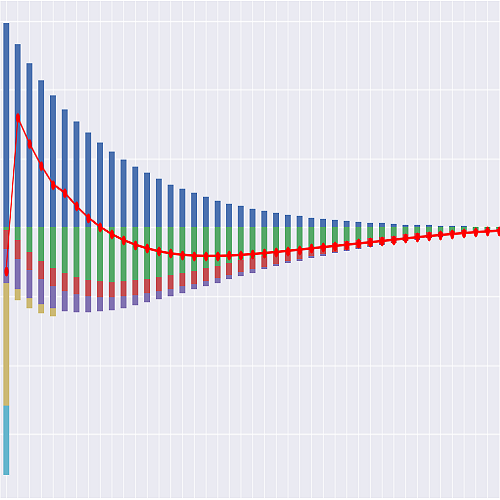
Implementation Notes#
Status: Draft, 2026-08-20. Built from
technical-notes.md; the product it implements is specified in
product-spec.md. Every parameter value below is one of theirs, and
where this document adds one it says so and tags it std.
This is a mechanics demonstration, not a pricing or reserving result. The contractual mechanics are sourced; every quantitative input is a standardization. No carrier publishes a medical rate table, there is no published morbidity table in Japan at all, and 第三分野標準生命表2018 may not be redistributed — so the office premium is a model point input, the incidence basis is a construction on public 患者調査 statistics, and the shipped mortality file is a documented proxy rather than the real table. Replace the assumption tables with company data before drawing any conclusion from the output.
Medical_JP_S is the executable counterpart of
technical-notes.md: a monthly, by-policy projection of gross
best-estimate liability cash flows for third-sector medical insurance (iryō hoken, 医療保険).
It is the jplib third-sector chassis — Cancer_JP_S
and LTC_JP_S state deltas against the day-limit machinery
here rather than restating it.
Run it#
python products/medical/run.py        # anchor cell, point_id = 1
python products/medical/run.py 4      # another model point
run.py prints the model point, the first thirteen months of the cash flow statement
(t = 0 … 12), the benefit-day and rider ledgers over the same months, the first five
policy-year totals (grouped as policy_year = t // 12 + 1), and the seven check_*
identities. Its output is ASCII-only so it prints on a Windows console under any code
page: amounts are written “JPY” and the product is romanized.
In a session:
import modelx as mx
model = mx.read_model("products/medical/Medical_JP_S")
model.Projection[1].result_cf()      # the worked example's anchor cell
model.Projection[1].result_days()    # the 通算 ledgers, per surviving policy
Projection[1] reproduces the worked example of technical-notes.md to the precision the
notes display: all four printed monthly rows, every figure of the three prose traces, and
the policy-year-1 aggregate of −¥41,860.47.
Structure#
Two Spaces, the house layout. Data is unparameterized and holds the five CSV readers and
their filename References, so each file is read once per model however many policies
are projected; Projection is parameterized by point_id, so every Projection[N] is a
separate ItemSpace with its own cells cache and readers placed there would re-read every
file for every policy.
Projection carries 100 cells and 33 References. t is the policy month and it is
0-based, the library-wide convention: t = 0 is the first policy month, month t
runs from t to t + 1 months after the 契約日, and the frame is
t = 0 … proj_len() − 1. proj_len() is therefore the number of projected months —
the exclusive end of the frame, not the last index — so result_cf(), result_pols()
and result_days() are each built over range(proj_len()) and hold proj_len() rows:
924 on the anchor cell, t = 0 … 923. pols_if(0) = pols_if_init() = 1 and
age(0) = issue_age().
The policy year is the contractual 1-based label derived from t, never an index
into the frame: policy_year(t) = t // 12 + 1, so months t = 0 … 11 are policy year 1
and age(t) steps at t = 12, 24, …. It exists because lapse_table.csv is keyed by
policy year and because the notes speak in policy years while the model steps in months.
Premium and maintenance expense fall at the start of the month, benefits and the claim
expense at the end, then mortality, then lapse, then the benefit-driven termination.
Acquisition expense and initial commission fall at t = 0; renewal commission starts at
t = 12, the first month of policy year 2.
The horizon is set by the mortality basis, not by a contract term: proj_len() is
12 × (omega_age() − x + 1), 924 months on the anchor cell, and omega_age() is read off
mort_table.csv rather than hard-coded so that replacing the table replaces the horizon
with it. On the 定期 model point flag the horizon is instead the last ten-year renewal
completing by age 80 [S10], and pols_maturity carries the survivors out at it. The other
term carrier’s 定期医療保険 renews to a higher age [S7], so 80 is that carrier’s limit and
not a market-wide one.
The day-limit machinery is the model#
A death-benefit model prices a sum assured; this one prices frequency × severity × limit. Three limits act in a fixed order and the order is the product:
L1inside the stay expectation, spell by spell —d_pay_capped(t). On the anchor’s 35–64 length-of-stay row that is 15.20 days against an uncapped mean of 20.20, so the 60-day limit removes 24.75% of raw days. Capping the mean instead would givemin(20.20, 60) = 20.20and remove the limit silently.The five-day minimum as an amount, not five days —
d_ben_capped(t). The carriers write 「入院給付金日額×5」 [S4] [S6] [S7], so the floor raises the benefit and adds nothing to the 通算 ledger. With it on, the same row gives 16.10 benefit days against 15.20 ledger days.The 通算 limit, per limb, with memory —
agg_days_dis(t)andagg_days_acc(t), withd_pay_dis/d_pay_acccapped by the room left andd_ben_dis/d_ben_accscaled in proportion. Two ledgers, because the 通算 limit runs separately on the 疾病 and 災害 limbs [S4] [S1]; one combined ledger terminates the contract roughly twice as early.
Both day ledgers and the 先進医療 and 入院一時金 ledgers are carried per surviving
policy and are never weighted by pols_if. A ledger multiplied by the in-force
probability measures the block’s consumption rather than the policyholder’s and defers the
limit indefinitely; it is the easiest state-variable error in this product, and
result_days() is printed unweighted so that the basis is visible.
term_rate(t) is the benefit-driven termination — cover ceases when both limbs are
exhausted [S9] — and pols_term(t) the decrement it produces. On every shipped model
point’s expectation it is identically zero: expected paid days run about 0.709 a year at
age 40 and about 15.2 at 90 and over, and the 疾病 limb takes 92% of them, so
agg_days_dis reaches about 541 days by the terminal age against its 1,095-day limit
while agg_days_acc reaches about 47. That is a property of the expectation, not of the
product, since E[min(Σ, LA)] ≠ min(E[Σ], LA), and the ledgers are implemented anyway
for two reasons. A seriatim or stochastic run needs them — the dispersion an
expected-value grid averages away is exactly what makes LA bite. And the
三大疾病無制限 特則 cannot be expressed without them: it takes がん, 心疾患 and 脳血管疾患
days out of the 通算 count entirely, which is a change in what the ledger counts and
which defers the benefit-driven termination further still. They are not kept for the
dependants: neither Cancer_JP_S nor
LTC_JP_S inherits them, and both document the deletion as
a product fact — cancer (がん保険) has no L1 and no LA,
nursing care (介護保険) no d_pay, no d_ben and no agg_days_*
ledger. Do not delete a ledger because it reads zero.
One statement here is sharper than the notes’. A ledger advances by
i(t) × s × min(d_pay, room) — a fraction of the room left, because i(t) × s < 1 in
every month — so on a deterministic grid it approaches LA geometrically and never
reaches it. term_rate is therefore unreachable on an expected-value projection, not
merely unreached at the anchor cell’s parameters. The test suite pins both halves of that:
re-read against a model point whose LA is five days and the cap bites in the very first
month — d_pay_dis falls from 15.20 to the 5.00 of room left, d_ben_dis scales with it,
and the ledger stops just short of the limit instead of overflowing it — while term_rate
stays 0 for the whole 924 months. That is E[min(Σ, LA)] ≠ min(E[Σ], LA) in its strongest
form, and it is why the benefit-driven termination is a seriatim or stochastic property
rather than an expected-value one.
Three absences, each a product fact#
There is no death benefit — the main contract pays nothing on death [S1] [S4] [S6]
[S9] [S10] — so mortality is a pure liability release and no claims_death exists. There
is no 契約者貸付 and no 自動振替貸付 [S1], so nothing carries a policy through a missed
premium and no lapse-suppression term belongs in the recursion; the automatic-premium-loan
machinery of the whole life savings chassis (終身保険) must not
be inherited here. And there is no
surrender value under 終身払 at any duration, so claims(t, "LAPSE") is identically zero
on eight of the nine model points and the zero column is published rather than dropped.
cv_pp exists only because the 65歳払済 short-pay variant acquires 10 × 入院給付金日額 once
the premium-paying period completes [S1] [S6] — model point 4, and the single route by
which this chassis ever has a surrender value at all.
Inputs are external files#
CSVs beside run.py, read at run time; the model folder holds formulas only — no
_data/, no IOSpec, no embedded values. Data.input_dir() resolves the directory from
_model.path.parent, so the model works from any checkout. The consequence worth knowing
is that the model is not portable on its own: copy Medical_JP_S/ without its
parent’s CSVs and it reads cleanly and then fails on first evaluation.
File |
Contents |
Provenance |
|---|---|---|
|
9 model points: chassis, 契約年齢, sex, 日額, |
Contractual columns from the composite [S1] [S4] [S6] [S9] [S10]; the office premium is std on every row |
|
Annual |
The library-wide canonical std construction: log-linear graduation between the 22 sourced anchors read out of 第三分野標準生命表2018, exact at every one of them — 男 q40 = 0.00076 R4 REG-R18 REG-R19 REG-R20; not a copy — redistribution is prohibited REG-R21 |
|
Annual |
std, anchored by construction to the 5.6% industry 解約・失効率 REG-R31 |
|
入院受療率 per 100,000 by five-year band, 平均在院日数 by broad band, and the sex factors |
All fifteen 受療率 bands sourced R6 REG-R26, all four 平均在院日数 bands sourced R6 REG-R27; sex factors std |
|
Five-band length-of-stay distribution per broad age band |
std shape; probabilities solved so each row mean equals the sourced 平均在院日数 R6 REG-R27 |
Every row of every assumption table carries a provenance column tagging it [std] … or
naming the source it came from. Files are UTF-8 without a BOM; headers and every cells
name are ASCII lower_snake_case.
No input file is keyed by the model’s t, so the move to the 0-based time index left
every CSV byte-for-byte unchanged. Column by column:
File |
Column |
What it is |
Decision |
|---|---|---|---|
|
|
The contractual 1-based policy-year label, the basis the std curve is stated on |
Values left alone. |
|
|
An attained age, not a duration |
Left alone; reached through |
|
|
The edges of a five-year age band |
Left alone; reached through |
|
|
The edges of a broad age band |
Left alone; reached through |
|
|
A length of stay in days — a severity, not a point on the projection’s time axis |
Left alone |
|
|
An age, a category ( |
Left alone. There is no in-force column at all — no |
The mortality file is a proxy on purpose. 第三分野標準生命表2018 is public, free and
machine-readable — the sharp contrast with uklib, which had
to proxy subscriber-only tables — so anyone can retrieve it and check a rate. But the publisher’s terms prohibit
reproduction and transmission to third parties without written consent REG-R21. jplib
therefore cites the table by URL, quotes the handful of rates the worked example
needs, and ships a documented construction over those quoted rates. The construction is
canonical across the library: the same file, value for value and provenance string for
provenance string, ships in every jplib product that reads a third-sector rate, so the
same cell cannot carry two values in two products. It takes the union of the anchors the
research pass actually read — 22 of them, both sexes, age 0 to the terminal age — and
graduates log-linearly (geometrically) between adjacent anchors,
q(x) = q(a)·(q(b)/q(a))^((x−a)/(b−a)). Every anchor is reproduced exactly, so male
q40 is exactly 0.00076 and q at the terminal age is exactly 1 — which is what closes
the projection horizon — and the curve is locally the Gompertz family the publisher’s own
table uses. Each row’s provenance says which it is: an anchor quotes its rate, an
interpolated row names the two anchors it sits between. Nothing in it is a statement about
Japanese third-sector mortality.
受療率 is a prevalence, not an incidence, and inc_rate_base is where the model
refuses to confuse the two. The conversion inc = (juryoritsu / 100,000) × 365 / alos is
an explicit std step flagged as needed by the source itself REG-R26; at age 40 it
turns the published 0.00258 into 0.046619 a year, a factor of 18.07.
Modules that are off in the base run#
Five of the notes’ optional constructions are implemented and switched off on the anchor cell, so the base run reproduces the worked example while the machinery stays visible and testable. Each is exercised somewhere, and the test suite asserts both positions of each.
Module |
Off position |
Switched on |
|---|---|---|
Anti-selective lapse: |
|
At the notes’ 0.30 the anchor cell’s lifetime |
保険料払込免除: an absorbing state on the premium-paying population, since the 特定三疾病 特則 waives premiums for life once triggered [S1] and has no recovery limb |
Incidence zero unless the 特則 is elected. The base disability waiver is zero in every run, not only the base one: 第三分野標準生命表2018 excludes 高度障害 R5 REG-R20 and no public 高度障害 incidence table was retrieved |
Model point 7, at the notes’ placeholder |
The 三大疾病無制限 特則: it does not merely raise the limits — it removes |
|
Model point 4: benefit days per hospitalization 15.20 → 16.70, ledger-consuming days 15.20 → 10.64 |
入院一時金特約: ¥100,000 per hospitalization against a 通算50回 count ledger [S1] |
|
Model points 3 and 7; point 3 pays ¥231,914.26 over the lifetime and reaches a count of 24.91 |
The age-basis offset: the contract ages on attained age with the fraction discarded (man-nenrei, 満年齢) [S4] [S10] while 第三分野標準生命表2018 is built for nearest-birthday (hoken-nenrei hōshiki, 保険年齢方式) R5 REG-R20, so half a year sits between the projection basis and the valuation basis |
|
0.5 reads the table at |
surg_after_limit is a switch too, but it is on in the base run because it resolves a
genuine contradiction between carriers rather than an optional feature: where surgery
is performed during a stay whose day limit is exhausted, one carrier pays at the
in-hospital multiple [S4] and another pays nothing [S10]. The composite pays. Reversed —
model point 5 — the truncated day fraction of 24.75% of in-hospital surgeries falls outside
cover, so the two positions differ by a quarter of the in-hospital surgery benefit and are
not roundable into each other.
Named and not modelled#
The one-month 払込猶予期間 lag and the grace-window claim rule [S1] [S4] [S10]; 復活, which belongs in the model as a new model point because the 責任開始期 resets to the 復活日 [S4] [S9]; 前納 discounting [S4]; catastrophe proportionality [S4]; prospective 支払事由 change on amendment of the 診療報酬点数表 [S2] [S6]; and クーリング・オフ, a pre-inception decrement REG-R36. Each is a [std scope] exclusion in the notes and each stays one here.
Sign convention#
net_cf is income positive — premiums less every benefit limb, less acquisition and
maintenance expense, less claim expense, less commission — which is both the notes’ own
orientation and the library-wide convention. The
notes print the stream that way too, so unlike the whole life and payout annuity models
there is no outgo-positive liability_cf companion to publish: one stream, one sign, one
name.
The shape to expect is a deep month-0 strain — ¥57,800 of acquisition expense and initial commission against one month’s ¥2,100 premium — then thin positive margins that thin further with age: the level premium prefunds a morbidity cost that rises for the whole of life, and year-1 claims are only 21.5% of year-1 premium at age 40.
Naming#
Cells names follow lifelib’s basiclife/BasicTerm_S wherever it has an analogue: pols_*
for policy counts, plural nouns for cash flows, *_rate for annual rates with *_rate_mth
for their monthly companions, *_pp for per-policy amounts, claims(t, kind) with an
uppercase kind string, and pols_if_at(t, timing) for the within-month in-force reads.
The technical notes use compact symbols; the full mapping lives in the Projection Space
docstring. Six cases needed care:
Notes |
Cells |
Why |
|---|---|---|
|
|
The notes give the monthly rate the shorter symbol. A bare |
|
|
Two different quantities: ledger days and benefit days, separated by the five-day floor. |
|
|
The notes’ 0/1 indicator is a decrement rate, spelled beside |
|
|
Spelled out because the unit is days and the limb is the whole point of having two of them |
|
|
A JPY ledger and its cap, named for what they hold rather than for the notes’ letters |
(no symbol) |
|
Library-wide, the count whose cover ends at the scheduled end of the contract, paid or not; a payment for it would be |
Four names are fixed by rulings that run across all nine jplib models rather than by
anything particular to this product, and this model carries its share of them:
Cells |
Ruling |
|---|---|
|
|
|
|
|
The table lookup keyed by age, beside |
|
The multiplier turning the shipped valuation table into the projection basis, in all nine models. |
Standardizations used#
Everything the notes mark std is carried through unchanged: mort_be_factor = 1.25,
the
0.92 / 0.08 疾病 / 災害 limb split, s_ih = 0.35 and s_op = 0.15, adv_freq = 0.00040 with
adv_sev = ¥150,000 and the 10% / ¥500,000 top-up, the lapse curve, the five-band
length-of-stay shape, the sex factors on incidence, the expense and commission scale, and
the monthly conversions.
Two standardizations are introduced here rather than in the notes, because they are implementation parameters that a document about the product on paper does not need:
share_3dis= 0.30 std. The share of hospitalizations the 三大疾病無制限 特則 exempts from both day limits. It carries no observed range: no cause split of 入院受療率 was extracted in the research pass R7 REG-R33. It is inert unless the 特則 is elected, and the base run is bit-identical with it at any value.The 定期 final expiry age std. 「Renewable to age 80」 [S10] is read as the last ten-year renewal whose term completes at or before 80, so an issue age of 35 expires at 75.
teiki_expiry_ageandteiki_renewal_termare References.
Nothing in incidence_table.csv is interpolated: the 概況 publishes 入院受療率 for every
five-year band from 20–24 to 90歳以上, so all fifteen bands the model needs are sourced
row by row R6 REG-R26. Only the sex factors on that table are std.
The nine office premiums are std model point inputs. The anchor’s ¥2,100 is the notes’ own, sitting between the two public specimen rates for that exact specification [S8] [S3] and 14.6% above the break-even premium this model’s own std basis implies; the other eight sit between 8.6% and 19.7% above their own break-even, so that no shipped model point projects a lifetime loss on its own assumptions. They are not rates, and no rate table exists to check them against — the 算出方法書 is a 基礎書類 filed with the 金融庁 and is not published REG-R2.
Tests#
tests/test_model_conventions_jp.py applies the house style: the layout, the
Data/Projection split, read-once inputs, the docstrings, the naming register, the
result_cf() column conventions, that every model point projects without NaN, and the
read → write → re-read round trip. It also applies the library-wide frame rule to
every one of the nine model points: the index of result_cf() is contiguous, starts at
t ≥ 0, ends at proj_len() − 1, and len(result_cf()) == proj_len(). This model opens
every point at t = 0, because every model point is new business.
Seven check_* cells assert the identities this product implies. Each takes no argument
and returns a bool over all t, with the signed per-month residual at
check_*_resid(t); all seven return True on all nine shipped model points.
Check |
What it closes |
|---|---|
|
|
|
Both 通算 ledgers advance by exactly the month’s ledger-consuming paid days, unweighted by |
|
The three limits act in order: no expectation exceeds |
|
The 先進医療 ledger advances by the reimbursed 技術料 only — not the cash top-up — and never passes ¥20,000,000 |
|
The 入院一時金 count ledger advances by the month’s payments and never passes 通算50回 |
|
The 保険料払込免除 state is absorbing and stays in [0, 1] |
|
The printed cash flow statement adds to |
The nine model points cover both sexes, issue ages 20 and 80 at the edges, both per-hospitalization limits, both aggregate limits, the five-day floor, the 10倍 and in-hospital-only surgery structures, both positions of the surgery-after-limit contradiction, the 入院一時金 rider, the 三大疾病無制限 特則, the 特定三疾病 waiver, the 65歳払済 short-pay point that is the only one with a surrender value, and the 定期 ten-year-renewable chassis. Model point 1 is the anchor cell and reproduces the notes’ worked example to the precision the notes display.
tests/test_medical_jp.py is this model’s own suite. It asserts:
The worked example, hard-coded as a module-level table rather than pickled, so a reviewer can check it against the notes by eye — all four printed monthly rows to the yen-cent and to six decimals of
pols_if, every assumption value the notes quote before the table, the month-0 trace as products rather than totals, the policy-year-1 aggregate of −¥41,860.47 line by line on unrounded values, and the closing state att = 12.pols_if(12) = 0.99905 × 0.91is an exact half-unit tie at six decimals, so the tolerance there is a half unit plus the tie, stated in the test rather than hidden in a rounder.Every entry in the notes’ Known modeling pitfalls list, one test each, named after the pitfall it protects — fifteen of them, from 受療率 as a prevalence through the five-day minimum, the order of the three day limits, the unweighted per-policy ledger, the two limbs, radiation folded into 手術給付金, the absent death benefit and surrender value, the fixed 型, the age-basis mismatch, the 180-day grouping rule, to monthly rounding that does not re-add. Each fails if its pitfall is committed.
The roll-forward identities and all seven
check_*cells on all nine model points, plus the month-by-month residual, the mortality-before-lapse order andpols_ifas a decreasing probability in [0, 1].Each optional module in both positions — anti-selective lapse off and at 0.30, the premium waiver off and elected, the 三大疾病無制限 特則 off and elected, the 入院一時金 rider off and attached, the age-basis offset at 0 and 0.5, and
surg_after_limitin both of its contradictory readings.The published frame:
result_cf()is indexed by the 0-based policy month, namedt, running0 … proj_len() − 1— 924 rows on the anchor cell — with the notes’ month-0 strain on the first row. Every golden key and every literaltin the module is on that index.The structural product facts: the horizon set by the mortality table rather than by a contract term, the 定期 flag’s expiry with no maturity value, the short-pay point as the single route to a surrender value, the sex crossover in incidence between ages 30 and 40, the benefit-driven termination as a third decrement, the provenance column on every assumption row, and that an input can be swapped without touching a formula.