The Projection Space#
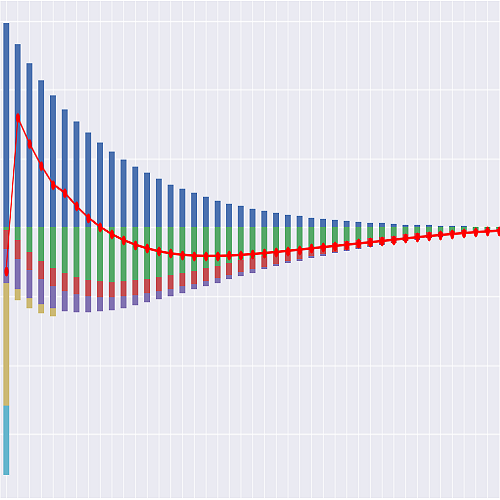
The by-policy projection of the Child_KR_S model.
The Space is parameterized by point_id, so Projection[1] is an ItemSpace
projecting model point 1:
>>> Projection[1].result_cf()          # the worked example's anchor cell
>>> Projection.point_id = 4            # or switch the default
t counts policy months, 0-based: t = 0 is the first projected month and month
t runs from t to t + 1 months after the 계약일. proj_len() is the number
of projected months — the exclusive end of the frame — so the projection runs over
t = 0 … proj_len() - 1 and result_cf() carries proj_len() rows. The last index
t = proj_len() - 1 is the 계약해당일 at 보험나이 term_age on which the contract
expires: a terminal row that holds the surviving in-force count, the residual 계약자적립액
and nothing else. On the anchor cell proj_len() is 1,201 — the longest projection
in krlib, and the whole point of the product.
The age basis, and the two ages a foetal contract carries
The contract’s own clock is 보험나이 (boheom nai, insurance age): 계약일 현재 실제
만 나이 with a fraction under six months discarded and six months or more rounded up,
incrementing at each 계약해당일 (표준약관 제21조 [REG-R25], reproduced verbatim by every
carrier). That is what age() returns, and it governs the premium, the anniversary
on which the 갱신형 block renews and the 보험나이 15 threshold at which the 면책기간
switches on.
The decrement tables are read at 만나이 (man nai, age last birthday) through
age_man(), because every public series they are built from is published on 만나이 —
the 완전생명표 [REG-R38] [REG-R39], the 국가암등록통계 age bands [REG-R40] and the
국민건강보험 statistics [REG-R41]. Because of the six-month rule the two differ for
roughly half of all issue dates, and on an ordinary contract the offset is the [std]
half-year average, taken here as zero.
On a 태아 contract the offset is not an average but a stated quantity. The 계약나이 is 0 at the 계약일 [S8 제60조], the child’s 만나이 is 0 at birth, and 「보험금 지급기준표에서 적용하는 피보험자 나이는 피보험자가 출생한 날부터 계산합니다」 [S8 제58조], so
보험나이(t) = issue_age + t // 12 만나이(t) = (t - birth_month) // 12 for t >= birth_month, undefined before
and the two differ by exactly birth_month() months for the life of the contract — five
on the anchor cell, capped at six by [S8 제61조]. The contract therefore expires when the
insured is 99 years and 7 months old, not 100.
Notes symbol map
The technical notes use compact actuarial symbols; the cells use lifelib names.
Notes symbol |
Cells |
Meaning |
|---|---|---|
— |
|
the selected model point as a Series |
— |
|
the number of projected policy months |
n = proj_len - 1 |
— |
the terminal 계약해당일 month index |
b |
|
the policy month of birth |
m |
|
the 납입기간 in months |
x |
|
보험나이 at the 계약일 |
x + floor(t/12) |
|
attained 보험나이 in month t |
y(t) |
|
attained 만나이 in month t |
S_j |
|
보험가입금액 of cover j |
P |
|
monthly office premium, all streams |
q(y) |
|
annual mortality of the insured |
i_j(y) |
|
annual incidence of cause j |
w(t) |
|
annual lapse rate |
v(t) |
|
pre-birth 무효 rate |
omega(t) |
|
annual 납입면제 rate, both lives |
l(t) |
|
in force at the start of month t |
l_P(t) |
|
of which still paying premium |
l_W(t) |
|
of which waived |
AV(t) |
|
계약자적립액 per policy, at time t |
CV(t) |
|
해약환급금 per policy, at time t |
X(t) |
|
unamortised 해약공제액, at time t |
CF(t) |
|
net cash flow, income positive |
Every state variable in this model is a time-point value, at time t, and not a
closing balance of period t: av_pp, cv_pp, cv_std_pp, surr_chg_pp,
refund_ratio, cum_prem_pp and prem_foetal_paid_pp are read at the start of
month t, before that month’s premium, with t = 0 at the 계약일 — hence
cum_prem_pp(0) = 0 and av_pp(0) = 0, and twelve instalments stand at t = 12.
The counts pols_if, pols_pay and pols_waived are likewise at the start of
month t. The four exit payments of month t fall at its end and are valued on
those start-of-month quantities [std].
The pre-birth period, and what is in force in it
Months t < birth_month() are the part of this model that has no analogue anywhere in
this repository. Cover attaches at birth and not at the 계약일 — 「제53조의 태아는
출생시에 피보험자가 됩니다」 [S8 제54조], and sixteen carriers were ordered in 2016 to
stop advertising otherwise [R2] — so born() is false, every cover on the child’s own
life is identically zero, and there is neither mortality nor morbidity on the insured.
What is in force instead is the 태아보장기간, whose limbs pay from the date of birth
even where the event preceded it [S8 제59조]; the premium, on all three streams; and a
void decrement. 유산 or 사산 makes the contract 무효 and every premium paid is
returned [S8 제56조] [S9], which is not a lapse: nothing is retained, and the cash flow is
a refund of premiums already collected rather than a surrender value. pols_void()
carries it and claims() pays it as the "VOID" kind.
Two decrement lives
The premium stops on the earlier of two events drawn from two different rows of the mortality table. The child’s trigger is 50% 이상 후유장해, one of the 7대질병 or a 중대한특정상해수술 [S2]; the 계약자’s is his own death or a cumulative 장해지급률 of 50% or more [S10 제22조], which is lawful in one clause because that wording makes the 피보험자 of the contract 「계약자와 가입자녀」 [S10 제3조]. The two are treated as independent [std] — nothing in the sources says otherwise and nothing the model can see relates them — and the child’s limb carries the P코드 carve-out: it does not operate over the 1년만기 신생아 block on a 태아 contract, so the covers most likely to pay in the first year of a foetal contract are precisely the ones that cannot stop the premium.
Processing order, and the roll-forward it closes
Within month t the order is void, then the waiver, then mortality, then lapse
[std order]. The void decrement applies only before birth and to the whole in-force
block; the waiver moves a policy from pols_pay() to pols_waived() without
changing pols_if(); mortality applies to both compartments; and lapse applies to the
paying compartment alone, a policy paying nothing having nothing to lapse for. The
identity check_pols_roll_fwd() closes exactly under that order, and
check_waiver_split() asserts that the two compartments still sum to the block.
Input data
Inputs are external files: plain CSVs living in the model folder’s parent directory,
products/child/, read at run time rather than stored inside the model. Each table has
a filename Reference and a reader Cells, both on Data, reached here
through the data Reference. The consequence worth knowing: the model is not portable
on its own. Copying the Child_KR_S folder without its parent’s CSVs produces a model
that reads and then fails on first evaluation.
Cells Descriptions#
- sex()[source]#
The sex (M / F) of the insured: a rating factor and a key into every basis table.
On a 태아 contract the sex is not known at issue and the contract is 「일단 남자 아이를 기준으로」 priced, trued up after delivery [R3] [S8]. The composite adopts the male-rate convention and does not model the true-up, because the direction is no longer reliable: on the current published tables four carriers price the female above the male and seven below, the spread running 62% to 114% of the male rate [S11].
- issue_age()[source]#
x: the 보험나이 of the insured at the 계약일.
0on a 태아 contract, where 「계약일에 있어서의 피보험자의 계약나이는 0세로 합니다」 [S8 제60조]. The current issue-age envelope is 태아 ~ 보험나이 15세 [S2] [S4] [S5] [S6]; the pre-2023 generation of the same product lines accepted to 30 [S1] [S7], and the 2023 감독행정 restricted the product name above 15 rather than the age itself [R1], so a 30-year-old issue is a documented historic variant and is shipped as one.
- foetal()[source]#
True where the contract is a 태아가입 — written before the insured exists.
The 태아가입특칙 is what makes it possible: a 태아 has no legal personality and cannot be the 피보험자 of an 인보험 contract, so 「제53조의 태아는 출생시에 피보험자가 됩니다」 [S8 제54조] [R3]. It is not a fringe variant — 20.7% of new child contracts in FY2007 were written in utero [R3] — and every current 상품요약서 offers it, with 가입나이 written as 「태아」 at the head of the issue-age grid [S2] [S3] [S4] [S5] [S6].
- birth_month()[source]#
b: the policy month in which the insured is born; 0 on an ordinary contract.
5 on the anchor cell [std]. Three sources bound it: [S8 제61조] caps the pre-birth period at six months by moving the 계약일 back where the birth falls later than that; the neonatal riders close at 임신 22주 [S5], so a contract written inside that window still has at least 4.1 months of gestation to run; and the 태아 sub-term is written 「1~10월만기」 at one carrier [S1]. Five is between those two bounds and is a whole number of grid steps.
- issue_age_man()[source]#
The 만나이 of the insured at the 계약일: 0 on a 태아 contract.
On an ordinary contract the 만나이 is taken equal to the 보험나이, a [std] simplification: the six-month rounding rule puts the true 만나이 at
issue_age()orissue_age() - 1with roughly equal probability, and no source supplies the distribution of issue dates within a policy year that a conversion would need. On a 태아 contract no simplification is needed — the offset is exactlybirth_month()months.
- term_age()[source]#
The 보험나이 at which the 보험기간 ends: 100 on the composite.
Observed maxima: 100세 at four carriers [S1] [S2] [S5] [S6] and 110세 at one [S4], the longest term found anywhere in this research. 100 is the modal maximum, the term on which every published premium and cash-value grid in the file is quoted [S11] [S2] [S1], and the term whose arrival in 2011 made the product what it is [R5]; 110세 adds no mechanic and is shipped as a model point.
- prem_period_years()[source]#
The 납입기간 of the core covers in years: 20 on the composite.
Observed 10 / 15 / 20 / 25 / 30년납 on the 100세만기 forms [S2] [S4]. 20 years is the payment term the comparison board quotes every premium on [R12]; it is the 해약공제계수 cap of 감독규정 [별표 14], 「보험기간(최대 20년)」 [REG-R20]; and it leaves eighty years of paid-up cover on the anchor cell — four times the payment period, and the reason a child policy’s measurement is dominated by what happens long after the premium stops.
- prem_period_mths()[source]#
m: the 납입기간 of the core covers in policy months,
12 x prem_period_years().
- prem_end()[source]#
The last policy month in which a core premium falls due,
prem_period_mths() - 1.The premium is payable monthly in advance, so a 20년납 contract pays in months 0 to 239 and 납입완료 falls at
t = 240— which is where the 무해지 surrender-value step sits and why it is a cliff rather than a curve [S2].
P_core: the monthly office premium of the core covers, a model point input.
₩28,000 on the anchor cell [std], being ₩27,000 of core 보장보험료 and ₩1,000 for the 계약자 waiver module; ₩27,000 on the calibration cell. No Korean carrier publishes a rate table by age and duration — the 산출방법서 that holds each carrier’s own 적용위험률 and 예정사업비율 is an undisclosed 기초서류 [REG-R2], and the bureau’s 참조순보험요율 is filed with the FSC under 보험업법 제176조제4항 with no general publication obligation [REG-R4], the 장기손해보험 display published under 제176조제9항 carrying risk rates rather than office premiums [REG-R61] — so the office premium enters as an input rather than being computed. What is published is a specimen premium per product on a standardised basis (보험나이 5세, 상해 1급, 100세만기 20년납, 월납, the 보장보험료 of the compulsory covers only [R12]), and the observed levels vary by a factor of seven, ₩21,502 to ₩148,250 for a male 5-year-old, because carriers include different compulsory sets in the quoted figure [S11]. ₩27,000 is the tight cluster of the three mid-market carriers whose compulsory sets are closest to [R12]’s — ₩26,841, ₩26,999 and ₩27,480 [S11]. Nothing in this model depends on it being a market rate;
equiv_premium_mth_pp()computes the premium the shipped basis actually implies, and where the two differ the computed figure governs.
P_foetal: the monthly premium of the 태아 module, 전기납 over its own short term.
₩3,000 on the anchor cell [std], giving ₩31,000 a month to
t = 16and ₩28,000 fromt = 17. The second stream is not an artefact of the composite: a 태아 contract really does carry a second, short term with its own premium — 「계약체결일부터 출생시점 … 까지의 기간을 보험기간으로 하여 아래의 보험기간 및 보험료 납입기간을 추가로 부가합니다」 [S2], written elsewhere as a fixed 「1~10월만기 전기납 태아 월납」 sub-term [S1].
- foetal_cover_end()[source]#
The policy month at which the 태아 module’s cover ends:
birth_month() + 12.The module merges two terms the sources state separately — the 태아보장기간, 「계약체결일부터 출생시점(출산 또는 분만 과정에서 보험금 지급사유가 발생하는 경우 포함)까지」 [S2], and the 1년만기 전기납 신생아 block that follows it, matching 「출생 전후에 발생하는 질환에 대한 보장을 강화하려는 목적으로 출생 후 1년까지만 보장」 [R5] [S2] [S5]. On the anchor cell that is
t = 17.
- foetal_prem_end()[source]#
The last month in which a 태아 module premium falls due, one month before its term.
The module’s premium is 전기납 and payable monthly in advance, so a term ending at
t = 17collects in months 0 to 16 — which is exactly what the published anchor premium says: ₩31,000 tot = 16, ₩28,000 fromt = 17[S2] [S1].
- cv_form()[source]#
The surrender-value form:
std,susporgraded.std표준형 — 해약환급금 = 순보험료식 계약자적립액 less the 해약공제액, floored at zero [S2] [S1] [REG-R19 제7-66조제1항제1호]. The base run, deliberately: every carrier on the board offers a suppressed form beside it [S11] and the market has moved there, but the 적립부분 credited at the 공시이율 exists only on the 표준형 — the suppressed forms are 순수보장성 and show 「-」 for it [S11] [S2] — and the 표준형’s value exceeds premiums paid from about year 30, a shape no other
krlibprotection product produces and only a hundred-year term can.susp해약환급금 미지급형 — nil during the 납입기간 and
cv_floor_ratio()of the 표준형 value afterwards [S2] [S11] [REG-R19 제7-66조제4항].graded해약환급금 미지급형Ⅲ — the published ten-step ladder, 5% of the 표준형 value in the two years after 납입완료 rising in 5-point steps every two years to 50% eighteen years after it [S1].
- cv_floor_ratio()[source]#
k: the suppressed form’s fraction of the notional 표준형 value after 납입완료.
0.50, the regulatory floor of 감독규정 제7-66조제4항제2호 [REG-R19] [REG-R28] and the level every carrier writes to [S2] [S11]. The 50% is 50% of a product nobody can buy: the comparator is synthetic and both carriers say so — 「’해약환급금미지급형 비교상품’은 … 해지율을 적용하지 않은 상품이며, 비교안내를 위한 종목으로 실제로 판매하지 않음」 [S3] [S1]. So the suppressed form’s post-completion value is half of a hypothetical cash value computed without the lapse assumption used to price the form itself, which is the whole reason that assumption became a supervisory matter [R11] [REG-R27].
- waiver_child()[source]#
True where the child’s 보험료 납입면제 is attached. On in the base run.
Triggers: 50% 이상 후유장해 (상해 or 질병), diagnosis of one of the 7대질병 — 암(유사암 제외), 뇌혈관질환, 중대한재생불량성빈혈, 양성뇌종양 and three 심혈관질환 limbs — or a 중대한특정상해수술, 「상해로 뇌손상, 내장손상을 입고 사고일로부터 180일 이내에 받은 개두·개흉·개복수술」 [S2].
- waiver_payer()[source]#
True where the 계약자’s 보험료 납입면제 module is attached. On in the base run.
「보험료 납입기간 중 … 계약자가 사망 또는 … 장해지급률이 50% 이상인 장해상태가 되었을 때에는 차회 이후의 보험료 납입을 면제하여 드립니다」 [S10 제22조제1항]. This is the mechanic with no counterpart in
uslib,uklib,jplib,frlibordelib: a decrement on a life who is not the insured. On the 손해보험 chassis the same economics arrive as a compulsory 부양자 death rider on the parent’s own life [S5] [S11], which is a benefit and not a decrement, and modelling one as the other would be wrong in both level and shape.
- payer_age()[source]#
The 만나이 of the 계약자 at the 계약일: 33 on the composite [std].
33 is the mid-point of the 20~47세 band the mother-side riders themselves state [S2], and the only sourced anchor for a parental age in the whole file; Korean statistics on mean age at first birth were not retrieved and are not relied on. The waiver’s whole value is concentrated in the twenty years in which a 33-to-53-year-old parent might die or become severely disabled, and Korean mortality at those ages is low, which is why the module is cheap enough to be compulsory.
- payer_sex()[source]#
The sex of the 계약자, a key into the same mortality table as the insured.
Male on the composite, so the waiver decrement runs on the male table, which is the conservative direction [std]; a female 계약자 is a model-point variant. The 계약자 may be changed during the contract, which would change the decrement life mid-projection; no retrieved wording states how the waiver responds, so the composite holds the 계약자 fixed and marks the point [unverified].
- sum_assured(cover)[source]#
S_j: the 보험가입금액 of cover
j, read from the model point.The rider set is the 손해보험협회 comparison basis [R12] — the only standardised specification of a Korean child policy the market itself publishes, and the basis every published premium is quoted on — plus a 유사암 tier and a 태아 module that basis does not carry. At the anchor cell:
disability₩100,000,000 (the 기본계약, paid as 보험가입금액 × 장해지급률),disease_disab₩10,000,000,cancer₩10,000,000,minor_cancer₩2,000,000 (20% of the general tier, the chassis ratio),cerebralandcardiac₩10,000,000 each on the narrow 뇌출혈 and 급성심근경색증 definitions,surgery₩5,000,000 per named-disease operation,fracture₩400,000,burn₩200,000,liability₩100,000,000 per occurrence andneonatal₩10,000,000 as the 태아 module’s own 가입금액.
- hosp_daily()[source]#
The 입원일당 per day: ₩40,000, on a 1~180일 per-stay basis [R12] [S2].
The observed menu is wide — 1~180일, 1~120일, 1~30일, 1~10일 and 4일이상 bases, with 종합병원 / 상급종합병원 / 중환자실 / 1인실 variants and 암직접치료 and 요양병원 sub-limits [S1] [S2] — and the composite takes the comparison basis’s single form. This is the cover a child policy actually pays on, an order of magnitude below the diagnosis benefits in amount and several orders above them in frequency.
- broad_def()[source]#
True where the two adult-disease limbs are written on the broad KCD ranges.
Two definitions are in the market for each: the narrow 뇌출혈 and 급성심근경색증 the comparison basis prices [R12], and the broad 뇌혈관질환 and 허혈성심장질환 most current products sell [S11] [S2]. The composite takes the narrow pair, against the grain of current practice, because every published premium in the file is quoted on [R12]’s specification — pricing the broad definitions against a premium collected for the narrow ones would make the anchor cell internally inconsistent. The switch multiplies both incidences by
broad_def_factor[std].
- waiting_mths()[source]#
The 면책기간 in months before the 암보장개시일: 0 on the anchor cell.
암보장개시일 =
    the day the first premium is received     if 보험나이 < 15 at the 계약일
    the 91st day counting 계약일 as day 1      if 보험나이 >= 15 at the 계약일
    the day the first premium is received     if the cover is a 태아가입용 form
Two independent primary statements, from two carriers and two document types: 「최초 계약과 부활계약의 면책기간은 보험나이 15세 이상인 경우에만 적용」 [S3], and 「보장개시일(계약일로부터 90일이 지난날의 다음날, 계약일 현재 보험나이 15세 미만 피보험자의 경우 1회 보험료를 받은 때)」 [S11]. The origin is 2006: there being no evidence of anti-selection or of a 위험률차손 at child ages, the 90-day 부담보 was deleted for 어린이보험 [R5]; a 태아가입용 cover has 「면책기간 없음」 at all [S3].
The rule is tested at the 계약일 and not at the claim date, so a contract issued at 계약나이 0 has no cancer waiting period at any point in its hundred-year life, including the eighty-five years during which the insured is an adult. A model that re-tests the rule at each anniversary is wrong.
- reduction_mths()[source]#
The 감액기간 in months, during which a diagnosis benefit pays half: 0.
The market has moved to 감액없음 and prints the word in the benefit names — 암진단비 (유사암제외)**(감액없음)** — at five carriers [S1] [S3] [S11]; where a 감액 survives it is a first-year 50% [S6] [S11], which is the shipped switch. And a 태아 contract may not be subject to 감액 at all: a 변경권고 of 2015-06-17 inserted 「단, 피보험자가 보험가입 당시 태아(胎兒)인 경우에는 보험금의 100%를 지급합니다」 across 17 carriers and 56 products, on the reasoning that 「태아는 보험가입시 역선택 가능성이 거의 없는데도」 [R2]. The disapplication is applied here rather than left to the model point.
- prem_discount_rate()[source]#
The 2026 저출산 premium discount, as a fraction of the office premium. 0 in base.
From 2026-04-01 every Korean insurer operates a 1%–5% discount for one year on a 보장성 어린이보험 where the policyholder or spouse is within a year of a birth, on 육아휴직, or on 육아기 근로시간 단축 for a child of 12 or under [R6]. On the birth limb the discount applies to a sibling’s policy and not the newborn’s own. It is limited to one use per contract, pre-existing contracts qualify, and the expected industry cost is about ₩1,200억원 a year [R6]. Whether it applies to the 영업보험료 or the 보장보험료 is not stated and is [unverified]; the model applies it to the whole office premium.
- prem_discount_mths()[source]#
The number of months over which the 2026 저출산 discount runs: 12 where on [R6].
- lapse_basis()[source]#
Which of the three shipped lapse vectors this model point uses.
loglinearis the 2024 계리가정 guideline’s 원칙모형 [REG-R27] [R11] and the base;disclosedis the 적용해지율 one carrier actually publishes [S1];flatis a level comparison vector. Shipping the first two side by side is exactly the comparison the guideline requires an insurer departing from the 원칙모형 to disclose.
- mort_be_factor()[source]#
The multiplicative adjustment from the shipped table to a best estimate.
1.0 in the base run: the table is already a [std] construction on population data rather than a valuation table with a margin in it, so there is nothing to unwind. It is carried so that a user replacing
mort_table.csvwith a company valuation table has the hook the sister libraries use, and one model point runs at 1.10.
- pols_if_init()[source]#
The number of policies in force at
t = 0: one.Every model point is a single policy, so the whole projection reads as an amount per policy issued. On a 태아 contract “in force” at
t = 0means the contract is on risk for the 태아보장기간 limbs and for the premium — not that the insured exists.
- proj_len()[source]#
The number of projected policy months,
12 x (term_age() - issue_age()) + 1.The exclusive end of the frame: the projection runs over
t = 0toproj_len() - 1andresult_cf()carriesproj_len()rows. 1,201 on the anchor cell, the longest projection inkrlib: a 태아 contract at 계약나이 0 running to the 100세 계약해당일. The+ 1is that 계약해당일 itself: the 1,200 months of the 보험기간 aret = 0 … 1,199, and the last indexn = proj_len() - 1 = 1,200is the terminal row on which the contract expires — the surviving in-force count and the residual 계약자적립액, and no cash flow of its own.On a 태아 contract the terminal date is fixed by the 계약일 and not by the birth, so the insured’s 만나이 at expiry is 100 less the pre-birth period — 99 years and 7 months on the anchor cell. That asymmetry runs the whole length of the projection and is a direct consequence of [S8 제60조] setting the 계약나이 to 0 before the child exists.
- age(t)[source]#
The attained 보험나이 in policy month t,
issue_age() + t // 12.The contractual clock: it governs the premium, the anniversary on which the 갱신형 block renews and the 보험나이 15 threshold of the 면책기간 [S3] [S11] [S7 제27조]. It increments at each 계약해당일 whether or not the insured has been born.
- age_man(t)[source]#
y(t): the attained 만나이 in policy month t;
-1before birth.「보험금 지급기준표에서 적용하는 피보험자 나이는 피보험자가 출생한 날부터 계산합니다」 [S8 제58조], so on a 태아 contract this runs from
birth_month()and lagsage()by exactly that many months for the life of the contract. Every decrement table in this model is read at this age.
- born(t)[source]#
True once the insured exists,
t >= birth_month().The single most important gate in the model. Cover attaches at birth and not at the 계약일 [S8 제54조] [R3], and in 2016 sixteen carriers and nineteen products were ordered to stop advertising 「태아 때부터 보장」 and 「엄마 뱃속에서부터 보장」 under 보험업감독규정 제4-35조제3항 [R2]. Every benefit on the child’s own life, and the child’s own mortality, is zero while this is false; the only things in force before it are the premium, the void decrement and the 태아보장기간 limbs of the 태아 module, which pay from the date of birth even where the event preceded it [S8 제59조].
- duration_years(t)[source]#
The elapsed duration in years at policy month t,
t / 12, as a real number.The key into the
buildhalf of the 환급률 progression, which the 상품요약서 publishes at 1, 3, 5, 10, 15, 20, 30, 40, 50 and 60 years [S2].
- runoff(t)[source]#
The fraction of the 보험기간 run off at policy month t,
t / (proj_len() - 1).The denominator is the terminal 계약해당일 index
n = proj_len() - 1, so this is 0 at the 계약일 and exactly 1 on the last row of the frame.The key into the
taperhalf of the 환급률 progression. Indexing the terminal collapse on the fraction of the term rather than on a duration is what lets one shipped grid serve a 30세만기, a 100세만기 and a 110세만기 contract without re-basing the published figures.
- mort_series(s)[source]#
The annual mortality rates of sex
sas a Series indexed by 만나이.Held as a cells so the frame is sliced once per sex rather than once per lookup.
- mort_rate_at_age(x, s)[source]#
q(x): the annual mortality of a life aged 만나이
xof sexs.A [std] construction shaped on the Korean 완전생명표 age pattern [REG-R38] [REG-R39]; the 제10회 경험생명표 is published only as 평균수명 and 기대여명 summary statistics [REG-R33] [REG-R34]. The shape a child policy is exposed to is the infant peak, the trough at about age 10 and the adolescent turn — none of which a table graduated from age 20 upwards would carry.
- mort_rate(t)[source]#
q(t): the annual mortality of the insured in policy month t.
Zero before birth: a 태아 has no mortality in this contract, because 「태아는 법적으로 인격을 갖지 못하여 인보험의 보호대상이 될 수 없으므로 … 태아보험에서는 태아의 사망을 직접적으로 보장하지는 아니함」 [R3]. What the pre-birth period carries instead is
void_rate_mth(), which is a validity adjustment and not a decrement of the same kind.
- mort_rate_payer(t)[source]#
The annual mortality of the 계약자 in policy month t.
Read from the same table at the 계약자’s own attained 만나이 and sex. This is the second decrement life, and it is the reason this model differs structurally from every other in the six libraries: the premium stream stops on the earlier of two events drawn from two different rows of one table [S10 제22조].
- lapse_rate(t)[source]#
w(t): the annual lapse rate in policy month t.
On the
loglinearbasis, the 2024-11-07 계리가정 guideline’s 원칙모형: a log-linear decay from the first-year rate to 0.1% at 납입완료, and 0.8% thereafter [REG-R27] [R11]. The guideline’s own functional form was never converted from HWP and is [unverified] at instrument level; the two endpoints are verified from the 보도자료.On the
disclosedbasis, the step function one carrier actually publishes for its suppressed forms — 5.0% for the first ten years, 3.0% from ten to fifteen, 1.0% thereafter during the payment period and 0.5% after 납입완료 [S1] — which is the comparison the guideline obliges an insurer departing from the 원칙모형 to disclose.On the
flatbasis, a level rate: the synthetic 표준형 the 환급률 comparison is made against is priced with no lapse assumption at all [S1] [S3], and a level rate is the nearest thing a projection can carry to that.Lapse is treated as absorbing. 부활 is available within three years even where there is no surrender value, and may not be refused merely because a claim event occurred before termination [REG-R25 제27조] [S8]; below 보험나이 15 there is no cancer waiting period to re-run [S3], so a reinstated child policy is very nearly the policy that lapsed. The simplification is conservative on a protection product and is recorded as one [std].
- void_rate_mth(t)[source]#
v(t): the monthly rate at which a 태아 contract is voided before birth.
「태아가 유산 또는 사산에 의해 출생하지 못한 경우에는 계약을 무효로 합니다 … 이미 납입한 보험료를 돌려드립니다」 [S8 제56조] [S9]. This is not a lapse: nothing is retained, the contract is de-recognised rather than terminated, and the cash flow is a refund of premiums already collected — a validity adjustment, which is why it has its own decrement and its own
"VOID"claim kind rather than sitting in the lapse column.No Korean source retrieved gives a foetal-loss rate; what the sources fix is the mechanic. The level is a [std] annualised rate over the pre-birth months alone and is zero everywhere else.
- inc_pivots(cause)[source]#
The (age, rate) pivots of
causefor this model point’s sex, sorted by age.Held as a cells so incidence_table.csv is sliced once per cause rather than once per age.
- inc_rate_at(x, cause)[source]#
i_j(x): the annual incidence of cause
jat 만나이x, log-linearly graduated.Interpolated in the logarithm between the fourteen pivot ages of incidence_table.csv, held flat outside them and returned exactly at a pivot, so that the one published rate in the file reproduces to every digit it is printed with. A logarithmic interpolation is the right one here because every one of these rates spans two or more orders of magnitude across the age range — cancer incidence rises about two hundredfold from age 10 to age 80 — and a linear interpolation between decade pivots would be wrong by a factor of two in the middle of every span.
Every rate is a [std] construction save the
disabilitypivot at age 5, which is the one 적용위험률 published anywhere in this file [S1]. The provenance column of each row names the authority its shape rests on.
- inc_rate(t, cause)[source]#
The annual incidence of cause
jin policy month t; zero before birth.The two adult-disease limbs carry the broad-definition switch: where
broad_def()is set,cerebralandcardiacare multiplied bybroad_def_factor[std], which is the difference between the narrow 뇌출혈 / 급성심근경색증 the comparison basis prices [R12] and the broad 뇌혈관질환 / 허혈성심장질환 most current products sell [S11] [S2].
- inc_rate_mth(t, cause)[source]#
The monthly incidence of cause
j,1 - (1 - i)^(1/12).The
hosp_accandhosp_discauses are expected days rather than probabilities, so they are divided by twelve instead;benefit_pp()handles them separately and does not call this.
- frac_open(t, cause)[source]#
The probability that a policy in force at t has not yet claimed cause
j.The diagnosis benefits are 최초 1회한 each [S1] [S2] [S11], so the exposed population is not the in-force block but the part of it whose benefit line is still open.
frac_open(0) = 1andfrac_open(t+1) = frac_open(t) (1 - i_m(t)), the incidence being taken as independent of the exit decrements [std].The quantity is worth watching on this product rather than on the chassis. Paediatric cancer incidence is two orders of magnitude below the adult rate, so the ledger is almost untouched for thirty years and then drains fast: the general tier runs from 1.0000 to 0.4023261296 over the term, so nearly 60% of that line has been used by the 100세 계약해당일, which is what a level premium on a 100세만기 child policy has to fund.
- waiver_rate_child(t)[source]#
The annual rate at which the child’s 납입면제 fires in policy month t.
cancer + cerebral + cardiacpluswaiver_disab_shareof the two 후유장해 incidences, standing for the 7대질병 diagnosis limb, the 50% 이상 후유장해 limb and the 중대한특정상해수술 limb of [S2] respectively [std].The P코드 carve-out is the sharpest interaction in the product and is implemented rather than averaged away: 「출생전후기에 기원한 특정 병태(P코드) 진단시 납입면제를 적용하지 않음」 [S2]. The 태아 module’s whole reason for existing is the perinatal chapter of the KCD, so on a 태아 contract this limb does not operate at all over the 1년만기 신생아 block — the covers most likely to pay in the first year are precisely the ones that cannot stop the premium. That is coherent, a neonatal condition not being a lifelong impairment, and it is a [std] implementation of a sourced carve-out.
- waiver_rate_payer(t)[source]#
The annual rate at which the 계약자’s 납입면제 fires in policy month t.
The 계약자’s own death or a cumulative 장해지급률 of 50% or more from one cause [S10 제22조제1항], taken as mortality grossed up by
payer_disab_ratio[std], no Korean disability incidence table being public. It runs fromt = 0, before the insured exists: the policyholder is an insured of the contract in his own right [S10 제3조], so his death is a contractual event from the 계약일 whether or not the child has been born.
- waiver_rate(t)[source]#
omega(t): the annual rate at which the premium stops, on either life.
1 - (1 - child)(1 - payer). The two decrements are not independent of each other in any way the model can see, and the composite treats them as independent — a [std] simplification. Because the waiver on the main contract carries every rider with it — 「이 특약의 보험료 납입기간 중 주계약의 보험료 납입이 면제되었을 때에는 이 특약의 차회 이후의 보험료 납입을 면제하여 드립니다」 [S8] — a single event stops the whole premium stream, the 태아 module included, and not merely the core.
- pols_pay(t)[source]#
l_P(t): in force and still paying premium at the start of policy month t.
l_P(0) = pols_if_init(), thenl_P(t+1) = ( l_P(t) (1 - v(t)) - e(t) ) (1 - q(t)) (1 - w(t))
where
e(t)ispols_waiver_entry(). Premium-paying and lapse-exposed. The processing order is void, waiver, mortality, lapse [std order].
- pols_waived(t)[source]#
l_W(t): in force with the premium waived at the start of policy month t.
l_W(0) = 0, thenl_W(t+1) = ( l_W(t) (1 - v(t)) + e(t) ) (1 - q(t)).Cover continues in full; payment of the 적립보험료 stops as well [S2]. These policies are not exposed to lapse — a policy paying nothing has nothing to lapse for, and a voluntary surrender out of a waived state is not something any retrieved wording describes — which is a [std] treatment and the one the sister libraries use for a waived or claiming cohort. A waiver granted in one renewal cycle does not carry into the renewed contract on the 표준형 [S2]; the composite’s renewals are inside a 비갱신 core, so nothing here reverses.
- pols_waiver_entry(t)[source]#
e(t): policies whose premium waiver fires in policy month t.
Drawn from the paying compartment after the month’s void decrement. The waiver is a correlated decrement: it fires on the same events that pay the diagnosis and disability benefits and then runs for as long as the insured survives inside the 납입기간, so its value is an incidence rate multiplied by a post-onset survival curve. On a child policy it is worth very little in the early years — paediatric cancer and cerebrovascular incidence are two orders of magnitude below the adult rates the chassis is calibrated on — and a great deal from about
t = 180, when the insured reaches an age at which the 7대질병 begin to occur and which is still sixty months inside the 납입기간.
- pols_if(t)[source]#
l(t): the number of policies in force at the start of policy month t.
pols_pay(t) + pols_waived(t): not voided, not dead, not lapsed and not matured, whether or not the premium is being waived.pols_if(0) = pols_if_init() = 1. This is the weight on every cash flow of the sameresult_cf()row. Before birth it is the probability that the contract is still valid; from birth it is the probability that the insured is alive and the contract in force.
- pols_if_at(t, timing)[source]#
The number of policies in force at a point inside policy month t.
"BEF_DECR"l(t), the start of the month, before any decrement; the same number as
pols_if()and the weight on that month’s cash flows."BEF_LAPSE"after the void decrement, the waiver and mortality, before lapse — the processing order is void, waiver, mortality, lapse [std order] — so this is the population lapses are taken from, plus the waived cohort, which is not exposed to them.
"AFT_DECR"l(t+1), the end-of-month state.
- pols_void(t)[source]#
Policies de-recognised in policy month t because the pregnancy did not go to term.
Zero from birth, and zero on every contract that is not a 태아가입. A void is not a termination: 「계약을 무효로 합니다 … 이미 납입한 보험료를 돌려드립니다」 [S8 제56조] [S9], so the whole premium collected comes back and the contract is treated as never having existed.
- pols_death(t)[source]#
Deaths of the insured in policy month t, on the survivors of the void decrement.
Zero before birth. No 사망보험금 is payable below 만 15세 and the prohibition is statutory — 상법 제732조 makes such a contract 무효 [R7] [REG-R50] and 표준약관 제19조제2호 restates it with 제19조제3호 refusing to extend the age-correction saving to it [REG-R25] — so what this decrement produces is not a death benefit but the 계약자적립액 and the 미경과보험료; see
claims().
- pols_lapse(t)[source]#
Lapses in policy month t, from the paying compartment alone.
Taken after the void decrement, the waiver and mortality. A missed premium opens a 납입최고 of at least 14 days [REG-R25 제26조], operated in practice as a calendar-month window running 「납입기일 다음날부터 납입기일이 속하는 달의 다음달 마지막 날까지」 [S8], which is why the monthly grid is the right one for it.
- pols_maturity(t)[source]#
Policies reaching the 100세 계약해당일: the whole surviving block, at the last row.
Non-zero only at
t = proj_len() - 1, the terminal 계약해당일 index. They are paid whatever 계약자적립액 remains and nothing else — there is no 만기환급금 on the protection part [S1] [S2], and on the published grid the residual is 16.0% of premiums paid at 95 years and effectively nil at 만기 [S2].
- cover_open(t, cover)[source]#
1 where cover
jis on risk in policy month t, otherwise 0.Three gates, in this order. Birth: every cover on the child’s own life is closed while
born()is false [S8 제54조] [R2]. Expiry: nothing is on risk att = proj_len() - 1, the 계약해당일 on which the contract ends. The 면책기간: the 두 cancer limbs are closed forwaiting_mths()months from the 계약일, which on the anchor cell and on every contract issued below 보험나이 15 is no months at all [S3] [S11] [R5].Waiting periods that survive and are not swept away with the cancer one: the 90-day 보장개시일 on the 누수사고 limb of the liability rider, which resets at every renewal [S5] [S3], carried in
benefit_pp().
- reduction_factor(t)[source]#
The 감액 factor on a diagnosis benefit in policy month t: 1.0 throughout the base.
0.5 while
t < reduction_mths()where the switch is on, being the first-year 50% that survives at two carriers [S6] [S11].reduction_mths()returns zero on a 태아 contract whatever the model point says, because a 변경권고 of 2015 removed the 감액 from foetal contracts across 17 carriers and 56 products [R2].
- neonatal_cost_pp(timing)[source]#
The 태아 module’s expected cost per birth, for one of its two timings.
"birth"is the 태아보장기간 limbs — 출생위험 on its three tiers and 조산 진단 — which pay once, at birth, on an event of the pregnancy or the delivery [S1] [S2]."block"is the 1년만기 신생아 block — the incubator and perinatal day benefits, the two 선천이상 limbs and 신생아 뇌출혈 — spread evenly over its twelve months [S1] [S8].Two of the limbs are day-capped rather than amount-capped and are implemented as written:
incubator benefit = 50,000 x max(0, min(days_used, 60) - 2)
perinatal cash    = 10,000 x max(0, min(stay_days, 120) - 3), stay_days >= 4
from 「최고 60일을 한도로 실제 사용일수에서 2일을 공제하고」 [S1] and 「3일 초과 1일당, 1회 입원당 120일 한도」 [S8], so the
unitscolumn of neonatal_table.csv holds expected paid days after the deduction and inside the cap. The module’s cost is a length-of-stay question rather than an amount question, which is why the supervisor’s own worked claim — ₩16,836,420 on a birth at 32 weeks and 1.84 kg [R3] — is the useful datum.
- benefit_pp(t, kind)[source]#
The expected benefit outgo of kind
kin policy month t, per policy in force."DISABILITY"the 기본계약 and its 질병 twin:
S x severity x i(t)on each. The 기본계약 is a percentage scale, not a lump sum — 보험가입금액 × 장해지급률 on a continuous 3~100% band, payable more than once with the percentages accumulating [R12] [S1] [S2] [S11] — and the modal 장해지급률 on a child accident is small, so a model treating the cover as a lump sum atSoverstates the liability by about eight times. 장해 is a settled impairment, 「치유된 후 신체에 남아 있는 영구적인」 [REG-R25], so its incidence lags the accident rather than coinciding with it."DIAGNOSIS"암(유사암 제외), 유사암, 뇌출혈 and 급성심근경색증, each 최초 1회한 and each weighted by its own
frac_open()ledger, timesreduction_factor(). The 유사암 tier is 20% of the general amount on the chassis ratio, and its shape is the clearest illustration of what a 100세만기 child policy is: 갑상선암 is overwhelmingly an adult cancer, so the tier costs almost nothing for thirty years and then becomes the most frequently paid diagnosis benefit in the contract."SURGERY"the 수술비 on the three named diseases, at
surgery_rate_jgiven the diagnosis [std]. It follows the first diagnosis rather than repeating, the model carrying no re-diagnosis mechanic; 재진단암 is an option and is out of the base [S1] [S3]."HOSPITAL"hosp_daily() x (days_acc + days_dis) / 12 x hosp_cap_factor. The twohosp_*causes are expected days per policy year rather than frequencies, and the cap factor is what survives the 1~180일 per-stay limit [R12] [S2]. No 180-day one-hospitalization memory is implemented: no retrieved Korean child wording states a re-admission grouping rule, and inventing one would be an unsourced benefit mechanic."EVENT"골절진단비 and 화상진단비, payable repeatedly. Small and frequent, which is the opposite of the chassis.
"LIABILITY"가족일상생활배상책임, scaled by the ratio of the model point’s limit to the ₩100,000,000 the comparison basis prices. The 누수사고 limb’s 90-day 보장개시일 resets to the renewal date at every renewal of the 3년만기 갱신형 block [S5] [S3], so
leak_shareof the cost is off for the first three months of each 36-month cycle — the one place in this model where the renewal mechanic has a cash consequence. It is also the only limb whose claim is a third party’s loss rather than a state of the insured, and the cover only a non-life licence may write [R5] [S5]."NEONATAL"the 태아 module, on its two terms.
- benefit_cost_pp(t)[source]#
The whole morbidity benefit cost of policy month t, per policy in force.
The sum of the seven
benefit_pp()kinds — everything the contract pays on a state of the insured or on a third party’s loss, and nothing it pays on the account. This is the quantityrisk_prem_ann_pp()accumulates over the first policy year to form the notional 보험가입금액 of 감독규정 [별표 15] 제9호 [REG-R21].
- claim_count_pp(t)[source]#
The expected number of benefit events in policy month t, per policy in force.
Every discrete claim event — the two 후유장해 limbs, the four diagnosis limbs, 골절, 화상 and 배상책임 — but not hospital days, which are metered rather than counted. It is the exposure the claim handling expense is charged on.
- cum_prem_pp(t)[source]#
The cumulative scheduled core office premium at time t, per policy.
A time-point value, at time
t(t = 0at the 계약일), read as the opening value of periodt— before that month’s premium, socum_prem_pp(0) = 0— and the exit payments of montht, which fall at its end, are valued on it [std].premium_mth() x min(t, prem_period_mths()): the premium is payable monthly in advance, so twelve instalments have been paid byt = 12. It is the scheduled stream and not the collected one, because the 환급률 the 상품요약서 publishes is a ratio to 납입보험료 on a policy that stayed in force, and because a waived premium is deemed paid for every benefit purpose [S2]. The 태아 module’s own premium is excluded: the 적립부분 belongs to the core contract, and the module is 순수보장성 over a seventeen-month term.
- refund_build(d)[source]#
The published 표준형 환급률 at duration
dyears, linearly interpolated.The grid is the one a current 상품요약서 publishes on a named specimen contract — 0.0% at 1 year, 45.6% at 3, 62.5% at 5, 73.7% at 10, 78.3% at 15, 82.6% at 20, 101.2% at 30, 122.5% at 40, 144.1% at 50 and 158.9% at 60, at 공시이율 1.7% (2026-07), 평균공시이율 2.5% and 최저보증이율 0.3% [S2] — held flat beyond 60 years and taken down to maturity by
refund_taper().The shape has two features no other
krlibprotection product produces. The value crosses premiums paid at about year 30, because the 적립부분 compounds at the 공시이율 while the 보장부분 reserve is still building. And only a hundred-year term can do it.
- refund_taper(r)[source]#
The terminal collapse factor at runoff fraction
r, linearly interpolated.1.0 until 85% of the term has run, then down to zero at 만기. Both forms collapse at maturity — the 표준형 to 16.0% of premiums paid at 95 years and the 미지급형 to 0.0% [S2] — because there is no 만기환급금 on the protection part and what remains is only the residual 적립부분. The node at 0.95 is calibrated to reproduce that published 16.0% on a 100세만기 contract; indexing on the fraction of the term rather than on a duration is what lets one shipped grid also serve the 30세만기 and 110세만기 points.
- refund_ratio(t)[source]#
The 환급률 of the notional 표준형 at time t: build times taper.
A time-point value, at time
t(t = 0at the 계약일), read as the opening value of periodt[std], on the same convention ascum_prem_pp().The ratio the product is sold on and the one the supervisor regulates, and the ratio against which a suppressed form’s 50% is measured [REG-R19 제7-66조제4항제2호].
- cv_std_pp(t)[source]#
The 해약환급금 of the notional 표준형 at time t, per policy.
A time-point value, at time
t(t = 0at the 계약일), read as the opening value of periodt[std], on the same convention ascum_prem_pp().refund_ratio(t) x cum_prem_pp(t). 「금융감독원장이 인가한 산출기준에 따라 계산한 이 보험의 순보험료식 계약자적립액에서 해약공제액을 공제한 금액」 [S2] — so this is already net of the 해약공제액 and is the amount payable, not the account. It is the comparator the suppressed forms are measured against, and it is synthetic: 「해지율을 적용하지 않은 상품이며, 비교안내를 위한 종목으로 실제로 판매하지 않음」 [S3] [S1].
- cv_grade_ratio(t)[source]#
The 미지급형Ⅲ ladder: the fraction of the 표준형 value payable at policy month t.
Published in full, where M is the payment term in years: 5% from the day after the end of year M to the day before the M+2 계약해당일, then 10, 15, 20, 25, 30, 35, 40, 45 and finally 50% from M+18 to the end of the term [S1]. Zero during the 납입기간.
- cv_pp(t)[source]#
CV(t): the 해약환급금 actually payable on surrender at time t, per policy.
A time-point value, at time
t(t = 0at the 계약일), read as the opening value of periodt: the lapses of monthtfall at its end and are paidcv_pp(t) + unearned_prem_pp(t)[std].On the 표준형 it is
cv_std_pp(). On the 미지급형 it is nil through the entire 납입기간 andcv_floor_ratio()of the notional 표준형 value afterwards; on the 미지급형Ⅲ it climbs the published ten-step ladder. Floored at zero [REG-R19 제7-66조제1항제1호].The suppressed form’s value is a cliff, not a curve. The published grid shows it nil through the whole payment period — the 「60원」 and 「550원」 entries between are rounding on a nominally zero quantity — and then 64.0% of premiums paid ten years after 완납 [S2]. That asymmetry is the whole difference between the two forms in a projection: the same lapse rate produces a very different cash flow depending on whether anything is paid on it, and on the 미지급형 there is also no 보험계약대출 and no automatic premium loan to break the fall [REG-R28].
- risk_prem_ann_pp()[source]#
The expected benefit cost of the first policy year, per policy issued.
The 위험보험료 term of 감독규정 [별표 15] 제9호 [REG-R21]. On a 태아 contract it carries the 태아 module, which is most of it: the module’s whole cost falls inside the first thirteen months of a hundred-year contract.
- sa_notional_pp()[source]#
The notional 보험가입금액 of 감독규정 [별표 15] 제9호, per policy [REG-R21].
This contract has no 일반사망보험금, so [별표 15] 제3호 does not apply and 제9호 does: 「보험가입금액 = (위험보험료 / 정기보험의 위험보험료) × 정기보험의 보험가입금액」. A 제3보험 contract with no death benefit therefore gets a notional face amount by scaling a term policy’s by the ratio of risk premiums, computed at the 기준연령 요건 — 남자 만 40세 [REG-R9 제1-2조제2호]. Since a term policy’s risk premium per unit of face is its mortality rate, the notional amount is the first year’s risk premium divided by that rate. It is that notional amount, and not the ₩100,000,000 of accidental disability cover, that enters the 10/1000 term of the 표준해약공제액.
- prem_net_ann_pp()[source]#
The 연납순보험료 of the 표준해약공제액 formula, per policy [REG-R20].
12 x premium_mth() x net_prem_ratio[std]. [별표 14] note 3 requires the 연납순보험료 to be recomputed on a 전기납 basis, or on 20년납 where the term is 20 years or more, which binds here. No Korean 예정사업비율 is published — the 산출방법서 that holds it is an undisclosed 기초서류 [REG-R2] — so the 순보험료 share is a standardization.
- surr_chg_coef()[source]#
The 해약공제계수 of 감독규정 [별표 14]: the policy term in years, capped at 20.
「보험기간(최대 20년)」 for a 보장성보험 [REG-R20]. On every model point here the term is 30 years or more, so the coefficient is 20 throughout.
- surr_chg_cap_pp()[source]#
The 표준해약공제액 of 감독규정 [별표 14], per policy [REG-R20].
5% x 연납순보험료 x 해약공제계수 + 보장성보험의 보험가입금액 x 10/1000, the second term taken on the notional amount ofsa_notional_pp()and at the schedule’s own rate of 10/1000, which is one per cent and not one per mille.On this product the formula limb does not bind and that is the finding. The notional 보험가입금액 of [별표 15] 제9호 is ₩132,306,409 on the anchor cell, so the 10/1000 term alone is ₩1,323,064 and the whole formula ₩1,575,064 — 56.3 months of core office premium, against the FSC’s 2019 statement of the same ceiling as 보장성보험 13배 of the monthly premium [REG-R29]. The two readings of one cap are that far apart because 제9호 divides this contract’s whole first-year risk premium by a 40-year-old’s mortality rate, and a bundled child stack has a large risk premium and a small death rate. The composite therefore takes the lesser of the two, which is the treatment
Cancer_KR_Sstates for the same mechanic:surr_chg_cap_monthsis the 13 of [REG-R29] and it binds on every shipped model point. Both limbs rest on inputs that are themselves [std], andacq_cost_months()publishes the ratio actually reached so the two readings can be compared rather than asserted equal.
- surr_chg_period()[source]#
The 해약공제기간 in months: the 납입기간, capped at 7 years [REG-R19].
감독규정 제7-66조제1항제2호 caps it at seven years, which on a 20년납 contract is what binds; on a shorter payment term the payment period does.
- surr_chg_pp(t)[source]#
X(t): the unamortised 해약공제액 at time t, per policy.
A time-point value, at time
t(t = 0at the 계약일), read as the opening value of periodt[std]: full att = 0and nil fromt = 84on a 20년납 contract.Released linearly over the 해약공제기간 [std], from the full 표준해약공제액 at issue to nil at the end of it. It is the difference between the amount payable on surrender and the 계약자적립액 the contract is actually holding, which is what makes the death benefit of a 제3보험 contract larger than its surrender value in the early years.
- av_pp(t)[source]#
AV(t): the 계약자적립액 at time t, per policy.
A time-point value, at time
t(t = 0at the 계약일), read as the opening value of periodt— before that month’s premium, soav_pp(0) = 0and twelve instalments stand att = 12— and the deaths and maturities of montht, which fall at its end, are valued on it [std].The quantity 감독규정 제7-63조제1항제1호 makes payable on a death the contract does not cover [REG-R17], 표준약관 제22조 implements — 「산출방법서에서 정하는 바에 따라 회사가 적립한 사망 당시의 계약자적립액」 [REG-R25] — and 상법 제736조 floors [REG-R50]. It accrues monthly before 납입완료 and daily afterwards, credited at the 공시이율 and floored at the 최저보증이율 [REG-R19 제7-66조제1항제4호]; the model reads the published progression rather than running the recursion, and does not implement the 공시이율 reset, which it carries by reference to
WholeLife_KR_S.The published grid does not determine it in the first two years and this is where the [std] enters. What the 상품요약서 publishes is 「순보험료식 계약자적립액에서 해약공제액을 공제한 금액」 [S2] — the surrender value, already net of the charge and floored at zero — so the account can be recovered by adding the unamortised charge back only where the floor is not binding. Where it is, the identity gives no more than
0 <= AV <= 해약공제액, and the account is capped instead at the cumulative net premiumnet_prem_ratio x cum_prem_pp(t), which is the most a 순보험료식 reserve can have accumulated before any interest or mortality. The account therefore starts at nil, as it must, rather than at the surrender charge.
- unearned_prem_pp(t)[source]#
The 미경과보험료 refundable on a termination in policy month t, per policy.
Half a month’s premium [std], deaths and terminations being taken as uniform within the month. 「이 계약이 소멸하는 경우 회사는 … 미경과보험료를 계약자에게 돌려드립니다」 [REG-R19 제7-66조제5항], added to whatever surrender value is paid.
- acq_cost_pp()[source]#
계약체결비용 at issue, per policy [std].
No retrieved document quantifies any expense item for this product. Both 상품요약서 in the set define 계약체결비용 and 계약관리비용 and then give no number, and the 산출방법서 that holds the 예정사업비율 is a filed but undisclosed 기초서류 [REG-R2]. What is available is a statutory ceiling: 감독규정 [별표 14] caps the deductible acquisition cost at the 표준해약공제액 [REG-R20] and the FSC’s 2019 expense reform states the same cap as thirteen months’ premium for a 보장성보험 [REG-R29]. The composite sets it at
acq_cost_ratioof the cap.
- acq_cost_months()[source]#
The acquisition cost expressed in months of core office premium, as a diagnostic.
The FSC’s 2019 expense reform states the 표준해약공제액 cap as thirteen months’ premium for a 보장성보험 [REG-R29], while the [별표 14] computation is driven by the notional 보험가입금액 of [별표 15] 제9호 [REG-R21] instead. The two readings of one cap are far apart on this product — the formula limb reaches 56.25 months of core premium on the anchor cell — so
surr_chg_cap_pp()takes the lesser of them and the ratio actually reached is published rather than asserted. The 13-month limb binds on every shipped model point, so this returns 0.9 x 13 = 11.7 on all ten of them.
- comm_init_pp()[source]#
First-year commission, per policy [std].
comm_init_shareofacq_cost_pp(). No Korean carrier publishes a commission scale; what regulation supplies instead is a cap — first-year remuneration within the first year’s expected premium, and an obligation to offer an instalment structure paying no more than 60% of the 표준해약공제액 a year [REG-R22 제4-32조제5항·제8항] [REG-R29].
P: the monthly office premium due in policy month t, per policy, on all streams.
Three streams on the anchor cell, and the third is a real feature of the contract rather than an artefact of the composite:
core 보장보험료          KRW 27,000    t = 0 .. 239
계약자 waiver module      KRW 1,000     t = 0 .. 239
태아 module (전기납)      KRW 3,000     t = 0 .. 16
— the first two entering as the single
premium_mthinput and the third aspremium_foetal_mth, so the office premium is ₩31,000 a month to ``t = 16`` and ₩28,000 from ``t = 17`` to ``t = 239`` [S2] [S1]. Level for the whole 납입기간 on the 비갱신 core: the contract is 무배당, so there is no dividend and no premium review [S1] [S2] [S11] [REG-R12].
- prem_discount_factor(t)[source]#
The factor applied to the office premium by the 2026 저출산 discount [R6].
1.0 outside the discount window and in the base run.
Premium income at the start of policy month t, an inflow.
Carried on
pols_pay()alone: a waived policy pays nothing while its premiums are deemed paid for every benefit purpose, which is the whole point of the waiver and the reason it is a state rather than a rate adjustment. It runs through the pre-birth period on all three streams — the contract is on risk for the 태아보장기간 and the premium is payable from the 계약일 — and stops at the earliest of 납입완료, death, lapse, the void, the operation of either waiver and, for the 태아 module, the end of its own seventeen-month term.
- claims(t, kind=None)[source]#
Benefit outgo in policy month t, by kind; the total when kind is omitted.
The seven morbidity kinds of
benefit_pp(), weighted bypols_if(), and four kinds that arise from the decrements:"DEATH"not a death benefit. There is no 사망보험금 below 만 15세 and the prohibition is statutory — 상법 제732조 makes such a contract 무효 [R7] [REG-R50] and 표준약관 제19조 restates it [REG-R25] — so what is paid is the 계약자적립액 at the date of death plus the 미경과보험료, which is what 감독규정 제7-63조제1항제1호 requires of a 제3보험 contract on a death it does not cover [REG-R17] and what 상법 제736조 floors [REG-R50]. On the 미지급형 switch that sum is close to nil for the whole payment period, and a family whose child dies in year 10 receives almost nothing: a real and uncomfortable property of the suppressed form, stated rather than smoothed.
"LAPSE"the 해약환급금 on voluntary 해지, plus the 미경과보험료. On a 무해지 contract inside the 납입기간 this is identically zero, which is precisely why the lapse assumption over that period is worth so much CSM and why it became a supervisory matter [R11] [REG-R27] [REG-R28].
"MATURITY"whatever 계약자적립액 remains at the 100세 계약해당일. There is no 만기환급금 on the protection part [S1] [S2], and on the shipped progression the residual is nil at 만기, so the column is a column of zeros — published rather than dropped, because the residual is a real quantity on a contract whose term ends earlier.
"VOID"the return of every premium paid where the pregnancy does not go to term [S8 제56조] [S9]. It is not a surrender: the contract is 무효 and is de-recognised, so the cash flow is a refund of premiums already collected and belongs in a validity adjustment rather than in the lapse column.
- prem_foetal_paid_pp(t)[source]#
The cumulative 태아 module premium paid by time t, per policy.
A time-point value, at time
t(t = 0at the 계약일), read as the opening value of periodt[std], on the same convention ascum_prem_pp().Needed only by the
"VOID"claim kind: where the pregnancy does not go to term the contract is 무효 and every premium paid comes back [S8 제56조], the module’s own included, so the refund is the whole of both streams and not merely the core.
- claim_expenses(t)[source]#
The claim handling expense on the month’s benefit events [std].
₩30,000 per event, uninflated, charged on
claim_count_pp()and on the deaths and voids of the month. No Korean expense rate was obtained from any source: the 약관 name 계약체결비용 and 계약관리비용 and quantify neither, and the 산출방법서 that holds the 예정사업비율 is an undisclosed 기초서류 [REG-R2]. Published as its own column inresult_cf()and deducted explicitly innet_cf(); it is not insideexpenses().
- inflation_factor(t)[source]#
The expense inflation factor at policy month t:
(1 + pi)^(t/12)[std].2.0% a year, the Bank of Korea’s own inflation target, chosen because no Korean expense basis exists to anchor anything better. Over a hundred-year horizon 2% compounds to 7.2, so on this product the assumption is not a detail: per-policy maintenance over the eighty paid-up years is the largest single expense item in the projection, and it is held as its own parameter for that reason.
- expenses(t)[source]#
계약체결비용 and 계약관리비용 in policy month t [std] — acquisition and upkeep.
At issue, the part of
acq_cost_pp()not paid away ascomm_init_pp(). Thereafter the 계약관리비용, which the 약관 subdivides into 유지관련비용 and 기타비용 and quantifies nowhere: a per-policy monthly amount inflating at 2%, plus a percentage of premium income while premiums are paid. Maintenance continues for the whole hundred years, not to 납입완료 — that is the structural point of this product, a contract on which the premium stops after twenty years and the obligations run for eighty more. There is no separate surrender expense; it is folded into maintenance [std]. The claim handling expense is not here: it isclaim_expenses(), published in its own column.
- commissions(t)[source]#
Commission outgo in policy month t [std].
comm_init_pp()at issue, then a renewal percentage of premium income from the thirteenth month to 납입완료. No renewal commission is paid after 납입완료: a projection that keeps charging it there is charging commission on a premium nobody pays, and on this product that would be eighty years of it.
- net_cf(t)[source]#
CF(t): the net cash flow of policy month t, income positive.
Premiums less benefits, claim handling expense, acquisition and maintenance expense and commission. The library-wide sign, which is also the notes’ own, so there is no outgo-positive
liability_cfcompanion.The shape to expect is the product in one line: a new business strain at
t = 0, a positive stretch of twenty years in which a level premium is collected against a morbidity that has barely begun, and then eighty years of pure outgo in which the premium has stopped, maintenance continues, and the diagnosis and hospital limbs reach the ages they were priced for. Undiscounted, the total is heavily negative, and that is not a defect in the projection: it is what a hundred-year contract with a twenty-year premium term looks like before discounting.equiv_premium_mth_pp()is where the two sides are made to balance.
- pv_factor(t)[source]#
The discount factor at policy month t on the 보장부분 적용이율.
2.75% a year [std], the modal value of the 보장부분 적용이율 column of the comparison board, whose observed range is 2.50%–3.00% [S11]. A full-text search of the 감독규정 returns zero occurrences of 예정이율: the regulation speaks only of the 계약자적립액 적용이율 and of the 금리확정형 / 금리연동형 distinction [REG-R9] [REG-R48], and what the board publishes instead is the 보장부분 적용이율 — the pricing rate under another name.
Used only by the equivalence diagnostics below. The projection itself does not discount: every
technical-notes.mdin this library specifies gross liability cash flows and leaves discounting, the 책임준비금, the IFRS 17 CSM and the K-ICS 요구자본 to a separate layer that consumes them.
- epv_outgo_pp()[source]#
The expected present value of every outgo, per policy issued, at the 적용이율.
Benefits, claim handling expense, acquisition and maintenance expense and commission.
- epv_prem_unit_pp()[source]#
The expected present value of one unit of monthly core premium, per policy.
The discounted, in-force-weighted count of premium instalments actually collected — stopping at 납입완료, at death, at lapse, at the void and at either waiver. It is the annuity the equivalence premium is divided by, and on a 20년납 hundred-year contract it is where the waiver and the lapse assumption do all their work.
The level monthly core premium at which the discounted streams balance.
epv_outgo_pp() / epv_prem_unit_pp(), on the shipped basis and at the 보장부분 적용이율. It is a first-order equivalence: the expense basis is held at the level the shipped premium produces rather than re-scaled with the answer, so a premium that moves a long way moves the percentage-of-premium expense terms with it.This is the figure the technical notes’ equivalence calculation reports, and where it and the shipped ₩27,000 / ₩28,000 differ, this one governs — nothing in the model depends on the model point’s premium being a market rate. Reading it against the published cluster is the only calibration of a Korean child policy this file can make: the board’s own levels vary by a factor of seven on a nominally standardised basis [S11], because carriers include different compulsory sets in the quoted 보장보험료.
- check_pols_roll_fwd_resid(t)[source]#
The in-force roll-forward residual in policy month t; zero everywhere.
l(t) - l(t+1)less the voids, deaths, lapses and maturities of the month. Four exits, not two, and the first of them is the one that makes this product different: a voided contract has not lapsed and has not died, and netting it into either would hide a decrement and mis-state the cash flow that goes with it.
- check_pols_roll_fwd()[source]#
True when the in-force roll-forward closes in every projected policy month.
The library-wide form of a roll-forward check: no argument, one bool over all t, so one test can call it across every model.
check_pols_roll_fwd_resid()gives the signed residual of the month that failed.
- check_waiver_split_resid(t)[source]#
The residual of the paying / waived split in policy month t; zero everywhere.
pols_pay(t) + pols_waived(t) - pols_if(t). The waiver moves a policy between the two compartments without changing the block, so this is what says the second decrement life has been carried without leaking policies into or out of the projection.
- check_waiver_split()[source]#
True when the paying and waived compartments sum to the in-force block, every month.
- check_exit_total_resid()[source]#
The residual of the exit identity over the whole projection; zero.
Every policy issued leaves exactly once — by a void, a death, a lapse or the maturity — so the four decrements sum over the projection to
pols_if_init(). This is the global companion to the per-month roll-forward, and it is what catches a decrement that closes locally at every t and still loses mass at the ends.
- check_cover_at_birth_resid(t)[source]#
The residual of the 태아가입 gate in policy month t; zero everywhere.
The sum of every benefit written on the child’s own life in months before birth. 「제53조의 태아는 출생시에 피보험자가 됩니다」 [S8 제54조], and cover attaches at birth and not at the 계약일 [R2] [R3], so this must be identically zero for
t <
birth_month()
. The 태아 module is deliberately not in the sum: its 태아보장기간 limbs are the one thing that may pay in respect of an event before the insured legally exists, and they pay from the date of birth [S8 제59조], which is why they are tested separately bycheck_neonatal_term().
- check_cover_at_birth()[source]#
True when no cover on the child’s own life pays before the child is born.
The identity that makes this a 태아가입 model rather than an ordinary one. It is vacuous on a non-foetal model point, where
birth_month()is zero, and that is the right behaviour: the same formula covers both.
- check_once_only_resid(t)[source]#
The worst violation of the 최초 1회한 ledgers at policy month t; zero everywhere.
Each diagnosis benefit is payable once [S1] [S2] [S11], so its
frac_open()ledger must stay inside[0, 1]and must never rise. The residual is the largest breach across the four causes at that t.
- check_neonatal_term_resid(t)[source]#
The 태아 module’s outgo outside its own two terms at policy month t; zero everywhere.
The module runs from the 계약일 to the 출생시점 and then for a 1년만기 block, so it must pay in
birth_month() <= t < foetal_cover_end()and nowhere else [S2] [S5] [R5], and must pay nothing at all on a contract that is not a 태아가입.
- check_cv_floor_resid(t)[source]#
The surrender-value form’s residual at policy month t; zero everywhere.
Three things at once: the payable value is never negative [REG-R19 제7-66조제1항제1호]; on a suppressed form it is exactly nil through the whole 납입기간, the cliff being a contractual fact and not an approximation [S2]; and after 납입완료 it is at least
cv_floor_ratio()of the notional 표준형 value on the 미지급형 and at least 5% of it on the graded ladder [REG-R19 제7-66조제4항제2호] [S1].
- check_cv_floor()[source]#
True when the surrender value obeys its form’s floor in every projected month.
- check_av_bounds_resid(t)[source]#
The residual of the account’s own bounds at policy month t; zero everywhere.
Three inequalities that together say the 계약자적립액 has been recovered from a published surrender value without inventing anything: the account is never below the amount payable on surrender, it never exceeds that amount grossed up by the whole unamortised 해약공제액, and it is never negative. The first is what makes a death benefit on a 제3보험 contract larger than its surrender value in the early years; the second is the arithmetic limit of 「순보험료식 계약자적립액에서 해약공제액을 공제한 금액」 [S2] read backwards.
- check_surr_chg_cap_resid(t)[source]#
The excess of the deducted 해약공제액 over the statutory cap at t; zero everywhere.
감독규정 [별표 14] caps the surrender charge at the 표준해약공제액 [REG-R20] and 제7-66조제1항제2호 caps the 해약공제기간 at seven years [REG-R19]. Both are structural here, and the check exists so that a user who replaces the [std] inputs of
surr_chg_cap_pp()with a company basis finds out at once if the result breaches the cap.
- check_surr_chg_cap()[source]#
True when the surrender charge stays inside the 표준해약공제액 at every duration.
- check_acq_cost_cap_resid()[source]#
The excess of the acquisition cost over the 표준해약공제액; zero.
감독규정 [별표 14] caps the deductible 계약체결비용 at the 표준해약공제액 [REG-R20], and the thirteen-months-of-premium reading of the same cap [REG-R29] is the limb that binds on this product,
surr_chg_cap_pp()taking the lesser of the two. The ratio the acquisition cost actually reaches is published asacq_cost_months()rather than asserted.
- check_acq_cost_cap()[source]#
True when the acquisition cost is inside the statutory acquisition-cost cap.
- check_refund_grid_resid(t)[source]#
The residual against the published 환급률 grid at policy month t; zero at nodes.
At each duration the 상품요약서 publishes — 1, 3, 5, 10, 15, 20, 30, 40, 50 and 60 years [S2] — and while the terminal taper is still 1, the model’s
refund_ratio()must return the published figure exactly. It is the one check in this model that ties a computed quantity to a number a reader can look up, and it is what catches an interpolation that is smooth and wrong.
- check_refund_grid()[source]#
True when the 환급률 progression reproduces every published node it reaches.
The residual of the equivalence identity; zero.
equiv_premium_mth_pp() x epv_prem_unit_pp() - epv_outgo_pp(). It verifies the two summations rather than the pricing, and it is a real check on a hundred-year projection: the two sides accumulate 1,201 terms each, over quantities that span eight orders of magnitude, and a term dropped from either would not otherwise show anywhere.
True when the equivalence premium reproduces the discounted outgo it was solved from.
- check_net_cf_resid(t)[source]#
The published cash-flow statement’s residual in policy month t; zero everywhere.
net_cf()less the publishedresult_cf()columns of the same row. It closes the loop between the total benefit outgo and the eleven kinds that make it up, so a twelfth kind added toclaims()and left out of the statement shows up here rather than silently vanishing from it.
- check_net_cf()[source]#
True when the net cash flow equals the sum of its published columns, every month.
- result_cf()[source]#
Result table of cash flows, indexed by policy month t.
pols_ifis the start-of-month count, which is the weight applied to every cash flow on the same row.net_cfcarries the income-positive sign.expensesis acquisition and maintenance; the claim handling expense is beside it inclaim_expenses, as in every model in the six libraries. The benefit outgo is published as its eleven kinds and never as a subtotal, so the columns sum tonet_cf:claims_voidis the pre-birth refund,claims_deaththe 계약자적립액 on a death the contract does not cover, andclaims_maturitya column of zeros on the shipped progression, published rather than dropped because the residual 적립부분 is a real quantity on a contract whose term ends earlier.
- result_pols()[source]#
Result table of policy counts and decrement rates, indexed by policy month t.
pols_payandpols_waivedare the two compartments ofpols_if;pols_voidis the pre-birth decrement, non-zero only on a 태아 model point and only before birth.ageis 보험나이 andage_man만나이, printed side by side so that the offset a foetal contract carries for its whole life can be read off the table.
- result_val()[source]#
Result table of the account, the surrender charge and the surrender value, by t.
cv_std_ppis the notional 표준형 value andcv_ppthe amount this model point actually pays, so the 무해지 cliff at 납입완료 and the value an instant before it can be read off the same table.refund_ratiois the 환급률 the product is sold on and the ratio the supervisor regulates; on the anchor cell it reproduces the published grid at every node.