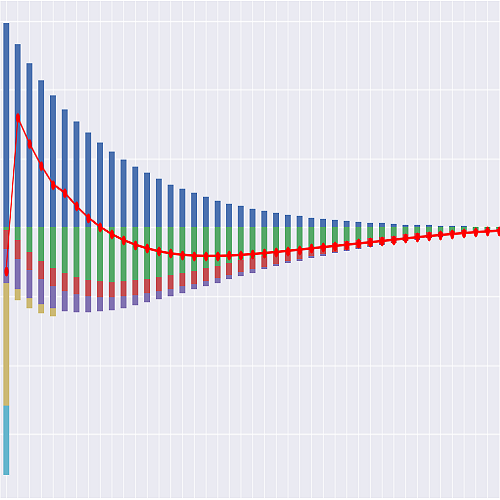
Technical Notes#
Status: Draft, 2026-08-29; citations re-verified against the primary documents 2026-08-30.
Scope note. These notes specify a reference liability cash-flow projection model — model name
RLV_DE_S, monthly grid — for the standardized composite German Risikolebensversicherung
defined in product-spec.md (same directory). This is not any single insurer’s product. [S#]/[R#]
tags refer to the source list in sources.md (numbering carried from
_research/risikolebensversicherung.md; frozen); [REG-R#] tags refer to the cross-product reference
library references/regulatory-and-actuarial-references.md (its own R-numbering). std marks
standardizations introduced for the reference implementation; unverified marks claims no search
corroborated. Parameter values are identical to those in product-spec.md. Cells names,
model-point columns and CSV headers are English lower_snake_case; German terms of art keep their
German form in prose.
Retrieval conditions. These notes were drafted with direct HTTP egress from the build
environment blocked and the session’s WebSearch budget already exhausted, so nothing cited in them
had been opened and the text rested on the authoring model’s own knowledge of German insurance law
and practice, with inherited corroboration from sibling delib research files as its only
second-hand evidence. The citations have since been re-verified against the primary documents
(2026-08-30): 22 of the 40 entries in sources.md now read Retrieved: yes and 18 still read
no — the statutes as canonical XML carrying each law’s Stand, three AVB and two premium
specimens as PDFs, against a carrier sweep and a secondary literature that stayed shut. Where an
entry says no, a delib citation is still a pointer, not a certificate; and every price,
charge, margin and behavioural level below is still std, one direct writer’s published model
case [S2] being a check on them and not an input.
One vocabulary decision, made once and used throughout. Three unrelated things are called “netto” in this product, and confusing them is the classic implementation error [mechanic 4]:
Term as used |
Means |
Name used here |
|---|---|---|
Nettoprämie / Nettobeitrag (actuarial) |
The risk premium from the mortality and interest bases, before expense loadings |
|
Nettobeitrag / Zahlbeitrag (consumer) |
The premium billed = Bruttobeitrag less the Beitragsverrechnung. The market’s dominant usage |
|
Nettotarif / Honorartarif (distribution) |
A commission-free tariff sold through fee-based advice |
not modelled |
The bare word Nettobeitrag is never a parameter name in this library, and prem_net_pp is on
the library’s retired-names register.
Model scope and conventions#
Purpose. Project gross best-estimate liability cash flows, undiscounted — the billed Zahlbeitrag, death claims, expenses and commission — for a single-policy model point on an expected (probability-weighted) basis. Discounting, the Deckungsrückstellung, Solvency II technical provisions and the SCR are referenced, never specified (see Valuation and reserve pointers). The one place a discount rate appears is inside the pricing equivalence that strikes the Bruttobeitrag and the Beitragsverrechnungssatz, and inside the first-order Deckungskapital published as a pricing diagnostic. Neither discounts a published cash flow.
Projection frequency. Monthly grid. The product is annual — a level annual Bruttobeitrag, an annual Überschussdeklaration, an annual Versicherungssumme schedule R5 R6 — and every one of those stays on the anniversary; what the finer grid resolves is timing. It also removes the one approximation the annual grid had to declare: § 168 VVG makes the Versicherungsperiode follow the Zahlweise, so a monthly-paying contract is terminable monthly and its exits are not concentrated at anniversaries R8 REG-R28, and a fractionated Zahlbeitrag is collected in instalments rather than whole at the anniversary. Both are now expressed rather than booked at the anniversary and noted as a simplification.
The frame is 0-based, and
tcounts policy months from issue. Monthtruns from timetto timet + 1, and falls in the policy year at attained agex(t) = issue_age + duration(t), whereduration_mth(t) = tis the completed policy months andduration(t) = t // 12the completed policy years. The first month ist = 0and the contractual policy year ispolicy_year(t) = duration(t) + 1— the label the three schedule CSVs are keyed on, derived and never indexed by. A new-business model point opens att = 0; an in-force model point opens att = 12 · duration_y,duration_ybeing completed policy years and therefore already a 0-based elapsed count, so that everything keyed to duration — the § 161 three-year window, the lapse table, the Zillmerung run-off — reads off one clock and needs no second. That is whyduration_yis a model-point column rather than a re-based issue age.proj_len()is the number of projected policy months,12 · policy_term, and it is the frame’s exclusive end;proj_len_y() = policy_termis the Versicherungsdauer in whole years and is what every annual construction is written against.result_cf()is indexed bytfrom12 · duration_ytoproj_len() − 1inclusive, contiguously, so the frame isrange(12·duration_y, proj_len())and has12·(policy_term − duration_y)rows. This is lifelib’s own convention, which delib adopts and asserts intests/test_model_conventions_de.py.result_cf_annual()sums that frame into policy years and is the view the worked example below is stated on.Two speeds, and which quantity runs at which.
mort_rate(t)andlapse_rate(t)are the annual rates of the policy year containing montht— the vectors this document tabulates — andmort_rate_mth(t)andlapse_rate_mth(t)are the monthly rates actually applied, each1 − (1 − r)^(1/12)std, so that twelve of them compound back to exactly the year’s rate. That is what makes the in-force at every anniversary identical to the annual-step model’s, and it is why the whole first-order equivalence —G,Gn,v_dand the Deckungskapital — is unchanged by the conversion.Cover ends at attained age
issue_age + policy_term, and the last covered month ist = proj_len() − 1, the twelfth month of the policy year at attained ageissue_age + policy_term − 1.cover_end_ageis derived, not carried, so the two cannot disagree.Timing conventions std. A Zahlbeitrag instalment on the Zahlweise’s own cycle at the beginning of month
t— one month in twelve for a jaehrlich payer, every month for a monatlich one; acquisition cost and initial commission at issue, i.e. in montht = 0of a new-business point and never on an in-force point, where they are sunk; a twelfth of the sum-related admin charge, the collection cost on the instalment actually collected, and the renewal commission on it, at the beginning of the month on the opening in-force; death claims and the claim expense at the end of the month of claim; lapses at the end of the month, after the death decrement; expiry at the end of the last montht = proj_len() − 1.Age basis. Alter am Jahrestag — the attained age at the policy anniversary. The age steps at
t = 12, 24, …and not monthly: the monthly grid does not make the age basis finer, and every rate read at that age is flat across the policy year’s twelve months. Germany has no counterpart to the French différence de millésime, where the rating age steps on 1 January irrespective of birth month; on a real-date implementation the offset here is at most a few months std.No cash value in the model — and, in the market, a cash value that is nil or nominal. § 169 Abs. 1 VVG confines the surrender-value duty on Kündigung to a policy insuring a risk “bei dem der Eintritt der Verpflichtung des Versicherers gewiss ist”, which a term assurance’s is not, and that wording is now read rather than inferred R2 REG-R28. But it does not follow that no wording pays one, and the retrieved wordings show that two of three do: the GDV model conditions and the Hannoversche AVB convert the contract into a beitragsfreie Versicherung on Kündigung and pay a Rückkaufswert under § 169, less a Stornoabzug, where the paid-up sum fails a minimum [S1] § 13 Abs. 8, [S4] § 13; Cosmos pays nothing [S3] § 15 Abs. 10. What is uniform is the size: the Kostenverrechnung leaves “keine oder nur geringe Mittel” [S1] § 14 Abs. 4, [S3] § 16 Abs. 4. The model therefore has no account value, no
av_pp_at, no surrender cells and no paid-up state, andclaims(t, "LAPSE")andclaims(t, "MATURITY")are 0.00 at everyt— asserted by a publishedcheck_no_cash_value()rather than left to prose. Read that check as pinning a best-estimate approximation of a nil-or-nominal amount, not as a statement that German term assurance cannot carry a surrender value. The cash flow is right either way: a Beitragsfreistellung pays nothing at the time in any wording — it converts.What is deliberately not modelled, each stated so a reader does not go looking for it: the Kriegsklausel and the ABC clause, which are catastrophe-scenario provisions rather than best-estimate ones; the § 162 VVG forfeitures; the mental-illness exception to § 161; selective lapse and premium-shock lapse, which ship as switchable modules that are off in the base run; the Summenzuwachs, verzinsliche Ansammlung and Todesfallbonus surplus forms; every rider (UZV, BUZ, Beitragsbefreiung, vorgezogene Todesfallleistung, Verlängerungs- and Umtauschoption, vorläufiger Versicherungsschutz); and all taxation, which is documented in
product-spec.mdand computed nowhere.Currency, sign and rounding. EUR throughout.
net_cf(t)is income-positive (premiums +, claims and expenses −), with the outgo-positive orientation published asliability_cf(t) = −net_cf(t). Intermediate values at full precision; displayed cash flows to euro cents andpols_ifto six decimals std. Totals are summed at full precision and then rounded, never summed from rounded cells.
External inputs#
Inputs are external CSVs in the model folder’s parent — the annuallife/TradLife_A layout, not
basiclife/BasicTerm_S’s embedded IOSpec — read by an unparameterized Data Space so each file is
read once per model rather than once per model point. Every file but the model point table
carries a per-row provenance column, which is delib’s second ruling and is machine-checked.
File |
Index columns |
Value columns |
Provenance |
|---|---|---|---|
|
|
the 18 model-point attributes below |
exempt — a model point is a configuration, not an assumption |
|
|
|
per row |
|
|
|
per row |
|
|
|
per row |
|
|
|
per row |
|
|
|
per row |
Six files, no orphans: the conventions suite asserts that every CSV beside the model backs a
filename Reference in Data and that the set read by a full sweep is exactly the set registered in
tests/de_registry.py. Scalar assumptions are References on Projection, not rows in a table,
following TradLife_A; their values and tags are the assumption tables below.
Model point attributes#
Attribute |
Type |
Meaning |
Exercised by |
|---|---|---|---|
|
int |
Row key; |
all |
|
str |
Human-readable policy reference |
all |
|
int |
Eintrittsalter of the first versicherte Person |
all |
|
enum {M, F} |
Sex of the first life. Decrement only — must never enter pricing R13 REG-R34 |
1 vs 2 |
|
enum {N, R} |
Nichtraucher / Raucher of the first life; the largest rating split after age |
1 vs 3 |
|
float EUR |
Initial Versicherungssumme, |
all |
|
int |
Versicherungsdauer in whole years; equals |
all |
|
int |
Beitragszahlungsdauer in whole years, |
6 (12 < 20) |
|
enum {laufend, einmal} |
Level Bruttobeitrag over |
7 |
|
enum {jaehrlich, halbjaehrlich, vierteljaehrlich, monatlich} |
Zahlweise; drives the Ratenzahlungszuschlag |
4, 5, 6, 10 |
|
str |
Key into |
4, 5 |
|
str |
Key into |
9 |
|
enum {beitragsverrechnung, keine} |
Participating with Beitragsverrechnung, or the § 153-excluded non-participating tariff R5 |
12 |
|
int {1, 2} |
Single life, or verbundene Leben paying on the first death |
10 |
|
int |
Eintrittsalter of the second life; |
10 |
|
enum {N, R, -} |
Smoker status of the second life; |
10 |
|
float |
Risikozuschlag: a multiplier on the mortality basis, both orders. 1.00 standard |
11 |
|
str |
Key into |
all |
|
int |
Completed policy years at the valuation date; |
8 |
|
date |
Reporting only; the model runs on integer durations |
none |
Three of these are worth a sentence each. sex is carried and must not be priced on: art. 5(2)
of the Gender Directive was struck down with effect from 21 December 2012 R13 REG-R34, while the
underlying DAV 2008 T tables remain sex-distinct R12 REG-R48. The model resolves the tension the
only way § 138 VAG allows — the tariff blends the two tables 50/50 and the projection uses the
policy’s own sex R11 REG-R8 — so the unisex cross-subsidy appears in the cash flows rather
than in the price. rating_factor scales the mortality basis, not the price: an impaired life
pays more and is expected to claim more, so the Zahl/Brutto ratio is nearly invariant to it; the
alternative reading, in which the loading is pure price and falls through to surplus, is pitfall 17.
duration_y is the only thing that moves where the frame starts, and it is what makes the § 161
window, the lapse table and the acquisition-cost switch all read off one clock.
Model points shipped#
Fourteen, covering both premium forms, all four payment frequencies, all three benefit schedules, an in-force point, three options and three boundary cases. Model point 1 is the worked example’s anchor cell.
# |
Configuration |
What it exercises |
|---|---|---|
1 |
35 M N, 300 000 € |
The anchor. The representative composite |
2 |
As 1 but |
The unisex cross-subsidy: identical tariff, different projected claims |
3 |
As 1 but |
The smoker split; the derived premium ratio against point 1 |
4 |
40 M N, 250 000 € |
Falling sum; the 5 % Ratenzahlungszuschlag |
5 |
33 F N, 400 000 € |
Darlehensabsicherung schedule; the 3 % loading |
6 |
45 M N, 200 000 € |
Abgekürzte Beitragszahlungsdauer; the largest Deckungskapital; the 2 % loading |
7 |
50 M N, 100 000 € |
The second premium form; the equivalence at its boundary |
8 |
30 F N, 150 000 € |
In force. The frame opens at |
9 |
32 M N, 200 000 € |
Nachversicherungsgarantie; the § 161 clock restarting per increment |
10 |
38 M N + 36 F N, 300 000 € |
Verbundene Leben; the first-death rate |
11 |
42 M R, 250 000 € |
Risikozuschlag on an impaired smoker |
12 |
36 F N, 300 000 € |
The § 153-excluded tariff: |
13 |
60 M N, 50 000 € |
Boundary. Oldest entry, shortest term; the § 161 window covers three of five years |
14 |
18 M N, 100 000 € |
Boundary. Youngest entry, longest term; cumulative lapse at its largest |
State variables#
Variable |
Description |
Updated |
|---|---|---|
|
|
once per model point |
|
|
once per model point |
|
completed months ( |
derived |
|
Attained age of the first life = |
anniversary |
|
Attained age of the second life = |
anniversary |
|
In-force count at the start of month |
monthly recursion |
|
Versicherungssumme in force = |
schedule lookup |
|
The benefit actually payable on a death in month |
anniversary |
|
Second-order annual death rate of the policy year: own sex, smoker, rated, first-death where |
lookup |
|
The monthly rate applied, |
monthly |
|
First-order annual tariff rate: unisex 50/50 blend, |
lookup |
|
Annual lapse rate of the policy year; 0 through the whole final policy year |
lookup |
|
The monthly rate applied after the death decrement, |
monthly |
|
§ 161 benefit switch, |
anniversary |
|
Annual Bruttobeitrag per in-force policy, loaded for frequency; 0 for |
anniversary |
|
Annual Beitragsverrechnung per in-force policy |
anniversary |
|
Annual Zahlbeitrag per in-force policy = |
anniversary |
|
Instalments a year (1/2/4/12), months between them, whether one falls due this month |
Zahlweise |
|
The three annual amounts divided into instalments, zero in a month none is due |
monthly |
|
First-order net Deckungskapital per policy at policy year |
prospective, annual |
|
The same reserve less the unamortised Zillmer balance; negative for much of the term |
prospective, annual |
|
Expected deaths in month |
monthly |
|
Expected lapses in month |
monthly |
|
Expiring survivors; 0 except at |
monthly |
|
|
monthly |
|
|
monthly |
|
|
monthly |
|
Acquisition + maintenance + collection + claim expense |
monthly |
|
Initial Abschlussprovision + Bestandspflegeprovision |
monthly |
|
Net liability cash flow, income-positive |
monthly |
There is no account-value state variable, no surrender-value state variable and no paid-up state. That is a statutory fact about the product, not a modelling simplification R2 R3 R8 REG-R28.
Assumption inputs#
(a) Contractual / guaranteed elements (cited)#
Input |
Value |
Basis |
|---|---|---|
Death benefit |
|
|
Survival benefit |
None. Nothing is paid at expiry |
|
Surrender / paid-up value |
Nil or nominal, and modelled as nil. No § 169 Abs. 1 duty attaches on Kündigung (the gewiss test, now read verbatim); § 165 carries no such limitation and its paid-up right is live on a constant sum insured — [S3] ends the contract only below a 300 € paid-up sum, [S4] below 2 500 €, and on a falling sum insured no Deckungskapital is built at all. Where a wording pays, it pays the Deckungskapital less a Stornoabzug — 60 % at [S4] |
|
Premium form |
A level Bruttobeitrag over the Beitragszahlungsdauer, guaranteed for the term as the maximum the policyholder can ever be required to pay |
|
What is billed |
The Zahlbeitrag = Bruttobeitrag less the declared Beitragsverrechnung. Not guaranteed; § 153 confers an entitlement to participate, not to a level |
|
Minimum surplus allocation |
90 % of the Risikoergebnis, MindZV § 7 — the section number the file previously refused to guess, now read (gap 4 closed). § 8 gives 50 % of the übriges Ergebnis and § 6 Abs. 1 gives 90 % of the anzurechnende Kapitalerträge “abzüglich der rechnungsmäßigen Zinsen”; each is floored at zero. Both carrier wordings state the same three [S3] § 3 Abs. 1 a, [S4] § 20 |
|
Equal treatment |
VAG § 138 Abs. 2, verbatim: “Bei gleichen Voraussetzungen dürfen Prämien und Leistungen nur nach gleichen Grundsätzen bemessen werden.” The unit of “gleiche Voraussetzungen” is the Bestandsgruppe and, inside it, the Gewinnverband — [S1] § 2 Abs. 2–3, with [S3] naming Bestandsgruppe 112 for its term book. One declared rate per Gewinnverband, and [S2] shows it holding across two product variants to three decimal places |
|
Selbsttötung |
Insurer leistungsfrei where the versicherte Person intentionally takes her own life “vor Ablauf von drei Jahren nach Abschluss des Versicherungsvertrags”, unless in a state excluding free determination of the will; extendable by Einzelvereinbarung (Abs. 2); the substitute payment is the Rückkaufswert nach § 169 (Abs. 3), which here is nil or nominal. The clock restarts for an increased or reinstated part — not from § 161, which is silent, but from all three retrieved wordings |
|
Premium cessation |
On death, and at the end of the Beitragszahlungsdauer |
mechanics 4, 17 |
Rechnungszins |
1,00 % — but that is the DeckRV Höchstzinssatz, the ceiling, read at the amending regulation itself (Art. 1 V v. 19.7.2024). A carrier need not price at it and one does not: [S3]’s AVB states its Rechnungsgrundlagen as “einem Rechnungszins in Höhe von 0,25 Prozent”. The model uses the ceiling; see the pitfalls |
|
Höchstzillmersatz |
25 ‰, DeckRV § 4 Abs. 1: “Der Zillmersatz darf 25 Promille der Summe aller Prämien nicht überschreiten”; cut from 40 ‰ with effect from 1 January 2015, and the rate at conclusion applies for the whole term (Abs. 4). It caps the zillmerbare part only — both wordings spread the remaining acquisition cost over the premium-paying period [S1] § 14 Abs. 3, [S3] § 16 Abs. 3 — and the GDV model carries the clause only “bei der Verwendung des Zillmerverfahrens”, so it is optional on this line |
|
Unisex |
Sex may not enter the premium for contracts concluded from 21 December 2012 |
|
Mortality table family |
DAV 2008 T, with R and NR variants, suitable for premium calculation but not without a Gesundheitsprüfung; values proprietary, not redistributed |
|
Premium tax |
None — VersStG 2021 § 4 Abs. 1 Nr. 5 Buchst. a exempts a contract creating claims “im Fall des Todes”, so there is no premium-tax line |
(b) Insurer-discretionary current elements#
Thin, but decisive — on this product the discretion is the customer’s bill.
Input |
Snapshot value |
Basis |
|---|---|---|
Declaration scaling |
1.00, i.e. the insurer declares exactly the MindZV minimum |
std (1) |
Surplus share |
0.90 of the tariff mortality margin |
|
Resulting |
Derived, not assumed — see the recursion section. Lands at about 0.43 on the anchor, so |
derived; inputs std |
Cap on the declared rate |
0.95 — a rebate may not exceed the premium |
std (2) |
Kostenüberschuss |
Not returned. The tariff’s β is 5,0 % and the modelled collection cost 3,0 %, so a cost result emerges in |
std (3) |
Summenzuwachs, verzinsliche Ansammlung, Todesfallbonus |
Off. Only Beitragsverrechnung is implemented |
mechanic 6; std |
§ 163 premium adjustment |
Off. The Bruttobeitrag is fixed for the term — [S3]: “bleibt Ihre Absicherung sowie der vereinbarte Bruttobeitrag über die gesamte Versicherungsdauer unverändert” |
R6 REG-R27 [S3]; non-use in practice still unverified |
Modelling the statutory minimum is the conservative choice for the Zahlbeitrag, and it is the only level any instrument fixes: no German carrier publishes a declaration for this product, and none was located (research gap 1).
decl_scaleis the stress lever — setting it to 0 raises the billed premium to the guaranteed one with no change to any claim, which is precisely the move § 163 does not govern R6, and it is the model’s representation of the product’s single largest policyholder risk.v_maxbinds nowhere in the shipped model points; it exists so that an extrememcannot drive the billed premium negative, and so thatcheck_prem_split()has a stated domain.The tariff loading and the modelled cost are deliberately different numbers, and the gap is the Kostenüberschuss. Returning it would require splitting the übriges Ergebnis limb of the MindZV, whose minimum share is different and for which the research file gives no basis R9 REG-R18. Not returning it is a stated simplification and pitfall 15, not an oversight.
(c) Behavioural / experience assumptions (the modeller’s view)#
Every input in this class is std. No German insurer publishes a mortality table, a Sicherheitszuschlag, a best-estimate factor, a commission scale or a lapse rate for this product, and none was retrieved [S3]–[S13] R12. Expense loadings are the one exception, and only per contract: § 2 VVG-InfoV makes the insurer give the applicant its acquisition and administration costs in euro R17, and one carrier’s published specimen prints them [S2] — a model case, not a rate card, and not adopted here.
Mortality. The regulatory basis is DAV 2008 T with its R and NR variants R12
REG-R48, which is cited by name and never shipped — the tables are the property of the
Deutsche Aktuarvereinigung, are not public, and are not redistributed here. mort_table.csv is a
std Gompertz-form proxy for a medically selected insured-lives population:
mort_rate(sex, smoker, x) = base(sex) × smoker_mult(smoker) × 1.095^(x − 30),   ages 18–80

base(M) = 0.00040      base(F) = 0.00020
smoker_mult(N) = 1.00  smoker_mult(R) = 2.20
Three anchors a replacement table must preserve, so that the worked example still closes. The
50/50 unisex non-smoker blend is 0.00030 × 1.095^(x − 30), which is the std best-estimate
scale the research file constructed and froze; the female-to-male ratio is 0.50 at every age,
the order of magnitude reported for insured lives at the ages this product is sold unverified; and
the smoker multiplier is 2.20, the mid-point of the two-to-three range reported for insured-lives
smoker mortality at working ages unverified, which reproduces a premium ratio near 2 once
sum-related and per-policy expenses are added back — 2.007 between model points 3 and 1 on the
built model, against the research file’s zero-interest construction of 2.04. The 9,5 % per year of age is the slope of the
research’s construction; it is a fitted-in-spirit gradient with no German source, and on a
40-year run (model point 14) it is the single most exposed number in the file. Population tables
are the wrong starting point for a replacement: an RLV model built on a Destatis table without a
selection adjustment overstates claims by a wide margin at issue ages 25–45 REG-R48 REG-R52.
The two-order split. The first-order (tariff) rate is
mort_rate_tar(t) = (1 + m) × [ ω·q_tab(M, smoker, x(t)) + (1 − ω)·q_tab(F, smoker, x(t)) ]
                   × rating_factor
with the Sicherheitszuschlag m = 1.25 std and the unisex mix ω = sex_mix_male = 0.50
std. So q1 = 2.25 × q2 for the tariff’s own unisex life, and for a real policy the ratio
is 2.25 × (unisex blend / own-sex rate). On the shipped proxy the blend is 0.75 × q̃(M), so the
ratio is 1.6875 for a male and 3.375 for a female. That asymmetry is the unisex cross-subsidy, and it is a product fact, not a modelling
artefact. m is the single parameter that sets the Brutto/Zahlbeitrag spread; its level is not
public — the DAV Richtlinie regulates the procedure for setting the Sicherheitszuschläge,
not the level R12 — and the argued range is 1.0 to 1.5 (research gap 6).
Lapse. No Risikoversicherung-specific rate exists anywhere in the research file (gap 13). The inherited whole-market Stornoquote — 2,72 % (2024) and 2,56 % (2023) on the main GDV measure, with a second irreconcilable measure at 1,2 % (2024) R18 — is a book average dominated by long-dated savings contracts and is deliberately not used. The shipped table is argued from three structural features instead: there is nothing to lose by lapsing, no surrender value and no accumulated bonus, so the financial friction that suppresses savings-contract lapse is absent; the contract is terminable at the end of each Versicherungsperiode, monthly for a monthly payer R8, so exit is frictionless in time as well as in money; and the need that motivated the purchase amortises.
Policy year ( |
1 |
2–3 |
4+ |
|
|---|---|---|---|---|
|
0 |
1–2 |
3+ |
|
|
6 % |
4 % |
3 % |
0 |
In the final period the lapse rate is zero. Lapses fall at the end of the period, and
the end of period t = n − 1 is the moment cover expires — a lapse and an expiry are then the same
event paying the same nothing, so the whole surviving cohort is booked as pols_maturity(n − 1).
No cash flow moves either way, but the convention decides the split between Σ pols_lapse and
pols_maturity(n − 1) and is load-bearing for the closure identity. The argued plausible range in the
early durations is 2 % to 8 %, and no German figure supports any of it. Note the shape
argument the shipped table does not follow: because the need amortises, term-life lapse arguably
should rise in later durations rather than flatten, the opposite of a savings product’s shape.
The research file ships the flat 3 % tail; that tension is recorded here and is a listed sensitivity
rather than a silent choice.
Suicide share. § 161 makes the insurer leistungsfrei for an intentional self-inflicted death inside three years, substituting a Rückkaufswert that is nil here R1 R2. The model applies
suicide_factor(t) = 1 − suicide_share   for the first three periods of a cover tranche
                  = 1                   thereafter,           suicide_share = 0.03  **[std]**
to death claims only. No German cause-of-death share was retrieved, and none is asserted; 0,03
stands for “about three per cent of deaths at these ages are suicides”, with an argued range of
0,01 to 0,05 unverified. It carries three times the weight of the French one-year factor
[frlib R1] simply because the window is three times as long, which is why the parameter is stated
rather than buried.
Expenses and commission (all levels std; the structures are cited where they exist).
Input |
Value |
Basis |
|---|---|---|
Acquisition cost, total |
|
|
— of which initial commission |
20 ‰ of the Beitragssumme |
std (4) |
— of which other acquisition cost |
5 ‰ of the Beitragssumme |
std (4) |
Tariff premium loading |
5,0 % of each Bruttobeitrag, inside the equivalence |
std (4) |
Modelled collection cost |
3,0 % of each Zahlbeitrag |
std (4) |
Renewal commission |
1,0 % of each Zahlbeitrag from policy year 2 |
std (4) |
Sum-related admin |
0,30 ‰ of |
std (4) |
Expense inflation |
2,0 % a year, on the sum-related admin only; the tariff’s γ is level |
std (5) |
Claim expense |
250 € per death claim |
std (4) |
Best-estimate mortality factor |
1.00 |
std (6) |
Ratenzahlungszuschlag |
1.000 annual · 1.02 half-yearly · 1.03 quarterly · 1.05 monthly |
convention std (7) |
German term-life charge levels are not published as a rate card — but they are disclosed (research gap 8, corrected). There is no Effektivkostenquote, and § 2 Abs. 1 Nr. 9 VVG-InfoV gives the reason in terms, confining the duty to a contract “bei dem der Eintritt der Verpflichtung des Versicherers gewiss ist”; and no Basisinformationsblatt, the product not being a PRIIP R17. But § 2 Abs. 1 Nr. 1 with Abs. 2, and § 4 Abs. 2, require the acquisition and administration costs to be given to the applicant in euro, and both retrieved wordings point him there [S1] § 14 Abs. 1, [S3] § 16 Abs. 1. One carrier’s published specimen shows α = 2,41 % of the Tarifbeitragssumme, other annual costs of 48,52 € of which 35,20 € administration [S2] — so the composite’s assumption that a term tariff runs at the 25 ‰ ceiling is close to right for that carrier, though the ceiling is mis-typed: DeckRV § 4 caps only the zillmerbare part, the rest being spread over the premium term [S1] § 14 Abs. 3, [S3] § 16 Abs. 3. The parameters are unchanged — one model case is not a market [S3] [S12]. This is the single std charge most likely to be overstated, and the notes say so rather than letting a reader discover it from a sensitivity.
Inflating the modelled γ while the tariff’s γ is level means the cost result narrows over a long term and eventually reverses — a real feature of a 25-year contract, and the reason model point 14 (40 years) is worth its place.
Set to 1.00 so that the shipped proxy is the best estimate and there is exactly one unsourced mortality level rather than two stacked on each other. A user with experience data should move this rather than editing the table.
2 % / 3 % / 5 % is a market convention with no carrier attribution, inherited from the sibling delib research (gap 21). Whether German carriers strike it on the Bruttobeitrag or the Zahlbeitrag was not established; the model loads the billed amount, so the split identity holds at every frequency (pitfall 10).
Cash flow components and recursions#
Notation (defined once, used throughout)#
Symbol |
Meaning |
|---|---|
|
month index, 0-based: |
|
policy year index, 0-based: |
|
attained ages, |
|
|
|
|
|
|
|
|
|
|
|
|
|
|
|
|
|
|
|
|
|
|
|
|
|
|
|
|
|
|
|
|
|
tariff survivorship over policy years, mortality only: |
|
|
|
|
|
|
|
|
|
|
|
|
|
|
|
|
|
|
q₁, q₂ and w are dimensionless annual probabilities and q₂ᵐ, wᵐ the monthly ones
derived from them; S0, B, G, P and every cash-flow component are EUR. G, Gn and P are
annual amounts; what is collected in a month is P_inst.
The two mortality bases#
q₂(t) = mort_be_factor · rf · Q̃(t),        Q̃(t) = q̃(sex, smoker, x(t))                 lives = 1
q₁(t) = (1 + m) · rf · [ ω·q̃(M, smoker, x(t)) + (1 − ω)·q̃(F, smoker, x(t)) ]
Both are annual rates, read at an attained age that steps on the anniversary, and both are
therefore flat across a policy year’s twelve months. Only q₂ is converted to the month, at
q₂ᵐ(t) = 1 − (1 − q₂(t))^(1/12) std; q₁ is a pricing rate and the equivalence it enters is
annual, so it is never converted.
For lives = 2 the two lives are combined at table level, before any loading, on an
independence assumption std:
Q̃(t) = q̃_A(t) + q̃_B(t) − q̃_A(t)·q̃_B(t)
and the same combination is applied to the two unisex blends before (1 + m)·rf. Combining after
loading instead inflates the cross term and is pitfall 14. The independence assumption understates
the true first-death rate for a couple sharing a household, a vehicle and a lifestyle, and no German
figure bounds the understatement (research gap 15).
The Bruttobeitrag, by first-order equivalence#
Struck once, at issue, on first-order bases and tariff survivorship — never on the projection’s own lapse or best-estimate mortality, and therefore acyclic with respect to everything behavioural. Write
A  = Σ_{y=0..n−1} v^(y+1) · p₁(y) · q₁(12y) · B(12y)   APV of death benefits, paid at year end
ä  = Σ_{y=0..k−1} v^y · p₁(y)                          premium annuity-due over the paying term
Γ  = Σ_{y=0..n−1} v^y · p₁(y) · B(12y)                 sum-exposure annuity, for the γ loading
Every sum here runs over policy years, not months, and that is a decision rather than an
inheritance. A first-order equivalence is an annual construction: the Höchstrechnungszins is an
annual rate, the Bruttobeitrag it strikes is the annual amount the Versicherungsschein states,
and the end-of-year benefit timing inside A is the tariff’s prudent convention and not the
projection’s, which pays a death claim at the end of the month of death. Re-striking the equivalence
month by month would move G, Gn, v_d and every figure below while changing nothing about the
contract. On the monthly grid all four are bit-identical to the annual-step model’s.
The equivalence, with the α loading a per-mille of the Beitragssumme k·G incurred at issue,
G·ä = A + z·k·G + β·G·ä + γ·Γ
is linear in G and solves in closed form:
G = ( A + γ·Γ ) / ( (1 − β)·ä − z·k )
For premium_form = einmal, k = 1 and ä = 1, so the same expression returns the
Einmalbeitrag — the second premium form is the same engine at a boundary, not a second engine. The
actuarial Nettoprämie is Gn = A / ä, and it is what the reserve recursion below uses; it is
not a cash flow and never appears in result_cf().
The Zahlbeitrag, by the MindZV allocation#
The tariff’s own mortality margin in period t, per in-force policy, is the difference between
the first-order rate and the tariff’s best estimate:
margin_pp(t) = ( q₁(t) − q₁(t)/(1 + m) ) · B(t) = (m/(1+m)) · q₁(t) · B(t)
so its actuarial value at issue is exactly (m/(1+m))·A. The declared Beitragsverrechnungssatz is
struck once, at issue, to return surplus_share of it over the premium-paying term:
v_d = min( v_max, decl_scale · surplus_share · (m/(1+m)) · A / (G · ä) )
and is 0 where surplus_form = keine. Then, at every t < k,
prem_gross_pp(t)  = G · φ
prem_rebate_pp(t) = v_d · G · φ
prem_paid_pp(t)   = (1 − v_d) · G · φ
and all three are 0 for t ≥ k. Substituting the equivalence into v_d gives the identity that
explains the whole German term-life spread in one line:
v_d = decl_scale · surplus_share · (m/(1+m)) · [ 1 − β − ( γ·Γ + z·k·G ) / ( G·ä ) ]
— the surplus share, times the margin fraction of the risk element, times the risk share of the
gross premium. On the anchor’s calibration the bracket is about 0.85, so
v_d ≈ 1 × 0.90 × 0.5556 × 0.85 ≈ 0.43 and Zahl / Brutto ≈ 0.57, reproducing the research file’s
frozen std ratio from the mechanic rather than assuming it. Raising m raises G and v_d
together, which is why the Bruttobeitrag moves far more than the Zahlbeitrag (product spec,
contractual mechanics).
The § 161 benefit switch, and increments#
The base cover’s three-year window runs from issue, so it bites at duration(t) < 3 — months 0 to
35, policy years 1 to 3. A Nachversicherungsgarantie increment granted at the anniversary opening
policy year y_j carries its own three-year window, y_j ≤ duration(t) < y_j + 3 R1 [S1] [S3] [S4] — market practice, not a modelling choice (research gap 9, closed): “Wenn unsere Leistungspflicht durch eine Änderung des Vertrages erweitert wird …, beginnt die Dreijahresfrist bezüglich des geänderten … Teils neu”. With
Δu(t) = u(t) − u(t − 1) for t > 0 and Δu(0) = u(0), the effective benefit is
benefit_paid_pp(t) = S0 · f(t) · Σ_{j : y_j ≤ duration(t)} Δu(y_j) · σ_j(t)
σ_j(t) = 1 − suicide_share   if  duration(t) < y_j + 3,  else 1   (the base tranche has y_j = 0)
so suicide_factor(t) = benefit_paid_pp(t) / benefit_pp(t) is a weighted average across
tranches, strictly between 1 − suicide_share and 1 in a policy year when one tranche is inside
its window and another is not. On an in-force model point with duration_y ≥ 3 and no increments,
σ ≡ 1 at every projected t. The switch never touches lapses or the expiry, both of which pay
nothing in any event.
Both clocks are annual and every boundary therefore falls on an anniversary, which is why the
monthly grid resolves the switch exactly rather than approximately: § 161’s three years from
conclusion are months 0 to 35, and duration(t) < 3 is the same statement as t < 36. The
comparison is written in years because that is the unit the statute and the Bedingungen use.
Decrements and the in-force recursion#
Two decrements, applied in the stated order at the end of the month, on the monthly rates:
pols_death(t)    = l(t) · q₂ᵐ(t)
pols_lapse(t)    = l(t) · (1 − q₂ᵐ(t)) · wᵐ(t)        with w ≡ 0 in the final policy year
pols_maturity(t) = 0 for t < 12n−1;  l(12n−1)·(1 − q₂ᵐ(12n−1))  at t = 12n−1
l(t+1)           = l(t) − pols_death(t) − pols_lapse(t) − pols_maturity(t),    l(t0) = 1
so l(12n) = 0 exactly: every exit lands inside the frame, which is what lets result_cf() end
at proj_len() − 1 with nothing left over. Closure identity, which a test asserts:
Σ_{t=t0..12n−1} [ pols_death(t) + pols_lapse(t) + pols_maturity(t) ] = pols_if_init() = 1
This recursion collapses to the annual one at every anniversary. Because q₂ᵐ and wᵐ each
compound back to their policy year’s annual rate, twelve months of it give
l(t+12) = l(t)·(1 − q₂(t))·(1 − w(t)) — the annual-step recursion, term for term — so the in-force
at every policy anniversary is the annual-step model’s own figure. What the finer grid adds is the
eleven months between them, and one genuine change: deaths and lapses now interleave, each
eroding the exposure the other works on, so the split of the closure identity moves even though
its total does not.
Benefits, expenses and net cash flow#
claims(t, "DEATH")    = benefit_paid_pp(t) · pols_death(t)
claims(t, "LAPSE")    = 0                                        [R2] [R3] [R8]
claims(t, "MATURITY") = 0                                        a term contract pays nothing at expiry
claims(t)             = Σ_kind claims(t, kind)

acq_pp   = z·k·G                                                  incurred once, at issue
comm_pp  = c₀·k·G                                                 of which commission
maint(t) = γ · B(t) · (1 + π)^duration(t) / 12  +  a · P_inst(t)

expenses(t)    = (acq_pp − comm_pp)·1{t = 0 and duration_y = 0}
                 + maint(t)·l(t) + ec·pols_death(t)
commissions(t) = comm_pp·1{t = 0 and duration_y = 0}
                 + c_r·P_inst(t)·l(t)·1{duration(t) ≥ 1}

prem_due(t)            = 1{ duration_mth(t) mod (12/r) = 0 }
prem_gross_inst_pp(t)  = prem_gross_pp(t)/r · prem_due(t)
prem_rebate_inst_pp(t) = prem_rebate_pp(t)/r · prem_due(t)
P_inst(t)              = prem_gross_inst_pp(t) − prem_rebate_inst_pp(t)

premiums(t)    = P_inst(t)·l(t)
prem_gross(t)  = prem_gross_inst_pp(t)·l(t)
prem_rebate(t) = prem_rebate_inst_pp(t)·l(t)

net_cf(t)      = premiums(t) − claims(t) − expenses(t) − commissions(t)
liability_cf(t) = −net_cf(t)
Acquisition cost is a month-0 outgo, not an annualised loading and not a twelfth of one. The
tariff amortises it through the equivalence; the cash flow incurs it at issue, which is the economic
reason an early lapse hurts on a product with no surrender value to forfeit (mechanic 10). On an
in-force model point it is sunk and is not incurred at all — which is why the switch tests
duration_y = 0 and not merely t = 0.
The two halves of maint move differently on the monthly grid, and both moves are the point.
The sum-related administration charge is an annual amount and accrues a twelfth a month, so a policy
that runs a full year carries the same charge as it did — but it is borne by the in-force of each
month rather than of the anniversary, which is what makes a decrementing block cost less. The
collection cost follows the Zahlweise: it is charged when a bill is actually collected, once a
year on a jaehrlich payer and twelve times on a monatlich one, which is what a collection cost
is and what the Ratenzahlungszuschlag was pricing all along.
The Zahlweise is now a cash-flow fact rather than a loading with nothing behind it. On the
annual grid the instalments column of freq_loading_table.csv could not be used for anything: the
whole loaded annual premium was collected at the anniversary whatever the mode. Here it sets the
cycle, so a fractionated payer’s later instalments are collected on a block that has already lost
lives, and § 168 VVG’s Versicherungsperiode is expressed rather than approximated. The instalments
of a policy year sum to exactly that year’s annual amount, φ having multiplied the annual figure
once: loading an instalment again after dividing charges the surcharge twice (pitfall 10).
The first-order Deckungskapital — a pricing diagnostic#
Published because mechanic 11’s central claim is checkable and a naive implementation fails it, and labelled a pricing quantity because it is one: it is not a Deckungsrückstellung, it is not gezillmert, it enters no cash flow, and nothing in this library discounts a published cash flow.
Its argument is a policy year y, not a month, like the equivalence it belongs to: a
first-order Deckungskapital is struck on the tariff’s annual bases against an annual
Rechnungszins, and a monthly reserve would be a different quantity built on a rate this contract
does not have. result_pols() publishes it against the policy year of each month, so it is flat
across that year’s twelve rows.
res_pp_at(y,"BEF_PREM") = Σ_{u=y..n−1} v^(u−y+1)·(p₁(u)/p₁(y))·q₁(12u)·B(12u)
                          − Gn · Σ_{u=y..k−1} v^(u−y)·(p₁(u)/p₁(y))
with res_pp_at(0,"BEF_PREM") = 0 by the equivalence, res_pp_at(n,"BEF_PREM") = 0 by exhaustion,
and a strictly positive interior. res_pp_at(y,"AFT_PREM") = res_pp_at(y,"BEF_PREM") + Gn·1{y < k}.
The Thiele recursion the check asserts is
( res_pp_at(y,"BEF_PREM") + Gn·1{y < k} ) · (1 + i)
    = q₁(12y)·B(12y) + (1 − q₁(12y))·res_pp_at(y+1,"BEF_PREM")
The gezillmert companion subtracts the unamortised Zillmer balance,
res_zill_pp_at(y, timing) = res_pp_at(y, timing) − z·k·G · [ Σ_{u=y..k−1} v^(u−y)(p₁(u)/p₁(y)) ] / ä
which is −z·k·G at y = 0 — negative from the first day, exactly as mechanic 10 describes, and
back to zero at expiry. Whether a negative individual reserve must be floored at zero for
balance-sheet purposes — the Nullstellung question — was not established R21 REG-R54
(research gap 11), and because the model publishes no balance-sheet reserve, the question does not
reach its cash flows.
What result_cf() publishes#
Indexed by the 0-based month t, contiguous from 12·duration_y to proj_len() − 1, in this
order:
pols_if, prem_gross, premiums, prem_rebate,
claims_death, claims_lapse, claims_maturity,
expenses, commissions, net_cf, liability_cf
The three premium columns are the amounts collected in the month, so on an annual Zahlweise
eleven rows in twelve carry zeros in them. result_cf_annual() sums the frame into policy years,
indexed by the contractual 1-based policy_year, with pols_if the count at the start of the
year — a regrouping of the same numbers and never a second projection, which is what lets the
annual worked example below stay annual and still be asserted cell by cell.
prem_gross is the guaranteed stream and does not enter net_cf; premiums is the billed
stream and does. Publishing both is required by the product — a model carrying one premium stream
cannot represent a German RLV R6 — and check_net_cf() names exactly which columns enter the
identity, so there is no ambiguity about which to skip.
liability_cf is the eleventh column and is −net_cf(t) exactly: net_cf is income-positive, the
library-wide sign, and the outgo-positive orientation a valuation layer wants is published beside it
rather than left to a reader to flip. It was added to the list at the model stage, because the
conventions suite reads the identity off the frame — a model that publishes a liability_cf
cells and omits the column fails test_net_cf_is_income_positive. expenses excludes
commissions here, which is its own column, and net_cf subtracts the two separately.
The published check_* identities#
Five, each with a per-t residual companion check_*_resid(t), each returning a bool over all
t, and all five called on every model point by the conventions suite.
Check |
Identity |
Why it earns its place |
|---|---|---|
|
On |
delib’s first ruling: the headline number is reconciled in code, not only in prose — and by a different route from |
|
|
The decrement roll-forward and its closure |
|
On the instalments, |
The product’s signature identity, at every |
|
The Thiele recursion above, per policy year, plus |
The reserve mechanic 11 says a naive implementation gets wrong |
|
|
A statutory fact R2 R3 R8, checked on every model point rather than asserted in prose |
Two further identities are scalar rather than per-period and are therefore asserted in
tests/test_risikolebensversicherung_de.py instead of published as check_* cells: the first-order
premium equivalence G·ä = A + z·k·G + β·G·ä + γ·Γ, and the surplus equivalence
v_d·G·ä = decl_scale·surplus_share·(m/(1+m))·A. Forcing a scalar identity into a per-t residual
would mean inventing a per-period decomposition the product does not have, which is worse than
putting it in the test module and saying so.
Monthly processing order#
For t = t0 … 12n − 1, in exactly this order. Steps 1 to 3 change only at an anniversary; the rest
run every month.
Set
duration(t) = t // 12,policy_year(t) = duration(t) + 1andx(t) = issue_age + duration(t)(andx₂(t)wherelives = 2). Ift ≥ 12n, stop.Read the schedules at
policy_year(t):f(t)frombenefit_schedule.csv,u(duration(t))fromnvg_schedule.csv; formB(t) = S0·f(t)·u(duration(t)). Both are flat across the policy year.Read the table rates for each life at its own attained age; combine to a first-death rate where
lives = 2, before any loading; form the annualq₂(t)on the policy’s own sex andq₁(t)on the tariff’s unisex blend, then the monthlyq₂ᵐ(t) = 1 − (1 − q₂(t))^(1/12).Beginning of month — premium instalment. For
duration(t) < k, set the annualprem_gross_pp(t) = G·φ,prem_rebate_pp(t) = v_d·G·φandprem_paid_pp(t)as their difference; else all three zero. Whereprem_due(t), divide each byrto get the instalment; else all three instalments are zero. Takepremiums(t) = P_inst(t)·l(t).Beginning of month — expenses on the opening in-force. Collection
a·P_inst(t)·l(t)and a twelfth of the sum-related admin,γ·B(t)·(1+π)^duration(t)/12·l(t); att = 0and only whereduration_y = 0, the acquisition cost and the initial commission; forduration(t) ≥ 1, the renewal commission on the instalment collected.Apply the § 161 switch tranche by tranche to get
benefit_paid_pp(t).End of month — death.
pols_death(t) = l(t)·q₂ᵐ(t);claims(t,"DEATH") = benefit_paid_pp(t)·pols_death(t); claim expense on the deaths. Claimants have already paid whatever instalment fell due at step 4 — that is what “premium payment ceases at death” means on a grid with premiums in advance std, and applying a second(1 − q₂ᵐ)factor topremiums(t)charges the rule twice (pitfall 11).End of month — lapse.
pols_lapse(t) = l(t)·(1 − q₂ᵐ(t))·wᵐ(t);claims(t,"LAPSE") = 0. Through the whole final policy year,duration(t) ≥ n − 1,wand hencewᵐare 0 std.End of month — expiry. At
t = 12n − 1only,pols_maturity(12n − 1) = l(12n − 1)·(1 − q₂ᵐ(12n − 1));claims(12n − 1,"MATURITY") = 0.Roll forward
l(t+1)and formnet_cf(t).
At t = 12n − 1 the projection ends with no maturity payment, no tail state and l(12n) = 0.
Known modeling pitfalls#
These are the specific ways an implementation of this product looks right and is wrong. Each
one becomes a test in tests/test_risikolebensversicherung_de.py.
Confusing the three “netto”s. Nettoprämie (actuarial), Nettobeitrag/Zahlbeitrag (consumer) and Nettotarif (distribution) are unrelated [mechanic 4]. Assert the order the built model actually produces on the anchor —
prem_paid_pp(0)/φ < prem_net_level_pp() < prem_gross_pp(0)/φ, i.e. 733,01 € < 1 084,80 € < 1 275,41 € — and that no cells is namedprem_net_ppornettobeitrag. The billed Zahlbeitrag sits below the actuarial Nettoprämie, becauseGn = A/äis struck on the loaded first-order rate and 90 % of that loading is handed straight back as Beitragsverrechnung. AssertingGn < Pinstead would be asserting the absence of the product’s central mechanic.Carrying only one premium stream. A model with a single premium cannot represent this product R6. Assert
prem_gross_pp(t) > prem_paid_pp(t)at everyton model point 1 andprem_gross(t) > premiums(t)in every month an instalment is actually collected, andprem_gross(t) == premiums(t)exactly on model point 12, wheresurplus_form = keine.Treating the Zahlbeitrag as guaranteed. Only the Bruttobeitrag is R6 REG-R27. Assert that setting
decl_scale = 0raisespremiumstoprem_grossat everytand changes no claim, no decrement and no expense other than the collection cost that scales with the billed premium.Inventing a Rückkaufswert — and the narrower point that replaced it. This model pays none, and asserts so:
claims(t,"LAPSE") == 0.0andclaims(t,"MATURITY") == 0.0at everytand every model point,check_no_cash_value()isTrue, and noav_pp_at,surr_valueor paid-up cells exist inProjection. What that check does not license is the sentence “a German term assurance has no surrender value”. No § 169 Abs. 1 duty attaches on Kündigung — the gewiss test, read verbatim R2 — but the GDV model wording and the Hannoversche AVB both convert to a beitragsfreie Versicherung and pay a Rückkaufswert under § 169, less a Stornoabzug, where the paid-up sum fails a minimum [S1] [S4]; only Cosmos pays nothing [S3]. The amount is nil or nominal in all of them, which is why the model’s zero is defensible — as an approximation of a small number, not as an identity R2 R3 R8 [S1] [S3] [S4].Concluding there is no Deckungskapital. A level premium against a rising death rate builds one (mechanic 11). Assert
res_pp_at(0,"BEF_PREM") == 0andres_pp_at(n,"BEF_PREM") == 0to 1e-9, thatres_pp_at(t,"BEF_PREM") > 0at some interiorton the anchor, thatres_zill_pp_at(0,"BEF_PREM") == −z·k·Gto 1e-9 (the two are formed by different summations, so the tolerance is headroom, even though they agree exactly on the anchor), and thatcheck_res_roll_fwd()isTrue.Letting
sexinto the price. Unlawful in Germany for contracts concluded from 21 December 2012 — AGG § 33 Abs. 5 confines the derogation to Versicherungsverhältnisse “die vor dem 21. Dezember 2012 begründet werden”, and § 20 Abs. 2 leaves no actuarial justification open for sex at all R13 REG-R34. Model points 1 and 2 differ only insex: assert theirprem_gross_pp(t),prem_paid_pp(t)andbeitragsverrechnung_rate()are identical to 1e-12, while theirclaims_deathtotals differ by a factor near two.Applying the Sicherheitszuschlag to the projection.
q₁prices,q₂projects. Assert thatclaims_deathis invariant tosicherheitszuschlag_mwhileprem_grossis not, and thatmort_rate_tar(t) / mort_rate(t)equals2.25 × (unisex blend / own-sex rate)— 1.6875 for a male, 3.375 for a female on the shipped proxy, the blend being0.75 × q̃(M)— rather than 2.25 for both.Applying the § 161 switch beyond three years, or to the wrong things. Assert
suicide_factor(t) == 1 − suicide_shareexactly for the first thirty-six months and== 1from month 36 on model point 1; that it is1at every projectedton the in-force point 8 (t0 = 144); and that it touches neitherclaims_lapsenorclaims_maturity, both of which are zero anyway. The window is thirty-six months and not three rows, and because the statute measures it in years its boundary falls on an anniversary either way.Forgetting that the clock restarts for a Nachversicherungsgarantie increment. All three retrieved wordings restart it “bezüglich des geänderten oder wiederhergestellten Teils” [S1] [S3] [S4], so this is the market’s rule and not a modelling convenience. On model point 9, in the policy year of and the two policy years after each increase, assert
1 − suicide_share < benefit_paid_pp(t)/benefit_pp(t) < 1strictly — the base tranche out of its window and the increment inside it — and that each window opens and closes on an anniversary, months 60 to 95 for the first increment.Mishandling the Ratenzahlungszuschlag.
φmultiplies the annual billed amount, so both premium streams and the rebate carry it once, and the instalment is that loaded amount divided byr. Assertcheck_prem_split()on every model point; thatprem_gross_pp(0)on model point 4 (monatlich) is exactly1.05 ×the same cell recomputed atjaehrlich; and that the twelve instalments of a policy year sum to exactly the year’s annual amount — a single loading, not one applied to each stream separately and not one applied again to each instalment.Double-counting premium cessation at death. Instalments are collected at the beginning of the month and claims fall at its end, so a claimant has already paid. Assert
premiums(t) == prem_inst_pp(t) * pols_if(t)exactly, with no(1 − q₂ᵐ)factor anywhere. The finer grid narrows the error — 0,038 € in the first month against 0,46 € in the first year — without removing the trap: there are now twelve times as many chances to apply it.Running the premium past the Beitragszahlungsdauer. On model point 6 (
k = 12years,n = 20) assertprem_gross_pp(t) == premiums(t) == prem_rebate_pp(t) == 0fort = 144…239, whileclaims_death(t) > 0there andres_pp_at(y,"BEF_PREM")is falling. The boundary is an anniversary, the Beitragszahlungsdauer being stated in whole years; the last instalment of this halbjaehrlich cell falls in month 138.Hard-coding a constant sum insured. Two of the three German shapes fall (mechanic 3). Assert
benefit_pp(t)is flat on point 1; falls linearly toS0/non point 4; and on point 5 falls slowly then fast,benefit_pp(12) − benefit_pp(0) < benefit_pp(12(n−1)) − benefit_pp(12(n−2))in absolute size — the property a linear schedule gets backwards. And assert that each shape steps on the anniversary and is flat across a policy year: a declining Versicherungssumme does not decline monthly because the grid does.Combining two lives after loading instead of before. On model point 10 assert
Q̃ == q̃_A + q̃_B − q̃_A·q̃_Bexactly andQ̃ < q̃_A + q̃_Bstrictly, and thatq₁is(1+m)·rftimes the combined blend, not the combination of two separately loaded rates.Returning the Kostenüberschuss as well as the Risikoüberschuss. The model returns only the mortality margin; the cost result emerges in
net_cfand stays there. Assert thatprem_rebateis invariant tomaint_prem_pctandcomm_rate_renew, whilenet_cfis not.Taking the whole-market Stornoquote as the term-life lapse rate. Structurally wrong R18 (research gap 13). Assert the annual
lapse_rate(t) == 0.06through months 0–11,== 0.04through months 12–35 and== 0.03from month 36; thatlapse_rate(t) == 0through the whole final policy year while the table’s own row for policy yearnstill reads 0.03; and that twelve oflapse_rate_mthcompound back to the year’s rate exactly. Spreading the annual rate by dividing it by twelve instead would leave the in-force at every anniversary wrong.Letting
rating_factorscale the benefit. A Risikozuschlag is a mortality loading, not a benefit uplift (mechanic 9). On model point 11 assertbenefit_pp(t)is invariant torating_factorwhileprem_gross_ppandclaims_deathboth scale with it, and that the ratioprem_paid_pp(0)/prem_gross_pp(0)moves by less than one percentage point whenrating_factorgoes from 1.00 to 1.75 — the invariance that follows from loading both bases.Treating the Über-Kreuz-Versicherung as a different product. It is a contracting structure with identical cover and identical cash flows; only the Erbschaftsteuer outcome changes R15 REG-R46. Assert that no model-point column, no cells and no CSV in this product refers to it, and that the notes say why.
Policyholder behaviour modelling#
All dynamic formulas are std reference constructions; there is no German calibration evidence for any of them (research gap 13).
Base lapse std. The duration table above, 6 % / 4 % / 3 %, with
w(n − 1) = 0. Its whole argument is structural: nothing is forfeited by lapsing, exit is frictionless in time as well as in money because the Versicherungsperiode follows the Zahlweise R8, and the need amortises.Premium-shock lapse std (optional module, off in the base run). The product’s distinctive behavioural risk is that the insurer can raise the bill without changing a guaranteed term, simply by cutting the declaration R6. The reference multiplier on
w(t):M_shock(t) = 1 + λ_s · max( 0, prem_paid_pp(t)/prem_paid_pp(t−12) − 1 )
with
λ_s = 2.0std and base runλ_s = 0, soM_shock ≡ 1. The ratio is between consecutive renewals and so reads the annual Zahlbeitrag twelve months back, not one: a comparison of consecutive instalments would fire on the Zahlweise rather than on the declaration, and on an annual payer it would divide by a zero bill in eleven months of twelve. It is 1 through the whole of policy year 1, which has no preceding bill. It is inert in the base run becauseprem_paid_ppis level there — it bites only whendecl_scaleis stressed, which is exactly when it should. A model that raises the Zahlbeitrag toward the Bruttobeitrag in a stress and leaves the lapse assumption unchanged is understating the stress.Selective lapse std (optional module, off in the base run). Healthy lives can re-underwrite into a cheaper contract; impaired lives cannot, so persisters’ mortality drifts up:
q₂_eff(t) = q₂(t) · [ 1 + λ · max(0, w_cum(t) − w_ref) ]
with
w_ref = 0.25andλ = 0.30std, base runλ = 0. delib does not model selective lapse in the base run — one basis for stayers and leavers — which is a known simplification and pitfall-adjacent rather than a pitfall: it is stated here so it is not discovered.No dynamic surrender, no Widerruf decrement, no option take-up. There is nothing to surrender R2, so the whole of the exit machinery is lapse and a lapse pays nothing; the 30-day § 152 Widerrufsfrist R8 REG-R23 sits inside the year-one lapse rate std; and Nachversicherungsgarantie and Dynamik take-up is exogenous, supplied as a schedule rather than modelled as a decision, because no event list, cap, window or age limit was established (research gap 7).
Worked example#
Configuration. Model point 1, the anchor cell, in full: point_id = 1,
policy_id = RLV-000001, issue_age = 35, sex = M, smoker = N,
sum_assured = 300 000 €, policy_term = 25, prem_term = 25,
premium_form = laufend, prem_freq = jaehrlich (prem_freq_load = 1.000,
instalments = 1), benefit_schedule_id = konstant (benefit_factor = 1.0 at every t),
nvg_schedule_id = keine (sum_uplift = 1.0 at every t),
surplus_form = beitragsverrechnung, lives = 1, issue_age2 = 0, smoker2 = -,
rating_factor = 1.00, mort_table_id = dav2008t_proxy, duration_y = 0,
issue_date = 2026-01-01. Hence t0 = 0, proj_len_y() = 25 and proj_len() = 300 so the frame
is t = 0 … 299 months, cover to attained age 60, and the annual table below — the monthly
frame summed into policy years by result_cf_annual() — is the entire projection.
Assumptions, each tagged. Mortality: the shipped std proxy
mort_rate(M, N, x) = 0.00040 × 1.095^(x − 30) at attained ages 35 to 59, so
mort_rate(0) = 0.00040 × 1.095^5 and mort_rate(24) = 0.00040 × 1.095^29 std;
mort_be_factor = 1.00 std. Tariff mortality: the unisex 50/50 blend
0.00030 × 1.095^(x − 30) std loaded by 1 + m with sicherheitszuschlag_m = 1.25
std, and sex_mix_male = 0.50 std R13 REG-R34. Interest:
rechnungszins = 1,00 % — the DeckRV Höchstzinssatz, a ceiling the model adopts as the
rate; a retrieved carrier prices its term tariff at 0,25 % instead R10 REG-R14 REG-R15
[S3] — used only in the premium equivalence and the first-order reserve and never to discount
a published cash flow. Loadings: zillmer_rate = 0.025 of the Beitragssumme at the
Höchstzillmersatz ceiling R10 REG-R16, which bounds the zillmerbare part rather than the
whole acquisition cost [S1] [S3], level std; comm_rate_init = 0.020 of the Beitragssumme std;
beta_tariff = 0.05 of each Bruttobeitrag std; gamma_rate = 0.00030 of the
Versicherungssumme a year std. Surplus: surplus_share = 0.90, the MindZV minimum
allocation from the Risikoergebnis R9 REG-R18 with the choice of the minimum std;
decl_scale = 1.00 std; v_max = 0.95 std; so v_d is derived, not assumed.
Modelled expenses: maint_prem_pct = 0.03 of each Zahlbeitrag std;
comm_rate_renew = 0.010 of each Zahlbeitrag instalment from policy year 2 std;
expense_infl = 0.02 on the sum-related admin only std; claim_expense = 250 € per death
claim std. Behaviour: lapse 6 % in policy year 1, 4 % in policy years 2 and 3, 3 % from
policy year 4, with lapse_rate ≡ 0 through the whole of policy year 25 because that year ends at
expiry std, and each annual rate spread to the month at 1 − (1 − w)^(1/12) std;
suicide_share = 0.03 applied to death claims in months 0 to 35, policy years 1 to 3, only std R1
REG-R26. Modules: premium-shock lapse λ_s = 0 and selective lapse λ = 0, both off
std. No Nachversicherungsgarantie, no Dynamik, no rider, no premium tax R16, no
discounting of any published cash flow.
expenses below is the total of acquisition, sum-related admin, collection and claim expense;
commissions is the initial Abschlussprovision plus the Bestandspflegeprovision. All amounts in
euros; pols_if to six decimals; cash flows to the cent. The Total row is summed at full
precision and then rounded, which can differ in the last cent from adding the displayed cells.
The annual view, result_cf_annual(), indexed by the contractual 1-based policy year, with
pols_if the count at the start of the year:
policy year |
age |
pols_if |
prem_gross |
premiums |
prem_rebate |
claims_death |
expenses |
commissions |
net_cf |
|---|---|---|---|---|---|---|---|---|---|
1 |
35 |
1.000000 |
1,275.41 |
733.01 |
542.40 |
178.15 |
269.04 |
637.71 |
−351.88 |
2 |
36 |
0.939408 |
1,198.13 |
688.60 |
509.54 |
185.01 |
105.44 |
6.89 |
391.26 |
3 |
37 |
0.901210 |
1,149.41 |
660.60 |
488.82 |
194.35 |
102.78 |
6.61 |
356.86 |
4 |
38 |
0.864508 |
1,102.60 |
633.69 |
468.91 |
211.46 |
100.58 |
6.34 |
315.32 |
5 |
39 |
0.837880 |
1,068.64 |
614.18 |
454.47 |
224.41 |
99.08 |
6.14 |
284.55 |
6 |
40 |
0.812008 |
1,035.64 |
595.21 |
440.43 |
238.14 |
97.59 |
5.95 |
253.53 |
7 |
41 |
0.786867 |
1,003.58 |
576.78 |
426.80 |
252.69 |
96.13 |
5.77 |
222.20 |
8 |
42 |
0.762432 |
972.41 |
558.87 |
413.54 |
268.11 |
94.68 |
5.59 |
190.50 |
9 |
43 |
0.738680 |
942.12 |
541.46 |
400.66 |
284.43 |
93.25 |
5.41 |
158.36 |
10 |
44 |
0.715587 |
912.67 |
524.53 |
388.13 |
301.71 |
91.84 |
5.25 |
125.73 |
11 |
45 |
0.693130 |
884.03 |
508.07 |
375.95 |
320.01 |
90.45 |
5.08 |
92.53 |
12 |
46 |
0.671287 |
856.17 |
492.06 |
364.11 |
339.37 |
89.07 |
4.92 |
58.70 |
13 |
47 |
0.650036 |
829.06 |
476.48 |
352.58 |
359.84 |
87.70 |
4.76 |
24.17 |
14 |
48 |
0.629355 |
802.69 |
461.32 |
341.36 |
381.49 |
86.35 |
4.61 |
−11.13 |
15 |
49 |
0.609224 |
777.01 |
446.57 |
330.44 |
404.37 |
85.01 |
4.47 |
−47.28 |
16 |
50 |
0.589621 |
752.01 |
432.20 |
319.81 |
428.54 |
83.68 |
4.32 |
−84.34 |
17 |
51 |
0.570527 |
727.66 |
418.20 |
309.45 |
454.06 |
82.35 |
4.18 |
−122.39 |
18 |
52 |
0.551923 |
703.93 |
404.57 |
299.36 |
480.98 |
81.04 |
4.05 |
−161.50 |
19 |
53 |
0.533788 |
680.80 |
391.27 |
289.53 |
509.37 |
79.73 |
3.91 |
−201.74 |
20 |
54 |
0.516105 |
658.25 |
378.31 |
279.94 |
539.28 |
78.42 |
3.78 |
−243.18 |
21 |
55 |
0.498853 |
636.24 |
365.67 |
270.58 |
570.78 |
77.12 |
3.66 |
−285.89 |
22 |
56 |
0.482016 |
614.77 |
353.32 |
261.45 |
603.90 |
75.82 |
3.53 |
−329.94 |
23 |
57 |
0.465576 |
593.80 |
341.27 |
252.53 |
638.72 |
74.52 |
3.41 |
−375.38 |
24 |
58 |
0.449515 |
573.32 |
329.50 |
243.82 |
675.27 |
73.22 |
3.29 |
−422.28 |
25 |
59 |
0.433815 |
553.29 |
317.99 |
235.30 |
723.59 |
72.78 |
3.18 |
−481.56 |
Total |
21,303.65 |
12,243.75 |
9,059.91 |
9,768.05 |
2,367.66 |
752.81 |
−644.78 |
claims_lapse(t) and claims_maturity(t) are 0.00 at every t and are omitted for width; both are
required columns of result_cf() and check_no_cash_value() asserts them. liability_cf(t) = −net_cf(t) is omitted for the same reason — it is the last column with its sign turned over.
The monthly view, the twelve months of policy year 1 on result_cf() — the shape the annual
grid could not show. Month 0 collects the whole year’s Zahlbeitrag, this cell being a jaehrlich
payer, and bears the acquisition cost and the initial commission; the other eleven collect nothing
and carry a death claim and a twelfth of the sum-related admin charge:
t |
pols_if |
prem_gross |
premiums |
prem_rebate |
claims_death |
expenses |
commissions |
net_cf |
|---|---|---|---|---|---|---|---|---|
0 |
1.000000 |
1,275.41 |
733.01 |
542.40 |
15.27 |
188.93 |
637.71 |
−108.90 |
1 |
0.994805 |
0.00 |
0.00 |
0.00 |
15.20 |
7.47 |
0.00 |
−22.67 |
2 |
0.989637 |
0.00 |
0.00 |
0.00 |
15.12 |
7.44 |
0.00 |
−22.55 |
3 |
0.984495 |
0.00 |
0.00 |
0.00 |
15.04 |
7.40 |
0.00 |
−22.43 |
4 |
0.979380 |
0.00 |
0.00 |
0.00 |
14.96 |
7.36 |
0.00 |
−22.32 |
5 |
0.974292 |
0.00 |
0.00 |
0.00 |
14.88 |
7.32 |
0.00 |
−22.20 |
6 |
0.969231 |
0.00 |
0.00 |
0.00 |
14.80 |
7.28 |
0.00 |
−22.09 |
7 |
0.964195 |
0.00 |
0.00 |
0.00 |
14.73 |
7.24 |
0.00 |
−21.97 |
8 |
0.959186 |
0.00 |
0.00 |
0.00 |
14.65 |
7.21 |
0.00 |
−21.86 |
9 |
0.954203 |
0.00 |
0.00 |
0.00 |
14.57 |
7.17 |
0.00 |
−21.74 |
10 |
0.949246 |
0.00 |
0.00 |
0.00 |
14.50 |
7.13 |
0.00 |
−21.63 |
11 |
0.944314 |
0.00 |
0.00 |
0.00 |
14.42 |
7.09 |
0.00 |
−21.52 |
Year 1 |
1.000000 |
1,275.41 |
733.01 |
542.40 |
178.15 |
269.04 |
637.71 |
−351.88 |
The Total row is summed at full precision, then rounded, which is not the same as adding the
twenty-five displayed annual cells: prem_gross 21 303,65 € against 21 303,64 €, premiums
12 243,75 € against 12 243,73 €, claims_death 9 768,05 € against 9 768,03 €, expenses
2 367,66 € against 2 367,67 €. Only prem_rebate, commissions and net_cf agree.
Assert the full-precision totals; a test that adds the rounded rows tests the rounding.
What the monthly grid moved, and what it did not#
The annual-step model’s own figures are kept here as the cross-check rather than deleted.
Unmoved, because they are annual constructions the conversion never touched: ä = 21,6374941,
A = 23 472,374330 €, Γ = 6 491 248,23 €, G = 1 275,411882 €, Gn = 1 084,800958 €,
v_d = 0,42527476, the Zahlbeitrag 733,011403 €, the whole Deckungskapital including its
7 553,29 € peak, and pols_if at every policy anniversary — the column above is the annual
model’s to the last displayed digit, and to 4e-15 across all fourteen model points.
Moved, and that is the reason for the finer grid:
annual grid |
monthly grid |
|
|---|---|---|
|
9 899,20 € |
9 768,05 € |
|
2 396,51 € |
2 367,66 € |
|
−804,77 € |
−644,78 € |
policy year 1 |
−359,51 € |
−351,88 € |
crossover to negative |
policy year 14 |
policy year 14 |
deaths / lapses over the run |
0,03305608 / 0,53554078 |
0,03261764 / 0,53597922 |
expiries |
0,43140314 |
0,43140314 |
model point 4 (monatlich) |
4 471,82 € |
4 400,26 € |
Death claims fall because a claim now falls in the month of death rather than at the year end, so it is borne by a block that has decremented for part of the year — except in the final policy year, where lapse is zero under both grids and the year’s deaths are therefore identical. Expense falls because a twelfth of the admin charge accrues each month on that month’s in-force. The premium columns are unchanged on the ten annual-Zahlweise points and lower on the four fractionated ones, where instalments after the first are collected on a block that has already lost lives: 0,95 % less on the halbjaehrlich point 6, 1,67 % less on the monatlich point 10. And the closure identity’s total is unchanged at 1,00000000 while its split moves, deaths and lapses now interleaving month by month instead of the whole year’s lapses being taken after the whole year’s mortality.
Independent checks#
Three cells rebuilt a different way, and three closure identities. Every figure below is arithmetic a reader can follow with a calculator from the tagged assumptions above; none of it reads a cell of the model.
1. The premium engine, from the equivalence rather than the closed form. The equivalence is
G·ä = A + z·k·G + β·G·ä + γ·Γ, and at G = 1 275,411882 € its two sides are
G·ä    = 1 275,411882 × 21,6374941 = 27 596,717080
A                                  = 23 472,374330
z·k·G  = 0,025 × 25 × 1 275,411882 =    797,132426
β·G·ä  = 0,05 × 27 596,717080      =  1 379,835854
γ·Γ    = 0,00030 × 6 491 248,23    =  1 947,374470   sum = 27 596,717080
The Beitragsverrechnungssatz then follows from the Zahlbeitrag section’s one-line identity
without forming G at all: the risk share of the gross premium is
1 − 0,05 − 2 744,506896/27 596,717080 = 0,85054952, so
v_d = 0,90 × (1,25/2,25) × 0,85054952 = 0,50 × 0,85054952 = 0,42527476, the model’s
beitragsverrechnung_rate() to eight decimals, and
prem_paid_pp(0) = 0,57472524 × 1 275,411882 = 733,011403 €. Two things follow. The surplus share
and the margin fraction multiply to exactly one half, so on this calibration the Zahlbeitrag is
“the Bruttobeitrag less half its risk element”. And the derivation runs on m, β, γ, z and
k and never touches the mortality level — which is why moving the level moves both premiums
together and leaves the ratio nearly still.
2. The first month t = 0, rebuilt from the table rate up. At attained age 35 the annual
rate is q₂(0) = 0,00040 × 1,095⁵ = 0,00040 × 1,57423874 = 0,00062969550, and the monthly rate
applied is q₂ᵐ(0) = 1 − (1 − 0,00062969550)^(1/12) = 0,000052489776 — twelve of which compound
back to exactly q₂(0), which is the whole reason the conversion leaves the in-force at every
anniversary alone. Policy year 1 is inside the § 161 window, so a claim pays
0,97 × 300 000 = 291 000 €, giving
claims_death(0) = 291 000 × 1,000000 × 0,000052489776 = 15,274525 (table: 15.27). The expense
line is four numbers and only one of them is large:
acquisition net of commission  (0,025 − 0,020) × 25 × 1 275,411882 = 159,426485
sum-related admin, one twelfth 0,00030 × 300 000 × 1,02⁰ / 12      =   7,500000
collection, on the instalment  0,03 × 733,011403                   =  21,990342
claim expense                  250 × 0,000052489776                =   0,013122   = 188,929950
with commissions(0) = 0,020 × 25 × 1 275,411882 = 637,705941 € on its own line, and
733,011403 − 15,274525 − 188,929950 − 637,705941 = −108,899012 €. The first month’s strain is
the initial commission: alone it is 87 % of the premium collected that month, which is why an
early lapse hurts on a contract that pays nothing on lapse. Summed over policy year 1 the twelve
months give −351,883322 €, the annual table’s first row.
3. The third policy year, rebuilt through two decrement steps, reading nothing from the
recursion. Twelve months of (1 − q₂ᵐ)(1 − wᵐ) collapse to the annual (1 − q₂)(1 − w), so
l(12) = [(1 − 0,000052489776)(1 − 0,005143)]¹² = 1 × (1 − 0,00062969550) × (1 − 0,06) = 0,93940809; with q₂(12) = 0,00040 × 1,095⁶ = 0,00068951657 and w = 0,04,
l(24) = 0,93940809 × (1 − 0,00068951657) × (1 − 0,04) = 0,90120993 — both the figures the
annual-step model printed. With q₂(24) = 0,00040 × 1,095⁷ = 0,00075502064 spread over policy year
3’s twelve months, the deaths of that year total 0,000667867276 and
claims_death = 291 000 × 0,000667867276 = 194,349377 (table: 194.35). Using the contractual
300 000 € here gives 200,36 € — a 3 % overstatement that runs for three years and then disappears,
the kind of error a totals-only test misses.
Closure 1 — the decrements account for the whole policy. Over the three hundred months:
deaths 0,03261764, lapses 0,53597922, expiries 0,43140314, total 1,00000000 =
pols_if_init(), and pols_if(300) = 0 exactly, which is what lets result_cf() stop at
proj_len() − 1 = 299. The expiring cohort is the annual-step model’s own figure to the last digit,
lapse being zero through the final policy year under either grid. The split between deaths and
lapses is not — 0,03305608 and 0,53554078 on the annual grid — because the two decrements now
interleave month by month, each eroding the exposure the other works on. Keeping the table’s own 3 %
in the final policy year instead would give 0,54895 and 0,41846, and no cash flow moves either
way.
Closure 2 — the § 161 wedge is the only thing between claim events and claim amounts. Expected
claim events at the contractual sum are 300 000 × 0,03261764 = 9 785,291238 € against claims paid
of 9 768,048760 €. The difference is 17,242478 €, which is exactly
0,03 × 300 000 × 0,00191583088 = 9 000 × 0,00191583088 = 17,242478 €, the deaths of the first
thirty-six months — policy years 1 to 3. So the Selbsttötung switch is the only thing
standing between events and amounts on this cell — no lapse pays, no expiry pays, the schedule is
flat. An implementation applying the switch to every month, or to a lapse, or over the wrong window
breaks this while leaving every total plausible.
Closure 3 — the cash flow statement, which is check_net_cf(). At full precision,
12 243,747304 − 9 768,048760 − 2 367,661171 − 752,813300 = −644,775928 €. Note which columns are
not in it: prem_gross is the guaranteed stream and does not enter, and prem_rebate is the
difference between the two premium columns and must not be subtracted again. That ambiguity is why
delib requires check_net_cf() of every model.
And the reserve mechanic 11 says a naive implementation gets wrong. On policy-year
arguments, the Deckungskapital being an annual construction:
res_pp_at(0,"BEF_PREM") = 0 exactly, res_pp_at(25,"BEF_PREM") = 0 exactly, and the interior peaks
at 7 553,29 € in policy year 15 — 2,52 % of the sum insured. The Thiele step at the peak:
(7 553,290695 + 1 084,800958) × 1,01 = 8 724,472569 against
0,00414558817 × 300 000 + (1 − 0,00414558817) × 7 511,937517 = 8 724,472569. The gezillmerte
companion opens at −797,132426 € = −z·k·G: negative from the first day.
What the sign of the total means, and what it does not. net_cf sums to −644,78 € here
and to +4 252,82 € on model point 2, the same cell with sex = F. Neither is a profit measure —
the stream is undiscounted, the tariff was struck at 1,00 % on no-lapse survivorship, and no reserve
is held against the later years — but the difference is the unisex cross-subsidy the law requires:
the tariff prices a 50/50 blend, the declaration returns 90 % of the margin measured against that
blend, and a male life then claims about a third more than the tariff’s own best estimate while
paying, to the cent, the same premium as a female one. The book average is positive; the anchor
alone is not, and the model is meant to show that rather than hide it.
Variant — the declaration withdrawn (decl_scale = 0)#
The product’s largest policyholder risk, and the one § 163 VVG does not govern. Selected rows of model point 1 on the annual view, with the Total row covering all twenty-five years:
policy year |
age |
pols_if |
prem_gross |
premiums |
prem_rebate |
claims_death |
expenses |
commissions |
net_cf |
|---|---|---|---|---|---|---|---|---|---|
1 |
35 |
1.000000 |
1,275.41 |
1,275.41 |
0.00 |
178.15 |
285.31 |
637.71 |
174.25 |
2 |
36 |
0.939408 |
1,198.13 |
1,198.13 |
0.00 |
185.01 |
120.72 |
11.98 |
880.42 |
3 |
37 |
0.901210 |
1,149.41 |
1,149.41 |
0.00 |
194.35 |
117.45 |
11.49 |
826.12 |
13 |
47 |
0.650036 |
829.06 |
829.06 |
0.00 |
359.84 |
98.28 |
8.29 |
362.65 |
24 |
58 |
0.449515 |
573.32 |
573.32 |
0.00 |
675.27 |
80.53 |
5.73 |
−188.22 |
25 |
59 |
0.433815 |
553.29 |
553.29 |
0.00 |
723.59 |
79.84 |
5.53 |
−255.68 |
Total |
21,303.65 |
21,303.65 |
0.00 |
9,768.05 |
2,639.46 |
837.99 |
8,058.16 |
pols_if, claims_death and prem_gross are identical to the last bit at every t. What moves
is premiums, 12 243,75 € → 21 303,65 €, a 74,0 % increase in the customer’s bill for no change
whatever in cover, and with it the two flows that scale with the billed premium: expenses
+271,80 € (collection at 3 %) and commissions +85,18 € (renewal at 1 %). net_cf goes from
−644,78 € to +8 058,16 €. No § 163 procedure, no Treuhänder, no right of objection, because no
guaranteed term has moved — and it is a one-Reference change. The stress runs with the
premium-shock lapse module off, so the table shows the mechanical effect alone; switching
shock_lapse_lambda on is what a stress of this shape should carry, and its omission is why the
base run’s λ_s = 0 is stated rather than assumed.
What the conversion to a monthly step changed in these notes#
The model was moved from an annual grid to a monthly one after these notes were written, and the sentences that stopped being true were restated rather than left standing. What changed here:
The frame.
tcounts policy months,proj_len() = 12 · policy_term, and the worked example is now two tables — the twelve months of policy year 1 onresult_cf(), and the whole run summed into policy years byresult_cf_annual(), which is the view every figure the notes quote is stated on. The annual grid’s own totals are kept beside them as the cross-check.The two speeds.
mort_rateandlapse_ratestay the annual rates this document tabulates;mort_rate_mthandlapse_rate_mthare what the recursion applies, each1 − (1 − r)^(1/12)std. That geometric form, rather than dividing by twelve, is what makes the in-force at every anniversary identical to the annual-step model’s.Nothing annual moved. The first-order equivalence and the Deckungskapital take policy-year arguments and are bit-identical; so do the Versicherungssumme schedule, the Nachversicherungs- garantie steps, the § 161 windows, the Beitragszahlungsdauer and the expense inflation, all of which step on the anniversary.
The Zahlweise became real. A modal Zahlbeitrag is collected in instalments on its own cycle instead of whole at the anniversary, so the four fractionated model points collect 0,95 %–1,67 % less over the run. That is the premium-cessation rule biting where an annual grid could not express it, and § 168 VVG’s Versicherungsperiode being modelled rather than approximated — the one approximation the annual grid had to declare, now gone.
The totals the timing moved. Death claims 9 899,20 € → 9 768,05 €, expenses 2 396,51 € → 2 367,66 €,
net_cf−804,77 € → −644,78 € on the anchor, and +4 158,46 € → +4 252,82 € on model point 2. The crossover to a negative policy year stays at policy year 14.The closure identity’s split. Deaths and lapses now interleave month by month, so the anchor reads 0,03261764 deaths and 0,53597922 lapses against 0,03305608 and 0,53554078; the expiring cohort 0,43140314 and the total 1,00000000 are unchanged.
The premium-shock module reads twelve months back,
prem_paid_pp(t)/prem_paid_pp(t−12), because the comparison is between consecutive renewals and not between consecutive instalments.
What the model stage changed in these notes#
Six corrections, each made because the built model disagreed with a sentence written before it existed, and in each case the model was right. Nothing in the model was changed to fit a sentence.
Pitfall 1’s ordering was inverted. It asked for
prem_net_level_pp() < prem_paid_pp(0)/φ; the model gives 1 084,80 € against 733,01 €, the other way round, becauseGnis struck on the loaded first-order rate and 90 % of that loading comes back as Beitragsverrechnung.mort_rate_tar / mort_rateis 1,6875 for a male and 3,375 for a female, not 1,5 and 3,0: the unisex blend of a proxy whose female rate is half the male one is0,75 × q̃(M). Corrected in The two-order split and in pitfall 7.result_cf()publishes eleven columns,liability_cfadded: the conventions suite readsnet_cf(t) = −liability_cf(t)off the frame, so publishing the cells without the column fails.The
decl_scale = 0uplift is 74,0 %, not “roughly 75 %”; it is a ratio of premiums and the monthly grid leaves it where it was.The smoker premium ratio is 2,007 on the built model against the research file’s 2,04, and the Bruttobeitrag 1 275,41 € against that scale’s 1 316 € — both because the research construction used a zero Rechnungszins and the model uses the real 1,00 %. Both figures stand.
Pitfall 5’s
res_zill_pp_at(0,"BEF_PREM") == −z·k·Gis asserted to 1e-9, as headroom: on the shipped calibration the two summations agree exactly.
The sensitivity the notes predicted before the model existed came out of it unaltered: moving m
from 1,0 to 1,5 moves the Bruttobeitrag 1 146,33 € → 1 404,05 €, +22,5 %, and the
Zahlbeitrag 711,63 € → 754,34 €, +6,0 % — mechanic 5’s 23 % and 6 %, reproduced from the
mechanic rather than assumed.
Valuation and reserve pointers#
This library projects gross best-estimate-style liability cash flows, undiscounted, on a declared grid. The valuation layers consume them and are cited, never reproduced.
The German statutory Deckungsrückstellung. HGB § 341f requires it to be computed prospectively — HGB § 341f Abs. 1 requires the Deckungsrückstellung “in Höhe ihres versicherungsmathematisch errechneten Wertes … und nach Abzug des versicherungsmathematisch ermittelten Barwerts der künftigen Beiträge (prospektive Methode)”, and Abs. 2 adds the interest-guarantee test. The rest of what this paragraph used to attribute to § 341f is not in it: the requirement to use the premium bases with a prudent margin is DeckRV § 5 Abs. 1, whose terms are worth having — “Die Ableitung von Rechnungsgrundlagen auf der Basis eines besten Schätzwertes genügt nicht” — and the provision for future administration costs where the premium-paying period is shorter than the cover period, which is exactly model point 6’s situation, belongs to the RechVersV, which was not retrieved and stays
[unverified]R21 R10 REG-R54. [S4] gives the carrier-side chain: the reserve is computed “nach § 88 VAG und § 341e und § 341f HGB sowie den dazu erlassenen Rechtsverordnungen”. The DeckRV caps the Rechnungszins at the Höchstzinssatz in force at conclusion (1,00 % from 1 January 2025) — a ceiling, not a rate: [S3] prices its term tariff at 0,25 % — and the Zillmersatz at 25 ‰ of the Summe aller Prämien, the rate at conclusion applying for the whole term R10 REG-R14 REG-R15 REG-R16 [S3]. The model’sres_pp_atis the net, ungezillmert, first-order reserve and is a pricing diagnostic: it is not floored, not gezillmert and not a statutory provision. The Nullstellung question — whether a negative individual reserve must be floored at zero — was not established (research gap 11), and because no reserve of any kind entersresult_cf(), it does not reach these cash flows.The Zinszusatzreserve. DeckRV § 5 Abs. 3’s Referenzzins and Korridormethode REG-R17 reach this product only nominally: the reserve is small and short-lived, so a reader expecting the Zinszusatzreserve discussion that dominates
products/kapitallebensversicherung/andproducts/klassische_rentenversicherung/will not find one here, and that is a product fact.The Überschuss layer. The MindZV’s minimum allocation binds on the HGB accounts and is a transfer to the RfB, not a payout R9 REG-R18 REG-R19; § 139 VAG’s Bewertungsreserven participation and its Sicherungsbedarf test are economically empty here, the attributable amount scaling with a Deckungsrückstellung that is nil or nominal R11 REG-R9 unverified. The model’s
prem_rebateis the contract-level consequence of the allocation, not the allocation itself; a reader wanting the RfB mechanics should readproducts/kapitallebensversicherung/technical-notes.md.Solvency II best estimate. Probability-weighted future cash flows discounted at the relevant risk-free term structure, plus a risk margin REG-R1 REG-R2 REG-R6, reaching German business through the VAG rather than directly.
BEL = Σ_t v(t) · liability_cf(t)over the recursion above. No cost-of-capital rate, contract-boundary rule or standard-formula shock in this library was read from a retrieved instrument, so every such figure would be std, and none appears R22. Directive (EU) 2025/2 takes effect 30 January 2027 and nothing here implements a 2027 basis REG-R3.Contract boundary — and here the German product is easier than the French one. The Bruttobeitrag is guaranteed for the whole term and the insurer’s only unilateral lever is the declaration, which is not a repricing of a guaranteed term R6 REG-R27. So there is none of the ambiguity
frlib’s annually revisable temporaire décès faces, where the boundary may end at the next renewal. The model’s posture is the same either way: project to expiry and publish the full stream; a boundary-truncated view is a truncation ofresult_cf(), never something baked into the projection.IFRS 17. Fulfilment cash flows plus a contractual service margin, applying to IFRS reporters from 1 January 2023 with no German carve-out REG-R55. The same expected-cash-flow engine feeds it; grouping, CSM and risk adjustment are out of scope. Professional standards sit with the DAV’s Fachgrundsätze and its annual Höchstrechnungszins recommendation REG-R56.
Key sensitivities and model risks#
In rough order of leverage for a German term-life block.
The Sicherheitszuschlag
m, and the reason it is not the lever it looks like.msets the Bruttobeitrag almost by itself, and its level is not public — the DAV Richtlinie regulates the procedure, not the level R12 (research gap 6). But because 90 % of the extra margin is returned as Beitragsverrechnung, movingmacross its argued range of 1.0 to 1.5 moves the Bruttobeitrag by about 23 % and the Zahlbeitrag by about 6 % (product spec, contractual mechanics). So the parameter with the widest uncertainty has the narrowest effect on the cash flow that matters, which is the most useful single result in this product and the reason the Zahlbeitrag is derived rather than assumed.decl_scale— the declaration, and the product’s largest policyholder risk. Setting it to 0 raisespremiumstoprem_grossat everyt, with no § 163 procedure, no Treuhänder and no policyholder remedy R6 REG-R27. On the anchor that is a 74,0 % increase in the billed premium — 21 303,65 € collected over the term against 12 243,75 € — with no change to any benefit and no change to any decrement. Nothing in the corpus bounds how far or how often a German carrier has actually moved a declaration on this product (research gap 1), and the premium-shock lapse module exists precisely because a stress that ignores the behavioural response understates itself.Mortality level and slope. Both are std and unsourced. The level anchors on the research file’s constructed unisex scale; the slope, 9,5 % per year of age, compounds — over model point 14’s 40 years it is worth a factor of about 36 between the first and last year’s death rate, so a one-point error in the slope is worth far more than a one-point error in the level. The DAV 2008 T tables are the intended replacement and are not redistributable R12 REG-R48; a Destatis population table is not a substitute without a selection adjustment REG-R52.
The unisex mix
ω. It moves the tariff a great deal — female mortality at these ages is roughly half male unverified — and no German carrier discloses its own mix, which makes it one of the largest single sources of unexplained rate spread between carriers R13 REG-R34. Because the mix enters the tariff and not the projection, it is also the parameter that decides how large the cross-subsidy between model points 1 and 2 is.Lapse. Nothing in the corpus supports any rate, and the whole-market Stornoquote is deliberately not used R18 (gap 13). Cumulative lapse over the anchor’s 25 years is large enough that the assumption governs how much of the profitable later term is ever reached — and note the direction: on a level-premium product the early years are the strained ones, so early lapse hurts, which inverts the intuition a reader arriving from the French annually-revisable product brings with him.
Acquisition cost at the Zillmer ceiling. The composite assumes a term tariff runs at 25 ‰ of the Beitragssumme, and a slim direct-channel cost would sit far below it [S3] [S12]. It is the single largest year-one cash flow after the premium, it is entirely std, and it decides whether small model points such as point 13 (50 000 €, five years) are viable at all.
The suicide share, and the § 161 window’s length. Worth little in the totals and much in correctness: the German window is three years against France’s one R1 [
frlibR1], so the parameter carries three times the weight, and an implementation that applies the switch to every year, or to a lapse, or that omits the restart on a Nachversicherungsgarantie increment, is wrong in a way the totals will not reveal.What the model deliberately cannot represent. The Kriegsklausel is a catastrophe-scenario clause and is documented, not modelled; the § 161 mental-illness exception is the ground on which German suicide claims are actually litigated R23 and cannot be a best-estimate switch; selective lapse is real and is off by default; and the Kostenüberschuss emerges in
net_cfand is not returned, because the MindZV’s übriges Ergebnis limb carries a different minimum share and the research file gives no basis on which to split a German term tariff’s expense result R9 REG-R18. Each is a stated choice, and each is stated here rather than left to be discovered from a number that looks wrong.